All about dinosaurs, fossils and prehistoric animals by Everything Dinosaur team members.

Fossil finds, new dinosaur discoveries, news and views from the world of palaeontology and other Earth sciences.

19 10, 2014

Nosing Around Dinosaurs with a New Study

By |2024-05-04T18:30:40+01:00October 19th, 2014|Categories: Dinosaur and Prehistoric Animal News Stories, Main Page|0 Comments

New Study Sniffs Out Details of the Pachycephalosaur Nose

A study into the nasal passages conducted by a team of scientists from Ohio University suggests that certain types of dinosaur used their complicated noses to help cool their brains as well as to enhance their ability to smell.  A new study has got to grips with the noses of dinosaurs.

The Noses of Dinosaurs

The study, which focused on specimens from the Pachycephalosauridae family (the bone-heads), involved the development of computer models derived from CT scans of fossilised skulls in order to map the airflow in and out of a dinosaur’s snout.  Palaeontologists have known for some time that a number of different types of dinosaur had very complex nasal passages.  The nasal region although mostly associated with breathing (respiration), also plays an important role in helping to define and enhance a creature’s sense of smell.  In addition, the ability to bring in air at an ambient temperature into the skull may have a function in helping the brain to keep cool.

In the Late Cretaceous of North America, Pachycephalosaurs may have had small brains in their heavily armoured skulls but they did not want them to cook inside those thick heads.

A Model of a Typical Member of the Pachycephalosauridae Family
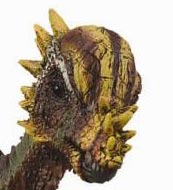
Nosing around the nasal passages of dinosaurs.

Nosing around the nasal passages of dinosaurs.

Picture credit: Everything Dinosaur

Lead author of the research, which has just been published in the academic journal “The Anatomical Record”, Jason Bourke (Ohio University) states:

“Figuring out what’s going on in their [dinosaurs] complicated snouts is challenging because noses have so many different functions.  It doesn’t help that all the delicate soft tissues rotted away millions of years ago.”

Examining the Nasal Passages

In order to gain an appreciation of the nasal passages of long extinct dinosaurs, the team examined the snouts of extant relatives of the Dinosauria, namely birds, crocodiles and other reptiles including lizards.  The study of fossil skulls of pachycephalosaurs was supported by lots of dissections, blood-vessel injections to map blood flow as well as CT scans.  The researchers also relied upon computer models that provided a three-dimensional analysis of airflow.

A technique more commonly applied to the study of airflow in the aerospace industry, a technique called computational fluid dynamics was used to better understand how extant animals such as Alligators and Ostriches breathe.

As PhD student Jason Bourke explained:

“Once we got a handle on how animals breathe today, the tricky part was finding a good candidate among the dinosaurs to test our methods.”

The team turned to a family of bird-hipped dinosaurs known as the pachycephalosaurs, the bone-headed dinosaurs.  These particular dinosaurs were chosen as a number of specimens were readily available to study in the United States/Canada and skulls attributed to several genera were known.   The thick skulls with their ornamentation may have been used  by these relatively small dinosaurs for head-butting or visual displays.  The skull bones, some of which are several inches thick, has helped to preserve details of the nasal passages which the scientists were able to map and analyse in great detail.

Getting Up a Dinosaur’s Nose
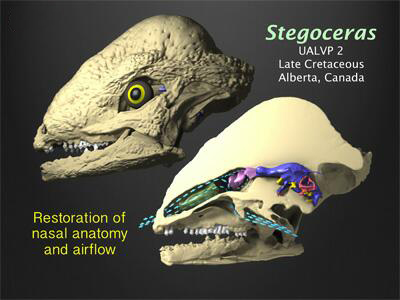
Airflow in the nasal passages in the Pachycephalosaur Stegosaurus validum is mapped.

Airflow in the nasal passages in the Pachycephalosaur Stegoceras validum is mapped.

Picture credit: Ohio University/The Anatomical Record

Studying Stegoceras

One pachycephalosaur that was studied was Stegoceras (S. validum) and the researchers were able to show that some of the airflow that they mapped would have carried odours to the olfactory region, helping to improve this dinosaur’s sense of smell.  In addition, the team tried to piece together the shape of the nasal concha, otherwise known as the turbinates, that help to direct and manage airflow through the nasal passage.  This small bone, superficially resembles a sea shell (hence the name) and the fossil evidence supports the presence of such a bone but it is not found in the Dinosauria fossil record (as far as we at Everything Dinosaur know).

As the researchers point out, there is the bony ridge preserved on pachycephalosaur skulls that indicate its presence and when airflow models were created, the best and most efficient ones produced included a turbinate structure within the model.

Commenting on the research results, Jason Bourke stated:

“We don’t really know what the exact shape of the respiratory turbinate was in Stegoceras, but we know that some kind of baffle had to be there.”

Study co-author Ruger Porter (Ohio University), pointed out that turbinates may well direct air to the olfactory region, but they might have also played another critical role, helping to cool the brain or at least helping to conserve moisture that might have been lost during exhalation.

Porter pointed out:

“The fossil evidence suggests that Stegoceras was basically similar to an Ostrich or an Alligator.  Hot arterial blood from the body was cooled as it passed over the respiratory turbinates and then that cooled venous blood returned to the brain.”

Endothermic Implications?

Whether this new research supports the theory that these dinosaurs were warm-blooded (endothermic) is being debated, but it does suggest there was more going on within dinosaur’s noses than scientists had previously thought.  It is hoped that the research team will be able to apply their analytical methods to other types of dinosaur such as the Thyreophora (armoured dinosaurs), known for their notoriously complex nasal passages.  This research may also provide answers to the questions concerning the bizarre shape of many crests found in lambeosaurine dinosaurs (duck-billed dinosaurs).

For models and figures of dinosaurs and other prehistoric creatures: CollectA Prehistoric Life Models and Figures.
16 10, 2014

Giant Kangaroos Made for Walking

By |2023-03-17T08:13:47+00:00October 16th, 2014|Categories: Dinosaur and Prehistoric Animal News Stories, Main Page|0 Comments

Giant Sthenurine Kangaroos Probably Walked Rather Than Hopped

The Pleistocene prehistoric fauna of Australia may not quite be as embedded into the public’s consciousness as the Woolly Mammoths, Cave Bears and Sabre-toothed cats that represent examples of European Pleistocene prehistoric animals, but if anything, ancient “Aussies” were even more amazing than the shaggy coated examples typical of the fauna of the western hemisphere.

Giant Kangaroos

In a new study, published in the on line academic journal PLOS One (Public Library of Science), a team of researchers propose that ancient, giant Australian Kangaroos were walkers rather than hoppers, making up part of a prehistoric fauna that was truly astonishing.

The Kangaroos in question are the heavy-weight members of the Sthenurinae (the short-faced kangaroos).  A sub-family of the Macropodidae (means “big feet”), the family to which all Kangaroos belong.  Following a rigorous comparative analysis, the research team conclude that these large animals, some of which stood over two metres tall, did not hop but were adapted to a pedestrian lifestyle, these animals were walkers.

Sadly, like most of Australia’s mega fauna these herbivores became extinct and did not make it into the Holocene.  The last of the Sthenurinae died out about 30,000 years ago, shortly before the last of the Neanderthals in western Europe.

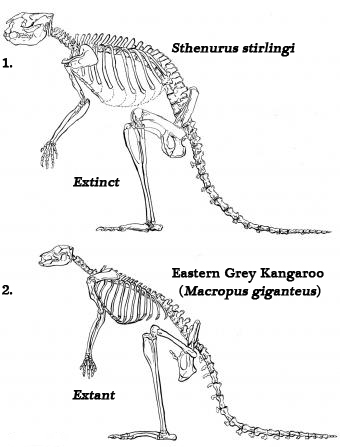
A Comparison Between an Extant Sthenurinae Kangaroo (Sthenurus stirlingi) and a Large Extant Species

Both these types of Kangaroo can stand up to two metres tall.

Both these types of Kangaroo can stand up to two metres tall.

Picture credit: Wells and Tedford, 1995.  Original artist Lorraine Meeker, American Museum of Natural History, with additional annotation from Everything Dinosaur

Extinction Theories

As for reasons for their extinction, that question remains to be answered, however, it is thought that the presence of man on the continent from around 60,000 years ago had a severe impact on the fauna of Australia.  Giant Short-faced Kangaroos such as Simosthenurus occidentalis (short-faced, strong tail, western Kangaroo), known from fossils found in south-western Australia, probably could not move very quickly and could be caught by human hunters.  The use of fire could also have devastated their forest habitats leaving these browsers with little food.

The research team was led by Professor Christine Janis, (Professor of Ecology and Evolutionary Biology at Brown University, Rhode Island, USA).  Over one hundred comparative measurements were made, comparing the skeletons of living and extinct Kangaroo and Wallaby types.  For Professor Janis, her eureka moment occurred in 2005.  She was examining the bones of a mounted skeleton of a sthenurine Kangaroo in a Sydney museum when she noticed how inflexible the spine looked when compared to a modern-day counterpart.  The professor began to wander whether these Pleistocene roos moved in the same way as extant Kangaroos.

Extinct Sthenurines

Working in collaboration with the papers co-authors, Borja Figuerido of the University of Malaga (Spain) and Karalyn Kuchenbecker, a former undergraduate at Brown University, the Professor spent several years examining the fossilised remains of extinct Kangaroos to determine their method of locomotion.  In the published account of their studies, the team hypothesise that in their motion the extinct sthenurines were very different from large Kangaroos found today.  The scientific paper is intriguing entitled: “Locomotion in Extinct Giant Kangaroos: Were the Sthenurines Hop-Less Monsters?”.

Extant Kangaroos can hop very quickly and utilise this unique form of motion to cover vast distances very efficiently.  They can also move about on all fours as their front limbs are capable of helping to support bodyweight, an anatomical characteristic absent in the larger members of the Sthenurinae.  The tail of many members of the Macropodidae is also able to bear weight, providing additional support for many Kangaroos and Wallabies.  The use of the tail as a fifth limb has been referred to as a “pentapedal” stance.  Extinct Kangaroos such as Sthenurus stirlingi seem to lack the flexible spine need to make leaps and bounds.  Their anatomy seems best suited to putting one foot in front of the other – a walking Kangaroo!

Sthenurines had proportionally bigger hip and knee joints.  The shape of the pelvic area differs significantly as well (see diagram above).  The sthenurines had a broad and flared pelvis that would have allowed for proportionally much larger gluteal muscles than other Kangaroos.  Those muscles would have allowed them to balance weight over just one leg at a time, as do the large gluteals of humans during walking.

One Massive Toe

Unlike modern Kangaroos with their four-toed feet, the extinct sthenurines had just one, massive toe on the end of each foot.  The research team conclude that when the anatomy of all the Macropodidae is considered, the “weird” ones are the extant species that hop.  They are very lightly built for their size and their preferred method of locomotion may not be typical for the group as a whole.  A bit like using the Cheetah as a template for all Felidae motion.

Commenting on the research Professor Janis stated:

“If it is not possible in terms of biomechanics to hop at very slow speeds, particularly if you are a big animal and you cannot easily do pentapedal locomotion, then what do you have left?  You have to move somehow.”

An over reliance on walking, which is not as efficient as hopping, might explain the demise of these Kangaroos about 30,000 years ago.  These animals might have been easier to catch so humans took a toll on the population.  Or as the climate became more arid, these walking Kangaroos were not able to migrate far enough to find new sources of food.

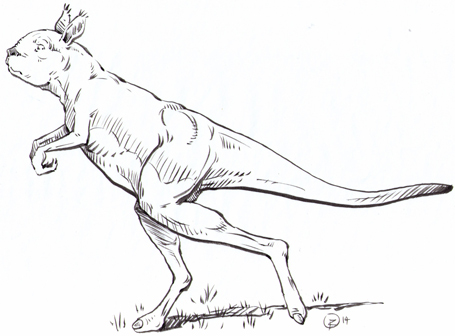
An Artist’s Impression of a Short-Faced Kangaroo

Short-faced Kangaroo a pedestrian.

Short-faced Kangaroo a pedestrian.

Picture credit: Brian Regal

The research team admit that more evidence is required to back up their anatomical study.  Ideally, if a set of “walking Kangaroo” tracks could be discovered, that would add considerable weight to their hypothesis.

11 10, 2014

How Did Huge Sauropods Manage to Get Along Together?

By |2023-03-16T22:13:58+00:00October 11th, 2014|Categories: Dinosaur and Prehistoric Animal News Stories, Dinosaur Fans, Palaeontological articles|0 Comments

Dietary Niche Partitioning Amongst the Sauropoda

A team of British scientists have been tackling one of the biggest puzzles in palaeontology and a sophisticated analysis of dinosaur skull bones might just have helped them solve a mystery of gigantic proportions.  Sauropods, that group of long-necked dinosaurs that include such famous creatures as Diplodocus, Brachiosaurus and Apatosaurus (formerly known as Brontosaurus), ate vast quantities of plant material.

Huge Sauropods

These huge animals with many individuals exceeding twenty metres in length and weighing many times more than a bull African elephant, would have been capable of stripping an area of vegetation, but the fossil record shows that in many parts of the world, lots of different species of sauropod seem to have co-existed.

The scientists, a joint research team from Bristol University and the Natural History Museum (London), propose that Late Jurassic sauropod skulls became specially adapted to help them feed on different types of plant material.  In this way, the skull morphology helped the long-necked dinosaurs divide up the available food resources between them, therefore limiting the amount of direct competition.

Sauropods in the Ecosystem

Previous studies had shown that in areas where lots of different species of sauropods co-existed their body shapes and ability to angle their necks may have allowed the development of different feeding strategies with each species preferring to feed on a particular part of the flora that was available.

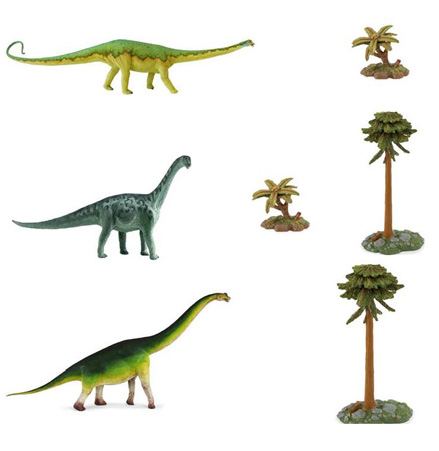
Proposed sauropod Feeding Strategies

Long necks for different feeding envelopes.

Long necks for different feeding envelopes.

Picture credit: Everything Dinosaur

Niche Partitioning

In the picture above, models made by Safari Ltd help to illustrate current thinking about the feeding adaptations of members of the Sauropoda.  Diplodocids such as Diplodocus and Apatosaurus with their very long necks and relatively horizontal feeding platforms probably specialised in feeding on ferns, cycads and plants that made up the vegetative understorey.  Whilst in the middle, dinosaurs such as camarasaurids a member of a different family of sauropods called the Macronaria could feed on a wider range of plant material, cycads and seed ferns as well as being able to strip leaves off small trees.

The dinosaur in the bottom of the picture is a member of the Brachiosauridae (Brachiosaurus).  These dinosaurs had much longer forelimbs than hindlimbs and as a result, their heads were held much higher.

These dinosaurs probably specialised in feeding from the very tops of the tallest trees, parts of the vegetative canopy not available to other plant-eating dinosaurs (unless they knocked the trees down).  The tree in the picture is an Agathis conifer, a model also made by Safari Ltd.

To view Everything Dinosaur’s range of prehistoric plant models and dinosaurs (Safari Ltd): Safari Ltd Prehistoric World Figures.

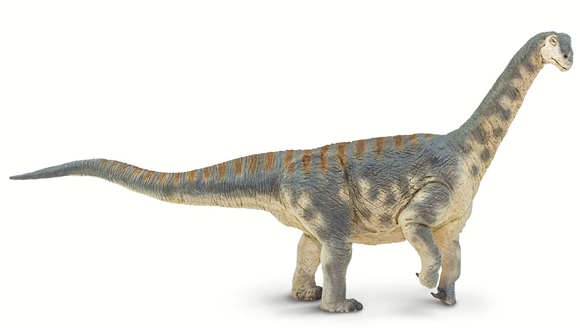
A Detailed Model of a Camarasaurus

Wild Safari Prehistoric World Camarasaurus dinosaur model.

The award-winning Wild Safari Prehistoric World Camarasaurus dinosaur model.

Picture credit: Everything Dinosaur

A spokesperson from Everything Dinosaur commented:

“Based on counts of the fossilised bones, Camarasaurus seems to have been the most common of all the different types of sauropod known from the Morrison Formation.  Perhaps this dinosaur was more of a “generalist” when it came to diet.  A half-way house between the long-necked diplodocids and the giraffe-like brachiosaurids.  An ability to feed on a wide variety of plants, including the tougher plants not available to the likes of Diplodocus and Apatosaurus, could have led to this particular genus of long-necked dinosaur being one of the most successful in the Late Jurassic of the western North America, to the south of the Sundance Sea.”

Analysis of Sauropoda Fauna

Building on previous studies, the British team looked specifically at the sauropod fauna associated with the Upper Jurassic Morrison Formation of the western United States.  At least ten different species of sauropod are known from this formation, one of the most intensely studied fossiliferous formations in the Americas.  Although the Morrison Formation deposits represent a number of habitats, some of the most famous fossil beds such as those making up the Salt Wash Member indicate that some parts of the Morrison Formation represent deposits laid down in harsh, semi-arid environments, not the sort of place where one might expect vast numbers of different types of sauropod.

Despite the harsh conditions, the fossil record shows that lots of different sauropods co-existed.  When the diverse faunas of modern day Africa are considered, these habitats only support one truly huge, extant species – the elephant.  So how did the sauropods get along with each other?

Bristol University’s PhD student David Button worked in collaboration with the Natural History Museum to examine how the skulls of different long-necked dinosaurs may have been adapted to help them feed on different types of plant.  Digital reconstructions were made of the skulls of Camarasaurus and Diplodocus using data compiled from Computerised tomography (CT scans).  From this data, a biomechanical model of the Camarasaurus skull was created and then this skull was compared to an existing digital model of the Diplodocus.

Finite Element Analysis (FEA)

Finite Element Analysis (FEA), was used to assess the stresses that each skull could take.  FEA analysis is used in engineering to calculate loads and stress bearings in complex shapes, this research showed that the box-like skull of Camarasaurus gave this dinosaur a stronger bite.  Camarasaurus could have coped with tougher vegetation than Diplodocus.  The weaker bite and more delicate skull of Diplodocus would have restricted this animal to softer plant material such as ferns.  Diplodocus could have compensated for this to some extent by using its strong neck muscles to help detach plant material through movements of the head.

David Button concluded:

“Our results show that although neither could chew, the skulls of both dinosaurs were sophisticated cropping tools.  This study indicates that differences in diet between these two dinosaurs would have allowed them to co-exist.”

The research team used a number of biomechanical measurements from other Morrison Formation sauropods to calculate the different types of feeding adaptations, providing evidence for different diets and overall a conclusion that dietary niche partitioning did occur in the Sauropoda.

Comparing the Skulls of a Typical Camarasaurid and Diplodocid

Analysis of fossil bone helped the researchers determine the size and location of jaw muscles.

Analysis of fossil bone helped the researchers determine the size and location of jaw muscles.

Picture credit: David Button

In the picture above, the box-like skull of Camarasaurus is shown left (a) with a typical skull of a Diplodocus (b).

Co-author of the scientific paper, which has been published in the Proceedings of the Royal Society Biology, Professor Emily Rayfield (Bristol University) stated:

“In modern animal communities differences in diet such as this, termed dietary niche partitioning, allow multiple species to co-exist by reducing competition for food.  Although, dietary niche partitioning has been suspected between Morrison Formation sauropods based on their structural features and patterns of tooth-wear, this is the first study to provide strong, numerical, biomechanical evidence for its presence in a fossil community.”

This new research may help palaeontologists to understand more about how the Sauropoda evolved.  Sauropods from the Dashanpu Quarry region of China dating from the Middle Jurassic may also show similar adaptations over skull morphology and bite strength as reflected in the research done on the slightly later sauropods from the Morrison Formation.

In addition, this analysis may help scientists to unravel the mechanisms responsible for supporting the high diversities of mega-herbivores found in other Mesozoic and Cenozoic animal populations, particularly those in resource limited environments.

For related articles on sauropod feeding strategies:

Ostrich Necks Provide Clues to Sauropod Neck Flexibility.

Diplodocus Feeding – a biter or a comber?

Evidence for Seasonal Migrations Amongst Camarasaurids.

9 10, 2014

Indonesian Cave Paintings Change Ideas About the Origin of Art

By |2023-03-16T18:44:12+00:00October 9th, 2014|Categories: Dinosaur and Prehistoric Animal News Stories, Main Page|0 Comments

Oldest Prehistoric Cave Art in the World Perhaps – An Indonesian Cave Art Exhibition

The human ability to think in abstract terms is often cited as one of the key differences between our species and those in the rest of the animal kingdom.  Our love of art and visual depiction can be traced back to the Late Palaeolithic but the thought that since cave paintings are confined to France and Spain, therefore art began in Europe, has been challenged thanks to an amazing discovery on the Indonesian island of Sulawesi.

A joint Australian and Indonesian team of anthropologists have uncovered a series of ancient human hand stencils and paintings of animals in seven cave sites in the southern portion of Sulawesi island.  Although a rural location, these caves (Karst Maros) had been visited by a number of tourists and backpackers, but until now nobody knew just how old some of the paintings were.

Cave Paintings

Archaeologists and palaeoanthropologists had long been puzzled by the appearance in southern Europe around 40-35 thousand years ago of a rich and varied range of artwork, including rock paintings and carved figures, but the absence or scarcity of similar art found elsewhere in the world.  Homo sapiens migrated into southern Asia and the Far East but little evidence of any form of culture in terms of works of art has been left behind on these migration routes.

Using a dating method that is based on the radioactive decay of uranium to thorium in small mineral growths that had formed on the paintings, the scientists were able to determine the minimum age of the paintings.  One hand stencil has been dated to circa 39,900 years ago, making it the oldest human hand print known to science.  A painting of a wild pig, an animal probably hunted by these ancient humans, has been dated to at least 35,400 years ago.  The artwork and images had been created by using red ochre, the materials and painting techniques used seem to be very similar to those found in caves of a similar age in western Europe.

Symbolic Explosion

Commenting on the significance of this study, Maxine Aubert of Griffith University (Queensland), one of the researchers stated:

“It was previously thought that Western Europe was the centre piece of a symbolic explosion in early human artistic activity such as cave painting and other forms of image making, including figurative art, around 40,000 years ago.”

This new research suggests that the rock art traditions seen on Sulawesi are at least as old as the oldest known European art.   One of the implications of this new study is that it has now been demonstrated that humans were producing very similar types of rock art by 40,000 years ago but at opposite ends of the Pleistocene Eurasian world.

Faded Artwork

The artwork is very faded in the photographs, so we have circled in green the rock art in the images that was studied.  It is feared, that just like the cave art in some European caves, modern pollution could damage these ancient Indonesian drawings.

To read an article about the damage being done to cave paintings in Europe due to rising levels of fungi: Cave Paintings Might Be Lost Forever.

The scientists hope to use this radioactive dating technique to accurately date other rock art sites in Asia and Australia.  By doing this they hope to better understand human migration and the movement of abstract ideas through the ancient population as it migrated eastwards.

Visit Everything Dinosaur’s award-winning website: Visit Everything Dinosaur.

8 10, 2014

Venezuela’s Second Dinosaur is Announced The Amazing Tachiraptor

By |2024-05-04T13:57:48+01:00October 8th, 2014|Categories: Dinosaur and Prehistoric Animal News Stories, Dinosaur Fans|0 Comments

Tachiraptor admirabilis – Tracing the Origins of the Big Theropods

Venezuelan dinosaurs must be a bit like buses, you wait for years for one to come along and then two arrive almost simultaneously.  Back in August of this year, we reported on the discovery of Venezuela’s first ever dinosaur, a small, plant-eater from the very Early Jurassic.  This dinosaur was named Laquintasaura venezuelae and it was the first dinosaur named from the north of South America.  Two months later and a second paper about a new Venezuelan dinosaur, this time a meat-eater, is about to be published.  Say hello to Tachiraptor, a bipedal, fast-running carnivore that may very well have been a predator Laquintasaura.

An Artists Impression of Tachiraptor Attacking Laquintasaura

A carnivorous Tachiraptor attacks a flock of Laquintasaura dinosaurs.

A carnivorous Tachiraptor attacks a flock of Laquintasaura dinosaurs.

Picture credit: Maurílio Oliveira

The illustration above shows the fearsome, newly described theropod Tachiraptor attacking a small flock of primitive, ornithopod dinosaurs (Laquintasaura), whilst a couple of alarmed rhamphorhynchid pterosaurs take flight.

To read more about Laquintasaura: Laquintasaura – What Does it All Mean?

Tachiraptor admirabilis

The artist has chosen to illustrate both the dinosaurs in the picture as feathered creatures.  During the Early Jurassic, around 200 million years ago, approximately the time that both Tachiraptor and Laquintasaura lived, Venezuela was close to the equator.  The sandstone deposits in which the fossils were found indicate a flood plain environment.  This flood plain was surrounded by harsh, inhospitable deserts that probably did not support much vertebrate life.  Day temperatures would have been high, but just like many desert areas close to the equator today, at night, temperatures would have plummeted.  Relatively small animals like Tachiraptor and the even smaller Laquintasaura may have sported a coat of insulating feathers to help keep them warm.

A recent dinosaur discovery from Siberia (Kulindadromeus), suggests that many early types of dinosaur may have been feathered, although no fossil evidence for feathers in both Laquintasaura and Tachiraptor has been found (as far as we at Everything Dinosaur know), it seems reasonable at this point to depict these Early Jurassic members of the Dinosauria as feathered.

To read more about the discovery of Kulindadromeus: Information on Early Feathered Dinosaurs.

The Dinosaur Biota of Venezuela

If Laquintasaura has been described as being about the size of a red fox (Vulpes vulpes), then to keep the canine motif, the predatory Tachiraptor may have been around the size of a grey wolf (Canis lupis), with a total length of 1.5 metres.  The size estimate is based on the two fossil bones ascribed to this genus discovered so far.  The fossils represent lower leg bones from two individuals, the research team responsible for the excavation and study of this new theropod (Universidade de São Paulo), Brazil found the bones back in 2013 in the same cutting between the towns of La Grita and Seboruco where the fossils of Laquintasaura had been found.

Tachiraptor admirabilis honours the Venezuelan state of Táchira, the species name is in commemoration of the 1813 campaign led by Simón Bolívar to form a republic (known in Spanish as the Campaña Admirable – admirable campaign).

Tachiraptor – The Name Means “Robber of Táchira”

An agile, lithe predatory dinosaur.

An agile, lithe predatory dinosaur.

Picture credit: Everything Dinosaur

Limb Bone Fossils

Dr Max Cardoso Langer, of the palaeontology department of São Paulo University, one of the scientists involved with this study, explained that the fossil material consisted of a tibia and a second lower leg bone that was fragmented.  However, the locality and morphology of these scrappy fossils gave the research team the confidence to assign a new genus.  Although the exact taxonomic affinity within the Theropoda could not be established as the fossils date from the Hettangian faunal stage, it was most likely a basal theropod.

A spokesperson from Everything Dinosaur stated:

“Very little is known about the dinosaurs that lived in the very Early Jurassic.  When Tachiraptor and Laquintasaura roamed Venezuela some 200 million years ago, the world was recovering from a mass extinction event.  The fossils of these two dinosaurs will help palaeontologists to understand better the implications for the Dinosauria after the Triassic/Jurassic mass extinction.”

5 10, 2014

Dinosaur Tracks in Danger of Becoming Extinct

By |2023-03-16T18:33:26+00:00October 5th, 2014|Categories: Dinosaur and Prehistoric Animal News Stories, Dinosaur Fans, Palaeontological articles|0 Comments

Cal Orck’o Dinosaur Tracks Threatened

To the north-east of the city of Sucre in central Bolivia lies one of the most remarkable fossil sites anywhere in the world. The Huellas de Dinosaurio de Cal Orck´o which translates as the “dinosaur footprints on the lime hill”.  For here, preserved on a sheer slope, are the fossilised tracks of dinosaurs, more than 5,000 individual prints, in excess of 350 trackways providing a spectacular trace fossil record of life in the Late Cretaceous some 68 million years ago.  However, extraction of material to support the local cement works could be endangering the entire site according to local conservationists.

Dinosaur Tracks

Although less famous than the Lark Quarry site (Australia) and the Sauropoda tracks found in Gansu Province (China), the Bolivian site represents one of the biggest, if not the biggest collection of dinosaur footprints discovered to date.   At least eight types of dinosaur trackways have been identified.  There are the huge footprints of gigantic titanosaurs, tracks made by some of the largest land animals that ever existed.  Many of the individual prints measure more than 100 centimetres in diameter and indicate dinosaurs around twenty metres or more in length.

Ornithopods and Ankylosaurids

There are also tracks of ornithopods and ankylosaurids.  Meat-eaters are represented too, the largest three-toed tracks identified as having been made by theropod dinosaurs most probably represent tracks made by abelisaurids, the nearby Parque Cretácico (Cretaceous Park) contains a number of life-size, colourful replicas of the dinosaurs that once roamed this part of Gondwanaland.

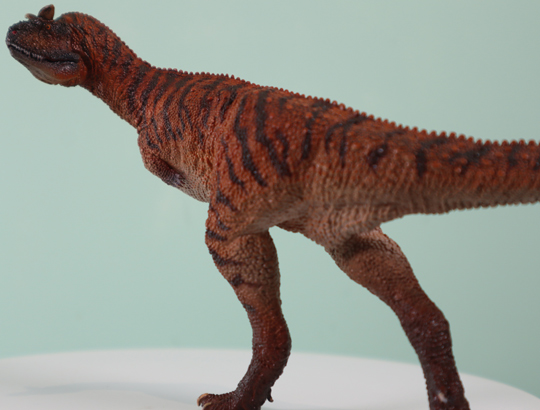
Photograph of a Typical Late Cretaceous Abelisaurid (Carnotaurus)

The PNSO Domingo the Carnotaurus model (lateral view)

The PNSO Carnotaurus model stands perfectly stable without the use of the transparent stand which is supplied with the figure. However, Everything Dinosaur recommends that the support stand is used when the model is put on display.

Picture credit: Everything Dinosaur

For dinosaur models and figures: PNSO Museum Quality Age of Dinosaurs Figures.

The park and viewing platforms were opened in 2006, a collaboration between a number of scientific institutions including the Natural History Museum of Basel (Switzerland) whose research teams did much to document and map the tracks between 1998 and 2003, with the support of the Bolivian Government.  Fossilised tracks had been found by cement industry workers and quarry men for many years before the discovery in 1994 of the extensive trackways.  The cliff site and the nearby Cretaceous Park attract in the region of 120,000 tourists each year.

Cement Factory Nearby

However, the nearby cement factory could be endangering the fossilised footprints as the quarrying of limestone takes place nearby.  The quarry work and frequent dynamiting of rock faces to expose new material could be undermining the entire site and making the sixty-eight-million-year-old fossils in danger of collapse.

Elizabeth Baldivieso, the administrator of Parque Cretácico stated:

“The cliff has been quite affected by the many years of extraction of raw material.”

The regional Tourism and Cultural Secretary, Juan Jose Padilla disagrees, referring to Elizabeth Baldivieso’s description as “somewhat alarmist”.  The cement company, Fancesa jointly owned by a local university, the city and regional administrators has vowed to protect the site.

The dinosaur tracks appear to indicate that these ancient creatures were climbing an almost sheer vertical cliff face.  However, back some 68 million years ago, the landscape was flat and muddy.  Over time plate movements pushed up the floodplain creating the near vertical trackways which stretch for around fifteen hundred metres or so.

Proposed UNESCO World Heritage Site

This location was proposed as a UNESCO World Heritage site in 2009, but the cement company opposed the application and it was eventually turned down.  Campaigners are hoping to re-apply for UNESCO World Heritage status in 2015.  This would provide much greater protection to the fossil trackways and we at Everything Dinosaur wish the Bolivian Government and conservationists every success with the re-submission.

To read an article written by Everything Dinosaur about the discovery of some Early Cretaceous dinosaur footprints in Bolivia: Farmer Describes Dinosaur Tracks to Scientists.

4 10, 2014

Extensive Dinosaur Bonebed Discovered in Northern Mexico – Amazing Fossils

By |2024-05-04T13:59:53+01:00October 4th, 2014|Categories: Dinosaur and Prehistoric Animal News Stories, Dinosaur Fans|1 Comment

Joint Mexican and German Field Team Discover Extensive Dinosaur Remains in Chihuahua Desert

The Chihuahua Desert covers much of northern Mexico and stretches across the border into the United States.  At around  160,000 square miles it is the second biggest desert in North America, the United Kingdom would fit into this semi-arid and true desert habitat one and a half times.  This vast area is widely recognised as supporting one of the most diverse and speciose desert ecosystems on Earth, it is ironic then to report that a team of palaeontologists have discovered a site in the Chihuahua Desert that might represent one of the most concentrated areas of Late Cretaceous dinosaur bones anywhere in the world.

Large Fossil Discovery

Mapping and Recording Fossil Evidence

A dinosaur bone bed

A dinosaur bonebed.

Picture credit: Reuters

A field research team exploring Upper Cretaceous strata have reportedly found the remains of at least fourteen dinosaurs on a site measuring fifty by two hundred metres.  Such concentrations of prehistoric animal bones although rare, have been found elsewhere in North America, perhaps most famously in Canada where a number of single species ceratopsian bone beds have been excavated, but we at Everything Dinosaur are unaware of such a concentration in Mexico.

Dinosaur Bonebed

The research team consists of scientists from the University of Heidelberg, the State Museum of Natural History in Karlsruhe and the Desert Museum in Saltillo (30 miles south-west of Monterrey, Mexico).  Although there has been no data published as yet confirming the identity of these animals to the genus level, we suspect that much of the material may represent fossils of duck-billed dinosaurs.  In a statement, reported in a German newspaper, the field team have announced the discovery of at least fifteen more specimens at a nearby location, just a few miles away from the concentration.

Both sites represent riverine deposits and along with the fifteen other, more scattered specimens, the scientists have found fossils of turtles, small crocodilians and the teeth of a number of Cretaceous mammals.

An Extensive Floodplain

During the Late Cretaceous much of northern Mexico was an extensive flood plain and low lying coastal area with the Western Interior Seaway to the east and the Atlantic Ocean to the south.  This landmass formed part of the southern provinces of the island continent of Laramidia which stretched from Mexico in the south up to the northern tip of Alaska.

A Bone Bed Containing Extensive Fossil Remains

A map showing the distribution of fossil material in an Edmontosaurus bonebed.

A map showing typical disarticulated fossil bone distribution in a bonebed.

Picture credit: Syndar et al (PLoS One)

Dinosaur Bonebeds

To read about the discovery of a huge dinosaur “graveyard” in Switzerland: Dinosaur “Graveyard” Discovered.

Commenting on the on-going field work, palaeontologist Eberhard Frey (State Museum of Natural History in Karlsruhe) said:

“There is a huge delta here with several rivers flowing into the Gulf of Mexico.  This was a very active ecosystem.  We have not only found dinosaur bones, but also four different species of turtle, remains of very small crocodiles and the teeth of early mammals”.

Trace fossils have also been found in the area including some three-toed footprints indicating the presence of a large theropod dinosaur in the locality.

Außerplanmäßiger Professor Frey added:

“This week we have found three teeth of theropods.  These are diagnostic features that allow us to determine the species more precisely.”

More Information to be Published Next Year

An Everything Dinosaur team member stated that it was likely that more information about the fossils will be published next year as the field team expected to return to the excavation site in 2015 to further map the area, remove more fossil material and examine the surrounding area.

Scientists have learned a great deal about the flora and fauna of the this part of the continent of Laramidia in recent years.  It was just six years ago that scientists, including researchers from the Desert Museum in Saltillo published a paper on the first, unique dinosaur genus to have been identified in Mexico.

To read more about this research: Viva Mexico! New Species of Duck-Billed Dinosaur Described.

Last week, a new species of armoured dinosaur (Ziapelta sanjuanensis) was announced.  The fossils of this plant-eating member of the Ankylosauridae family were discovered across the border in the southern United States (New Mexico)

To read more about this fossil find: New Armoured Dinosaur from New Mexico.

27 09, 2014

New Armoured Dinosaur from New Mexico

By |2023-03-16T16:03:53+00:00September 27th, 2014|Categories: Dinosaur and Prehistoric Animal News Stories, Main Page|5 Comments

Ziapelta sanjuanensis From New Mexico but Closely Related to Canadian Ankylosaurs

For some strange reason, the ankylosaurs don’t seem to be held in quite the same awe as the horned dinosaurs by most members of the public.  We at Everything Dinosaur have our own theory about this.  The horned dinosaurs are much easier for the lay person to recognise.  There is the spectacular spiked frill of Styracosaurus, the peculiar nasal boss of Pachyrhinosaurus, a dinosaur genus which came to greater prominence with the “Walking with Dinosaurs in 3-D” movie.  Then there is of course, the most famous horned dinosaur of all – Triceratops (three horned face).

The Ankylosauridae

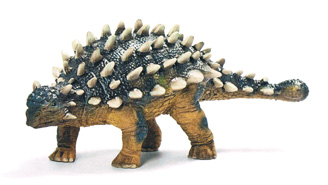
Members of the Ankylosauridae tend to have the same basic body plan.  They have broad rumps, bony clubs on the end of their tails and of course, all that body armour.  Model makers often find it difficult to distinguish different armoured dinosaurs.  For example, the Saichania replica made by Schleich, to the uninitiated, resembles Ankylosaurus.

The Saichania Model made by Schleich

Saichania means "beautiful"

Saichania means “beautiful”.

Picture credit: Everything Dinosaur

When it comes to films and television documentaries, the ankylosaurs are rarely given star billing.  So today, in our own small way, we are going to champion the Late Cretaceous armoured dinosaurs by discussing the newest member of their family – Ziapelta, from the San Juan Basin of north-western New Mexico.  The fossils of Ziapelta consist of elements of the skull and incomplete neck rings of spiky bone and fragments of the famous, scaly Ankylosauria body armour (osteoderms).

Discovered in 2011

The material was discovered in 2011 by Robert Sullivan, subsequently excavated by Dr Sullivan and colleagues and then stored at the New Mexico Museum of Natural History and Science.  Once extracted from its silt and sandstone matrix, the scientists had enough fossil evidence to assign these fossils to a new genera.  A thorough exploration of the surrounding area produced no further post-cranial material.  It seems the head and neck of this armoured dinosaur were separated from the rest of the body prior to burial.  How this came about, one can only speculate.

Ziapelta sanjuanensis

The fossils were collected from the De-na-zin Member of the Kirtland Formation which as been dated to around 74 to 72 million years ago.  At perhaps as much as six metres long, the herbivorous Ziapelta would have been a very formidable adversary for even the largest tyrannosaurid.

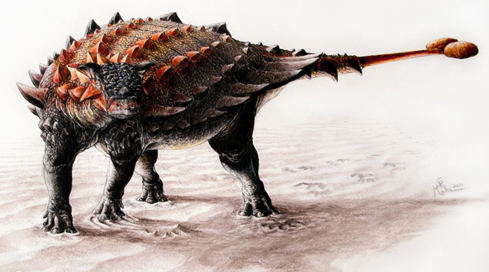
An Illustration of Ziapelta (Z. sanjuanensis)

New Armoured Dinosaur from New Mexico

New armoured dinosaur from New Mexico.

Picture credit: Sydney Mohr

To the lay person, the spiky-looking Ziapelta might just look like any other Ankylosauridae, so let’s explain why the skull and neck material have allowed scientists to erect a new genus of armoured dinosaur.  Firstly, elements of the skull have been found, the skull morphology (shape) and composition can be very helpful when looking to identify an animal new to science, dinosaurs included.  Co-author of the scientific paper, which is published in the on line academic journal PLOS One, Victoria Arbour commented:

“The horns on the back of the skull are thick and curve downwards and the snout has a mixture of flat and bumpy scales – an unusual feature for an ankylosaurid.”

Closely Related to Canadian Ankylosaurids

Dr Arbour (University of Alberta) is a renowned expert on all things ankylosaur, she was invited to examine the fossils along with PhD student Mike Burns (University of Alberta).  The scientists concluded that unlike the armoured dinosaur Nodocephalosaurus kirtlandensis, which is also known from the San Juan Basin and is believed to be related to Asian genera of the Ankylosauridae, Saichania for example, Ziapelta was more closely related to the ankylosaurids of Canada.

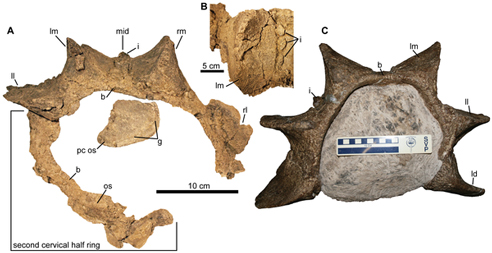
The Formidable Spiky Cervical Rings of Ziapelta

Bony and spiky neck armour of Ziapelta.

Bony and spiky neck armour of Ziapelta.

Picture credit: PLOS One

Dr Arbour stated:

“Bob Sullivan, who discovered the specimen, showed us pictures and we were really excited by both its familiarity and its distinctiveness.  We were pretty sure right away we were dealing with a new species that was closely related to the ankylosaurs we find in Alberta.”

Unusual Features

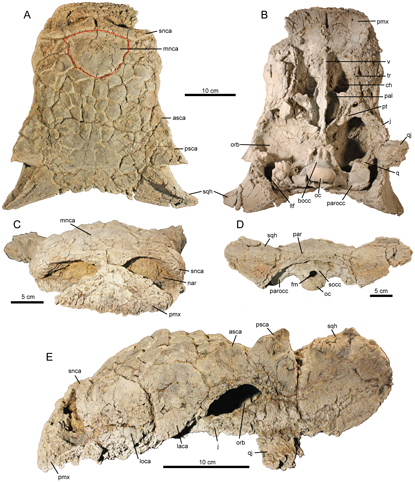
Ziapelta has another unusual feature that distinguishes it from other ankylosaurids, a feature that we at Everything Dinosaur find quite endearing considering the size and fearsome nature of these reptiles.  The layout of the scales that make up the top of the skull are often very distinctive.  In the case of Ziapelta, it has a large triangular-shaped scale on the tip of its snout, in contrast to many other ankylosaurids which have a six-sided scale on their snouts

Views of the Skull Fossil of Ziapelta (Z. sanjuanensis)

Views of the skull fossil material of Ziapelta.

Views of the skull fossil material of Ziapelta.

Picture credit: PLOS One

The photograph above shows various views of the holotype skull material, A – dorsal view (view from the top), B = ventral view (viewed from underneath), C = anterior view (view from the front), D = occipital view (viewed from the rear) and finally E – left lateral view (view of the left side of the skull).  In photograph A, we have highlighted in red the outline of that large triangular scale on the snout (referred to as mnca – median nasal caputegulum to use the formal scientific term).

Dr Arbour put it very succinctly stating:

“There’s also a distinctive large triangular scale on the snout, where many other ankylosaurids have a hexagonal scale.”

Specialising in Studying Ankylosaurs

The University of Alberta scientist has specialised in studying ankylosaurs, especially those specimens which are known from the Late Cretaceous of North America.  Back in 2013, Everything Dinosaur reported on Dr Arbour’s research into the Ankylosauridae which was helping to redefine this family of dinosaurs.

To read more about this research: When is a Euoplocephalus a Euoplocephalus?

Ankylosaurid fossils make up a small, but significant proportion of the Dinosauria fossil assemblage of southern Alberta, but to date, no ankylosaurid material has been found in the Horseshoe Canyon Formation (lower parts of this formation, the Strathmore and the Drumheller Members) of Alberta.  These rocks are roughly the same age as the strata in which the fossils of Ziapelta were found.  This New Mexico armoured dinosaur is helping palaeontologists to plug a gap in the record of ankylosaurid fossils known from North America.

Dr Arbour explained:

“The rocks in New Mexico fill in this gap in time, and that’s where Ziapelta occurs.  Could Ziapelta have also lived in Alberta, in the gap where we haven’t found any ankylosaur fossils yet?  It is possible, but in recent years there has also been increasing evidence that the dinosaurs from the southern part of North America – New Mexico, Texas and Utah, for example, are distinct from their northern neighbours in Alberta.”

There is a lot of evidence to support the idea of “dinosaur provinciality” in North America.  It seems that although the overall mix of dinosaurs was about the same in the regions, the actual genera that made up the dinosaur populations differed markedly.  How or why these distinct faunas came about remains something of a mystery.  The discovery of Ziapelta may help to add more pieces to the picture as palaeontologists strive to solve this puzzle.

25 09, 2014

New Research Suggests Multicellular Life Started Earlier

By |2023-03-16T15:56:05+00:00September 25th, 2014|Categories: Dinosaur and Prehistoric Animal News Stories, Educational Activities, Main Page, Palaeontological articles|0 Comments

Evidence Suggests Multicellular Life 60 Million Years Earlier than Previously Thought

Researchers from the Virginia Tech College of Science in collaboration with counterparts from the Chinese Academy of Sciences have published new data on one of the most fundamental and significant changes that occurred in the history of life on our planet.  At some time during the Proterozoic Eon, multicellular life forms evolved.  These organisms evolved from single-celled entities and in a paper published in the academic journal “Nature”, the researchers propose that multicellular life forms evolved some sixty million years earlier than previously thought.

Multicellular Life

The team suggest that they have found fossil evidence of complex multicellularity in strata dating from around 600 million years ago, although microscopic fossils are known in Precambrian strata from several locations around the world (Australia, South Africa as well as China), this new research is helping to clarify some long-standing interpretations of micro-fossils.

Professor of Geobiology at the Virginia Tech College of Science, Shuhai Xiao explained the significance of this new fossil discovery:

“This opens up a new door for us to shine some light on the timing and evolutionary steps that were taken by multicellular organisms that would eventually go on to dominate the Earth in a very visible way.  Fossils similar to the ones in this study have been interpreted previously as bacteria, single-cell eukaryotes, algae and transitional forms related to modern animals such as sponges, sea anemones, or bilaterally symmetrical animals.  This paper lets us put aside some of those interpretations.”

The Origins of Complex Life

It has long been known that simple, multicellular organisms evolved before more complex ones, such as red algae and sponges.  If a biological hierarchy existed (and most scientists believe that this is the case), then at some point in the past, single-celled organisms began to evolve into much larger, more complicated multicellular organisms.  The trouble is, with the paucity of the fossil record and the difficulties involved in interpreting Ediacaran fauna there is a lot of debate amongst biologists and palaeontologists as to when the solo living cells began to fuse into more cohesive, complex forms.

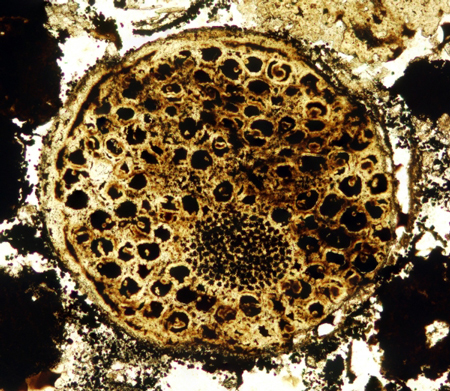
Evidence of Complex Multicellular Organisms from the Doushantuo Formation

Evidence of multicellular structures in 600 million year old rocks.

Evidence of multicellular structures in 600-million-year-old rocks.

Picture credit: Virginia Tech College of Science

The researchers examined microscopic samples of phosphorite rocks from the Doushantuo Formation in Guizhou Province (south, central China).  This formation represents extensive marine sediments that were deposited from around 635 million years ago to around 550 million years ago.  They preserve a unique record of microscopic life (Metazoan life – animals) that existed during the Ediacaran geological period, the period in Earth’s history defined as immediately before the Cambrian and that marks the end of the Precambrian or the Proterozoic Eon.

What is an Eukaryote?

The scientists were able to identify a number of three-dimensional multicellular fossils that show signs of cell-to-cell adhesion, cells potentially performing different functions and programmed cell death.  These qualities are all found in complex eukaryotes, the organisms that dominate visible life on Earth to day, the fungi, animals and plants.  Eukaryotes range in size from single-celled amoebas to giant sequoias and blue whales.  We (H. sapiens) belong to the Domain Eukarya.   Eukaryote cells are complex, they have a distinct nucleus surrounded by a membrane.  The nucleus contains most of the genetic material.  The nucleus itself is a specialised area of the cell, it is referred to as an organelle.  Eukaryote cells have a number of specialised areas within them (other organelles as well as a nucleus).

Professor Xiao and his colleagues admit that these are not the first multicellular fossils found, nor are they probably the oldest, but the exceptional preservation permits the researchers to draw certain conclusions.  For example, it had been previously thought that these multicellular characteristics had started to develop much later in Earth’s history, perhaps as recently as 545 million years ago, a time shortly before the great Cambrian explosion.

What was the Cambrian Explosion?

The Cambrian explosion refers to the period in Earth’s history around 545 to 542 million years ago when there was a sudden burst of evolution as recorded by extensive fossil discoveries.  A wide variety of organisms, especially those with hard, mineralised body parts first appear.

This new research may help to shed some light on when multicellularity arose, but the reasons for this significant change remain unclear.  The complex multicellularity shown in these Chinese fossils is not consistent with that seen in simpler forms such as bacteria.  The scientists note, that whilst some earlier theories can be disregarded these three-dimensional structures can be interpreted in many ways and more research is required to construct the complete life cycle of these ancient organisms.

In summary, these fossils may show some affinity towards the stem-groups that led to the first members of the Kingdoms we know as Animalia, Fungi and Plantae, but much more data is needed to establish a more thorough phylogenetic relationship.

21 09, 2014

“Big Nose” Dinosaur – New Hadrosaur Species Described

By |2023-03-16T15:02:23+00:00September 21st, 2014|Categories: Dinosaur and Prehistoric Animal News Stories, Dinosaur Fans, Main Page|0 Comments

Rhinorex condrupus – “King of the Dinosaur Noses”

A team of researchers from Brigham Young Museum of Palaeontology and North Carolina State University (North Carolina Museum of Natural Sciences) have described a new type of duck-billed dinosaur, one with an enormous “conk”.   Duck-billed dinosaurs are well-known for sporting elaborate crests, even combs after recent research into the Edmontosaurus genus, but roaming the estuarine habitat of Utah around 75 million years ago was Rhinorex, a duck-billed dinosaur whose genus name translates as “Nose King”.

The “Nose King”

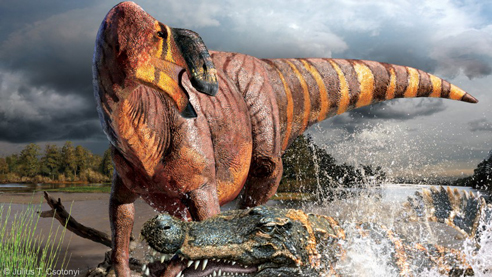
An Illustration of Rhinorex (R. condrupus)

"King nose" is surprised by a Cretaceous crocodilian.

“King Nose” is surprised by a Cretaceous crocodilian.

Picture credit: Julius Csotonyi

Terry Gates, a post-doctoral researcher with North Carolina Museum of Natural Sciences and North Carolina State University, collaborated with Rodney Scheetz (Brigham Young), to analyse the skull of a specimen that had been excavated from the Book Cliffs area of east-central Utah in the 1990s.  This strata forms part of the Neslen Formation which consists of a series of sedimentary layers of rock representing both marine and terrestrial environments.

Rhinorex condrupus

The specimen had been studied as associated with the fossil skull bones, were some very well preserved skin impressions.  However, it was only when the scientists constructed the skull that they realised they had a new species on their hands.

Commenting on their findings, which are reported in the Journal of Systematic Palaeontology, Terry Gates stated:

“We had almost the entire skull, which was wonderful, but the preparation was very difficult.  It took two years to dig the fossil out of the sandstone it was embedded in.  It was like digging a dinosaur skull out of a concrete driveway.”

Incomplete Skeleton

Although the skeleton is far from complete, unique morphologies of the skull indicate that this is a new species of duck-billed dinosaur,  a member of the Hadrosauridae family.  The dinosaur has been named Rhinorex condrupus.  The name translates as “king nose buried in the cliffs”, the genus name makes reference to the unique shape of the nasal bones and premaxilla.  These bones indicate that this plant-eating dinosaur had a large, fleshy nose.

Whilst it is difficult to estimate the exact size of this dinosaur from the fossil bones that have been collected, comparisons with the closely related Gryposaurus and Kritosaurus give a maximum length of around nine metres, with a body weight in excess of three tonnes.  The sandstone sediments represent a low lying, swampy, estuarine environment and to date, Rhinorex is the only substantial hadrosaur fossil known from this locality.

Terry Gates explained:

“We have found other hadrosaurs from the same time period [Campanian faunal stage] but located about two hundred miles further south.  They may have been adapted to a different environment.  This discovery gives us a geographic snapshot of the Cretaceous and helps us to place contemporary species in their correct time and place.”

In essence, “King Nose” helps to fill a gap in the hadrosaurid family tree.

Hadrosaur Diversity

Many different types of duck-billed dinosaur existed during the later years of the Cretaceous, scientists have found fossils of hadrosaurids in almost all the Upper Cretaceous fossil bearing terrestrial formations in western North America.  Although the vast majority of these fossils are far from complete, they suggest that the varied Hadrosauridae family evolved as each genus occupied a relatively small geographical area.

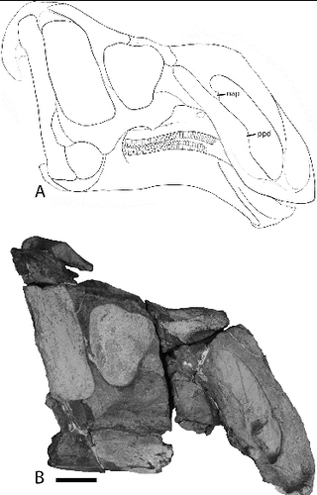
The Reconstructed Skull of R. condrupus

The line drawing shows the reconstructed skull from the fossil bones (scale bar 5cm).

The line drawing shows the reconstructed skull from the fossil bones (scale bar 10cm).

Image credit: Journal of Systematic Palaeontology

The line drawing (A) is labelled with the autapomorphies (unique characters or traits) that distinguish this dinosaur as a new genus, namely the hook-like structure (nap) nasal anteroventral process and the expansion of bone located posteroventrally on the premaxilla (ppd).

Why Such a Big Nose?

The large and fleshy snout remains a bit of a puzzle.  It may not be related to an enhanced sense of smell.

Post-doctoral student Terry postulated:

“The purpose of such a big nose is still a mystery.  If this dinosaur is anything like its relatives then it likely did not have a super sense of smell, but maybe the nose was used as a means of attracting mates, inter-herd recognition or perhaps it supported a large plant-smashing beak.  We are already sniffing out answers to these questions.”

It certainly would have looked a little odd with its enlarged naris.  However, when you consider the weird and wonderful saurolophines, Parasaurolophus with its enormous, backward sweeping head crest, Edmontosaurus regalis with a fleshy comb on its head and Tsintaosaurus which may have superficially resembled a unicorn, then we think Rhinorex would have fitted right in.

For models and replicas of hadrosaurs and other Late Cretaceous prehistoric animals: PNSO Museum Quality Age of Dinosaurs Figures.

Go to Top