All about dinosaurs, fossils and prehistoric animals by Everything Dinosaur team members.

Fossil finds, new dinosaur discoveries, news and views from the world of palaeontology and other Earth sciences.

10 12, 2014

The Earliest Horned Dinosaur in North America?

By |2023-03-18T10:46:15+00:00December 10th, 2014|Categories: Dinosaur and Prehistoric Animal News Stories, Dinosaur Fans, Main Page, Palaeontological articles|0 Comments

Aquilops americanus – The Implications

When it comes to the horned dinosaurs of North America, there has been a lot of focus in the last few years on mapping the extraordinary diversity of ceratopsians that once roamed the landmass known as Laramidia.

There has been much debate over the ethnicity of the Dinosauria, as suggested by the myriad of fossil finds and indeed the debate has been reignited recently with the publication of the research undertaken by the UK’s Dr Nick Longrich and the “northern Pentaceratops” – Pentaceratops aquilonius.  Let’s face it, ever since the publication of “New Perspectives on Horned Dinosaurs”, there seems to have been an addition to the Late Cretaceous Ceratopsidae every couple of months or so.  For instance, Mojoceratops, Kosmoceratops, Utahceratops, Nasutoceratops, Xenoceratops and so forth.

Finding a New Dinosaur Species

To read about the recent research of Dr Nick Longrich: Finding a New Species of Horned Dinosaur in a Canadian Museum.

However, many scientists have been turning their attention to another part of the horned dinosaur’s family tree.  These researchers have been trying to piece together (literally), the fossil evidence that hints at the presence of basal, more primitive members of this great group of ornithischians much earlier in the Cretaceous of North America.

The search for the neoceratopsian dinosaurs, may not garner quite the same publicity as work on their Campanian and Maastrichtian cousins such as Styracosaurus and Triceratops, but this dedicated team are helping scientists to understand how these dinosaurs evolved and migrated out of their Asian ancestral home.

Earliest Horned Dinosaur

That is why the paper published this week in the academic journal PLOS One is so important.  This paper describes the partial skull and lower jaw of a horned dinosaur, the fossils represent the earliest evidence of neoceratopsian dinosaurs recorded in North America.  Say hello to Aquilops americanus, about the size of a King Charles spaniel that roamed southern Montana somewhere between 109 and 104 million years ago.

 A Tiny Skull that is Making a Big Difference

Skull fossil that can sit in the palm of your hand.

Skull fossil that can sit in the palm of your hand.

Picture credit: Reuters

Prior to this fossil discovery, the neoceratopsian dinosaurs of North America were represented by isolated teeth and skull fragments, collected from places as far apart as Utah and Maryland, the Cedar Mountain Formation and the Arundel Formation respectively.

The Paucity of the Fossil Record

The paucity of the fossil record was severely hampering the work of scientists as they tried to understand the pattern of migrations between Asia and North America.  During the Cretaceous, Asia and North America were joined, they shared a land bridge between them, most likely there were many occasions when fluctuating sea levels and geological activity permitted a land bridge to be formed.  It seems that the horned dinosaurs evolved in Asia but migrated via what is now the Bering Straits over to Canada and the United States.

Aquilops americanus

Aquilops seems closely related to Early Cretaceous horned dinosaurs known from Asia such as Liaoceratops and Auroraceratops, it has been speculated that there were at least intermittent connections between these two continents throughout the Late Early Cretaceous, likely followed by a long period of geographic isolation that permitted a number of new genera to evolve before a final reconnection towards the end of the Mesozoic.

The skull measures just 8.4 cm in length, it is likely that Aquilops americanus (the name means “American eagle face”), was an unobtrusive herbivore, selectively grazing young shoots and leaves from the protection of the undergrowth.  It may even have been nocturnal or perhaps it may have lived in a burrow.

Line Drawing of the Skull and a Reconstruction of the Dinosaur

Skull sketches top and middle with an artist's impression underneath.

Skull sketches top and middle with an artist’s impression underneath.

Picture credit: PLOS One, life restoration by Brian Engh

The line drawings of the skull have been based on better known neoceratopsian specimens from Asia.  Note the large orbit (eye-socket), this has led to speculation that this little dinosaur may have lived in low light conditions or might possibly have been nocturnal.

A Small Herbivore

Commenting on the study, one of the authors of the scientific paper Dr Andrew Farke (Raymond M. Alf Museum of Palaeontology, California) stated:

“This was a small plant-eater and we know from its hooked beak that it was pretty selective, nipping off whatever vegetation was around.”

 An Illustration of Aquilops americanus

Earliest horned dinosaur known from North America.

Earliest horned dinosaur known from North America.

Picture credit: Brian Engh/Raymond M. Alf Museum of Palaeontology

Studying Ceratopsian Dinosaurs

One of the mysteries with the ceratopsian dinosaurs is when did the Asian migrations occur, and where there any significant migrations of North American fauna into Asia?  Before this discovery, the oldest known horned dinosaur from North America was Zuniceratops, which roamed New Mexico and Arizona some 90 million years ago.

A Scale Drawing of Zuniceratops
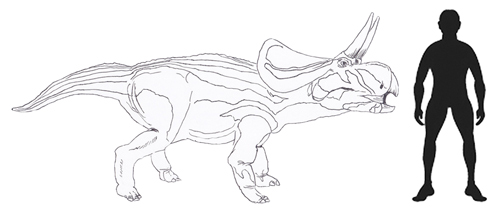
Zuniceratops scale drawing.

Everything Dinosaur’s scale drawing of the Neoceratopsian Zuniceratops christopheri. Picture credit: Everything Dinosaur.

Picture credit: Everything Dinosaur

To view replicas and articulated models of horned dinosaurs and other prehistoric animals: Beasts of the Mesozoic Models.

Dr Farke added:

“Aquilops lived nearly twenty million years before the next oldest horned dinosaur named [and described] from North America.  Even so, we were surprised that it was more closely related to Asian animals than those from North America.”

The discovery of these fossils, does support the theory that these type of bird-hipped dinosaurs did evolve in Asia and that they spread into North America, most likely via a northern latitude route, however, as the authors of this scientific paper say themselves, more field studies and more fossils will be needed before anyone can state anything else with a degree of certainty.

8 12, 2014

Walking with Dinosaurs – Birth of a Dinosaur Footprint

By |2023-03-18T10:37:28+00:00December 8th, 2014|Categories: Dinosaur and Prehistoric Animal News Stories, Dinosaur Fans, Main Page|0 Comments

Getting Under the Skin of a Dinosaur’s Foot

The footprints of prehistoric animals preserved as fossils can provide scientists with a wealth of information.  However, in a research project involving Brown University (Providence, Rhode Island) and the Royal Veterinary College, steps have been taken (no pun intended), to get a much more complete understanding of how ancient creatures walked.  It’s question of applying a number of highly technical research methods to step into the footsteps of a dinosaur, this research certainly adds a whole new meaning to “Walking with Dinosaurs”.

Walking with Dinosaurs

Providing a Deeper Understanding About Fossil Footprints

Sauropod footprint, the hand provides scale.

Sauropod footprint, the hand provides scale.

Picture credit: AFP Photo/Igor Sasin

Dinosaur Footprint

Dr Peter Falkingham, a Research Fellow at the Royal Veterinary College (London) and co-author, Professor Stephen Gatesy (Brown University), attempted to map the displacement and complex re-organisation of sediment that takes place when a footprint is formed.  Put simply, imagine you are walking on the beach, across wet sand.  As you proceed across the sediment you will create footprints, these are visible impressions left in the surface layer, however, as your bodyweight moves across the sand, it will have an impact on the sand particles that surround and are underneath the area that you have just walked over.  In a unique experiment, the scientists have been able to create visual images of the re-organisation of particles involved in footprint formation.

This research can help ichnologists (the term used to describe a specialist in studying trace fossils), interpret dinosaur footprints, thus in turn providing palaeontologists with a better understanding of prehistoric animal locomotion.

A Variety of Research Techniques Employed

A variety of techniques were used to create visual images of three-dimensional footprints.  Firstly, a guineafowl (Galliformes) was persuaded to walk across a bed of poppy seeds.  The poppy seeds and the way that they were moved would mimic the action of the substrate as if it were soft sand.   The virtual footprint was created by combining two X-ray videos with a digital skeletal model of the bird’s legs derived from CT scans and a three-dimensional motion analysis called X-ray Reconstruction and Moving Morphology (XROMM), which had been developed at Brown University.

This technology enabled the research team to reconstruct the motions of the bird’s foot in three dimensions, even when the toes are hidden from sight as they sink into the sediment.

Which Came First the Guineafowl or the Virtual Simulation of a Dinosaur Footprint?

Cutting edge research combined with a Guinea Fowl.

Cutting edge research combined with a guineafowl.

Picture credit: Royal Veterinary College/Brown University

The picture above shows the hind limb bones of the guineafowl, projected in three dimensions along with the footprints formed.

“Ground-breaking” Research

Commenting on this ground-breaking research (literally), Dr Falkingham stated:

“By observing how a footprint is formed, from the moment the foot hits the sediment until it leaves, we can directly associate motions with features left behind in the track.  We can then study a fossil track left by a dinosaur and say, OK, these features of the track are similar, but these are different, so what does that mean for the way the animal was walking?”

A powerful computer programme was used to analyse and interpret the data, so that a virtual footprint that had been generated could be observed as an impression at the surface and also below the surface of the substrate.  Being able to directly associate movements of the foot with features of the footprint, both on the surface and deeper into the sediment, opens up the possibility of more accurately reconstructing the way in which long extinct creatures moved.

The Simulated Footprint (Guineafowl Footprint)

The footprint mapped at 1cm below the surface layer.

The footprint mapped at 1 cm below the surface layer.

Picture credit: Royal Veterinary College/Brown University

Professor Gatesy added:

“Footprints are not just simple moulds of the bottom of the foot, so it’s important to understand how the dynamic interaction between a living animal and the substrate give rise to a track’s 3-D shape”.

The team’s findings, published in the journal “Proceedings of the National Academy of Sciences”, could help palaeontologists better understand how dinosaurs walked and perhaps build up a picture of how dinosaur locomotion changed as the Dinosauria evolved. Moving forward, (again no pun intended), the advent of  XROMM technology could help researchers explore how early hominids adapted to a bipedal stance.

Visit Everything Dinosaur’s website: Dinosaur Models, Toys and Gifts.

5 12, 2014

Dinosaur Bone Damaged by Vandals is Removed

By |2023-03-18T10:26:26+00:00December 5th, 2014|Categories: Dinosaur and Prehistoric Animal News Stories, Main Page|0 Comments

Vandalised Dinosaur Bone is Removed from the Dinosaur National Monument

The 150-million-year-old dinosaur bone had slowly weathered out of the rock, its location, on part of the Fossil Discovery Trail at the Dinosaur National Monument (Utah), meant that thousands of visitors to the park could see the beautifully preserved fossil lying in situ.  However, the thoughtless and reckless action of vandals has resulted in the bone having to be removed from the trail for fear that it could crumble away.

Vandalised Dinosaur Bone

Back in September, Everything Dinosaur reported on the incident of vandalism at the famous Dinosaur National Monument, one of the richest sources of Upper Jurassic fossil material anywhere in the world.  A Ranger spotted the damaged fossil bone (humerus of a juvenile sauropod), whilst taking visitors on the 1.2-mile-long Fossil Discovery Trail that runs between the Quarry Visitor Centre and the Exhibition Hall.

To read Everything Dinosaur’s report of the vandalism: Fossil Damaged at Dinosaur National Monument – Utah.

Fist-sized Chunk

A fist-sized chunk had been removed from the bone, a thoughtless act of vandalism, probably inspired by the high prices fetched for the sale of dinosaur fossils at auctions.  Palaeontologists assessed the bone and decided to remove it to prevent further damage and the possibility that the bone could break up over the winter as frost and freezing conditions would lead to cracks in the fossil widening.

Brooks Britt, a palaeontologist from Brigham Young University (department of Geological Sciences), carefully extracted the specimen, using techniques and tools that would not have been unfamiliar to the scientists who first extracted bones from this location over one hundred years ago.

Removing the Damaged Bone

Commenting on his work, Associate Professor Britt stated:

“This bone is easy to get out because it is in relatively soft rock.  The vandals took a chunk out about the size of my fist, that destabilised the fossil.  It propagated fractures, it opens them up and then the weathering process starts attacking the bone, so you can’t leave it out in the open.”

 Carefully Does It – Removing the Sauropod Humerus (Upper Arm Bone)

Vandalised bone is removed to prevent further damage.

Vandalised bone is removed to prevent further damage.

Picture credit: Geoff Liesik/KSL TV

Frustrated and Angry

Daniel Chure, the Monument’s palaeontologist, described his reaction on hearing the news of the vandalism of one of “frustration and anger”.

He added:

“Hundreds and thousands of visitors have been able to come here and actually look at dinosaur bones as they are naturally exposed by erosion.  Now because of the thoughtless actions of one person, future visitors won’t have the opportunity to see this particular bone in the field.”

Finding the Culprit

Park Rangers are still optimistic about finding the culprit.  They are asking for people who may have witnessed the act of vandalism to come forward.  A reward of $750 USD is being offered for information that could lead to a conviction.

What is the future for the sauropod arm bone?  The Park Service has plans for it.  They would like the fossil to be fully prepared, stabilised and cleaned up ready for display at the Monument’s Quarry Visitor Centre.

A spokesperson for Everything Dinosaur stated:

“Hopefully this fossilised bone will serve as a reminder to visitors not to damage or to attempt to take fossils away with them.  It might prevent future fossil thefts or acts of vandalism, we sincerely hope so.”

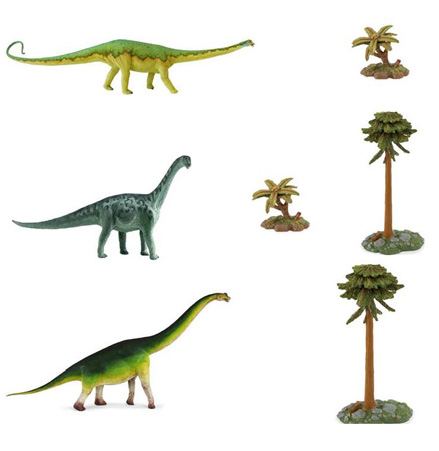
An Illustration Showing Typical Sauropod Bauplans of the Late Jurassic of the Western United States

Long necks for different feeding envelopes.

Long necks for different feeding envelopes.

Picture credit: Everything Dinosaur

For models and figures of sauropods and other dinosaurs: Wild Safari Prehistoric World Figures.

3 12, 2014

Carnivorous Plant Remains Found Preserved in Amber

By |2023-03-18T08:36:54+00:00December 3rd, 2014|Categories: Dinosaur and Prehistoric Animal News Stories, Main Page, Photos/Pictures of Fossils|0 Comments

The Mystery of The Very First Carnivorous Plant Fossil Leaves

Some types of organism, despite having been on our planet for tens of millions of years have such a poor preservation potential that they rarely, if at all appear in the fossil record.  One such group are the carnivorous plants, be they Venus Fly Traps, Sundews or Pitcher plants.

The trapping structures are often derived from primary growth, this reduces the preservation potential and these types of plants tend to be found in areas such as peat bogs and tropical forests where rapid breakdown of organic material occurs.  Up to now, carnivorous plant fossils have consisted of micro-fossils such as preserved pollen with the occasional fossil seed.  However, a team of scientists from the Botanical State Collection of Munich as well as Bielefeld and Göttingen Universities have found the first fossils of a proto-carnivorous plant preserved in Baltic amber.

Carnivorous Plant Remains

Two leaves, trapped in pine resin over between thirty-five and forty-seven million years ago, have been identified to belonging to the family of flypaper plant traps.  These types of plant produce sticky substances that trap small insects and other arthropods.

The sticky hairs on the leaves can be clearly made out under a microscope.  The amber was found in a mine near Kaliningrad, the Russian enclave on the Baltic coast.  Amber from this part of the world, referred to as Baltic amber is relatively common and remarkably as amber floats in sea water, from time to time pieces of Baltic amber are washed up on the coast of East Anglia (United Kingdom).

The Fossils of a Carnivore (Roridula spp.)

Leaf remains trapped in amber.

Leaf remains trapped in amber.

Picture credit: PNAS and University of Göttingen/Alexander Schmidt.

An Academic Paper

Writing in the Proceedings of the National Academy of Sciences (United States), the research team led by Professor Alexander Schmidt (University of Göttingen), have identified the leaves, with their long-stalked multicellular glands as being reminiscent of extant plant species in the Roridula family.  Plants in the family Roridulaceae are not true carnivorous plants in the strictest botanical sense.

In contrast to the likes of the Venus Fly Trap (Dionaea spp.), Roridula do not trap, kill and digest their animal prey.  These plants are not capable of producing the enzymes required to breakdown the bodies of their victims.  Instead, they rely on a symbiotic relationship between types of carnivorous Heteropteran insects (bugs), that feed on the trapped organisms.  In turn, the nutrient rich excretions from these scavengers are absorbed by the plant through its leaves.

Today, living members of the carnivorous plant Roridula are restricted to southern Africa, however, during the Eocene these plants must have been much more widespread.  For much of the Eocene Epoch, the world was warmer than it is today.

A Mystery to Solve

The discovery of these fossils provides a mystery for the research team to solve.  Firstly, it suggests that the flora in the forests that were to produce the tree resin that was to eventually become amber, must have been more diverse than previously thought.  Secondly, it had been thought that the ancestors of the Roridula evolved around 90 million years ago in Africa and these plants evolved in isolation as Africa became separated from other land masses as the southern super-continent of Gondwanaland broke up.

However, as Professor Schmidt points out:

“The new fossils from Baltic amber show that the ancestors of Roridula plants occurred in the Northern Hemisphere until around 35 million years ago, they were not restricted to South Africa.”

These plants seem to be have been more widespread than previously thought, the fossils also confirm molecular dating that hypothesised that these types of plant had been distinct from other plant families for at least 38 million years.

Everything Dinosaur acknowledges the help of the University of Göttingen in the compilation of this article.

Visit Everything Dinosaur’s award-winning website: Everything Dinosaur.

2 12, 2014

Chinese “Sea Dragon” Amazing Fossil Hints at Triassic Fauna Recovery

By |2024-05-04T18:49:21+01:00December 2nd, 2014|Categories: Dinosaur and Prehistoric Animal News Stories, Dinosaur Fans, Main Page, Palaeontological articles|0 Comments

Monster Nothosaur from China Suggests Ecosystem Recovery after Mass Extinction Event

A team of Chinese scientists, supported by palaeontologists from Bristol University, Washington D.C. and Australia, writing in the academic journal “Nature: Scientific Reports”, have described the fossilised remains of a giant marine reptile.  This fearsome hunter provides evidence that by around 245 million years ago, much of the world’s marine habitats had recovered sufficiently from the Permian/Triassic mass extinction event to support complex food chains.

The Permian/Triassic Mass Extinction Event

The Permian/Triassic extinction event is often referred to as the “Great Dying”, a huge portion of life on Earth died out, scientists debate just how many different types of organisms perished, but it has been suggested that as much as 95% of all life on Earth became extinct.

To read more about how mass extinction events are defined: When is an Extinction Event a Mass Extinction?

The fossil represent a new species of nothosaur, it is potentially the largest nothosaur discovered to date.  The discovery is significant as it indicates that on the eastern side of the Paleotethys Sea, marine life had recovered sufficiently to support complex food chains, with carnivorous marine reptiles as the apex predators in the environment.

Monster Nothosaur

As similar sized apex predators are known from the western fringes of the Paleotethys Sea and also from the eastern seaboard of the Panthalassa Ocean, this provides evidence to support the theory that by the early part of the Middle Triassic there had been a global recovery (a synchronous global recovery), of marine fauna and flora.

The nothosaur fossil consisting of an almost complete lower jaw, isolated teeth and post cranial elements was discovered in 2008.  The only known specimen was collected from Bed number 165 of the Dawazi section of strata, a highly fossiliferous zone that represents a shallow marine environment.  The fossils are located in Luoping County, Yunnan Province in the far south-west of China.  This part of the world is famous for its Middle Triassic marine fossils, many thousands of specimens have been collected including a number of ichthyosaurs as well as other marine reptiles.

The Nothosaur Fossil Material (a) Line Drawing (b)

The specimen has been named Nothosaurus zhangi

The specimen has been named Nothosaurus zhangi

Picture credit: Nature: Scientific Reports

Explaining Nothosaurs

Nothosaurs were a group of marine reptiles related to the better known plesiosaurs.  They evolved from terrestrial ancestors and typically were between one and three metres in length.  They had relatively long snouts, quite narrow skulls, and their fingers and toes may have been webbed to help propel them through water.  The were also capable of hauling themselves up onto land and although well adapted to a marine environment, they probably rested and bred on land.  The nothosaurs evolved very early on in the Triassic Period and as a group they persisted up until the beginning of the Jurassic.

 A Model of a Typical Nothosaur (Safari Prehistoric Sealife Toob)

One of the models in the Safari Prehistoric Sealife Toob.

One of the models in the Safari Prehistoric Sealife Toob.

Picture credit: Everything Dinosaur

The picture above shows a typical nothosaur bauplan (body plan), it is one of the models from the fantastic “Prehistoric Sealife Toob”, part of the range of prehistoric animal and plant replicas made by Safari Ltd.

To view this range: Safari Ltd. Prehistoric Animal Models.

Nothosaurus zhangi

This new giant species of nothosaur has been named Nothosaurus zhangi.  The species or trivial name honours the discoverer of the Luoping biota, scientist Qiyue Zhang.  Although far from complete, a comparative analysis using fossil material from the nothosaur species known as N. giganteus, whose fossils come from Middle and Upper Triassic aged rocks in Germany, suggests that Nothosaurus zhangi was between five and seven metres in length.  Think of this ancient reptile being about the size of a large Nile crocodile (Crocodylus niloticus).

The jaw was lined with a number of sharp, pointed teeth, many of which projected outwards to give the impression of elongated fangs.  These were adaptations to grabbing and subduing struggling prey, such as fish and cephalopods.  Given the size of Nothosaurus zhangi, it very probably hunted other, smaller marine reptiles in the shallow, tropical sea that once covered much of China.

The Eastern Side of the Paleotethys Sea

These fossils from what would have been the eastern side of the Paleotethys Sea, when considered with the fossilised remains of other enormous Middle Triassic marine reptiles, suggests that across the world marine environments had recovered sufficiently to support complex food chains by around 245 million years ago.

A Map of the Middle Triassic Showing the Location of Apex Predator Marine Fossil Finds

Marking the location of apex predator fossils.

Marking the location of apex predator fossils.

Picture credit: Nature: Scientific Reports with additional material from the Palaeobiology database

The map shows a whole world projection of the Middle Triassic. The super continent of Pangea is firmly established and the locations of potential apex predator marine reptile fossils have been marked.

Key

  • Thalattoarchon – (T. saurophagis) a giant ichthyosaur estimated to have measured 8-9 metres in length (YELLOW)
  • Cymbospondylus (several species), a basal ichthyosaur estimated to have reached lengths in excess of 10 metres (BLUE)
  • Nothosaurus giganteus – estimated to be about 5-7 metres long (PURPLE)
  • Nothosaurus zhangi – estimated to be about 5-7 metres long (RED)

Building a Triassic Food Chain

Thanks to the astonishing variety of fossils from the Luoping Province, scientists have been able to build up a great deal of knowledge about life in the seas surrounding the ancient land mass on the western fringes of Pangea, that was to eventually become China. The researchers have been able to develop a complex food chain diagram and the newly described Nothosaurus zhangi is placed at the top of the food chain as the largest predator discovered to date.

A Food Chain Constructed Using Luoping Biota Fossil Data

Nothosaurus zhangi at the top of the food chain.

Nothosaurus zhangi at the top of the food chain.

Picture credit: Nature: Scientific Reports

It may have taken terrestrial life slightly longer to recover from the end Permian extinction event, but based on this evidence, many of the shallow sea environments had recovered fully and new types of fauna had filled ecological niches.

The German manufacturer Schleich recently introduced a replica of a Nothosaurus into their prehistoric animal model range.

Schleich Nothosaurus marine reptile model.

The new for 2022 Schleich Nothosaurus marine reptile model in lateral view.

Picture credit: Everything Dinosaur

To view the Schleich range of prehistoric animal replicas: Schleich Dinosaurs and Prehistoric Animal Replicas.

To read an article published in April 2014 about the discovery of a bizarre type of marine reptile (Atopodentatus) from the Luoping Biota: Bizarre Triassic Marine Reptile Described.

28 11, 2014

British Palaeontologist Discovers New Species of Dinosaur in a Canadian Museum

By |2023-03-18T08:07:35+00:00November 28th, 2014|Categories: Dinosaur and Prehistoric Animal News Stories, Dinosaur Fans, Main Page|1 Comment

Those Complicated North American Chasmosaurs

It has happened before and we are certain that it will happen again.  A scientist examining the fossilised remains of dinosaurs within the collection of a museum, finds that on analysis, specimens ascribed to known genera, turn out to be new species.  A British palaeontologist has identified potentially two new species of dinosaur.

The Canadian Museum of Nature

Dr Nick Longrich from the Biology and Biochemistry department of the University of Bath was studying ceratopsian (horned dinosaur) specimens at the Canadian Museum of Nature (Ottawa, Canada) and thanks to his research, two horned dinosaur fossils, known from the Dinosaur Provincial Park Formation of Alberta and previously believed to represent Anchiceratops and Chasmosaurus may actually represent animals new to science.

Writing in the scientific journal “Cretaceous Research”, Dr Longrich proposes that the fossils he studied, although from Canada, resemble dinosaurs known from much further south, from New Mexico and Utah to be precise.

How Could This Happen?

How could this be?  Let’s start with by looking at the landmass we now know as North America and what it looked like some seventy-five million years ago in the Late Cretaceous.  In the Late Cretaceous, rising sea levels and tectonic forces led to the formation of an immense shallow sea that covered much of the continent.  This sea, which effectively linked the Arctic Ocean with the Gulf of Mexico, is known as the Western Interior Seaway.  The extent of the seaway changed over millions of years, shaping the landmasses and also influencing the flora and fauna that lived on them.

Towards the very end of the Cretaceous further plate movements and a phase of resulting mountain building led to the shrinking of the sea, the seaway retreated shrinking to represent a marine environment less than 10% of its maximum area by the beginning of the Cenozoic.

North America in the Late Cretaceous

North America 75 million years ago and 65 million years ago

North America 75 million years ago and 65 million years ago

Picture credit: Dr Ron Blakey of Colorado Plateau Geosystems, Inc

The picture above shows how the shape of the continent is believed to have changed over the last ten million years or so of the Cretaceous Period, now back to Dr Longrich.  The landmass that existed on the western side of this seaway is known as Laramidia.  Dinosaurs dominated this part of the world, just as they did in all the other terrestrial environments during the Cretaceous, but the fossil record preserved indicates that there was a tremendous variety of dinosaurs in this part of the world.  What is more, there seems to have been distinct faunal provinces, the southern portion of this landmass had different dinosaurs to those found on the northern parts of Laramidia.

Dinosaur Ethnicity

The fossil record seems to show ethnicity in the fauna that evolved, how and why this occurred (even if it actually occurred at all), has been hotly debated by palaeontologists.  Some scientists have suggested that there must have been physical barriers between populations that over tens of thousands of years permitted new, distinct species to evolve.

To read an article related to this:  A Surge in Mountain Building May Have Led to Dinosaur Diversification.

The horned dinosaur specimens studied by Dr Longrich had previously been classified as Anchiceratops and Chasmosaurus, species known from Canada, the north of Laramidia.  However, after re-analysing these particular fossils, he realised that they more closely resembled dinosaurs from the southern part of the Laramidia landmass.

Frill Fragments

Two frill fragments from the uppermost Dinosaur Park Formation, found near Manyberries, south-east Alberta, that had thought to represent Anchiceratops have been re-classified as Pentaceratops dinosaur material.  These Canadian frill bones are sufficiently different in their morphology from Pentaceratops sternbergii, which is known from New Mexico, that they have been ascribed to a new Pentaceratops species – P. aquilonius

An Artist’s Impression of Pentaceratops aquilonius

A new species of "northern Pentaceratops".

A new species of “northern Pentaceratops”.

Picture credit: University of Bath

Pentaceratops aquilonius

Pentaceratops aquilonius may have been very closely related to the southern Pentaceratops (P. sternbergii), but it was smaller and it had differently shaped frill bones and a different arrangement of hornlets (epiparietals).  The genus name means “five horned face”, although, just like the much later and more famous Triceratops, this dinosaur only had three horns.  The elongated jugal bones on the side of the skull  had horny outgrowths, when viewed from the front, this dinosaur had the appearance of having five horns.  The species name aquilonius means “northern” – a reference to where this dinosaur roamed.

The second horned dinosaur fossil specimens, studied by Dr Longrich had been thought to represent Chasmosaurus.  However, the British palaeontologist noted that the partial skull in the Canadian Museum of Nature’s collection closely resembled another type of horned dinosaur called Kosmoceratops.  Fossils of Kosmoceratops have been found in Utah, (Grand Staircase-Escalante National Monument), this horned dinosaur was named and described back in 2010.

To read more about Kosmoceratops: Those Curious Ceratopsians.

CollectA have created a large number of ceratopsian models including Kosmoceratops to view this range of prehistoric animal figures: CollectA Prehistoric Life/Prehistoric World Models.

New Species of Dinosaur

Phylogenetic analysis of the skull’s characteristics places this specimen in a sister taxon to Kosmoceratops richardsoni, the name ascribed to the Utah fossil finds.  More fossils are required from the Dinosaur  Provincial Park Formation before a new species of Kosmoceratops can be erected.

Not So Distinct Northern and Southern Provinces in Laramida

A mixing of faunas, at least amongst elements of the Ceratopsidae.

A mixing of faunas, at least amongst elements of the Ceratopsidae.

Picture credit: University of Bath

The diagram above maps the two dinosaurs (coloured red)  in situ with other chasmosaurine dinosaur fossil discoveries.

Dinosaurs would spread from one part of the continent to another and then diverge from their “home” ancestors to evolve into a new species.  Competition between the different species then would have prevented the dinosaurs from moving between the northern and southern provinces, although changes in climate and flora may too have had an affect.  The established populations may have been able to resist migrations as they had specifically evolved to cope with local conditions.

Dr Longrich stated:

“We thought we had discovered most of the species, but it seems there are many undiscovered dinosaurs left.  There are lots of species out there, we’ve really only just scratched the surface.”

So Many Species of Megfauna

But why were there so many species of mega fauna in this part of the world during the Late Cretaceous.  This pattern is not seen in many ecosystems today.  Dr Longrich has a theory, he thinks:

“In living mammals, there tend to be relatively few large species, and they have large ranges.  With Cretaceous dinosaurs, we see a lot of large species in a single habitat.  They also tend to be very regional, as you move from one habitat to another, you get a completely different set of species.”

These patterns of distribution might help explain why palaeontologists keep finding more types of dinosaur, when they sample different habitats, they find different species.

Dr Longrich speculates that the biology of these reptiles could be the reason for these patterns:

“In this sense, dinosaur biology seems quite different from mammal biology.  It could be that mammals are more intelligent and so they tend to have more flexible behaviour, they adapt their behaviour to their habitats.  On the other hand, dinosaurs may have had to adapt themselves physically to survive in a different habitat and as a result, they evolved into new species.  Perhaps that’s the reason why there are so many species.”

The Ceratopsian Fauna of Laramidia

The ceratopsian fauna of Laramidia has posed a number of important questions for palaeontologists. For example, in Alberta bone beds of centrosaurine dinosaurs (one group of ceratopsians) are relatively common, a number of bone bed deposits have been found, whereas fossils of chasmosaurines (the other group of ceratopsians) are much rarer altogether and very little bone bed evidence has been discovered.

Why might this be?

We said at the beginning of this article that there had been previous cases of a new species of dinosaur being discovered when museum collections are re-examined, to read about a similar case, but this time involving the Sauropoda, see the link below.

Where’s the best place to find a new species of dinosaur: Look in a Museum for a New Dinosaur.

25 11, 2014

Tiny Theropod Dinosaur Fossil Found in South Korea

By |2023-03-18T06:50:48+00:00November 25th, 2014|Categories: Dinosaur and Prehistoric Animal News Stories, Dinosaur Fans|0 Comments

Tiny Terror from South Korea

A South Korean news agency has reported that the nearly complete fossilised skeleton of a new species of meat-eating dinosaur has been discovered in Hadong County, some 300 miles south of the country’s capital Seoul.  A think tank, the National Research Institute of Cultural Heritage has stated that not only is this the most complete dinosaur skeleton to be found in South Korea it is also the smallest.

Small Dinosaur Skeleton

The specimen represents an individual animal that would probably have been around 30 centimetres in length, with a good portion of that being made up of the tail.  The miniature meat-eater’s skull measures 5.7 centimetres long and is 2.6 centimetres wide.  Palaeontologists have yet to determine whether the fossil is of a young dinosaur or an adult animal.

A Picture of the Fossil Material Released by the News Agency

Tiny fossils from South Korea.

Tiny fossils from South Korea.

Picture credit: Yonhap News Agency

Theropod Dinosaur

The picture above shows the partially exposed skeleton, elements from the skull as well as the ribs and part of the back bone can be made out.  From the photograph, it is difficult to determine what sort of creature this could be, it does not look particularly theropod like with this dorsal view (view from the top looking down) of the specimen.

A number of dinosaur and other prehistoric animal fossils have been found in the Early Cretaceous rocks that are exposed in Hadong county (South Gyeongsang province).  This fossil has been tentatively dated to around 120 million years ago (Aptian faunal stage of the Early Cretaceous).  Sauropod tracks are also known from this part of the world, as well as fragmentary evidence supporting the presence of large, carnivorous dinosaurs including some remarkable bones that might have preserved evidence of dinosaur feeding behaviour.

To read about the discovery of dinosaur bones that might provide evidence of feeding:  Strange Marks in the Bones – Dinosaurs Feeding?

Back in 2008, the South Korean Government failed in their attempt to get part of the coastline of the country, with its rich and varied Mesozoic fossils, listed as a UNESCO World Heritage site.

Intriguing Press Release

Intriguingly, notes accompanying the press release stated that the tiny fossil had vertebrae connected to the ribs, whether this statement means that the ribs were actually fused to the backbone is unclear.  It has also been suggested that another specimen is located in the same matrix.  We at Everything Dinosaur, will look out for further press releases, hopefully more information about this discovery  will come to light.

Could the Fossils Represent a New Species of Tiny Theropod Dinosaur?

Many small meat-eating dinosaurs once roamed the British Isles

Many small meat-eating dinosaurs once roamed ancient environments.

Picture credit: Dinosaurs of the British Isles (Siri Scientific Press)

For models and replicas of theropod dinosaurs and other prehistoric creatures: Eofauna Scientific Research Models and Replicas.

18 11, 2014

Getting our Teeth into Malaysia’s Remarkable Dinosaurs

By |2024-05-04T18:38:14+01:00November 18th, 2014|Categories: Dinosaur and Prehistoric Animal News Stories, Dinosaur Fans|0 Comments

Putting Malaysia on the Dinosaur Fossil Map

Back in February of this year, February 18th to be exact, Everything Dinosaur wrote an article about the discovery of Malaysia’s first dinosaur fossil, a small tooth believed to represent a member of the Spinosauridae.  Although, this fossil was just a little over two centimetres in length, it made a big impression on Asian palaeontologists.  Here was evidence that Malyasia, like Thailand and Laos, could be home to dinosaur fossil remains, most probably new species to boot.

Dinosaur Fossil

Now, exactly nine months later, we are happy to report on the unearthing of more fossils from Malaysia, they hint at a potential treasure trove of new dinosaur discoveries that could be made, perhaps rivalling the recent dinosaur discoveries of Western Malaysia’s northern neighbour Thailand.

To read about the discovery of Malaysia’s first dinosaur fossil: Malaysia’s First Dinosaur – A Fossil Tooth is Found.

Firstly, the team behind the discovery of and research into the Spinosauridae tooth have reported that they have found evidence of a second type of dinosaur in the same region.  It’s another fossilised tooth, but not from a meat-eating theropod, this tooth is that of a herbivore and similar to the teeth of bird-hipped dinosaurs (ornithischians), although the family is difficult to determine as the teeth looks to be heavily worn and from the photographs that have been released, it is not easy to determine any clear, distinguishing traits.

Possible Armoured Dinosaur?

According to some press reports we have read, the tooth may have come from an armoured dinosaur, a member of the Thyreohora (shield-bearers), a sub-group of the ornithischian dinosaurs that consists of the armoured dinosaurs.

Malaysia’s Second Dinosaur Tooth

A second fossil tooth has been discovered.

A second fossil tooth has been discovered.

Picture credit: AFP

A Dinosaur Tooth

In the picture, of the lead researchers in the Malaysian dinosaur project, Dr Masatoshi Sone from the University of Malaya (Kuala Lumpur), holds up a coin to show the size of the fossil specimen.  This tooth is smaller than the theropod’s discovered earlier, it is just 13 mm long and measures 10.5 mm wide.  The age of this fossil has yet to be determined but the research team, which also includes scientists from Japan’s Waseda University and Kumamoto University, hope to use pollen micro-fossils, recovered from the surrounding matrix to help date the specimen more accurately.  For the time being, the fossil tooth is being described as from the Early Cretaceous so it could be around 140 million years old.

A Second Fossil Tooth

This second fossilised tooth was found in the same locality as the first tooth fossil, the Taman Negara region of Pahang State (Western Malaysia), the exact location of the fossil find is being kept secret, to deter amateur fossil hunters from damaging the site.

The Taman Negara region is extensively forested and searching for fossils in a part of the world that is heavily vegetated is not easy, but the research team were keen to point out that construction projects often allowed access to bedrock and rock strata not normally within reach.  Dr Masatoshi remarked that he often took his wife with him to explore the ground works of housing construction projects, as these building sites, with the vegetation cleared and excavations, were ideal places to look for evidence of ancient life in the freshly exposed rocks.

Are More Dinosaur Fossil Finds Likely?

When asked about the possibility of further dinosaur finds, Dr Masatoshi stated:

“It is plausible that large dinosaur fossil deposits still remain in Malaysia.”

How true!  No sooner has the University of Malaya held a press conference to show their new dinosaur discovery, then there comes a report from the Mineral and Geoscience Department of the Malaysian Geological Heritage Group that more evidence of dinosaurs has been found, this time in the Mount Gagau region of Terengganu State, some distance from the Pahang fossil finds.

These new fossils are believed to be unrelated to the finds made by the research team led by Dr Masatoshi and they have yet to be accurately dated.  The discoveries consist of several footprints, bones and teeth and at least three different types of dinosaur are represented, although it is impossible to identify them down to the genus level at the moment.

Commenting on the dinosaur fossil finds, one of the directors of the Mineral and Geoscience Department of the Malaysian Geological Heritage Group, Datuk Yunus Abdul Razak stated:

“They are significant findings that will lead to even more dinosaur fossil enquiries, also, the fossils that we found were more intact.”

Possible Iguanodontid

A tooth, measuring about 1.5 cm in length and two footprints could be from an iguanodontid, a member of a group of highly successful ornithischian dinosaurs whose fossils have been found in Cretaceous aged deposits all over the world.  There have even been reports of iguanodontid fossils recovered from Upper Jurassic strata, for example camptosaurs and other North American ornithopods.

The Rocks with the Tooth of an Iguanodontid are Shown to the Press

caption

Geoscience assistant Mohd Azrul Aziz shows the rocks that could contain Iguanodontid fossil material.

Picture credit: Mineral and Geoscience Department of the Malaysian Geological Heritage Group

Fossils of iguanodontids are known from South-East Asia, with a number of fossil specimens identified as belonging to members of the Iguanodontidae family, but once again, genus identification is difficult.  With luck, as more fossils are found, the scientists will be able to build up a picture of the Dinosauria of South-East Asia and assign some fossils to new genera.

At Everything Dinosaur, we look forward to hearing more about dinosaur discoveries from Malaysia.

16 11, 2014

To Clone or Not to Clone a Woolly Mammoth

By |2023-03-17T21:05:29+00:00November 16th, 2014|Categories: Dinosaur and Prehistoric Animal News Stories, Main Page, Press Releases|0 Comments

Documentaries on Woolly Mammoth Autopsy and Cloning Possibilities

Two documentaries focusing on the study of a remarkably well preserved female Woolly Mammoth carcase are due to be shown in the UK and the United States towards the end of this month.  Channel 4 (UK) will show “Woolly Mammoth: The Autopsy” on Sunday, November 23rd at 8pm.  Stateside viewers will be able to see a similar documentary entitled “How to Clone a Woolly Mammoth”, it will air on the Smithsonian Channel on November 29th.

Cloning a Woolly Mammoth

The 40,000-year-old star of the show, is “Buttercup” a mature female Woolly Mammoth.  The frozen carcase was discovered back in 2013, when a research team from the Research Institute of Applied Ecology, the Russian Geographical Society and the North Eastern Federal University was exploring the remote Lyakhovsky islands, part of the Novosibirsk archipelago, situated in the Eastern Siberia Sea in the search for Woolly Mammoth fossil remains.

Scientists found that entombed within the ice, much of the front part of this Mammoth’s body was intact.  This was one of the best preserved specimens ever discovered and the television programme makers examine what these remains can tell us about these long extinct creatures and then the programmes discuss the prospect of scientists producing a clone.

Woolly Mammoth “Blood”

When the body cavity of the Mammoth was examined, in places where it had begun to slightly thaw, a thick, red liquid could be encouraged to flow out of the flesh.  At the time this was described as “blood”. Although it may have contained constituents of blood, the television documentaries will explain in more detail what this was.  However, one thing that the field team could be confident about, this one of the best preserved Woolly Mammoths ever found.  Having a strong stomach is needed for this sort or work.  A nose peg/face mask is recommended, once the body starts to warm up, decomposition and putrefaction are not far away.

Woolly Mammoth

Returning a Woolly Mammoth, a species that has not been seen on this Earth for thousands of years, back from the dead.  This might sound like the stuff of science fiction, but the cloning of a Woolly Mammoth (Mammuthus primigenius), is a distinct possibility although probably not for at least another thirty or forty years – just a blink in geological time.

To read about the discovery of the Mammoth that is now called “Buttercup”: A Woolly Mammoth with Fresh Blood?

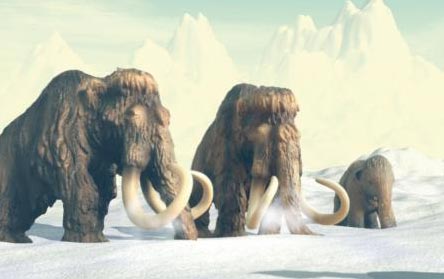
Should the Woolly Mammoth be Resurrected?

Will the Woolly Mammoth return?

Will the Woolly Mammoth return?

Picture credit:  Everything Dinosaur

Mired in a Bog

It is likely that this elephant became mired in a bog and she probably succumbed to exhaustion, although an attack from predators is not ruled out as much of the rear portion of the skeleton has been lost and that which remains shows feeding damage.   Whether this was post-mortem, we at Everything Dinosaur are unable to say.

Whilst we at Everything Dinosaur are very much in favour of the study of these Siberian giants.  After all, actually examining the slowly thawing out flesh of such a creature provides science with so much more information than just the bones. We remain concerned about the moral and ethical issues involved in any cloning process.  True, scientists from Harvard University and from South Korea’s Sooam Biotech Research Foundation are trying to just that, to bring a Woolly Mammoth back by cloning, although both teams are going about it in slightly different ways.

To Resurrect the Mammoth

We feel that certain questions have to be asked, for example, what contribution to overall genetic research would such a project make?  Indeed, is it right to focus on trying to resurrect the Mammoth when more resources could be directed at trying to save critically endangered flora and fauna that are still around.

We imagine a scenario, whereby, many Indian elephant females are subjected to experimentation and if a clone could be created, then there is the problem of surviving the lengthy gestation if a successful implanting into the womb of a surrogate mother could be achieved.

The Life of a Baby Mammoth

Perhaps, if the baby could survive to term, then there is the birth itself, or most likely a Caesarean section, as no commercial company would want to lose their “genetic investment” at this late stage.  If the baby survives, boy or girl (gender will probably be determined for it), then it could end up being rejected by what would already be a traumatised mother.  If the calf lives, we suspect there may be a number of unforeseen medical issues (as has been the case in the cloning a number of extant animals), then what sort of life would this young Woolly Mammoth have.

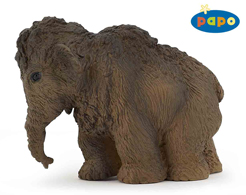
Could we See a Baby Woolly Mammoth in a Zoo in 2050?

Baby Woolly Mammoth - the New Lyuba?

Baby Woolly Mammoth – the New Lyuba?

Picture credit: Everything Dinosaur

For models and replicas of Woolly Mammoths and other prehistoric creatures: Papo Models and Prehistoric Animal Figures.

Possibly rejected by its own mother and never able to be part of a herd, this elephant, highly social by instinct, part of a species that had a childhood almost as long as a human’s childhood, would be totally isolated and alone.  It would have no references, no role models, no benchmark.  It would be a Woolly Mammoth or something resembling a Mammoth (depending on the proportion of Indian elephant DNA involved), but it would not know how to behave or act like a Mammoth.

The Realities of Resurrecting a Mammoth

We at Everything Dinosaur foresee a heart-breaking scene in a zoo, perhaps in the not too distant future, whereby, a shaggy, rough coated elephant is paraded in front of crowds of visitors to the great satisfaction and economic benefit to the institution that owns this genetic wonder.  For the animal itself, it would most probably be doomed to live an entirely unnatural existence with none of the social interactions that these elephants would crave.  Just as we have captured Orcas and displayed them at theme parks and we are now only being to understand the trauma we put these magnificent creatures through.

Cloning One Day Possible?

Being able to explore the flesh and blood of a long dead creature is of great importance to science.  We accept that one day in future the cloning of a Mammoth may indeed be possible.  But just because we can do something doesn’t make it right to do.  To clone a Mammoth would involve a tremendously dedicated team of scientists who would be pushing at the boundaries of our understanding of genetics, but just as with the study of the carcase itself, when it comes to the moral and ethical implications, a strong stomach will be required.

Let’s hope that the documentaries examine the ethical dimensions of cloning such as a creature as well as providing more information on how these ancient creatures lived and died.

15 11, 2014

A Fishy Dinosaur Tail from South-western Alberta

By |2023-03-17T20:56:39+00:00November 15th, 2014|Categories: Dinosaur and Prehistoric Animal News Stories, Main Page|0 Comments

Fishermen Spot Duck-Billed Dinosaur Fossil in the Castle River

Palaeontologists at the Royal Tyrrell Museum (Alberta, Canada), have a new hadrosaur specimen to study, thanks to a pair of keen-eyed fishermen who spotted the fossilised remains of an 80-million-year-old dinosaur whilst on an angling trip to the Castle River in the extreme south-west of Alberta.

Hadrosaur Specimen

Back in August, a father and son fishing trip on the river was interrupted when the son, spotted the brownish/black outline of some bones exposed on the surface of a huge boulder that had been washed into the middle of the Castle River.  Last year, the south-west of Alberta experienced some of the worst flooding in living memory.

The devastation caused by the extensive flooding had a silver lining for vertebrate palaeontologists as a number of fossils were swept into river systems. This hadrosaur specimen, which consists of a partial skull, articulated cervical vertebrae and bones from the upper portion of the chest, could represent an entirely new species.

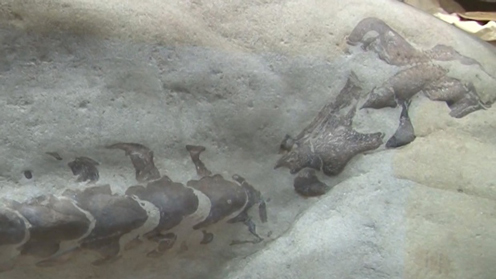
The Fossilised Bones are Entombed Inside a Sandstone Boulder

The exposed skull (top right) and the articulated neck vertebrae.

The exposed skull (top right) and the articulated neck vertebrae.

Picture credit: Royal Tyrrell Museum

Hadrosaurs

Hadrosaurs, or more specifically dinosaurs that belong to the Superfamily known as the Hadrosauroidea, were bird-hipped, herbivores that had horny beaks and batteries of teeth to help them cope with tough vegetation.  Known from the Cretaceous to the very end of the Age of Dinosaurs, these reptiles, also referred to as the duck-billed dinosaurs were amongst the most speciose of all the known types of dinosaur and they were particularly numerous and diverse during the Campanian and Maastrichtian faunal stages of Late Cretaceous North America.

Commenting on the significance of this discovery, the Curator of Dinosaurs at the Royal Tyrrell Museum, Dr Donald Henderson explained that the unusual location of this fossil find, just a few miles from the border with British Columbia, makes this specimen extremely important.

He stated:

“It is one of the reasons we were so keen to get it, every time we find something different in another part of the province, it’s something important.  This means we could be finding new dinosaurs in the extreme south-west of Alberta.”

Duck-billed Dinosaur Fossil

A helicopter was called in to airlift the one tonne boulder onto a low-loader for transport up to Drumheller, where the museum is based.  The specimen will then be carefully prepared in the museum’s laboratory.  Field workers did search the rest of the river bed and along the banks in the immediate vicinity of the fossil in a bid to find other parts of the skeleton, but to no avail.  Last year’s floods may have delivered this partial specimen but the remainder would have most likely been washed away.

It is rare for such a specimen, to be preserved in this manner.  The sandstone rock in which the fossil is entombed is extremely hard, the resistance of this rock to erosion helped preserve the fossil, although extracting the fossilised bones from the surrounding matrix will be a very difficult and time consuming job due to the tough matrix.

Entombed in Hard Sandstone

Dr Henderson added:

“It’s in really, really hard sandstone, otherwise it would have been smashed up a long time ago.  It’s [the fossil specimen] sort of coiled up inside, at the time of its death, the neck and head curled back and the body was swept away in a river of sand. “

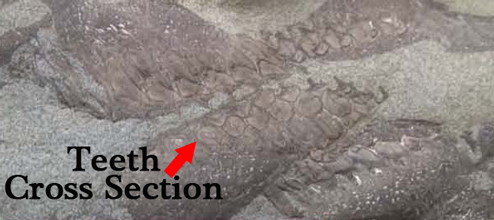
A Close up of the Skull Showing the Rows of Teeth in the Jaws

Erosion has led to the skull and jaws being cross-sectioned to reveal internal details.

Erosion has led to the skull and jaws being cross-sectioned to reveal internal details.

Picture credit: Royal Tyrrell Museum

A spokesperson from Everything Dinosaur said, that the actions of the fishermen should be praised.  It is important for members of the public to alert museums when they come across something unexpected and unusual.  The fossil is probably preserved in three-dimensions, the hard sandstone protecting the bones, normally such bones are crushed, flattened and smashed.  Palaeontologists might be able to learn a great deal about Late Cretaceous ornithischian dinosaurs as a result of this fossil discovery.

Go to Top