Nundasuchus songeaensis: New Triassic Archosaur Discovered in Tanzania
In the aftermath of the End Permian extinction event those terrestrial vertebrates that had managed to cling on found themselves with a host of newly opened up ecological niches to exploit. Many vertebrates rapidly diversified and new lineages evolved to fill those gaps in the ecosystem vacated by genera and families that had died out.
The Archosauria
The archosaurs were typical and a myriad of new forms of these reptiles evolved as the Early Triassic gave way to the Middle Triassic. Scientists led by researchers at Virginia Tech (Blacksburg, Virginia, United States) have published a paper on a newly described genus of large, predatory archosaur that may have been one of the apex predators around some 245 million years ago. Say hello to Nundasuchus songeaensis, a fearsome, ancient ancestor of today’s crocodiles and birds.
The Recovered Fossil Material Superimposed on a Reconstruction of the Reptile
Scale bar = 0.5 metres.
Picture credit: Sterling Nesbitt
Discovered in 2007
The fossil material was discovered in 2007, during a field expedition to explore the fossiliferous Manda Beds exposed in southern and south-western Tanzania. Sterling Nesbitt, was at the time a graduate student, he is now an Assistant Professor of Geological Sciences at Virginia Tech. The highly fragmentary fossils had been eroding out of a small hillock and although most parts of the skeleton are represented (excluding cranial material), it has taken more than a 1,000 painstaking hours to restore and study the fossilised remains.
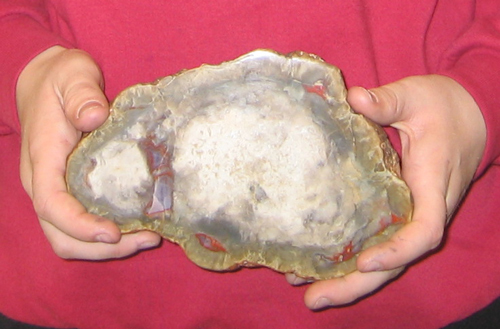
A Photograph of Some of the Fossils Collected by the Team
About 10% of the entire skeleton is represented by the fossil material.
Picture credit: Robert Smith
New Triassic Archosaur
The animal was clearly a predator and it would have been about the size of fully grown female American Alligator (Alligator mississippiensis), although unlike today’s modern crocodiles, the limb bones were held underneath the body and they did not spread out in a sprawling posture as seen in extent crocodilians. Nundasuchus (pronounced Noon-dah-suk-kus), would have been capable of more efficient locomotion, it probably hunted the ancestors of those other very well-known archosaurs – the Dinosauria.
The researchers are unsure as to where this new genus sits in the Archosauriform family tree. The skeleton shows anatomical traits found in the branch of the archosaurs that led to the dinosaurs and birds, but it had bony armour (osteoderms) on its back like a crocodile.
Commenting on the significance of this discovery, Assistant Professor Nesbitt stated:
“There’s such a huge gap in our understanding around the time when the the common ancestor of birds and crocodilians was alive, there isn’t a lot out there in the fossil record from that part of the reptile family tree. This helps us fill in some gaps in the reptile family tree, but we’re still studying it and figuring out the implications.”
The name is derived from local Swahili “Nunda” for predator and the Greek for crocodile “Suchus”, the genus name therefore translates as “predator crocodile”. The trivial name comes from the town of Songea, as this settlement is close to where the fossils were found.
Despite the fragmentary nature of the fossil material, Nundasuchus songeaensis represents one of the more complete early Middle Triassic (Anisian faunal stage), archosaurs from southern Pangea and is part of a previously unrecognised early and diverse Archosauriform assemblage.
Sterling Nesbitt, who formerly held a post at Texas University, has been involved in a number of studies into the evolutionary development of African Triassic fauna. Back in 2010, Everything Dinosaur reported on another research project in Tanzania involving Assistant Professor Nesbitt. Fossils found indicated that the Dinosauria may have evolved earlier than previously thought.
Extraterrestrial Impact May Not Have Caused Global Firestorms
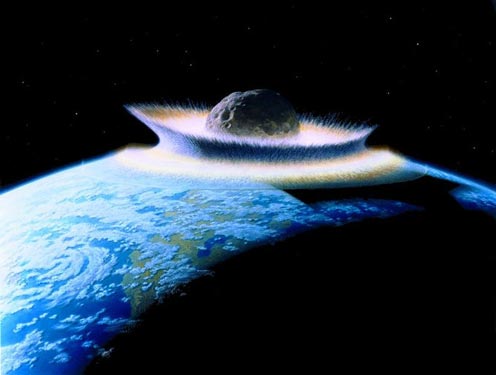
The debate over the consequences of the extraterrestrial impact that took place around sixty-six million years ago continues with the publication of pioneering new research that investigates whether or not the Yucatan impact caused extensive firestorms on a global scale. It is now widely believed that at least one huge object from outer space crashed into Earth which very probably contributed to the mass extinction event that marks the end of the Cretaceous. This is perhaps the most famous of all the mass extinction events recorded in the Phanerozoic fossil record, as no significant quantities of dinosaur fossils are found in younger strata.
Mass Extinction Event
The end Cretaceous mass extinction event saw the demise of the Dinosauria, the pterosaurs, most of the marine reptiles and a number of other significant casualties. It had been thought that a consequence of the impact was a series of huge fires that ravaged the Earth, destroying much of the plant-life on the planet. Plenty of evidence for this catastrophic event has been cited, for example, large amounts of carbon preserved in strata at the K-T boundary, believed to be the preserved remains of such conflagrations.
Scientists have also recorded evidence of a “fern spike” that occurred immediately after the extinction event. Large numbers of fossilised fern spores have been recorded (microfossils), in contrast to a very low level of other plant remains such as pollen from flowering plants being recorded. Ferns are quick to re-colonise an area after a devastating volcanic eruption. The “fern spike” data was taken as supporting evidence for the massive destruction of much of the planet’s green matter.
Did the Extraterrestrial Impact Cause Global Firestorms?
Cataclysmic impact event, but was there a global firestorm?
Picture credit: Don Davis commissioned by NASA
Global Firestorms
However, a team of UK based researchers (University of Exeter, Imperial College London and the University of Edinburgh), have challenged the idea of world-wide fires. The scientists recreated the massive energy released from the impact event and they found that the blistering heat near the impact site was too short-lived to ignite living plants. The scientists conducted a series of experiments using pulses of heat and writing in the Journal of the Geological Society, the team conclude that close to the actual impact, the heat wave would have lasted less than a minute, too short a time to set fire to living plants.
However, using computer models they discovered that the effects of the blast would have been felt as far away as New Zealand, some 12,000 kilometres from the site of the explosion. The further away from the blast centre, the less intent the heat wave, but it would have been longer lasting. In New Zealand, the heat blast would have lasted for around seven minutes, long enough to ignite living plant material.
Living Plants Not Ignited
Experiments conducted suggest that dry and dead plant matter could be set alight, but live plants such as conifer needles were not ignited.
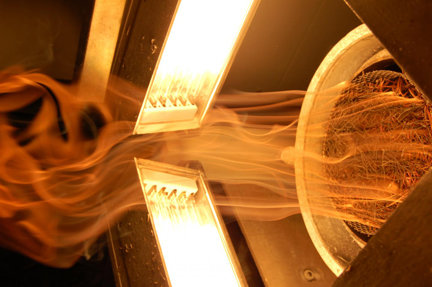
Having a Blast with Heat Wave Experiments
Global firestorm study.
Picture credit: University of Exeter
The picture above shows the fire propagation apparatus recreating the impact induced thermal pulse at the Cretaceous/Palaeogene (K-T boundary). Halogen lamps are delivering the intense, thermal radiation.
Commenting on the study, Dr Claire Belcher (Earth System Science group in Geography at the University of Exeter) stated:
“By combining computer simulations of the impact with methods from engineering we have been able to recreate the enormous heat of the impact in the laboratory. This has shown us that the heat was more likely to severely affect ecosystems a long distance away, such that forests in New Zealand would have had more chance of suffering major wildfires than forests in North America that were close to the impact. This flips our understanding of the effects of the impact on its head and means that palaeontologists may need to look for new clues from fossils found a long way from the impact to better understand the mass extinction event.”
The Impact on Flora and Fauna
Fauna and flora populations are generally resistant to localised fire events, animals can hide or hibernate/enter aestivation and the seeds of plants can survive the intense heat of forest fires. Some plants even rely on seasonal fires to help them spread. Based on these assumptions, it can be suggested that wildfires on their own are unlikely to be directly responsible for extinctions. However, large dinosaurs which were unable to run very far, or shelter may have suffered terribly from such fires.
Dr Rory Hadden from the University of Edinburgh added:
“This is a truly exciting piece of inter-disciplinary research. By working together engineers and geoscientists have tackled a complex, long-standing problem in a novel way. This has allowed a step forward in the debate surrounding the end Cretaceous impact and will help geoscientists interpret the fossil record and evaluate potential future impacts. In addition, the methods we developed in the laboratory for this research have driven new developments in our current understanding of how materials behave in fires particularly at the wildland-urban-interface, meaning that we have been able to answer questions relating to both ancient mass extinctions at the same time as developing understanding of the impact of wildfires in urban areas today.”
Everything Dinosaur would like to thank Exeter University for the use of a press release that enabled this article to be compiled.
Dearcmhara shawcrossi– An Ichthyosaur from the Isle of Skye
No it’s not a dinosaur, contrary to some media reports. It certainly is not “Nessie”, but it does mark the culmination of a tremendous effort by Scottish palaeontologists to collate and study marine reptile fossils that have been found in Scotland. A new species of ichthyosaur (marine reptile), has been described from fossils found on the Isle of Skye.
The “wee beastie” has been named Dearcmhara shawcrossi, the name comes from the Scottish Gaelic for marine lizard and the trivial name honours amateur fossil hunter Brian Shawcross who found the creature’s fossils at Bearreraig Bay in 1959. Bearreraig Bay is part of a highly fossiliferous coastline which can be found on the eastern side of the island. As far as we at Everything Dinosaur know, this is the first marine reptile to be given a Gaelic name, Dearcmhara is pronounced “jark vara”.
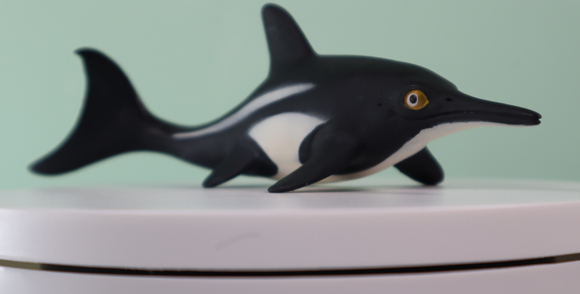
A Model of an Ichthyosaur (Fish Lizard)
An Ichthyosaurus model.
Picture credit: Everything Dinosaur
Scotland’s Very Own Ichthyosaur (D. shawcrossi)
Around 170 million years ago, much of the Isle of Skye was underwater. A shallow sea separated the landmasses of Europe and North America, this sea formed when rifts in the Earth’s crust led to the break-up of the super- continent Laurentia. Marine reptiles like Dearcmhara shawcrossi were part of a diverse ecosystem, Dearcmhara grew to around 4.5 metres in length, motor boat size as described by Dr Steve Brusatte (University of Edinburgh School of GeoSciences), who led the study.
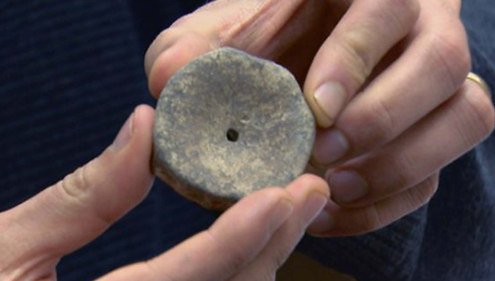
Fossil Vertebra of the Newly Described Species
Most likely a dorsal vertebra from
Picture credit: BBC News
Dr Steve Brusatte (holding the fossil in the photograph) went onto comment:
“During the time of the dinosaurs, the waters of Scotland were prowled by big reptiles the size of motor boats. Their fossils are very rare, and only now, for the first time we’ve found a new species that was uniquely Scottish.”
The Isle of Skye
The Isle of Skye is a very important part of the world to palaeontologists. Exposures along the shoreline and inland are strata that was laid down during the Middle Jurassic. There are very few places in the world where such rocks are exposed and this makes any fossil discovery from the island very significant indeed.
Recently, Everything Dinosaur wrote about a new initiative to try and protect the island’s geological heritage in the wake of fears that unscrupulous fossil dealers might want to remove rare and valuable fossil bones of plesiosaurs and ichthyosaurs.
The discovery of a new species of Scottish ichthyosaur is just part of a collaborative effort being undertaken by researchers from the University of Edinburgh, the Hunterian Museum, the National Museums of Scotland, Staffin Museum (Isle of Skye) and Scottish National Heritage to try and catalogue significant vertebrate fossil finds.
A spokesperson from Everything Dinosaur commented:
“Without the donation made by local fossil enthusiast Brian Shawcross, this new species of ichthyosaur would not have been recognised. This goes to show how important amateur fossil collectors can be when it comes to learning about life in the past.”
To read an article that explains the importance of the Isle of Skye from a palaeontological perspective: Scotland’s Mid Jurassic Heritage.
Everything Dinosaur acknowledges the assistance of a media release from the University of Edinburgh in the compilation of this article.
Utahraptor Predator Trap Promises Fresh Insight into Dromaeosaurs
Lots of media coverage in the last few days concerning the efforts of a research team from Utah and their remarkable work to remove a nine tone block of mixed mudstone and sandstone that may contain the fossilised remains of a pack of Utahraptors from an isolated Mesa located in the Arches National Park (eastern Utah). The block is believed to represent what is known as a “predator trap” and it may contain the fossilised remains of six Utahraptors, a fleet-footed, feathery hunter, related to the Velociraptor of Mongolia, but much, much bigger.
Utahraptor Predator Trap
If the sandstone/mudstone block can be prepared, then palaeontologists will be able to gain further information about the growth habits (ontogeny) of these theropod dinosaurs. It may be difficult to ascertain whether the fossils represent a pack of dinosaurs that perished together, or whether the concretion represents the demise of a number of dinosaurs over a prolonged period, i.e. individual dinosaurs becoming fatally trapped rather than the whole group succumbing together.
The Fearsome Utahraptor ostrommaysi
Utahraptor is the largest genus of dromaeosaur described to date. Although regarded by many scientists as being the “Arnold Schwarzenegger” of this particular type of meat-eating dinosaur, it was very typical of the group. It was a fast running, bipedal predator and most likely feathered. Adults reached lengths of around five and a half metres with a skull length in excess of fifty-five centimetres.
The sickle-shaped second toe claw was up to thirty-eight centimetres long and like other “raptors”, palaeontologists have postulated that Utahraptor could lift up its sickle claw whilst running, with toes three and four bearing the weight of the animal. Utahraptor was named and described in 1993, one of the scientists involved in the formal scientific description was James Kirkland.
James Kirkland, now one of the best known American palaeontologists, was leading a field trip involving University of Utah students back in 2001, when the first dinosaur bone, a leg bone was found indicating that a site on a 240 metre high Mesa in the Arches National Park, might yield an exciting dinosaur discovery.
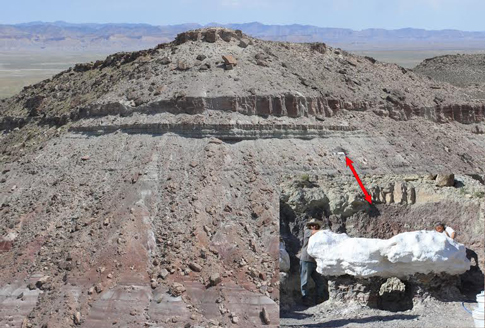
The Location of the Utahraptor Fossils
The inset shows a close up of the nine tonne boulder in situ.
Picture credit: James Kirkland/St. George News
The inset and the red arrow indicates the location of the fossil find on the Mesa which is managed by the U.S National Parks Service. Removing fossils from such locations is prohibited without special permits issued by the Government.
Further expeditions to the site, indicated that this was something special. Back in 2004, it was confirmed that there was a mass of disarticulated and associated fossil bones preserved and over the last decade or so, the on-going investigation led scientists to believe that the best option was to remove the majority of the fossils in one massive block. The excavation culminated in the removal of an 18,200 lb mass of boulders, carefully protected by burlap and plaster. It was a tricky job negotiating the steep slopes of the Mesa but after heavy plant was brought in the huge rock was loaded onto a low loader for transportation to the Utah Department of Natural Resources (Salt Lake City).
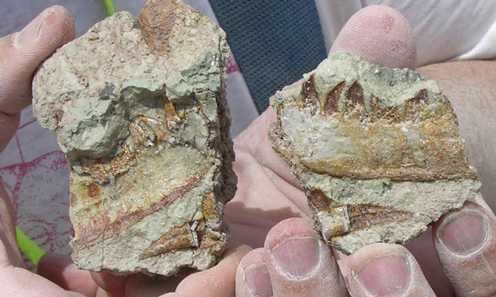
One of the Utahraptor Jawbones Found at the Site
Slab and counter slab.
Picture credit: James Kirkland/St. George News
Commenting on the fossils, which may represent at least six different aged Utahraptors, James Kirkland (Adjunct Associate Professor, University of Utah) stated:
“We realised all the raptors were intertwined. As we tried to separate the bones from the ground, we kept running into more skeletons. We ended up with a giant mass.”
Amongst the fossil material listed so far is a nearly two foot long adult skull, along with elements from a baby Utahraptor’s ten centimetre long skull. These fossils will help scientists to work out how these animals changed as they grew and developed. This discovery, part of an extremely rich fossil heritage from the American State has been described as a “Rosetta stone of dinosaur fossil hunting for Utah.”
A Predator Trap?
In conjunction with the Utahraptor remains, scientists have uncovered fragmentary fossils of a herbivorous iguanodontid. It has been proposed that the stench of the rotting carcase of the herbivore attracted the predators who were hoping to scavenge on the rotting corpse. However, these creatures too, become stuck in what was effectively quicksand and what killed them helped preserve their bodily remains. Predator traps occur when large number of meat-eaters congregate around the corpse of a prey animal that has become stuck in mud or quicksand.
A number of predator traps are known from the fossil record, the Early Cretaceous tyrannosauroid Guanlong has been associated with a predator trap, the tar pits at La Brea (Los Angeles), are effectively one huge predator trap, they still catch out unwary birds and small mammals today.
Commenting on the Utahraptor fossil discovery, a spokesperson for Everything Dinosaur stated:
“These fossils represent a remarkable opportunity for palaeontologists to learn about one of the most formidable predators of the Cretaceous. Around 120 million years ago, this part of what is now the desert of Utah, was covered in a series of large and often seasonal lakes. As the water evaporated over the long, dry season, so herbivorous dinosaurs would run the risk of getting stuck in the mud and soft sand on the shore. With water seeping away from such sites, quicksand was quickly formed and these would ensnare unwary dinosaurs.”
The spokesperson went onto add:
“It will be difficult for the scientists to state with any degree of certainty whether or not this fossil site provides evidence of pack behaviour in Dromaeosaurs, but we suspect that the debate over this type of dinosaur behaviour, already inferred by other fossil finds, will come to fore once more.”
Everything Dinosaur’s Top Ten Blog Articles of 2014
One of the things we like to do at this time of year at Everything Dinosaur is to review this blog site and pick out those blog articles and news stories that we have featured that have proved to be the most popular. Of the three hundred and sixty articles written in 2014 (we try to write one article per day), picking out just ten has proved to be quite a challenge.
Everything Dinosaur
However, we have looked at page views, comments, Facebook likes, retweets and a whole range of other factors to help us compile a top ten. The subjects covered this year have been as diverse as in previous years, with features ranging from three dimensional printers, the origins of life on Earth, crocodile attacks, World Heritage sites, shrinking sauropods as well as fossil discoveries, new dinosaur models, and Everything Dinosaur updates. Our top ten list reflects the breadth of the topics that we try to cover on this web log and although we would not want to claim any statistical validity for this particular piece of research, here is our top ten countdown.
Popular Blog Posts
10). A Special Year for Ichthyosaur Research
There have been a number of new marine reptiles named and described this year, including some Early Triassic animals whose fossils have been found in China. However, 2014 marks the 200th anniversary of the publication of the first academic paper that described an ichthyosaur and in at number ten is a short article we wrote back in June commemorating this anniversary.
Christmas is a time of year when families get together. In 2014, research into the “human family” has continued at a pace. Team members predicted that there would be more news stories this year about developments in hominin genetic research and it turns out that some diseases associated with our population are linked to our Neanderthal ancestry. One of the first articles we published on the blog looked at a study that had concluded that some diseases associated with H. sapiens can be related to our inherited H.neanderthalensis genes.
8). Pushing the Origins of the Pterosauria Back in Time
A fragmentary fossil of an ancient flying reptile that had been discovered in 2001 got fans of the Pterodactyloidea in a bit of a flap this year when a scientific paper was published describing a new type of pterosaur. The fossil came from north-western China and it pushed back the evolution of the Pterodactyloidea by at least another five million years. Kryptodrakon progenitor, (the name means ancestor of the hidden dragons), is the most primitive, basal member of the Pterodactyloidea pterosaur family known to science and Everything Dinosaur wrote about this exciting fossil find back in April.
New pterosaur named after “Crouching Tiger Hidden Dragon” Film.
Picture credit: Brian Andres
7). Welcome to the “Metal Age” of Palaeontology
Readers of this blog site may well be familiar with the term genome. A number of ancient creatures have had at least part of their genome mapped, Neanderthals, Woolly Mammoths and such like, but in at number seven is an article all about the work of Manchester University and their research into mapping elements such as Zinc, Copper and Nickel that can be preserved within the fossil record.
University of Manchester researchers used a synchrotron particle accelerator to bombard a fifty-million-year-old fossil leaf to help them calculate the chemical composition of an ancient plant. They then compared this data with the metallome of a modern species from a related plant. This was heralded as the start of the “metal age of palaeontology”.
This is the first article in our top ten that concerns the Dinosauria. Sadly, Everything Dinosaur has written about a number dinosaur fossil thefts in 2014. Thieves stealing fossils, especially those of dinosaurs, is a trend we see continuing over the next few years and our story at number six concerns the theft of a dinosaur footprint from Bureau of Land Management managed land in Utah. We first reported on the theft on February 22nd, a local man, the owner of a construction company, was accused of the theft, which he at first denied but in a court hearing (July) he pleaded guilty to stealing the fossil.
Moab resident Jared Ehlers (35), was sentenced on October 20th to six months house arrest and one year of probation. In addition, he was ordered to pay over $15,000 dollars in restitution to help cover the expenses incurred by the Utah Department of Public Safety as they searched the Colorado River for the fossil. Fearing prosecution, Mr Ehlers, who claimed that he had stolen the three-toed footprint as he wanted to make a coffee table out of it, threw the fossil into the river, unfortunately the fossil has never been recovered.
Moab Resident Pleaded Guilty to Trace Fossil Theft
Six months house arrest plus probation and substantial fine for fossil theft.
Into the top five and at number five is an article that featured the launch of Everything Dinosaur’s new website aimed at helping teachers and other educationalists when it comes to teaching about fossils and prehistoric animals. The specially commissioned website: Everything Dinosaur lots of helpful articles, dinosaur toys and models, free downloads and educationtional items aimed at helping teaching professionals and museum staff.
Helping to Teach About Dinosaurs and Fossils in School etc.
Teaching tips, articles, resources and free downloads.
Picture credit: Everything Dinosaur
The new site was launched at the end of August to coincide with the start of the autumn term and lots of schools have already benefited from the articles featured as well as the example lesson plans and downloadable teaching resources.
4). Jurassic World (Official Trailer)
Dinosaur fans young and old have been eagerly looking forward to the release of the fourth film in the “Jurassic Park” franchise, “Jurassic World”. The film is due to be premiered in June of 2015, but back in November, a trailer for the movie was finally released and sure enough, Everything Dinosaur’s blog site was one of the first to feature it. The film is bound to be a huge success when it finally comes out and the trailer certainly whetted the appetite and teased viewers about the new, mysterious, genetically engineered dinosaur that is the big villain of this latest instalment of “Jurassic Park”. We can’t wait to learn more about “Diabolus rex”.
The “Jurassic World” Official Trailer
Video credit: Universal Studios
The original blog article featuring the trailer was published on November 25th. Had the trailer come out slightly earlier in the year, it could well have made it to the number one spot on our list.
New Prehistoric Animal Models
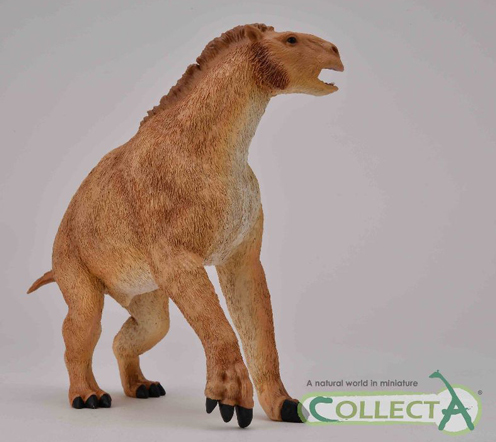
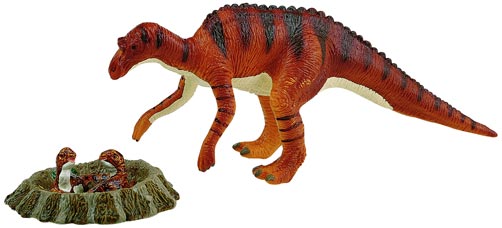
3). New Prehistoric Animal Models from CollectA (2015)
2015 sees the introduction of a lot of new dinosaur and prehistoric animal models. Collectors can expect new models from Schleich, Papo and Safari Ltd. All our posts about new replicas did well in our survey of the top blog articles of this year, but our only top ten entry concerns the new 2015 releases from CollectA. We first revealed the list of models back in late October, over the following weeks we wrote several articles providing more information about these new additions to the highly successful CollectA “Prehistoric Life” model range.
A Chalicothere is to be Included in CollectA’s New Models for 2015
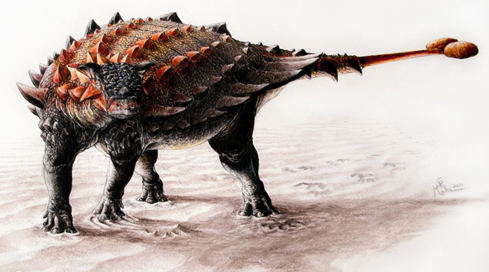
Runner up is an article we published on the 27th September. Everything Dinosaur team members had blogged about the fact that dinosaurs in the Ankylosauridae don’t seem to attract that much attention when compared to other ornithischians. How wrong we were as the naming and describing of a new type of heavily armoured dinosaur sparked a great deal of interest amongst readers.
Fragmentary fossils including beautifully preserved cranial material found in 2011 in strata related to the Kirtland Formation were described this year and a new type of armoured dinosaur named. Ziapelta sanjuanensis at over six metres in length, would have made a very formidable adversary for even the largest, hungriest theropod dinosaur.
An Illustration of Ziapelta sanjuanensis (Ankylosaur)
New Armoured Dinosaur from New Mexico.
Picture credit: Sydney Mohr
A New Armoured Dinosaur
This ankylosaurid that roamed New Mexico between 74 and 72 million years ago (Campanian faunal stage), is extremely important as the fossils indicate affinities with better known ankylosaurids whose fossils have been found in Canada (Alberta). This spiky herbivore, described as a “living tank” certainly caused a stir when the scientific paper was published.
Before we reveal our top blog article posting of the year, time for a few honourable mentions. The research into the giant titanosaur known as Dreadnoughtus schrani proved very popular, as did a number of articles published earlier in the year about Patagonian fossil finds. The introduction of the new, high quality dinosaur replica range from Rebor got collectors very excited along with our video review of the new for 2014 prehistoric animal models, including a short video we made showing how to ease the articulated jaw on the Papo Dilophosaurus.
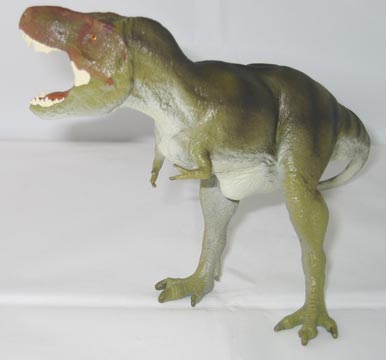
Carnegie Collectibles Tyrannosaurus rex Model
1). Carnegie T. rex (2014) Reviewed
Top of the tree, our number one article was published on the 18th of March. It concerned a review of the new Tyrannosaurus rex model made by Safari Ltd. This model, the only new Carnegie Collectible replica introduced by the company this year was reviewed by Everything Dinosaur team members and despite being introduced with a number of Wild Safari models, it was this T. rex figure that drew most of the attention. We also made a short video review of this very well made model, it also proved popular.
Everything Dinosaur’s Written Review of the Carnegie Collectibles Tyrannosaurus rex at Number One
This model featured in one of our Outlook signatures created for our emails, it must have been seen thousands of times and we also made several reviews of this particular scale replica. The red colouring around the head and its fearsome pose were commented upon by a number of blog readers and we received lots of correspondence about this model from professional collectors and from young dinosaur fans.
A very big thank you to everyone who commented, retweeted and “liked” our articles. We look forward to writing more in 2015, a year that should, if everything goes to plan, feature our 3,000th published article on this site.
Evidence of Recovery after End Permian Extinction Event
A very strange member of a little known group of ancient marine reptiles has been formally described by a joint team of American and Chinese scientists. The new genus described as “platypus-like” is a hupehsuchian, part of a group of Early Triassic diapsid reptiles, that may have been ancestral to the much better known ichthyosaurs.
Eohupehsuchus brevicollis
The fossil has been named Eohupehsuchus brevicollis, the name means “early short-necked crocodile of Hubei Province” and it was excavated from strata laid down around 248 million years ago (Olenikian faunal stage), as the world recovered from the “Great Permian Dying”, a mass extinction event that is believed to have wiped out around 95% of all the species on the planet.
Fossils associated with Hupehsuchia have been found in two counties within Hubei Province (eastern, central China). The Order Hupehsuchia was named after the alternative name for Hubei Province (hupeh), E. brevicollis is unlike any other known member of the Hupehsuchia as it possessed a short neck, with only six cervical vertebrae.
Hupehsuchian Marine Reptile
Other hupehsuchians had much longer necks, with at least ten neck bones. The forty centimetre long specimen is believed to represent an adult animal, it is somewhat smaller than the better known Nanchangosaurus (fossils dated from the Middle Triassic) and it lacked teeth. Analysis of the skull and jaws indicate that this little reptile probably had a beak like a duck (hence the platypus analogy), it paddled its way through the shallow sea using its strong limbs. The bones are thickened and heavy, indicating some adaptation to a marine environment.
Heavy bones would have helped these animals dive, although it did possess extensive dermal armour, perhaps a remnant of its terrestrial ancestry. Scientists are unsure as to whether the extensive armoured scales evolved in the Hupehsuchia after they adapted to a marine existence or whether these tough scales evolved in this group’s reptile ancestors, which lived on land.
The Fossilised Remains of E. brevicollis
The holotype material for E. brevicollis.
Picture credit: PLOS One
Looked Similar to a Platypus
One of the lead authors of the scientific paper, published this week in the on line journal PLOS One, Professor Ryosuke Motani (University of California Davis), commented:
“Although it’s a very different animal, it had a skull and beak like a duck without teeth, a very heavily built body with thick bones and paddles to swim through the water. The details are different, but the general body design looks similar to a platypus.”
With at least four genera identified as Hupehsuchia, researchers are beginning to piece together how marine ecosystems recovered after the Permian mass extinction. Intriguingly, this specimen indicates that there were most probably large vertebrate predators in the habitat 248 million years ago. The left forelimb is incomplete, with several bones missing and those present are broken. This has been interpreted as a bite from a larger predator that could only have occurred pre-burial.
This little reptile may have been attacked by a predator and escaped only to perish and to be buried a short while after.
This fossil find adds to the growing body of evidence that suggests a rapid radiation and diversification of vertebrates after the mass extinction event.
The University of California researchers have been prominent in the research into Lower Triassic marine reptiles from China. Back in November, Everything Dinosaur published an article on a fossil of a basal ichthyosaur that had been studied by this team. Unlike, Eohupehsuchus which comes from Hubei Province, the basal ichthyosaur fossil was found in the neighbouring province of Anhui (to the east of Hubei Province).
A lot can be learned from the skulls, teeth and jaws of prehistoric animals. However, what goes in one end has to come out the other. Quite exactly how the dinosaurs voided their digestive tracts (went to the toilet), remains a mystery, but a pair of scientists based in Brazil have mapped the fossilised excreta associated with a number of Mesozoic formations in that South American country. The research has just been published in the “Journal of South American Earth Sciences”.
Urolites and Coprolites
So let’s get down and dirty with the Dinosauria. Many people might be aware that fossilised faeces are called coprolites. The word coprolite comes from ancient Greek, it means “dung stone” from the words kopros for dung and lithos for stone. We suspect that rather less people are aware that trace fossils believed to represent displaced sediment as a result of a stream of urine coming from a vertebrate are referred to as urolites. The word urolite is also derived from the Greek. Uro meaning urine and lithos for stone.
The Joy of Studying Coprolites
“Shiny side up” the joys of “dino dung”.
Picture credit: Everything Dinosaur
Studying Unique Trace Fossils
Back in 2004, the two scientists responsible for this latest research paper, Marcelo Adorna Fernandes (University of São Carlos), and Paul Roberto Figueiredo Souto (University of Rio de Janeiro), published a ground-breaking study (no pun intended) into trace fossils believed to be represent the disturbance caused in sand when a stream of urine hits that spot. These traces of animal behaviour were preserved as fossils and so scientists had the opportunity to study the patterns made from splashes of urine.
The urolite fossils studied in 2004 and also examined in this latest paper, come from Cretaceous sandstone deposits of São Paulo State, in south-eastern Brazil (Botucatu Formation). They have been found in association with the fossilised footprints of two different types of dinosaurs, a meat-eating theropod and an ornithopod. It is not known which type of dinosaur created the urolites.
Studies of Urolites and Experiments to Recreate Sediment Redistribution
Study into the trace fossils made by the elimination of water from ancient creature’s bodies.
Picture credit: The Society of Brazilian Palaeontology (2004)
The above photographs show three trace fossils that are believed to correspond to liquid wastes (A, B and C). Photograph D shows an excavation created by dropping two litres of water from a height of eighty centimetres as the scientists experimented to try to recreate the impressions. In all of the photographs the scale bar is in centimetres.
Anatomical Advantage of the Dinosauria
One of the reasons why scientists believe that the dinosaurs came to dominate life in the Mesozoic is that they were very efficient at retaining moisture inside their bodies compared to other types of terrestrial vertebrates . Most types of birds excrete very little water with their faeces. In fact, the way in which birds and reptiles deal with processing waste products, particularly those wastes and toxins associated with protein digestion, differs from the way that mammals handle the problem of expelling waste.
Ammonia, a by-product of protein digestion, is toxic, it has to be got rid of. Mammals convert ammonia in the body into a concentrated form (urea), this is expelled as urine, but it means we lose water. Reptiles and birds tackle the problem of getting rid of ammonia in a slightly different way. These other types of amniotes convert the ammonia into uric acid, which is much less toxic than urea.
It therefore does not need to be diluted with water to such an extent. Indeed, uric acid does not need to mix with any water at all, it can be excreted as a semi-solid and thus, a lot of water can be conserved in this way.
The internal plumbing of birds and reptiles also varies. Crocodiles and some types of Ratite, such as the Ostrich, can expel urine and faeces separately, the urine first followed by the solids (usually). Most birds and most reptiles tend to expel what liquid they wish to get rid of as well as any solids at the same time. Kind of a “one flush system” as we call it. The mystery about dinosaur waste elimination is this – did the Dinosauria expel urine and faeces separately like ostriches and crocodiles or were they to a “one flush system”?
Perhaps different types of dinosaur expelled waste in different ways. Ostriches for example, can store their urine in a urodeum, an organ similar in function to the mammalian bladder. The solid waste is stored in another organ called a coprodeum, this is eliminated subsequently to the urine expulsion.
Observations of Ostriches Spending a Penny
Observations of Ostriches spending a penny as it were, shows that they produce a strong jet of urine that hits the ground with quite a force. They create similar patterns in unconsolidated soil as seen in the trace fossils found in the Botucatu Formation (pictures A, B and C above).
So why bother to map the places in Brazil where coprolites and urolites are found? These fossils provide important evidence to palaeontologists. They help scientists build up a picture of the diet of vertebrates and evidence of plant remains as well as depositional data can provide information about the palaeoclimates. For example, the sandstones of the Botucatu Formation where the urolites were found, represent a dune environment interspersed with oasis and wadis.
In this latest research paper, coprolites from Upper Cretaceous as well as potential Jurassic aged deposits have been mapped. This all helps to extend our knowledge with regards to the Gondwana biota during the Mesozoic.
Putting Brazil’s Coprolites and Urolites on the Map
The location of coprolite and urolite fossil specimens included within the 2014 study.
Picture credit: Journal of South America Earth Sciences/annotation by Everything Dinosaur
This area of research is often overlooked. There is a lot we do not know about the Dinosauria. Take for example the Late Cretaceous hadrosaurine dinosaur Maiasaura (Maiasaura peeblesorum). The Two Medicine Formation of Montana provided an extraordinary amount of evidence about this ornithopod and its nesting behaviour.
“Egg Mountain”
The fossil deposit location was referred to as “egg mountain”, as these sediments preserved evidence of huge nesting colonies. In addition, this location is one of very few in the world where large amounts of coprolite directly associated with a single genus was discovered. It seemed appropriate as well as polite to nick-name these highly fossiliferous sites “egg mountain”, naming the location “*h!# mountain” would have been scientifically valid, but perhaps not as acceptable in popular literature.
Lots of Coprolite Fossils Associated with Maiasaura (M. peeblesorum)
The foreshore along the beaches in the Penarth area of the Vale of Glamorgan (South Wales), is one of the most popular fossil collecting locations in the whole of the British Isles. The beaches are very accessible, there is plenty of parking nearby and the sites are loved by family holiday makers. The strata in the area, is Lower Jurassic (blue lias) and it is highly fossiliferous. A thirty minute walk along the foreshore can result in the finding of many specimens, mostly brachiopods, gryphaea, and the occasional worn ammonite fragment.
Welsh Ichthyosaur Fossil Discovery
Vertebrate fossils, those of marine reptiles are rare, although the occasional ichthyosaur vertebra or paddle bone can be discovered. Geological hammers are not necessary, the strong tides combined with the the crumbly nature of the cliffs ensures a regular scattering of fossils across the beach. However, one very lucky amateur palaeontologist has uncovered the fossilised remains of a two-metre-long Ichthyosaurus, and what’s more, the specimen seems almost complete.
Beach Find
Jonathan Bow, made his discovery whilst walking along the beach back in September, a small inch long piece of rock took his eye after it had been exposed by a tide. He stated that anyone could have made this find, it all took was careful observation. Indeed, this is true, when Everything Dinosaur team members are out on fossil hunts it is often the children who are with us with their sharper eyesight, that spot the fossils.
The Fossilised Remains of the Ichthyosaur (after preparation)
Penarth’s very own prehistoric monster.
Picture credit: Jonathan Bow
A Once in a Lifetime Find
Mr Bow, a keen fossil collector explained that:
“Something this large and complete is a once in a lifetime find.”
The collections manager in the Geology Department at the National Museum Wales described this fossil as “potentially a very important find.”
Ichthyosaurs were a diverse group of marine reptiles that evolved in the Early Triassic and thrived during the Jurassic Period. As a group they survived into the Cretaceous but mysteriously, despite being superbly adapted to marine environments, they became extinct around eighty million years ago.
Ichthyosaurs – Marine Reptiles Known as “Fish Lizards”
The Ichthyosaurus model (Wild Safari Prehistoric World) ready to take its turn on the Everything Dinosaur turntable. Picture credit: Everything Dinosaur.
2014 marks the 200th anniversary of the first scientific description of an animal that was later named as an ichthyosaur. In June 1814, Sir Everard Home published an account of a discovery made by the Anning family of Lyme Regis (Dorset). This was the first scientific account ever published on an ichthyosaur. Fitting then, that this year, the most complete fossilised remains of a “Fish Lizard” found in South Wales have come to light.
A Welsh Ichthyosaur Fossil
Ichthyosaurus Fossils Come to Light
Ichthyosaur fossils from this part of South Wales are rare.
Picture credit: Jonathan Bow
The picture shows a smaller Ichthyosaurus fossil specimen as Mr Bow found it (small picture, bottom left) and the larger picture shows the same specimen once it had been exposed and prepared. Ribs, paddle bones and vertebrae can be clearly distinguished.
Our congratulations to Jonathan, but a word of warning to would be fossil hunters keen to visit this part of the Welsh coast. The cliffs are dangerous and rock falls common, there are plenty of fossils to find on the beach, please avoid getting too close to the cliffs.
A spokesperson from Everything Dinosaur, acknowledged that the cliffs were best avoided and that there were plenty of fossils to be found on the beach itself, particularly along the foreshore, before adding:
“We suspect that this is an example of the ichthyosaur species called Ichthyosaurus communis, although we would need to take a closer look before a species identification could be formally made. We anticipate further marine reptile fossil finds early next Year, but this time from the Jurassic coast of Dorset as the winter storms do their work.”
Ancient Balloon Shaped Animal Sheds Light on Cambrian Fauna
A bizarre creature that resembled a “spiky balloon”, part of an amazing marine biota that thrived some 520 million years ago, has been named in honour of a Leicester scientist who died earlier this year. The finely-grained, fossiliferous beds around Chengjiang (southern China), are believed to rival the famous Burgess Shale beds of British Columbia. The rocks in this part of the world were once the muds and silts that collected at the bottom of an ancient Cambrian sea.
Cambrian Creature
Preserved within the layers of rock, over half a billion years old, are the remains of strange creatures that thrived at around the time of the very first animals with a notochord, the ancestor of today’s vertebrates, were evolving.
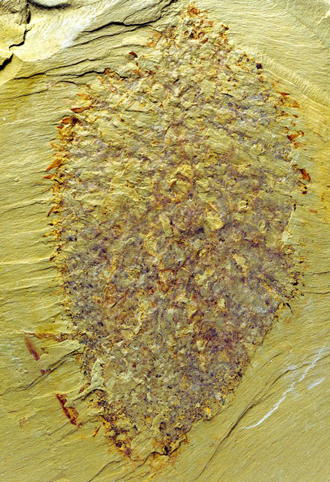
One such creature, which has a fossil described as being like “a crushed bird’s nest” has been named Nidelric pugio in honour of the late Professor Richard Aldridge, an internationally renowned palaeontologist and keen bird watcher. He was a prominent member of the University of Leicester’s Department of Geology. Fragmentary specimens of this creature had been found before, but this specimen preserves the majority of the animal and even though the fossil is distorted, it has been identified as a type of chancellorid, a group of animals that have no direct descendants alive today.
Nidelric pugio
Professor Aldridge was regarded as a world leader in the research into the Cambrian fossils found in the Chengjiang locality. This prickly specimen measures around nine centimetres in total length. It is just one of an incredible number of beautifully preserved creatures that hint at a rich and diverse marine ecosystem. A record of which has been preserved as fossils.
The Bizarre Nidelric pugio – Like Nothing on Earth Today
An ancient pin cushion N. pugio.
Picture credit: Leicester University
Honouring the Late Professor Richard Aldridge
The name of the fossil is derived from the Latin “Nidus”, meaning bird’s nest or a resemblance to such a structure and “adelric”, the Old English name “Aedelic”, which itself means “noble ruler”, the source for the surname Aldridge.
A Close Up of the Spikes that Surround this Animal
Ancient defences?
Picture credit: Leicester University
The “Cambrian Explosion”
One of the reasons stated for the “Cambrian explosion”, a rapid radiation and diversification of creatures during the latter stages of the Cambrian, is that food chains began to be established, whereby passive grazing and feeding as a result of serendipitous circumstances were replaced with predator/prey interactions. The spikes that surrounded N. pugio, which measured just a few millimetres high, most likely had a defensive purpose. The spikes probably deterred attackers.
The strata has permitted the preservation of these creatures in such perfect detail that even traces of their rudimentary nervous systems can be identified, as well as legs, guts, eyes and even that most advance element of the central nervous system – the brain.
Professor Aldridge, passed away in February of this year. He had a distinguished career in palaeontology. The professor was regarded as an expert on conodonts and early marine invertebrates. He became a professor at Leicester University in 1996 and served as Head of the Department of Geology from 1998 to 2004. He held he prestigious title of the F.W. Bennett Professorship at the University from 2002 until his retirement from the University three years ago.
Cambrian Creature Named in Honour of Professor Aldridge
The Danek Edmontosaurus Bonebed – Learning About Dinosaur Communities
Vertebrate bonebeds are fascinating places to explore and one particular dinosaur dominated fossil site is under scrutiny as the Canadian Journal of Earth Sciences produces a special edition all about the Danek Edmontosaurus bonebed. The exact location of this highly fossiliferous site is kept under wraps, for fear of vandalism and theft but this extensive jumble of prehistoric animal remains is providing palaeontologists with a tremendous insight into dinosaur behaviour, ontogeny and anatomy.
Danek Edmontosaurus Bonebed
The site, part of the urban area of Edmonton, is called the Danek Edmontosaurus bonebed, as it was discovered by amateur fossil collector Danek Mozdzenski (March 31st 1989), and the vast majority of the fossil material has been attributed to the species Edmontosaurus regalis. Bonebeds are known from a number of locations within the Province of Alberta, ironically during the early years of dinosaur fossil collecting in this part of Canada, many of them were ignored by palaeontologists as they strove to find, identify and extract much more complete articulated specimens for study and for museum collections.
The Royal Tyrrell Museum
Initial excavations at the site by the Royal Tyrrell Museum from 1989 to 1991 led to the collection of eighty specimens, including one partially articulated skeleton. The site was reopened by the University of Alberta Laboratory for Vertebrate Palaeontology back in 2006, so far another eight hundred fossils have been catalogued.
The site, which dates from the end of the Cretaceous is stratigraphically contentious, its age has been debated (Campanian to Maastrichtian faunal stages). Radiometric dating of microscopic zircons deposited, most likely as a result of volcanic activity and found just below the main bone bearing layer indicate the site may represent a sequence in geological time perhaps as long as 100,000 years. Large groups of dinosaurs may have migrated along a huge river valley.
Catastrophic Events
From time to time, catastrophic events would overtake the dinosaurs leading to mass mortalities. Amongst the Edmontosaurus bones, scientists have found evidence of horned dinosaurs, ornithomimids, evidence of tyrannosaurids (Albertosaurus) as well as smaller predators such as Troodon and Sauronitholestes.
An Illustration of Edmontosaurus regalis
Edmontosaurus a member of the hadrosaurine group of duck-billed dinosaurs.
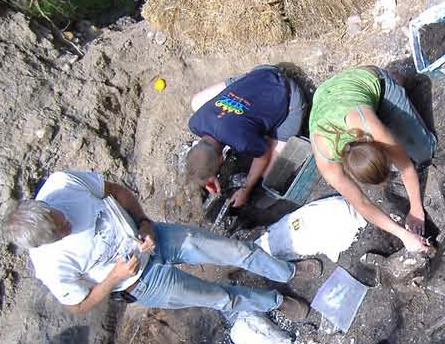
The Danek Edmontosaurus bonebed provides an excellent location for palaeontology students to practice their field craft skills. Due to the amount of fossil material preserved, the exceptional state of preservation and the volume of associated material the Danek Edmontosaurus bonebed lends itself to a wide range of research projects.
Students and Supervisors Working at the Danek Edmontosaurus Bonebed
The site is ideal for field work.
Picture credit: Victoria Arbour
Studying the Organic Matter
In addition to the extensive dinosaur remains found, the sediments that make up the bonebed are rich in organic matter. This organic matter can be studied to help reconstruct the palaeoenvironment of this part of Canada during the Late Cretaceous. Pieces of amber (fossilised tree resin) found at the site indicate that the river valley area was surrounded by extensive conifer forests – rich feeding grounds for the highly efficient feeders – the Edmontosaurs.
The site will continue to play an important role in helping to teach and train the next generation of palaeontologists and field technicians.
Commenting on the importance of the special edition of the Canadian Journal of Earth Sciences, dedicated to the Danek Edmontosaurus bonebed, Professor Phil Currie (University of Alberta) exclaimed:
“This collection of papers represents a significant contribution to our understanding of the dinosaurs that lived in prehistoric Edmonton.”