

A remarkable new species of feathered dinosaur has been described from north-eastern China. Named Norellraptor barsboldi, this small theropod is helping scientists understand how flight evolved in the Dinosauria. The research suggests that different groups of feathered dinosaurs developed flight-related adaptations independently, rather than following the same evolutionary pathway.
The international research team, which included Italian palaeontologist Andrea Cau, published its findings in the scientific journal “Nature Communications”.
Say Hello to Norellraptor barsboldi
The fossil was discovered in Lower Cretaceous deposits of the Jiufotang Formation in Liaoning Province, China. The Jiufotang Formation is a member of the extensive Jehol Group. It is famous for its exquisite vertebrate fossils, including dinosaurs, pterosaurs and early birds. Palaeontologists have been able to build up a detailed picture of the environment that existed in this part of the world in the Early Cretaceous. Norellraptor barsboldi belonged to the Microraptorinae, a group of small, feathered theropods closely related to birds. These dinosaurs were members of the Dromaeosauridae, a family that also includes Velociraptor and Deinonychus.
To read an article from 2021 about an incredible flying reptile from the Jiufotang Formation: Remarkable Pterosaur Fossil Helps to Define a Genus.
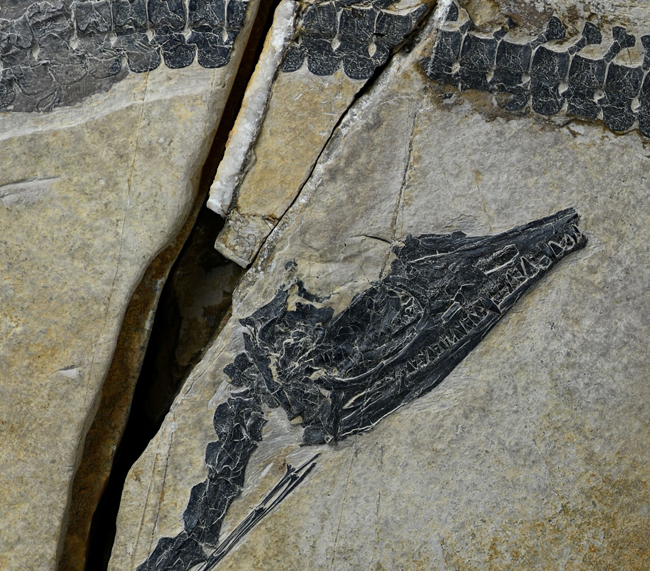
The almost complete fossil skeleton measures approximately fifty-seven centimetres in length. Furthermore, impressions of some of the animal’s feathers have been preserved.
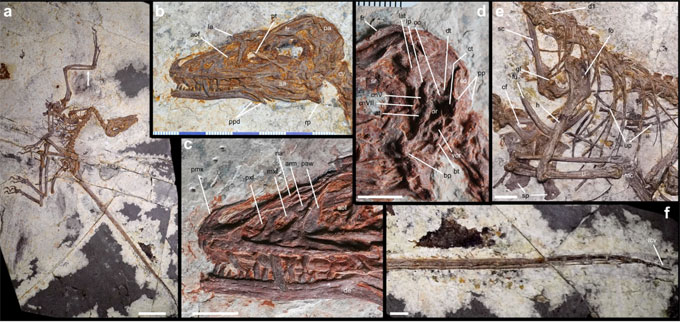
Figure 1 – Fossil specimen of Norellraptor barsboldi (specimen number 130108-MHGU-F4281). Whole specimen (a) with skull in lateral view (b). Close up of the rostrum (c). Close up view of the posterior part of skull (d). Pectoral region (e) and distal end of the tail (f). Scale bar equals 5 cm (a) and 1 cm (b-f). Picture credit: Wang et al. (2026), Nature Communications. Reproduced with the kind permission of Dr Andrea Cau.
Picture credit: Wang et al. (2026), Nature Communications. Reproduced with the kind permission of Dr Andrea Cau
The researchers also examined the microscopic structure of its bones. Their findings indicate that the dinosaur was at least three years old when it died.
Honouring Two Influential Palaeontologists
The scientific name Norellraptor barsboldi honours two distinguished palaeontologists who made major contributions to dinosaur research. The genus name recognises American palaeontologist Mark Norell (1957–2025), renowned for his research into theropod dinosaurs and the evolutionary origins of birds. Meanwhile, the species name honours Mongolian palaeontologist Rinchen Barsbold (1935–2025). His pioneering research transformed our understanding of theropod anatomy and the close evolutionary relationship between dinosaurs and birds.
Both scientists played important roles in advancing research into feathered dinosaurs.
To read more about the contribution to palaeontology made by Mark Norell: Mark Norell and His Dinosaur Discoveries.
Rinchen Barsbold contributing to research into dromaeosaurids: Natovenator – A Semi-aquatic Dromaeosaurid.
Did Dinosaur Flight Evolve More Than Once?
One of the most intriguing questions in vertebrate palaeontology concerns the evolution of flight. Microraptorines possessed several anatomical features associated with aerial locomotion. For example, some members of this group had long feathers on their forelimbs and hindlimbs. These adaptations suggest that certain microraptorines could move through the air, perhaps by gliding or using other forms of aerial locomotion.
However, scientists have debated whether these adaptations were inherited from a common ancestor shared with birds. Alternatively, similar features might have evolved independently in different dinosaur lineages. The discovery of Norellraptor barsboldi provides important new evidence.
Different Evolutionary Pathways to Flight
The researchers compared anatomical features associated with flight in microraptorines and early birds. Their analysis revealed that approximately thirty percent of the evolutionary innovations identified in microraptorines also appeared independently in the bird lineage.
Crucially, these adaptations did not evolve in the same sequence. This suggests that the two groups developed their flight-related anatomy through different evolutionary pathways.
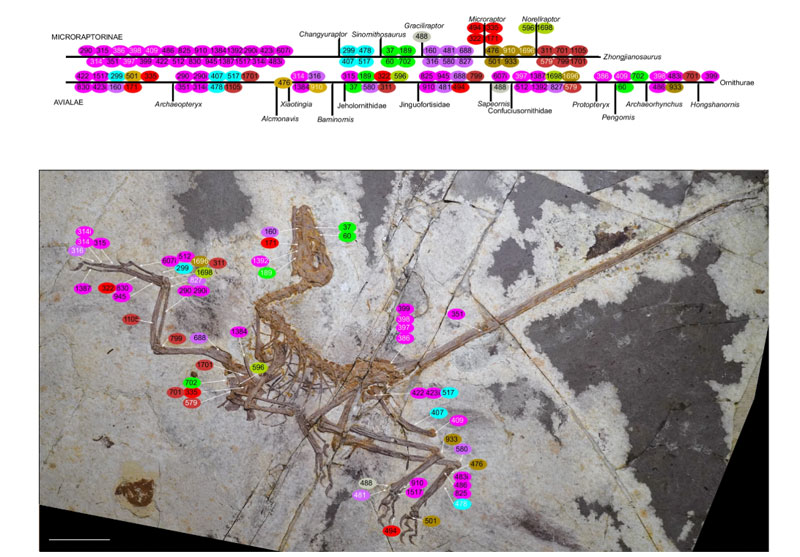
Evolutionary sequences of the derived features shared by Microraptorinae and Avialae mapped onto the Norellraptor barsboldi holotype. Picture credit: Wang et al. (2026), Nature Communications. Scale bar equals 5 cm. Reproduced with the kind permission of Dr Andrea Cau.
Picture credit: Wang et al. (2026), Nature Communications. Reproduced with the kind permission of Dr Andrea Cau
The researchers also investigated bone growth in microraptorines. Their findings suggest that these dinosaurs may have possessed distinctive patterns of limb development. Taken together, the evidence challenges the idea that birds and microraptorines inherited a common flight apparatus or followed an identical developmental programme. Instead, different evolutionary pressures may have shaped the wings and flight-related anatomy of these closely related dinosaurs.
An Important Discovery for Understanding Bird Evolution
The discovery of Norellraptor barsboldi demonstrates the importance of exceptionally preserved fossils in reconstructing evolutionary history. Although birds evolved from theropod dinosaurs, the development of flight was evidently a complex process.
Different dinosaur lineages experimented with anatomical adaptations that helped them exploit aerial environments. However, these adaptations did not necessarily evolve in the same order or serve identical functions. The new research supports the hypothesis that flight-related adaptations evolved independently in different branches of the dinosaur family tree. Further fossil discoveries and detailed investigations into dinosaur bone growth should help palaeontologists test this evolutionary scenario.
Norellraptor barsboldi provides another fascinating piece of evidence in the continuing investigation into the dinosaur origins of birds.
Everything Dinosaur acknowledges the assistance of corresponding author Dr Andrea Cau (OPHIS Museo Paleontologico e Centro Erpetologico, Teramo, Italy) in the compilation of this article.
The scientific paper: Wang, X., Ji, Y., Cau, A. et al. (2026). “Independent assembly of the flight apparatus in a non-avian dinosaur clade” published in Nature Communications, 17, 10074.
https://doi.org/10.1038/s41467-026-77804-6
The award-winning Everything Dinosaur website: Museum Quality Models of Prehistoric Animals.

Leave A Comment