

A remarkable new dinosaur discovery from South Korea has captured both scientific and public attention. Researchers have named a newly identified species Doolysaurus huhmini, inspired by a famous cartoon character loved across generations.
A Dinosaur Inspired by a Cultural Icon
The name Doolysaurus honours “Dooly”, a mischievous green cartoon dinosaur well known in South Korea. As a result, the name creates a meaningful link between science and popular culture. Lead researcher Jongyun Jung explained that the connection felt natural. The fossil represents a young individual, and the cartoon character is also depicted as a baby dinosaur. Therefore, the name is both scientifically appropriate and culturally significant.

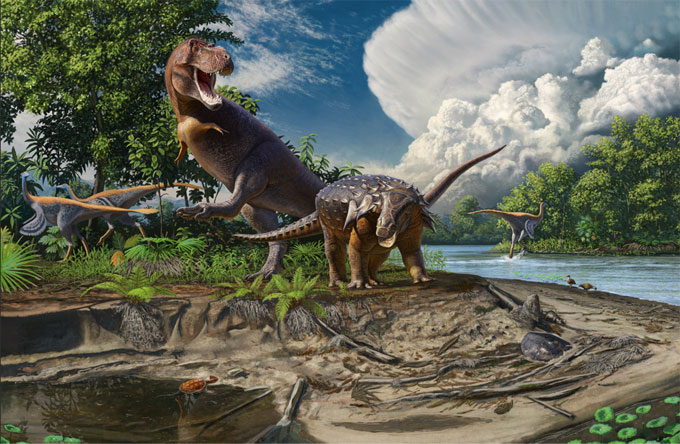
A life reconstruction of a juvenile Doolysaurus huhmini. It is depicted alongside birds and other dinosaurs that lived during the Cretaceous in what is now South Korea. Picture credit: Jun Seong Yi.
Picture credit: Jun Seong Yi
Hidden Doolysaurus huhmini Fossil Revealed by Advanced Scanning
The fossil was discovered on Aphae Island and initially appeared quite limited. Only a few leg bones and vertebrae were visible. However, everything changed once researchers used advanced micro-CT scanning technology. This technique, developed at University of Texas High-Resolution X-ray Computed Tomography Facility, allowed scientists to look inside the rock without damaging it. As a result, previously hidden skull bones and additional skeletal elements were revealed.
Importantly, this marks the first dinosaur fossil from Korea to preserve parts of the skull. Moreover, it is the first dinosaur species based on skeletal remains described from South Korea since Koreanosaurus boseongensis was named and described in 2011.
A Young Dinosaur About the Size of a Turkey
The specimen represents a juvenile dinosaur, estimated to be around two years old when it died. It measured roughly the size of a turkey. However, adults may have grown to twice that size.
Scientists identified growth markers in the femur, which confirmed its young age. In addition, the anatomy suggests that this dinosaur belonged to a group called thescelosaurids. These were small, bipedal herbivorous or omnivorous dinosaurs. Interestingly, researchers think Doolysaurus may have had a coat of fuzzy filaments. Consequently, it might have looked quite different from traditional scaly dinosaur depictions.

Study co-authors Minguk Kim (left) and Hyemin Jo during the initial discovery and excavation of Doolysaurus. Picture credit: Jongyun Jung, The University of Texas at Austin.
Picture credit: Jongyun Jung, The University of Texas at Austin
Evidence of Diet Preserved in the Fossil
The fossil also contained numerous gastroliths. These are small stones swallowed by animals to aid digestion. Their presence provides important clues to the animal’s diet. It suggests that Doolysaurus was likely an omnivore. In other words, it probably ate plants, small animals, and invertebrates. Furthermore, the gastroliths helped researchers realise that more of the skeleton might be preserved inside the rock. This insight ultimately led to the decision to scan the specimen.
The research, published in the journal Fossil Record, highlights the growing importance of CT scanning in palaeontology. This method is especially useful for small and delicate fossils. South Korea is already famous for dinosaur footprints, nests, and eggs. However, body fossils are comparatively rare. Therefore, this discovery is particularly significant.
To read Everything Dinosaur’s blog post about the discovery of fossils of an early ceratopsid dinosaur in South Korea: Koreaceratops – A Ceratopsian with a Broad Tail.
The researchers are optimistic. They believe that more hidden fossils may be waiting to be revealed using similar techniques.

The skeletal anatomy of a juvenile Doolysaurus huhmini. The graphic highlights the fossil bones that were found with the dinosaur. Known fossil bones shown in white in the skeletal drawing. Artwork: Janet Cañamar, adapted from Jung et al 2026.
Artwork: Janet Cañamar, adapted from Jung et al 2026
Looking Ahead to Future Discoveries
The team plans further fieldwork on Aphae Island and nearby locations. They hope to uncover additional specimens and expand our understanding of Korea’s prehistoric ecosystems.
As a result, Doolysaurus may be just the beginning. With continued exploration and new technology, many more discoveries could follow.

The newly discovered dinosaur species is named after the popular South Korean cartoon Dooly the Little Dinosaur. The titular Dooly is on the left. Picture credit: ⓒDoolynara.
Picture credit: ⓒDoolynara
Mike from Everything Dinosaur commented:
“This charmingly named dinosaur combines cutting-edge science with cultural storytelling. It also demonstrates how modern technology is transforming palaeontology. Most importantly, it reminds us that even well-studied regions can still yield exciting new dinosaur discoveries.”
Everything Dinosaur acknowledges the assistance of a media release from the University of Texas at Austin in the compilation of this article.
The scientific paper: “A new dinosaur species from Korea and its implications for early-diverging neornithischian diversity” by Jongyun Jung, Minguk Kim, Hyemin Jo and Julia A. Clarke published in the Fossil Record.
The award-winning Everything Dinosaur website: Dinosaur and Prehistoric Animal Models.

Leave A Comment