All about dinosaurs, fossils and prehistoric animals by Everything Dinosaur team members.
8 03, 2018

A New Straight-Tusked Elephant Model

By |2024-05-04T17:52:58+01:00March 8th, 2018|Categories: Dinosaur Fans, Everything Dinosaur News and Updates, Everything Dinosaur Products, Main Page, Photos, Photos of Everything Dinosaur Products, Press Releases|0 Comments

Eofauna Scientific Research – Straight-tusked Elephant

Eofauna Scientific Research have announced that the next figure to be added to their replica range will be a 1:35 scale replica of a Straight-tusked elephant (Palaeoloxodon antiquus).  The model is currently in production and it will be available late May, perhaps early June.

The Eofauna Scientific Research Straight-tusked Elephant

Straight-tusked elephant model.
Eofauna Scientific Research Straight-tusked elephant (Palaeoloxodon antiquus).

Picture credit: Eofauna Scientific Research

Palaeoloxodon antiquus – A Prehistoric Giant

These large prehistoric elephants ranged across much of southern Europe and the Middle East during the Pleistocene Epoch.  Their fossils have even been found in southern England and several fossil sites record the interaction of hominins with this large proboscidean.  For example, in 2013, Everything Dinosaur published an article summarising research from Southampton University that suggested that the remains of a Straight-tusked elephant found in Kent, could have been hunted and killed by Homo heidelbergensis.  The flints found at the site, along with cut marks preserved on the bones indicated that the carcass was butchered.

Perhaps H. heidelbergensis was capable of bringing down such a large mammal, evidence from elsewhere in Europe would suggest so.  In late 2017, a team of scientists published a paper describing the fossilised remains of a large bull Palaeoloxodon found in Greece that also exhibited evidence of having been butchered by ancient humans (probably H. heidelbergensis).

The Straight-tusked Elephant – It Might Have Been Hunted by Ancient Humans
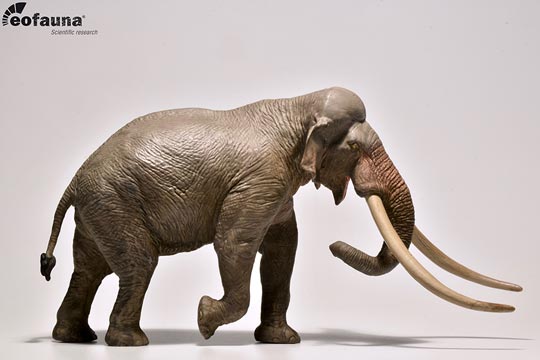
Straight-tusked elephant model.
Eofauna Scientific Research Straight-tusked elephant (Palaeoloxodon antiquus).

Picture credit: Eofauna Scientific Research

Based on Actual Fossil Specimens

Just like the Eofauna Steppe Mammoth replica that proceeded it, the  Palaeoloxodon antiquus figure from Eofauna Scientific Research is based on actual fossil specimens.  Fossils representing three individual animals formed the basis for the sculpt.

The elephant remains that helped to inspire this amazingly detailed model come from the state of Sachsen-Anhalt in central Germany.  Open cast mining in the area has led to the excavation of around seventy individual Palaeoloxodon antiquus specimens.  These remains were preserved in ancient lake deposits and they have enabled scientists to learn a great deal about these ancient herbivores.  Scientists have been able to determine the physical appearance of Palaeoloxodon, how big it was, how much it weighed and to study growth rates.  Fully grown bulls weighed twice as much as the living bush elephant (Loxodonta africana) and just like extant elephants today, the males were much larger than the females.

Visit the Eofauna section of the Everything Dinosaur website: Eofauna Scientific Research Models.

 Models Based on Actual Fossil Remains

Eofauna models (Steppe Mammoth and Straight-tusked elephant).
The Eofauna Straight-tusked elephant and the Eofauna Steppe mammoth models.

Picture credit: Eofauna Scientific Research

Everything Dinosaur – Taking a Look

Everything Dinosaur team members got the chance to examine this beautiful model a few weeks ago, when we met up with Eofauna Scientific Research staff.  We even took some exclusive pics of the figure so that when the time came, we could provide more photographs of this new addition to the Eofauna range for our customers.

Available Around Late May/Early June from Everything Dinosaur
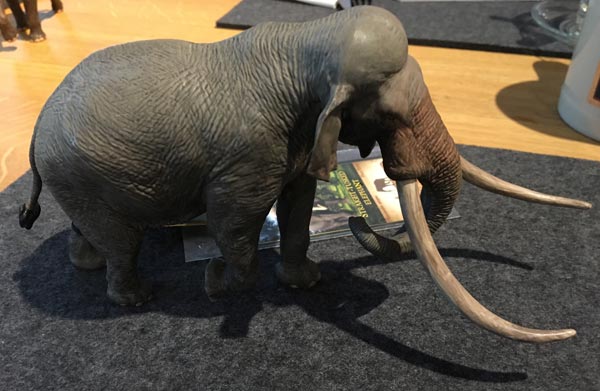
Eofauna Scientific Research Straight-tusked elephant.
Straight-tusked elephant (Palaeoloxodon antiquus) model.  It comes complete with a data card.

Picture credit: Everything Dinosaur

A Reserve List for the Eofauna Scientific Research Straight-tusked Elephant Has Been Opened

The Eofauna Scientific Research Straight-tusked elephant is expected to be in stock at Everything Dinosaur in a few weeks (in stock late May or early June).  We shall keep our customers and blog readers updated on production.

In the meantime, we have opened a priority reserve list for the Eofauna Scientific Research Straight-tusked elephant…

To request to be added to our priority reserve list: Email Everything Dinosaur.
8 03, 2018

Geological Timelines Spotted in Year 5

By |2023-05-14T10:32:53+01:00March 8th, 2018|Categories: Key Stage 1/2|Comments Off on Geological Timelines Spotted in Year 5

Year 5 Getting to Grips with Deep Time

Children in Year 5 at Oasis Academy Short Heath (Birmingham), got to grips with geological timelines as they commenced the term topic entitled “Jurassic World”.   The emphasis might be on developing vocabulary and improving writing but there was plenty of evidence of cross-curricular activities on display in the two well-appointed classrooms.

Geological Timelines

Learning About Classification and Geological Timelines

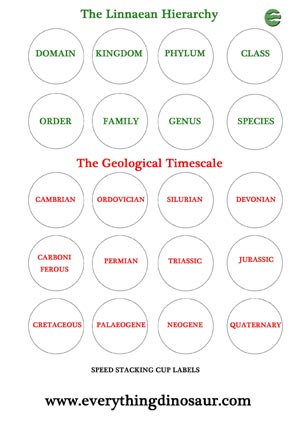
speed stacking game labels.

Learn how animals are classified, learn the geological timescale with this speed stacking game.  Picture credit: Everything Dinosaur.

Picture credit: Everything Dinosaur

Exploring the Mesozoic

The Mesozoic Era is divided into three geological periods, the Triassic, the Jurassic and the Cretaceous.  This enormous period of time in Earth’s history is sometimes referred to as the “Age of Dinosaurs”.  It was during the Mesozoic that the first dinosaurs evolved and the non-avian dinosaur extinction event marks the end of the Cretaceous.

The pupils in 5E and 5G have been compiling questions about dinosaurs that they want to research and during our dinosaur workshops with Year 5, our dinosaur expert was able to field the numerous questions that the children posed.  The eager, young scientists also explored the concept of extinction and they discovered that not all the Dinosauria are extinct.

For models and replicas of Mesozoic animals: Models, Figures and Replicas of Prehistoric Animals.

What is the Geological Timescale?

A geological timescale records intervals of immense periods of time relative to one another.  Several different geological timescales exist, each one developed using slight different datasets and interpretation methods.  These timescales, recording the history of our planet (all 4.57 billion years of it), have been revised and updated since the first timescales were produced more than two hundred years ago.

As our dating techniques and knowledge improves so these timescales get reviewed and revised.  There are several academic bodies responsible for these revisions, the British Geological Survey (BGS) and the Geological Society of America (GSA) for instance.  However, it is the International Commission on Stratigraphy that is generally responsible for ruling on any proposed changes.

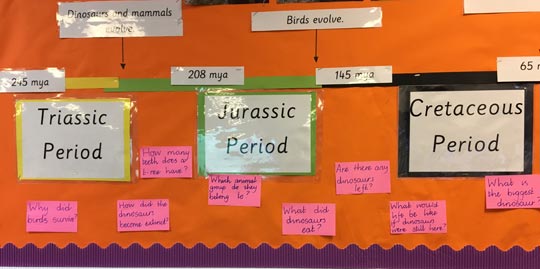
A Geological Timescale Created by Year 5 Pupils

Geological Timescale.

A geological timeline created by school pupils.

Picture credit: Oasis Academy Short Heath/Everything Dinosaur

We won’t quibble with the dates stated in the timeline sequence, for instance, the changes in our planet that mark the end of the Triassic and the beginning of the Jurassic are now dated to approximately 201.5 million years ago and not 208 million years ago, as chronicled in older text books.  Perhaps, it might be instructive for the classes to explore the current debate about the need to recognise our impact on the climate of Earth by erecting a new geological Epoch – the Anthropocene.

Visit Everything Dinosaur’s website: Everything Dinosaur.

Here are some links to blog articles that cover this debate:

The search for the start of the Anthropocene: Scientists Search for the Anthropocene Spike.

The impact of global climate change: COP21 – Global Climate Change.

7 03, 2018

Dinosaurs A Year 1 Art Project

By |2023-10-05T09:25:24+01:00March 7th, 2018|Categories: Dinosaur and Prehistoric Animal Drawings, Dinosaur Fans, Educational Activities, Main Page, Teaching|0 Comments

Year 1 Art Project Dinosaurs

Whilst searching through our extensive archives, we came across a photograph taken during one of our many visits to schools to conduct dinosaur and fossil themed workshops.  The children in a Year 1 class at Wellgate Primary have used prehistoric animal drawings to help inspire them in their art classes.  Various drawings of dinosaurs and fossils were used to help the children gain an appreciation of perspective and to learn about the influence of shading on the appearance of a drawing.  How very creative!

Dinosaurs Inspire a Year 1 Art Class

Dinosaur drawings inspire Year 1.
Super dinosaur drawings by a Year 1 class.

Picture credit: Everything Dinosaur/Wellgate Primary

Black and White Illustrations Using Dinosaurs and Fossils

The teacher instructed the children to only use pencil to shade in their drawings and not to add anything else to their illustrations.  This display formed part of an extensive collage that highlighted various painting and drawing styles, all focused on the theme of fossils and prehistoric animals.  Our dinosaur and fossil expert who visited the school to conduct a workshop, took the picture to demonstrate the creative approach to the scheme of work adopted by the teaching team with its cross-curricular touch points clearly evident.

It looks like we have some budding future palaeoartists, all the various pieces of art made a fantastic display.

Visit the Everything Dinosaur website: Everything Dinosaur.

6 03, 2018

The Remarkable Jinyunpelta sinensis – Oldest Swinger in Town

By |2024-05-04T18:01:24+01:00March 6th, 2018|Categories: Dinosaur and Prehistoric Animal News Stories, Dinosaur Fans, Main Page, Photos/Pictures of Fossils|0 Comments

Basal Ankylosaurine Dinosaur Jinyunpelta is Described

Scientists, including researchers from the Chinese Academy of Sciences have published details of a new genus of club-tailed, armoured dinosaur that roamed China around 100 million years ago.  The dinosaur has been named Jinyunpelta sinensis, it represents the first definitive ankylosaurid dinosaur from southern China.

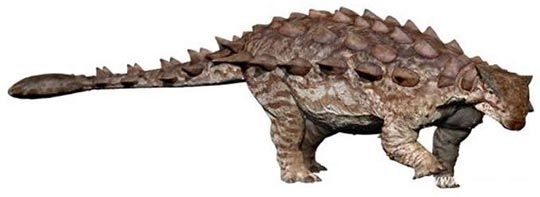
An Illustration of the Basal Ankylosaurine Jinyunpelta sinensis

Jinyunpelta sinensis illustrated.
An illustration of Jinyunpelta sinensis.

Picture credit: The Chinese Academy of Sciences

Two Fossil Specimens of Jinyunpelta sinensis

This new dinosaur, very distantly related to Late Cretaceous ankylosaurs like Euoplocephalus and Ankylosaurus (from which the group is named), has been described based on two fossil specimens.  The fossils come from Jinyun County, Zhejiang Province, China and have been excavated from rocks which form part of the Liangtoutang Formation, which covers the important boundary between Lower and Upper Cretaceous sediments (Albian faunal stage to the Cenomanian faunal stage of the Cretaceous).

The fossil material consists of an almost complete skull, parts of the jaw and postcranial remains including a beautifully-preserved tail club.

The Skull and Jaw of Jinyunpelta sinensis

The skull and mandible of Jinyunpelta sinensis.
Skull and jaw of Jinyunpelta (a) dorsal view, (b) ventral view and (c) anterior view, with accompanying line drawings.

Picture credit: The Chinese Academy of Sciences/Scientific Reports

The generic name derives from “Jinyun” (Mandarin) honouring Jinyun County where the fossils were found and “pelta” (Latin), a small shield, in reference to the osteoderms found on all ankylosaurians.  The root of the specific name “sin” (Greek) refers to China, the country of origin.

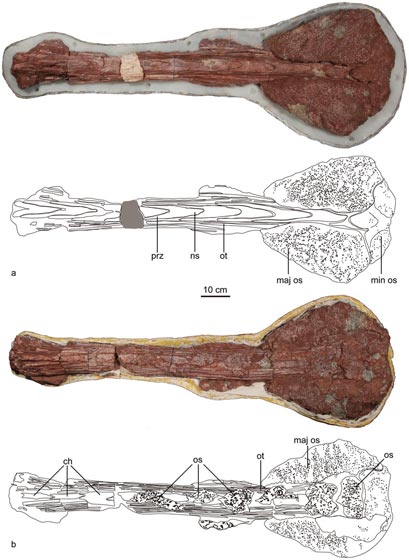
Photographs and Line Drawings of the Spectacular Tail Club

The Tail Club of Jinyunpelta sinensis.
The tail club Jinyunpelta sinensis paratype ZMNH M8963 in dorsal (a) and ventral (b) views.

Picture credit: The Chinese Academy of Sciences/Scientific Reports

The Oldest Swinger in Town

J. sinensis is described as a basal ankylosaurine dinosaur and it represents the oldest and the most basal ankylosaurian known to have a well-developed tail club knob.  It is quite a sizeable bony club too, getting on for nearly half a metre across at its widest part.  The researchers conclude that large and highly modified tail clubs evolved at the base of the ankylosaurine at least about 100 million years ago.

Jinyunpelta possesses unique cranial features which differentiates this Chinese dinosaur from other armoured dinosaurs known from the northern hemisphere, these autapomorphies support the establishment of a new genus.  Several other types of ornithischian dinosaur have been reported from this part of China, including another armoured dinosaur – a  nodosaur and basal ornithopod that was named and described in 2012 (Yueosaurus tiantaiensis)

The discovery of Jinyunpelta expands the known diversity and palaeogeographical distribution of ankylosaurians in Asia.

The scientific paper: “The Most Basal Ankylosaurine Dinosaur from the Albian–Cenomanian of China, with Implications for the Evolution of the Tail Club” by Wenjie Zheng, Xingsheng Jin, Yoichi Azuma, Qiongying Wang, Kazunori Miyata & Xing Xu published in the open access journal “Scientific Reports”.

Visit the Everything Dinosaur website: Everything Dinosaur.

5 03, 2018

Watching the Beautiful Birdie – Early Cretaceous

By |2024-05-04T17:53:36+01:00March 5th, 2018|Categories: Dinosaur and Prehistoric Animal News Stories, Dinosaur Fans, Main Page, Palaeontological articles, Photos/Pictures of Fossils|0 Comments

Early Cretaceous Enantiornithine Shines Light on Early Bird Evolution

A tiny, beautifully preserved fossil of a baby bird is helping scientists to shine a light on the early evolution of some of the first birds.  The fossil represents an enantiornithine bird and researchers, including Dr Fabien Knoll (Manchester University), have used synchrotron radiation to analyse the microscopic structure of the bird’s skeleton in order to assess at what stage of development the poor creature was at when it met its demise.

An Elemental Map of the Fossilised Skeleton was Created using Synchrotron Radiation

The enantiornithine bird fossil (elemental mapping).
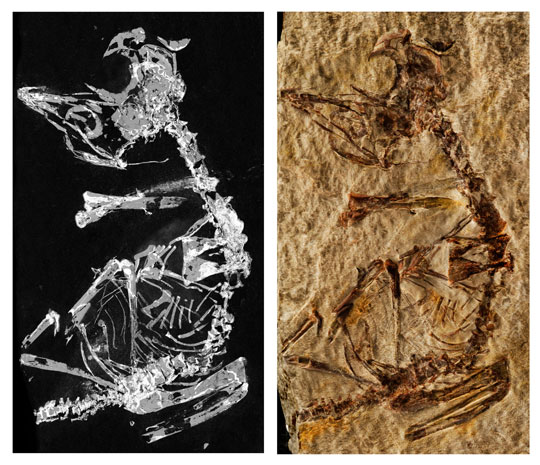
Elemental mapping of the tiny bird fossil.  Mapping the slab and the counter slab of the fossil to determine the chemical composition of the skeleton.

Picture credit: Manchester University

The Enantiornithes – Early Birds

The Enantiornithes were a clade of diverse Cretaceous birds that possessed several characteristics of modern birds (Neornithines) but were also anatomically different in a number of respects.  They retained claws on their wings and most species had teeth, in contrast to all modern Aves which are edentulous.  Despite having an almost global distribution and being regarded as the most specious and successful birds of the Cretaceous, the Enantiornithes are thought to have become extinct at the same time as the last of the non-avian dinosaurs.

A study published in 2016 proposed that the evolution of a toothless beak may have helped some types of birds to survive the end Cretaceous mass extinction event.  To read an article summarising the study’s findings: Seed Eating May Have Helped Some Birds Survive the End Cretaceous Extinction Event.

The Enantiornithine Bird – One of the Smallest Mesozoic Avian Fossils Described

The specimen preserved on a slab and counter slab is one of the smallest Mesozoic bird fossils to have been found to date.  The specimen measures less than five centimetres in length and the baby bird would have been able to sit in an egg-cup.  However, it is remarkably well-preserved and the skeleton is virtually complete and what makes this fossil so significant is the fact that the baby bird died shortly after emerging from its egg.

The poor, unfortunate bird might have had an extremely short life, but it has given researchers a rare opportunity to analyse a baby bird’s bone structure and assess its skeletal development.

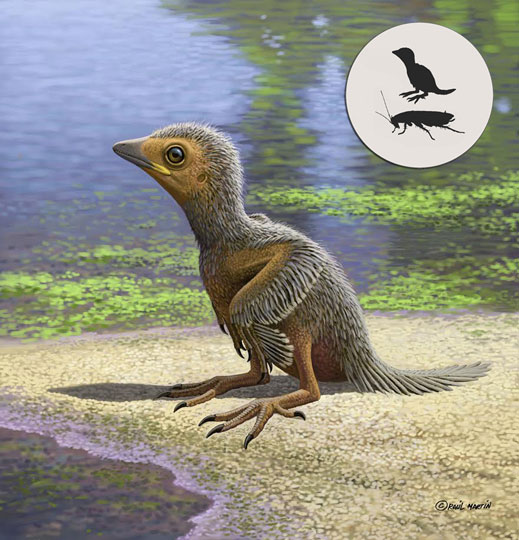
A Reconstruction of the Cretaceous Bird

A reconstruction of the baby Cretaceous bird.f
A reconstruction of the enantiornithine baby bird with insert showing scale.

Picture credit: Raul Martin

Assessing Bone Structure and Development

The scientists have been able to study the ossification of the bones, how they were growing and developing.  A better understanding of the skeleton of the very young bird will help researchers to better understand whether this bird species was capable of flight soon after birth and how independent it was.

Lead author of the study, Dr Fabien Knoll (Interdisciplinary Centre for Ancient Life [ICAL] at the School of Earth and Environmental Sciences, Manchester University) and the ARAID Dinopolis in Spain stated:

“The evolutionary diversification of birds has resulted in a wide range of hatchling developmental strategies and important differences in their growth rates.  By analysing bone development, we can look at a whole host of evolutionary traits.”

Lead Author of the Study Dr Fabien Knoll Prepares the Specimen for Analysis

Dr Knoll (Manchester University) studying the enantiornithine bird fossil.
Dr Fabien Knoll studying the slab and counter slab of the bird fossil.

Picture credit: Manchester University

Altricial, Precocial or Somewhere in Between

As the fossil was so small, being less than the length of the average person’s little finger, the team used synchrotron radiation to analyse the specimen at a “submicron” level.  The skeleton could be assessed in extreme detail and the microstructures of the bones observed.

Dr Knoll explained:

“New technologies are offering palaeontologists unprecedented capacities to investigate provocative fossils.  Here we made the most of state-of-the-art facilities worldwide including three different synchrotrons in France, the UK and the United States.”

New Technology Helps to Map the Elemental Composition of an Ancient Bird Fossil

Phosphorous mapping and a photograph of the fossil.
A phosphorous map of the bird skeleton and photograph of the fossil.  The fossil is around 127 million years old (Early Cretaceous).

Picture credit: Manchester University

Synchrotron Analysis

The synchrotron analysis determined that the baby bird’s sternum (breastplate bone) was largely composed of cartilage and had not completely ossified.  The absence of hard bone in the sternum suggests that this bird could not fly.  The patterns of ossification observed in this and the other few, very young enantiornithine birds known to date also suggest that the developmental strategies of this particular group of ancient avians may have been more diverse than previously thought.

The researchers remain cautious and don’t wish to definitively come down on one side of the argument in terms of how dependent/independent this baby bird could have been.  The lack of bone development does not necessarily prove that the hatchling was reliant on its parents for feeding and care (altricial trait).

Bird Evolution

Modern birds demonstrate a variety of behavioural responses when it comes to bringing up babies.  Some bird species like chickens and ostriches have highly precocial young.  The babies are able to leave the nest and feed themselves within hours of hatching.  In contrast, most of the passerines (song birds) such as robins, blackbirds and thrushes are helpless when they hatch and rely on their parents to feed them and to keep them warm.

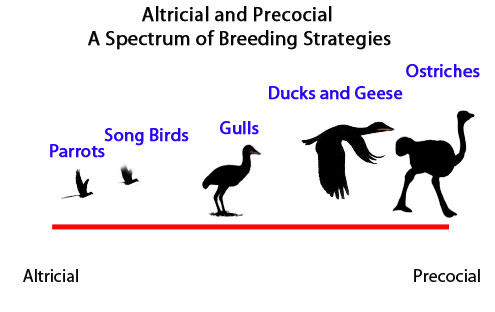
Altricial and precocial behaviours tend to be at opposite ends of a spectrum, the breeding strategy employed by this enantiornithine remains obscure.  As extant Aves exhibit a variety of breeding strategies from totally altricial through to super precocial (such as the megapodes, an example being the Australian brush turkey), it is difficult to clarify the development strategy of any extinct species.

Altricial and Precocial Behaviours can be Viewed as Opposite Ends of a Spectrum

Birds - altricial and precocial behaviours.
Altricial and precocial behaviours in Aves – a spectrum. Picture credit: Everything Dinosaur.

Picture credit: Everything Dinosaur

Co-author of the study, Luis Chiappe (Los Angeles Museum of Natural History) added:

“This new discovery, together with others from around the world, allows us to peek into the world of ancient birds that lived during the age of dinosaurs.  It is amazing to realise how many of the features we see among living birds had already been developed more than 100 million years ago.”

Everything Dinosaur acknowledges the assistance of a press release from Manchester University in the compilation of this article.

Visit the Everything Dinosaur website: Everything Dinosaur.

5 03, 2018

Fascinating Facts About Dinosaurs

By |2024-05-04T18:01:49+01:00March 5th, 2018|Categories: General Teaching, Key Stage 1/2|Comments Off on Fascinating Facts About Dinosaurs

Dinosaur Facts

A visit to a school in the chilly south of the country to work with four groups of Year 4 children who have just started their topic for the second half of the Spring Term.  The spacious and well-appointed classrooms already had some dinosaur themed work on display.  Our fossil expert spotted a display board with some A4-sized print outs that had been posted up.  One of the Learning Support Assistants (LSA’s), explained that the facts had been pinned up in a diagonal shape, this would permit the children to look at the published facts, research whether they were accurate or not and post up their own findings either above or below.

Testing Dinosaur Facts (Published Facts About Dinosaurs)

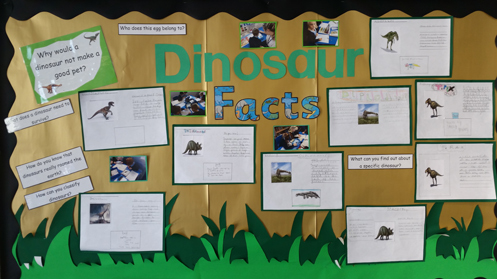
A Colourful Dinosaur wall display. Facts about dinosaurs.
Everything Dinosaur team members are always impressed by school displays that feature dinosaurs and fossils. For example, these pupils produced a colourful dinosaur wall display during their term topic studying prehistoric animals. Picture credit: Everything Dinosaur

Picture credit: Everything Dinosaur/LHPA

Visit the Everything Dinosaur website: Everything Dinosaur.

Encouraging Independent Enquiry

The children were being challenged to conduct their own independent research to test the validity of the statements on the print outs.  Could they uncover evidence to either support or refute the statements (facts)?  The eager, young palaeontologists could then post up their responses either above or below the statements, the position on the wall indicating how much they agreed with the statement or how much they disagreed with the statement following their independent enquiries.  This would provide a visual display as well as giving a valuable lesson in working scientifically.

The Year 4 classes were being challenged to look for evidence, assess the validity of the evidence and either to support or refute the statements that had been posted up.

Facts About Dinosaurs

We wish the young scientists well with their endeavours, our fossil expert chatted to many of the children over the course of the day.  They were all enjoying their dinosaur and prehistoric animal term topic and many of the children already possessed a lot of knowledge about dinosaurs.  One confident learner explained in remarkable detail how the dinosaurs (non-avian dinosaurs), became extinct.

An eager dinosaur fan even asked could we come back when she was in Year 5?

For further information about Everything Dinosaur’s science outreach work: Email Everything Dinosaur.
4 03, 2018

Celebrating 300 Unique School Blog Posts

By |2024-05-04T17:54:10+01:00March 4th, 2018|Categories: General Teaching|Comments Off on Celebrating 300 Unique School Blog Posts

Everything Dinosaur Celebrates 300 School Blog Posts

Everything Dinosaur team members have posted up 300 articles onto their school blog!  Since we started this special “dinosaurs for schools” blog site, highlighting examples of excellent teaching and helping schools deliver lessons about dinosaurs, fossils, extinction and life in the past, we have steadily built up our collection of blog posts.  Today, we mark reaching the achievement of posting up number 300!

Everything Dinosaur Team Members Celebrate the Achievement of Reaching Blog Post Number Three Hundred

Everything Dinosaur dinosaur themed educational resources.
Teaching tips, articles, resources and free downloads. Picture credit: Everything Dinosaur.

Picture credit: Everything Dinosaur

A Thank You from Everything Dinosaur

A special thank you to all the contributors who sent letters, drawings and other amazing prehistoric animal-themed items into our offices.  A big thanks to all the teachers, learning support assistants, senior leadership team members and parents who gave their permission for us to post up examples of children’s work.  We look forward to posting up another 300 articles featuring the various activities and extensions that come out of our dinosaur and fossil workshops.  A big thank you to all our “dinosaurs for schools” blog readers too, we really do appreciate all the feedback and comments that we receive and yes, we do read them all and we respond to all those that require a reply.

Next week, we have more dinosaur workshops to deliver and our team members have volunteered to answer questions about dinosaurs compiled by children in a Reception class located in North Wales, it should be another exciting and fascinating week at Everything Dinosaur.
Visit the award-winning, user-friendly Everything Dinosaur website: Everything Dinosaur.
4 03, 2018

Celebrating 4,000 Unique Blog Posts

By |2024-05-04T18:02:19+01:00March 4th, 2018|Categories: Adobe CS5, Dinosaur Fans, Everything Dinosaur News and Updates, Main Page, Press Releases|0 Comments

Everything Dinosaur Reaches Landmark of 4,000 Blog Posts

Team members at Everything Dinosaur are celebrating the landmark of having achieved 4,000 blog posts.  Since our first article was posted up in May 2007, a lot has happened in the world of palaeontology and the Earth sciences in general.  We have done our best to update readers on these exciting developments, covering news stories, fossil discoveries, new dinosaurs, updates on extinction theories, breakthroughs in the use of research technologies and so much more.

For model collectors and dinosaur fans, we have seen entire ranges come and go and just like the study of the Dinosauria, which is often thought of being in a golden age of discovery, so collectors of models seem to be in a golden age when it comes to prehistoric animal replicas and figures.

Everything Dinosaur Celebrates Posting Up 4,000 Blog Articles

4,000 articles on the Everything Dinosaur blog.
Everything Dinosaur celebrates posting up 4,000 blog articles.  Picture credit: Everything Dinosaur.

Picture credit: Everything Dinosaur

Everything Dinosaur – Our First Thank You

A very big thank you to all the researchers, press officers, undergraduates, university professors, field team members, media companies, professional palaeontologists, dedicated fossil collectors, teachers, manufacturers, scientists and prehistoric animal fans who have shared stories with us so that we can post them up on this weblog.  We really do appreciate all the help and assistance that we have had along the way.

Our Iguanodon Gives Everyone a Big Thumbs Up!

Iguanodon thumbs up!
Praise from a dinosaur!  A big thank you to all our contributors and to our readers. Picture credit: Everything Dinosaur.

Picture credit: Everything Dinosaur

Our Second Thank You

Also, a very big thank you to all our readers, feedback providers, reviewers, commentators, email senders, letter writers, picture takers and so forth that have helped keep our blog so fresh, vibrant and diverse.  We will continue to strive to bring you updates on research, information on new discoveries and photographs of fossils and other amazing wonders.  Next week’s blog postings are already in place, we can’t give too much away at this time as a number of them have embargoes, but what we can say is that the next few posts will reflect the aims and objectives of our weblog, to educate, inform and indulge fans of dinosaurs and prehistoric animals.

Everything Dinosaur Working with Major Universities

One article scheduled for release next week has been written with the co-operation of the University of Manchester, it covers research into an aspect of Cretaceous theropod behaviour.  Another article prepared and ready for adding in the next few days has been compiled in collaboration with Eofauna Scientific Research, we will be announcing the next prehistoric animal figure in this exciting, new model range.  We will also be posting up some exclusive photographs of the new Eofauna Scientific Research model.

To view the Eofauna range of prehistoric animal figures: Eofauna Scientific Research Models.

Wonder what exciting scientific developments, discoveries and new products we will be covering in the next 1,000 posts?

Visit the user-friendly Everything Dinosaur website: Everything Dinosaur.

3 03, 2018

Schleich New Models for 2018 (July)

By |2023-10-03T07:05:56+01:00March 3rd, 2018|Categories: Dinosaur Fans, Everything Dinosaur News and Updates, Everything Dinosaur Products, Main Page, Photos of Everything Dinosaur Products|0 Comments

Schleich New Models for 2018 (July)

At the end of last month, Everything Dinosaur posted up information summarising the retirements from the Schleich range of prehistoric animal models.  The Germany-based figure and replica manufacturer has announced a number of retirements and several dinosaur models are now out of production.  However, Schleich has already introduced five new figures into their “Dinosaurs”* range in 2018 and Everything Dinosaur is aware of plans to add a further three models in the summer.

“Dinosaurs”* – the prehistoric animal figures produced by Schleich come under the sub-brand of “Dinosaurs” although this part of their range also includes several non-dinosaurs such as Dunkleosteus, the new for 2018 Dinogorgon (see picture below) and Dimetrodon.  The exact taxonomic position of Herrerasaurus remains controversial but for the time being we include this Triassic carnivore within the theropod dinosaur Suborder.

Five New Schleich Figures Were Introduced in Early 2018

New Schleich prehistoric animals (2018).
New Schleich prehistoric animal models (2018).

To read Everything Dinosaur’s recent article about Schleich retirements: Prehistoric Animal Model Retirements from Schleich.

Three New Large Prehistoric Animal Models for Summer 2018

As stated previously on this blog, Schleich intend to bring out three large prehistoric animal figures in the summer of 2018.  We are expecting our first deliveries around July, the models could arrive a little earlier, perhaps a little later, but three new Schleich replicas are expected in the summer.

The Schleich Juvenile Tyrannosaurus rex

Schleich T. rex juvenile.
The Schleich Tyrannosaurus rex juvenile. Picture credit: Everything Dinosaur.

Picture credit: Everything Dinosaur

Schleich will also be bringing out a juvenile Therizinosaurus, with a similar colouration to the red/black adult Therizinosaurus figure that was introduced a few weeks ago.

A Schleich Juvenile Therizinosaurus Figure Due Out in Summer 2018

Schleich juvenile Therizinosaurus.
Schleich juvenile Therizinosaurus model. Picture credit: Everything Dinosaur.

Picture credit: Everything Dinosaur

The Schleich Juvenile Therizinosaurus

The Schleich juvenile Therizinosaurus looks a very fearsome beast indeed.  There may also be a number of colour variants of existing Schleich models introduced, a blue coloured Psittacosaurus and a sandy coloured Herrerasaurus for example, if we get further information from Schleich about product developments we will post it up on this blog and on our social media platforms to help keep all our customers informed.

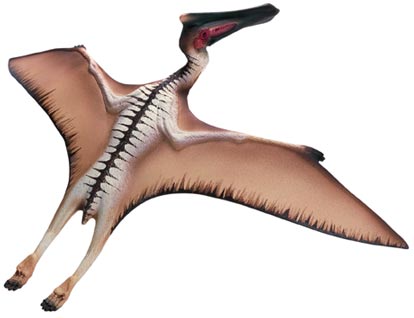
The third figure due to be introduced next summer is a colourful Pteranodon.  Schleich will be adding to their pterosaur portfolio by adding a Pteranodon longiceps figure to their range.   This is good news as the future of the “World of History” Quetzalcoatlus looks uncertain and this model may well be retired.

The Schleich Pteranodon Model – Close-up View of the Head

Schleich Pteranodon replica.
Schleich Pteranodon model.  Due to be flying high in the summer of 2018. Picture credit: Everything Dinosaur.

Picture credit: Everything Dinosaur

The Schleich Quetzalcoatlus Model – Heading for Extinction?

Schleich Quetzalcoatlus model.
Schleich Quetzalcoatlus model due for retirement?

The Schleich Quetzalcoatlus (pictured above), was introduced in 2011, the bizarre wing markings caused a bit of a “flap” when it was first introduced and many collectors and model fans commented that the “Saurus” Quetzalcoatlus (pictured below), had more realistic wings.  If the Quetzalcoatlus figure is withdrawn, then perhaps Schleich will consider adding a new flying reptile model to its range over the next couple of years or so.

To read Everything Dinosaur’s original 2011 article about the arrival of a controversial Quetzalcoatlus figure: Schleich Quetzalcoatlus Causing a Flap.

The “Saurus” Quetzalcoatlus Figure

Schleich "Saurus" Quetzalcoatlus model.
A more conventional pterosaur model?

View the range of Schleich prehistoric animal figures available from Everything Dinosaur: Schleich Prehistoric Animal Models.

To read Everything Dinosaur’s recent article about the summer 2018 models from Schleich: New Schleich Prehistoric Animals (Summer 2018).

2 03, 2018

What’s Your Favourite Dinosaur Book? A Great Question

By |2024-05-04T18:02:44+01:00March 2nd, 2018|Categories: General Teaching|Comments Off on What’s Your Favourite Dinosaur Book? A Great Question

What is Your Favourite Book About Dinosaurs?

Writing about our favourite dinosaur book.

Yesterday, was World Book Day, an opportunity to celebrate books, authors, illustrations and the joy of reading.  For part of the day team members were tweeting and re-tweeting the various pictures put up on social media that highlighted the numerous activities taking place at schools that we had recently visited to deliver dinosaur workshops.  We received lots of emails and we responded to all those that required a reply, praising the efforts of the children, teachers and other grown-ups who had worked so hard to make World Book Day memorable.

In one of the email that we received, we were asked to nominate our favourite book about dinosaurs.

Our Nominated Favourite Dinosaur Book (Childhood Favourite)

favourite dinosaur book.
Beautiful dinosaur book. Picture credit: Everything Dinosaur.

Picture credit: Everything Dinosaur

Favourite Dinosaur Book

Choosing a favourite dinosaur book from our substantial collection was quite hard.  However, after much deliberation we chose “Dinosaurs and Other Prehistoric Reptiles”.  This publication was first put into print in the mid 1960’s, the text by Jane Werner Watson guides the reader through geological time and focuses on the rise of the dinosaurs.  The illustrations are by Rudolph F Zallinger and they are beautiful, although like the few facts in this book, they are now hopelessly inaccurate and out of date.  Zallinger painted wonderfully detailed landscapes, populated by dinosaurs and other prehistoric creatures.

We love the small details in Zallinger’s paintings, the tiny mammal appearing next to the giant Triceratops, the beautifully crafted plants and the woodland that forms the backdrop to a dramatic illustration of Ornitholestes attempting to catch Archaeopteryx.  We know that Ornitholestes and Archaeopteryx lived in different parts of the world, but as children this book really captured our imaginations and helped to fuel a life-long fascination with ancient animals, fossils and life in the past.

The Joy of Reading – Browsing Books

Browsing books.
Time for browsing at the Frankfurt Book Fair.

Picture credit: The Frankfurt Book Fair Press

Visit the Everything Dinosaur website: Everything Dinosaur.

Go to Top