All about dinosaurs, fossils and prehistoric animals by Everything Dinosaur team members.
17 03, 2018

“Attenborough’s Sea Dragon” on Display

By |2023-10-07T06:29:53+01:00March 17th, 2018|Categories: Dinosaur and Prehistoric Animal News Stories, Main Page, Photos/Pictures of Fossils|0 Comments

Ichthyosaur Specimen on Display at Charmouth Heritage Coast Centre

The fossilised remains of a new species of ichthyosaur are on display at the Charmouth Heritage Coast Centre for the rest of this year.  The Centre, based on the famous Jurassic coast of Dorset, will be home to the partial skeleton of a four-metre-long, new species of “fish lizard”, it’s discovery and excavation was documented in a BBC television programme shown back in January.

The New Ichthyosaur Display at the Charmouth Heritage Coast Centre
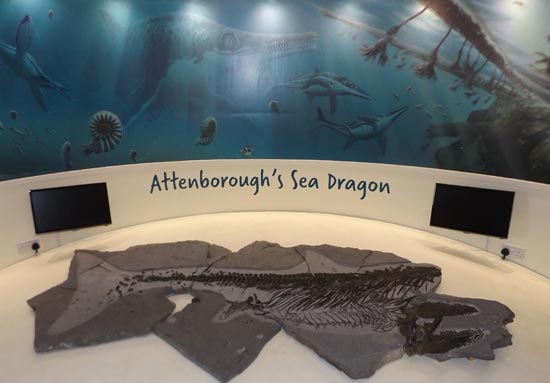
Ichthyosaur specimen on display.
The “Sea Dragon” fossil on display.  The head of the specimen has been lost, it probably was eroded out of the cliff face prior to Chris Moore’s discovery.

Picture credit: Charmouth Heritage Coast Centre

The Tale of a Sea Dragon

Narrated by Sir David Attenborough, the programme told the story of the fossil’s discovery by experienced local collector Chris Moore.  Chris along with a team of climbing experts and geologists spent weeks excavating the rock containing the creature by hand from a Dorset cliff.  The headless skeleton, that even retained evidence of ichthyosaur skin, was transported by boat back to Lyme Regis so that the matrix covering the bones could slowly be removed and full details of the 200-million-year-old specimen revealed.

To read Everything Dinosaur’s article about the BBC documentary: Attenborough and the Sea Dragon.

Experts from Southampton and Bristol Universities studied and analysed the skeleton as well as the exceptionally well-preserved skin still on the bones.  They identified it as a new species of ichthyosaur, probably an animal of the open ocean that for some reason had come closer to the shore, where, in the coastal waters, it was attacked and killed by a much larger animal.  The palaeontologists, preparators and researchers had a murder scene on their hands.  In the television programme, a CGI version of the unfortunate marine reptile was created and its final moments re-enacted, an attack by a super predator, one of the most dangerous animals on the planet during the Early Jurassic – a ferocious Temnodontosaurus.

Everything Dinosaur’s Illustration of Temnodontosaurus
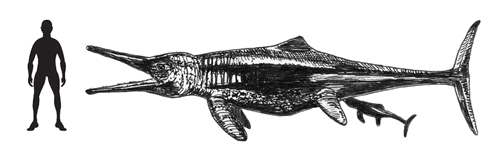
Scale drawing of Temnodontosaurus.
Temnodontosaurus scale drawing (T. platyodon) shown giving birth. Picture credit: Everything Dinosaur.

Picture credit: Everything Dinosaur

For models and replicas of ichthyosaurs and other marine reptiles: CollectA Prehistoric Life Models.

Attacked by a Much Larger Ichthyosaur

As the fossilised skeleton was slowly but surely revealed, damaged vertebrae and broken ribs provided evidence of an attack by a much bigger marine reptile.  The assailant was probably a Temnodontosaurus, one of the largest of the Ichthyosauria, capable of growing to around ten metres in length with a body mass estimated at approximately two tonnes.  The attacker did not get its prize, the researchers speculated that the initial bite on the unfortunate victim, punctured the animal’s body cavity releasing air from the lungs and the ichthyosaur’s body descended into the deep.

The body of the ichthyosaur descended rapidly and it was soon out of the diving range of the attacker, coming to rest on the seabed.  The corpse was rapidly covered by fine sediment and fossilisation eventually took place, two hundred million years later, fossil hunter Chris Moore spotted part of the skeleton eroding out of a cliff and the process of excavating the specimen was begun.

Chris Moore (Foreground) with Sir David Attenborough and Sally Thompson (Producer/Director of the Television Documentary)
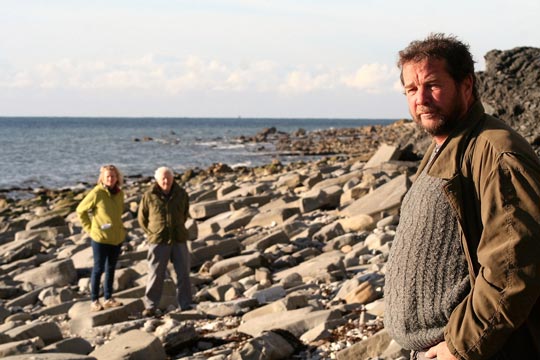
Chris Moore on the Dorset Coast
Chris Moore (foreground) with television programme director/producer Sally Thompson and Sir David Attenborough (background).

Picture credit: Charmouth Heritage Coast Centre

Sea Dragon Tale Narrated by Sir David Attenborough

Veteran naturalist, life-long fossil collector and highly esteemed broadcaster, Sir David Attenborough explained in the hour-long programme:

“It’s been a fascinating journey of discovery, but for me the real wonder is the bones themselves.  It is a long time spent just revealing the body of this creature, but it’s also revealed this extraordinary story of life and death, predator and prey fighting it out in the seas 200 million years ago, just down there (at the beach).”

Team members from Everything Dinosaur are hoping to visit the exhibit at the Charmouth Heritage Coast Centre when they will be working on the Dorset coast in the autumn.

As the BBC television programme drew to a close, Sir David Attenborough remarked:

“For Chris [Chris Moore], this has been a labour of love and its filled in another gap in the palaeontological jigsaw.  A story that all started with an odd-looking boulder on a Dorset beach.  It’s extraordinary to think that some 200 million years ago exactly here, the greatest predator of its time was swimming around in the sea, and that’s what I love about fossils and fossil hunting, it gives you an extraordinarily vivid insight into what the world was like millions of years before human beings even appeared on this planet.”

Attenborough’s Sea Dragon is on display at Charmouth Heritage Coast Centre throughout 2018.

For further information on the Charmouth Heritage Coast Centre: Charmouth Heritage Coast Centre.

Visit the award-winning Everything Dinosaur website: Everything Dinosaur.
16 03, 2018

“Beast from the East” Does Not Stop Dedicated Fossil Hunters

By |2023-10-07T06:37:03+01:00March 16th, 2018|Categories: Dinosaur Fans, Main Page, Photos/Pictures of Fossils|0 Comments

Irregular Sea Urchins in Unseasonable Weather

The area of the Dorset coast around Lyme Regis and Charmouth is often said by locals to experience its very own microclimate.  Everything Dinosaur team members have experienced this phenomenon for themselves, it can be raining very heavily inland at Axminster but on the coast, it can be a dry and sunny.  However, when the “Beast from the East” affected most parts of the UK recently, the Lyme Regis area had its fair share of bad weather.

Cold Snap Does Not Deter Fossil Hunters

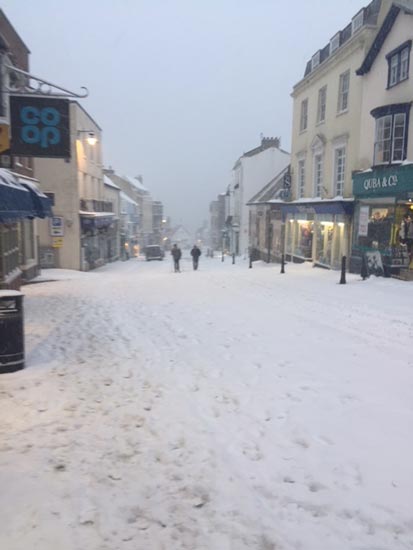
Our fossil hunting chum, Brandon Lennon took a photograph of Lyme Regis high street as the cold snap hit.  Brandon commented that shoppers were taking to skis to ensure that they could traverse the steeply sloping terrain.

The “Beast from the East” Made Its Presence Felt on the Dorset Coast

Snowy conditions in Lyme Regis
Lyme Regis high street covered in snow.

Picture credit: Brandon Lennon

Fossil Collecting in the Snow

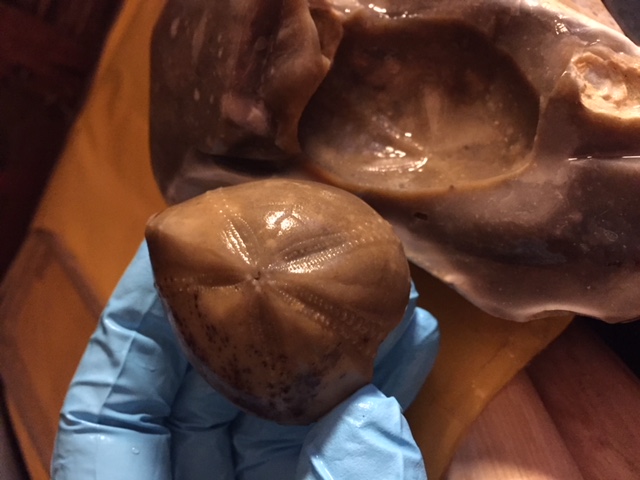
Fossil hunting in the snow is difficult but not impossible.  With the treacherous road conditions, most fossil collectors who would have had to travel into the Lyme Regis area by car, sensibly postponed their journeys.  This meant that local fossil hunters had the beaches to themselves for as long as the inclement weather persisted.  Several calcite ammonites were collected from the East Cliff Beach (heading towards the small village of Charmouth).  Brandon found some beautiful fossil sea urchins (irregular echinoderms) whilst exploring Monmouth Beach, to the west of the Cobb.  It may have been cold and the beaches were almost deserted but some exciting fossil discoveries could still be made.

A Beautiful Cretaceous Echinoderm Fossil Extracted from a Flint Nodule

Echinoderm fossil (Lyme Regis).
A sea urchin fossil extracted from a flint nodule.

Picture credit: Brandon Lennon

For replicas of fossils: Everything Dinosaur Learning Section of our Website.

A Mini “Beast from the East”

The weekend promises a “mini Beast from the East” to hit the UK.  More snow could fall in the Lyme Regis area, however, we don’t think it will be enough to dissuade the dedicated fossil hunters of Dorset from visiting the beaches to see what they can find.

Everything Dinosaur recommends that visitors to the Lyme Regis area interested in collecting fossils, go on an organised fossil walk.  This is the safest way to explore the beaches around the town of Lyme Regis, as the sea can cut-off unwary beachcombers and cliff falls are common in the area.

For information about organised fossil walks: Brandon Lennon Fossil Walks.

Visit the Everything Dinosaur website: Everything Dinosaur.
16 03, 2018

Investigating Fossils an Exciting and Fun Activity

By |2024-05-10T07:33:08+01:00March 16th, 2018|Categories: Key Stage 1/2|Comments Off on Investigating Fossils an Exciting and Fun Activity

Fossil Investigation – Learning About Mary Anning

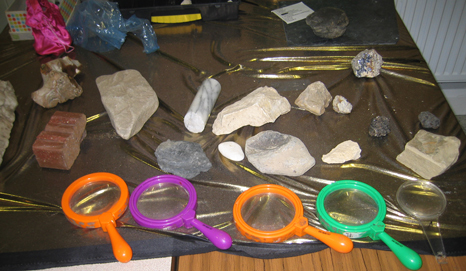
Our dinosaur expert spotted a very busy fossil investigation table whilst on a visit to Altrincham Preparatory School to work with the two classes of Year 1 children who are currently studying dinosaurs and investigating fossils.  The boys have been learning all about the life and work of Mary Anning and most of the fossils on display came from the Lyme Regis (Dorset) area which is where Mary lived.

A Fossil Investigation Table

Rocks and fossils to explore.
A very full “rock table”. Picture credit: Everything Dinosaur.

Picture credit: Everything Dinosaur

Mary Anning Themed Extension Resources

After an exciting morning of dinosaur and fossil workshops, our team member returned to the office and prepared additional themed extension materials that were then emailed over to the school.  Having been comprehensively briefed by the dedicated and enthusiastic Year 1 teaching staff, we were able to provide a non-chronological report compiling exercise that involved the boys researching the story of Mary Anning and learning about some of her fossil discoveries.  In addition, we were able to send over some pictures and drawing materials of prehistoric animals that once thrived in the seas and oceans of the Mesozoic.  After all, the rocks along the Dorset coast around Lyme Regis were all formed in marine conditions.

To enquire about Everything Dinosaur’s outreach work: Email Everything Dinosaur.

The Mary Anning Non-chronological Report Exercise Prepared for the School

Mary Anning Non-chronological report. Investigating fossils.
A non-chronological report exercise based on the life and work of Mary Anning. Picture credit: Everything Dinosaur.

Picture credit: Everything Dinosaur

Investigating Fossils

An Example of One of the Marine Reptile Drawings Sent to the School

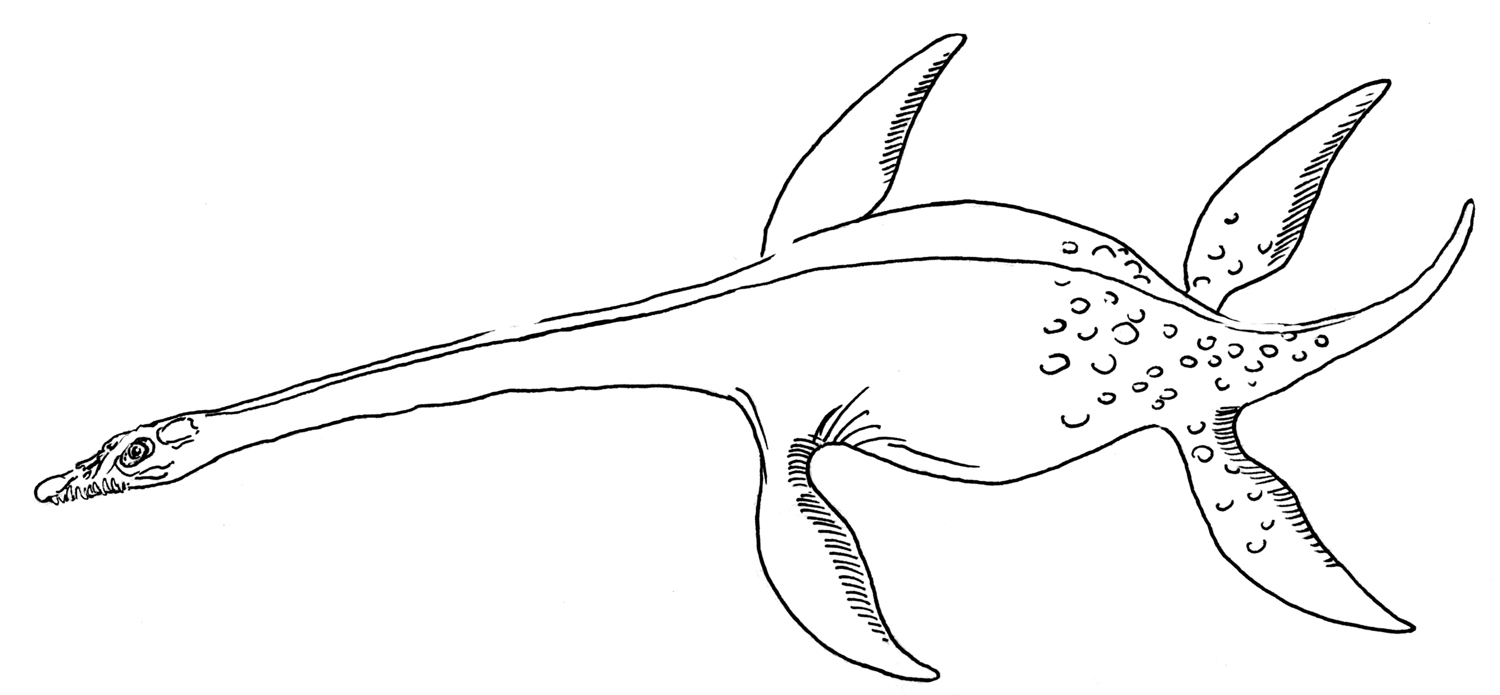
Attenborosaurus conybeari.
Plesiosaurs and other prehistoric animals featured in the lesson plan. Picture credit: Everything Dinosaur.

Picture credit: Everything Dinosaur

We look forward to seeing the prehistoric marine seascapes that the pupils create.  Perhaps they will be put up on display in the well-appointed classrooms, if so, we might receive a picture of the boy’s artwork which we can share on our various social media sites.

Visit the Everything Dinosaur website: Everything Dinosaur.
15 03, 2018

New Study Suggests Pterosaurs More Diverse at the End of the Cretaceous than Previously Thought

By |2024-02-25T07:59:51+00:00March 15th, 2018|Categories: Dinosaur and Prehistoric Animal News Stories, Dinosaur Fans, Main Page, Photos/Pictures of Fossils|1 Comment

Getting to Grips with Six New Species of Pterosaurs

The Pterosauria, that Order of winged reptiles that thrived alongside the dinosaurs were thought to have had their heyday in the Early Cretaceous. Only a single family, the Azhdarchidae (several of whom were giants), was known from the very end of the Cretaceous (Maastrichtian faunal stage).  Many palaeontologists had thought that these flying reptiles, the first vertebrates to evolve powered flight, had gone into gradual decline, slowly but surely displaced by those rapidly evolving new masters of the air, the birds.

The Diversity of the Pterosaurs in the Late Cretaceous

However, a scientific paper, published this week in the academic journal “PLOS Biology”, challenges this view.  A total of six new species, representing three families of pterosaurs have been discovered in Late Cretaceous (Maastrichtian) rocks in Morocco.  This new discovery, the most diverse Late Cretaceous pterosaur fossil assemblage found to date, suggests that the Pterosauria may not have gradually faded away, as previously thought.  Their long lineage probably ended abruptly, in essence, the Pterosauria met the same fate at the end of the Cretaceous as their archosaur cousins the Dinosauria.

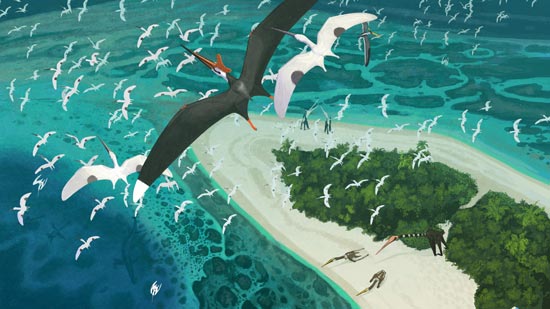
A Diverse Assemblage of Pterosaurs – Late Cretaceous Morocco

Pterosaurs of the Late Cretaceous (Morocco).
Six new species of pterosaur have been identified from Morocco.  This suggests that the Pterosauria were far more diverse and speciose at the end of the Cretaceous than previously thought.

Picture credit: John Conway

A Treasure Trove of Ancient Vertebrate Fossils

Writing in the journal PLOS Biology, the researchers from the University of Bath, Portsmouth University and the University of Texas at Austin, identified a total of seven species of flying reptile from fragmentary and largely isolated fossils found in marine rocks from phosphate mines in northern Morocco (Ouled Abdoun Basin).  Working in conjunction with local fossil hunters, the scientists were able to build up a collection of around two hundred pterosaur bones.

Over the years, commercial mining has revealed large numbers of marine vertebrates dating from the end of the Cretaceous and into the Palaeogene.  Cretaceous fauna associated with these deposits include turtles, plesiosaurs, mosasaurs, sharks and lots of different types of teleost (bony fish).  Occasionally the remains of terrestrial animals are preserved in such deposits, including the bones of Late Cretaceous dinosaurs, representing some of the youngest dinosaur fossils found.

To read our 2017 article about the discovery of an abelisaurid dinosaur: The Last Dinosaur in Africa.

Some of the Last Pterosaurs

The pterosaurs identified by the researchers range in size with the smallest found having a wingspan equivalent to that of an extant Golden Eagle (Aquila chrysaetos), to giants with wingspans approaching ten metres, three times bigger than the wingspan of the largest volant birds alive today.  The fossil material has been dated to just over 66 million years ago, making these pterosaurs amongst the very last of their kind on Earth.

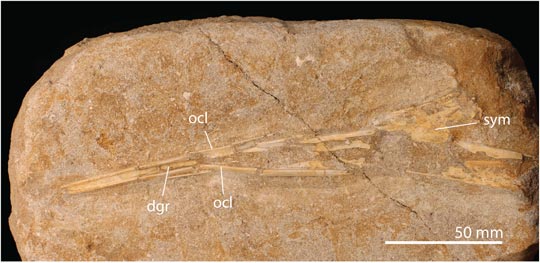
The Mandible of the Newly Described Nyctosaurid Alcione elainus

Pterosaur fossil mandible Alcione elainus.
The mandible of the newly described Moroccan pterosaur A. elainus.

Picture credit: PLOS Biology

Key

dgr = dorsal groove, ocl = occlusal ridge,  sym = symphysis.

Lead author of the study, Dr Nicholas Longrich, (Milner Centre for Evolution and the Department of Biology and Biochemistry, Bath University) stated:

“To be able to grow so large and still be able to fly, pterosaurs evolved incredibly lightweight skeletons, with the bones reduced to thin-walled, hollow tubes like the frame of a carbon-fibre racing bike.  Unfortunately, that means these bones are fragile and so almost none survive as fossils.”

Six New Species of Pterosaur

The researchers were able to identify six new species of pterosaur, representing three different families:

  1. Tethydraco regalis (Pteranodontidae) – the youngest member of the Pteranodontidae family described to date.  Estimated wingspan around 5 metres.
  2. Alcione elainus (Nyctosauridae) – wingspan estimated at about 2 metres.
  3. Simurghia robusta (Nyctosauridae) – a large pterosaur with a wingspan of around 4 metres.
  4. Barbaridactylus grandis (Nyctosauridae) – an even bigger pterosaur with a wingspan estimated to be about 5.2 metres.
  5. Quetzalcoatlus spp. (Azhdarchidae) – described from a single neck bone (cervical vertebra) which resembles the cervical vertebrae of Quetzalcoatlus (Q. northropi).  Size estimates for this flying reptile are very speculative, however, it could have had a wingspan of around 4 metres based on comparisons with better known azhdarchid pterosaurs.
  6. Sidi Chennane specimen (Azhdarchidae) – not scientifically named as yet, known from a single, partial ulna (arm bone), measuring 362 mm long, but when complete it would have been around 600 to 700 mm in length.  This suggests a giant azhdarchid pterosaur with a wingspan of approximately 9 metres.  This specimen has been named after the phosphate mine where it was found, formal scientific description will depend on the discovery of more fossil material.  The researchers conclude that this animal was probably related to the giant azhdarchid Arambourgiania philadelphiae, which is known from the Late Cretaceous of Jordan and the United States.

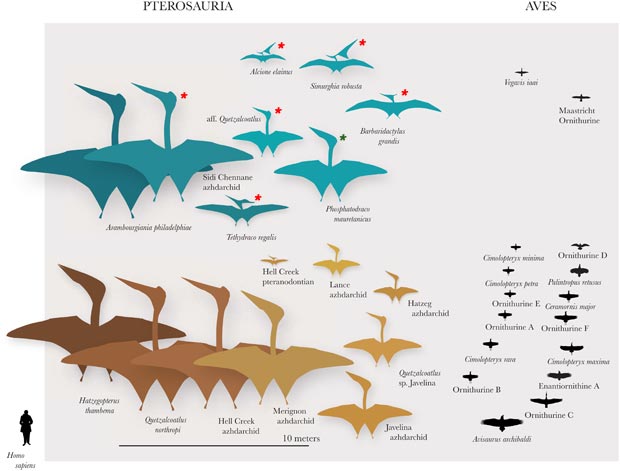
Late Cretaceous Pterosaur Faunas (Marine and Terrestrial) Compared to Late Cretaceous Birds

Late Cretaceous birds compared to Late Cretaceous Pteosaurs
Size disparity between Late Cretaceous pterosaurs and Late Cretaceous birds.

Picture credit: PLOS Biology with additional annotation by Everything Dinosaur

The diagram above compares the size disparity between Late Cretaceous pterosaurs with those of contemporaneous birds (coeval Aves – birds that lived at the same time as these flying reptiles).  Pterosaurs shaded blue are associated with marine environments, pterosaurs shaded in brown are associated with terrestrial habitats.  The six new species from the Ouled Abdoun Basin identified in the scientific paper have been given a red star.  The one species from the Ouled Abdoun Basin that had been previously described (2003), has been labelled with a green star (the azhdarchid Phosphatodraco mauritanicus).

A Giant Pterosaur

The giant pterosaur referred to as the Sidi Chennane specimen is estimated to have approached Quetzalcoatlus in size, but it was much more lightly built and therefore, presumably weighed less.  These proportions indicate a distinct flight mode and ecological niche, suggesting that giant pterosaurs occupied a range of niches in Late Cretaceous habitats.  In addition, the researchers conclude that this flying reptile fossil assemblage demonstrates that the Maastrichtian pterosaurs show increased ecological niche occupation when compared to earlier Late Cretaceous pterosaurs (Santonian to Campanian faunas).  This study also indicates that when it came to developing large body forms, the Pterosauria were able to outcompete coeval birds.

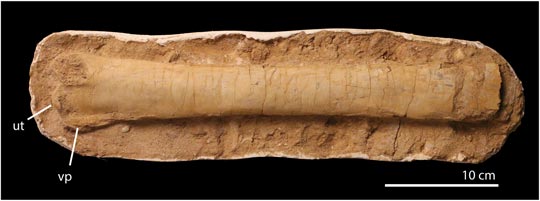
The Fossilised Partial Ulna of the Sidi Chennane Specimen

Fossil ulna of a giant azhdarchid pterosaur.
The ulna of the Sidi Chennane specimen.

Picture credit: PLOS Biology

Key

ut = ulna tubercle, vp = ventral process

A 5% Increase in Known Pterosaur Species

Co-author of the study, Dr Brian Andres, from the Jackson School of Geosciences at The University of Texas at Austin, commented:

“The Moroccan fossils tell the last chapter of the pterosaurs’ story – and they tell us pterosaurs dominated the skies over the land and sea, as they had for the previous 150 million years.”

With around 130 pterosaur species described to date, these fossils from Morocco have led to a 5 percent increase in the known number of flying reptile species.  This diversity of pterosaur species from Upper Maastrichtian deposits in Morocco suggest an abrupt mass extinction of the Pterosauria at the Cretaceous-Palaeogene boundary.

The scientific paper: “Late Maastrichtian Pterosaurs from North Africa and Mass Extinction of Pterosauria at the Cretaceous-Paleogene boundary” by Nicholas R. Longrich, David M. Martill and Brian Andres published in PLOS Biology.

Everything Dinosaur acknowledges the help of a press release from the University of Bath in the compilation of this article.

Visit the award-winning Everything Dinosaur website: Everything Dinosaur.

14 03, 2018

Are Palaeontologists Naming Too Many New Species?

By |2023-10-05T21:52:56+01:00March 14th, 2018|Categories: Dinosaur and Prehistoric Animal News Stories, Dinosaur Fans, Main Page, Palaeontological articles|0 Comments

Cautionary Tale When It Comes to Naming New Species from Fragmentary Fossils

In the 19th century when scientists were beginning to understand that there were many different types of dinosaur, lots of new species were erected, often from the most fragmentary of fossils.  As the western United States and Canada were explored, large quantities of dinosaur fossil material came to light.  This led to palaeontologists naming many new species.  Famous dinosaurs such as the hadrosaurid Trachodon (T. mirabilis), which graced an amazing number of dinosaur books in the 1960s and 1970s, named in 1856 by the American palaeontologist Joseph Leidy, is a typical example.

Leidy described Trachodon from just a few teeth found in Montana (Judith River Formation).  Today, palaeontologists regard the genus Trachodon as nomen dubium (its validity is doubted).  Those teeth used to describe this iconic duck-billed dinosaur probably represent several different plant-eating dinosaurs both hadrosaurs and even horned dinosaurs (ceratopsians).

As Seen in Numerous Dinosaur Books in the Late 20th Century – Trachodon

Postcard with Trachodon illustration.
An illustration of Trachodon.  A genus of dinosaur regarded as nomen dubium (validity is questioned). Picture credit: Everything Dinosaur.

Picture credit: Everything Dinosaur

Recognising new Fossil Species

It is not just the Dinosauria that has suffered from overzealous species naming, however, a comprehensive review of variations in ichthyosaur bones will help scientists to recognise new fossil species.  Dean Lomax (Manchester University) and Professor Judy Massare (SUNY College at Brockport, New York, USA), have examined hundreds of Ichthyosaurus specimens and they urge caution when it comes to erecting new species based on the evidence of a few fragmentary elements or isolated fossil remains.

Writing in the “Geological Journal”, the pair of scientists report that by focusing on just one part of the anatomy of an Ichthyosaurus an appreciation of the variation within a species can be obtained.  Their paper looked at the hind fin, (back paddle), the purpose being to evaluate different forms amongst the six known species that make up the Ichthyosaurus genus.  In total, ninety-nine specimens were examined, providing useful information on the variations within different species of “fish lizard”.

A Fossil Specimen of Ichthyosaurus somersetensis Named and Formally Described in 2017

Ichthyosaurus somersetensis specimen.
Ichthyosaurus somersetensis fossil specimen.  The black arrow in the photograph shows the location of the hind fin.

Picture credit: Dean Lomax/Manchester University

Large Sample Size Helps to Provide Robust Results

Early in their research, the scientists found different types of hind fin that initially appeared to represent different species.  As more specimens were studied, they found further examples of variation between the hind fins of individual animals.   The hind fins differed in a number of ways, hind fins had different numbers of bones, their shape differed and the size of the hind fin also varied.  From this work, it was concluded that a single hind fin alone could not be used to distinguish amongst the species of Ichthyosaurus, however, particular variations were more common in certain species than in others.

Palaeontologist Dean Lomax explained:

“As we have such a large, complete sample size, which is relatively unique among such fossil vertebrates, our study can help illustrate the limitations that palaeontologists face when dealing with few or even just one specimen.”

This new study shows that with only a few specimens in the sample, features can be found that differ substantially from one specimen to the next and this can cause confusion if these autapomorphies (distinctive traits) are used to classify organisms.  It can appear that there are several species.  In reality, with a much bigger sample, the gaps in the “unique” variations are filled in, showing that differences are simply the result of individual variations within a population.

Visit the website of Dr Dean Lomax: British Palaeontologist Dr Dean Lomax.

Judy Massare added:

“We described a few hind fins, which might have been called a new species if they were found in isolation.  Instead, we had enough specimens to determine that it was just an extreme variation of a common form.”

How Many Types of Ichthyosaurus Existed?

A Jurassic marine scene (Ichthyosaurus).
Ichthyosaurus life restoration.

Picture credit: James McKay

Palaeontologists – “Lumpers” and “Splitters”

Palaeontologists can be put into two distinct groups when it comes to naming new species, the “lumpers” and the “splitters”.   “Lumpers” group similar specimens together, whilst in contrast, the “splitters” opt to split specimens into new species.  In this new study, if the team opted to split-up the specimens based on the variation found, it would suggest that there were a large number of species.

Dean Lomax stated:

“If we considered the variation as unique, it would mean we would be naming about 30 new species.  This would be similar to what was done in the 19th century when any new fossil find, from a new location or horizon, was named as a new species if it differed slightly from previously known specimens.”

Just like the example of Trachodon given above.

As more fossil material is found and better dating techniques are developed, the decision to erect a new species has to be given extremely careful consideration.  This new study into variation within an extinct group of individual specimens can help scientists to make appropriate choices when it comes to classification.

The scientific paper: “Hindfins of Ichthyosaurus: effects of large sample size on ‘distinct’ morphological characters” by Judy A. Massare and Dean R. Lomax published in the Geological Journal.

Everything Dinosaur acknowledges the help of Manchester University in the compilation of this article.

Visit the Everything Dinosaur website: Everything Dinosaur.
13 03, 2018

Plans Progressing for a New Palaeoloxodon Figure

By |2024-05-10T18:29:00+01:00March 13th, 2018|Categories: Dinosaur and Prehistoric Animal Drawings, Dinosaur Fans, Everything Dinosaur News and Updates, Everything Dinosaur Products, Main Page, Photos of Everything Dinosaur Products, Press Releases|0 Comments

Everything Dinosaur Preparing for a Straight-tusked Elephant

Everything Dinosaur team members have been busy preparing for the introduction of the Straight-tusked elephant figure from Eofauna Scientific Research.  This 1:35 scale replica of Palaeoloxodon antiquus is due to arrive in stock around late May/early June, that may be a few weeks away, but there is still plenty of work to do in the meantime.

The New for 2018 Straight-tusked Elephant from Eofauna Scientific Research

Straight-tusked elephant model.
Eofauna Scientific Research Straight-tusked elephant (Palaeoloxodon antiquus).

Picture credit: Eofauna Scientific Research/Everything Dinosaur

To join Everything Dinosaur’s reserve list for this new 1:35 scale figure simply email: Contact Everything Dinosaur to Reserve Your Model.

Space has been allocated in our warehouse to receive this wonderful proboscidean and we have ensured that there will be adequate stock of the first figure in the Eofauna range, the Steppe Mammoth model (introduced last year), which is likely to have an upsurge in sales as more collectors discover this wonderful model range.

View the Everything Dinosaur website: Everything Dinosaur.
Commissioning a Scale Drawing of Palaeoloxodon antiquus

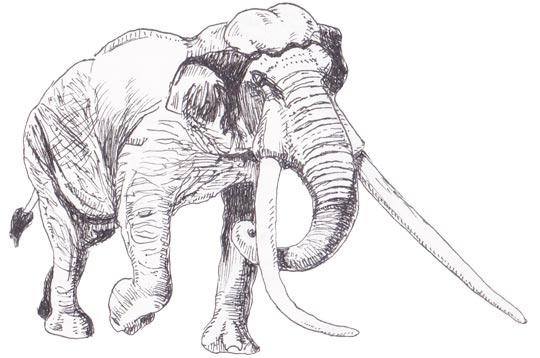
An illustration of Palaeoloxodon antiquus has already been commissioned and completed.  This drawing, will form the basis for a scale drawing of this extinct elephant that will be used in our exclusive Straight-tusked elephant fact sheet that will be sent out with every model sell.  The fact sheet is currently being researched and prepared.  Once it has been approved, this new fact sheet will be added to our library of several hundred prehistoric animal data sheets that Everything Dinosaur has compiled.

The Illustration of the Straight-tusked Elephant Commissioned by Everything Dinosaur

Straight-tusked elephant illustration.
A drawing of a Straight-tusked elephant.

Picture credit: Mike Fredericks/Everything Dinosaur

A spokesperson from Everything Dinosaur commented:

“We do appreciate that model collectors often like to learn a little about the prehistoric animal that a model represents, that’s why we go to the trouble of commissioning drawings and creating fact sheets for the majority of the prehistoric animals and dinosaurs that we sell.  In addition, as the Eofauna Scientific Research figure is based on actual fossil specimens, it is fitting for us to provide a fact sheet on this extinct elephant, after all, one of our objectives is to help educate and inform.”

Palaeoloxodon Upsets the Loxodonta

A study of ancient Palaeoloxodon antiquus DNA revealed that this extinct species was closely related to African forest elephants (Loxodonta cyclotis).  This came as a surprise as most palaeontologists had believed that the Palaeoloxodon genus was, from a taxonomic perspective, closer to the Asian elephant (Elephas maximus).  Furthermore, the genetic analysis revealed that extant forest elephants in the Congo Basin were more closely related to Palaeoloxodon antiquus than they were to the African savannah elephant (Loxodonta africana).  This meant that the elephant family tree would have to be drastically revised and the Loxodonta genus itself will have to be reviewed and subjected to some revision.

Members of the Elephantidae family (most of them), might have big, but it turns out that these iconic animals with their ancient lineage can still produce some enormous surprises.

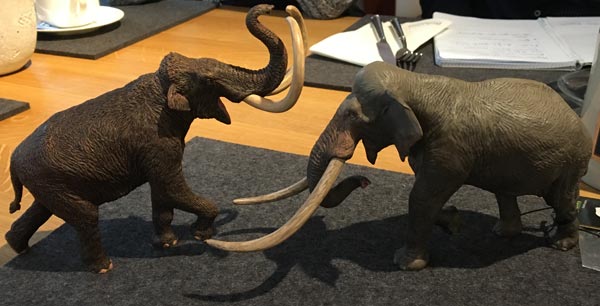
The Eofauna Scientific Research Straight-tusked Elephant with the First Eofauna Model (Mammuthus trogontherii)

The Eofauna Straight-tusked elephant the Steppe Mammoth model.
The Eofauna Scientific Research Straight-tusked elephant (right) and the Steppe Mammoth figure (left). Picture credit: Everything Dinosaur.

Picture credit: Everything Dinosaur

To view the current range of Eofauna Scientific Research models available from Everything Dinosaur: Eofauna Scientific Research Models and Replicas.

12 03, 2018

An Exclusive Minmi Armoured Dinosaur Illustration?

By |2024-05-10T18:29:52+01:00March 12th, 2018|Categories: Dinosaur and Prehistoric Animal Drawings, Dinosaur Fans, Main Page|2 Comments

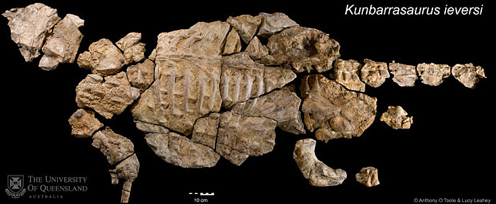
Minmi paravertebra or is this Kunbarrasaurus ieversi?

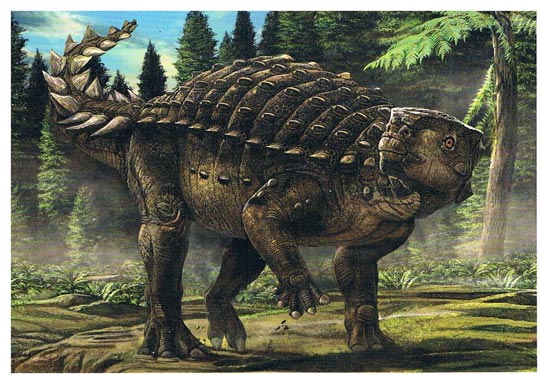
Everything Dinosaur team members were reviewing some of the images from Zhao Chuang within their database and spotted an anomaly.  Zhao Chuang is the talented artist responsible for many scientific illustrations of prehistoric animals including the beautiful images associated with the PNSO “Age of Dinosaurs” range.   One picture of an armoured dinosaur was labelled Minmi, indicating that this was an illustration of Minmi paravertebra.  However, we have seen this image used in articles associated with the naming and scientific description of another Australian member of the clade Ankylosauria – Kunbarrasaurus ieversi.

Is This Minmi or Kunbarrasaurus?

Basal Ankylosaur illustration.
An illustration of an Australian member of the Ankylosauria clade.  Is this Kunbarrasaurus or is this Minmi?

Picture credit: Zhao Chuang

Confusing Minmi paravertebra and Kunbarrasaurus ieversi

Kunbarrasaurus was named and described in 2015.  The fossil remains that led to the erection of this new genus had been formerly described as Minmi (M. paravertebra).   In 1989,  the nearly complete skeleton of an armoured dinosaur was discovered on Marathon Station, near Richmond, north-western Queensland.  The specimen (QM F18101), was provisionally assessed as a specimen of Minmi paravertebra, at the time, the only known armoured dinosaur from Australia.

However, further preparation of the fossil material and a detailed CAT scan of the fossils identified notable differences in skull anatomy when compared to the fossil material that had been ascribed to Minmi paravertebra.  These autapomorphies (different traits), were deemed sufficient to permit the establishment of a new genus of armoured dinosaur and the scientific paper detailing this research was published in the journal PeerJ.

To read Everything Dinosaur’s article on the naming of Kunbarrasaurus from 2015: The Newest Dinosaur from Australia.

The Kunbarrasaurus Fossil Specimen (QM  F18101)

Kunbarrasaurus fossils.
Kunbarrasaurus fossil material (QM F18101) – dorsal view.

Picture credit: The University of Queensland

How Closely Related is Kunbarrasaurus to Minmi paravertebra?

More than half a dozen fossil specimens have been ascribed to the genus Minmi, however, of these, only two have been studied in detail.  Lack of relative and temporal dating information of the fossil bearing strata in Australia has hindered classification as has the presence of extensive dermal armour which has caused problems when palaeontologists attempt to identify subtle differences in skull morphology and nasal pathways.

Exactly how closely related these two Australian armoured dinosaurs were to each other remains an area of debate amongst scientists.  Minmi has been assigned as a basal member of the  Ankylosauridae, the family of armoured dinosaurs that includes Ankylosaurus and Euoplocephalus.  However, the fossil material ascribed to the genus K. ieversi is regarded by many palaeontologists as sufficiently different that it can’t be placed within the Ankylosauridae family, but it has been assigned to the clade Ankylosauria, a broader group encompassing less closely related animals.

For models and replicas of ankylosaurs and other armoured dinosaurs: CollectA Prehistoric Life Models.

Further revision of the taxonomic relationships between armoured dinosaurs that roamed Gondwana is likely as more fossils are found.  Therefore, it is understandable for the work of a scientific illustrator to become mixed up in the phylogenetic assessments.  Whether Zhao Chuang’s illustration represents Minmi or Kunbarrasaurus is a moot point, it remains a fantastic armoured dinosaur illustration (in our opinion anyway).

Visit the award-winning Everything Dinosaur website: Everything Dinosaur.
11 03, 2018

Special Google Doodle – Dinosaurs for Mother’s Day

By |2024-05-10T07:35:54+01:00March 11th, 2018|Categories: Dinosaur Fans, Educational Activities, Main Page|0 Comments

Mother’s Day Dinosaurs

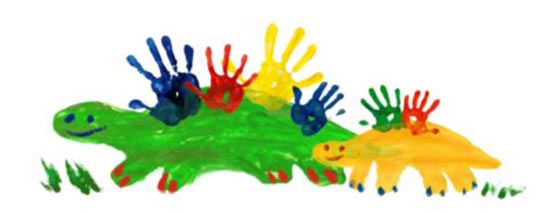
The Google doodle for the UK and Ireland today is a pair of dinosaurs (we think).  The doodle has been put up in honour of Mother’s Day and the painting represents one child’s view of a mother dinosaur with its baby.  At least to us, who spend a lot of the time looking at dinosaurs, this is what the drawing resembles.

Google Doodle Dinosaurs

Google Doodle - dinosaurs.
Google Doodle March 11th 2018 for Mother’s Day.

Picture credit: Google

Do Armoured Dinosaurs Make Good Parents?

Whether or not the non-avian dinosaurs made good parents is a topic often debated amongst palaeontologists.  Like their close relatives, the birds, non-avian dinosaurs probably adopted a range of strategies when it came to looking after their young.  Nesting sites discovered in the United States strongly suggest that Maiasaura, (M. peeblesorum), a Late Cretaceous hadrosaur, fed their young and looked after them, whilst other types of dinosaur probably adopted different behaviours.

To read our post about “Good Mother Lizard”: Maiasaura and Marsh.

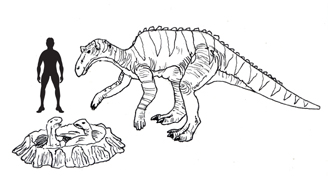
An Illustration of a Maiasaura and Young

Maiasaura drawing.
The person in the picture provides a scale so the size of this dinosaur can be estimated. Picture credit: Everything Dinosaur.

Picture credit: Everything Dinosaur

Fossils of very young Maiasaura indicate that these dinosaurs were not capable of leaving their nest and that they were dependent on the adult animals to feed them.

At the other end of what is a spectrum, precocial animals are born ready to lead much more independent lives.  Precocial young are able to leave the nest shortly after birth/hatching and are capable of feeding themselves.  As for evidence of armoured dinosaurs and their behaviour with regards to bringing up baby, the evidence is less substantial.  However, a number of young individuals of armoured dinosaurs have been found in a single bone bed.  The fossils come from an armoured dinosaur known from northern China (Inner Mongolia), called Pinacosaurus (P. grangeri).  If these young Pinacosaurus died together, it does suggest that these animals lived in social groups.  This may have implications for parenting behaviour.

Late Cretaceous Northern China

China - Late Cretaceous
Late Cretaceous China.  Pinacosaurus can be seen in the foreground.

Picture credit: Zhao Chuang

Research Papers on Dinosaurs

Team members at Everything Dinosaur also recall coming across a research paper that reported upon the discovery of an adult armoured dinosaur and a juvenile being found together.  Although, it is difficult to interpret the exact circumstances, the fossils could represent an adult and offspring having perished together.

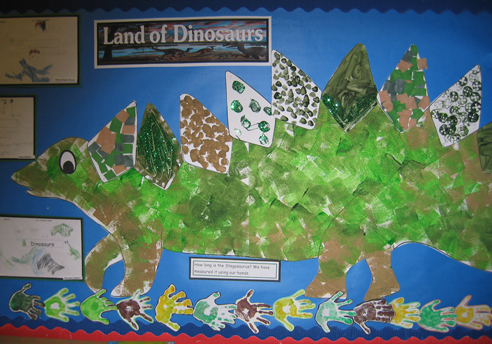
An Armoured Dinosaur Themed Artwork on Display in School

Stegosaurus artwork in school.
How many hands?

Picture credit: Bamford Academy Foundation Stage

On this Mothering Sunday, it is fitting to consider whether dinosaurs were altricial or precocial.  It is likely, that just like birds, the Dinosauria exhibited a number of behaviours.

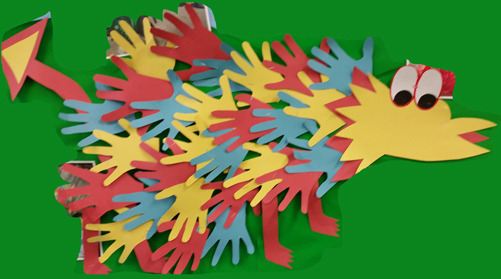
A “Handy” Illustration of a Monster Created by School Children

Hands inspire artwork in school.
A “handy” way to create a prehistoric animal in the classroom.

Picture credit: Feversham Primary

Happy Mother’s Day.

View the Everything Dinosaur website: Everything Dinosaur.
10 03, 2018

Finalising Exclusive Fact Sheets for March Deliveries

By |2024-05-10T18:30:14+01:00March 10th, 2018|Categories: Dinosaur and Prehistoric Animal Drawings, Dinosaur Fans, Everything Dinosaur News and Updates, Everything Dinosaur Products, Main Page, Photos of Everything Dinosaur Products|0 Comments

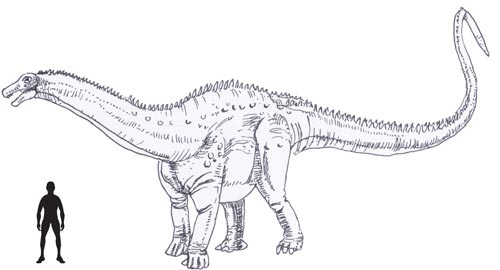
Brontosaurus Fact Sheet for the CollectA Brontosaurus Model

The first of the new for 2018 CollectA figures are due in stock at Everything Dinosaur at the end of this month (March 2018).  Preparations to receive the new models along with deliveries from Papo and Mojo Fun are well underway.  However, as we send out a fact sheet on virtually every named animal we supply, our team members have been busy compiling a fact sheet on the famous sauropod Brontosaurus, as CollectA will be introducing a Brontosaurus figure this year.

Everything Dinosaur’s Scale Drawing of Brontosaurus

Drawing of Brontosaurus.
A scale drawing of Brontosaurus.  Picture credit: Everything Dinosaur.

Picture credit: Everything Dinosaur

Bully for Brontosaurus

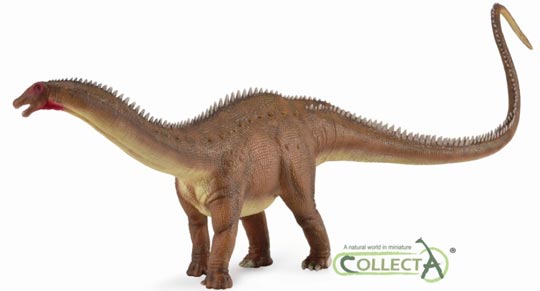
The CollectA Brontosaurus model has a release date of mid-2018, it will be part of the company’s extensive “Prehistoric Life” collection of not-to-scale dinosaur models.  The double row of scutes running along the back of the figure is an interpretation of the fossil material related to diplodocids that suggests that some types of these long-necked, Late Jurassic dinosaurs had dermal armour.

The New for 2018 CollectA “Prehistoric Life” Brontosaurus Model

CollectA Brontosaurus replica.
The CollectA Brontosaurus dinosaur model with a double row of dermal spikes running down the body.

Observant model collectors will have noticed the red flash on the neck of this herbivore.  Palaeontologists believe that these large animals lived in herds and the brightly coloured patch of skin on the throat might have acted as a signalling device in visual displays.  This colouration, along with the double row of dermal spikes is speculative, however, these features on this excellent figure have a grounding in science and reflect what has been deduced about these dinosaurs from their fossils and from studying animals living in herds today.

Several Sauropods in the CollectA Range

The CollectA range “Prehistoric Life” already includes several not to scale models representing sauropods.  For example, the range contains Cetiosaurus, Shunosaurus, Agustinia, Amargasaurus, Ampelosaurus, Argentinosaurus, Brachiosaurus, Diplodocus, Daxiatitan, Rebbachisaurus, a rearing Rhoetosaurus and an Alamosaurus.  It is great to see a replica of “Thunder Lizard” being added to this collection.

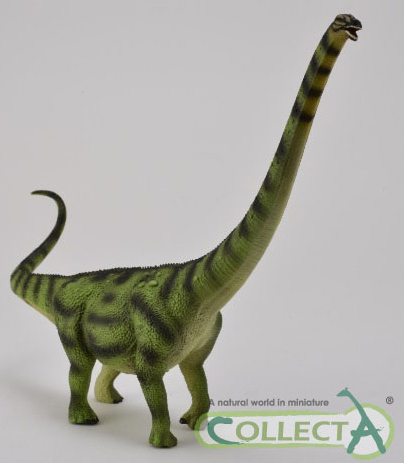
The CollectA “Prehistoric Life” Range Features Several Sauropods

Daxiatitan model by CollectA.
A Daxiatitan replica is amongst numerous sauropods featured in the extensive CollectA “Prehistoric Life” model range.

To view the range of CollectA scale models: CollectA Deluxe Prehistoric Life.

Commenting on the impending introduction of a Brontosaurus model, a spokesperson from Everything Dinosaur stated:

“Brontosaurus has had a rather chequered taxonomic career since the genus was first erected in 1879.  For a long time, Brontosaurus was thought to be a junior synonym of Apatosaurus until a substantial review of diplodocid fossils undertaken in 2015 led to the resurrection of the genus”.

To read Everything Dinosaur’s article on this research into the Diplodocidae: The Return of Brontosaurus.

Everything Dinosaur Already Has a Fact Sheet on the Closely Related Apatosaurus

Apatosaurus scale drawing.
Scale drawing of Apatosaurus (A. ajax). Picture credit: Everything Dinosaur.

Picture credit: Everything Dinosaur

We are looking forward to completing our fact sheets as we await the arrival of the new models.

To view the CollectA “Prehistoric Life” models including the sauropods in stock at Everything Dinosaur: CollectA Prehistoric Life Figures.

Visit the Everything Dinosaur website: Everything Dinosaur.
9 03, 2018

Working to Honour Mary Anning and Mary Leakey

By |2023-10-04T06:23:52+01:00March 9th, 2018|Categories: Dinosaur Fans, Educational Activities, Everything Dinosaur News and Updates, Famous Figures, Main Page, Press Releases, Teaching|0 Comments

Everything Dinosaur Helping to Honour Female Scientists

With International Women’s Day having been very much in the news this week, Everything Dinosaur is taking this opportunity to honour two female pioneers in the Earth sciences, both called Mary.  Today, March 9th, is the anniversary of the death of Mary Anning, the famous amateur fossil collector from Dorset who did much to bring the amazing geology of that part of the coast of southern England to the world’s attention.  It is only in the last few decades that her contribution to the nascent science of palaeontology has begun to be recognised.  As part of our continuing work in schools, we have developed a lesson plan based around researching the life of Mary Anning for Key Stage 1 and Key Stage 2 pupils.

Everything Dinosaur’s Non-chronological Report Focused on Mary Anning

Mary Anning Non-chronological report.
A non-chronological report exercise based on the life and work of Mary Anning.  Picture credit: Everything Dinosaur.

Picture credit: Everything Dinosaur

A Non-chronological Report Focused on Mary Anning

A non-chronological report is a non-fiction report that is not written in time order.  Usually written in the third person, these reports help children to practice structuring texts and working with a variety of writing styles.  They involve a planning phase in which the compiler has to research the subject area and to decide what to include or discard.   It helps children to evaluate sources of information, encourages cross-checking of references and provides the opportunity for the teacher to check learning.  Everything Dinosaur’s lesson plan includes a template for the creation of a non-chronological report focused on the life and work of Mary Anning.

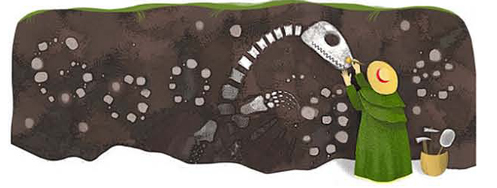
Mary Anning Honoured in a Google Doodle

Google celebrates the life and work of Mary Anning.
Google pays tribute to Mary Anning (1799-1847).

Picture credit: Google

Mary Douglas Leakey (1913-1996)

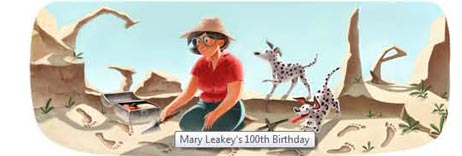
The British palaeoanthropologist Mary Leakey, who along with her husband Louis, did much to improve our understanding of the evolution of humankind has also been the subject of a Google doodle.  Everything Dinosaur is working towards honouring the work of this ground-breaking scientists by having a blue plaque erected at her childhood home in London.  We shall update blog readers with regards to our progress in the near future.

A Google Doodle Honouring the Work of Mary Leakey

Mary Leakey honoured by Google.
Celebrating the role of women in science.

Picture credit: Google

To read more about the life and work of the remarkable Mary Leakey: Celebrating the Role of Women in Science – Mary Douglas Leakey.

Visit the award-winning Everything Dinosaur website: Everything Dinosaur.

Go to Top