Ceratopsian Species – Where and When did they Live (part 1)
A few days ago, Everything Dinosaur published an article which summarised some remarkable research into the ceratopsian family tree undertaken by a team of international scientists. This research team, that included researchers from the University of London, postulated that all those fancy frills and horns associated with the horned dinosaurs, probably evolved to help individuals attract a mate. This statistical study involved mapping when different species of horned dinosaur lived, where they lived and what other ceratopsians may have been contemporaneous.
Ceratopsian Dinosaur Study
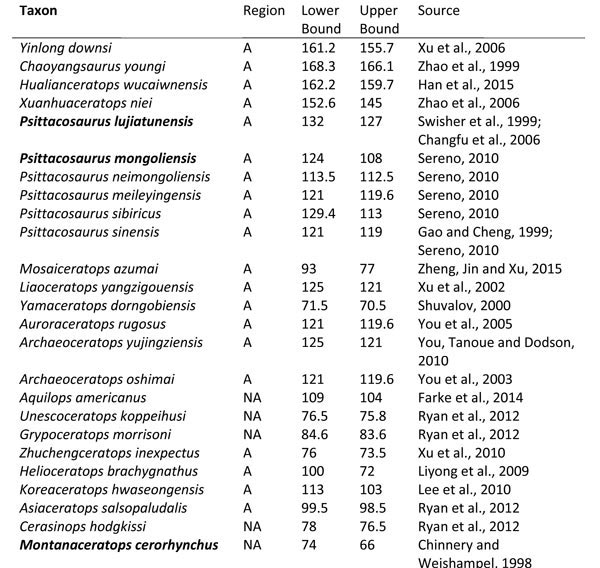
In the supplementary data, the researchers provided a marvellous ceratopsian family tree plotted against geological time. Quite a feat considering more than seventy species of horned dinosaur were analysed. In addition, the team published very useful tables that summarised the data they had compiled. The table listed the horned dinosaurs and provided information about which continent their fossils had been found and calibrated their approximate ages (upper limit and lower limit of stratigraphical distribution).
Plotting Ceratopsian Species Against Temporal and Geographical Distribution
Temporal calibrations and geographical locations of ceratopsian species (part 1).
Table credit: Andrew Knapp, Robert J. Knell, Andrew A. Farke, Mark A. Loewen, David W. E. Hone published in the Proceedings of the Royal Society B (Biology).
The table (above) shows temporal calibrations and geographical locations of ceratopsian species. Taxa that were included in the morphological character state analysis (the research into horns and crests), are indicated in bold type. Region abbreviations: Asia: A; North America: NA; Europe: E.
Yinlong downsi
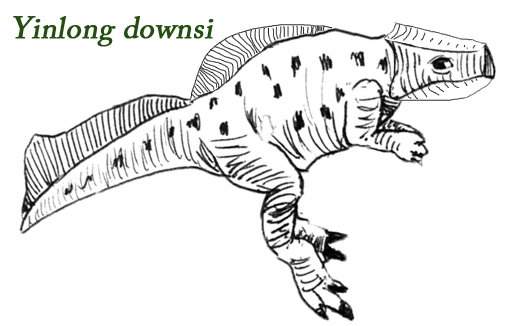
One of the earliest ceratopsians described to date is Yinlong downsi, fossils of which were found in Upper/Middle Jurassic aged rocks in Xinjiang Province (western China). It is likely that the ceratopsian lineage originated in the Middle Jurassic and that these bird-hipped dinosaurs first evolved in Asia.
An Illustration of Yinlong downsi – An Early Ceratopsian
Yinlong downsi, an early ceratopsian dinosaur. The first horned dinosaurs were very probably small and bipedal. Picture credit: Everything Dinosaur.
Picture credit: Everything Dinosaur
Building on the Shoulder of Giants
The research team collated a significant amount of data that had been produced by other scientists. Using this extensive research (source of the data is recorded in the table), a table listing ceratopsian species, where they lived and when they lived was produced.
Plotting Ceratopsian Species Against Temporal and Geographical Distribution (Part 2)
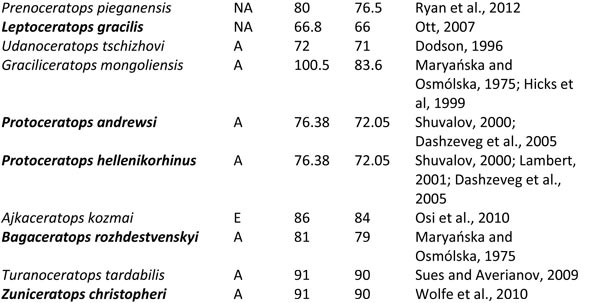
Temporal calibrations and geographical locations of ceratopsian species (part 2).
Table credit: Andrew Knapp, Robert J. Knell, Andrew A. Farke, Mark A. Loewen, David W. E. Hone published in the Proceedings of the Royal Society B (Biology).
The second part of the table lists horned dinosaurs from the Late Cretaceous (majority) and also includes the first reference to a horned dinosaur from Europe Ajkaceratops kosmai, which is known from anterior portions of the skull and jaws discovered in Hungary.
We congratulate the research team conducting the statistical study into the ornamentation of the Ceratopsia and praise all those patient, dedicated scientists that helped to provide the data set for them to work on. it is such a detailed ceratopsian dinosaur study. A second article will be published shortly that features the rest of the horned dinosaur temporal and geographical distribution table.
What Can You Do to Help Protect Your Privacy and Personal Data?
These days, we seem to be spending more and more time online and there is a growing awareness about protecting privacy and personal data when it comes to the internet. As Everything Dinosaur’s plans to comply with the forthcoming General Data Protection Regulation (GDPR)* progress, we thought it would be helpful to our customers and to visitors of our various websites to provide some tips about how individuals can help to keep their personal data safe and secure. After all, if Everything Dinosaur is working hard to safeguard your personal data, it only makes sense to do what you can to help maintain your privacy and personal security too.
Keeping Safe Online – Protecting Your Privacy and Personal Data
Protecting your personal data and privacy.
Here is a list of some things to consider to help stay safe online and to enjoy your browsing experience. It’s by no means an exhaustive list, but we hope it provides additional support and assistance.
Protecting Personal Data – Tips
Have strong and safe passwords. Remember to keep them private and change them periodically. Passwords to more sensitive information such as financial details should be changed more frequently. Never disclose your passwords, anybody who knows your password may access your personal data/accounts.
When using a device in a public place, it is recommended that you always log out and close the website browser when you have finished online. Be careful, somebody might be watching you, ensure that as you type in or access sensitive information, you are not being overlooked.
Avoid using the same password for multiple accounts.
When creating a password, use a minimum of seven characters. Never use words, email addresses or any other aspect of your personal data within your password. Letter, figure and symbol-based passwords are best. When Everything Dinosaur upgraded its websites, existing account holders were asked to change their passwords and new stronger password creation measures were put in place. A few moments of inconvenience are more than made up for by knowing that your personal data is protected and more secure.
Everything Dinosaur will never ask you to confirm any bank account or credit/debit card details or other financial information via email. If you receive an email claiming to be from an organisation asking you to do so, treat this with great caution. It is often best to ignore it and not to respond. Do not click on any links within such emails.
Look for the padlock… Look for HTTPS – all Everything Dinosaur’s sites are safeguarded by HTTPS protocols
The Green Padlock and HTTPS Helps to Give Web Browsers Confidence and Builds Trust
HTTPS and the padlock sign provides extra security to website visitors. The red arrow in the picture above shows the location of the padlock and the secure HTTPS information associated with a website managed by Everything Dinosaur. Picture credit: Everything Dinosaur.
Picture credit: Everything Dinosaur
Beware of websites offering discount codes or vouchers for Everything Dinosaur’s products and services. Our company philosophy is very simple, we try to offer the very best service we can at the cheapest possible prices. If you come across a website claiming to offer discount or voucher codes for Everything Dinosaur, we would urge you to take caution. You can always contact Everything Dinosaur to check, we have included our contact email details within this blog post.
When on a social networking platform, think about how to keep your personal data safe. Check and adjust the site’s privacy controls if necessary, use strong passwords and secure logins, consider the amount of personal information that you post up, could this data put you at risk from identify theft/fraud?
Make sure that your computer has an effective firewall and appropriate anti-virus/spy-ware/anti-malware programmes in place. Only download files from trusted sources.
Before you give out any personal information online, make sure you know who you are dealing with.
Check the email address carefully before opening the message, don’t click on any links or attachments unless you are sure of the sender’s identity.
Ensure any mobile devices are kept secure, use passwords and secondary security systems such as thumb print identity checks. Make sure your operating system has the latest updates and do not delay the installation of updates.
Everything Dinosaur Contact Details
If you have a query regarding Everything Dinosaur’s privacy policy, a question relating to the company’s policies helping to protect your personal data and privacy or if you have come across a website claiming to offer discount codes and vouchers for Everything Dinosaur’s goods and services, you can email us here: Email Everything Dinosaur.
What is the GDPR?
The GDPR is the European Union’s binding legislation for the protection of personal data. This regulation will be in effect from the 25th May 2018 onwards, it has been designed to deal with the inconsistencies within the current data protection laws that exist throughout the European Union. It aims to facilitate the secure, free-flow of data and provide enhanced protection for data subjects (individuals whose data is managed, processed, handled, stored and so forth).
What is HTTPS?
HTTPS (Hypertext Transfer Protocol Secure), is the protocol where encrypted HTTP data is transferred over a secure connection. Everything Dinosaur’s websites have digital certificates that authenticates the identity of our websites and encrypts information sent to servers. Encryption involves the scrambling of data into an undecipherable string that can only be returned to a readable format with the proper decryption key, this helps to protect the privacy and integrity of exchanged data. This helps to ensure that any personal data collected is held more securely.
Recently, Everything Dinosaur posted up an article that featured some remarkable research by an international team of scientists who set about answering the question, why did horned dinosaurs have fancy frills? The scientific paper detailing this fascinating study, undertaken by scientists from the Natural History Museum of Utah, the Raymond M. Alf Museum of Palaeontology (California) and the University of London has been published in the “Proceedings of the Royal Society B.”
The researchers conclude that there is no statistical evidence to support the idea that the elaborate horns, neck frills and bony outgrowths associated with the skulls of the Ceratopsia evolved to help with inter-species recognition. If a Centrosaurus (Centrosaurus apertus), happened to encounter an Achelousaurus (A. horneri), then it is likely that they used more subtle signals to help distinguish themselves. Although, inter-species recognition is discounted, the paper suggests that the amazing skull ornamentation evolved as a sign that the individual was genetically healthy and therefore an attractive mate.
The Horns of Triceratops Probably Played a Role in Demonstrating Fitness for Breeding
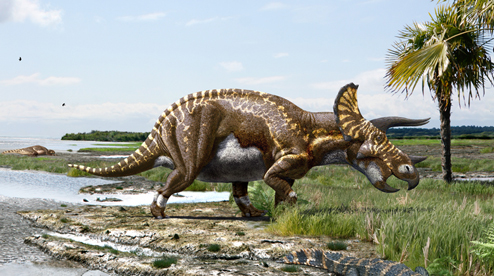
Triceratops was one of the last dinosaurs to evolve and its horns probably played a role in demonstrating fitness for breeding as well as defence.
Picture credit: Julius Csotonyi
How Many Horned Dinosaurs and When Did They Live?
Before the statistical analysis could be carried out, the dedicated research team had to create a pool of horned dinosaur data to work with. To test the idea about fancy frills and huge horns having something to do with inter-species identification, the scientists had to work out when the species of horned dinosaur lived, where they lived and what other horned dinosaurs shared their habitat. In essence, an audit of the stratigraphical, geological and temporal evidence for the Ceratopsia (more than 70 species), had to be constructed.
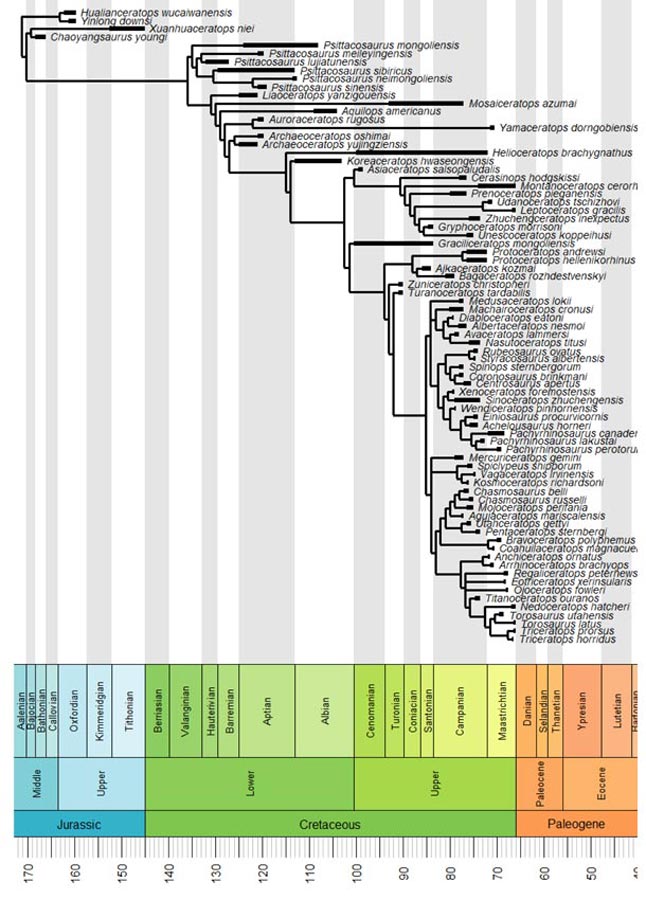
Drawing on numerous sources, the research team compiled a time-scaled phylogeny for all the known ceratopsians. When each species of horned dinosaur lived was plotted against the geological timescale. In this way, a single chart could show which horned dinosaurs were contemporaneous.
When the Horned Dinosaurs Lived (Ceratopsians) Plotted Against Geological Time
The Ceratopsia family tree (spring 2018).
Picture credit: Published in the Supplementary Section of the Scientific Paper*
The picture (above), shows a time-scaled phylogeny for all the ceratopsian species known at the time of compilation. Estimated temporal range of each species is indicated by the thick, black bars at the branch tips. This phylogeny was created using strap package for R. (Bell and Lloyd, 2014).
Middle Jurassic Origins
From their Middle Jurassic origins, the evolution of the horned dinosaurs can be outlined in a single figure. Dinosaur fans can see which ceratopsians lived at the same time as each other. They can also observe which horned dinosaurs are associated with the various faunal stages that make up the Jurassic and the Cretaceous.
The very last horned dinosaurs include the likes of Nedoceratops hatcheri, Torosaurus latus and Triceratopsprorsus,this information can be found towards the bottom corner of chart. Note how the two recognised species of Triceratops T. horridus and the geologically younger T. prorsus are not contemporaneous. This reflects recently published research (2014), that mapped changes in the Triceratops fossil population and the evolution of a new species as the genus changed over time.
*The scientific paper: “Patterns of Divergence in the Morphology of Ceratopsian Dinosaurs: Sympatry is not a Driver of Ornament Evolution” by Andrew Knapp, Robert J. Knell, Andrew A. Farke, Mark A. Loewen, David W. E. Hone published in the Proceedings of the Royal Society B (Biology).
Everything Dinosaur continues to set the pace when it comes to independent reviews for the company’s products and customer service. The UK-based supplier of dinosaur and prehistoric animal themed merchandise is approaching the milestone of having 500 on-line customer service reviews published by the independent ratings company FEEFO. Everything Dinosaur continues to earn the coveted 5-star rating.
FEEFO Awards Everything Dinosaur Top Marks
5-star rating for Everything Dinosaur.
Picture credit: Everything Dinosaur
Over 1,000 Product Reviews
Ever since Everything Dinosaur entered into a partnership with the FEEFO reviews company in the early spring of last year, the product reviews, feedback and comments have come rushing in from satisfied and often delighted Everything Dinosaur customers. Soon the mail order business will have published its 1,000th product review. A few weeks ago, Everything Dinosaur was awarded the highest accolade from FEEFO, the Gold Trusted Service Award that reflects on the company’s constant attention to detail and care of its customers.
Everything Dinosaur Awarded the Highest Accolade by FEEFO
FEEFO Gold Trusted Service Award (Everything Dinosaur).
In a statement released by the ratings company, the significance of the Gold Trusted Service Award was explained.
“Our highest accolade – the Trusted Service Award honours the best businesses using FEEFO, that go above and beyond for their customers. Held annually, every business that works with FEEFO is automatically entered and those that meet the criteria receive the award. We have worked hard to ensure that the Trusted Service Award retains its status as the symbol of outstanding service – as voted by genuine customers.”
A spokesperson from Everything Dinosaur added:
“Our business model has always been based on providing the very best customer service that we can. Savvy shoppers are beginning to realise that there are a lot of organisations operating on-line that have not been entirely honest in how customer’s data and information has been treated.”
The spokesperson added:
“At Everything Dinosaur, we recognise the importance of trust, our customers trust us to look after them, to make sure that their purchases are securely packed and that they are delivered promptly and safely. In addition, our customers know that Everything Dinosaur can be relied upon to protect their information and personal data too. Respecting the rights of individuals with regards to their personal data will become increasingly important, we have always fostered a climate of respect and in this aspect of our business we are ahead of the curve.”
Visit the award-winning and highly rated Everything Dinosaur website: Everything Dinosaur.
Why Did Horned Dinosaurs Have Fancy Frills (and Horns Too for that Matter)?
One of the great pleasures of working with so many young dinosaur enthusiasts is that we get to answer lots of their amazing questions. We do get asked all sorts of things, such seems to be the fascination with dinosaurs and other prehistoric animals. Scientists get to ask questions too, after all, the essence of scientific enquiry is all about seeking answers. It is surprising just how often the question asked of us by an eight-year-old overlaps with the sort of enquiries being explored by palaeontologists. Take for example, the question of why did horned dinosaurs have horns and frills?
Thanks to a some recently published fascinating statistical analysis, researchers are able to at least rule out one possible explanation for these very ornate and often bizarre examples of dinosaur head gear.
Studying the Frills of Horned Dinosaurs
Writing in the “Proceedings of the Royal Society B (Biology)”, researchers have concluded that all this ornamentation probably did not evolve to help a dinosaur distinguish itself from another species. Yes, they may have had a role in defence, after all, many of the later ceratopsians had to contend with tyrannosaurs in their neighbourhood, but this new analysis lends weight to the idea that the diverse range of headgear sported by horned dinosaurs probably evolved to help them win mates.
Lots of Horned Dinosaur Species – But Why all the Different Horns and Ornamentation?
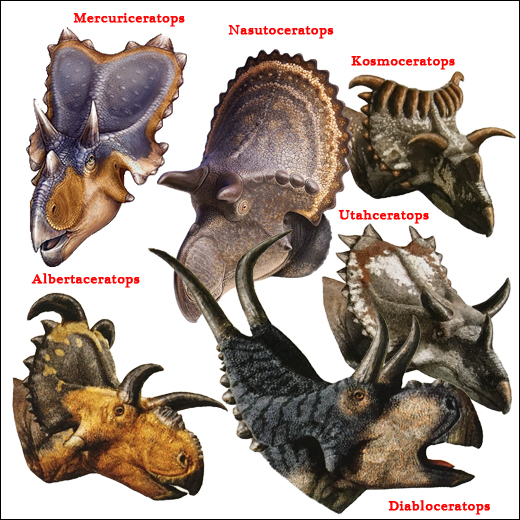
Illustrations of different horned dinosaurs but why the fancy headgear?
Picture credit: Everything Dinosaur with artwork from Julius Csotonyi, Danielle Dufault and the Canadian Museum of Natural History/Andrey Atuchin
A Statistical Study of Ceratopsians
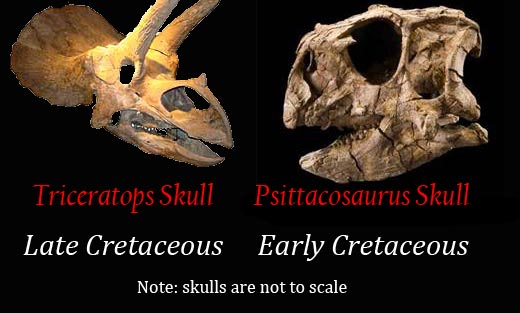
The research team which included scientists from the University of London, the Natural History Museum of Utah and the Raymond M. Alf Museum of Palaeontology in California, first set about building a list of all the known horned dinosaurs that had been described to date. The Ceratopsia (horned dinosaurs), is a major clade of the bird-hipped dinosaur lineage, it contains over seventy species, all of which possessed some form of skull ornamentation, from the small “sticky-out” cheek horns of Psittacosaurus from the Early Cretaceous to the spectacular multi-faceted head crests and horns sported by Late Cretaceous giants such as Styracosaurus, Triceratops and Pachyrhinosaurus that lived some fifty million years later.
Members of the Ceratopsia with Differing Ornamental Traits
Ornamental traits in the Ceratopsia. Psittacosaurus and Triceratops compared.Picture credit: Everything Dinosaur.
Picture credit: Everything Dinosaur
Looking for Sympatry
These horned dinosaurs had very different shaped skulls and to test the idea that these features evolved to help with species recognition, the researchers then set about looking at which horned dinosaurs lived at the same time and in the same parts of the world. In essence, they looked to see if any two species were sympatric – this simply means whether two species live in the same area at the same time and therefore encounter each other. A modern example can be found in the Serengeti National Park, where Impalas and Grant’s Gazelle, two species of antelope, live side by side. There is sympatry between Impalas and Grant’s Gazelle.
Horned Dinosaurs – Diverse Skulls in All Shapes and Sizes
Once the fossil records for all the known species of ceratopsian had been analysed by location and when these animals lived, the team set about looking at the physical features of all those species which had enough fossil material associated with them to make any analysis statistically valid. To test the idea that these horns and frills evolved to help in species recognition, there should be some evidence that at some point, several closely related species with different ornamentation lived at the same time in environments that at least partially overlapped and therefore these animals would have encountered each other.
Horned Dinosaur Skulls Come in All Shapes and Sizes
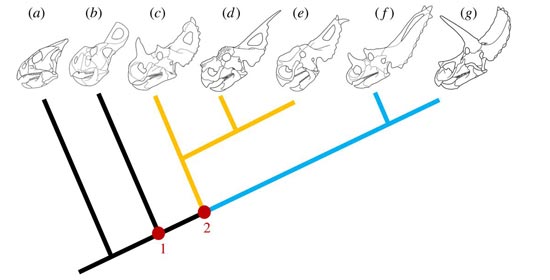
Line drawings of ceratopsian skulls showing different morphology.
Picture credit: Proceedings of the Royal Society B (Biology)/Scott Hartman
The picture above shows seven line drawings of horned dinosaur skulls namely:
a). Liaoceratops yangzigouensis – from Asia with a temporal range of 125 to 121 million years ago (Aptian faunal stage of the Early Cretaceous).
b). Protoceratops andrewsi – from Asia with a temporal range of 76.38 to 72.05 million years ago (Campanian faunal stage of the Late Cretaceous).
c). Centrosaurus apertus – from North America with a temporal range of 77 to 75.5 million years ago (Campanian faunal stage of the Late Cretaceous).
d). Achelousaurus horneri – from North America with a temporal range of 75.8 to 74 million years ago (Campanian faunal stage of the Late Cretaceous).
e). Pachyrhinosaurus canadensis – from North America with a temporal range of 72 to 68.3 million years ago (Campanian/Maastrichtian faunal stage of the Late Cretaceous).
f). Chasmosaurus belli – from North America with a temporal range of 77 to 76 million years ago (Campanian faunal stage of the Late Cretaceous).
g). Triceratops horridus – from North America with a temporal range of 66.8 to 66.4 million years ago (Maastrichtian faunal stage of the Late Cretaceous).
The red node 1 represents the clade Coronosauria a sub-division of the Ceratopsia that contains all the horned dinosaurs with enlarged frills. Node 2 represents the clade Ceratopsoidea, which is split into two branches, the Centrosaurinae (orange branch) and the Chasmosaurinae (blue branch). It is these two branches, the centrosaurines and the chasmosaurines that exhibit the majority of the cranial ornamental diversity.
Looking at Traits/Examining Characteristics
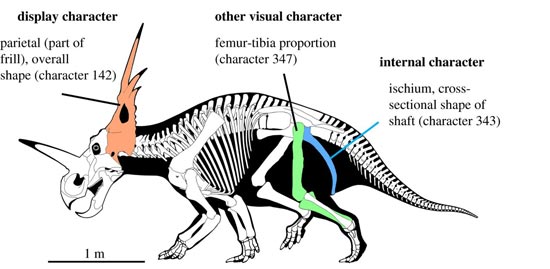
The next step was to classify those differences in the skeleton to separate out any features that may have played a role in inter-species recognition. The scientists looked for anatomical traits within the skeleton. Each trait was classed as either external or internal, based on whether it was likely to have an effect on the exterior appearance of the animal in life. External characters were further subdivided into display and non-display, defined as whether or not the character or trait in question was deemed whole or part of an ornament (i.e. in ceratopsians, the frill, horns and bosses of the skull).
An Example of the Traits Identified by the Researchers (Styracosaurus)
A skeletal reconstruction of the centrosaurine dinosaur Styracosaurus (S. albertensis).
Picture credit: Proceedings of the Royal Society B (Biology)/Scott Hartman
The statistical analysis found no evidence to support the idea that the horns and frills of ceratopsians evolved to help these animals differentiate themselves from other species that they shared habitats with.
Palaeontologist David Hone (University of London), explained that this study suggests that these ornamentations evolved as “social-sexual functions” i.e. as both males and females of each species had similar ornamentation, the horns and frills evolved to help advertise the animal’s condition and fitness for breeding.
He stated:
“We think that, really, it’s mostly a big kind of display feature, so just as peacocks have the big showy feathers and lions have the big mane and deer have big antlers. It’s some kind of big advertising feature for these animals to show off.”
The Frills of Horned Dinosaurs – Billboards for Mutual Attraction
These skull ornamentations may have been a horned dinosaur’s way of demonstrating that it was healthy, strong and had good genetic make-up. In short, both males and females were advertising their fitness for mating. In evolutionary terms, the more fantastic your head crest and the bigger the lumps, bumps and horns on your face the dinosaur is highlighting that it is fit and healthy. It shows that it can grow lots of bone and carry it around without suffering from any disadvantages, such as being too slow and heavy to avoid a T. rex.
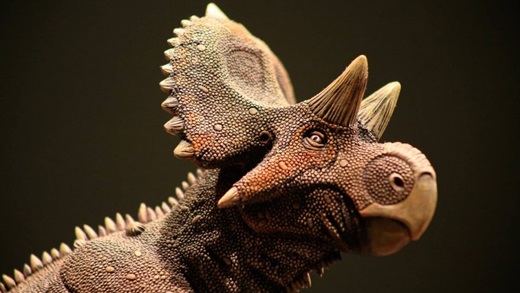
Those Skull Features – Basically They Communicate Fitness for Breeding
Scientists have constructed a model of the Mexican dinosaur called Yehuecauhceratops. Those horns, crests and frills probably advertise the animal’s fitness for breeding.
Picture credit: Museo del Desierto, Mexico (The Coahuila Desert Museum)
Species Recognition Mechanism Theory is Not Supported
The researchers conclude that the theory that all this ornamentation evolved as a species recognition mechanism, has no statistical support among known ceratopsians.
The various features associated with the vast and diverse family of horned dinosaurs probably had other functions too. Perhaps they played a role in thermoregulation and they may have functioned as defensive structures, plus they could have had a role in visual communication and display. However, the idea that they developed to aid with inter-species recognition has been rejected by this research team.
The next time we get asked by an eight-year-old why did Triceratops have horns? We can provide a more complete answer…
The scientific paper: “Patterns of Divergence in the Morphology of Ceratopsian Dinosaurs: Sympatry is not a Driver of Ornament Evolution” by Andrew Knapp, Robert J. Knell, Andrew A. Farke, Mark A. Loewen, David W. E. Hone published in the Proceedings of the Royal Society B (Biology).
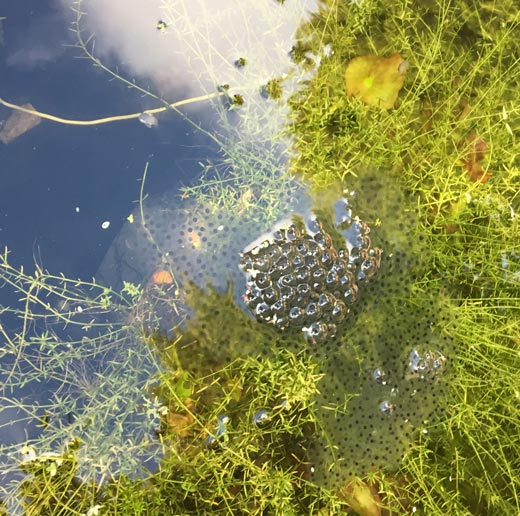
After a false start, when we noticed one clump of unfertilised frog spawn in our pond, we are happy to announce that on the morning of the 17th March we spotted three clumps of newly laid frogspawn. The first eggs were produced on the 20th of February, just prior to a sudden cold snap. Whether a female frog had been stressed we don’t know, but despite our careful gathering of the tennis ball-sized clump of spawn and storing it in a goldfish bowl along with some of the pond water and pond weed, the eggs failed to develop. Our intention was to protect the spawn from the extremely cold weather and then once the snow had melted, to re-introduce the spawn into the pond.
Frog Spawn in the Office Pond (March 2018)
Frogspawn 2018, at least three clumps of spawn have been spotted.
Picture credit: Everything Dinosaur
Later Than Last Year
The spawning has taken place around a week later than last year. We suspect the cold weather delayed the onset of breeding. Hopefully, with the approach of warmer weather (no snow at least), this spawn will be able to develop and soon we will have tadpoles to observe. The amount of spawn, is about average, we estimate that three females laid eggs. Although the eggs tend to merge into one, single mat of jelly, if you can observe the egg masses before they swell you can get a reasonable idea of the number of fertile females present.
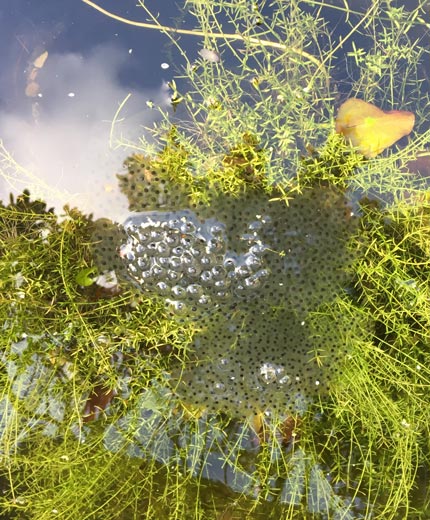
We Intend to Keep a Close Watch on the Frogspawn
Frogspawn 2018.
Picture credit: Everything Dinosaur
Our pond is a haven for wildlife and we hope that at least some of the tadpoles make it to adulthood. Common Frogs (Rana temporaria) inhabit our pond, although sadly, these animals like most of the native British amphibians are no longer common. At least our little pond is helping with conservation efforts.
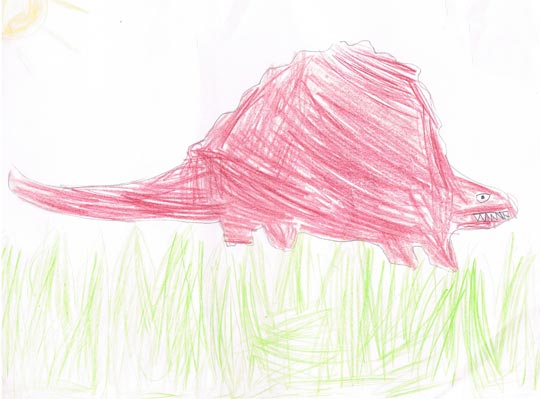
Whilst tidying up one of the office book shelves we came across this wonderful drawing of the Permian reptile Dimetrodon. It had been sent into us by a young dinosaur fan who lives in Lancashire. It just goes to show that Everything Dinosaur also receives drawings and illustrations of other prehistoric animals, not just dinosaurs.
A drawing of a Dimetrodon. Another example of a non-dinosaurian illustration having been sent in to Everything Dinosaur.
Dimetrodon
Most budding, young palaeontologists will tell you all about Dimetrodon, a genus of pelycosaur that evolved during the Permian period and died out many millions of years before the first dinosaurs. Although, not a member of the Dinosauria, this sail-backed reptile is synonymous with the likes of Triceratops, Stegosaurus and Tyrannosaurus rex and often features in so-called “dinosaur model” sets.
Our thanks to the young palaeoartist who sent this drawing in, it certainly helped to brighten our day.
Dinosaur fossils unearthed in Lockesburg, (Arkansas), nearly fifty years ago have been formally described in a scientific journal. Writing in the academic publication the “Journal of Vertebrate Palaeontology”, researchers have assigned the fossil elements representing the right hind foot of an “ostrich mimic dinosaur” to a basal position in the Ornithomimosauria clade. The dinosaur, named Arkansaurus fridayi, was previously thought to represent an animal related to Ornitholestes. However, the researchers, led by palaeontologist ReBecca Hunt-Foster, who works at the Bureau of Land Management and is based in Utah, a U.S. state more accustomed to dinosaur fossils than “The Natural State”, suggest that A. fridayi is more primitive than contemporaneous Asian ornithomimosaurs.
An Illustration of an Ornithomimid Dinosaur (Ornithomimus)
Reconstructions of Arkansaurus have been based on better known ornithomimids such as Ornithomimus (above).
Picture credit: Julius Csotonyi
The State Dinosaur of Arkansas
Although only a handful of bones have been found, palaeontologists have built up a picture of this fleet-footed, lizard-hipped dinosaur, by comparing the fossil pedal (foot) material to more complete and better-known ornithomimids such as Struthiomimus and Ornithomimus that roamed western North America in the Late Cretaceous.
These Late Cretaceous ornithomimids lived on a landmass called Laramidia, it was separated from the eastern part of the continent by a shallow sea (the Western Interior Seaway). Arkansas and consequently, Arkansaurus fridayi was on the other side of this waterway and very little is known about the dinosaurs that existed on this landmass (Appalachia). The right foot, is the only known evidence of saurischian dinosaurs from Arkansas, despite the lack of skeletal information and the absence of a formal scientific description, last year, this dinosaur was named the official state fossil of Arkansas.
ReBecca Hunt-Foster, started working on the fossils more than a decade ago, whilst studying at the University of Arkansas. Her co-author of the scientific paper, James Quinn works at the Department of Geosciences (University of Arkansas), they postulate these fossils will help to improve our understanding of the radiation and geographical dispersal of ornithomimosaurs. Arkansaurus roamed Appalachia some 113 million years ago (Albian-Aptian) faunal stage of the Early Cretaceous, it may well have been an ancestor of the Late Cretaceous “ostrich mimics” such as Ornithomimus.
An Illustration of Arkansaurus fridayi (Estimated Scale)
An illustration of Arkansaurus fridayi. The actual size of the dinosaur is not known, but based on the size of the foot bones, the fossils may represent a dinosaur that was over 4.6 metres in length.
Picture credit: Brian Engh
Not Much Known About North American Early Cretaceous “Ostrich Mimics”
The fossilised foot bones come from the Lower Cretaceous Trinity Group. Exposures in Texas have yielded plenty of dinosaur fossils, but as yet, no ornithomimids have been named from the Texas material, in fact Arkansaurus represents the second-oldest “ostrich mimic” dinosaur known from the whole of North America.
The oldest ornithomimid from North America described to date is Nedcolbertia, (N. justinhofmanni) which is known from fragmentary remains representing several juveniles found in Early Cretaceous sediments deposited in Utah. Such is the paucity of the fossil material of Early Cretaceous ornithomimids from North America, that there is something like a fifteen-million-year gap between Nedcolbertia and the newly described Arkansaurus.
Vertebrate Palaeontologist ReBecca Hunt-Foster with a Cast of the Foot Bones
Vertebrate palaeontologist ReBecca Hunt-foster with a cast of the Arkansaurus foot bones.
Picture credit: R. Hunt-Foster
Arkansaurus fridayi – A Lucky Fossil Discovery
The trivial name honours farmer Robert Friday who discovered the fossils on his farm back in 1972. He was checking on his livestock when he spotted some bones in a ditch excavated by a road construction crew. Any other parts of the skeleton that might have been preserved were probably lost as the construction crew worked. Hunt-Foster and her colleagues are hoping to learn more about Appalachian ornithomimosaurs from any future fossil finds from Arkansas. They hope to build up a picture of the Early Cretaceous palaeofauna and they have speculated that these types of dinosaurs may have originated in Europe and that they are not closely related to other, better known “ostrich mimics” from Asia.
The scientific paper: “A New Ornithomimosaur from the Lower Cretaceous Trinity Group of Arkansas” by ReBecca K. Hunt and James H. Quinn published in the Journal of Vertebrate Palaeontology.
Rebor Fallen Queen, Straight-tusked Elephants and Paleo-Creatures Feature in Newsletter
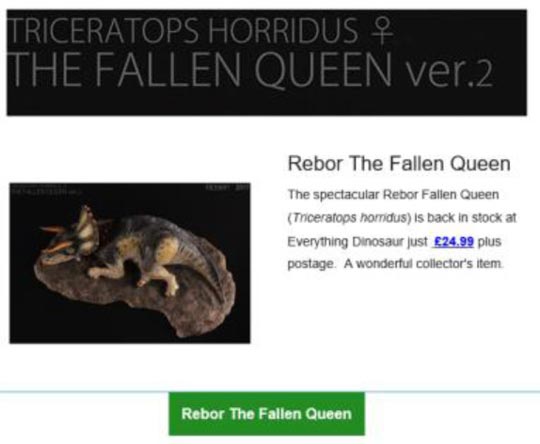
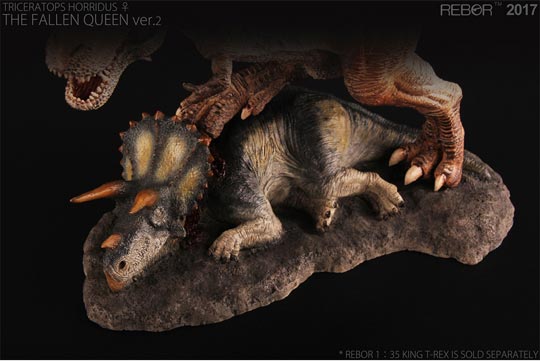
Everything Dinosaur’s latest customer newsletter has been circulated and it contains lots of helpful information about new products, stocking levels and updates on forthcoming introductions. The headline features the return of the extremely popular Rebor Fallen Queen (Triceratops horridus) figure. Version two of this figure is back in production and Everything Dinosaur has received stocks of this super replica which makes a fantastic addition the Rebor King T. rex model.
The Latest Everything Dinosaur Newsletter
The March Newsletter has Triceratops in the Headlines
The Rebor T. horridus in the March newsletter from Everything Dinosaur. Picture credit: Everything Dinosaur.
Picture credit: Everything Dinosaur
The Rebor Fallen Queen is a Stand Alone Figure or can be used in Conjunction with the Rebor 1:35 scale T. rex Replica
The Rebor Fallen Queen (version 2) with the Rebor King T. rex figure.
Reserving Models
Everything Dinosaur customers who had requested a model be reserved for them have already been contacted.
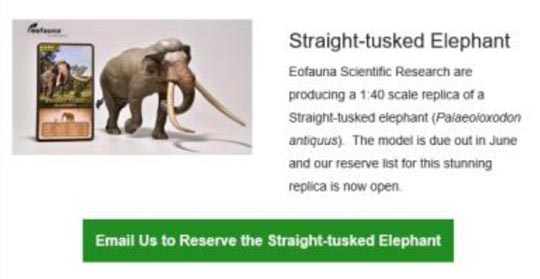
On the subject of reserve lists, Everything Dinosaur’s priority reserve list for the second model in the Eofauna Scientific Research scale model series is now open. The Straight-tusked elephant (P. antiquus) has already generated a lot of excitement after our joint press release with our friends at Eofauna. A number of museums and other institutions have already made enquiries and this 1:35 scale figure will be with us in June.
Proving Very Popular Already – The Eofauna Scientific Research Straight-tusked Elephant Model
The reserve list is now open for the Eofauna Scientific Research Straight-tusked elephant.Picture credit: Everything Dinosaur.
Picture credit: Everything Dinosaur
To join our priority reserve list for this stunning Straight-tusked elephant scale model, simply drop Everything Dinosaur an email: Email Everything Dinosaur.
Leave the rest to us, you don’t have to have a memory like an elephant, we will reserve a figure for you and a team member will personally email you to let you know that the stock has arrived.
Extinct Animals from Paleo-Creatures and a Soft Toy Dodo
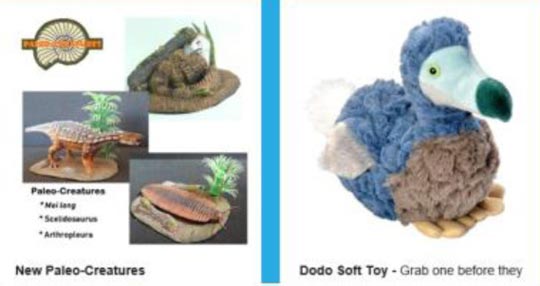
Our latest bulletin also features three new figures from Paleo-Creatures, the “sleeping dragon” Mei long, a marvellous Arthropleura model and especially for fans of early armoured dinosaurs, a splendid Scelidosaurus replica. These new additions are in stock and currently available from Everything Dinosaur.
Paleo-Creatures Replicas and a Dodo Soft Toy
Extinct creatures feature in the Everything Dinosaur March 2018 newsletter.Picture credit: Everything Dinosaur.
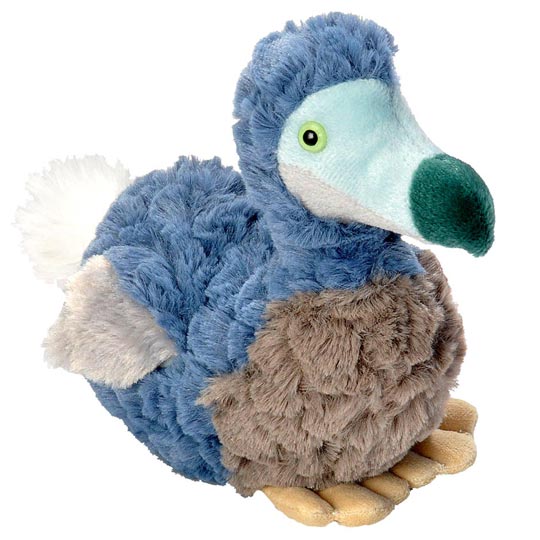
Standing a fraction under twenty centimetres high, the new Dodo soft toy has been skilfully crafted and it looks incredibly cute. There are just a few of these remarkable plush Dodos in stock so grab yours before they become extinct. Best of all, you don’t have to travel all the way to Mauritius to pick one up.
The Dodo Soft Toy Available from Everything Dinosaur
PNSO Triceratops “Doyle” and the Eofauna Scientific Research Steppe Mammoth
Concluding our latest newsletter, we feature the stunning and extremely rare PNSO Triceratops “Doyle” figure along with the very first figure in the Eofauna Scientific Research range, the 1:40 scale Steppe Mammoth model (Mammuthus trogontherii). These two scale models have proved to be extremely popular with model collectors.
The PNSO Triceratops Figure “Doyle” and the Eofauna Scientific Research Steppe Mammoth
PNSO Triceratops Doyle and the Eofauna Scientific Research Steppe Mammoth.Picture credit: Everything Dinosaur.
Coming from the PNSO Age of Dinosaurs range, the Triceratops “Doyle” is also in 1:35 scale, it measures around 26 centimetres in length and the base upon which the replica stands is a little over nineteen centimetres long.
We look forward to sending out more newsletters later on in the spring. Remember, if you want to join our newsletter list simply drop Everything Dinosaur an email, expressing your wish to get our periodic newsletters: Email Everything Dinosaur to Subscribe to our Newsletter.
Class 1 at Ysgol Bro Carmel Enquire About Diplodocus
The children in class 1 at Ysgol Bro Carmel Nursery and Primary School in North Wales have been learning all about dinosaurs this term. The class teacher, Mrs Metcalfe emailed Everything Dinosaur and explained that as part of the diverse and varied teaching programme, the eager, young palaeontologists had some questions about Diplodocus for us. A diplodocid had been spotted in the school yard and the children had been writing instructions on how to trap this long-necked dinosaur. Could Everything Dinosaur offer some assistance?
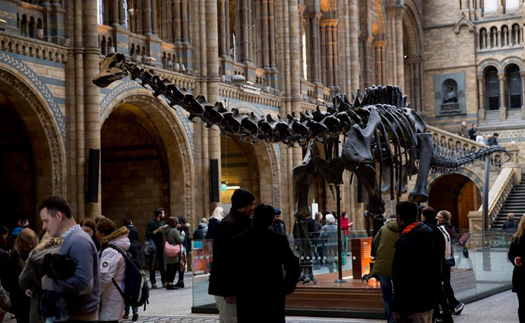
Diplodocus on Display at the Natural History Museum (London)
Diplodocus on display in a museum, this long-necked dinosaur is proving to be very popular with the Class 1 children at Ysgol Bro Carmel.
Answering Questions About Dinosaurs and Diplodocus
What Did Dinosaurs Eat?
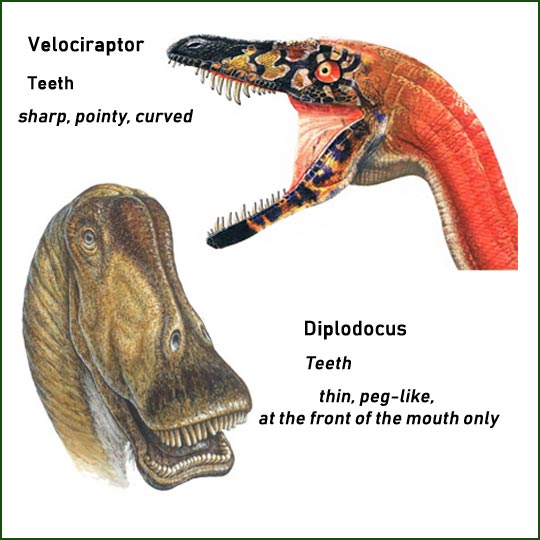
Palaeontologists can work out what extinct dinosaurs liked to eat by looking at their fossilised teeth. The shape of the teeth can tell a scientist a lot about the type of food that dinosaurs ate. The teeth of Velociraptor are sharp, pointed and curved. This suggests that Velociraptor was a meat-eater (carnivore). The teeth of diplodocids are a very different shape when compared to the teeth of the fearsome Velociraptor. Diplodocus only had teeth at the front of its mouth, these teeth were thin and looked like pegs.
Comparing the Teeth of a Meat-eater (Velociraptor) to the Teeth of a Plant-eater (Diplodocid)
Comparing the teeth of the carnivore Velociraptor to the herbivore (sauropod).
Picture credit: Everything Dinosaur from original illustrations by Michael Skrepnick and Zhao Chuang
Diplodocus was a plant-eater (herbivore), this dinosaur probably spent most of his life eating plants.
How is Diplodocus Different from Brontosaurus?
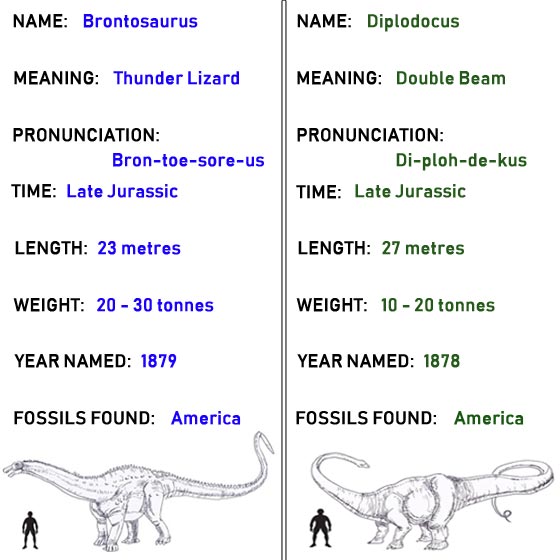
Diplodocus and Brontosaurus were closely related. Both were plant-eaters and they probably liked to eat the same types of plants. These long-necked dinosaurs lived in the Late Jurassic and their fossils have been found in the same country (United States of America). Diplodocus was different from Brontosaurus in a number of ways. It had a much longer tail and its neck was longer and more slender than Brontosaurus. Brontosaurus was probably much heavier than Diplodocus.
Similarities and Differences Between Brontosaurus and Diplodocus
Brontosaurus compared to Diplodocus.Picture credit: Everything Dinosaur.
Picture credit: Everything Dinosaur
How big is a Diplodocus?
We have provided some information about the size of Diplodocus in the picture above. Can the children work out how much longer Diplodocus was compared to Brontosaurus? Why have we put a picture of a person next to our two dinosaur drawings (above), can the children think like scientists and come up with the answer?
How Could We Trap a Diplodocus if it was Alive?
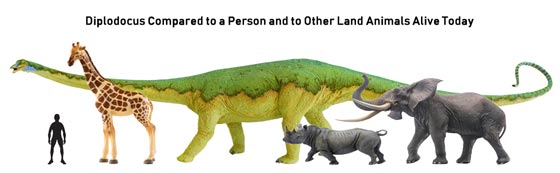
Trying to trap a Diplodocus might be quite dangerous, after all, this plant-eating dinosaur was much bigger than any land animals alive today. The children have probably come up with some amazing ideas and suggestions. You could dig a big pit and cover it with tree branches then chase the Diplodocus towards the hole, if the Diplodocus fell in, it would probably get stuck, so long as the hole was deep enough. However, this might hurt the dinosaur, so perhaps instead of trying to force the dinosaur to try and do something, it might be better to persuade it to come to you.
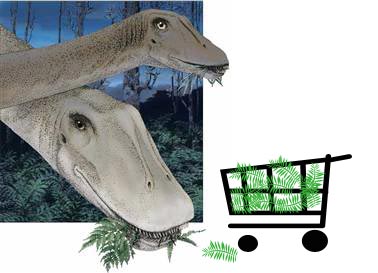
Since Diplodocus needed to eat a lot of plants, class 1 could perhaps persuade it to come and visit them by putting out some of its favourite food. If the children collected lots and lots of ferns (Diplodocus probably ate around 200 kilograms of plants every day), filling a shopping trolley with Diplodocus treats, might persuade the dinosaur to come and visit the children in the playground.
Attracting Diplodocus into the Playground by Providing Some of its Favourite Food
No need to catch a Diplodocus, try attracting it into the playground by leaving out some of its favourite food.
People attract dinosaurs into their gardens every day, even though they probably don’t realise they are doing this. Birds are so closely related to dinosaurs, that we should not call birds “birds” at all. They are “avian dinosaurs”. If you have a bird table at your school or in your garden you can watch dinosaurs feeding. Check out the feet on birds like the sparrow, thrush and blackbird, they have claws just like a dinosaur and they walk on three toes just like Tyrannosaurus rex!
How Long is the Neck of a Diplodocus? How Long is the Tail of Diplodocus?
A complete fossilised neck of Diplodocus has never been discovered. All the bones that make up a tail of a Diplodocus have never been found. When you visit a museum and see a spectacular mounted skeleton like “Dippy” the Diplodocus which used to be on display at the Natural History Museum (London), the skeleton you see consists of the bones of several individuals put together to make a single exhibit.
Missing bones are made as models and added to the skeleton to make it look complete. Most palaeontologists think that Diplodocus had around fourteen or fifteen neck bones and the neck measured about eight metres long. A baby Diplodocus had a relatively short neck, when it hatched (as far as we know, all dinosaurs hatched from eggs, just like birds today), as the Diplodocus grew, its neck got longer and longer. The whip-like tail of Diplodocus was longer than its neck. Size estimates for the tail of a Diplodocus are difficult to make, but Everything Dinosaur’s fossil experts suggest that the tail of a fully-grown Diplodocus could have been around fourteen metres long, that’s longer than a Badminton court!
Comparing a Diplodocus to Large Land Animals Alive Today
Diplodocus compared to animals alive today.
Picture credit: Everything Dinosaur
Our thanks to all the children in class 1 at Ysgol Bro Carmel Nursery and Primary School, we hope our answers to your questions help you with your term topic.