All about dinosaurs, fossils and prehistoric animals by Everything Dinosaur team members.
14 08, 2014

New Species of Flying Reptile Identified from “Pterosaur Graveyard”

By |2023-03-16T08:00:13+00:00August 14th, 2014|Categories: Dinosaur and Prehistoric Animal News Stories, Main Page|0 Comments

New Flying Reptile with a Crest Shaped Like a Butterfly’s Wing

Scientists have announced the discovery of a new species of flying reptile (pterosaur) that very probably lived in colonies and had a bizarre head crest shaped like the wing of a butterfly.  The fossils were found in south-eastern Brazil, near to Cruzeiro do Oeste in Paraná State, about 300 miles west of the city of São Paulo.  The actual fossil site discovery was made in 1971, but a formal study of the extensive fossil material has only just been completed.

The scientists who carried out the research were drawn together from various Brazilian museums and research institutes as this discovery represents the first time an extensive bone-bed of pterosaur fossils has ever been found.  The fossilised remains of at least forty-seven flying reptiles have been described to date, although the strata may have preserved the remains of hundreds of individual animals.

Caiuajara dobruskii

This new species has been named Caiuajara dobruskii (pronounced Kay-you-ah-jar-rah doe-brusk-key)  and the fossils represent  mainly young animals although the remains of at least two fully grown adults have been identified.  The smallest pterosaurs preserved had wingspans of around sixty-five centimetres, whilst the adults had wingspans in excess of 2.3 metres, making a fully grown Caiuajara about the size of Golden Eagle (Aquila chrysaetos).

An Artist’s Impression of the New Species of Flying Reptile

The fossilised bones of at least 47 individuals have been found.

The fossilised bones of at least 47 individuals have been found.

Picture credit: Maurilio Oliveira/Museu Nacional-UFRJ

New Species of Flying Reptile

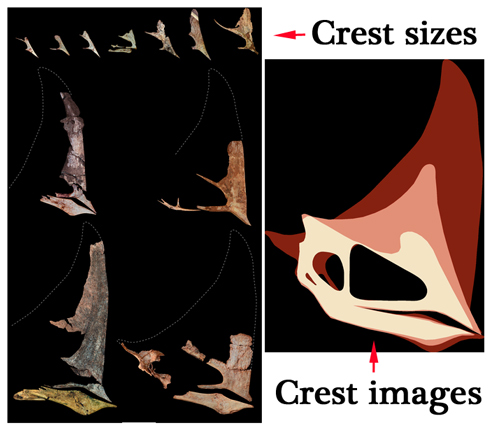
So far, about 130 different genera of pterosaur have been identified worldwide.  However, most of these are known from just a few fragmentary bones.  In this instance, the palaeontologists have hundreds of bones to study and they can map the growth and development of these creatures.  It seems that the bizarre “butterfly-wing shaped crest”, got bigger and more elaborate as this reptile grew and matured.

The Brazilian researchers were able to plot how the crest changed as these animals got older.  Palaeontologists think that a number of types of flying reptile sported elaborate crests.  It seems that the males of many species used their crests to display and attract a mate, as the one definite fossil of a female pterosaur known did not have a substantial crest.

Crest Shape and Size Changed as these Pterosaurs Grew
Reconstructing the shape of adult and juvenile Caiuajara skulls.

Reconstructing the shape of adult and juvenile Caiuajara skulls.

Picture credit: PLOS One/Everything Dinosaur

The picture on the left shows various bone fragments representing different stages of growth, from very young animals (top left) through to mature adults (bottom right).  The crest images indicate the suggested changes in the skulls of these pterosaurs as these animals grew and matured  from a juvenile skull (light colour) to an adult (dark colour).

Fossils Found at Three Levels

The fossils were found at three levels of sandstone that form part of the Caiuá Group of the Goio-Erê Formation.  A fourth layer, representing a younger geological deposit was also excavated but this only yielded a few very fragmentary remains.  The strata represents deposition in a palaeodesert environment associated with a water source, very probably a lake.  The research team have suggested that Caiuajara dobruskii lived in large colonies around an oasis which was surrounded by desert.  Since no egg shell material has been recovered it seems unlikely that this was a nesting site.

However, study of the very youngest specimens suggest that these animals were precocial (able to fend for themselves almost immediately after hatching), and that they could fly at a very young age,  although an extensive period of parental care is not ruled out by the researchers.

As the fossils were found in defined layers, the scientists have concluded that this region was home to pterosaur populations for an extended period of time, thousands of years.  Dramatic events such as violent storms could have hit the colony from time to time carrying any bones into the lake where they would eventually be preserved.  An alternative hypothesis, not favoured by the researchers, who have published their data in the latest edition of the on line scientific journal “PLOS One”, is that this region represented a staging post and Caiuajara was migratory.

Demonstrating the Density of the Fossil Material that Accumulated

Dense fossil deposit.

Dense fossil deposit.

Picture credit: PLOS One

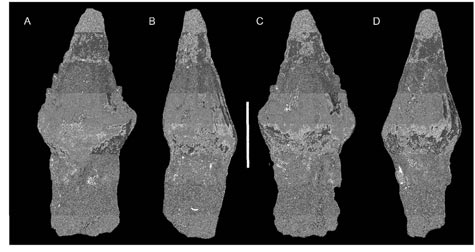
The picture above shows one of the blocks of sandstone containing a large number of disarticulated pterosaur fossil bones, at least fourteen partial skulls have been identified in this individual stone block.  Scale bar = 20 centimetres, mandible (jaw bones) = man and cranium (skull bones) = cra.

This is an important fossil discovery because:

  • This is the first time pterosaur fossils have been found in south-eastern Brazil.  Brazil has produced some amazing pterosaur fossils in the past but these have been located in the north-east of the country.
  • The quantity of fossils has permitted scientists to plot how the anatomy of these flying reptiles changed as the animals grew.
  • The finding of so many fossils of the same species together indicates that these animals may have lived in colonies, it suggests that pterosaurs may have been highly social animals.
  • Caiaujara dobruskii fossil material is associated with an inland environment, most pterosaur fossils have been found in marine sediments.
  • These fossils may represent the youngest (in terms of geological age) of this type of pterosaur found anywhere in the world.

If pterosaurs like C. dobruskii were indeed gregarious and highly social animals then this might help explain the evolution of those bizarre crests.  Bigger and more elaborate crests being selected for as females over generations showed a preference for larger crests in potential mates.

This new species has been assigned to the Tapejarinae sub-family of Tapejaridae pterosaurs.  The genus name is a combination of Caiuá after the formation in which the fossils were found and the pterosaur family name (although coincidently, there is a small town called Tapejara close to where the fossils were discovered as well).  The trivial name honours Alexandre Dobruski, who with his son, João Dobruski, found the fossil site back in 1971.

An Illustration of a Typical Pterosaur from the Tapejaridae Family
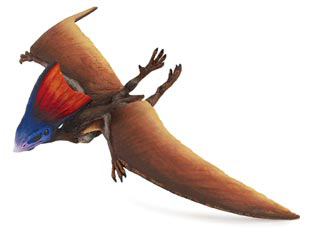
A model of Tapejara imperator (Safari Ltd)

A model of Tapejara imperator (Safari Ltd).

Picture credit: Safari Ltd /Everything Dinosaur

For models and replicas of pterosaurs and other prehistoric animals: Wild Safari Prehistoric World Figures and Models.

The Goio-Erê Formation has proved extremely difficult to date.  It is estimated that the sandstones that make up this formation were laid down sometime in the Upper Cretaceous from around 93 million years ago to 75 million years ago.  Other Tapejaridae fossils found in north-eastern Brazil, Europe and China date from the Lower Cretaceous, making Caiaujara dobruskii potentially the youngest known member of the Tapejaridae family in terms of geological deposition.

A spokes person from Everything Dinosaur commented:

“Although the head crest makes this flying reptile look quite fierce it actually had no teeth in its jaws.  It is not known what this pterosaur may have eaten but like other members of the Tapejara family it possessed a relatively short but robust beak.  It could have specialised in eating fruits and seeds from the flourishing flowering plants (angiosperms).  Imagine that!  Pterosaurs playing a role in seed dispersal for flowering plants.”
13 08, 2014

Unique Dinosaur Footprints Damaged

By |2024-05-02T12:00:43+01:00August 13th, 2014|Categories: Dinosaur and Prehistoric Animal News Stories, Dinosaur Fans, Main Page, Palaeontological articles|0 Comments

Welsh Dinosaur Footprints Vandalised

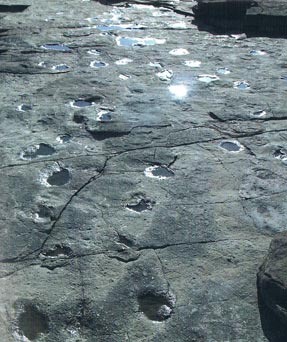
They might be as much as 200 million years old but the thoughtless actions of fossil hunters have damaged a number of dinosaur footprints preserved at a site of special scientific interest (SSSI) in Wales.  A number of prints have been damaged including one that was filled with plaster of paris in a bid to make a cast and then an attempt was made to hammer the cast out of the rock.  The fossilised footprints form part of an important palaeontological site in the Vale of Glamorgan.  The prints can be found on a stretch of exposed coastline between the towns of Barry and Sully on the northern coast of the Bristol Channel, the trace fossils are the oldest known dinosaur tracks to found anywhere in the British Isles.

Welsh Dinosaur Footprints

The picture above shows one of the three-toed (tridactyl) prints with marks around it where an attempt was made to cut out the fossil from the surrounding rock.

The fossils, which are located in strata that form the Mercia Mudstone Group have been subjected to vandalism before.  Sadly, authorities and conservation bodies face a dilemma, do they permit free access to the site so that walkers can view the fossilised footprints and tracks in situ or should the trace fossils be removed and stored in a secure facility to prevent vandalism and fossil thefts?

Back in August 2012, Everything Dinosaur team members reported on the theft of footprint fossils from the same area, fortunately the fossils were recovered a few weeks later.

To read about the earlier fossil theft: Dinosaur Footprints Stolen from the Vale of Glamorgan.

This new damage was discovered by South Wales archaeologist Karl-James Langford whilst he was conducting students around the SSSI.

Mr Langford, the founder of Archaeology Cymru (Archaeology Wales) stated:

“I took a group of ten students to give them the tour of the dinosaur footprints.  I could not hide my horror at the damage which had been deliberately caused.   We examined one print that had been filled with plaster of paris.  On a visit to inspect the damage with another group later that same day, somebody had deliberately tried to smash it out with a breeze block, damaging the 200 million year old print in the process.”

It has also been reported that fires had been lit around the site and rubbish left, calls were made last night to provide this extremely important fossil site with greater protection.

What’s so Special About this Location?

The mudstones exposed on this stretch of the coast running along the northern edge of the Bristol Channel were laid down towards the end of the Triassic Period (Upper Triassic – Norian to Rhaetian faunal stage), dinosaur footprint fossils from this time in Earth’s history are extremely rare and the site is one of the world’s most important in terms of recording the activities of Late Triassic dinosaurs.  This was an area of mud flats and silts leading towards the edge of a shallow tropical sea to the south-west.  Many different types of ancient reptile crossed these mud flats and their footprints and tracks were preserved.

Hundreds of individual prints have been recorded and something like sixty trackways have been mapped.  Most of the dinosaur tracks represent a small, three-toed, theropod which has been given the ichnogenus Grallator.  An ichnogenus is a name given to an organism that has left trace fossils, usually tracks, prints or burrows.  Other types of dinosaur footprints have been recorded, including tracks representing a large meat-eater (theropod) and a series of trails left by plant-eating prosauropods.

Field Photograph Showing Preserved Trace Fossils at Barry (Vale of Glamorgan)

Dinosaur Tracks from the Late Triassic.

Dinosaur tracks from the Late Triassic.

Picture credit: Tom Sharpe (Dinosaurs of the British Isles)

Dinosaur Tracks

The photograph above shows a number of rounded footprints and tracks.  The rounded prints are believed to have been made by a prosauropod dinosaur.  Many of the tracks are quite difficult to spot, the best time to see them is in the evening when the low sun casts shadows on those tracks which represent natural casts.  In addition, if there has been recent rain, or a high tide many of the trackway depressions will be filled with water and this makes observing the prints much easier.

Team members at Everything Dinosaur would like to echo the comments made by a number of other organisations with regards to this damage.  It is essential that sites such as this are protected and safeguarded and we urge all readers to remember that this is a SSSI and as such it is an offence for any person or persons to intentionally or recklessly damage or destroy any of the features of special interest of an SSSI!

If any visitor to this location sees suspicious activity, such as damage to footprints, attempts to make casts or actions that could lead to the theft of a print, please alert the Countryside Council for Wales, the Geology Department of the National Museum of Wales or the Geologists’ Association South Wales Group.

Useful Contacts

For the Geology Department of the National Museum of Wales telephone +44 (0)29 2057 3213

Email: the Geologists’ Association of South Wales Group: [email protected]

For the Countryside Council for Wales, try Natural Resources Wales (Mon-Fri) on 0300 065 3000

12 08, 2014

Early Dinosaurs of North America Pushing the Date back 11 Million Years According to New Research

By |2024-05-02T12:06:40+01:00August 12th, 2014|Categories: Dinosaur and Prehistoric Animal News Stories, Dinosaur Fans|0 Comments

New Research Suggests Dinosaurs were Living in North America Earlier than Previously Thought

A team of researchers have used radiometric dating of zircon crystals to determine that the first dinosaurs lived in North American more than eleven million years earlier than previously thought.  Publishing their work in the scientific publication “American Journal of Science”, the Massachusetts Institute of Technology (MIT) scientists state that the uranium to lead decay ratios recorded in the zircon crystals indicate that there were dinosaurs living in North America as early as 223 million years ago (Carnian faunal stage of the Upper Triassic).

Dinosaurs

In addition, the team have demonstrated that these earliest dinosaurs coexisted with close non-dinosaur relatives, as well as significantly more evolved dinosaurs, for more than 12 million years.  To add to the mystery, they identified a 16-million-year gap, older than the dinosaur-bearing rocks, where there is either no trace of any vertebrates, including dinosaurs, in the rock record, or the corresponding rocks have eroded away.

During the Triassic period, most of the land masses we now know today were joined together to form a single, super-continent (Pangaea).  It had been thought that the Dinosauria evolved in the portion of this landmass that ended up becoming South America.  Fossils dated to around 228 million years ago from Argentina indicate the presence of small, theropod dinosaurs (Eoraptor), however, the “Dinosaurs evolved in South America” theory has recently been challenged after the discovery of fragmentary fossils in southern Tanzania that may date from as early as 240 million years ago.

To read more about this: The Oldest Dinosaur?

The Earliest Dinosaurs

Lead author of the paper, Jahan Ramezani, a research scientist at the Department of Earth, Atmospheric and Planetary Sciences (MIT), stated:

“Right below that horizon where we find the earliest dinosaurs, there is a long gap in the fossil and rock records across the sedimentary basin.  If the record is not there, it does not mean the dinosaurs didn’t exist.  It means that either no fossils were preserved, or we haven’t found them.  That tells us the theory that dinosaurs simply started in South America and spread all over the world has no firm basis.”

The difficulty we have is that vertebrate fossil records are exceptionally fragmentary from the Triassic and what fossils that have been found such as extensive fossil material associated with the dicynodont Placerias is very difficult to date accurately.  Another factor which can confuse palaeontologists is that during the Triassic, a number of archosaur groups thrived and determining which fossils represent an example of a true dinosaur or a crocodylomorph, aetosaur or rauisuchian is a very complicated business.

During the Triassic – All Kinds of Reptile Coexisted

Dinosauromorphs.

All kinds of “Dinosauromorphs” existed.

Picture credit: Journal Science

The Chinle Formation

Certainly, parts of Argentina have a more recognisable stratigraphic geology than North America.  Plotting the progressive evolution of dinosaurs in the United States is therefore more problematical.  However, the research team focused on the Upper Triassic rocks of the Chinle Formation of the south-western United States.  This is where the oldest dinosaur fossils from North America can be found.  But just how old are they?

The Chinle Formation covers parts of New Mexico, Arizona, Utah and Colorado. It is probably best known for the Petrified Forest National Park location (Arizona), with its extensive fossils of prehistoric trees.  Scientists had previously dated isolated beds of this formation, and determined the earliest dinosaur-like animals, discovered in New Mexico, appeared by about 212 million years ago.

Dating Strata at the Petrified Forest National Park (Blue Mesa Location)

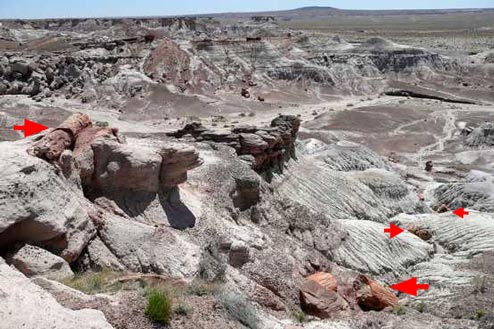
The red arrows indicate petrified wood.

The red arrows indicate petrified wood.

Picture credit: Malka Machlus from Lamont-Doherty Earth Observatory of Columbia University

The picture above shows the Blue Mesa locality of the Petrified Forest National Park, a few logs of petrified wood (rust colour) can be seen eroding out of the sun-bleached sandstones (white).  We have highlighted the location of some of the chunks of petrified wood using red arrows.

Dating the Formation

Ramezani and his colleagues sought to more precisely date the entire formation, including levels in which the earliest dinosaur fossils have been found.  The team took samples from exposed layers of sedimentary rock that were derived, in large part, from volcanic debris in various sections of the Chinle Formation.

In the lab, the researchers subjected the rocks to acids and intense heat in order to break them down and isolate individual microscopic grains of zircon, a uranium-bearing mineral that forms in magma shortly prior to volcanic eruptions.  From the moment zircon crystallises, the decay of uranium to lead begins in the mineral and, as Ramezani explains it, “the chronometer starts.”  Researchers can measure the ratio of uranium to lead isotopes to determine the age of the zircon, and, inferentially, the rock in which it was found.

This is virtually the same dating technique that was used to help date Venezuela’s first dinosaur Laquintasaura.

To read more about Laquintasaura and what this discovery means: Laquintasaura – What’s All the Fuss About?

MIT Led Research

The study involved a number of researchers from MIT, including co-author of the scientific paper Sam Bowring, the Robert R. Shrock Professor of Geology at MIT.  David Fastovsky, (Professor of Geosciences at the University of Rhode Island), also assisted in the research.  It seems that dinosaurs, both primitive members of this Order and more advanced forms happily co-existed together for many millions of years.  These reptiles in turn, shared the habitat that was to eventually form the southern United States with a wide variety of other archosaurs.

A spokes person from Everything Dinosaur commented:

“The U-PB ID-TIMS zircon geochronology dating method [uranium to lead] is very precise and this team’s study has led to a reassessment of the age of the rocks that make up the lower portions of the Chinle Formation.”

Charting the evolution of the Dinosauria in North America is extremely difficult due to the sparse nature of the fossil record and the lack of firm data to assist with the relative ages of tetrapod fossil bearing strata.  This new study prompts a revision of the dating of the Lower Chinle Formation and provided a new temporal context for its rich and diverse tetrapod fauna.

Everything Dinosaur acknowledges the help of MIT in helping to compile this article.

11 08, 2014

1:40 Scale CollectA Deluxe Therizinosaurus Video Review

By |2023-03-16T07:45:20+00:00August 11th, 2014|Categories: Dinosaur Fans, Everything Dinosaur Products, Everything Dinosaur videos, Product Reviews|0 Comments

A Video Review of the CollectA Deluxe 1:40 Therizinosaurus Dinosaur Model

Those clever manufacturers CollectA have made an excellent replica of the bizarre theropod dinosaur known as Therizinosaurus.  We at Everything Dinosaur have made a short video review of this new for 2014 replica.  In this short video (six minutes and fifty seconds), we look at this model in more detail, discuss the fossil discoveries and compare this replica to the smaller, not-to-scale therizinosaur model introduced by CollectA a couple of years ago now.

CollectA Deluxe Therizinosaurus

Everything Dinosaurs 1:40 Scale CollectA Therizinosaurus Video Review

Video credit: Everything Dinosaur

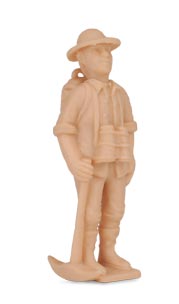
In this video we introduce Sir Arthur Gauge.  Sir Arthur is the name of the human replica that is included with many of the 1:40 Deluxe CollectA models.  He provides a scale for the replica in question.   In this particular case, estimating the scale of the CollectA Deluxe Therizinosaurus model is quite difficult, the fragmentary fossil material makes it tricky to provide a size guide for a fully grown animal. Some palaeontologists believe that Therizinosaurus cheloniformis weighed more than five tonnes and was over ten metres long.  Based on our estimates, we calculate that this figure is around 1:35 to 1:40 scale.

Sir Arthur Gauge Provides a Guide to Scale Size

A clever way to provide a scale for dinosaur models.

A clever way to provide a scale for dinosaur models.

Picture credit: Everything Dinosaur

To view Everything Dinosaur’s range of CollectA Deluxe scale models: CollectA Deluxe Prehistoric Animal Models.

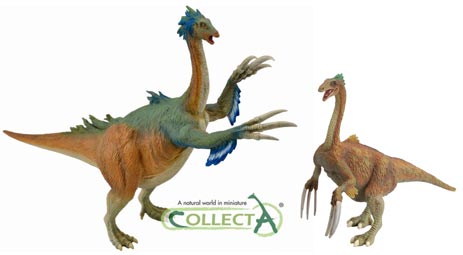
 Those impressive claws, are very well depicted.  The largest manual unguals (claw cores) associated with T. cheloniformis measure over seventy centimetres in length.  In life, with the horny sheath covering the largest claws would have been around a metre long.

The Bizarre but Spectacular Therizinosaurus

A pair of Therizinosaurs.

A pair of therizinosaurs.

Picture credit: Everything Dinosaur

10 08, 2014

750,000 Unique Views on YouTube

By |2024-05-02T11:55:24+01:00August 10th, 2014|Categories: Adobe CS5, Dinosaur Fans, Everything Dinosaur News and Updates, Press Releases|0 Comments

750,000 Video Views on Everything Dinosaur’s YouTube Channel

A very big thank you to everyone who has viewed our various video offerings on Everything Dinosaur’s YouTube channel.  Earlier this week we passed an amazing 750,000 video views.  We certainly don’t regard ourselves as Steven Spielberg, or for older readers a Cecil B. DeMille, but we wanted to post an article to say thank you to all those people who have taken the time to view our model reviews and other videos that we have posted.

Everything Dinosaur

Everything Dinosaur’s YouTube Channel Passes 750,000 Video Views

Thank you!

Thank you!

Picture credit: Everything Dinosaur

Prehistoric Sharks Toob Video Review

Our most popular video is the review we posted up of the Prehistoric Sharks Toob, a set of beautifully made prehistoric shark models manufactured by Safari Ltd.  This video has had something like 95,000 video reviews, which we are so chuffed about.

Everything Dinosaur’s Most Popular Video (So Far)

Video credit: Everything Dinosaur

To see our comments on the prehistoric shark models when they were first introduced: Prehistoric Sharks Swim into View.

We are all genuinely humbled by all the comments we have received, we do try and respond to each and every one of them and to answer any questions that get raised by viewers.  In total, we have eighty-nine videos uploaded with our ninetieth due to go up today (a review of the 1:40 Deluxe Collecta Therzinosaurus dinosaur model).  Thank you for all the “likes” and feedback and a special mention to those customers of Everything Dinosaur who put up reviews of the models and other items that they have purchased from us.  It is always a pleasure to see such videos and we really enjoy watching them.

Our Safari Ltd Megalodon (C. megalodon) video review is also popular along with a number of our video reviews on various Tyrannosaurus rex models.

To see the Safari Ltd model range: Wild Safari Prehistoric World Figures.

We shall continue to make and post up model reviews, aiming to have over one hundred posted by the end of the year, a special thanks to all our subscribers.

To visit Everything Dinosaur’s YouTube channel: Everything Dinosaur on YouTube.

9 08, 2014

“Mega-Trove” of Dinosaur Footprints from Burgos Province (Spain)

By |2023-03-16T07:35:10+00:00August 9th, 2014|Categories: Dinosaur and Prehistoric Animal News Stories, Dinosaur Fans, Main Page|0 Comments

Spanish Site – Provides Palaeontologists with the Opportunity to Follow in the Footsteps of Dinosaurs

A site some twenty kilometres south-east of the town of Burgos in northern Spain has provided a team of palaeontologists with an opportunity to study an exceptionally well-preserved collection of fossilised dinosaur footprints.  The site, known as Las Sereas part of the Quitanilla de las Viñas trace fossil beds is believed to date from the Early Cretaceous and the location, which covers some five kilometres, preserves the trace fossils from a number of different types of dinosaur – stegosaurs, sauropods and a variety of theropods.

Dinosaur Footprints

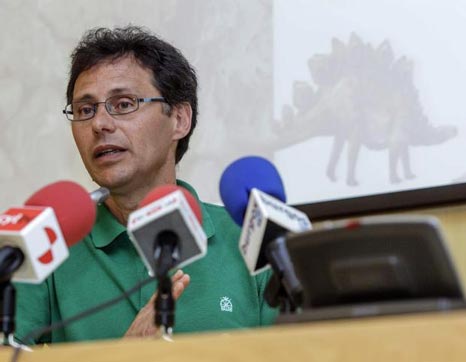
In a media briefing, the scientific director of the Las Sereas site, Fidel Torcida, heralded the huge number of footprints and regarded it as a “mega-trove” of ichnites (the term used to describe a fossil footprint).

Research Director Dr Torcida Discusses the Fossilised Footprints

Important trace fossil site from northern Spain.

Important trace fossil site from northern Spain.

Dr Torcida, who is also the research director at the nearby Dinosaur Museum (Salas de los Infantes), commented that some of the fossilised prints show sauropod prints with four toes on the front feet and not five.  He stated that the four toes are not curved, unlike all the others that have been documented around the world.

In 2011, Dr Torcida was a member of a team of researchers who described a new species of long-necked dinosaur Demandasaurus darwini.  Demandasaurus (named from the Sierra de la Demanda mountains).  It was classified as a diplodocoid and as such it was the first to be formally described from the Iberian peninsula of Spain.

Demandasaurus darwini

D. darwini is known from a fragmentary skeleton, including elements of the skull, jaws and vertebrae.  It has been placed in the Rebbachisauridae family of sauropods, a bizarre family, only established in 1997 but the family now contains more than a dozen genera including species from Africa and South America.  Demandasaurus is believed to have measured around ten metres in length and perhaps weighed more than five tonnes.

An Illustration of a Rebbachisaurid (Nigersaurus taqueti)

The "Lawn Mower" Sauropod

The “Lawn Mower” sauropod.

Picture credit: Everything Dinosaur

For replicas of sauropods and other Early Cretaceous dinosaurs: Wild Safari Prehistoric World Figures.

The site has been studied for several years, but the full extent of the trace fossil material is only beginning to be realised.  Last year, a large footprint from a sauropod was discovered, but recent excavations revealed a trail some seventeen metres long , consisting of forty-five sauropod prints.  Many of the individual prints are over fifty-five centimetres long and record a time some 144 million years ago when a large sauropod made its may across a mud flat.

In total, something like eight hundred individual footprints had been identified so far, but it was reported that there was probably more than a thousand or so trace fossils in total.  The tracks of at least three different sized theropod (meat-eating) dinosaurs had also been identified.

Over the last decade, there have been some remarkable dinosaur discoveries made in Spain.  Back in 2007, Everything Dinosaur reported on the discovery of an extensive bone bed containing the preserved remains of several Late Cretaceous dinosaurs from a site near to the city of Cuenca in western Spain.

To read more about this discovery: Dinosaur Bone bed from Spain.

8 08, 2014

CollectA Mosasaurus Model Video Review

By |2023-03-16T07:27:08+00:00August 8th, 2014|Categories: Dinosaur Fans, Everything Dinosaur Products, Everything Dinosaur videos, Product Reviews|0 Comments

The CollectA Mosasaurus Model Video Review

The first account of a mosasaur fossil was written in 1764, so 2014 marks the 250th anniversary of the publication of this information.  The fossil was found in Holland, near the town of Maastricht and here Everything Dinosaur team members contribute to the mosasaur database by publishing our video review of the excellent Mosasaurus model made by CollectA.

CollectA Mosasaurus

Everything Dinosaurs Video Review of the CollectA Mosasaurus

Video credit: Everything Dinosaur

A Video Review

CollectA made a not-to-scale replica of the mosasaur known as Tylosaurus a few years ago now, this new, larger replica brings the Mosasauridae right up to date with pterygoid teeth depicted on the roof of the mouth and a spectacular tail fluke.  In this short video, (six minutes, forty-eight seconds), we point out these details and explain how this model reflects some of the latest scientific research on these amazing marine reptiles.

To view Everything Dinosaur’s range of CollectA figures: CollectA Prehistoric Life Models.

To read an article which reports on the study of a mosasaur fossil specimen that provides evidence of a tail fluke: Mosasaurs – A Shark’s Tale.

In the video, we also touch upon the chosen colour scheme of this model.  It does remind us of the markings on the extant Whale Shark (Rhincodon typus), the biggest fish alive today.  The largest members of the Mosasaurus genus would have grown to around the same length of a Whale Shark, perhaps fourteen metres or more, but the Whale Shark would have been many times heavier.

Whale Sharks may be gentle, slow-swimming plankton feeders but the mosasaurs were fast-swimming, predators with the likes of Mosasaurus hoffmanni, whose fossils have been found in Holland, preying on other large marine vertebrates such as plesiosaurs, large fish and turtles.

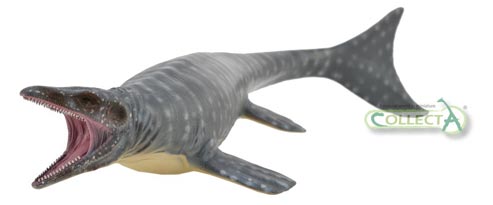
Super Colouration on this Mosasaurus Model

Fearsome marine predator from Collecta due in 2014.

Fearsome marine predator from CollectA.

Picture credit: Everything Dinosaur

These reptiles were believed to have been predators of the surface waters.  Many palaeontologists think that these animals had relatively poor, stereoscopic vision so they would have most likely avoided the darker, deeper water, preferring to hunt in the relative shallows.  Whale Sharks tend to swim in the top 100 metres or so of the sea as they collect food with their huge, cavernous mouths, this might explain the colouration chosen for the Mosasaurus replica.

To read an article about the study of organic material found by Swedish scientists as they examined a Mosasaur specimen: Soft Tissue in a Mosasaur Fossil?

Recently, palaeontologists identified a species of mosasaur that lived in freshwater, to read about this discovery: Freshwater Mosasaur from Hungary.

7 08, 2014

Laquintasaura – What Does it all Mean? That’s a Great Question!

By |2024-05-02T12:09:00+01:00August 7th, 2014|Categories: Dinosaur and Prehistoric Animal News Stories, Dinosaur Fans, Main Page, Palaeontological articles|0 Comments

Notes on the Newly Described Dinosaur – Laquintasaura

Over the last day or so, the popular science media has carried a vast array of articles detailing the discovery of a new type of dinosaur from the continent of South America.  There have been radio interviews with some of the scientists behind the academic paper, news reports and of course, a number of video news stories too.   The great majority of the press outpourings have been excellent.  The naming of a new dinosaur is a big story, the general public seems to have an ever-lasting fascination with these ancient animals.

Palaeontologists and science editors far cleverer than ourselves have provided a comprehensive overview of Laquintasaura venezuelae, so rather than dwell on describing this animal, we at Everything Dinosaur will try to place this dinosaur discovery in context and cover some of the issues raised in the scientific paper that were not necessarily picked up by the general media.

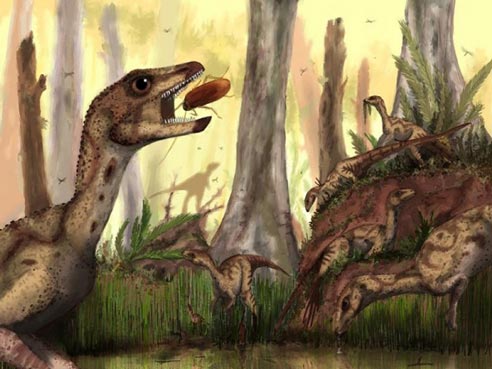
The Illustration of the Newly Named Dinosaur L. venezuelae

Small, Early Jurassic, bird-hipped dinosaur

Small, Early Jurassic, bird-hipped dinosaur.

Picture credit: Mark Witton/Natural History Museum

Why Saura and Not Saurus?

First of all, let’s deal with the name Laquintasaura venezuelae.  The fossil material (and there is lots of it), comes from a single bone bed located at a dig site which is effectively a road cutting between the two small towns of Seboruco and La Grita in  Táchira State, western Venezuela, just a few miles from the border with Columbia.

The horizon from which the fossils were excavated form part of the La Quinta Formation, which outcrops in western Venezuela and eastern Columbia.  So the  name is pronounced La-quin-tah-sore-rah  ven-ee-zway-lay and it translates as “Venezuela’s lizard from the La Quinta”, but note the ending of the genus, it is “saura” and not the much more common “saurus”, what’s going on here?

Saura is the female form of the Greek word saurus, it still means lizard and a number of dinosaurs have been given genus names which take the female form of saurus, examples are the likes of Maiasaura (means “good mother lizard”), or the small Cretaceous ornithopod Leallynasaura which was named after the daughter of the discoverer.  There is nothing particularly feminine about Laquintasaura, it is very likely that the bone bed represents the remains of both males and females, in this case, we think the name has come about as the rock formation “La Quinta” has a female root.

Early Jurassic – So What?

The majority of the rocks that make up the La Quinta Formation are sandstones, accurately dating these rocks is made all the more difficult due to the lack of marine deposits and the more abundant zonal fossils that help to date them.  However, the scientists involved in this study have been able to date the age of the fossils with a very high degree of confidence.  Zircon crystals found very close to the fossilised bones permitted highly accurate radiometric dating techniques to be applied.  Essentially, these crystals are abraded by acids, cooked at very high temperatures and then the proportion of uranium isotopes is measured.

Radioactive elements such as uranium begin to decay from the moment they are formed.  They decay and form “daughter” isotopes by shedding electrons at a consistent, regular rate.  By measuring the proportion of isotopes in these minute zircon crystals the rock formation can be accurately dated.  The fossils of Laquintasaura are 200.91 million years old, plus or minus half a million years or so.

Very few dinosaur fossils have been found that can be dated so accurately to this period in Earth’s history.  The vast majority of the dinosaur fossils that have been dated to around 200 million years or so, are lizard-hipped dinosaurs (saurischians), Laquintasaura is a member of that other group of dinosaurs, the bird-hipped dinosaurs (Ornithischia).

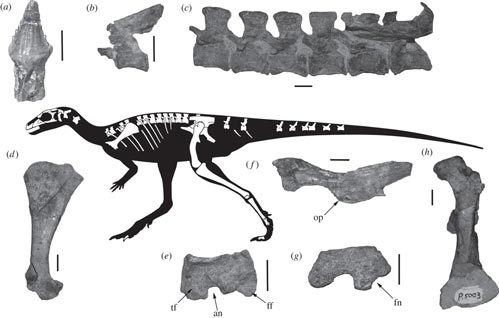
Photographs of Some of the Fossil Material and Outline Body Shape

Abundant fossil finds.

Abundant fossil finds.

Picture credit: Proceedings of the Royal Society B.

What’s so Special about Laquintasaura?

The picture above shows an outline of the body shape of Laquintasaura.  It was estimated to be about a metre long, but half of its body length was made up of the tail.  It was lightly built and probably a fast runner, roughly the size of a common Red Fox (Vulpes vulpes).  The drawing also indicates the sort of fossil material that has been found.  Most of the fossils are isolated teeth, or represent bones from the hip area or fragments of rib.  However, other fossils representing parts of the skull, the limb bones and vertebrae have also been found but these elements are much rarer.  The fossils represent the remains of at least four individuals, but probably many more.

Key to the Picture

  • (a) Triangular cheek tooth
  • (b) Neck bones
  • (c) Dorsal vertebrae
  • (d) Left shoulder blade
  • (e) Part of the ankle bone
  • (f) Left ischium (bone from the hip)
  • (g and h) Views of the femur

This is the first early ornithischian bone bed containing the bones of a number of individual dinosaurs found anywhere in the world.  Studies of the bones suggest that the fossils represent a group of animals that ranged from about three years to twelve years of age.

Although the bones are jumbled up, they do not show any obvious signs of having been transported a long distance perhaps by a river in spate.  Palaeontologists interpreting this fossil deposit have suggested that this bone bed was not formed over a long period, where single dinosaur carcases were deposited in the same location as a result of seasonal, violent floods.

The fossils seem to have been transported and deposited in a low-energy water environment, perhaps a slow moving river and it has been suggested that this group of dinosaurs died in a single catastrophe.  It is unclear whether they all died as a result of becoming stuck in the water, or whether the water transport occurred after death.   This suggests that this was a social group, a small herd or a flock if you prefer.

Most palaeontologists are confident that later ornithischians, the likes of the iguanodonts, duck-billed dinosaurs and the horned dinosaurs lived in herds.  If Laquintasaura is a social, bird-hipped dinosaur, then these fossils have provided the earliest known evidence for the evolution of complex social groups in the Ornithischia.  This social behaviour in ornithischian dinosaurs is being seen around fifty million years earlier than previously thought.

Weird Teeth

The teeth are unlike any other teeth associated with ornithischian dinosaurs.  They are quite prominent, and although triangular in shape, the edges are curved and slightly concave in appearance.  The edges of the crown (the tooth that sticks out of the gum) are coarsely serrated.  This suggests that this little dinosaur was most probably a herbivore eating tough ferns and horsetails.  It probably also grabbed at passing insects or small reptiles from time to time, hence the bug eating Laquintasaura depicted in Mark Witton’s excellent illustration (see above).

A Close up of One of the Teeth of Laquintasaura (various views)

Strange teeth indicate herbivorous habit.

Strange teeth indicate herbivorous habit.

Picture credit: Barrett et al, Proceedings of the Royal Society B.

Venezuela’s First Dinosaur – Dinosaurs Thrived Around the Equator

Much has been made of the fact that this is the first dinosaur ever to be discovered in Venezuela.  Indeed, this is the first dinosaur to be named and described from the northern portion of South America.  Two hundred million years ago, Venezuela formed part of the central portion of the giant super-continent Pangaea.  Laquintasaura seems to have thrived in a habitat close to the equator in the centre of this huge land mass.  Very few dinosaur fossils have been found in what is termed the palaeoequatorial region.

It had been thought that much of this part of the world in the Late Triassic/Early Jurassic was too hot and dry to support extensive, complex ecosystems.  Much of this area was thought to have been covered by vast, inhospitable deserts.  However, the finding of the fossils of Laquintasaura suggests that dinosaurs and most likely other types of vertebrate did live in these regions.

The Location of the Laquintasaura Fossils (Palaeoequatorial Environment)

Spatial distribution of early bird-hipped dinosaurs.

Spatial distribution of early bird-hipped dinosaurs.

Picture credit: Proceedings of the Royal Society B.

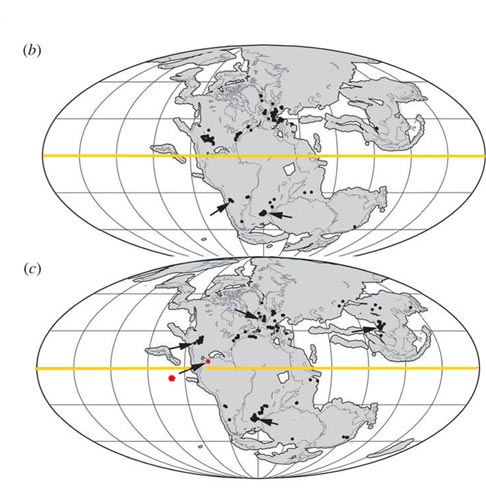
The diagram (b) shows the location of dinosaur fossil finds mapped onto a picture of the world from the Late Triassic.  The yellow line indicates the position of the equator.  Diagram (c) shows the position of dinosaur fossil finds known from the very Early Jurassic.  Arrows indicate ornithischian dinosaur finds.  Note the scarcity of palaeoequatorial dinosaur finds and the very limited palaeobiogeographical distribution of ornithischians in the Late Triassic and their subsequent spread in the Early Jurassic.  The red dot in diagram (c) indicates the site of the Laquintasaura fossils.  As these dinosaurs were small, around one metre in length, it is highly unlikely that these dinosaurs could have migrated long distances, this and the fact that the fossil bones show little sign of long distance transport indicates that Laquintasaura lived close to the equator.

The discovery of Laquintasaura suggests that there were ornithischian dinosaurs living close to the equator around 200 million years ago.  Their presence (and the discovery of two theropod teeth at the same site), indicates that western Venezuela supported a diverse and flourishing ecosystem.

What Does it Mean for Dinosaur Evolution?

The fossils of Laquintasaura come from just a few hundred thousand years after the end Triassic extinction event.  The period of deep time marked by the end of the Triassic experienced a mass extinction event.  The type and diversity of terrestrial vertebrates altered dramatically with many kinds of reptile and amphibian becoming extinct.

Palaeontologist Dr Paul Barrett of the Natural History Museum (London) and one of the lead authors of the scientific paper commented:

“Laquintasaura lived very soon after the major extinction at the end of the Triassic Period, 201 million years ago, showing dinosaurs bounced back quickly after this event.  It is fascinating and unexpected to see they lived in herds, something we have little evidence of so far in dinosaurs from this time.”

Either the dinosaurs did recover quickly after this extinction event or they were not too badly affected when compared to other vertebrates.

Laquintasaura

In addition, scientists are aware that by the Middle Jurassic, the bird-hipped dinosaurs had begun to diversify into a range of body types.  There were the likes of the ancestors of the camptosaurs, heterodontids and the first of the armoured dinosaurs.

This research carried out by the University of Zurich and the Natural History Museum is helping to piece together the origins and the subsequent diversification of this group of the Dinosauria that led them to become the dominant terrestrial herbivores of the Mesozoic.

6 08, 2014

Getting Ready for “Back to School”

By |2023-03-15T08:13:01+00:00August 6th, 2014|Categories: Educational Activities, Everything Dinosaur Products, Press Releases, Teaching|0 Comments

Dinosaurs for School

The first week of August is nearly over and team members at Everything Dinosaur are busy finalising their teaching plans and activities for the next school term.  It feels like only yesterday we were completing our last round of dinosaur themed workshops in school at the start of the summer holidays, and now we are busy preparing for 2015 and beyond.  Roll on the next school year.

Everything Dinosaur

When it comes to equipping young palaeontologists in readiness  for school, Everything Dinosaur has just about everything any dinosaur fan might need.  From pencils, pens, art materials, books, school sets, soft and cuddly school back packs and even school lunch boxes (all with a dinosaur theme of course), Everything Dinosaur is a one stop shop for back to school products and stationery.

Back to School 2014/15 with Everything Dinosaur

Get ready to "roar" back to school.

Get ready to “roar” back to school.

Picture credit: Everything Dinosaur

To visit Everything Dinosaur’s website: Dinosaur Themed School Products.

The picture shows the new banner which has in the centre of it the soft and cuddly Tyrannosaurus rex back pack that we supply.  Naturally, our dedicated dinosaur experts ensure that a T. rex fact sheet is sent out with sales of this popular dinosaur themed school back pack as well, it is our way of helping to inform and educate the next generation of scientists.

Back to School with Everything Dinosaur

Our new schools website is ready for launch, packed with lots of helpful advice, lesson plans and free downloads for teachers, learning support providers and for those who home school.  For further information on Everything Dinosaur’s range of prehistoric animal themed toys and games: Everything Dinosaur. our team members have been very busy putting together new schemes of work to help support the new teaching curriculum.

So it’s full steam ahead, now where did we put our exercise books?

6 08, 2014

Back to School with Some Free Learning Support

By |2024-05-02T12:09:42+01:00August 6th, 2014|Categories: General Teaching, Key Stage 1/2|Comments Off on Back to School with Some Free Learning Support

Getting Ready for the Challenges of the New Autumn Term

There may be a few weeks left of the summer holiday, but many teachers and teaching assistants are already busy preparing for the start of the autumn term.  In many cases (English schools), there is the challenge of the new curriculum to look forward to, however, we at Everything Dinosaur are doing our best to help.

Back to School

Soon be Time to Go Back to School

Back to school with Everything Dinosaur.

Everything Dinosaur stocks an amazing range of dinosaur themed back to school items.

Picture credit: Everything Dinosaur

We also appreciate that for those who choose to educate their children at home, the summer break is far from a break with teaching work continuing.  For our team members too, the last month or so has seen us working hard on a number of new lesson plans in support of the rocks and fossils element of the new curriculum in England for Year 3.  These lesson plans and teaching resources are available as free downloads, in addition our team members are happy to be contacted so that individual enquiries can be dealt with.

For dinosaur themed school resources such as school kits and stationery: Dinosaur Themed Back to School Items.

Everything Dinosaur Providing Learning Support

Learning support providers are in the process of writing and organising their teaching workloads for the coming school year.  There are some very exciting changes to the curriculum, for example, in England, in the science section, the emphasis is on a more rigorous teaching programme with a focus on “scientific working”.

Back to school themed dinosaur school resources available from Everything Dinosaur.

Go to Top