

A remarkable new study suggests that Homo erectus populations in East Asia may have co-existed and interbred with Denisovans hundreds of thousands of years ago. The research provides the first molecular evidence linking these ancient human lineages. This recently published research demonstrates how new protein recovery and analysis techniques can enhance data retrieved in association with hominin fossil discoveries.
The paper, published in the journal “Nature”, analysed fossil teeth from China dating to around 400,000 years ago (Chibanian stage of the Pleistocene Epoch). Scientists extracted ancient proteins preserved inside the dental enamel. As a result, they uncovered genetic clues that may reshape our understanding of human evolution in Asia.
Ancient Proteins from Fossil Teeth
The researchers studied six Homo erectus teeth from three famous Chinese fossil sites. These included Zhoukoudian, the home of “Peking Man”. Zhoukoudian on the North China Plain is now a UNESCO World Heritage site. The Pliocene and Pleistocene deposits have preserved the remains of early hominins, and the site has been the focus of intense research.
“Peking Man” is thought to represent a sub-species of Homo erectus. A fossil tooth discovered in 1921 and subsequent hominin fossil discoveries has helped palaeoanthropologists to re-define aspects of hominin evolution. For example, H. erectus is thought to be a direct ancestor of modern humans (H. sapiens). In addition, whilst it is thought that Homo erectus originated in Africa, it was the first hominin to migrate extensively, with fossil remains found throughout Asia.
Importantly, the team used palaeoproteomics (the study of ancient proteins), rather than ancient DNA analysis. Ancient DNA rarely survives in fossils this old. However, proteins locked within tooth enamel can persist for far longer.
The scientists identified two unusual amino acid variants in a tooth-development protein called ameloblastin. One variant appears unique to East Asian Homo erectus. The second variant proved even more intriguing. Previously, it had only been identified in Denisovans. The Denisovans are an enigmatic and poorly known archaic hominins that lived in Asia during the middle to late Pleistocene. They are named after the Denisova Cave in the Altai Mountains of Siberia, Russia, where their fossils were first discovered in 2008.
To read an article from 2013 highlighting research into the Denisovans: The Mystery of the Denisovans.
Evidence of Ancient Interbreeding?
The shared protein variant hints that Homo erectus and Denisovans may have interbred in East Asia. If correct, this would add another layer of complexity to the human evolution story. Palaeoanthropologists have long suspected that ancient human species interbred with one another. For example, analysis of other hominin fossil discoveries revealed modern humans interbred with both Neanderthals and Denisovans. Moreover, traces of Denisovan ancestry survive in some living populations today, especially in Southeast Asia and Oceania.
Now, this study suggests that these ancient interactions may have started much earlier than previously thought.
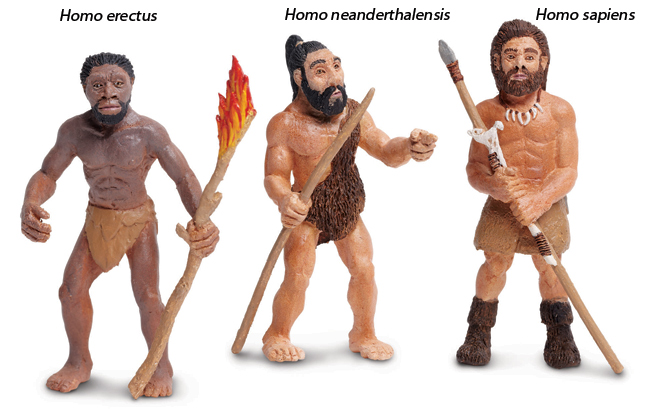
Models depicting three hominins. Homo erectus (left), H. neanderthalensis (centre) and a modern human (H. sapiens) right. The Homo erectus is holding a flaming stick a reference to their tool making abilities and control of fire.
The image (above) shows three figures that help to illustrate hominin evolution. The Homo erectus figure reflects the control of fire that this species is thought to have possessed. The models come from an “Evolution of Man” model set produced by Safari Ltd.
To view the range of prehistoric figures including early hominins available: Prehistoric World Figures.
A Complicated Human Family Tree
Scientists know that several human lineages overlapped across Africa and Eurasia during the middle to late Pleistocene. However, their exact relationships remain poorly understood. This new research adds more evidence that ancient humans did not evolve in isolated branches. Instead, different populations probably met and exchanged genes repeatedly.
Interestingly, some researchers now wonder whether certain Chinese fossils traditionally assigned to Homo erectus might actually belong to Denisovan-related groups.
A new species of hominin Homo longi: “Dragon Man” from North-eastern China.
Hominin Fossils Still Hold Molecular Secrets
The study also highlights the growing importance of protein analysis in palaeoanthropology. Recovering DNA from hominin fossil remains extremely difficult. Nevertheless, palaeoproteomics is providing new perspectives on human evolution. Ancient proteins recovered from hominin teeth may provide evidence to help scientists to better understand human evolution.
As more fossils undergo molecular analysis, researchers may finally untangle the complicated evolutionary history of ancient humans in Asia. Furthermore, how our own species evolved and its complex taxonomic relationship with other hominin taxa.
For now, these ancient teeth provide tantalising evidence that Homo erectus and Denisovans once shared more than just the same landscape. They may also have shared genes.
The scientific paper: “Enamel proteins from six Homo erectus specimens across China” by Qiaomei Fu, Zhongyou Wu, E. Andrew Bennett, Song Xing, Qiang Ji, Zhe Dong, Huiyun Rao, Xuejun Gu, Yizhao Dang, Jun Xing, Kai Zhou and Xiaotian Feng published in the journal Nature.
For scientifically accurate models of ancient hominins and other Pleistocene fauna: Models of Prehistoric Life.

Why are ancient Homo Sapiens always portrayed as modern Europeans having light skin and hair? Didn’t dark skin remain dominant until after the ice ages?
Thank you for your comment. The picture used to illustrate the article was taken from an official Safari Ltd “Evolution of Man” image. When this range of 5 hominin figures was first introduced both the Neanderthal and modern human had much lighter skin tone. More recent production runs have depicted these two figures with much darker skin tones. I am not sure whether this is a deliberate attempt by the manufacturer to reflect the origins of these hominin species from much warmer climates or the colour scheme of the figures has been changed to simplify the painting process for the set.