By Mike|2024-05-11T06:14:33+01:00August 2nd, 2018|Categories: General Teaching, Key Stage 1/2|Comments Off on A Beautiful “Spikyosaurus”
A Colourful Dinosaur Drawing
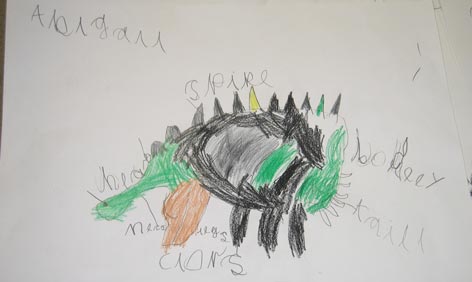
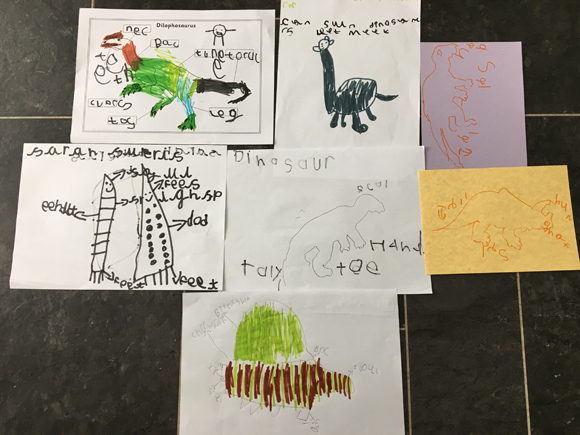
Our thanks to young dinosaur fan Neve, who after attending one of our family friendly dinosaur and fossil workshops, was inspired to send in to us a drawing of their very own design for a dinosaur. Neve even gave this prehistoric animal a name, this very colourful dinosaur is called “Spikyosaurus”.
A Very Bright, Colourful and Spiky Dinosaur Drawing
A spiky dinosaur. A wonderful and imaginative dinosaur drawing. Picture credit: Everything Dinosaur.
Picture credit: Everything Dinosaur
A “Spikysaurus” and Armoured Dinosaurs
Palaeontologists are aware that there were lots of armoured dinosaurs. The first armoured dinosaurs evolved in the Early Jurassic. These plant-eaters were distinguished by the presence of bony scales on their backs and flanks. These dinosaurs evolved from the ornithischian line (bird-hipped dinosaurs). Armour probably evolved in herbivorous dinosaurs to provide protection against the rapidly evolving carnivorous dinosaurs. The last of the armoured dinosaurs died out at the very end of the Cretaceous.
By Mike|2024-05-11T06:03:03+01:00July 18th, 2018|Categories: General Teaching|Comments Off on It’s Planning Time Again as New Academic Year Begins
Lots of Teachers Already Preparing for the New Academic Year
For many schools in England and Wales, the long summer holidays are about to start. Although many teaching staff will be taking a deserved vacation, we note from the number of emails, phone calls and general enquiries that we have received that lots of dedicated teaching professionals are well advanced with their planning for dinosaur and fossil teaching the start of the next academic year.
September will soon come around and teachers supported by teaching assistants and other learning support providers will be busying themselves making preparations for the challenges that a new academic year brings. From the enquiries that we have received so far this month, it seems that the Cornerstones Curriculum “Dinosaur Planet” and the term topic “Jurassic Forest” are going to be popular choices when it comes to Key Stage 1 and Reception term topics.
Lots of Schools are Planning Term Topics Focused Around Dinosaurs and Fossils
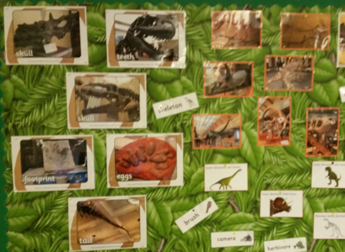
Lots of dinosaur and fossil pictures on display. Picture credit: Everything Dinosaur.
Picture credit: Everything Dinosaur
Preparing Prehistoric Themed Schemes of Work
As always, our dedicated teaching team are on hand to provide advice and assistance. There are numerous downloadable resources available from Everything Dinosaur’s dedicated teaching website, all provided free of charge. Our handy lesson plans, resource packs, teaching suggestions and information sheets have been downloaded by teachers, educationalists, museums and other institutions hundreds of times. We are happy to help and we get a large amount of emails from teachers asking for specific information, these are all responded to and we do our best to assist and advise where we can.
For Everything Dinosaur’s educational themed items including toys and games: Dinosaur Toys and Games.
Lesson Plans Helped to Inspire a Poster Making Exercise
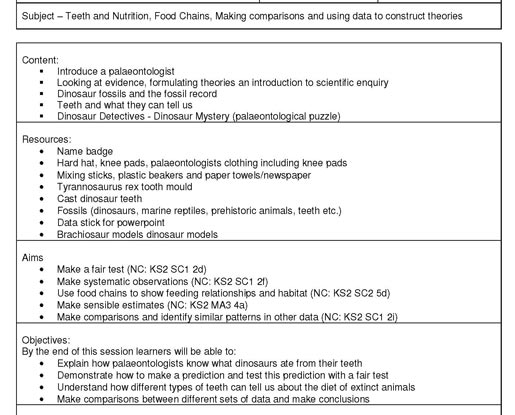
Example lesson plan (Key Stage 2).Picture credit: Everything Dinosaur.
Picture credit: Everything Dinosaur
Dinosaur and Fossil Workshops in School
Our dinosaur and fossil workshops in schools are booking up fast, we already have bookings for the summer term of 2019 and enquiries for the 2019/20 academic year. We conduct a lot of work with schools and our workshops are built around curriculum teaching aims and objectives including developing writing skills, aiding literacy, exploring ideas, problem solving, working scientifically, building confidence and encouraging an understanding of materials and the wider world.
There is certainly a big “wow” factor with a visit from ourselves but everything we do attempts to reinforce learning and help achieve the teaching outcomes required by the school. Dinosaurs as a teaching theme lends itself to all sorts of ideas and extension activities and we often provide additional resources to help support the school’s scheme of work.
For further information about our dinosaur workshops in schools and to request details of our science outreach work: Contact Everything Dinosaur.
Our hard-working team members will do all they can to accommodate teaching needs, but, spaces are getting booked up fast.
Thank You Letters Received After Another Successful Dinosaur Workshop
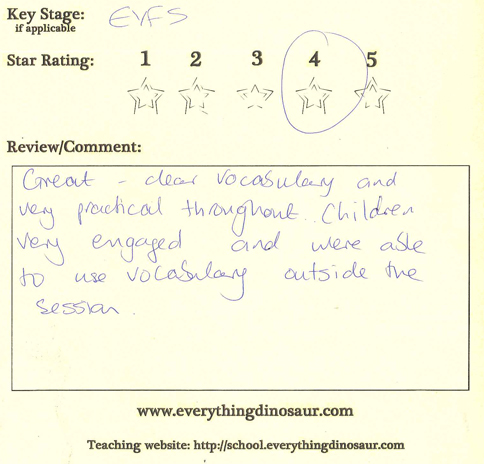
Feedback from Primary School (EYFS). Picture credit: Everything Dinosaur.
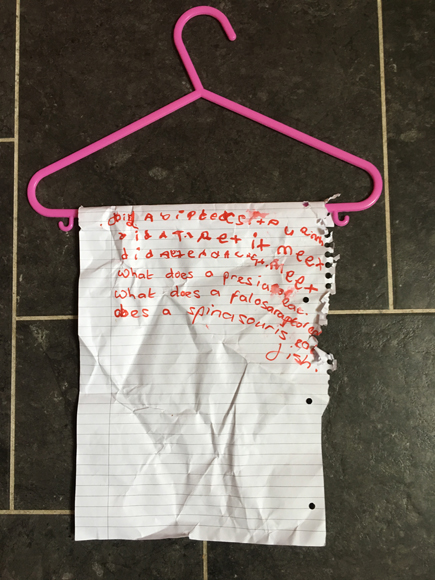
Budding young palaeontologist Ethan and his friends at Longmoor Community Primary School in Liverpool (north-west England), have been learning all about dinosaurs and life in the past this term, aided and supported by their Reception class teachers. Whilst on a visit to the school to work with class 1 and class 2 to deliver a dinosaur and fossil themed workshop, our dinosaur expert was presented with a list of questions that Ethan had prepared.
Ethan’s Questions About Dinosaurs
Ethan presented Everything Dinosaur with some questions. Picture credit: Everything Dinosaur.
Picture credit: Everything Dinosaur
Questions About Dinosaurs Prepared at Home
Ethan’s teacher informed us that many of the children had thought of questions about prehistoric animals as they progressed through their term topic. These questions had been pinned up onto the classroom display board and the eager fossil hunters in the Reception classes had set about researching the answers as they enthusiastically learned about dinosaurs. Ethan had prepared his questions at home, he had set his own homework. The classroom was filled with lots of examples of the children’s work, including super writing, “cotton bud skeletons” and dinosaur fact sheets that the children had made. The classes had even built their own dinosaur museum!
Drawings of Dinosaurs Produced by Reception Class
Class 2 produced some wonderful dinosaur drawings. Picture credit: Everything Dinosaur.
Picture Credit: Everything Dinosaur
Ethan’s Questions About Dinosaurs
Ethan wanted to know did Tyrannosaurus rex eat meat?
T. rex was definitely a meat-eater (carnivore). Palaeontologists can get a good idea about what an extinct animal ate by studying their fossil teeth. Tyrannosaurus rex is regarded as a hypercarnivore, this means that it got at least 70% of its food from eating other animals. Cats are also regarded as hypercarnivores, which means, if you have a pet cat, it probably loves eating meat as much as T. rex did!
Ethan asked does a Spinosaurus eat fish?
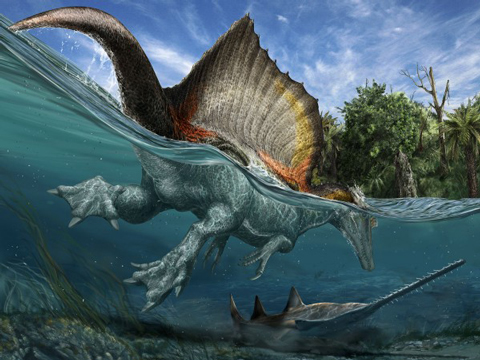
The jaws of Spinosaurus were very long and they were filled with up to two hundred, sharp and very pointed teeth. These teeth would have been ideal for catching and holding slippery fish. Palaeontologists know that when Spinosaurus roamed North Africa about 100 million years ago, there were lots of large lakes and rivers that teemed with fish. Fossils of this large, dinosaur are usually found near ancient sources of water.
In 1975, part of a fossilised jaw of a Spinosaurus was found and it had a bone from a huge sawfish called Onchopristis (Onk-coe-pris-tis) stuck in it. Palaeontologists also believe that Spinosaurus spent a lot of its time in water, so it is very likely that Spinosaurus did eat fish. An animal that eats fish is called a piscivore (pie-see-vore).
A Picture of a Spinosaurus Going for a Swim
Spinosaurus – very much at home in the water. An Onchopristis (sawfish) is trying to avoid being eaten.
By Mike|2023-10-18T07:16:14+01:00July 3rd, 2018|Categories: General Teaching|Comments Off on A Very Big Trilobite
A Very Big Trilobite
The Wren’s Nest/Castle Hill site near Dudley in the West Midlands is one of the most important sites anywhere in the world for Silurian fossils. At this location there are superb exposures of Middle Silurian strata (Wenlock and lower Ludlow series). Coal seams in the surrounding hills date from the later Middle Carboniferous. The lime and coal at this location made this part of England a focal point for the industrial revolution.
There are lots of fossils to be found too, including trilobites.
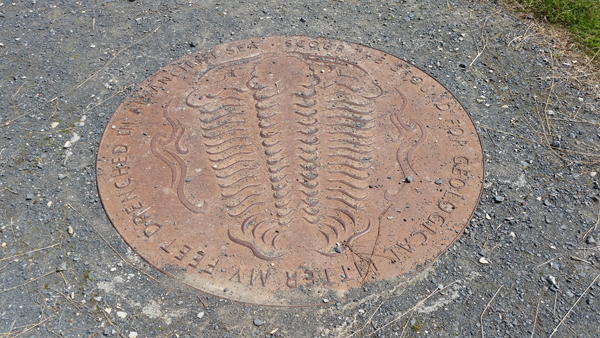
A Commemorative Plaque Recognising the Significance of Wren’s Nest
A trilobite plaque at the Wren’s nest SSSI (Dudley, West Midlands). Picture credit: Everything Dinosaur.
“Scour the ground for geological litter my feet drenched in an ancient sea.”
The fossils preserved at Wren’s Nest represent marine life on an ancient reef system which is around 420 to 425 million years old. This an amazing (and free) place to visit, a beautiful nature reserve that was designated Britain’s first National Nature Reserve for geology back in 1956.
By Mike|2023-10-16T14:51:38+01:00June 28th, 2018|Categories: General Teaching|Comments Off on A Magnificent Dinosaur Birthday Cake
Delicious Dinosaur Birthday Cake
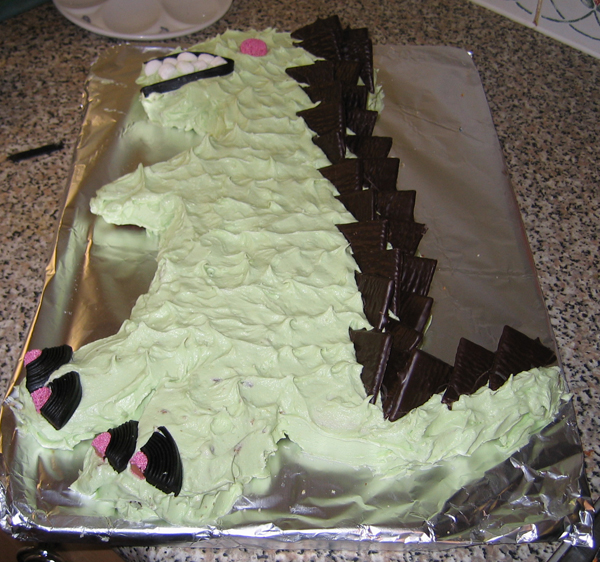
Our thanks and best wishes to Athina and Peter who contacted Everything Dinosaur recently to ask advice when choosing some dinosaur and prehistoric animal models to feature on their grandson’s birthday cake. The grandparents emailed us to say thank you for our assistance and included a picture of the magnificent birthday cake that had been baked and decorated with dinosaurs in honour of young Luca’s birthday.
A Dinosaur Birthday Cake
What a Magnificent Dinosaur Birthday Cake!
A fantastic dinosaur birthday cake. Picture credit: Everything Dinosaur.
Picture credit: Everything Dinosaur
Athina commented:
“The cake was a big success, thanks for your help.”
What a wonderful cake! Team members at Everything Dinosaur are always intrigued to find out how our dinosaurs and prehistoric animals are used by our customers. One question remains, how are Athina and Peter going to top this wonderful confectionery creation when it comes to Luca’s 5th birthday?
By Mike|2023-10-16T07:42:39+01:00June 18th, 2018|Categories: General Teaching|Comments Off on Praising the Museum of Natural History in Oxford
In Praise of the Museum of Natural History (Oxford)
Oxford as the county town of Oxfordshire (England), has many attractions. It is of course, famous for its distinguished and highly respected university. It is one of the oldest seats of learning (alongside Paris and Bologna), in the western world. The Victorian poet Matthew Arnold (1822-1888), coined the phrase “the city of dreaming spires”, it is indeed a very awe-inspiring place with its beautiful architecture and stunning university colleges and buildings.
Oxford Museum of Natural History
However, Oxford should not necessarily just be the haunt of academics and students. For families, there is much to see and do in this historic part of England. Take for example, the Museum of Natural History, it is free to enter (donations are suggested) and it provides a fantastic day out for young and old alike.
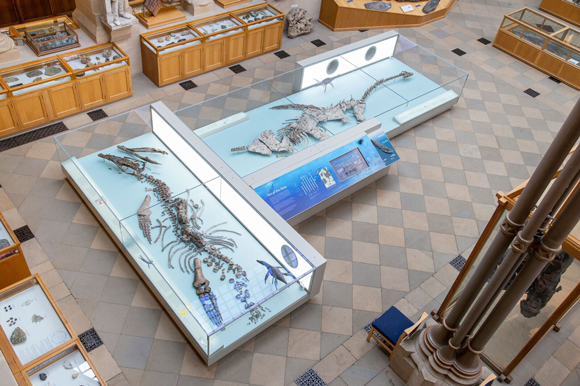
A View of the Ground Floor of the Natural History Museum (Oxford)
Plesiosauria fossils on display at the Oxford University Museum of Natural History. Picture credit: Everything Dinosaur.
Picture credit: Everything Dinosaur
The image (above) shows marine reptile fossils on display.
The museum acts as a centre for scientific study for the University of Oxford. It houses the University’s collection of palaeontological, geological and zoological specimens, including some of the very first dinosaur bones to be scientifically studied. This collection is housed in a stunning example of neo-Gothic architecture, the ornate columns and use of copious amounts of glass provides a wonderfully spacious and well-lit learning area. With visitor numbers estimated to be around 700,000 people a year, this well-laid out and beautifully appointed museum can get quite busy at times, but please note, the Natural History Museum (London), attracts approximately 5,000,000 visitors per annum. The London museum can get extremely congested, in contrast, the Oxford University Museum of Natural History (OUMNH), especially shortly after opening at 10 am tends to be much quieter.
Founded in 1860
Founded in 1860, that’s twenty-one years before the Natural History Museum (London) opened its doors, the OUMNH has maintained its strong tradition to inform and educate and helps to underpin a varied programme of scientific research as well as playing a significant role in teaching. The Museum provides an extensive array of family orientated activities and if over the course of the summer holidays, you have a few hours to spare this museum is well-worth a visit.
Look out for the cast of a male Tyrannosaurus rex, a life-sized model of a Coelacanth, some amazing fossil specimens, live insects and of course, arguably the OUMNH’s most famous resident – the remains of a Dodo.
In the meantime, visit the award-winning Everything Dinosaur website: Everything Dinosaur.
By Mike|2024-05-11T06:08:44+01:00June 16th, 2018|Categories: Key Stage 1/2|Comments Off on Wonderful Dinosaur Designs and Drawings
Dinosaur Designs and Drawings Sent in by Year 2 Children
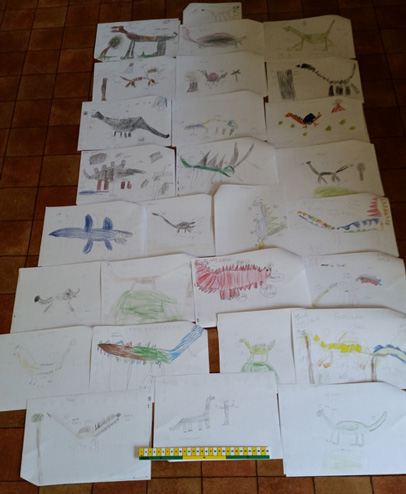
It is always a pleasure to receive feedback after a dinosaur workshop in school. Take for example, these amazing dinosaur drawings sent in to our offices by Year 2 children following a visit to their primary school.
Children in Year 2 Send in Dinosaur Drawings and Designs
A selection of prehistoric animal designs by a Year 2 class at Great Wood Primary. Picture credit: Everything Dinosaur.
Picture credit: Year 2 (Great Wood Primary/Everything Dinosaur)
During our dinosaur and fossil workshop with the class, we challenged the children to design their very own prehistoric animal. They had to consider whether it would be a carnivore, herbivore or omnivore and in addition, they were asked to consider where the animal might live (considering habitat) and how it might survive in the age of dinosaurs (thinking about adaptations).
We certainly received some very colourful, imaginative dinosaur drawings. Our thanks to all the children who took part and to their hardworking, dedicated teaching team.
Another busy day for Everything Dinosaur’s teaching team. One of our dinosaur and fossil experts had been invited to a school in south Yorkshire to help the Nursery and Reception classes kick-start their term topic learning all about prehistoric animals. The enthusiastic children enjoyed the workshops and had fun handling the fossils, several of them talked excitedly about it for the rest of the day.
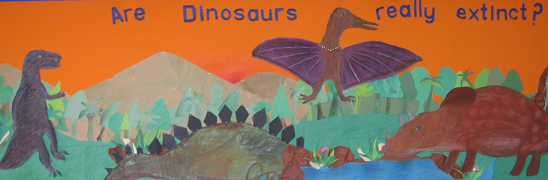
We were given the spacious hall to set up in and we noted that on one of the walls, there was a display of prehistoric animals that had been created by some of the children at the school.
Prehistoric Animals on Display at the Primary School
Are dinosaurs really extinct? Prehistoric animals on display. Picture credit: Everything Dinosaur.
Picture credit: Everything Dinosaur
Extension Resources
Prior to the start of our workshops we were briefed on the learning needs of the children by one of the teachers. The classes had only been studying dinosaurs for a week, but they had prepared some amazing questions for our dinosaur expert to tackle. As well as delivering four workshops throughout the day, we donated some dinosaur books to the school library and provided some additional teaching resources to help support the scheme of work for the school term.
We are confident that our “dinosaur hokey cokey” will be well received by the eager, young palaeontologists.
We were also able to email over some dinosaur fact sheets and additional drawing materials to help support the Reception classes with a little challenge that we had set them.
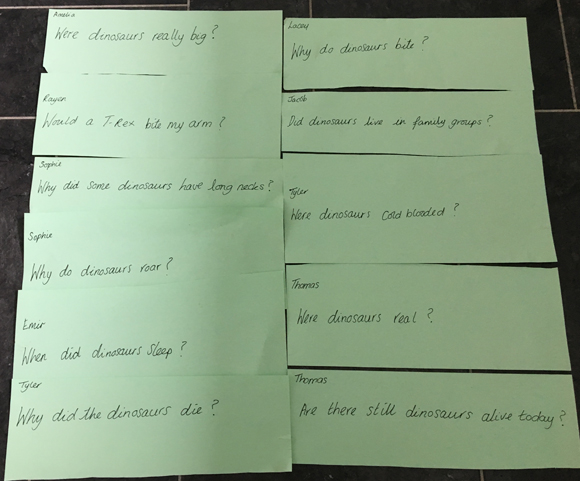
Our congratulations to all the budding palaeontologists in Sooty Owls class (Foundation Stage 2), at Laithes Primary in south Yorkshire for compiling such a fascinating set of questions about dinosaurs. The children in Foundation Stage at this Barnsley school have just started their summer term topic and they are very excited to be learning about dinosaurs and life in the past.
Questions About Dinosaurs
Questions Compiled by Sooty Owls for Everything Dinosaur
The children in the Sooty Owls class have compiled a set of questions about dinosaurs.
Picture credit: Everything Dinosaur/Laithes Primary School
Why do Dinosaurs Roar?
Sophie asked why do dinosaurs roar? This is a very difficult question to answer as we don’t have a living Tyrannosaurus rex, Stegosaurus or any other non-avian dinosaur to study. Dinosaurs certainly do a lot of loud roaring in movies like “Jurassic Park”, but it is hard to work out what sort of sounds they made by just studying the fossilised bones alone. Having said that, the tiny bones of the inner ear that have been found have given palaeontologists some ideas as to the sort of sounds that these animals might have heard.
Dinosaurs seem to have had good hearing so they probably did make some sounds, perhaps some of the smaller dinosaurs might have chirped like their near relatives the birds. Other dinosaurs might have squawked, twittered or clucked, whilst very big dinosaurs may have made low frequency rumbling sounds, the vibrations of which, could have been detected by their feet (elephants are believed to be able to detect low frequency sounds in this way).
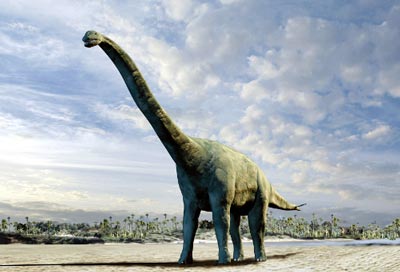
Some Very Big Dinosaurs Could have Picked Up Sounds Using their Feet
Some very big dinosaurs could have picked up sounds using their feet.
When do Dinosaurs Sleep?
Emir wanted to know about dinosaur sleeping habits. He asked when do dinosaurs sleep? There are lots and lots of different types of dinosaurs and some of them were probably nocturnal (active at night), so these types of dinosaurs would have slept during the day. Can the children in Sooty Owls class make a list of animals alive today that are nocturnal? Most dinosaurs would have slept at night, just like we do, but all dinosaurs would have probably napped from time to time to.
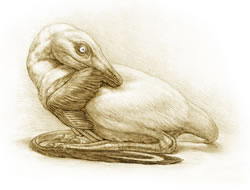
Palaeontologists have found fossils of sleeping dinosaurs. Some dinosaurs may have slept with one eye open so that they could stay safe.
A Sleeping Dinosaur (Mei long)
Did dinosaurs sleep with one eye open?
The fossils of the dinosaur from China called Mei long, suggest that some dinosaurs slept like birds. The name Mei long means “sleeping dragon”.
Were Dinosaurs Cold-blooded?
Tyler asked were dinosaurs cold-blooded? Reptiles that are alive today, animals like snakes, lizards and crocodiles, have to rely on external sources of heat to help them keep warm and active. Reptiles bask in the sun, using the heat from the sun to warm their bodies. It is likely that most dinosaurs, which were probably much more active than snakes and crocodiles, were not cold-blooded, that is, they could have maintained a body temperature that was warmer than their surroundings.
Many dinosaurs had feathers and these feathers helped trap body heat to keep these dinosaurs from getting too cold.
Some dinosaurs lived in Antarctica and some dinosaurs lived in the Arctic Circle, so they would have been well-used to chilly conditions. Mammals and birds are warm-blooded, birds are very closely related to dinosaurs.
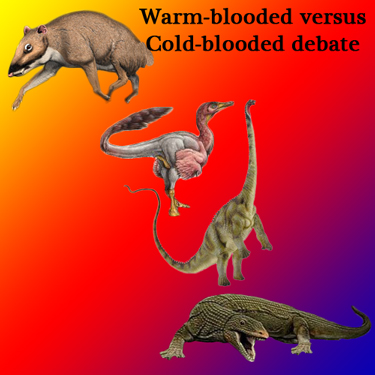
Warm-blooded or Cold-blooded Dinosaurs?
Where on the spectrum between endothermic and ectothermic are the Dinosauria?
Picture credit: Everything Dinosaur
Would a T. rex Bite My Arm?
Rayen wanted to know about Tyrannosaurus rex and asked the following question – would T. rex bite my arm? Tyrannosaurus rex was a meat-eating dinosaur, if it was around today, then a T. rex might indeed try to eat you. T. rex was so big that he could have eaten everyone in Sooty Owls class for dinner and eaten the class teacher for dessert. A fully-grown T. rex would have been capable of swallowing Rayen in one big bite! It is reassuring to know that these types of dinosaurs, known as the non-avian dinosaurs are extinct!
Our thanks once again to the children in Sooty Owls class for compiling such a wonderful set of dinosaur themed questions.
By Mike|2023-10-14T18:40:17+01:00June 12th, 2018|Categories: General Teaching, Key Stage 1/2|Comments Off on The Prehistoric Animals that Feature in “Fallen Kingdom”
“Fallen Kingdom” – Dinosaurs and Other Prehistoric Animals
In response to the numerous requests from young dinosaur fans who have seen the latest instalment in the “Jurassic Park/Jurassic World” film franchise – “Fallen Kingdom”, here is a list of the prehistoric animals that we spotted in the movie. In total, Everything Dinosaur team members spotted seventeen different prehistoric animals, how many did you see?
Hitting our Cinema Screens at Present – “Fallen Kingdom”
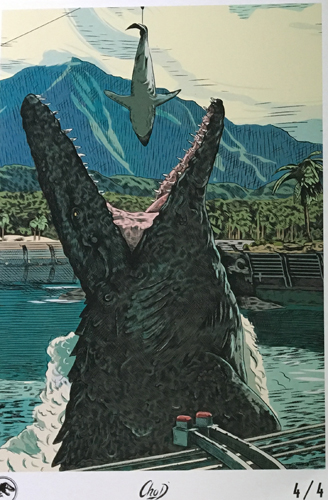
The movie poster features a Mosasaurus.
Everything Dinosaur’s List of the Prehistoric Animals in “Fallen Kingdom”
Allosaurus – a big, carnivorous dinosaur that lived during the Late Jurassic.
Ankylosaurus – an armoured dinosaur, a herbivore from the Late Cretaceous of North America.
Apatosaurus/Brontosaurus – a giant, long-necked plant-eating dinosaur from the Late Jurassic.
Baryonyx – a carnivorous dinosaur that may have specialised in catching fish, the first fossils of which were found in southern England. Baryonyx lived during the Early Cretaceous of Europe.
Brachiosaurus – an enormous, plant-eating, long-necked dinosaur from the Late Jurassic.
Carnotaurus – a predatory dinosaur from the Late Cretaceous of South America.
Compsognathus – at around a metre in length, the smallest non-avian dinosaur inhabitant of Isla Nublar. This little dinosaur lived in Europe during the Late Jurassic.
Gallimimus – a fast-running, “ostrich mimic” dinosaur that lived in Asia during the Late Cretaceous.
Mosasaurus – not a dinosaur, but a marine reptile that belongs to the same group of reptiles as lizards and snakes. These predators lived during the Cretaceous.
Pteranodon – also not a dinosaur, but a flying reptile from the Late Cretaceous, a pterosaur. Pteranodon fossils have been found in North America, England and Asia.
Sinoceratops – a member of the horned dinosaur group, it roamed China towards the end of the “Age of Dinosaurs”.
Stegosaurus – “roof lizard”, a herbivore from the Late Jurassic of America.
Stygimoloch – a “bone-headed” dinosaur from the Late Cretaceous of North America which was good at knocking down walls if the movie is to be believed!
Triceratops – one of the most famous of all the plant-eating dinosaurs. Triceratops lived at the very end of the Cretaceous. Its fossils have been found in North America.
Tyrannosaurus rex – no dinosaur film would be complete without an appearance of T. rex. The “king of the tyrant lizards”, lived in North America and its fossils are associated with Upper Cretaceous sedimentary deposits.
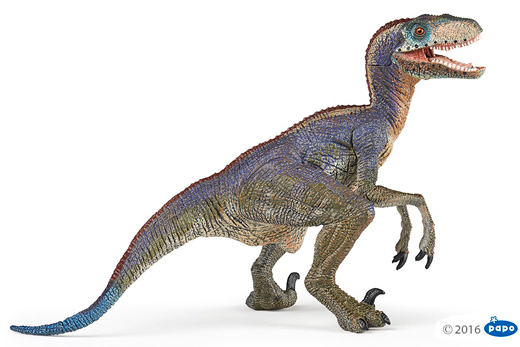
Velociraptor – The “raptor” called Blue which was reared and brought up by animal trainer Owen Grady (played by Chris Pratt). Velociraptor lived during the Late Cretaceous of Asia.
Last but not least, comes Indoraptor, a dinosaur created from the DNA from Indominus rex – the monstrous carnivore from the previous film in the franchise – “Jurassic World” and Velociraptor.
Look out for the sequel which is scheduled for release in June 2021. What dinosaurs do you think should be in this film?