By Mike|2024-05-11T05:59:47+01:00June 5th, 2018|Categories: General Teaching|Comments Off on Acknowledging the Importance of World Environment Day
World Environment Day
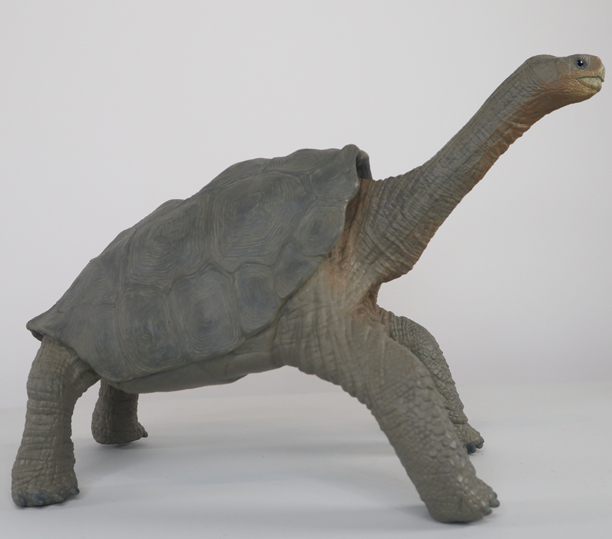
Today, June 5th is World Environment Day. This annual event organised by the United Nations aims to raise awareness of the environment and specific issues caused by human activity that are threatening our planet’s ecosystems and habitats. This day, sometimes referred to as “World Eco Day”, was established in principle in 1972 and the first commemorative events took place two years later. We commemorate this important date by posting up an image of giant tortoise model.
A 1:6 Scale Replica of the Pinta Island Giant Tortoise (Extinct)
The Rebor 1:6 scale Pinta Island tortoise “Lonesome George” in lateral view. The model measures 30 cm long and stands 20 cm high. Picture credit: Everything Dinosaur.
Picture credit: Everything Dinosaur
The picture (above) shows the Rebor Pinta Island tortoise model.
The last Pinta Island giant tortoise (Lonesome George) died on the 24th of June 2012. It was the last known individual of the sub species Chelonoidis niger abingdonii.
So, it seems fitting that today, World Environment Day, we remember the now extinct Pinta Island giant tortoise. The last of the Pinta Island tortoises was named “Lonesome George”. Researchers are hoping to resurrect the lineage using a controlled breeding programme involving other tortoise sub-species.
By Mike|2024-05-11T06:00:15+01:00June 4th, 2018|Categories: General Teaching|Comments Off on A Beautiful Linheraptor – Dinosaur Drawing
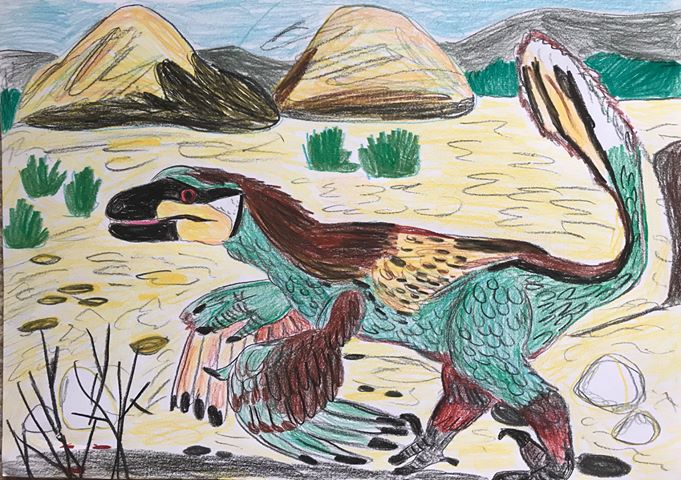
Linheraptor exquisitus by Caldey
Our thanks to young Caldey for sending in her picture of the “raptor” called Linheraptor (Linheraptor exquisitus). Most people might be familiar with dinosaurs such as Velociraptor, made famous from the “Jurassic Park/Jurassic World” film franchise, but in truth, there were a large number of “raptor-like” dinosaurs and they were all (very probably), feathered and potentially quite colourful creatures too.
A Drawing of the “Raptor” Linheraptor (L. exquisitus) by Caldey
Dinosaurs like Velociraptor and Linheraptor are members of the Dromaeosauridae family. The Dromaeosauridae are very geographically diverse, bird-like dinosaurs that were particularly abundant during the Late Cretaceous. Linheraptor was named relatively recently, (2010), the first of dromaeosaurid was named in 1922 (Dromaeosaurus). Like many of its kind, the fossils of Linheraptor come from Asia.
Our thanks to Caldey for sending in her super illustration.
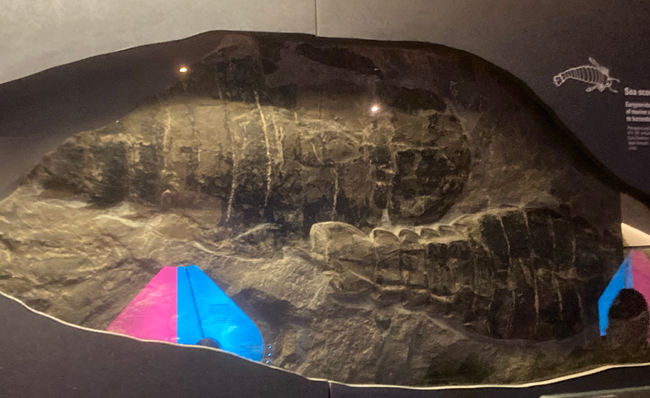
A fabulous pair of eurypterid fossils photographed in the London Natural History Museum.
Spotted in the British Museum (London), two beautifully preserved sea scorpion fossils. The picture (below) shows a wonderful example of what looks like a fossilised, giant woodlice. However, all is not as it seems.
Sea Scorpion Fossil Specimens
A pair of eurypterid fossil specimens on display at the London Natural History Museum. Picture credit: Everything Dinosaur.
Picture credit: Everything Dinosaur
Woodlice are isopods and members of the Arthropoda Phylum. Eurypterids are arthropods too. Both have segmented bodies and share several anatomical characteristics, but they are only distantly related.
Probably originating during the Ordovician, eurypterids persisted until the Permian. Both marine and freshwater forms evolved. Some marine eurypterids represent the largest arthropods known to science. The largest described to date is Jaekelopterus rhenaniae. Based on a forty-six-centimetre claw fossil, palaeontologists have suggested that J. rhenaniae reached a length of 2.5 metres or more.
Although the eurypterid fossils on display are not as large as the biggest species of Jaekelopterus (pronounced Yay-kel-op-ter-us), they are still impressive.
A spokesperson from Everything Dinosaur commented on the details preserved within the fossil specimens and stated:
“When you see up close stunning eurypterid fossils, you gain an appreciation of the diversity and variety of life on Earth. It is hard to believe, but for more than 150 million years these amazing arthropods thrived, outcompeting vertebrates. Many forms evolved to become apex predators.”
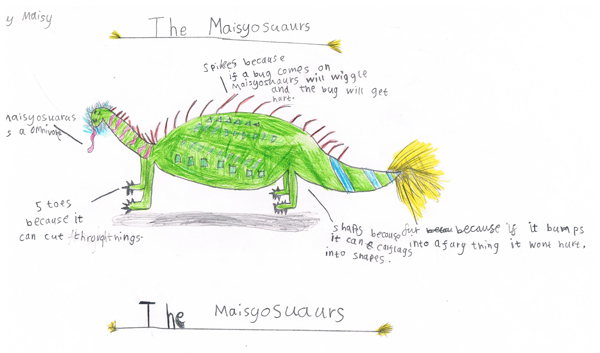
Our thanks to young Maisy and her classmates for sending lots of beautiful dinosaur drawings to our offices. We had challenged the children (Year 2), to have a go at designing their very own prehistoric animals during a dinosaur workshop at their school. We received an amazing array of very colourful drawings, with lots of lovely labelling and some fascinating explanations from the children as to why their dinosaur was so special.
Maisy Has Designed a Maisyosaurus
A very colourful dinosaur design created by Maisy in Year 2.
Picture credit: Maisy/Everything Dinosaur
Maisy and Her Dinosaur
Maisy labelled the various body parts of her dinosaur, explaining that it was an omnivore and that it had five toes to help it cut through things. Certainly, having four fingers and a thumb makes using scissors very straight forward, I’m sure the dinosaur would have appreciated the comment. Maisyosaurus also had spikes on its back, as Maisy explained, the spikes helped this dinosaur shake off a bug should one alight on it. Perhaps it could it have shaken its big, bushy yellow tail in order to scare off flies and other insects.
Our thanks again to Maisy and the other Key Stage 1 pupils at her school for sending in the super dinosaur designs.
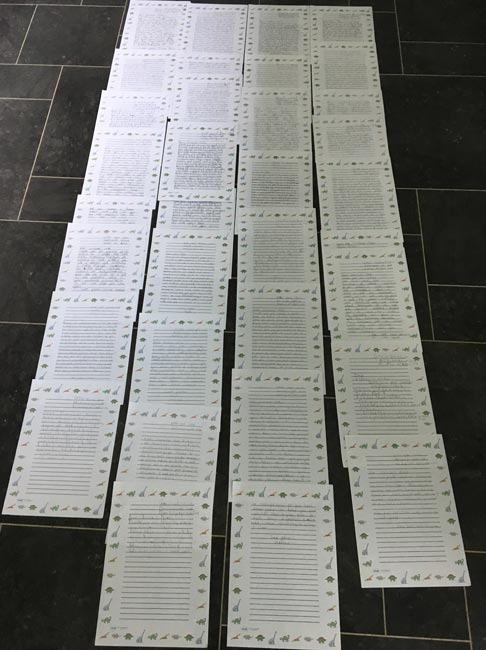
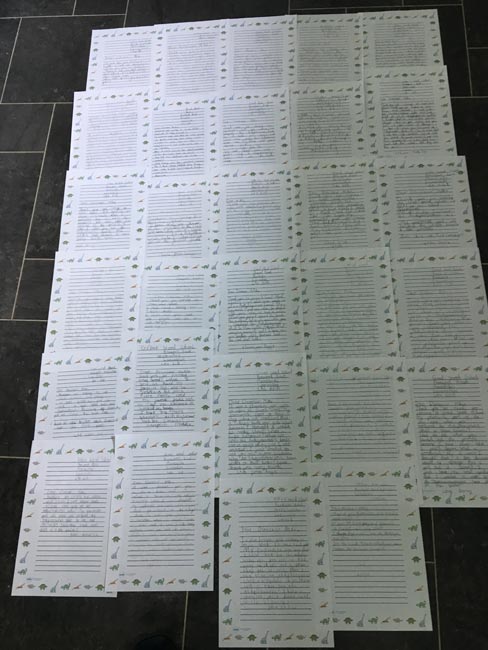
Children in Year 2 at Great Wood Primary (Lancashire), sent in some super thank you letters to team members at Everything Dinosaur following a workshop at their school. The pupils have been learning all about dinosaurs for their summer term topic and last month, an Everything Dinosaur team member was invited into the school to deliver two dinosaur and fossil themed workshops, one for each Year 2 class.
A Set of Thank You Letters Sent to Everything Dinosaur by One Year 2 Class
Pupils at Great Wood Primary sent thank you letters to Everything Dinosaur. Picture credit: Everything Dinosaur.
Picture credit: Everything Dinosaur
Beautiful Letters from Year 2
During our workshop, lots of extension ideas surfaced and we always try to support the lesson plans and scheme of work of the teaching team. Challenging the class to write a letter to us gives an opportunity for the children to practice their handwriting and use of grammar. We received two sets of letters, one from each class and it was great to see such excellent examples of letter writing. Some of the children produced long letters, using two sheets of A4 paper, that is brilliant!
Lots and Lots of Letters for Us to Read – Here are the Letters from the Second Class
Children send in letters about dinosaurs. Picture credit: Everything Dinosaur.
Picture credit: Everything Dinosaur
Dinosaur Mike, who conducted the two workshops with the eager young palaeontologists from Great Wood Primary praised the children, saying:
“It was a great honour to receive the letters from Year 2. The correspondence was held up in the post and we had to go to the Royal Mail delivery centre to pick them up, but the trip was so worthwhile as we came back with two sets of super thank you letters. We really appreciate the letters and we have read them all.”
Everything Dinosaur Puts the Letters on Display
The team have read them all and they hope to post up responses to some of the questions the children asked. After laying the letters out onto the packing room floor in the company’s warehouse so they can be photographed, the letters will shortly be pinned up to the warehouse notice board. They will make a super display and they will help to remind Dinosaur Mike of his visit to the school. In the letters, the children inform us about their favourite part of the workshop. It seems that the children really enjoyed comparing their brain to the brain of a giant armoured dinosaur and handling fossils. The Tyrannosaurus rex tooth segment was also a favourite.
We wish the children and their hardworking Key Stage 1 teaching team every success with their dinosaur themed term topic and thank you once again for sending into Everything Dinosaur the wonderful correspondence.
By Mike|2024-05-11T05:53:35+01:00May 20th, 2018|Categories: General Teaching, Key Stage 1/2|Comments Off on Dinosaur Food Webs a Helpful Explanation
Dinosaur Food Webs
Team members at Everything Dinosaur help school pupils to understand prehistoric animal food webs.
The national curriculum of England science programme outlines the fundamental topics to be taught to various age groups to provide a broad foundation for future scientific study. Key elements include providing a basis for making sense of our planet (understanding our world) and developing the rational required to examine problems, look for evidence and to test via experimentation (scientific working).
In Key Stage 1, children are expected to be able to distinguish between carnivores, herbivores and omnivores. In addition, they will be expected to identify that most living things live in habitats to which they are suited and describe how different habitats provide for the basic needs of different kinds of animals and plants, and how they depend on each other.
Prehistoric Animal Food Webs
A term topic on dinosaurs helps to reinforce and support this learning. At Everything Dinosaur, we have been asked to provide simple food webs to help get some of these fundamental points about ecosystems across. After all, for most children, learning about what Tyrannosaurus rex ate can enthuse even the most reluctant biologist.
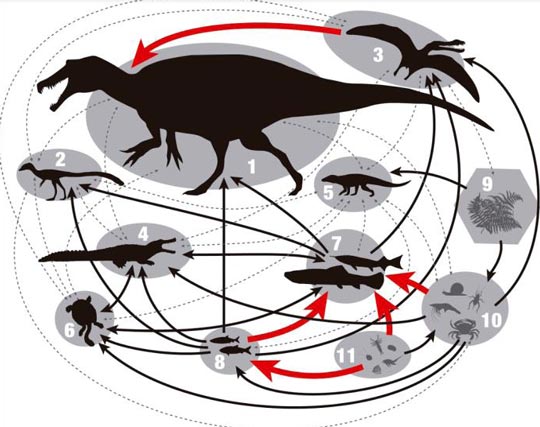
A Simplified Dinosaur Themed Food Web
Proposed food chain showing LPP-PV-0042 as apex predator. A diagram showing a prehistoric animal food web.
Picture credit: Cretaceous Research
Basic Food Chain Principles
Children in Year 2 for example, will be required to explain how animals obtain their food from plants and other animals, using the idea of a simple food web. They will be expected to identify and name different sources of food.
Food chains show the feeding relationships between animals, plants and other organisms. Whether it is examining the biota of the Upper Cretaceous Hell Creek Formation of Montana, the Savannah of Africa or the school pond, the principles regarding food webs still apply. Food chains tend to be roughly triangular in shape with the greater amount of biomass to be found at the lower levels. The amount of material and energy decreases from one level to the next. Food production is much more efficient if the food chain is short.
Energy is transferred along food chains from one level to the next. Not all of the energy available to organisms at one level can be absorbed by organisms at the next level up. Arrows tend to show the direction of energy flows in a food chain. At the base of most food chains is the sun, as it is sunlight that plays a role in photosynthesis, allowing plants to grow.
By Mike|2024-05-10T21:19:33+01:00May 1st, 2018|Categories: General Teaching|Comments Off on Fake Reviews and Feedback Some Important News
Fake Reviews and Feedback
Genuine teaching reviews posted up on Everything Dinosaur’s websites.
In the UK at the moment, there is a lot of media coverage about fake reviews. A BBC investigation has found that fake on-line reviews are being openly traded on the worldwide web. In a radio programme broadcast on BBC 5 live, an investigator was able to purchase a false, 5-star recommendation placed on one of the world’s leading review websites, Trustpilot. The BBC programme also uncovered on-line forums and closed groups where Amazon shoppers are offered full refunds in exchange for product reviews. Both Trustpilot and Amazon have stated that they do not tolerate false reviews.
Genuine Teaching Reviews
At Everything Dinosaur, we know how many customers rely on the information contained within testimonials and reviews before opting to either make a purchase or to use the company’s services. Every single review either posted onto our website, or on our Feefo account and shown on our website, or a dinosaur workshop review posted up here on this site, is genuine. We have never indulged in such practices, trying to mislead potential customers by purchasing fake reviews.
Everything Dinosaur has never purchased Facebook “likes”, Google reviews or undertaken any form of unscrupulous practice in a bid to boost our profile and ratings. We pride ourselves in being an honest and ethical team that does all it can to help and support our customers.
The Latest Dinosaur Workshop Reviews – All Genuine from Teachers and Teaching Assistants Who Have Witnessed our Work
Five stars for Everything Dinosaur! Picture credit: Everything Dinosaur.
Picture credit: Everything Dinosaur
Let our Service and Products Speak for Themselves
Currently, at the time of writing, Everything Dinosaur has 489 verified Feefo reviews posted up onto its main website: Everything Dinosaur in addition, we have over 1,685 comments and reviews posted by customers on this website too, a total of over 2,170, genuine customer reviews and comments. We have a 5-star rating with Feefo and have earned the prestigious Gold Trusted Service Award from that company.
Genuine Reviews from Real People
Everything Dinosaur 5-stars on Feefo. Picture credit: Everything Dinosaur.
Picture credit: Everything Dinosaur
Our thanks to all those educationalists who posted up helpful and informative teaching reviews.
A spokesperson from Everything Dinosaur stated:
“Feedback, customer comments and reviews are very important to us. We use this information to help improve our customer service and the various workshops that we deliver in schools. We do all we can to help our customers and the schools that we work with and we are immensely proud of our consistently high ratings for customer satisfaction and service. Our reviews, just like our company can be trusted.”
By Mike|2023-10-10T14:30:40+01:00April 30th, 2018|Categories: General Teaching, Key Stage 1/2|Comments Off on A Mini Dinosaur World Created in a Box
A Mini Dinosaur World Created in a Box
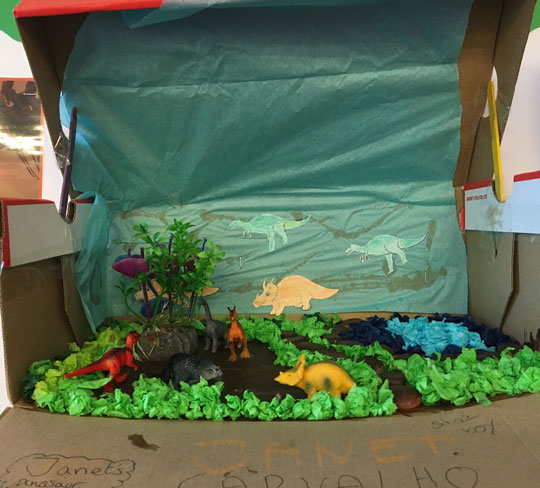
One enterprising Year 2 pupil showed us their mini “Jurassic Park” that they had created for a school project all about dinosaurs, fossils and prehistoric animals. The child had made their own mini dinosaur world using a cardboard box, some paints, tissue paper, small sticks and gravel.
A Mini Dinosaur and Prehistoric Animal Theme Park
Dinosaur dioramas created by children at Langley Hall Primary Academy. Picture credit: Everything Dinosaur.
Picture credit: Everything Dinosaur
A Dinosaur World
The dinosaurs look very much at home in this scene, there is a river with a waterfall, the effect of the foaming water being created by scrunching up some tissue paper. The designer has provided the dinosaurs with a stone bridge so that they can cross safely to the other side of the river and reach the dinosaur nest composed of small sticks. The nest contains some yellow dinosaur eggs, which are being guarded by a meat-eating dinosaur.
A large, herbivorous dinosaur, a long-necked sauropod browses nearby and our dinosaur and fossil experts really liked the model tree complete with purple fruits that had been added to the diorama. In the background a volcano is erupting. The green tissue paper gives the impression of prehistoric vegetation. The plant-eating dinosaurs have lots of food to eat.
Our congratulations to the young model maker for building such a clever and colourful dinosaur diorama.
By Mike|2024-05-10T21:37:05+01:00April 29th, 2018|Categories: General Teaching|Comments Off on Wonderful Dinosaur Trackway Biscuits
Dinosaur Trackway Biscuits
Tracksites and fossilised footprints can tell palaeontologists a lot about the behaviour of long extinct animals. These fossils are called “trace fossils”, as they preserve the activity of animals. Unlike “body” fossils such as bones and teeth, which may have been transported after death a long way from where the animal died, most trace fossils are direct evidence of the environment at the time and place the organism was living.
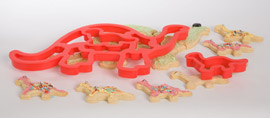
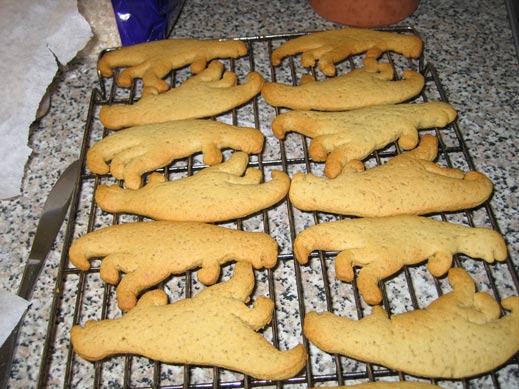
Everything Dinosaur received some pictures from a young dinosaur fan from Germany who had used a dinosaur model to make a wonderful trace fossil biscuit.
Dinosaur Model Used to Make a Biscuits
Dinosaur shortbread biscuits
What a very clever idea! Everything Dinosaur team members are always pleased to see how various prehistoric animal themed toys are used in such creative ways, the biscuit dough makes a wonderful media to preserve the dinosaur footprints. The dinosaur model used for the biscuit trackways was a Papo Parasaurolophus.
Baked Dinosaur Biscuits
T. rex biscuits. Picture credit: Everything Dinosaur.
Picture credit: Everything Dinosaur
Art Imitates Science
Recently, Everything Dinosaur wrote an article about the discovery of a single slab of rock that preserved a collection of prehistoric animal footprints, including several types of dinosaur tracks. The block, found in the grounds of NASA’s Goddard Spaceflight Centre (Maryland, USA), holds the fossilised tracks of several dinosaurs, flying reptiles and preserved tracks of early mammals.
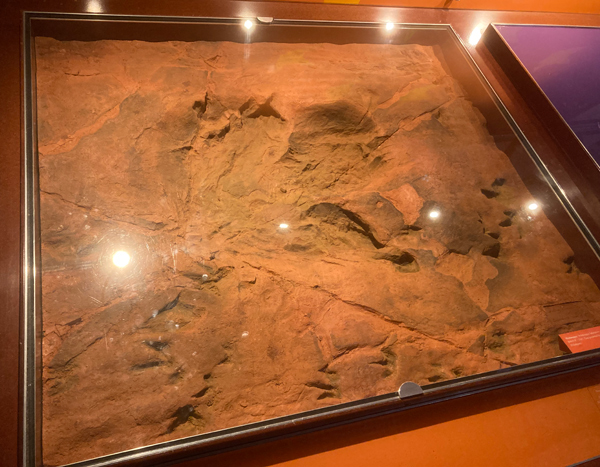
A Dinosaur Footprint Preserved on a Single Slab of Rock
A fossil dinosaur footprint photographed at the London Natural History Museum. The exhibit features a three-toed print from the famous Lark Quarry track site in Australia. Picture credit: Everything Dinosaur.
Children in Year 1 compiled lots of facts about dinosaurs and prehistoric animals as part of a term topic on life in the past. The enthusiastic teaching team had challenged the pupils to conduct some independent research into dinosaurs and other creatures that lived before people.
The children were given a choice, they could research a single animal such as Brontosaurus, Triceratops or Tyrannosaurus rex, or they could create a poster about dinosaurs in general. The only prerequisite stated by the teachers was that the children’s work had to include lots of information, lots of facts.
Children in Year 1 Compile Dinosaur and Prehistoric Animal Posters
Year 1 children design dinosaur posters. Picture credit: Everything Dinosaur.
Picture credit: Newport Infant School (Squirrel Class)/Everything Dinosaur
Demonstrating Knowledge About Dinosaurs
During our visit to the school to conduct a series of dinosaur workshops with the Year 1 classes, the children were keen to demonstrate their knowledge confidently asserting that dinosaurs laid eggs and that dinosaur fossils could be found all over the world, even in Australia! We provided a number of extension resources to help support the school’s scheme of work, including a challenge to the children to create a non-chronological report on the life and times of the famous scientist Sir Richard Owen, highly appropriate since one of the children was called Owen.
Producing Dinosaur Posters for Display at the School
Dinosaur facts compiled by Year 1 children. This poster features a lot of different dinosaurs including herbivores and carnivores. To date, something like 1,300 dinosaur genera have been described. Picture credit: Everything Dinosaur.
Picture credit: Newport Infant School (Squirrel Class)/Everything Dinosaur
For further information about Everything Dinosaur’s work in schools and to enquire about our outreach work: Contact Everything Dinosaur.
Dinosaurs as a Teaching Topic
Learning about dinosaurs provides plenty of opportunities for cross-curricular activities. For example, the children had been exploring the properties of different materials by making prehistoric animal models and this topic has lots of scope to include writing activities (fiction and non-fiction writing). Everything Dinosaur’s workshop leader challenged the classes (and their teachers), to produce a dinosaur themed poem. A piece of prose that features a prehistoric animal, an intriguing idea that helps the children explore different types of writing and gives them the opportunity to develop their vocabulary, introducing the idea of stanzas, cadence, verses and iambic pentameter.
A spokesperson from Everything Dinosaur commented:
“Our workshops provided the ideal provocation to kick-start the children’s term topic. Dinosaurs and prehistoric animals certainly enthused the pupils and they were eager to demonstrate their pre-knowledge and to show their visitor all the posters, fact sheets and non-chronological reports on life in the past that they had created. The teachers too, were very enthusiastic and eager to learn, taking lots of notes and photographs during the sessions with the three classes.”