By Mike|2023-10-30T08:38:13+00:00September 15th, 2018|Categories: General Teaching|Comments Off on A Beautiful Marine Reptile Model
Wonderful Model of a Pliosaurus
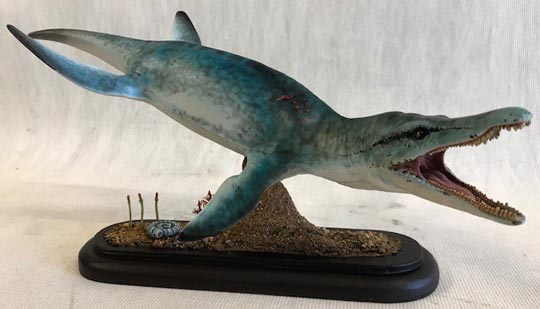
Our thanks to the model collector and prehistoric animal fan who sent in a picture of a wonderful marine reptile diorama. The figure in question is a model of the fearsome, carnivore Pliosaurus. The artist (Martin Garratt), has done a splendid job in making a prehistoric animal model that costs just a few pounds into something truly unique and spectacular.
Prehistoric Pliosaurus Model Display Piece
A customised CollectA Pliosaurus scale model.
Collecta Deluxe Pliosaurus
The image (above) shows the figure. It is a customised CollectA Deluxe Pliosaurus. It has been used to make an amazing marine reptile diorama.
To help depict the model in a dynamic swimming pose, the sculptor moulded a support and incorporated this into the base by making it look like an irregular section of the sandy seabed the marine reptile was cruising past. The fine details on this display piece help to reflect the quality of the craftsmanship involved. The sculptor has even created a coiled ammonite shell and added it to the seabed.
A spokesperson from Everything Dinosaur commented:
“We enjoy seeing pictures of prehistoric animal dioramas and we get lots sent into our offices. We look at every one, pictures of dinosaur models created by children as well as museum quality dioramas such as this one created by a professional artist.”
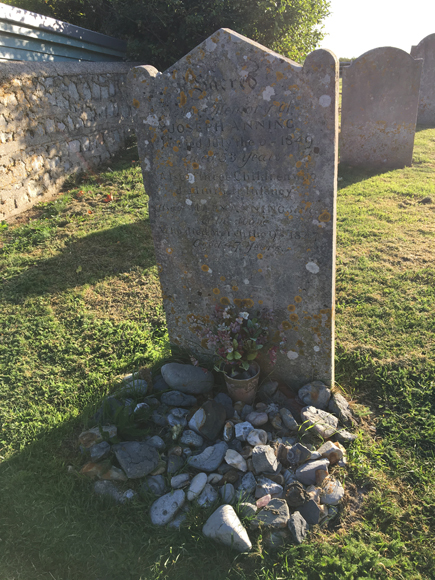
When team members at Everything Dinosaur visit the coast of Dorset, they always try and take time out of their busy schedules to visit the grave of Mary Anning and her brother Joseph. The grave of Mary and Joseph Anning can be found at St Michael the Archangel Church, in the appropriately named Church Street in the picturesque town of Lyme Regis. In 1811, Mary along with her brother Joseph, discovered the fossilised remains of an ichthyosaur, their first major, documented fossil discovery. Within the Church itself, there is a stained glass window that honours the life and work of Mary Anning. It was paid for in part, by members of the Geological Society in recognition of her contribution to this branch of scientific enquiry.
The Grave of Mary and Joseph Anning at Lyme Regis
The grave of Mary and Joseph Anning.
Picture credit: Everything Dinosaur
Paying Tribute to Mary Anning (1799-1847)
A stained glass window in the church is not the only way in which the contribution of Mary is remembered. Over the last few years it has become something of a tradition to place a fossil or a pebble from the beach on the grave. This is a touching gesture, one that allows tourists as well as professional fossil hunters to acknowledge the work of a pioneer in palaeontology.
Everything Dinosaur team members have done much to support the inclusion of the story of Mary Anning and her fossil discoveries within the English National Curriculum. Mary Anning is one of the historical figures included in many study texts and schemes of work associated with English Primary School curriculum. Her life and work provides an excellent role model for many people, especially girls, who can learn about a female scientist, someone who might help and inspire them to take a greater interest in science subjects.
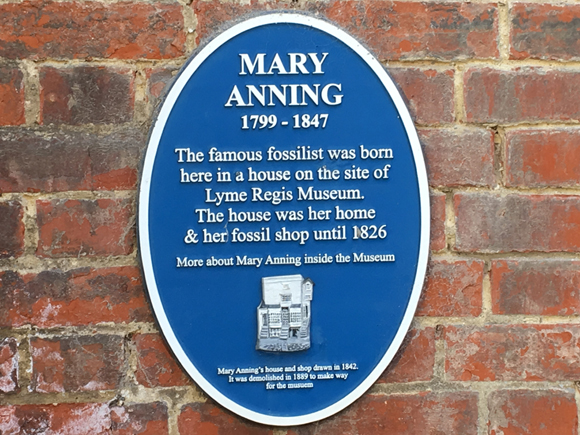
Within the town of Lyme Regis, a blue plaque has been erected on the site of the Anning family’s residence and Mary’s first fossil shop. The house has long gone, but in its place stands the Lyme Regis Museum which contains numerous displays of Mary’s fossil discoveries as well as some of her personal effects.
The Blue Plaque on the Wall of the Lyme Regis Museum Commemorating the Life and Work of Mary Anning
The blue plaque commemorating the birth of Mary Anning outside the Lyme Regis Museum.
By Mike|2024-05-11T16:33:19+01:00September 9th, 2018|Categories: General Teaching, Key Stage 1/2|Comments Off on Getting to Grips with an Amazing K-W-L Strategy
Everything Dinosaur Helps Out Primary School with K-W-L Strategy
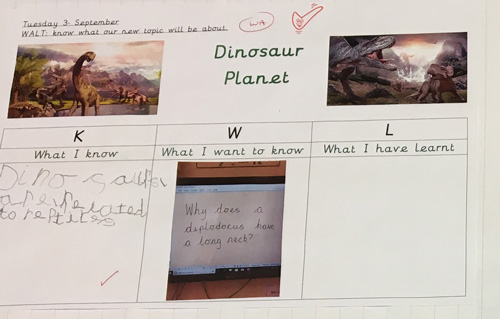
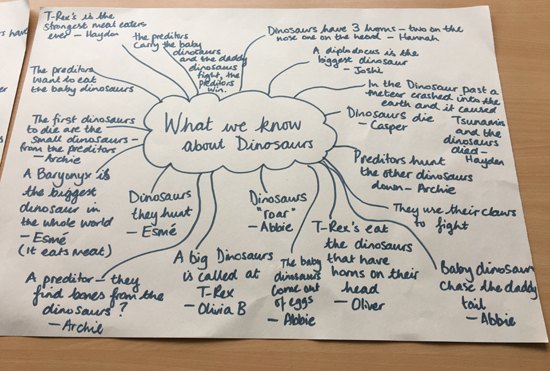
Team members at Everything Dinosaur have been approached by a primary school teacher to help her introduce a term topic all about dinosaurs for her Year 1 class. The teacher wants to utilise a K-W-L strategy to establish the topic and to identify what the children already know about prehistoric animals and to use the results to direct learning over the coming weeks.
The Use of a K-W-L Strategy in the Classroom
At the start of the dinosaur topic the Year 1 children recorded what they know about dinosaurs. Picture credit: Everything Dinosaur.
Picture credit: Everything Dinosaur
Defining a K-W-L Strategy
A K-W-L strategy is essentially a tabular method of assessing the level of knowledge that children have at the beginning, in the middle and at the end of a period of work. It can be implemented over a term topic such as “Dinosaur Planet” or “Jurassic Forest” or it can be used at the individual lesson level.
K-W-L – examines:
What the children know = K
What the children would like to learn about = W
What the children have learned = L
A Three-part Strategy for Learning
This teaching tool gives pupils an opportunity to make connections between different topic areas, it appeals to visual learners and allows the teaching team to shape the subject to suit the needs and requirements of the class. It allows the teacher to identify what prior subject knowledge the children possess, in the case of dinosaurs, it is surprising how much information the children know and are very enthusiastic to divulge. The K-W-L strategy can help to guide lesson planning and to focus on appropriate teaching strategies to address the lack of knowledge uncovered during the mapping exercise.
Mind Maps Can Support a K-W-L Strategy
Using the KWL technique to start a term topic all about dinosaurs. Picture credit: Everything Dinosaur.
Picture credit: Everything Dinosaur
Everything Dinosaur Answering Questions
In order to help support the teacher, Everything Dinosaur team members have promised to answer emails from the children in support of their enquiries about dinosaurs and life in the past.
A spokesperson from Everything Dinosaur commented:
“The teacher can include the children emailing our dinosaur and fossil experts within their lesson planning. The use of email to answer the children’s questions can help incorporate and develop the ICT element of the curriculum.”
Crystal Palace Statues Helping with Outdoor Learning
Recently, Everything Dinosaur has been providing advice on how best to utilise the outdoor resources at the famous Crystal Palace Park in south London. Schools have been invited to make the most of this area, with its historic “dinosaur statues”. Outdoor learning is being encouraged and the park with its hard and soft landscaping as well as its iconic prehistoric animal figures makes a fantastic open space for creative activities linked to the English national curriculum. Everything Dinosaur is delighted to support the Crystal Palace Dinosaurs.
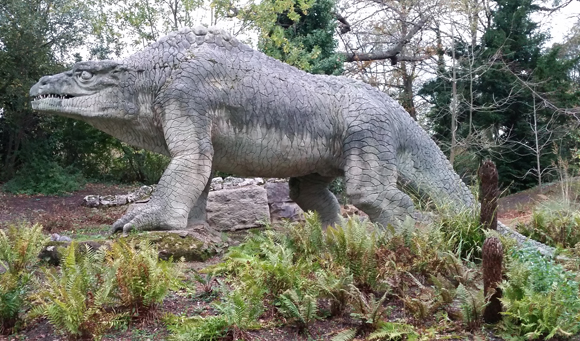
One of the Dinosaur Statues on Display at the Park (Megalosaurus)
The Megalosaurus statue at Crystal Palace – a dinosaur from 1854. Picture credit: Everything Dinosaur.
Picture credit: Everything Dinosaur
Prehistoric Animal Figures Not Just Dinosaurs
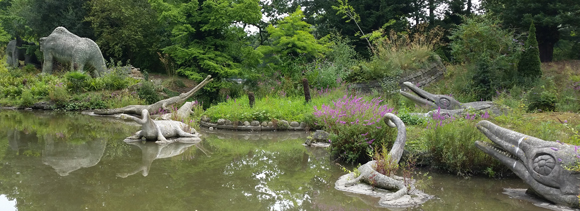
In reality, dinosaurs make up only a small proportion of the more than thirty statues on display. The figures created by Benjamin Waterhouse Hawkins with scientific input from the soon to be knighted Sir Richard Owen, who went onto to help found the London Natural History Museum, include marine reptiles, crocodilians, turtles and extinct mammals. They were erected in the middle of the 19th century (circa 1854) and they represent the first attempt to create life-size, dinosaur figures. However, our view of the Dinosauria has evolved somewhat since the 1850s and the dinosaurs, depicted as four-footed, tail-dragging scaly lizards, is wildly inaccurate by today’s standards.
Marine Reptiles Feature at Crystal Palace – Statues Inspired by the Discoveries Made by Mary Anning
Prehistoric animal figures at Crystal Palace, the world’s first “Jurassic Park”. Picture credit: Everything Dinosaur.
All the figures are listed on Historic England’s “National Heritage List for England” as Grade 1 monuments. This listing recognises the historic importance of these statues and a lot has been done to help preserve the dinosaurs and other figures as part of our country’s scientific and historical heritage.
In our advisory work, team members have suggested ways in which our changing views about the Dinosauria can be incorporated into the teaching programme. The dinosaurs represented by the figures, the first three genera to be incorporated within the order Dinosauria, Megalosaurus, Hylaeosaurus and Iguanodon, show how our interpretation of the fossil record has changed over the last 170 years or so. The statues provide a three-dimensional testament to how scientific ideas evolve and change in the light of new evidence.
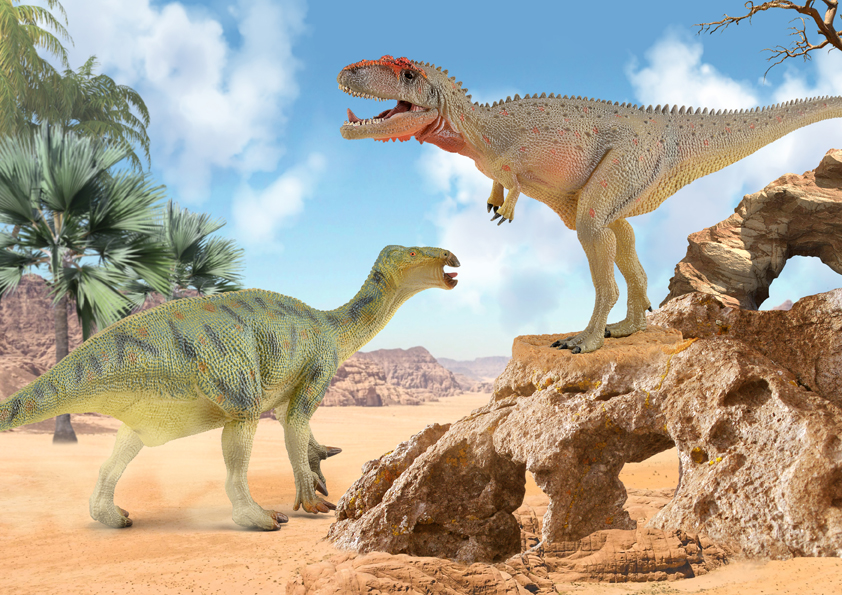
The Iguanodon (Foreground) – A Modern Interpretation of an Iguanodontid
The CollectA 1:40 scale Iguanodon and Mapusaurus dinosaur models.
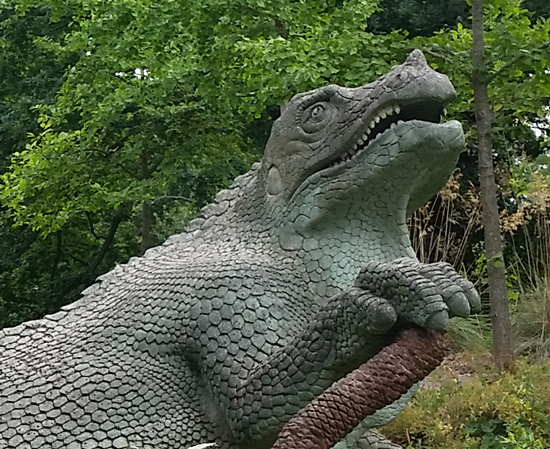
The spike associated with fossils of Iguanodon is now known to have been part of the hand (a thumb spike), whereas, in the 1854 model, the lizard-like Iguanodon statue has the spike incorrectly placed on the bridge of the snout.
One of the Iguanodon Figures on Display at Crystal Palace Park
One of the Iguanodon figures on display at Crystal Palace Park. Note the “thumb spike” placed incorrectly on the nose. Picture credit: Everything Dinosaur.
Picture credit: Everything Dinosaur
Team members at Everything Dinosaur wish all those involved in the schools outreach programme at the Park every success.
By Mike|2023-10-28T18:30:41+01:00September 3rd, 2018|Categories: General Teaching|Comments Off on Back to School with Everything Dinosaur
Back to School with Everything Dinosaur
It is the start of the new academic year and Everything Dinosaur team members like lots of teachers and teaching assistants, are busy finalising plans for the upcoming autumn term.
Many primary schools are kicking off their Reception (Foundation Stage Two) and Key Stage One schemes of work with a dinosaur themed term topic. Topic areas such as “Jurassic Forest” and “Dinosaur Planet” can be linked to core elements of the national curriculum such as English to help the pupils develop an understanding of non-chronological reports and non-fiction writing, whereas, in science, the topic area can link to work exploring carnivores, herbivores, omnivores and food webs.
Everything Dinosaur Making Preparations for the Autumn Term
Dinosaur fossils have been found all over the world, studying prehistoric animals can assist with the children learning about the world’s continents and oceans, helping to support geography teaching in schools.
The Art and Design element of the curriculum can be included by challenging the children to use drawings and paintings of prehistoric animals to help them develop their imagination and to share their ideas. Lots of different resources such as pasta shapes, straws, stencils and charcoal can be used in creative art and design projects to help the children learn more about the properties of different materials.
Prehistoric Animals Helping to Support the Art and Design Elements of the Curriculum
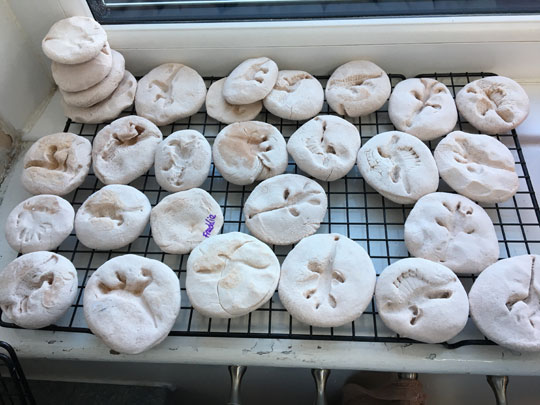
Dinosaur salt dough fossils spotted at a school. Picture credit: Everything Dinosaur.
Picture Credit: Everything Dinosaur
The Creative Curriculum – History
Learning about events beyond living memory by studying the time of the dinosaurs – the Triassic, Jurassic and the Cretaceous geological periods. The science element can further be supported by incorporating how and why palaeontologists study fossils. Learning about fossils can provide a real sense of discovery at the heart of the term topic.
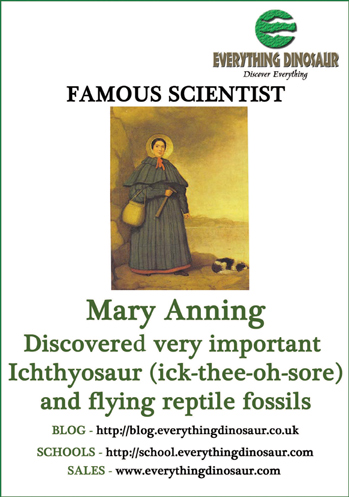
Historical figures can be introduced, such as learning about the life and contribution to science made by Mary Anning, a fossil collector and amateur palaeontologist from Dorset (southern England).
Studying the Life and Works of Mary Anning Dove-tails into the History Section of the National Curriculum
Helping Year 4 to learn all about scientists.
Picture credit: Everything Dinosaur
Dinosaurs as a term topic provides lots of important “touch points” to the curriculum. Furthermore, such an exciting and challenging topic area can really help young learners to settle down and to make good progress as they start the new school year.
For further information about Everything Dinosaur’s work in schools and outreach work: Email Everything Dinosaur.
Please remember to include the name and postcode of your school, plus, it would be helpful if you could let us know the age of the children.
By Mike|2024-05-11T08:15:30+01:00August 23rd, 2018|Categories: General Teaching|Comments Off on William Draws Wonderful Dinosaurs
Dinosaur Drawings By William
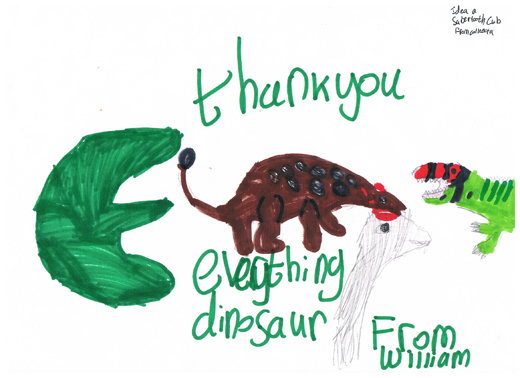
Our thanks to young dinosaur fan William who kindly sent in a drawing of two of his favourite dinosaur models. At Everything Dinosaur, we get sent lots of dinosaur and prehistoric illustrations and we like to post these up in our warehouse. William wrote to thank Everything Dinosaur team members for supplying the dinosaur figures.
A Young Dinosaur Fan (William) Draws Prehistoric Animals
William draws dinosaurs and the Everything Dinosaur logo. Picture credit: William.
Picture credit: William
Not only has William chosen to illustrate some dinosaurs for us, but he also sent to us a lovely copy of our company logo, a large letter “e” that represents a three-toed dinosaur footprint as well as the first letter of our company’s name. Congratulations to William, for the drawings and for the clear and well-spaced writing.
Everything Dinosaur registered trade mark.
Dinosaur Drawings from Children
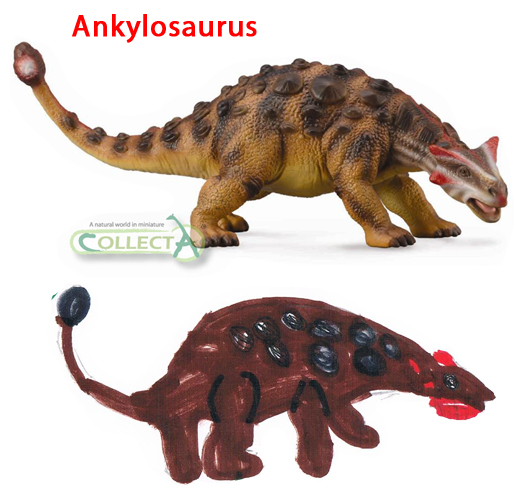
Lots of children are fascinated by dinosaurs and many schools utilise this love of all things dinosaur as they deliver dinosaur-themed term topics. Learning about ferocious and thankfully, extinct creatures from the past can really help to motivate and enthuse young learners when it comes to gaining confidence with numbers and improving writing skills. William for example, as chosen to illustrate one of his favourite dinosaur models – Ankylosaurus. It we compare William’s drawing to a model of this armoured dinosaur, it is clear that William has taken great care over his work.
William Draws an Ankylosaurus
William draws Ankylosaurus. The model (top) compared to William’s illustration (bottom). Picture credit: William.
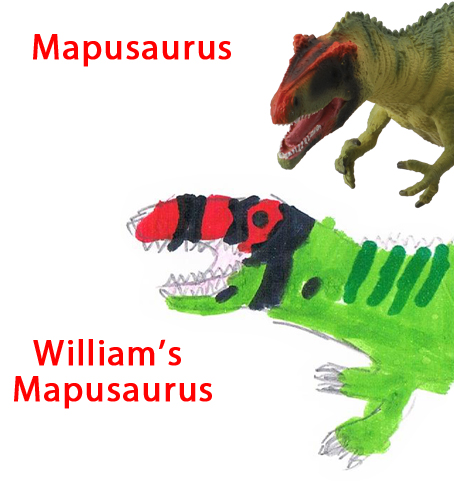
In addition, to his armoured dinosaur illustration, William chose to draw a picture of a Mapusaurus. Mapusaurus, (as we are sure William will know), was a large, carnivorous dinosaur, fossils of which come from Argentina. It was probably the largest predator in its environment, with some palaeontologists estimating that Mapusaurus weighed around six tonnes and measured more than twelve metres long.
William Draws Mapusaurus
William draws a Mapusaurus. Picture credit: William.
Picture credit: William/Everything Dinosaur
Once again, we congratulate William on the accuracy of his drawing, team members at Everything Dinosaur were able to recognise that this was an illustration of the CollectA Mapusaurus dinosaur model.
Our thanks to William for his drawing and to his kind mum Anna who gave it to us. We hope you liked the fact sheets that accompanied the models that we supplied.
We noted the suggestion for CollectA to produce a model of a Sabre-tooth Cat cub, this suggestion along with the illustration will be forwarded onto our chums at CollectA.
By Mike|2023-10-28T08:51:16+01:00August 22nd, 2018|Categories: General Teaching|Comments Off on Take Care When Visiting the Beach this Bank Holiday
Everything Dinosaur Issues a Warning About Dangerous Cliffs
This weekend, it is the August Bank Holiday here in the UK. This is the last national Bank Holiday before Christmas, a sobering thought, but with lots of families heading to the beach to make the most of the summer weather, team members at Everything Dinosaur have issued a warning about dangerous cliffs on many of the UK’s coasts.
Dangerous Cliffs
Families will be visiting the seaside for lots of reasons, some might even be amateur fossil collectors, keen to find a few choice specimens before the autumn weather rolls in. However, the exceptional hot, dry spells that much of the country has experienced over the last three months or so has left many of the cliffs overlooking beaches even more dangerous than ever.
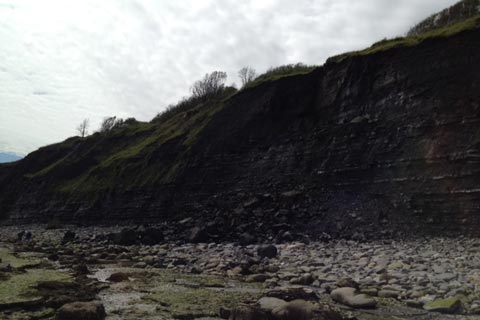
A Recent Cliff Collapse at Happisburgh Beach on the Norfolk Coast
Dangerous cliffs along the coast. Picture credit: Everything Dinosaur.
Picture credit: Everything Dinosaur
Sandstone and chalk cliffs are particularly vulnerable. These cliffs have become increasingly dry over the summer and when it does rain, the water can make overlying rocks heavier and these overhangs can collapse. The dry weather followed by sudden downpours makes cliffs very unstable and rock falls are more likely to occur.
Stay Away from the Clifftops and the Base of the Cliff
A spokesperson from Everything Dinosaur commented:
“We want everyone to have a great time if they are planning on a visit to the coast during the holiday period. However, we would strongly advise that anybody visiting the beach at this time stays away from the cliffs and avoids the clifftops too.”
Would-be fossil hunters should take care to avoid getting to close to the base of cliffs, there are probably plenty of fossils to find further down the beach away from any potential landslips or rock falls.
It is advisable to heed warnings and to listen to advice from the local coastguard.
Instead of visiting the dangerous cliffs, visit the Everything Dinosaur website: Everything Dinosaur.
By Mike|2024-05-11T08:07:24+01:00August 19th, 2018|Categories: Key Stage 1/2|Comments Off on Helping Out Year 5 with Free Teaching Resources
Providing Extra Resources for Upper Key Stage 2
Many teachers and teaching assistants are busy planning their forthcoming scheme of work as they prepare for the start of the next academic year. Recently, Everything Dinosaur was contacted by a Year 5 teacher who was working on lesson plans for the science element of the national curriculum, specifically that part of the topic area that covered evolution, natural selection and Darwinism. They intended to look at the geology of their local area and explain what life was like in the very distant past. Around 300 million years ago, the school would have been underwater, covered by a shallow tropical sea that teemed with life.
Everything Dinosaur Exploring Limestone Outcrops
Evidence for this can be found in the numerous limestone outcrops in the area. The limestone is used as a local building material and the teacher planned to use these resources to help explain about the area’s geological past.
Setting Out to Explore the Local Geology of the Area
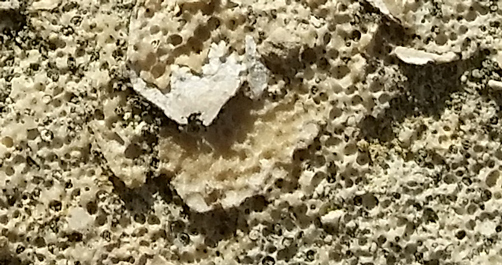
Fossil shell fragments in the oolitic limestone. Everything Dinosaur.
Picture credit: Everything Dinosaur
The picture (above) shows a form of limestone called oolitic limestone. The term means “egg stone”, as the texture of the rock’s surface resembles fish eggs. The circular patterns are the remains of ooliths that make up the limestone rock. Fragments of sea shell, or grains of sand are rolled around on the sea floor and as they move they collect CaCO3 (calcium carbonate). Concentric layers of this material are formed and it is these that give the rock its characteristic appearance. The teacher hopes to inspire the Year 5 pupils by showing them the geology on their doorstep.
By Mike|2023-10-27T14:20:34+01:00August 14th, 2018|Categories: General Teaching|Comments Off on A Beautiful Edaphosaurus Model
A Stunning 1:20 Scale Edaphosaurus Model
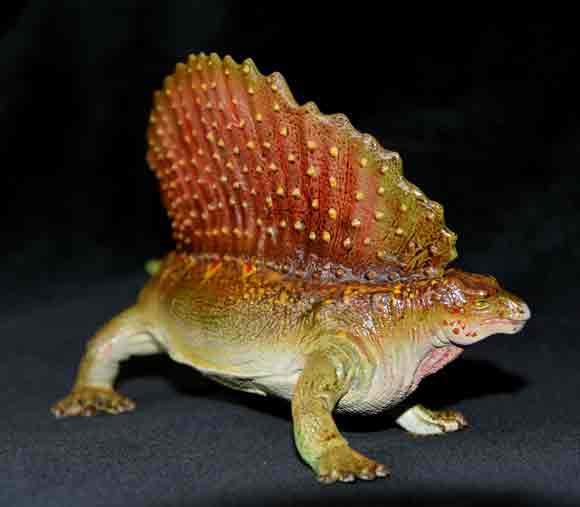
Our thanks to prehistoric animal model fan, Elizabeth, who sent us in this wonderful replica of an Edaphosaurus, a reptile that lived many millions of years before the dinosaurs evolved but is often mistaken for a dinosaur.
A Beautiful 1/20th Scale Replica of a Edaphosaurus
Edaphosaurus a customised CollectA model.
Picture credit: Elizabeth
The figure is part of the CollectA Deluxe prehistoric life model series. It has been customised and provided with a display base.
Edaphosaurus, like Dimetrodon, is sometimes referred to as a “sail-backed reptile”. It is sometimes included in dinosaur model sets. However, Edaphosaurus was not a dinosaur. This reptile was a synapsid, a member of a group of reptiles that has a single opening (fenestra) just behind the eye socket in the skull. Dinosaurs, along with lizards, crocodiles, Aves (birds) and marine reptiles such as the Plesiosauria, were diapsids. Diapsids have two holes on each side of the skull. Mammals are also synapsids, so Edaphosaurus was ironically more closely related to mammals like us than to the Dinosauria, although the term “mammal-like” reptile that is often applied to this ancient reptile is very misleading and not accurate.
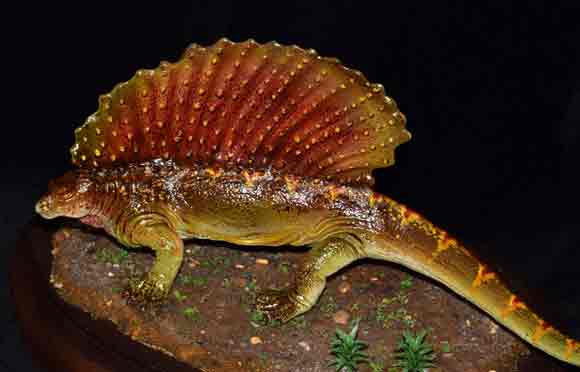
Edaphosaurus Lived During the Permian Geological Period, Long Before the First Dinosaurs
A customised Edaphosaurus model complete with display base.
Picture credit: Elizabeth
Our thanks to Elizabeth for sending in to us some photographs of her fabulous Edaphosaurus diorama.
Visit the award-winning and user-friendly Everything Dinosaur website: Everything Dinosaur.
By Mike|2023-10-27T07:20:56+01:00August 6th, 2018|Categories: General Teaching|Comments Off on A Successful Dinosaur and Fossil Workshop
Dinosaur and Fossil Workshop Success
Recently, Everything Dinosaur team members were invited up to the beautiful Beacon Museum at Whitehaven, Cumbria, to participate in the Museum’s “Dino Fest”, a weekend of activities focusing on all things dinosaur. The Beacon Museum is holding a dinosaur inspired exhibition for the summer months with lots of family friendly activities. On the Friday afternoon, Everything Dinosaur hosted a special meeting of the Museum’s “Quantum Leap” club. We looked at fossils including dinosaur bones and the children got the chance to find and take home their own fossils, including pieces of fossilised dinosaur bone.
Everything Dinosaur and Fossil Workshops
Everything Dinosaur at the Beacon Museum 27th July to 29th July. Picture credit: Everything Dinosaur.
Picture credit: Everything Dinosaur
Fossil Casting
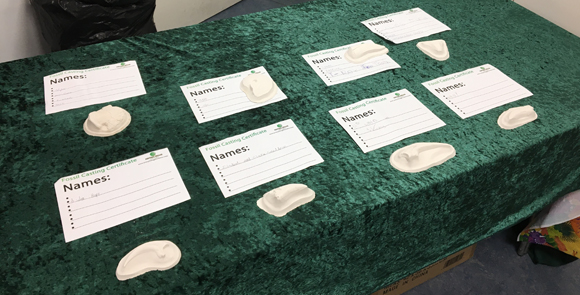
During our work with the enthusiastic “Quantum Leap” club members we got the budding young scientists to have a go at casting their own museum quality replicas. Over the course of the weekend, we held a number of dinosaur and fossil workshops and lots of fossils were found and some amazing casts were made.
Fossil Casts on Display
The completed fossil casts produced by visitors to The Beacon Museum (Whitehaven) who participated in Everything Dinosaur’s workshops. Picture credit: Everything Dinosaur.
Well done to Joe and Tom for making such a superb cast from one of our Late Cretaceous ammonite fossils from Canada.
Fossil Casting Workshops
In total, Everything Dinosaur held three two-hour long fossil workshops and numerous, shorter fossil hunting activities.
A spokesperson from Everything Dinosaur, who participated in the weekend of dinosaur-themed activities commented:
“It was great to meet all the eager and enthusiastic, young dinosaur fans at The Beacon Museum over the weekend. We all had a great time hunting for fossils, helping to make fossil casts and answering all their questions about dinosaurs.”
Visit the award-winning, user-friendly Everything Dinosaur website: Everything Dinosaur.