All about dinosaurs, fossils and prehistoric animals by Everything Dinosaur team members.

Pictures of fossils, fossil hunting trips, fossil sites and photographs relating to fossil hunting and fossil finds.

7 07, 2021

New Dinosaur Described from Spain

By |2024-05-27T13:45:06+01:00July 7th, 2021|Categories: Dinosaur and Prehistoric Animal News Stories, Dinosaur Fans, Main Page, Palaeontological articles, Photos/Pictures of Fossils|0 Comments

A new species of dinosaur has been named and described from a jawbone found in Castellón, Spain. The dinosaur has been named Portellsaurus sosbaynati and it has been classified as a member of the Ornithopoda subgroup Styracosterna. Its discovery could help shed light on the evolution of the Hadrosauroidea – the duck-billed dinosaurs, from other large-bodied dinosaurs more closely related to the iguanodontids.

Portellsaurus sosbaynati life reconstruction
A life reconstruction of the newly described Spanish styracosternan hadrosauroid named Portellsaurus sosbaynati. Picture credit: Universitat Jaume I.

Portellsaurus sosbaynati

The fossil material, consisting of a right dentary (lower jawbone), specimen number MQ98-II-1, comes from Mirambell Formation exposures at a site near Mas de Curolles, Portell, Castellón (Spain). The fossil is around 129-130 million years old (Barremian faunal stage of the Early Cretaceous). The strata represent a shallow lagoon and although no other fossil material has been described, unique characteristics associated with the dentary combined with the fossil’s geological age, permitted the research team to erect a new genus of herbivorous dinosaur.

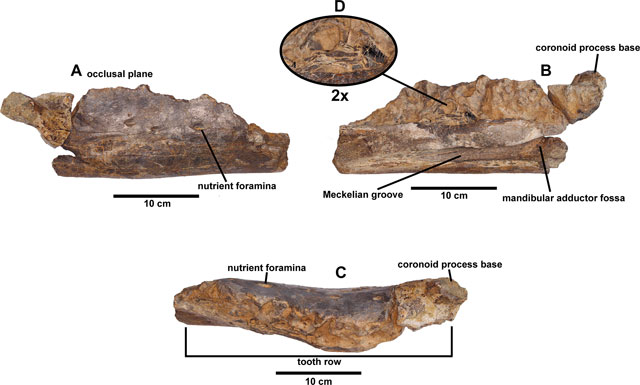
Views of the right dentary of Portellsaurus
View of the right dentary (MQ98-II-1) of Portellsaurus sosbaynati. Labial (A), lingual (B), and occlusal (C) views. (D) Enlargement (2x) of a dental crown fragment at the tooth row. Note scale bar = 10 cm. A new dinosaur described from a fossil jawbone.  Picture credit: Santos-Cubedo et al.

For dinosaur models and replicas: Dinosaur Models and Prehistoric Animal Replicas.

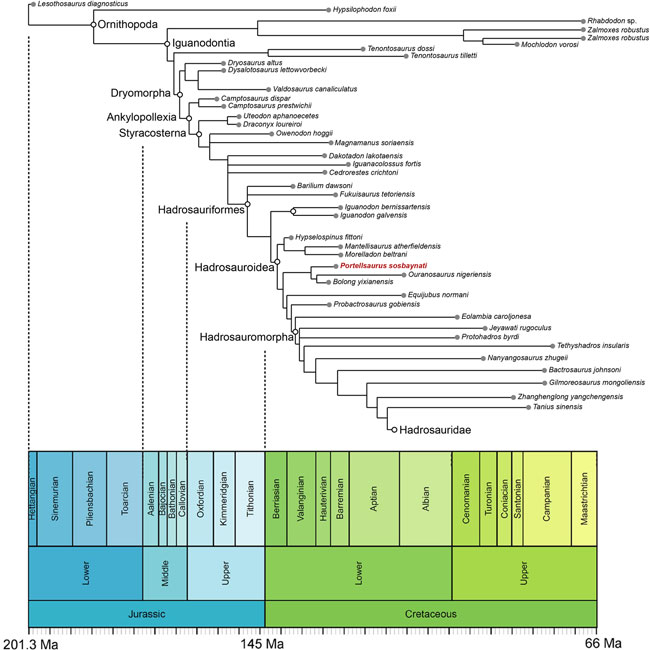
Writing in the on-line academic journal PLoS One, the researchers from Universitat Jaume I, Grup Guix and Valencia University, conclude that Portellsaurus is closely related to Ouranosaurus (O. nigeriensis) from Africa and Bolong (B. yixianensis) from north-eastern China.

Based on comparisons with other fossil material from other better-known iguanodontids and hadrosauroids, the scientists estimate that Portellsaurus could have been up to 8 metres long. The genus name for this new Spanish dinosaur honours the town of Portell, whilst the trivial name honours Vicente Sos Baynat, a Spanish geologist born in Castelló de la Plana and the first scientist to be awarded the accolade of honorary doctorate by the Universitat Jaume I.

Time-calibrated phylogeny of Portellsaurus sosbaynati.
Time-calibrated phylogeny of Portellsaurus sosbaynati. This analysis suggests that this Spanish styracosternan hadrosauroid was closely related to Ouranosaurus from Africa and Bolong from China. Picture credit: Santos-Cubedo et al.

Not Closely Related to Other Large-bodied Iberian Ornithopods

In addition, the scientists including corresponding author Andrés Santos-Cubedo (Universitat Jaume I), conclude that Portellsaurus sosbaynati is less closely related to other Iberian taxa such as Iguanodon bernissartensis and Proa valdearinnoensis than it is to the other Early Cretaceous Iberian styracosternans Mantellisaurus atherfieldensis and Morelladon beltrani, although Portellsaurus is geologically several million years older than both Mantellisaurus and Morelladon.

The scientific paper: “A new styracosternan hadrosauroid (Dinosauria: Ornithischia) from the Early Cretaceous of Portell, Spain” by Andrés Santos-Cubedo, Carlos de Santisteban, Begoña Poza and Sergi Meseguer published in PLoS One.

Visit the Everything Dinosaur website: Everything Dinosaur.
3 07, 2021

Dinosaurs Nested in the High Arctic

By |2024-05-27T13:36:43+01:00July 3rd, 2021|Categories: Adobe CS5, Dinosaur and Prehistoric Animal News Stories, Dinosaur Fans, Main Page, Palaeontological articles, Photos/Pictures of Fossils|0 Comments

Analysis of sediments taken from the famous Prince Creek Formation of northern Alaska has revealed tiny, fossilised bones and teeth representing perinatal dinosaurs – either embryonic (just about to hatch) or dinosaurs that have recently hatched. Several different types of dinosaurs are represented, which means that high latitudes in the Northern Hemisphere were probably the dinosaur’s permanent home and that they nested there.

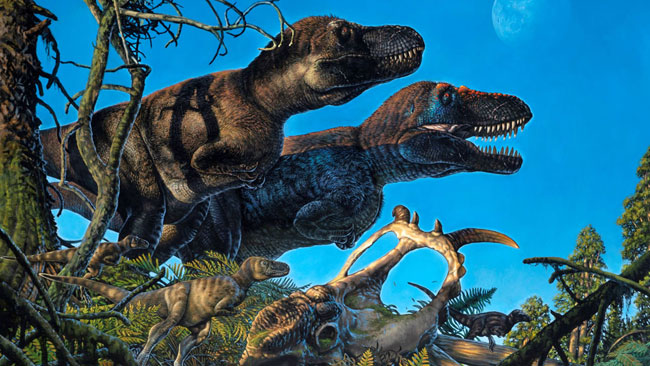
High Arctic was a Nursery for some dinosaurs
The discovery of tiny teeth and bones from perinatal dinosaurs provides strong evidence for dinosaurs nesting in the Arctic. This in turn suggests that many different dinosaurs were year-round residents and supports the hypothesis that most theropod and ornithischian dinosaurs were endothermic (warm-blooded). Picture credit: James Havens.

A Dinosaur Nursery

Researchers from the University of Alaska Museum, the Royal Tyrrell Museum, Florida State University and the University of Colorado writing in the academic journal “Current Biology”, report the discovery of tiny teeth — some less than 2 mm in length along with bones from seven species of perinatal dinosaurs. These tiny fossils were found after conducting a microscopic analysis of sediments from the bluffs that can be found along the shores of the Coleville River. These sediments are from the Prince Creek Formation and represent deposition that took place around 70 million years ago,

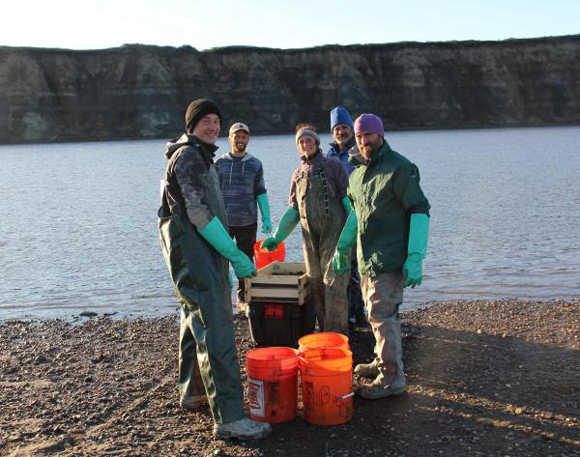
The field season is very short at such a high latitude. In the three weeks of field work that are possible, the team removed hundreds of kilograms of sediment from the face of the bluffs. The buckets of sediment are hauled down to the river’s edge, where team members wash the material through smaller and smaller screens until they have removed any large rocks and soil.

Researchers pose next to buckets of sediments that will be sieved for microfossils.
Field team members pose for a photograph next to buckets of sediment that they will sift through to search for tiny mammalian teeth end evidence of perinatal dinosaurs. Picture credit: Jaelyn Eberle.

Once back at the lab, researchers run the material through more screens to remove all the clay, until all that’s left is sandy particles. Then, teaspoon by teaspoon, the team, including graduate and undergraduate students examine the sand under microscopes to find the tiny bones and teeth. This work has revealed tiny teeth of mammals, but in addition, tiny teeth and bones of dinosaurs have been discovered.

dinosaurs nested in the Arctic
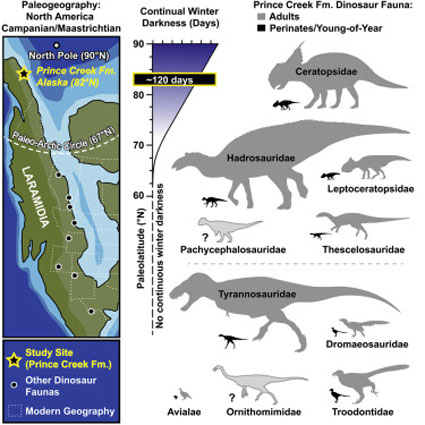
A map of Laramidia in the Late Cretaceous showing the position of the Prince Creek Formation in relation to other deposits where Late Cretaceous dinosaur fossils have been found. At this latitude, around 120 days each year were in total darkness. The scientists have found perinatal bones and teeth representing a wide variety of dinosaurs. Picture credit: Druckenmiller et al

Endothermic Dinosaurs

Although not as cold as today, conditions in this part of northern Laramidia during the Late Cretaceous were extremely challenging. For around 120 days each year there was total darkness and it has been calculated that the mean average temperature was just 6.3°C ± 2.2°C (43.3°F ± 4.0°F). The Eumeralla and Wonthaggi Formations of Australia at a palaeolatitude of about 70° south, have also provided evidence of recently hatched dinosaurs and yearlings.

However, the Prince Creek Formation at a latitude of 80°– 85° north represents the most extreme environment yet described for the Dinosauria. Intriguingly, whilst dinosaurs living in southern Gondwana (Eumeralla and Wonthaggi Formation fossil remains), would have experienced around 45 days of total darkness each year, this palaeoenvironment was still warm enough for ectothermic animals such as crocodilians and amphibians to thrive. However, no such “cold-blooded” animals are found in association with Prince Creek Formation sediments.

To survive such harsh conditions, the researchers conclude that the dinosaurs of Prince Creek Formation were endothermic, just like modern mammals and birds.

Evidence of perinatal dinosaurs from the Prince Creek Formation.
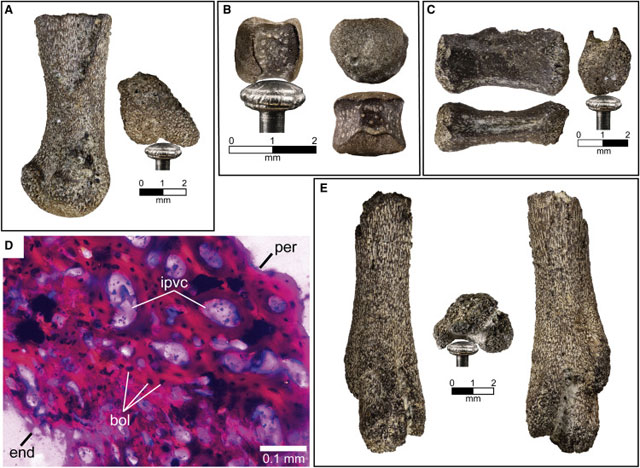
Perinatal skeletal elements of Prince Creek Formation dinosaurs. Insert (A) medial and distal views of distal femur(?), Ornithischia indet. (UAMES 41721). (B) Lateral, articular, and ventral views of caudal centrum, Ornithischia indet. (UAMES 41633). (C) Lateral, ventral, and articular views of caudal centrum, Theropoda indet. (UAMES 51934). (D) Transverse thin section of Ornithischia indet. long bone (UAMES 52384) showing the extreme porosity attributable to large, irregularly shaped vascular canals and the incompletely formed primary vascular canals on both the endosteal and periosteal surfaces. (E) Extensor, distal, and flexor views of distal tarsometatarsus, Avialae indet. (UAMES 41722). bol, bulbous osteocyte lacunae; end, endosteal surface; ipvc, incipient primary vascular canals; per, periosteal surface.

Lead author of the research Patrick Druckenmiller (University of Alaska Museum) commented:

“Recovering these tiny fossils is like panning for gold. It requires a great amount of time and effort to sort through tonnes of sediment grain-by-grain under a microscope. The fossils we found are rare but are scientifically rich in information”.

Dinosaurs were Year-round Residents of Northern Alaska

The presence of such young dinosaurs, who were not capable of making long, seasonal migrations is strong evidence to suggest that the dinosaur biota was present all year. The palaeoenvironment was extreme but numerous different types of dinosaur were able to thrive in this harsh habitat.

Tiny teeth suggest dinosaurs nested in the Arctic
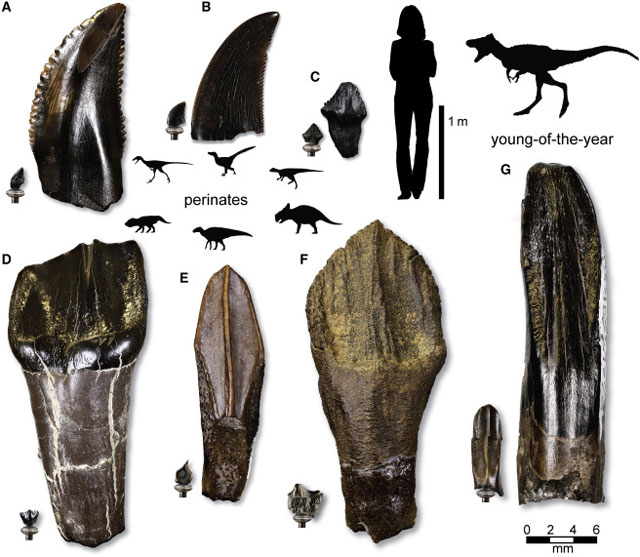
Comparative sizes of immature and mature teeth from Prince Creek Formation dinosaurs. A) Troodontidae indet. (UAMES 52268, UAMES 51652). (B) Saurornitholestinae indet. (UAMES 52292, UAMES 29574). (C) Thescelosauridae indet. cheek teeth (UAMES 52230, UAMES 52272) (D) Leptoceratopsidae indet. (UAMES 42720, UAMES 39298). (E) Hadrosauridae (cf. Ugrunaaluk) (UAMES 42739, UAMES 12491). (F) Ceratopsidae (cf. Pachyrhinosaurus) (UAMES 52467, UAMES 29413). (G), Tyrannosauridae (cf. Nanuqsaurus) premaxillary teeth, Picture credit: Druckenmiller et al.

This discovery demonstrates just how adaptable members of the Dinosauria were and hints at a diverse and rich dinosaur dominated ecosystem hundreds of miles inside the Palaeo-Arctic Circle.

The scientific paper: “Nesting at extreme polar latitudes by non-avian dinosaurs” by Patrick S. Druckenmiller, Gregory M. Erickson, Donald Brinkman, Caleb M. Brown and Jaelyn J. Eberle published in Current Biology.

Visit the Everything Dinosaur website: Everything Dinosaur.
2 07, 2021

Triassic Beetle Described from Fossil Poo by Researchers

By |2024-05-27T13:35:19+01:00July 2nd, 2021|Categories: Adobe CS5, Dinosaur and Prehistoric Animal News Stories, Dinosaur Fans, Main Page, Palaeontological articles, Photos/Pictures of Fossils|0 Comments

A new species of ancient beetle has been named and described based on preserved remains found in the poo (coprolite) of an ancestor of the dinosaurs. The beetle named Triamyxa coprolithica, is the first insect to be scientifically described from coprolite and this research, suggests that coprolite remains could become as important as insects preserved in amber when it comes to identifying new species.

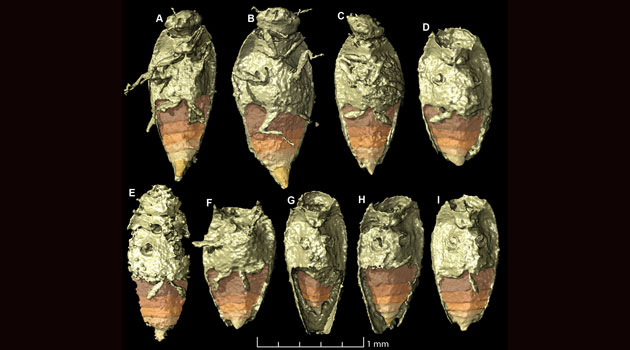
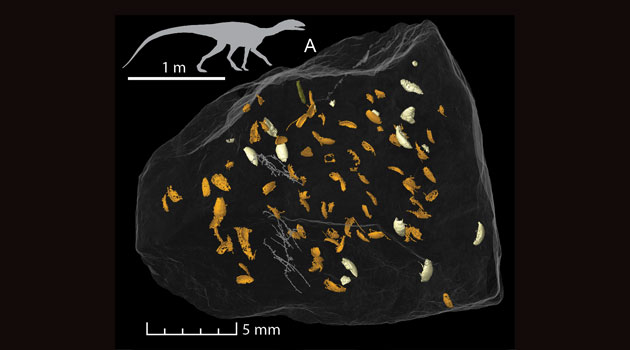
Images of the Triassic beetle Triamyxa coprolithica
Images of the newly described Triassic beetle Triamyxa coprolithica, the first insect to be named and described from a coprolite. Picture credit: Qvarnström et al.

Published in Current Biology

The researchers from Uppsala University (Sweden), in collaboration with entomologists from Sun Yat-sen National University (Taiwan), Jena University (Germany) and Guadalajara University in Mexico used synchrotron microtomography to examine the coprolite’s contents and sophisticated computer software to rebuild the tiny insects so that they could be studied. The coprolite contained numerous insect remains preserved in three-dimensions. Most insect fossils are squashed so flat that deciphering them is extremely difficult.

The researchers conclude that coprolites may prove to be an important source of information for exploring insect evolution. Their paper is published this week in “Current Biology”.

Using synchrotron microtomography, the beetle fossil was virtually reconstructed while still remaining in the coprolite. Picture credit: Qvarnström et al

Silesaurus opolensis

Although the scientists cannot be certain, they speculate that the coprolite represents the scat from a relative of the dinosaurs called Silesaurus opolensis, which is known from the same Polish deposits associated with the coprolite. An animal (probably S. opolensis), swallowed a large number of these tiny insects 230 million years ago, the greedy reptile inadvertently giving palaeontologists a rare opportunity to study a beetle, at a time (the Triassic), when many different types of insect were evolving and diversifying.

Phylogenetic analysis suggests that T. coprolithica is a member of Myxophaga (fungal beetles), a small suborder of beetles with a sparse fossil record whose extant representatives are small and often associated with wet environments.

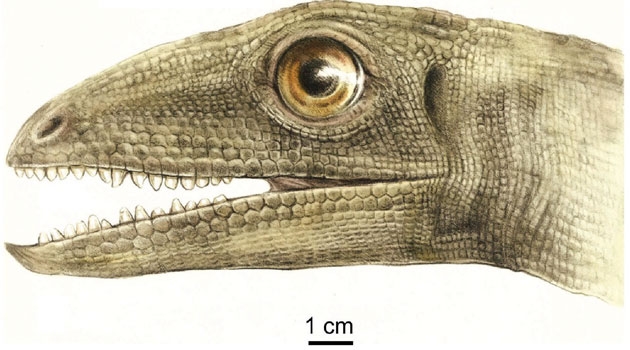
An illustration of the Triassic dinosauriform Silesaurus.
An illustration of the Triassic dinosauriform Silesaurus opolensis, the coprolite has been putatively assigned to this reptile. Picture credit: Małgorzata Czaja

Complete Specimens Preserved

Some of the beetles were almost complete with even their antennae and thin legs intact and attached to the body.

Commenting on the significance of this research, lead author of the scientific paper, Martin Qvarnström, (Uppsala University), remarked:

“We were very positively surprised by how many beetle remains there were in the coprolite and above all how well preserved they were. We really have to thank Silesaurus, who was probably the animal that helped us collect and preserve the beetles”.

The labrador-sized Silesaurus did not usually dine on such small insects, it probably was a generalist eating a wide variety of prey. It had a beak that was possibly used to bite insects just like today’s living dinosaurs – the birds. Despite the fact that Silesaurus ingested lots of individuals of Triamyxa coprolithica, these small beetles probably did not constitute its main food. Triamyxa lived in the same environments as larger insects and it was these insects as well as small vertebrates that probably made up the majority of the diet of this fast running, agile reptile.

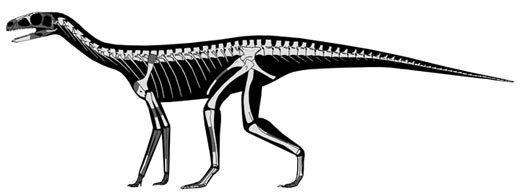
Silesaurus body plan
A skeletal reconstruction of the Late Triassic dinosauriform Silesaurus.

The beetle fossils are reminiscent of other beetle remains associated with amber. Both coprolites and amber are capable of preserving insects in three-dimensions and this study suggests coprolites can be extremely valuable for studying early insect evolution and extinct animal food chains at the same time.

The scientific paper: “Exceptionally preserved beetles in a Triassic coprolite of putative dinosauriform origin” by
Martin Qvarnström, Martin Fikáček, Joel Vikberg Wernström, Emmanuel Arriaga-Varela, Per E. Ahlberg and Grzegorz Niedźwiedzki published in Current Biology.

Visit the Everything Dinosaur website: Dinosaur Toys and Models.

1 07, 2021

The Amazing Titus the T. rex Roars into View

By |2024-05-27T13:32:38+01:00July 1st, 2021|Categories: Adobe CS5, Dinosaur Fans, Everything Dinosaur News and Updates, Main Page, Photos/Pictures of Fossils, Press Releases|0 Comments

Team members from Everything Dinosaur were lucky enough to get a preview of the new “Titus T. rex is King” exhibition at Wollaton Hall (Nottinghamshire), the first time that actual Tyrannosaurus rex fossils have been exhibited in England for more than a century.

Titus the T.rex exhibit
The spectacular Titus the T. rex exhibit at Wollaton Hall.  Picture credit: Everything Dinosaur.

Picture credit: Everything Dinosaur

The exhibition entitled “Titus: T. rex is King” opens on Sunday 4th July 2021 and will run until August 2022, giving visitors the opportunity to view a real Tyrannosaurus rex specimen, the actual fossilised bones and teeth of arguably, the most famous dinosaur of all.

Titus the T. rex Exhibition

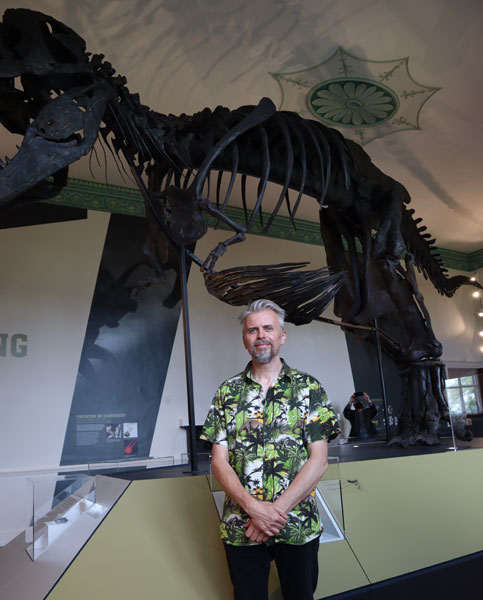
The stunning T. rex mount has been created by talented conservator Nigel Larkin who has over 30 years’ experience of conservation and curation. His expertise in skeletal reconstruction enabled this Late Cretaceous apex predator to be exhibited, the actual fossil bones of a T. rex combined with casts from a second specimen and then skilfully painted and mounted to provide a stunning display.

Nigel Larkin next to the Titus T. rex specimen
Conservator Nigel Larkin who was tasked with creating the Titus the T. rex specimen combining the actual T. rex fossil bones with casts from “Stan” the T. rex specimen STAN-BHI3033.  Picture credit: Everything Dinosaur.

Picture credit: Everything Dinosaur

A Titan from the Hell Creek Formation

This T. rex specimen comes from Montana (Hell Creek Formation). In September 2014 palaeontologist Craig Pfister found a handful of fragmentary T. rex bones. Working in the extremely harsh conditions of the “Badlands”, Craig was able to recover around 20% of the skeleton of a Tyrannosaurus rex. Skilled conservator Nigel Larkin was given the task of combining these real fossil bones with casts from another similar sized T. rex specimen to create this spectacular display which is over 12 metres in length.

When entering the room in which this dinosaur is exhibited, visitors immediately get a sense of just how big and powerful this dinosaur was. The jaws of this huge predator loom over you as if you are about to become a snack for this formidable monster. Nigel Larkin was able to utilise his three decades of experience of working with dinosaur fossils to design and build the metal armature that enables Titus to be shown in such a dynamic pose.

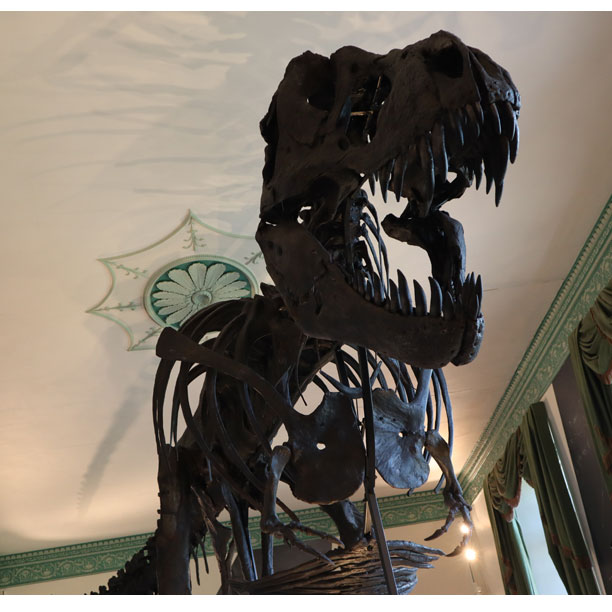
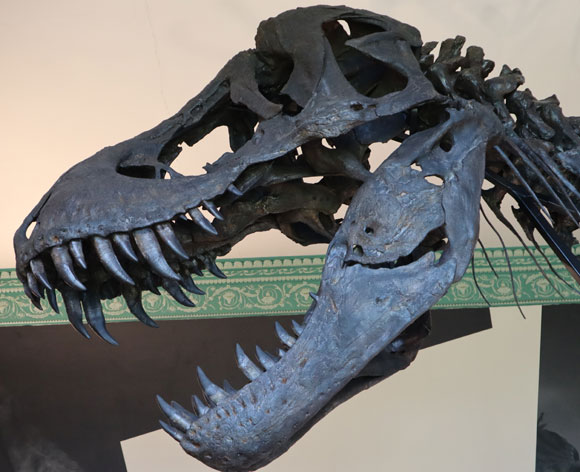
Titus the T. rex Skull and Jaws
The skull of the T. rex exhibit on display at Wollaton Hall until August 2022.  Picture credit: Everything Dinosaur.

Picture credit: Everything Dinosaur

Interactive Virtual Media Displays

Visitors will have the opportunity to explore the life and habitat of Tyrannosaurus rex using digital and interactive virtual media displays that tell the tale of the dinosaur’s discovery, the excavation work, the painstaking and time-consuming process of piecing together the life story of an enormous predator.

Team members at Everything Dinosaur were fortunate to meet Simon Wallett of Hot Knife Digital Media, who was responsible for creating the interactive digital displays. Those lucky enough to get tickets for the exhibition will be able to excavate key bones from the dig site, identify where they fit on the skeleton and to discover some of the secrets that the bones reveal. In addition, visitors will be able to reconstruct their own Tyrannosaurus rex decide whether to add feathers or scales and to transport their digital creation back to a Cretaceous landscape.

Remarkably, all the displays designed by Hot Knife Digital Media operate without the need to be touched. Clever software interprets the movements of your fingers enabling you to try your hand at palaeontology without the need to touch anything. A very smart solution, permitting participation at an event where COVID-19 safety precautions are meticulously complied with.

Simon Wallett of Hot Knife Digital Media.
Simon Wallett of Hot Knife Digital Media demonstrates one of the clever interactive displays. The innovative design of these machines enables visitors to operate them without the need to actually touch them. It’s a tactile, immersive experience without the need to touch!  Picture credit: Everything Dinosaur.

Picture credit: Everything Dinosaur

Telling the Tale of a Tyrant

Prominent and informative display panels help visitors to understand what these fossilised bones of T. rex have revealed. They help to tell the tale of a tyrant that had a tough life. For example, disease identified in a toe bone represents the first time this specific pathology has been found in a dinosaur.

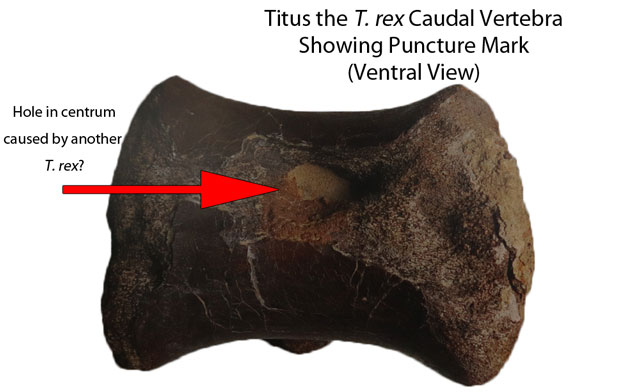
A deep puncture in the underside of a bone in the tail, suggests that Titus battled other tyrannosaurs. The wound in the tail shows signs of healing, so this traumatic injury is unlikely to have been the cause of this titan’s ultimate demise.

Damaged tail bone of a T. rex
The single tail bone of the T. rex showing the deep puncture mark which was probably inflicted during intraspecific combat (a fight with another T. rex).

Sue Judd from Everything Dinosaur commented:

“Visitors to the Titus T. rex is King exhibition will be able to view real Tyrannosaurus rex fossils, the first time in more than a century fossils like these have been on display in England. We are sure this magnificent dinosaur will feel very much at home at the majestic Wollaton Hall. This wonderful building surrounded by fantastic parkland houses an amazing natural history collection – a fitting home for the king of the tyrant lizards.”

Visit the Everything Dinosaur website: Dinosaur Toys and Prehistoric Animal Models.

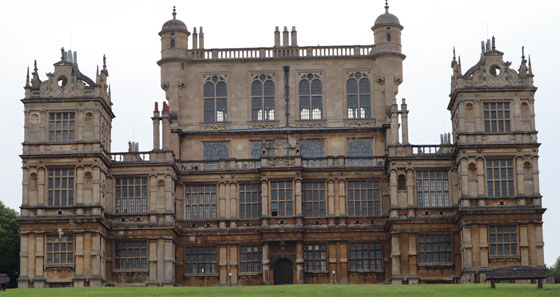
Wollaton Hall in Nottinghamshire
The majestic Wollaton Hall, home to real T. rex fossils until August 2022.  Picture credit: Everything Dinosaur.

Picture credit: Everything Dinosaur

Please note, this exhibition has now closed.

27 06, 2021

“Dragon Man” from North-eastern China

By |2024-05-27T09:14:24+01:00June 27th, 2021|Categories: Dinosaur and Prehistoric Animal Drawings, Dinosaur and Prehistoric Animal News Stories, Main Page, Palaeontological articles, Photos/Pictures of Fossils|1 Comment

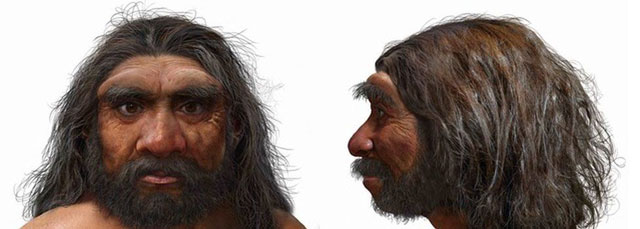
No sooner have we praised the remarkable artist Zhao Chuang for his work illustrating the mammaliamorph biota associated with Early Cretaceous China, then he produces another stunning piece of palaeoart – this time illustrating the newly described “Dragon Man” or to give the proposed formal scientific name Homo longi.

Dragon Man life reconstruction.
A life reconstruction of “Dragon Man”. Picture credit: Zhao Chuang.

A Completely New Species of Human

Researchers including Professor Chris Stringer from the London Natural History Museum have published a paper in the journal “Innovation” that describes and dates a remarkable and very complete fossil skull from Heilongjiang Province. The team have concluded that the ancient skull believed to be at least 146,000 years old represents a completely new species of human. They postulate that the skull could be from our closest evolutionary relative among known species of hominin such as Homo erectus and Homo neanderthalensis.

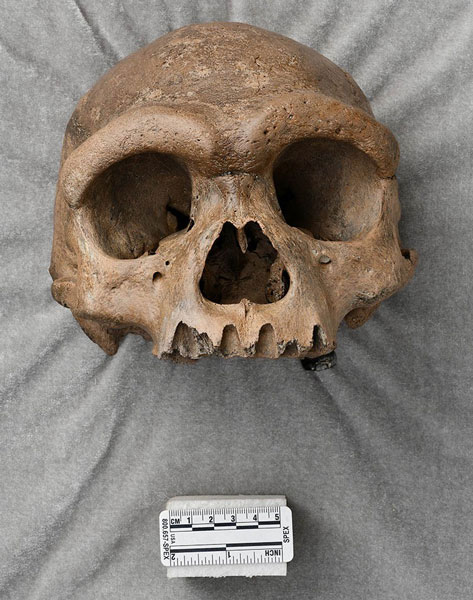
Harbin hominin skull.
The skull of the archaic hominin from the Harbin region of China. It could represent a new species of human. Picture credit: Chinese Academy of Sciences.

“Dragon Man”

The skull was reportedly discovered in 1933 by a construction worker helping to build a bridge over the Songhua river running through the city of Harbin. The river means “Black Dragon River” in the local language which explains why this skull representing a male was nicknamed “Dragon Man”.

The province was occupied by imperial Japanese forces at the time, so the construction worker hid the skull at the bottom of his family’s well to prevent it falling into the hands of the Japanese. According to media reports he only told relatives about the fossil find shortly before his death. The specimen was handed over to scientists so that a full examination of this extraordinary fossil could be carried out.

Where the fossil was found remains a mystery, but geochemical analysis suggests it came from lakebed sediments (lacustrine sediments). The research which involved non-destructive X-ray fluorescence, the analysis of rare earth elements and strontium isotope degradation, placed the date of this fossil between 138 to 309 thousand years old.

Uranium isotope analysis indicated that the fossil was at least 146,000 years old.

The face of "Dragon Man"
Views of the face of “Dragon Man”. Picture credit: Kai Geng

Commenting on the significance of this discovery, Professor Chris Stringer stated:

“The skull has a large brain capacity, fully within the range of modern humans and Neanderthals. It also shows features resembling our species, including flat and low cheekbones with a shallow canine fossa, and the face looks reduced and tucked under the braincase. It’s widely believed that the Neanderthals form the sister group of the Homo sapiens lineage. But our analyses suggest that this skull, and some other Middle Pleistocene human fossils from China, form a third East Asian lineage, which is actually closer to sapiens than the Neanderthals are”.

Is “Dragon Man” a Denisovan?

Other researchers have suggested that the skull might represent an example of the ancient human known as a Denisovan. Where “Dragon Man” fits on the human family tree remains uncertain, but it is true that the evolution of hominins during the Pleistocene Epoch has yet to be fully explained. There may have been a number of human lineages inhabiting our planet and the exact taxonomic relationships between them will continue to attract controversy and lively debate.

The scientific paper: “Geochemical provenancing and direct dating of the Harbin archaic human cranium” by Qinqfeng Shao, Junyi Ge, Qiang Ji, Rainer Grün and Chris Stringer published in the journal Innovation.

For the article featuring the mammaliamorph illustration by Zhao Chuang: The Jehol Biota and a Wonderful Illustration.

The artist Zhao Chuang is associated with the remarkable PNSO range of prehistoric animal figures.

To view the PNSO prehistoric animal model range: PNSO Scientific Art Figures.

26 06, 2021

Tickets Snapped Up at Special T. rex Premiere

By |2024-05-27T09:10:52+01:00June 26th, 2021|Categories: Dinosaur and Prehistoric Animal News Stories, Dinosaur Fans, Main Page, Photos/Pictures of Fossils|4 Comments

Excitement is mounting as we approach the start of the “Titus: T. rex is King” exhibition at Wollaton Hall Natural History Museum in Nottingham which officially opens to the public on Sunday 4th July (2021). Tickets for the Exclusive Premiere Event are also being snapped up as dinosaur fans grab the chance to be the first people to see a real Tyrannosaurus rex fossil skeleton in England for 100 years.  This is going to be a special T. rex premiere.

Titus the T. rex bones from the jaw.
The fearsome upper jaws (premaxilla and maxilla) of the T. rex known as Titus going on display at Wollaton Hall Natural History Museum in Nottingham.

Tickets for Exclusive Premiere Selling Fast

Organisers have revealed that the T. rex has safely arrived in Nottingham and this precious cargo is currently being unpacked and made ready for the grand opening of the exhibition. The organisers have also revealed that a third of the tickets for the Exclusive Premiere Event to be held on Saturday 3rd July have already gone.

Just 100 tickets were available for this unique event on Saturday 3rd July, the day before the exhibition officially opens to the public. For those eager to claim that they were the very first to meet Titus, they are being urged to purchase tickets now via the Wollaton Hall website, before, just like a T. rex they are gone forever!

To find out more about ticket sales including the Exclusive Premiere Event: Wollaton Hall Website.

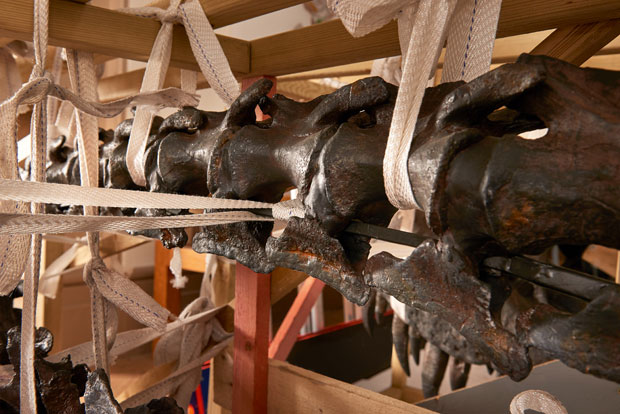
The tail bones of Titus the T. rex.
The articulated caudal vertebrae of Titus the T. rex ready to be unpacked for display.

T. rex Proving to be an Irresistible Attraction

Ever since tickets went on general sale, the chance to view a real Tyrannosaurus rex skeleton and to visit this exciting exhibition has proved irresistible. Interest in “Titus: T. rex is King” has been so high that virtually all the weekend tickets for the whole of July have gone already.

In response to the huge demand the organisers decided to launch the special one-off premiere event on Saturday 3rd July to mark the century since a real T. rex was last exhibited in the country.

The exhibition will officially open its doors to the general public on Sunday 4th July at Wollaton Hall Natural History Museum – an appropriate date, revealing an iconic North American dinosaur on U.S. Independence Day!

Visitors will be able to get up close to the skeleton Titus and enjoy an immersive experience of digital and interactive media displays that takes them from his discovery in the Montana Badlands in the USA, through the journey of excavation and curation.

The ticket price of £53 (inc. booking fee) includes a conversation with renowned palaeontologist Dr. David Hone and an exhibition Goody Bag of Titus merchandise worth over £30.

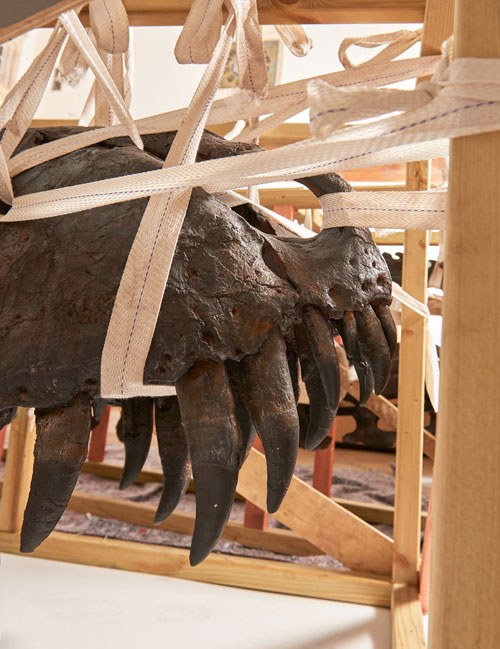
The famous clawed hand of a T. rex
Unpacking the famous limbs of the Tyrannosaurus rex exhibit (Titus the T. rex).

Palaeontologist Dr David Hone, Senior Lecturer in Zoology at the University of London has played a key role in the story of Titus and has helped set up the Exclusive Premiere Event. Dr Hone will be the host for the premiere event, taking guests on a “A Walk with Titus”. What a fantastic opportunity to learn from the UK’s top expert about the biology and behaviour of the most famous of all the dinosaurs.

Event Details

To comply with Covid-19 regulations in place, arrival times will be staggered with 11.00a.m., 12.00p.m. and 1.00p.m. slots available to purchase. Visitors will be required to wear face masks throughout, unless exempt.

Details

Titus: T. rex is King Premiere Event
Saturday July 3rd, 11.00a.m., 12.00p.m. and 1.00p.m.
Ticket Price is £50.00 (plus £3.00 booking fee), to include a specialist talk by Dr David Hone and exhibition Goody Bag of merchandise to the value of £30.00.

Please note this exhibition has now closed.

Visit the Everything Dinosaur website: Everything Dinosaur.
25 06, 2021

New Type of Ancient Human Unearthed in Israel

By |2024-05-27T09:08:45+01:00June 25th, 2021|Categories: Dinosaur and Prehistoric Animal News Stories, Main Page, Palaeontological articles, Photos/Pictures of Fossils|0 Comments

A scientific paper has been published this week in the journal “Science” that suggests that interactions between different species of human during the Middle and Late Pleistocene Epoch were much more complex than previously thought.

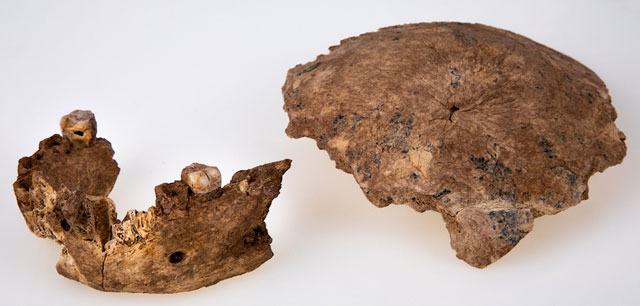
Researchers working in Israel have identified a previously unknown type of ancient human that lived alongside our own species (H. sapiens) more than 100,000 years ago. The remains consisting of a fragment from the top of the skull (parietal bones), the mandible and a lower second molar tooth discovered near the city of Ramla in the Central District of Israel, have been dated to around 140,000 – 120,000 years ago and these fossils represent one of the very last members of an ancient human group that may have been the ancestors of the Neanderthals.

Nesher Ramla hominin.
The skull fragment (right) and the jawbone complete with some teeth (left). Picture credit: Avi Levin and Ilan Theiler, Sackler Faculty of Medicine.

Human Remains Found Amongst Stone Tools and Other Fossil Bones

Yossi Zaidner from the Institute of Archaeology at the Hebrew University of Jerusalem found the fossils during excavations to salvage Middle Pleistocene material and fossils that had been uncovered during construction work. Thousands of fossil bones depicting a rich and varied fauna including aurochs, horses and deer were also recovered. Stone tools were also found, analysis of these tools suggest they were constructed in the same manner that modern humans of the time also made their implements.

The researchers made virtual reconstructions of the fossils to permit their analysis using sophisticated computer software and to compare them with other hominin fossils from Europe, Asia and Africa. The results suggest that the Nesher Ramla hominin fossils represent late survivors of a population of humans who lived in the Middle East during the Middle Pleistocene period.

Rolf Quam, one of the co-authors of the scientific paper commented:

“The oldest fossils that show Neanderthal features are found in Western Europe, so researchers generally believe the Neanderthals originated there. However, migrations of different species from the Middle East into Europe may have provided genetic contributions to the Neanderthal gene pool during the course of their evolution.”

Everything Dinosaur acknowledges the assistance of a press release from Binghamton University State University of New York in the compilation of this article.

The study, “A Middle Pleistocene Homo from Nesher Ramla, Israel,” was published in Science, along with a companion paper discussing the culture, way of life and behaviour of the Nesher Ramla hominin.

The Everything Dinosaur website: Prehistoric Animal Models and Figures.

21 06, 2021

Researchers Find The Last Record of Dinosaurs in Britain

By |2024-05-27T08:56:19+01:00June 21st, 2021|Categories: Adobe CS5, Dinosaur and Prehistoric Animal News Stories, Dinosaur Fans, Geology, Main Page, Palaeontological articles, Photos/Pictures of Fossils|0 Comments

Researchers writing in the Proceedings of the Geologists’ Association have reported tracks from at least six different species of dinosaur found in Lower Cretaceous rocks at Folkestone in Kent. The tracks and trackways from the Lower Greensand Group date to around 112-110 million years ago (Albian faunal stage of the Cretaceous). As such, these rare trace fossils represent evidence of the last known dinosaurs to walk on the UK landmass.

An artist's interpretation of the Folkestone dinosaur tracks.
An artist’s interpretation of the Folkestone dinosaur tracks. In the foreground a solitary ankylosaurid wanders up the beach passing a small herd of iguanodonts. In the background three titanosaurs are spooked by an approaching theropod. Picture credit: Megan Jacobs.

Evidence of Dinosaurs in Britain

The footprints were discovered in the cliffs and on the foreshore in Folkestone, Kent (southern England). Storms affect the cliffs and wash away sediments occasionally exposing fossils and in very rare cases, evidence of dinosaurs. Isolated vertebrae thought to represent an armoured dinosaur had been found previously and there have been reports of dinosaur tracks being discovered, but the paper published in the Proceedings of the Geologists’ Association is the first, formal, scientific assessment of these remarkable trace fossils.

A Challenge to Find a Dinosaur Footprint

Philip Hadland, a curator at the Hastings Museum and Art Gallery, an expert on the fossils of Folkestone, found a dinosaur track, believed to represent an ornithopod on the 13th September 2017. After showing his find to Steve Friedrich, a local fossil hunter with decades of experience, Steve thought that he too might try his luck to see if he could spot one. Remarkably, within ten minutes Steve found a beautiful, three-toed print, most likely representing a theropod.

Ornithopod track from Folkestone (Kent)
A large ornithopod track found at Folkestone in Kent. The fossil footprint, probably representing an iguanodontid, was found by Philip Hadland on 13th September 2017. Picture credit: University of Portsmouth/PA Media.

Professor of Palaeobiology at the University of Portsmouth and co-author of the scientific paper, David Martill, commented:

“It is quite an extraordinary discovery because these dinosaurs would have been the last to roam in this country before becoming extinct.”

Folkestone theropod track
A single theropod track from Folkestone (Kent). The tridactyl print found by Steve Friedrich. Picture credit: University of Portsmouth/PA Media.

Many of these remarkable specimens are on display at the Folkestone Museum.

These trace fossils have forced palaeontologists to rethink the Early Cretaceous depositional environment of this part of the Kent coast. Dinosaur footprints, together with fossil wood and oysters in a matrix of well-rounded quartz grains indicates a coastal depositional environment of an extremely shallow depth, perhaps with short periods of exposure as dry land.

Everything Dinosaur Comments

A spokesperson from Everything Dinosaur commented that an exposed beach may have provided an easier route for dinosaurs to use to travel from one food source to another. It was probably more convenient for these large animals to navigate a sandy beach than to try moving through dense undergrowth that would have been found further inland. Some of the dinosaurs could have been beachcombing, it is possible that the theropods may have visited the beach looking for any corpses that may have been washed up by the tide.

One of the authors of the scientific paper, Philip Hadland, has produced a really helpful guide to fossil hunting in the Folkestone area. Entitled “Fossils of Folkestone, Kent” it is available from Siri Scientific Press here: Siri Scientific Press.

Fossil collecting guide to the Folkestone area.
Fossils of Folkestone, Kent by Philip Hadland. Picture credit: Everything Dinosaur.

Picture credit: Everything Dinosaur

To read Everything Dinosaur’s review of “Fossils of Folkestone, Kent”: Everything Dinosaur reviews “Fossils of Folkestone, Kent”.

The scientific paper: “The youngest dinosaur footprints from England and their palaeoenvironmental implications” by Philip T. Hadland, Steve Friedrich, Abdelouahed Lagnaoui and David M. Martill published in the Proceedings of the Geologists’ Association.

Visit the Everything Dinosaur website: Dinosaur Toys and Models.

18 06, 2021

New Species of Paraceratherium

By |2024-05-27T07:43:58+01:00June 18th, 2021|Categories: Adobe CS5, Dinosaur and Prehistoric Animal News Stories, Dinosaur Fans, Main Page, Palaeontological articles, Photos/Pictures of Fossils|0 Comments

The giant prehistoric rhino, Paraceratherium, is considered the largest land mammal that ever lived. It was mainly found in Asia, especially China, Kazakhstan, Mongolia and Pakistan. How these giant, hornless rhinos dispersed across Asia was unknown, but the discovery of fossils in Gansu Province, has led to the naming of a new Paraceratherium species (Paraceratherium linxiaense) and shed light on how these amazing herbivores evolved and dispersed across the Asian continent.

Paraceratherium linxiaense life reconstruction.
A life reconstruction of the newly described Paraceratherium linxiaense with several other mammal fauna from the Linxia Basin (Oligocene Epoch) illustrated. Picture credit: Chen Yu.

Providing Important Clues About Paraceratherium Dispersal

Writing in the academic journal “Communications Biology”, the researchers from the Chinese Academy of Sciences, the Hezheng Paleozoological Museum (Gansu Province), Henan University (Henan Province) and Harvard University describe fossils found near the village of Wangjiachuan (Gansu Province) in 2015 that enabled the establishment of a new species of Paraceratherium.

Analysis of the fossil material led the scientists to conclude that this new species was closely related to giant rhinos that once lived in Pakistan (Paraceratherium bugtiense), which suggests ancestral forms migrated across Central Asia.

The holotype (HMV 2006) of Paraceratherium linxiaense
The holotype (HMV 2006) of Paraceratherium linxiaense consisting of skull and jaw material. Picture credit: The Chinese Academy of Sciences.

The Remarkable Fauna of the Linxia Basin in the Late Oligocene

The fossil material which includes a skull and articulated mandible as well as the first cervical vertebra (atlas), as well as another neckbone and two thoracic vertebrae from a second individual were found in Late Oligocene deposits associated with the Jiaozigou Formation of Linxia Basin (Gansu Province), close to the north-eastern border of the Tibetan Plateau.

Around 26.5 million years ago, the open woodland environment of north-central China was home to a wide variety of prehistoric mammals including the giant rhinos Turpanotherium and Dzungariotherium, the rodent Tsaganomys, the creodont Megalopterodon, the chalicothere Schizotherium, the hyracodont Ardynia, the rhinocerotid Aprotodon, and the entelodont Paraentelodon – some of these animals are illustrated in the Paraceratherium linxiaense life reconstruction (above).

Standing taller than a giraffe and weighing approximately 20 tonnes, Paraceratherium linxiaense had a slender skull and a prehensile nose trunk similar to that of the modern tapir to help it to grab leaves and branches from the tops of trees, a food resource that no other animal in its environment could exploit.

Plotting the Distribution and Dispersal of Paraceratherium

A phylogenetic analysis carried out by the research team suggests P. linxiaense as a derived form with a mix of basal and more advanced traits. The phylogenetic analysis produced a series of progressively more-derived species from P. grangeri, through P. huangheense, P. asiaticum, and P. bugtiense before finally terminating in P. linxiaense and what is thought to be its sister taxon P. lepidum.

The research team conclude that Paraceratherium linxiaense was a more specialised animal, with a more flexible neck, similar to P. lepidum, and both are derived from Paraceratherium bugtiense known from Pakistan. They team were then able to plot and map the spread of these giant rhinos across Asia.

Mapping the Dispersal of Paraceratherium
Mapping and plotting the dispersal of Paraceratherium across Asia. Location of the early Oligocene species are marked by the yellow colour, and the red indicates the late Oligocene species. Picture credit: Institute of Vertebrate Paleontology and Paleoanthropology.

The researchers found that all six species of Paraceratherium are sister taxa to the hornless rhinoceros Aralotherium which is known from Kazakhstan and China and form a monophyletic clade in which P. grangeri is the most primitive, succeeded by P. huangheense and P. asiaticum.

The researchers were thus able to determine that, in the Early Oligocene, P. asiaticum dispersed westward to Kazakhstan and its descendant lineage expanded to South Asia as Paraceratherium bugtiense. In the Late Oligocene, Paraceratherium returned northward, crossing the Tibetan region, which implies that this area of Asia was not yet uplifted to form a high, difficult to traverse plateau. This migration led to two distinct species evolving P. lepidum to the west in Kazakhstan and P. linxiaense to the east in the Linxia Basin.

The ITOY Studio Paraceratherium.
A view of the eagerly anticipated ITOY Studio Paraceratherium model. A replica of the largest land mammal known to science.  Picture credit: Everything Dinosaur.

Picture credit: Everything Dinosaur

Contrasting the high altitude of the Tibetan region today to the environment of this region during the Late Oligocene Epoch, lead author of the research Professor Deng Tao explained that:

“Late Oligocene tropical conditions allowed the giant rhino to return northward to Central Asia, implying that the Tibetan region was still not uplifted as a high-elevation plateau.”

During the Oligocene, the giant rhino could disperse freely from the Mongolian Plateau to South Asia along the eastern coast of the Tethys Ocean and perhaps through Tibet. Up to the Late Oligocene, the evolution and migration from P. bugtiense to P. linxiaense and P. lepidum demonstrates that the “Tibetan Plateau” was not yet a barrier to the movement of the largest land mammal known to science.

The scientific paper: “An Oligocene giant rhino provides insights into Paraceratherium evolution” by Tao Deng, Xiaokang Lu, Shiqi Wang, Lawrence J. Flynn, Danhui Sun, Wen He and Shanqin Chen published in Communications Biology.

The Everything Dinosaur website: Preshistoric Animal Models and Figures.

9 06, 2021

Fossil Collecting on the East Dorset Coast

By |2024-05-26T21:32:58+01:00June 9th, 2021|Categories: Adobe CS5, Book Reviews, Dinosaur Fans, Geology, Main Page, Palaeontological articles, Photos/Pictures of Fossils|0 Comments

The third and final part of a series of guides to fossil hunting on the Dorset coast has been published by Siri Scientific Press. A guide to “Fossil Collecting on the East Dorset Coast” by Steve Snowball and Craig Chivers, provides an up to date and very informative guide to fossil collecting from the beautiful coast near Durdle Door eastwards ending at the Eocene-aged deposits to be found at Hengistbury Head.

The front cover of a Guide to Fossil Collecting on the East Dorset Coast
The front cover “A Guide to Fossil Collecting on the East Dorset Coast” by Steve Snowball and Craig Chivers published by Siri Scientific Press.  Picture credit: Everything Dinosaur.

Picture credit: Everything Dinosaur

A Highly Acclaimed Guidebook

“Fossil Collecting on the East Dorset Coast” is aimed at amateur as well as the more serious fossil hunter and it is required reading if you want to visit some of the more remote parts of the Dorset coast. Access to some of the locations can be tricky and the authors have ensured that plenty of useful information has been included such as advice about tide times, avoiding the dangers of rock falls (which can be frequent along this stretch of the coastline), along with details about accessing quarries and which ones require visitor permission.

This highly acclaimed guidebook is beautifully illustrated with lots of colour photographs not only showing fossil finds but also highlighting the stunning landscape and geology of this part of the southern coast of England.

Fossil collecting on the East Dorset Coast
The book is packed with beautiful photographs showing typical fossil finds at each location as well as stunning shots of the Dorset coast. Often typical fossil finds are shown against a backdrop of the magnificent scenery of this part of England’s southern coast.

Stunning Images of Fossils

The authors provide an introduction to the UNESCO World Heritage site known as the “Jurassic Coast” before outlining the Dorset fossil collecting code of conduct and focusing on the unique geology of east Dorset. The book is then sub-divided into different sections taking the reader on fossil hunting excursions starting at the majestic Bat’s Head and St. Oswald’s Bay in an easterly direction to Worbarrow Bay and Gad Cliff through to Peveril Point and Swanage. The final excursion visits the Studland Bay and the Hengistbury Head area. Each part of the book contains stunning images of the fossils associated with each location.

A block containing bones and scales of a fish (Lepidotes)
A block containing the fossilised remains of a prehistoric fish found on the east Dorset coast. Fossil found by Nicola Parslow. A “Guide to Fossil Collecting on the East Dorset Coast” contains full colour images highlighting fossils that can be found at the various locations.

Highlights include information and photographs showcasing the remarkable Etches Collection Museum of Jurassic Marine Life at Kimmeridge and the contribution made by Steve Etches, extensive information on the types of ammonites to be found and details on the different types of vertebrate fossils including trace fossils such as dinosaur footprints along with body fossils such as the bones from ancient crocodiles.

Crocodile vertebra found at Durlston Bay (Dorset)
A crocodile vertebra found on the east Dorset coast (Durlston Bay) found by Julian and Vicky Sawyer.

Highly Recommended

A spokesperson from Everything Dinosaur commented:

“This book has over 200 colour photographs and illustrations including wonderful prehistoric scenes created by the very talented Andreas Kurpisz, it is an extremely informative and invaluable guide to fossil hunting on this part of the beautiful Dorset coast. The detailed descriptions of the fossil locations provided by the authors are a testament to their in-depth knowledge and passion for their hobby. It completes the trilogy of books dedicated to fossil hunting on the Dorset Coast and it is essential reading for amateur fossil collectors, students as well as seasoned professionals. Highly recommended.”

Fossil Collecting on the Dorset Coast
Three excellent guides have been published about fossil hunting on the Dorset coast by Steve Snowball and Craig Chivers. All three publications are available from Siri Scientific Press whilst stocks last.  Picture credit: Everything Dinosaur.

Picture credit: Everything Dinosaur

To purchase the “Guide to Fossil Collecting on the East Dorset Coast” visit the website of the publisher Siri Scientific Press: Siri Scientific Press.

The Everything Dinosaur website: Everything Dinosaur.
Go to Top