All about dinosaurs, fossils and prehistoric animals by Everything Dinosaur team members.

Pictures of fossils, fossil hunting trips, fossil sites and photographs relating to fossil hunting and fossil finds.

7 06, 2021

Amazing Aussie Dinosaur “Cooper” Officially Named

By |2024-05-26T21:25:53+01:00June 7th, 2021|Categories: Dinosaur and Prehistoric Animal News Stories, Dinosaur Fans, Main Page, Palaeontological articles, Photos/Pictures of Fossils|0 Comments

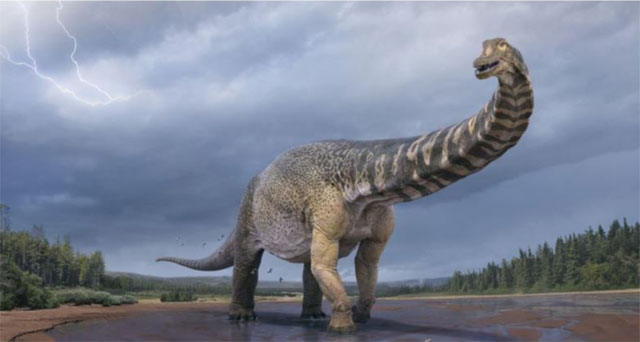
“Cooper” the giant Australian dinosaur, whose bones were found back in 2007 has been officially named. The largest animal ever to walk on the “land down under” has been named Australotitan (Australotitan cooperensis), this Cretaceous giant is estimated to have been around 30 metres in length, so Australotitan rivalled some of the giant South American titanosaurs, (to which it was distantly related), in size. Writing in the academic journal “PeerJ”, scientists describe this Australian titanosaur.

Australotitan cooperensis life reconstruction
A life reconstruction of the newly named Australotitan cooperensis, the largest known animal to have ever lived in Australia. Picture credit: Queensland Museum.

“Southern Titan”

Writing in the academic journal “PeerJ”, the researchers who include corresponding author Scott Hocknull of the Queensland Museum and Robyn and Scott Mackenzie from the Eromanga Natural History Museum (Queensland), used limb bone comparisons to estimate the size of Australotitan. A sophisticated computer programme provided detailed 3-D surface scans of the fossil bones to permit autapomorphies to be identified that led to the erection of this new taxon.

A Giant Australian Titanosaur

The huge dinosaur, with a shoulder height of around 6 metres was named “Southern Titan”, the trivial (species name), honours the site of the fossil discovery – the Cooper-Eromanga Basin, Cooper Creek system and the common vernacular for this part of south-western Queensland “Cooper Country”.

Back in 2015, Everything Dinosaur reported on the on-going research being conducted on this titanosaur when final preparations were being made for the opening of the Eromanga Natural History Museum which was being built to house this specimen along with other dinosaur and marine reptile remains that had been found in Queensland.

To read our article about “Cooper”: Super-Duper Dinosaur Nicknamed “Cooper”.

The Benefits of the 3-D Bone Scans

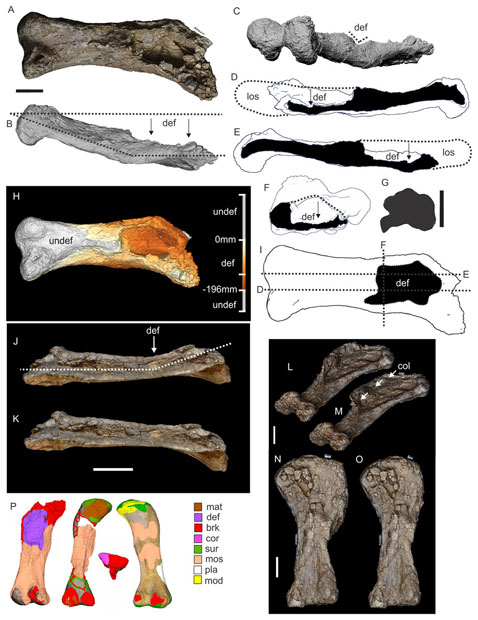
Several of the bones although almost complete show distortion. The bones of this particular titanosaur seem to have been trampled and partly crushed by the movements of another titanosaur that “walked over the grave” of Australotitan. The use of the 3-D bone scans permitted the researchers to correctly reconstruct bone morphology and a subsequent phylogenetic assessment revealed that A. cooperensis was related to three other, roughly contemporaneous sauropod taxa known from Queensland – Wintonotitan, Diamantinasaurus and Savannasaurus.

Examples of sauropod bone preservation and taphonomic alteration (A. cooperensis).
The right femur (specimen number EMF102) seems to have been trampled and crushed as another sauropod walked over it. Sophisticated 3-D scans were used to reconstruct the original shape of the bones and permit taxonomic study. Note scale bars = 20 cm. Picture credit: Hocknull et al

The scientific paper: “A new giant sauropod, Australotitan cooperensis gen. et sp. nov., from the mid-Cretaceous of Australia” by Scott A. Hocknull, Melville Wilkinson, Rochelle A. Lawrence, Vladislav Konstantinov, Stuart Mackenzie and Robyn Mackenzie published in PeerJ.

Visit the Everything Dinosaur website: Everything Dinosaur.

6 06, 2021

Studying Stegosaurs from the Arctic Circle

By |2024-05-26T21:24:43+01:00June 6th, 2021|Categories: Adobe CS5, Dinosaur and Prehistoric Animal News Stories, Dinosaur Fans, Main Page, Palaeontological articles, Photos/Pictures of Fossils|0 Comments

Earlier this spring, a team of researchers led by Pavel Skutschas (St Petersburg University, Russia), published a paper reporting on the study of 63 stegosaur teeth that had been found in Lower Cretaceous deposits in south-western Yakutia, located in eastern Siberia. Just like today, during the Early Cretaceous this part of Siberia was at a high latitude (palaeolatitude estimate of N 62°- 66.5°) and within the Arctic circle. The scientists conclude that these stegosaurs may have had some special adaptations to help them survive their harsh environment, such as a rapid tooth replacement rate to permit them to cope with a diet mainly consisting of conifer needles and branches.

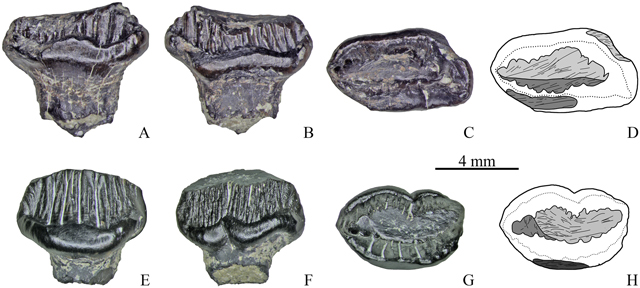
Examples of very worn stegosaur teeth from the Teete locality (Siberia).
Maxillary teeth with two (A-D), and with three wear facets (E-H) of Stegosauria indet. from the Teete locality, Yakutia, Russia; Batylykh Formation (Lower Cretaceous). Specimens ZIN PH 80/246 (A-D), ZIN PH 57/246 (E-H) in labial (A, E), lingual (B, F), occlusal (C, G) views, and interpretive drawings (D, H) in occlusal views showing the wear facets with scratches. Picture credit: Skutschas et al.

Stegosaurs Probably Present All Year

There has been much debate amongst palaeontologists as to whether large herbivorous dinosaurs such as stegosaurs were permanent residents of high latitude palaeoenvironments, or whether they migrated up to these latitudes in the summer to take advantage of the long periods of daylight. In the height of summer, there would have been around twenty-two hours of daylight at this latitude presumably providing very favourable conditions for plant growth.

The researchers, writing in the on-line, academic journal PLOS One report the discovery of smaller stegosaur teeth in the excavations, which took place in 2012 and then in the summer months from 2017-2019. As it is thought that the teeth represent a single species of stegosaur, this indicates that both adults and juveniles were present at this site.

Lead author Pavel Skutschas an Associate Professor in the Department of Vertebrate Zoology at St Petersburg University commented:

“We have found teeth of animals of different ages. This suggests that the polar stegosaurs are most likely to have been sedentary that they reproduced and raised offspring on the same territory all year round”.

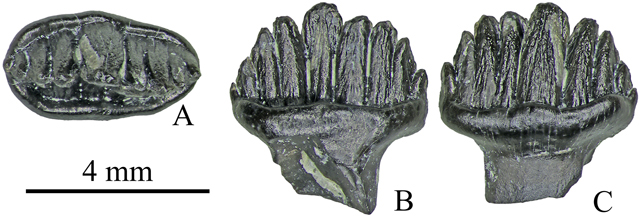
Small stegosaur tooth from the dentary.
Small, relatively unworn tooth of an indeterminate stegosaur from the Teete locality in (A) occlusal, (B) labial and (C) lingual views. This suggests that both adult and juvenile stegosaurs were present. Picture credit: Skutschas et al.

A Diverse Prehistoric Fauna

The researchers from St Petersburg University worked together with colleagues from the Zoological Institute of the Russian Academy of Sciences, the Borissiak Paleontological Institute of the Russian Academy of Sciences, the University of Bonn (Germany) and the Diamond and Precious Metal Geology Institute of the Siberian Branch of the Russian Academy of Sciences to examine, excavate and sieve material from the Batylykh Formation, Sangar Series (Lower Cretaceous, Berriasian–Barremian faunal stage) along the banks of the Teete River in Suntar Ulus, Yakutia, Eastern Siberia.

This location has yielded dinosaur fossils (including theropods as well as ornithischian dinosaurs), turtles, salamanders and early mammals.

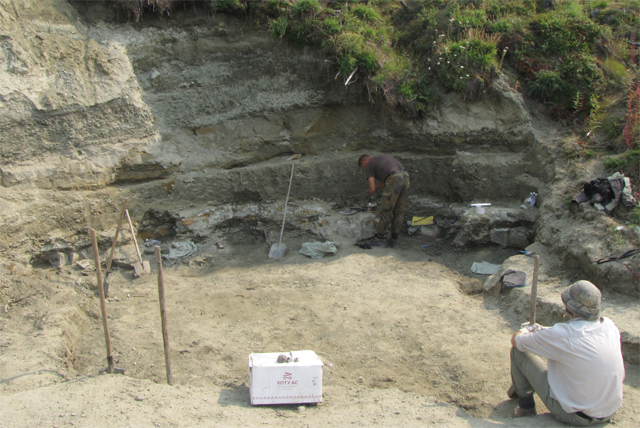
The stegosaur teeth excavation site
Researchers working at the excavation site. Picture credit: University of St Petersburg.

Stegosaurian remains are the most abundant and consist of numerous isolated teeth, vertebrae, ribs, pelvic elements and occasional cranial material. The stegosaur teeth were all retrieved by screen washing and sieving samples. Most exhibit a high degree of wear and indicate that these animals fed on very abrasive plant material. In addition, study of the tiny scratches on the teeth suggest tooth on tooth contact and precise dental occlusion in the Teete River stegosaurs.

Studying Stegosaurs

The microwear examined suggests that these animals had a more complex jaw movement to help them process food in their mouths, the tooth wear observed could not have occurred if these dinosaurs were only capable of moving their jaws up and down in a simple scissor-like action.

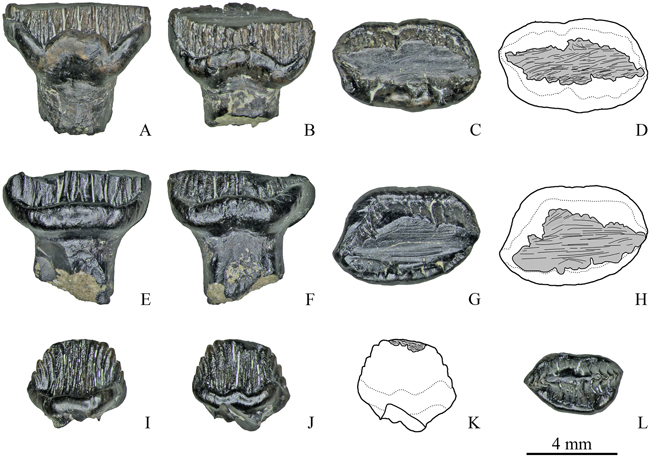
Examples of the very worn stegosaur teeth from the Teete locality
Maxillary teeth with a single apical facet of Stegosauria indet. from the Teete locality, Yakutia, Russia; Batylykh Formation (Lower Cretaceous). Specimens ZIN PH 7/246 (A–D), ZIN PH 11/246 (E–H), ZIN PH 20/246 (I–L), ZIN PH 6/246 (M–P) in labial (A, E, I, M), lingual (B, F, J, N), occlusal (C, G, K, P) views, and interpretive drawings in occlusal (D, H, L) and lingual (O) views showing the wear facets with scratches. Picture credit: Skutschas et al.

Rapid Tooth Replacement

Under the microscope, the researchers made another surprising discovery. The Teete stegosaurs are characterised by their relatively short tooth formation time. The teeth were rapidly replaced and the replacement teeth were formed in a relatively short time (95 days). This might have been an adaptation to the particularly abrasive diet of these herbivores which probably fed on conifers. Furthermore, the scientists identified the presence of a “wavy enamel pattern” on the teeth.

This type of enamel has also been found on the teeth of Psittacosaurus, a basal member of the horned dinosaurs (Ceratopsia) and within the Ornithopoda. The researchers conclude that this feature of teeth is a shared trait amongst bird-hipped dinosaurs. Whether it was present in the ancestor of the ornithischian dinosaurs or whether this histological feature is an example of convergent evolution in different types of plant-eating dinosaur is not known.

The scientific paper: “Wear patterns and dental functioning in an Early Cretaceous stegosaur from Yakutia, Eastern Russia” by Pavel P. Skutschas, Vera A. Gvozdkova, Alexander O. Averianov, Alexey V. Lopatin, Thomas Martin, Rico Schellhorn, Petr N. Kolosov, Valentina D. Markova, Veniamin V. Kolchanov, Dmitry V. Grigoriev, Ivan T. Kuzmin and Dmitry D. Vitenko published in PLOS One.

Visit the Everything Dinosaur website: Everything Dinosaur.

2 06, 2021

Reinterpreting the Burgess Shale Deposits

By |2024-05-26T21:18:03+01:00June 2nd, 2021|Categories: Dinosaur and Prehistoric Animal News Stories, Geology, Main Page, Palaeontological articles, Photos/Pictures of Fossils|1 Comment

New research suggests that the remarkable Burgess Shale deposits may not preserve the remains of a single, complex Cambrian marine ecosystem but the animals that were to become preserved as fossils may have been transported to this location from much further away.

A New Research Paper Focusing on the Burgess Shale Deposits

Researchers led by Dr Nicholas Minter and Dr Orla Bath Enright (University of Portsmouth), writing in the academic journal “Communications Earth & Environment” postulate that the amazing biota associated with the Walcott Quarry could have undergone substantial transport prior to deposition. They suggest that this aggregation of fossils of primitive marine creatures might not represent the remains of a single, rich and diverse ecosystem but the accumulated remains of several prehistoric communities.

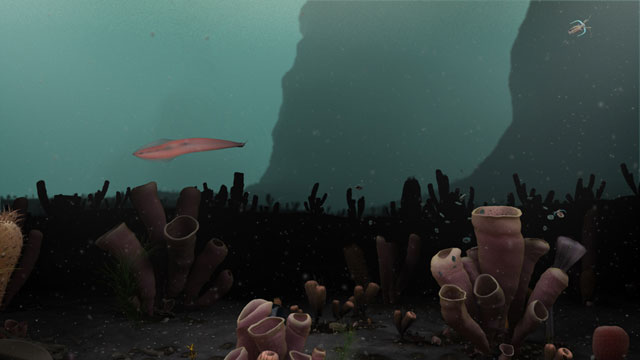
The Burgess Shale Marine community
The rich and diverse Cambrian biota associated with the Walcott Quarry (British Columbia). Picture credit: Phlesch Bubble/Royal Ontario Museum.

Ancient Lifeforms Moved by Mudflows

In late August 1909, American palaeontologist Charles Walcott was exploring an area of shale deposits exposed in the mountains of British Columbia close to Mount Burgess. He discovered a profusion of fossils in the shales, many of which had their soft parts preserved. The strata consist of fine mud which were laid down between 510 and 505 million years ago and the location, now known as Walcott Quarry, was declared a UNESCO World Heritage site in 1984.

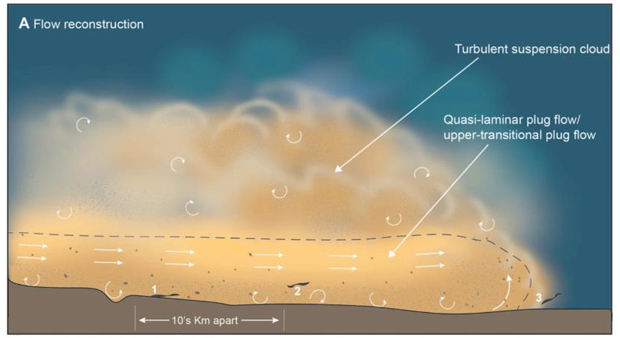
More than 65,000 fossil specimens have been collected representing more than 120 species. This fossil assemblage helped to support the theory of the “Cambrian explosion”, that towards the middle of the Cambrian there was a sudden burst of evolutionary activity leading to the evolution of the Phyla we have today. It had been thought that this Lagerstätte had been formed when catastrophic mudflows buried the ecosystem but the researchers, using flume experiments were able to demonstrate that the remains of delicate animals were capable of being transported tens of kilometres.

Mudflows Transporting Specimens Leading to the Burgess Shale Lagerstätte
The research team were able to plot the movement of delicate animal remains in mudflows and they concluded that they would not have deteriorated further despite significant transport. Picture credit: Orla Bath Enright et al.

Taphonomic Assessment and Analysis of the Burgess Shale Deposits

The researchers used a combination of measurements and assessments at the Walcott Quarry site with flume tank laboratory tests to mimic the mudflows and the deposition. They concluded that the delicate bodies of certain creatures could have been moved over tens of kilometres without damage, creating the illusion of this Lagerstätte representing a single prehistoric community.

Field work at the Walcott Quarry (Burgess Shale).
Field work being carried out at the Walcott Quarry located in the Burgess Shale of British Columbia. Picture credit: Orla Bath Enright.

The Deterioration of the Remains of Polychaete Worms

The University of Portsmouth was assisted in this research by scientists from University of Saskatchewan and Southampton University. They looked at one particular species of polychaete worm (Alitta virens) present in the shales, classified the degree of preservation for fossil specimens from entire/complete to degraded with just jaws and setae (bristle-like structures) left. They concluded that transport of the carcasses of these delicate animals did not significantly damage the remains further beyond what has already occurred due to normal decay processes.

Increasing states of polychaete degradation (Alitta virens)
Increasing states of polychaete degradation (Alitta virens). The researchers examined the fossilised remains of one species of polychaete worm and grouped the remains into categories related to the pristine state of the fossil material. It was concluded that the remains of soft-bodied, delicate animals could have been transported considerable distances and thus the Burgess Shale Lagerstätte might represent the preserved remains of more than one marine community. Picture credit: Orla Bath Enright et al.

Commenting on the implications this study might have Dr Bath Enright stated:

“We don’t know over what kind of overall time frame these many flows happened, but we know each one produced an ‘event bed’ that we see today stacked up on top of one another. These flows could pick up animals from multiple places as they moved across the seafloor and then dropped them all together in one place”.

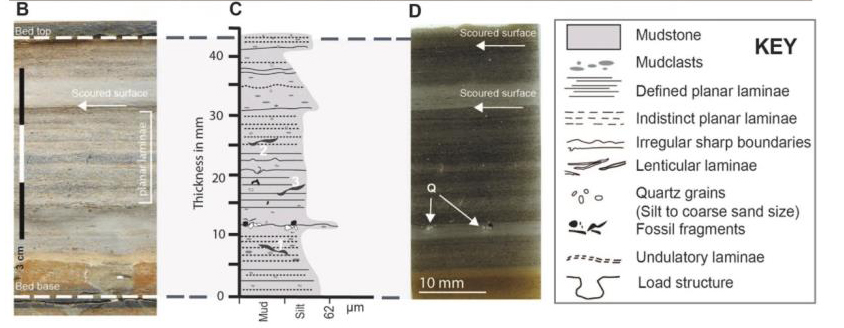
Stratigraphy and interpretative line drawings from sediments associated with the Walcott Quarry
Stratigraphy and interpretative line drawings from sediments associated with the Walcott Quarry. The image (B) shows Bed A from the Greater Phyllopod Bed of the Walcott Quarry, whilst (C) shows a line drawing of the sedimentation of Bed A. Soft-bodied organisms (1, 2, and 3) from the proposed mud flows will become mixed in the deposit. Picture (D) shows a thin-section scan from Bed A showing parallel laminae, erosive, scoured bases, and “floating” quartz grains (Q). White arrows indicate transitional cohesive flow deposits. Picture credit: Orla Bath Enright et al.

A Cautionary Note

This research indicates that the transportation of the remains of soft-bodied creatures does not unduly affect their degradation. Fossils found in a single layer of sediment and assumed to represent animals living together in a single ecosystem, could actually represent the accumulation of remains that have been gathered together and that these animals may have lived far apart. The study provides a cautionary note on how palaeontologists develop views on ancient ecosystems based on the fossilised remains of the creatures they study.

Intriguingly, for what appears to be such a rich and specious community, dominated by benthic organisms (living on the seafloor), there is very little evidence of trackways, burrows or bioturbation associated with this famous fossil site. The lack of these trace fossils suggests a predominantly low oxygen or anoxic habitat and this lends weight to the idea that the sediments in which the fossils were found do not represent the habitat of these creatures.

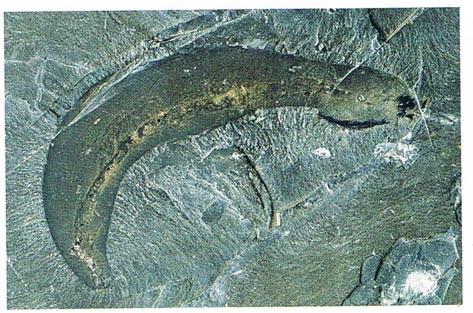
An Ottoia fossil from the famous Burgess Shale.
An Ottoia fossil (Burgess Shale). Many different types of worm are associated with the Burgess Shale deposits but very few trace fossils such as burrows have been preserved. This lends weight to the idea that the remains of these animals were transported to the site from elsewhere.

What Caused the Mudflows?

It is not known precisely what caused the mudflows which buried and transported the animals which became fossilised, but the area was subject to multiple flows, causing well-preserved fossils to be found at numerous different levels in the shale.

Dr Bath Enright added:

“When we see multiple species accumulated together it can give the illusion we are seeing a single community. But we argue that an individual ‘event bed’ could be the product of several communities of animals being picked up from multiple places by a mudflow and then deposited together to give what looks like a much more complicated single community of animals”.

The scientific paper: “Flume experiments reveal flows in the Burgess Shale can sample and transport organisms across substantial distances” by Orla G. Bath Enright, Nicholas J. Minter, Esther J. Sumner, M. Gabriela Mángano and Luis A. Buatois published in Communications Earth & Environment.

The Everything Dinosaur website: Prehistoric Animal Models.

31 05, 2021

Exciting Jurassic June Approaches

By |2024-05-26T11:21:58+01:00May 31st, 2021|Categories: Dinosaur Fans, Everything Dinosaur News and Updates, Main Page, Photos/Pictures of Fossils|0 Comments

Tomorrow, June 1st, marks the official start of summer in the UK. The weather for a change is behaving itself and #JurassicJune is trending on social media. Everything Dinosaur is expecting stock of Beasts of the Mesozoic Wave 1 ceratopsians and more Beasts of the Mesozoic “raptors” to be delivered to their warehouse along with more Rebor figures and possibly some new PNSO models too.

It is going to be a busy few weeks for team members, but perhaps there will be a little time to plan some fossil collecting expeditions. COVID-19 restrictions in England could be revised with some restrictions being lifted in June. This could permit group fossil hunting trips.

Fossil hunting at Monmouth Beach
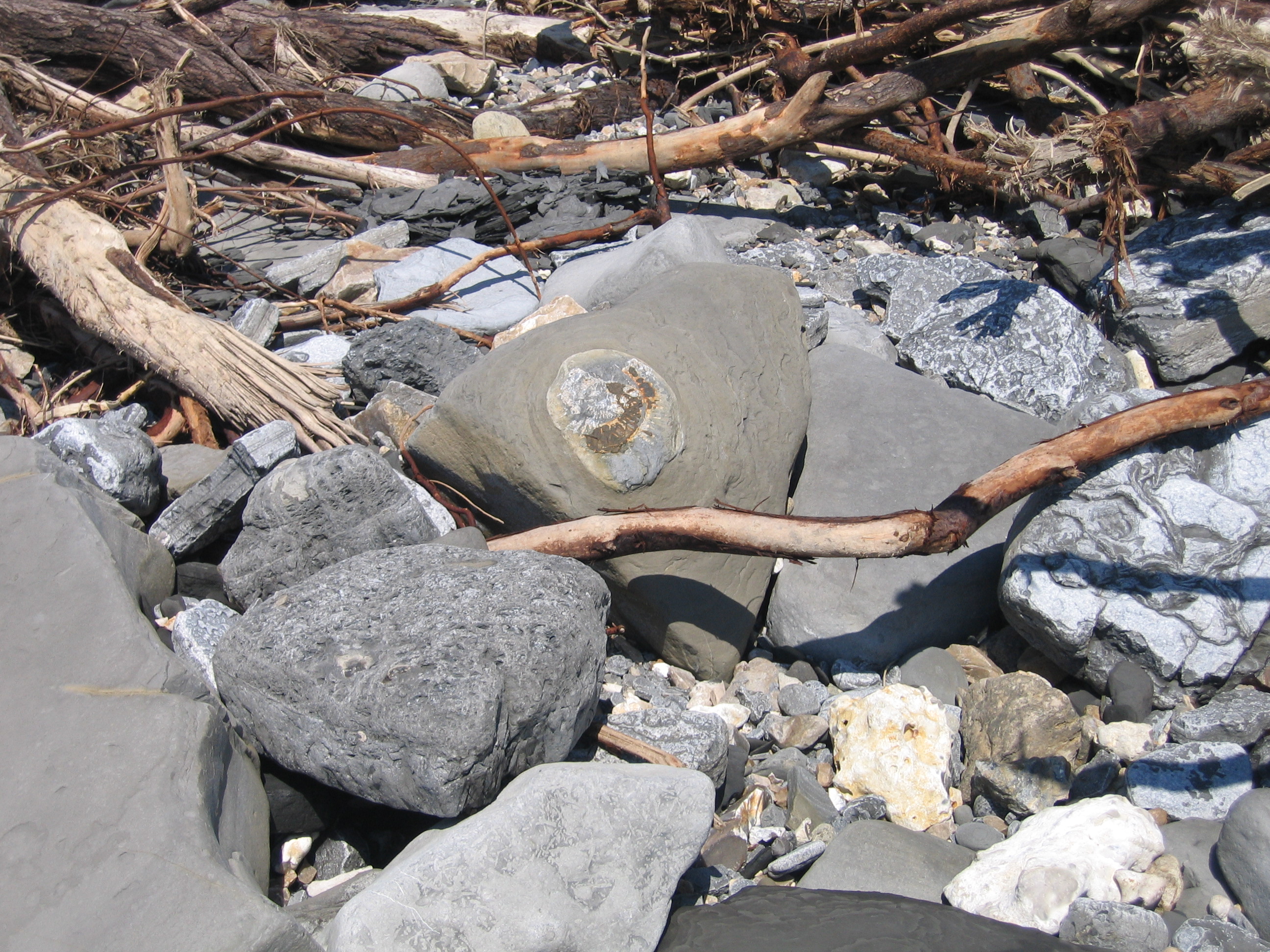
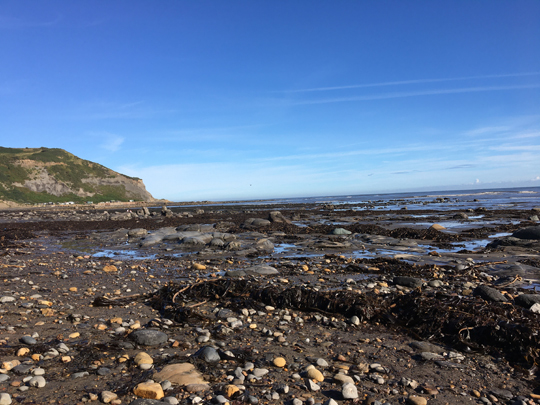
Will you find a fossil at Lyme Regis? The warmer weather and the possibility of COVID-19 restrictions being lifted in England could permit lots of fossil hunting trips including fossil hunting on the famous “Jurassic Coast” of southern England. The photograph was taken at Monmouth Beach which lies to the west of the Dorset town of Lyme Regis.  Picture credit: Everything Dinosaur.

Picture credit: Everything Dinosaur

Fossil Hunting Trips – Some Safety Tips

If you are planning to visit the coast and to do some fossil hunting, here are some safety tips:

  • Always stay away from the cliffs, rock falls can be common.
  • Do not climb on the cliffs or any recent landslips/mudflows.
  • Tell a responsible person where you are going and when you will return.
  • Have a mobile phone handy in case of emergencies.
  • Beware of the threat of landslides, especially after the recent heavy rain.
  • Note the tide times particularly high tide and take the advice of the local coastguard etc.
  • Aim to collect fossils on a falling tide, be aware of the incoming tide especially around headlands where you could easily get cut off and stranded.
  • In rough weather, be aware of strong winds and high waves and the fact that the footing underneath might be slippery.
  • Wear suitable clothing and shoes, sunscreen might prove very sensible too.
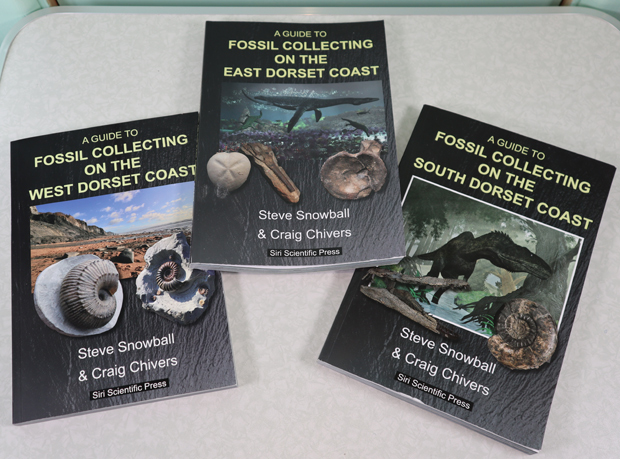
Fossil Collecting on the Dorset Coast
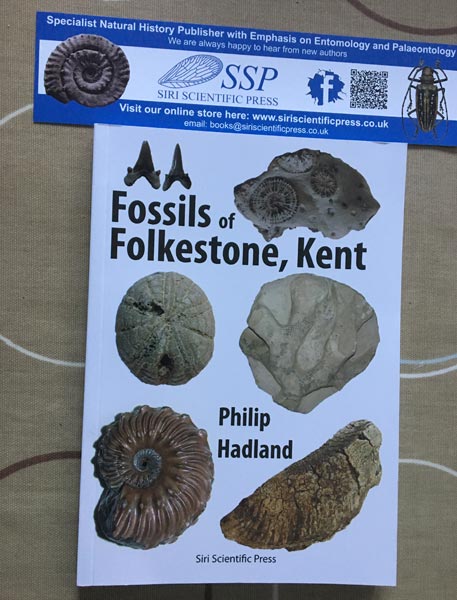
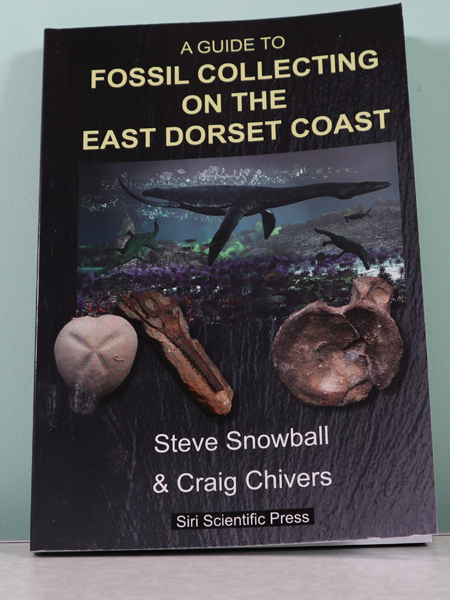
Three excellent guides have been published about fossil hunting on the Dorset coast. Titles by Steve Snowball and Craig Chivers. Books such as these published by Siri Scientific Press are essential reading for the serious fossil collector.  Picture credit: Everything Dinosaur.

Picture credit: Everything Dinosaur

If you are looking to acquire some books about fossil hunting, then check out the range of publications from Siri Scientific Press: Books About Fossils and Fossil Hunting.

Some Advice When Collecting Fossils

  • Do not collect or hammer into the cliffs, rocky ledges or other geological features.
  • The best and safest place to find fossils is on the beach where the sea has washed away soft clay and mud – let nature do some work for you.
  • Take a fossil hunting guide with you, such as one of the books in the photograph (above).
  • Keep collecting to a minimum, don’t be greedy, perhaps select a few specimens at the end of the session to take home.
  • Avoid removing “in situ” material be content with a photograph, leave the fossils where they are for someone else to enjoy.
  • Do not collect from buildings or walls.  Take care not to undermine fences, bridges stone walls etc.
  • Take your litter and other rubbish home with you.
  • Observe all notices and signs, some land is privately owned and fossil collecting is not permitted without prior approval.

With the start of official summer time here in the UK, there are going to be a lot of people planning trips to the seaside and perhaps they will go on a fossil hunt or two. Hopefully, these tips will help them to keep safe and allow the hobby of fossil collecting to continue without causing harm to others or the environment.

A trip to the coast to collect fossils.

A visit to the North Yorkshire coast on fossil collecting expedition. Picture credit: Everything Dinosaur.

Picture credit: Everything Dinosaur

Visit the award-winning Everything Dinosaur website: Prehistoric Animal Models and Toys.

29 05, 2021

A New, Giant Moroccan Mosasaur – Pluridens serpentis

By |2024-05-26T11:01:09+01:00May 29th, 2021|Categories: Adobe CS5, Dinosaur and Prehistoric Animal News Stories, Dinosaur Fans, Main Page, Palaeontological articles, Photos/Pictures of Fossils|0 Comments

This month (May 2021), has seen yet another scientific paper published describing a new species of mosasaur from the Late Cretaceous of Morocco. The newly described Pluridens serpentis reminds us that these whale-sized animals were related to snakes and lizards (Squamata). It may have sensed its marine environment in a similar way to extant sea snakes.

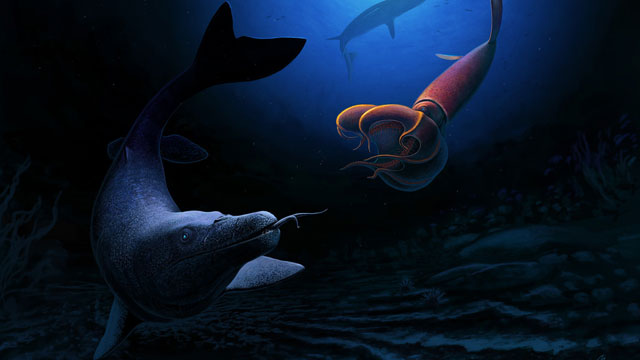
A life reconstruction of Pluridens serpentis
A life reconstruction of the Moroccan mosasaur Pluridens serpentis. The orbits (eye sockets), were disproportionately small when compared to other mosasaurs, it also had very sensitive jaws that were capable of helping it to make sense of its environment (as indicated by numerous neurovascular foramina on the premaxillae). It may have specialised in hunting prey in deep water, or in poorly lit habitats. Picture credit: Andrey Atuchin.

Morocco a Hot Bed of Late Cretaceous Mosasaurs

Mosasaurs were the last, great group of marine reptiles to evolve. They originated in the early Late Cretaceous and they were around for about 20 million years, a much shorter temporal range than other marine reptiles from the Mesozoic such as the ichthyosaurs and plesiosaurs. However, they were extremely successful and globally widespread with more than 40 different genera described.

The extensive phosphate beds of the Ouled Abdoun Basin in northern Morocco have proved to be a hot bed of mosasaur fossil remains. Thirteen mosasaur genera have been named and described from these Upper Cretaceous (Maastrichtian) deposits to date. For example, Everything Dinosaur wrote about the discovery of the specialised piscivore Gavialimimus almaghribensis in October 2020: Another New Species of Mosasaur from Morocco.

Based on Two Complete Skulls and Referred Jaw Material

Writing in the academic journal “Cretaceous Research”, scientists including Dr Nick Longrich (University of Bath), describe P. serpentis based on two complete skulls and referred jaw material. The skulls imply a total body length of around 6 to 8 metres, but the jaw material found indicates that Pluridens could have grown much larger, perhaps as big as 10 metres in length.

It had long, slender jaws lined with over a hundred tiny snake-like teeth which were well-adapted to grabbing small fish and squid. When compared to other mosasaurs, Pluridens had relatively small eyes, suggesting it had poor vision. It probably relied on other senses to understand its environment and to hunt. The upper snout (premaxilla), had dozens of openings for nerves (neurovascular foramina), hinting at the ability to hunt by sensing water movements and changes in pressure. These nerves may have been sensitive to tiny variations in water pressure, an adaptation seen in sea snakes.

The prepared skull of the newly described Moroccan mosasaur Pluridens serpentis
The prepared skull of the newly described Moroccan mosasaur Pluridens serpentis. Picture credit: Dr Nick Longrich.

Lead author of the study, Dr Longrich, (senior lecturer at the Milner Centre for Evolution, University of Bath), commented:

“Typically, when animals evolve small eyes, it’s because they’re relying more heavily on other senses. If it wasn’t using the eyes, then it’s very likely that it was using the tongue to hunt, like a snake. Many aquatic snakes and lizards – sea snakes and water monitors flick their forked tongues underwater, using chemical cues to track their prey. Mosasaurs would have resembled whales and dolphins, so it’s tempting to assume they lived like them. But they’re very different beasts – they’re huge lizards – so they probably acted like them.”

Thick, Robust and Heavy Jawbones

The researchers, who include scientists from the Natural History Museum of Sorbonne University (France), the University Cadi Ayyad in Marrakech and the OCP Group S. A. (both in Morocco), noted that the dentary (lower jaw bone) becomes massive and robust in the largest individuals, suggesting sexual selection and perhaps sexual dimorphism. In some species of extant beaked whales, the males use their jaws in combat (intraspecific combat). It is postulated that male Pluridens behaved in a similar way with the mandibles possibly functioning for combat as in modern beaked whales and some lizards such as Komodo dragons.

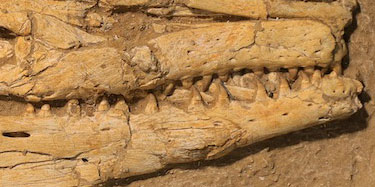
A close-up view of the jaw of Pluridens serpentis
A close-up view of the jaws of Pluridens showing the fang-like teeth and small holes in the jaw bones (foramina) – openings for nerves, hinting at the ability to hunt by sensing water movements and changes in pressure. Picture credit: Dr Nick Longrich.

Pluridens serpentis

The newly described Pluridens serpentis lends weight to the theory that mosasaurs were continuing to specialise and diversify until the very end of the Cretaceous. It is the thirteenth species of mosasaur to be identified from Morocco and very probably not the last. Team members at Everything Dinosaur are looking forward to the publication of future scientific papers, once again highlighting the remarkable diversity of North African mosasaurs during the Maastrichtian faunal stage of the Cretaceous.

The scientific paper: “Pluridens serpentis, a new mosasaurid (Mosasauridae: Halisaurinae) from the Maastrichtian of Morocco and implications for mosasaur diversity” by Nicholas R. Longrich, Nathalie Bardet, Fatima Khaldoune, Oussama Khadiri Yazami and Nour-Eddine Jalil published in Cretaceous Research.

The Everything Dinosaur website: Prehistoric Animal Figures and Models.
25 05, 2021

Rare Dinosaur Bones from Western Queensland

By |2024-05-26T10:47:51+01:00May 25th, 2021|Categories: Adobe CS5, Dinosaur and Prehistoric Animal News Stories, Dinosaur Fans, Main Page, Photos/Pictures of Fossils|0 Comments

Team members at Everything Dinosaur have received reports from Australian media sources that dinosaur bones have been discovered at Eromanga in western Queensland. The fossil bones believed to be cervical vertebrae (neck bones) represent the remains of a titanosaur. A field team from the Eromanga Natural History Museum has begun excavations and they suspect that the fossils, representing a titanosaur will end up being described as a new species.

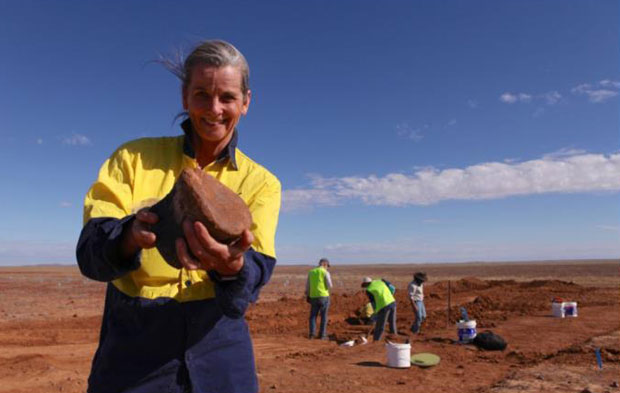
The director of the Eromanga Natural History Museum holds a fossil bone.
Robyn Mackenzie, Director and palaeontologist for the Eromanga Natural History Museum, holds one of the recently excavated dinosaur bones. Picture credit: Dan Llewellyn/Eromanga Natural History Museum).

Land of Giant Titanosaurs

Several dinosaurs have already been named and described from fossil remains found in this region. The sandstones, mudstones and silts represent deposits from an ancient river network. Given the depth of the formation (the Winton Formation), that exceeds 400 metres deep at some locations, palaeontologists have postulated that this part of Australia around 98-95 million years ago was home to a huge river comparable to the Mississippi today.

Palaeontologist and director of the Eromanga Natural History Museum, Robyn Mackenzie explained that the excavations were looking promising and that she was optimistic that more elements from the skeleton of the large herbivore would be found.

In 2015, Everything Dinosaur reported on the fossilised bones of Australia’s largest dinosaur going on public display for the first time. These fossils were found in the same region and represent an animal around thirty metres in length. The dinosaur was nicknamed “Cooper”.

To read more about the titanosaur nicknamed “Cooper”: A super-duper titanosaur called “Cooper”.

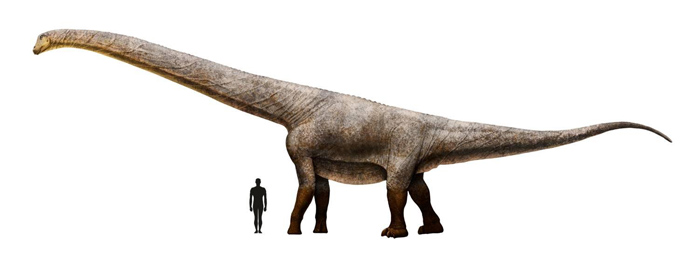
A scale drawing of an Australian Titanosaur.
Scale drawing of “Cooper”. This titanosaur, whose bones were found in 2007 and went on display in 2015 has yet to be formally scientifically described and named.

Fossils Found by Director’s Son

The site was first discovered in 2018 by Robyn Mackenzie’s son and daughter-in-law. Whilst out rounding up cattle dinosaur vertebrae were spotted exposed on the surface of the red clay soil.

Dinosaur Bones Exposed on the Surface
Dinosaur bones exposed on the surface.  Picture credit: Eromanga Natural History Museum.

A spokesperson from Everything Dinosaur stated that dinosaur bones from the early Late Cretaceous were relatively rare globally and the fossils from this part of western Australia are helping palaeontologists to better understand the dinosaur biota of southern Gondwana.

The Everything Dinosaur website: Dinosaur Models and Toys.

23 05, 2021

A Predator Becomes Prey as Remarkable Fossil is Investigated

By |2024-05-26T10:38:36+01:00May 23rd, 2021|Categories: Dinosaur and Prehistoric Animal News Stories, Main Page, Palaeontological articles, Photos/Pictures of Fossils|0 Comments

A team of scientists have interpreted a remarkable fossil from southern Germany as a rare example of predation in the fossil record. A belemnite (a squid-like animal), has been preserved with the remains of a crustacean still held in its arms. However, the belemnite (a cephalopod), never had a chance to finish its meal, its fossilised remains display damage that indicate that it too was predated upon.

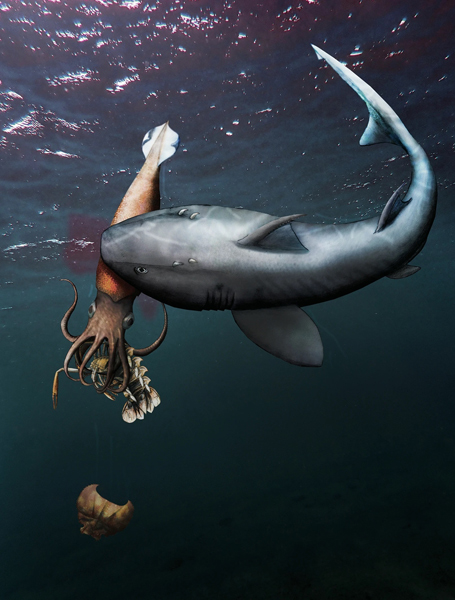
The belemnite was attacking the crustacean, when it too was attacked, presumably by a vertebrate predator which the researchers postulate was a type of prehistoric shark.

Shark Attacks Belemnite Attacking a Crustacean
Possible scenario explaining the taphonomy of the belemnite. Hybodus hauffianus (prehistoric shark), is known to have fed on belemnites, although it is unclear whether some individuals learned how to avoid the swallowing of the calcitic rostrum. The belemnite Passaloteuthis laevigata holds remains of the exuvia of Proeryon in its arms. Picture credit: Klug et al.

Discovered in 1970

The specimen was discovered in 1970 by amateur fossil collector Dieter Weber. The fossils come from the famous Lower Jurassic, Posidonia Shale from near Holzmaden (Germany). These marine shales which are exposed in Switzerland, Luxembourg, Austria and Holland as well as Germany, are famous for their beautifully preserved but crushed fossil specimens including many types of Early Jurassic marine reptile and fish.

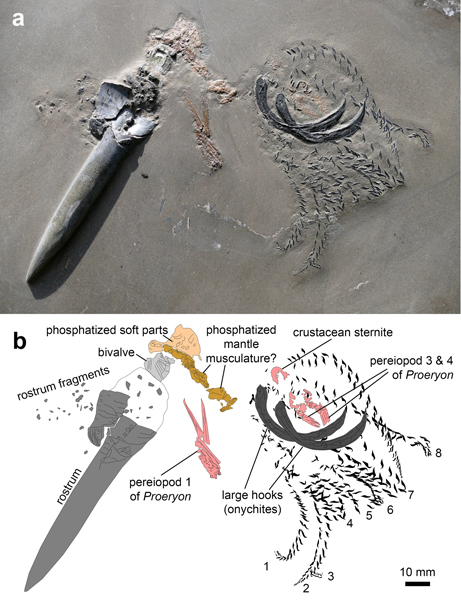
In Germany, these shales are known as the Posidonienschiefer Formation. The name of the formation is derived from the extensive and abundant fossils of the bivalve Posidonia bronni. Günter Schweigert (Natural History Museum Stuttgart), had been invited to view Herr Weber’s extensive private collection when he noted the fossilised remains of a belemnite (Passaloteuthis bisulcata) in close proximity to a crustacean. The remains of the crustacean, identified as an example of the decapod Proeryon, were still held in the arms of the belemnite and some soft tissue of the cephalopod had been preserved.

Evidence of Predation in an Early Jurassic Fossil Specimen
Taphocoenosis of a Passaloteuthis bisulcata with preserved arm crown and remains of its prey, SMNS 70514, Early Toarcian, Tenuicostatum Zone, Semicelatum Subzone, Ohmden, Germany. Photo of the specimen and its prey (a) Line drawing of fossil. Picture credit: Klug et al.

Damage to the Belemnite

When examined closely, the soft parts of the belemnite were far from complete and the scientists, which included researchers from the University of Zurich (Switzerland), Friedrich-Alexander-University (Erlangen, Germany), the Luxembourg National Museum of Natural History and the Ruhr-University Bochum (Germany), proposed that this was possible evidence of the belemnite having been attacked whilst in the process of subduing its prey.

Fossilised “Leftovers” – Pabulite

The specimen is interpreted as evidence of incomplete predation. The belemnite was attacked but not all of it was eaten. The assailant dropped the belemnite, which was still clutching the decapod, the remains settled on the seabed to be covered over in sediment and eventually turned to stone.

For this kind of fossil, one that provides circumstantial evidence to indicate these are the preserved remains of a dropped meal, the researchers coined the term “pabulite”. This word is derived from the Latin word “pabulum” for food and the Greek word “lithos” for stone.

What Sort of Animal Attacked the Belemnite?

As most of the belemnite soft parts between the arm crown and the calcitic rostrum are missing, the scientists postulate that this represents remains of a meal of a vertebrate predator, possibly of the Early Jurassic shark Hybodus hauffianus which is known to have eaten belemnites.

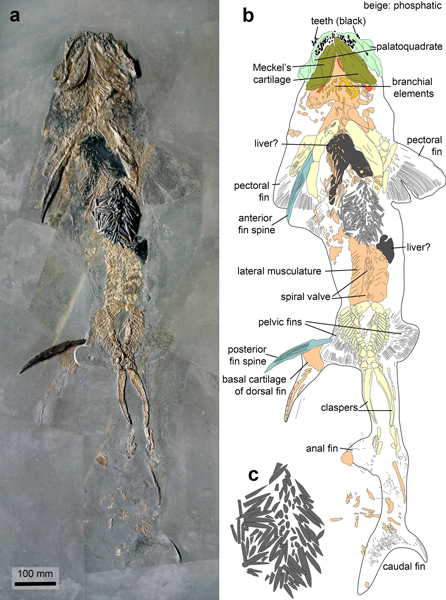
One remarkable fossil (SMNS 10062), in the collection of the Natural History Museum Stuttgart, depicts one of these small sharks which had at least 93 part or complete belemnite rostra wedged in its stomach. It has been suggested that this indigestible material probably killed the shark.

Hybodus shark fossil with stomach clogged by belemnite rostra
The Early Jurassic elasmobranch Hybodus hauffianus with its stomach clogged by belemnite rostra; SMNS 10062, Posidonia Shale, Toarcian, Holzmaden (Germany). Picture credit R. Böttcher.

Evidence of Behaviour Preserved in the Fossil Record

These fossilised leftovers provide a glimpse into a marine food web that existed 180 million years ago. In the recently published scientific paper, the researchers speculate that vertebrate predators of belemnites, animals such as ichthyosaurs, sharks and metriorhynchid crocodiles learned to avoid the hard, indigestible rostra of these cephalopods. Instead, they bit off the soft parts and consumed them leaving the rostrum of their victim to descend to the seafloor.

The researchers suggest that the association of the complete belemnite arm crown with a complete rostrum and some soft parts represent the remains of the meal of a vertebrate predator, which had learned enough about belemnite anatomy to avoid the rostrum. This idea lends further credibility to the hypothesis that belemnite predation might contribute to belemnite accumulations (so-called battlefields, where huge numbers of fossilised belemnite guards are found together) under certain circumstances.

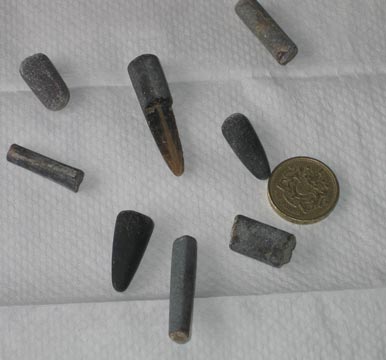
Some belemnite guard fossils, the coin shows scale.
Belemnite guard fossils from the “Jurassic Coast”. Picture credit: Everything Dinosaur.

Picture credit: Everything Dinosaur

The scientific paper: “Fossilized leftover falls as sources of palaeoecological data: a ‘pabulite’ comprising a crustacean, a belemnite and a vertebrate from the Early Jurassic Posidonia Shale” by Christian Klug, Günter Schweigert, René Hoffmann, Robert Weis and Kenneth De Baets published in the Swiss Journal of Palaeontology.

Visit the Everything Dinosaur website: Everything Dinosaur.

20 05, 2021

Amazing Horned Crocodile Gets a Home

By |2024-05-26T10:30:27+01:00May 20th, 2021|Categories: Animal News Stories, Key Stage 3/4, Main Page, Photos/Pictures of Fossils|0 Comments

Specimens of a strange, recently extinct crocodile housed at the American Museum of Natural History (New York), have helped unravel a mystery surrounding the evolutionary relationships of crocodilians. The skulls belong to the horned crocodile of Madagascar (Voay robustus) and a research team has demonstrated that it was closely related to “true crocodiles” – Crocodylus, making it the closest species to the common ancestor of the crocodile genus.

Voay robustus - horned crocodile skull
A skull of Voay robustus collected at Ampoza during the joint mission Franco-Anglo-American expedition from 1927–1930 (White, 1930). Picture credit: Hekkala et al.

Recently Extinct

When the first Europeans came to Madagascar the native Malagasy people told them about two distinct types of crocodiles that lived on their island. There was a gracile form that preferred rivers, this was identified as a population of Nile crocodiles (Crocodylus niloticus), but the swamps and lakes were home to a crocodile that the early explorers had never seen before. This second type was a much more heavy-set and powerful animal with two, bony bumps at the top of its skull.

When first named and described in 1872 (Grandidier and Vaillant), it was thought to be a species of true crocodile – a member of the Crocodylus genus. More recent studies have suggested affinities with the dwarf crocodiles (Osteolaeminae), however, with an estimated length of around 5 metres V. robustus was much larger than any other species assigned to this group.

New research published in the academic journal Communications Biology, which used DNA extracted from the American Museum of Natural History specimens, has resolved the phylogeny of this enigmatic reptile. Carbon dating of the material used in the study confirms that the horned crocodile probably survived until just a few hundred years ago.

Voay robustus phylogeny
The DNA study places the horned crocodile right next to the true crocodile branch of the evolutionary tree, making it the closest species to the common ancestor of the crocodiles alive today.

One of the authors of the scientific paper, Evon Hekkala, a research associate at the American Museum of Natural History stated:

“This crocodile was hiding out on the island of Madagascar during the time when people were building the pyramids and was probably still there when pirates were getting stranded on the island. They blinked out just before we had the modern genomic tools available to make sense of the relationships of living things. And yet, they were the key to understanding the story of all the crocodiles alive today.”

Mitochondrial DNA extracted from sub-fossil specimens found during a Franco-Anglo-American expedition to south-western Madagascar (1927 to 1930), demonstrates that V. robustus was not a true crocodile but very closely related to that lineage that led to them. Being placed next to the true crocodiles on an evolutionary tree suggests that it was the closest species to the common ancestor of extant members of the Crocodylus genus.

Voay robustus lower jaw.
The tip of the lower jaw (dentary) of the horned crocodile from Madagascar (Voay robustus). Carbon dating of the subfossils suggests that they are less than 1,400 years old. Picture credit: The American Museum of Natural History.

Co-author George Amato, (American Museum of Natural History), explained:

“This is a project we’ve tried to do on and off for many years, but the technology just hadn’t advanced enough, so it always failed. But in time, we had both the computational setup and the paleogenomic protocols that could actually fish out this DNA from the fossil and finally find a home for this species.”

“Teasing apart the relationships of modern crocodiles is really difficult because of the physical similarities,” Hekkala added. “Many people don’t even realise that there are multiple species of crocodiles, and they see them as this animal that’s unchanging through time. But we’ve been trying to get to the bottom of the great diversity that exists among them.”

Surprising Results

The close affinity of Voay to Crocodylus lends weight to the idea that Crocodylus originated in Africa and then dispersed into the Americas and Asia/Australia. Competing theories have proposed an Asian origin for Crocodylus but as Voay was restricted to Madagascar and has been cited as the closest species to the true crocodiles, this DNA analysis lends weight to the “African origins” idea.

The scientific paper: “Paleogenomics illuminates the evolutionary history of the extinct Holocene “horned” crocodile of Madagascar, Voay robustus” by E. Hekkala, J. Gatesy, A. Narechania, R. Meredith, M. Russello, M. L. Aardema, E. Jensen, S. Montanari, C. Brochu, M. Norell and G. Amato published in Communications Biology.

The Everything Dinosaur website: Everything Dinosaur.

12 05, 2021

Menefeeceratops – The Oldest Centrosaurine? That’s a Great Question!

By |2024-05-26T09:31:47+01:00May 12th, 2021|Categories: Adobe CS5, Dinosaur and Prehistoric Animal News Stories, Dinosaur Fans, Main Page, Photos/Pictures of Fossils|0 Comments

Fossilised dinosaur remains found over twenty years ago have been re-examined and determined to represent a new species of horned dinosaur. Menefeeceratops (M. sealeyi) from the early Campanian of New Mexico, might just be the oldest centrosaurine described to date.

Menefeeceratops sealeyi life reconstruction.
Menefeeceratops sealeyi life reconstruction. Picture Credit: Sergey Krasovskiy. This horned dinosaur was contemporaneous with the tyrannosaur Dynamoterror (D. dynastes). This theropod can be seen in the background (right). Recent fossil discoveries are helping scientists to better understand the dinosaur dominated biota of southern Laramidia during the Campanian. The picture (above) also depicts a hadrosaur in the background (left), team members at Everything Dinosaur consider this to be a depiction of the saurolophine hadrosaur Ornatops (O. incantatus)

From the Menefee Formation of New Mexico

Researchers from the University of Pennsylvania, the New Mexico Museum of Natural History and Science in collaboration with a colleague from the State Museum of Pennsylvania, writing in the academic journal Paläontologische Zeitschrift, report on the reassessment of ceratopsian bones originally collected at a site near to Cuba, in New Mexico. The fossils, representing a partial skeleton of a single dinosaur were found by Paul Sealey, a research associate at the New Mexico Museum of Natural History and Science, whilst exploring the Allison Member of the Menefee Formation in 1996 and discussed in academic literature a year later but no genus name was proposed or other research conducted.

The fossils which consist of cranial and postcranial material remained within the collection of the New Mexico Museum of Natural History and Science, however, with dinosaurs being named and described from the Menefee Formation such as the tyrannosaur Dynamoterror dynastes and the nodosaurid Invictarx zephyri, both of which were named and described in 2018, interest in this specimen was reawakened. Further preparation revealed unique traits associated with the skull material that permitted the establishment of a new genus.

A skeletal reconstruction of Menefeeceratops showing known bones in blue.
Skeletal reconstruction of Menefeeceratops showing known bones in blue. Picture credit: Dalman et al.

Menefeeceratops sealeyi

Classified as a basal member of the Centrosaurinae, Menefeeceratops sealeyi helps palaeontologists to piece together the evolutionary history of the Ceratopsia. Estimated to have lived around 82 million years ago (Early Campanian), the authors of the scientific paper Sebastian Dalman, Spencer G. Lucas and Asher Lichtig (New Mexico Museum of Natural History and Science), Steven Jasinski (State Museum of Pennsylvania) and Peter Dodson (University of Pennsylvania) postulate that Menefeeceratops represents the earliest member of the centrosaurine subfamily of horned dinosaurs known to science.

The distinctive shape of the squamosal (skull bone that formed part of the neck frill), permitted the scientists to erect a new genus. The name honours the Menefee Formation, whilst the trivial name recognises the work of Paul Sealey, not only for the original discovery but for his contribution to the study of the dinosaurs of New Mexico.

Views of the left squamosal bone of Menefeeceratops,
Views of the left squamosal bone of Menefeeceratops sealeyi (left lateral and right lateral views). Picture credit: Dalman et al. The squamosal, whilst less ornate than other ceratopsids has a distinctive shape which helped permit the erection of a new genus.

How Big was Menefeeceratops?

By comparing the bones of Menefeeceratops to more complete centrosaurine specimens, the research team were able to estimate the size of this dinosaur. They conclude that it was relatively small, when compared to later members of the Centrosaurinae such as Pachyrhinosaurus and Styracosaurus, at around 3.9 to 4.4 metres in length.

Commenting on the significance of the reassessment of the fossil material that led to the naming of Menefeeceratops, co-author of the scientific paper Spencer G. Lucas stated:

“Menefeeceratops shows us just how much we still have to learn about the horned dinosaurs of western North America. The oldest centrosaur, Menefeeceratops indicates that the southwest region of the United States was an important place in the evolution of the centrosaurs. The recognition of this new centrosaur adds to a growing diversity of centrosaurs, and thus provides impetus to further efforts to discover fossils of these kinds of dinosaurs.”

Authors involved in this study, also named and described the related but geologically much younger centrosaurine Crittendenceratops. To read about Crittendenceratops krzyzanowskii: A New Horned Dinosaur from Arizona.

Everything Dinosaur acknowledges the assistance of a media release from the University of Pennsylvania in the compilation of this article.

The scientific paper: “The oldest centrosaurine: a new ceratopsid dinosaur (Dinosauria: Ceratopsidae) from the Allison Member of the Menefee Formation (Upper Cretaceous, early Campanian), north-western New Mexico, USA” by Sebastian G. Dalman, Spencer G. Lucas, Steven E. Jasinski, Asher J. Lichtig & Peter Dodson published in Paläontologische Zeitschrift.

Visit the Everything Dinosaur website: Dinosaur Toys.

10 05, 2021

An Amazing Billion-Year-Old Fossil from Scotland

By |2024-05-26T09:25:18+01:00May 10th, 2021|Categories: Dinosaur and Prehistoric Animal News Stories, Geology, Main Page, Palaeontological articles, Photos/Pictures of Fossils|0 Comments

A one-billion-year-old microfossil found in the Scottish Highlands has been shown to consist of two distinct cell types and could represent the earliest example of a multicellular animal ever recorded. Scientists from the University of Sheffield in collaboration with colleagues from Boston College (USA), have published a paper describing the discovery of a tiny fossil that provides a new perspective on the transition from single-celled organisms to more complex multicellular forms.

Image of Bicellum brasieri.
A highly magnified image of Bicellum brasieri preserved in petrographic thin sections. Two distinct cell shapes in the closely-packed cluster can be made out – elongate cells and more rounded ones. Picture credit: Professor Paul Strother (Weston Observatory of Boston College).

The photograph (above), shows an image of Bicellum brasieri, the cluster of cells measures around 20 microns in diameter, approximately 750 of these tiny organisms could sit on the head of a pin.

Lying Somewhere Between Single-celled and Multicellular Animals

The microscopic fossil material comes from the Mesoproterozoic-aged Diabaig Formation, which is exposed at Loch Torridon in the Northwest Scottish Highlands. It has been named Bicellum brasieri, the genus name being derived from the two types of cells (elongate and isodiametric) that were identified in the tightly grouped cell clusters.

Loch Torridon the site of the fossil discovery
The picturesque Loch Torridon a sea loch on the west coast of Scotland in the Northwest Highlands. The site of the Bicellum brasieri fossil discovery. Picture credit: Sheffield University.

Classified as a Holozoan

Writing in the academic journal “Current Biology” the researchers who include lead author Professor Charles Wellman from the Department of Animal and Plant Sciences (Sheffield University), have assigned this primitive lifeform to the Holozoa – a clade that includes all animals and their closest single-celled relatives but excludes fungi. If their interpretation is correct, then B. brasieri is distantly related to all living animals including our own species Homo sapiens.

Location map and outline of the stratigraphy of the Bicellum brasieri fossil discovery.
Location map and outline of the stratigraphy of the Bicellum brasieri fossil discovery. Picture credit: Strother et al.

A Remarkable Record of a Significant Development for Life on Earth

The shales of the Diabaig Formation were laid down at the bottom of a freshwater lake. The microfossils preserved in these rocks represent planktonic and benthic forms of microscopic life that existed around a billion years ago. The discovery suggests more complex lifeforms were evolving during this time in Earth’s history. The material could represent the earliest multicellular animal known to science.

Professor Wellman explained:

“The origins of complex multicellularity and the origin of animals are considered two of the most important events in the history of life on Earth, our discovery sheds new light on both of these. We have found a primitive spherical organism made up of an arrangement of two distinct cell types, the first step towards a complex multicellular structure, something which has never been described before in the fossil record.”

Bicellum fossil site location.
View of Diabaig Formation type section along the north shore of Loch Diabaig at the village of Lower Diabaig (B). The arrow marks the sample site. (C and D). View of dark shales (C) with lenticular, bedded phosphatic nodules in situ (D). Scale bar in (D), 5 cm. Picture credit: Strother et al.

Did the Animalia Evolve in the Sea or in Freshwater?

The exceptional preservation of the fossils enabled the research team to analyse them at both a cellular and subcellular level. The discovery of Bicellum brasieri challenges the long-held theory that complex life evolved in marine environments.

Professor Paul Strother, lead investigator of the research from Boston College stated:

“Biologists have speculated that the origin of animals included the incorporation and repurposing of prior genes that had evolved earlier in unicellular organisms. What we see in Bicellum is an example of such a genetic system, involving cell-cell adhesion and cell differentiation that may have been incorporated into the animal genome half a billion years later.”

This study has shed new light on the transition of single-celled organisms to more complex, sophisticated forms with cell specialisation.

The Boston College professor added:

“The discovery of this new fossil suggests to us that the evolution of multicellular animals had occurred at least one billion years ago and that early events prior to the evolution of animals may have occurred in freshwater like lakes rather than the ocean.”

The scientific paper: “A possible billion-year-old holozoan with differentiated multicellularity” by Paul K. Strother, Martin D. Brasier, David Wacey, Leslie Timpe, Martin Saunders and Charles H. Wellman published in Current Biology.

Visit the Everything Dinosaur website: Everything Dinosaur.

Go to Top