All about dinosaurs, fossils and prehistoric animals by Everything Dinosaur team members.

Pictures of fossils, fossil hunting trips, fossil sites and photographs relating to fossil hunting and fossil finds.

13 03, 2022

Is Bashanosaurus the Oldest Stegosaur? A New Dinosaur Taxon

By |2024-10-27T22:05:57+00:00March 13th, 2022|Categories: Adobe CS5, Dinosaur and Prehistoric Animal News Stories, Dinosaur Fans, Main Page, Palaeontological articles, Photos/Pictures of Fossils|0 Comments

The trouble with being regarded as the biggest, longest, tallest or oldest when you are newly described species of dinosaur, is that sooner or later another fossil discovery will take this claim away from you. Back in 2019, team members wrote a blog post about the discovery of Adratiklit boulahfa from the Middle Jurassic of Morocco North Africa’s First Stegosaur. The fossils of this armoured dinosaur were estimated to be around 168 million years old (Bathonian faunal stage), making Adratiklit the oldest definitive stegosaur described.

Scientists including Dr Susannah Maidment a senior researcher at the London Natural History Museum, who co-authored the paper describing A. boulahfa, have announced the discovery of an even older stegosaur, this time from China. The new stegosaur named Bashanosaurus primitivus is at least one million years older than the Moroccan stegosaur.

The Fossils of Bashanosaurus

The fossils of Bashanosaurus herald from the Lower Member of the Shaximiao Formation and radiometric dating based on isotope decay analysis using zircon crystals (geochronological data), suggest that the deposits associated with the fossil bones are around 169 ± 0.68 million years of age.

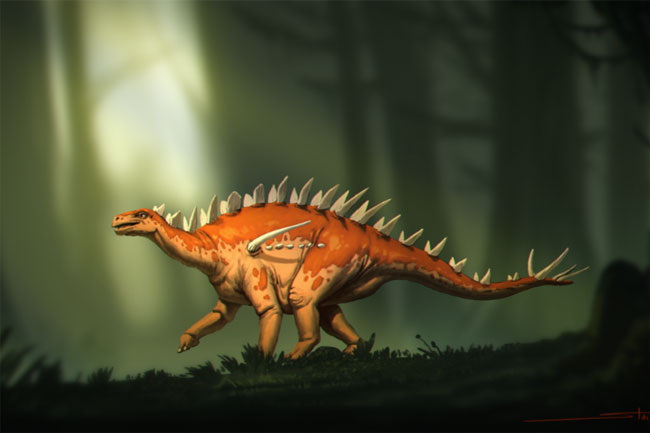
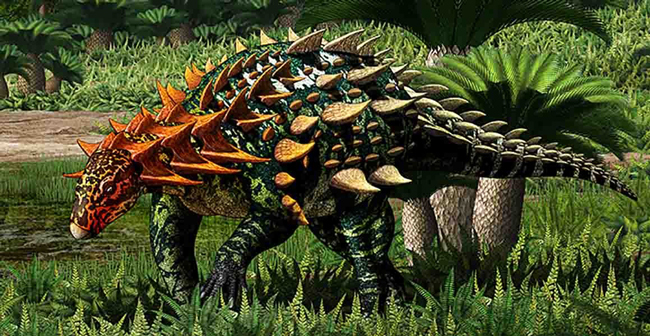
Bashanosaurus life reconstruction.

A life reconstruction of the newly described Chinese stegosaur Bashanosaurus primitivus. Picture credit: Banana Art Studio.

Picture credit: Banana Art Studio

Did the Stegosauria Evolve in Asia?

The fossil record of early stegosaurs is highly fragmentary and the evolution of this iconic branch of the Thyreophora is poorly understood. The Stegosauria represents a major clade within the Ornithischia (bird-hipped dinosaurs). Fourteen genera of stegosaur have been described to date and they are both geographically and temporally widespread, known from all the major landmasses except for Australia and Antarctica.

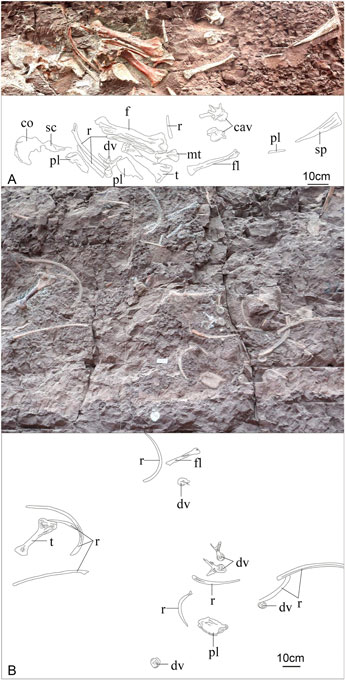
In 2016, a new dinosaur quarry was opened in Yunyang County, Chongqinq Municipality in southwestern China. Stegosaur fossil material was identified on the western side of the quarry. The disarticulated material preserved within the sandstone consisted of a dorsal vertebra, two tail bones (caudal vertebrae), a right scapula, a right coracoid and elements from the hind legs. Three pieces of dermal armour were also discovered at this location (one plate and two spines) along with fragments of rib bones. These fossils (CLGPR V00006-1) are regarded as the holotype of B. primitivus.

Potentially Three Bashanosaurus Specimens

More stegosaur fossils were found at the site approximately fifty metres away from the holotype material (CLGPR V00006-2). They consist of five dorsal vertebrae, a right tibia, a right fibula some ribs and a single piece of dermal armour (one plate). In addition, a single dorsal vertebra (CLGPR V00006-3) was found on the eastern part of the site some one hundred and twenty metres away from the holotype material.

Whilst the researchers have confidently assigned these fossils to the Stegosauria and specifically to Bashanosaurus primitivus, three individual stegosaurs are represented by the bones.

Bashanosaurus fossils.

Photograph (A) with interpretative line drawing showing the position of the B. primitivus holotype fossil material (CLGPR V00006-1) on the western side of the wall of dinosaur fossils. Photograph (B) with interpretative line drawing showing the second location with B. primitivus fossil material ((CLGPR V00006-2) towards the middle of the wall of dinosaur fossils. Picture credit: Hui et al.

Picture credit: Hui et al

It is not known whether the fossil bones represent a juvenile or a fully-grown animal. However, based on these bones, the researchers estimate that the largest stegosaur from the quarry was about 2.8 metres in length.

Unique Anatomical Traits

The scientists who include researchers from the Chongqing Bureau of Geological and Mineral Resource Exploration and Development in China and London’s Natural History Museum identified several unique anatomical traits that led to the erection of a new genus. Bashanosaurus possesses anatomical characteristics associated with basal thyreophorans as well as more derived features associated with early stegosaurs. For example, it has a smaller and less developed shoulder blade, the bony projection of the thighbone (fourth trochanter) is positioned below the middle of the shaft and the bases of the armour plates curve outwards and are thicker than the plates on the backs of later stegosaurs.

The genus name is derived from “Bashan” in reference to the ancient name for the area of Chongqing in China where the dinosaur was found. The species moniker is derived from the Latin for “first” – primitivus.

Lead author of the research team, Dr Dai Hui from the Chongqing Bureau of Geological and Mineral Resource Exploration and Development commented:

“All these features are clues to the stegosaurs’ place on the dinosaur family tree. Bashanosaurus can be distinguished from other Middle Jurassic stegosaurs, and clearly represents a new species.”

Phylogenetic Analysis

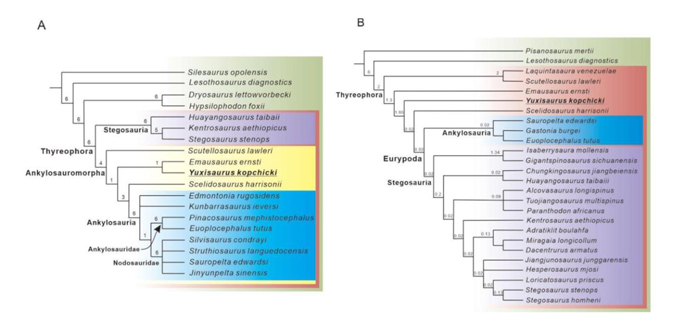
Phylogenetic analysis shows that Bashanosaurus primitivus is the earliest-diverging stegosaur, along with Chungkingosaurus (C. jiangbeiensis), which is thought to be closely related, although Chungkingosaurus lived much later than Bashanosaurus. Chungkingosaurus fossils are known from the Upper Member of the Shaximiao Formation.

The discovery of Bashanosaurus will help researchers to learn more about the evolution of stegosaurs and supports the theory that this type of armoured dinosaur first appeared in Asia. Although there have been some exciting fossil discoveries helping to improve understanding with regards to the evolution of armoured dinosaurs (Thyreophora), there are still numerous gaps in the fossil record which makes mapping the evolutionary development of these iconic dinosaurs extremely difficult.

For example, Everything Dinosaur recently wrote an article about the discovery of the basal thyreophoran Yuxisaurus kopchicki, whose fossils also come from China. Scientists from the London Natural History Museum also contributed to the scientific paper on Yuxisaurus: The Earliest Armoured Dinosaur Found to Date.

Everything Dinosaur has inserted Yuxisaurus kopchicki within the phylogenetic assessment of Bashanosaurus to help put these recent fossil discoveries into context (see below).

Bashanosaurus phylogeny and comparison with the recently described Yuxisaurus.

A phylogenetic analysis showing the placement of B. primitivus within the Stegosauria. It is believed to be around one million years older than the recently described Adratiklit boulahfa (Maidment et al) from the Middle Jurassic of Morocco. The earliest armoured dinosaur from Asia known to date (Yuxisaurus kopchicki) from Yunnan Province, China (Yao et al) has been incorporated into the image by Everything Dinosaur to show the approximate phylogenetic and temporal placement of Y. kopchicki when compared to B. primitivus. Picture credit: Hui et al with additional annotation by Everything Dinosaur.

Picture credit: Hui et al with additional annotation by Everything Dinosaur

The Stegosauria Clade Originated in Asia?

Commenting on the phylogenetic assessment Dr Hui stated:

“What’s more, our analysis of the family tree indicates that it [B. primitivus] is one of the earliest-diverging stegosaurs along with the Chongqing Lizard (Chungkingosaurus) and Huayangosaurus. These were all unearthed from the Middle to Late Jurassic Shaximiao Formation in China, suggesting that stegosaurs might have originated in Asia”

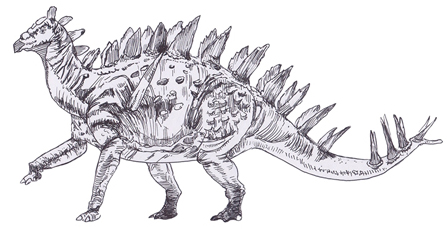
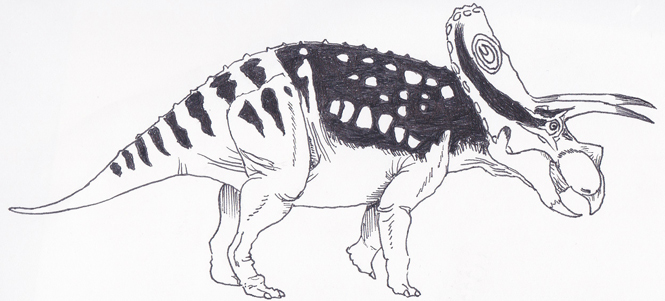
Chungkinogsaurus illustrated.

An illustration of the Chinese Stegosaur Chungkingosaurus. Picture credit: Everything Dinosaur.

Picture credit: Everything Dinosaur

The picture (above) shows a drawing of a model from the PNSO model range.

To view this range of prehistoric animal figures: PNSO Age of Dinosaurs Figures.

Co-author of the scientific paper published in the Journal of Vertebrate Paleontology, Dr Susannah Maidment of the London Natural History Museum and an expert in ornithischian dinosaurs added:

“The discovery of this stegosaur from the Middle Jurassic of China adds to an increasing body of evidence that the group evolved in the early Middle Jurassic, or perhaps even in the Early Jurassic, and as such represent some of the earliest known bird-hipped dinosaurs. China seems to have been a hotspot for stegosaur diversity, with numerous species now known from the Middle Jurassic right the way through until the end of the Early Cretaceous period.”

Everything Dinosaur acknowledges the assistance of a media release from the Taylor & Francis Group in the compilation of this article.

The scientific paper: “New Stegosaurs from the Middle Jurassic Lower Member of the Shaximiao Formation of Chongqing, China” by Dai Hui, Li Ning, Susannah C. R. Maidment, Wei Guangbiao, Zhou Yuxuan, Hu Xufeng, Ma Qingyu, Wang Xunqian, Hu Haiqian and Peng Guangzhao published in the Journal of Vertebrate Paleontology.

Visit the Everything Dinosaur website: Everything Dinosaur.
4 03, 2022

Sauropods Walked Like Hippos According to New Study

By |2024-10-27T11:02:43+00:00March 4th, 2022|Categories: Adobe CS5, Dinosaur and Prehistoric Animal News Stories, Dinosaur Fans, Main Page, Palaeontological articles, Photos/Pictures of Fossils|0 Comments

Researchers from Liverpool John Moores University have developed a new and innovative approach to interpreting sauropod trackways enabling them to calculate their gaits (the order in which the animal moved its four limbs to progress). Jens Lallensack and his colleague Peter Falkingham discovered that the placement of tracks relative to each other in a sauropod trackway changes in a consistent way when the animal changes its velocity (either speeding up or slowing down). Using this technique, subsequently verified by analysing the gaits of living animals such as dogs, horses, a camel and an elephant, the scientists have concluded that sauropods walked more like hippos than elephants.

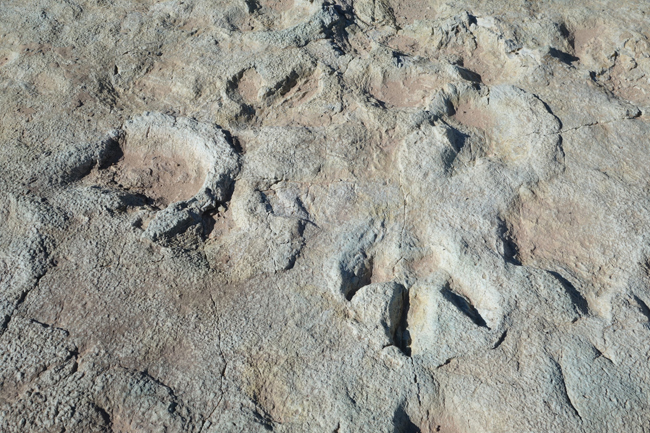
Sauropod Tracks (Brontopodus plagnensis).

A picture of the sauropod trackway (Plagne, France). Picture credit: P. Dumas/Centre National de la Recherche Scientifique.

Picture credit: P. Dumas/Centre National de la Recherche Scientifique.

Quadruped Locomotion

Four-footed animals (quadrupeds), may use different gaits such as trots, walks, and pace gaits. In a trot, one diagonal limb pair (e.g. hind right and front left) moves together, followed by the other limb pair. Many mammals use trots at faster gaits, but reptiles also use trots at slow speeds. In a pace gait, in contrast, the limbs on one side of the body (e.g. hind right and fore right) move together in a similar way as the locomotion of a camel.

In-between these extremes is the single foot gait, in which the time lag between fore and hind feet is equal – a good example of this type of locomotion is the movement of horses.

The movements of living animals can be observed, direct observation of extinct animals such as huge, long-necked, long-tailed sauropod dinosaurs is not possible, but data can be obtained by careful study of their fossilised prints and trackways.

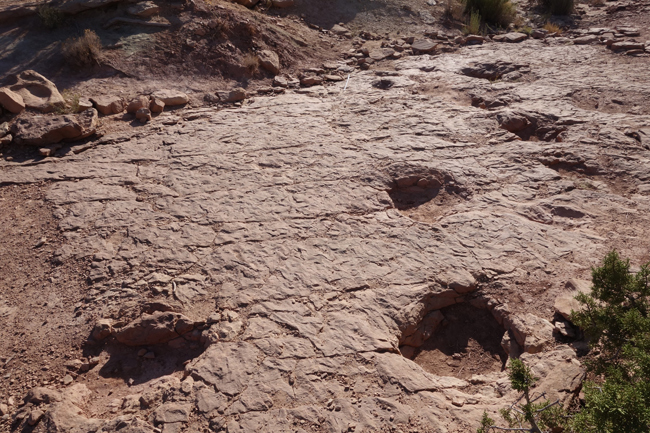
Dinosaur tracks

Trace fossils such as these dinosaur tracks can provide palaeontologists with data on dinosaur locomotion, velocity and gaits. Picture credit: Liverpool John Moores University.

Picture credit: Liverpool John Moores University

Examining Sauropod Tracksites

Liverpool John Moores University researchers Jens Lallensack and Peter Falkingham identified that the placement of an animal’s feet changes in a predictable and consistent way when the animal’s velocity changes. If a trackway is long enough and shows variation in stride length (indicating a change of speed), it is possible to calculate gaits and to gain an insight into how extinct animals moved.

Their predictions were confirmed in an analysis of the gaits of different types of living animal, including elephants, thanks to the help from locomotion expert Professor John Hutchinson (Royal Veterinary College, London), who provided elephant locomotion data. These new analytical methods were used to plot the limb movements along three sauropod trackways from the Lower Cretaceous De Queen Formation (Arkansas, USA). Although it is not possible to identify specific sauropod species (ichnospecies) from the De Queen Formation (Albian fauna stage) tracks, these trace fossils represent large, sauropod trackmakers (median average hind foot length 70-85 cm and maximum stride length 3.42 metres).

Commenting on the outcome of their findings, reported in the journal “Current Biology”, Dr Falkingham stated:

“Many researchers assumed that sauropods walked like elephants, with which they share many similarities, but that doesn’t appear to be the case.”

Dinosaur Trackway

Researchers have found a way to identify the gait of sauropods by studying their tracks. Picture credit: Liverpool John Moores University.

Picture credit: Liverpool John Moores University

Sauropod Dinosaurs Compared to Elephants

As elephants are the largest living terrestrial animals alive today, it had been suggested that their locomotion was an appropriate analogy for the movement of sauropod dinosaurs. Elephants use a gait intermediate between the pace gait and the singlefoot, i.e. the two limbs on the same body side tend to swing together. The gait analysis, in the current study by contrast, revealed that sauropods instead employed a gait intermediate between the singlefoot and a trot: the opposite-side limbs tend to swing together.

Based on this data, sauropod dinosaurs had a similar gait to hippos.

To Sway or Not to Sway

If sauropods moved very differently compared to the largest land animals alive today, this suggests that these two types of animal with large body sizes evolved different solutions to locomotion. Sauropods, even the titanosaurs known for their narrower trackways when compared to other types of sauropod such as diplodocids and dicraeosaurids, have a much broader stance than elephants. Elephants place one foot almost directly in front of another producing surprisingly narrow tracks for such large animals. Sauropod trackways, in contrast, are much broader. Their particular gait allowed sauropods to have at least one foot on the ground on both the left and right sides of the body at all times, preventing swaying from side to side.

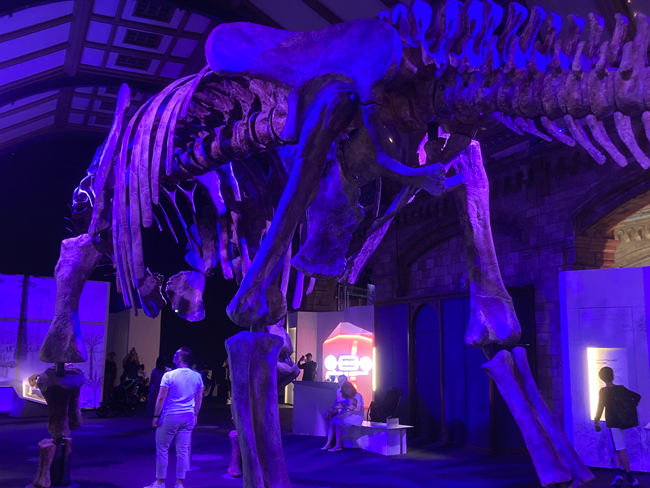
Patagotitan skeleton on display at the London Natural History Museum.

The enormous body of the titanosaur dwarfs visitors. Patagotitan mayorum skeletal reconstruction. Titanosaurs are known for their narrower tracks when compared to other types of sauropod but as many were much bigger than elephants, elephants do not make a good analogy for describing the gaits of titanosaurs or of sauropods generally. Picture credit: Everything Dinosaur.

Picture credit: Everything Dinosaur

Everything Dinosaur acknowledges the assistance of a media release from Liverpool John Moores University in the compilation of this article.

Lead author of the scientific paper Dr Jens Lallensack added:

Sauropods chose a gait that maximised stability but still allowed for efficient walking”.

The scientific paper: “A new method to calculate limb phase from trackways reveals gaits of sauropod dinosaurs” by Jens N. Lallensack, Peter L. Falkingham published in Current Biology.

The Everything Dinosaur website: Dinosaur Toys.

1 03, 2022

Are There Three Tyrannosaurus Species? New Research Asks the Question

By |2024-10-27T10:42:02+00:00March 1st, 2022|Categories: Adobe CS5, Dinosaur and Prehistoric Animal News Stories, Dinosaur Fans, Main Page, Palaeontological articles, Photos/Pictures of Fossils|0 Comments

So, the scientific paper is out and theropod feathers are about to be ruffled. The iconic Tyrannosaurus rex might not be just one species, but actually three. That is the conclusion reached by researchers Gregory S. Paul, Scott Persons and Jay Van Raalte – all highly respected scientists, but already other academics have challenged their findings.

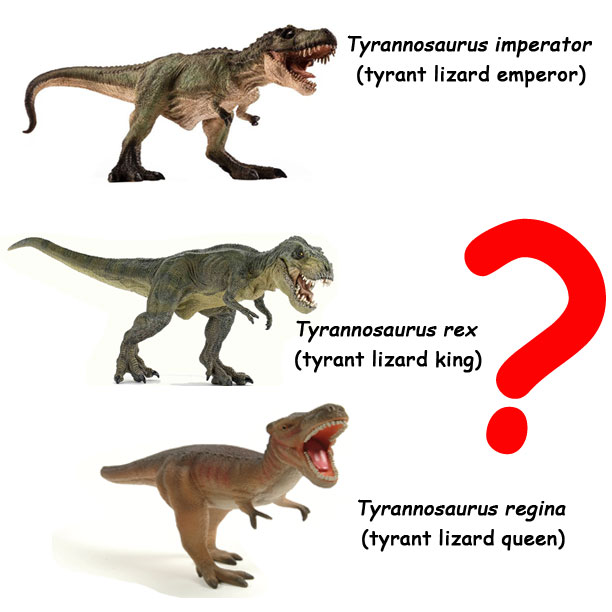
Writing in the academic journal “Evolutionary Biology”, two new Tyrannosaurus species are proposed, a geologically older, robust form newly named Tyrannosaurus imperator that was followed by two further species the already named Tyrannosaurus rex, also a robust tyrannosaur and a contemporaneous gracile form which has been named Tyrannosaurus regina.

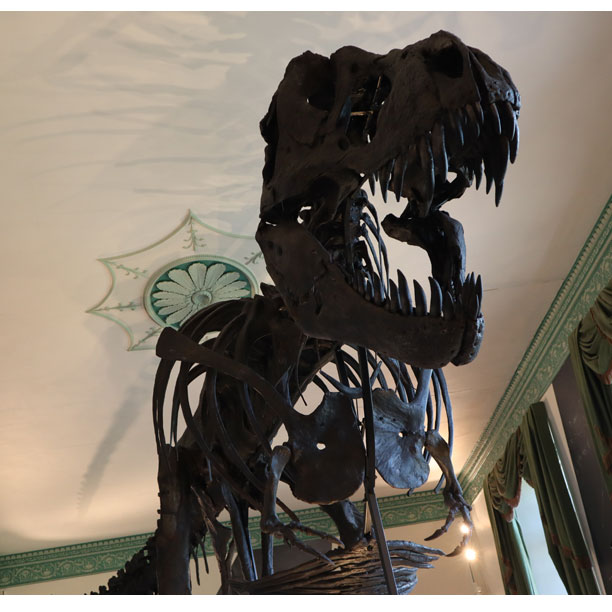
Titus the T.rex exhibit. A T. rex skeleton on display.

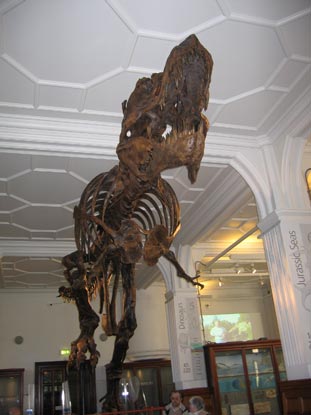
The spectacular Titus the T. rex exhibit at Wollaton Hall. PIcture credit: Everything Dinosaur.

Picture credit: Everything Dinosaur

The Tyrannosaurus Controversy

The fearsome, apex predator Tyrannosaurus rex might be synonymous with the famous Hell Creek Formation, but Tyrannosaurus fossils have also been found in many other Upper Cretaceous deposits (Maastrichtian stage). For example, T. rex fossils or at least indeterminate Tyrannosaurus material is associated with nine other North American geological formations.

T. rex fossils have been found in exposures of the Scollard Formation of south-western Alberta the Frenchman Formation of southern Saskatchewan and south-eastern Alberta. This suggests that this large theropod roamed northern areas of Laramidia. Tyrannosaurus fossils from the Laramie Formation exposures in Colorado have been assigned to Tyrannosaurus rex. T. rex fossil material has been reported from much further south, from the Javelina Formation of Texas.

With only one species of Tyrannosaurus (T. rex), the fossil evidence as classified so far indicates that the “tyrant lizard king” had a huge geographical distribution, virtually the entire ancient landmass of Laramidia.

Furthermore, these deposits represent vast amounts of geological time. The Hell Creek Formation is believed to have been formed over two million years and as scientists have now concluded that other iconic taxa such as Triceratops evolved over this time period into new species, then surely T. rex would have been subject to the same evolutionary pressures.

"Scotty" the Tyrannosaurus rex.

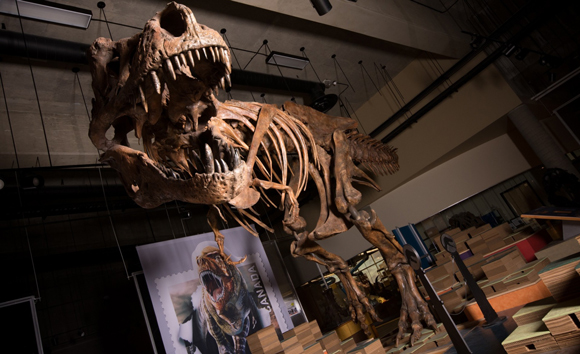
A reconstruction of the skeleton of “Scotty” the T. rex. The fossils come from the Frenchman Formation of Saskatchewan (Canada) and one of the authors of the scientific paper published in the journal the Anatomical Record was Scott Persons who is a co-author of the new paper describing three Tyrannosaurus taxa. Picture credit: Amanda Kelley.

Picture credit: Amanda Kelley.

Analysis of Limb Bones (Femora)

A total of thirty-seven fossil specimens were studied by the researchers. Two-thirds of these had femora (thigh bones) associated with them and the scientists found differences in the thickness and robustness of these bones, that were unlikely a result of individual variation within a single species. In the sample studied, Gregory S. Paul and his colleagues found greater variation in femur robustness in the T. rex thigh bone material than in the whole of the other tyrannosaurid femora material known from the preceding ten million years.

The team discounted size variations based on maturity, ontogeny (growth pattern) and the age of the Tyrannosaurus when it died. Robust forms and more gracile forms of T. rex have been known for some years. Some palaeontologists have speculated that the smaller, more slender bones of some T. rex specimens compared to the more robust femora of other specimens might be explained as differences in the sexes.

If robust forms represent females, and gracile forms males, then it would be expected that the fossil record would show roughly even numbers of these bone types. However, the research team point out an uneven ratio of robust bones to gracile bones and as such they discount the differences as sexual variation.

In addition, the team report that gracile bones are only found in higher layers of sediment. These bones are geologically much younger than other more robust T. rex bones associated with lower layers.

Tyrannosaurus rex cast skeleton on display

Which Tyrannosaurus species? A cast of the T. rex specimen known as “Stan” (BHI 3033), but researchers propose that there were actually three species of Tyrannosaurus present in the Late Cretaceous of North America. Picture credit: Everything Dinosaur.

Picture credit: Everything Dinosaur

Differences in Tooth Count

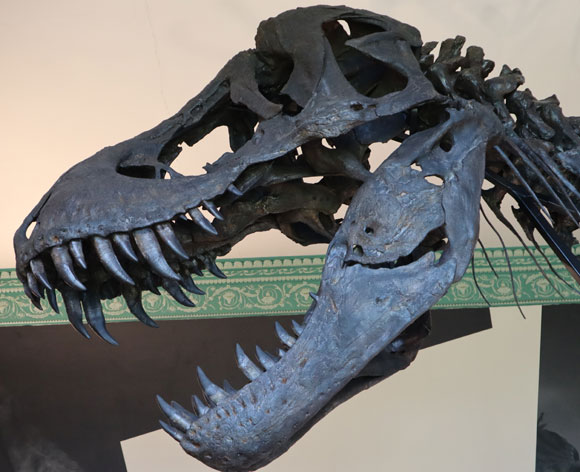
The scientists also commented on differences in tooth counts associated with Tyrannosaurus lower jaws (the dentary). Tyrannosaurus imperator (the earliest Tyrannosaurus species) had two small incisors in each dentary. Whilst the later species (T. regina and T. rex) had only one small incisor in each dentary.

Titus the T. rex Skull and Jaws. Dinosaur extinction.

The research team identified differences in the number of small incisor-like teeth in the lower jaw which they concluded was further evidence of the T. rex fossil material actually representing a trio of Tyrannosaurus species. Picture credit: Everything Dinosaur.

Picture credit: Everything Dinosaur

The researchers concede that they cannot rule out other explanations for their findings. Several palaeontologists have challenged the paper, stating that the variations seen in the fossils could be explained by factors such as individual variation amongst individuals of a single species. Like many dinosaurs, Tyrannosaurus rex changed radically as it grew and matured, this aspect of dinosaur taxonomy is going to be debated for a considerable time to come.

For fans of dinosaur models, does this mean that collectors will have to reassess their Tyrannosaurus rex models?

Three Tyrannosaurus species proposed.

Which Tyrannosaurus species are you? A newly published scientific paper proposes three Tyrannosaurus species. Picture credit: Everything Dinosaur.

Picture credit: Everything Dinosaur

The scientific paper: “The Tyrant Lizard King, Queen and Emperor: Multiple Lines of Morphological and Stratigraphic Evidence Support Subtle Evolution and Probable Speciation Within the North American Genus Tyrannosaurus” by Gregory S. Paul, W. Scott Persons IV and Jay Van Raalte published in Evolutionary Biology.

Visit the award-winning Everything Dinosaur website: Everything Dinosaur.
27 02, 2022

A New Book is Published – A Time Traveller’s Guide to Fossil Hunting on the West Dorset Coast

By |2024-10-26T16:20:30+01:00February 27th, 2022|Categories: Adobe CS5, Book Reviews, Dinosaur Fans, Geology, Photos/Pictures of Fossils|0 Comments

When visiting Lyme Regis and other parts of the Jurassic Coast we are often aghast at the huge numbers of fossil hunters to be seen on the beach. We tend to avoid the late summer months as this beautiful part of the Dorset coast will have been virtually picked clean of all the fossil material. The tide might continue to wash out the remains of creatures from an Early Jurassic sea, but the enthusiastic holidaymakers and tourists soon make short work of whatever has been deposited on the beach.

Sitting on some large rock, comfortably away from the dangerous cliffs, with a flask of tea and a local pastie to sustain us, we are often approached by beachcombers curious to ask our advice or to receive assistance in identifying their finds. Diligently and politely, we offer what assistance we can, but amongst the hubbub we often think what it would have been like to have explored the foreshore in earlier times, before this stunning coastline became a haven for tourists.

Thanks to a new, delightful book by Steve Snowball and Craig Chivers, we have the opportunity to do so.

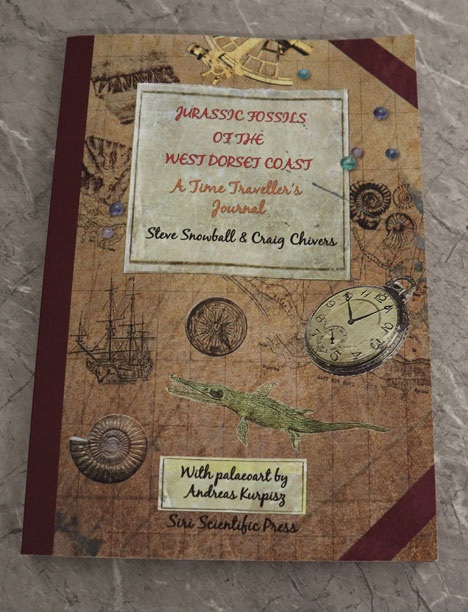
Front cover of "Jurassic Fossils of the West Dorset Coast"

A time traveller’s guide to fossil hunting on the west Dorset coast. A fantastic collector’s guide written in the form of an Edwardian diary with wonderful illustrations and photographs. Written by renowned fossil hunters and preparators Steve Snowball and Craig Chivers and available from Siri Scientific Press. Picture credit: Everything Dinosaur.

Picture credit: Everything Dinosaur

“Jurassic Fossils of the West Dorset Coast – A Time Traveller’s Journal”

The fourth collaboration between devoted fossil hunters Steve Snowball and Craig Chivers takes the form of an Edwardian diary. Imagine finding on the beach at Charmouth an old journal that catalogues the visit of two Edwardian gentlemen to the west Dorset coast at the beginning of the 20th Century. Starting at Seatown and Golden Cap, the two explorers record the geology, the fossil discoveries and the Dorset landscape over a period of eight days, culminating with a trip to Pinhay Bay where the strata records the boundary between the Triassic and the Jurassic.

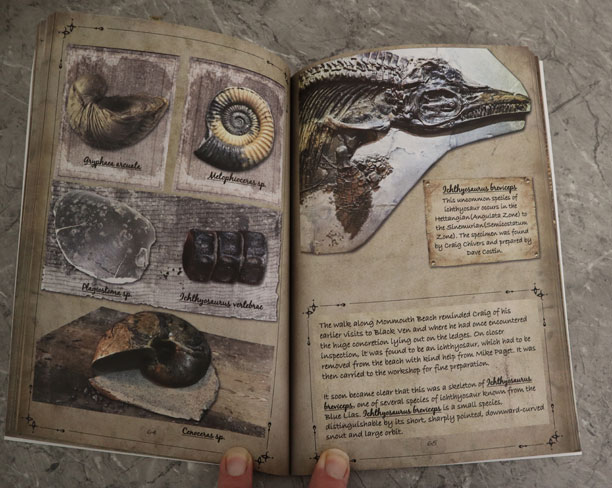
"Jurassic Fossils of the West Dorset Coast" contents

Photographs of fossil finds plus lots of helpful notes – a time traveller’s guide to the west Dorset coast. Picture credit: Everything Dinosaur.

Picture credit: Everything Dinosaur

The Everything Dinosaur website: Everything Dinosaur.

Illustrations by Andreas Kurpisz

Produced by Siri Scientific Press and with illustrations by Berlin-based artist Andreas Kurpisz, this is a novel and quirky guide to fossil hunting on the west Dorset coast. There is a copious amount of helpful information provided on each location, with notes and lots of photographs of fossils associated with the site. Talented artist Andreas Kurpisz provides colourful illustrations depicting prehistoric scenes – there are even one or two dinosaurs featured.

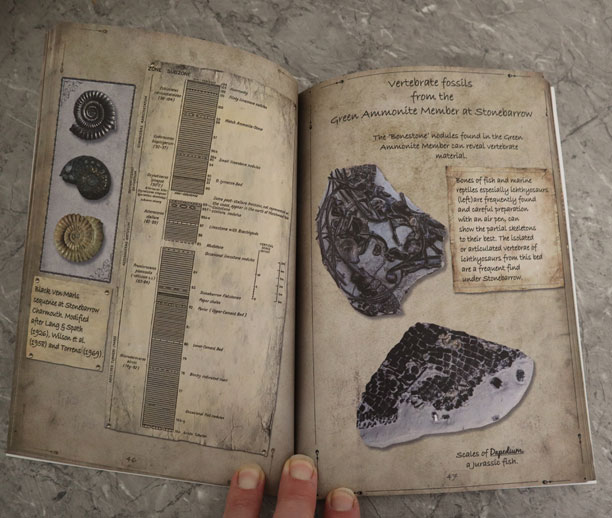
At around 160 pages long, this is a most informative guide, we particularly enjoyed examining the biostratigraphical maps provided and the accompanying images of strata – all helpfully labelled. Priced as we write at £19.99 plus postage and available from the Siri Scientific Press website this is a welcome and imaginative addition to the plethora of fossil hunting guidebooks that address the amazing geology of the Dorset coast.

"Jurassic Fossils of the West Dorset Coast"

Written in the form of an Edwardian gentleman’s journal, the book is packed with helpful information, fossil hunting tips and wonderful photographs of fossil discoveries. Picture credit: Everything Dinosaur.

Picture credit: Everything Dinosaur

Bringing the Past to Life

“Jurassic Fossils of the West Dorset Coast – A Time Traveller’s Journal” helps to bring the past to life and provides an echo of a time when the beaches around Lyme Regis were less busy and undoubtedly more productive. However, armed with this guide your chances of finding an incredibly special fossil are greatly enhanced.

The book concludes with our courageous Edwardian explorers coming across evidence of another visitor to the “Jurassic Coast”, this time from the 21st century. The gentlemen have been left notes on how to prepare ammonites for display from a kind-hearted collector from our own time. This device permits the authors to segue into a section of the book that provides helpful tips and advice on modern tools such as air scribes that will assist collectors with fossil preparation.

Visit Siri Scientific Press and use the search word “Jurassic” to find the books about Dorset written by Steve Snowball and Craig Chivers including the excellent “Jurassic Fossils of the West Dorset Coast – A Time Traveller’s Journal”: Siri Scientific Website.

25 02, 2022

Giant Trilobite was a Cannibal According to New Research

By |2024-10-26T16:09:23+01:00February 25th, 2022|Categories: Adobe CS5, Dinosaur and Prehistoric Animal News Stories, Dinosaur Fans, Main Page, Palaeontological articles, Photos/Pictures of Fossils|0 Comments

Researchers have conducted an extensive review of injured trilobites and disarticulated pieces of trilobite exoskeleton from the Emu Bay Shale Konservat-Lagerstätte on Kangaroo Island (South Australia). They conclude that the injuries caused to Redlichia trilobites were from attacks by other members of this genus. This is the oldest record of cannibalism recorded in the fossil record to date.

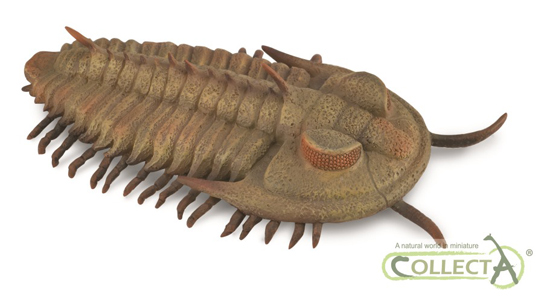
CollectA Redlichia rex trilobite. "First Life"

CollectA Redlichia rex trilobite model.

The picture (above) shows the CollectA Redlichia rex trilobite model.

To view this range of prehistoric animal figures: CollectA Prehistoric Life Models.

A Study of Redlichia Fossils from the Emu Bay Shale

The Cambrian explosion represents the rapid emergence of complex marine ecosystems and a huge burst of evolutionary activity that led to the establishment of virtually all the Animalia phyla recognised today. Whilst many palaeontologists do not like the phrase “explosion” as it implies a sudden event, opting instead to use the term “Cambrian radiation” to describe the emergence in the fossil record of abundant preserved shells and exoskeletons, the reasons for this change in the Earth’s ecosystems remains controversial.

It is thought that one of the main drivers of this evolutionary event was the development of predator/prey interactions. The proliferation of biomineralised exoskeletons and shells was a response to the evolution of the first predators capable of breaking through these defences.

Writing in the academic journal Palaeogeography, Paleoclimatology, Palaeoecology, researchers from the University of New England, (Armidale, New South Wales), Uppsala University (Sweden), the University of Adelaide (South Australia), the South Australian Museum and Cambridge University conducted an analysis of 38 injured specimens representing two large trilobite species from the 515-million-year-old Emu Bay Shale deposits (Redlichia takooensis and Redlichia rex).

Redlichia rex injuries.

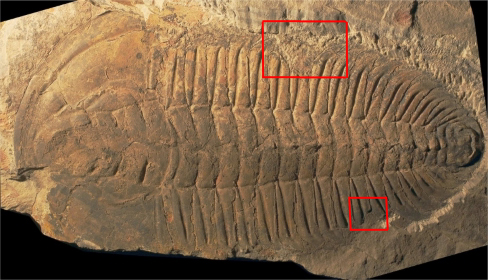
Healed but scarred injuries on a fossil specimen of Redlichia rex. The red squares indicate areas of damage possibly caused by an attack by another Redlichia. Picture credit: Bicknell et al (Palaeogeography, Paleoclimatology, Palaeoecology).

Picture credit: Bicknell et al (Palaeogeography, Paleoclimatology, Palaeoecology)

Studying a Giant Trilobite

The team concluded that that the injuries they documented were caused by a durophagous (consuming hard parts of the skeleton) predator.

Specimens of both species show that most injuries are located on the posterior portion of the thorax, indicating that predators most likely attacked from behind or that intended prey presented the posterior portion of their trunk to the attacker when threatened or attempting to flee. Previous studies had indicated that Cambrian trilobites exhibit most injuries to their right side. This study refutes this, arguing there is no evidence for a preference for attacking either the right or left side of intended prey.

The injured specimens typically represent some of the largest individuals known for the Redlichia taxa. This suggests that bigger trilobites were more successful in fighting off an attack and recovering from their injuries. Smaller individuals were probably completely consumed and therefore the likelihood of finding evidence of an attack on a smaller fossil specimen was greatly reduced.

Redlichia rex trilobite fossil.

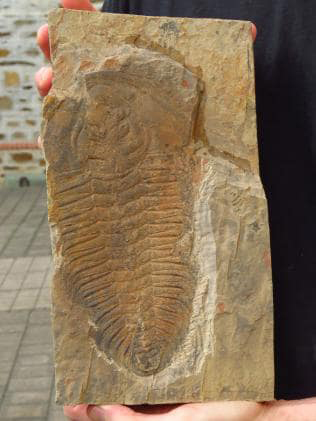
A near complete specimen of the large Cambrian trilobite Redlichia rex. Picture credit: University of Adelaide.

Picture credit: University of Adelaide

Redlichia rex

To read Everything Dinosaur’s blog post about the discovery of Redlichia rex: “King of the Trilobites” Discovered in South Australia.

The research team concludes that the scarred Emu Bay Shale trilobites represent the oldest record of cannibalism known to science.

The scientific paper: “Cambrian carnage: Trilobite predator-prey interactions in the Emu Bay Shale of South Australia” by Russell D. C. Bicknell, James D. Holmes, Stephen Pates, Diego C. García-Bellido and John R. Paterson published in Palaeogeography, Paleoclimatology, Palaeoecology.

Visit the Everything Dinosaur website: Everything Dinosaur.
24 02, 2022

The Last Day of the Mesozoic – It was Boreal Spring

By |2024-10-26T16:04:58+01:00February 24th, 2022|Categories: Dinosaur and Prehistoric Animal News Stories, Dinosaur Fans, Main Page, Palaeontological articles, Photos/Pictures of Fossils|0 Comments

An international team of researchers led by scientists from the Vrije Universiteit of Amsterdam, the Royal Belgian Institute of Natural Sciences (Brussels), Uppsala University (Uppsala, Sweden) in collaboration with colleagues from the European Synchrotron Radiation Facility, (Grenoble, France), have published a scientific paper that concludes the Chicxulub impact event took place in the northern hemisphere spring.

Writing in the academic journal “Nature”, the researchers postulate that the timing of this devastating event could have had a bearing on the types of animals that survived the mass extinction. For example, animals in the Northern Hemisphere spring (boreal spring), could have been rearing young that would have been extremely vulnerable to the dramatic, planet-wide changes. However, in the Southern Hemisphere winter was approaching (austral autumn), many mammals could have been in hibernation or sheltering in a bid to avoid the worst of the approaching wintry weather.

The Culimination of the Mesozoic

The research team postulates that the timing of the Chicxulub impact in boreal spring and austral autumn was a major influence on selective biotic survival across the Cretaceous–Palaeogene boundary.

The Remarkable Tanis Site

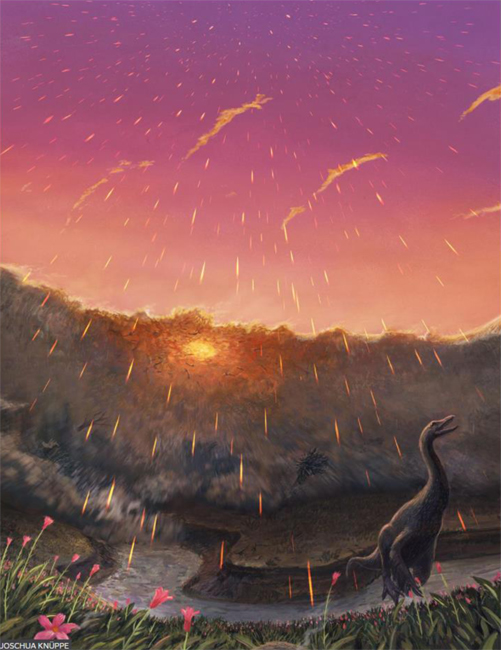
The Tanis Konservat-Lagerstätte preserves the devastation to a river system flowing into the Pierre Seaway (remnants of the Western Interior Seaway). The Tanis site would have been around 2,000 miles away from the impact in the Gulf of Mexico, earthquakes led to an immense water surge (a seiche), that shattered the ecosystem.

Palaeontologists have estimated that this event took place within an hour of the bolide impact. Enormous volumes of sediment engulfed fishes, ammonites and other creatures and buried them alive while impact spherules rained down from the sky.

Tanis Site Destruction

An artist’s impression of the seiche hitting the Tanis location. Picture credit: Joschua Knüppe.

Picture credit: Joschua Knüppe

To read an Everything Dinosaur article from last year (2021), summarising research that came to broadly similar conclusions as this study: Spring/Summer End to the Reign of the Dinosaurs.

Analysing Fish Fossils

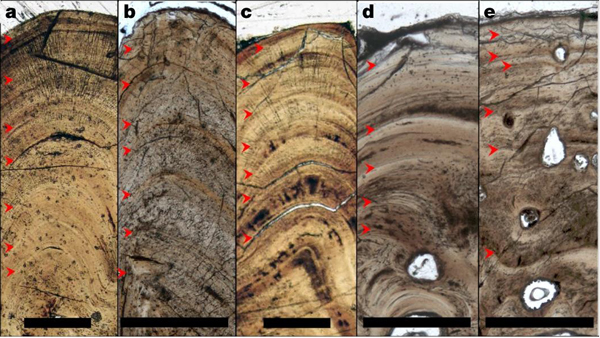
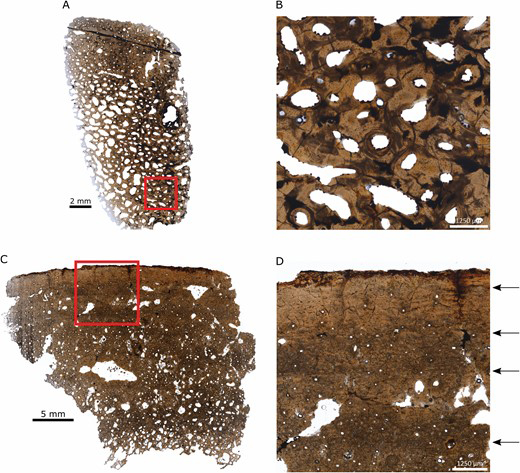
Histological analysis of thin sections of material extracted from six fish fossils found at the site enabled the researchers to conclude that the Tanis Konservat-Lagerstätte was formed in the Northern Hemisphere spring. The fish would have grown rapidly in the spring and summer when food was abundant, but much more slowly during the autumn and winter months when food was scarce.

Lines of arrested growth (LAG) preserved in the fossils show that all the fish (paddlefish and sturgeons) died shortly after beginning a new period of rapid growth. This evidence indicates these fish died in the spring and therefore if the Tanis site is a record of the immediate aftermath of the Chicxulub impact – the bolide must have hit Earth in the boreal spring.

Tanis Fish Bone Histology

Osteohistological thin sections of five fish fossils from the Tanis site. The red arrows indicate LAGs and indicate that these fish died in the spring. Scale bar in images a-e = 0.5 mm. Picture credit: During et al.

Picture credit: During et al

The Last Day of the Mesozoic

BBC Studios Productions have created a special documentary entitled “Dinosaurs: The Final Day” narrated by Sir David Attenborough. The one-off programme, will piece together the events that marked the end of the Mesozoic Era, using evidence from the remarkable Tanis site.

Sir David Attenborough stated:

Dinosaurs were among nature’s most extraordinary creatures, dominating the planet for over 150 million years before they became extinct. Tanis could be a place where the remains can give us an unprecedented window into the lives of the very last dinosaurs, and a minute-by-minute picture of what happened when the asteroid hit.”

The television programme is likely to be broadcast in the spring.

The scientific paper: “The Mesozoic terminated in boreal spring” by Melanie A. D. During, Jan Smit, Dennis F. A. E. Voeten, Camille Berruyer, Paul Tafforeau, Sophie Sanchez, Koen H. W. Stein, Suzan J. A. Verdegaal-Warmerdam and Jeroen H. J. L. van der Lubbe published in the journal Nature.

Visit the Everything Dinosaur website: Everything Dinosaur.
20 02, 2022

New Spinosaur from Portugal

By |2024-10-26T12:53:59+01:00February 20th, 2022|Categories: Adobe CS5, Dinosaur and Prehistoric Animal News Stories, Main Page, Palaeontological articles, Photos/Pictures of Fossils|0 Comments

Scientists have announced the discovery of a new spinosaur species from Portugal. Iberospinus (I. natarioi), from Lower Cretaceous deposits associated with the Papo Seco Formation. Its discovery further supports the theory that these enigmatic theropods originated in western Europe.

Estimated to have been around eight metres in length, Iberospinus is the third spinosaur* to have been described based on fossil material found on the Iberian Peninsula. The scientific description of this taxon reinforces the idea that Iberia was a hotspot for spinosaur biodiversity, with several endemic genera having been identified from fossils found in this region.

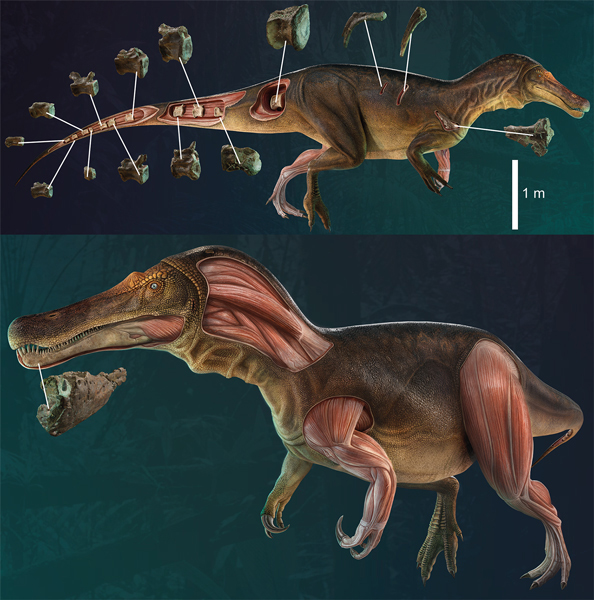
Iberospinus natarrioi reconstruction showing musculature.

Life reconstruction of Iberospinus natarioi (ML1190) showing three-dimensional digitalisation of some of the fossil bones, along with reconstructed musculature. Upper picture – right lateral view; Lower picture – anterolateral left view. Picture credit: Victor Feijó de Carvalho.

Picture credit: Victor Feijó de Carvalho

Iberospinus natarioi “Natário’s Iberian Spine”

Researchers Octávio Mateus and Darío Estraviz-López (NOVA School of Science and Technology, Caparica, Portugal), writing in the open-access journal PLOS One reassessed fossil material, originally found in 1999 and attributed to Baryonyx, combining this new study with an analysis of further fossil material recovered from the excavation site in the summer of 2020.

The scientists, both of whom work at the famous Museu da Lourinhã, Lourinhã (Portugal), identified a number of unique characteristics in the fragmentary fossils that permitted them to propose a new taxon. For example, CT scans revealed Iberospinus has a unique neurovascular system associated with the Meckelian groove in the lower jaw. The anterior portion of the lower jaw has a straight-profile and does not point upwards, an anatomical trait seen in other spinosaurs. The partial pubis is thickened towards its distal end and these autapomorphies permitted the erection of a new taxon

A New Spinosaur from Portugal

Iberospinus has been classified as a basal member of the Spinosauridae as its skeleton shows an intermediate condition between early tetanuran theropods and spinosaurids.

The dinosaur’s genus was inspired by the Roman name for the Iberian Peninsula and “spinus” from the Latin for spine in recognition of the long neural spines associated with spinosaurids. The species name honours amateur fossil collector Carlos Natário, who discovered the holotype fossil (specimen number ML1190) in 1999 and helped to ensure that it was placed within the vertebrate fossil collection of the Museu da Lourinhã.

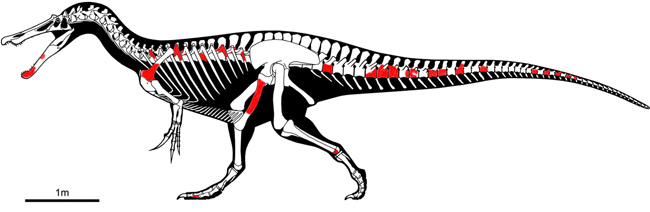
Iberospinus skeletal reconstruction.

A skeletal drawing of the newly described basal spinosaurid Iberospinus natarioi. The red coloured bones represent known fossil material. Note the scale bar = 1 metre. Picture credit: Octávio Mateus and Darío Estraviz-López modified from an original figure by Scott Hartman.

Picture credit: Octávio Mateus and Darío Estraviz-López modified from an original figure by Scott Hartman

Different Spinosaurs Co-existing in the Same Environment.

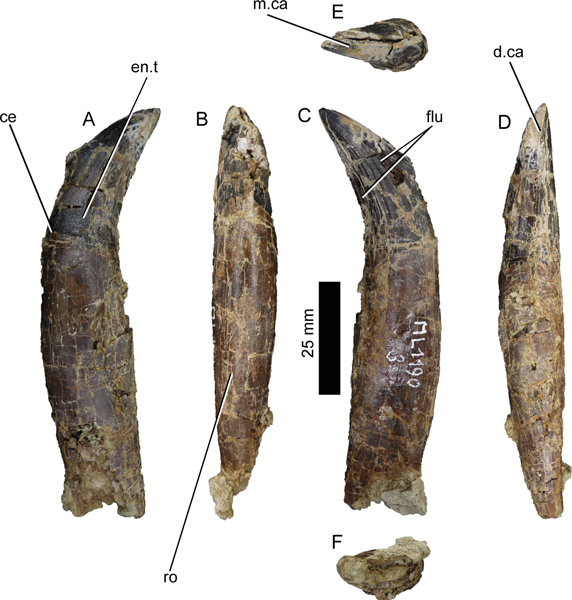
The large tooth complete with root was also described in the scientific paper. It possesses characters associated with the Baryonychinae subfamily of spinosaurs. The tooth crown is strongly recurved whilst more advanced and geologically younger members of the Spinosauridae such as Spinosaurus aegyptiacus tend to have straighter, conical teeth.

This reassessment of Iberian theropod fossil material demonstrates that different spinosaurid taxa co-existed within the same environment. The occurrence of more than one spinosaurid genus in a relatively restricted geographical area has been reported before, most recently with the naming of two new genera of spinosaurs (Riparovenator milnerae and Ceratosuchops inferodios) that co-existed in the Lower Cretaceous of southern England with Baryonyx (B. walkeri).

To read Everything Dinosaur’s earlier article about the recently described Isle of Wight spinosaurs: Two New Spinosaurids Described from the Isle of Wight.

Iberospinus tooth.

Tooth from the upper jaw of I. natarioi (specimen number ML1190-3) in A, lingual, B, mesial, C, lingual, D, distal, E, occlusal, and F ventral views. Note the scale bar = 25 mm. The tooth crown is strongly curved and the tooth morphology is similar to that seen in members of the Baryonychinae. Later spinosaurs had teeth that were straighter. Picture credit: Octávio Mateus and Darío Estraviz-López.

Picture credit: Octávio Mateus and Darío Estraviz-López

Iberian Spinosaurs*

Despite the lack of relatively complete fossil material, specimens collected from the Iberian Peninsula represent one of the best accumulations of spinosaurid fossils found to date. After Baryonyx (B. walkeri) was formally named and described in 1987, several fossils from this region were ascribed to this taxon. However, more recent analysis and further fossil discoveries has led to a revision and at present three contemporaneous spinosaur taxa have been attributed to this region.

  • Camarillasaurus cirugedae – from Teruel Province (north-eastern Spain). Formally named and described in 2014. Previously thought to represent a ceratosaur, now regarded as a member of the Spinosauridae.
  • Vallibonaventrix cani – from the Castellón Province (north-eastern Spain). Named and described in 2019, the taxonomic position of this genus remains uncertain although the current consensus is that the fossils do represent a member of the Spinosauridae family, but there is an on-going debate as to whether Vallibonaventrix is a member of the Baryonychinae or whether it is more closely related to Spinosaurus aegyptiacus.
  • Iberospinus natarioi – newly described (2022, Mateus and Estraviz-López) from the Papo Seco Formation of Cabo Espichel, Sesimbra, Portugal.

The scientific paper: “A new theropod dinosaur from the early cretaceous (Barremian) of Cabo Espichel, Portugal: Implications for spinosaurid evolution” by Octávio Mateus and Darío Estraviz-López published in PLOS One.

Visit the Everything Dinosaur website: Everything Dinosaur.
13 02, 2022

Prehistoric Croc with Dinosaur Remains in its Stomach

By |2024-10-26T11:37:53+01:00February 13th, 2022|Categories: Dinosaur and Prehistoric Animal News Stories, Dinosaur Fans, Main Page, Palaeontological articles, Photos/Pictures of Fossils|0 Comments

Scientists have announced the discovery of a new genus of crocodyliform from the Late Cretaceous Winton Formation of Queensland, Australia. Named Confractosuchus sauroktonos it is only the second crocodyliform known from the Cenomanian-aged Winton Formation and remarkably, the last meal of this predator has been preserved. The abdominal contents consist of the partial remains of a juvenile ornithopod, thus providing the first evidence of crocodile/dinosaur predation in Australia.

Furthermore, the ornithopod bones represent the first skeletal remains of this group reported from the Winton Formation, previously only known from tracks and shed teeth, the unfortunate dinosaur that was eaten by Confractosuchus may represent a new taxon.

Confractosuchus sauroktonos attacks a juvenile ornithopod.

A life reconstruction of Confractosuchus sauroktonos capturing the juvenile ornithopod. Picture credit: Dr Matt White/Australian Age of Dinosaurs Museum.

Picture credit: Dr Matt White/Australian Age of Dinosaurs Museum

“Prehistoric Croc” High Resolution Scans Reveal Delicate Fossil Bones

The crocodile specimen consisting of a nearly complete skull with post-cranial material representing about 35% of the total skeleton was discovered in 2010, on the Elderslie Station near to the town of Winton (Queensland). A field team was excavating the remains of a titanosaur and during the removal of the overburden the crocodile fossil material was found. Unfortunately, the concretion containing the fossil was partly crushed by an excavator. The small bones contained within the concretion were too fragile to be removed from the hard stone surrounding them so the object was subjected to neutron and synchrotron X-ray micro-computerised tomography so their details could be revealed.

Confractosuchus skull fossil.

The skull of the newly desribed Confractosuchus sauroktonos, only the second crocodyliform to be described from Winton Formation fossils. Picture credit: Australian Age of Dinosaurs Museum.

Picture credit: Australian Age of Dinosaurs Museum

“Broken Lizard Killer”

The diet of fossil crocodyliforms are usually inferred based on distinctive bite marks on fossil bone, although it has long been suspected that just like their extant relatives, ancient crocodiles would have preyed upon a wide variety of other animals. This fossil specimen indicates that young dinosaurs were on the menu for Confractosuchus.

The genus name of the new taxon is derived from Confractus which means “broken” in Latin, a reference to the shattered concretion in which the fossil material was preserved and suchus from the Greek for the Egyptian crocodile god Sobek. The species name is also from the Greek meaning “lizard”, a common word used as a suffix for the Dinosauria and ktonos meaning “killer”.

Although the tail and hind legs were missing, the researchers estimate that this Confractosuchus preshistoric croc individual was around 2.5 metres long, but it was not fully grown. Analysis of the teeth and jaws suggest that it probably had a similar diet to an extant caiman, it probably did not specialise in hunting and killing young dinosaurs, but it would not have turned down the opportunity of catching a young dinosaur or scavenging a corpse.

Analysis of the ornithopod fossils suggest that the crocodile either directly killed the dinosaur or scavenged it quickly after its death.

Confractosuchus sauroktonos is only the second crocodyliform to be named and described from fossils found in Winton Formation strata. The related but much smaller Isisfordia duncani was named and described in 2006.

Confractosuchus sauroktonos from Queensland

The concrection (left) that when subjected to high resolution tomography revealed the remains of a juvenile ornithopod within the crocodyliforms body cavity. Picture credit: White et al.

Picture credit: White et al

Both C. sauroktonos and I. duncani have been classified as members of the Eusuchia clade of crocodyliforms. As such, they are distantly related to modern caiman, alligators, gharials and crocodiles as all living crocodyliforms are also eusuchians.

The scientific paper: “Abdominal contents reveal Cretaceous crocodyliforms ate dinosaurs” by Matt A. White, Phil R. Bell, Nicolás E. Campione, Gabriele Sansalone, Tom Brougham, Joseph J. Bevitt, Ralph E. Molnar, Alex G. Cook, Stephen Wroe and David A. Elliott published in Gondwana Research.

The Everything Dinosaur website: Prehistoric Animal Toys.

10 02, 2022

New Research Giving the Arthropoda a Leg Up

By |2024-10-24T08:23:19+01:00February 10th, 2022|Categories: Adobe CS5, Dinosaur and Prehistoric Animal News Stories, Main Page, Palaeontological articles, Photos/Pictures of Fossils|0 Comments

A University of Manchester researcher in collaboration with a team of international scientists from China, Sweden and Switzerland has helped invertebrate palaeontologists to resolve the puzzle of how arthropods evolved gills. Dr David Legg from the Department of Earth, Atmospheric, and Environmental Sciences and his co-authors have published a scientific paper this week that describes a new genus of ancient marine arthropod from the Chengjiang biota of Yunnan Province, China. The newly described Erratus sperare swam in a shallow tropical sea some 518 million years ago (stage 3 of the Cambrian). At around 3 centimetres in length, it was no giant, but it represents a giant leap forward in the evolution of the Arthropoda.

Erratus sperare life reconstruction

A life reconstruction of the Cambrian Erratus sperare which has helped palaeontologists to improve their understanding of the origin of gills in the Arthropoda. Picture credit: University of Manchester.

Picture credit: University of Manchester

The Evolution of Biramous Limbs

Extant water dwelling arthropods and their extinct counterparts such as the trilobites have biramous limbs, legs that have two distinct parts or branches – one for breathing and one for walking. The inner branch is known as the endopod and the outer branch is called the exopod, together these two branches form the marine arthropod limb.

How such specialised limbs evolved was a mystery. Some of the earliest fossil arthropods, like Anomalocaris, had swimming flaps that may have doubled as gills, but until now researchers didn’t know how arthropods made the jump from these specialised flaps to the biramous limbs of modern arthropods.

CollectA Anomalocaris

The CollectA Anomalocaris model. A fantastic replica of an early apex predator. The CollectA Anomalocaris (Other Prehistoric Animal Models).

The picture (above) shows a model of an Anomalocaris, a large Cambrian predator.  This model is part of the CollectA range.

To view the CollectA range of prehistoric animal figures: CollectA Prehistoric Life Models.

Erratus sperare – A Transitional Form

Erratus sperare fossils come from the UNESCO World Heritage Site located in Yunnan Province, China. The Maotianshan shales exposed in Chengjiang County preserve a record of a Cambrian marine community that existed several million years before the Burgess Shales of British Columbia were laid down. The highly fossiliferous strata have yielded at least 196 different species, with both hard parts and soft tissues preserved.

E. sperare appears to be a transitional form, it provides a missing link between arthropods that used specialised flaps such as Anomalocaris and arthropods with biramous limbs. It has both legs and flaps.

Erratus sperare fossils and explanatory line drawing.

Erratus sperare gen. et sp. nov. from the early Cambrian (Series 2, Stage 3), Chengjiang Lagerstätte, China. The fossils are approximately 518 million years old. Photograph (a) NWUS92-310, specimen formerly referred to Isoxys auritus note the carapace with short anterior spine and covering the seven most anterior body segments; the flap margin without setae (arrows); (b) details of flap 6–7; note the smooth margin. XDBZ102 (c), the complete carapace (Ca) of E. sperare in dorsal view, showing anterior spine and straight posterior margin; (d) line drawing of (a) showing cardinal spine (Cs), ventral eyes (Ey) with stalk (Es), and flaps 1–11; the ventral endopods (En) are present in the anterior trunk. Scale bars, 2 mm for (b) and 1 cm for others. Picture credit: Fu et al.

Picture credit: Fu et al

Explaining the significance of this fossil discovery, Dr David Legg commented:

“Fish aren’t the only organisms that have gills! Arthropods have gills too… they just have them on their legs. When it came to arthropods, however, we just weren’t sure where these gills came from. Thanks to this new fossil, Erratus sperare, we now have a much clearer idea. These gills also probably went on to evolve into the wings of insects and the lungs of terrestrial arthropods like spiders so were a very important innovation.”

Everything Dinosaur acknowledges the assistance of a media release from the University of Manchester in the compilation of this article.

The scientific paper: “The evolution of biramous appendages revealed by a carapace-bearing Cambrian arthropod” by Dongjing Fu, David A. Legg, Allison C. Daley, Graham E. Budd, Yu Wu and Xingliang Zhang published in Philosophical Transactions of the Royal Society B.

Visit the Everything Dinosaur website: Everything Dinosaur.
9 02, 2022

A New Super-predator from the Middle Triassic

By |2024-10-24T08:15:41+01:00February 9th, 2022|Categories: Adobe CS5, Dinosaur and Prehistoric Animal News Stories, Dinosaur Fans, Main Page, Palaeontological articles, Photos/Pictures of Fossils|0 Comments

Scientists from the University of Birmingham, Virginia Tech (USA) and the London Natural History Museum have described a new super-predator from the Middle Triassic of Tanzania. The ancient archosaur, a very distant relative of modern crocodiles, has been named Mambawakale ruhuhu, with a skull estimated to be around 75 cm long and a total body length of around 5 metres, Mambawakale is one of the largest terrestrial carnivores known from this period in Earth’s history.

Originally referred to as Pallisteria angustimentum, with the genus name honouring geologist John Weaver Pallister OBE (1912–1985), the researchers writing in the open-access journal Royal Society Open Science, wanted to acknowledge the contribution of local scientists and field team members from Tanzania and Zambia. Once it had been established that the fossils represented a new taxon, advice was sought and the genus name Mambawakale (from the regional Kiswahili language meaning “ancient crocodile”) was erected.

Photographs of the skull of Mambawakale ruhuhu (Holotype)

Photographs of the skull of Mambawakale ruhuhu (NHMUK R36620) in right lateral view (a) and left lateral view (b). Note scale bar = 100 mm. Picture credit: Butler et al.

Picture credit: Butler et al

The Manda Beds of Tanganyika (Tanzania)

The first, major collection of Triassic fossils from the Middle Triassic Manda Beds exposed in the Ruhuhu Basin of southern Tanzania took place in the 1930s. The research was led by the British geologist Gordon Murray Stockley. At the time Tanganyika was still part of the British Empire and the fossils were removed to the UK, Europe and to South Africa (an independent dominion of the British Empire). The archosaur fossils were studied by Alan Charig in the late 1950s, but this work was not published until after his death in 1997.

In 1963, two years after Tanganyika gained independence and was renamed Tanzania, Alan Charig participated in a British Museum (Natural History Museum) expedition to the region to find more archosaur material. This expedition was heavily reliant on Tanzanians and Zambians who helped excavate fossils, locate dig sites and built roads to permit transport of the fossils. Sadly, the efforts of these people were not recognised in published reports and no Tanzanians or Zambians were named in the publications.

The Mambawakale material consisting of a partial skull, lower jaw, cervical vertebrae and the bones from the left hand (manus), was one of the last sets of fossils from the 1963 expedition to be studied. Once the researchers had identified that these fossils represented a new genus, they wanted to recognise the previously little acknowledged contributions of the Africans, hence, the reference to the Kiswahili language for the genus name. The species epithet makes reference to the Ruhuhu Basin.

Mambawakale left manus

Left hand (manus) of the newly described pseudosuchian archosaur Mambawakale ruhuhu (specimen number NHMUK R36620). Picture credit: Butler et al.

Picture credit: Butler et al

One of the Oldest Known Archosaurs

The large skull and heterodont dentition in the anterior portion of the upper jaw, indicate that Mambawakale was a powerful animal and a formidable carnivore.

Corresponding author Richard Butler, Professor of Palaeobiology at the University of Birmingham stated:

“Mambawakale ruhuhu would have been a large and terrifying predator, which roamed across Tanzania some 240 million years ago. At around 5 metres long, it’s one of the largest predators that we know of from this period.”

Analysis of the skull led to the identification of cranial autapomorphies (unique characteristics) that permitted the research team to erect a new genus. The Mambawakale material can be confidently distinguished from all other Manda Bed archosaurs, with the possible exception of the probably very closely related Stagonosuchus nyassicus for which direct comparisons are not possible due to the lack of overlapping fossil bones.

Photographs of the skull of Mambawakale ruhuhu in (a) dorsal view and (b) ventral view

Photographs of the skull of Mambawakale ruhuhu in (a) dorsal view and (b) ventral view. Specimen number NHMUK R36620, note scale bar = 100 mm. Picture credit: Butler et al.

Picture credit: Butler et al

Professor Butler went onto add:

“Our analysis identifies Mambawakale as one of the oldest known archosaurs and an early member of the lineage that eventually evolved into modern crocodilians. It’s an exciting discovery, because identifying this animal helps us to understand the rapid early diversification of archosaurs and enables us to add a further link to the evolutionary story of modern-day crocodiles.”

Mambawakale ruhuhu life reconstruction

Life reconstruction of the newly described pseudosuchian Mambawakale ruhuhu. Only the skull, elements from the jaw and fragmentary postcranial material are known so the body shape has been created based on better-known, large pseudosuchian relatives. Picture credit: Gabriel Ugueto.

Picture credit: Gabriel Ugueto

Dating the Manda Beds

Tetrapod fossils associated with the Manda Beds have led palaeontologists to propose that the deposits date from the Anisian stage of the Middle Triassic, however, the age of these rocks remains in dispute. Some recent papers have suggested that the rocks, and therefore the fossils contained therein are actually younger and that the strata were laid down in the Late Triassic (Carnian stage).

Everything Dinosaur acknowledges the assistance of a media release from the University of Birmingham in the compilation of this article.

The scientific paper: “A new pseudosuchian archosaur, Mambawakale ruhuhu gen. et sp. nov., from the Middle Triassic Manda Beds of Tanzania” by Richard J. Butler, Vincent Fernandez, Sterling J. Nesbitt, João Vasco Leite and David J. Gower published in Royal Society Open Science.

The Everything Dinosaur website: Prehistoric Animal Models.

Go to Top