All about dinosaurs, fossils and prehistoric animals by Everything Dinosaur team members.

Pictures of fossils, fossil hunting trips, fossil sites and photographs relating to fossil hunting and fossil finds.

5 02, 2022

A Remarkable Miocene Fish Skull Fossil Filled with Fossil Worm Poo

By |2024-10-23T07:18:40+01:00February 5th, 2022|Categories: Adobe CS5, Dinosaur and Prehistoric Animal News Stories, Main Page, Palaeontological articles, Photos/Pictures of Fossils|0 Comments

The famous marine sediments of the Chesapeake Group, which outcrops across North Carolina, Delaware, Virginia and Maryland in the USA are regarded as some of the most extensively studied Cenozoic marine deposits in the world. The first fossil described from North America (Ecphora quadricostata) a marine snail which was scientifically described in 1685, comes from deposits associated with the Chesapeake Group (St Marys Formation)

A Miocene Fish Fossil

Many different types of fish and marine invertebrates have been named from fossils found at locations such as the Calvert Cliffs on the western shore of Chesapeake Bay (Maryland). Cetacean fossil material is also associated with these strata, along with sea cows and many seabirds such as gannets and fulmars. Marine turtles and the remains of land tortoises and freshwater crocodiles are also known.

A researcher from the Calvert Marine Museum (Maryland), is one of the authors of a recently published scientific paper that highlights a first for these Miocene-aged deposits. The partial skull of a fish has been found crammed full of tiny, fossil poo probably created by scavenging worms that once feasted on the head of the fish.

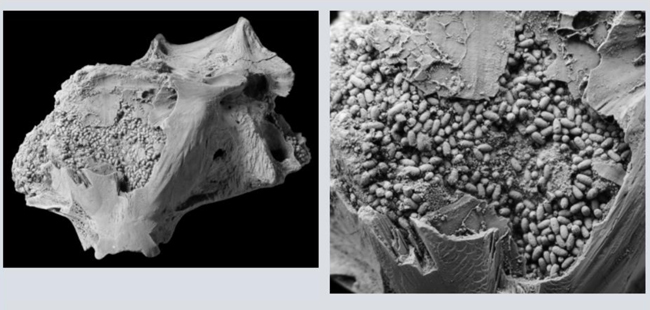
Invertebrate faecal matter in fossil fish braincase.

Photograph (left) of the partial skull of the Miocene Stargazer fish (ventral view). Some of the bone has broken away revealing hundreds of fossilised faecal pellets filling the braincase. A close-up view of the faecal matter (right). Picture credit: Calvert Marine Museum.

Picture credit: Calvert Marine Museum

Stargazer Skull (Astroscopus spp.)

The specimen represents the first skull completely infilled with faecal pellets ever recorded, the fossil poo (micro-coprolite) is an example of the coprulid ichnospecies Coprulus oblongus. The pellets range in size from 1 mm to 5 mm in length and the skull comes from a Stargazer fish (Astroscopus), a genus of bottom living fish that bury themselves in soft sediment lying in wait to ambush small fish and invertebrates that come within striking distance.

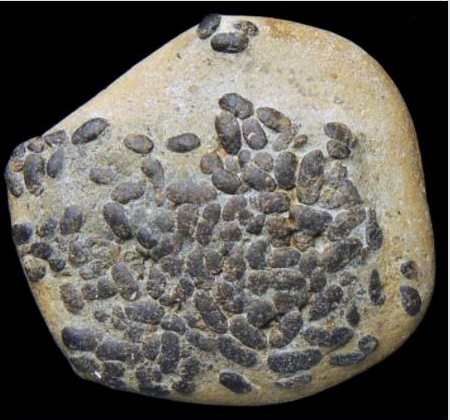
Miocene coprolite fossil.

A fossil of worm faecal pellets from Miocene-aged deposits from southern Maryland (USA). Each pellet is approximately 3 millimetres in length. Picture credit: Calvert Marine Museum.

Picture credit: Calvert Marine Museum

Crocodile Coprolites Studied Too

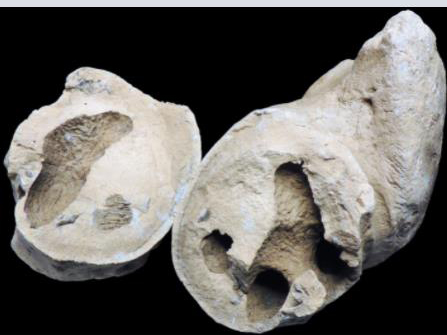
Writing in the academic journal “Rivista Italiana di Paleontologia e Stratigrafia”, the researchers also describe a series of trace fossils found in preserved crocodile coprolite from the Miocene Calvert Formation. The fossil crocodile poo was tunnelled into, presumably evidence of the faeces being consumed (coprophagy). The scientists are unable to identify the organism(s) responsible for producing the burrows although the sides of the burrows preserve evidence of scratches which are thought to be feeding traces.

Crocodile coprolite fossil with feeding traces.

Crocodile coprolite broken open showing trace fossil burrows made by a coprophagus organism. Feeding gouge marks can be seen on the walls of the burrow. Length of crocodile coprolite 17.5 cm approximately. Picture credit: Calvert Marine Museum.

Picture credit: Calvert Marine Museum

Whilst these remarkable fossils might not be as awe-inspiring as the whale bones that have been found in these rocks, they provide important evidence with regards to the recycling of nutrients from faecal matter in Miocene-aged marine environments.

The scientific paper: “Coprolites from the Calvert Cliffs: Miocene fecal pellets and burrowed crocodilian droppings from the Chesapeake Group of Maryland, USA” by Stephen J. Godfrey, Alberto Collareta and John R. Nance published in Rivista Italiana di Paleontologia e Stratigrafia.

4 02, 2022

Ice Age Animal Remains Found in Devon

By |2024-10-23T07:08:51+01:00February 4th, 2022|Categories: Adobe CS5, Dinosaur and Prehistoric Animal News Stories, Main Page, Photos/Pictures of Fossils|0 Comments

The remains of several different types of Ice Age mammal that inhabited south-western England have been recovered from a cave in Devon. The fossils, which are estimated to be between 30,000 and 60,000 years old provide scientists with a unique perspective on the fauna that existed during the Devensian, or the Last Glacial Period (LGP). Although ice sheets did not reach south-western England, Devon would have experienced extreme cold, tundra-like conditions.

Animal remains found in the cave include the partial remains of a Woolly Mammoth (Mammuthus primigenius), bones from a Woolly Rhinoceros (Coelodonta antiquitatis), the skeleton of a wolf, plus hyena, red fox, horse, reindeer and mountain hare fossils.

Ice Age Prehistoric Animal Remains found in Devon

The jumbled up bones of Ice Age animals found in a Devon cave. Picture credit: Historic England.

Picture credit: Historic England

An “Exceptional” Fossil Site

A substantial new town consisting of over 5,000 new houses and related infrastructure is being built close to Plymouth. The Sherford Consortium, the developers, state that the cave was located close to old lime kilns and Sherford Quarry. Commenting on the significance of the discovery, Duncan Wilson, Chief Executive of Historic England stated that these fossils were “exceptional” and added:

“To have found partial remains of such a range of species here in Devon gives us a brilliant insight into the animals which roamed around Ice Age Britain thousands of years ago, as well as a better understanding of the environment and climate at the time.”

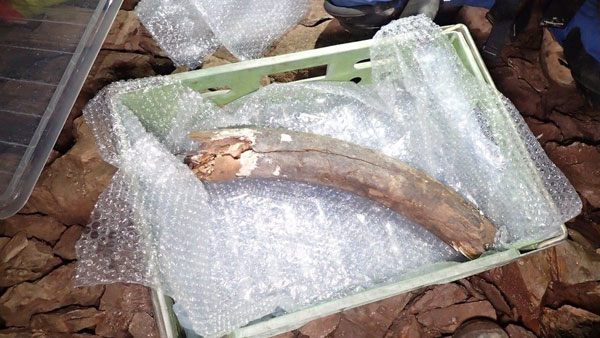
Mammoth Tusk from the Devon Cave

Part of a mammoth tusk carefully being packed into a box for transport off the dig site. Picture credit: AC Archaeology.

Picture credit: AC Archaeology

Ice Age Animal Remains

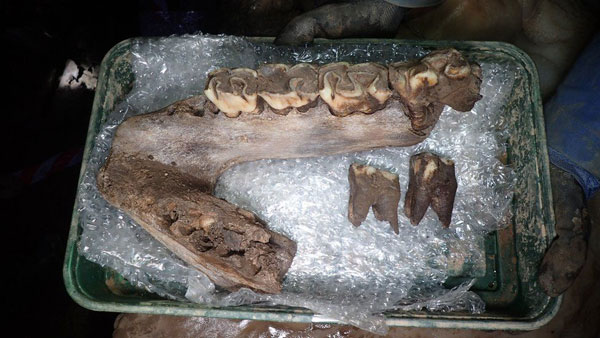
A team of experts have been brought in to carefully document and record the fossil finds. The fossils, including an exceptionally preserved lower jaw from a Woolly Rhinoceros (C. antiquitatis), are currently being studied. It is hoped that this collection of Ice Age remains will be able to stay in the county, with the most likely final destination for the fossils being “The Box”, a recently opened museum in Plymouth close to the University.

Woolly rhino jaw with dentition.

A lower jaw from a Woolly Rhinoceros with some teeth in situ with two additional teeth. Picture credit: AC Archaeology.

Picture credit: AC Archaeology

The Mammoth Gallery

Proposals have been made to put the fossils on permanent display in the Mammoth Gallery of The Box Museum. Plymouth’s former Museum and Art Gallery was re-opened as “The Box” in 2020 following extensive development and renovation. The Mammoth Gallery at the museum explores the natural history of Devon and includes many fossil specimens of the Ice Age fauna associated with south-western England.

The excavation and removal of the fragile fossils involved specialist archaeologists such as those from AC Archaeology, independent archaeological consultants and contractors who provide advice on historic environment issues to developers, local authorities and national bodies.

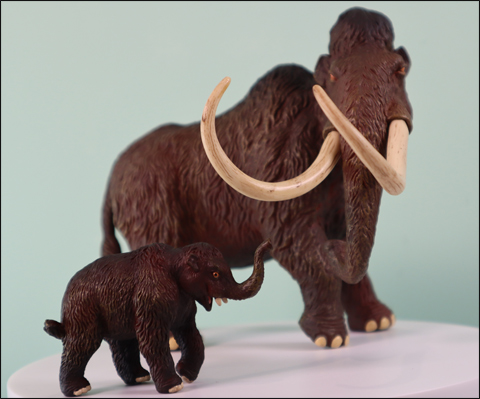
CollectA Woolly Mammoth models.

The CollectA Deluxe Woolly Mammoth model in 1:20 scale and the CollectA Prehistoric Life Woolly Mammoth calf. Woolly Mammoths roamed Devon. Picture credit: Everything Dinosaur.

Picture credit: Everything Dinosaur

1 02, 2022

Rare Dinosaur Tracksite Damaged by Construction Crew

By |2024-10-22T21:40:18+01:00February 1st, 2022|Categories: Dinosaur and Prehistoric Animal News Stories, Dinosaur Fans, Main Page, Palaeontological articles, Photos/Pictures of Fossils|0 Comments

Reports emerged over the weekend that a hugely significant dinosaur tracksite near to Moab in Utah had been damaged by Bureau of Land Management (BLM) contractors as they attempted to build a raised concrete and rail walkway at the site.  Team members were saddened to hear the news of a rare dinosaur tracksite damaged by a construction team.

The Mill Canyon dinosaur tracksite was opened as a visitor attraction in 2016. The location features more than 200 dinosaur tracks representing at least 8 different types of dinosaur, a record of activity close to a water source some 112 million years ago (Albian faunal stage of the Early Cretaceous). Over the weekend, reports emerged on social media that a Bureau of Land Management project to replace the wooden boardwalk with a more robust structure had encountered problems. It has been alleged that a mechanical digger had driven over the exceptionally rare trace fossils and damaged as much of 30% of the site.

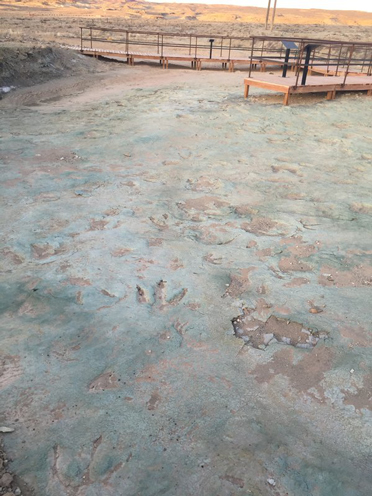
Mill Canyon tracksite.

At least six different dinosaur tracks have been deciphered at Moab (Utah). Picture credit: Bureau of Land Management.

Picture credit: Bureau of Land Management

Cease and Desist

It has been reported in the media that the Center for Biological Diversity (based in Tucson, Arizona), sent a cease-and-desist letter to the U.S. Bureau of Land Management’s Utah office, requiring the agency to halt the destruction with immediate effect.

Commenting on the alleged damage, Patrick Donnelly, Great Basin Director at the Center for Biological Diversity stated:

“I’m absolutely outraged that the BLM has apparently destroyed one of the world’s most important paleontological resources. This careless disregard for these irreplaceable traces of the past is appalling. It really calls into question the Bureau’s competence as a land-management agency.”

Trace fossil - crocodile tail drag.

The tail drag made by an ancient crocodile preserved in the Red Ruby mudstones of the Cedar Mountain Formation (Utah). Picture credit: Bureau of Land Management.

Picture credit: Bureau of Land Management

Dinosaur Tracksite Damaged

Last year, the Bureau of Land Management approved an environmental assessment to replace the existing boardwalk with a raised concrete-and-steel trail. The document explained that any risks to the dinosaur tracks would be mitigated by flagging sensitive areas and providing “onsite inspections during construction.” Photos shared on social media show a mechanical digger left on the site, tyre tracks damaging dinosaur prints and a rare crocodilian resting trace”.

The cease-and-desist letter documents the destruction of these rare artefacts and states that the Paleontological Resources Preservation Act of 2009 has been violated. Furthermore, the Bureau of Land Management may also be in breach of the National Environmental Policy Act and the Federal Lands Policy and Management Act for neglecting to adhere to project approval protocols.

A spokesperson from Everything Dinosaur expressed dismay at this development and went onto state:

“We have blogged about fossil thefts and vandalism to very important palaeontological sites, many of our posts relate to sites in Utah. It is extremely sad to have to write about this very unfortunate incident. Let’s hope that any damage that has occurred can be mitigated and this extremely significant trace fossil site continues to enjoy the protection that it deserves.”

To read Everything Dinosaur’s original post about the opening of the trackway to visitors: New Dinosaur Track Exhibit Opened.

25 01, 2022

A New Study of Struthiosaurus austriacus – Differences Between Nodosaurids and Ankylosaurids

By |2024-10-15T17:02:28+01:00January 25th, 2022|Categories: Dinosaur and Prehistoric Animal News Stories, Dinosaur Fans, Main Page, Palaeontological articles, Photos/Pictures of Fossils|0 Comments

A study published this month in “Scientific Research” suggests that the Late Cretaceous European nodosaurid Struthiosaurus was not the most active of dinosaurs and probably not the most social. Analysis of the single, partial braincase (IPUW 2349/6) of S. austriacus has permitted scientists to gain a better understanding of this armoured dinosaur’s senses. The conclude that the short semi-circular canals and the shortest cochlear duct described from dinosaur fossils known to date, indicate that Struthiosaurus led a rather inert, sedentary life and compared to other members of the Dinosauria, it was comparatively inactive with limited social interactions.

The researchers calculate that Struthiosaurus had poor hearing and it probably relied on a less active style of self-defence compared to their tail club swinging relatives the ankylosaurids.

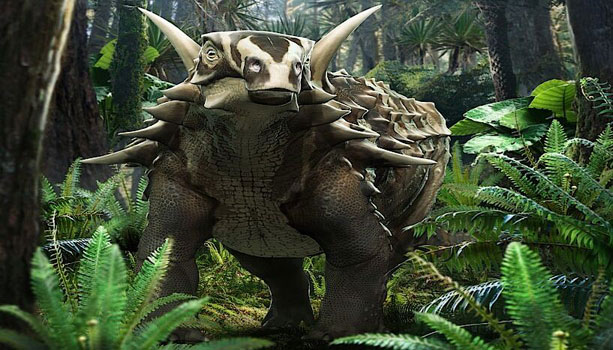
Struthiosaurus austriacus life reconstruction

An illustration of the Late Cretaceous nodosaurid Struthiosaurus austriacus from Austria. A study of this dinosaur’s braincase suggests that it was relatively inert, sluggish and partially deaf. Picture credit: Fabrizio De Rossi.

Picture credit: Fabrizio De Rossi

Sluggish and with Limited Hearing

Researchers from the University of Vienna in collaboration with a colleague from the University of Greifswald in Germany subjected the partial braincase of S. austriacus to CT scans. From this information, three-dimensional models of the 5 cm wide braincase of this dinosaur were created.

The braincase consists of several fused skull bones that housed the brain and other neurosensory tissues. Analysis of the structures preserved can provide palaeontologists with information about the sensory capabilities of the animal and more fundamental details of anatomy such as the angle at which the animal held its head.

Struthiosaurus braincase study

Photographs (C,D,G,J) and photogrammetric models (E,F,H,I,K) created from the CT scans of the holotype specimen of Struthiosaurus austriacus, (IPUW 2349/6). Right lateral view (C,E), (D,F) left lateral, (I) anterior, (J,K) ventral and (G,H) posterior views. Note scale bar = 2 cm. Picture credit: Schade et al.

Picture credit: Schade et al

The results of this study of the braincase of Struthiosaurus indicate that its brain was very similar to the brains of other nodosaurids. For example, the flocculus, an ancient part of the tetrapod brain, associated with co-ordination and motor skills was very small. Ankylosaurs with their large tail clubs, such as Euoplocephalus had a proportionately larger flocculus. A bigger flocculus might have helped ankylosaurs to co-ordinate their defensive strikes with their powerful tail clubs.

In addition, the team which included Marco Schade (University of Vienna), plotted the auditory capacity of Struthiosaurus and calculated that its hearing range was rather limited (between 296 and 2164 Hz). In contrast, humans on average have a much broader frequency of hearing range – around 31 Hz to 19,000 Hz.

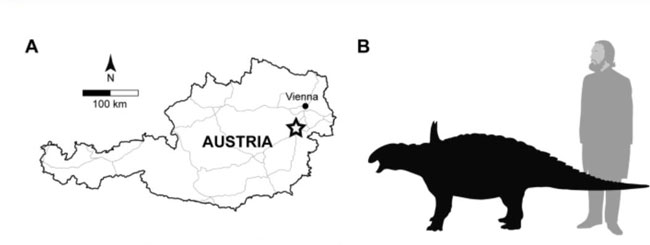
S. austriacus type locality and scale drawing.

Location of the Struthiosaurus austriacus fossil finds in Austria (A). To date three species of Struthiosaurus have been scientifically described, S. transylvanicus from Maastrichtian-aged deposits or Romania, S. languedocensis from the early Campanian of France and S. austriacus which was described from fragmentary fossil material including a partial braincase discovered during coal mining operations near the town of Muthmannsdorf (early Campanian Grünbach Formation). The type locality of S. austriacus is marked by the star. Scale drawing of S. austriacus from Fabrizio De Rossi. Picture credit: Schade et al.

Picture credit: Schade et al

Nodosaurids Occupied a Different Ecological Niche

Both nodosaurids and their close relatives, the ankylosaurids were lumbering, heavily armoured animals adapted to low browsing. Although postcranial fossils are quite similar, there is a growing body of evidence to indicate marked differences between these two types of dinosaur. Nodosaurids may have preferred coastal or floodplain environments and may have evolved stronger jaws to give them a more powerful bite, an adaptation to processing tough vegetation. Gut contents associated with nodosaurids such as Borealopelta markmitchelli, suggest they were selective feeders: Borealopelta was a Fussy Eater.

This study suggests that for Struthiosaurus at least the combination of a relatively short cochlear duct, a reduced flocculus, less elaborate nasal passages and the absence of a tail club but with heavily reinforced dermal armour suggests that nodosaurids had different ecological adaptations when compared to ankylosaurs.

The researchers postulate that nodosaurids were possibly less reliant on their sense of hearing, had a less active style of self-defence and may have occupied different ecological niches than ankylosaurids.

Struthiosaurus may have lived alone and may not have moved in social groups.

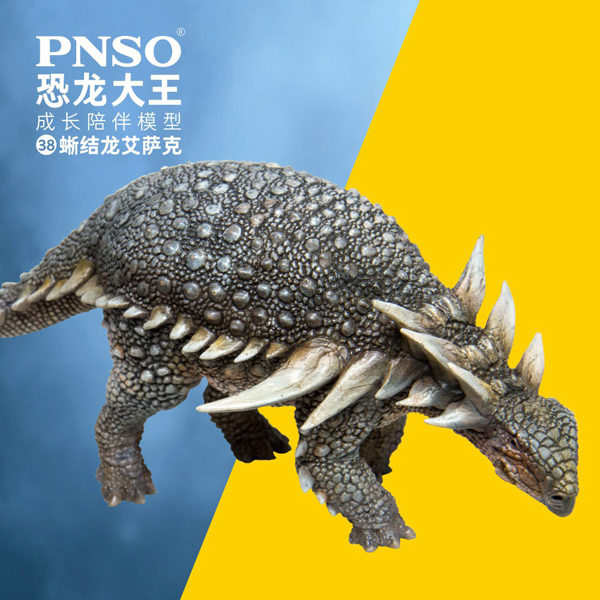
PNSO Isaac the Sauropelta dinosaur model.

The recently introduced Isaac the Sauropelta model depicts the typical armour and spikes of a nodosaur. These dinosaurs may have been relatively slow moving, with a limited sense of hearing but they would have represented a formidable adversary for a younger theropod.

The scientific paper: “Neuroanatomy of the nodosaurid Struthiosaurus austriacus (Dinosauria: Thyreophora) supports potential ecological differentiations within Ankylosauria” by Marco Schade, Sebastian Stumpf, Jürgen Kriwet, Christoph Kettler and Cathrin Pfaff published in Scientific Reports.

The Everything Dinosaur website: Dinosaur Toys.

24 01, 2022

The Muscles of Thecodontosaurus Provide Clue to Super-sized Sauropods

By |2024-10-15T16:53:56+01:00January 24th, 2022|Categories: Dinosaur and Prehistoric Animal News Stories, Dinosaur Fans, Main Page, Palaeontological articles, Photos/Pictures of Fossils|0 Comments

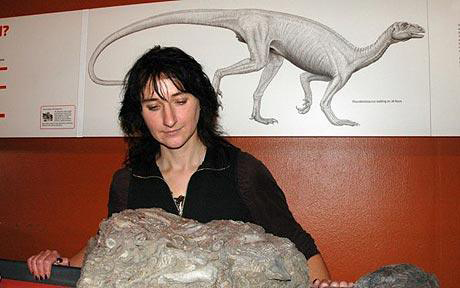
New research into the musculature of the early sauropodomorph Thecodontosaurus antiquus has helped scientists to understand the evolutionary transition from agile bipeds to super-sized quadrupedal sauropods. Writing in the open-access, on-line journal “Royal Society Open Science”, scientists from the University of Bristol have reconstructed the limb musculature of Thecodontosaurus. Their reconstruction shows that this Late Triassic dinosaur was an agile, biped but it already had some anatomical adaptations which would permit its descendants to grow to huge sizes.

Thecodontosaurus study.

Thecodontosaurus fossil block with life reconstruction in the background. Picture credit: Simon Powell/University of Bristol.

Picture credit: Simon Powell/University of Bristol

Bristol’s Dinosaur

Thecodontosaurus (T. antiquus) fossils are known from Upper Triassic rocks exposed around the city of Bristol in England. During the Late Triassic, this region consisted of an archipelago surrounded by a warm tropical sea. Hundreds of fragmentary fossils representing many individuals are known, most of these fossils are housed at the Bristol City Museum and Art Gallery. Thecodontosaurus is believed to have measured up to 2.5 metres in length, however, its long, thin tail made up more than 50% of its entire body length.

It weighed around twenty kilograms, but it was part of the Sauropodomorpha clade of lizard-hipped dinosaurs that were to evolve into giants during the Jurassic and Cretaceous. Famous dinosaurs such as Diplodocus and Brachiosaurus from the Jurassic as well as Cretaceous leviathans such as Patagotitan and Alamosaurus.

Thecodontosaurus

Thecodontosaurus was the first Triassic genus of dinosaur to be named and described (1836).

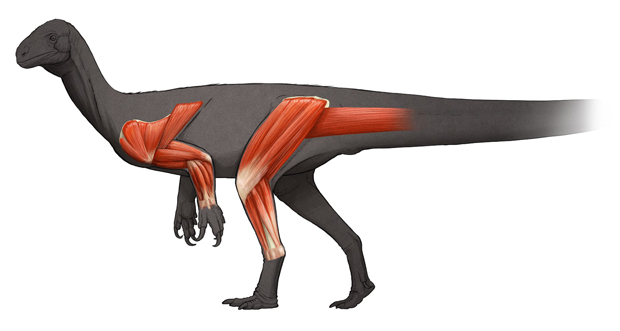
Thecodontosaurus limb muscles

Researchers have examined tell-tale muscle scars associated with Thecodontosaurus limb bones to reconstruct the musculature of this Late Triassic dinosaur. Picture credit: Gabriel Ugueto.

Picture credit: Gabriel Ugueto

Lead author of the paper, PhD student at the University of Bristol Antonio Ballell commented:

“The University of Bristol houses a huge collection of beautifully preserved Thecodontosaurus fossils that were discovered around Bristol. The amazing thing about these fossilised bones is that many preserve the scars and rugosities that the limb musculature left on them with its attachment.”

These features on the bones permit palaeontologists to infer the shape, size and anatomical position of the musculature of the animal. For example, the muscles associated with the limbs can be reconstructed and the dinosaur’s anatomy can be further refined by comparing the computer models generated with the anatomy of extant relatives such as crocodiles and birds.

Co-author of the study Professor Emily Rayfield (University of Bristol), added:

“These kinds of muscular reconstructions are fundamental to understand functional aspects of the life of extinct organisms. We can use this information to simulate how these animals walked and ran with computational tools.”

Palaeontologists Continuing to Learn from Thecodontosaurus Fossils

Thecodontosaurus was one of the first dinosaurs to be formally named and described but palaeontologists can still learn a lot from its fossils. For example, thanks to the considerable volume of T. antiquus material, the research team were able to build the entire forelimb and hindlimb musculature. This is the first time scientists have been able to reconstruct the limb musculature of an early-branching sauropodomorph.

The analysis of the limb muscles of T. antiquus confirm that it was a fast-running, agile biped. The forelimbs were probably not used in locomotion but were very effective at grasping objects such as potential prey. The anatomy of the lithe Thecodontosaurus is in stark contrast to the later sauropods which became obligate quadrupeds.

The researchers determined that key traits of later sauropod-line dinosaurs had already evolved in this early genus.

“From an evolutionary perspective, our study adds more pieces to the puzzle of how the locomotion and posture changed during the evolution of dinosaurs and in the line to the giant sauropods. How were limb muscles modified in the evolution of multi-ton quadrupeds from tiny bipeds? Reconstructing the limb muscles of Thecodontosaurus gives us new information of the early stages of that important evolutionary transition.”

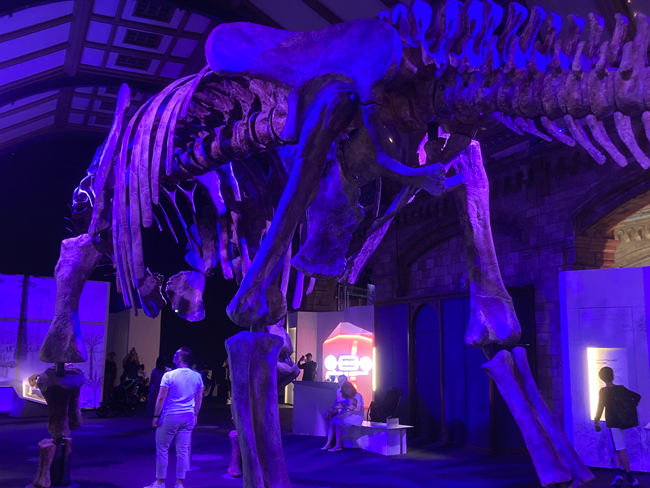
Patagotitan skeleton on display at the London Natural History Museum.

The enormous body of the titanosaur dwarfs visitors. Picture credit: Everything Dinosaur.

Picture credit: Everything Dinosaur

Everything Dinosaur acknowledges the assistance of a media release from the University of Bristol in the compilation of this article.

The scientific paper: “Walking with early dinosaurs: appendicular myology of the Late Triassic sauropodomorph Thecodontosaurus antiquus” by Antonio Ballell, Emily J. Rayfield and Michael J. Benton published in Royal Society Open Science.

Visit the Everything Dinosaur website: Everything Dinosaur.

18 01, 2022

Menucocelsior arriagadai – from Southern Argentina

By |2024-10-14T12:21:48+01:00January 18th, 2022|Categories: Adobe CS5, Dinosaur and Prehistoric Animal News Stories, Dinosaur Fans, Main Page, Photos/Pictures of Fossils|0 Comments

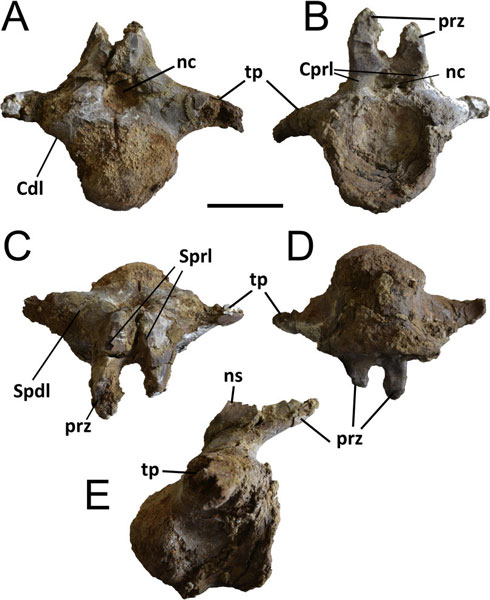
Scientists writing this month in the journal “Cretaceous Research” have formally described a new genus of Late Cretaceous titanosaur from Patagonia. The dinosaur has been named Menucocelsior arriagadai based on a series of tail bones (caudal vertebrae) and fragmentary limb bones including a right humerus and a left fibula, found in sediments associated with the Allen Formation (Maastrichtian stage of the Upper Cretaceous).

Views of Menucocelsior arriagadai tail bones.

Views of Menucocelsior arriagadai tail bones. Autapomorphies in the caudal vertebrae permitted the erection of a new titanosaur genus. Picture credit: Rolando et al.

A Titanosaur that “Jumped the Gun”

The announcement concerning the naming of a new titanosaur genus was made last year (2021), Menucocelsior was one of several new titanosaur genera named in 2021. However, the formal, scientific paper that erected the genus was published this month in the January edition of “Cretaceous Research”.

To read Everything Dinosaur’s article from December 2021 that outlined the new titanosaurs named and described over the previous twelve months: New Titanosaur Species Described from South America – Arrudatitan.

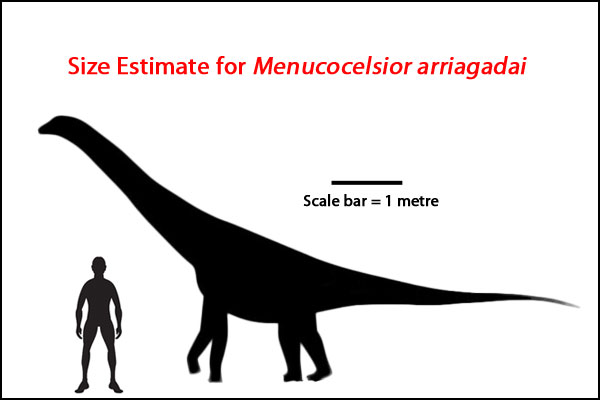
Menucocelsior arriagadai scale drawing.

A scale drawing of M. arriagadai. Although only known from caudal vertebrae a size estimate has been made based on more complete and better known South American titanosaurs. It is estimated that Menucocelsior arriagadai measured around 8-10 metres in length. Picture credit: Everything Dinosaur.

Picture credit: Everything Dinosaur

A Late Cretaceous Titanosaur Paradise

Although only known from very incomplete and fragmentary material, the fossilised remains assigned to M. arriagadai do not demonstrate a close taxonomic relationship with any other, previously described titanosaur. The site where the fossils were found Salitral Ojo de Agua in Río Negro Province has also yielded the fossilised bones of at least three other species of titanosaurs and other contemporary fossil sites in the Allen Formation have provided evidence of numerous other titanosaurs along with hadrosaurs.

Researchers have concluded that the environment must have been extremely productive to support such a large number of mega herbivores. It has been proposed that the titanosaurs evolved different feeding strategies to avoid excessive competition for food resources (niche partitioning). Perhaps these animals were selective browsers, specialising in feeding from the branches of trees, whilst the hadrosaurs were bulk-feeders, targeting ground vegetation.

The genus name is derived from the indigenous Mapuche language for a large watering hole, which describes the fossil site. The specific or trivial name honours the Arriagada family, the owners of the land where the fossils were found.

The scientific paper: “The sauropod record of Salitral Ojo del Agua: An Upper Cretaceous (Allen Formation) fossiliferous locality from northern Patagonia, Argentina” by Mauro Aranciaga Rolando, Jordi A. García Marsà, Federico L. Agnolín, Matías J. Motta, Sebastián Rozadilla, and Fernando E. Novas published in Cretaceous Research.

11 01, 2022

A Rare Tooth from a Pterosaur

By |2024-10-14T10:34:23+01:00January 11th, 2022|Categories: Adobe CS5, Dinosaur Fans, Main Page, Photos/Pictures of Fossils|0 Comments

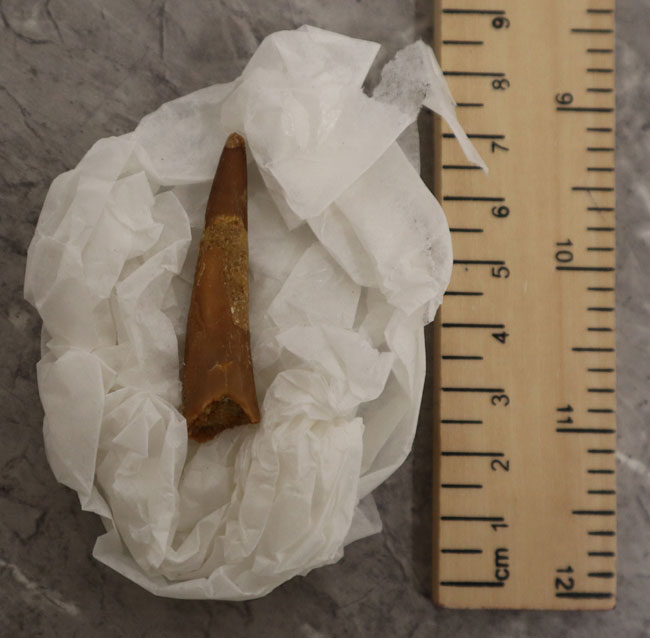
Our thanks to Robert, a customer of Everything Dinosaur, who sent into our offices a fossil of a pterosaur tooth from the Kem Kem Formation of Morocco. The large tooth is slightly curved and lacks any serrations (denticles), it is a typical example of a flying reptile tooth from the early Late Cretaceous Kem Kem deposits. Although we are unable to identify the genus, we suspect that the tooth comes from an ornithocheirid pterosaur.

Fossil pterosaur tooth

The pterosaur tooth fossil sent into Everything Dinosaur by one of our Scottish customers. The tooth, which measures approximately 5 cm long most likely comes from an ornithocheirid pterosaur. Picture credit: Everything Dinosaur.

Picture credit: Everything Dinosaur

Fossil Pterosaur Tooth

When taking a picture of a fossil, or indeed, taking a photograph of an object that you think might be a fossil but need help with identification, it is a good idea to provide some scale in the picture. A coin could be placed next to the item to provide a scale reference. At Everything Dinosaur, we tend to use one of our brightly coloured geological rulers but as we did not have one of these in the office, an ordinary ruler was pressed into service. Viewers of the photograph can instantly get an idea of the size of the object. In this case, the fossil tooth measures approximately 5 cm in length.

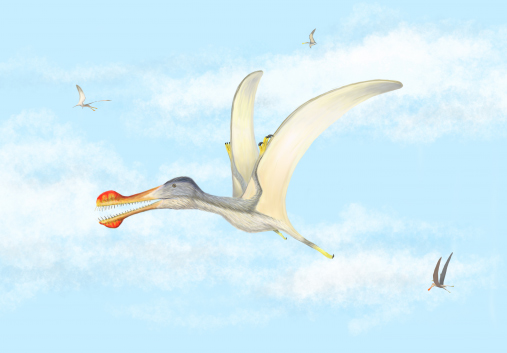
New pterosaur genera described from the Kem Kem Beds of Morocco.

The pterosaur Anhanguera soars over the skies of North Africa with Coloborhynchus and Ornithocheirus to keep it company. Picture credit: Megan Jacobs (University of Bath).

Picture credit:  Megan Jacobs (University of Bath)

For models and replicas of pterosaurs and other prehistoric animals: Safari Ltd. Wild Safari Prehistoric World Models.

Kem Kem Beds

The Kem Kem Formation, actually consists of two Formations, lower Gara Sbaa Formation and the geologically younger Douira Formation. Technically, the Kem Kem Formation should be referred to as the Kem Kem Group, these strata are exposed across a large part of the Algerian/Moroccan border and are famous for dinosaur remains.

Fossils associated with the Kem Kem Beds are often highly fragmentary and although several pterosaur genera have been described from fossil discoveries associated with these deposits, their remains are relatively rare and often difficult to interpret.

To read an article describing a new species of toothless pterosaur from Morocco: A Fourth New Moroccan pterosaur – Afrotapejara.

Our thanks to Robert for sending into Everything Dinosaur, this excellent example of a pterosaur tooth.

Visit the Everything Dinosaur website: Everything Dinosaur.

10 01, 2022

The Amazing Rutland Ichthyosaur

By |2024-10-11T08:40:48+01:00January 10th, 2022|Categories: Adobe CS5, Dinosaur and Prehistoric Animal News Stories, Dinosaur Fans, Main Page, Palaeontological articles, Photos/Pictures of Fossils|0 Comments

The discovery of the remarkable Rutland ichthyosaur has featured in many news channels and media outlets. It is a stunning fossil specimen, demonstrating that even in a country like Britain, arguably the birthplace of geology and the science of palaeontology, a part of the world that has been extensively mapped, documented and studied, that there are still amazing fossils to be found.

This story highlights the many largely unsung individuals that bring to the attention of scientists, strange phenomena that they spot, often in the unlikeliest of places. In this case it was Joe Davis (Conservation Team Leader for Leicestershire and Rutland Wildlife Trust at the Rutland reservoir), who along with his colleague Paul Trevor spotted strange circular objects jutting out of the exposed Jurassic clay as they routinely inspected part of a drained lagoon back in February 2021.

These objects turned out to be bones from the spinal column, fortunately, Joe a career conservationist, was familiar with the skeletons of whales and dolphins and he had an inkling that these objects were organic in origin. The local council was called and asked whether they had a “dinosaur department” that could investigate further. Thus, was set in motion a series of events that led to award-winning ichthyosaur specialist Dr Dean Lomax setting up an exploratory dig at the site, the results of which led to a full-scale excavation over the summer.

Dr Dean Lomax dwarfed by the giant ichthyosaur skeleton.

Dr Dean Lomax provides the scale for an aerial shot of the Rutland ichthyosaur specimen. Picture credit: Anglian Water/Leicestershire and Rutland Wildlife Trust/Matthew Power Photography.

Picture credit: Anglian Water/Leicestershire and Rutland Wildlife Trust/Matthew Power Photography

An Extraordinary Marine Reptile Fossil

The ichthyosaur fossil is the largest and most complete ichthyosaur to have been found in the UK. It measures around 10.5 metres in length. As has been repeatedly stated in the plethora of media releases concerning this Jurassic monster, ichthyosaurs are not dinosaurs. Ichthyosaurs are aquatic reptiles that evolved from terrestrial ancestors. Their evolutionary origins remain obscure, but their fossil record covers most of the Mesozoic and the Rutland ichthyosaur happens to be the most complete skeleton of a large prehistoric reptile ever found in the UK.

This spectacular fossil discovery stands out well compared to the scrappy and fragmentary remains of Britain’s dinosaurs.

Some of the team members responsible for the Rutland Sea Dragon excavation

Some of the Rutland “Sea Dragon” excavation team. Left to right – Dr Emma Nicholls (Senior Curator of Natural Sciences at the Horniman Museum and Gardens, London), David Savory (Peterborough Geological and Palaeontological Group), Nigel Larkin (palaeontological conservator), Dr Dean Lomax (palaeontologist), Mick Beeson (Peterborough Geological and Palaeontological Group), Dr Mark Evans (palaeontologist at the University of Leicester), Emily Swaby (PhD student the Open University), and Darren Withers (Peterborough Museum). Picture credit: Anglian Water.

Picture credit: Anglian Water

A “Rosetta Stone” for the Temnodontosaurus Genus

The fossil specimen has been tentatively assigned to the species Temnodontosaurus trigonodon. If this proves to be the case, the identification will be confirmed when the fossils are fully cleaned and prepared, then this is the first T. trigonodon known from the British Isles.

The species Temnodontosaurus trigonodon was erected in 1843. Its fossils have been found in Germany and France, if the Rutland specimen proves to be this species it will extend the palaeogeographical range of T. trigonodon. In addition, the almost complete, articulated Rutland ichthyosaur will provide an extremely useful comparator when assessing Temnodontosaurus fossils. It will help to identify other large, but much less complete, ichthyosaur specimens housed in museums, acting as a “Rosetta Stone” for the genus.

A life reconstruction of the Rutland Ichthyosaur

The ichthyosaur specimen has been tentatively assigned to the species Temnodontosaurus trigonodon. T. trigonodon was an apex predator and it probably hunted other smaller ichthyosaurs. Picture credit: Bob Nicholls.

Picture credit: Bob Nicholls

A Huge Fossil but It’s Also the Little Details

These fossilised remains are not the first ichthyosaur fossils to have been found at Rutland Water, smaller, fragmentary material representing other species were found during construction of the reservoir. Once excavated and wrapped in plaster jackets the Rutland ichthyosaur was taken to a research facility where the job of preparing and restoring it will take place under the watchful supervision of conservator Nigel Larkin.

The bones and teeth may have been removed but the site can still provide a great deal of data. For example, the clay-rich rocks that contained the specimen represent deposits from the Whitby Mudstone Formation and analysis of microfossils preserved in the sediment have enabled researchers at the University of Birmingham to reliably date the Rutland ichthyosaur to 181.5 to 182 million years ago (Toarcian faunal stage of the Jurassic).

The composition of these microfossils indicates that this large predator lived in a tropical, marine environment with a rich and diverse ecosystem. Temnodontosaurus is thought to have lived far out to sea and away from the coast. It is hoped that further analysis of the matrix surrounding the fossil will provide more details of this animal’s palaeoenvironment.

The Rutland sea dragon excavation

The summer 2021 excavation of the Rutland ichthyosaur. The ventral elements of the skull can be seen in the foreground. This photograph was taken before prior to plaster encasement of the specimen and it being removed from the site. Picture credit: Anglian Water/Leicestershire and Rutland Wildlife Trust.

Picture credit: Anglian Water/Leicestershire and Rutland Wildlife Trust

Locked in Time

Palaeontologist Dr Dean Lomax who led the excavation, has recently published a book in collaboration with Bob Nicholls the artist that provided the Temnodontosaurus illustration.

It provides a fascinating analysis of fifty extraordinary fossils and what these discoveries can tell scientists about life in the past.

The book is available from Columbia University Press: Columbia University Press just search for Dean Lomax on this site.

Locked in Time by Dean Lomax and illustrated by Bob Nicholls

Published by Columbia University Press “Locked in Time” examines 50 extraordinary fossils that provide a remarkable glimpse into the lives and behaviours of long extinct animals. Picture credit: The University of Manchester.

Picture credit: The University of Manchester

For models of ichthyosaurs and other marine reptiles: Buy Prehistoric Animal Models.

7 01, 2022

Research into Fossils Affected by a Significant Colonial Bias

By |2024-10-10T13:56:31+01:00January 7th, 2022|Categories: Adobe CS5, Dinosaur and Prehistoric Animal News Stories, Dinosaur Fans, Main Page, Palaeontological articles, Photos/Pictures of Fossils|0 Comments

The study of fossils, the science of documenting the history of life on our planet, is heavily biased by influences such as colonialism, history and global economics. That is the conclusion from new research conducted by palaeontologists from the University of Birmingham in collaboration with colleagues from the University of Erlangen-Nürnberg (Germany), Rhodes University (South Africa), Federal University of Rio Grande do Norte (Brazil), Cambridge University and IISER Pune, Department of Earth and Climate Science (India).

Distorting Estimates of Past Biodiversity

The research team discovered that sampling biases in the fossil record distort estimates of past biodiversity. However, these biases not only reflect the geological and spatial aspects of the fossil record, but also the historical and current collation of fossil data. These findings have significance across the field of palaeontology, but also for the ways in which researchers are able to use our knowledge of ancient fossil records to gain clearer, long-term perspectives on Earth’s biodiversity.

Writing in the journal “Nature Ecology & Evolution”, the researchers investigated the influence and extent of these biases within the Paleobiology Database, a vast, widely-used and publicly-accessible resource which forms the foundation for analytical studies in the field.

They found significant bias in areas such as knowledge production, with researchers in high or upper-middle-income countries contributing to 97 per cent of fossil data. This means that wealthy countries, primarily located in the Global North control the majority of the palaeontological research power.

Percentage contribution of the top 15 countries to the total fossil data analysed in this study.

Percentage contribution of the top 15 countries to the total fossil data analysed in this study. The colour of each bar represents whether the authors of each country conducted their research domestically (that is, in the same country), in a foreign country, or in a foreign country without collaboration with local palaeontologists. Picture credit: Raja et al.

Picture credit: Raja et al

Lack of Involvement for Local Researchers

The team also found the top countries contributing to palaeontological research, carried out a disproportionate amount of work abroad, more than half of which did not involve any local researchers (researchers based in the country where the fossils are being collected).

There are many famous examples of colonial, political and economic biases across the natural sciences and humanities. During the 19th century and for most of the 20th century, specimens uncovered following exploratory expeditions were shipped back to respective imperial capitals to be housed in museums, where many are still used for scientific research today.

In a press release from Birmingham University the plight of the Parthenon sculptures, sometimes referred to as the Elgin Marbles was provided as an example. The Greek government has repeatedly requested that they be returned since they were taken from Athens in the early 19th century and transported to Britain.

There are also many other examples, such as the fossil excavations undertaken in Egypt by the German palaeontologist Ernst Freiherr Stromer von Reichenbach or the removal of many Cretaceous-aged dinosaur fossils by French field teams from the island of Madagascar.

Research into Fossils Has a Colonial Bias

The researchers postulate that these biases affect the way in which palaeontologists conduct their research and can lead to unethical practices in the most extreme cases.

Co-lead author Dr Emma Dunne (University of Birmingham) stated:

“Although we know there are these irregularities and gaps in our knowledge of the fossil record, the historical, social and economic factors which influence these gaps are not well understood. Many of the research practices that are informed by these biases still persist today and we ought to be taking action to address them.”

Dr Dunne added:

We are familiar, for example, with ‘scientific colonialism, or ‘parachute science’, in which researchers, generally from higher income countries drop in to other countries to conduct research, and then leave without any engagement with local communities and local expertise. But this issue goes further than that – the expertise of local researchers is devalued, and laws are often violated, hindering domestic scientific development and leading to mistrust between researchers.”

The first step towards conducting research that is more equitable and ethical, argue the researchers, is to address the power relations driving the production of scientific research. This means properly involving and acknowledging local expertise.

One project which strives to do this is a research project involving researchers from both European and African universities, based in a remote area of Western Cape in South Africa. Here palaeontologists from University of Witwatersrand and the University of Johannesburg are at the forefront of the research and are working with local education specialists Play Africa to create interactive materials that can be toured around schools in the region.

The scientific paper: “Colonial history and global economics distort our understanding of deep-time biodiversity” by Nussaïbah B. Raja, Emma M. Dunne, Aviwe Matiwane, Tasnuva Ming Khan, Paulina S. Nätscher, Aline M. Ghilardi and Devapriya Chattopadhyay published in Nature Ecology & Evolution.

The Everything Dinosaur website: Prehistoric Animal Models.

4 01, 2022

Aiding a Spectacular Ammonite

By |2024-10-10T13:18:00+01:00January 4th, 2022|Categories: Adobe CS5, Educational Activities, Everything Dinosaur News and Updates, Main Page, Photos/Pictures of Fossils|0 Comments

Team members at Everything Dinosaur, try their best to help their customers. Our knowledgeable staff can provide lots of information and advice when it comes to prehistoric animals, but our contacts and connections are not just confined to models and model collecting.

For example, when a customer enquired about getting a fossil ammonite that he had found prepared and cleaned, we were able to provide assistance.

Fossil ammonite (geological hammer provides scale).

Large ammonites preserved on the beach. Picture credit: Everything Dinosaur.

Picture credit: Everything Dinosaur

For replicas of iconic animals from the fossil record and models of famous fossils: Replicas of Fossil and Prehistoric Animals.

A Mollusc Fossil from the Midlands

The Everything Dinosaur customer explained that they had found an ammonite fossil when visiting a large construction site in the midlands (UK). The mollusc fossil dates from the Jurassic and they wanted to have it cleaned and conserved, with the iron pyrites elements that did not constitute the fossil removed.

We were able to text them with the contact details of a talented nearby preparator who was very experienced in cleaning and preparing ammonites and had probably worked on a few examples from the same location.

An ammonite fossil find.

An ammonite partially eroded out of a nodule. We think this is an example of Dactylioceras commune. Picture credit: Everything Dinosaur.

Picture credit: Everything Dinosaur

We are happy to help with customer’s enquiries and do our best to put them in touch with professionals who can assist them with their fossil collections.

The Everything Dinosaur website can be visited here: Everything Dinosaur.

Go to Top