All about dinosaurs, fossils and prehistoric animals by Everything Dinosaur team members.

Articles, features and information which have slightly more scientific content with an emphasis on palaeontology, such as updates on academic papers, published papers etc.

8 04, 2016

New Model to Help Find Fossils

By |2023-04-17T07:55:31+01:00April 8th, 2016|Categories: Dinosaur and Prehistoric Animal News Stories, Dinosaur Fans, Geology, Main Page, Palaeontological articles|0 Comments

Serendipity Taken Out of Fossil Finding

Very often a major fossil find is attributed to serendipity, someone being in the right place at the right time.  Even the most experienced palaeontologist needs a little bit of luck, take for example the discovery of the ancient hominin Homo floresiensis on the Indonesian island of Flores.  Had the research team excavated an area just one metre either side of that part of the cave they did excavate they would never have found the beautifully preserved skull and partial skeleton of an individual (the holotype LB-1).  Yes, “lady luck” does play a part in many new scientific discoveries.  Palaeontologists are all too aware of serendipity.

However, an international team of scientists, including researchers from the University of Adelaide, have created a mathematical model to help palaeontologists find the remains of long-extinct animals.

Combining Scientific Disciplines to Predict Where Fossils Can be Found

The international team, that included researchers from Kiel University (Germany), as well as Australia, looked at the estimated ages of the fossils from a number of extinct Australian megafauna and plotted known fossil find locations for these creatures against data for the prehistoric climate of Australia.  This provided a guide to the maximum likely ranges of the animals in the study.  This information was then mapped against the geology of Australia to provide an indication of what suitably aged, likely fossil bearing strata was exposed.

Weighting for the erosion potential of the rocks was built into the mathematical model and this data set could then be used to help determine the best areas in the country to look for the animal’s fossil remains.

Scientific Paper Published

A paper detailing the research has been published in the on line journal PLOS One, the research team confidently state that their model can provide fossil hunters with guidelines on how to find fossils elsewhere in the world too.

Determining the Best Places to Hunt for Fossils
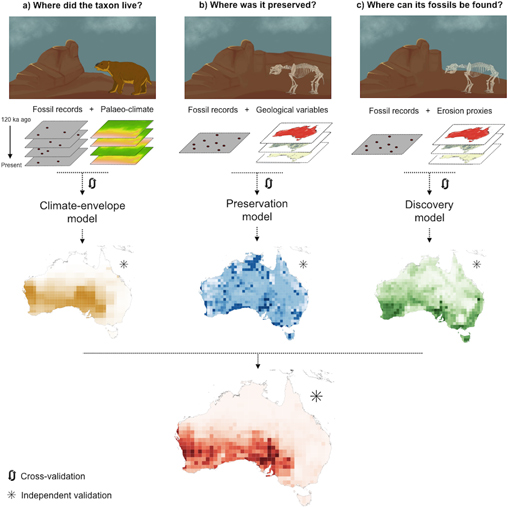
Combining palaeoclimate data with erosion studies and known fossil finds to predict where fossils can be found.

Combining palaeo-climate data with erosion studies and known fossil finds to predict where fossils can be found.

Picture credit: Sebastián Block, Frédérik Saltré,  Marta Rodríguez-Rey, Damien A. Fordham, Ingmar Unkel, Corey J. A. Bradshaw

The picture above provides an illustration of how the mathematical model was constructed and how to implement it.  For any given type of extinct animal (in this example, the giant marsupial Diprotodon), the red map at the bottom shows the likely places to hunt for fossils of that animal.  The darker the red shading the more likely that location is to be a “fossil finding hot spot”.   The red map has been created by looking at certain variables, namely:

  • Where the animal used to live – a map created by assessing ancient climate data and known fossil finds (the brown map).
  • Where the fossils could be preserved – using an assessment of the geology of the local area (blue map).
  • The location where it is now possible to find the fossils of that particular animal, building in an assessment of erosion profiles of the likely fossil bearing strata (green map).

A Systematic Approach for Palaeontologists

The scientists are confident that this systematic approach to fossil finding is more likely to be successful than random approaches to fossil hunts, even out-doing sophisticated approaches such as using satellite data to identify likely fossil bearing outcrops and exposures.

Five genera of Late Pleistocene megafauna were selected for this study.  All had an extensive and relatively widely distributed fossil record on the continent and since all had become extinct relatively recently there was plenty of evidence to support an assessment of the ancient climate.  The creatures studied were Thylacoleo (the marsupial lion), Protemnodon (a giant wallaby), the cow-sized, giant marsupial  Zygomaturus, the flightless bird Genyornis and Diprotodon, the largest marsupial known to science.

Diprotodon Played a Role in the Study
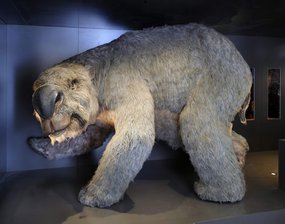
Diprotodonts - Giant Marsupials

Diprotodon – A giant marsupial.

Picture credit: Australian Museum/James King

Although all these five genera are unique to Australia, the scientists had sufficient fossils to create an accurate map of the creatures prehistoric distribution.

The Reasoning Behind the Model

Commenting on the reasoning behind their model, project leader, Professor Corey Bradshaw, (Sir Hubert Wilkins Chair of Climate Change at the University of Adelaide) stated:

“A chain of ideal conditions must occur for fossils to form, which means they are extremely rare, so finding as many as possible can tell us more of what the past was like, and why certain species went extinct.  Typically, however, we use haphazard ways to find fossils.  Mostly people just go to excavation sites and surrounding areas where fossils have been found before.  We hope our models will make it easier for palaeontologists and archaeologists to identify new fossil sites that could yield vast treasures of prehistoric information.”

Lead author of the scientific paper Sebastián Block explained that the team made use of modelling techniques already used widely in ecology.  They looked at the past distribution of these prehistoric genera, where fossils were likely to have formed and the probability of making field discoveries.  The model may not make the back-breaking work of excavating fossils any easier, but at least palaeontologists will be looking in the most likely places.

The Probability of Finding Fossils
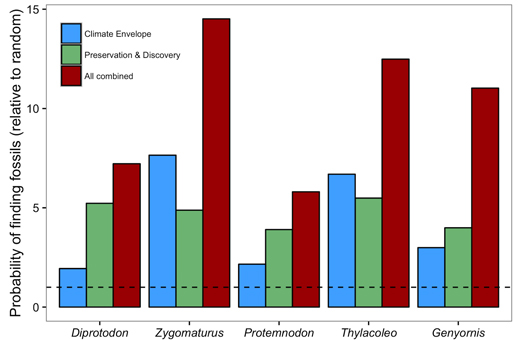
Combining disciplines increases the probability of finding fossils.

Combining disciplines increases the probability of finding fossils.

Graph credit: Sebastián Block, Frédérik Saltré,  Marta Rodríguez-Rey, Damien A. Fordham, Ingmar Unkel, Corey J. A. Bradshaw

Assisting Palaeontologists and Fossil Hunters

The bar chart above shows how the model increases the likelihood of fossil discovery for the five genera studied.

The chances of finding a fossil of that particular genus compared to a random search is plotted on the vertical (Y axis).  The blue bars represent the probability of finding a fossil based on an assessment of ancient climate.  The green bars show the probability of a successful fossil hunt using just geological data and erosion assessments.  The red bars show the increased likelihood of success after the application of the variables used in this assessment (ancient climate, preservation potential and known discoveries).  The dashed line outlines the probability of finding a fossil using a random search in a known fossil bearing locality.

Likely Fossil Preservation Sites Accounted For

The team added into their data relevant predictors for the likelihood of fossil discoveries.  For example, many Late Pleistocene fossils are found in caves so the number of caves in the areas studied were also plotted.  In addition, as Australian megafauna (indeed most terrestrial animal fossils), are found in association with ancient lakes and rivers, areas where sedimentary material can be built up were given greater weighting as indeed were areas that tended to be more open and devoid of extensive plant cover as this would make fossil finding easier.

Using the model, likely fossil “hot spots” identified include the area south of Lake Eyre (South Australia), the land to the west of Lake Torrens (also South Australia) and the Shark Bay locality in Western Australia.

Kiel University’s Professor Ingmar Unkel added:

“Our methods predict potential fossil locations across an entire continent, which is useful to identify potential fossil areas far from already known sites.  It’s a good “exploration filter”; after which remote-sensing approaches and fine-scale expert knowledge could compliment the search.”

Luck will still play a role in fossil discoveries but at least this mathematical model helps to swing the odds in the scientists favour.
5 04, 2016

Extinct Bird of New Caledonia Mystery Solved

By |2023-04-17T07:26:01+01:00April 5th, 2016|Categories: Animal News Stories, Main Page, Palaeontological articles|0 Comments

Giant Bird Mystery Solved But Heaps of Problems

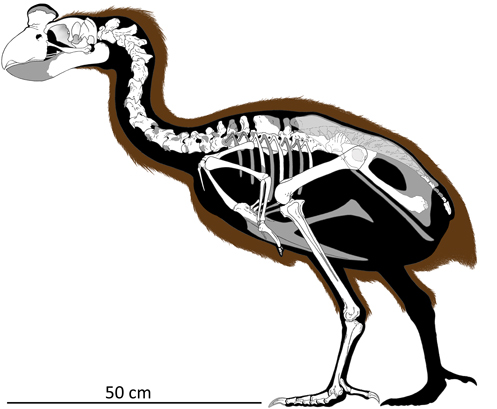
Scientists including researchers from Flinders University (South Australia), have solved the mystery of an extinct flightless bird that once roamed the island archipelago of New Caledonia.  For the first time, the post cranial skeleton has been reconstructed using fossils from a number of cave sites, however, the strange heaps found on the island may not have been nesting mounds created by this large bird, the mounds remain a mystery.

Extinct Flightless Bird

The bird named Sylviornis neocaledoniae, was about the size of a Dodo, but with much longer legs and a longer neck, large individuals may have reached 80 centimetres tall and weighed as much as 34 kgs.  It survived on these isolated islands until very recently, there is evidence to suggest that these birds were around 2,500 years ago.  The arrival of humans in New Caledonia led to the extinction of Sylviornis, but a mystery remained.  Large earth mounds were believed to be nesting sites excavated by these flightless birds but an analysis of foot bones reveals that this extinct New Caledonian resident was not a member of the Megapodiidae (incubator birds), if it did not build these mounds than what or who did?

Scientists have Reconstructed the Skeleton of Sylviornis neocaledoniae

Scale bar = 50 cm, a skeletal reconstruction of the giant, flightless bird from New Caledonia Sylviornis.

Scale bar = 50 cm, a skeletal reconstruction of the giant, flightless bird from New Caledonia Sylviornis neocaledoniae.

Picture credit: PLOS One

Known bones are shaded white in the illustration above, bones not associated with known remains are shaded grey.  Previously, only the skull had been reconstructed, this robust bird probably fed on small animals including invertebrates.

Sylviornis neocaledoniae

The islands of New Caledonia in the south-west Pacific lie some 750 miles to the east of the coast of Queensland.  Dinosaur enthusiasts might remember that New Caledonia was the location chosen to shoot episode three of the ground-breaking BBC television series “Walking with Dinosaurs” that first aired back in 1999.  The exotic fauna of these tropical islands contains a number of unique trees and plants, that are descended from species that once existed on the super-continent Gondwana.

The isolation of the islands permitted several types of ancient flora to survive, for example the New Caledonia Pine (Araucaria columnaris) is descended from ancient trees once grazed by dinosaurs.  The islands became Oxfordshire in the Late Jurassic some 149 million years ago, for the purposes of episode three of the television series – “The Cruel Sea”.

A Scientific Paper Published

The research, published in the on-line journal PLOS One suggests that S. neocaledoniae is not closely related to megapodes, birds such as the Australian Brush Turkey (Alectura lathami) or the Malleefowl (Leipoa ocellata), it had feet more like a chicken than the feet of birds that construct large mounds of earth and vegetation which they then lay eggs in, relying on the mound to incubate the eggs.

Comparison of Foot Bones S. neocaledoniae (left) with a Malleefowl (Leipoa ocellata)

Sylviornis foot bones (left) compared to the extant, mould building Malleefowl of Australia (right).

Sylviornis foot bones (left) compared to the extant, mould building Malleefowl of Australia (right).

Picture Credit: PLOS One

The two black bars are scale bars, each one equates to ten centimetres.  The foot of Sylviornis may have been much bigger than the extant Malleefowl, but the toes are proportionally much smaller, the claws less sharp and indeed, the pedal unguals (bones that make up the digits) are also proportionally smaller than that found in the Malleefowl.  The scientists conclude that these feet were not adapted to creating nesting mounds and that S. neocaledoniae probably incubated its eggs by sitting on the nest in the same way as Ostriches and Emus.

Commenting on the Extinct Flightless Bird Study

Commenting on the study, one of the authors of the scientific paper, Miyess Mitri (Flinders University) stated:

“I was privileged to study this amazing bird, whose large legs and tiny wings made it look like a turkey on steroids.  The tell-tale muscle scars showed that the muscles for the toes were weak and the claws were just like those of chickens — nothing like the mini-spades of mound-builders.”

A phylogenetic analysis using characteristics observed from more than 600 bones studied, suggests that the closest relative of Sylviornis neocaledoniae was Megavitiornis altirostris, colloquially known as the Noble Megapode, that was once resident on the island of Fiji some 850 miles east of New Caledonia.  Sadly, the flightless Megavitiornis seems to have suffered the same fate as Sylviornis, it too became extinct once humans settled on Fiji.  It is likely that both birds, believed to be from the same bird family as the chicken, were hunted to extinction because they tasted good and being flightless they would have been relatively easy to catch.

As for those strange heaps of earth, the research team suggest that they could have been caused by a phenomenon of natural erosion.

Visit Everything Dinosaur’s website: Everything Dinosaur.

6 03, 2016

A Remarkable Window into the Mesozoic

By |2023-04-13T21:52:32+01:00March 6th, 2016|Categories: Dinosaur and Prehistoric Animal News Stories, Main Page, Palaeontological articles|0 Comments

Major Jurassic and Early Cretaceous Fossil Site Announced

A team of scientists have announced the discovery of an enormous area of fossil-rich land in the highlands of southern Patagonia (Argentina), the site, which has yet to be fully explored, may extend for some sixty thousand square kilometres and as such, this location may prove to be the greatest single concentration of fossils (Lagerstätten) yet found anywhere in the world.  Lead author of the research paper published in the on line, bi-monthly, scientific journal “Ameghiniana”, Juan Garcia Massini, concludes that this huge site could provide an unprecedented amount of fossil material and provide an unparalleled view of life on Earth between 160 million and 140 million years ago.

Fossil Site

The discovery was made back in 2012, but it has taken nearly four years for the Argentinian research team to map and plot the area and to gain an appreciation of the astonishing array of organisms preserved.

A Map of the Southern Highlands of Patagonia Showing the Hot Spring Fossil Locations

The hot spring deposits identified to date are shown in red.

The hot spring deposits identified to date are shown in red.

Picture credit: Regional Centre for Scientific Research and Technology Transfer

For Juan Garcia Massini (Regional Centre for Scientific Research and Technology Transfer, known s CRILAR), the site is truly remarkable, he stated:

“No other place in the world contains the same amount of diversity of Jurassic fossils.”

Volcanic Hot Springs Preserve Fossils in Exquisite Detail

This region of southern Argentina was once very geologically active.  There were volcanoes and hot springs, resembling the sort of springs found in Yosemite National Park (in the Sierra Nevada mountains of California), from time to time these hot springs went into overdrive and large amounts of silica-rich, hot water erupted, covering the land.  This petrified the local fauna and flora that was not mobile enough to get out of the way.  The organisms were preserved in situ and almost instantaneously trapped as fossils.  This led to an amazing degree of preservation.  Plant remains, fungi, nematodes, insects and other Arthropods have been preserved, providing scientists with a unique window into life in the Late Jurassic and Early Cretaceous.

Dr Massini explained:

“You can see the landscape as it appeared in the Jurassic—how thermal waters, lakes and streams as well as plants and other parts of the ecosystem were distributed.”

The Fossilised Compound Eye of an Insect

A beautifully preserved compound eye from an insect.

A beautifully preserved compound eye from an insect.

Picture credit: Regional Centre for Scientific Research and Technology Transfer

The exquisite fossilised eye was found in an area of the Patagonian Highlands called La Bajada, just one of several areas identified so far to have particularly high concentrations of fossils.  By slicing the silicate rocks and polishing the exposed surface, very small fossils of the micro fauna and flora can be observed.

The area has been slowly eroded exposing the highly fossiliferous layers, providing the scientists with an almost pristine “in situ” Jurassic and Early Cretaceous landscape to study.

A Piece from a Conifer and a Nematode Worm

The remains of a sprig of a conifer (left) and a nemotode worm (right)

The remains of a sprig of a conifer (left) and a nematode worm (right).

Picture credit: Regional Centre for Scientific Research and Technology Transfer

A Large Number of Specimens from the Fossil Site

A large number of fossils are remarkably well preserved, the speed of petrification may have caused this, with the scientists suggesting that significant areas may have been covered by the hot springs in less than a day, preserving the area as a time capsule providing a unique window into life in the Mesozoic.

Dr Massini added:

“You can see how fungi, cyanobacteria and worms moved when they were alive.”

The slow erosion of the layers of rock that covered the sites in the Deseado Massif mountain range has contributed to the phenomenal level of preservation.  The region has been compared to the famous Rhynie Chert sedimentary deposits of eastern Scotland, named after the nearby village of Rhynie (Aberdeenshire).  This site preserves the flora and fauna of a Devonian ecosystem that was also preserved due to the influx of hot springs inundated with silica.    These fossils are much older, dating from approximately 410 million years ago (Pragian faunal stage of the Early Devonian).  The Rhynie Lagerstätten preserves evidence of some of the very first terrestrial inhabitants, including the first land plants.

The silica-rich sediments are referred to as cherts and when sliced very thinly and studied under powerful microscopes they reveal their fossil content.  The preparation, cutting and polishing of the material will take time, the field team expect to be working on the Deseado Massif for decades as they gradually build up an extremely detailed and unique picture of life in the Mesozoic.

27 02, 2016

Rare Doedicurus DNA Solves Glyptodont Puzzle

By |2024-05-05T19:01:44+01:00February 27th, 2016|Categories: Dinosaur and Prehistoric Animal News Stories, Main Page, Palaeontological articles|0 Comments

Ancient DNA Puts Glyptodonts Firmly in the Armadillo Family Tree

It has proved more difficult to trace than the pattern of osteoderms on the giant, armoured back of Glyptodon but thanks to a new study published in the journal “Current Biology” scientists have been able to establish that glyptodonts nestle well and truly within the family tree of modern armadillos.  It had long been suspected that these heavily armoured animals, many of which possessed fearsome, spiky tail clubs, were closely related to extant armadillos, but this new research, based on the analysis of 12,000 year old mitochondrial DNA extracted from a Doedicurus fossil, identifies them as a subfamily with the armadillos.

Doedicurus

Placing the Glyptodonts in the Armadillo Family

Good old "pestle tail" has a home.

Good old “pestle tail” has a home.

Picture credit: Safari Ltd

The picture above shows a model of the glyptodont called Doedicurus (D. clavicaudatus), by Safari Ltd.  Doedicurus was one of the larger representatives of this group of strange prehistoric animals that originated in South America.  At over three metres in length and weighing in at approximately 1,400 kilogrammes, this herbivore was around the size of a Volkswagen Beetle car.

Earlier studies based on the shape of fossil bones indicated that the glyptodonts were members of the Xenarthra Order.  A group of mammals that includes anteaters, sloths and armadillos, but there were considerable anatomical differences between members of this Order, which led to confusion as to how closely related to the armadillos the extinct glyptodonts were.

The Key is the Carapace

That large, dome-shaped shell, (carapace) certainly resembles that seen in modern armadillos, but it lacks the articulation.  However, it was a fragment of fossilised carapace, believed to come from a Doedicurus that roamed some 12,000 years ago that has unlocked this mystery.  Scientists from the National Centre of Scientific Research (CNRS) and Montpellier University in France in collaboration with colleagues from McMaster University (Ontario, Canada), were able to reconstruct the entire mitochondrial genome based on computer modelling that could predict likely mitochondrial DNA sequences.

Studying Glyptodonts

The researchers had to develop RNA probes capable of identifying potential genetic material from the target species from within the heavily contaminated fossil sample.  Possible ancestral sequences were plotted against the genomes of present-day Xenarthra (sloths, anteaters and armadillos) and slowly and surely the composition of the mitochondrial genome of Doedicurus was pieced together.

The Family Tree of the Armadillos (Cingulata)

Phylogenetic analysis places the glyptodonts firmly in the Armadillo family.

Phylogenetic analysis places the glyptodonts firmly in the Armadillo family.

Picture credit: Current Biology

The picture above shows a phylogeny and molecular timescale of extant armadillos including the extinct glyptodont Doedicurus sp. (in red).

DrcFrederic Delsuc, one of the authors of the scientific paper explained:

“Glyptodonts should probably be considered a subfamily of gigantic armadillos.”

The resulting phylogenetic analysis places the Glyptodontinae as a subfamily but a distinct lineage within the Cingulata (armadillos).  The closest living relative to the giant glyptodonts according to this new research, is the Pichiciego, otherwise known as the Dwarf Pink Fairy Armadillo (Chlamyphorus truncatus) an inhabitant of the grasslands of central Argentina.  Ironically, the Pichiciego, is the smallest species of Armadillo alive today, with adults rarely measuring in excess of twelve centimetres long and weighing around 120 grammes, that’s around 1,160 times lighter than the giant Doedicurus!

Implications for this Study

This research has wider implications when it comes to piecing together the evolutionary relationships between long extinct animals and their modern relatives.  This ancient DNA identification and mapping technique pioneered in this research  can help unlock and reconstruct a range of other ancient genomes, allowing scientists a much better understanding of the diversification, evolution and radiation of vertebrate species.

To view the range of prehistoric animals made by Safari Ltd including that splendid Doedicurus replica: Wild Safari Prehistoric World Figures.

8 02, 2016

Australopithecus sediba – Jaw Study Suggests a More Delicate Bite

By |2023-04-12T20:46:33+01:00February 8th, 2016|Categories: Dinosaur and Prehistoric Animal News Stories, Main Page, Palaeontological articles|0 Comments

Australopithecus sediba – Bio-mechanical Study Hints at Diet

South Africa might be regarded by many as the “cradle of humanity”, thanks to the wealth of Australopithecus and early hominin fossils found in that part of the world.  Thanks to a collaborative research effort involving a bio-mechanical study of skull strength and bite forces, it seems that further light is being shed on the diet of one of southern Africa’s most famous early residents Australopithecus sediba.  This new research may help palaeoanthropologists to further refine the evolutionary position A. sediba in relation to the hominins and ultimately this Australopith’s relationship to our own species.

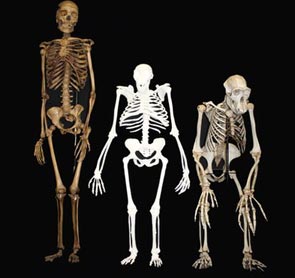
H. sapiens Compared to A. sediba and Pan troglodytes (Chimpanzee)

A. sediba is in the middle, the human to the left of the picture with the chimp skeleton on the right.

A. sediba is in the middle, the human to the left of the picture with the chimp skeleton on the right.

Picture credit: University of Witwatersrand

Fossils Found in 2008

Fossils which came to be known as A. sediba were discovered in 2008 at the famous dig site of Malapa in the Cradle of Humankind World Heritage Site, located around thirty miles north-west of the city of Johannesburg.  Research published in 2012 suggested that this gracile, possible early human ancestor, had lived on a eclectic woodland diet including hard foods mixed with tree bark, fruit, leaves and other plants.  Other research, reported upon by Everything Dinosaur in 2013, provided further insight into the dietary habits of early hominins.

To see the article on research into early hominin diets: From a Forest Diet to a Savannah Smorgasbord.

To read an article explaining how A. sediba came to be named: South African “Cradle Fossil” Named.

This new study carried out by an international team of researchers, including Professors Lee Berger and Kristian Carlson from the Evolutionary Studies Institute (ESI) at the University of the Witwatersrand, now shows that Australopithecus sediba did not have the jaw and tooth structure necessary to exist on a steady diet of hard foods.  This may have important implications on how this species of australopith is viewed in terms of its evolutionary link to that line of hominins that eventually led to our own kind.

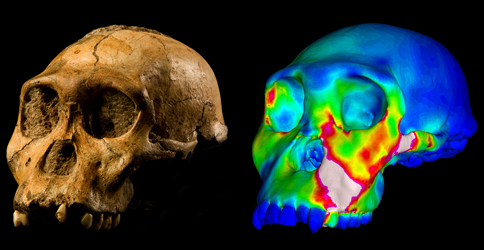
Bio-mechanical Study Indicates that A. sediba Did Not Have “Nutcracker Jaws”

Bite Force Study on A. sediba cranium.

Bite force study on A. sediba cranium.

Picture credit: Image of MH1 by Brett Eloff provided courtesy of Lee Berger (University of the Witwatersrand).

Finite Element Modelling

The picture above show the fossilised skull of A. sediba (specimen number MH1) and a finite element model of the skull depicting strains experienced during a simulated bite on the its back teeth (premolars).  “Warm” colours indicate high mechanical strain, whilst “cool” colours indicate areas of low strain on the skull.

Commenting on the research, published today in the scientific journal “Nature Communications”, Professor David Strait (Washington University, St Louis, USA) stated:

“Most australopiths had amazing adaptations in their jaws, teeth and faces that allowed them to process foods that were difficult to chew or crack open.  Among other things, they were able to efficiently bite down on foods with very high forces.”

Co-author Dr Justin Ledogar, researcher at the University of New England in Australia added:

“Australopithecus sediba is thought by some researchers to lie near the ancestry of Homo, the group to which our species belongs, yet we find that A. sediba had an important limitation on its ability to bite powerfully; if it had bitten as hard as possible on its molar teeth using the full force of its chewing muscles, it would have dislocated its jaw.”

Not Bitting Off More Than It Could Chew

Bio-mechanical modelling based on a computer generated replica of the fossil skull material does not provide conclusive evidence that Australopithecus sediba was on the direct evolutionary line towards Homo, but it does indicate that dietary changes were shaping the evolutionary paths of early human species.  The data acquired from the bio-mechanical analysis does not dispute the possibility that A. sediba occasionally ate hard foods such as nuts and bark.  However, limitations on the amount of bite force that the skull could withstand suggests that hard foods needing to be processed with high bite forces were not an important component of the diet of this species.

About Australopithecus sediba

Australopithecus sediba, a diminutive pre-human species that lived about two million years ago in southern Africa, has been heralded as a possible ancestor or close relative of Homo, our own family.  Australopiths appear in the fossil record about four million years ago, and although they have some human traits such as the ability to walk upright on two legs, most of them lack other characteristically human features such as a large brain, flat faces with small jaws and teeth, and advanced use of tools.  Humans, members of the genus Homo, are almost certainly descended from an Australopith ancestor, and A. sediba is a candidate to be either that ancestor or something similar to it.

Dr Justin Ledogar explained:

“Humans also have this limitation on biting forcefully and we suspect that early Homo had it as well, yet the other Australopiths that we have examined are not nearly as limited in this regard.  This means that whereas some Australopith populations were evolving adaptations to maximise their ability to bite powerfully, others (including A. sediba) were evolving in the opposite direction.”

Foods that were important to the survival of Australopithecus sediba probably could have been eaten relatively easy without the need for high bite forces.

Everything Dinosaur acknowledges the support of the University of Witwatersrand in the compilation of this article.

Visit Everything Dinosaur’s award-winning website: Everything Dinosaur.

17 12, 2015

Rare Pliosaur Skull Links Dorking to Kansas

By |2024-05-05T18:16:48+01:00December 17th, 2015|Categories: Dinosaur and Prehistoric Animal News Stories, Dinosaur Fans, Main Page, Palaeontological articles|0 Comments

Pliosaur Skull Links Dorking to Kansas

For much of the later stages of the Cretaceous, the area that is now known as the British Isles lay underwater.   Bad news if you are searching for evidence of terrestrial dinosaurs, however, the limestones and chalk deposits associated with southern England can still yield some exciting surprises for vertebrate palaeontologists.  Take for example, the research of Dr Roger Benson (University of Oxford, Dept. of Earth Sciences), who has been examining the fragmentary remains of pliosaurs associated with the lithostratigraphic unit of strata known as the Chalk Group.

Analysis of a Pliosaur Skull

Dr Benson’s analysis of a pliosaur specimen housed in the collection of the Dorking Museum and Heritage Centre reveals that the fossils may have been misidentified, by none other than Sir Richard Owen, the anatomist who is credited with the naming of the Order Dinosauria.

An Illustration from the Original 1858 Monograph by Richard Owen

One of the original lithographs from Owen's 1858 paper.

One of the original lithographs from Owen’s 1858 paper.

Picture credit: The Pterosaur Database/Dr R Benson (Supplement (No. III) to the Monograph on the Fossil Reptilia of the Cretaceous Formations: 1858).

The illustration above shows some of the skull fossils and teeth described by Richard Owen as the pliosaur Polyptychodon interruptus.  The smaller illustrations to be found in the lower portion of the picture depict various pterosaur fossils.

What are Pliosaurs?

Pliosaurs, or those animals that make up the Pliosauridae clade, are an extinct group of marine reptiles, that along with the long-necked plesiosaurs make up the Order Plesiosauria.  Pliosaurs tend have short necks and large, broad skulls.  They have a worldwide fossil distribution and they first appeared during the Early Jurassic with many of these reptiles evolving into giants that specialised in hunting other marine vertebrates like today’s killer whales.  Famous prehistoric animals such as Liopleurodon and the Australian Kronosaurus are examples of pliosaurs.

An Illustration of a Typical Pliosaur (Pliosaurus brachydeirus)

A scale drawing of a Pliosaurus.

A scale drawing of a pliosaurus.

Picture credit: Everything Dinosaur

Having dominated marine environments for the best part of a 100 million years, with many forms becoming apex predators, towards the early Late Cretaceous remains of these reptiles disappear from the fossil record.  Around ninety million years or so ago, these sea monsters died out.  Why the pliosaurs became extinct remains a mystery.

Studying Fossil Material

It is important for palaeontologists to gain as much information as they can from existing fossil specimens.  Perhaps, thanks to the careful research of Dr Benson and the presence of many fine fossil collections held in regional museums, one day scientists may have a more complete understanding of how these great reptiles evolved and radiated out into so many forms dominating a number of marine palaeoenvironments.  Scientists might even be able to provide information on why these leviathans went into decline and died out.

The Dorking Pliosaur Specimen

During the early part of the 19th century a number of fossils of marine reptiles were collected by amateur geologists and naturalists.  One such collection, which had been the amassed by the first Baron Ashcombe was donated to the Dorking Museum in 1948 by the first Baron’s grandson.  Amongst the specimens donated was the relatively complete skull of a pliosaur which had been discovered sometime in the 1850s.

The first Baron Ashcombe had used his influence to invite none other than Richard Owen to examine the fossil collection.  Richard Owen, who was later to help found the Natural History Museum (London), described this skull as an example of the pliosaur Polyptychodon interruptus (Po-lip-tie-ko-don in-terr-rupt-us), the name means ” broken apart fin shaped tooth”.

A Pliosaur Skull

When Dr Benson visited the Dorking Museum and Heritage Centre to inspect the skull material, he noted a number of similarities between this fossil specimen and the fossils of another pliosaur, known from North America.  In addition, Dr Benson’s study revealed that most other fossils of Polyptychodon species come from rocks that are much older than the ones found in the chalk pits in this part of Surrey (southern England).  This casts doubt over the original conclusions drawn by the celebrated anatomist Richard Owen.  It seems that the Dorking specimen may represent a type of pliosaur whose fossils are associated with Kansas.

A Fragment of the Lower Jaw

Individual tooth sockets (alveoli) can be made out along the jawbone.

Individual tooth sockets (alveoli) can be made out along the jawbone.

Picture credit: Dr Roger Benson (Oxford University)

Affinities with Brachauchenius

Although Owen thought the Dorking specimen belonged to Polyptychodon the shape of the skull (morphology) suggests to Dr Benson that this specimen may actual be another type of pliosaur altogether.  Dr Benson concludes that the Dorking specimen shares many similarities with a pliosaur known as Brachauchenius (Brak-ow-ken-ee-us) whose fossils are mainly associated with the Western Interior Seaway of the early Late Cretaceous that covered most of the land that is now known as the United States.

According to Dr Benson’s research, most other specimens assigned to the Polyptychodon genus are around 115 million years old (Aptian age of the Cretaceous), but the Dorking fossil material comes from much younger strata, rocks that date from around 90-95 million years ago (Cenomanian to Turonian age).  This indicates that the pliosaur fossils within the collection of the Dorking Museum and Heritage Centre represents one of the last of the pliosaurs.

Part of the Lower Jaw Bone

Lateral view of part of the Pliosaur lower jaw.

A view of part of the pliosaur lower jaw.

Picture credit: Dr. Roger Benson (Oxford University)

Knowledge of the Pliosauridae

Our knowledge of the Pliosauridae has improved enormously since the time of Richard Owen, as has our knowledge of stratigraphy.  These collections, many of which are housed in small regional museums can still have a very significant role in research, for example, in this instance, helping to build up a better picture of an ancient marine fauna.

Everything Dinosaur stocks a wide range of pliosaur and plesiosaur models: Sea Monsters and Marine Reptile Models.

The Museum’s Chairman, Nigel Arch, commenting on Dr Benson’s visit stated that it was:

“A good example of the value of our collections and the fact that we can always learn more.  It is wonderful to think that the study of this specimen, found locally and collected by a local person, is still contributing to scientific knowledge today.” 

A Pliosaur Tooth of P. interruptus

Compare Dr. Benson's photograph to the Pliosaur tooth depicted in Owen's monograph.

Compare Dr Benson’s photograph to the pliosaur tooth depicted in Owen’s monograph.

Picture credit: Dr Roger Benson (Oxford University)

Dr Benson put his research into context, explaining:

“Pliosaurs were giant marine reptiles that could swim across oceans, specimens like the Dorking pliosaur show that this is true because similar fossils are also found in America”.

The Importance of Regional Museums

Regional museums such as the the Dorking Museum and Heritage Centre house many fine specimens assisting in the preservation of an amazing geological and fossil record.

Research using some of the specimens from within these collections can help to shed light on the diversity and distribution of pliosaur genera.  Who knows, perhaps locked away in some cabinet, part of the prized fossil collection of another regional museum may lay the fossilised bones of another mislabelled specimen, one that could provide clues as to the why the Pliosauridae became extinct.

15 12, 2015

New Sail-Backed Dinosaur from Early Cretaceous Spain

By |2023-04-09T18:31:12+01:00December 15th, 2015|Categories: Dinosaur and Prehistoric Animal News Stories, Dinosaur Fans, Main Page, Palaeontological articles|0 Comments

Morelladon beltrani – A Spanish Sail-Backed Dinosaur

A team of Spanish scientists have published details of a new genus of plant-eating dinosaur which roamed the Iberian Peninsula about 125 million years ago (Early Cretaceous).  The dinosaur named Morelladon beltrani is believed to have been closely related to Iguanodon and the discovery helps to reinforce the belief held by many palaeontologists that the Ornithopoda were extremely diverse in Europe during this part of the Cretaceous.

Sail-backed Dinosaur

The dorsal vertebrae have large, extended neural spines a feature seen in other Early Cretaceous ornithopods, dinosaurs such as Ouranosaurus from Niger.  These spines may have supported a hump or perhaps a sail-like structure, the purpose of which remains open to debate.

An Illustration of Morelladon beltrani

An illustration of Morelladon.

An illustration of Morelladon.

Picture credit: Universidad Nacional de Educación a Distancia (Spain)

This new species of dinosaur has been named from the fossilised remains of a single animal, preserved bones consist of dorsal vertebrae, the sacrum, partial ribs, the pelvic girdle, isolated teeth from the lower jaw and the right tibia.

However, despite a lack of cranial material, the team of scientists from the Spanish equivalent of the Open University (Universidad Nacional de Educación a Distancia) and the Autonomous University of Madrid (Universidad Autónoma de Madrid), identified eight unique anatomical features (autapomorphic features) that enabled a new genus to be established.

Elongated Neural Spines

One of the unique anatomical features identified were the very elongated and tall neural spines of the dorsal vertebrae.  Such features are known in other plant-eating dinosaurs, such as the Ouranosaurus (Ouranosaurus nigeriensis) from the Early Cretaceous of Africa and although Morelladon is related to Ouranosaurus, a phylogenetic analysis carried out by the Spanish team suggests that this new Spanish dinosaur is more closely related to other western European dinosaur taxa.  Dinosaurs such as Iguanodon (I. bernissartensis) from Belgium and Mantellisaurus atherfieldensis (from England).

The Extended Neural Spines of the Dorsal Vertebrae

A photograph of the fossil material and accompanying line drawing.

A photograph of the fossil material and accompanying line drawing.

Picture credit: Universidad Nacional de Educación a Distancia (Spain)/PLOS One

Close to the City of Morella

The fossils come from a dig site within a quarry about five miles south-west of the city of Morella (Castellón Province), on the eastern coast of Spain.  The specimen was excavated from a red clay bed dated to the Upper Barremian age (125 million years ago), part of the Arcillas de Morella Formation.  The dinosaur’s name means “Morella tooth”, after the location of the fossil find and in keeping with the naming of Iguanodon, which itself means “iguana tooth”.  The trivial name honours quarry owner, Víctor Beltrán who has been prominent in the excavation and research of a number of Cretaceous vertebrates from this part of Spain.

The Fused Sacral Vertebrae of the Specimen (Sacrum)

The sacrum (fused vertebrae over the hips) of Morelladon.

The sacrum (fused vertebrae over the hips) of Morelladon.

Picture credit: Universidad Nacional de Educación a Distancia (Spain)/PLOS One

Measuring up to six metres long and standing around 2.5 metres high at the hips, this new genus supports the hypothesis that the Iberian Peninsula in the Early Cretaceous was home to a large number of different types of Iguanodon-like herbivorous dinosaurs.

Why the Tall Neural Spines?

There have been a number of theories put forward to explain the presence of elongated neural spines in some types of dinosaur.  For example, one of the most famous of all the meat-eating dinosaurs – Spinosaurus had neural spines which supported a structure its back, often referred to as a “sail” that must have been more than two metres high.  The neural spines of Morelladon hint at a much smaller feature, around half a metre tall.

It has been proposed that since this dinosaur lived in a delta subject to distinct seasons the spines could have supported a fleshy hump where food reserves and fat could be stored to help the animal through leaner times.  Extant North American buffalo (Bison bison) have dorsal spines that support such structures.  The spines could also have supported a sail-like structure, perhaps this had a role in communication within the herd, or display.

Commenting on another potential purpose for the structure, Dr Fernando Escaso (Universidad Nacional de Educación a Distancia) stated:

“The “sail” could have helped in heat exchange [thermoregulation] by releasing excess body heat into the environment as do the ears of the modern-day elephants.”

An effective heat exchanger would have been useful for such a large-bodied animal.  Everything Dinosaur team members suspect that oxygen isotope analysis from the many different types of teeth found in eastern Spain in Early Cretaceous rocks, would provide palaeontologists with a lot of information about the palaeoclimate.  For instance, some researchers claim that there was an annual average temperature range of thirty-six degrees with temperatures in excess of 40 degrees Celsius being recorded with annual lows of around 4 degrees C.

What are Styracosternan Dinosaurs?

Other media sources have cited the comment that Morelladon represents a new member of the styracosternan sub-group of the clade Iguanodontia.  What does this mean?  In the mid 1980s it had become clear to many palaeontologists that the division of the Ornithopoda into large bodied forms such as Iguanodon and Dollodon and smaller forms such as Hypsilophodon was over simplistic.

A number of academics proposed new classifications of these bird-hipped dinosaurs, for example Paul Sereno (1986) proposed a new clade within the Ornithopoda called the Ankylopollexia “stiff thumbs”.  This clade included the camptosaurs, iguanodonts, Ouranosaurus and the hadrosaurids “duck-billed dinosaurs”.  This clade was further divided by Sereno et al (1986) into the Styracosterna, which included all the Ankylopollexia members with the exception of the camptosaurids (Camptosauridae family).

  1. Ankylopollexia = a clade of the iguanodontian dinosaurs
  2. Styracosterna = a clade of the iguanodontian dinosaurs the same as Ankylopollexia but with the camptosaurids excluded.

Therefore, the Styracosterna dinosaurs can be divided as a sub-group of the Iguanodontia clade that contains all the “duck-billed dinosaurs” and all the dinosaurs more closely related to them than to the Camptosauridae.

Phylogenetic relationships of Morelladon beltrani within the Iguanodontia Clade

Phylogenetic relationships of Morelladon beltrani with the Styracosterna.

Phylogenetic relationships of Morelladon beltrani with the Styracosterna.

Picture credit: PLOS One with additional annotation by Everything Dinosaur

The diagram above shows how the Styracosterna fit into the clade Iguanodontia.   Phylogenetic analysis places Morelladon beltrani firmly in the with the styracosternan dinosaurs but more closely related to Western European iguanodonts such as Iguanodon bernissartensis and Mantellisaurus atherfieldensis than to other Iberian styracosternans such as Delapparentia turolensis and Proa valdearinnoensis.

For models and replicas of ornithopods and other prehistoric animals: CollectA Age of Dinosaurs.

10 12, 2015

New Dog-sized Dinosaur and Chasing “Ghosts”

By |2024-05-05T18:19:40+01:00December 10th, 2015|Categories: Dinosaur and Prehistoric Animal News Stories, Main Page, Palaeontological articles|0 Comments

Hornless Hualianceratops wucaiwanensis

So, details regarding  the dog-sized newest member of the Ceratopsia has been published in the on-line academic journal PLOS One.  Say hello to Hualianceratops wucaiwanensis (pronounced as wal-lee-an-sera-tops woo-sigh-wan-en-sis), a small plant-eating dinosaur at the very foot of the dinosaur family tree that would lead to the mighty horned dinosaurs, animals such as Triceratops, Styracosaurus and Pachyrhinosaurus.

New Horned Dinosaur Without Any Horns

Hualianceratops illustrated.

Hualianceratops illustrated.

Picture credit: Portia Sloan Rollings

Ever Expanding Horned Dinosaurs

Over the last ten years or so there have been a remarkable number of new genera of horned dinosaur erected, mostly representing Late Cretaceous ceratopsians from North America.  Back in July, for example, Everything Dinosaur team members wrote an article about the latest edition to the centrosaurine group of horned dinosaurs  Wendiceratops (W. pinhornensis).  The month before that, the other great subfamily of the ceratopsians, the chasmosaurines got a new member (Regaliceratops peterhewsi).  Whilst there is undoubtedly lots of attention focused on the six-metre-plus, very ornate giants of North America, palaeontologists, as yet, don’t really understand how the horned dinosaurs evolved, or indeed, little is known about the phylogenetic relationships of some of the earliest forms.

Hualianceratops

Step into the frame Hualianceratops (the name translates as “ornamental face”), here’s a half-metre-long dinosaur that may shed some much needed light on ceratopsian ancestry.  Ironically, Hualianceratops manages to hint at future fossil discoveries without providing a great deal of data about itself.

To read the article on Wendiceratops pinhornensis: Southern Alberta’s Wendiceratops.

To read an article describing the discovery of Regaliceratops: New Horned Dinosaur Causes a Royal Rumble.

The angular and the dentary (bones that form the lower jaw along with the predentary) have a roughened texture (rugose).  It is this rough texturing not known in any other basal Asian ceratopsian that gives this little dinosaur its genus name.  The species or trivial name comes from the Chinese Wucaiwan “five colour bay” from the area in Xinjiang Province where the fossils were found.  The strata forms part of the famous Junggar Basin (Shishugou Formation).

Views of the Lower Jaw of Hualianceratops

The mandible of Hualianceratops wucaiwanensis (IVPP V18641)

The mandible of Hualianceratops wucaiwanensis (IVPP V18641).

Picture credit: PLOS One

Roughened Texture

The picture above shows two photographs of part of the lower jaw of this little dinosaur, the angular bone (an) and the dentary (d) have a roughened texture.  The fossil material consists of the majority of the skull, plus some fused sacral vertebrae and portions of the lower limbs which include an almost complete left hind leg.  It is from these bones that the scientists have been able to deduce that Hualianceratops was a biped, moving around on its back legs, in contrast to the much larger, heavier and later North American ceratopsians such as the famous Triceratops.

Post Cranial Fossil Material (Lower Limbs and Left Foot (Pes)

A partial hind limb and the left foot of Hualianceratops.

A partial hind limb and the left foot of Hualianceratops.

Picture credit: PLOS One

The researchers behind the scientific paper, published this week in PLOS One, consist of a team from the University of Washington and from the Institute of Vertebrate Palaeontology and Palaeoanthropology, (IVPP), part of the Chinese Academy of Sciences.  These institutes have been collaborating since 2002, exploring numerous fossil sites in north-western China.  A number of early ceratopsians have already been named as a result of this research programme.  The oldest known member of the horned dinosaur family Yinlong (Yinlong downsi) was found in the same Formation by these researchers.  It was formally named and described back in 2006.

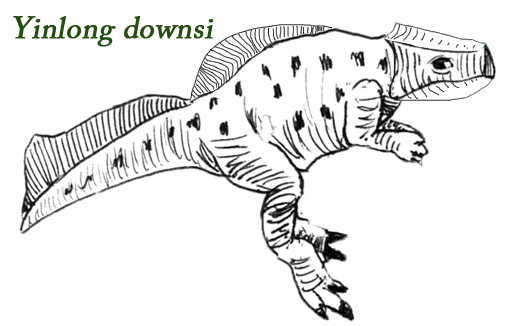
An Illustration of Yinlong downsi Earliest Known Ceratopsian

Yinlong downsi, the earliest known Ceratopsian dinosaur.

Yinlong downsi, the earliest known ceratopsian dinosaur.

Picture credit: Everything Dinosaur

Hornless Hualianceratops

The newly described Hualianceratops would have looked very similar, but it was slightly shorter and stockier.  The bristles are speculative, no evidence of bristle-like structures have been found in association with Yinlong or Hualianceratops fossil material, as far as team members at Everything Dinosaur are aware, but if the related psittacosaurs had such structures it can be speculated that these little dinosaurs also sported similar quills and bristles.  Both Yinlong and Hualianceratops, despite being classified as basal horned dinosaurs, did not have any horns.

The genus name Yinlong means “hidden dragon”, this does not reflect any great difficulties of extracting the fossil from the dig site, but merely pays homage to the fact that Xinjiang Province provided most of the location shots for the award winning Chinese film “Crouching Tiger, Hidden Dragon”.

Both Hualianceratops and Yinlong were found in the same fossil bed, although Yinlong’s location suggests that this animal lived before Hualianceratops evolved.  The age of the rocks in the Junggar Basin are difficult to date accurately, there is considerable debate as to the precise age of the strata, however, the rock layer from which these two dinosaurs were extracted has been dated to the Oxfordian age (Late Jurassic, approximately 163.5 to 157.3 million years ago).

Greater Diversity of Late Jurassic Horned Dinosaurs

The discovery of a new type of horned dinosaur from Upper Jurassic rocks provides evidence that as early as 160 million years ago, a number of Ceratopsia genera had already evolved.  These little hornless horned dinosaurs were much more diverse much earlier in geological time than previously thought.

Commenting on the discovery, Professor Catherine Forster, a biologist at George Washington University and co-author of the scientific paper on Hualianceratops, stated:

“Finding these two species in the same fossil bed reveals there was more diversity there than we previously recognised.  It suggests that the ceratopsian dinosaurs already had diversified into at least four lineages [possibly five] by this time in the Jurassic Period.”

Looking for Ghosts

That’s really the significance of these fossil finds, prior to 2006, not a single ceratopsian was known from the beginning of the Late Jurassic.  Although, the exact evolutionary path of the Ceratopsia remains unknown and the exact relationship between the likes of Yinlong, Hualianceratops and the closely related Psittacosaurus is unclear, because of these fossil discoveries and similar finds in China, palaeontologists can work out that there must be other early horned dinosaurs awaiting discovery.

Hualianceratops and the Ghosts (Ghost Lineages)

Hualianceratops and the ghost lineages..

Hualianceratops and the ghost lineages.

Picture credit: PLOS One with additional annotation from Everything Dinosaur

“Ghost Lineages”

Comparing the features of known early horned dinosaur fossils has led scientists to identify a number of “ghost lineages” in the early horned dinosaur family tree.  In this instance, when the family tree of these basal ceratopsians is pieced together, the “best fit” that can be made indicates that there are a number of pieces missing.  These are ghost lineages, an evolutionary line that has no traces in the fossil record.  In simple terms, if the fossils of the “ghosts” have been preserved, then nobody has found them yet.

The researchers conclude that, based on the fossils that have been found at least five ceratopsian lineages were present at the beginning of the Late Jurassic.

  1. Yinlong
  2. Hualianceratops
  3. The ghost lineage that led to the psittacosaurs (dotted red line on the left of the picture)
  4. A ghost lineage that led to the later horned dinosaurs Chaoyangsaurus and Xuanhuaceratops (middle red dotted line)
  5. The ghost lineage that led to the evolution of the later Neoceratopsia (the red dotted line on the right)

Potentially, there are more “hidden dragon” fossils waiting to be found.  Perhaps, the name for the next basal horned dinosaur to be found from this part of north-western China will be inspired by another film, not “Crouching Tiger, Hidden Dragon” but “Ghostbusters”!

PNSO have created a range of small, model prehistoric animals including several horned dinosaurs.  To see this range: PNSO Age of Dinosaurs.

6 12, 2015

Isle of Skye Sauropods and Their Water World

By |2023-04-09T16:33:00+01:00December 6th, 2015|Categories: Dinosaur and Prehistoric Animal News Stories, Dinosaur Fans, Main Page, Palaeontological articles|0 Comments

Sauropod Tracks Suggest a Preference for Water

For much of the 19th and 20th centuries, those behemoths of the Dinosauria, the sauropods, were depicted as aquatic animals, at home in the deep water of large lakes, where their enormously heavy bodies could be supported by the water and their weak, peg-like teeth could cope with the soft and lush lakeside vegetation.  A substantial amount of evidence was put forward by scientists to support this hypothesis, not least of which was trackway evidence.

Most sauropod tracks were associated with soft mud, the sort of conditions found close to large bodies of water.  Therefore, it seemed logical to depict these super-sized reptiles as animals at home in lacustrine (lakes), estuaries or riverine dominated habitats.  Thanks to some remarkable Middle Jurassic sauropod footprints, this idea of long-necked dinosaurs preferring to live near to water might just be resurrected and find favour once again in palaeontological circles.

Dinosaur Tracks (Sauropoda) Discovered on the Isle of Skye

Sauropod tracks in hyporelief (Isle of Skye)

Sauropod tracks in hyporelief (Isle of Skye).

Picture credit: University of Edinburgh/Scottish Journal of Geology

Went Out for An Ichthyosaur Came Back with an Ichnogenus!

A party of scientists from Edinburgh University in collaboration with local fossil experts were working on the northern part of the Isle of Skye conducting research into the fauna and flora preserved in strata that makes up the bay just south of the ruin of Duntulm Castle.  Although it is difficult to precisely date the vertebrate fossils found in these rocks, these sediments are believed to preserve evidence of life during the Middle Jurassic and since there are only a handful of highly fossiliferous sites dating from this time in geological history to be found anywhere in the world, the Isle of Skye represents an extremely important location for scientists.

Ironically, the team, which included Dr Steve Brusatte from the School of GeoSciences (Edinburgh University), had set out to recover some Ichthyosaurus fossils but the area where the marine reptile lay remained covered by the high tide.

Sauropod Tracks

Although disappointed, the team continued to document the variety of fossils located on the foreshore and as the light from the relatively low sun cast shadows along the rocky coastline, Dr Brusatte and his colleague Dr Tom Challands came across some large lumps of raised rock.  Protruding from one lump of rock were extensions of the material that gave the distinct impression of digits and substantial claws, particularly on digits I and II.  This pattern is diagnostic of the hind footprint from a sauropod dinosaur.

The Left Hind Foot (Pes) of a Sauropod Dinosaur Isle of Skye

a = dorsal view, whilst b = anterior view, the digits are marked.  Lens cap = 5 cm.

a = dorsal view, whilst b = anterior view, the digits are marked. Lens cap = 5 cm.

Picture credit: University of Edinburgh/Scottish Journal of Geology

The picture above shows one of the rear feet of the sauropod (left pes), the digits are marked and the lens cap, in the picture to provide scale, measures five centimetres in diameter.  The prints are in hyporelief (convex and raised).  The tracks were found in three beds in total (bed 34 and 35 provided trackways, whilst bed 9 provided single prints identified as those from a sauropod plus additional individual tridactyl prints identified as having been made by a large theropod.

The footprints, the largest of which is around seventy centimetres in diameter were made by animals that were around fifteen metres in length and weighed in excess of ten tonnes.  The tracks are the first Sauropod tracks to be found north of the border and represent the largest dinosaur known from Scotland.

Long-Necked Dinosaurs Walking Across a Salt Water Lagoon

The beds from which the prints come from also contain shark teeth, and the remains of marine molluscs.  The strata does not exhibit any signs of mud cracks or drying out, so this evidence, along with the associated fossils, suggests that the sauropods were wading across a shallow salt water lagoon.  Although an ichnogenus has yet to be assigned to these tracks, the University of Edinburgh research team have proposed that the prints are similar to the ichnogenus Breviparopus or perhaps Parabrontopodus.

Sauropod Tracks Discovered on the Isle of Skye

Concave epirelief trackways in bed 35 (Isle of Skye).

Concave epirelief trackways in bed 35 (Isle of Skye).

Picture credit: University of Edinburgh/Scottish Journal of Geology

If you examine the picture above carefully, you can see that despite the size of the prints, they are quite close together.  The footprints of titanosaurs for example, tend to be much wider apart.  These are “narrow gauge” prints perhaps indicative of a cetiosaurid or a diplodocid dinosaur.

To view models and replicas of sauropod dinosaurs: Mojo Fun Prehistoric Animal Models.

Implications for the Habits of Sauropods

As sauropod prints are found in three different beds it could be suggested that these dinosaurs were frequent visitors to this sort of salt water habitat.  Although, it has to be pointed out that it is difficult to determine how much time elapsed between the deposition of the different beds.  The strata could have been laid down over a few centuries or there could be thousands of years between these bedding planes.  One thing that the scientists can be fairly confident about is that between some of the beds in this area there are large concretions of limestone.

The algae and other micro-fossils such as dinoflagellate and preserved palynomorph fossils indicate that these sediments date from the Bathonian age (167.7 to 164.7 million years ago approximately).

A Line Drawing of Some of the Epirelief Prints Showing the “Narrow Gauge” of the Dinosaur Tracks

A line drawing of the Sauropod trackways from bed 35.

A line drawing of the sauropod trackways from bed 35.

Picture credit: University of Edinburgh/Scottish Journal of Geology

Why Live Close to Salt Water?

Dr Challands described the moment when the team became aware of the significance of their discovery as an “epiphany”.  Details of the tracks have been published in the “Scottish Journal of Geology” and these trackways and others like them found elsewhere in the world (including England), have led some palaeontologists to re-examine the evidence for sauropods being entirely terrestrial animals.  The researchers writing in the journal state:

“The Skye site presents a confluence of evidence for sauropods living in the region of a submerged lagoon over multiple generations.”

There might have been a number of advantages for the sauropods if they lived close to large bodies of water, for example:

  • Sandy beaches would have made natural thoroughfares for these large creatures providing access to the edge of forests adjacent to the shoreline.
  • Open areas would have limited the chances of these plant-eating dinosaurs being ambushed by theropods.
  • Lagoons are associated with abundant food supplies.
  • By wading or wallowing in the water these creatures would have been able to cool their large bodies very effectively.
  • The salt water and mud would have provided relief from biting insects.
  • Few predators would have been prepared to venture out into the lagoon to hunt the sauropods.

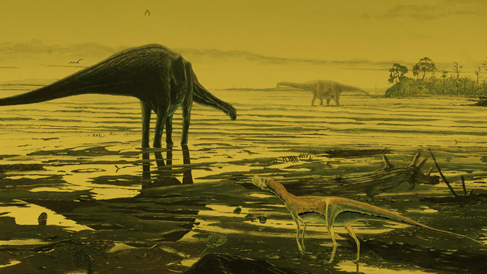
The Isle of Skye in the Middle Jurassic

The Isle of Skye (Bathonian faunal stage).

The Isle of Skye (Bathonian faunal stage).

Picture credit: Jon Hoad

The illustration above shows two sauropods on the mud flats of the lagoon, whilst in the foreground a small, theropod (Ornitholestinae subfamily) looks on warily.

A Significant Middle Jurassic Discovery

Commenting on the trace fossils and their importance to palaeontology, Dr Brusatte stated:

“The Middle Jurassic was a really interesting period in the history of life, when there was a whole lot of evolution going on. What is really frustrating is that we have a lot of fossils from different places with fossils from the Early Jurassic and the Late Jurassic, but there is relatively little fossil-bearing Middle Jurassic rock around.”

The Isle of Skye fossils pose some intriguing questions, these tracks most likely were made by primitive sauropods at a time when the Sauropoda were beginning to radiate, differentiate and evolve into a number of new forms.

In addition, the strata preserves evidence of multiple generations of sauropods inhabiting lagoonal environments, which suggests the intriguing possibility that these huge creatures might have sought out such habitats, preferring them to inland areas.

Do these tracks preserve evidence of Isle of Skye sauropods and their water world?

28 11, 2015

The Amazing Jehol Biota and Sea Turtle Origins

By |2024-05-05T14:51:00+01:00November 28th, 2015|Categories: Dinosaur and Prehistoric Animal News Stories, Dinosaur Fans, Main Page, Palaeontological articles|0 Comments

Scientists Use Chinese Cretaceous Turtle Fossils to “Crack” Turtle Evolution

Turtles and tortoises are representatives of a very ancient group of reptiles and scientists have much still to learn about their origins and how the Chelonia (the name given to tortoises, turtles and terrapins) evolved, but new research by a joint German, Hungarian and Chinese research team is helping to shed some light on these shelled creatures.  The scientists have been studying the beautiful, fossilised remains of Early Cretaceous turtles from north-eastern China in a bid to determine how the first sea turtles arose.

The extant sea turtles found today, represent just a tiny portion of what was once, a hugely diversified group.  There are just seven species, the majority of which are very vulnerable to extinction.  The first sea turtle fossils appear in Cretaceous aged rocks some 130 million  years old, it is very likely that these marine animals evolved from a common, freshwater ancestor, although this ancestor has yet to be identified.

A New Study of the Jehol Biota

In this new study, Dr Chang-Fu Zhou of the Shenyang Normal University of Liaoning and Dr Márton Rabi of the Biogeology Workgroup of the University of Tübingen and the Hungarian Academy of Sciences tried  to identify the ancestors of modern sea turtles from amongst the many excellent turtle fossils that represent the famous Jehol Biota of the Early Cretaceous of north-eastern China.

An Example of One of the Exquisitely Preserved Turtle Fossils Affiliated to the Jehol Biota

The newly-described fossil species, Xiaochelys ningchengensis, from northeastern China’s Jehol Biota; right: an illustration of the skeleton incorporating positive and negative impressions preserved in the layers of stone

The newly-described fossil species, Xiaochelys ningchengensis from north-eastern China’s Jehol Biota; right: an illustration of the skeleton incorporating positive and negative impressions preserved in the layers of stone.

Picture credit: Chang-Fu Zhou

The picture above shows the slab and counter slab of the newly described Cretaceous turtle Xiaochelys ningchengensis from north-eastern China.  To the right of the photograph a line drawing has been produced to show the preserved features of the shell (scale bar = 20 mm).

The Importance of the Jehol Biota

The Jehol Biota is a rich Cretaceous ecosystem preserved in a multi-layered rock formation cropping out in the Chinese provinces of Liaoning, Hebei and Inner Mongolia.  The habitat represented is that of a temperate forest zone, with large lakes in situ.  Nearby, volcanoes occasionally covered the area in fine ash and this led to the exquisite preservation of many of the fossils to be found in these regions.  The most famous fossils associated with these strata are feathered dinosaurs, animals such as Sinosauropteryx, Sinornithosaurus, Microraptor and the recently described  Zhenyuanlong suni.

To read an article about the significance of the Jehol Biota: Unravelling the Sequence of Deposition in North-eastern China.

To read an article about the “winged dragon”  Zhenyuanlong suni: A New “Winged Dragon” from China.

North-eastern China Around 130-125 Million Years Ago

A rich and diverse Jurassic environment dominated by small mammals, Pterosaurs and feathered Theropods.

A rich and diverse environment dominated by small mammals, pterosaurs and feathered theropods.

Picture credit: Julia Molnar

Models of Prehistoric Animals

PNSO of China have created a range of prehistoric figures, many of which represent pterosaurs, dinosaurs and other creatures associated with the Jehol Biota: PNSO Age of Dinosaurs.

Ironically, despite this part of the world’s connection with feathered dinosaurs, the first vertebrate of the Jehol Biota to be described was a freshwater turtle (1942).

Xiaochelys ningchengensis – A New Species of Freshwater Turtle

The research team have described a new species of freshwater turtle, adding to the rich vertebrate assemblage known to have existed in this part of the world during the Early Cretaceous.  A study of the fossils of X. ningchengensis was undertaken to ascertain whether this ancient turtle, whose shell was not much bigger than a saucer, was a potential ancestor of today’s sea turtles.

Dr Zhou and Dr Rabi applied comparative morphological assessment techniques to try to map this turtle’s position in relation to other members of the Chelonia, this produced a comprehensive phylogeny diagram of turtle evolutionary relationships leading to today’s living turtle species.  The scientists wanted to test an earlier hypothesis that the Jehol Biota turtles belong to a lineage that eventually gave rise to extant marine reptiles.

Dr Zhou explained:

“According to our findings, the Jehol turtles are instead found on the lineage leading to the Cryptodiran turtles.”

An Illustration of Xiaochelys ningchengensis

An illustration of the freshwater turtle Xiaochelys

An illustration of the freshwater turtle Xiaochelys.

Picture credit: W. S. Wang

Xiaochelys ningchengensis

In the picture above, the small, freshwater turtle Xiaochelys ningchengensis has caught a fish (Lycoptera spp.) fossils of these fish are associated with the same strata as the X. ningchengensis material.  Xiaochelys (pronounced sho-ow-key-lis) comes from the Chinese Pinyin “Xiao” a reference to the small size of this taxon and the Greek for turtle “chelys”.  The trivial name honours the type locality, Ningcheng County (Inner Mongolia).  The research has been published in the latest edition of the academic journal “Scientific Reports”.

The cryptodires, which also include sea turtles, are able to pull their heads and necks vertically into their shells using an S-shaped motion.  The statistical analysis only just placed the likes of Xiaochelys outside the ancestral line of modern turtles, so it is quite likely that this Cretaceous turtle was quite similar to those types of turtle that were ancestral to the modern forms.

Dr Zhou added:

“These well-preserved fossils give us insights into the origin of cryptodires.  About three-quarters of today’s turtles belong to that group.”

Evolutionary Changes

It is not clear however, just how the main adaptations of marine turtles arose.  These evolutionary changes included the reduction of their skeleton and the development of large, rigid paddles which enable the creatures to swim in a style which is best described as “flying underwater”.  The Chelonia, throughout their long evolutionary history seemed to have evolved into a myriad of forms with several lineages “flipping” between a terrestrial and fully aquatic existence.  Scientists still don’t really understand how the Chelonia evolved and changed since they first appeared many millions of years ago.

Everything Dinosaur acknowledges the help of Tübingen University in the compilation of this article.

Visit Everything Dinosaur’s award-winning website: Everything Dinosaur.

Go to Top