All about dinosaurs, fossils and prehistoric animals by Everything Dinosaur team members.

Articles, features and information which have slightly more scientific content with an emphasis on palaeontology, such as updates on academic papers, published papers etc.

28 05, 2016

Strange Tusked Dicynodont from Brazil

By |2023-04-30T16:07:53+01:00May 28th, 2016|Categories: Dinosaur and Prehistoric Animal News Stories, Main Page, Palaeontological articles|0 Comments

Rastodon procurvidens – A Permian “Tusker” from Brazil

Palaeontologists wanting to learn more about a bizarre group of Permian/Triassic therapsids known as dicynodonts usually head to the Karoo Basin of South Africa, a part of the world famous for its reptile fossils.  So abundant are the various dicynodont fossils in the strata that make up the Permian and Triassic components of the Karoo Basin Supergroup, that their fossil remains are used to date the rocks in which they are found.  There is no doubting that the dicynodonts were a very successful group, but what about the rest of Pangaea and their fossil record?

A Model of a Typical Dicynodont

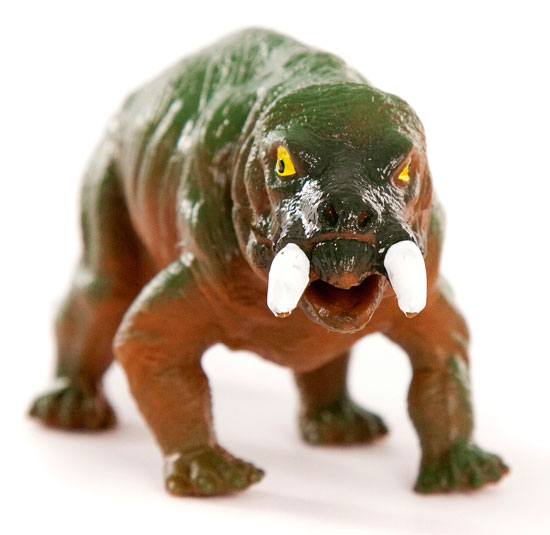
Placerias prehistoric animal model (anterior view)

Placerias model in anterior view.  A model of a dicynodont.

Picture credit: Everything Dinosaur

For models and replicas of prehistoric animals: CollectA Deluxe Prehistoric Life Scale Models.

Rastodon procurvidens

Scuttle forward Rastodon procurvidens, only the second Permian dicynodont to be identified from the Paraná Basin of Brazil.  A team of international scientists writing in the on-line, open access journal PLOS One describe Rastodon from a beautifully preserved, albeit slightly crushed fossil skull that was found on a private residence (Boqueirão farm outcrop), located in the municipality of São Gabriel (Catuçaba district), approximately in the central part of the Rio Grande do Sul State, in south-eastern Brazil.

The researchers, which include scientists from the Federal University of Rio Grande do Sul and the Museum für Naturkunde (Berlin, Germany), studied the holotype material, which consists of most of the skull with attached lower jaws and named the animal “Rasto – tooth” in honour of the Rio do Rasto Formation from which the fossils came.  Ironically, as a synapsid reptile, Rastodon is more closely related to mammals such as ourselves than it is to modern reptiles like crocodiles, snakes and lizards.

Left Lateral View of the Skull of Rastodon procurvidens

Rastodon fossil skull from Brazil.

A view of the skull of the therapsid Rastodon.

Picture credit: Felipe Lima Pinheiro

Odd Tusks

Many types of dicynodont had enlarged tusks in the upper jaw.  The tusks of Rastodon seem to be extremely unusual, even for this bizarre group of ancient herbivores.  They are very small and curve forwards with the tip of each tusk angled towards the front of the snout.  Phylogenetic analysis indicates that R. procurvidens is the earliest and most basal member of Bidentalia, a cosmopolitan clade that includes Permian and Triassic dicynodonts whose dentition is usually reduced to a pair of maxillary tusks.

Tusk Shape Not Due to Post-mortem Crushing

The authors of the scientific paper note that the shape and position of the tusks were not due to post-mortem crushing of the skull bones or due in any part to the fossilisation process.   Both tusks look symmetrical when the skull is viewed from the front end (anterior view) and in addition, each tooth fits neatly into a groove in the lower jaw.  The presence of this embayment or recess confirms that the teeth position and morphology are just about unchanged from when this quadruped scuttled around this part of Brazil the best part of 260 million years ago.  The odd tusks of Rastodon have inspired the trivial name which means “curved forward tooth”.

To read an article about another bizarre therapsid from Brazil: Bizarre Sabre-Toothed Permian Herbivore from Brazil.

As to the specific function of these strange teeth, well, that remains somewhat of a mystery.

Visit Everything Dinosaur’s website: Everything Dinosaur.

25 05, 2016

The “Black Sheep” of the Ichthyosaur Family

By |2023-04-30T13:08:36+01:00May 25th, 2016|Categories: Dinosaur and Prehistoric Animal News Stories, Dinosaur Fans, Main Page, Palaeontological articles|1 Comment

Making Heads or Tails of Sclerocormus parviceps

No sooner has the likes of Oliver Rieppel, (Rowe Family Curator of Evolutionary Biology at the Field Museum, Chicago) and Nick Fraser (National Museums of Scotland), in collaboration with scientists from China “unzipped” the bizarre Triassic marine reptile Atopodentatus unicus*, another academic paper comes along introducing the equally peculiar looking Sclerocormus parviceps to the world.

A number of media outlets have already covered this news story, but in this article we will take a slightly different approach, focusing on the rapid evolutionary changes that seem to have taken place in marine ecosystems following the End Permian mass extinction event.

Sclerocormus parviceps

The Complete Specimen of Sclerocormus parviceps (Holotype Reference AGB6265)

Sclerocormus parviceps fossil material.

Sclerocormus parviceps fossil material.

Picture credit: Da-yong Jiang (Peking University)

The photograph above shows the various components that make up the holotype specimen.  The scale bars to the left and in the centre each measure 25 centimetres in length.  The long, thin, whip-like tail is on the left of the photograph, the skull on the right.

From the Majiashan Quarry

The specimen was excavated from Bed 719 in the Majiashan Quarry, near the city of Chaohu in Anhui Province (eastern China).  These, predominately limestone beds are highly fossiliferous, and a huge variety of invertebrate and vertebrate fossils are known from this location.  The strata was laid down in a shallow, tropical sea environment not long after the End Permian extinction event and as a result, the fossils found in these rocks have provided palaeontologists with a unique opportunity to examine how marine fauna bounced back after the extinction that is believed to have wiped out around 95% of all marine life.

Sclerocormus parviceps – Not Your Typical Ichthyosauriform

Writing in the on-line journal “Scientific Reports”, the researchers describe this new type of marine reptile as a basal member of the ichthyosauriforms.  The fossil material dates from around 248 million years ago (Olenekian faunal stage of the Lower Triassic), it suggests that if a long-tailed, short-snouted marine reptile existed at this time, then these reptiles must have diversified rapidly during the Early Triassic.  Although, related to the ichthyosaurs, those dolphin-like, super sleek animals with their long jaws and fishy tails, as S. parviceps was so different from the typical ichthyosaur body plan it indicates that there must have been a period of very rapid evolution.

A Scale Drawing of Sclerocormus parviceps

A scale drawing of Sclerocormus parviceps.

A scale drawing of Sclerocormus parviceps.

Picture credit: Everything Dinosaur modified from an illustration by Nicolay Zverkov

A Serpentine Tail

Measuring around 1.6 metres long from that stubby snout to the end of the serpentine tail Sclerocormus parviceps is one of the largest types of marine reptile known from the Lower Triassic.  Based on an analysis of the fossil material, in comparison to Late Triassic ichthyosaurs, Sclerocormus would have been a relatively poor swimmer.  In addition, whilst many of the later ichthyosaurs evolved into apex predators, the short -snouted Sclerocormus seems to have specialised in eating small, soft-bodied creatures.

A Suction Feeder

The scientists speculate that the toothless Sclerocormus used its short snout to create pressure and suck up food like a syringe.  It looks very different from its relatives and it probably behaved very differently too.  Sclerocormus could be considered the “black sheep” of this particular group of marine reptiles and as it was so very different from its relatives it tells palaeontologists a lot about the rapid exploitation of ecosystem niches by vertebrates after the mass extinction event.

The Skull of Sclerocormus parviceps (b) and a Line Drawing Illustrating the Individual Bones (b2)

The skull of Sclerocormus parviceps (b) with an explanatory line drawing identifying individual bones (b2).

The skull of Sclerocormus parviceps (b) with an explanatory line drawing identifying individual bones (b2).

Picture credit: Scientific Reports

The Crushed Skull of Sclerocormus parviceps

The picture above shows (b) a close up of the skull material and (b2) a line drawing indicating the individual position of the bones.  Although, crushed the palaeontologists can make out a lot of detail regarding the skull morphology of this marine reptile.  The scale bars represent 1 cm (b) and 2 cm (b2).

Key

Skull elements. Abbreviations: a?, angular; ar?, articular; d?, dentary; f, frontal; j?, jugal, l?, lacrimal; m, maxilla; n, nasal; p, parietal; pm, premaxilla; po, postorbital; pof, postfrontal; prf, prefrontal; q, quadrate; sa?, surangular; scl, scleral ossicles; sq, squamosal and st, supratemporal.

Commenting on the significance of this discovery, Dr Rieppel stated:

“Sclerocormus tells us that ichthyosauriforms evolved and diversified rapidly at the end of the Lower Triassic period.  We don’t have many marine reptile fossils from this period, so this specimen is important because it suggests that there’s diversity that hasn’t been uncovered yet.”

The Triassic Timescale and Marine Reptile Diversity

Although, the marine reptile fossil record for the Lower and Middle Triassic is poor, scientists have been able to use recent fossil discoveries from China to help plot the evolution of this important group of marine reptiles.

The authors of the scientific paper plotted the diversity of species during the Triassic and their evidence suggests that there was not a single burst of evolution during the Early to the Middle Triassic, but at least two waves of marine reptile diversification, separated by a decline in speciation.

Two Waves of Marine Reptile Diversification

In addition, the scientists conclude that the first burst of evolution led to a rapid increase in the Ichthyosauromorpha, the ichthyosauriforms such as Sclerocormus and the related Hupehsuchia.  This was followed by a second period of rapid marine evolution, but this time it was the Sauropterygia (placodonts and their relatives) and the closely related Saurosphargidae that seem to have evolved most rapidly.

Two Bursts of Marine Reptile Evolution in the Early to Middle Triassic

The diversity of Triassic marine reptiles.

The diversity of Triassic marine reptiles.

Picture credit: Scientific Reports with additional annotation by Everything Dinosaur

Plotting the Triassic

The graph above shows species diversity over time through the Triassic.  The black line in the graph shows raw data from the fossil record, however, as the fossil record for marine reptiles from this time is far from complete, the scientists have inflated the stratigraphic ranges of species to account for gaps in the fossil record.  The red dotted line plots the data where half of the species are assumed to have their records missing from the faunal sub-stages of the Triassic.  The blue dotted line shows a more extreme view where all species known to date are assumed to be missing records from the faunal sub-stages before and after the actual date of a fossil discovery.

The data, however it is plotted, does show two distinct evolutionary phases, lots of new species in a relatively short time.

Rapid Evolutionary Changes

Explaining the team’s findings in the context of Darwinian evolution, Dr Rieppel explained:

“Darwin’s model of evolution consists of small, gradual changes over a long period of time, and that’s not quite what we’re seeing here.  These ichthyosauriforms seem to have evolved very quickly, in short bursts of lots of change, in leaps and bounds.”

Gradual change, a sort of slow, creeping evolution may not have taken place in shallow seas immediately following the End Permian extinction event.  With so many vacant niches to exploit, those vertebrates that survived the extinction seem to have radiated rapidly, evolving a myriad of specialist forms such as Sclerocormus parviceps.  This may be an example of “punctuated equilibrium” a form of evolution proposed by the famous palaeontologist Stephen Jay Gould and others whereby evolutionary change occurs relatively rapidly, alternating with longer periods of relative evolutionary stability.

For models and replicas of marine reptiles and other sea monsters: CollectA Deluxe Prehistoric Animal Scale Figures.

The Triassic Timescale – An Explanation

In the line graph above, Everything Dinosaur team members have labelled the three Epochs that form the Triassic on the horizontal timeline (Lower, Middle and Upper).  Underneath the graph, we have annotated the faunal sub-stages listed by providing a key showing the faunal stage that each sub-stage is associated with (Olenekian, Anisian, Ladinian, Carnian and Norian).  For some readers the term faunal sub-stage may be unfamiliar to them, here is a brief explanation.

Biostratigraphic dating in conjunction with relative dating and more recently methods such as radiometric dating and palaeomagnetism have enabled scientists to date events preserved in the geological record.  These time intervals allow a geological period, in this case the Triassic to be established.  However, to explore in more detail the geological record laid down over the tens of millions of years represented by a geological period, this immense amount of time is further divided up into epochs, faunal stages and sub-faunal stages.  It is just like the pages of a book being divided up into paragraphs, the pages themselves being grouped into chapters.

Explaining the Triassic Epochs, Faunal Stages and Sub-stages

The Triassic comprises of three Epochs (also called series): Lower, Middle and Upper

These in turn are divided into seven faunal stages:
Lower = Induan, Olenekian
Middle = Anisian, Ladinian
Upper = Carnian, Norian, Rhaetian

As the faunal stages themselves represent many millions of years, changes in the geological record are used to divide these stages themselves into a series of smaller units called faunal sub-stages:

The seven faunal stages of the Triassic are further divided into fifteen faunal sub-stages namely:

Induan = upper Griesbachian and the Dienerian

Olenekian = Smithian and the Spathian

Anisian= Aegean, Bithynian, Pelsonian and the Illyrian

Ladinian =Fassanian, Longobardian

Carnian = Julian and the Tuvalian

Norian = Lacian, Alaunian, Sevatian

*To read an update on the bizarre Triassic marine reptile Atopodentatus unicus: Atopodentatus unzipped.

18 05, 2016

Life “Loomed Large” 1.56 Billion Years Ago

By |2023-04-29T06:47:37+01:00May 18th, 2016|Categories: Dinosaur and Prehistoric Animal News Stories, Main Page, Palaeontological articles, Photos/Pictures of Fossils|0 Comments

Multicellular Eukaryotes from  1.56 billion-year-old Rocks (Gaoyuzhuang Formation)

A team of Chinese and American scientists have confirmed the presence of large (several centimetres long in some cases), communities of eukaryotic cells preserved as impressions within rocks laid down in a shallow marine environment some 1.56 billion years ago.  This suggests that organisms had begun to form such structures during the Mesoproterozoic, some five hundred million years or so after the very first eukaryote cells evolved.

Macro-Fossils Preserved in the Mudstones of the Gaoyuzhuang Formation (Northern China)

Examples of various eukaryotic communities preserved in the mudstones of the Gaoyuzhuang Formation.

Examples of various eukaryotic communities preserved in the mudstones of the Gaoyuzhuang Formation.

Picture credit: Nature Communications/Nanjing Institute of Geology and Palaeontology

Scale bar information for the picture (above) 5 cm (in a,b,g), 20 mm (in c), 40 mm (in d) and 5 mm (in e,f).

Multicellular Eukaryotes

The scientists, which included Professor Andrew Knoll (Harvard University), a co-author of the academic paper published in the journal “Nature Communications”, identified a variety of different shaped fossils, some were linear, others wedge-shaped, whilst some were oblong and yet another group were described as tongue-shaped.  In total, fifty-three fossil communities were identified.  Although it is difficult to assign these structures to a place in standard Linnaean classification, a spokesperson from Everything Dinosaur suggested that these ancient life forms could be linked to the Kingdom Protoctista, a biological kingdom which includes certain large, multicellular eukaryotes, such as red algae and kelp.

What is a Eukaryotic Cell?

Eukaryotes have their genetic material enclosed within a nucleus, this is a distinct area within the confines of the cell where the genetic instructions and information can be found.  They also have organelles which are specialised structures within the cell that are responsible for specific areas of activity such as mitochondria for energy production or chloroplasts that convert sunlight energy into sugars (photosynthesis).  The first cells to form lacked a nucleus and specialised structures (organelles), these cells are referred to as prokaryotes (from the Greek which means “before the nucleus”), the DNA of prokaryotic cells is held in the cytoplasm of the cell.

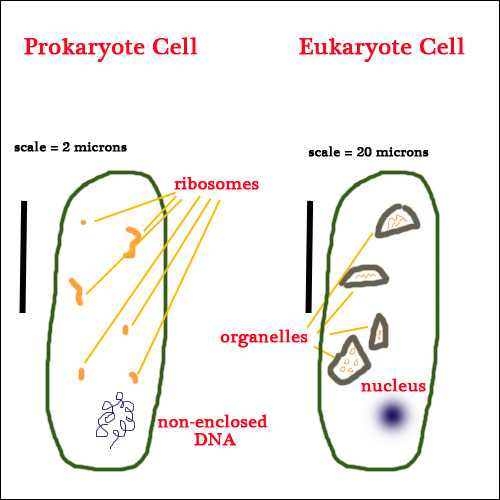
Prokaryote Cells Compared to Eukaryote Cells

Simple diagram showing differences in Eukaryote cells and Prokaryote cells.

Simple diagram showing differences in eukaryote cells and prokaryote cells.

Picture credit: Everything Dinosaur

The diagram above shows the basic differences between prokaryotic and eukaryotic cells.  Note the different scales, due to their unstructured form, prokaryotic cells are much smaller than eukaryotic cells.  Fossil evidence for cyanobacteria (prokaryotes) suggest that these cells first formed some 3.5 billion years ago (Archean Eon)*.  The first eukaryotic cells may have formed around 2.1 billion years ago**.

Visit Everything Dinosaur’s website: Everything Dinosaur.

Eukaryote Cells

Eukaryote cells most likely evolved from prokaryote cells at some point in the Paleoproterozoic.  How this came about is a subject of much debate.  One theory proposes predatory prokaryotes engulfed other smaller prokaryote cells.  Instead of these cells being consumed, a symbiotic relationship resulted with the smaller cells becoming the specialised elements of the larger cell.  Another theory suggests that more complex cells came about due to mutations during cellular division.  The presence of DNA strands in mitochondria which are not exactly the same as the DNA found within the host cell nucleus suggests that the mitochondria were once single-celled organisms in their own right.

The Significance of the Gaoyuzhuang Formation

Fossils described as macro-fossils are exceedingly rare in rocks older than the Late Neoproterozoic Era, but uranium – lead (U to Pb) radiometric dating suggests that the biota identified from the mudstones from the Gaoyuzhuang Formation (Yanshan area in the Hebei Province of northern China) are around 1.56 billion years old.  Other geological formations dated to over a billion years old which contain macro-fossils have been identified before, but it is the number and variety of the different types of fossil that marks out this strata as being something special.

Researchers Exploring the Exposed Mudstones Looking for Evidence of Ancient Life

Researchers examine the fine-grained mudstones which form part of the Gaoyuzhuang Formation.

Researchers examine the fine-grained mudstones which form part of the Gaoyuzhuang Formation.

Picture credit: Nature Communications

Exhibiting Multicellular Structures

Some of the fossilised structures measure up to thirty centimetres in length and eight centimetres wide.  The researchers conclude that the specimens may not represent the oldest know eukaryotes but they are the oldest eukaryotes that exhibit multicellular structures.  These organisms lived in a shallow marine environment and they were probably benthic (lived on the sea floor).  Analysis of the cells indicates that they may have been capable of photosynthesis and although large by Precambrian standards these organisms cannot be described as complex life.

Explaining the difference between complex life and these large multicellular structures, Professor Knoll stated that the Chinese fossils were:

“Large but I doubt that they were complicated – it’s an important distinction.”

Eukaryotic cells are capable of becoming specialised with different cells being responsible for different systems, functions and processes, a vital step on the path to complex life forms.  These cells, preserved as carbonaceous impressions in the rock show no signs of fundamental differentiation at the cellular level.

The Best Evidence Yet

These fossils provide the best evidence to date that multicellular eukaryotes of large size (greater than a centimetre in length), with a regular shape existed in marine environments at least a billion years prior to the Cambrian explosion.  They are multicellular but they are not the complex, more specialised and differentiated cells associated with more advanced organisms.

Treated Sections of the Fossils Showing the Cell Structure

Treated sections of the Gaoyuzhuang Formation fossils showing cellular structures.

Treated sections of the Gaoyuzhuang Formation fossils showing cellular structures.

Picture credit: Nature Communications

The picture above shows various views of the cell structure.  Pictures b and d show organic fragments with preserved cellular structure, the scale bar representing 100 μm (microns).  Pictures c and e show polygonal cells forming a multi-layered network (scale bar 20 μm).

The existence of these structures provides further evidence of the diversity of life during the Proterozoic, it also suggests that an increase in oxygen levels in conjunction with the establishment of a protective ozone layer in the Earth’s upper atmosphere may have permitted these multicellular organisms to form.

*/**The dates given for the first fossil evidence of prokaryotes and eukaryotic cells are speculative.

17 05, 2016

Rare Horseshoe Crab Fossil Discovery from Nova Scotia

By |2023-04-29T06:34:34+01:00May 17th, 2016|Categories: Dinosaur and Prehistoric Animal News Stories, Main Page, Palaeontological articles|0 Comments

The Important Role Enthusiastic Amateurs Play in Palaeontology

Last week Everything Dinosaur reported on the concerns being raised over the extensive amount of digging into cliffs on north Norfolk beaches by fossil collectors.  Whilst we frown upon such activities and urge all fossil collectors to follow the fossil collecting code, today, we report on the significant contribution made to palaeontology by a couple of enthusiastic fossil hunters from Nova Scotia.  Their dedication has resulted in a number of important discoveries, the latest being a new species of ancient horseshoe crab, which is known from just two specimens.

To read the article about concerns over coastal Norfolk fossil sites: Experts Fear for Safety of Fossils and Fossil Collectors.

Lower Carboniferous Sandstones and Silts of the Bay of Fundy

The Blue Beach area of the Bay of Fundy (Nova Scotia), is one of the most important Late Palaeozoic fossil locations in the world.  The strata is being constantly eroded by the exceptionally powerful tides (a macro tidal environment) and the eroding cliffs are giving up the fossilised remains of animals and plants that lived in the very Early Carboniferous period (Lower Mississippian Epoch – Tournaisian faunal stage).  The body and trace fossils found here record life in a estuarine environment bordered by dense swamps that existed some 360 million years ago.

Thanks to the efforts of husband and wife team Chris Mansky and Sonja Wood, tens of thousands of fossil specimens have been retrieved from the beach.  The rocks have such significance as they preserve fossils of some of the very first tetrapods – primitive amphibians that were the first terrestrial vertebrates.

Paleolimulus woodae – Horseshoe Crab Fossil

Working in conjunction with scientists from the New Mexico Museum of Natural History and Science, an extremely rare horseshoe crab fossil has been identified and described as a new species.  The species name honours Sonja, the ancient arthropod has been called Paleolimulus woodae (pronounced pay-leo-limb-mew-lus wood-i).

A Natural Goldmine for Fossils

Commenting on the significance of the fossil find, co-author of the scientific paper that has just been published in the academic journal “Neues Jahrbuch für Geologie und Paläontologie”, Chris Mansky stated:

“We’re sitting on an unrealised bonanza or mother-load of information.  It’s a very small scarp that shows probably one of the most important pieces of evolutionary information.”

The CollectA Age of Dinosaurs Horseshoe Crab Model

CollectA Horseshoe Crab model.

CollectA Age of Dinosaurs Popular Size Horseshoe Crab.

CollectA have produced an excellent Horseshoe crab model.

To view the CollectA Age of Dinosaurs model range: CollectA Age of Dinosaurs Model Range.

The powerful tides scour the beach and cliffs twice a day exposing fossil material all year round.  The work of Chris and Sonja is vital, as without their help, many important fossil specimens, such as the ten pence sized horseshoe crab fossil would be lost.  The couple have run the Blue Beach Fossil Museum since 2002, and they have amassed a collection of some 90,000 lbs of rocks containing body fossils of early tetrapods, ancient fish, molluscs, as well as important trace fossils, preserving tracks in the mud made by both back-boned animals and invertebrates.

Romer’s Gap and All That

Horseshoe crabs are marine arthropods, (Order Xiphosurida, Family Limulidae), known as living fossils as they seem little changed since their evolutionary origins some 450 million years ago.  A number of genera exist today, but populations are threatened due to habitat destruction and the removal of eggs for human consumption.

An Illustration of a Extant Horseshoe Crab

An illustration of a Horseshoe Crab (a living fossil).

An illustration of a Horseshoe Crab (a living fossil).

Picture credit: Everything Dinosaur

The Blue Beach location is regarded as one of the most important Lagerstätte (strata with an abundance of fossils), of the Late Palaeozoic.  The Lower Carboniferous rocks are helping to provide scientists with information about vertebrates to fill in “Romer’s Gap”, a discontinuity in the fossil record between the end of the Devonian and the first fifteen million years of the Carboniferous, a time when terrestrial ecosystems were rapidly evolving and the first land animals with back-bones were becoming widespread.  The gap in the geological record is named after the American palaeontologist Alfred Sherwood Romer who first recognised this discontinuity.

Explaining just how rare the horseshoe crab fossils are, Chris Mansky said:

“Out of the tens of thousands of fossils that have been gathered [from the Blue Beach area] only two were horseshoe crab.”

The fossil material including body impressions and tracks made by the horseshoe crabs in the soft mud are helping scientists to piece together more information about this ancient palaeoenvironment.  Today, we pay tribute to Chris and Sonja whose efforts are helping scientists to learn more about a crucial period in the evolution of life on Earth.

Romer’s Gap – An Explanation

The gap in the fossil record that marks the beginning of the Carboniferous geological period.  In sedimentary rocks fractionally older than Romer’s Gap palaeontologists have unearthed evidence of very primitive Devonian tetrapods , fish with fingers, lots of fingers.  Tetrapod fossils found in slightly younger rocks provide evidence of Carboniferous tetrapods that all had five fingers and toes and they are much better adapted to terrestrial habitats.

Visit Everything Dinosaur’s website: Everything Dinosaur.

14 05, 2016

Remarkable Stone Tools and Fossil Bones From Sinkhole Revises American History

By |2024-05-06T06:39:21+01:00May 14th, 2016|Categories: Dinosaur and Prehistoric Animal News Stories, Main Page, Palaeontological articles|0 Comments

The Oldest Floridians

The discovery of ancient mammal remains plus stone tools in association with them is helping a team of scientists to redraw the map of human settlement in the Americas.  Evidence suggests that the north-western part of Florida (United States), was inhabited by humans some 1,500 years earlier than previously thought.  The research paper detailing the discoveries and the dating information has just been published in the open access journal “Science Advances”.

Stone Tools and Fossil Bones

Lead author of the scientific paper, Assistant Professor of Anthropology at Florida State University Jessi Halligan, had to employ her skills as a diver to reach the site, as the evidence of pre-Clovis existence has come from a sinkhole in the middle of the Aucilla River some ten metres below the water surface.  Radiocarbon dating of the artefacts excavated suggests that humans inhabited this part of Florida some 14,550 years ago.

Assistant Professor Halligan with Some of the Fossil Bones

Scientists state that humans occupied the south-eastern United States 1,500 years earlier than previously thought.

Scientists state that humans occupied the south-eastern United States 1,500 years earlier than previously thought.

Picture credit: Bruce Palmer/Florida State University

The picture about shows Jessi Halligan and some of the prehistoric mammal bones recovered from the site.  In the foreground (left) is a vertebra from a Mastodon, in the foreground (right) is the lower jaw (dentary) of a prehistoric Llama.

Prior to this research, it had been widely believed that the first people to live in this part of the Americas were the Clovis people which reached this part of the continent some 13,000 years ago.  The Clovis people are believed to have migrated across the Bering land bridge from Asia as the Last Ice Age ended, they moved through Canada and into the northern parts of the United States and over many generations gradually moved further and further south.

The Clovis Culture

The Clovis culture is believed to represent the first widespread human culture in the New World and it is likely that the Clovis people were the ancestors of the native American Indians.  It is from the Clovis culture that the various native American cultures evolved.  Named from the distinctive stone tools such as finely crafted spear points found at Clovis in New Mexico, many Clovis sites have been excavated and DNA evidence suggests that more than three-quarters of all living native Americans in North and South America are directly related to the Clovis people.

Human Migration Through the Americas is a Complex Picture

As the last Ice Age ended and the ice sheets retreated, so humans migrated across the Bering Strait land bridge (Beringia) and into the New World.  However, mapping the extent of this colonisation and the journey south has proved extremely difficult, with a range of dates given for different sites.  There has been evidence presented before that suggested humans lived in parts of the Americas earlier than 10,000 to 12,000 years ago, but the evidence had been controversial.

However, at the Aucilla River site, some seventy-one items have been radiocarbon dated and they all support the idea that the stone tools and bones, many of which show cut marks made from tools , indicate human habitation as early as 14,550 years ago.

Commenting on the significance of this research, Assistant Professor Halligan stated:

“This is a big deal!  There were people here.  So how did they live?  This has opened up a whole new line of inquiry for us as scientists as we try to understand the settlement of the Americas.”

The Remarkable Page-Ladson Site

The excavations took place at a site on a bend in the Aucilla River some twenty miles east of the Florida State capital Tallahassee.  Animal bones had been found in this region for many years but it was first explored and mapped extensively by diver Buddy Page who found Mastodon remains and brought the site to the attention of archaeologists and palaeontologists.  The site is owned by the Ladson family and as result the sinkhole and subsequent cores that have been taken from the river bed are collectively referred to as the Page-Ladson prehistory site.

The location represents a water hole that was filled in by deposits and these deposits represent Late Pleistocene material at the bottom, leading up through to younger Early Holocene deposits that are exposed on the river bed.

Working up to Ten Metres Underwater to Find Traces of Human Activity

Underwater excavation reveals evidence of the earliest humans from the south-eastern United States.

Underwater excavation reveals evidence of the earliest humans from the south-eastern United States.

Picture credit: Florida State University

Stone Tools and Fossil Animal Bones Preserve Evidence of Human Activity

There are a cluster of sites dotted all over North America that date to around 13,200 years ago, but there are estimated to be only about five in all of the New World that are believed to provide older evidence of human habitation.

Assistant Professor Halligan worked in collaboration with Michael Waters from Texas A&M University and Daniel Fisher (University of Michigan) to excavate the site.  The research team were aware that a number of fossil bones and other finds had already been excavated from the site, but between 2012 and 2014 the Page-Ladson prehistory site was once again opened up and explored.

One of the team’s most significant finds was a biface, a stone tool flaked on both sides to produce a knife-like instrument with two cutting edges.  Daniel Fisher (vertebrate palaeontologist), also took a close look at the Mastodon tusk that had been retrieved in the 1980s and he was able to identify cut marks indicating that the tusk had been removed by people.  The scientists are not certain whether the Mastodon was killed by humans or its carcase was scavenged.

Michael Waters ( Texas A&M’s Centre for the Study of the First Americans) explained:

“The new discoveries at Page-Ladson show that people were living in the Gulf Coast area much earlier than believed.”

Examples of Stone Tools Recovered from the Page-Ladson Prehistory Site

Examples of stone tools excavated from the Page-Ladson site (Florida).

Examples of stone tools excavated from the Page-Ladson site (Florida).

Picture credit: Science Advances with notation by Everything Dinosaur

The picture above show examples of the stone tools recovered from the Page-Ladson location.  The biface stone tool “top” has two flaked cutting blades and would have performed the role of a small knife, similar to the type of tool that created the butchery marks in the animal bones.  The stone tools (middle and bottom) are typical flakes, the middle flake shows signs of wear (use).

Pleistocene Marine Transgression

Florida in the latter stages of the Pleistocene Epoch was much drier than it is today.  Sea levels were over one hundred metres lower.  The Page-Ladson site represents a spring fed waterhole that existed in a ravine.  It may have been the only reliable water source for miles around and as such, it attracted animals and people to it.  With the rise in global temperatures, the great ice sheets that covered much of the Northern Hemisphere began to melt.  This led to a rise in global sea levels resulting in low-lying areas becoming flooded (the Late Pleistocene marine transgression).  The Page-Ladson site was buried with an influx of sediment and left submerged.

This location in north-western Florida is helping anthropologists to understand more about the migration of humans into the New World and also provides further information with regards to the megafauna that shared this Late Pleistocene habitat.

An Illustration of the Page-Ladson Prehistory Site

An Illustration of the Page-Ladson Prehistory Site (Florida 14,500 years ago).

An Illustration of the Page-Ladson Prehistory Site (Florida 14,500 years ago).

Picture credit: Greg Harlin

For replicas and figures of early hominins and prehistoric mammals: Safari Ltd. Wild Safari Prehistoric World Models.

11 05, 2016

Concerns for the Coastal Norfolk Fossil Sites

By |2023-04-26T08:28:14+01:00May 11th, 2016|Categories: Dinosaur and Prehistoric Animal News Stories, Dinosaur Fans, Geology, Main Page, Palaeontological articles|2 Comments

Experts Fear for Fossils and Safety of Fossil Hunters

Scientists at the Norfolk Museums Service along with British palaeontologists and geology societies have expressed concern over the rise in unscrupulous fossil hunting activities being reported from parts of the Norfolk coast.  These famous Pleistocene age deposits have yielded an extensive array of vertebrate fossils including many large mammals such as rhino and elephant.

The West Runton Elephant

One of England’s most important fossil finds, the spectacular West Runton elephant (more correctly termed a Steppe Mammoth – Mammuthus trogontherii), was found in the cliffs.  The discovery, the first bones were found in 1990, represents the largest and oldest nearly complete fossil mammoth from the UK.  Bones and teeth can still be found on the foreshore but sadly, there has been a rise in reports of fossil hunters digging into the cliffs in a bid to find more specimens.

A Model of a Steppe Mammoth

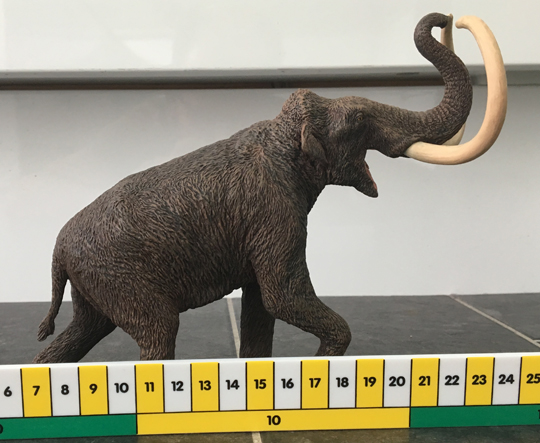
The size of the Eofauna Steppe Mammoth model.

The beautiful Eofauna Scientific Research Steppe Mammoth model.

Picture credit: Everything Dinosaur

The model (above) is an Eofauna Steppe Mammoth.

To view the Eofauna model range: Eofauna Scientific Research Models.

Concern for Norfolk’s Fossil Sites

A spokesperson for the Norfolk Museums Service advised against such excavation, not only would the digging potentially damage any fossil material but as the cliffs were unstable, working so close to the cliffs was very dangerous.  He expressed grave concern following reports of a rise in the number of fossil hunters “hacking into the cliff tops”

The Foreshore and Cliffs of Many Locations Require Protection

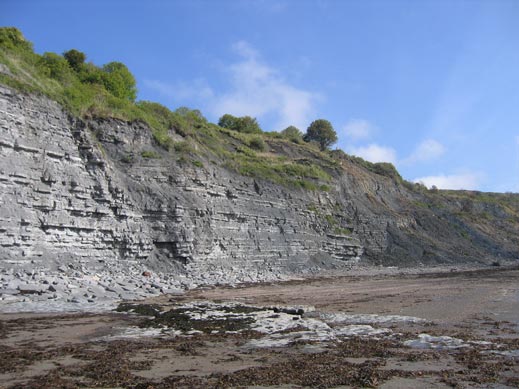
The Church cliffs at Lyme Regis.

Fossil hunting can be fun but beware of the cliffs.

Picture credit: Everything Dinosaur

Important Fossil Sites

The freshwater Pleistocene deposits and associated Cretaceous chalks yield a large number of different types of fossil.  As well as freshwater molluscs and mammal remains from the freshwater beds, the chalk is highly fossiliferous and different types sea urchin and fossil sponges can be found.  The picture above shows a typical UK coastal site with fossils.  As the cliffs are eroded fossils are exposed.

A team member from Everything Dinosaur commented:

“This part of the Norfolk coast is subject to high levels of erosion, we would urge all fossil collectors to stay on the beach and look for fossils at low tide along the foreshore, the rapidly eroding cliffs are delivering lots of fossil material onto the beach area and this is a wonderful location for a family fossil hunt.  However, please don’t dig into the cliffs and we urge all visitors to follow the fossil collecting code.”

For an article on the fossil collecting code and a guide to safe collecting: Everything Dinosaur’s Guide to Fossil Collecting Safely.

Register Fossil Finds with the Norfolk Museums Service

A partial Mammoth tooth was found nearby last month and no doubt other finds will be reported over the summer at this popular tourist attraction.  Palaeontologist Dr. Waterhouse of the Norfolk Museums Service and the leader of the Cromer Forest-bed Fossil Project reminded fossil hunters that it was good practice to report finds to the Norfolk Museum Service, the museum at Cromer just a few miles from West Runton, was a good place to take any fossil finds and team members from the Norfolk Museums Service would be happy to assist with identification.  As Mammoth fossils, especially tusks and teeth are very popular with collectors, it is likely that many of the overzealous fossil hunting activities have been driven by the high prices such fossils make on auction sites.

A Model of a Woolly Mammoth (M. primigenius)

A model of a Woolly Mammoth.

A model of a Woolly Mammoth.

Picture credit: Everything Dinosaur

Dr Waterhouse said:

“Norfolk is the best place in the country and probably Europe to find Mammoth remains because they went through about six sets of teeth in their lifetime, so there is a lot more teeth than there were Mammoths.  Something that I think needs highlighting is poor and even dangerous fossil collecting by people hacking into the cliffs at places like West Runton.  Ethical collecting is high on my agenda, and also recording fossil finds as part of the Cromer Forest-bed Fossil Project, so that important scientific information isn’t lost forever.”

At Everything Dinosaur we echo the views of Dr Waterhouse and we urge fossil hunters to take care and to abide by the fossil collecting code as well as local bye laws and regulations.

Visit Everything Dinosaur’s website: Visit Everything Dinosaur.

6 05, 2016

Remarkable Antarctic Expedition Provides Window into Late Cretaceous Seacape

By |2024-05-06T06:32:21+01:00May 6th, 2016|Categories: Dinosaur and Prehistoric Animal News Stories, Dinosaur Fans, Geology, Main Page, Palaeontological articles|0 Comments

Fossilised Birds, Ammonites and Giant Marine Reptiles

A team of international scientists including researchers from the University of Queensland and the Carnegie Museum of Natural History, have been showing off their vast collection of fossils after a very successful expedition to Antarctica earlier this year.  The fossils, estimated to weigh over 1,000 lbs, provide evidence of life in a shallow sea close to land some 71 million-years-ago (Late Cretaceous).

Late Cretaceous Fossils

The specimens were collected from James Ross Island, a forty mile long island on the south-eastern side of the Antarctic peninsula, a long finger of land that points towards South America, although the island itself is more than six hundred miles from the Chilean mainland.

Some of the Fossils Found During the Two-Month Long Antarctic Expedition

Spectacular fossils preserved in nodules found in Antarctica.

Spectacular fossils preserved in nodules found in Antarctica.

Picture credit: University of Queensland

Fossils Found in Nodules (Concretions)

The picture above shows a number of split nodules that contain invertebrate fossils of various kinds including a number of ammonite specimens.  The geological hammer, probably the one used to split the nodules provides scale.  Over two hundred different fossils have been collected by the scientists.

An Illustration of a Typical Ammonite

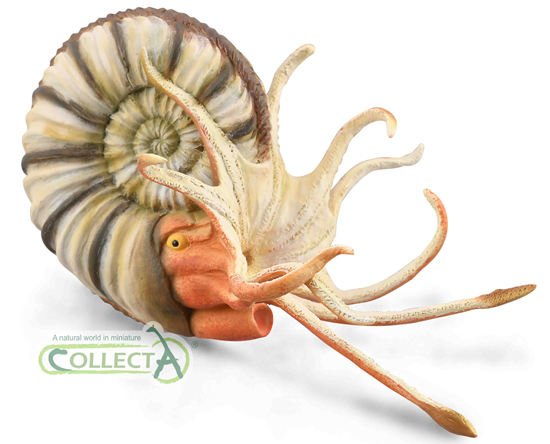
CollectA Pleuroceras ammonite model.

CollectA Age of Dinosaurs Popular Size Pleuroceras ammonite model.

To view replica ammonites and other models of prehistoric creatures: CollectA Age of Dinosaurs Popular Range.

Marine Reptiles and Dinosaurs

One of the main objectives of the research team over the two month period of the expedition (February to March) was to search for vertebrate fossils to provide information on the marine and terrestrial fauna that existed in this part of Gondwana towards the end of the Cretaceous.

Giant shark vertebrae the size of saucers, as well as plesiosaur and mosasaur remains along with bird fossils were discovered, these fossils along with the other specimens are currently being stored in Chile prior to onward transport to the Carnegie Museum of Natural History (Pittsburgh, Pennsylvania) for preparation and study.  It is likely that a number of new species will be identified.

Palaeontologists Working on a Plesiosaur Shoulder Girdle

Palaeontologists carefully excavate the shoulder girdle of a Plesiosaur (James Ross Island).

Palaeontologists carefully excavate the shoulder girdle of a plesiosaur (James Ross Island).

Picture credit: Dr  Matthew Lamanna (Carnegie Museum of Natural History)

The picture above shows graduate student Abby West (American Museum of Natural History) working alongside Dr Steve Salisbury (University of Queensland) and marine technician Julia Carlton as they carefully prepare the shoulder girdle of a plesiosaur for extraction by helicopter.  The location of the fossil sites are so inaccessible that they only way such large specimens could be removed was by helicopter.

The choppers used to support the field team were called “raptors” – very Jurassic Park as one expedition member quipped.
The photograph was taken by Dr Lamanna (Assistant Curator of Vertebrate Palaeontology), an expert on the terrestrial fauna of Gondwana, a few days ago, Everything Dinosaur reported on the naming of a new giant titanosaur from Argentina that had been named based on the extensive study of a beautifully preserved skull and neck elements that had been found some years before (Sarmientosaurus musacchioi).

To read more about this story: Late Cretaceous Titanosaur from Patagonia.

Identifying New Fossil Sites

The scientists are part of an international Antarctic research project – Antarctic Peninsula Paleontology Project (forgive the Americanised spelling), or AP3 for short.  Consisting of specialists in vertebrate palaeontology and geology, the team heralds from universities and museums from the United States, Australia, South Africa, Chile and the UK.

Located a gruelling six mile hike from the team’s base camp, the main fossil bearing beds are located on the steeply sloping south-western flank at Sandwich Bluff on Vega Island, which is located just a few thousand metres to the north-west of James Ross Island.  Much of the strata exposed around James Ross Island dates from the very Late Cretaceous and from the very Early Palaeogene.  A number of new fossil bearing sites have already been located including several plant remains beds and two previously undocumented Cretaceous exposures that were targeted for future field work.

The Late Antarctic Summer – Hiking Looking for Fossils

Isolated and very difficult to reach - fossil hunting in Antarctica.

Isolated and very difficult to reach – fossil hunting in Antarctica.

Picture credit: The Carnegie Museum of Natural History

The Antarctic – A Potential Treasure Trove of Fossils

The James Ross Island basin is one of the few parts of Antarctica where the snow and ice melts sufficiently to expose the rock strata below.  The absence of soil helps with the exploration, although we tip our hard hats to the research team members who braved freezing temperatures, howling gales and sea sickness just to reach the fossil quarries.  The specimens were excavated from the Upper Cretaceous Sandwich Bluff Member of the López de Bertodano Formation.

The beds here represent deposits in a shallow, marine environment with occasional occurrences of terrestrial material (particularly plant remains) that would have been washed into the sea from the nearby land.  Dinosaur fossils were found, although fragmentary, the palaeontologists are confident that these fossils will help to extend our understanding of the Late Cretaceous dinosaur fauna of Antarctica.

Visit Everything Dinosaur’s website for models and replicas of Cretaceous animals: Everything Dinosaur.

Recovering Late Cretaceous Fossils – It’s a Tough Job!

Commenting on the research, Dr Salisbury explained:

“It’s a very hard place to work, but it’s an even harder place to get to.  A lot of the bigger bones will need quite a bit of preparation before we can do much research on them.  Working in Antarctica is tough!”

Fossilised remains of birds were also found, including early ducks dating from the end of the Cretaceous period.

It’s a Tough Job – Searching for Fossils in the James Ross Island Basin

Lying down on the job! Looking for fossils in the Antarctic.

Lying down on the job! Looking for fossils in the Antarctic.

Picture credit: Carnegie Museum of Natural History

Everything Dinosaur Pays Tribute

A spokesperson from Everything Dinosaur paid tribute to the research team and their supporters stating:

“The Antarctic provides vertebrate palaeontologists the opportunity to explore pristine fossil bearing environments without the risk of damage from vandals or illegal fossil hunters.  This treasure trove of fossils, currently in Chile, will provide scientists with a great deal of data regarding the fauna and flora at what was a pivotal moment in the history of life on Earth.”

In the summer of 2015, Everything Dinosaur reported on the discovery of a plesiosaur, but this time from the other end of the world – the Arctic.

To read an article about this amazing fossil find: Elasmosaur Fossil from Alaska.

2 05, 2016

A New Late Cretaceous Titanosaur from Patagonia

By |2023-04-19T07:31:17+01:00May 2nd, 2016|Categories: Dinosaur and Prehistoric Animal News Stories, Dinosaur Fans, Main Page, Palaeontological articles|0 Comments

Sarmientosaurus musacchioi – A “Drop Head” Dinosaur

The beautifully preserved skull of a new type of titanosaur is helping scientists to understand the evolution of these herbivorous dinosaurs.  Titanosaur skull fossils are exceptionally rare, but thanks to the skull of Sarmientosaurus musacchioi, palaeontologists have got a “heads up” on basal titanosaurs, ironically computer modelling and an analysis of the skull morphology suggests that this dinosaur may have specialised in feeding on low growing vegetation.  If that was the case, then this long-necked dinosaur probably spent a lot of its time with its head pointing downwards towards the ground.

An Illustration of Sarmientosaurus musacchioi

New basal Titanosauriform from Argentina (Sarmientosaurus).

New basal titanosauriform from Argentina (Sarmientosaurus).

Picture credit: Everything Dinosaur (background from the artwork of Julius Csotonyi

Rare Titanosaur Skull Fossil Discovery

Reporting in the on line academic journal PLOS One, the team of palaeontologists which includes lead author Dr Rubén D. F. Martínez (National University of Patagonia), describe a beautifully preserved and almost complete skull specimen excavated from strata which makes up the Lower Member of the Upper Cretaceous Bajo Barreal Formation in south, central Chubut Province, Patagonia (southern Argentina).

The fossils, comprising the skull plus elements from the neck are believed to date from around 95 million years ago (Middle Cenomanian stage of the Late Cretaceous).

Scientists Show Off the Beautifully Preserved Dinosaur Skull

Dr. Martinez (right) and Dr. Lamanna (left) with Sarmientosaurus skull.

Dr Martinez (right) and Dr Lamanna (left) with Sarmientosaurus skull.

Picture credit: Carnegie Museum of Natural History

The Titanosaur a Member of the Sauropodomorpha

The skulls of members of the Sauropodomorpha, the suborder of dinosaurs to which the titanosaurs belong, tend to be disproportionately small when compared to the size of the body.  In addition, the skulls of these dinosaurs are at the end of a long neck.  When an animal died and the carcase rotted away, then the skull bones were likely to become detached from the rest of the skeleton.  Skull fossils of sauropods are exceptionally rare.  In titanosauriforms, only three other skull fossils are known:

  • Rapetosaurus (from the Late Cretaceous of Madagascar)
  • Tapuiasaurus (from the Early Cretaceous of Brazil)
  • Nemegtosaurus (from the Late Cretaceous of Mongolia

The discovery of an almost complete titanosaur skull will help scientists to understand more about the anatomy, evolution and behaviour of these dinosaurs.  For example, analysis of the orbit within the skull and the relative position of the eye suggests that this dinosaur had particularly good vision.  Such is the completeness of the fossil material that the scientists, which included Gondwana titanosaur specialist Dr Matthew Lamanna (Carnegie Museum of Natural History), have been able to piece together an endocast of the brain and demonstrate the shape of the inner ear.

Views of the Skull of Sarmientosaurus (Sarmientosaurus musacchioi)

A view of the skull (lateral views)

A view of the skull (lateral views)

Picture credit: PLOS One

The picture above shows the prepared skull seen in right lateral view (photograph A and line drawing B) and left lateral view (C).  The naris slopes gently downwards towards the premaxilla and the orbit (eye-socket) is quite large.  The simple, peg-like teeth (57 teeth associated with the fossil), project forward, an adaptation perhaps to assist with the combing action of feeding.  The scale bar in the picture above represents ten centimetres.

For models and replicas of titanosaurs and other prehistoric animals: Prehistoric Animal Models and Figures.

Dr Lamanna noted:

“Titanosaurs included the biggest land animals ever, so we want to know as much about them as we can.  But to truly understand a creature, you need to have its head and because titanosaur skulls are super-rare, lots of important aspects of how these dinosaurs lived and behaved have really been anybody’s guess.”

CAT Scans Reveal Previously Unseen Features in Titanosaur Fossil Material

The skull fossil has provided palaeontologists with their first really good view of a basal titanosaur and it has provided new information regarding the shape of the brain case and the senses of these dinosaurs.  For example, CAT scans have enabled the researchers to model the structure of the inner ear, from this they have deduced that this dinosaur had good hearing, able to detect a wide range of low frequency airborne sounds.  This perhaps provides a clue to how these herding animals communicated.

The Excavation of the Rare Titanosaur Fossil Material

Sarmientosaurus fossils at the dig site.

Sarmientosaurus fossils at the dig site.

Picture credit: PLOS One

The photographs above show the articulated skull lying upside down partially eroded out of the rock (A), note that the skull is seen in ventral view (viewed from underneath) and that the geological hammer provides an approximate scale.

The black arrow in photograph A shows the position of an ossified cervical tendon lying very close to the back of the skull.  Photographs B and C show two views of the articulated skull and the partial cervical series (neck bones) exposed in the rock (ventral view).  The black arrows indicate the position of cervical tendons.  Photograph D shows a cervical rib (white arrow) and its relationship in the matrix to an ossified cervical tendon (black arrow), the field instruments provide an approximate scale.

Ossified Bony Tendons

When compared to the Tapuiasaurus fossil skull from Brazil which dates from around 115 million years ago, the teeth and skull morphology of Sarmientosaurus are relatively primitive.  The researchers have concluded that radically different titanosauriforms probably co-existed for much of the Cretaceous.  This suggests that different types of titanosaur evolved to fill different ecological niches and perhaps this might help to explain why these types of plant-eaters made up a substantial portion of the herbivorous mega fauna fossils associated with the Southern Hemisphere in the Late Cretaceous.

Views of the Restored Skull of Sarmientosaurus

Views of the prepared skull of Sarmientosaurus (scale bar = 10cm).

Views of the prepared skull of Sarmientosaurus (scale bar = 10 cm).

Picture credit: PLOS One

In the picture above, A, C and E are photographs of the skull in various views.  A frontal view (A), a view of the back (B) and a caudodorsal view (C) which is a view of the back of the skull from the orientation of looking down on it from the top.  The images B, D and F are diagrams that show the individual bones and skull features as preserved in the fossil material.  Sarmientosaurus is the first non-avian dinosaur to show evidence of a very long bony tendon in the neck.  The research team compare the thin ossified tendon with that found in extant Cranes.  The function of this structure is not known.

Superior Senses When Compared to Other Sauropodomorphs

The CAT scans provided a remarkable amount of detailed information regarding the sensory capabilities of this titanosaur.  The large eye-socket indicated good eyesight and the orientation of the balance organ of the inner ear suggests that this dinosaur probably held its head with the snout facing downward.  From this it has been inferred that Sarmientosaurus fed mainly on low-growing plants.
Professor Lawrence Witmer, a specialist in cranial anatomy and one of the co-authors of the scientific paper explained:

“The Sarmientosaurus skull is beautifully-preserved, which meant that we could tease out a ton of information.  It was really exciting for us to work through the CT scan data because it gave us a glimpse into the biology and lifestyle of this animal like we rarely get with dinosaurs.”

What’s in a Name?

The genus name honours the small town of Sarmiento in Chubut Province which is close to the fossil quarry where the skull was found.  The trivial name is in tribute to the late Dr Eduardo Musacchio, a palaeontologist and professor at the National University of Patagonia who was a mentor to Dr Martínez as well as a close friend.

Visit Everything Dinosaur’s award-winning website: Everything Dinosaur.

24 04, 2016

Seed Eating May Have Helped Birds Survive According to New Scientific Paper

By |2024-05-05T21:56:15+01:00April 24th, 2016|Categories: Dinosaur and Prehistoric Animal News Stories, Dinosaur Fans, Main Page, Palaeontological articles|2 Comments

Seed Clue to How Birds Survived the Cretaceous Extinction Event

The birds that are around today, might have the seed-eating habit of an ancestor to thank for enabling their kind to survive the extinction event that saw the demise of the dinosaurs.  A study published in the scientific journal “Current Biology” suggests that whilst the meat-eating and insectivorous feathered Maniraptoran dinosaurs did not survive into the Tertiary, toothless, beaked birds may have coped with the devastation that wiped out 70% of all terrestrial vertebrates, by eating seeds.

Seed Eating a Key to Survival

The study, conducted by scientists from the University of Toronto and the Royal Ontario Museum, involved the analysis of 3,104 Maniraptoran fossil teeth from eighteen different sites in western North America (Montana, USA and Alberta, Canada).

Late Cretaceous North America – Survival of the Seed Eaters?

Study suggests the evolution of a toothless beak ideal for seed eating may have had evolutionary advantages at the end of the Cretaceous.

Study suggests the evolution of a toothless beak ideal for seed eating may have had evolutionary advantages at the end of the Cretaceous.

Picture credit: Danielle Dufault

Seed Eating Birds

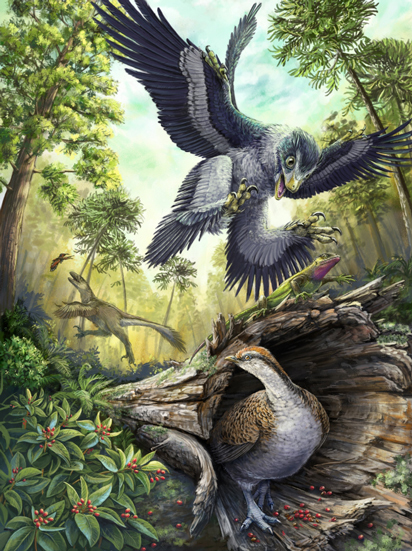
The beautiful illustration above, depicts an imaginary scene in the forests of Late Cretaceous North American (Maastrichtian faunal stage).  There were probably large numbers of Maniraptoran dinosaurs represented by numerous families but these types of dinosaur along with the toothed birds did not survive the End Cretaceous mass extinction.  Those members of the Maniraptora clade that had evolved an edentulous (toothless) beak capable of holding, manipulating and cracking seeds may have had an evolutionary advantage.

In the picture above, a large dromaeosaurid dinosaur pursues a toothed bird in the background, whilst a smaller dromaeosaurid pounces on an unsuspecting lizard resting on a log.  Emerging from the hollow log is a hypothetical, toothless bird, closely related to the earliest modern birds.

A Nuclear Winter

Many scientists believe that after the extraterrestrial impact that marked the beginning of the end for the non-avian Dinosauria, the impact threw up huge amounts of dust and debris into the atmosphere.  This would have blocked out sunlight, leading to a nuclear winter with plant populations (reliant on photosynthesis to make food), crashing.  The loss of the plants led to a collapse of the entire food chain.  The plant-eaters would have died out and once there were no carcases left to scavenge, the meat-eaters would have perished too.

This new paper is one of a number of recent studies that attempts to explain why some types of animals survived, whilst other, often closely related species did not.

Toothed Dromaeosaurs Faced Extinction

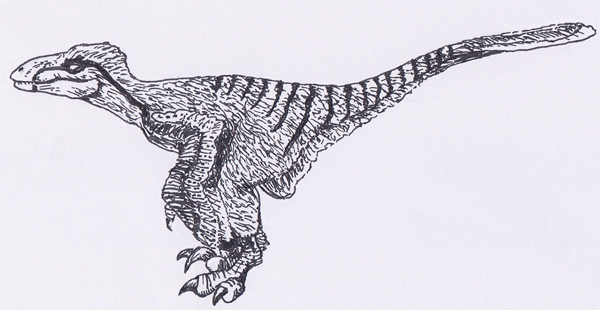
Maniraptor illustration (dromaeosaurid).

Dromaeosaurid drawing for Everything Dinosaur.

Picture credit: Everything Dinosaur

The Maniraptora Fossil Record

The Maniraptora fossil record (dinosaurs and the birds) is very incomplete.  The research team knew that they only had a limited number of fossils of Late Cretaceous Maniraptorans to examine and that in all likelihood there were many more species living towards the end of the Age of Dinosaurs than have been identified to date.  In addition, there was very little direct evidence of fossil species surviving the extinction event.  So to help unravel the puzzle as to why some animals died but their close relatives survived, the scientists examined the fossil record of isolated teeth.

Shed teeth tend to be more robust than the delicate and light bones of Maniraptorans and they are more numerous, so the research team had a more substantial data set to work with.

Seeds – A Readily Available Food Source

The team concluded that seeds would have survived the global devastation that occurred.  Seeds already in the ground would have been available as a food source for anything with a beak capable of eating them.

Commenting on why some animals survived whilst others went extinct, lead researcher, Derek Larson (University of Toronto) explained:

“We came up with a hypothesis that it had something to do with diet.  Looking at the diet of modern birds, we were able to reconstruct a hypothetical ancestral bird and what its likely diet would have been.  What we are envisaging is a seed-eating bird, so you’d have a relatively short and robust, strong beak, which would be able to crush these seeds.”

In August 2014, Everything Dinosaur published a study which had been conducted by an international team of researchers that looked at the rapid evolution and diversification of the  Maniraptora.   These dinosaurs evolved very rapidly and probably made up a significant proportion of the terrestrial vertebrate fauna in a number of Late Cretaceous ecosystems.

The Evolution of the Maniraptora

To read more about the rapid evolution of the Maniraptora: Downsizing Dinosaurs the Key to Survival.

The challenge to palaeontologists is to find fossil evidence of seed-eating birds being prevalent prior to the End Cretaceous extinction event and then evidence of radiation and diversification in strata laid down in younger sediments deposited beyond the famous K-T extinction boundary.

What About the Mammals?

This very interesting piece of research raises a number of other questions.  For example, a number of Cretaceous  small mammals would also have very probably eaten seeds, just like many kinds of small mammals do today.  Could seed-eating also have helped several different types of mammal survive the extinction event?  Given the success of the Maniraptora and their diversity it seems peculiar that no member of the Dinosauria evolved to take advantage of seeds as a source of food.

Many members of the Maniraptora were small, around the size of many seed-eating birds today, why weren’t these dinosaurs also able to take advantage of this food source to help them endure the nuclear winter?

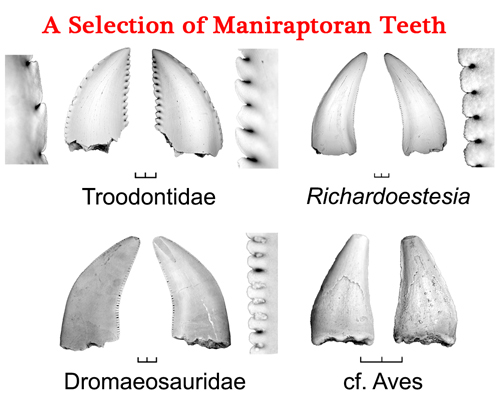
Teeth Representing a Variety of Different Members of the  Maniraptora Were Studied

No evidence of teeth adapted to seed-eating were found in the study.

No evidence of teeth adapted to seed-eating were found in the study.

Picture credit: Royal Ontario Museum/University of Toronto with additional notation by Everything Dinosaur

Shed Teeth

The picture above shows a typical selection of the shed teeth used in the fossil study.  Four different types of maniraptoran were incorporated into the study.  Firstly, there were the Troodontidae, (top left) with their proportionately broader and much more prominent tooth serrations (denticles), an example of a typical Late Cretaceous North American Troodontidae would be Troodon inequalis.  Secondly, there were members of the genus Richardoestesia (top right).

These maniraptoran dinosaurs are known from a pair of jawbones and many shed teeth, two species have been assigned, based on tooth differences.  Then there are the dromaeosaurids (Dromaeosauridae).  The teeth tend to be much more finely serrated than troodontid teeth and a typical North American dromaeosaurid would have been the two-metre-long Saurornitholestes langstoni.

An Illustration of Saurornitholestes langstoni

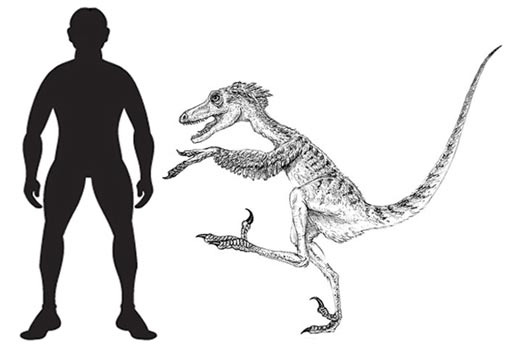
Saurornitholestes langstoni illustration - scale drawing.

Saurornitholestes langstoni illustration (scale drawing).

Picture credit: Everything Dinosaur

For models and replicas of dromaeosaurids and other dinosaurs: Beasts of the Mesozoic Models.

Dinosaur and Bird Fossils

Even though only a handful of fossil bones ascribed to Aves (birds) have been found in places such as the Dinosaur Provincial Park (southern Alberta), those bones that have been discovered indicate that some volant (flying) birds as big as modern-day raptors existed during the Late Cretaceous.  Many examples of teeth from toothed birds are known from the Dinosaur Provincial Park, and at least three types of Neornithine birds have been described.

This research, that examined maniraptoran teeth across the last 18 million years of the Cretaceous, supports the idea of a sudden extinction event and the survival of Neornithine lineages as a result of some forms having evolved to exploit seeds as a food source.

Visit Everything Dinosaur’s website: Everything Dinosaur.

10 04, 2016

Spectroscopic Studies on Organic Matter from Triassic Reptile Bones

By |2023-04-17T09:16:19+01:00April 10th, 2016|Categories: Dinosaur and Prehistoric Animal News Stories, Dinosaur Fans, Main Page, Palaeontological articles|0 Comments

More Evidence of Organic Matter Preserved in the Mesozoic Fossil Record

Over the last few years, Everything Dinosaur has reported on a number of fascinating research projects from around the world that suggest that there may be more to the fossil record than first meets the eye. In this article, we will examine a recently published paper that proposed that traces of organic compounds had been identified in Triassic reptile bones.

As more and more sophisticated research methodologies are employed, so there has been an exponential increase in our understanding of ancient life.  One of the most controversial areas of research are those studies concerning the finding and identification of traces of organic material preserved in the fossilised bones of long-dead animals.  A team of Polish scientists have recently published in the on-line academic journal “PLOS One” a paper detailing the discovery of blood vessels and traces in protein in the bones of Triassic reptiles.

Triassic Reptile Bones

As far as we are aware at Everything Dinosaur, this is the oldest organic material identified to date.

One of the Fossil Limb Bones Used in the Study

One of the limb bones used in the study of Triassic vertebrates from Poland.

One of the limb bones used in the study of Triassic vertebrates from Poland.

The scientists, which include researchers from the University of Silesia (Faculty of Earth Science), Jagiellonian University and the Polish Academy of Sciences report on the finding of preserved blood-vessel-like structures enclosing organic molecules that could be amino acids and fragments of other proteins including fibrils of collagen.   It is thought that the organic material had been preserved in the 247-million-year-old specimens as the bones were rapidly mineralised.

The Shores of the Ancient Tethys Ocean

For much of the Early and Middle Triassic, the central northern portions of Europe, including the countries of Poland and Germany were submerged under a shallow sea (the western edge of the mighty Tethys Ocean).  The limestone strata that was formed during this time preserve evidence of a rich and varied vertebrate fauna as a number of different types of diapsid reptile lived on the shoreline.  The most common large vertebrate fossils are Nothosaurs and the evidence of organic material preservation came from a study of Nothosaur limb bones.  In addition, the fossilised vertebrae (specifically a centrum) of an as yet unidentified Protanystropheus species was also studied.

A Model of a Triassic Marine Reptile a Nothosaurus

One of the models in the Safari Prehistoric Sealife Toob.

One of the models in the Safari Prehistoric Sealife Toob.

Picture credit: Everything Dinosaur

Studying Protanystropheus

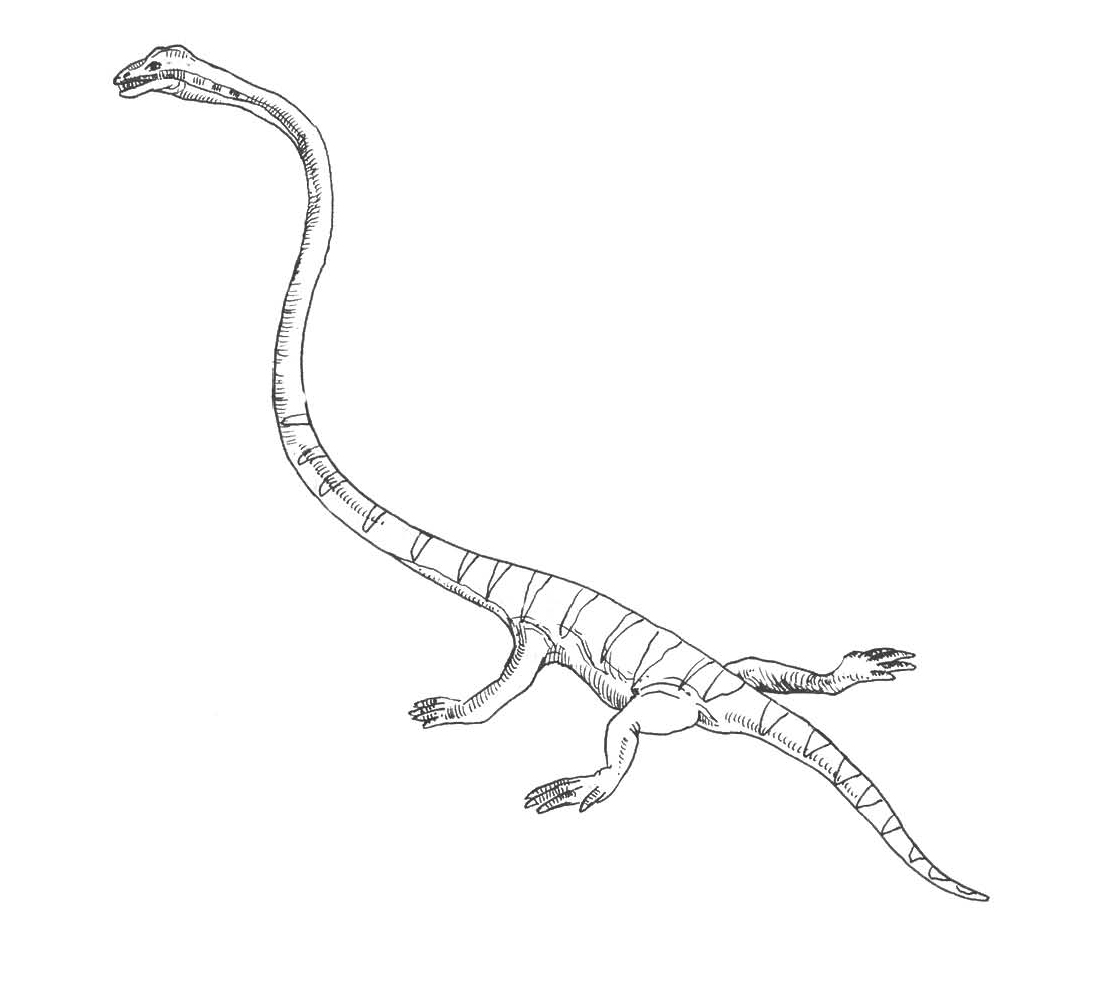
Protanystropheus is a member of the Tanystropheidae family of Archosauromorphs, a strange group of reptiles characterised by extremely long and stiff necks that in some species represent more than half their entire body length.  It is likely that both Nothosaurs and Protanystropheus were fish-eaters (piscivores).

An Illustration of a Typical Member of the Tanystropheidae (T. longobardicus)

A drawing of the bizarre Triassic reptile Tanystropheus.

A drawing of the bizarre Triassic reptile Tanystropheus.

Picture credit: Everything Dinosaur

Finding Fossil Biomolecules

The team, some of which had identified potential organic material in the fossilised remains of dinosaurs from the Gobi Desert, used an array of advanced and highly sophisticated research methods to identify the biomolecules.  The team used several analysis methods including X-ray photo-electron spectroscopy (XPS), an environmental scanning electron microscope (ESEM) and fourier transform infrared spectroscopy (FTIR).  Amino acids including hydroxyproline and hydroxylysine were found.  This discovery provides the oldest evidence yet of preservation of complex organic molecules in vertebrate remains from a marine environment.

Commenting on the team’s findings researcher Dr. Andrzej Boczarowski (Faculty of Earth Science, University of Silesia) stated:

“Among other proteins, we managed to find collagen, one of the most important proteins in the bodies of animals in general and vertebrates in particular.”

Highly Magnified Images Showing Demineralised Blood Vessels from the Fossil Material

Organic matter potentially identified in Triassic vertebrae fossils.

Organic matter potentially identified in Triassic vertebrae fossils.

Picture credit: PLOS One

The pictures above show some of the images of demineralised blood vessels identified from the fossil samples.

  • Picture (a) – parallel-orientated fossilised blood vessels from the Protanystropheus centrum.
  • Photo (b) – fossilised “floating” blood vessels from the Protanystropheus centrum revealed during the demineralisation process (removing the calcium in a EDTA solution).
  • Picture (c) – and ESEM image of branching (bifurcated) blood vessels mounted on a carbon conductive tab – this organic material was identified from a Nothosaurus femur.
  • Pictures (d, e and f) – stereoscopic microscopic images of isolated branch-like blood vessels from the Nothosaurus femur.

Highly Magnified Fragment of Mineralised Blood Vessel with Tubular Morphology Preserved

Highly magnified image of a blood vessel-like object showing preservation of tube shape.

Highly magnified image of a blood vessel-like object showing preservation of tube shape.

Picture credit: PLOS One

ESEM Images

The picture above shows three ESEM images (g) a potential blood vessel mounted on a carbon conductive tab, (h) mineralised blood vessel showing preservation of a tubular shape from the Nothosaurus femur and (i) an image of a mineralised, damaged wall of a blood vessel from the Protanystropheus centrum.

Complex Molecular Analysis

Complex molecular analysis using highly sophisticated research techniques has yielded evidence of organic material in a number of Pleistocene specimens.  Some organic material including the remnants of blood vessels and collagen has been reported in studies of Cretaceous aged fossil material, but such findings have been questioned and contamination or an infiltration of bacteria have been put forward as more likely sources of organic material.  However, this new study further extends the age range of such potential organic material discoveries and may provide palaeontologists with further insight with regards to the biology of Early Triassic diapsid reptiles.

Go to Top