All about dinosaurs, fossils and prehistoric animals by Everything Dinosaur team members.

Everything Dinosaur’s work with schools and other educational bodies. Articles, features and stories about dinosaurs and their role in education and educating young people.

2 05, 2014

Fantastic Dinosaur Fun at St Elizabeth’s Primary School

By |2024-05-02T09:47:22+01:00May 2nd, 2014|Categories: Educational Activities, Main Page|0 Comments

Foundation Stage Children Explore Dinosaurs

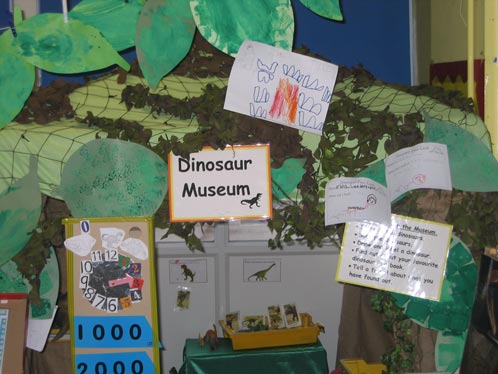
The month of May is always a busy time for Everything Dinosaur team members and May Day itself saw Everything Dinosaur carrying out a morning’s activities with Foundation Stage children at St Elizabeth’s  Primary School.  The children had been learning about dinosaurs and fossils and with the help of their teachers, Mrs Carr and Miss Bailey the budding young palaeontologists had created a “dinosaur museum” in one of the classrooms.

Exploring Dinosaurs

The Dinosaur Museum at the School

Children create their very own dinosaur exhibition.

Children create their very own dinosaur exhibition.

Picture credit: St Elizabeth’s Primary/Everything Dinosaur

The museum was full of lots of drawings and labelling exercises that the children had undertaken, with the help of Mrs Driver and Mrs Wilson (teaching assistants).  The children were keen to demonstrate which dinosaurs were plant-eaters and which ones ate meat.

Everything Dinosaur

As part of Everything Dinosaur’s visit to the school, our dinosaur expert challenged Foundation Stage 2 to create a piece of dinosaur themed writing.  Could they write about their favourite dinosaur?

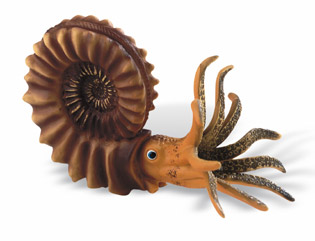
Perhaps they could include a dinosaur fact,  could they recall something that the dinosaur expert had said to them and then include this in their piece of prose?  In return, Everything Dinosaur’s expert promised (pinkie palaeontologist promise), to email a drawing of an ammonite for the children’s museum along with a fact sheet on these extinct cephalopods for Mrs Carr.

A Promise to Send over Information on Ammonites

A model showing an Ammonite.

A model of an ammonite.

Picture credit: Everything Dinosaur

Learning About Ammonites

Ammonites are members of the Mollusca phylum and they are closely related to the cuttlefish, octopus and squid.  The children learned all about their wiggle-wobbly tentacles and how some ammonites swam and caught fish.

It was a full morning of activities for the children, some of which were only just 4 years of age, but they demonstrated excellent listening skills.  Although, our dinosaur expert was kept very busy, there was still time to take some pictures of the lovely dinosaur models that the children had made.

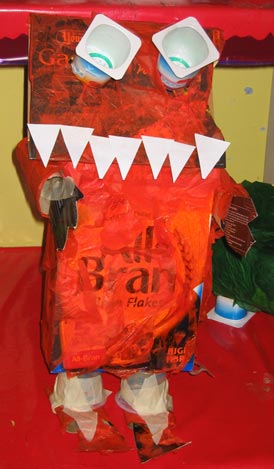
A Model of a Tyrannosaurus rex Made by the Children

A very fearsome looking dinosaur.

A very fearsome looking dinosaur.

Picture credit: St Elizabeth’s  Primary School/Everything Dinosaur

This dinosaur has some very big teeth and the yoghurt pot eyes look fantastic.  Perhaps the children can think of an appropriate name for their model, how about “Yoghurt-pot-o-saurus”?

To learn more about Everything Dinosaur’s extensive product range: Visit Everything Dinosaur.

The combination of physical activities, cognitive processes, tactile fossil handling with the extension activity seemed to be very well received by the children and their teachers.

1 05, 2014

How to Identify Which Fossil Find is Which

By |2023-03-12T15:05:30+00:00May 1st, 2014|Categories: Dinosaur Fans, Educational Activities, Everything Dinosaur News and Updates, Everything Dinosaur Products, Photos of Everything Dinosaur Products, Press Releases, Teaching|0 Comments

Sorting out Fossil Finds Dinosaur Excavation Kits

The fossil finds dinosaur excavation kits that Everything Dinosaur supplies are certainly very popular.  These kits include a digging tool, so that young dinosaur fans can excavate their own plastic dinosaur skeleton and experience what it is like to be a real palaeontologist.  The digging tool included is very similar to one we actually use ourselves when working around fossil bone.  There are four different types of dinosaur skeleton to collect. They are Tyrannosaurus rex, Velociraptor, Stegosaurus and Triceratops.

Fossil Finds

 Everything Dinosaur Fossil Finds

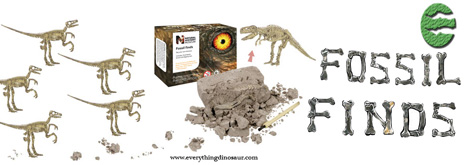
Everything Dinosaur creates a banner to promote Fossil Finds.

Everything Dinosaur creates a banner to promote Fossil Finds.

Picture credit: Everything Dinosaur

These dinosaur fossil inspired kits are very popular with teachers who use them as teaching resources in schools as well as with mums and dads who use them at dinosaur themed party gifts.  The square packaging makes them ideal for use in a pass the parcel game at a dinosaur inspired birthday party. However, the packaging on all four of the kits looks very similar and our team members at Everything Dinosaur thought it would be a good idea if we published a handy guide to identify which kit is which.

Identifying the Dinosaur

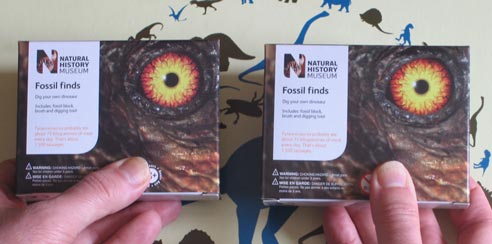
All the kits look the same from the front, this can lead to confusion as purchasers may not be sure which dinosaur fossil find they have.

A View of the Front of the Fossil Finds Packaging

Although there are four different dinosaur fossil finds in the series they all look the same from the front.

Although there are four different dinosaur fossil finds in the series they all look the same from the front.

Picture credit: Everything Dinosaur

All the fronts of the boxes feature a Tyrannosaurus rex themed fact.  The fact states that this apex predator probably ate around seventy-five kilogrammes of meat a day, the equivalent of 1,500 sausages.  Customers of Everything Dinosaur might think that all the fossil finds that they have bought feature the same skeleton inside.  All is not lost, here is how to determine which dinosaur is actually in each kit.

For models and replicas of dinosaurs and other prehistoric animals: Dinosaur and Prehistoric Animal Models.

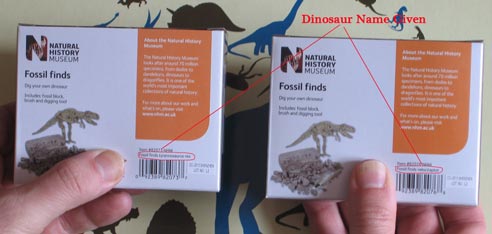
To determine which fossil find excavation kit you have, turn the box over and look at the back.  In the bottom corner above the product’s bar code, the name of the dinosaur featured inside will be shown.

Turn the Kit over and Look at the Printing on the Back

The name of the dinosaur whose skeleton is featured in the kit can be seen just above the bar code.

The name of the dinosaur whose skeleton is featured in the kit can be seen just above the bar code.

Picture credit: Everything Dinosaur

We have highlighted in red where the dinosaur’s name is printed.  All the kits have similar printing on the back of the box too, but the name of the dinosaur featured should be clearly displayed.

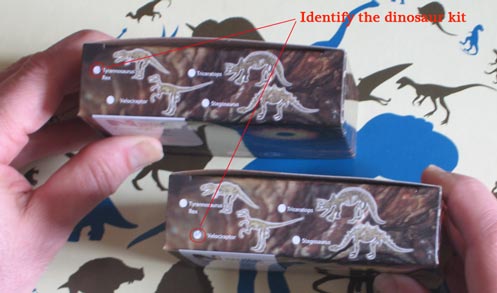
There is another way to check, if you look on the top of the box, illustrations of the four dinosaur skeletons in this series are shown.  There should be a tick or mark in the circle next to the skeleton illustration to indicate which dinosaur is in the kit, although we at Everything Dinosaur recommend you check the printing on the back of the box as sometimes this “check mark” is difficult to make out.

The Top of the Box Should Provide Guidance as to Which Dinosaur is in Each Kit

A tick or mark in the white circle identifies the dinosaur skeleton in the box.

A tick or mark in the white circle identifies the dinosaur skeleton in the box.

Picture credit: Everything Dinosaur

In the picture above we have highlighted the “check mark” area to help customers find the information they are looking for.

To view the range of educational prehistoric animal themed skeleton kits available from Everything Dinosaur: Dinosaur Themed Toys and Gifts.

All the kits we supply in this fossil finds range are sent out with a dinosaur fact sheet which provides more information about the dinosaur the kit represents.  Hopefully, this article will help our customers to sort out which fossil find kit is which and save any confusion when preparing a lesson plan for use in school or when getting ready for a dinosaur themed birthday party or some other event.

24 04, 2014

Hoylandswaine Primary School Send in Thank You Letters

By |2023-03-12T09:49:48+00:00April 24th, 2014|Categories: Educational Activities, Main Page, Teaching|0 Comments

Year 1 and Year 2 Show Off their Writing Skills

Last month, a team member at Everything Dinosaur visited Hoylandswaine Primary School to help teach about dinosaurs and fossils as the Year 1 and Year 2 students had spent a good portion of their term learning all about prehistoric animals.

Under the guidance of Miss Birkinshaw, the teacher and with the support of Mrs Burr (teaching assistant), the school children had been studying how fossils are formed, the life of Mary Anning, dinosaurs and the extinction event at the end of the Cretaceous.  The enthusiastic, young palaeontologists had even had a go at making their own fossils and creating their own dinosaur dig site in the classroom.  Our dinosaur expert felt very much at home surrounded by all the artwork and posters showing dinosaur facts and figures that the children had made.

Everything Dinosaur

At the end of the morning’s teaching, the Everything Dinosaur team member challenged the children to write a thank you letter.  Could they start their letter correctly?  Could they include a dinosaur fact or perhaps tell us about their favourite part of the morning’s dinosaur themed activities?  Would they use connectives, proper sentences, could they think of a way of ending their letter?

Having returned from some fieldwork, there was a bulging postal sack waiting in the office and amongst all our correspondence was a set of thank you letters from Hoylandswaine Primary.

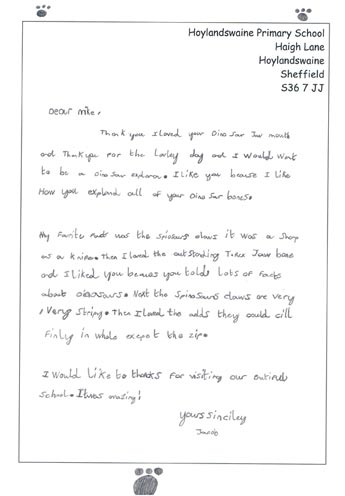
Thank you Letter Received from Jacob

Jacob loved learning all about Spinosaurus.

Jacob loved learning all about Spinosaurus.

Picture credit: Hoylandswaine Primary Year 1/2 – Jacob

One of the many thank you letters received by Everything Dinosaur, young Jacob has illustrated his letter with some three-toed dinosaur footprints.

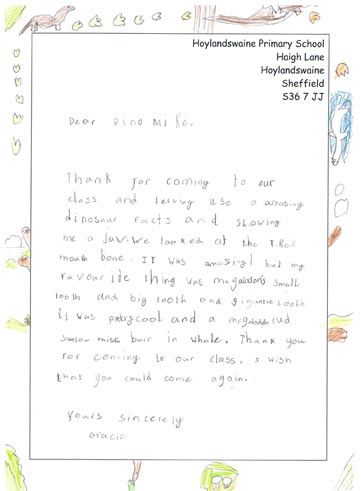
Gracie’s Thank You Letter to Everything Dinosaur

Gracie's favourite thing was learning all about giant sharks.

Gracie’s favourite thing was learning all about giant sharks.

Picture credit: Hoylandswaine Primary Year 1/2 – Gracie

Thank You Letters

Gracie chose to illustrate her letter with pictures of dinosaurs and a marine reptile swimming in the sea.  We had lots of colourful letters and we have posted them all up onto our huge warehouse wall so that we can look at them and smile whilst we are sorting out fossils and working on our dinosaurs.

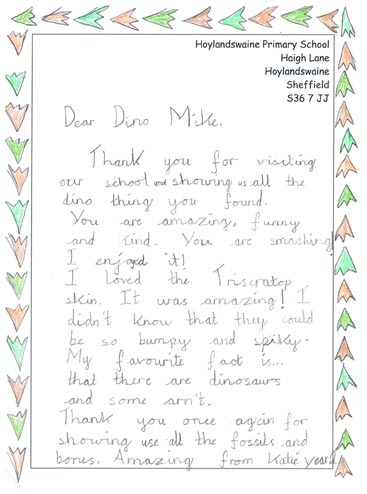
Thank you Letter Sent in by Katie

"Amazing fossils"

“Amazing fossils”.

Picture credit: Hoylandswaine Primary Year 1/2 – Katie

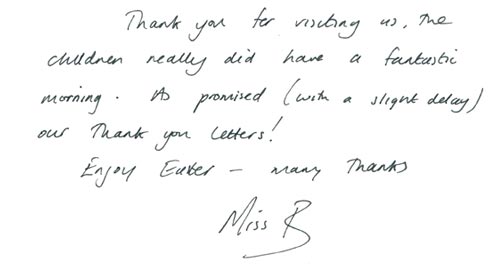
A very big thank you to all the children who sent us thank you letters, there are too many to post up here but we have put them all up onto our warehouse wall.  Miss Birkinshaw even got in on the act and sent us a short note to thank Everything Dinosaur for their morning’s teaching work at the school.

Teacher’s Thank You Note

"The children really did have a fantastic morning."

“The children really did have a fantastic morning.”

Picture credit: Hoylandswaine Primary Year 1/2 – Miss Birkinshaw

A Creative Writing Exercise

Setting a creative writing exercise such as this, is very worthwhile.  Often it can be difficult for the teaching team to motivate the children to write, but this follow up exercise enables the teacher to assess a child’s writing and reading progress as well as testing recall and how the pupil conveys information.  At Everything Dinosaur we always follow up letters we receive and we send out a reply to the school so that the children can learn a little more about the work we do and what we have been doing since our school visit.

Once again, our thanks to all the children in Year 1 and Year 2 who sent in thank you letters.

To view the range of dinosaur toys, models and games available from Everything Dinosaur: Everything Dinosaur.

14 04, 2014

Make Your Own Dinosaur Chocolate Nests

By |2023-03-12T08:51:00+00:00April 14th, 2014|Categories: Dinosaur Fans, Educational Activities, Main Page, Press Releases|0 Comments

A Spring Holiday Activity Idea – Making Dinosaur Chocolate Nests

Here’s a simple and fun recipe aimed at young dinosaur fans, a recipe to make dinosaur chocolate nests.  This is a great activity for the Easter or spring holidays.

Dinosaur Chocolate Nests

Dinosaur Chocolate Nests – What you Need

Ingredients – (makes a batch of about 8 to 10 dinosaur  nests)

  • Plain or Milk cooking Chocolate 225 grammes (8oz)
  • Packet of Breakfast Cereal Cornflakes or Shredded Wheat variety
  • Packet of Sugar Coated Mini-chocolate Eggs
  • Pack of Small Cake Cases
A recipe to make dinosaur chocolate nests.

Make your own dinosaur chocolate nests.

How to Make the Dinosaur Chocolate Nests

1.  Take the cooking chocolate out of its wrapper and snap it into small pieces into a heat-proof bowl.  Then melt the chocolate over a pan of hot water (simmering).  Putting the bowl in a microwave for 30 seconds (full power), will help to melt the chocolate if you are in a hurry and need to get the chocolate to melt more quickly.

2.  Once melted remove from the heat (turn off the heat source) and give the chocolate a quick stir to ensure all the chocolate pieces have melted.

3.  Put in the chosen breakfast cereal, a little at first then gradually add more until the chocolate/cereal mix takes on the appearance of twigs or wood in a nest.

4.  Spoon enough of the chocolate/cereal mix into each of the cake cases, a table spoon is usually sufficient.  Make a little indentation in the centre of each chocolate dinosaur next, this hollow is where the eggs will be placed.

5.  Put two mini-chocolate eggs into the hollow formed at the centre of each nest.  The chocolate being sticky, will ensure that the eggs stay in place.  A pair of eggs per nest is all that is needed.  Palaeontologists know that dinosaurs laid their eggs in twos (dinosaurs unlike birds had two ovipositors) – the egg laying apparatus of a dinosaur has been described as being like a “double barrelled shot-gun”.

6.  Then leave the nests to harden and set, they should be ready to eat in under 2 hours.

Great for a Dinosaur Party – Dinosaur Chocolate Nests
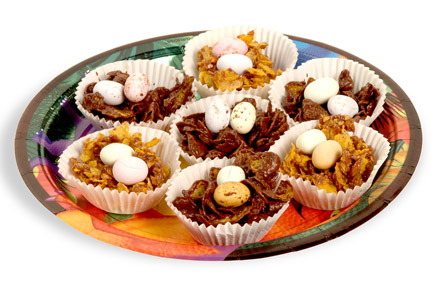
Super dinosaur chocolate nests which are fun and easy to make.

Super dinosaur chocolate nests which are fun and easy to make.

Picture credit: Everything Dinosaur

To view Everything Dinosaur’s huge range of products: Visit Everything Dinosaur.

Some Facts about dinosaur eggs (for all young, budding palaeontologists)

A).  Dinosaur eggs were not as large as many people think, the largest dinosaur eggs known to science are about the size of a soccer ball.  Some of the biggest dinosaur eggs have been ascribed to a genus of huge, long-necked dinosaur (titanosaur), whose fossils have been found in France.  This dinosaur is called Hypselosaurus (the name means “high ridged lizard”.  Hypselosaurus was named and described back in 1869, from fossils found in Provence, however, scientists are unsure as to whether the genus name can be established based on such fragmentary fossil evidence.  The genus is now termed a nomen dubium, palaeontologists have doubts about its validity.

B).  Dinosaur eggs were lots of different shapes, some were very round, some oval shaped, some even quite pointy at one end.  The shape of the egg tells scientists a little about the dinosaur that laid them.  Something like forty different types of dinosaur egg have now been identified by scientists.

C).  The classification of fossil eggs is referred to as ootaxa, dinosaur eggs are classified in virtually the same way as other organisms are classified using the classical Linnaean method (after the Swedish botanist Carl Linnaeus 1707-1778), there are oofamilies, oogenera and oospecies.

D).  Some dinosaurs were very attentive parents, incubating the eggs and protecting the nest.  When the eggs hatched the parents brought food to the nest for the baby dinosaurs.

E).  The oldest dinosaur eggs that contain the fossils of baby dinosaurs inside them were found in China and a report published on them in 2013.  These eggs are around 190 million years old.

Dinosaur Fossilised Eggs (Hypselosaurus)
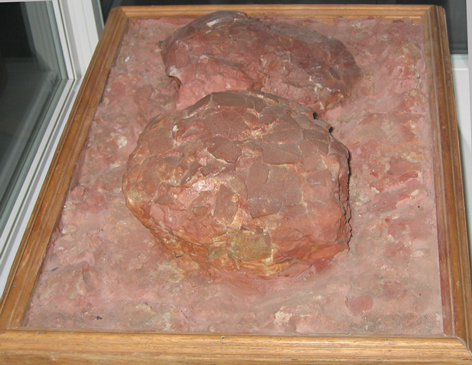
Fossilised Dinosaur Eggs but who laid them?

Fossilised Dinosaur Eggs but who laid them?

Picture credit: Everything Dinosaur

Articles on dinosaur egg discoveries published by Everything Dinosaur:

X).  Not the World’s Biggest Dinosaur Eggs!

Y).  Treasure Trove of Dinosaur Eggs Discovered in India.

Z).  School Children Make Dinosaur Egg Discovery.

9 04, 2014

Volcanoes at Yorkshire School – Unique Artwork on Display

By |2024-05-02T09:49:23+01:00April 9th, 2014|Categories: Educational Activities, Geology, Teaching|0 Comments

Year 4 Pupils Make Volcanoes

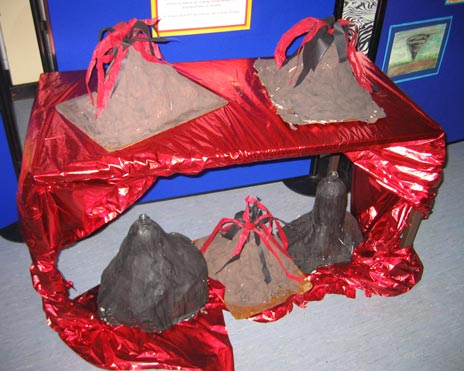
Whilst on a school visit to teach about dinosaurs and fossils one of our teaching team was given the chance to view an excellent display of volcanoes made by Year 4 pupils as they studied rocks and the formation of the Earth. There was some amazing artwork on display and under the teacher’s tutelage, some children had even made models.  Some of the models spouted lava flows made from coloured tissue paper, other volcano models had been prepared for use later on in the day, where with the addition of vinegar and bicarbonate of soda, they were going to “erupt”.

Volcanoes

Carbon dioxide produced in the plastic drinks bottle that helps to form the cone shape will force out the liquid lava as the gas pressure builds.  It is a good idea to put plenty of newspaper down to keep mess to a minimum and we like to add a few drops of washing up liquid to help the lava bubble.  Food colouring can be used to create, red, orange and even blue lava  – whatever colour takes your fancy!

Children’s  Models of Volcanoes on Display

Lava erupting from the cone shaped volcanoes

Lava erupting from the cone shaped volcanoes. Picture credit: Everything Dinosaur.

Picture credit: Everything Dinosaur

Everything Dinosaur

We discussed the extinction of the dinosaurs as part of our dinosaur workshop and we looked at other theories about the Cretaceous mass extinction, including volcanic activity leading to dramatic climate change.

To read more about alternative theories to the asteroid impact theory: Dinosaur Extinction Theory – Blame the Deccan Traps.

It certainly was a most enjoyable day, one that delighted our geologist colleagues when the saw the pictures of the children’s work.

To learn more about Everything Dinosaur’s extensive product range including replicas of iconic animals preserved in the fossil record: Dinosaur Themed Educational Items and Toys.

2 04, 2014

Beautiful Schematic Story Maps Help Children Remember Facts

By |2024-05-02T09:57:46+01:00April 2nd, 2014|Categories: Educational Activities, Everything Dinosaur News and Updates, Teaching|0 Comments

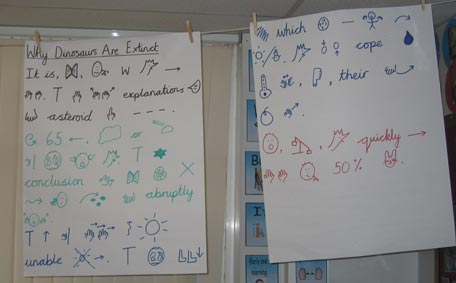
Dinosaur Extinction Explained using Schematic Story Maps

When it comes to helping Year 1 recount what they have learned during their term topic on dinosaurs, the class teaching team at Wroxton Primary School utilise a simple technique that helps “map out” facts into a straight forward story for the children.

Dinosaur Extinction

Being able to demonstrate evidence of learning at the end of a term topic is extremely important.  It is essential that the teaching team with the support of their learning support providers and teaching assistants can monitor the progress made by pupils.  At Everything Dinosaur, we recommend using the KWL technique to help plan and record the achievement of various learning objectives, however, there are a number of different techniques and methodologies available to teachers.

The KWL Technique

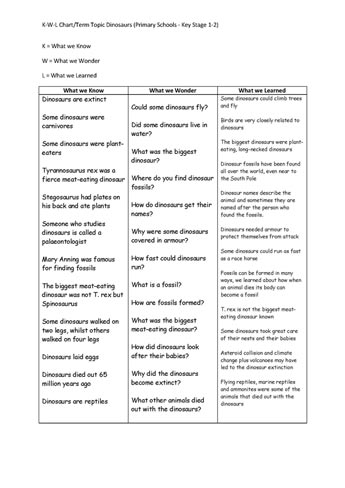
The KWL technique involves working with the class at the start of the topic to establish what the children know, what they would like to learn and this provides the foundation for the scheme of work and permits that all important recall and checking of learning once the topic has been concluded.

A Typical KWL Chart Prepared for a Dinosaur Teaching Topic

A chart to help kick-start a teaching topic about dinosaurs.

A chart to help kick-start a teaching topic about dinosaurs.

Picture credit: Everything Dinosaur

Essentially, KWL permits the following:

K= Know (test what the children known, brainstorming/discussion activities) log results.

W = What (during the first stage questions will be raised, ideas to be tested proposed, these can form the basis of the teaching work).

L = Learn (the recounting stage or the recall stage, review at the end of the term topic what the children have learned (check learning, summarise learning).

School Visit

During a school visit to a primary school in Oxfordshire, one of Everything Dinosaur’s dinosaur experts came across some excellent examples of story maps being used to help create visual cues to stimulate learning and recall for use in creative writing activities.  Our expert saw several examples of such “story boarding” maps, one covering the extinction of the dinosaurs, another telling the story of Mary Anning (1799-1847).

Visual Story Map for use in Year 1

Visual cues to help young children recall facts about dinosaurs.

Visual cues to help young children recall facts about dinosaurs. Picture credit: Everything Dinosaur.

Picture credit: Everything Dinosaur

A level of knowledge regarding possible causes of the extinction of the dinosaurs was clearly demonstrated by the Year 1 pupils who were eager to explain all about an object from outer space crashing into the Earth and what happened to the dinosaurs as a result.  This was a most impressive demonstration of learning using a technique which would appeal to those children who prefer a visual learning style.

To view the range of prehistoric animal themed gifts available from Everything Dinosaur: Dinosaur Models, Gifts and Toys.

30 03, 2014

A Morning Studying Amazing Dinosaurs

By |2024-05-02T09:58:21+01:00March 30th, 2014|Categories: Educational Activities, Teaching|0 Comments

Christ Church Primary School Pupils Study Dinosaurs

Year 1 pupils at Christ Church Primary School (Stoke on Trent, England), got the chance to get up very close to some dinosaur fossils as they studied prehistoric animals as part of their term topic.  Under the tutelage of one of the school’s Key Stage 1 tutors Miss Bryant, ably assisted by teaching assistant Mrs Dyer, the children have been learning about life in the past and how fossils are formed as they study dinosaurs over the spring term.

Schoolchildren Study Dinosaurs

A team member from Everything Dinosaur had been invited into the school to assist with the teaching work and to undertake a whole morning of dinosaur themed activities and exercises as part of a dinosaur workshop.  The classroom was very colourful with lots of dinosaur artwork and posters on display and the children were very keen to complete morning registration so that the dinosaur themed teaching activities could start.

Casting Fossils

The children were challenged to have a go at casting museum quality replica fossils from Everything Dinosaur’s own fossil collection and with one group of children led by Mrs Dyer and the second group supervised by Miss  Bryant, two lovely replica fossils were cast.  The size and scale of some dinosaurs was considered and the children were encouraged to compare bones in their body to those of famous dinosaurs.  The brain of an armoured dinosaur from the Late Cretaceous being confirmed as being about the size of a six-year old child’s fist, whilst the same dinosaur could happily sit five Year 1 pupils in its body cavity.

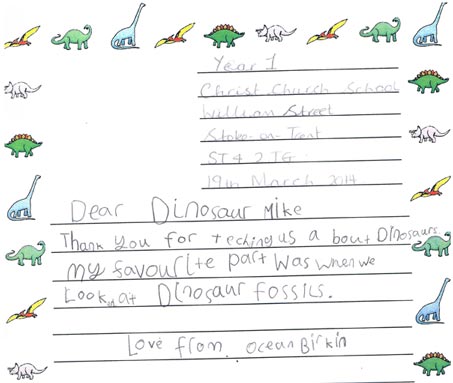
Thank you Letter Sent in by Ocean

Ocean says thank you to Everything Dinosaur for school visit.

Ocean says thank you to Everything Dinosaur for school visit.

Picture credit: Ocean (Christ Church Primary School)

There were lots of questions asked and the pupils showed a good degree of independent learning as the Everything Dinosaur team member discussed meat-eating dinosaurs and compared them to plant-eating dinosaurs.  Over the course of the morning, a lot of different types of fossil were examined and at the end of the visit an Everything Dinosaur “pinkie palaeontologists challenge” was set before the class.  Could the children demonstrate the ability to recall information and write a thank you letter to our dinosaur expert?

Dinosaurs as a Teaching Topic

Dinosaurs as a teaching topic lends itself to all sorts of innovative learning activities that dove-tail into the outcomes and aims expected from the National Curriculum.  Creating a thank you letter permits the teaching team to introduce a recounting element into the teaching work.  This helps to check understanding and reinforce learning.

Often a problem when developing literacy exercises for Year 1 pupils is how to give the children  a purpose for writing, a thank you letter to a school visitor fits the bill nicely.

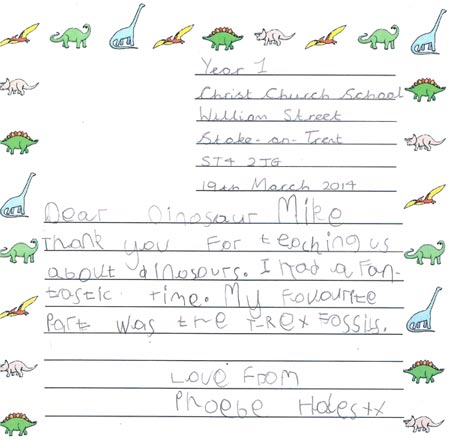
School Children Send In Thank You Letters

Wonderful writing from Year 1.

Wonderful writing from Year 1.

Picture credit: Phoebe (Christ Church Primary School)

 All the letters that we received were carefully read by our team of dinosaur experts and we have posted them up onto a big display board, a special thank you to all the budding palaeontologists who wrote thank you letters.  It seems that the teaching staff had fun teaching about dinosaurs in school and the school children loved learning all about prehistoric animals.

To learn more about Everything Dinosaur’s range of toys and gifts including replicas of iconic fossil animals: Dinosaur and Prehistoric Animal Models including Fossil Replicas.

21 03, 2014

Art and Science Combine in School During Fossil Study

By |2023-03-11T15:17:12+00:00March 21st, 2014|Categories: Educational Activities, Teaching|0 Comments

School Children Make Models of Fossils as they Study Dinosaurs

Year 1 and Year 2 children at Hoylandswaine Primary School showcased their dinosaur and prehistoric animal knowledge this week during a school visit from a dinosaur expert at Everything Dinosaur.  Under the tutelage of Miss Birkinshaw, the class teacher, the children had been studying dinosaurs and fossils with a special emphasis on food chains and the role of carnivores/herbivores in ecosystems.

Dig Site in the Classroom

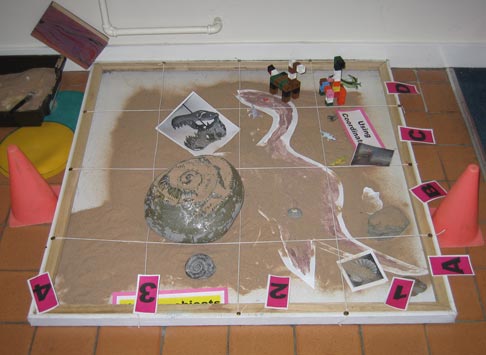
A dig site had been created in the classroom, with Miss Birkinshaw and the children providing fossils for the budding young palaeontologists to excavate.  A grid system had been overlaid and the children had been set a number challenges to identify and describe the objects located on various parts of the dig site.  This reflects what we actually do when it comes to mapping an actual fossil excavation.

Primary School Children Map Out Their Own Fossil Excavations

Palaeontology in schools

Palaeontology in schools – a wonderful exercise to help children learn more about fossils. Picture credit: Everything Dinosaur.

Picture credit: Everything Dinosaur

Some super ammonite fossils can be seen in the picture.

As part of the morning’s activities the children examined a variety of fossils including teeth from a giant prehistoric shark (O. megalodon) and with Harry’s help the size of the backbone of a Stegosaurus was compared to our own vertebrae.  Mrs Burr (Teaching Assistant) and Miss Burkinshaw were appointed team captains as one half of the class were given the task of casting a replica shark fossil tooth, whilst the other half were challenged with casting a dinosaur toe bone which had come from a huge and very old duck-billed dinosaur, a specimen of a dinosaur called Edmontosaurus.

The children asked lots of questions and they learned some facts about Tyrannosaurus rex which meant that their poster display on the “King of the Tyrant Lizards” would have to be altered in the light of the information that they had been provided with.  Lots of artwork and creative writing was on display and in the corridor close to the school office there was was a display that had been populated by various dinosaur themed objects and a special workbook that showed some of the areas of study that the children had been looking at.

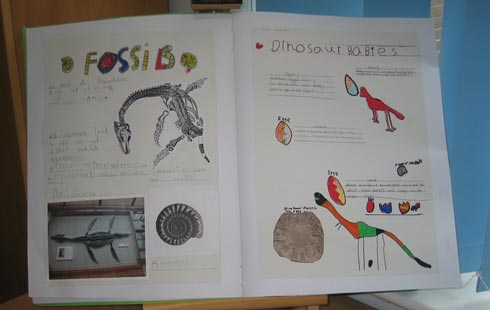
School Dinosaur Project Book on Display

Children write about fossils and fossil discoveries

Children write about fossils and fossil discoveries in a superbly illustrated book all about prehistoric animals. Picture credit: Everything Dinosaur.

Picture credit: Everything Dinosaur

On the left-hand side of the book shows pictures of plesiosaur fossils (a marine reptile), fortunately, our expert had a piece of a plesiosaur vertebrae on hand to show some of the children who had stayed behind during lunch to ask further questions.  Young Jack had brought in some of his own fossils.  His fossil collection proved very handy when Harriet exhibited the fossil model she had made out of clay.  Our expert was able to talk about the lines of symmetry in Harriet’s colourful model and then compare the clay fossil to a real “sand dollar” fossil in Jack’s fossil collection.

Comparing a Clay Model to a Fossil “Sand Dollar”

Sand dollar fossil compared to a clay model.

Sand dollar fossil compared to a clay model. Picture credit: Everything Dinosaur.

Picture credit: Everything Dinosaur

Models of Fossils

Harriet had done a wonderful job of making and painting her fossil.  The lines radiating out from the centre reminded our dinosaur expert of the fossilised calcite plates associated with a type of sea urchin (Echinoids – pronounced “eck-in-oids”), often referred to as a “sand dollar”.  “Sand dollars” fossils are relatively common, these animals are part of a group of sea creatures that originated around 480 million years ago (Ordovician), but most of the “sand dollar” fossils seen today are much more recent.  Still, Jack’s fossil could be over twenty million years old.

The rigid external skeleton of a “sand dollar” is called a “test”.  On the top surface, is a five pointed star-like structure, these are five paired rows of pores, like look a little like the petals on a flower.  These pores can seen on Jack’s fossil.  When the sea urchin was alive, tube feet projected through theses pores and these feet were multi-purpose, they helped the little animal to burrow into soft sediment,  to move about and they also helped the animal breathe and to gather food.

Sand Dollars

“Sand dollars” are around today and often tests are washed up onto the beaches of the Western United States.  These tests look like coins hence their common name, but they are also sometimes called “Mermaid coins”, in the past sailors used to believe that if they found one it would bring them good fortune on their next voyage.

Note for Harriet

Lots of different types of “sand dollar” sea urchins are alive today, and some are indeed coloured green and blue.

To conclude the visit, our dinosaur expert set the class a challenge.  The children could write a thank you letter but they must use capital letters and connectives correctly.  Perhaps they could write about their favourite dinosaur or indeed, include a special dinosaur fact in their letter.

We shall see what the budding young palaeontologists from Hoylandswaine Primary School come up with…

For further information on Everything Dinosaur’s range of toys, models and gifts: Dinosaur Toys, Gifts and Models.

19 03, 2014

Lovely Thank you letter from a School

By |2024-05-02T07:09:15+01:00March 19th, 2014|Categories: Educational Activities, Teaching|0 Comments

Primary Schoolchildren Write Thank you Letters to Everything Dinosaur

After a busy few weeks with Everything Dinosaur team members carrying out a lot of dinosaur workshops in schools, team members are busy preparing free downloads for the company’s new “dinosaurs for school” website.  As well as all this teaching activity we have also been keeping up with the huge volume of correspondence that we receive.  Amongst all the drawings, pictures, feedback forms, information requests and such like we get letters from schoolchildren who have been involved with our dinosaur teaching in schools.  One such letter was sent from Holly from Yorkshire, we were so impressed that we thought we would post Holly’s excellent letter on our blog site.

Everything Dinosaur

Holly Says Thank You to Everything Dinosaur

School children thank Everything Dinosau

Schoolchildren thank Everything Dinosaur after team members from the UK-based dinosaur company visited their school.

Picture credit: Everything Dinosaur/Holly

Thank You Letter

Naturally, our team members respond to all those letters, enquiries and contacts that require a reply.

We wrote to Holly saying:

“We are glad that you like dinosaurs and we were very impressed with your writing skills, your letter was very well laid out, the first word that you wrote started with a capital letter and you remembered to use full stops.  You also remembered to put your name on the letter at the bottom, well done Holly!”

We look forward to working with Holly and her classmates in the future and undertaking more dinosaur teaching in schools.

Visit Everything Dinosaur’s website to see the huge range of soft toys available: Prehistoric Plush – Dinosaur Soft Toys.

17 03, 2014

Nursery School Children Construct a Unique Dinosaur

By |2024-05-02T10:11:22+01:00March 17th, 2014|Categories: Educational Activities, Teaching|0 Comments

Nursery Children Build their own Dinosaur

Whilst on a visit to teach about dinosaurs in school in Yorkshire, one of the Everything Dinosaur team members took a picture of a dinosaur that the nursery class had built as they too studied dinosaurs for the day.  As part of the dinosaur workshop, we were working with Year 2 and Year 3 children, but the nursery children also joined in the day of dinosaur themed activities with some colouring in of pictures of prehistoric animals and an exploration of dinosaurs using the sensory play area.

Dinosaur

Nursery School Children Build a Dinosaur

Nursery school children construct a dinosaur in the playground.

Nursery school children construct a dinosaur in the playground.

Picture credit: Everything Dinosaur

Using the tyres and building blocks from the outside play area along with some crates that the class had borrowed the children were able to build their very own dinosaur.  One of the little palaeontologists pointed out the yellow feet, whilst another explained that they had put building blocks on the tail just like the plates on a Stegosaurus.

The Everything Dinosaur team member was not quite sure what name the children had come up with, but one of the nursery school children said that their dinosaur was “definitely a plant-eater”.

We suggested that this dinosaur should be called “Nurseryosaurus”.

To read more about Everything Dinosaur’s huge range of dinosaur themed toys and games: Everything Dinosaur – Toys, Models and Gifts.

Go to Top