All about dinosaurs, fossils and prehistoric animals by Everything Dinosaur team members.

Everything Dinosaur’s work with schools and other educational bodies. Articles, features and stories about dinosaurs and their role in education and educating young people.

19 09, 2014

Key Stage 1 Pupils Learn about Dinosaurs and Fossils

By |2023-03-16T14:53:26+00:00September 19th, 2014|Categories: Educational Activities, Teaching|0 Comments

Primary School Pupils Explore the Dinosauria

Another busy day for Everything Dinosaur team members with a primary school visit.  Children at St. Joseph and St. Bede R. C. Primary had a great time exploring fossils and learning all animals and plants that lived in the past.  As part of our teaching work we looked at the work of a palaeontologist, examined the differences and the similarities between plants today and those preserved as fossils.  The pupils looked at plant-eaters and meat-eaters, well done to Tilly for knowing what a herbivore ate.

Dinosaurs and Fossils

Our team member even met a student called Maia and we explained all about the dinosaur called Maiasaura (Good Mother Lizard).

To read more about the dinosaur called Maiasaura: Maiasaura – Mothers Day and Marsh.

 The Teaching Team Prepared A Slide Show of the Activities

Slideshow credit: St. Joseph and St. Bede Primary School

 We did have some dinosaur eggs, but we are not sure where they have gone.  Could we have left them at the school?

Lots of extension activities have come out of the visit, we look forward to hearing more about how the school children have been learning to work scientifically.

For more information about Everything Dinosaur’s extensive dinosaur and prehistoric animal themed product range: Visit Everything Dinosaur.

18 09, 2014

Tropical North Wales – 300 Million Years Ago

By |2023-06-12T17:56:25+01:00September 18th, 2014|Categories: Dinosaur and Prehistoric Animal News Stories, Educational Activities|0 Comments

Photographs of the Brymbo Steelworks Fossils

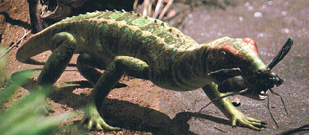
We were emailed today by the mum of one keen young palaeontologist who wanted to know all about Petrolacosaurus (pet-ro-lak-co-saw-rus).  Our team member explained that this primitive reptile was not a dinosaur, although it was very distantly related to them.  Petrolacosaurus lived at the very end of a geological period called the Carboniferous, at a little over forty centimetres in length, most of that tail, it was not the biggest reptile known from the fossil record – but its fossils are exceedingly important.  It looked like a lizard and it scurried through the extensive tropical forests that dominated the world at that time in Earth’s history.

Petrolacosaurus

By the early Permian, Petrolacosaurus was extinct, it remains one of the earliest reptiles known, part of a rapidly diverging group, that unlike amphibians evolved amniotic eggs.

One of the Earliest Reptiles – Petrolacosaurus (P.kansensis)

Petrolacosaurus kansensis

Petrolacosaurus kansensis.

Picture credit: BBC

Amniotes

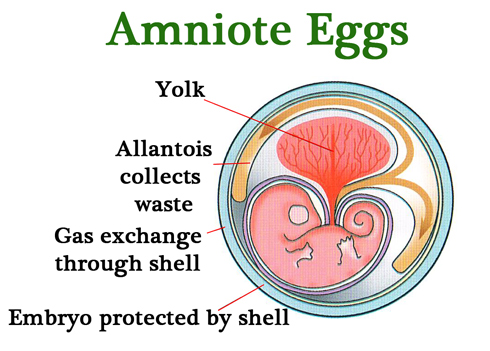
Amniotic eggs have a semi-permeable shell that protects the embryo from drying out.  A tough, internal membrane called the amnion surrounds the growing embryo as well as the yolk, the food source.  Development of the embryo in a shelled egg meant that for the first time in history, the tetrapods were no longer tied to water to breed.  We as mammals are amniotes, along with the birds and reptiles.

The Amniote Egg – Great Breakthrough for the Tetrapods

The growing embryo is protected by a semi-permeable egg shell.

The growing embryo is protected by a semi-permeable egg shell.

Fossils of the rare and exotic Petrolacosaurus come from faraway Kansas, other primitive reptiles are known from a site in Nova Scotia (more about Nova Scotia later), but did you know that in an abandoned steelworks, just north of Wrexham (North Wales), a team of dedicated researchers and volunteers are busy preserving the fossilised remains of a Carboniferous habitat?

Important Fossil Discovery

It is not all that often that we get to talk about globally significant scientific sites virtually on our doorstep, but that’s exactly what the “fossil forest” preserved at an abandoned steelworks at Brymbo is and we are delighted to hear that plans are being considered to develop this location, perhaps leading to a visitor centre to explain all about the local industry and the fossils to be found nearby.  The Brymbo steelworks site preserves a forest and swamp environment from the Late Carboniferous, a time when the first reptiles scurried around hunting for insects and from time to time becoming prey themselves.

Top predators of the Late Carboniferous included spiders the size of dinner plates and three-metre-long amphibians.  Although, no reptile fossils have been discovered to date, this location is just one of a handful of such sites around the world and it is likely to significantly improve our understanding of the palaeoecology of the Late Carboniferous of Europe.

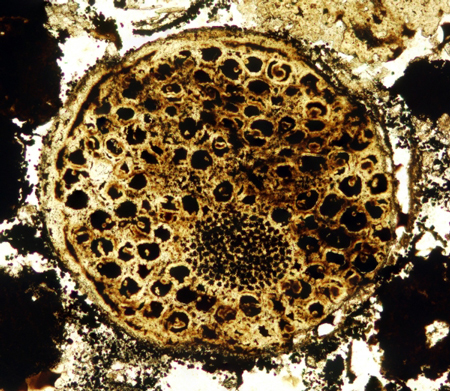
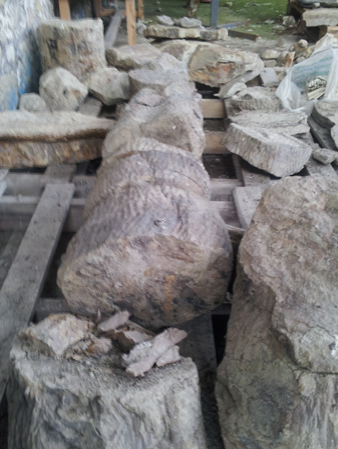
 Some of the Hundreds of Plant Fossils Collected at Brymbo

Ancient fossil uncovered at North Wales steel works.

Ancient fossil uncovered at North Wales steel works.

Picture credit: Rachel Mason

Tropical North Wales

The first fossils were discovered in 2005, when coal was being extracted from part of the Brymbo site. Everything Dinosaur team members wrote an article about the discoveries in 2009, when some of the fossil finds went on display to the public:

To read the article: Fossilised Plant Remains Go on Display.

The forest that existed 300 million years ago in North Wales was part of an extensive ecosystem that stretched across Europe and North America.  The vast amount of peat that was formed as the plant remains became buried was, eventually, over time, turned into coal. This coal was to fuel the Industrial Revolution, so it could be argued that the 300-million-year-old forest gave rise to the steelworks.  The forest would not have looked like any modern-day forest environment.

Giant Lycopsids adn Huge Sphenopsids

Giant forty-metre-high Lycopsids (club mosses dominated), along with huge Sphenopsids (horsetails) called Calamites.  Nowhere else in Britain have Calamites fossils been found in such quantities.   Many other types of plant are known from this site, including the now extinct seed ferns (Pteridosperms) and the true fern Syndneia, which was previously known just from one site in Canada.

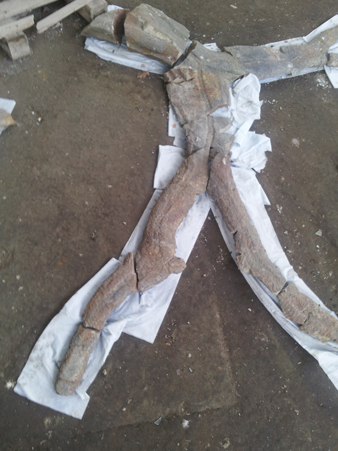
Giant Lycopsid fossils found

Giant lycopsid fossils found.

Picture credit: Rachel Mason

Plants are very rarely preserved as whole fossils, but normally occur as isolated individual parts, such as leaves, stems, cones and roots.  As these different parts of plants are found separately in the fossil record, they tend to be given their own individual binomial name.  The roots system of lycopsids such as the huge Lepidodendron, had a branching structure and these root systems are often preserved along with the Knorria (the name for the base of the trunk).  The term Lepidodendron, although used to describe the entire plant is actually the term that refers specifically to the upper part of the plant and its branches.

More Fossils from Brymbo (we suspect Stigmaria)

Preserved elements of the roots (we think) of a Lycopsid.

Preserved elements of the roots (we think) of a lycopsid.

Picture credit: Rachel Mason

Now Back to Nova Scotia

We mentioned earlier primitive reptile fossils from Nova Scotia.  Important information about life on Earth around 310 million years ago has been gained from studies of the coal deposits and the fossils they contain from Joggins in Nova Scotia.  The fossils in theses coal measures represent an ecosystem that is probably a few million years older than the one represented by Brymbo.

The Joggins site preserves numerous tree-sized stumps just as at Brymbo.  However, the fossilised remains of many different types of vertebrate (early tetrapods) have been found inside the sediment associated with these hollowed out tree stumps.  It has been suggested that the hollow trunks of Lepidodendron plants became natural traps for many creatures, which has preserved evidence of the vertebrate fauna associated with these ancient forests and swamps.

No terrestrial vertebrate fossils have been found to date (as far as we know), from the Brymbo site, but importantly, Brymbo is a sheltered, inland location.  Yes, it has the vagaries of the Welsh weather to contend with, however, the Coal Measures at Joggins are on the coast and this site is subjected to much harsher weather, frequent cliff falls and significant amounts of erosion.

In terms of its importance to geology and palaeontology, the Brymbo site with its plant, invertebrate and trace fossils, may turn out to be one of the most important fossil sites in the whole of Europe.

Visit Everything Dinosaur’s award-winning website: Everything Dinosaur.

17 09, 2014

Congratulations to the North-West Science Alliance

By |2023-03-16T14:43:19+00:00September 17th, 2014|Categories: Educational Activities, Press Releases|0 Comments

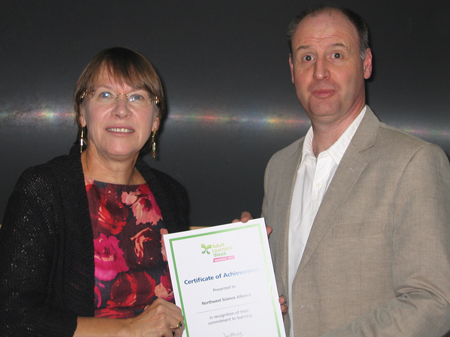
Certificate of Achievement for the North-West Science Alliance

Within the scientific community there are a great many hard-working, dedicated people who give up their free time to advance the general public’s understanding of science.  The North-West branch of the British Science Association is a typically vibrant team who work tirelessly to help inform, inspire and educate.

North-West Science Alliance

Amongst the many successes of this dedicated community that provides speakers, organises science festivals, SciBars (a science presentation in a pub), workshops and other hands-on events, there is the North-West Science Alliance (NWSA). This long-standing organisation has acted as a facilitator bringing together the public, science industries, schools, colleges and universities and fosters co-operation between these diverse bodies.

Lorelly Wilson, as Chairperson of the NWSA and the Chair/Secretary of the North-West branch of the British Science Association has done more than most to advance the general public’s understanding of science and to promote careers in science to students.  Her work was recognised when the NWSA was nominated for an award as part of Adult Learners’ Week organised by the National Institute of Adult Continuing Education (NIACE).  Yesterday evening, a team member of Everything Dinosaur was asked to present a Certificate of Achievement to Lorelly in recognition of her hard work.

Certificate of Achievement to the North-West Science Alliance

Lorelly Wilson accepts award.

Lorelly Wilson accepts award.

Picture credit: Everything Dinosaur

One of the great things about our work is that we get to meet some amazing and talented people.  We were delighted to be able to present this award, the North-West Science Alliance had some stiff competition, more than fifteen hundred nominations were put forward and we at Everything Dinosaur were very pleased to hear of their success and to celebrate this achievement with them.

Visit Everything Dinosaur’s website: Visit Everything Dinosaur.

10 09, 2014

School Site Updates and Important News for Teachers

By |2024-05-02T10:23:07+01:00September 10th, 2014|Categories: Educational Activities, Press Releases, Teaching|0 Comments

Everything Dinosaur’s School Site Updates

Busy days at Everything Dinosaur, not only are team members starting the first of the autumn term’s teaching assignments this morning, but there are further updates being added to the company’s bespoke teaching website.  Everything Dinosaur provides a lot of educational resources and support to schools, home educators, teaching assistants and museums.  The teaching website was set up so as to provide a dedicated support site about dinosaurs and fossils to assist those involved in education.

Everything Dinosaur

Teaching tips, articles, resources and free downloads.

Teaching tips, articles, resources and free downloads.  Everything Dinosaur supplies lots of dinosaur themed educational resources.

Picture credit: Everything Dinosaur

Helping Teachers

Amongst the free downloads, teaching plans, schemes of work and other resources, Everything Dinosaur team members have been busy writing bespoke articles about how dinosaurs and fossils can help in education on the site’s teaching blog.  Trouble is, we have hundreds of articles and even more ideas for new articles so this task is monumental.  Still we shall persevere and new articles are being posted up all the time.

To visit Everything Dinosaur’s extensive range of dinosaur themed educational resources: Dinosaur Themed Educational Resources.

7 09, 2014

Everything Dinosaur’s New School Site Goes from Strength to Strength

By |2023-03-16T13:35:13+00:00September 7th, 2014|Categories: Educational Activities, Teaching|0 Comments

Teachers Getting Access to Free Downloads

The new school website from Everything Dinosaur has only been “live” for a little over a week but already teachers and learning support providers from as far away as Australia and California have been taking the opportunity to download the free teaching resources.  With the new curriculum being rolled out in England, there is a strong emphasis on “working scientifically” and our trained teachers and academics have been enthusiastically offering support and teaching advice.

Everything Dinosaur

New Schools and Educational Website From Everything Dinosaur

Teaching tips, articles, resources and free downloads.

Teaching tips, articles, resources and free downloads.  Everything Dinosaur educational products for schools.

Picture credit: Everything Dinosaur

Science Curriculum

In the science curriculum, rocks and fossils are an integral part of Key Stage 2 and dinosaurs make a fantastic term topic subject for Early Years Foundation Stage (EYFS) and Reception.  Everything Dinosaur’s school visits start in earnest next week, but our teaching team hope to post up some more, free dinosaur and fossil themed teaching resources before the teaching schedule and dinosaur workshops get into full swing.

A spokesperson for Everything Dinosaur commented:

“We have been very pleased with the take up, lots and lots of free dinosaur and fossil themed teaching resources have already been downloaded by teachers, teaching assistants and home educators.”

To visit Everything Dinosaur’s website, a website aimed at helping teachers and other educationalists with the delivery of Earth science based teaching schemes and lesson plans: Visit Everything Dinosaur.

1 09, 2014

New School Curriculum With Rocks, Fossils and Dinosaurs

By |2023-03-16T12:35:59+00:00September 1st, 2014|Categories: Educational Activities, Main Page, Teaching|0 Comments

New Curriculum – New Challenges For Teaching Teams

This week sees the introduction of the new national curriculum for school children in England.  A more “rigorous” curriculum with English, Mathematics and Science as core subjects with pupils at Key Stage 1 (five to seven years old) being introduced to simple fractions and even computer programming.  The aim of this new curriculum which is being rolled out across all state-funded primary and secondary schools, is to improve standards.

A New Curriculum

However, academies, which now form the majority of secondary schools, will not be required to follow the new curriculum.  State funded schools in Scotland, Wales and Northern Ireland are managed differently but current policies and practices are being reviewed in many parts of the British Isles.

Why the Changes?

The Department for Education, responsible for children’s’ services and education in England, cites falling academic standards when students in England are compared to students from other countries, particular countries such as Singapore, South Korea and China.  From Everything Dinosaur’s perspective, our teaching work aims to help promote the concept of working scientifically and we deal with classes ranging from EYFS (Early Years Foundation Stage) right up to Key Stage 4 (students from fourteen to sixteen years).

A number of comparative studies have been undertaken and just like schools themselves, the results vary.  For example, back in 2012 Everything Dinosaur team members reported on the biannual comparative study carried out by researchers at Boston College (USA), which covers the results from two very important international teaching studies, the Progress in International Reading Literacy Study (PIRLS) and the trends in International Mathematics and Science Study (TIMSS).  Broadly, the United Kingdom had shown good progress when it came to mathematics but standards seemed to be slipping when it came to the sciences.

Teaching about Dinosaurs and Fossils in School – Working Scientifically

Lots of facts about dinosaurs.

Lots of facts about dinosaurs. Picture credit: Everything Dinosaur.

Picture credit: Everything Dinosaur

Rocks, Fossils and Dinosaurs

A topic all about dinosaurs, fossils and extinction helps to bring together core teaching subjects such as science, English and mathematics.

To read more about the study: Mixed Results for Science and Maths in English Schools.

Where Does Everything Dinosaur Come In?

With the emphasis on scientific knowledge, conceptual understanding and learning about scientific methods, dinosaurs as a term topic or part of a special science themed teaching week is a great way to engage young minds at Key Stage 1 and earlier.  As children tend to have a fascination with prehistoric animals, our dinosaur workshops help to introduce and reinforce learning objectives as outlined by the new curriculum.  Lower Key Stage 2 have to learn about fossils, how they are formed and what they tell us about the once living things that they represent.   As one of our colleagues declared “Mary Anning is on the curriculum” – great to see a female role model in science.

Studying Genetics and Evolution

Older students  in Key Stage 3 and heading up to Key Stage 4 are being given the opportunity to study genetics, evolution and the work of such notable scientists as Darwin and Wallace.

Teachers and their support providers have been working hard to get to grips with this new “rigorous” curriculum.  We are aware that some of the teaching resources related to dinosaurs and fossils used in the past are in some cases out of date, or worse still inaccurate. Everything Dinosaur offers lots of free, downloadable prehistoric animal themed teaching resources from its bespoke teaching website, as well as helpful articles, tips, advice and the opportunity to invite our dinosaur experts into school.

To visit Everything Dinosaur’s website: Everything Dinosaur’s Website.

A Teaching Exercise – Our Hands versus the Hands of a Dinosaur

Examining Dinosaur Hands (Key Stage 2/3)

Examining Dinosaur Hands (Key Stage 2/3).  Picture credit: Everything Dinosaur.

Picture credit: Everything Dinosaur

Supplying Teaching Resources

In terms of teaching resources, Everything Dinosaur team members have been advising learning support providers about all sorts of prehistoric animal related merchandise – from finger puppets to science kits.  All the resources we supply have been tested and reviewed by our own teaching team, there’s even free dinosaur fact sheets included as well.

Resources for schools: Dinosaur Themed Educational Products.

Here’s to that dedicated group of professionals who serve our school children so well and we wish all the students starting the new curriculum every success with their studies.

31 08, 2014

Palaeontologist versus Paleontologist Providing a Helpful Explanation

By |2024-05-02T10:46:22+01:00August 31st, 2014|Categories: Educational Activities, Main Page, Teaching|1 Comment

Palaeontologist v Paleontologist – What’s the Difference?

During our school visits to carry out dinosaur and fossil themed workshops we often get asked to help with various aspects of the teaching scheme of work.  Everything Dinosaur’s team members are happy to provide advice and to assist where they can.  We even send out lots of free teaching resources, lesson plans, activity ideas and learning aids related to fossils and prehistoric animals.

Supporting Teachers

However, we do see a lot of other teaching resources, many of which have been downloaded from education company websites, that are inaccurate.  Some of these resources have cost money, thus depleting an already stretched teaching budget.  We try to do what we can to help out.

Everything Dinosaur Provides a Lot of Teaching Resources to Schools

So many events, so many activities, so many photographs.

So many events, so many activities, so many photographs.

Picture credit: Everything Dinosaur

Palaeontologist v Paleontologist

Today we will deal with a very simple point, the difference between “palaeontology” and “paleontology”.  We know that a number of the resources used by teachers and learning support providers (home educators too for that matter), are sourced from other countries, such as America.  Herein lies the confusion.   The word palaeontology is often seen in these resources (and elsewhere) with an “a” missing.  We have the term “palaeontologist” and also “paleontologist”.

So let’s start at the beginning – what is palaeontology or paleontology?

Providing Explanations

Palaeontology or paleontology mean the same thing.  These words describe the branch of science that deals with the study of extinct animals and plants and their fossilised remains.  The word is derived from the Greek palaios which means “ancient”, a reference to prehistoric times.  Palaeontology (with an extra “a” added) is the term used in Britain and elsewhere in the world, whilst paleontology is the Americanised version of the word and it is customarily used in the USA.  Both words are interchangeable but most institutions tend to use one word rather than the other.

For example, Everything Dinosaur uses the term palaeontology, whilst the Chicago Field Museum (Illinois, USA) uses the word paleontology.  The dropping the “a” convention applies to all the sub-disciplines in this broad area of scientific study.

Common Terms in Palaeontology and Related Subjects

Palaeontology (UK) Paleontology (USA) – The study of extinct organisms and their fossils.
Palaeontologist (UK) Paleontologist (USA) – A person who studies extinct organisms and their fossils.
Vertebrate Palaeontologist (UK) Vertebrate Paleontologist (USA)  – The branch of palaeontology that studies animals with back bones.
Invertebrate Palaeontologist (UK) Invertebrate Paleontologist (USA) – The branch of palaeontology that studies animals without back bones.
Micropalaeontology (UK) Micropaleontology (USA) – The study of microscopic fossils (micro-fossils).
Palaeobotany (UK) Paleobotany (USA) – fossil plants; traditionally includes the study of fossil algae and fungi in addition to land plants.
Human Palaeontology (UK) Human Paleontology (USA) –  The study of prehistoric human and proto-human fossils.
Palaeoanthropology (UK) Paleoanthropology (USA) – As above (prehistoric human and proto-human fossils).
Palaeoecology (UK) Paleoecology (USA) – Ecology of extinct and prehistoric organisms.
Palaeoclimatology (UK) Paleoclimatology (USA) – The study of past climates.
Palaeogeography (UK) Paleogeography (USA) – Study of geographical features of the past.
Palaeomagnetism (UK) Paleomagnetism (USA) – Study of the magnetism remaining in rocks and related magnetic fields.

 Credit: Everything Dinosaur

So the terms palaeontology and paleontology are equally valid, but whilst working in schools and UK based museums we tend to use the terms with an extra “a”.

To learn more about Everything Dinosaur’s extensive product range: Everything Dinosaur.

26 08, 2014

Everything Dinosaur’s New School Website Is Launched

By |2023-03-16T09:47:15+00:00August 26th, 2014|Categories: Educational Activities, Main Page, Press Releases, Teaching|0 Comments

Dinosaur Workshops In School

Everything Dinosaur’s new teaching themed website has been launched today.  This new site, aimed at helping teachers, learning support providers and home educators is packed full of dinosaur and fossil themed teaching ideas, blog articles, helpful hints and free downloads.

Everything Dinosaur

Dinosaurs for Schools

Everything Dinosaur aims to help teachers, museums and home educators.

Everything Dinosaur aims to help teachers, museums and home educators.

Picture credit: Everything Dinosaur

To visit Everything Dinosaur’s educational products: Prehistoric Animals Models and Toys.

The new website has been designed to act as an educational resource to help teachers, teaching assistants and other member of the teaching profession to cover science subjects aimed at school children from the Early Years Foundation Stage right up to Key Stage 4 and beyond.  Home educators too, will find this new resource helpful.  Everything Dinosaur’s team of teaching professionals have worked over the last six months or so to provide reliable assistance with the challenges posed by the new curriculum.

Supporting Learning Providers

The intention is to help learning support providers and teachers by permitting access to dinosaur, fossil and evolution teaching resources that have been checked over by dinosaur experts and fossil collectors, thus providing a reliable set of resources and guides to assist educators as they instil the skills needed to develop an interest in and perhaps a career in the sciences.

A spokesperson for Everything Dinosaur commented:

“It is all about getting students to develop scientific skills such as enquiry, investigation, observation and analysis.  For many teachers the challenge will be to help pupils to work scientifically, whilst for those teaching professionals working at EYFS and Key Stage 1 a dinosaur themed teaching topic is a great way to help engage the children.”

19 08, 2014

Helping to Inspire, Inform and Educate Young People

By |2024-05-02T11:59:33+01:00August 19th, 2014|Categories: Educational Activities, Everything Dinosaur News and Updates, Teaching|0 Comments

Everything Dinosaur Helps to Inform and Educate

It seems like a long time ago now, but when our happy band got together we set about creating a mission statement, a sort of who we are, what we do and why do we do it.  Other organisations had such things and we thought we ought to have one too.  As a teaching team, we wanted to help inform and educate and our mission statement for our work in schools reflects this.

Everything Dinosaur

Teaching Mission Statement

 “Everything Dinosaur’s aim is to help motivate young people to learn more about Earth sciences by participating in hands-on, dinosaur themed teaching activities and dinosaur workshops.  Our mission is to engage and inspire the next generation of young scientists by having dinosaurs and fossils in school.”

Every day we receive letters, drawings, photographs, pictures all sorts of things from schoolchildren.  It is always a pleasure to see them.  We encourage creative writing as part of our work in schools and as a result we get lots of thank you letters, stories and fact sheets sent in.

 A Typical Letter Sent in by a Dinosaur Fan

Helping to encourage sentence construction and creative writing.

Helping to encourage sentence construction and creative writing.

Picture Credit Phoebe (Year 1)

We do our best to reply to all the questions we get asked and we try to make sure that everyone’s efforts are acknowledged.  We have young dinosaur fans all over the world, we get correspondence from Scandinavia, Brazil, Spain, Germany, Australia, just about every country you can think of.

Drawing of a Triceratops (M. V. Eashwar from India)

Super drawing of a Triceratops from M. V. Eashwar.

Super drawing of a Triceratops from M. V. Eashwar.

Picture credit: M. V. Eashwar

In two weeks time the new school year starts and we can’t wait to meet all the enthusiastic palaeontologists during our many scheduled classroom visits to conduct dinosaur workshops.

To visit Everything Dinosaur’s website: Visit Everything Dinosaur.

6 08, 2014

Getting Ready for “Back to School”

By |2023-03-15T08:13:01+00:00August 6th, 2014|Categories: Educational Activities, Everything Dinosaur Products, Press Releases, Teaching|0 Comments

Dinosaurs for School

The first week of August is nearly over and team members at Everything Dinosaur are busy finalising their teaching plans and activities for the next school term.  It feels like only yesterday we were completing our last round of dinosaur themed workshops in school at the start of the summer holidays, and now we are busy preparing for 2015 and beyond.  Roll on the next school year.

Everything Dinosaur

When it comes to equipping young palaeontologists in readiness  for school, Everything Dinosaur has just about everything any dinosaur fan might need.  From pencils, pens, art materials, books, school sets, soft and cuddly school back packs and even school lunch boxes (all with a dinosaur theme of course), Everything Dinosaur is a one stop shop for back to school products and stationery.

Back to School 2014/15 with Everything Dinosaur

Get ready to "roar" back to school.

Get ready to “roar” back to school.

Picture credit: Everything Dinosaur

To visit Everything Dinosaur’s website: Dinosaur Themed School Products.

The picture shows the new banner which has in the centre of it the soft and cuddly Tyrannosaurus rex back pack that we supply.  Naturally, our dedicated dinosaur experts ensure that a T. rex fact sheet is sent out with sales of this popular dinosaur themed school back pack as well, it is our way of helping to inform and educate the next generation of scientists.

Back to School with Everything Dinosaur

Our new schools website is ready for launch, packed with lots of helpful advice, lesson plans and free downloads for teachers, learning support providers and for those who home school.  For further information on Everything Dinosaur’s range of prehistoric animal themed toys and games: Everything Dinosaur. our team members have been very busy putting together new schemes of work to help support the new teaching curriculum.

So it’s full steam ahead, now where did we put our exercise books?

Go to Top