All about dinosaurs, fossils and prehistoric animals by Everything Dinosaur team members.

Everything Dinosaur’s work with schools and other educational bodies. Articles, features and stories about dinosaurs and their role in education and educating young people.

11 11, 2014

A “Brummie-saurus” a Sensational Dinosaur Statue

By |2024-05-04T18:33:06+01:00November 11th, 2014|Categories: Educational Activities, Main Page, Teaching|0 Comments

Birmingham School Children Learn All About Dinosaurs and Fossils

It was an early start today for an Everything Dinosaur team member as they set off to visit a school in Birmingham (West Midlands), to work with the Year 3 classes who had just started their topic on dinosaurs and fossils.  The focus for the day was to help each class get to grips with working scientifically and to support the intended learning outcomes of the teaching team.

Dinosaurs and Fossils

One of the things we had been asked to do was to help explain what the world looked like during the time of the dinosaurs and how the location of land masses has changed.  Time for us to bring in some of our collection of Permian plant fossils, specifically fossils of various glossopterids to assist us with this aspect of our work.  A map of the world stuck onto the wall of the dance studio where we were based for the day came in very handy.

Lower Key Stage 2 Children

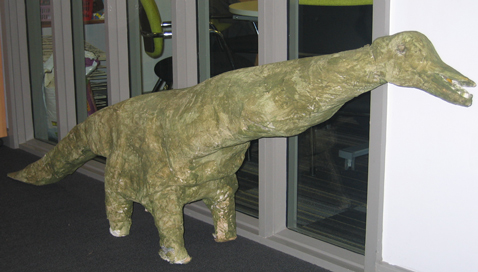
This is the first time a dinosaurs and fossils topic had been introduced at the lower Key Stage 2 level at this school, however, our sharp-eyed photographer spotted a wonderful paper mache sauropod that was lurking in a corridor.  Apparently, this dinosaur had been part of a art project a few years ago.  It was certainly a very striking sculpture.

Diplodocus Inspired Artwork on Display at School

A school's very own version of "Dippy".

A school’s very own version of “Dippy”.

Picture credit: Everything Dinosaur 

We conducted various experiments (hopefully, our experiment with 3PW will demonstrate tomorrow how fossils can form), we were asked some amazing questions by the budding young scientists and we set each class one of our “palaeontologist challenges” as part of the extension activities.

Our dinosaur expert got some lovely feedback from the children.

“I loved learning all about dinosaurs” – AB

“It was fantastic!” – AM

One of the Year 3 teachers told us:

“The children’s reaction to the workshop was fantastic.  They were all engaged and amazed by the facts and the artefacts!”

Volcanoes in the Dance Studio

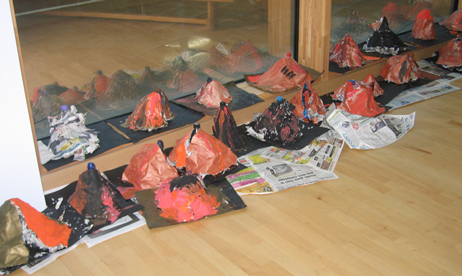
The dance studio, where we set up for the day, was also the place where a number of volcano models that had been built by children at the school were being stored.  We felt very much at home.

Models of Volcanoes Built by School Children

Geology on display in the dance studio.

Geology on display in the dance studio.

Picture credit: Everything Dinosaur

To see the huge range of dinosaur themed toys and gifts available from Everything Dinosaur: Dinosaur Toys and Gifts.

As part of the agreed extension activities, we set up a little bit of work for the children which links into their ICT studies this term.  We can’t wait to see the results.  Perhaps these Birmingham based school children will design their very own dinosaur, could we have a “Brummie-saurus” on our hands?

6 11, 2014

Year 2 Pupils Learn All About Dinosaurs

By |2023-03-17T17:13:16+00:00November 6th, 2014|Categories: Educational Activities, Main Page, Teaching|0 Comments

Dinosaur Workshop at Liverpool Primary School

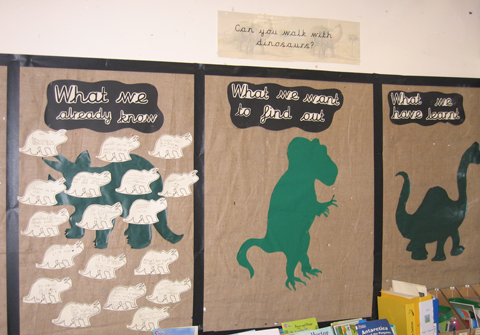
School children at Anfield Infants School enjoyed a visit from Everything Dinosaur this week, as Year two pupils studied dinosaurs and fossils.  The school children had just started their topic and they had lots of amazing questions about prehistoric animals, which we did our best to answer.  The dedicated teaching team had prepared a comprehensive scheme of work and they had posted up a huge K-W-L chart in each of the Year 2 classrooms (high flyers, bright sparks and whizz kids).

Dinosaurs

What fantastic and imaginative names for the classes!

The K-W-L Chart Prepared as Part of the Term Topic

Learning all about dinosaurs and fossils.

Learning all about dinosaurs and fossils. Year 2 pupils learn about dinosaurs.

Picture credit: Everything Dinosaur/Anfield Infants

The K-W-L concept helps teachers to plan a topic and to check learning.  It consists of three areas, firstly, the children brainstorm and say what they think they know about dinosaurs and fossils.  During the brainstorming session, statements might be identified that provide the teacher with information as to what the children would like to find out about prehistoric animals.

The third area highlights what the children have learned at the end of the topic.  This helps reinforce learning and allows the teacher to check understanding.

K-W-L Chart

A different dinosaur denotes each section of the K-W-L chart with the initial brainstorming session indicated by a Triceratops. The second element of the K-W-L chart features a Tyrannosaurus rex, whilst the final section (what the children have learned from the topic), is denoted by a sauropod (long-necked dinosaur).

The Everything Dinosaur team member, as part of the dinosaur workshop, challenged the classes to carry out some extension activities and promised to follow up any questions that the children emailed into the company as part of uniting this topic with their ICT studies.

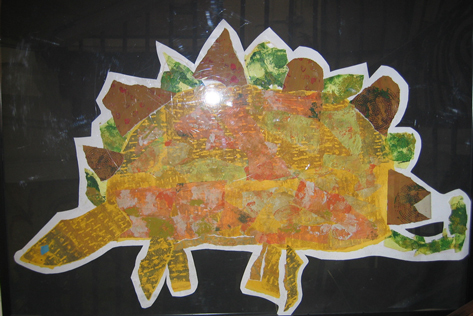
Lots of Prehistoric Animal Inspired Artwork on Display Throughout the School

Stegosaurus inspired artwork.

Stegosaurus inspired artwork.

Picture credit: Everything Dinosaur

To read more about Everything Dinosaur’s huge range of dinosaur toys and gifts: Dinosaur Toys and Gifts.

25 10, 2014

Haverigg Primary School Pupils Study the Stunning Stone Age

By |2024-05-04T18:06:19+01:00October 25th, 2014|Categories: Educational Activities, Teaching|0 Comments

School Pupils Learn All About Mammoths and Woolly Rhinos

Children in Year 3 at Haverigg Primary School were happy to show our dinosaur expert how much they knew about prehistoric animals.  Under the enthusiastic tutelage of the teaching team the children had been studying different parts of human history beginning with the Stone Age.  We were happy to point out how long ago dinosaurs lived before the likes of the Stone Age came along, a simple demonstration using a clapping exercise was a helpful way of illustrating just how deep geological time can be.

With the assistance of some very knowledgeable Year 3 students we explained how fossils form and what types of rock are likely to contain fossils.  In addition, we helped the children gain an appreciation about what fossils can tell us (and perhaps, as importantly), can’t tell us about animals and plants that lived long ago.

Mammoths and Woolly Rhinos

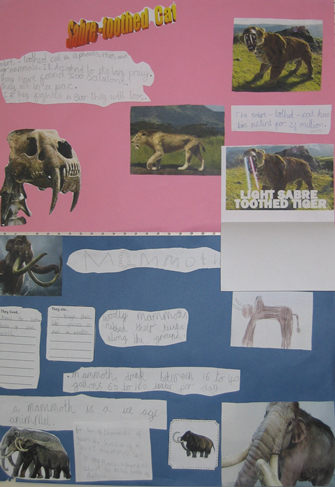
The children had created lots of very well labelled posters.  Each class had been split into teams and given the task of researching and writing about a certain type of prehistoric mammal that might have roamed the land now known as the United Kingdom sometime in the past.

To view the large range of prehistoric mammal models available from Everything Dinosaur: Models of Prehistoric Mammals.

Year 3 Children Research Prehistoric Mammals

All about Ice Age animals.

All about Ice Age animals. Picture credit: Everything Dinosaur.

Picture credit: Everything Dinosaur

Mary Anning

In addition, we discussed the important role of Mary Anning and her contribution to the nascent science of palaeontology.  We set each class a couple of challenges as part of planned extension activities agreed with the teaching team.  The Everything Dinosaur team members are looking forward to seeing the results.

A spokesperson from Everything Dinosaur commented:

“The children loved showing how much they had learned as they studied this topic.  They also enjoyed the fossil workshop immensely and we look forward to hearing how they have progressed with the extension activities we set after teaching about fossils in school.”

17 10, 2014

School Lesson Plan – How do Fossils Form? (Helpful Questions for Key Stage 1/2)

By |2024-05-04T18:31:43+01:00October 17th, 2014|Categories: Educational Activities, Teaching|0 Comments

Celery Experiment Helping to Demonstrate How Fossils are Formed

With rocks and fossils now part of the National Curriculum for science at Key Stage 2 and with many schools running a term topic focused on dinosaurs as part of their scheme of work with Reception and Year 1, our team members have received lots of requests from teachers to help them explain how fossils are formed.  We do cover this subject area in our dinosaur workshops but here is a simple experiment that the children can conduct that demonstrates an important principle in fossilisation.

How Do Fossils Form?

The vascular system of plants can be used to suggest how open spaces in a living organism can become filled with minerals that crystallise out of water seeping through the sediment that the remains have been covered by.  The filling up of the pores and open spaces is known as permineralisation.  This process helps to explain how some types of fossil can be formed.

By studying the movement of coloured water in a stalk of celery the children can observe how liquid is moved around a plant.  An experiment such as this demonstrates that plants have spaces inside them, which allow permineralisation (and replacement for that matter), it also leads in very nicely to the work in the English national curriculum about the structure of plants.

National Curriculum Links (England)

  1. Plants (Year 1, 2, 3)
  2. Living Things and their Habitats (Year 2, 4, 5, 6)
  3. Rocks (Year 3)
  4. Animals including Humans (Year 1-6)

Preliminary

Ask the class what are fossils?  Explore ideas about how fossils form.  Stress that fossils can be formed over very long periods of time and some fossils are formed when the spaces inside an animal or plant that has died gets filled with minerals and slowly over time the remains of the plant or animal turn to stone (petrification).  It is this process, that explains in part how fossils are made.

This experiment will permit the children to see that living matter has spaces inside, it is these spaces that can be filled with minerals as part of the fossilisation process.

What You Will Need – Teaching Resources

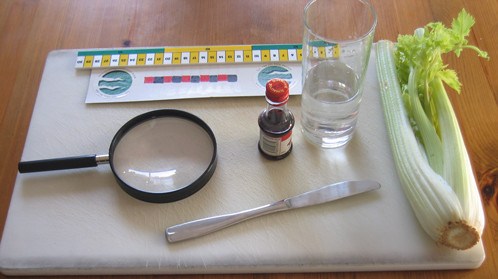
How Fossils Form (Celery Experiment) Resources
s

Resources = plant material (celery recommended), magnifying glass, water, glass, food colouring, chopping utensil, chopping board or surface and a ruler

Picture credit: Everything Dinosaur

Using Celery to Demonstrate Fossil Formation

Resources = celery stalks, glass or clear plastic beaker, a few drops of food colouring (we found red or blue works best), magnifying glasses, a simple chopping tool, a chopping board, ruler and some tap water.

How Fossils Form – The Experiment (Part 1)

  1. Divide the class up into small groups, provide each group with their own set of resources as outlined above.
  2. Have the children carefully chop the top and bottom of their chosen celery stalk(s), if resources allow have them choose stalks with and without leaves.
  3. Using the magnifying glasses, have each group observe what they can see when they study the stalk ends.  The bottom part of the celery stalk should show very clearly evidence of a vascular system.  Record this information.

Examining and Recording What Can Be Observed
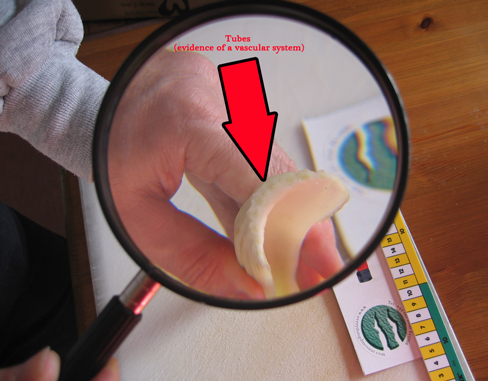
Tubes and other structures can be made out (evidence of a vascular system).

Tubes and other structures can be made out (evidence of a vascular system).

Picture credit: Everything Dinosaur

How Fossils Form – The Experiment (Part 2)

  1. The length of each stalk can be measured (remember to include the length of the leaves on any stalks), these measurements can be recorded.
  2. A quantity of water can then be put into the beaker or glass.  A precise measurement is not needed but it is important to make sure that the bases of all the stalks will be covered.
  3. Carefully, each group puts a couple of drops of the food colouring into the glass or beaker.  Only two to three drops will be needed.  A cap full of food colouring will be sufficient.  The water can be given a quick stir.

Adding the Food Colouring to the Beaker/Glass
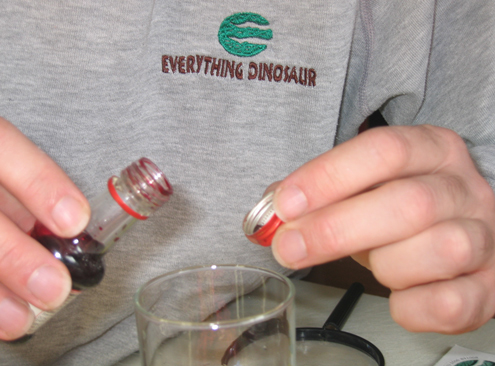
Add a couple of drops of food colouring to each beaker/glass.

Add a couple of drops of food colouring to each beaker/glass.

Picture credit: Everything Dinosaur

Place the celery to be tested in the beaker/glass, record the time when this was done.

Time to Leave Your Fossil Experiment
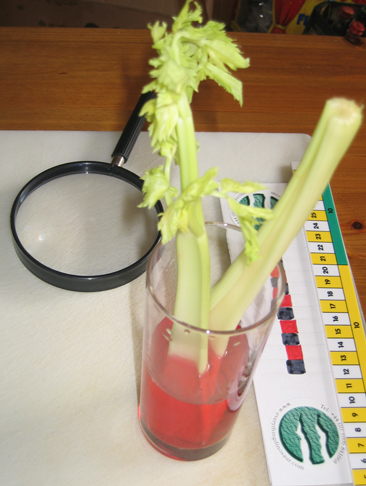
Record the time when the celery was placed in the solution.

Record the time when the celery was placed in the solution.

Picture credit: Everything Dinosaur

It may take several hours, but slowly capillary action will permit the coloured water to move up the plant tissues.  This experiment not only highlights the water transportation system in plants (xylem) but also demonstrates that spaces in living organisms have the potential to be filled by minerals such as calcium carbonate or phosphate that are dissolved in water.   This experiment is demonstrating how living things can become filled with minerals dissolved in water which can lead to petrifaction (means turning to stone), the fossilisation process.

How Fossils Form – The Experiment (Part 3)

  1. Examine the celery leaves and stalks after 4 hours (later on in the school day).  What changes can the children see?   Can they record how far the coloured water has travelled?  What differences can be seen between stalks?

Examine the Celery Stalks after about Four Hours
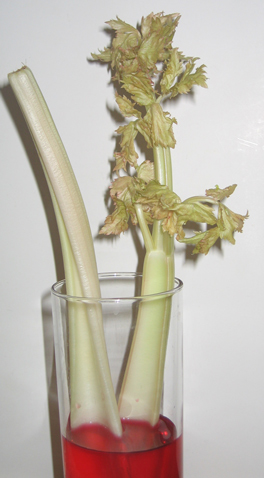
If a camera or Ipad is handy a visual record of the change can be made.

If a camera or Ipad is handy a visual record of the change can be made.

Picture credit: Everything Dinosaur

What differences can the children observe with their fossil formation experiments after a day, two days, a week?  Can the children measure the amount of red colouration they see after each time interval?

After One Day the Fossil Formation Experiment Will Show A Distinctive Colour Change
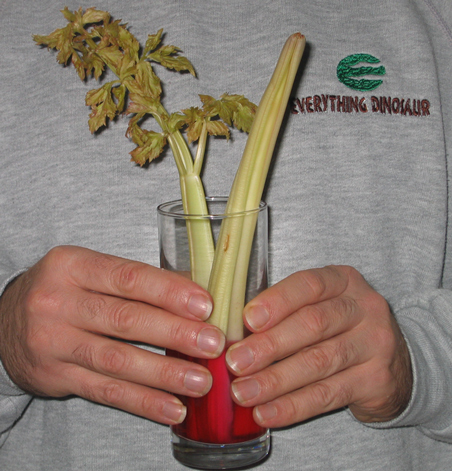
The food colouring in the water will have been transported up the plant.

The food colouring in the water will have been transported up the plant.

Picture credit: Everything Dinosaur

Hard biological materials such as bones, shells and wood contain tiny pores and other spaces (such as the Haversian canals in bones – see close up picture of dinosaur fossil bone provided below).  When buried in sediment, these pores and spaces can be filled up with minerals that crystallise out of the water seeping thorough the layers of sediment.  These extra minerals are permineralising the organism, the start of the process of turning a once living thing into stone has begun.

A Close up View of Fossilised Dinosaur Bone Showing Internal Structure
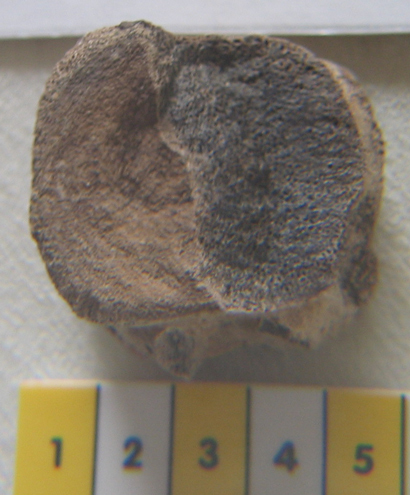
The internal structure of the dinosaur bone can be seen.

The internal structure of the dinosaur bone can be seen.

Picture credit: Everything Dinosaur

The picture above shows the internal structure of a dinosaur tail bone.  Bones just like teeth, shells and even wood contain pores, it is these open spaces that can become permineralised as part of the process of fossilisation.

Extension Ideas

  1. Why was it easier to see the movement of water when the leaves were examined (links to the role of different parts of the plant)?
  2. If the hard parts of organisms like bones and teeth can permineralise and become fossils, what happens to the soft parts such as gums, skin, muscle?
  3. What examples of fossils formed from the soft parts of animals and plants can the children find?  How were these fossils formed?
  4. What other types of fossils can be found?  Think moulds, casts and trace fossils like burrows and footprints.
  5. Record and photograph this experiment and utilise it again when exploring plants, plant transport systems and photosynthesis with older year groups

Extra Notes – Capillary Action

Capillary action, the movement of liquid through tubes takes place because water molecules stay close together (cohesion forces) and because water molecules are attracted to and stick to other substances (adhesion forces).  The adhesion of water to the walls of a narrow vessel such as xylem in a plant stem will cause an upward force on the liquid at the edges where the water and the surface of the tube interact.  This will result in the meniscus turning upward.  Surface tension acts to hold this water at the surface of the tube (the front of the water column) intact.  Capillary action will occur when the adhesion to the walls of the tube is stronger than the cohesive forces between the water molecules.  It is through this capillary action that water is transported around plants.

To view the huge range of educational, prehistoric animal themed items available: Dinosaur Toys, Games and Crafts.

If you need to speed up the experiment, some change in colouration can be seen after two hours or so, especially if a wilted piece of celery with leaves is chosen.

For information on Everything Dinosaur’s fossil and dinosaur themed workshops in schools and other activities: Email EverythingDinosaur.

7 10, 2014

When was Deinonychus Named? That is an Excellent Question!

By |2024-05-04T13:56:39+01:00October 7th, 2014|Categories: Dinosaur Fans, Educational Activities, Everything Dinosaur News and Updates|0 Comments

Providing Information on Deinonychus

Yesterday we were emailed by one young dinosaur fan who asked when was the fearsome dinosaur called Deinonychus named?  Our team members are always happy to help out and we emailed over the information, some Dromaeosauridae themed drawing materials and a fact sheet to assist this budding palaeontologist.

Deinonychus

Barnum Brown, the great American fossil hunter discovered the bones of a fast, agile predatory dinosaur in Wyoming back in 1931.  He named this animal Daptosaurus (D. agilis), the name means “active lizard”.  This was an informal name for the dinosaur, the fossilised bones were never officially described.  It was not until the 1960s when another great American scientist and explorer, John Ostrom, found more bones of this lithe but powerful dinosaur that the story of Deinonychus really begins.  Deinonychus (D. antirrhopus), the name means “terrible claw” due to that sharp, sickle-shaped second toe claw, was formally named in 1969.

An Image of Deinonychus

Fast-running, active, warm-blooded dinosaurs

Fast-running, active, warm-blooded dinosaurs

Picture credit: Everything Dinosaur

An Active Animal

Ostrom speculated that Deinonychus was a very active animal, capable of the sort of movements more akin to a mammal or a bird than to a reptile.  He argued that dinosaurs such as Deinonychus were probably endothermic (warm-blooded). He depicted them as very active creatures, challenging the widely held view at the time of the Dinosauria being slow, cumbersome creatures.  John Ostrom was ahead of his time in this respect.

It is John Ostrom and his assistant Bob Bakker who are widely credited with changing the academic world’s perception of the Dinosauria.  Changing views about the dinosaurs in the 1960s and 1970s were known as the “Dinosaur Renaissance”.

To read a blog post about the “Dinosaur Renaissance”: The Dinosaur Renaissance.

Beasts of the Mesozoic “Raptors”

“Raptor” figures and models have proved to be extremely popular with dinosaur model collectors.  Their popularity is epitomised by the Beasts of the Mesozoic articulated dinosaur model range: Beasts of the Mesozoic Models and Figures.

3 10, 2014

Year 2 Dinosaur Workshop Extension

By |2023-09-03T09:11:04+01:00October 3rd, 2014|Categories: Educational Activities, Everything Dinosaur News and Updates, Teaching|0 Comments

St Joseph and St Bede R.C. Primary make Dinosaur Video

Year 2 under the supervision of their enthusiastic teachers made a comic strip and video presentation after a visit by Everything Dinosaur.  Our team members had conducted a dinosaur workshop with the class back in September and as part of a planned extension activity we had pretended to leave a clutch of dinosaur eggs behind for the schoolchildren to discover and then look after.

Dinosaur Video

The children asked if they could look after the eggs and we agreed.  However, disaster has struck, one of the eggs has hatched and a baby dinosaur has escaped.

St Joseph and St Bede Primary School Children Make a Video

Picture credit: St Joseph and St Bede R.C. Primary School

We think the baby dinosaur is going to be all right.  It was spotted on the school’s CCTV climbing out of a window and heading off out of the school gates to start a “dinosaur adventure”.  We provide lots of extension activities and support to schools when we conduct dinosaur and fossil workshops in schools.

Visit the Everything Dinosaur website: Everything Dinosaur.

Dinosaur Soft Toys

One of the suggestions we have made, is for the dinosaur to be pictured (photoshop comes in very handy), at a number of famous landmarks.  The “Cretaceous critter” can then send the class postcards and emails all about where it has been and what it has done.  The children can plot the dinosaur’s travels on a map (great for helping with geography lessons).  They can also write back to the dinosaur, which in itself is a great lesson plan for a creative writing session.

Where has our Baby Dinosaur Got To?

Dinosaur adventure!
Dinosaur adventure!

Picture credit: Everything Dinosaur

Congratulations to the school children and the teaching team for making such a super video.

Everything Dinosaur team members used a soft toy dinosaur to help develop this lesson plan, to view the range of dinosaur soft toys available at Everything Dinosaur: Dinosaur Soft Toys.

28 09, 2014

Positive Feedback from Foundation Class after Special Dinosaur Workshop

By |2024-05-04T13:59:22+01:00September 28th, 2014|Categories: Educational Activities, Everything Dinosaur News and Updates, Teaching|0 Comments

Five Stars for Everything Dinosaur (sort of)

At Everything Dinosaur we encourage teachers to provide our team members with feedback over our visits to schools to teach about dinosaurs.  We conduct dinosaur and fossil workshops from children within the EYFS (Early Years Foundation Stages) right up to students at Key Stage 4.  We are keen to develop our work in schools and museums and we are very grateful for all the feedback that we receive.  Whilst it would be great if teachers could leave feedback and comments on our dedicated teaching website, we do have a section dedicated to this, we do appreciate that sometimes teaching professionals find themselves so busy that this is not always possible.

Everything Dinosaur

To view Everything Dinosaur’s dedicated prehistoric animal toys and gifts website: Visit Everything Dinosaur.

To help overcome this we always carry feedback forms with us when we visit schools, colleges and other institutions.  Being able to provide instant feedback is a great benefit to the teachers, teaching assistants and learning support team members that we work with.

Following our visit to Kensington Primary School to work with Foundation Stage children, we got lots of very positive feedback from the teaching team.  This feedback has already been posted up on our dedicated teaching website, but we thought it would be helpful if we posted up one of the forms from a class teacher here.

Foundation Stage Teacher Praises Everything Dinosaur

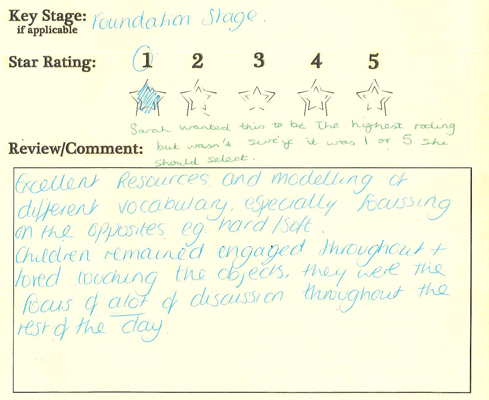
5 Stars for Everything Dinosaur.

5 stars for Everything Dinosaur.

Picture credit: Kensington Primary School

 Feedback

We note that our “star rating” system was perhaps a little confusing but the comments are greatly appreciated.

The Foundation Stage teacher commented:

“Excellent resources and modelling of different vocabulary, especially focusing on opposites eg. hard/soft.  Children remained engaged throughout and loved touching the objects.  They were the focus of a lot of discussion throughout the rest of the day.”

Our dinosaur expert talked through a couple of extension activities with the teaching team and we look forward to hearing how the term topic develops.

26 09, 2014

Year 1 Explore Exciting Dinosaurs

By |2024-05-04T13:55:38+01:00September 26th, 2014|Categories: Educational Activities, Everything Dinosaur News and Updates, Teaching|0 Comments

Exploring Dinosaurs and Learning How to Eat Like a Diplodocus

Another busy day yesterday for Everything Dinosaur with a visit to Altrincham Preparatory School to work with Year 1.  The children, under the enthusiastic tutelage of their teachers Mrs Bacon and Mrs Eyley had been studying dinosaurs and fossils and a visit from our dinosaur expert helped to reinforce learning.  One of the pupils in the class heralds from Canada, so it was apt to explore the rib bones of an Edmontosaurus (named after the capital of the Canadian province of Alberta).  One of the children in 1E was born in Argentina, so we promised to send out some information on Argentinosaurus, a huge titanosaur, as part of the extension resources.

Exploring Dinosaurs

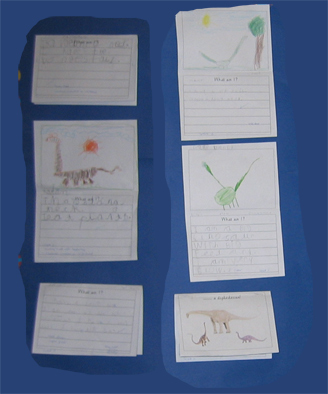
The children had been busy writing about Diplodocus and our expert was able to see some of the excellent examples of hand-writing, vocabulary use and sentence construction that was on display.

Year 1 Pupils Write About Diplodocus

A "What I am" writing exercise with Diplodocus.

A “what I am?” writing exercise with Diplodocus.

Picture credit: Altrincham Preparatory School/Everything Dinosaur

Everything Dinosaur

As part of the experiments we conducted, we showed how sauropod dinosaurs like Diplodocus fed and then we looked at some fossilised plants and compared them to living ferns.

To read more about Everything Dinosaur’s school visit: Children Prepare Questions About Dinosaurs.

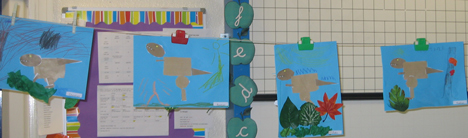
There was also some wonderful artwork on display in the classrooms of 1B and 1E, the children were keen to demonstrate their knowledge and one young dinosaur fan even brought in a model of a Baryonyx.

Piecing Together a Carnivorous Dinosaur

Meat-eating dinosaurs inspire artwork.

Meat-eating dinosaurs inspire artwork.

Picture credit: Altrincham Preparatory School/Everything Dinosaur

The children and the teaching team really enjoyed the morning and it was great to see so many dinosaur themed examples of work posted up around the classrooms.  We even met one little boy called Owen, so we sent over some information on the anatomist Sir Richard Owen who was responsible for naming the group of animals we know as the Dinosauria.

To read more about Everything Dinosaur’s huge product range: Visit Everything Dinosaur.

25 09, 2014

New Research Suggests Multicellular Life Started Earlier

By |2023-03-16T15:56:05+00:00September 25th, 2014|Categories: Dinosaur and Prehistoric Animal News Stories, Educational Activities, Main Page, Palaeontological articles|0 Comments

Evidence Suggests Multicellular Life 60 Million Years Earlier than Previously Thought

Researchers from the Virginia Tech College of Science in collaboration with counterparts from the Chinese Academy of Sciences have published new data on one of the most fundamental and significant changes that occurred in the history of life on our planet.  At some time during the Proterozoic Eon, multicellular life forms evolved.  These organisms evolved from single-celled entities and in a paper published in the academic journal “Nature”, the researchers propose that multicellular life forms evolved some sixty million years earlier than previously thought.

Multicellular Life

The team suggest that they have found fossil evidence of complex multicellularity in strata dating from around 600 million years ago, although microscopic fossils are known in Precambrian strata from several locations around the world (Australia, South Africa as well as China), this new research is helping to clarify some long-standing interpretations of micro-fossils.

Professor of Geobiology at the Virginia Tech College of Science, Shuhai Xiao explained the significance of this new fossil discovery:

“This opens up a new door for us to shine some light on the timing and evolutionary steps that were taken by multicellular organisms that would eventually go on to dominate the Earth in a very visible way.  Fossils similar to the ones in this study have been interpreted previously as bacteria, single-cell eukaryotes, algae and transitional forms related to modern animals such as sponges, sea anemones, or bilaterally symmetrical animals.  This paper lets us put aside some of those interpretations.”

The Origins of Complex Life

It has long been known that simple, multicellular organisms evolved before more complex ones, such as red algae and sponges.  If a biological hierarchy existed (and most scientists believe that this is the case), then at some point in the past, single-celled organisms began to evolve into much larger, more complicated multicellular organisms.  The trouble is, with the paucity of the fossil record and the difficulties involved in interpreting Ediacaran fauna there is a lot of debate amongst biologists and palaeontologists as to when the solo living cells began to fuse into more cohesive, complex forms.

Evidence of Complex Multicellular Organisms from the Doushantuo Formation

Evidence of multicellular structures in 600 million year old rocks.

Evidence of multicellular structures in 600-million-year-old rocks.

Picture credit: Virginia Tech College of Science

The researchers examined microscopic samples of phosphorite rocks from the Doushantuo Formation in Guizhou Province (south, central China).  This formation represents extensive marine sediments that were deposited from around 635 million years ago to around 550 million years ago.  They preserve a unique record of microscopic life (Metazoan life – animals) that existed during the Ediacaran geological period, the period in Earth’s history defined as immediately before the Cambrian and that marks the end of the Precambrian or the Proterozoic Eon.

What is an Eukaryote?

The scientists were able to identify a number of three-dimensional multicellular fossils that show signs of cell-to-cell adhesion, cells potentially performing different functions and programmed cell death.  These qualities are all found in complex eukaryotes, the organisms that dominate visible life on Earth to day, the fungi, animals and plants.  Eukaryotes range in size from single-celled amoebas to giant sequoias and blue whales.  We (H. sapiens) belong to the Domain Eukarya.   Eukaryote cells are complex, they have a distinct nucleus surrounded by a membrane.  The nucleus contains most of the genetic material.  The nucleus itself is a specialised area of the cell, it is referred to as an organelle.  Eukaryote cells have a number of specialised areas within them (other organelles as well as a nucleus).

Professor Xiao and his colleagues admit that these are not the first multicellular fossils found, nor are they probably the oldest, but the exceptional preservation permits the researchers to draw certain conclusions.  For example, it had been previously thought that these multicellular characteristics had started to develop much later in Earth’s history, perhaps as recently as 545 million years ago, a time shortly before the great Cambrian explosion.

What was the Cambrian Explosion?

The Cambrian explosion refers to the period in Earth’s history around 545 to 542 million years ago when there was a sudden burst of evolution as recorded by extensive fossil discoveries.  A wide variety of organisms, especially those with hard, mineralised body parts first appear.

This new research may help to shed some light on when multicellularity arose, but the reasons for this significant change remain unclear.  The complex multicellularity shown in these Chinese fossils is not consistent with that seen in simpler forms such as bacteria.  The scientists note, that whilst some earlier theories can be disregarded these three-dimensional structures can be interpreted in many ways and more research is required to construct the complete life cycle of these ancient organisms.

In summary, these fossils may show some affinity towards the stem-groups that led to the first members of the Kingdoms we know as Animalia, Fungi and Plantae, but much more data is needed to establish a more thorough phylogenetic relationship.

24 09, 2014

Feedback after Working with EYFS (Reception)

By |2023-03-16T15:12:20+00:00September 24th, 2014|Categories: Educational Activities, Teaching|0 Comments

A Tactile Dinosaur Themed Session Helping to Develop Vocabulary

Everything Dinosaur’s team members are busy with the teaching and other outreach commitments as the autumn term progresses.  Yesterday, Everything Dinosaur was working with a primary school in Merseyside, the aim being to help with the term topic (dinosaurs) by providing an interactive and tactile dinosaur and fossil themed workshop.

Dinosaur Workshop

Could we answer the question of the day – Were some dinosaurs huge?

One of the objectives that was set in the short briefing with the teaching team prior to the first session was to focus on helping to develop vocabulary and to give the children the opportunity to develop a wider range of describing words.

Feedback form from Reception Teacher

Feedback from Primary School (EYFS).

Feedback from Primary School (EYFS).  Feedback about Everything Dinosaur.

Picture credit: Everything Dinosaur

Working with children, some of whom do not have English as a first language and who have only just started school, can be quite a challenge.  However, guided by their enthusiastic teachers the children had been undertaking all sorts of exciting exercises and activities to do with dinosaurs and other prehistoric animals.  It seems from the feedback received that Everything Dinosaur had indeed, achieved the learning objectives.

We suggested a couple of extension activities as a follow up to some of the work undertaken in the actual dinosaur themed workshop and we look forward to hearing how the children fared as they explore all things dinosaur!

To learn more about Everything Dinosaur’s dinosaur and prehistoric animal toys and games: Everything Dinosaur’s Toys and Gifts.

Go to Top