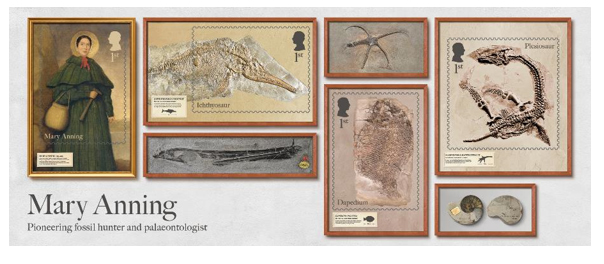
Royal Mail intend to introduce a set of Mary Anning stamps. The set of four stamps feature a portrait of the pioneering palaeontologist and three fossil finds. The stamps have been launched at the same time as a set of prehistoric animal stamps.
The Royal Mail Mary Anning stamps can be purchased individually or as a special presentation set for collectors.
Four Royal Mail stamps produced in collaboration with the Natural History Museum of London commemorate the contribution to the nascent science of palaeontology made by the amateur fossil collector Mary Anning (1799-1847). Picture credit: Royal Mail.
Ichthyosaurus communis and Other Significant Fossils
One of the stamps illustrating fossil discoveries features Ichthyosaurus communis. This was the first species within the Ichthyosaurus genus to be erected (De la Beche and Conybeare, 1822).
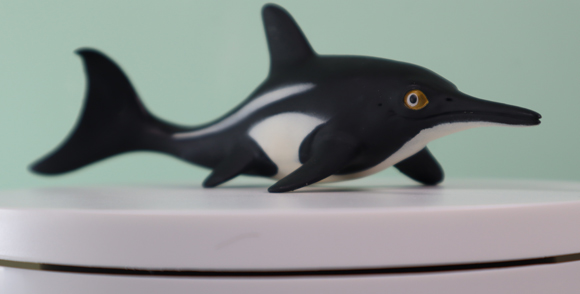
The Ichthyosaurus model (Wild Safari Prehistoric World) ready to take its turn on the Everything Dinosaur turntable. Picture credit: Everything Dinosaur.
Picture credit: Everything Dinosaur
The image (above) shows a typical replica of an ichthyosaur. This marine reptile was a sleek and agile predator with a body shape similar to that of extant dolphins. The dolphin/ichthyosaur body morphology is often cited as an example of convergent evolution.
The model is from the Wild Safari Prehistoric World range.
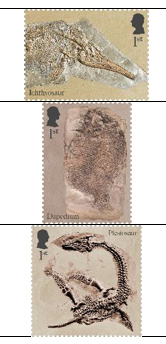
The stamps feature three prehistoric animals connected to Mary Anning. Ichthyosaurus communis (top) a complete fossilised juvenile, purchased from Mary Anning circa 1835. Dapedium politum a species of ray-finned fish (Actinopterygii) collected by Mary Anning circa 1829 (middle). Plesiosaurus macrocephalus (bottom), a near-complete, articulated juvenile collected by Mary Anning in 1830.
The stamps feature three prehistoric animals connected to Mary Anning. Picture credit: Royal Mail.
A Portrait of Mary Anning
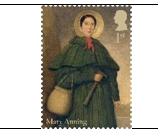
The set of stamps also includes a portrait of Mary Anning. The date of the painting remains unknown, but it has been suggested that it was painted before 1842. It is housed at the Natural History Museum (London). Unfortunately, the name of the artist who created this portrait of Mary in her best clothes was not recorded.
A portrait of Mary Anning. Picture credit: Royal Mail.
A spokesperson from Everything Dinosaur commented:
“It is wonderful to see Royal Mail recognising the contribution to palaeontology and geology by Mary Anning. We hope these beautiful Mary Anning stamps and the presentation set will spark an interest in the Earth sciences.”
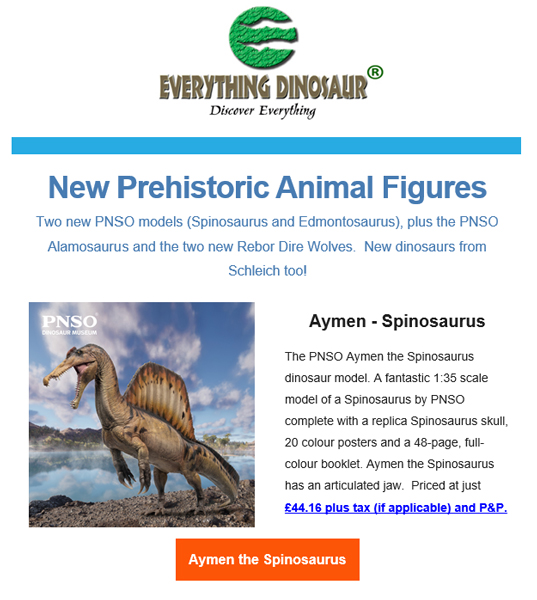
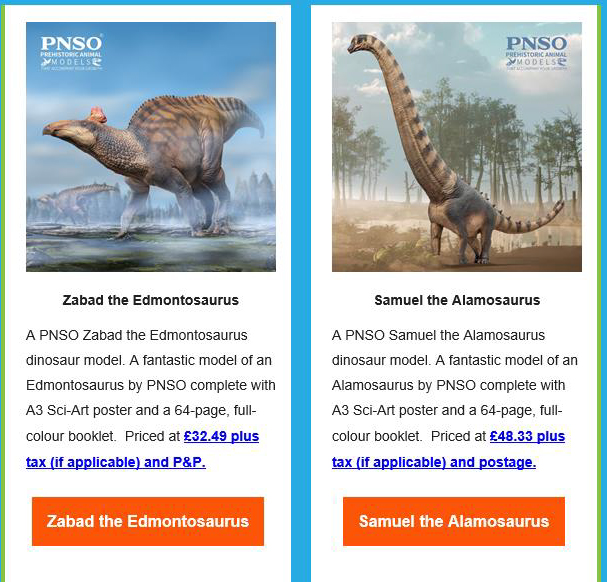
New PNSO dinosaur models along with two new Rebor dire wolf figures feature in the latest Everything Dinosaur newsletter. Joining these prehistoric animal models are two new for 2024, Schleich dinosaurs. The newsletter features, Aymen the Spinosaurus and Zabad the Edmontosaurus. In addition, the PNSO Alamosaurus model (Samuel) is highlighted.
The Everything Dinosaur March newsletter features the PNSO Aymen the Spinosaurus model. Picture credit: Everything Dinosaur.
Picture credit: Everything Dinosaur
Aymen the Spinosaurus (PNSO)
Making the newsletter headlines is the new PNSO Aymen the Spinosaurus figure. Zabad the Edmontosaurus was also in the latest PNSO delivery. This Edmontosaurus model has been praised as it has an accurate manus (hand) complete with a hoof-like toe. Fresh stock of the popular PNSO Alamosaurus figure has also arrived. Both models are included in the newsletter promotion.
The beautiful Zabad the Edmontosaurus is included in the latest newsletter along with the impressive and extremely large Samuel the Alamosaurus figure. Picture credit: Everything Dinosaur.
Picture credit: Everything Dinosaur
To view the wide range of PNSO prehistoric animal figures available from Everything Dinosaur: PNSO Age of Dinosaurs.
Rebor Dire Wolf Figures
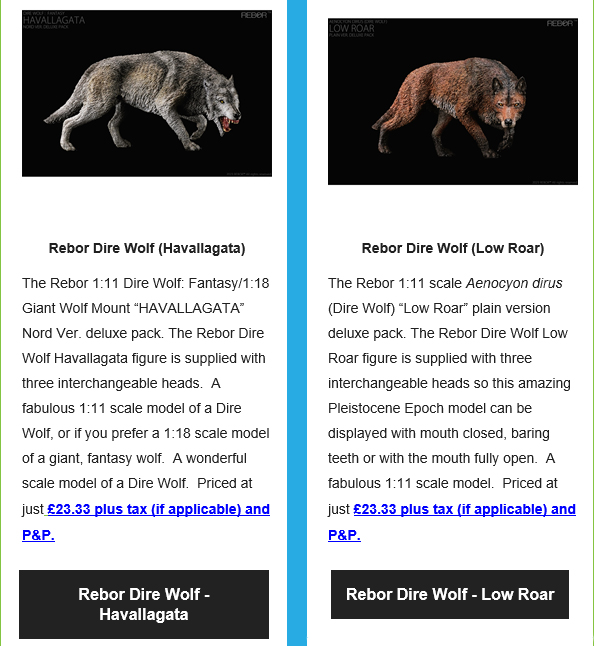
The latest Everything Dinosaur newsletter also includes details on the two Rebor dire wolf figures “Havallagata” and “Low Roar”. These magnificent models of a Pleistocene predator have just arrived at Everything Dinosaur’s warehouse.
Two, recently introduced Rebor dire wolf figures feature. The “Havallagata” version (left) and the Rebor dire wolf “Low Roar” (right). Picture credit: Everything Dinosaur.
Schleich Dinosaurs in the Everything Dinosaur Newsletter
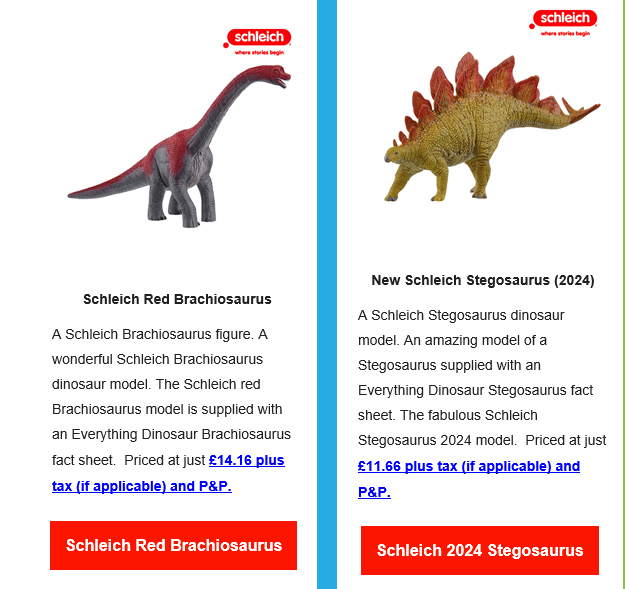
The two most colourful figures to feature in the Everything Dinosaur newsletter are the two Schleich figures. Both the red Brachiosaurus and the new for 2024 Schleich Stegosaurus have been painted in attractive, vibrant colours.
To view the range of Schleich dinosaurs available from Everything Dinosaur: Schleich Dinosaur Models.
The Everything Dinosaur customer newsletter includes information on the two recently arrived Schleich dinosaur models (Red Brachiosaurus and the new for 2024 Schleich Stegosaurus model). Picture credit: Everything Dinosaur.
Picture credit: Everything Dinosaur
A spokesperson welcomed the arrival of these new figures and commented:
“Our company newsletter helps to keep customers informed about new prehistoric animal models coming into stock.”
At Everything Dinosaur, we receive quite a lot of emails from customers and fans of prehistoric animals. Many of these emails are requests asking for more information about prehistoric animal figures. However, customers also contact us wanting help with answering a specific query about extinct creatures and life in the past. For example, we were recently asked what animals alive today are the closest relative of the eurypterids?
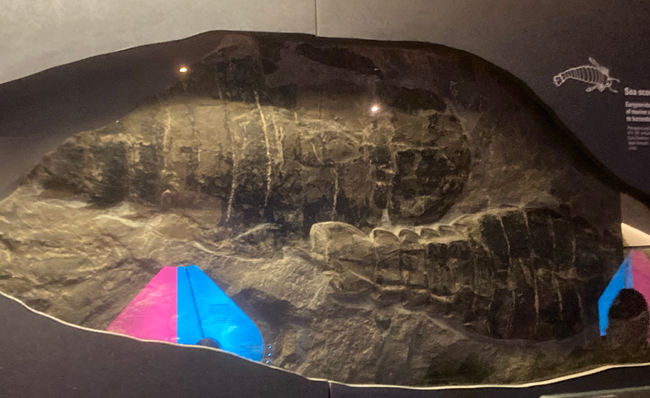
A pair of eurypterid fossil specimens on display at the London Natural History Museum. Picture credit: Everything Dinosaur.
Picture credit: Everything Dinosaur
Answering a Question About Eurypterids
Eurypterids were members of the Arthropoda phylum. Specifically, they are part of the Subphylum Chelicerata (pronounced kel-iss-ser-rat-ah), which also contains the spiders, mites, scorpions and horseshoe crabs. These animals have a pair of jointed appendages that are located in front of their mouths (chelicerae – kel-iss-ser-ray). For most, they are modest feeding appendages such as seen in horseshoe crabs. In the spiders these chelicerae form venom injecting fangs. In some eurypterids such as the Pterygotidae, these appendages evolved into giant pincers designed for grabbing prey.
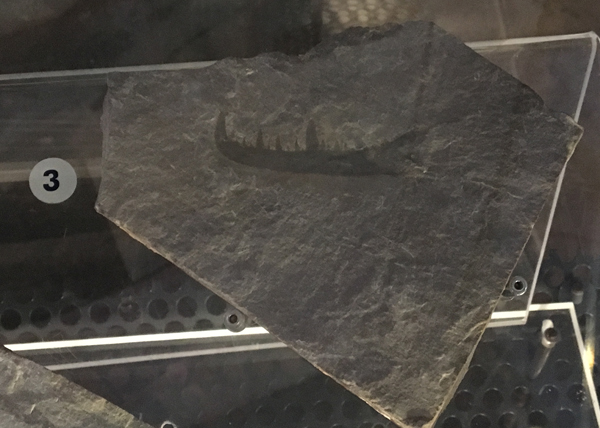
A stunning fossil of a sea scorpion (eurypterid) claw housed at the National Museum Cardiff (Wales) photographed in 2019 when team members at Everything Dinosaur visited. Picture credit: Everything Dinosaur.
Picture credit: Everything Dinosaur
Scorpiones or Xiphosurans?
Scientists remain uncertain as to whether extant scorpions or xiphosurans such as the horseshoe crab are the closest living relatives to the extinct eurypterids. Scorpions share a similar body plan, although scorpions are entirely terrestrial. Xiphosurans share the aquatic habit and also have an anatomy that is similar to the “sea scorpions” in some respects. Eurypterid feeding was probably more similar to that of xiphosurans.
The question of phylogeny remains unresolved. The lack of soft tissue preservation in “sea scorpions” and the flattened nature of most eurypterid fossils have hampered research. The absence of a clear eurypterid analogue from living chelicerates may indicate that the eurypterids occupied an ecological niche that was intermediate between xiphosurans and the Order Scorpiones.
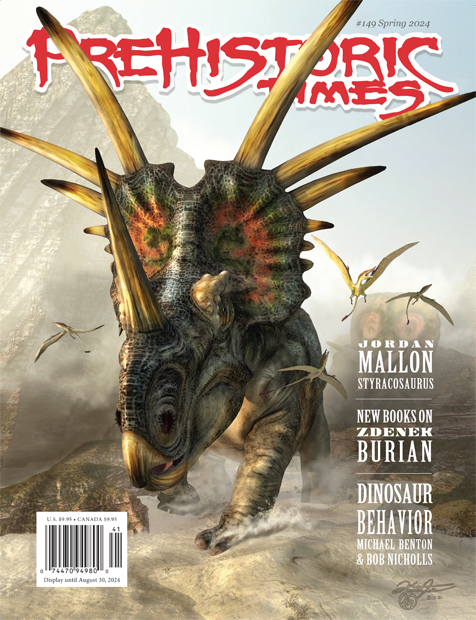
Our thanks to editor Mike Fredericks who sent to Everything Dinosaur the artwork for the next edition of “Prehistoric Times” magazine. This quarterly magazine is famed for its beautiful cover art. Many noteworthy palaeoartists have contributed over the years. The front cover artwork for issue 149 is no exception. The illustration featuring Styracosaurus albertensis is stunning!
We look forward to reading about the artist behind this remarkable image when issue 149 arrives.
The front cover artwork for “Prehistoric Times” issue 149 (Spring 2024).
Picture credit: Mike Fredericks
“Prehistoric Times” Magazine
The spring issue (149) will feature an in-depth interview with palaeontologist Jordan Mallon. Dr Mallon is based at the Canadian Museum of Nature (Ottawa, Canada). He specialises in studying dinosaur ecology and has been involved in the naming and scientific description of several fossil species, including a horned dinosaur – Spiclypeus shipporum. Although both members of the Ceratopsia clade and contemporary, Styracosaurus and Spiclypeus were not closely related. The centrosaurine Styracosaurus albertensis is known from the Dinosaur Provincial Park Formation of Alberta, (Canada). In contrast, the chasmosaurine Spiclypeus shipporum is known from the Judith River Formation of Montana (United States).
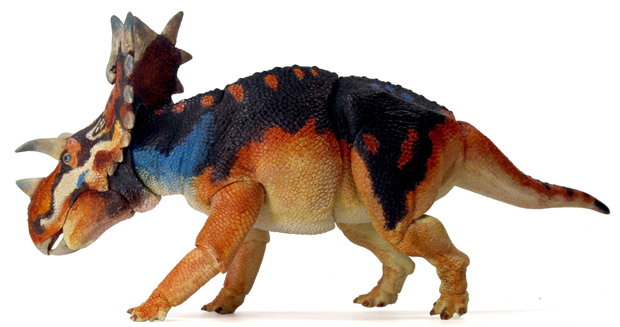
A replica of the horned dinosaur named by Mallon et al (2016). The Beasts of the Mesozoic Spiclypeus shipporum in lateral view.
The model (above) is the articulated Spiclypeus shipporum in the Beasts of the Mesozoic series.
The other prehistoric animal to be featured in the spring edition is the pterosaur Tapejara. Readers can expect a comprehensive profile of this Early Cretaceous flying reptile. Tapejara is famed for its huge head crest. We are looking forward to viewing all the reader submitted artwork illustrating this spectacular member of the Pterosauria.
In addition, details will be provided of new books chronicling the life and work of the influential Czech artist Zdeněk Burian. Issue 149 will also feature the latest instalment of the excellent series penned by Jon Lavas discussing the artwork of Burian. Jon contacted us to let us know that the next instalment covers South American ungulates but Burian did not actually do any formal paintings of these. Instead, Jon has used some of his own illustrations for the article. However, Burian’s artwork will continue in issue 150.
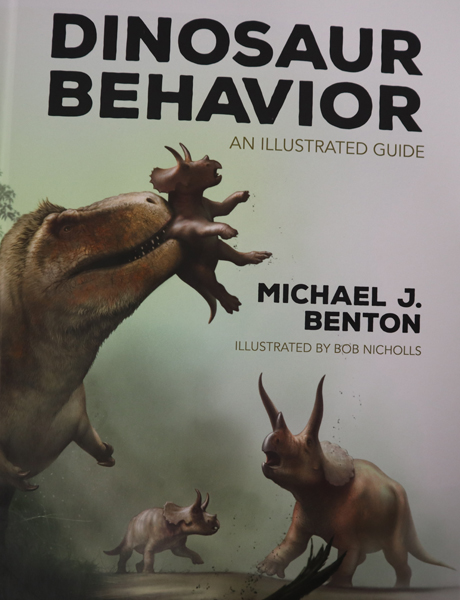
The work of English palaeoartist Bob Nicholls is also featured. Bob illustrated the wonderful “Dinosaur Behavior” which was launched late last year. This excellent dinosaur book was written by Professor Mike Benton (University of Bristol). Published by Princeton University Press “Dinosaur Behavior” is a beautifully illustrated and highly informative guide to the Dinosauria.
The front cover of the recently launched dinosaur book “Dinosaur Behavior” by Professor Michael J. Benton and illustrated by Bob Nicholls. It will feature in issue 149 of “Prehistoric Times” magazine. Picture credit: Everything Dinosaur.
Picture credit: Everything Dinosaur
The Spring Issue of “Prehistoric Times” Coming Soon
A spokesperson from Everything Dinosaur explained that they were looking forward to reading the next edition of “Prehistoric Times”.
The spokesperson added:
“This magazine is an institution! It contains well-written articles featuring leading academics and scientists along with fabulous profiles of prehistoric animals and updates on fossil discoveries as well as model collecting. The artwork submitted by readers is amazing!”
The prosauropods were popularised by the German palaeontologist Friederich von Huene in response to his work studying the extensive Plateosaurus fossil finds discovered in a clay quarry at Trossingen (Baden-Württemberg, Germany). Much of our understanding of the Prosauropoda has been informed through study of Plateosaurus fossil material.
Once thought to be facultative bipeds. These dinosaurs would normally walk on all fours, but if they so desired they could adopt a bipedal stance. Detailed analysis of the manus and forelimbs demonstrated that the hands could not be rotated to set the palms on the ground. The lack of an ability to pronate the hand suggests that Plateosaurus and its close relatives were bipeds.
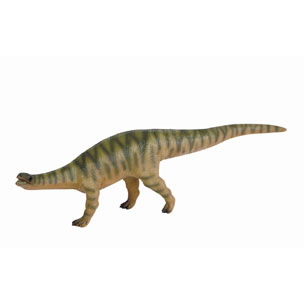
“Flat Lizard” replica. The Bullyland Plateosaurus model.
The picture (above) shows the now retired Bullyland Plateosaurus model. Plateosaurus is depicted as a quadruped, however, studies have shown that since this dinosaur could not pronate its wrists (turn the hand so that the palm could be placed on the ground), it probably was bipedal. Ironically, Bullyland’s original Plateosaurus figure was depicted rearing up onto its hind legs. The quadruped Bullyland Plateosaurus model was probably inspired by a Plateosaurus diorama at the Naturkundemuseum Stuttgart, Germany. The Plateosaurus models in the diorama are portrayed as quadrupeds. Bullyland’s range of prehistoric animal figures has been developed in partnership with the Naturkundemuseum Stuttgart.
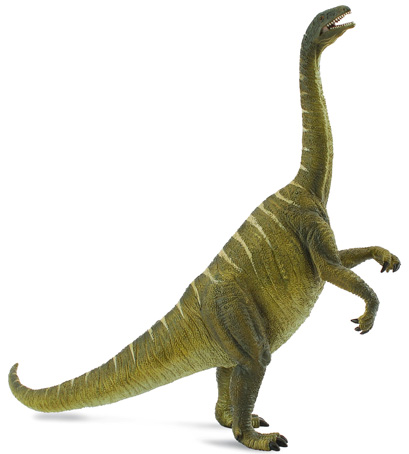
A rearing Plateosaurus model from the CollectA Age of Dinosaurs series.
The picture (above) shows the CollectA Age of Dinosaurs Plateosaurus replica. This model was first introduced into the not-to-scale CollectA Prehistoric Life model range in 2011. It is widely thought to be a more accurate representation of the Plateosaurus genus than the Bullyland figure.
Huene, based on his studies of the Trossingen fossils, proposed that the Plateosaurus taxon was closely related to the Sauropoda. He erected the Sauropodomorpha clade. He proposed that this clade consisted of all the sauropods and their closest ancestors. Huene suggested the Prosauropoda, which means “before the sauropods”, be established which would include Plateosaurus and its close relatives.
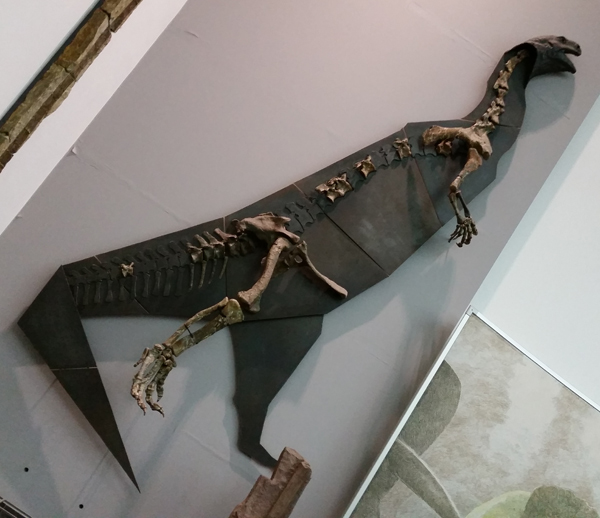
A specimen of a Plateosaurus with fossil material mounted in life position. This is part of a display at the Senckenberg Nature Museum (Frankfurt, Germany). Picture credit: Everything Dinosaur.
Picture credit: Everything Dinosaur
Prosauropod Term Replaced by Non-sauropod Sauropodomorph
Gigantism in the Sauropodomorpha has been associated with the development of a fully quadrupedal stance. The grasping hands were lost as body size increased. Sauropods evolved column-like eggs to help support their increased bodyweight. This was thought to have occurred in the Early Jurassic. However, the discovery of massive Triassic sauropodomorphs such as Lessemsaurus and Ingentia prima demonstrates that sauropodomorph gigantism predates the Triassic-Jurassic boundary. The transition from being probable omnivores to a fully herbivorous diet occurred during the Late Triassic in some sauropodomorph lineages.
Basal sauropodomorphs are, generally, considered smaller-bodied and defined by their obligatory bipedalism. Facultative to habitual quadrupedality appears to have evolved by the Late Triassic. The paucity of the fossil record inhibits our understanding of the ancestry of the Sauropodomorpha.
Prosauropod as a scientific term has fallen out of favour. Definitions of prosauropods as having five digits on the manus with three claws and the concept of facultative bipedalism have largely become redundant. The idea that prosauropods are the direct ancestor of the sauropods has been discounted by many palaeontologists. Most modern phylogenetic studies break the Prosauropoda up into several families with shared anatomical traits that evolved separately and may represent a gradual transition to the generally larger, fully quadrupedal and herbivorous sauropodomorphs. Instead, the term non-sauropod sauropodomorph has taken precedence.
Cladistic and phylogenetic analysis have demonstrated that the taxa within the Prosauropoda corresponds to the Plateosauridae family as both contain the same genera.
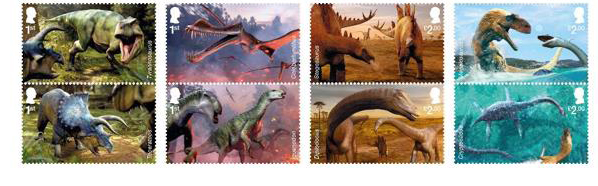
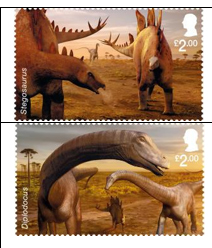
A beautiful set of Royal Mail prehistoric animal stamps is being introduced. The main set will feature prehistoric animals including Tyrannosaurus, Triceratops and Stegosaurus. A second set of stamps is also going on sale commemorating the life and works of Mary Anning.
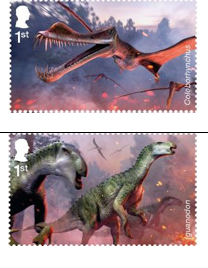
The eight main stamps feature beautiful illustrations of prehistoric animals by the Exeter-based digital concept illustrator Joshua Dunlop. Six dinosaurs are featured along with a pterosaur (Coloborhynchus) and a plesiosaur (Cryptoclidus). Picture credit: Royal Mail.
Celebrating Two Hundred Years Since the Formal Description of Megalosaurus
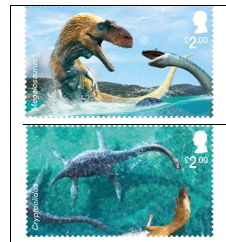
2024 marks the two hundredth anniversary of the formal, scientific description of a prehistoric animal that was later to be classified as a dinosaur. The theropod dinosaur Megalosaurus was named and described in 1824 by the Reverend William Buckland who was president of the Geological Society of London. The binomial species name Megalosaurus bucklandii was erected in 1827. This was the first scientific account in the western world of a dinosaur. Megalosaurus features on a pair of stamps along with the roughly contemporaneous marine reptile Cryptoclidus.
The fourth pair of stamps feature a Megalosaurus encountering a plesiosaur (Cryptoclidus) whilst wading through shallow water. Picture credit: Royal Mail.
Megalosaurus was for a long time a taxonomic waste basket. Theropod fossils from different strata were assigned to this taxon. The only definitive Megalosaurus remains come from Oxfordshire (England).
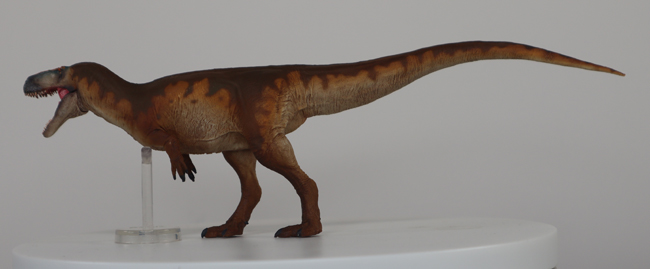
A model of Megalosaurus bucklandii. The new for 2023 PNSO Megalosaurus dinosaur model. Picture credit: Everything Dinosaur.
Picture credit: Everything Dinosaur
The picture (above) shows a model of Megalosaurus bucklandii from PNSO.
The eight prehistoric animal stamps were created by Joshua Dunlop, a digital concept artist based in Exeter (Devon). A second set of stamps features a portrait of the pioneering fossil collector Mary Anning. In addition, three stamps have been created that show photographs of fossils associated with Mary Anning and the Lower Jurassic rocks of Lyme Regis.
The list of dinosaurs featured:
Tyrannosaurus
Triceratops
Stegosaurus
Diplodocus
Iguanodon
Megalosaurus
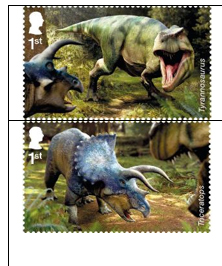
Triceratops and Tyrannosaurus feature on the new for 2024 Royal Mail prehistoric animal stamps. Only the genus name for Tyrannosaurus is given on the stamps and in the accompanying Royal Mail press release. We suspect that this is an illustration of Tyrannosaurus rex. Picture credit: Royal Mail.
In Collaboration with the London Natural History Museum
The Royal Mail prehistoric animal stamps were created in collaboration with the London Natural History Museum.
Diplodocus and Stegosaurus feature on the Royal Mail £2 stamps. These animals are known from the Upper Jurassic Morrison Formation of the United States. Picture credit: Royal Mail.
North American dinosaurs are featured (Tyrannosaurus, Triceratops, Stegosaurus and Diplodocus). Prehistoric animals known from fossil discoveries from southern England are also included. Each pair of stamps show a similar image but from a different prehistoric animal’s perspective. For example, one pair of stamps depicts a herd of Iguanodon escaping a forest fire whilst a flock of startled pterosaurs (Coloborhynchus) fly overhead.
One of the largest toothed pterosaurs known to science is featured on a stamp (Coloborhynchus). It accompanies an Iguanodon stamp. Both these prehistoric animals are known from the Lower Cretaceous of England. Picture credit: Royal Mail.
Everything Dinosaur Comments
A spokesperson from Everything Dinosaur commented:
“These are beautiful stamps. The eight prehistoric animal stamps show four different scenes, and they are designed to be viewed as pairs. For instance, the Tyrannosaurus stamp shows this theropod attacking a Triceratops. In contrast, the Triceratops stamp shows the horned dinosaur fending off a lunge from the Tyrannosaurus.”
Recently, Everything Dinosaur team members wrote a blog post summarising the findings of the latest scientific paper on Spinosaurus aegyptiacus. This paper (Myhrvold et al), outlined some drawbacks in using bone density analysis to infer an extinct animal’s habits and lifestyle. They outlined some errors and omissions in a previous study that concluded Spinosaurus and Baryonyx walkeri, were capable of submerging and hunting underwater.
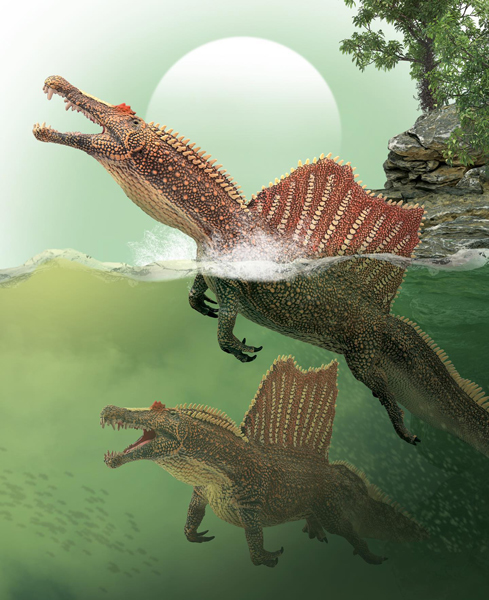
The CollectA Deluxe Spinosaurus dinosaur model. A recently introduced (2022) updated replica of the giant, North African theropod Spinosaurus.This paper (Fabbri et al), postulated that dense bones associated with this dinosaur were adaptations to help this animal dive and to stay underwater.
An Extensively Studied Theropod
Named and described in 1915 (Stromer), Spinosaurus aegyptiacus has been the subject of intense research over the last decade. It was perhaps the longest theropod dinosaur of all. Some palaeontologists have estimated that S. aegyptiacus was up to fifteen metres long. Its mode of hunting and behaviour has come under detailed scrutiny since a detailed description, based on new fossil material was published in 2014.
This paper proposed that Spinosaurus was a semi-aquatic, obligate quadruped.
Very much at home in the water according to the 2014 study. Picture credit: Davide Bonadonna, Nizar Ibrahim, Simone Maganuco.
A Shoreline Stalker or an Underwater Predator?
Palaeontologists continued to debate whether Spinosaurus aegyptiacus and its near relatives were underwater predators, or shoreline stalkers. The 2014 research paper proposed that although Spinosaurus was a capable swimmer it was not a fully aquatic, underwater predator.
However, in 2020 a paper published in the journal Nature described Spinosaurus caudal vertebrae. These bones suggested that S. aegyptiacus had a broad tail. This could be used to propel itself through the water.
The Papo Limited-edition Spinosaurus dinosaur model (2019). This model reflected the broad tail that was to be revealed in a forthcoming scientific paper. Picture credit: Everything Dinosaur.
Picture credit: Everything Dinosaur
The picture (above) shows the Papo limited-edition Spinosaurus aegyptiacus figure. This model depicts Spinosaurus as a quadruped and emphasises the broad, deep tail.
However, in 2022 a scientific paper was published in the journal “eLife” that challenged the aquatic lifestyle. Palaeontologists led by scientists from the University of Chicago argued that Spinosaurus and Baryonyx walkeri would have been unstable when surface swimming. They also concluded that these dinosaurs would be too buoyant to dive and remain fully submerged.
Also, in 2022 another assessment using a statistical analysis of bone density proposed that Spinosaurus could dive and stay submerged (Fabbri et al). The heavy bones acted like ballast. This anatomical adaptation is seen in extant birds such as penguins and also in some mammals like manatees. These researchers also argued that some other spinosaurids, such as Suchomimus lacked these dense bones and were probably waders.
The new study (Myhrvold et al), criticised the complex statistical methodology (pFDA) used in the bone density study. The team concluded that the study undertaken by Fabbri et al had measurement errors and was flawed. It was not possible to infer an aquatic habit for spinosaurids based on this data.
The researchers demonstrated that it is important to use consistent and objective criteria to decide which species to include and exclude, as well as how to classify their behaviour. The findings also demonstrate the importance of taking measurement errors and individual variations into account when assessing bone density.
The debate over the lifestyle and habits of spinosaurids is likely to continue. We look forward to the next instalment in this long-running debate.
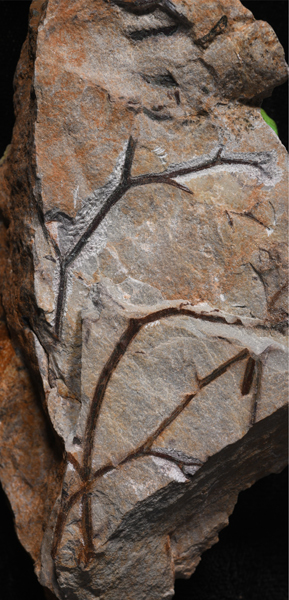
Evidence of a Devonian fossil forest has been found in the high sandstone cliffs located near Minehead in Devon. Researchers from the University of Cambridge and the University of Cardiff have discovered the oldest fossilised trees ever found in the UK. The fossil remains of the trees, known as Calamophyton represent the oldest known fossil forest on Earth.
Fossilised tree stumps near the town of Gilboa (New York, USA) and a quarry at nearby Cairo, New York are thought to be 380 and 385 million years old respectively. The Gilboa site is dominated by remains of Wattieza trees. These trees are related to the Calamophyton trees identified at the Devon site. They are both members of the Pseudosporochnales Order and are distantly related to modern ferns.
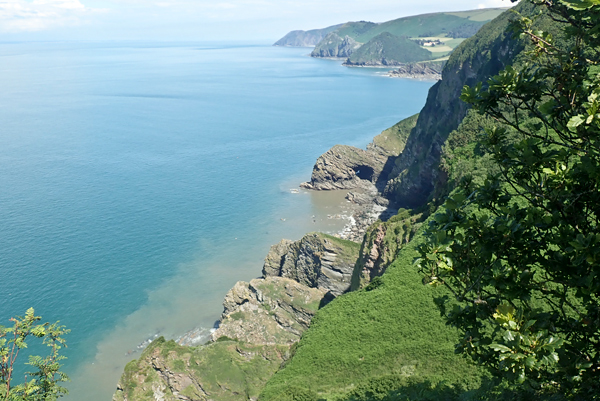
The cliffs close to the Butlin’s holiday camp near Minehead (Devon) where the fossils were found. Picture credit: Neil Davies (University of Cambridge).
Devonian Fossil Forest
The Devonian fossil forest is thought to be around four million years older than the tree fossils discovered in New York. The forest is approximately 390 million years old (Eifelian faunal stage of the Middle Devonian).
Detail of a fallen tree truck. Picture credit: Chris Berry (University of Cardiff).
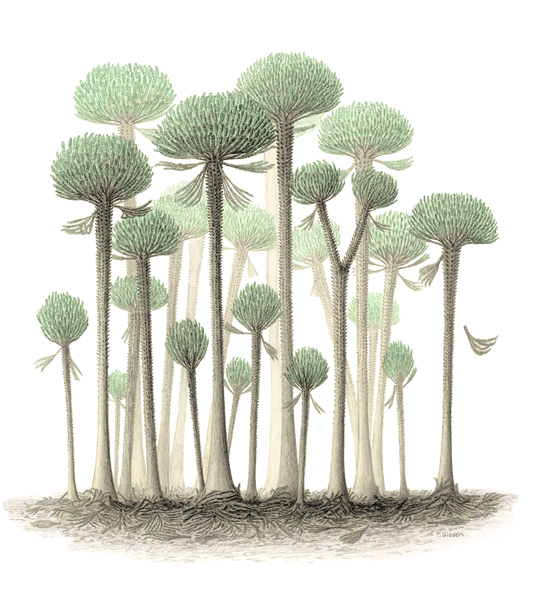
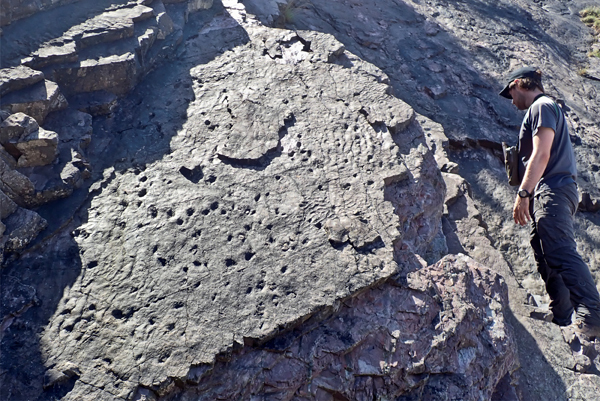
The fossils were found near the town of Minehead. The site is located on the south bank of the Bristol Channel, near a Butlin’s holiday camp. The fossilised trees, known as Calamophyton, at first glance resemble palm trees, but they are not related to modern angiosperms. Rather than solid wood, their trunks were thin and hollow in the centre. They also lacked leaves, and their branches were covered in hundreds of twig-like structures.
Devon fossil forest life reconstruction showing Calamophyton. Picture credit: Peter Giesen/Chris Berry.
Evidence of Arthropods Found
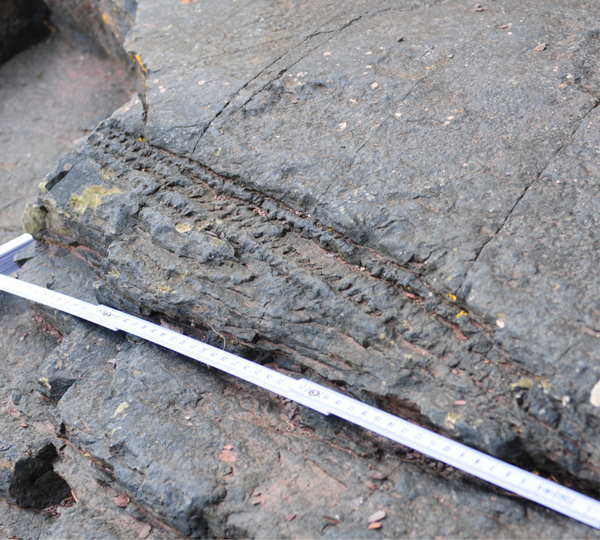
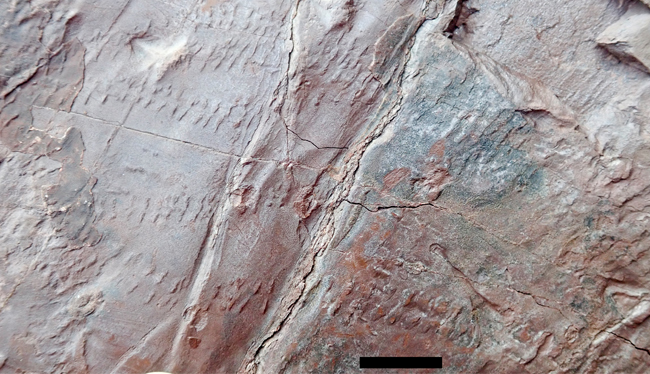
The trees were much shorter than extant trees. The largest specimens were between two and four metres high. As the trees grew, they shed their branches. The floor of the forest was covered in a dense mat of decaying vegetation. This was home to an array of invertebrates and arthropod tracks have been discovered at this site.
Arthropod tracks recorded at the Devon fossil forest site. Picture credit: Neil Davies (University of Cambridge).
A Devonian Ecosystem
It had been thought that these sandstone cliffs were largely devoid of fossils. This remarkable discovery demonstrates how early trees helped to stabilise riverbanks and coastlines hundreds of millions of years ago. It was during the Devonian that the first extensive terrestrial forests formed.
The Devonian lasted between 419 million and 359 million years ago. During this geological period the first complex terrestrial ecosystems evolved. By the end of the Devonian, the first seed-bearing plants (pteridosperms) appeared and the earliest land animals, mostly arthropods, were well-established.
A photograph showing an area of small tree stumps. Picture credit: Neil Davies (University of Cambridge).
Fundamentally Changing Life on Earth
Commenting on the significance of the fossil forest discovery, one of the paper’s co-authors, Professor Neil Davies (Cambridge University), stated:
“The Devonian period fundamentally changed life on Earth. It also changed how water and land interacted with each other, since trees and other plants helped stabilise sediment through their root systems, but little is known about the very earliest forests.”
The Devonian fossil forest identified by the researchers was found in the Hangman Sandstone Formation, along the north Devon and west Somerset coasts. During the Devonian period, this region was not attached to the rest of England, but instead lay further south, connected to parts of Germany and Belgium, where similar Devonian fossils have been found.
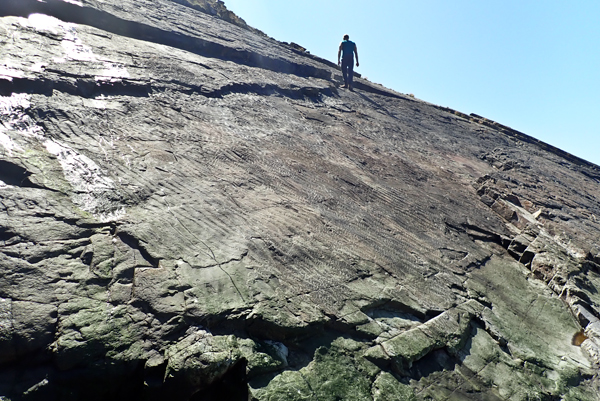
Ripple marks on the forest floor. Picture credit: Neil Davies (University of Cambridge).
Studying the Ecology of the Earliest Forests on Earth
Co-author Dr Christopher Berry (Cardiff University) commented:
“When I first saw pictures of the tree trunks I immediately knew what they were, based on 30 years of studying this type of tree worldwide. It was amazing to see them so near to home. But the most revealing insight comes from seeing, for the first time, these trees in the positions where they grew. It is our first opportunity to look directly at the ecology of this earliest type of forest, to interpret the environment in which Calamophyton trees were growing, and to evaluate their impact on the sedimentary system.”
During the Devonian, this location was a semi-arid plain, criss-crossed by small river channels spilling out from mountains to the northwest. The fieldwork was undertaken along the highest sea-cliffs in England, some of which are only accessible by boat. The sandstone formation is in fact rich with plant fossil material. The researchers identified fossilised plants and plant debris, fossilised tree logs, traces of roots and sedimentary structures, preserved within the sandstone.
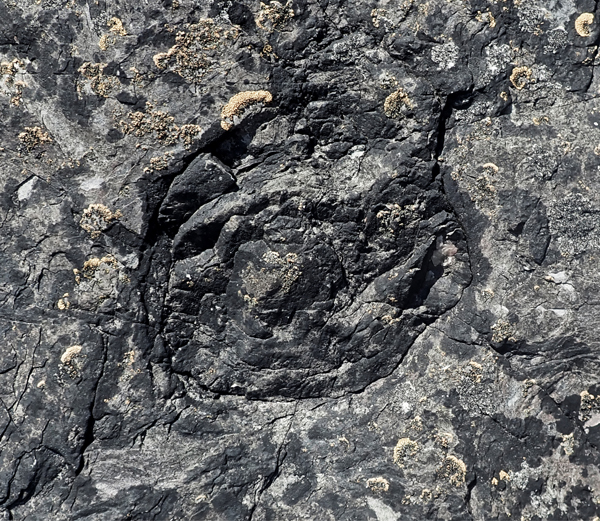
Cross section of tree stump. Picture credit: Neil Davies (University of Cambridge).
A Weird Forest
Professor Davies explained:
“This was a pretty weird forest – not like any forest you would see today. There wasn’t any undergrowth to speak of and grass hadn’t yet appeared, but there were lots of twigs dropped by these densely-packed trees, which had a big effect on the landscape.”
Small plant twigs. Picture credit: Chris Berry (University of Cardiff).
This was the first time in the history of our planet that large plants could grow together on land. The sheer abundance of debris shed by the Calamophyton trees built up within layers of sediment. The sediment affected the way that the rivers flowed across the landscape, the first time that the course of rivers could be affected in this way.
Professor Davies added:
“The evidence contained in these fossils preserves a key stage in Earth’s development, when rivers started to operate in a fundamentally different way than they had before, becoming the great erosive force they are today. People sometimes think that British rocks have been looked at enough, but this shows that revisiting them can yield important new discoveries.”
Everything Dinosaur acknowledges the assistance of a media release from the University of Cambridge in the compilation of this article.
The scientific paper: “Earth’s earliest forest: fossilized trees and vegetation-induced sedimentary structures from the Middle Devonian (Eifelian) Hangman Sandstone Formation, Somerset and Devon, SW England” by Neil S. Davies, William J. McMahon and Christopher M. Berry published in Journal of the Geological Society.
The spinosaurids represent an extremely unusual type of theropod. Their mode of hunting and lifestyle remains controversial. Over recent years more fossil material associated with perhaps the most derived spinosaurid Spinosaurus aegyptiacus, has been studied. In addition, new lines of enquiry have been explored in a bid to better understand these bizarre carnivorous dinosaurs. Some scientists have argued that Spinosaurus was a fully aquatic, underwater pursuit predator. Others have argued that this dinosaur stayed in the shallows or waded into the water to catch fish in a similar manner to extant bears.
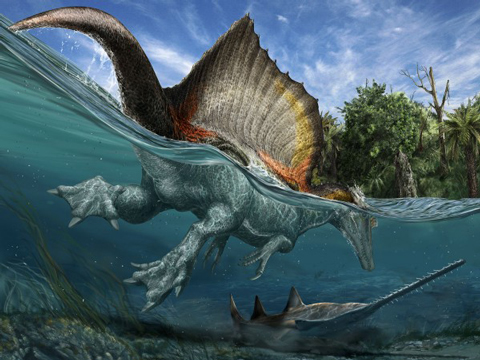
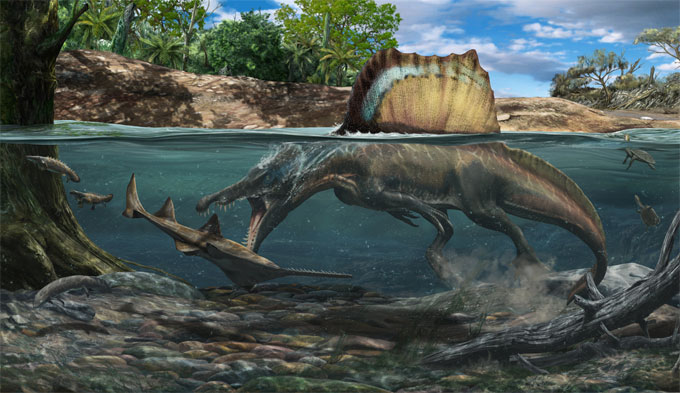
Spinosaurus, the longest predatory dinosaur known, is opening its elongate jaws, studded with conical teeth, to catch a sawskate. Contrary to previous suggestions, this animal was not a heron-like wader – it was a “river monster”, actively pursuing prey in a vast river system located in modern-day North Africa. Dense bones in the skeleton of Spinosaurus strongly suggest it spent a substantial amount of time submerged in the water. However, newly published research (Myhrvold et al) has challenged this view of Spinosaurus.Picture credit: Davide Bonadonna.
Spinosaurus aegyptiacus Bone Density Study
Numerous lines of enquiry have been explored in a bid to resolve these questions. A recently published study (Fabbri et al) sought to resolve this matter. They applied a statistical method and explored spinosaurid bone density. Animals like manatees have especially dense bones that enable them to stay submerged. These researchers examined spinosaurid bone density in comparison to the bone densities of extant animals which are adapted to an aquatic life. They concluded that Spinosaurus and its close relative Baryonyx (B. walkeri) were capable of submerging themselves underwater to hunt.
However, newly published research has challenged these conclusions. Scientists from the University of Chicago along with collaborators from the Royal Tyrrell Museum (Canada) and other co-authors have outlined some of the pitfalls in using statistical measurements of bone density to infer a lifestyle. The team identified inconsistencies and they proposed that it was difficult to draw conclusions when taxa are represented by limited data.
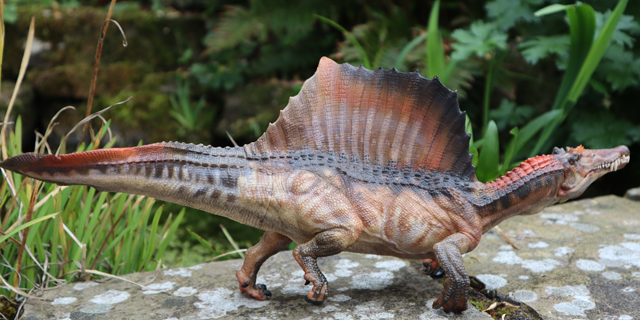
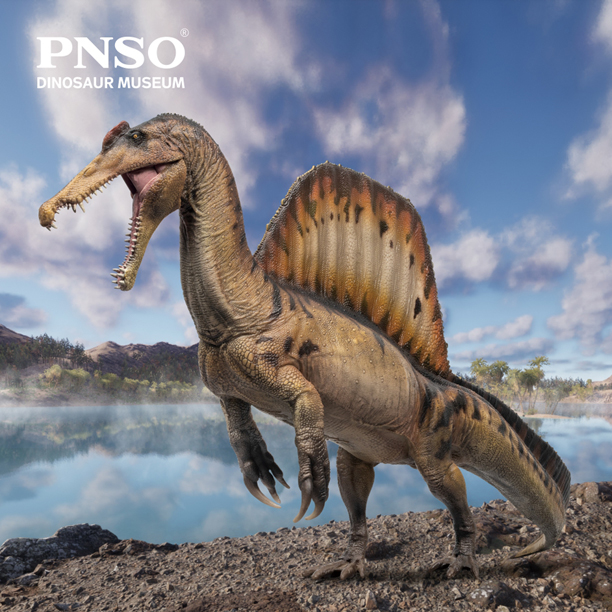
Striding across the landscape but with water close by, the new for 2024 PNSO Aymen the Spinosaurus dinosaur model. Scientists remain uncertain as to whether Spinosaurus was able to fully submerge and pursue prey.
The picture above shows the recently introduced PNSO Spinosaurus model. The replica contains a number of anatomical traits identified in contemporary scientific papers. For example, the PNSO Spinosaurus has a broad tail. However, it is depicted as a terrestrial, bipedal animal and not a semi-aquatic quadruped.
Writing in the open-access journal “PLOS One” the scientists argue that the previous research was not robust enough to conclude that S. aegyptiacus and Baryonyx walkeri were fully submerged “subaqueous foragers.” Their findings not only invalidate the conclusions of the earlier bone density analysis, but also have important implications for future quantitative uses of bone compactness and discriminant analysis in palaeontology.
The dense bones found in the relatively short hindlimbs, may have been an adaptation to support the animal’s great weight as it moved on land. The research team, which included Paul Sereno (University of Chicago), propose that Spinosaurus aegyptiacus probably could not dive. Instead, it may have waded in water around two metres deep, without floating. This permitted it to ambush fish with its huge claws and elongated jaws.
The scientific paper: “Diving dinosaurs? Caveats on the use of bone compactness and pFDA for inferring lifestyle” by Nathan P. Myhrvold, Stephanie L. Baumgart, Daniel Vidal, Frank E. Fish, Donald M. Henderson, Evan T. Saitta and Paul C. Sereno published in PLOS One.
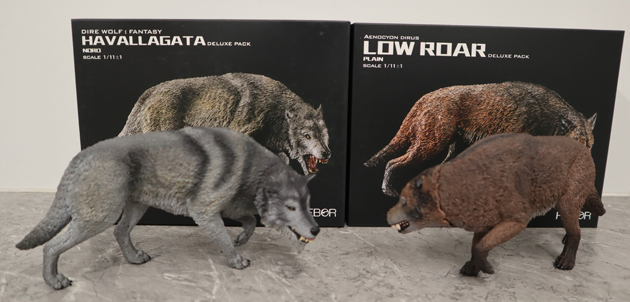
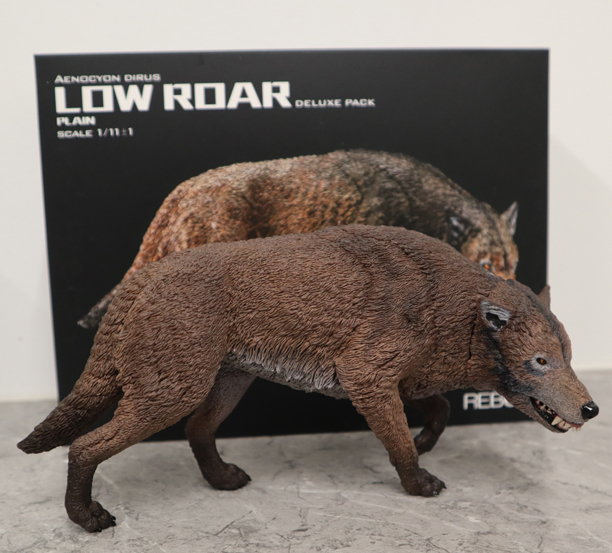
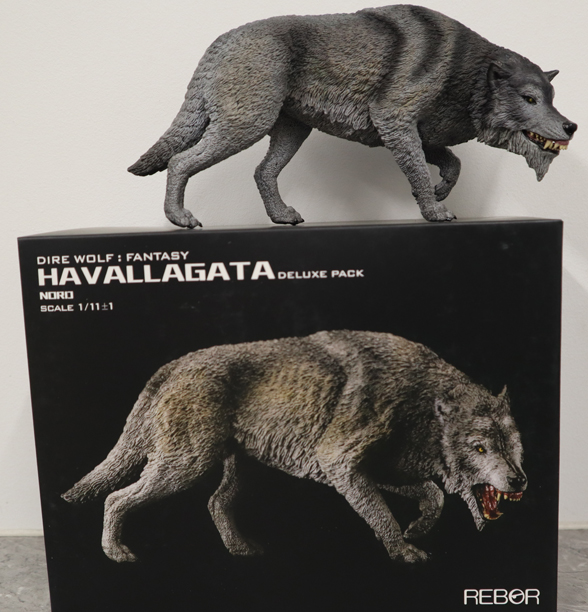
The two, new for 2024 Rebor dire wolf models are now in stock at Everything Dinosaur. The Rebor dire wolf (Aenocyon dirus) low roar plain deluxe pack has arrived along with the grey coloured “Havallagata” variant.
The grey figure (Havallagata) can represent a 1:11 scale dire wolf (Aenocyon dirus) or a 1:18 fantasy wolf. It is pictured next to the brown coloured Rebor dire wolf (low roar). Picture credit: Everything Dinosaur.
Picture credit: Everything Dinosaur
Rebor Dire Wolf Models
Each fabulous figure measures a little over eighteen centimetres in length. The shoulder height is around nine centimetres. The Rebor dire wolf figures are supplied with an Everything Dinosaur dire wolf fact sheet. The fact sheet highlights the taxonomy of these enigmatic Pleistocene carnivores. They are not closely related to the extant grey wolf (Canis lupus).
A scientific paper published in 2021 (Perri et al) demonstrated that the genome of the dire wolf was markedly different from the genome of extant canids. It is postulated that the dire wolf evolved in the Americas isolated from other canids. The lineage that led to the dire wolf diverged from the common ancestor of wolves and coyotes more than 5.5 million years ago.
The fabulous Rebor dire wolf (Aenocyon dirus) low roar deluxe pack. It is supplied with three interchangeable heads. Picture credit: Everything Dinosaur.
To view the range of Rebor models and figures in stock at Everything Dinosaur: Rebor Figures and Models.
Supplied with Three Interchangeable Heads
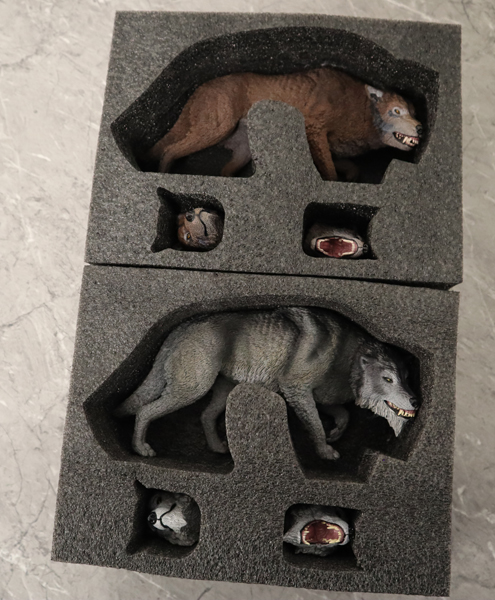
The Rebor Dire Wolf models are supplied with three interchangeable heads. The models can be displayed with mouth closed, showing their teeth or with the mouth fully open.
The Rebor dire wolf box contents. Each 1:11 scale figure is supplied with three interchangeable heads. Picture credit: Everything Dinosaur.
Picture credit: Everything Dinosaur
A spokesperson from Everything Dinosaur confirmed that the dire wolf fact sheet included a scale drawing of this prehistoric animal.
The Rebor dire wolf/fantasy figure with its product packaging. Picture credit: Everything Dinosaur.