All about dinosaurs, fossils and prehistoric animals by Everything Dinosaur team members.

Fossil finds, new dinosaur discoveries, news and views from the world of palaeontology and other Earth sciences.

1 08, 2018

How Did We Get Our Bones? That’s a Wonderful Question

By |2024-05-11T06:14:10+01:00August 1st, 2018|Categories: Dinosaur and Prehistoric Animal News Stories, Main Page, Photos/Pictures of Fossils|0 Comments

Tracing the Origins of the Vertebrate Skeleton

Our skeleton is very special, the evolution of a rigid internal skeleton (bones), was an extremely significant development in the history of life on Earth.  However, how hard, internal skeletons evolved has been the subject of much debate amongst palaeontologists.  However, thanks to research undertaken by scientists at Manchester and Bristol Universities in collaboration with the technicians at a synchrotron light source based in Switzerland, we might have a better understanding of how we came to be.

The Origins of Our Skeleton

All living vertebrates have skeletons built from four different tissue types: bone and cartilage (the main tissues that human skeletons are made from), and dentine and enamel (the tissues from which our teeth are constructed).  These tissues are unique because they become mineralised as they develop, giving the skeleton strength and rigidity.

Primitive fish were the first to develop a mineralised skeleton and one group of early fishes, the heterostracans, has attracted a lot of interest from scientists as they try to work out the evolutionary processes that took place.  The heterostracans, were a group of heavily armoured, jawless fishes that evolved during the Early Silurian.  These fish, which are mostly associated with marine and estuarine deposits, had two plates, one on the top of the body and one underneath, they served to help protect the animal from attack and might have had a secondary function to help keep the body stiffened.  These fish also had large scales on their bodies too.

A “Swimming Table Tennis Paddle” –  A Life Restoration of Drepanaspis – An Early Devonian Heterostracan
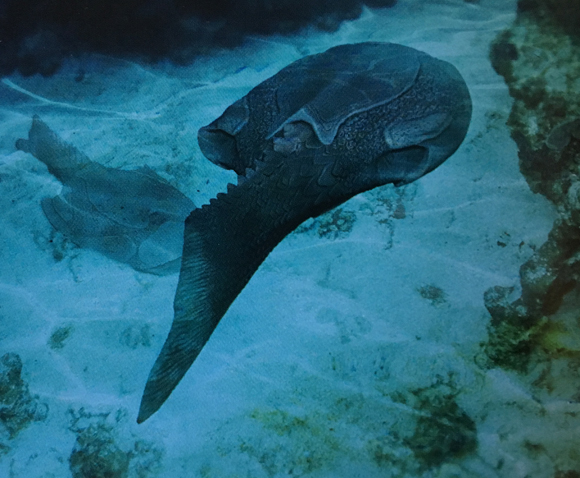
Drepanaspis life reconstruction.
A life reconstruction of Drepanaspis a typical heterostracan fish.

The Primitive Bone-like Tissue Aspidin

Earlier research had identified that the surface scales and broad plates of these primitive fishes had enamel-like tops over a core of dentine, essentially the same material that forms our teeth.  Supporting these structures was a layer of sponge-like material called aspidin.  Aspidin is bone in its earliest mineralised form.  It is thought that the very first basal, internal skeleton provided an anchor to support the armour that was on the outside of the body.  In this new study, the scientists used synchrotron X-ray tomographic microscopy to reveal the nature of aspidin.

Lead author of the paper, published in the journal “Nature Ecology & Evolution”, Dr Joseph Keating (Manchester University), explained:

“Heterostracan skeletons are made of a really strange tissue called “aspidin”.  It is crisscrossed by tiny tubes and does not closely resemble any of the tissues found in vertebrates today.  For 160 years, scientists have wondered if aspidin is a transitional stage in the evolution of mineralised tissues.”

Errivaspis – A Member of the Heterostraci from the Early Devonian
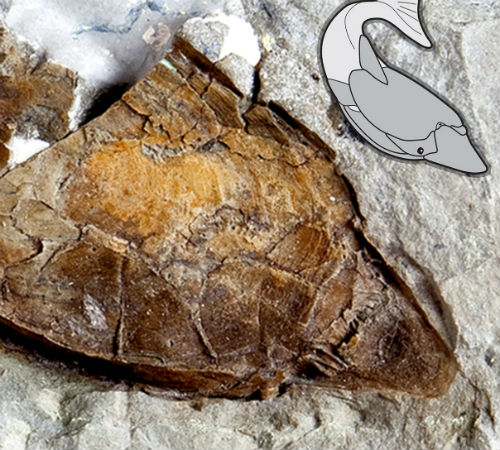
Errivaspis - primitive fish.
Errivaspis – anterior portion of fossil, from the Early Devonian.

Picture credit: Keating et al

Ruling Out Other Theories

Scientists had been aware of the spongy nature of aspidin.  However, they were unable to work out what might have filled the pores and spaces in the material, using traditional methods of study.  Knowing what filled these unmineralised spaces would provide the information needed to help demonstrate the role that aspidin played in the evolution of back-boned animals.

Four theories regarding what filled these spaces had been put forward:

  1. The spaces housed cells, like the osteoblasts and osteocytes that are found in living bones.
  2. The spaces were filled with fibres made from proteins such as collagen.
  3. The spaces were filled with dentine.
  4. The spaces were filled with a mixture of dentine and bone.

The team showed that these “gaps” in the aspidin represented the location of bundles of collagen (2).  These “gaps” housed the same sort of protein that is found in our skin and bones (in fact collagen is the most abundant type of protein found in our bodies).

Aspidin is the Earliest Evidence of Bone in the Fossil Record

These findings enabled Dr Keating to rule out all but one theory for the tissue’s identity, proving that aspidin is the earliest evidence of bone in the fossil record.

Co-author of the study, Professor Phil Donoghue (University of Bristol), who has done much to reveal the true anatomical nature of the heterostracans, stated:

“These findings change our view on the evolution of the skeleton.  Aspidin was once thought to be the precursor of vertebrate mineralised tissues.  We show that it is, in fact, a type of bone, and that all these tissues must have evolved millions of years earlier.”

The team suggest that the collagen bundles form a scaffold which permits minerals to be deposited.  Aspidin is acellular dermal bone, so one question is answered but it gives rise to a host of others.  For example, if all the skeletal tissue types associated with vertebrates were present in the heterostracans, then these structures and materials must have evolved earlier than expected.

The scientific paper: “The Nature of Aspidin and the Evolutionary Origin of Bone” by J. Keating, C. Marquart and P. Donoghue published in Nature Ecology & Evolution.

Everything Dinosaur has an award-winning website.

Visit the Everything Dinosaur website: Everything Dinosaur.
29 07, 2018

Gharial Evolution Explained in New Scientific Paper

By |2024-05-11T06:17:00+01:00July 29th, 2018|Categories: Animal News Stories, Dinosaur and Prehistoric Animal News Stories, Main Page|0 Comments

Convergent Evolution Thoracosaurs and Gharials

Crocodylians are a very ancient group of reptiles, sometimes these animals are referred to as living dinosaurs, that’s a mistake, they may be archosaurs, the same as the Dinosauria, but they represent a different branch of the “ruling reptiles” clade.  However, just as with the dinosaurs, the ancient lineage of the crocodylians is full of intriguing taxonomic mysteries.  Back in 2017, Everything Dinosaur reported upon a new scientific paper that fundamentally re-wrote the dinosaur family tree, in recent weeks, a new scientific study has thrown light on the evolution of the gharials, specialist fish-eating crocodylians.

The Evolution of Gharials

This new research into the gharials may not result in such a seismic shift that we saw with the 2017 dinosaur family tree, but it does help to explain an inconsistency that has puzzled palaeontologists for decades.

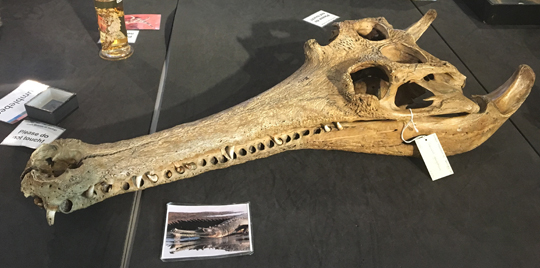
A Gharial (Gavialis gangeticus)

The skull of a gharial.
The skull of a gharial from the Grant Museum of Zoology (London). Picture credit: Everything Dinosaur.

Picture credit: Everything Dinosaur

The Thoracosaur Mystery

Late Cretaceous, long-snouted, fish-eating crocodiles known as thoracosaurs had been thought to be closely related to modern-day gharials (Gavialis lineage).  However, fossils of these crocodylians are found in Upper Cretaceous/Lower Palaeocene strata, but analysis of the genome of the modern Indian gharial suggests that these crocodiles only evolved some forty million years ago.  In a new study, led by Flinders University (South Australia), it is concluded that the Thoracosaurus is not closely related to the Gavialidae, it just happens to look very similar and to share the same adaptations for life as a piscivore.

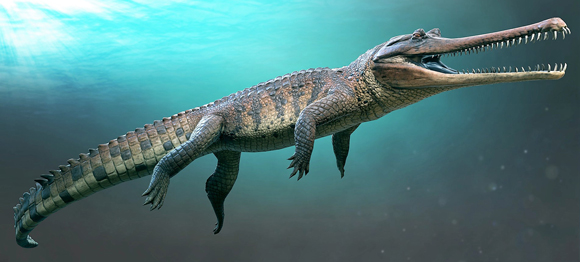
A Life Reconstruction of the Late Cretaceous Crocodylian Thoracosaurus

Thoracosaurus life reconstruction.
A life reconstruction of the fish-eating Thoracosaurus.

Picture credit: Jacob Baardse

The Four-metre-long Thoracosaurus

Two species of Thoracosaurus have been described, one from North America with a second species known from Europe.  This freshwater crocodile could have grown to a length of four metres or more.  Writing in the journal “Proceedings of the Royal Society Biology”, a team of international scientists propose that the uncanny resemblance between the modern gharial and the ancient Thoracosaurus is due to convergent evolution, the process whereby two unrelated organisms end up looking similar as they adapt to similar environments and ecological niches.

The study shows that the prehistoric thoracosaurs, that were around at the same time as the last of the dinosaurs, were not closely related to modern gharials at all.  They represent a separate and distinct group of reptiles that adopted a similar fish-eating habit, evolving long, narrow jaws with needle-like teeth, anatomical traits they share with gharials.  Therefore, as borne out by the DNA of modern-day gharials, members of the Gavialidae are relatively newcomers when it comes to crocodylian evolutionary history.  Gharials did not exist in the Mesozoic.

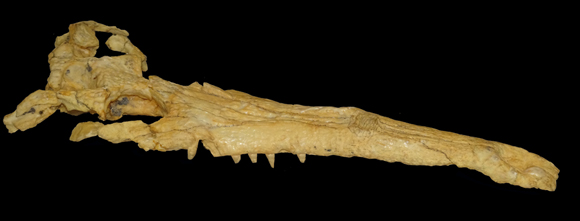
The Fossilised Skull and Upper Jaw of Thoracosaurus (Cast)

The skull of Thoracosaurus.
A cast of the fossilised skull and upper jaw of Thoracosaurus.

Picture credit: Michael Lee (Flinders University and South Australia Museum

Confusion Over the Indian Gharial and the False Gharial

The False gharial of south-east Asia (Tomistoma schlegelii), has a similar long snout to the Indian gharial, however, as it is broader at the base it was thought that this species was not closely related to the true gharial.  However, genomic studies have revealed that it is the sister taxon and consequently, very closely related to Gavialis gangeticus. Many biologists now classify this species as a member of the Gavialidae.

Lead author of the study, Professor Michael Lee (Flinders University), commented:

“The DNA of living gharials indicates they are a young group, which evolved well after the dinosaurs, but then why are there gharial-like fossils older than T. rex?  Either the DNA evidence is wrong, or we’ve misinterpreted these ancient thoracosaurs.  Our work suggests we have got the fossils wrong, after being misled by convergent evolution.”

The scientific paper:
“Tip Dating and Homoplasy: Reconciling the Shallow Molecular Divergences of Modern Gharials with their Long Fossil Record” by MSY Lee and AM Yates and published in Proceedings: Biological Sciences:

Everything Dinosaur’s article on the reassessment of the Dinosauria: Root and Branch Reform for the Dinosaur Family Tree.

Visit the Everything Dinosaur website: Everything Dinosaur.
25 07, 2018

Dino Fest at The Beacon Whitehaven

By |2023-10-20T15:43:20+01:00July 25th, 2018|Categories: Dinosaur and Prehistoric Animal News Stories, Dinosaur Fans, Educational Activities, Main Page, Press Releases|0 Comments

Dino Fest at The Beacon Whitehaven

The countdown has started, there are less than 48-hours to go before our first dinosaur and fossil workshop at The Beacon Museum (Whitehaven, Cumbria).  Staff at Everything Dinosaur have been preparing all the fossils and sorting out a vehicle so that it can be loaded up with all the fossils and other goodies which we will need this weekend as Everything Dinosaur delivers dinosaur and fossil workshops.  The plan is that visitors to Dino Fest at The Beacon will be able to help our team members hunt for fossils including real dinosaur bones!

Dino Fest from Friday 27th July until Sunday 29th July

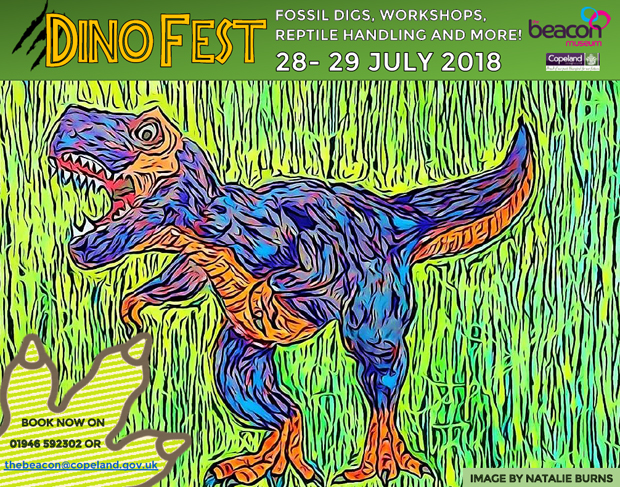
Dino Fest at The Beacon Museum (Whitehaven)
Dino Fest at The Beacon Museum July 2018.

Picture credit: The Beacon Museum/Natalie Burns

Dinosaur and Fossil Workshops

Join team members from Friday afternoon and throughout the weekend and take part in fossil casting, fossil handling and get the chance to find your very own fossils of prehistoric animals.  What you find you can keep, so, why not start your very own fossil collection.

A spokesperson from Everything Dinosaur commented:

“We will be delivering a total of three dinosaur and fossil workshops. The first one would be starting Friday afternoon.  We plan to conduct some fossil casting of specimens from our collection, including T. rex teeth and Velociraptor claws and then we can look at dinosaur skulls and of course, being shark week, we will have to include some prehistoric sharks too.”

When not providing workshops, the team members from Everything Dinosaur will be laying out fossil trays and inviting visitors to The Beacon Museum to search for ancient crocodile armour, Silurian coral, fossilised wood, sharks teeth, brachiopods, ammonites and other evidence of ancient life Everything Dinosaur has collected on their travels around the world.  As you would expect from a company called “Everything Dinosaur”, there will be some dinosaur fossils to find as well.

Dinosaur and Fossil Themed Workshops at The Beacon Whitehaven

Everything Dinosaur and fossil workshops.
Everything Dinosaur at the Beacon Museum 27th July to 29th July. Picture credit: Everything Dinosaur.

Picture credit: Everything Dinosaur

Late Cretaceous Dinosaurs

An Everything Dinosaur spokesperson explained that as fossils erode out of the ground, they are acted upon by natural forces causing the material to weather.  If people did not go out hunting for fossils, then much of the fossil record would simply be eroded away and lost forever.

“Imagine a 66 million-year-old Triceratops leg bone, exposed by erosion in the Hell Creek Formation of Montana.  It might be from an animal that lived in the Late Cretaceous but just a few years of freeze/thaw and weathering and the bone would simply crumble away.  By conducting fossil workshops and helping to explain how to tell fossils from rock, we might one day help someone discover their very own prehistoric animal, after all, around 100 different dinosaurs are known from fossils found in the British Isles.”

For further information about Everything Dinosaur, visit the company’s website: Everything Dinosaur.

24 07, 2018

Lingwulong New Dinosaur Discovery from Northern China

By |2023-10-20T15:38:04+01:00July 24th, 2018|Categories: Dinosaur and Prehistoric Animal News Stories, Dinosaur Fans, Main Page, Palaeontological articles, Photos/Pictures of Fossils|0 Comments

Lingwulong shenqi – The Dinosaur That’s Not Supposed to be There

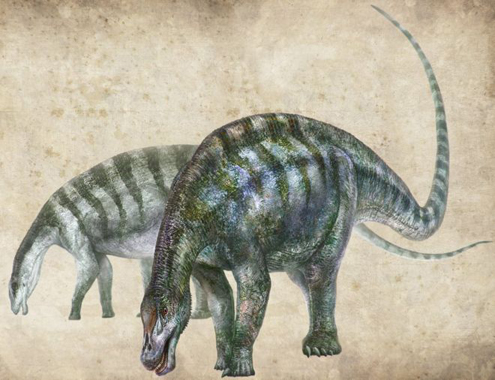
Dinosaurs, so often regarded in the past as epitomising animals that were too slow and stupid to survive, are demonstrating that they were one of the most successful groups of terrestrial vertebrates to have evolved.  A newly described, long-necked dinosaur from the Middle Jurassic of northern China suggests that sauropods dispersed and diversified much earlier than palaeontologists had previously thought.  The new dinosaur has been named Lingwulong shenqi and it is the earliest known diplodocoid.

A Life Reconstruction of the Newly Described Lingwulong shenqi

Lingwulong shenqi illustrated.
A life reconstruction of Lingwulong shenqi, the earliest known diplodocoid.

Picture credit: Zhang Zongda

Subgroups of Sauropods with Restricted Geographical Ranges

Although the sauropods dominated terrestrial faunas for much of the Mesozoic and their fossils are globally distributed, scientists had been aware that several subgroups demonstrated restricted geographical ranges.  For example, the sauropod superfamily Diplodocoidea, which is part of a huge clade of long-necked dinosaurs called the Neosauropoda, was believed to have never existed in eastern Asia.  This permitted a unique range of long-necked dinosaurs to evolve and thrive in this part of the world, the Mamenchisauridae.  In essence, the isolation of eastern Asia permitted to evolution of the region’s very own endemic range of dinosaurs.

Lingwulong shenqi – The Implications for Dinosaur Distribution

The Neosauropoda consists of two distinct groups of sauropod, firstly there is the Diplodocoidea, this includes some of the most famous dinosaurs of all, animals such as Brontosaurus, Apatosaurus, Diplodocus and Amargasaurus.  The second type of sauropod within the Neosauropoda are the Macronaria, which consists of equally famous dinosaurs such as Brachiosaurus and Camarasaurus.  It had been thought that once eastern Asia became isolated, the neosauropods were unable to spread to this part of the world.

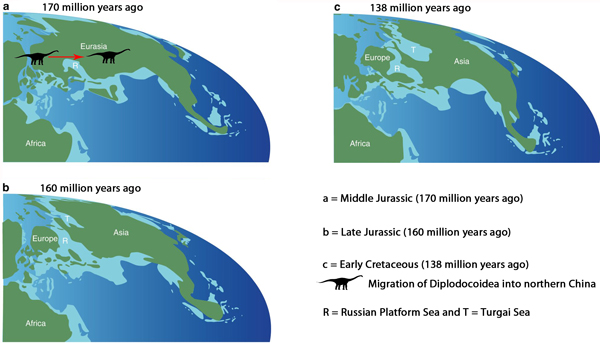
Their absence had been explained by the break-up of the super-continent Pangaea.  A seaway was formed cutting off and isolating this part of Asia during the Jurassic.  In the case of the Diplodocoidea, these types of long-necked dinosaur evolved and dispersed but they never reached northern China.  By the time sea levels had changed and land connections were once again formed linking northern China to other land masses in the Early Cretaceous, the diplodocoids were in decline and their numbers and geographic range had been greatly reduced since their Late Jurassic heyday.

The discovery of Lingwulong shenqi changes all this.  Diplodocoids were present in eastern Asia, so they must have evolved and diversified into this region earlier than previously thought, or land bridges may have existed linking this part of Asia to the rest of Pangaea for longer.

Mapping the Distribution of the Diplodocoidea

Mapping Diplodocoidea distribution.
An epicontinental sea formed during the Jurassic which isolated northern Asia from Europe. This restricted the spread of certain types of dinosaur. Diplodocoid dinosaurs had already evolved and spread before northern Asia was cut off.

Picture credit: Nature Communications with additional annotation by Everything Dinosaur

Co-author of the open access paper published in “Nature Communications”, Dr Philip Mannion (Imperial College London), explained the significance of this dinosaur discovery:

“Not only is it [Lingwulong] the oldest member [of the Diplodocoidea], but it’s the first ever from Asia.  For a long time it was thought that neosauropods didn’t get into Asia during the Jurassic.  This suggests that firstly [neosauropods] got in before any kind of barrier came up, but increasingly the geological evidence suggests maybe this barrier was quite ephemeral”

The Formation of the Russian Platform Sea and the Turgai Sea

Tectonic forces led to the formation of an epicontinental seaway during the Middle to Late Jurassic and this isolated northern Asia from the rest of Pangaea.  The fossils of Lingwulong come from the Yanan Formation in the Ningxia Hui Autonomous Region of China, the strata are estimated to be around 175 to 168 million years old (late Toarcian to Bajocian faunal stages).  The discovery of Lingwulong indicates that many advanced kinds of sauropod originated at least 15 million years earlier than previously realised.  The Diplodocoidea achieved a global distribution whilst Pangaea was still a single, coherent landmass.

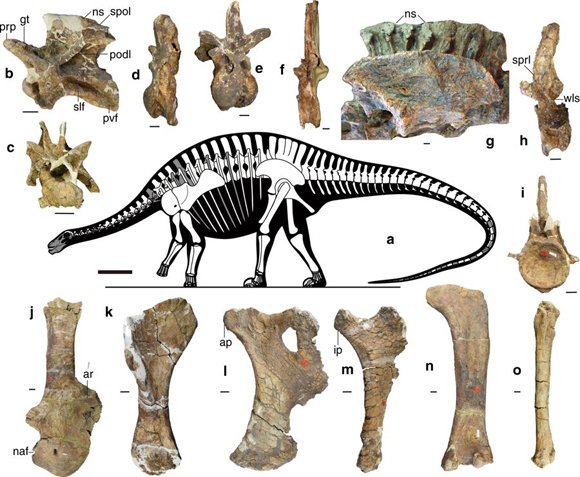
A Reconstruction of the Skeleton of L. shenqi and Examples of Some of the Fossil Bones

Skeleton reconstruction and some fossil bones of Lingwulong.
A skeletal reconstruction of Lingwulong shenqi and examples of fossil bones.  In the skeleton drawing, the bones in white represent fossils associated with this taxon.

Picture credit: Nature Communications

Lingwulong shenqi – “Lingwu’s Amazing Dragon”

The dinosaur has been named after Lingwu, the region in which the fossils were found and the Mandarin Chinese “long” which means dragon.  The trivial name – shenqi, comes from the Mandarin for “amazing”, reflecting the unexpected discovery of this type of dinosaur in the Middle Jurassic of China.  Excavations originally commenced in 2005 led to the discovery of between 7 and 10 individuals, including two specimens with associated skull material.  The fossils represent a range of animal sizes, representing juveniles as well as adults.

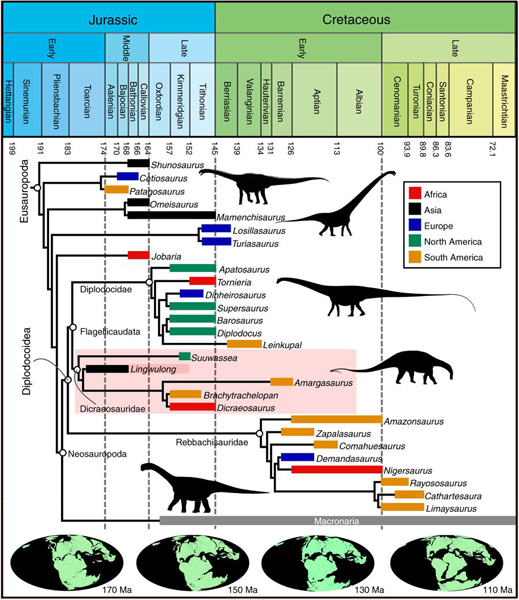
With so much fossil material to study, the researchers were able to assign this new genus to a specific place within the broad Superfamily of the Diplodocoidea.  They conclude that Lingwulong is a basal member of the Dicraeosauridae.

The Dicraeosauridae includes species such as Suuwassea from the Late Jurassic of Montana, Brachytrachelopan from the Late Jurassic of Argentina and Amargasaurus from the Early Cretaceous of Argentina.

The Position of Lingwulong shenqi Within the Neosauropoda

The taxonomic position of Lingwulong.
Plotting the taxonomic position of Lingwulong within the Diplodocoidea.

Picture credit: Nature Communications

The Bigger Picture

The idea that the eastern parts of Asia were cut off from other landmasses during the Jurassic has been put forward to explain the substantial differences between the Jurassic (and sometimes Early Cretaceous), terrestrial biotas between this part of the world and the rest of Pangaea.  It is likely that a seaway formed to the west of the Ural Mountains (the Russian Platform Sea), this seaway in conjunction with an ingress of water from the north (the Turgai Sea), isolated the land to the northeast.

This isolation has been used to explain the evolution of a number of new types of prehistoric animal  in eastern Asia, such as:

  • Mamenchisaurid sauropods
  • Oviraptorosaurs
  • Therizinosaurs
  • Marginocephalians

In addition, this sea barrier has been used to explain the absence of many groups that were present elsewhere in Pangaea during the Jurassic, such as:

  • Diplodocoid sauropods (now debunked by Lingwulong)
  • Early titanosauriform sauropods
  • Dromaeosaurids
  • Nodosaurids
  • The lineage leading to the iguanodontian ornithopods

The scientific paper: “A New Middle Jurassic Diplodocoid Suggests an Earlier Dispersal and Diversification of Sauropod Dinosaurs” by Xing Xu, Paul Upchurch, Philip D. Mannion, Paul M. Barrett, Omar R. Regalado-Fernandez, Jinyou Mo, Jinfu Ma and Hongan Liu, published in Nature Communications.

Visit the Everything Dinosaur website: Everything Dinosaur.
23 07, 2018

Confusion over Dinosaur Colour – It’s an Inside Job

By |2023-10-20T15:09:38+01:00July 23rd, 2018|Categories: Dinosaur and Prehistoric Animal News Stories, Dinosaur Fans, Main Page, Palaeontological articles|0 Comments

Internal Sources of Preserved Melanin Throw Doubt on Dinosaur Colour

One of the most exciting discoveries in the last two decades or so when it comes to the Dinosauria, was the recognition that fossilised, microscopic structures containing melanin (called melanosomes), could provide an indication of colour.  The shape of the preserved melanosome when compared to the same type of structures found in living animals, gave scientists an insight into the potential colouration of long extinct creatures.

However, new research from a team of palaeontologists led by scientists from Bristol University and University College Cork (Ireland), has upset the colour scheme somewhat.  They have discovered new sources of the pigment melanin such as in the liver, lungs and spleen preserved in fossils, this means how palaeontologists reconstruct the dinosaurs and other extinct prehistoric animals is going to have to be revisited.

Implications for the Dinosauria

This study has implications for the interpretation of colour within the Dinosauria.

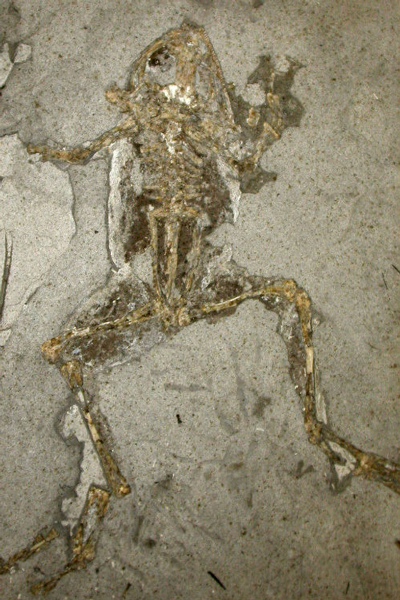
A Fossil Frog from the Miocene of Spain – Dark Areas in the Chest Cavity and Legs are Melanosomes

A frog fossil from Spain.
Scientists have detected new sources of melanin in fossil specimens.

Picture credit: Museo Nacional de Ciencias Naturales, Madrid, (Spain)

Study Published in “Nature Communications”

Writing in the academic journal “Nature Communications”,  the researchers looked at living and extinct amphibians.  It is known that extant vertebrates have melanosomes within internal tissues, the scientists demonstrated that these internal melanosomes have a high fossilisation potential and can vastly outnumber those from the skin.  This means that there could be a bias in fossils for preserved internal melanosomes thus “blurring” the picture when it comes to interpreting the colour of extinct animals.

Back to the Drawing Board?  Do we Really Know the Colour of Extinct Creatures?

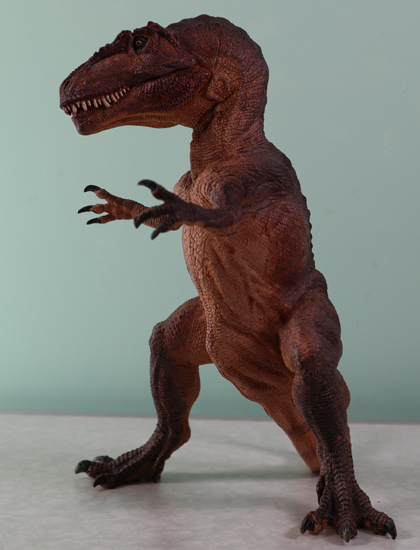
Papo Giganotosaurus.
The Papo Giganotosaurus dinosaur model. Picture credit: Everything Dinosaur.

Picture credit: Everything Dinosaur

The picture (above) shows a brown Papo Giganotosaurus dinosaur model. Is this an accurate reflection of Dinosauria colouration?

To view the Papo dinosaur model range: Papo Dinosaur Models and Figures.

Powerful microscopes in conjunction with the chemical analysis of body tissues demonstrated that internal melanosomes are abundant.  Lead author of the study, Dr Maria McNamara (University College Cork), stated:

“This means that these internal melanosomes could make up the majority of the melanosomes preserved in some fossils.”

However, all might not be lost as according to Dr McNamara, the shape and size of skin melanosomes are usually different from the melanosomes found in internal tissue.  If this is the case, it might permit palaeontologist to refine their melanosome assessments, differentiating between internal and skin melanosome types.  This could lead to more accurate depictions of extinct animals including dinosaurs.

Experiments with Decaying Frogs

Dr Paddy Orr (University College Dublin), along with Dr McNamara’s PhD student Valentina Rossi, also participated in the research, plotting the decay profiles of frogs in order to gain more information on how internal melanosomes can leak into other body parts during the fossilisation process.

Collaborator, Professor Mike Benton from the University of Bristol’s School of Earth Sciences, commented:

“Understanding the origin of melanosomes is crucial in the new studies of colour in dinosaurs and other extinct beasts.”

Slab and Counter Slab Splitting Can Influence the Picture

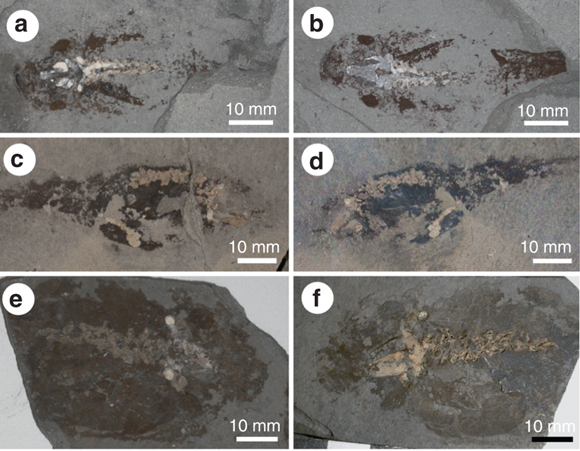
How a fossil is found in a slab or concretion can also influence any analysis of melanosomes.  The researchers examined the distribution of soft tissues in the slab and counter slab of fossil amphibians.  If the plane of splitting passes through the middle of the soft tissues, non-integumentary melanosomes can be exposed at the surface, producing nearly identical distributions of soft tissues in the slab and counter slab.

Distribution of Soft Tissues in the Slab and Counter Slab

Amphibian fossils.
Amphibian fossils from Europe (slab and counter slab) showing nearly identical distribution of soft tissue between the two parts.

Picture credit: Nature Communications

The photographs (above), labelled a to f, show near identical distributions of soft tissues in the slab and counter slab components of a fossil.  However, if the fossil is split, not quite in the middle (not a medial split), then the slab and counter slab are likely to show different distributions of soft tissue components.  Internal melanosomes may still be exposed at the surface of the fossil.

Uneven Distribution of Soft Tissue Between Slab and Counter Slab

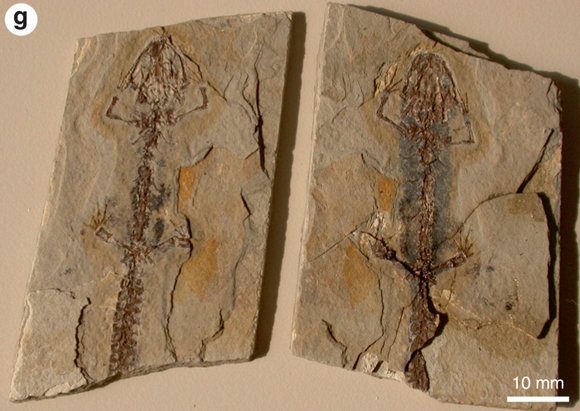
Chelotriton fossil salamander.
The dissimilar distribution of soft tissues in part and counterpart demonstrates that the plane of splitting is not precisely medial within the soft tissues; non-integumentary melanosomes may still be exposed at the surface.

Picture credit: Nature Communications

The picture (g), is the slab and counter slab of the prehistoric salamander Chelotriton from the Miocene of Spain.  The part of the fossil on the right shows more black staining, the remnants of soft tissues preserved in the fossil.  The plain of splitting of this fossil is not precisely medial, therefore leading to one side of the fossil showing greater staining than its counterpart.

A spokesperson from Everything Dinosaur commented:

“This newly published research, rather than thwarting attempts to reconstruct dinosaurs and other prehistoric animals, might actually lead to a refining of the illustration process, allowing palaeontologists and the palaeoartists that work closely with them to create more accurate reconstructions.”

Everything Dinosaur acknowledges the assistance of a media release from the University of Bristol in the compilation of this article.

Visit the Everything Dinosaur website: Everything Dinosaur.
21 07, 2018

Akainacephalus johnsoni – Beauty is in the Eye of the Beholder

By |2023-10-20T13:51:14+01:00July 21st, 2018|Categories: Dinosaur and Prehistoric Animal News Stories, Dinosaur Fans, Main Page, Photos/Pictures of Fossils|0 Comments

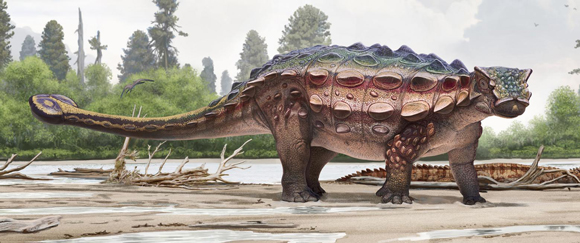
Akainacephalus johnsoni – One of the Oldest “Swingers” from North America

On Thursday of last week, a scientific paper was published in the on-line open access journal PeerJ, that described the discovery of a new species of armoured dinosaur from Utah.  The armoured dinosaur was named Akainacephalus johnsoni, the genus name is derived from the Greek meaning “spiky” or “thorn”, a reference to the large number of bony scales (caputegulae) located on the top and sides of the skull.  The species name honours Randy Johnson, a volunteer preparator at the Natural History Museum of Utah, who skilfully and patiently prepared the skull and lower jaws of this newly described ornithischian.

Akainacephalus johnsoni

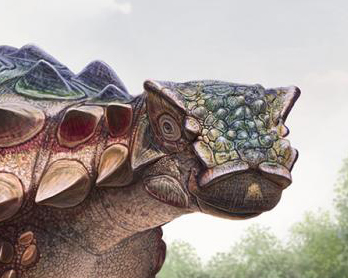
A Close-up View of the Bony and Scaly Head of Akainacephalus

Akainacephalus johnsoni illustrated.
A close up of the ornate head of Akainacephalus johnsoni.

Picture credit: Andrey Atuchin (Denver Museum of Nature and Science)

Secondary Functions of the Dermal Armour

This was one very heavily armoured ankylosaurid, with a face described by many media outlets as “ugly” or being one that only a “mother could love”.  The fossilised skull, which is nearly complete reveals an extensive amount of armour and ornamentation.  For example, the snout is particularly bony, covered in large osteoderms and above each eye there is a substantial horn.  Although this armour would have served as protection against attack, the degree of ornamentation in Akainacephalus was quite remarkable, it is likely that these osteoderms, the various lumps and bumps on the dinosaur’s body and head, served a number of functions.

Suggested functions for the extensive ornamentation of A. johnsoni

  • Anti-glare and anti-dazzle for the eyes.  If you look at the close-up view of the head of Akainacephalus in the illustration (above), the eye is shaded.  The various projections along the broad snout could have obscured the animal’s vision, but the eye would have been shaded from direct sunlight, a positive advantage in the Late Cretaceous of Utah.
  • Sexual selection – the greater the ornamentation the more imposing the individual.  Just as with peacocks and their impressive tails, deer and their antlers, the greater the number of bumps and lumps could have been a sign of the animal’s fitness to mate.  It might be one very ugly looking dinosaur to us, but beauty is in the eye of the beholder, the lumpier the Akainacephalus the greater the appeal of that individual.
  • In a similar vein to the point made above, the ornamentation could have played a role in display, intimidating rivals as part of ritualistic intraspecific combat or helping to put off the unwanted attentions of any large theropod that had decided to try and make a meal of this four-metre-long armoured dinosaur.
  • Thermoregulation – the dermal armour of crocodilians serves a number of functions, one of which is to help to regulate the animal’s body temperature.  The wide gut of ankylosaurids gave them a large surface area for the sun to beat down onto.  By pumping blood into the osteoderms the animal could cool down, helping to maintain its body temperature.

Armoured Dinosaur Mixed Up with Lots of Other Fossils

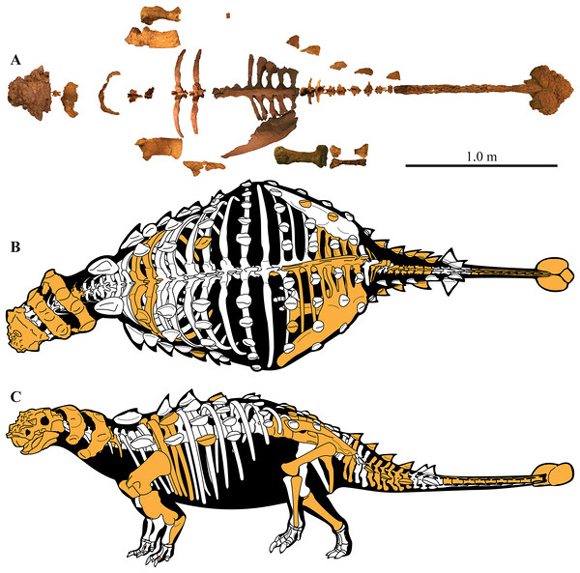
The Fossil Remains of Akainacephalus and two Skeletal Reconstructions

Akainacephalus fossils and a skeletal reconstruction.
The skeletal remains of Akainacephalus with two line drawings (dorsal and lateral views). Known fossil bones are highlighted in orange.

Picture credit: PeerJ

The first fossils were found in 2008, in a quarry which contained a mixed assemblage of vertebrate remains.  Finds at the site, known as the Horse Mountain Gryposaur quarry, include a nearly complete skull of the hadrosaurid Gryposaurus, turtle fossil remains (Arvinachelys goldeni), a skull and postcranial remains of a new taxon of alligatoroid and a poorly preserved partial skull of a small theropod.

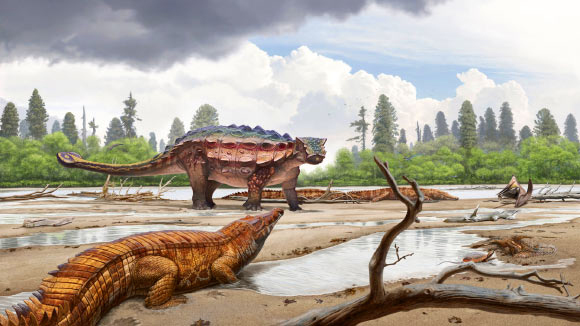
Akainacephalus Wanders Past Ancient Crocodilians

Akainacephalus johnsoni.
The Akainacephalus drawing shows some of the fauna associated with the dig site – crocodiles and a small freshwater turtle (right) – Arvinachelys goldeni.

Picture credit: Andrey Atuchin (Denver Museum of Nature and Science)

The Amazing Kaiparowits Formation

The fossils were excavated from sediments associated with the Kaiparowits Formation, which provides a unique perspective on the biota of south/central Laramidia during the Campanian faunal stage of the Late Cretaceous.  This thick succession of sandstones and mudstones was deposited at an unusually rapid rate within a time frame of less than two million years, making it one of the most rapidly deposited terrestrial formations in the world.  Akainacephalus dates from 76.2 to 75.9 million years ago, as such it is one of the oldest ankylosaurids known from North America.

It is also the first documented example of ankylosaurid skull and postcranial bones from the Kaiparowits Formation.  Although, some of the fossil bones are in a better condition than others, the fossils, including that amazing tail club are remarkably complete.

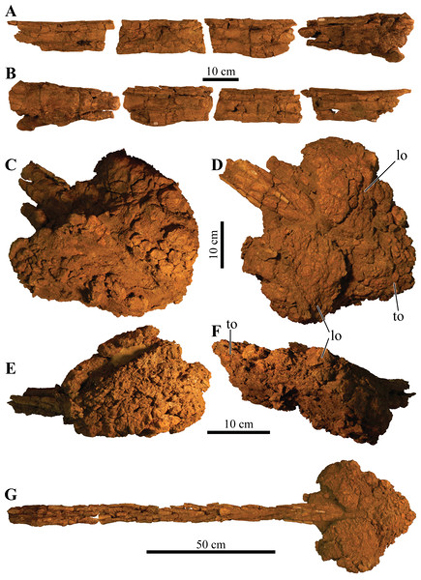
Views of the Caudal Vertebrae and the Tail Club of A. johnsoni

Akainacephalus tail club and caudal bones.
Akainacephalus caudal bones and tail club.

Picture credit: PeerJ

Dinosaur Immigrants from Asia

Those lumps and bumps on the skull (cranial ornamentation), are reminiscent of an armoured dinosaur from New Mexico (Nodocephalosaurus kirtlandensis), the researchers postulate that these dinosaurs might be closely related.  However, it is worth noting that Nodocephalosaurus is around three million years younger than Akainacephalus.  Both Nodocephalosaurus and Akainacephalus are also similar to Asian ankylosaurids such as Saichania chulsanensis, Pinacosaurus grangeri, and the spectacularly horned Minotaurasaurus ramachandrani.   The discovery of Akainacephalus adds support to the idea that ankylosaurids migrated across an ancient land bridge from Asia into North America prior to 76 million years ago.

The addition of this new ankylosaurid taxon from southern Utah provides further information on ankylosaurid diversity and supports the theory regarding there being regional variations in dinosaur biota across Laramidia during the later stages of the Cretaceous.

Indicating that Ankylosaurids Migrated from Asia into North America (Akainacephalus johnsoni)

Akainacephalus johnsoni illustrated.
Akainacephalus illustrated.

Picture credit: Andrey Atuchin (Denver Museum of Nature and Science)

Visit the Everything Dinosaur website: Everything Dinosaur.

20 07, 2018

Xiaophis myanmarensis – Remarkable Dawn Snake of Myanmar

By |2024-05-11T06:16:22+01:00July 20th, 2018|Categories: Dinosaur and Prehistoric Animal News Stories, Dinosaur Fans, Main Page, Photos/Pictures of Fossils|0 Comments

Baby Snake Preserved in Amber from Myanmar

A team of international researchers including scientists from the University of Alberta, Midwestern University and the Chinese Academy of Sciences have published a paper describing the remarkable discovery of the preserved remains of a baby snake entombed in amber from Myanmar (Burma). The snake has been named Xiaophis myanmarensis.

Amber deposits from northern Myanmar are providing scientists with some amazing insights into life in a forest some 100 million years or so ago.  Other amber nodules, known as burmite have revealed the preserved remains of baby birds, a dinosaur tail, frogs and an astonishing range of invertebrates and plant material.  The amber is proving to be a treasure trove for palaeontologists helping them to map the biota of a Cretaceous environment.

The Polished Amber Nodule Revealing the Fossilised Remains of a Baby Snake

The fossilised remains of a baby snake preserved in amber
The preserved remains of a baby snake preserved in amber from Myanmar.

Picture credit: Ming Bai (Chinese Academy of Sciences)

Xiaophis myanmarensis – Dawn Snake of Myanmar

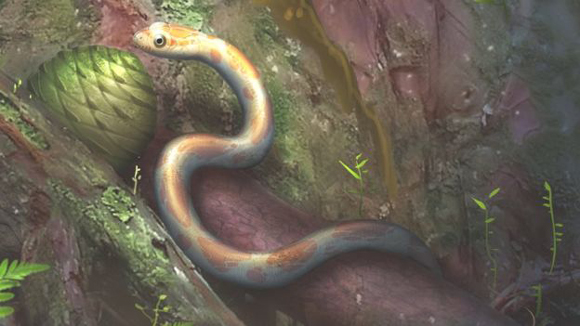
The baby snake measures around eight centimetres in length.  The fossil reveals that the vertebrae are not yet fully formed and this indicates that the snake was very young when it got trapped in the sticky tree resin.  The snake has been named  Xiaophis myanmarensis, which means “dawn snake of Myanmar”.

The international research team, led by Dr Lida Xing (China University of Geosciences, Beijing and the Chinese Academy of Sciences) and Professor Mike Caldwell (University of Alberta), have described this discovery as a remarkable fossil find.

A Life Restoration of Xiaophis myanmarensis

Dawn snake of Myanmar (Xiaophis myanmarensis)
An illustration of Xiaophis myanmarensis (dawn snake of Myanmar).

Picture credit: Cheung Chung Tat

Not One Fossil Snake but Two

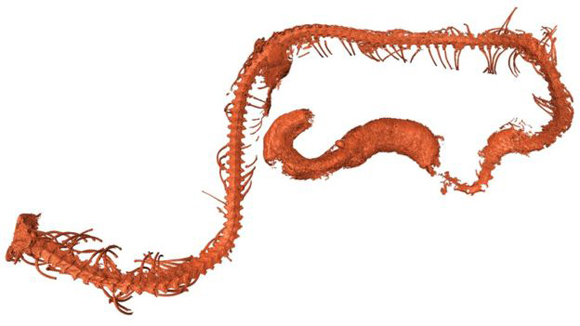
Although the baby snake is missing its skull, ninety-seven vertebrae have been preserved along with associated fossil ribs.  The tiny reptile’s bones were analysed using a synchrotron to bombard the specimen with X-rays and plot the result.  The back bone is remarkably similar to those found in neonatal snakes today.  This suggests that the vertebrae of snakes have remained largely unchanged for 100 million years.

A second amber fossil was discovered, which preserves a piece of the shed skin of another, much larger snake.  It is unclear whether these two fossils represent the juvenile and adult of the same species.

The Skeleton of the Baby Snake As Modelled from the Synchrotron Data

The preserved skeleton of the baby snake Xiaophis myanmarensis.
The skeleton of the baby snake Xiaophis myanmarensis.

Picture credit: Ming Bai (Chinese Academy of Sciences)

Xiaophis myanmarensis – A Remarkable Fossil

The discovery of this remarkable fossil, along with the piece of shed snake skin helps palaeontologists to build a picture of the evolution of snakes and how they spread following the break-up of the super-continents during the latter stages of the Mesozoic.

Dr Palci (Flinders University) and a co-author of the scientific paper published in the journal “Science Advances” commented:

“At 100 million years old, it dates back to the age of the dinosaurs, well before snakes started to differentiate into modern groups.  This Asian fossil helps shed light on how primitive snakes dispersed from the southern to the northern continents.  Although found in the Northern Hemisphere, it strongly resembles South American snakes that lived at the time.”

An Illustration of the Second Snake Specimen (Life Reconstruction)

Shed snake skin found in burmite.
The preserved skin of a second prehistoric snake has been found in amber from Myanmar.

Picture credit: Yi Liu

During the Jurassic, the region that we now know as Myanmar was joined to Antarctica, Australia, Africa and South America, forming the giant, southern super-continent of Gondwana.  As the Mesozoic progressed so this landmass began to split apart, Myanmar separated from Gondwana and drifted north, eventually colliding with Asia.

This is the first baby snake fossil from the Mesozoic ever found and it, along with other remarkable specimens preserved in amber from Myanmar (burmite), are providing scientists with a unique window into the Late Cretaceous world.

Visit the Everything Dinosaur website: Everything Dinosaur.
19 07, 2018

How Much Food Did Sauropods Eat? That’s a Great Question!

By |2024-05-11T06:03:38+01:00July 19th, 2018|Categories: Dinosaur and Prehistoric Animal News Stories, Dinosaur Fans, Main Page, Palaeontological articles|1 Comment

New Research Examines the Diets of Giant Dinosaurs

How many plants would a ten tonne Diplodocus need to eat to keep it happy and healthy?  For that matter, what about one of its larger cousins such as the macronarian Camarasaurus that tipped the scales at an estimated twenty tonnes?  If you had a pet Dreadnoughtus  (D. schrani), a long-necked, herbivorous dinosaur that was heavier than a dozen African elephants, how much food would you need to feed it each day?

Super-sized Sauropods and Their Super-sized Digestive Tracts

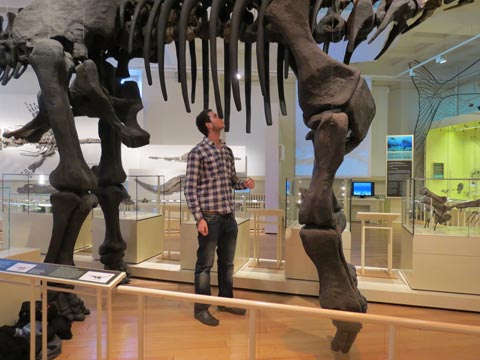
Paleaontologist Dean Lomax explores a Ceitiosaurus.
A belly up view of “Whale Lizard”.  Palaeontologist Dean Lomax tackling the tummy of Cetiosaurus.  How much food did “Whale Lizard” eat?

Picture credit: Dean Lomax

Palaeontologists have puzzled over the dietary requirements of these super-sized animals for many years.  One of the theories put forward to explain the huge size of sauropods is that they needed to grow big so that they could carry around their vast digestive tracts that were needed to process the huge volumes of plant matter required to provide them with enough energy to do what dinosaurs needed to do.

Sauropoda body mass becomes a sort of self-fulfilling prophecy.  You grow up fast and grow big to avoid predation, so you require a lot food to sustain your body, the bigger you get the more food you need to keep you going, the larger the stomach, especially as your teeth don’t play any role in helping to break up tough stems and foliage.

A Novel Approach

A team of scientists, including researchers from Leeds University, Nottingham University and the University of Göttingen (Germany), have conducted a novel piece of research so that the dietary needs of the largest terrestrial vertebrates can be better understood.  The team grew their own dinosaur food in atmospheric conditions that replicated the environment of the Late Jurassic.  Writing in the journal “Palaeontology”, the research team report on an experiment in which they grew typical plants that would have played a role in the diet of giant, herbivorous dinosaurs, ferns, horsetails, monkey puzzle trees and ginkgos.

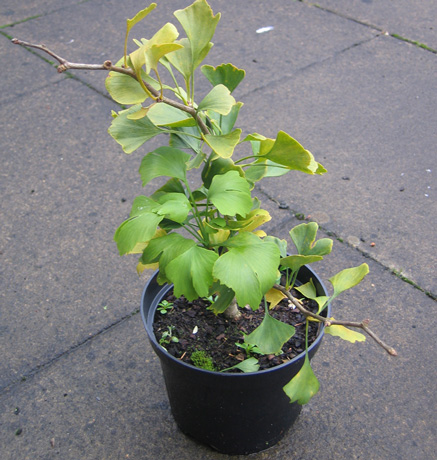
The Ancient Ginkgo (Maidenhair) Tree – Dinosaur Food Assessed in this Plant Growth Experiment

A Ginkgo biloba tree.
A small Ginkgo tree (G. biloba).  Typical of the canopy plants that would have been fed upon by sauropods. Picture credit: Everything Dinosaur.

Picture credit: Everything Dinosaur

Plants of the Jurassic Had a Low Nutritional Value

It had been thought that plants growing in an atmosphere with a high amounts of carbon dioxide had low nutritional value.  As a result, herbivorous dinosaurs had to consume vast quantities of plant material in order to obtain enough energy to sustain themselves.

A new experimental approach led by Dr Fiona Gill (School of Earth & Environment, Leeds University), has demonstrated that this may not be the case.  To explore the nutrition of a typical sauropod’s diet, a range of plants were chosen.  Plants representing the understory community, such as a fern (Polypodium vulgare), a type of horsetail (Equisetum hyemale) as well as Ranunculus acris, a member of the buttercup family to represent an early Cretaceous angiosperm (flowering plant), were selected.  Plants representing the forest canopy included the Ginkgo (G. biloba), Araucaria araucana, the monkey puzzle tree and a type of redwood conifer (Metasequoia glyptostroboides).

A Sauropod Stomach Study

The atmosphere was controlled as the plants were grown in walk-in growth chambers and the carbon dioxide concentrations were selected to represent a range of recent estimated CO2 values for the Mesozoic.  Although we are seeing a rise in atmospheric amounts of carbon dioxide today, it has been estimated that during the Age of Dinosaurs there was considerably more CO2 in the atmosphere.  By simulating prehistoric atmospheres, the research team could then cut leaves from the plants and test their nutritional value.  The understory plants were exposed to a Mesozoic climate for three months, the slower growing plants representing the canopy were give six months in the Mesozoic atmospheric conditions.

The Researchers Set Out to Create a Growing Room Atmosphere that Replicated the Conditions of the Mesozoic

A Jurassic scene
Turning walk-in growing rooms into the Jurassic!

An Artificial Sauropod Stomach

An artificial fermentation system was used to simulate digestion of the plant leaves in the sauropods’ enormous stomachs.  This permitted the research team to calculate the leaves’ nutritional value.  The results showed many of the plants had significantly higher energy and nutrient levels than previously believed.

The scientists concluded that these megaherbivores would have needed to consume much less plant material per day than previously thought.  Dinosaur numbers may not have been as constrained by the amount of plant food available.  Ecosystems could have potentially supported a much bigger dinosaur population density.  This might go some way to helping to explain the presence of lots of megaherbivores, including several different genera of sauropod present in the Upper Jurassic Morrison Formation of the United States.

Lead author Dr Gill, explained:

“The climate was very different in the Mesozoic Era, when the huge Brachiosaurus and Diplodocus lived with possibly much higher carbon dioxide levels.  There has been the assumption that as plants grow faster and/or bigger under higher CO2 levels, their nutritional value decreases.  Our results show this isn’t the case for all plant species.”

Higher CO2 Levels

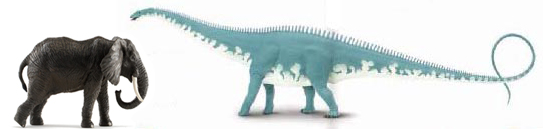
Having modelled the effect of different food metabolisable energy (ME), contents in digested plants and plotted this against estimated energy requirements for different sized sauropods, the scientists concluded that instead of having to consume over a hundred kilograms of plants per day much smaller quantities would be required.  For example, a 10 tonne Diplodocus with an assumed energy requirement of 280 kJ of metabolisable energy per kilogram of body weight per day, feeding exclusively on ferns would need to eat 33.2 kg per day.  If it dined exclusively on horsetails it would need to eat 23.8 kilograms per day.  An elephant, although smaller, as an endothermic mammal has a much greater energy requirement and would need to consume around 40 kilograms of plant material to sustain it.

An African Elephant Compared to a Diplodocid

Comparing the food requirements of megaherbivores.
The nutritional requirements of dinosaurs have been compared to those of megaherbivores today. Picture credit: Everything Dinosaur.

Picture credit: Everything Dinosaur

Studying Dinosaur Diets

Dr Gill stated:

“The large body size of sauropods at that time would suggest they needed huge quantities of energy to sustain them.  When the available food source has higher nutrient and energy levels it means less food needs to be consumed to provide sufficient energy, which in turn can affect population size and density.  Our research doesn’t give the whole picture of dinosaur diet or cover the breadth of the plants that existed at this time, but a clearer understanding of how the dinosaurs ate can help scientists understand how they lived.”

This research is not limited to the Dinosauria, the same methodology can be utilised to model the atmospheric conditions at other points in geological deep time, to assess the nutritional requirements and feeding habits of long extinct, Miocene and Oligocene mammals for example.

The scientific paper: “Diets of Giants: the Nutritional Value of Sauropod Diet during the Mesozoic” by Fiona L. Gill, Jürgen Hummel, A. Reza Sharifi, Alexandra P. Lee, and Barry H. Lomax published in Palaeontology, the journal of the Palaeontological Association.

Visit the Everything Dinosaur website: Everything Dinosaur.
17 07, 2018

Sad “tail” of a Spanish Plesiosaur

By |2023-11-11T13:12:17+00:00July 17th, 2018|Categories: Dinosaur and Prehistoric Animal News Stories, Dinosaur Fans, Main Page, Photos/Pictures of Fossils|0 Comments

Fossil Discovery Hints at Spanish Elasmosaurid

Recently printed in the academic journal “Cretaceous Research”, a trio of scientists have published details about a new plesiosaur specimen discovered in Late Cretaceous sediments in Guadalajara Province in central Spain.  Plesiosaur specimens are exceptionally rare from the Late Cretaceous of Europe and although the fossil material is indistinct in terms of any autapomorphies (unique features), that would permit the establishment of a new species, the fragmentary fossils, including a single tail bone, represent an important discovery nonetheless.

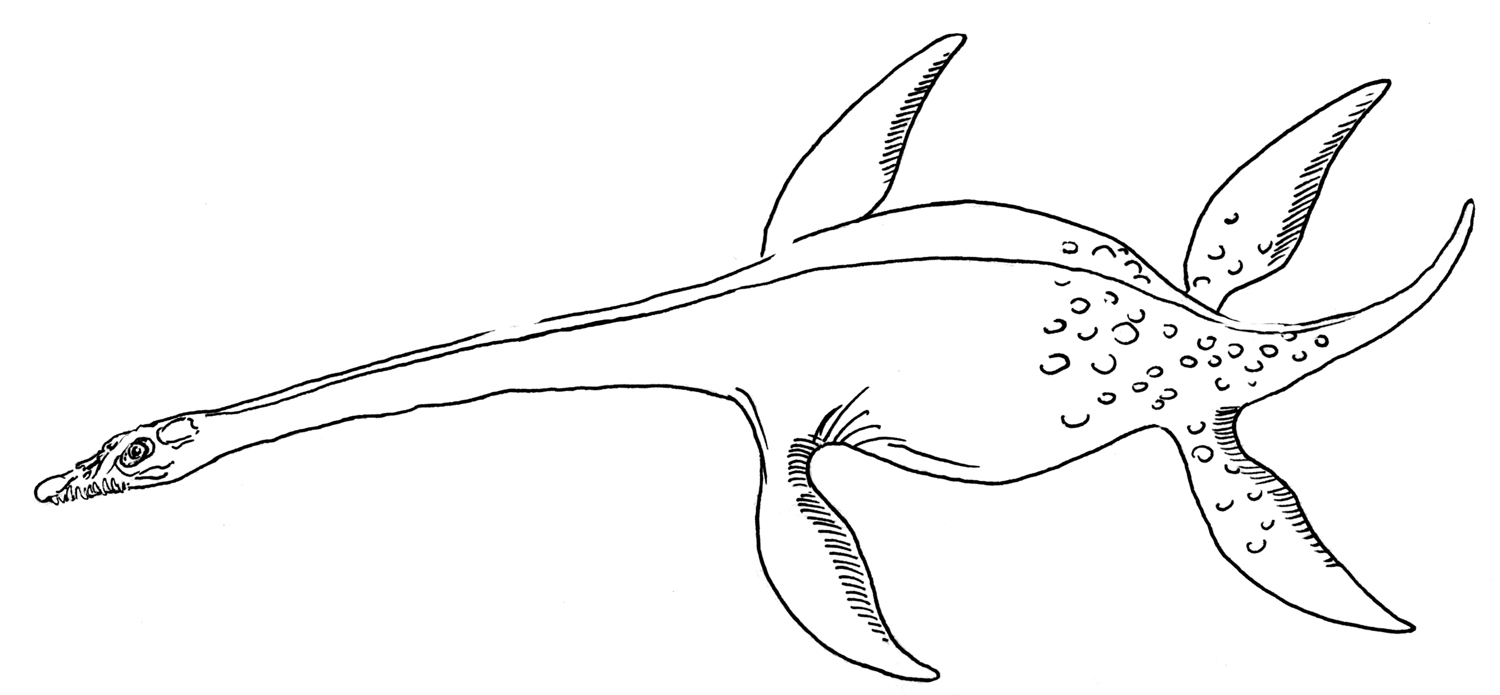
An Illustration of a Typical Member of the Plesiosauridae

Attenborosaurus conybeari.
Plesiosaurs swam in the Cenomanian seas of Europe.

Picture credit: Everything Dinosaur

The picture (above) is based on a Collecta Prehistoric Life marine reptile model.

To view this range of models: CollectA Prehistoric Life Models and Figures.

The First Plesiosauria from Algora

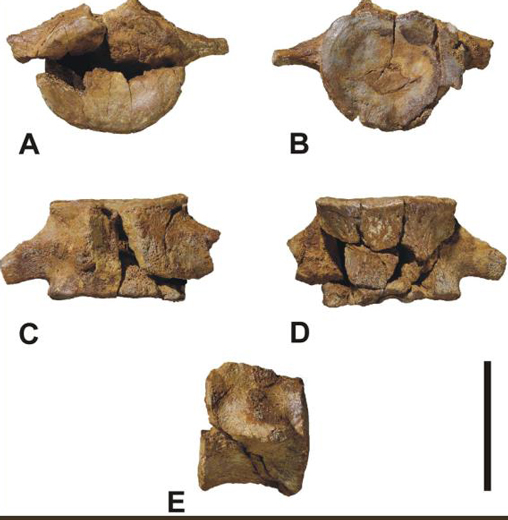
The fossils consist of elements from a pelvic girdle and a caudal vertebra (tail bone).  They are the first evidence of a plesiosaur in the coastal marine outcrops of Algora (Castilla-La-Mancha), Spain.  It is one of only a handful of such specimens reported from the Cretaceous of Spain.

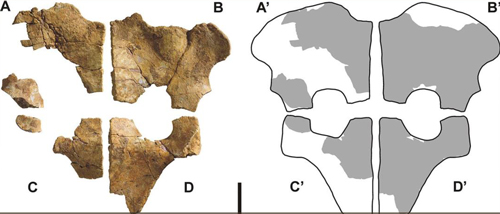
The Pelvic Girdle Fossil Bones with an Accompanying Line Drawing

Late Cretaceous Plesiosaur fossils from Spain.
The fossils making up part of the pelvic girdle with a line drawing (right).

Picture credit: N. Bardet, M. Segura and A. Pérez-García/Cretaceous Research

An Elasmosaurid

The fossils probably represent a single individual, as such, it is the only plesiosaur specimen from central Spain that is known from several bones.  The researchers conclude that the material represents an indeterminate member of the Elasmosauridae.  Elasmosaurids were a type of plesiosaur that had a wide geographical range during the Late Cretaceous and one that persisted to the end of the Maastrichtian faunal stage.

Views of the Caudal Vertebra (Indeterminate Elasmosaurid)

Photographs (various views) of a Plesiosaur caudal vertebra.
Images of a caudal vertebra (Late Cretaceous plesiosaur).

Picture credit: N. Bardet, M. Segura and A. Pérez-García/Cretaceous Research

The authors of the scientific paper include a researcher from the Natural History Museum of Paris (Muséum National d’Histoire Naturelle), as well as two researchers based in Spain.  They suggest that the fossils represent an individual that either died further out to sea and was washed into a bay (thanatocoenosis), or the remains of an animal that lived in a near-shore environment (biocoenosis).

The scientific paper: “A Plesiosaur (Reptilia, Sauropterygia) from the Cenomanian (Late Cretaceous) of Algora (Guadalajara Province, Central Spain)” by N. Bardet, M. Segura and A. Pérez-García published in Cretaceous Research.

Visit the award-winning Everything Dinosaur website: Everything Dinosaur.
16 07, 2018

Does the Fossil Record Represent True Diversity? That’s a Great Question!

By |2024-05-11T06:09:36+01:00July 16th, 2018|Categories: Dinosaur and Prehistoric Animal News Stories, Dinosaur Fans, Palaeontological articles, Photos/Pictures of Fossils|0 Comments

How Helpful is the Fossil Record When it Comes to Extinct Animal Diversity?

When it comes to understanding biodiversity in ancient palaeoenvironments, scientists have to rely on the fossil record for their information. Ghost lineages can be inferred, the likelihood of related genera can be proposed using cladistics and phylogeny, but ultimately it is the fossils that form the basis of our understanding about how diverse life was in the past.  This reliance on fossil material has numerous drawbacks.  The fossil record is very incomplete and there is a large preservation bias between different organisms and different environments.  For example, a snail with its hard shell, living on the muddy bottom of a shallow sea has got more chance of becoming a fossil than a soft-bodied mushroom living in a temperate forest.

Palaeontologists have to ask themselves: can the fossil record can be trusted to provide information about biodiversity?

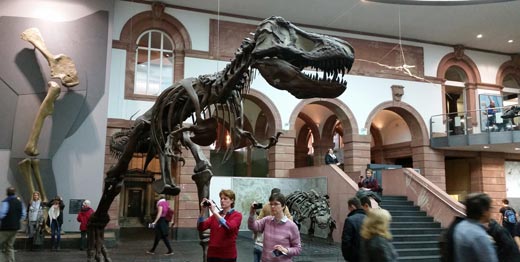
Tyrannosaurus rex Might Be Popular with Museum Visitors but Other Meat-eating Dinosaurs Have a Much Less Complete Fossil Record

T. rex skeleton at the Frankfurt Natural History Museum
T. rex might be very popular with museum visitors, but in reality most of the Tyrannosauroidae are very poorly known. Picture credit: Everything Dinosaur.

Mosasaurs Help to Provide Some Insight

Species are often named and described on the flimsiest of evidence, take for example famous dinosaurs such as Trachodon and Troodon, dinosaurs that were first named based on the finding of isolated teeth.  Fortunately, these days ,there is a higher bar set when it comes to establishing that a fossil represents an animal new to science, although some new species are still named based on very fragmentary fossils.

Could it be that our understanding of past biodiversity is simply related to the quality of fossil material in different geological rock formations through time?  This question relates to a fundamental debate within palaeontology about the quality and trustworthiness of the fossil record.

Exploring and Understanding the Fossil Record

Researchers from Bristol University and Leeds University set out to explore the relationship between the number and quality of fossils and their relationship with past diversity.  Writing in the journal “Palaeontology”, the scientists focused on the Mosasauridae, that family of marine reptiles closely related to today’s snakes and lizards that thrived in the Late Cretaceous before meeting their demise at the same time as the dinosaurs.

Using Mosasaur Models to Examine the Diversity of Extinct Animals

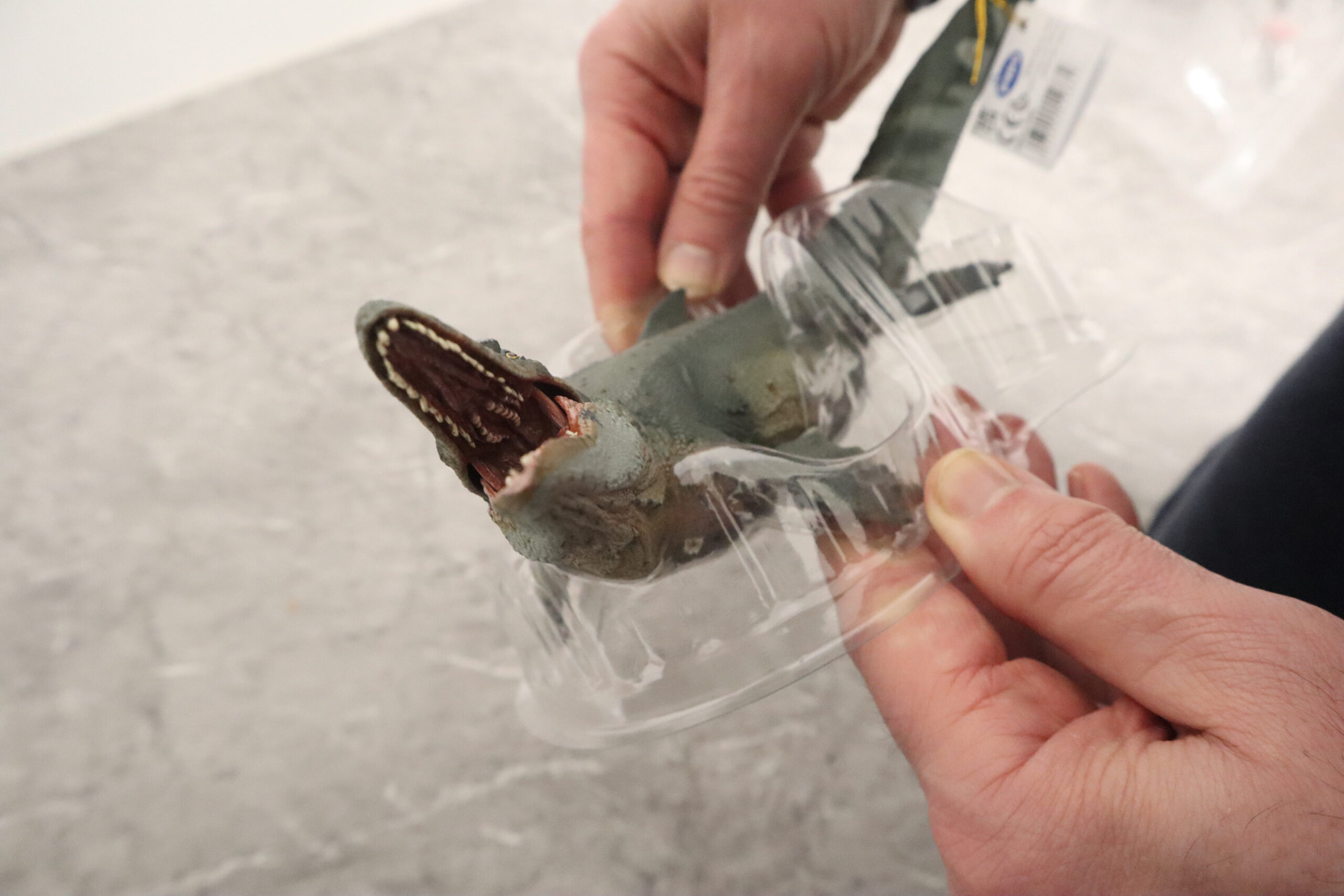
Pterygoid teeth of the Papo Mosasaurus model.
The Papo Mosasaurus figure has pterygoid teeth located in the roof of the mouth. A mosasaur model is used to help explain the diversity of the Animalia. Picture credit: Everything Dinosaur.

Picture credit: Everything Dinosaur

The picture (above) shows the Papo Mosasaurus model.

To view the range of Papo prehistoric animal figures: Papo Prehistoric Animal Models.

Mosasaurs evolved into a number of different forms during the Cretaceous, some were giants, measuring more than thirteen metres in length and were the apex predators of marine ecosystems.  Other species were much smaller such as the five-metre-long Platecarpus that fed on fish, squid and ammonites.  Scientists have even identified a possible freshwater species of mosasaur (Pannoniasaurus inexpectatus).

The Fossil Record Indicates Diversity Amongst the Mosasauridae

Illustrating the diversity of the Mosasaurs.
Fossils illustrate the diversity of the Mosasauridae.

Picture credit: Tom Stubbs and Dan Driscoll

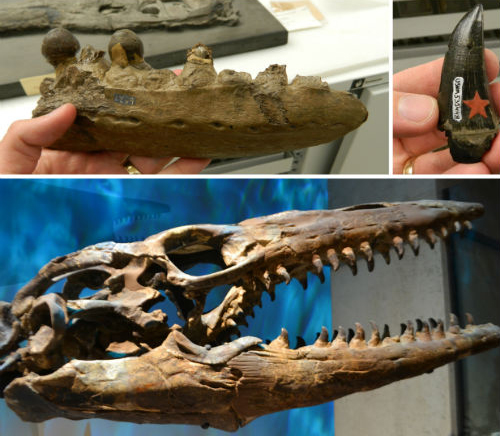
The picture (above), illustrates some of the diversity found in the Mosasauridae.  Some species are known from very fragmentary remains such as isolated bones and teeth, other species have been named based on far more complete skeletons.  The partial lower jaw (top picture), shows the rounded teeth, almost ball-like teeth of a member of the Globidensini tribe of mosasaurs.  A group of mosasaurs that evolved specialised teeth to cope with hard-shelled prey such as ammonites and crustaceans (durophagous diet). 

The photograph (far right), shows a single mosasaur tooth.  It is very large and the crown is robust and pointed, typical dentition associated with predatory behaviour, attacking and consuming other large vertebrates.  The picture (bottom), shows a complete, restored skull of a mosasaur with a jaw containing small, recurved teeth indicative of a diet of fish or other small slippery creatures such as squid.

Dr Dan Driscoll (Bristol University), the lead author of the research stated:

“Mosasaurs have one of the richest vertebrate fossil records and have attracted study for over two centuries.  The first mosasaur described was in 1808!  Often, studies of fossil record quality have focused simply on the numbers of fossil species, however, it is important to consider the completeness of individual fossil specimens, and whether this distorts our view of diversity.  To do this, robust statistical analysis is required.”

Using Mathematical Models to Test the Completeness of the Mosasaur Fossil Record

The researchers documented over four thousand and eighty mosasaur specimens and scored them for their degree of completeness.  This is the largest quantitative analysis of its kind undertaken to date.  By using mathematical modelling, the scientists were able to demonstrate that fossil completeness does not bias the fossil record of mosasaurs and that the rich fossil record of the Mosasauridae does provide an accurate illustration of the diversity and evolutionary history of these marine reptiles.

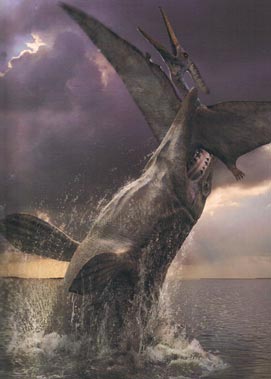
The Diverse Mosasauridae Family Occupied a Number of Niches within Marine Ecosystems

Tylosaurus attacks.
Fearsome marine reptiles such as Tylosaurus were apex predators.

Picture credit: BBC Worldwide

Bristol University’s Dr Tom Stubbs, a co-author of the study explained:

“Mosasaurs were key players in Late Cretaceous marine ecosystems.  Our study confirms that Mosasaurs were a successful group of animals that continued to diversify through their evolutionary history, before being abruptly wiped out by the extinction event that also impacted dinosaurs and many other groups.”

Fresh Insights into Mosasauridae Evolution

The conclusions provided by this new research reveals new insights into the evolution of the Mosasauridae, and highlights that, although the fossil record is most definitely incomplete, variable fossil completeness does not appear to bias large scale evolutionary and ecological patterns.

Co-author, Dr Alex Dunhill, (School of Earth and Environment at the University of Leeds), added:

“Palaeontologists often presume that the vertebrate fossil record is heavily biased by sampling.  This may be so but, here we show that variation in the completeness of fossil specimens does not appear to bias large scale evolutionary patterns.”

Everything Dinosaur acknowledges the assistance of a media release from the University of Bristol in the compilation of this article.

The scientific paper: “The Mosasaur Fossil Record Through the Lens of Fossil Completeness” by D. Driscoll, A. Dunhill, T. Stubbs and M. Benton published in Palaeontology.

Visit the Everything Dinosaur website: Everything Dinosaur.
Go to Top