All about dinosaurs, fossils and prehistoric animals by Everything Dinosaur team members.

Fossil finds, new dinosaur discoveries, news and views from the world of palaeontology and other Earth sciences.

24 09, 2018

New Marine Reptile Fossil Display at Museum

By |2023-10-30T11:03:12+00:00September 24th, 2018|Categories: Dinosaur and Prehistoric Animal News Stories, Dinosaur Fans, Main Page|0 Comments

Oxford University Museum of Natural History – Out of the Deep

Oxford University Museum of Natural History has welcomed two new residents, a pair of Jurassic marine reptiles that are the focus of a novel, tactile and interactive exhibit entitled “Out of the Deep”.  The fossilised remains of the two marine reptiles highlight the importance of the British Isles when it comes to studying apex predators of Mesozoic marine environments.  Both fossils were found in Britain and these new additions to the impressive Oxford University Museum collection, represent the largest permanent display to be added to the Museum’s central gallery in decades.

Two Marine Reptile Specimens on Display at the Oxford University Museum of Natural History
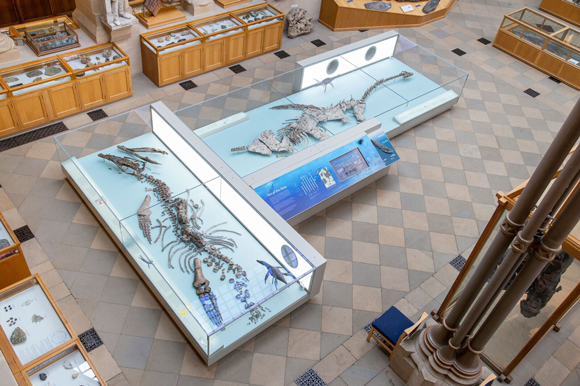
Two marine reptile fossils on display.
Plesiosauria fossils on display at the Oxford University Museum of Natural History.

Picture credit: Oxford University Museum of Natural History

Jurassic Marine Reptiles and the Diversity of the Plesiosauria

The beautiful and nearly complete fossils are displayed in separate well-lit display cases and the fossils, along with the interactive elements and information boards in this exhibit, help to inform visitors about the two main body plans that evolved amongst the Plesiosauria.  One specimen is a short-necked plesiosaur, known as a pliosaur.  It was discovered by a former Museum curator in the 1990s in Yarnton, Oxfordshire, just a few miles from the Museum.  The larger specimen is a long-necked plesiosaur, found in a quarry in Cambridgeshire in 2014 by the Oxford Clay Working Group, and donated to the Museum’s collections by the quarry’s owner Forterra.

The Exhibits Have Been Designed to Allow Easy Access to View the Specimens
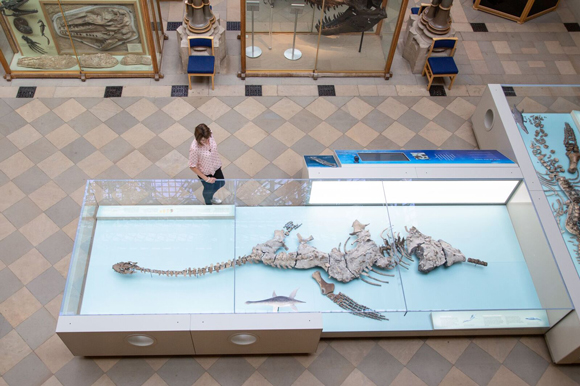
Plesiosaur specimen at the Oxford University Museum of Natural History.
The long-necked plesiosaur fossil specimen.  The person in the photograph helps to demonstrate the impressive size of the marine reptile.

Picture credit: Oxford University Museum of Natural History

Bringing a Middle Jurassic Tropical Sea to Life

The exhibit includes specially commissioned digital reconstructions that brings to life the marine biota that existed some 165 million years ago (Callovian faunal stage of the Middle Jurassic).  Visitors will be able to learn how the fossils were discovered and collected, how museum staff prepare and study specimens and gain an understanding about the life in an ancient, tropical sea that once covered much of the British Isles.

Visitors Will Be Able to Look an Extinct Plesiosaur in the Eye
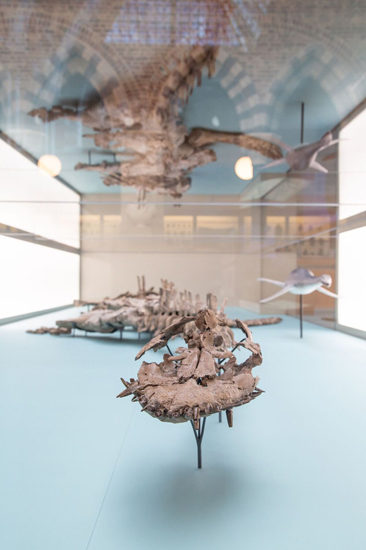
The business end of a Jurassic plesiosaur.
The teeth of the plesiosaur were well adapted for catching fish.

Picture credit: Oxford University Museum of Natural History

“Oxbridge Jurassic Marine Reptiles”

On display together for the first time, the Oxfordshire and Cambridgeshire specimens highlight the UK’s exceptional fossil heritage and provide a glimpse of some of the life inhabiting the marine environment of the Jurassic period.  Detailed and scientifically accurate models have been installed alongside the fossil material to help visitors to appreciate what these ancient reptiles probably looked like when they patrolled the ancient, sunlit waters.

Marine Reptile Models Help Visitors to Appreciate What the Specimens Looked Like When They Lived Some 165 Million Years Ago

A pliosaur model forms part of the exhibit.
A beautiful replica of a pliosaur helps visitors to imagine the fossil specimen as a living animal.

Picture credit: Oxford University Museum of Natural History

The Long-necked Plesiosaur Replica on Display
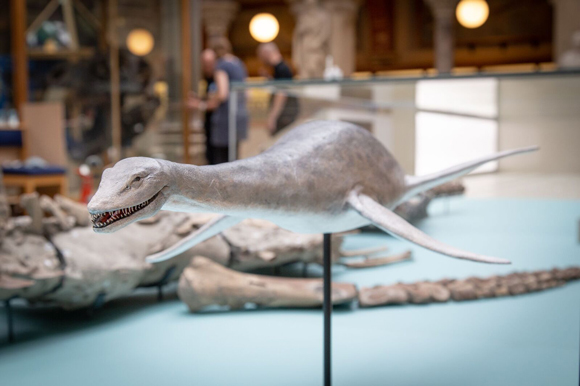
Oxford University Museum of Natural History plesiosaur.
A replica of a long-necked plesiosaur swims into view.

Picture credit: Oxford University Museum of Natural History

Director of the Oxford University Museum of Natural History, Professor Paul Smith commented:

“As the largest single new showcase to be installed in the museum for many years, the “Out of the Deep” display reinvigorates our central court and provides something new for our regular visitors.  After working on these two fantastic plesiosaur skeletons for many months, it’s hugely exciting to be able to display them together and in full for the first time since their discovery.”

Lots of Interactive and Tactile Learning Has Been Incorporated into the New Exhibit

Touching a replica of a pliosaur flipper.
Tactile displays help visitors to learn about marine reptiles.

Picture credit: Oxford University Museum of Natural History

A spokesperson from Everything Dinosaur commented:

“The Oxford University Museum of Natural History houses a treasure trove of prehistoric animal fossils, many of which have been found in Oxfordshire.  It is great to see the addition of these two stunning marine reptiles with their beautifully preserved and near-complete fossil skulls.  Visitors to the Museum will still be able to marvel at the dinosaur fossils on display within the central gallery but they will gain an appreciation that the Jurassic Seas were the domain of other, equally spectacular extinct creatures.”

The project has been generously supported by grants from the DCMS/Wolfson Museums and Galleries Improvement Fund, and WREN’s FCC Community Action Fund.

Everything Dinosaur acknowledges the assistance of a media release from the Oxford University Museum of Natural History in the compilation of this article.

For details about the range of prehistoric animals stocked by Everything Dinosaur: Jurassic Marine Reptiles and Prehistoric Animal Figures.
23 09, 2018

Chemical Clues to the Earliest Animal Fossils

By |2023-10-30T10:53:35+00:00September 23rd, 2018|Categories: Dinosaur and Prehistoric Animal News Stories, Main Page, Palaeontological articles, Photos/Pictures of Fossils|0 Comments

Cholesterol Proves Dickinsonia was an Animal

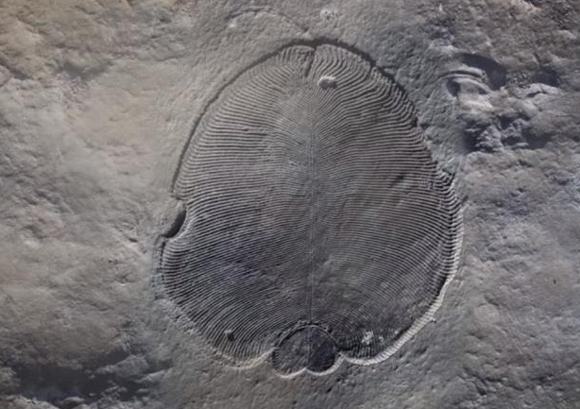
A team of international scientists including researchers from the Australian National University (Canberra) and the Russian Academy of Sciences (Moscow), have finally solved one of the great puzzles in palaeontology.  They have detected molecules of cholesterol in an ancient animal fossil to confirm that the bizarre Dickinsonia, part of the enigmatic Ediacaran biota, was an animal and therefore distantly related to all other animals including humans.

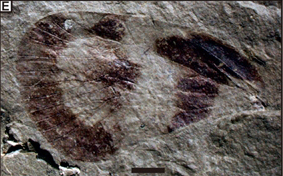
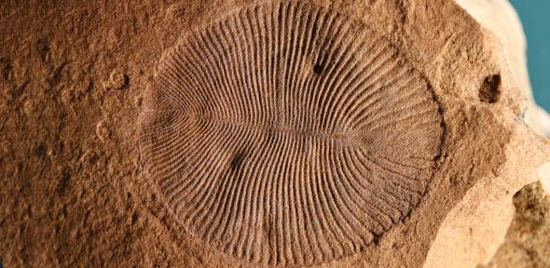
A Fossil of Dickinsonia – A Bizarre Disc-like Organism But What Exactly Was It?

Dickinsonia costata fossil.
The Ediacaran fossil Dickinsonia costata, specimen P40135 from the collections of the South Australia Museum.

Picture credit: Fr Alex Liu (Cambridge University)

The Enigmatic Ediacaran Biota

Before the Cambrian explosion and the evolution of hard-bodied organisms, there existed a strange biota formed of bizarre, soft-bodied organisms that did not show much affinity to Late Cambrian fossil groups and to any form of living organisms today.  Fossils appear in sedimentary rock dated between 570 to 541 million years ago and have been found in Australia, (the Ediacara Hills of South Australia, from which this period in Earth’s history is named) and notably in Namibia, England, China, Canada and Russia.  They were the first complex multi-cellular organisms to appear on Earth.

Although the Ediacaran biota immediately preceded the rapid appearance and diversification of animals in the Cambrian, where these strange organisms fit within the tree of life remained a mystery.  Some of these fossils appear segmented and show some bilateral symmetry, Dickinsonia for example, but most lack any obvious signs of a gut, a mouth, an anus or any appendages that might link them to the Animalia.

This new study, published in the journal “Science”, identified biomarkers, specifically the fat, cholesterol in the fossilised remains of Dickinsonia.  This discovery confirms that at least one bizarre Ediacaran group, Dickinsonia and related taxa are members of the animal kingdom (Metazoa).

Finding Fossils Can Be Dangerous

Australian National University PhD student Ilya Bobrovskiy and his fellow collaborators in this research project, explored a remote area of exposed cliff on the White Sea coast of north-western Russia.  The field team were looking for strata laid down in the Ediacaran so that they could study any fossils preserved within the ancient rocks.  The sedimentary material they were interested in was exposed high up on a steep cliff face and ropes had to be used to get the field team down the cliff face so that they could dislodge sandstone boulders which fell to the beach below and then could be collected for further analysis.

Palaeontology Can Be a Dangerous Business – Dislodging Ancient Marine Sandstone Boulders From the Cliff Face

Extracting sandstone blocks from the cliff face.
Digging out huge blocks of sandstone to find Ediacaran fossils on the Russian White Sea coast.

Picture credit: Australian National University

Dickinsonia – The Earliest Known Animal in the Geological Record

Some Dickinsonia fossils are a whopping 140 centimetres in length, indicating that these organisms were much bigger than most of the Ediacaran and later Cambrian biota, but where they fitted in the classification of life on Earth remained open to conjecture.  Previously, it had been suggested that these fossils represented giant, single-celled amoeba, lichens or dead-end evolutionary experiments that have no connection to other life forms.  The research team discovered a Dickinsonia fossil that was so well preserved that a molecular analysis revealed traces of tiny amounts of cholesterol, a type of fat that is only produced by animal life.  The scientists postulate that this is the conclusive evidence that confirms that Dickinsonia was an animal.

Cholesterol Found in Dickinsonia Proves it was an Animal

Dickinsonia fossil.
A beautifully preserved 558-million-year-old fossil of Dickinsonia, now classified as an animal (Metazoan).

Picture credit: Australian National University

Co-author of the study, Associate Professor Jochen Brocks from the ANU Research School of Earth Sciences commented:

“The fossil fat molecules that we’ve found prove that animals were large and abundant 558 million years ago, millions of years earlier than previously thought.  Scientists have been fighting for more than 75 years over what Dickinsonia and other bizarre fossils of the Ediacaran biota were.  The fossil fat now confirms Dickinsonia as the oldest known animal fossil, solving a decades-old mystery that has been the Holy Grail of palaeontology.”

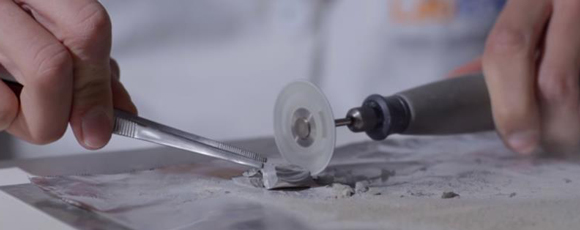
Preparing Fossil Specimens for Analysis

Searching for traces of organic materials such as fats in Dickinsonia.
Preparing a fossil specimen for the organic matter analysis.

Picture credit: Australian National University

Molecular Analysis of Dickinsonia Fossils

Using extremely sensitive techniques to assess the chemical nature of fossil material has opened up whole new areas of study for palaeontologists.  Prior to the employment of such technologies as computerised tomography, synchrotron radiation light sources, biomarker analysis and four-dimensional scanning, palaeontologists were restricted to studying the shape and the form of fossils.  Today, palaeontologists can utilise these new methodologies, drawn from a variety of disciplines such as engineering and medicine to undertake complementary areas of study.

To read an article published in 2017 that postulated that Dickinsonia was a member of the Animal Kingdom and likely to be a Metazoan: Growth Analysis Suggests Dickinsonia was Definitely an Animal.

For models and replicas of ancient prehistoric creatures: Prehistoric Animal Models.

20 09, 2018

Did Alvarezsaurids Eat Eggs? That’s a Fascinating Question

By |2024-05-11T06:21:42+01:00September 20th, 2018|Categories: Dinosaur and Prehistoric Animal News Stories, Dinosaur Fans, Main Page, Photos/Pictures of Fossils|0 Comments

Qiupanykus zhangi – Is This Evidence of Egg-eating Dinosaurs?

A team of scientists including researchers from the Chinese Academy of Sciences, Henan Geological Museum and Lanzhou University, have published a paper announcing the discovery of a new species of dinosaur.  The little animal that might have weighed around half a kilogram, has been named Qiupanykus zhangi and it has been classified as an alvarezsaurid, a group of bizarre, small, long-legged dinosaurs with highly specialised arms.

Eggshell fragments found close to the remains of the dinosaur’s tail, have thrown up the intriguing possibility that alvarezsaurids with their stocky arms and robust single claw, could have used their highly adapted limbs to break open the eggs of other dinosaurs and therefore these dinosaurs may have been specialist egg-eaters (ovivores).

A Life Reconstruction of the Newly Described Qiupanykus zhangi Breaking Open Dinosaur Eggs

Qiupanykus zhangi Depicted Breaking into the Eggs of an oviraptorid.
Qiupanykus zhangi – a new alvarezsaurid from the Late Cretaceous of central China.

Picture credit: Zhao Chuang

The Youngest Alvarezsaurid from China (Qiupanykus zhangi)

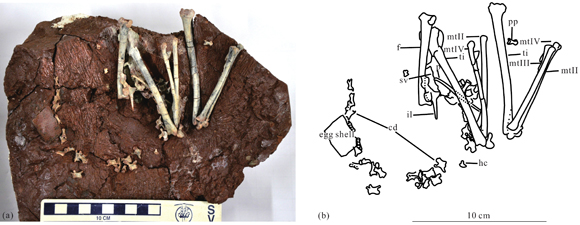
The fossil consisting of the rear portions of the skeleton of an individual was found in Guanping, Qiupa town in the Luanchuan County of Henan Province (central China).  Although the bones are poorly preserved, fossilised elements include most of the hind limbs, part of the hips some bones from the neck and twenty-five bones from the tail (caudal vertebrae).  Named specimen 41HIII-0101, it was excavated from Upper Cretaceous deposits (Late Maastrichtian faunal stage) of the Qiupa Formation. Qiupanykus is the youngest member of the Alvarezsauridae known from China so far described.  The paper describing the fossil specimen has been published in the journal “China Geology”.

A View of the Fossils of Q. zhangi and an Accompanying Line Drawing

Qiupanykus zhangi fossils and line drawing.
Qiupanykus zhangi fossils and accompanying line drawing.  Note the scale bar is 10 centimetres.  An eggshell fragment has been identified on the left of the picture.

Picture credit: China Geology

The Enigmatic Alvarezsauridae

The Alvarezsauridae are a geographically widespread family of very bird-like theropod dinosaurs.  Alvarezsaurid fossils have been found in Mongolia, China, as well as North and South America. They seem to have had a wide temporal distribution too, with the earliest known genera being excavated from Upper Jurassic strata in China.  When first studied, these little, fast-running dinosaurs were thought to have been flightless birds, but as more fossil remains were found they were re-classified as non-avian dinosaurs.  These dinosaurs have presented palaeontologists with a mystery.

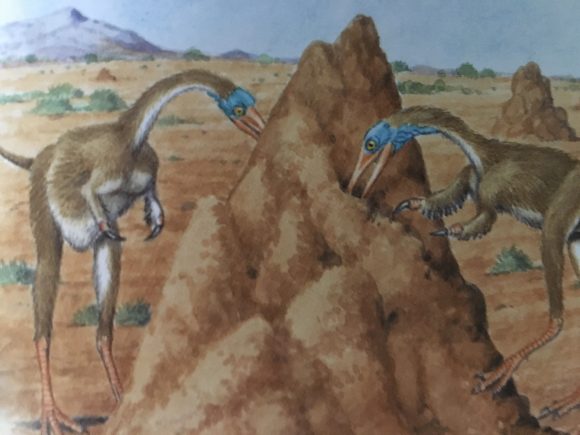
Their stubby arms and single, massive, hypertrophied claw indicate an adaptation to a specialised lifestyle.  Perhaps, they used their strong arms and their large claw for digging out burrows, some scientists have suggested that these dinosaurs were specialised insect eaters and they used their powerful front limbs to break into the mounds of termites.

A Pair of Alvarezsaurids Break Into a Termite Mound

Alvarezsaurids breaking into a termite mound.
Proposed alvarezsaurid feeding strategy.

Picture credit: Dougal Dixon

Did Qiupanykus zhangi Eat Eggs?

The discovery of an eggshell fragment in close proximity to the skeleton led the researchers to speculate on a possible link between Qiupanykus and egg eating.  The team ruled out that the egg might have been laid by Qiupanykus as they calculated that it was too small to have laid such a large egg and the eggshell resembled the shell of an oviraptorid dinosaur egg.

In 2012, Everything Dinosaur reported upon the discovery of a pair of eggs found in association with another alvarezsaurid from South America (Bonapartenykus ultimus), in the subsequent scientific paper, the researchers did comment as to the parentage of the eggs, they might have been laid by an oviraptorosaurid dinosaur.

When discussing the discovery of an eggshell fragment very close to the tail bones of Qiupanykus zhangi the research team provide three possible explanations:

  1. Fragments of eggshell were buried by chance alongside the remains of Q. zhangi the finding of the eggshell in association with a dinosaur skeleton is just coincidence.
  2. The eggshell comes from an egg laid by an alvarezsaurid dinosaur, it was part of a brood.
  3. The eggshell fragments were from eggs broken by alvarezsaurid dinosaurs and the eggs were not laid by them.

Given the specialised limbs and the strong, robust thumb claw of alvarezsaurids it is possible that these dinosaurs used their specialised arms and claws to crack open the eggs of other tetrapods and as such  alvarezsaurid dinosaurs were not insectivores digging into termite mounds but instead fed upon eggs (ovivores).

To read Everything Dinosaur’s 2012 article about Bonapartenykus ultimusAlvarezsaurid Eggs Uncovered In Patagonia.

To read Everything Dinosaur’s recent article that looks at fossil discoveries that are helping to map the evolution of the specialised arms of alvarezsaurids: Two New Chinese Dinosaurs Prove Handy.

Visit the Everything Dinosaur website: Everything Dinosaur.

17 09, 2018

Stay Small if you Want to Survive the Mesozoic

By |2023-10-30T08:58:27+00:00September 17th, 2018|Categories: Dinosaur and Prehistoric Animal News Stories, Main Page, Palaeontological articles|0 Comments

Tiny Fossils Reveal How Shrinking Was Essential for Successful Mammalian Evolution

Mammals and dinosaurs may have shared a common reptilian ancestor, but these two tetrapod lineages diverged from one another a very long time ago.  However, mammals lived alongside the dinosaurs for many millions of years and a new study published in the academic journal “Nature”, suggests that staying small and inconspicuous was a key factor contributing to the evolution of mammals.  It was only after the extinction of the dinosaurs and other types of reptile, pterosaurs and marine reptiles, for example, that mammals were able to grow much larger.

Mammals and Dinosaurs

Most Mammals Remained Small During the Mesozoic and Many were Probably Nocturnal

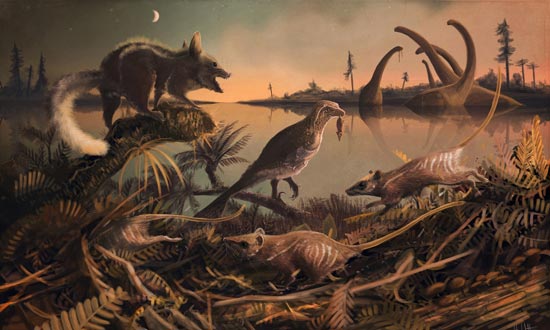
Purbeck (Dorset) 145 million years ago.
Purbeck Lagoon 145 million years ago, small placental mammals living alongside dinosaurs.  As darkness falls Durlstodon (top left) looks on whilst two Durlstotherium scurry through the undergrowth.  In the centre a Durlstotherium has been caught by Nuthetes destructor.

Picture credit: Mark Witton

The Origins of Mammals

There are three types of mammals living today, there are the monotremes, the egg-laying mammals such as the platypus and the echidna, remnants of a once very widespread and diverse group of egg-laying mammals called the Australosphenida, that existed in the Southern Hemisphere for much of the Jurassic and Cretaceous.  Secondly, there are the pouched mammals, the marsupials, familiar creatures such as kangaroos, possums, koalas and such like.  Thirdly, there are the much more common and geographically widespread placental mammals (humans are a placental mammal).

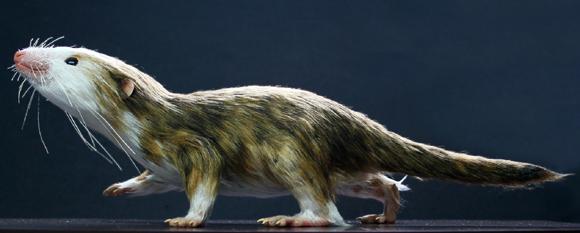
The first true mammals such as the Late Triassic Eozostrodon, Megazostrodon and Morganucodon lived over 200 million years ago and a team of scientists from the United States and the UK have concluded that whilst the dinosaurs grew into giants, the ancestors of all modern mammals opted for a different strategy, they stayed small.

A Life Reconstruction of the Morganucodont Morganucodon of the Late Triassic

Staying small helped A model of the Late Triassic mammaliaform evolution during the Mesozoic.
A model of the Late Triassic mammaliaform Morganucodon.

Picture credit: University of Birmingham

Getting to Grips with the Mammalian Jaw

The researchers used modern computer analysis to examine what happened to the skeleton of our tiny, shrew-like mammal ancestors.  Modern mammals have a unique lower jaw, consisting of a single bone that bears teeth (the dentary).  In contrast, other vertebrates have more complex lower jaws formed by several bones fused together.

In the course of the evolution of mammals, the complex jaws became simplified and a new jaw joint was formed, whilst some of bones that once formed the back of the jaws (the articular in the lower jaw and the quadrate in the back of the upper jaw), became much reduced in size, moving to the middle ear to evolve a role to aid hearing.

For an article that looks at the evolution of hearing in the mammaliaform and true mammals: Let’s Hear It For Mammalian Evolution.

A Transitional Process

The scientists looked at how it was possible for the jaw to be restructured, whilst the animal was still able to feed and to hear.  X-ray computed tomography (CT scans) were employed to assess the skulls and jaws, computer models were then built to simulate the evolutionary process.  The team’s results showed that the small size of the fossil mammals significantly reduced the stresses in the jaw bones when feeding, while still being powerful enough to capture and bite through prey, such as insects.

Early Mammals were Small and Shrew-like

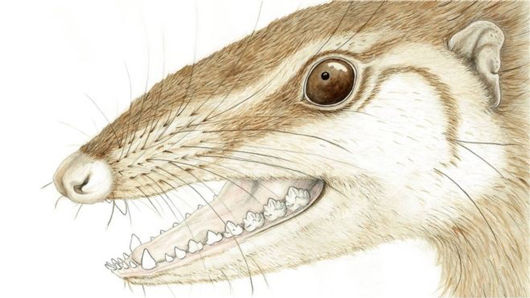
The Middle Jurassic mammaliaform (W. rex).
An illustration of Wareolestes rex.  An early mammaliaform that probably was nocturnal and insectivorous.

Picture credit: Elsa Panciroli

Mammalian Jaw Evolution

Commenting on the study, lead author and lecturer at Birmingham University, Dr Stephan Lautenschlager stated:

“Our results provide a new explanation of how the mammalian jaw evolved over 200 million years ago.  Getting very small appears to have been crucial for our mammalian ancestors.  This allowed them to reduce the stresses in the jaw during feeding and made the restructuring of the jaw bones possible.”

Professor Emily Rayfield (Bristol University), who lead the study added:

“The evolution of the mammalian jaw joint has perplexed palaeontologists for over 50 years.  Using computational methods, we can offer explanations to how our mammalian ancestors were able to maintain a working jaw while co-opting bones into a complex sound detection system.  Our research is about testing ideas of what makes mammals unique among the animal kingdom, and how this may have come about.”

The scientific paper: “The Role of Miniaturisation in the Evolution of the Mammalian Jaw and Middle Ear” by Stephan Lautenschlager, Pamela Gill, Zhe-Xi Luo, Michael J. Fagan and Emily Rayfield published in the journal Nature.

Everything Dinosaur acknowledges the assistance of a press release from the University of Birmingham in the compilation of this article.

Visit the Everything Dinosaur website: Everything Dinosaur.

14 09, 2018

Yizhousaurus Helping to Give Sauropod Evolution a “Head Start”

By |2023-10-30T08:32:09+00:00September 14th, 2018|Categories: Dinosaur and Prehistoric Animal News Stories, Dinosaur Fans, Main Page, Photos/Pictures of Fossils|0 Comments

Yizhousaurus sunae – Chinese Dinosaur May Help Unlock Key to Giant Dinosaur Evolution

A newly described long-necked dinosaur that once roamed south-western China during the Early Jurassic is helping palaeontologists to better understand the development of a dinosaur lineage that was to lead to the evolution of the largest land animals that ever lived.  The dinosaur, named Yizhousaurus sunae with its three-dimensional, well-preserved skeleton and undistorted skull provides new data on how the sauropod dinosaurs were able to achieve a giant body size.

This dinosaur lived approximately 190 million years ago and it has been estimated to have reached a length of about seven metres.  Its beautifully preserved bones can help palaeontologists to fill in a gap in their knowledge as they attempt to work out how bipedal, lizard-hipped dinosaurs of the Late Triassic and Early Jurassic evolved into the giant, quadrupedal sauropods like Brontosaurus, Apatosaurus and Brachiosaurus that dominated terrestrial ecosystems in the Late Jurassic.

Scientists from the Chinese Academy of Sciences in collaboration with colleagues from the Museum of Texas Tech University (Texas, USA) and the Bureau of Land and Resources of Lufeng County (Yunnan Province, China) have published their findings in the academic journal “Scientific Reports”.

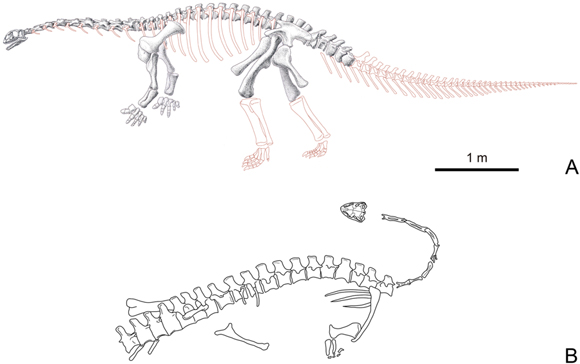
A Reconstruction of the Skeleton of Yizhousaurus sunae

Yizhousaurus skeletal reconstruction.
A – Yizhousaurus skeleton reconstruction with known bones shaded in grey and (B) the location of the bones at the fossil site.  Note the scale bar equals 1 metre.

Picture credit: Xiao-Cong Guo (A) and Qian-Nan Zhang (B)

Yizhousaurus sunae – A Significant Discovery

The specimen was collected near Duwafang Village, Chuanjie Town, Lufeng County, (Yunnan Province).  The fossils were found back in 2002 and partly reported upon at the Geological Society of America Conference in 2010, where it was described as a basal sauropod.  A phylogenetic analysis carried out by the research team places Y. sunae closer to the Eosauropoda (on the way to the sauropod family), than many of the other, similar dinosaurs known from this part of China, such as Lufengosaurus and Yunnanosaurus.

The skull has a lot of characteristics of a sauropod dinosaur, when the bones of the skull are examined phylogenetically without considering the postcranial fossil material, then this dinosaur is placed in a different position on the Sauropodomorpha family tree.  Yizhousaurus is described as a sauropodiform, a long-necked dinosaur that is within the Sauropodamorpha clade but not quite a true sauropod, a sort of blurred evolutionary area that incorporates all the dinosaurs that have traits like sauropods but are not direct ancestors of dinosaurs such as Brontosaurus and Apatosaurus.

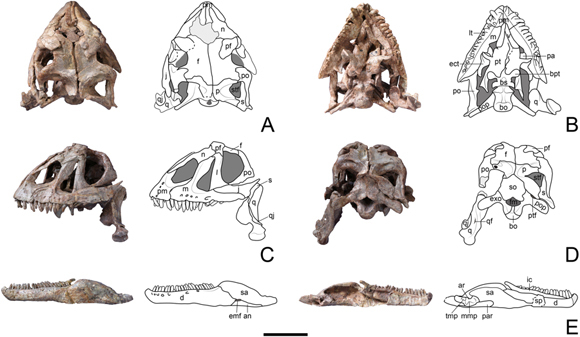
The Skull and Jaw of Yizhousaurus sunae with Line Drawings

The skull of Yizhousaurus and accompanying line drawings.
Views of the Yizhousaurus skull fossil with line drawings.

Picture credit: Scientific Reports

Commenting on the significance of the fossil material, one of the paper’s co-authors from the Chinese Academy of Sciences explained that the discovery enriches the diversity of Sauropodiformes and is significant to the studies on the origin and evolution of these types of lizard-hipped, plant-eating dinosaurs.  The specimen is currently on display at the museum in Lufeng Dinosaur Valley and the bones represent one of the best-preserved skeletons to have come out of the uppermost layer of the Zhangjiaao Member of the Lower Jurassic Lufeng Formation.

Yizhousaurus sunae – What’s in a Name?

The generic name Yizhou refers to the Chuxiong Yi Autonomous Prefecture of Yunnan Province, where the fossils were found.  The specific (trivial) name honours Professor Ai-Ling Sun, for her great contribution to Chinese vertebrate fossils, including those from Lufeng County.

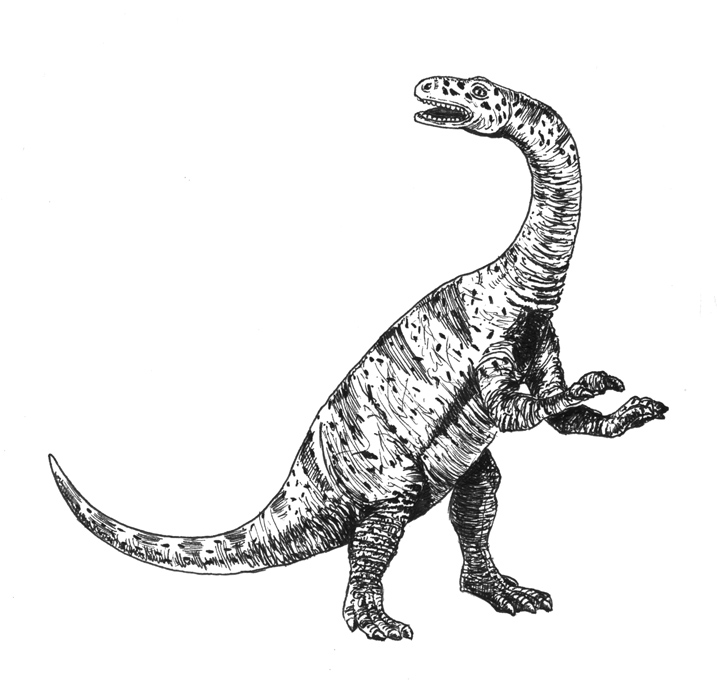
A Drawing of an Early Jurassic Sauropodiform (Based on Lufengosaurus)

Lufengosaurus drawing.
An illustration of an Early Jurassic typical sauropodiform. Picture credit: Everything Dinosaur.

Picture credit: Everything Dinosaur

The Development of the Super-sized Sauropods

The transformation from bipedal forms to the super-sized, four-footed sauropods is considered to be linked to a series of complex evolutionary processes related to changes in skeleton size and shape to accommodate a larger gut and changes in the skull to accommodate a shift in feeding behaviour.

Yizhousaurus is characterised by a suite of features, which increases understanding of the anatomical variation on the relatively conservative “prosauropod” skull plan.  The skull bones of Yizhousaurus are thickened and robust and the holes in the skull (fenestrae) are smaller and therefore consistent with the skull fenestrae of true sauropods.  These features have led to Yizhousaurus being placed closer to the evolutionary base of the Sauropoda when compared to other Sauropodiformes, known from the Lufeng Formation.

The scientific paper: “A New Sauropodiform Dinosaur with a “Sauropodan” Skull from the Lower Jurassic Lufeng Formation of Yunnan Province, China” by Qian-Nan Zhang, Hai-Lu You, Tao Wang & Sankar Chatterjee and published in the journal Scientific Reports.

For dinosaur models visit the Everything Dinosaur website: Everything Dinosaur.

8 09, 2018

The Wonderful Crystal Palace Statues Helping to Change Perceptions

By |2024-05-11T06:20:45+01:00September 8th, 2018|Categories: Dinosaur and Prehistoric Animal News Stories, Dinosaur Fans, Educational Activities, Everything Dinosaur News and Updates, Press Releases, Teaching|1 Comment

Crystal Palace Statues Helping with Outdoor Learning

Recently, Everything Dinosaur has been providing advice on how best to utilise the outdoor resources at the famous Crystal Palace Park in south London.  Schools have been invited to make the most of this area, with its historic “dinosaur statues”.  Outdoor learning is being encouraged and the park with its hard and soft landscaping as well as its iconic prehistoric animal figures makes a fantastic open space for creative activities linked to the English national curriculum. Everything Dinosaur is delighted to support the Crystal Palace Dinosaurs.

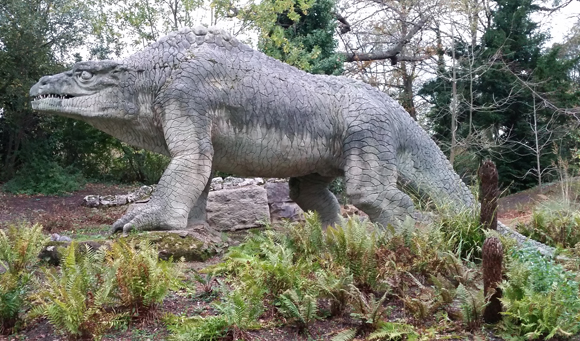
One of the Dinosaur Statues on Display at the Park (Megalosaurus)

The Megalosaurus dinosaur at Crystal Palace Park.
The Megalosaurus statue at Crystal Palace – a dinosaur from 1854. Picture credit: Everything Dinosaur.

Picture credit: Everything Dinosaur

Prehistoric Animal Figures Not Just Dinosaurs

In reality, dinosaurs make up only a small proportion of the more than thirty statues on display.  The figures created by Benjamin Waterhouse Hawkins with scientific input from the soon to be knighted Sir Richard Owen, who went onto to help found the London Natural History Museum, include marine reptiles, crocodilians, turtles and extinct mammals.  They were erected in the middle of the 19th century (circa 1854) and they represent the first attempt to create life-size, dinosaur figures.  However, our view of the Dinosauria has evolved somewhat since the 1850s and the dinosaurs, depicted as four-footed, tail-dragging scaly lizards, is wildly inaccurate by today’s standards.

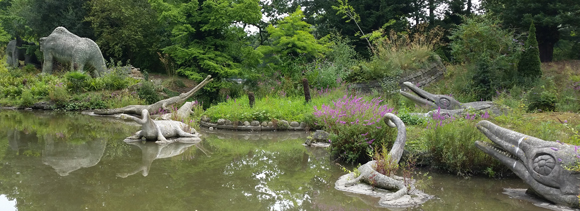
Marine Reptiles Feature at Crystal Palace – Statues Inspired by the Discoveries Made by Mary Anning

Crystal Palace dinosaurs and prehistoric animals.
Prehistoric animal figures at Crystal Palace, the world’s first “Jurassic Park”. Picture credit: Everything Dinosaur.

Picture credit: Everything Dinosaur

Crystal Palace Dinosaurs – Grade 1 Historic Monuments

All the figures are listed on Historic England’s “National Heritage List for England” as Grade 1 monuments.  This listing recognises the historic importance of these statues and a lot has been done to help preserve the dinosaurs and other figures as part of our country’s scientific and historical heritage.

In our advisory work, team members have suggested ways in which our changing views about the Dinosauria can be incorporated into the teaching programme.  The dinosaurs represented by the figures, the first three genera to be incorporated within the order Dinosauria, Megalosaurus, Hylaeosaurus and Iguanodon, show how our interpretation of the fossil record has changed over the last 170 years or so.  The statues provide a three-dimensional testament to how scientific ideas evolve and change in the light of new evidence.

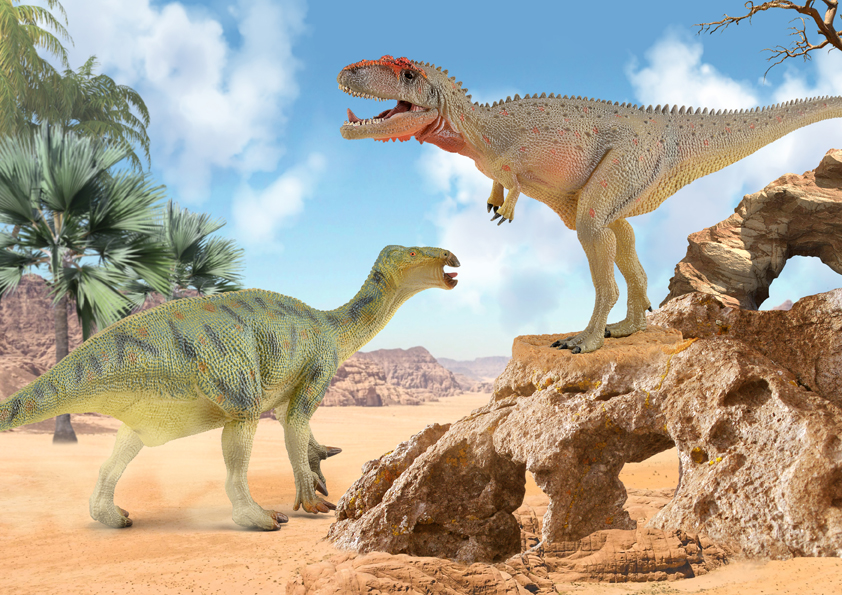
The Iguanodon (Foreground) – A Modern Interpretation of an Iguanodontid

CollectA Deluxe Mapusaurus and the CollectA Deluxe Iguanodon
The CollectA 1:40 scale Iguanodon and Mapusaurus dinosaur models.

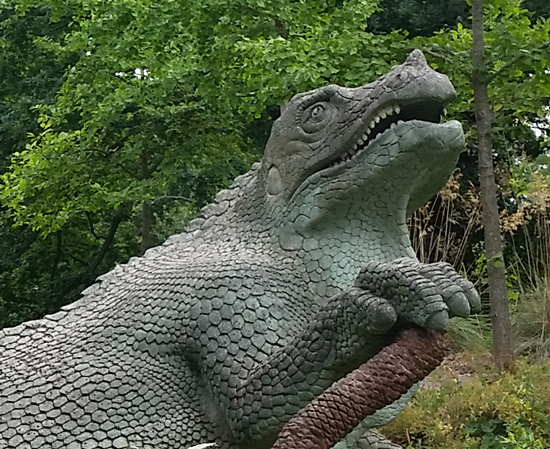
The spike associated with fossils of Iguanodon is now known to have been part of the hand (a thumb spike), whereas, in the 1854 model, the lizard-like Iguanodon statue has the spike incorrectly placed on the bridge of the snout.

One of the Iguanodon Figures on Display at Crystal Palace Park

One of the Crystal Palace Iguanodon statues.
One of the Iguanodon figures on display at Crystal Palace Park.  Note the “thumb spike” placed incorrectly on the nose. Picture credit: Everything Dinosaur.

Picture credit: Everything Dinosaur

Team members at Everything Dinosaur wish all those involved in the schools outreach programme at the Park every success.

Visit the Everything Dinosaur website: Everything Dinosaur.

It is always a pleasure to visit the Crystal Palace Dinosaurs.

To view scientifically accurate dinosaur models, including a 1:40 scale replica of an Iguanodon (I. bernissartensis): CollectA Deluxe Prehistoric Life Models and Figures

6 09, 2018

Chinese Fossils Show How Insects Came to Rule the World

By |2023-10-30T06:26:42+00:00September 6th, 2018|Categories: Dinosaur and Prehistoric Animal News Stories, Main Page, Photos/Pictures of Fossils|0 Comments

Chinese Fossils Show How Insects Came to Rule the World

A lot of work has been carried out by scientists to try to understand how marine and terrestrial ecosystems recovered after the End Permian extinction event that wiped out some 95% of all life on Earth.

The focus has been largely orientated towards how the vertebrates recovered, the rise of the dinosaurs, for example.  However, relatively little research has been undertaken to examine how insects recovered and diversified over the Triassic.  One of the main reasons for this, has been the lack of insect fossils from the Lower and Middle Triassic to study.

Chinese Fossils

A scientific paper that details the amazing fossil discoveries from two locations in China, is helping to change this and plug a gap in our understanding about the evolution and radiation of the most specious group of animals on Earth.

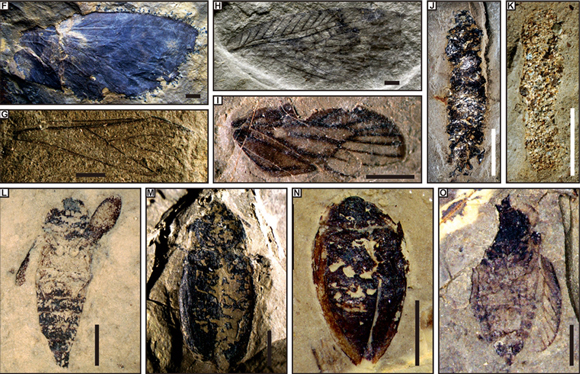
A Treasure Trove of Insect Fossils from China Reflect the Rapid Diversity of the Insect Fauna

Typical insect fossils from the Triassic deposits of Tongchuan and Karamay entomofaunas.
Photographs of typical insect fossils from Tongchuan and Karamay entomofaunas.

Picture credit: Zheng at al

Writing in the academic journal “Science Advances”, a joint Chinese/UK-based team of scientists have reported on the hundreds of insect fossils excavated from two sites in north-western China.  The researchers have discovered the earliest known fossils of several modern insect groups and also provided new insights into the early evolution of freshwater ecosystems.

New Evidence for Understanding the Process of Insect Diversification

The researchers which included scientists from the Nanjing Institute of Geology and Palaeontology, part of the Chinese Academy of Sciences, excavated two sites, one dating from the late Ladinian faunal stage (Tongchuan entomofauna), dated to around 238-237 million years ago.  The second location represents slightly younger deposits, dating from the Carnian faunal stage (Karamay entomofauna).

The Tongchuan entomofauna was found to consist of at least twenty-eight insect families representing eleven orders, making it the most specious and diverse of all the Triassic deposits where insect fossils have been discovered.  The Karamay entomofauna consisted of ten insect families in six orders, including the earliest known examples of water boatmen and caddisfly cases.  The discovery of water boatmen insect fossils in strata dating from the Carnian faunal stage, is the earliest record of aquatic insects.  These fossils suggest that many of the modern insect ecosystems were in place around 230 million years ago, far earlier than previously thought.

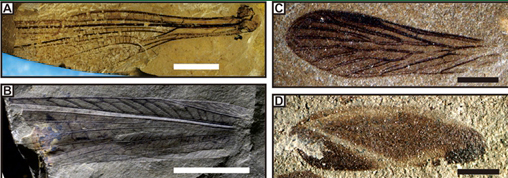
The Insect Fossils from North-western China Reveal a Diverse and Modern Insect Population

Evidence of the diversity of insects (Chinese fossils).
Beautifully preserved insect wing fossils from the Tongchuan and Karamay entomofaunas.

Picture credit: Zheng at al

Diversification of Insects (Aquatic Insects)

The researchers conclude that the hundreds of insect fossils indicate that a modern insect biota was established earlier in the Mesozoic than previously thought.  In addition, the diversification of aquatic insects had been thought to be part of the “Mesozoic Lacustrine Revolution”, which dates to the Middle Mesozoic.  This study suggests, however, that this diversification had already begun by the Middle Triassic, thus providing new insights into the early evolution of freshwater ecosystems.

The research team, which included a contributor based at the London Natural History Museum, conclude that over the period of the Early Triassic a number of new types of plants evolved and spread and the evolution of vegetation very probably contributed to the radiation and diversification of insect faunas.

A Beautifully Preserved Wing from a Planthopper Insect (Tongchuan Entomofauna)

Boreocixius species, wing fossil.
The fossilised wing of a planthopper insect (Boreocixius) a fossil representing the wide range of insects from the Tongchuan biota.

Picture credit: Zheng et al

Visit the Everything Dinosaur website: Everything Dinosaur.

5 09, 2018

Tracing the Origins of Biodiversity in the Animal Kingdom

By |2023-10-29T16:36:15+00:00September 5th, 2018|Categories: Dinosaur and Prehistoric Animal News Stories, Dinosaur Fans, Main Page, Palaeontological articles, Photos/Pictures of Fossils|0 Comments

Illuminating the Evolution of Animal Life – Humbling Thoughts

Recently two scientific papers have been published that delve deep into the origins of life on Earth.  In one paper, published in the “Proceedings of the National Academy of Sciences USA”,  the origins of animal body plans (Animalia) were explored, analysing the anatomical designs of animals, looking at how animal life half a billion years ago evolved and changed over time to bring us the biodiversity we see today and that which is preserved in the fossil record.

Tracing the Origins of the Animalia

This study mapped shared characteristics and one of the conclusions drawn from the research was that all those weird and wonderful Cambrian creatures, as preserved in the Burgess Shales of British Columbia or in the Sirius Passet Lagerstätte of Greenland, are actually less weird than the butterflies and birds that you might see in your own garden.

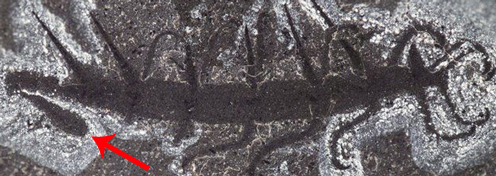
The Body Plans of Bizarre Cambrian Creatures Such as Hallucigenia are not that Bizarre According to a New Study

A Hallucigenia specimen (Burgess Shale).
A Hallucigenia specimen (Royal Ontario Museum).  The red arrow is pointing towards a teardrop shaped object that might represent the fossilised remains of this strange creature’s head.

Picture credit: Royal Ontario Museum/Dr Jean Bernard Caron with additional annotation by Everything Dinosaur

In the second scientific paper, which shares a number of authors with the first publication and was published last month in the journal “Nature: Ecology & Evolution”, researchers examined the evolution of all life as a whole, conducting research using a new molecular clock analysis to plot a unified timescale for the early evolution of life on our planet.

What is the Molecular Clock?

The idea of a molecular clock is based on the idea that evolutionary changes occur at regular time intervals, that the rate of genetic change (mutation), has remained constant over time.  The molecular clock uses this premise, it plots the number of differences in the genomes of two living species (for example a human and a bacterium) and these changes are proportional to the time since they shared a common ancestor.

Using this methodology, the scientists, from the universities of Bath and Bristol were able to avoid putting too much reliance on a very fragmentary and often highly controversial early life fossil record. 

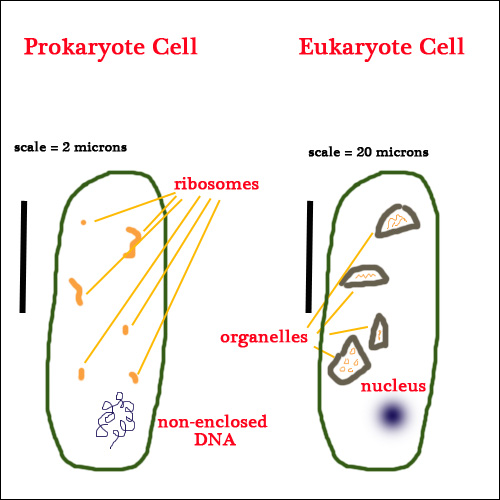
This research team concluded that the last universal common ancestor of cellular life existed more than 3.9 billion years ago and that the crown clades of two primary divisions of life – Eubacteria and Archaebacteria emerged less than 3.4 billion years ago.  Furthermore, the scientists concluded that modern eukaryotes (organisms whose cells have a nucleus enclosed within membranes – animals, protists, plants and fungi), don’t constitute a primary lineage of life and emerged relatively late during life on Earth’s evolutionary history (around <1.84 billion years ago).

Eukaryote Cell Compared to the Prokaryote Cell Typical of Eubacteria and Archaebacteria

Eukaryote Cell Compared to a Prokaryote Cell.
Simple diagram showing differences in eukaryote cells and prokaryote cells.  In a new study, scientists conclude that prokaryotes such as Eubacteria and Archaebacteria emerged less than 3.4 billion years ago whilst our branch of life on Earth, the eukaryotes emerged much more recently about 1.84 billion years ago. Picture credit: Everything Dinosaur.

Picture credit: Everything Dinosaur

Did Animal Body Plans Emerge Over Deep Time or Come About in Response to Sudden Changes?

This was the question that the researchers set out to answer in the paper published the “Proceedings of the National Academy of Sciences USA”.  It is agreed that complex animal life evolved from single celled eukaryotes and that multi-cellular animals diversified into thirty or forty distinct anatomical body plans, but when and how did these body plans emerge?  Were the majority of these different body plans already in existence after the Cambrian explosion, some 500 million years ago?

To answer these questions the research team, consisting of scientists from Bristol University, Dartmouth College in New Hampshire and the University of West Georgia, looked at features from living groups of animals and cross-referenced those characteristics against what can be identified from the fossil record.

Professor Philip Donoghue (Bristol University) a co-author of both scientific papers explained:

“This allowed us to create a ‘shape space’ for animal body plans, quantifying their similarities and differences.  Our results show that fundamental evolutionary change was not limited to an early burst of evolutionary experimentation.  Animal designs have continued to evolve to the present day, not gradually as Darwin predicted, but in fits and starts, episodically through their evolutionary history.”

Mapping the Evolution of Different Types of Animal Body Plan

Mapping the evolution of animal body plans.
Grouping similar body plans and separating dissimilar body plans in the Animalia.

Picture credit: Bristol University

The research team propose that major expansions in the type of animal following the Cambrian explosion aligns with other major ecological transitions such as the conquest of terrestrial environments.

Bradley Deline (University of West Georgia) added:

“Our results are important in that they highlight the patterns and pathways in which animal body plans evolved.  Many of the animals we are familiar with today are objectively bizarre compared with the Cambrian weird wonders.  Frankly, butterflies and birds are stranger than anything swimming in the ancient sea.”

Trying to Fit Extinct Animals into the Study

Contributors to both scientific papers, James Clark (Bristol University) and Mark Puttick (Milner Centre for Evolution, University of Bath), looked at how fossils could be incorporated into this research.

Dr Puttick stated:

“One of the problems we had is that our study is mostly based on living species and we needed to include fossils.  We solved the problem through a combination of analysing the fossils and using computer models of evolution.”

James Clark added:

“The fossils plot intermediate of their living relatives in shape space.  This means that the distinctiveness of living groups is a consequence of the extinction of their evolutionary intermediates. Therefore, animals appear different because of their history rather than unpreserved jumps in anatomy.”

Studying the Genomes of Different Animals (Animalia)

Jenny Greenwood, also from the University of Bristol’s School of Earth Sciences, wanted to explore how this study might be reflected in the genomes of different organisms.  She wanted to work out which of the many proposed genetic mechanisms drove the evolution of animal body plans.

Jenny commented:

“We did this by collecting data on the different genomes, proteins, and regulatory genes, that living animal groups possess.  The differences in anatomical designs correlate with regulatory gene sets, but not the type or diversity of proteins.  This indicates that it is the evolution of genetic regulation of embryology that precipitated the evolution of animal biodiversity.”

These researchers have concluded that animal evolution has been permitted or driven by gene regulatory evolution.

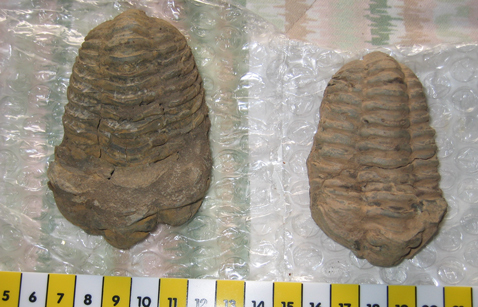
Two Papers Helping to Improve our Understanding of the Evolution of Life on Earth

The definition of benthic. A pair of trilobite fossils. Trilobites feature in the televison programme "First Life".
“Mike and Sue” – the Calymene trilobites. The Cambrian also the rapid diversification of the Trilobita. Picture credit: Everything Dinosaur.

Picture credit: Everything Dinosaur

Everything Dinosaur acknowledges the help of a press release from Bristol University in the compilation of this article.

The two scientific papers:

“Integrated Genomic and Fossil Evidence Illuminates Life’s Early Evolution and Eukaryote Origin” by Holly C. Betts, Mark N. Puttick, James W. Clark, Tom A. Williams, Philip C.J. Donoghue and Davide Pisani published in the journal Nature: Ecology & Evolution.

“Evolution of Metazoan Morphological Disparity” by B. Deline, J. Greenwood, J. Clark, M. Puttick, K. Peterson and P. Donoghue  published in the Proceedings of the National Academy of Sciences USA.

Visit the Everything Dinosaur website: Everything Dinosaur.

4 09, 2018

The Devastating Fire at Brazil’s National Museum

By |2023-10-28T18:49:01+01:00September 4th, 2018|Categories: Dinosaur and Prehistoric Animal News Stories, Dinosaur Fans, Main Page, Photos/Pictures of Fossils, Press Releases|1 Comment

Terrible Blow to the Fossil Heritage of South America

The scientific community is beginning to come to terms with the devastating fire that took place last Sunday night (2nd September), that left the historic Museu Nacional located in Rio de Janeiro a gutted ruin.  The fire tore through the museum, Brazil’s oldest scientific institution (founded in 1818), media reports state that much of the collection, some 20 million items of cultural and scientific interest have been destroyed.  The extent of the loss has yet to be confirmed but it is likely that the majority of the artefacts housed in the building have been lost, or damaged beyond repair.

The Impact of the Fire on the Fossil Collection and Palaeontology

Many of the invertebrate specimens and smaller vertebrate fossils were housed in metal cabinets. These cabinets may have survived the fire but the condition of the fossils inside remains unknown. The palaeontology exhibits section of the museum was utterly destroyed as confirmed by aerial views of the museum building taken yesterday.  Fortunately, as Everything Dinosaur understands the situation, a significant proportion of the fish and reptile collections were housed in a separate building and have not been affected by the fire. However, it is likely that many of the unique dinosaur, pterosaur and other prehistoric animal fossils documenting the ancient fauna of South America have been lost to science.

Much of the vertebrate fossil collection was excavated from Cretaceous-aged deposits from the Araripe Basin of Brazil, notably from the Crato Formation which dates from the Early Cretaceous. It is likely that many fossils of dinosaurs and pterosaurs including many holotypes will have been lost as a result of this tragic fire.

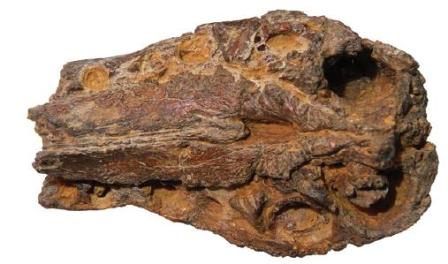
One Likely Casualty the Holotype of the Spinosaurid Oxalaia quilombensis

The holotype specimen of Oxalaia.
Evidence of giant spinosaur?  Specimen MN 6117-V, holotype of Oxalaia quilombensis likely lost in the museum fire.

Picture credit: Kellner et al

The Loss of Irreplaceable Specimens

Whilst it is noted, that thankfully, no-one was injured during the fire, this tragedy has resulted in the likely loss of thousands of irreplaceable specimens and artefacts, as well as the research notes, papers, reports and other documents of numerous scientists.  The laboratories and preparation areas will have been extensively damaged, this is a real blow for the scientific community of Brazil and their colleagues and counterparts throughout the world.

The Crato Formation is famous for its dinosaur and pterosaur fossils, but in addition, more than three hundred types of insect have been identified, both aquatic and terrestrial species and even magnificent aerial hunters like dragonflies.

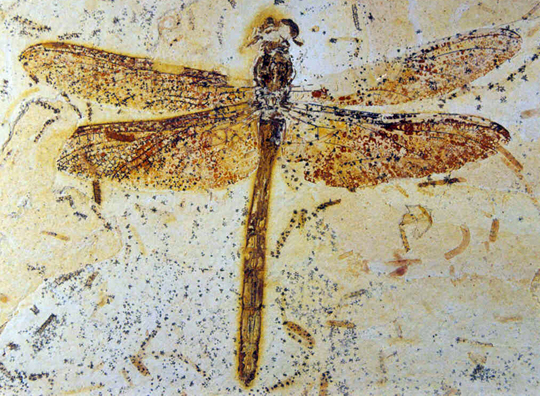
A Rare Dragonfly Fossil from the Crato Formation Could Specimens Like This Have Been Lost Too?

A Cretaceous-aged dragonfly fossil.
Odonta fossil from the Crato Formation of Brazil.  Museum specimen MN 7936-I.

Picture credit: Museu Nacional

The Impact on the Pterosauria

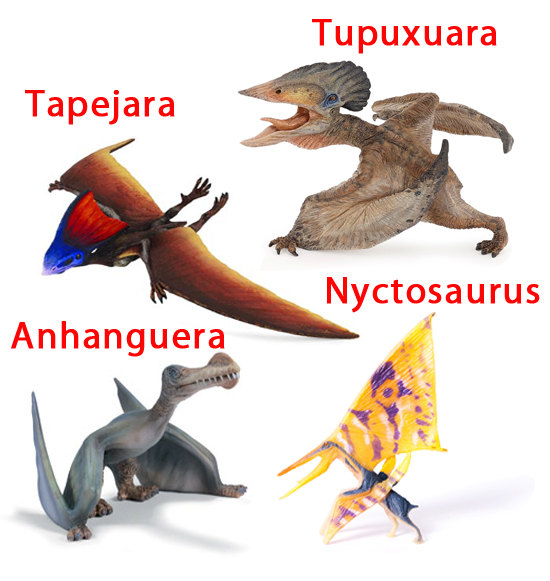
The Museu Nacional housed a number of holotype specimens of pterosaurs.  Several genera of flying reptiles are only known from the Crato Formation of north-eastern Brazil and their fossils were part of the vertebrate palaeontology collection of the museum.  Pterosaur fossils are exceptionally rare and virtually all of the fossil material associated with these genera was stored in the Rio de Janeiro museum.  Potential losses include the holotype of Tapejara wellnhoferi, plus other tapejarid postcranial material including wing impressions, the holotype of Tupuxuara longicristatus, a braincase associated with Anhanguera, plus a holotype associated with Nyctosaurus lamegoi.

The Impact on Pterosaur Research May Be Particularly Severe

Examples of pterosaurs from the Museum Nacional collection.
A number of pterosaurs that model collectors will be familiar with have been affected by the fire.  Fossils related to these well-known flying reptiles are believed to have been destroyed in the fire. Picture credit: Everything Dinosaur.

Picture credit: Everything Dinosaur

The President of Brazil Michael Temer has described the loss of the exhibits, specimens and artefacts as “incalculable to Brazil”.  The devastating fire and the subsequent loss of so many items in what was one of South America’s largest natural history collections, made last Sunday, a sad day for the whole of science.

Visit the Everything Dinosaur website: Everything Dinosaur.

3 09, 2018

Marine Reptile Teeth Tell the Tale of Changing Seas

By |2023-10-28T18:23:56+01:00September 3rd, 2018|Categories: Dinosaur and Prehistoric Animal News Stories, Dinosaur Fans, Main Page, Palaeontological articles|0 Comments

Study of Marine Reptile Teeth Hints at Faunal Turnover as Sea Levels Changed

New research undertaken by scientists at Edinburgh University in collaboration with colleagues at the University of Bristol, analysing marine reptile teeth, has revealed that marine faunal turnover during the Jurassic could well reflect what is likely to happen to apex marine predators today, as sea levels rise.

With global warming, so sea levels are likely to rise as ice sheets and glaciers melt.  This will have a significant impact on our planet, not least of all for our own species, but scientists are trying to predict the extent of the impact on changing sea levels on marine food chains and ecosystems.  Computer modelling can help, but surprisingly, so can studying the fossils of long extinct sea creatures.

Studying Marine Reptile Teeth

Sea levels have risen and fallen on numerous occasions throughout deep geological time.  It really is a question of history repeating itself and the scientists writing in the academic journal “Nature: Ecology & Evolution”, report on the study of marine reptile teeth fossils from the Jurassic, which shed light on how reptiles adapted to major environmental changes and how these adaptations might provide a useful metaphor for extant marine life.

The researchers conclude that marine predators that lived in deep waters during the Jurassic Period, thrived as sea levels rose, whilst in contrast, those species that lived in shallower environments, such as near-coastal areas, became extinct.

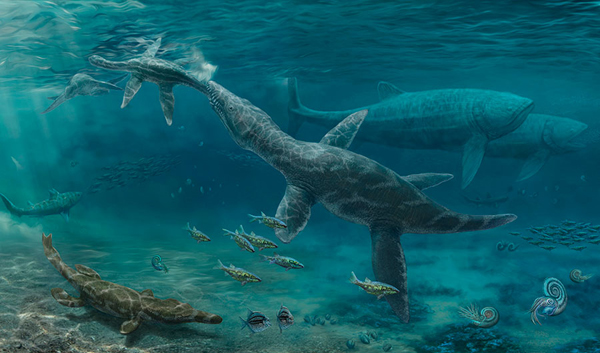
A Jurassic Marine Ecosystem (Jurassic Sub-Boreal Seaway)

Life in the Jurassic seas.
A Jurassic marine ecosystem.  A life reconstruction based on fossils found in the Oxford Clay Formation (England).

Picture credit: Nikolay Zverkov

The picture (above) depicts a marine ecosystem from the late Middle Jurassic (Callovian faunal stage).  A marine crocodile (metriorhynchid crocodyliform) avoids the attention of a large pliosaur attacking a plesiosaur, whilst sharks and a pair of giant, filter feeding Leedsichthys swim nearby.  A trio of ammonites can be seen (bottom right).

Marine Food Chains Unchanged for 150 Million Years

The study also indicates that the broad structure of food chains in today’s oceans have remained largely unchanged since the Middle Jurassic.  Naturally, the species are very different with mammals taking over the role once occupied by many types of extinct marine reptile, but the underlying structure of the food chain remains similar to what you would have seen had you been scuba diving in the shallow, tropical Jurassic Sub-Boreal Seaway some 160 million years ago.

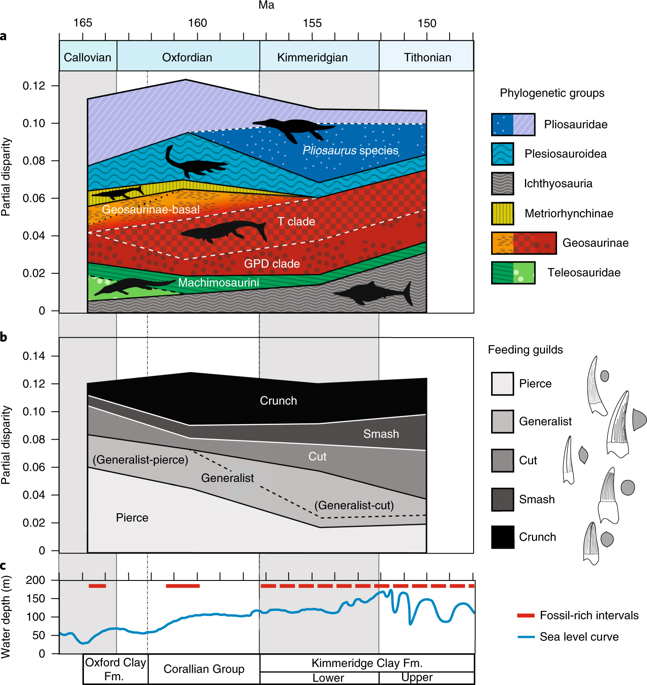
For more than 18 million years, a very diverse, reptile-dominated megafauna co-existed in the Jurassic Sub-Boreal Seaway, a stretch of shallow water that covered present-day northern France to Yorkshire on England’s north-east coast.  By examining the shape and size of teeth spanning this 18-million-year period when sea levels fluctuated, the researchers found that species belonged to one of five groups based on their teeth, diet and which part of the ocean they inhabited.

Five Feeding Groups Identified Based on the Shape of Fossil Teeth

The fossil teeth were placed into one of five groups depending on their shape.  The shape of the tooth provides a guide to the feeding strategy of the animal and using this data plotted against rising and falling sea levels, the researchers were able to plot how the marine animal populations changed over time as sea levels fluctuated.

The five groups (referred to as feeding guilds), identified were:

  1. Pierce
  2. Generalist
  3. Cut
  4. Smash
  5. Crunch

One of the key findings of the study, was that those predators with fine, piercing teeth useful for grabbing fast-moving, slippery prey such as small fish and squid made up a substantial portion of the marine predator population around 165 million years ago (Callovian faunal stage), when sea levels were low and the water relatively shallow.  However, as sea levels rose and the sea became much deeper, the teeth of these types of predators were less common in younger rocks dating from around 150 million years ago (Tithonian faunal stage of the Late Jurassic).

Using Fossil Teeth to Map How Marine Apex Predator Populations Changed Over Time

Jurassic Sub-Boreal Seaway feeding guilds.
A study of fossil teeth identified five types of feeding guild in Jurassic seas.  The fossil finds were then plotted against data for changing sea levels to map how animal populations changed as the environment changed.

Picture credit: Nature: Ecology & Evolution

The scientists concluded that the pattern that was identified is very similar to the food chain structure of modern oceans, where many different species are able to co-exist in the same area because they do not compete for the same resources.  Species used the resources in the environment differently and this permitted them to live together, this is termed niche partitioning.

Niche Partitioning

This niche partitioning enabled many species to co-exist.  Although a highly diverse fauna was present throughout the history of the Jurassic Sub-Boreal Seaway, as the scientists studied the teeth found at different stratigraphic levels they found that fish and squid eaters with piercing teeth declined over time while hard-object and large-prey specialists diversified, in concert with rising sea levels.

Larger species that inhabited deeper, open waters began to thrive.  These reptiles had broader teeth for crunching and cutting prey.  Deep-water species may have flourished as a result of major changes in ocean temperature and chemical make-up that also took place during the period, the researchers postulate.  This could have increased levels of nutrients and prey in deep waters, helping the species that lived there.  This research provides an analogy for modern ocean environments providing an insight into how species at the top of the marine food chain might respond to rising sea levels brought on by global climate change.

The Fate of Jurassic Predators May Well Provide an Analogy for Modern Marine Ecosystems

Marine crocodile (Plesiosuchus).
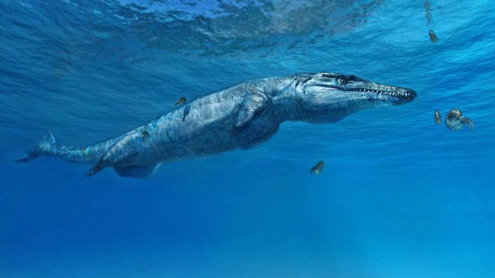
Marine crocodiles such as the large, broad-snouted Plesiosuchus manselii were apex predators specialising in hunting other marine reptiles.  These types of predator may have thrived as water depth increased, whereas, other smaller fish-eating marine crocodiles declined along with the long-necked plesiosaurs.

Picture credit: Fabio Manucci/University of Edinburgh

The scientific paper: “The Long-term Ecology and Evolution of Marine Reptiles in a Jurassic Seaway” by Davide Foffa, Mark T. Young, Thomas L. Stubbs, Kyle G. Dexter  and Stephen L. Brusatte published in the journal Nature: Ecology and Evolution.

The Everything Dinosaur website: Everything Dinosaur.

Go to Top