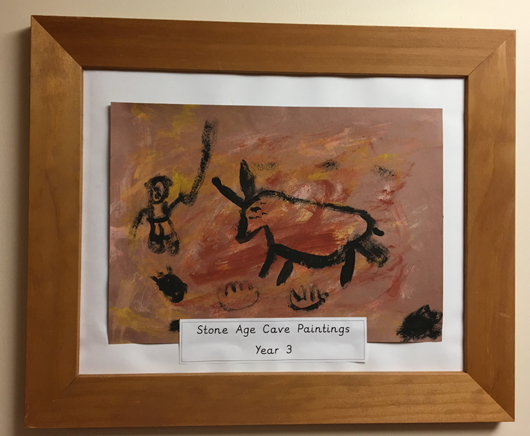
Everything Dinosaur team members were reviewing some wonderful examples of cave art created by Year 3 and Year 4 pupils. The children attended Bowlee Community Primary, and they had been studying life in the Stone Age. As part of an exciting and diverse term topic the children had recreated cave paintings.
A wonderful example of “Stone Age” cave art recreated by pupils at Bowlee Community Primary. Picture credit: Everything Dinosaur.
Picture credit: Everything Dinosaur
Recreating Cave Art
A spokesperson from Everything Dinosaur recalled visiting the school in 2017 and again in 2018. He praised the teaching team for their dedication and enthusiasm. The examples of the Stone Age drawings had been put on display outside the classroom. The children explained that they had enjoyed learning about their ancestors. They enjoyed creating the cave art and they were fascinated by the pictures of real cave art their teacher had shown them.
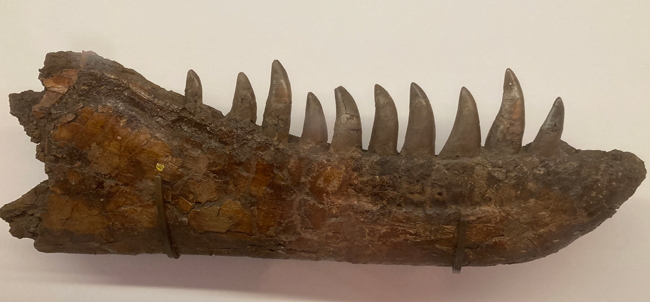
Dinosaur fans will know that there were many different tyrannosaur taxa. Whilst on a visit to a museum, an Everything Dinosaur team member spotted a tyrannosaur dentary. The theropod jawbone was located away from the Tyrannosaurus rex exhibit. The fossil represents a member of the Tyrannosauridae family. The fossil is from a Daspletosaurus. The accompanying information did not state the species.
A Daspletosaurus dentary on display at a museum (Natural History Museum London). Picture credit: Everything Dinosaur.
Daspletosaurus
Daspletosaurus roamed western North America (Laramidia) during the Late Cretaceous (Campanian faunal stage). Several species have been assigned to this genus. The genus was erected in 1970 (D. torosus). Subsequently, other species have been assigned including Daspletosaurus horneri in 2017 and Daspletosaurus wilsoni (2022).
The tyrannosaur jawbone (right dentary) depicts the typical D-shaped crowns associated with these theropods. A total of ten teeth can be viewed in the jawbone (buccal view). The buccal view shows the side of the jaw that is adjacent to the cheek.
Although Daspletosaurus was a large and powerful hunter, the lower jaw is less robust than the fossils associated with Tyrannosaurus rex.
A spokesperson from Everything Dinosaur commented:
“The dentary is in an exceptional state of preservation. Museum visitors could easily overlook this excellent tyrannosaur dentary. However, fossils such as these can tell palaeontologists a lot about the Daspletosaurus genus and theropod dinosaurs in general.”
Everything Dinosaur can confirm that two prehistoric animal models made by Schleich are now out of production and retired. With the recent introduction of five Schleich prehistoric animal figures, we can now confirm Schleich prehistoric animal model retirements.
The figures which have been retired are the Schleich Dimetrodon model that was introduced in 2019 and the Schleich pterosaur figure, the Dimorphodon.
The new for 2019 Schleich Dimetrodon model has now been retired by the German manufacturer.
The green-coloured 2019 Schleich Dimetrodon figure replaced an earlier Dimetrodon model (2016) with a reticulated pattern on its sail. It was one of five new model introductions into the Schleich prehistoric animal model range. Although not a dinosaur, Dimetrodon has proved to be a popular figure amongst collectors. Dimetrodon was a member of the Pelycosauria clade, a synapsid that lived during the Early Permian. Several species have been described.
The Schleich Dimorphodon Figure
Coincidently, the Schleich Dimorphodon figure was also introduced in 2019. It too is being retired. The Schleich Dimorphodon had distinctive “eye flashes” on its wings. It was depicted in a terrestrial pose. With its large skull and huge jaws, this pterosaur model proved to be popular with younger model collectors.
The Schleich Dimorphodon model (new for 2019).
Schleich Prehistoric Animal Model Retirements
A spokesperson from the UK-based Everything Dinosaur stated that both figures would be missed.
The spokesperson explained:
“We do appreciate that models have to be retired. Both the Dimetrodon and the Dimorphodon have been around for about four years, so they have had a good run. By taking some figures out of production this frees up space in the factory for new models.”
Everything Dinosaur team members have been examining generative artificial intelligence (GenAI) and how this exciting new technology might change the company. Recently, to commemorate the ninety-seventh birthday of Sir David Attenborough, Everything Dinosaur asked ChatGPT to write a short blog post. The ChatGPT artificial intelligence wrote a short biography of the naturalist and broadcaster. We also asked ChatGPT to compose a short birthday message to Sir David.
Artificial intelligence has a myriad of applications. As part of our testing programme to assess the scope of the current technology, we challenged ChatGPT (version 3.5) to provide Everything Dinosaur with five facts about Tyrannosaurus rex.
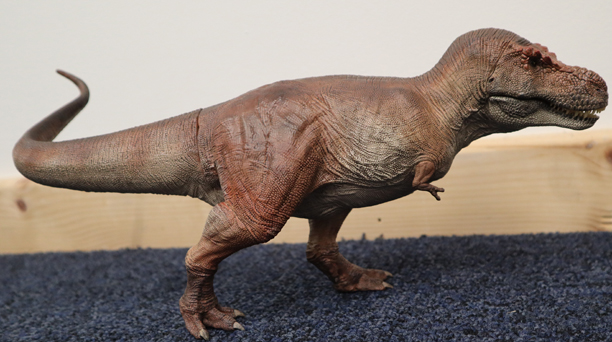
The Rebor T. rex Tusk King T. rex Requiem model is supplied with a clear plastic support base, but our models appear quite stable even standing on our office carpet without the need for the support stand. Can ChatGPT provide five facts about this famous dinosaur? Picture credit: Everything Dinosaur.
The picture (above) shows a Tyrannosaurus figure from Rebor (Tusk).
In response to our question “list five facts about Tyrannosaurus rex, here are the five facts about T. rex that ChatGPT compiled:
1). Tyrannosaurus rex lived during the Late Cretaceous period (approximately 68 to 65 million years ago).
It is true that T. rex lived during the Late Cretaceous however, we would take issue with the temporal range suggested. The date of the end-Cretaceous extinction event and the demise of the non-avian Dinosauria is now thought to have occurred around 66 million years ago. T. rex is known from several Upper Cretaceous North American formations, dating the fossil bones is notoriously difficult.
The Size of Tyrannosaurus rex
2). Tyrannosaurus rex was one of the largest land predators ever to exist, measuring up to 12 metres (40 feet) long and weighing up to 6.8 metric tonnes (15,000 pounds).
We will not dispute the ChatGPT comment about T. rex being one of the largest land predators ever. However, the size estimates could be disputed. For example, the biggest specimens described to date “Sue” and “Scotty” measure more than 12 metres in length. The robust “Scotty” is estimated to be around 13 metres long with a body weight calculated at approximately 8.8 tonnes (19,400 pounds).
3). Tyrannosaurus rex had a powerful bite force of up to 12,800 pounds per square inch – enough to crush the bones of its prey.
Not much to dispute here. There has been a considerable amount of research into the potential bite force of an adult animal. A study published in 2012 (Bates and Falkingham) did indeed suggest a bite force around 12,800 lbs, for the teeth located in the back of the mouth. The researchers suggested a potential range of bite forces, with 12,800 lbs being at the upper end of their estimates.
Banana-shaped Eyes?
4). Tyrannosaurus rex had two large, banana-shaped eyes which gave it good depth perception and probably excellent vision.
This is not true, T. rex did not have two large, banana-shaped eyes. We suspect that this is the GenAI confusing two aspects of tyrannosaur cranial anatomy. Something that a real person would intuitively consider incorrect. T. rex is famous for its large teeth, often described as being banana-shaped. Its eyes were spherical and quite big, about the size of a tennis ball.
ChatGPT is correct when it asserts that it had good depth perception and probably excellent vision. Many palaeontologists suggest that T. rex had vision as good as a modern-day bird of prey.
The Rebor GrabNGo 02 T. rex Type A in anterior view. T. rex probably had excellent, binocular vision. Picture credit: Everything Dinosaur.
Picture credit: Everything Dinosaur
5). Tyrannosaurus rex had a small brain compared to its body size, with a brain volume of only 1.5 litres (2.6 pints).
It is accurate to state that T. rex had a small brain relative to its body mass. This does not provide a measure of intelligence. For example, many birds such as crows and pigeons have small brains, but they are capable of solving complex problems and prodigious feats of memory and navigation. The statement about brain volume could also be disputed. Soft tissue preservation in the fossil record is exceptionally rare. No T. rex brain tissue has yet been found.
Brain size assessments are based on the volume of the braincase as calculated when skull bones are reconstructed. It would also be incorrect to assume that the brain of a Tyrannosaurus rex would completely fill the braincase, so only the maximum potential brain volume can be calculated.
Whilst errors can be identified in the answers given, we congratulate ChatGPT. It was a credible effort, particularly since the data set that the programme was working on was last updated in September 2021 or thereabouts.
The use of GenAI in writing books about dinosaurs, teaching about dinosaurs and perhaps providing updated display boards in museums is not too far away.
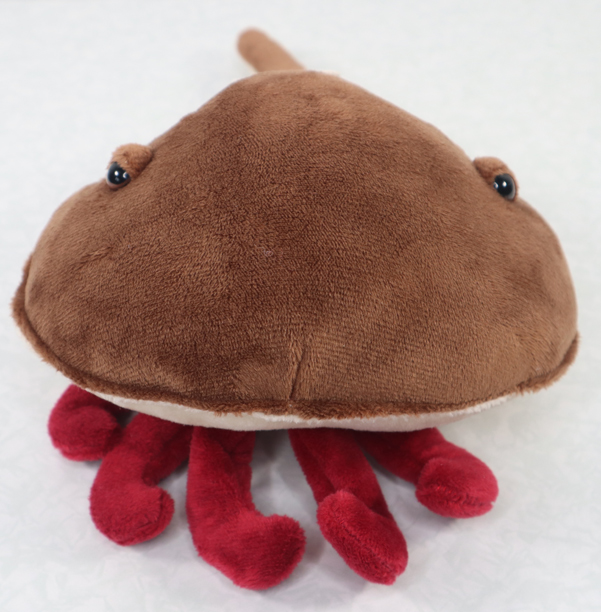
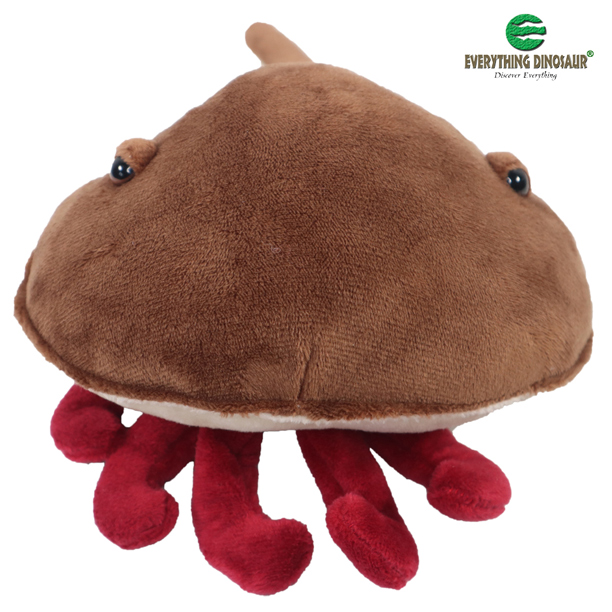
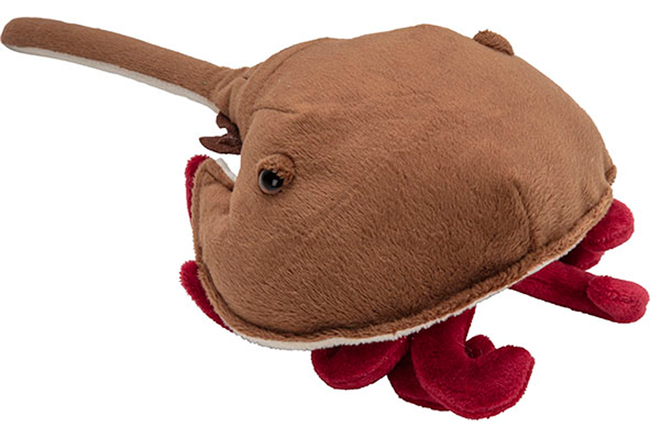
Everything Dinosaur has added a horseshoe crab soft toy to its range of prehistoric plush. The horseshoe crab is very cuddly, sponge washable and is a wonderful new addition to the company’s prehistoric animal soft toy range.
Everything Dinosaur has added a soft toy horseshoe crab to it range of prehistoric animal soft toys. Picture credit: Everything Dinosaur.
Picture credit: Everything Dinosaur
Horseshoe Crab Soft Toy
Animals in the family Limulidae are called “horseshoe crabs” due to the shape of their carapace which is shaped like a horseshoe. These ancient animals are not crabs. The first of these amazing creatures is thought to have evolved around 480 million years ago in the Ordovician. Often described as “living fossils” the four remaining species are the last representatives of the family, which was much more diverse in prehistoric times. Their body shape has not changed for millions of years.
Prehistoric plush! The soft and cuddly horseshoe crab.
Picture credit: Everything Dinosaur
Important Animals for Medical Research
These ancient creatures, with their famous, blue-coloured blood are playing an important role in medicine.
In the 1950s, researchers noticed that the blood of the western Atlantic horseshoe crab species (called Limulus polyphemus by scientists) clots quickly when exposed to certain bacteria. With further study, scientists determined that a compound called LAL (short for Limulus Amebocyte Lysate) is responsible for the clotting. LAL acts as a safeguard for the animals, reacting when it comes into contact with bacteria, fungi, and perhaps most importantly, proteins called endotoxins that are part of the cell structure of certain bacteria.
If these endotoxins get into a person’s bloodstream, they can cause a range of problems from fever to burst blood vessels in the brain. Even after an item has been sterilised of live bacteria, endotoxins can be residual. Researchers quickly saw the potential to use LAL as a simple, reliable test for endotoxins and developed methods to extract the compound. These ancient and increasingly rare marine animals continue to be studied by scientists, keen to understand more about their unique physiology.
The horseshoe crab soft toy will be supplied with an Everything Dinosaur horseshoe crab fact sheet.
An Everything Dinosaur Fact Sheet
A spokesperson from Everything Dinosaur welcomed the arrival of the horseshoe crab soft toy. It joins several other Palaeozoic plush such as the ammonite and belemnite soft toys.
The spokesperson stated:
“It is a very colourful prehistoric animal soft toy. This item of prehistoric plush has bright red legs, a cream-coloured underside and a brown carapace. It has beautiful, cute eyes and a long soft tail. The horseshoe crab soft toy is a welcome addition to our soft toy range.”
An Everything Dinosaur horseshoe crab fact sheet will be sent out with sales of this new soft toy.
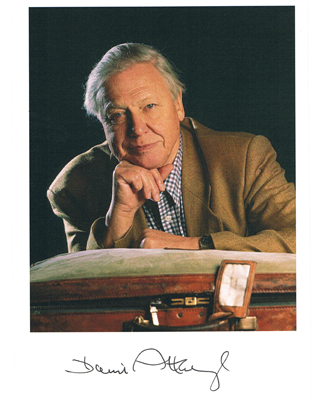
Today, is the ninety-seventh birthday of Sir David Attenborough. On behalf of everyone at Everything Dinosaur we would like to wish Sir David “Many Happy Returns”. Over his extraordinary career, this British naturalist and broadcaster has seen the world change in dramatic and astonishing ways.
One huge and very recent development is the advance of generative artificial intelligence (GenAI). To illustrate this, we have asked ChatGPT to write today’s Everything Dinosaur blog post. ChatGPT writing a tribute to Sir David Attenborough.
Many Happy Returns Sir David Attenborough!
ChatGPT Pays Tribute to Sir David Attenborough
Sir David Attenborough is one of the most beloved broadcasters of all time. His career has spanned over seven decades, and his work has made an incredible impact on our understanding of the natural world. On May 8th, 2023, he will be celebrating his 97th birthday, and it’s worth taking a moment to appreciate his incredible achievements and contributions.
Sir David Attenborough’s broadcasting career began in 1952, when he joined the BBC. He quickly gained a reputation for his exceptional knowledge and skill in presenting natural history programmes. He has since presented a variety of programmes, including Life on Earth, The Blue Planet, Planet Earth, and Frozen Planet. Each of these programmes has gone on to become hugely popular, and they have had a major impact on our understanding of the natural world.
In addition to his broadcasting work, Sir David Attenborough has also written numerous books and articles on natural history topics. He has also been an active campaigner for environmental conservation. He has spoken out against climate change and the destruction of natural habitats, and he has worked to promote sustainable practices.
Beloved Figure in Conservation and Environmentalism
Sir David Attenborough is one of the most beloved figures in conservation and environmentalism. His decades of work have had a profound impact on the way people think about the environment, inspiring countless others to take action and protect our planet.
Sir David’s passion for the natural world is evident in his work. He is a master storyteller, with the ability to capture both the beauty and fragility of our planet in ways that inspire us to appreciate and protect it. He has used his platform as a natural historian and broadcaster to engage millions of people across the world in conversations around conservation and sustainability.
Our thanks to ChatGPT for creating this short tribute to Sir David Attenborough.
Happy Birthday!
We asked the artificial intelligence software to generate a birthday message.
This is what ChatGPT produced:
“Happy Birthday, Sir David Attenborough! You have truly made a remarkable impact on the world of natural history, and we are so grateful for your immense contributions to the environment. Wishing you a wonderful day filled with joy and happiness!”
A gentleman and a scholar.
We could not have put this better ourselves…
This blog post provides a demonstration of the power and scope of GenAI. It is going to change the world, hopefully for the benefit of all humanity.
As for the Everything Dinosaur blog, we will continue to invest our own time and use our own efforts to produce posts. If we utilise artificial intelligence in any future article, we will make sure to inform our readers.
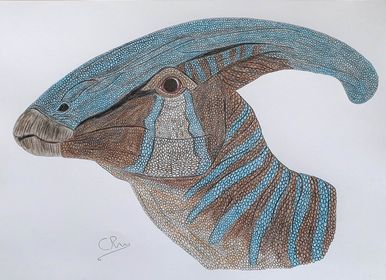
Our thanks to young artist Caldey who sent into Everything Dinosaur a superb drawing of the head of a Parasaurolophus. We were informed that Parasaurolophus is one of Caldey’s favourite dinosaurs. She enjoyed its brief appearance in the first “Jurassic Park” movie. It is a superb Parasaurolophus drawing.
Our thanks to young artist Caldey who sent into Everything Dinosaur a fine illustration of the head of a Parasaurolophus. Picture credit: Caldey.
Picture credit: Caldey
Parasaurolophus Head Drawing
The young artist has given her Parasaurolophus an impressive head crest and the blue motif works exceptionally well. It is thought that these lambeosaurine hadrosaurs had colour vision. So, why not give the Parasaurolophus a colourful appearance. Caldey has taken great care to include details of the skin and the dinosaur’s skin texture. The beak has been drawn accurately. In addition, that is a very impressive and professional signature that has been incorporated into the drawing.
A spokesperson from Everything Dinosaur commented:
“Our thanks to Caldey for sending in her illustration. It is superb. Team members have had to prepare a script all about Parasaurolophus. The script was required for a series of short YouTube videos being created to celebrate the thirtieth anniversary of the film Jurassic Park.”
Parasaurolophus in “Jurassic Park”
Parasaurolophus may only have a relatively minor role in the 1993 film. However, its fleeting screen appearance sets the scene for what is to come in the rest of the film and vividly demonstrates how our perception of the Dinosauria has radically changed.
Our thanks to Caldey for sending in her Parasaurolophus illustration.
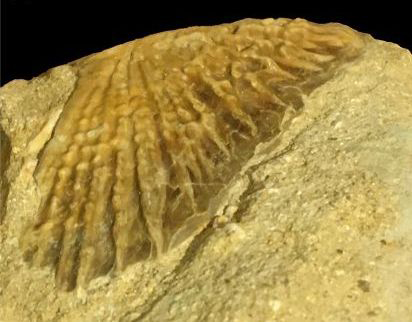
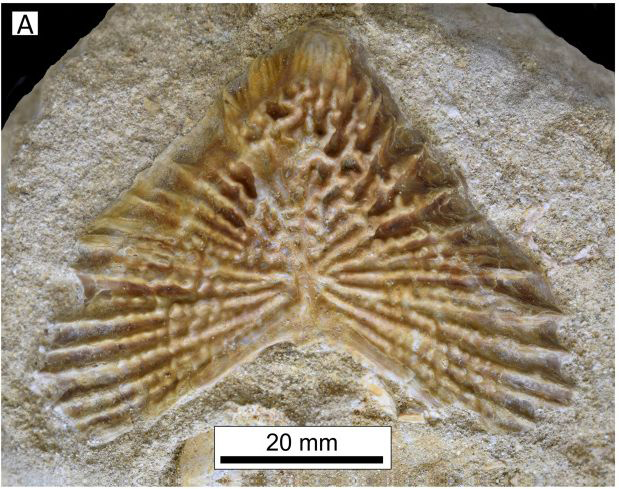
The discovery of a fossil sturgeon scute demonstrates that these “royal fish” were present in North Africa during the Late Cretaceous. The single, fossil scute is the first ever sturgeon fossil to have been found in Africa. The scute is a bony plate embedded into the sturgeon’s skin. Scutes provided a form of dermal armour that evolved to help protect these very ancient fish.
A digital photo of the sturgeon scute (also called buckler) specimen. Picture credit: University of Portsmouth.
A Significant Fossil Discovery
The sturgeon (there are more than two dozen extant species), belongs to the Acipenseriformes Order, which probably originated in the Late Triassic. Sturgeon fossils which are very similar to extant species, are known from Upper Cretaceous strata. Historically, they are associated with cooler waters of the Northern Hemisphere. The specimen was discovered by Professor David Martill (University of Portsmouth). It proves that these magnificent fish were present in Africa.
Sturgeons were more widespread in the Cretaceous than previously thought.
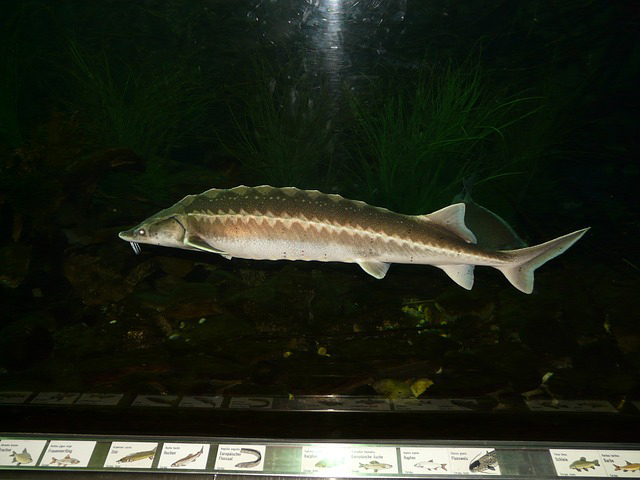
An extant European sturgeon. Picture credit: University of Portsmouth.
Professor Martill was exploring a well-known Moroccan fossil site during a field trip last November. He spotted a row of bony plates (bucklers) on a piece of rock and instinctively recognised the fossils represented the scutes from a sturgeon.
Discussing this significant fossil find, the Professor commented:
“It was a surprising discovery because all sturgeon species have been exclusively found in the Northern Hemisphere in the past. They’ve been located in North America, Europe, Russian Asia, Chinese Asia, but never in South America, Australia, Africa or India, which are the land masses that made up Gondwana, a supercontinent that existed around 336 million years ago and began breaking up around 150 million years ago.”
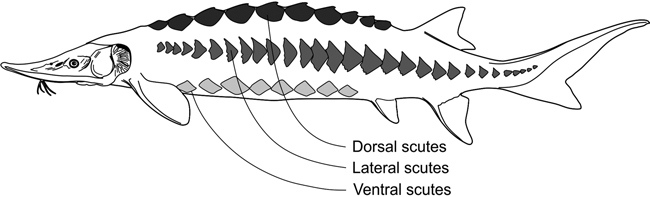
A drawing showing an extant sturgeon in lateral view. The different scutes are highlighted. Picture credit: University of Portsmouth.
A “Royal Fish”
The sturgeon has long been prized for its meat and for its roe (eggs). The roe is commonly referred to as caviar. King Edward II of England declared that all sturgeon from the waters of Wales and England belong to the monarch. This declaration was made in the early 14th century. Since then, these fish have been regarded as “royal fish”.
Sadly, due to overfishing and pollution, many species of extant sturgeon are close to extinction.
Commenting on his African fossil discovery Professor Martill stated:
“Russian beluga caviar is one of the most expensive in the world. Little did we know that at one time an extremely rare African sturgeon could have been a source of this delicacy!”
A digital photo of the dorsal surface of the fossil. Note the scale bar of 20 mm. Picture credit: University of Portsmouth.
Fossil Sturgeon Scute
Sturgeon are thought of as being “living fossils”, for they seem to have remained relatively unchanged since the time of Tyrannosaurus rex and Triceratops. Records from the 18th and 19th centuries indicate specimens reaching more than seven metres in length and weighing over 1.5 tonnes, but fish of this size are exceedingly rare today.
Professor Martill added:
“The very first sturgeons appear in the fossil record in the Late Triassic period in China. But the oldest true sturgeon ever discovered is probably a specimen in the Steve Etches collection from Dorset’s Jurassic Coast in England, which is mentioned in a book Steve and I wrote about fossils in the Kimmeridge Clay Formation.”
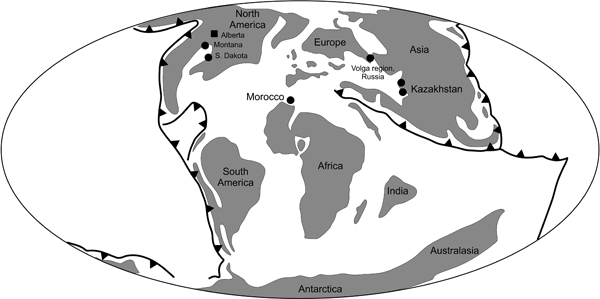
The discovery of a sturgeon fossil in Morocco complicates models of the geographical distribution of these fish during the Late Cretaceous.
A map of the continents at the end of the Cretaceous (66 million years ago). Sturgeon fossil localities are marked by solid black circles. Picture credit: University of Portsmouth
The fossil specimen is now in the collection of the University King Hassan II, Casablanca.
Everything Dinosaur acknowledges the assistance of a media release from the University of Portsmouth in the compilation of this article.
The scientific paper: “A sturgeon (Actinopterygii, Acipenseriformes) from the Upper Cretaceous of Africa” by David M. Martill published in Cretaceous Research.
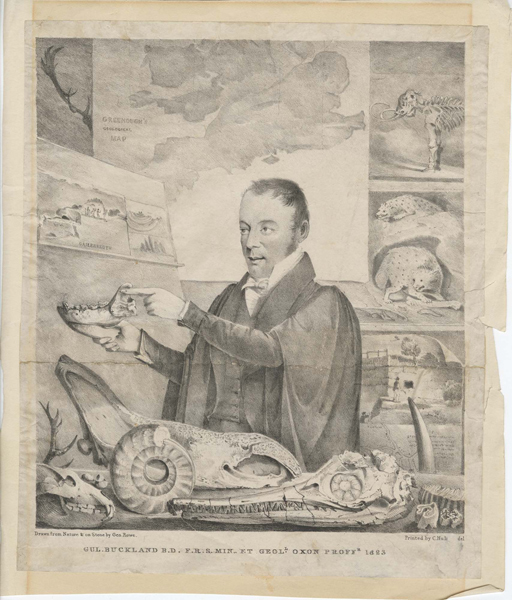
Oxford University Museum of Natural History has completed the purchase of archive material belonging to pioneering geologist the Reverend William Buckland and his wife Mary (née Morland).
This is an important, historical and culturally significant archive that has been acquired by the Oxford University Museum of Natural History (OUMNH). The material which documents the contribution to science by the 19th century theologian and geologist contains over 1,000 items. There are notebooks, family papers, drawings, artworks and letters. The collection is noteworthy as it also highlights the contribution of Buckland’s wife Mary (née Morland). Mary was a talented artist and naturalist.
A portrait of the Reverend William Buckland. Picture credit: Oxford University Museum of Natural History.
Funding the Acquisition
The acquisition has been made possible with support from the Friends of the National Libraries, Headley Trust, the Arts Council England/V&A Purchase Grant Fund and National Heritage Memorial Fund. Private donors also contributed.
Head of Earth Collections at the OUMNH, Eliza Howlett stated:
“The Museum’s acquisition of a large collection of Buckland papers from private hands is a game-changer for historians of science and others with an interest in the histories of gender, class, and colonialism. Combined with the already large and diverse Oxford collections, the new materials will confirm OUMNH as the epicentre for future research, and we are tremendously grateful to the many trusts and foundations, and to the private individuals, who generously contributed to this purchase.”
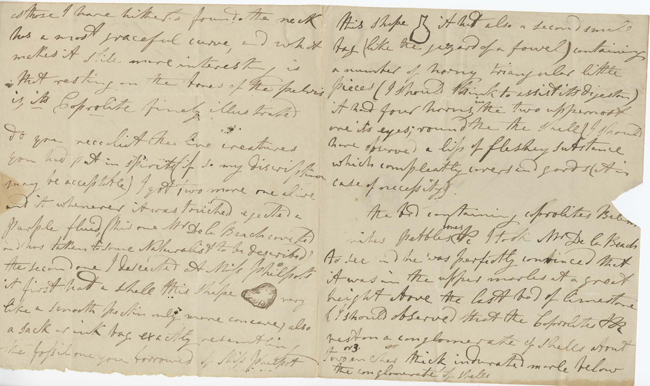
This important collection also includes correspondence between Mary Anning and William Buckland about new fossil discoveries. In a letter penned by Mary Anning the famous Lyme Regis resident informs the Reverend William Buckland about the discovery of Plesiosaurus remains.
Part of a signed letter from Mary Anning to William Buckland from December 21st 1830, informing him of a plesiosaur skeleton she had recently discovered. Picture credit: Oxford University Museum of Natural History.
William Buckland
William Buckland was a hugely influential figure in academia, religion, politics and science. He successively held the positions of Reader in Mineralogy and Geology at Oxford University; Dean of Westminster and Canon of Christ Church, Oxford.
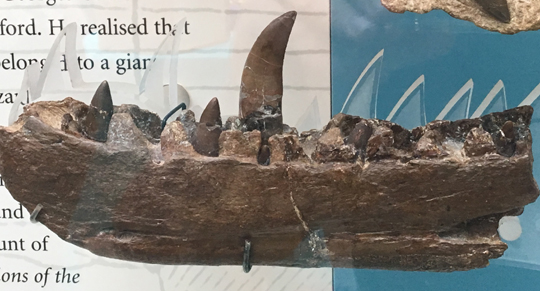
He is accredited with the first, formal scientific description of a dinosaur (Megalosaurus bucklandii). This was one of three genera placed into the Dinosauria by Richard Owen in the early 1840s.
The partial dentary with teeth associated with Megalosaurus bucklandii on display at the Oxford University Museum of Natural History. Picture credit: Everything Dinosaur.
The reverend William Buckland also pioneered palaeoecology with is ground-breaking study of an ancient hyena den. Buckland was also a notable convert to glacial theory, and showed how glaciation rather than a global flood shaped the British landscape.
An Insight into the Life of a Pioneering Scientist
This extensive archive reveals aspects of Buckland’s life as a student at Corpus Christi College, Oxford, as well his work as a practising geologist, eminent member of the clergy and university lecturer. Evidence from the archive provides a comprehensive insight into the thinking and institutions of the early 19th century. During this time, the biblical interpretation of creation was being challenged. Material in the archive documents correspondence with major figures such as art critic John Ruskin and prime minister Robert Peel.
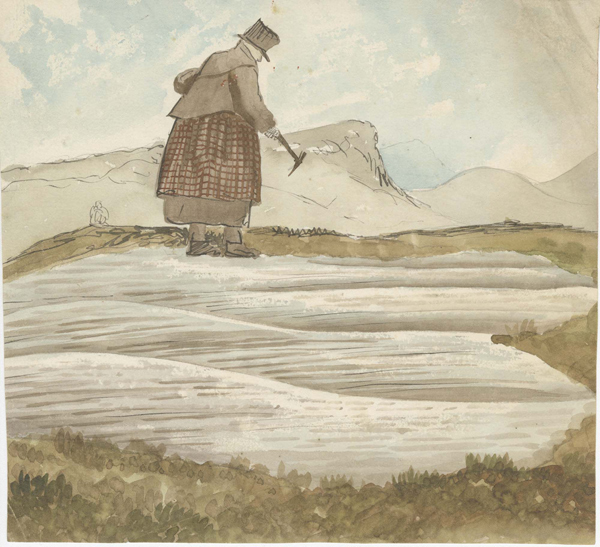
A watercolour of the Reverend William Buckland inspecting a rock formation in Snowdonia, by Thomas Sopwith (October 1841). Picture credit: Oxford University Museum of Natural History.
Identifying Iconic Artworks
The archive also includes original artworks, such as Thomas Sopwith’s watercolour of William Buckland exploring a rock formation armed with a geological hammer. It had been thought that this artwork portrayed Mary Anning. The collection also includes an exceptionally rare, coloured version of the lithograph based on Henry de la Beche’s drawing Duria Antiquior. The artwork, depicting prehistoric Dorset, is famous for being the first pictorial representation of a scene of prehistoric life based on fossil evidence.
Mary’s Contribution is Recognised
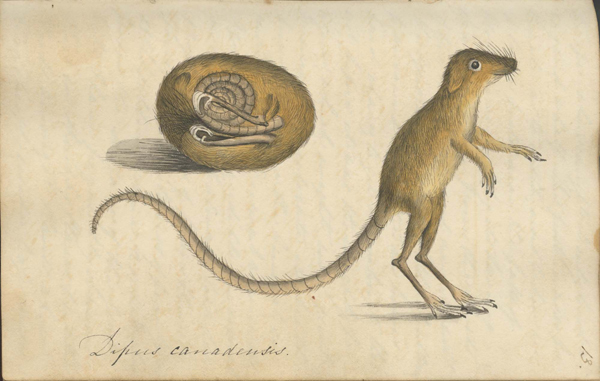
This substantial archive also includes a number of illustrations created by Buckland’s wife Mary (née Morland). Highlights include two of Mary’s sketchbooks. One of these, dating from before her marriage to Buckland, contains exquisite ink and watercolour drawings of natural history specimens, and highlights the huge artistic and scientific contribution she made to her husband’s work.
A watercolour of Dipus canadensis, a jumping mouse from Canada, by Mary Morland circa 1817 from her notebook of specimens. Picture credit: Oxford University Museum of Natural History.
Dr Simon Thurley CBE, Chair of the National Heritage Memorial Fund, commented:
“I am delighted the National Heritage Memorial Fund is able to support Oxford University Museum of Natural History to acquire the outstanding Buckland Archive and ensure that the collection remains together and is saved for the nation.”
Uniting the Collections
The Oxford University Museum of Natural History is already a significant repository for Buckland’s work. This new archive will fit with the Museum’s existing collection, helping to provide a more complete understanding of the contribution made to science and to scientific debate.
Reuniting these collections both physically and digitally will allow researchers and other museum audiences access to the full spectrum of Buckland material.
Everything Dinosaur acknowledges the assistance of a media release from the Oxford University Museum of Natural History in the compilation of this article.
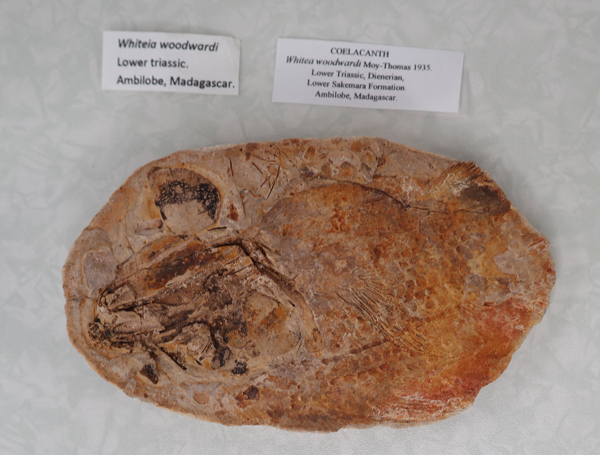
Our thanks to fossil collector and dinosaur model fan Robert who sent Everything Dinosaur a coelacanth fossil to add to our collection. The specimen is an example of Whiteia woodwardi, which is known from Triassic strata. The genus was both geographically and temporally widespread. Whiteia fossils are known from Madagascar (where this specimen comes from), as well as Indonesia and British Columbia (Canada).
The Canadian and Madagascan fossils are associated with Lower Triassic strata, whereas the Indonesian material (Whiteia oishii) is associated with Upper Triassic deposits (Norian faunal stage).
The Coelacanth fossil (Whiteia woodwardi) from the Lower Triassic of Madagascar. Picture credit: Everything Dinosaur.
Picture credit: Everything Dinosaur
A Coelacanth Fossil
The fish remains were preserved inside a concretion. When this nodule was split open the fossilised fish was revealed. The skull is present (to the left of the photograph), and scales can be observed. The impression of a fleshy pectoral fin can be seen.
Coelacanths are an ancient group of lobe-finned fish (Sarcopterygii). It is thought that these fish first evolved in the Early Devonian, around 410 million years ago. Two species are known today, in the genus Latimeria.
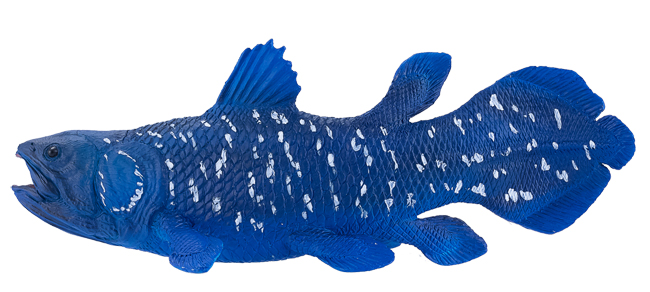
The beautifully painted and very blue Mojo Fun Coelacanth replica.
The picture (above) shows a model of a Coelacanth. This figure is from the Mojo Fun model series.
A spokesperson from Everything Dinosaur commented:
“We would like to thank Robert for his most generous gift. We did not have a Coelacanth specimen in our fossil collection. Thanks to Robert’s generosity we have this wonderful specimen, and we are looking forward to putting it into one of our fossil display cabinets.”
The spokesperson added:
“The Coelacanth fossil can be used in some of our outreach work. We highlight threats to animals today such as global warming and climate change and the Coelacanth, with its long fossil record helps us to explain about extinction and deep geological time.”