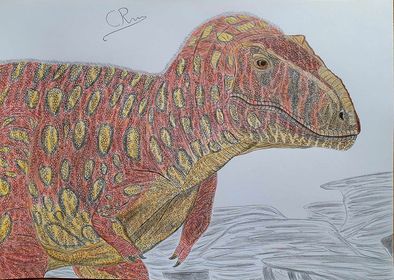
Our thanks to young artist Caldey who sent into Everything Dinosaur a Tarbosaurus dinosaur drawing. The drawing was inspired by a recent television programme. Tarbosaurus features in both series 1 and series 2 of “Prehistoric Planet” which was shown on the Apple TV+ network.
Tarbosaurus lived in Asia during the Late Cretaceous. It was closely related to Tyrannosaurus rex.
A stunning Tarbosaurus (T. bataar) illustrated. The dinosaur drawing was inspired by the tyrannosaurs seen on the recent “Prehistoric Planet” television series. Picture credit: Caldey.
Tarbosaurus Dinosaur Drawing
Caldey has taken great care over her Tarbosaurus dinosaur drawing. It is a striking composition and a very accurate reflection of the Tarbosaurus seen in the television series.
A spokesperson from Everything Dinosaur praised the artist and commented:
“It is a superb tyrannosaur illustration. The details around the head and those lipped jaws of this super-sized theropod are excellent. We congratulate Caldey for her artwork.”
Our thanks to young artist Caldey for sending into Everything Dinosaur her Tarbosaurus illustration.
The oldest spider ever found in Germany has been scientifically described. Named Arthrolycosa wolterbeeki this ancient creepy-crawly roamed northern Germany more than 300 million years ago (Carboniferous).
The fossils of this arachnid come from the Piesberg quarry near Osnabrück in Lower Saxony. They represent the first Palaeozoic spider found in Germany.
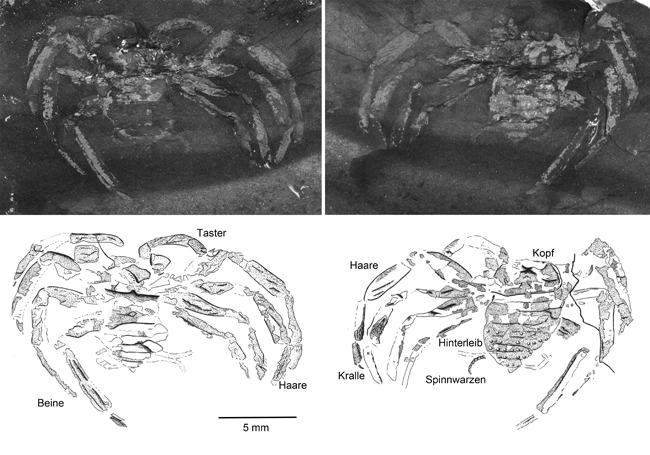
Arthrolycosa wolterbeeki fossils (top) and interpretative line drawing (bottom). Picture credit: Jason Dunlop, Museum für Naturkunde Berlin.
Arthrolycosa wolterbeeki
In a recent article published in the international journal Paläontologische Zeitschrift, Dr Jason Dunlop from the Museum für Naturkunde Berlin described this ancient arthropod. The spider is between 310 and 315 million years old and was named after its discoverer, Tim Wolterbeek, who generously donated the fossil to the Museum für Naturkunde Berlin.
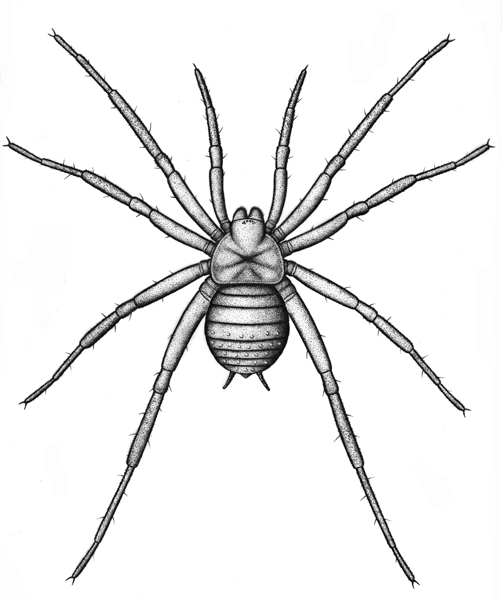
The spider had a body length of about one centimetre and a leg span of about four centimetres. It was about the same size as a common Wolf spider (Lycosidae). It belonged to a primitive group of arachnids known as the mesotheles, which, in contrast to most spiders today, still have a segmented abdomen. Its living relatives are found only in eastern Asia.
The fossil reveals stunning details. The silk-producing spinnerets and even hair and claws on the legs have been identified.
An Arthrolycosa wolterbeeki life reconstruction. Picture credit: Jason Dunlop, Museum für Naturkunde Berlin.
One of Nature’s Big Success Stories
The Arachnida are one of nature’s great success stories. More than 50,000 species of spider have been described worldwide. About a thousand species live in Germany. Spiders are also preserved as fossils. More than 1,400 extinct species are known. It is thought the first spider-like, terrestrial arthropods evolved in the Devonian. These creatures rapidly diversified and thrived in the swamps of the Carboniferous. They became important predators of insects and other small invertebrates. Some giant forms evolved, although the classification of some specimens remains controversial. For example, Megarachne servinei from the Late Carboniferous of Argentina had a leg span in excess of fifty centimetres. Once thought to be a giant spider, it has been reclassified as a bizarre eurypterid.
To read an article from 2018 about the discovery of a Cretaceous-aged spider with a whip-like tail: A Tale of a Spider with a Tail.
The Piesberg quarry is an important fossil site and was declared a National Geotope in 2019. The location has yielded numerous fossils of plants, insects and other animals, including arachnids such as scorpions. This new fossil shows that Late Carboniferous spiders also lived in the Piesberg coal forests. Spiders of this age are still extremely rare. Only twelve Carboniferous species worldwide can be positively identified as spiders, with previous records coming from France, the Czech Republic, Poland and the United States (Mazon Creek).
Everything Dinosaur acknowledges the assistance of a media release from the Museum für Naturkunde Berlin in the compilation of this article.
The scientific paper: “The first Palaeozoic spider (Arachnida: Araneae) from Germany” by Jason A. Dunlop published in Paläontologische Zeitschrift.
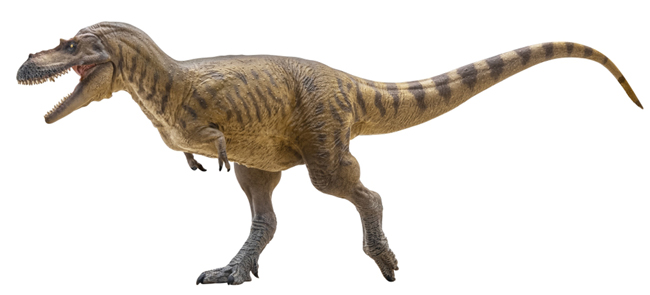
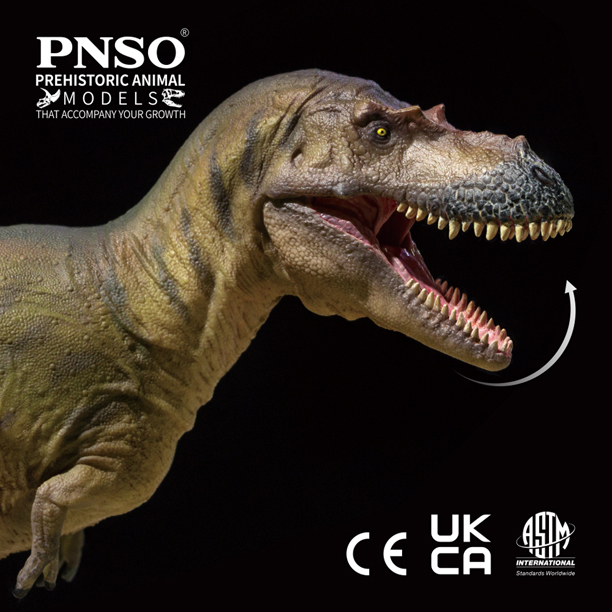
Everything Dinosaur can confirm that the UK-based company will be stocking the PNSO Wally the Albertosaurus model. This new PNSO tyrannosaur figure will be in stock in a few weeks.
The PNSO Albertosaurus dinosaur figure shown in lateral view.
PNSO Wally the Albertosaurus
PNSO has been working on several new tyrannosaur figures. Cameron the new Tyrannosaurus rex figure was announced a few months ago. Shortly afterwards, Lythronax and Daspletosaurus models were added to the replica range.
Cameron the T. rex, Cole the Daspletosaurus and Keynes the Lythronax models are coming into Everything Dinosaur in the next few days (July 2023). The Albertosaurus figure is expected on the next shipment from the factory.
All three theropod dinosaur models have articulated jaws.
The PNSO Wally the Albertosaurus dinosaur model has an articulated jaw.
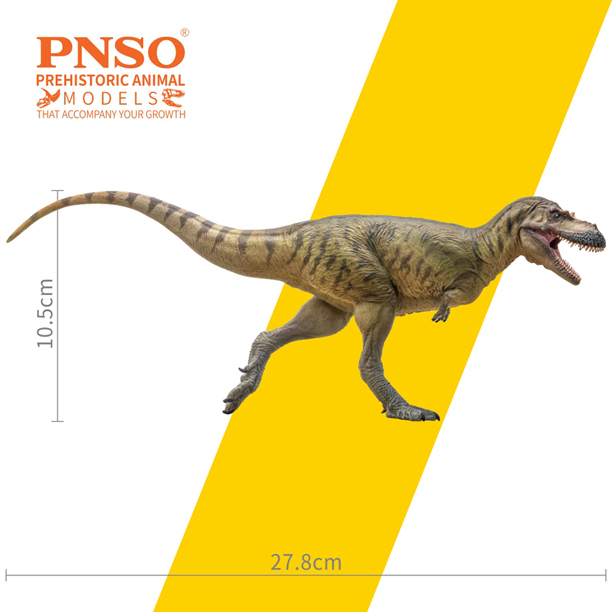
The Wally the Albertosaurus dinosaur model measures a fraction under twenty-eight centimetres in length and the tail is posed approximately ten and a half centimetres off the ground.
The PNSO Albertosaurus model measures 27.8 cm long and the tail is 10.5 cm off the ground.
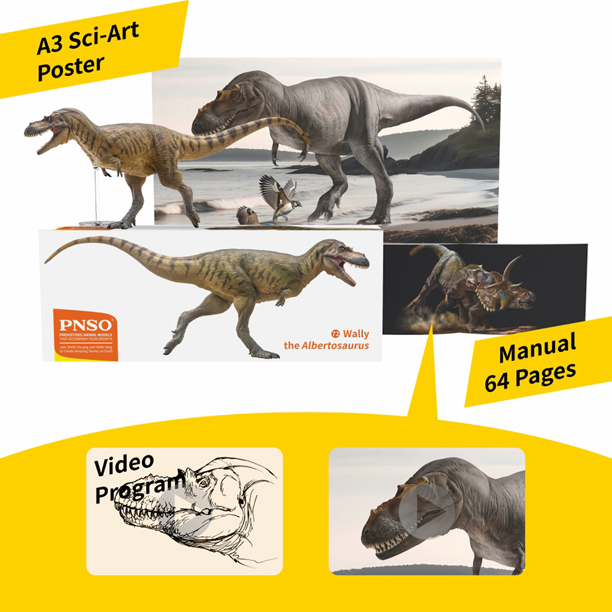
The latest PNSO tyrannosaur figure is supplied with a stunning, A3-sized scientific poster and the model has a transparent support stand. Wally the Albertosaurus is accompanied by a 64-page, full-colour illustrated booklet. A QR code on the box provides purchasers with access to a short video that explains how this figure was made.
The PNSO Wally the Albertosaurus dinosaur model is supplied with a full-colour Sci-Art poster and a 64-page, colour booklet.
The Everything Dinosaur Website
The Everything Dinosaur website features hundreds of different dinosaur and prehistoric animal figures. The UK-based, mail order company stocks a huge range of PNSO models and figures.
To view the range of PNSO prehistoric animal replicas in stock at Everything Dinosaur and other fantastic model ranges: Visit Everything Dinosaur.
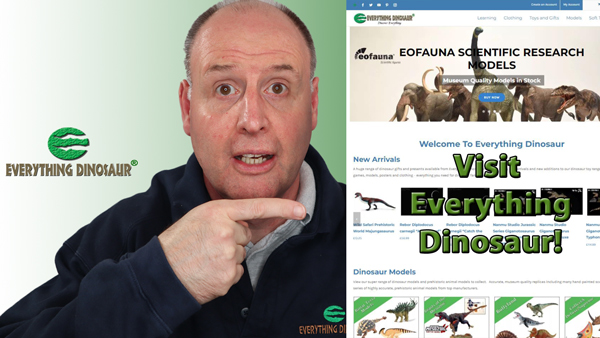
Following the completion of a YouTube short (video), team members at Everything Dinosaur created a new video end-card promoting the company’s award-winning website. The image shows the home page of the Everything Dinosaur website. The Eofauna Scientific Research slider image is visible in the screen shot.
At the end of the YouTube short viewers are reminded to visit the award-winning Everything Dinosaur website. Picture credit: Everything Dinosaur.
Picture credit: Everything Dinosaur
An International Award-winning Website
The Everything Dinosaur website has achieved several accolades. It has been awarded Platinum Trusted Service status for the last four years by Feefo. The company has won the prestigious Feefo Platinum Trusted Service award since its inception.
Everything Dinosaur has won the prestigious Feefo Platinum Trusted Service award ever year that it has been offered. Picture credit: Everything Dinosaur.
A spokesperson from the UK-based mail order company commented:
“We are keen to post up more YouTube and Instagram shorts highlighting aspects of prehistoric animal model collecting. We know our customers and social media followers like these posts. For our part, we enjoy corresponding with fellow collectors and dinosaur model fans.”
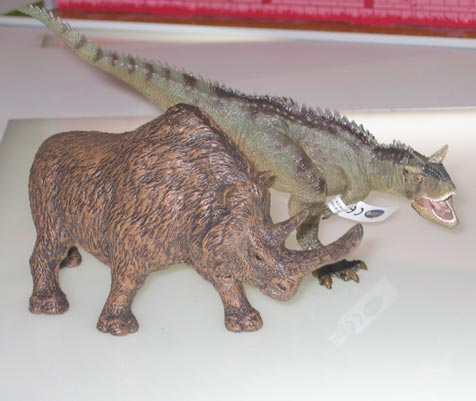
Everything Dinosaur asks the question – Which Woolly Rhino model do you prefer? Are you a fan of the reintroduced Papo Woolly Rhinoceros or do you prefer the recently added Mojo Fun Woolly Rhino? Picture credit: Everything Dinosaur.
The Everything Dinosaur YouTube channel contains dozens of dinosaur and prehistoric animal model reviews. The channel also provides helpful tips and advice about model collecting. For example, team members recently posted up a short video demonstrating a quick way to assemble the new for 2023 Rebor Diplodocus model.
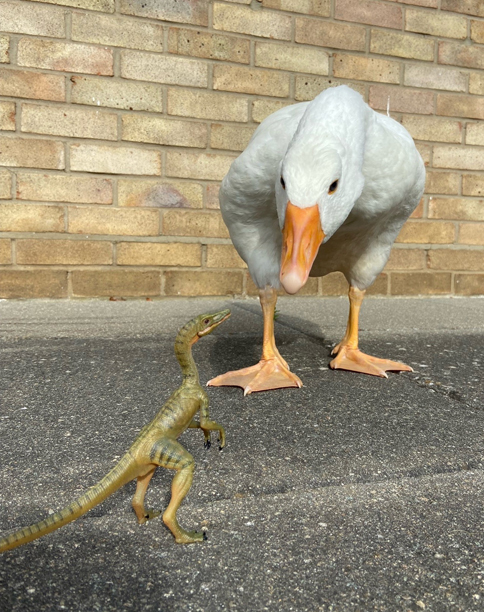
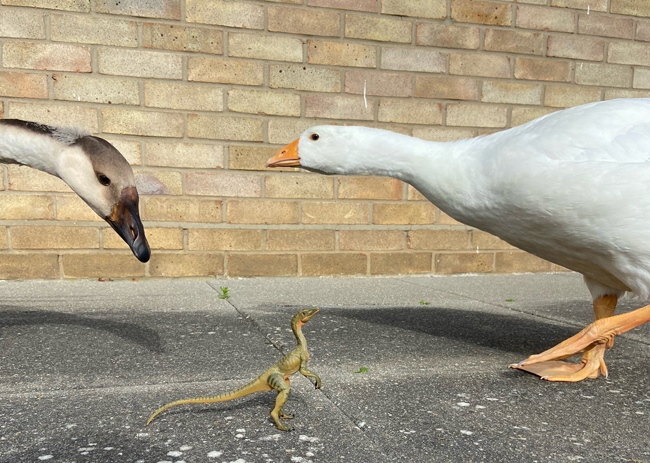
A goose meets a dinosaur! Our thanks to dinosaur fan and model collector Jessica who sent into Everything Dinosaur some photographs of her recently acquired Papo Compsognathus dinosaur model. The Compsognathus was photographed being studied by her pet geese.
A curious seven-week-old goose studies the Papo Compsognathus dinosaur model. Picture credit: Jessica.
Three Theropods Together
Ducks and geese are members of the Anseriformes, an ancient Order of birds that probably originated in the Late Cretaceous. Waterfowl would have co-existed alongside non-avian dinosaurs and pterosaurs. The earliest Cretaceous anseriform known to science is Vegavis (V. iaai). Its fossils come from the Late Cretaceous (Maastrichtian faunal stage) of Antarctica. A study published in 2017 postulated that just like modern geese, Vegavis probably honked!
Anseriforms, like all birds are descended from theropod dinosaurs.
Three members of the Theropoda together. A pair of geese and the Papo Compsognathus figure. Picture credit: Jessica.
Jessica emailed Everything Dinosaur stating:
“I just received my latest order today and I thought that you might like to see the Papo Compsognathus making friends with some of his distant relatives…”
Goose Meets a Dinosaur
The geese are seven weeks old. They already resemble adult birds. Their rapid growth is a possible ancestral trait passed on by their ancient non-avian dinosaur ancestors.
The birds seem to be very interested in the Papo Compsognathus figure.
Jessica added:
“I think they are possibly the most curious creatures on Earth!”
The Papo Compsognathus figure was introduced to the Papo “Les Dinosaures” range in 2018. It has proved to be a popular model, especially as it resembles the Compsognathus dinosaurs depicted in the film “The Lost World: Jurassic Park”, which was the second instalment of the “Jurassic Park” franchise.
A spokesperson from Everything Dinosaur thanked Jessica for the photographs and commented:
“What delightful photographs! It is always a pleasure to hear from our customers. We wonder what the Compsognathus thought about it all the attention it was getting from these very distant relatives.”
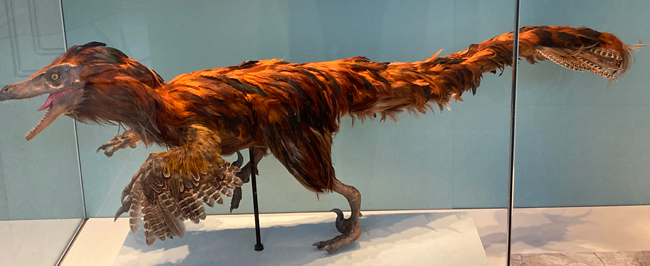
Whilst on a recent visit to the Manchester Museum team members at Everything Dinosaur took the opportunity to admire the life-size Velociraptor replica on display.
Encountering a life-size Velociraptor replica at the Manchester Museum. The replica is part of a display that documents the evolution of feathers and the ancestry of modern birds. Picture credit: Everything Dinosaur.
Picture credit: Everything Dinosaur
A Life-size Velociraptor Replica on Display
The life-size Velociraptor replica has been on display for several years. It has a shaggy coat of feathers and a long tail. The tail ends in a plume. Whilst speculative, the plume suggests that the tail played a role in visual communication.
The colouration is certainly striking and reflects the markings and plumage seen in some extant birds.
Those famous second toe claws are raised, and this small dinosaur is depicted as if it were running. Perhaps it is chasing down a small lizard or some other unfortunate prey.
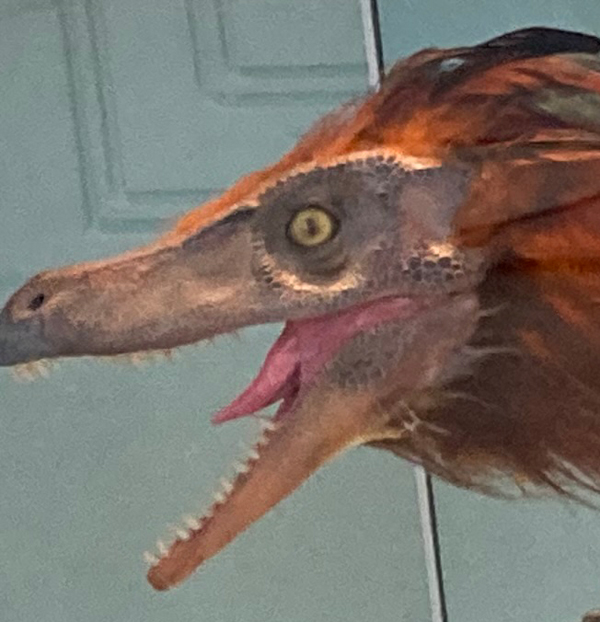
The head shows the delicate lower jaw, small teeth and a short tongue located towards the rear of the mouth. The tongue length is also speculative but reflects the views of many palaeontologists.
The eye has been given a vertical pupil.
A close view of the head showing the delicate lower jaw and the large eye with a vertical pupil. Picture credit: Everything Dinosaur.
Picture credit: Everything Dinosaur
A Vertical Pupil
The pupil’s function is to regulate the amount of light that enters the eye by constricting (closing) or dilating (opening) the pupil. Vertical pupils are associated with small, ambush hunters such as cats. They help these hunters see in poor light and also assist them in judging the distance between themselves and potential prey.
Getting to grips with the Beasts of the Mesozoic 1:18 scale Velociraptor mongoliensis model.
Velociraptor is thought to have been an agile hunter. The model above is a 1:18 scale Velociraptor mongoliensis replica from the Beasts of the Mesozoic range.
A spokesperson from Everything Dinosaur commented:
“We always say hello to the life-size Velociraptor replica. It is a very beautiful figure and helps to demonstrate the actual size of this lithe theropod. The Velociraptor forms part of a display that highlights the link between dinosaurs and birds.”
In the latest YouTube short posted up on Everything Dinosaur’s YouTube channel we ask the question which Woolly Rhino model do you prefer? Are you a fan of the recently reintroduced Papo Woolly Rhinoceros or do you like the new for 2023 Mojo Fun Woolly Rhino figure?
Everything Dinosaur asks the question – Which Woolly Rhino model do you prefer? Are you a fan of the reintroduced Papo Woolly Rhinoceros or do you prefer the recently added Mojo Fun Woolly Rhino? Picture credit: Everything Dinosaur.
Picture credit: Everything Dinosaur
The Woolly Rhino video is less than a minute in length. It shows the two Woolly Rhino models and asks which figure do you like best? The brief video has been posted up on Everything Dinosaur’s YouTube channel and also shared on the company’s social media posts.
The Papo Woolly Rhino was originally introduced back in 2013, it was launched at the same time as the Papo Carnotaurus figure. Whilst the Papo Carnotaurus is still in production, the Woolly Rhinoceros was withdrawn, and it went out of production. Papo reintroduced this figure this year (2023) it is the only prehistoric mammal to be added to the “Les Dinosaures” model range in 2023.
The Papo Carnotaurus (top) and the Papo Woolly Rhino model (bottom). These two figures were added to the Papo range in 2013. Picture credit: Everything Dinosaur.
Picture credit: Everything Dinosaur
To view the range of Papo prehistoric animal figures available from Everything Dinosaur (Les Dinosaures): Papo Prehistoric Animal Models.
Ask the Audience
A spokesperson from Everything Dinosaur explained that the followers of Everything Dinosaur on social media tended to be well informed and knowledgeable about prehistoric animals. Team members were always happy to hear from customers and social media participants. They looked forward to receiving comments about these two Woolly Rhino models.
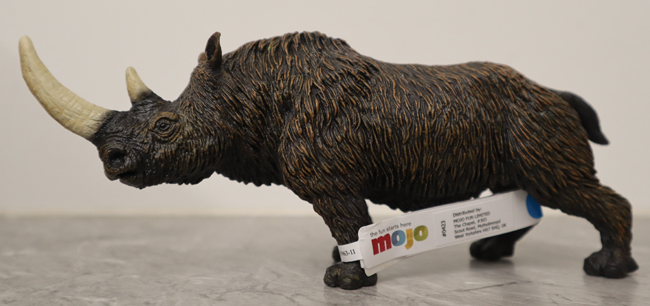
The new for 2023 Mojo Fun Woolly Rhino model has arrived in stock at Everything Dinosaur.
The Everything Dinosaur YouTube channel is jam-packed with model review videos and hints and tips for prehistoric animal model collectors. It has thousands of subscribers.
Which Woolly Rhino Model do you prefer?Video credit: Everything Dinosaur
A newly published study suggests that the Cambrian predator Anomalocaris canadensis had grasping appendages that were too weak to crack trilobite exoskeletons.
The research examined the mechanical properties of the claw-like appendages of the Late Cambrian predator Anomalocaris canadensis. The study concluded that this marine carnivore was built for speed but was not strong enough to crack the exoskeletons of trilobites.
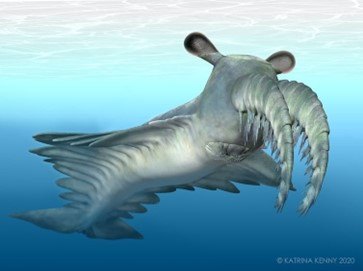
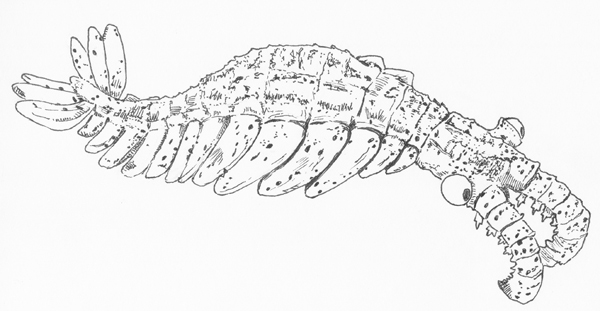
An Anomalocaris life reconstruction. Picture credit: Katrina Kenny.
A Nektonic, Agile Hunter
Writing in the academic journal the Proceedings of the Royal Society Biology, the researchers led by Russell Bicknell (American Museum of Natural History), show that A. canadensis was weaker than previously thought. They postulate that Anomalocaris was a fast and agile swimmer. It was nektonic, catching soft prey such as jelly fish and early vertebrates in open water. The study further refutes the idea that this large predator hunted trilobites.
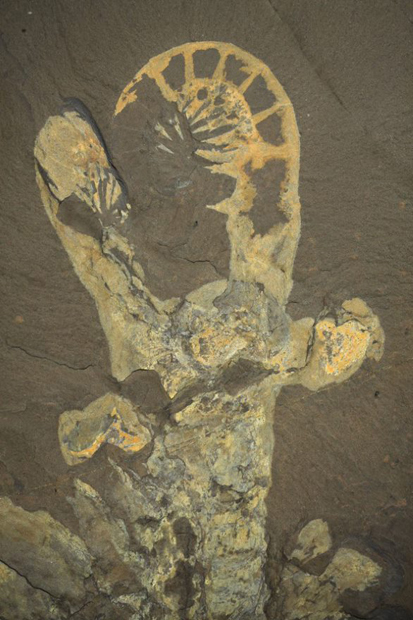
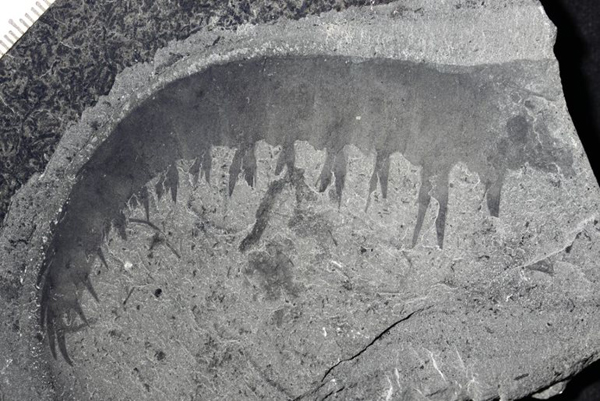
The fossilised head of an Anomalocaris canadensis showing a contracted grasping appendage. Picture credit: Greg Edgecombe.
This Study Supports the Conclusions of Earlier Research
Earlier research (Christopher Nedin, 1999) focused on the ring-shaped mouthparts of Anomalocaris (the oral cone). Anomalocaris mouthparts were at first misidentified. The oral cone was once thought to represent a jellyfish and named Peytoia. The lack of wear on the mouthparts was highlighted suggesting that they did not they did not come into regular contact with mineralised trilobite exoskeletons. It was proposed these radiodonts probably fed on soft-bodied organisms.
Revising the Behaviour of Anomalocaris canadensis
It had been thought that Anomalocaris was responsible for some of the scarred and crushed trilobite specimens preserved in the fossil record.
Postdoctoral researcher Russell Bicknell commented:
“That didn’t sit right with me because trilobites have a very strong exoskeleton, which they essentially make out of rock, while this animal would have been mostly soft and squishy.”
This study set out to investigate whether the pair of grasping appendages located on the head were capable of ripping apart a trilobite. Burgess Shale fossil material was used to create an accurate three-dimensional model of Anomalocaris canadensis.
Natural History Museum researcher and co-author of the paper, Greg Edgecombe explained:
“Having access to specimens with the entire body preserved in the fossils allowed us to understand the anatomy of the appendages in the context of the rest of the head and the trunk. We were able to get a better picture of Anomalocaris as a living organism.”
A new biomechanical study using techniques applied in engineering projects suggests that the spiked, grasping appendages of Anomalocaris canadensis were not strong enough to break the exoskeleton of a trilobite. Picture credit: Greg Edgecombe.
Compared to Extant Whip Scorpions and Whip Spiders
The scientists used modern predatory whip spiders and whip scorpions as analogues. The team demonstrated that the predator’s segmented appendages were able to grab prey and could both stretch and flex. Finite element analysis, a modelling technique used in engineering, was used to identify stresses and points where the appendage would have been under strain.
The team calculated that the appendages would have been damaged while grasping hard prey such as trilobites. The researchers also used computational fluid dynamics to place the three-dimensional model of Anomalocaris in a virtual current to predict the body position it would use while swimming.
Dr Imran Rahman (London Natural History Museum) stated:
“This study emphasises the great potential of modern computer modelling methods in palaeontology. By employing techniques more commonly used in other disciplines like engineering, we can test ideas about long-extinct animals like Anomalocaris.”
This is the first time this combination of biomechanical modelling techniques has been used together in a single study. A different view of Anomalocaris canadensis has emerged. The animal was probably nektonic. A speedy swimmer, chasing soft-bodied prey in the water column with its front appendages outstretched and forward-facing.
Bicknell remarked:
“Previous conceptions were that these animals would have seen the Burgess Shale fauna as a smorgasbord, going after anything they wanted to, but we are finding that the dynamics of the Cambrian food webs were probably much more complex that we once thought.”
Everything Dinosaur acknowledges the assistance of a media release from the London Natural History Museum in the compilation of this article.
The scientific paper: “Raptorial appendages of the Cambrian apex predator Anomalocaris canadensis are built for soft prey and speed” by Russell D. C. Bicknell, Michel Schmidt, Imran A. Rahman, Gregory D. Edgecombe, Susana Gutarra, Allison C. Daley, Roland R. Melzer, Stephen Wroe and John R. Paterson published in the Proceedings of the Royal Society B.
Earlier this week Everything Dinosaur posted up on the company’s YouTube channel a Schleich Quetzalcoatlus video short. This brief video (it is under forty-five seconds long), demonstrates how the jointed wings of this pterosaur model work.
Demonstrating the jointed wings on the new for 2023 Schleich Quetzalcoatlus pterosaur model. Video credit: Everything Dinosaur.
Shorts, or YouTube Shorts are easy to make and provide a quick way to engage your audience using video. They can be recorded straight from a smartphone if required. The video is less than sixty seconds in length and has a vertical format. They are great for getting across simple messages in an entertaining way.
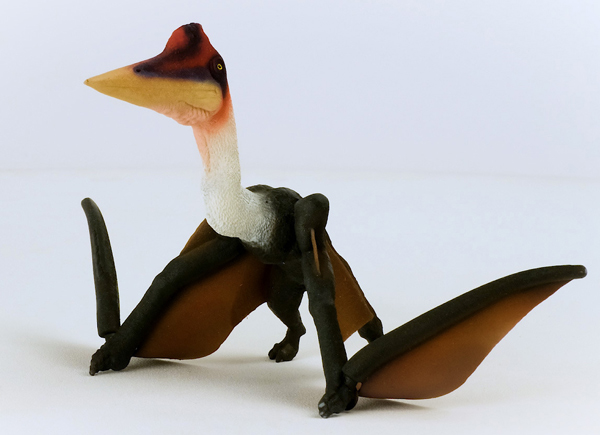
The Schleich Quetzalcoatlus figure in resting pose.
The Schleich Quetzalcoatlus Video Short
In the Schleich Quetzalcoatlus video short, the figure is shown in a flying pose. It is quickly converted into a pterosaur resting pose. This is a novel design, and we congratulate the development team at Schleich for their innovative approach to flying reptile models.
A spokesperson from Everything Dinosaur commented:
“We have lost track of the number of Quetzalcoatlus figures that Schleich have developed. We think that a Quetzalcoatlus pterosaur has been in production at the company in one form or other for more than fifteen years. The new for 2023 figure is the first Schleich Quetzalcoatlus to have jointed wings.”
Visit Everything Dinosaur’s user-friendly and award-winning website: Everything Dinosaur.
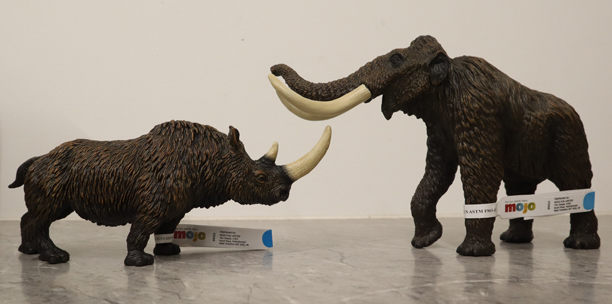
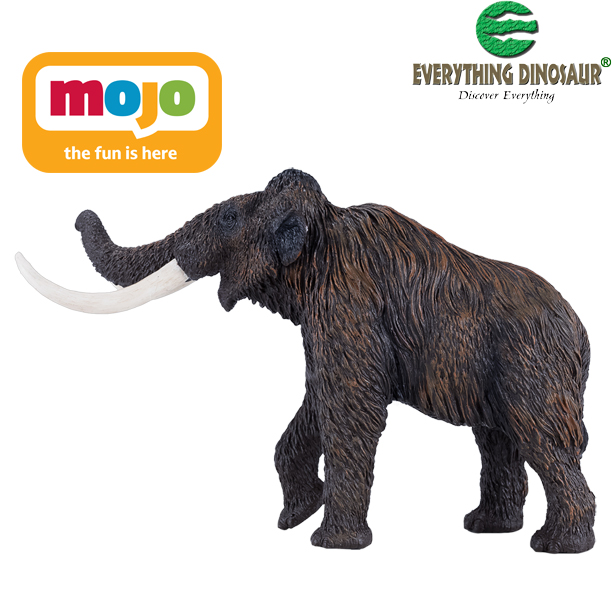
Everything Dinosaur team members have taken a photograph of Mojo Fun prehistoric mammals. A figure collector enquired about these two recently introduced prehistoric mammal replicas. The photograph helps to highlight the stunning details captured in the two figures.
Mojo Fun prehistoric mammal models. The Woolly Rhinoceros figure (left) and the Mojo Fun Woolly Mammoth model (right). Picture credit: Everything Dinosaur.
Mojo Fun had previously included a Woolly Mammoth within its “prehistoric and extinct” range of figures. The new Woolly Mammoth model is likely to replace their earlier figure. The Woolly Rhinoceros (Coelodonta antiquitatis) model is a new for 2023 release. It has already attracted widespread praise.
The new for 2023 Mojo Fun Woolly Rhino model has arrived in stock at Everything Dinosaur. Picture credit: Everything Dinosaur.
Picture credit: Everything Dinosaur
Mojo Fun Prehistoric Mammals
A spokesperson from Everything Dinosaur congratulated the design team.
The spokesperson added:
“These two Ice Age mammals are beautiful. Their shaggy coats have been skilfully modelled and there is much to admire in these two prehistoric mammal models.”
Mojo Fun Woolly Mammoth model (Mammuthus primigenius).
To visit the award-winning and user-friendly Everything Dinosaur website: Everything Dinosaur.