All about dinosaurs, fossils and prehistoric animals by Everything Dinosaur team members.
5 01, 2010

Everything Dinosaur Predictions for 2010

By |2023-03-03T22:46:18+00:00January 5th, 2010|Categories: Dinosaur and Prehistoric Animal News Stories, Dinosaur Fans, Everything Dinosaur News and Updates, Main Page, Press Releases|0 Comments

Everything Dinosaur Predictions for 2010

Time again for us at Everything Dinosaur to put our collective heads on the block and to try and second guess some of the news stories and palaeontological discoveries that are likely to take place over the next twelve months.  After quite a bit of debate and discussion amongst our team members, we have come up with a list of predictions as to what we think is going to happen, crystal ball gazing is not really our strong point but we have given it a go and early in 2011 we shall look back with trepidation to see how we did.

Everything Dinosaur

So in no particular order, here we go:

More Dinosaurs and Other Prehistoric Animals to go Under the Hammer

The trend for more specialist auctions of prehistoric artefacts and relics will continue.  In 2009, there were a number of high profile auctions held in Paris, London and Las Vegas with lots as varied as stone age implements, Sabre Tooth Cat skulls and fully mounted dinosaur skeletons.  We suspect that a number of large scale auctions will take place with a number of complete dinosaur fossils up for grabs.  Prices are likely to remain subdued, with the high figures of the late nineties and the noughties a distant memory.

Increased Pressure for Change in UK Museum Funding

With high levels of public debt in the United Kingdom and concerns over how to relieve the level of indebtedness of the UK Government, it is likely that there are going to be some dramatic cuts in public spending.  No prizes for us for stating the obvious; but one area that may come under increased scrutiny is the level of subvention provided to museums.  Many museums in Britain are free to enter, as a result of changes in Government funding in the late 1990s that led to increased subsidies and financial support for such institutions.

With the need to save money on public spending, free to enter museums such as the Natural History Museum in London may see their subvention and support cut and charges may have to be introduced.

“Dakota” to Hit the Headlines Once Again

Over the last three years or so we have covered a number of news stories and articles concerning the on-going research into the beautifully preserved Hadrosaurine dinosaur nicknamed Dakota.  This mummified Edmontosaurus is likely to reveal more secrets concerning Ornithischian anatomy and skin texture.

Criminal Charges for a Palaeontologist in the United States

One of the first changes made by President Obama when he came into office, was to strengthen legislation concerning the theft of ancient artefacts, relics and fossils from public land.  With the high prices that some fossils can fetch on the black market, we predict that there will be at least one reported court case concerning the extraction of fossils from public land and the falsifying of palaeontological records.  Expect more arrests regarding the excavation of dinosaur fossils.

The Everything Dinosaur Trilobite Hunt – At Last

For a number of years, team members at Everything Dinosaur have discussed the possibility of going on a trilobite hunt.  These highly successful, but now extinct arthropods hold a special fascination for us.  Many of the team members have had the opportunity to visit locations where trilobite fossils have been found.  However, we have never organised a company trip to find trilobite fossils.  We know of a number of secret locations where good quality trilobite fossils can be found and 2010 might just be the year when we take up the opportunity to visit one of these sites.

Naturally, if we find some fossils we will take far more photographs of the fossils in situ than take away specimens and of course we will leave plenty behind for other visitors.  May be we should put some pictures up on this web log of our trilobite hunt.

Increasing Emphasis on Science Teaching in UK Primary Schools

For a number of years now there has been slow and steady progress made by Primary and Secondary schools supported by various agencies to increase the amount of science and mathematics based teaching offered.  We expect that the work of Government backed educational organisations will become increasingly effective and more specialist lessons will be offered in support of the National Curriculum at Key Stage 1 to Key Stage 4.  National academic achievement statistics will show a continued improvement in the level of knowledge and understanding of science subjects.

March Marks a Millennium for Everything Dinosaur Web Log

We predict that by the end of March 2010, the Everything Dinosaur web log will have reached the landmark of 1,000 published articles, representing something like 1.2 million published words.  The web log (blog) began on Sunday May 27th 2007, it now takes up a considerable amount of band width and we continue to try add a new article or picture every single day.  We managed to go over the magic 100,000 page views back in August, we continue to attract more than 100,000 page views a month which is fantastic and we are grateful to all our readers and contributors.

As for predicting how many page views we will achieve by the end of 2010, that is a little tricky as we don’t have a great deal of experience in this field – however, we have had a sweep-stake round the office (the winner gets first choice of all the biscuits in the office for a month) and it seems that something close to 135,000 page views by the end of the year might be possible.  Here’s hoping.

New Genus of Pterosaur to be Announced

We would expect 2010 to continue the trend with many new dinosaur discoveries announced, however, we are plumping for a new genus of pterosaur to come to light over the next twelve months.  Pterosaur fossils are extremely rare in the fossil record, the delicate, light, air-filled bones do not fossilise readily and pterosaur discoveries tend to be much rarer than announcements concerning the discovery of new dinosaurs.  Northeastern China or Brazil with its famous Santana Formation are likely locations for such a discovery.

Beware of Smugglers

Despite the depressed market for dinosaur and other prehistoric animal fossils, we predict that there will be more smuggling of fossils and other valuable items onto the black market in 2010.  No doubt there will be some dubious items posted up onto Ebay and other auction websites to catch out the unwary.  We are expecting a major news story over the last year concerning the discovery and exposure of a significant fossil smuggling ring.

Last but not Least a thought for South Africa

In June and July the world’s sporting focus will be on South Africa with the football world cup taking place.  Although, we can’t predict a win for England (it would be lovely and they may make the semi-finals), but with all that Permian and Triassic strata in the country we predict that sometime in 2010 the discovery of new reptilian fossils will be announced in South Africa.  We could have suggested more dinosaur finds from Queensland in Australia, with the amount of excavation work going on down-under as it were, there is  a very good chance of new discoveries being made.  Perhaps a new genus of Dicynodont or something like that will emerge out of southern Africa.

Predictions for the Year Ahead

So there you have it, our just for a bit of fun, predictions for the year ahead.  At the end of this year we will review this article and see how well (or badly) we did.

In the meantime, here is a link to the Everything Dinosaur website: Everything Dinosaur.
4 01, 2010

Everything Dinosaur Predictions for 2009 – How Did we Do?

By |2023-01-01T22:46:51+00:00January 4th, 2010|Categories: Dinosaur Fans, Everything Dinosaur News and Updates, Main Page|0 Comments

Everything Dinosaur Predictions for 2009 – How Did we Do?

This is the time when we can reflect on the year just passed and look forward to 2010.  At this time last year, we wrote an article making ten predictions as to what sort of discoveries would take place over the next twelve months or so.  It is always difficult to make predictions especially when it comes to second guessing dinosaur and prehistoric animal discoveries and what articles we might have to put up on the web log.  However, looking back on our predictions, I don’t think we did too badly.

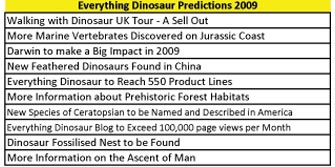
Here is a list summarising our predictions for 2009:

Image credit: Everything Dinosaur

We provided a varied set of predictions, some have come true and others have not.  For example, we were proved accurate in predicting the success of the UK tour of “Walking with Dinosaurs”, however, we did not foresee the very, very expensive merchandise or indeed the theft of one of the stage models during the Mexican leg of the world tour.  We were right about the Everything Dinosaur web log exceeding 100,000 page views per month.  We have managed to achieve in excess of 100,000 page views over the last few months or so, indeed our prediction regarding the number of products we would have in our web shop has also proved to be accurate.

Predicting that Charles Darwin would make a big impact in 2009, was not really difficult, it being the 150th anniversary of the publication of his book “The Origin of Species” and the 200th anniversary of Darwin’s birth.

Our prediction about more large prehistoric animal fossils being found along the Jurassic coast was also spot on.  A number of important discoveries were announced last year, most notably the 2.4-metre-long pliosaur jaws, potentially the largest pliosaur jaws ever found.

To read the article on the giant pliosaur jaws: T. rex a “Kitten” compared to giant Dorset Pliosaur.

We were also correct when it came to predicting the discovery of more feathered dinosaurs from China.  We wrote a number of articles about dinosaur discoveries from China over the course of the last 12 months.  Of particular note, was the article regarding the discovery of feathered theropods that predated the first known bird Archaeopteryx.  A number of stories and articles regarding the evolution of our feathered friends have been published by Everything Dinosaur in 2009.

Visit Everything Dinosaur’s website for prehistoric animal games, models and toys: Everything Dinosaur.

With our other predictions, we were slightly less accurate, there was more data published regarding dinosaurs and arboreal environments but we were not aware of the publication of a new genus of Ceratopsian dinosaur from the Americas.  We could have missed this announcement, but we don’t recall coming across information of this nature.  As for fossilised nests and more information on the evolution of our own species, a number of exciting discoveries were made, but perhaps we need to give our crystal ball a bit of a polish before we make our selections regarding what might happen for 2010.

3 01, 2010

Quick Point on the Diatryma/Gastornis Debate

By |2023-03-03T22:47:03+00:00January 3rd, 2010|Categories: Dinosaur and Prehistoric Animal News Stories, Main Page|0 Comments

The Diatryma/Gastornis Debate

An ancient prehistoric bird – the Diatryma/Gastornis debate. There is some confusion over whether Diatryma and Gastornis are separate genera.

With the demise of the dinosaurs at the end of the Cretaceous, the world was suddenly devoid of large vertebrates.  As the Earth’s climate warmed and became more humid extensive rain-forests dominated the flora even into high latitudes such as USA/Canadian border, but vertebrate lifeforms were taking their time in bouncing back from the mass extinction event that signalled the end of the Mesozoic.  It was the birds that took over the mantle of top predators in the Palaeocene.

Although the mammals were rapidly diversifying, nearly all the mammal families that were evolving, were dominated by small species.  One of the reasons for this suggested by scientists is that with dense jungle dominating the mid latitudes any mammals evolving were restricted in size by the lack of space in the tropical rain-forests.

Diatryma/Gastornis Debate

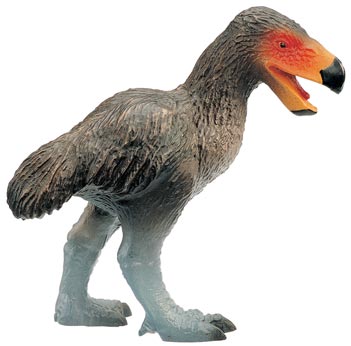
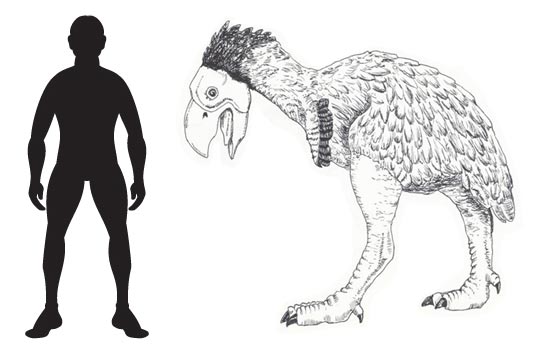
In the northern latitudes, the continents of the Earth had formed one single, large landmass representing what was to become Europe, North America and parts of Asia as sea levels fell.  Large 2-metre-tall flightless birds dominated the food chains.  Animals such as Gastornis from Europe and Diatryma from the United States roamed the primeval forests.  However, there remains some confusion over whether Diatryma and Gastornis are separate genera.

A Model of the “Terror Bird” Diatryma or should that be Gastornis

Picture credit: Everything Dinosaur

The imprint of a single femur of a giant bird from the famous Messel shales plus other material from Geiseltal led to the naming and describing of one genus of predatory, flightless, bird Gastornis.  These fossils were all found in Germany and as a result of these discoveries Gastornis was named and described.  This took place in the mid 1850s.  However, the fossil material associated with this bird remains fragmentary.

A Scale Drawing of Gastornis/Diatryma

Diatryma/Gastornis debate

There is some confusion over whether Diatryma and Gastornis are separate genera.

Picture credit: Everything Dinosaur

The first complete skeleton of the giant Palaeocene bird that was to become known as Diatryma was found in Wyoming in the 1870s.  The fragmentary fossils associated with Gastornis had been incorrectly reconstructed so very few scientists at the time noticed the similarities between Diatryma and the previously named Gastornis.  As more fossils of giant birds have been found and the anatomy of these large birds better understood so scientists have shown that the European Gastornis was almost identical to the North American Diatryma.  Many palaeontologists believe that the two scientific names apply to the same genus.  If this theory is accepted then the first name Gastornis will take precedence and the name Diatryma will be abandoned.

To view the prehistoric animal models available from Everything Dinosaur: Prehistoric Animal Models.

2 01, 2010

New Ankylosaurus from Bullyland of Germany

By |2024-04-19T06:26:40+01:00January 2nd, 2010|Categories: Main Page, Product Reviews|2 Comments

Scale Model of Ankylosaurus from Bullyland of Germany

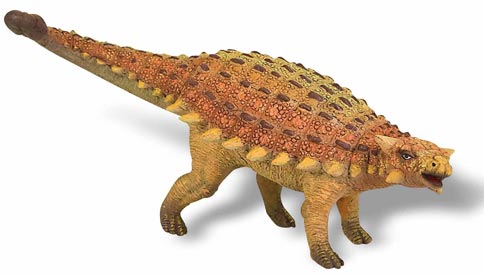
The new scale model of Ankylosaurus (Ankylosaurus magniventris), is a new interpretation of this Late Cretaceous ornithischian from Bullyland of Germany.  The model depicts this animal as quite lithe and animated in the middle of swinging its large tail club.

The model of Ankylosaurus from Bullyland

Picture credit: Everything Dinosaur

To view the Bullyland dinosaur range and other prehistoric animal models including pterosaurs and marine reptiles: Bullyland Dinosaur and Prehistoric Animal Models.

This scale model is beautifully painted and shows lots of fine detail.  Interestingly, for a model depicting the largest of the known and fully described ankylosaurs, the Museum Line Ankylosaurus model shows a relatively slim line version, far removed from the squat and heavy set Ankylosaurus models that we normally see.  The dermal armour resembles the shell of a turtle with a carapace like appearance, other models show the scutes and other elements of the body armour as more raised.

1 01, 2010

Top Ten Dinosaur and Fossil News Stories of 2009

By |2023-01-01T12:06:09+00:00January 1st, 2010|Categories: Dinosaur and Prehistoric Animal News Stories, Dinosaur Fans, Everything Dinosaur News and Updates, Main Page|0 Comments

Top Ten Dinosaur and Fossil News Stories of 2009

Another year gone by, my word, the Holocene seems to be whizzing by.  Anyway, it is that time of year when we reflect on all the amazing dinosaur and prehistoric animal discoveries and fossil news stories that we have written about over the last year.  There are so many to choose from, we have tried to write an article or post up a picture everyday over the last twelve months or so.  However, we have carefully studied the blog site’s statistics and we have produced a list of the top ten most popular news stories that we published in 2009 – a sort of top ten of dinosaur and prehistoric themed articles.

Fossil New Stories

So here it is, in the traditional countdown from number ten to the top spot:

10). Pterosaurs – The Flying Mystery – New Evidence

An article on that very popular but very mysterious group; the pterosaurs starts our top ten countdown, we published an article providing some information on the work of a team of researchers from Bristol University and University College (Dublin) on the position of the pteroid bone.  The position of the pteroid plays a significant role in determining the flight characteristics and capabilities of these flying reptiles.

To read this article: How Pterosaurs Flew – New Research.

9). Tiny Canadian Dinosaur Hints at Reptilian not Mammalian Predatory Role

Alberta (Canada) pops up in our prehistoric animal news story top ten, with an article published by scientists in association with the University of Calgary regarding the discovery of the smallest dinosaur known from North America.  Hesperonychus, a tiny dromaeosaur believed to be closely related to the Chinese dinosaur Microraptor gui an animal so small that it could quite easily have perched on the palm of a child’s hand.  Famous palaeontologist Phil Currie and his co-author, Dr Nicholas Longrich postulate on the idea that small theropod dinosaurs filled the ecological niche of tiny predators in the Mesozoic, the Cretaceous equivalent of the stoats and weasels we see today.

To read the article on Hesperonychus: Tiny Canadian Dinosaur Hints at Reptilian not Mammalian Predatory Niche.

8). Life on Mars?

We write articles on the global search for new prehistoric animal species, but an article featuring the search for extraterrestrial life published in early December flies into our top ten news stories of the last year.  The development of new technologies and research techniques has enabled scientists to examine in great detail the meteorite from Allen Hills with its evidence of micro-fossils, indicating that primitive life may have existed on Mars.

To read more about the latest research on the Martian meteorite: Life on Mars? New research into potential Microscopic Fossils on Martian Meteorite.

7). A year of Dinosaur Auctions – Pop over to Paris for a Bargain

Once again this year, we have featured a number of news stories about dinosaur and other fossil sales.  Whether writing about “Samson” the robust T. rex that went up for auction, or the sale of duckbilled dinosaurs and other ornithischians, there have certainly been a few opportunities to grab yourself a relic from prehistory over the last twelve months.  In at number seven is an article written about an auction of prehistoric animal fossils and other artefacts that took place at Christie’s in Paris.  The article published in April, detailed the auction of a number of rare items, including the remains of Psittacosaurus, the reconstructed jaws of Megalodon and an entire Cave Bear skeleton, all going under the hammer.

To read more about the Paris auction: Pop to Paris to Pick Up a Prehistoric Relic.

6).  Girl Finds Dinosaur Bone from the Cretaceous

Always a pleasure to read about dinosaur discoveries, especially when finds are made by people who would not regard themselves as professionals or even gifted amateurs.  An article published in November gives hope to anyone who has ever wandered along a road cutting or turned over a few rocks on a beach in the hope of finding a dinosaur fossil.  For young Gabrielle Block a trip with her family to the Laurel Dinosaur Park in Maryland (USA), proved to be memorable as she unearthed her very own dinosaur fossil.  Believed to be part of the caudal vertebra (tail bone) of a dromaeosaur, this fossil has been dated to around 100 million years ago.  It has been sent to the Smithsonian Institute for further analysis.

To read more about Gabrielle’s discovery: Girl Finds Dinosaur Bone from the Cretaceous.

Huge Titanoboa

5).  Titanoboa – Huge Prehistoric Snake

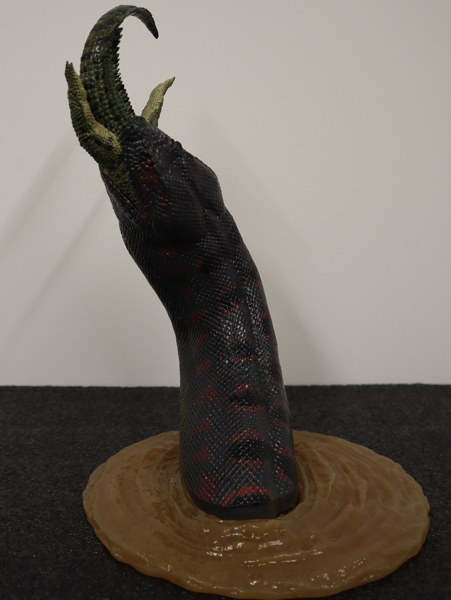
Crashing into the top five comes a story straight out of a Stephen King novel.  Scientists have described the fossil remains of a giant, prehistoric snake that lived in South America.  Fragmentary fossils found as a result of mining activity in northeastern Columbia have led to the naming and describing of a new genus of enormous constrictor-like snake called Titanoboa.  At an estimated 15 metres in length this colossal animal was the length of a school bus and probably weighed as much as an adult Bison.

Rebor Titanoboa Museum Class Maquette Brian Diccus prehistoric animal model.

The assembled Rebor Titanoboa Museum Class Maquette Brian Diccus prehistoric animal model. Picture credit: Everything Dinosaur.

To read more about this discovery: Titanoboa – Huge Snake of the Palaeocene Epoch.

To view the range or Rebor models and figures inclucing the Titanoboa replicas whilst stocks last: Rebor Prehistoric Animal Figures.

4).  How did Liopleurodon Get its Name?

Those fierce marine reptiles; the pliosaurs make two appearances in the top four of our news stories of the year.  It seems that the likes of Liopleurodon and Kronosaurus are as popular as ever and the number four in our list of the most read and popular articles over the last twelve months describes how Liopleurodon got its name.  It seems that old “smooth-sided tooth” remains a favourite with this article written in March appearing in our top five, and we are looking forward to introducing a new Liopleurodon scale model in a few months time.

To read more on Liopleurodon: How did Liopleurodon get its Name?

3).  T. rex a “Kitten” Compared to Dorset Sea Monster

When we write an article about a fierce carnivore that could have seen off a Tyrannosaurus rex, we are pretty confident about attracting lots of page views and readers.  This article about the discovery of the huge jaw bones of a Pliosaur on the “Jurassic Coast” of Dorset comes in at number three.  The jaws, at something in excess of 2.4 metres indicate a beast of between 10-16 metres in length.  The fossils have been recovered from some Kimmeridgian aged strata and it is hoped that more remains of this huge creature may be found in the future.

To read more about this Jurassic pliosaur: T. rex a “Kitten” compared to Dorset Sea Monster say Experts.

2).  World’s Oldest Spider’s Web found Entombed in Amber

The arthropods enter our top ten at number two, with this amazing story published in November about the discovery of ancient spiders silk strands in a piece of amber (fossilised tree resin).  An amateur palaeontologist, looking for dinosaur fossils on a beach along the Sussex coast found a 140 million year old piece of amber that contained the preserved remains of spider silk.  Scientists have claimed this to be the oldest spider’s web discovered to date.

Scientists were able to analyse the contents of the amber, by using a technique called microscopic imaging. This involved slicing the amber into very thin slices then using sophisticated imaging techniques to reveal its contents.

To read more about this amazing discovery: World’s Oldest Spider’s Web found Entombed in Amber.

1).  Dakota – New Discoveries from the Dinosaur Mummy

Fittingly for a blog called “Everything Dinosaur” our most popular article published this year concerns the latest information that has been obtained from the study of “Dakota” a superbly preserved hadrosaurine dinosaur.

An article featuring the work of a team of scientists led by researchers from the University of Manchester, England, about the identification of preserved organic molecules in the skin of a dinosaur that died approximately 66 million years ago makes it to our top spot for 2009.

The beautifully preserved fossil of a large, herbivorous duck-billed dinosaur, a hadrosaurine (Edmontosaurus) has been the subject of a National Geographic documentary as the scientists tried to understand what processes had taken place leading to such detailed preservation.

In a paper published in the prestigious scientific journal Proceedings of the Royal Society B, the team report that the dinosaur’s soft tissues were prevented from decay as it was buried quickly by fine sediments and the fossil was sealed in a mineral cast.  The lack of oxygen helped the preservation process as the soft tissues reacted with the minerals in the sediment to form a kind of protective seal around parts of the fossil leading to a remarkable state of preservation.  Over the last few years, we have featured the research on this incredible fossil as the dedicated team of scientists continue their analysis of this long dead ornithischian.

In an article we printed back in July, the scientific team reported finding traces of the original organic matter of the dinosaur mixed up with minerals formed during the preservation process.  This amazing fossil contains microscopic, cell-like structures although the proteins that made them have long since decayed.

To read more about this fascinating work: Amazing Dinosaur Mummy Yields more Secrets.

Go to Top