All about dinosaurs, fossils and prehistoric animals by Everything Dinosaur team members.
13 04, 2010

Countdown to our 1,000th Article Reaching a Significant Landmark

By |2024-04-18T21:45:38+01:00April 13th, 2010|Categories: Everything Dinosaur News and Updates, Main Page, Press Releases|0 Comments

Countdown to Article 1,000 on the Everything Dinosaur Blog

Since the start of this web log back in May 2007, we at Everything Dinosaur have tried to post an article everyday.  This has not always been easy, what with our workload and our busy jobs, however, we are approaching the landmark of 1,000 on line articles, which we think for a company made up of parents, teachers and dinosaur enthusiasts is quite an achievement.

Countdown to our 1,000th Article

There are many millions of web logs, and we do appreciate the hard work that goes into writing them.  For our part, the Everything Dinosaur blog provides a free resource for dinosaur fans to learn more about palaeontology and to catch up with some of the latest news and discoveries.  Recently, we are asked by a research team at a UK based university to participate in a survey on the use of web logs.  The survey consisted of a number of closed-ended and open-ended questions covering our objectives, our aims for putting the web log together.   As we approach our 1,000th article, by our calculations; the 1,000 article landmark will be reached this weekend, perhaps we ought to reflect on the reasons for starting this blog.

Everything Dinosaur – Preparing for Blog Post Number 1,000

Everything Dinosaur

Presenting an image to the world. Preparing for our 1,000th blog post.  Picture credit: Everything Dinosaur.

Picture credit: Everything Dinosaur

Everything Dinosaur

The simple truth is that our team members enjoy reading about and writing about palaeontology.  These last few years have been described as a “Golden Age” for the science, what with new fossil finds, new theories and new techniques being employed to find out more about prehistory.  The blog has provided a forum permitting two-way communication and helped teachers with school projects as well as fired the imaginations of dinosaur fans.  We have let school children ask questions and have their answers published, we have put up drawings and comments from young dinosaur fans as well as feedback  from eminent academics.  With a new dinosaur species being named and described every few weeks on average, it seems that our web log will have plenty of material to keep us going.

Visit Everything Dinosaur’s award-winning website: Everything Dinosaur.

12 04, 2010

Remembering Edward Drinker Cope (1840 – 1897) a Famous American Scientist

By |2024-04-18T21:48:06+01:00April 12th, 2010|Categories: Dinosaur and Prehistoric Animal News Stories, Dinosaur Fans, Educational Activities, Famous Figures, Main Page|0 Comments

Edward Drinker Cope – Eminent American Palaeontologist

Today, April 12th marks the anniversary of the death of Edward Drinker Cope, who along with his rival Charles Othniel Marsh did so much to explore and study vertebrate fossils of the United States.  Although the techniques employed by both parties in the “bone wars” of the late 19th century would certainly raise eyebrows today, there is no denying Cope’s dedication to the science of palaeontology.

As professor of comparative zoology and botany at Haverford College, Pennsylvania (USA), Cope led a number of expeditions to explore the fossil rich strata of the western United States.  It has been estimated that he and his team, discovered more than 1,000 species of extinct vertebrates – including dinosaurs.  Responsible for naming and describing iconic dinosaurs such as the sauropod Camarasaurus and the Triassic theropod Coelophysis, Cope has been honoured by having a dinosaur genus named after him.  Drinker nisti, a small ornithopod dinosaur whose fossils have been found in Wyoming (USA) was a 2 metre long, herbivorous dinosaur of the Late Jurassic  However, it seems that even naming dinosaurs after Cope brings him into direct conflict with his great rival Othniel Charles Marsh.  Drinker is known from a number of fragmentary remains and the partial skeletons of one adult and a juvenile.  It is very closely related to Othnielia (Othnielia rex), named in honour of Marsh.  In fact the differences between these two dinosaurs are so slight that it has been argued that Drinker is not a separate genus, but in fact a species of Othnielia.

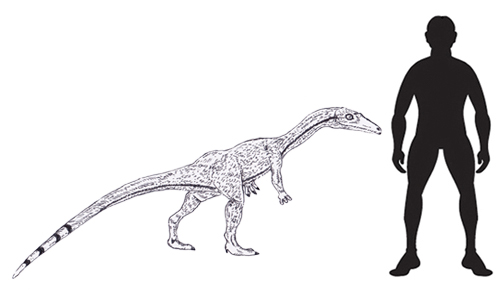
A Scale Drawing of Coelophysis

Coelophysis illustrated. Remembering Edward Drinker Cope.

A scale drawing of the Triassic dinosaur Coelophysis. Remembering Edward Drinker Cope.  Picture credit: Everything Dinosaur.

Picture credit: Everything Dinosaur

For models of Coelophysis (whilst stocks last) take a look here: Wild Safari Prehistoric World Replicas.

Looks like the rivalry between Marsh and Cope will rumble on.  However, Cope’s contribution to science cannot be doubted.  He published more than 1,200 books and papers during his lifetime and contributed greatly to the understanding of vertebrate evolution.

11 04, 2010

Feathered Dinosaurs – Model Set from the AMNH

By |2023-01-05T07:10:14+00:00April 11th, 2010|Categories: Dinosaur Fans, Everything Dinosaur News and Updates, Main Page, Press Releases|0 Comments

The Feathered Dinosaur Set from the AMNH (New York)

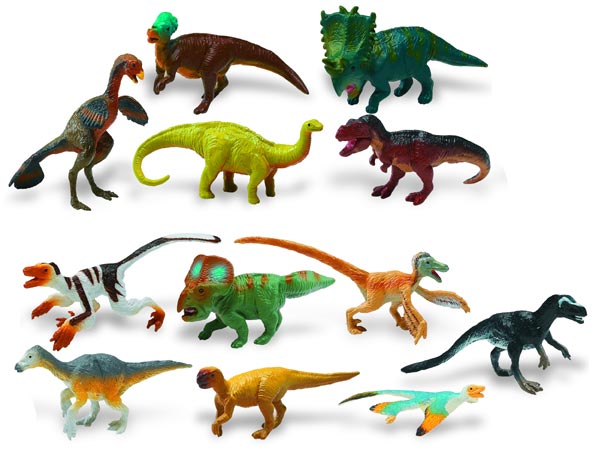
The set of feathered dinosaurs, designed by those clever palaeontologists and researchers at the American Museum of Natural History (AMNH) in New York is back in stock at Everything Dinosaur.  This set of model dinosaurs consists of a number of feathered dinosaurs.  Animals such as the ancestor of T. rex, the predatory Dilong from China, as well as smaller theropods such as Microraptor and Caudipteryx.  There is even a brightly coloured, feathered Velociraptor, depicted in a pose as if it is about to pounce on some unsuspecting prey.  Accompanying the feathered dinosaurs in this set are a number of rare non-feathered dinosaur models, including a member of the Chasmosaurinae (Chasmosaurus).

The American Museum of Natural History Feathered Dinosaur Model Set

Feathered Dinosaur Models.

Picture credit: Everything Dinosaur

To view models and replicas of prehistoric animals take a look at the huge: Safari Ltd. Wild Safari Prehistoric World Models.

Feathered Dinosaurs

The set also includes a model of a primitive horned dinosaur Protoceratops.  This is very appropriate (putting a model of Protoceratops and Velociraptor together), especially when you consider that new evidence is about to be published suggesting that the carnivorous Velociraptor may have scavenged the carcases of the herbivorous Protoceratops.

To read more about this discovery: Evidence of Velociraptor Feeding Behaviour – Scavenging the carcase of a Protoceratops.

Interestingly, another Asian dinosaur, distantly related to Protoceratops and Velociraptor is depicted in the set – Psittacosaurus.  Since the models making up this set (a tube as the Americans call them), were first cast; new evidence concerning Psittacosaurus has emerged.  Although this dinosaur is depicted as non-feathered in this particular model series, there is considerable fossil evidence to indicate that this small ornithischian dinosaur was covered in downy feathers, or at least it had long feather-like quills protruding from the tail.

To read more about the feathers on Psittacosaurus: The Evolution of Feathers – Bird-hipped Dinosaurs upset the Apple Cart.

All in all, this set makes a welcome return to the Everything Dinosaur product range.  The models are very well painted and the set helps to encourage creative, imaginative play.

10 04, 2010

Remarkable Fossil Turtle had Thick Shell to Defend itself against Super-sized Predators

By |2024-04-19T10:09:32+01:00April 10th, 2010|Categories: Dinosaur and Prehistoric Animal News Stories, Main Page|2 Comments

Fossil Turtle Shell as Thick as a 400 page Book

Researchers describe a new species of ancient chelonian based on the discovery of a fossil turtle shell.

A paper published in the scientific publication “The Journal of Vertebrate Palaeontology” provides new information on the unique fauna that existed in South American rain-forests as animals evolved to exploit the niches left vacant by the dinosaurs following the mass extinction event of 66 million years ago.

Scientists from the Smithsonian Tropical Research Institute and the Florida Museum of Natural History report their discoveries, including the finding of new species of ancient turtle, with one particular Chelonian sporting a shell as thick as a phone directory.  Speculating on why a turtle would need such a strong and thick carapace, the researchers point out that as well as predatory crocodiles, this turtle lived in the same habitat as Titanoboa (Titanoboa cerrejonensis) the largest snake known from the fossil record.

Fossil Turtle Shell

Following the major extinctions at the end of the Cretaceous new forms of life emerged.  The Palaeogene and the later Neogene periods may be referred to as the “Age of Mammals” as mammals rapidly diversified and became the dominant mega-fauna in most habitats.  However, in the early part of the Palaeogene, known as the Palaeocene there was considerable global warming.  Average world temperatures on land climbed to a staggering 28 degrees Celsius and much of the Earth became covered in tropical rain forests.  Under these conditions reptiles flourished and many types grew to enormous sizes and assumed the mantle of being “top of the food chain”.  Animals like the monstrous Titanoboa were formidable predators, and this perhaps explains why turtles developed super-thick shells.

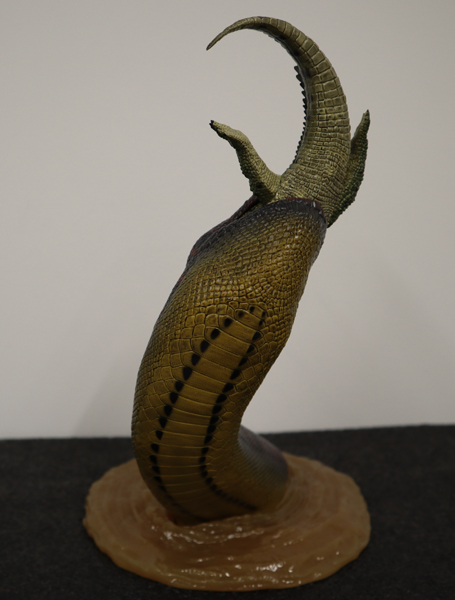
A Replica of the Giant Prehistoric Snake Titanoboa

The Rebor Titanoboa Museum Class Maquette Brian Diccus

Rebor Titanoboa Museum Class Maquette Brian Diccus model. Picture credit: Everything Dinosaur.

Picture credit: Everything Dinosaur

Rebor produced some fantastic museum-quality replicas of Titanoboa.

To see the range of Rebor models: Rebor Replicas of Prehistoric Animals.

The sixty million year old fossilised shell has come from the Cerrejón coal mine in Columbia.  The mine contains fossil rich strata that is helping to show scientists the fauna and flora of prehistoric South America.  The turtle shell is almost 4 cm thick and nearly a metre in diameter.  This fossil is one of a number of fossil turtle remains that have been discovered at the site.

Cerejonemys wayuunaiki

The scientists have named this new species Cerejonemys wayuunaiki – after the mining area and the Wayuu, the name of the local people, from this part of Columbia.  With a huge snake, a constrictor such as Titanoboa on the prowl, the extra thick shell could have provided some protection.  Palaeontologists have estimated that this snake may have reached lengths in excess of 16 metres long, much larger than any extant species of snake.

To read more about Titanoboa: Titanoboa – Huge Snake of the Palaeocene Epoch.

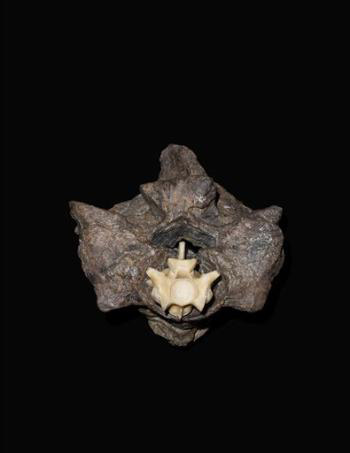
Comparison of Vertebrae – Titanoboa cerrejonensis and an Extant Anaconda

Picture credit: Nature

Commenting on the importance of the American based team’s work, Carlos Jarmillo, staff scientist at the Smithsonian Tropical Research Institute stated:

“The fossils from Cerrejón provide a snapshot of the first modern rain-forest in South America — after the big Cretaceous extinctions and before the Andes rose, modern river basins formed and the Panama land bridge connected North and South America.”

A number of other turtle species have been discovered at the site, the hard shells of turtles having a particularly high chance of being preserved under the prevailing rain- forest conditions, especially if they were deposited close to water sources.  The scientists are currently working on their finds and expect to name and describe a number of new species in the near future.

9 04, 2010

A Wonderful Excavate a Dinosaur Skull Kit

By |2024-04-19T06:28:17+01:00April 9th, 2010|Categories: Everything Dinosaur News and Updates, Everything Dinosaur Products, Main Page, Press Releases|0 Comments

Excavate a Dinosaur Skull Kit – Build your own Museum in your Bedroom

Everything Dinosaur announces a new addition to its Young Scientist range of science based educational products – the excavate your own dinosaur skeleton kit.  Each kit contains a gypsum block inside of which there are pieces of a dinosaur’s skull and skeleton for young palaeontologists to carefully excavate.  The kit contains the tools required to do the job, digging tools and a brush just like a real palaeontologist’s tools when they are digging around fossil bone.  You can display your excavation just like a dinosaur fossil in a museum.

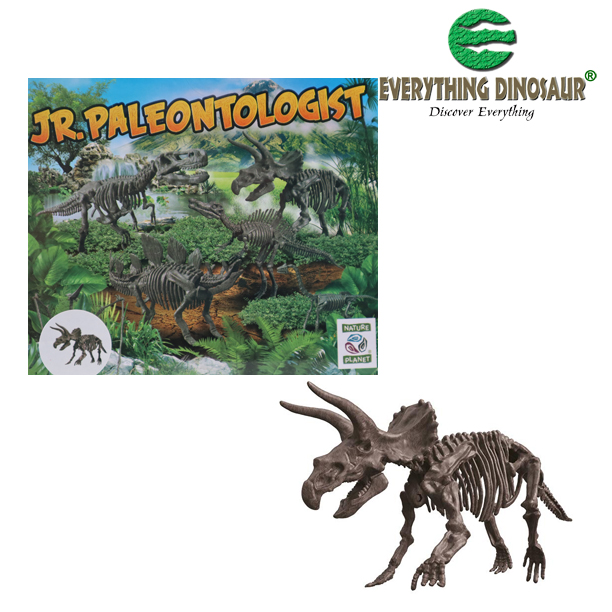
The Dinosaur Skeleton Excavation Kit from Everything Dinosaur

Triceratops skeleton dig kit.

A Triceratops skeleton dig kit. Picture credit: Everything Dinosaur.

Picture Credit: Everything Dinosaur

To view the extensive range of dinosaur and prehistoric animal themed toys and gifts available from Everything Dinosaur’s award-winning website: Everything Dinosaur.

Dinosaur Skeleton Kit

Turn your bedroom into a miniature museum with this range of dinosaur skeleton excavation kits for you to excavate and mount.  There are several in the series to collect and this product is suitable for children (with a little supervision from mums and dads).

Dinosaur skulls are perhaps the most important component of the dinosaur fossilised skeleton.  Differences in skull shape and size helps scientists determine whether or not the fossil may represent a new species.  Skulls and jaws can tell palaeontologists a great deal about the animal.  For example, what it ate, how it looked and it can even provide information on how important some of its senses like sight and smell might have been.

Can you build the dinosaur skeleton kit and create your own dinosaur museum?

8 04, 2010

New Evidence of Velociraptor Feeding Behaviour – Scavenging the Carcase of a Protoceratops

By |2024-04-19T10:06:16+01:00April 8th, 2010|Categories: Dinosaur and Prehistoric Animal News Stories, Dinosaur Fans, Main Page, Palaeontological articles|1 Comment

Fossil Find Shows Evidence of a Velociraptor Feeding upon Another Dinosaur

Velociraptor that speedy Late Cretaceous predator with its sickle-shaped “killing claw” on the second toe of each foot, plus a jaw lined with more teeth than a T. rex has a deserved reputation for being vicious amongst dinosaur fans and scientists.  However, with the exception of one amazing fossil find made in 1971, palaeontologists had little evidence of what this turkey-sized animal fed on, but now that has changed thanks to a remarkable discovery made in China.

A Fight to the Death
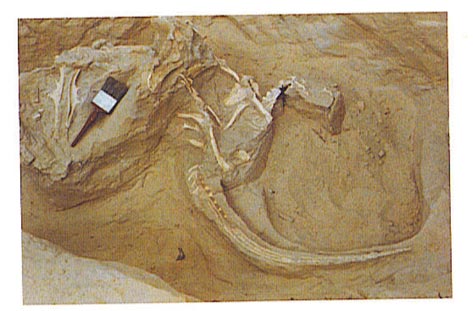
Picture credit: Polish Academy of Sciences

The picture above shows the partial excavation of one of the most famous dinosaur fossils discovered to date.  A Polish expedition exploring Late Cretaceous strata at a site called Toogreeg in the Gobi desert of Mongolia, uncovered evidence of a fight to the death between two dinosaurs.

A predatory Velociraptor (seen on the right of the picture) has been preserved alongside a Protoceratops (herbivore).  The tangled fossil shows that the Velociraptor had grasped the plant-eater’s head and was delivering vicious kicks to the underbelly of the Protoceratops, whilst the Protoceratops gripped the attacker’s arm in its strong beak.  It is likely that this duel led to both animals being mortally wounded, their remains being engulfed in sand and preserved.  This remarkable fossil is known as “the fighting dinosaurs” and is one of very few specimens that show fighting behaviour in Dinosauria.

However, a team of researchers have found fossil fragments of Velociraptor teeth alongside the scattered bones of a sub-adult Protoceratops and from the scratches on the bones, it seems that evidence of Velociraptor feeding behaviour has been found.  The teeth marks on the herbivore’s bones suggest that a Velociraptor scavenged the Protoceratops carcase.

Despite the “smoking gun” evidence of the 1971  discovery, scientists were unsure how often Velociraptor predated upon and fed upon other dinosaurs such as Protoceratops.  Velociraptor, with their misleading over-sized depiction in the Jurassic Park trilogy, were actually quite small theropods.  A fully grown Velociraptor (V. mongoliensis) could weigh as much as 15 kilogrammes and perhaps stood a little over a metre tall.  Protoceratops, despite being much slower than Velociraptor would have had size and strength on its side.

Adult Protoceratops would have reached lengths in excess of six feet and their squat, powerful bodies could have weighed as much as 400 kilogrammes.  Scientists have speculated that dinosaurs such as Velociraptor may have fed mainly on smaller animals such as lizards, baby dinosaurs and birds, although if they hunted in a pack they would have been capable of bringing down much larger quarry.

Protoceratops fossils in this particular rock strata are the commonest large vertebrate fossils found.  Fossils of Velociraptor, especially their teeth have been found in this strata also, this may indicate that the predatory Velociraptor interacted frequently with the relatively common herbivore Protoceratops.

This new discovery, a paper of which is due to be published shortly in the scientific journal Palaeogeography, Palaeoclimatology, Palaeoecology, suggests that Velociraptors may have regularly fed on Protoceratops.  The finding of Velociraptor teeth in association with Protoceratops bones that show scratches made from feeding dinosaurs indicates that Velociraptor may have regularly dined on Protoceratops, either by hunting or scavenging from the bodies of those animals that had already perished.

Dr David Hone of the Chinese Academy of Sciences (Beijing) made the new discovery in Upper Cretaceous deposits at Bayan Mandahu, in Inner Mongolia, China.   His colleague Dr Jonah Choiniere found a mass of badly eroded Protoceratops bones, amongst them lay two Velociraptorine-like teeth.  The scientists were keen to analyse the dinosaur bones to see if any signs of feeding behaviour had been preserved.  Dr Hone and colleagues Dr Mike Pittman and Dr Corwin Sullivan were able to identify a number of bite marks and scratches that indicated that the carcase had been scavenged by a Velociraptor-like dinosaur, the teeth were broken and shed as it fed.

Broken Velociraptorine Teeth find at the Site
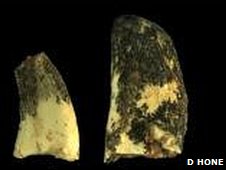
Broken “Raptor” Teeth.

Picture credit: Dr. David Hone

The picture shows the shed teeth found in association with the the Protoceratops fossils.  These tiny teeth are broken at the tip and indicate that they were lost when the Velociraptor-like animal bit into the hard bones of the dead dinosaur.  Finding evidence such as this is extremely difficult, the teeth of these dromaeosaurs are extremely small and fragmentary remains of teeth are notoriously hard to spot, even when using fine screening sieves to help recover the fossils.

Bite Marks on the Protoceratops Fossil Bone
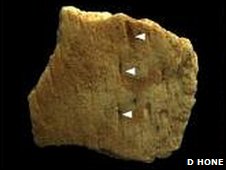
Bite Marks.

Picture credit: Dr. David Hone

The three white arrows in the picture show the strong scratches in the fossilised bone, indications that the Velociraptor scavenged the carcase.  The bite marks match the sort of impressions that Velociraptor teeth would have made.  As the Protoceratops was quite large (nearly fully grown) and since the bite marks were found on the jaw bones, it is likely that this fossil evidence represents scavenging behaviour and not hunting behaviour.

Dr Hone commented:

“The marks were on and around bits of the jaw.  Protoceratops probably weighed many times what a Velociraptor did, with lots of muscle to eat.  Why scrape away at the jaws, where there’s not much muscle, so heavily that you scratch the bone and lose teeth unless there was not much else there?”

This data suggests that a Velociraptor-like animal discovered the carcase, perhaps scenting the rotting flesh from many miles away and then it fed on what meat remained on the animal.

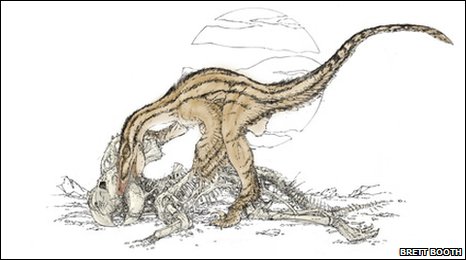
An Artists Impression of the Feeding Velociraptorine
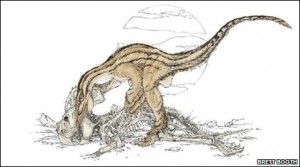
Feeding Velociraptor.

Picture credit: Brett Booth

Dr Hone stated:

“In short, this looks like scavenging as the animal would be feeding on the haunches and guts first, not the cheeks”.

Protoceratops did have powerful jaws, it is perhaps possible that the cheeks of this animal were quite fleshy and one of the choicest cuts of meat.  Flesh from the cheeks of animals such as cows is seen as a delicacy and revered by many butchers who regard this part of the carcase as a most flavoursome and tasty cut.  We know of many local butchers who remove the cheeks from a cow whilst butchering the rest of the carcase, taking home their prize.  Could the cheeks of a Protoceratops have been a choice cut for a Velociraptor?

Such feeding behaviour is not common in extent animals, most small scavengers attempt to grab what they can from where they can, after all, if they have been attracted to the carcase then some other larger beastie may be on its way to gate crash events.

Commenting on the 1971 Polish discovery Dr Hone said:

“The fighting dinosaurs suggests predation.  Combine the two and we have good evidence for both behaviours.  Animals like Velociraptor were probably feeding on animals like Protoceratops regularly, probably including both predation and scavenging.”

No doubt this new evidence will add spice to the perennial argument surrounding the feeding habits of Theropods, particularly the larger ones such as the late Tyrannosauridae.  Did these animals scavenge most of their meals or were they active hunters?  Almost all living carnivores do a bit of both, hunting but not being averse to free lunch should they find a corpse upon which they can feed.

Discussing this point Dr Hone stated:

“It is a question of degree.  Lions mostly predate, whilst jackals mostly scavenge.”

This new fossil discovery helps confirm what many researchers have long suspected about how carnivorous dinosaurs interacted with their plant-eating counterparts.

Dr Hone concluded:

“Even the most dedicated predator won’t turn down a free meal if they chance across a dead animal with a few bits of meat still attached, and this looks like the case here.”

The Beasts of the Mesozoic model series contains a variety of dromaeosaurid figures: Beasts of the Mesozoic Models and Figures.

7 04, 2010

If you go down to the woods today – discover a new species of Monitor Lizard

By |2023-03-05T14:22:17+00:00April 7th, 2010|Categories: Animal News Stories, Educational Activities, Main Page|0 Comments

Beware of a new Dragon in the Woods – Varanus bitatawa  a New Species

Finding a new species of vertebrate is a rare event.  Finding a new, large species, an animal that would be described as a member of the “mega fauna” is exceptional, but a new 2-metre-long species of Monitor Lizard (genus Varanus) has just been brought to the attention of western scientists.

The giant lizard resides in the Philippines, in the northern forests of Luzon island.  Luzon island is the largest island that makes up the Philippines and despite having parts of it densely populated (it is one of the most populated islands on Earth), it still has plenty of natural wonders awaiting discovery.

Monitor Lizard

The genus Varanus (Monitor Lizards) contains nearly 30 species, all of which live in the Old World, with species found in Africa, southern Asia, the Philippines and Australia.  The largest lizard in the world today is a Monitor Lizard – the Komodo dragon (V. komodoensis), it too has revealed some surprising discoveries recently, with confirmed evidence that this lizard that can grow up to 3 metres long and weigh 90 kilogrammes has a venomous bite.

Recently, a scientific paper was published suggesting that a genus of dinosaur called Sinornithosaurus may also have been venomous.

To read more about this: Sinornithosaurus – A Dinosaur with Venom.

This new species of monitor, although longer than a man, is actually very lightly built with the largest specimens so far weighing a little more than 10 kilogrammes.  Half the body length of this new species, named Varanus bitatawa is made up of tail.

The animal poses no threat to humans as it appears to be entirely herbivorous.  It has remained undescribed for so long as it is extremely secretive and spends a great deal of time living in trees, where it finds fruit to eat.  This new Monitor Lizard, described by the scientists who found it as “spectacular”, is a very striking animal indeed with bright yellow, blue and green skin.

A Model of the Largest Living Lizard – the Komodo Dragon

Rebor Komodo dragon 1:6 scale replica. A species of monitor lizard.

Rebor GrabNGo Komodo dragon model. Picture credit: Everything Dinosaur.

Picture credit: Everything Dinosaur

The model (above) is the Rebor Komodo dragon replica, to view this figure (whilst stocks last): Rebor Replicas and Prehistoric Animal Figures.

This lizard may be completely new to western science, but to the local tribes people of the forests of northern Luzon, the animal is very well known.  For centuries the locals have hunted it for food, it is reputed to taste extremely pleasant and such animals provide a valuable source of protein for the indigenous people.  We suppose it would be kind of like a version of “corn fed chicken”.  The secretive nature of this lizard may well be a result of hunting pressure with only the most reclusive and shy animals avoiding the attention of the local hunters.  At the same time, this Monitor remained unknown to scientists in the west.

International Research Team

The American, Dutch and Philippines based research team had found plenty of evidence of a large, arboreal lizard.  Many trees had claw marks on the trunk and the native people had talked about a lizard that was good to eat, but until now no documentary proof of this lizard’s existence had been collected.

One of the authors of the paper on this new species, Dr Rafe Brown stated:

“It is an incredible animal”.

The paper has been published in the scientific journal “Biology Letters”.  In the journal, the researchers describe how rare it is to find such a large terrestrial animal new to science.

The new species, which is called Varanus bitatawa, is thought to live almost entirely on fruit, making it one of just three species of fruit-eating Monitor Lizards in the world.  Living as it does in the tree canopy, this large lizard has remained undetected to the eyes of western scientists, despite a number of scientific expeditions to this part of the Philippines to map the diversity of the fauna and flora.

The new species of monitor lives at least 150km away from its nearest relative, another lizard called V. olivaceus, which also lives in trees and eats fruit.

6 04, 2010

Gondwanaland Cretaceous Amber gives a New Insight into Flower Power

By |2024-04-19T10:04:33+01:00April 6th, 2010|Categories: Dinosaur and Prehistoric Animal News Stories, Geology, Main Page|0 Comments

Cretaceous Amber from East Africa sheds Light on Cretaceous Ecosystem

The discovery of a deposit of amber (fossilised tree resin) in Ethiopia is providing scientists with the opportunity to learn more about the evolution of flowering plants.  This exceptionally rare discovery, no other strata containing amber dating from the Cretaceous is known in the Southern Hemisphere, is allowing researchers to learn more about insects, fungi and even bacteria that shared the environment with dinosaurs.

Fossilised Tree Sap

Amber is fossilised sap that has been produced by certain types of trees.  The resin seeps out of cuts or other parts of the damaged tree and helps to prevent infection and disease.  Organisms such as insects, pollen grains and even small lizards and frogs can be caught in the sticky substance and preserved in exquisite detail.  The tree sap that hardens and is preserved is usually produced by conifers (gymnosperms), but certain types of angiosperms (flowering trees) can produce amber.  Most amber known is from deposits that are less than seventy million years old.  The Ethiopian amber has been dated to approximately 95 million years ago ( Cenomanian faunal stage).

In a paper published in the scientific journal “The Proceedings of the National Academy of Sciences”, a description is provided of the new types of insects, other arthropods, nematodes, fungi and bacteria that have been discovered entombed in the hardened tree sap.  The research team hopes that the analysis of these nodules will provide further information on the development and the diversification of flowering plants.

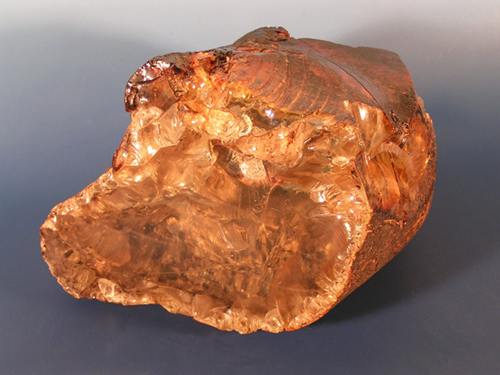
A Nodule of Ethiopian Amber dating from the Cretaceous

Picture credit: PNAS/Matthias Svojtka

One of the authors of the paper, Paul Nascimbene of the Division of Invertebrate Zoology at the American Museum of Natural History (New York) commented:

Until now, we had discovered virtually no Cretaceous amber sites from the Southern Hemisphere’s Gondwanan supercontinent.  Significant Cretaceous amber deposits had been found primarily in North America and Eurasia.”

Cretaceous Amber

The date of the amber deposit could be very significant as it was during this part of the Cretaceous that flowering plants (angiosperms) began to diversify and become the dominant form of plant life.  Alexander Schmidt, of the University of Göttingen in Germany, another author of the report, stated:

“The first angiosperms, or flowering plants, appeared and diversified in the Cretaceous.  Their rise to dominance drastically changed terrestrial ecosystems, and the Ethiopian amber deposit sheds light on this time of change.”

Some of the research team worked on the geological setting and the fossils entombed within the amber, whilst Nascimbene, along with Kenneth Anderson from Southern Illinois University, studied the amber nodules.  They found that the resin that seeped from these Cretaceous Gondwanan trees is similar chemically to more recent ambers from flowering plants in Miocene deposits found in Mexico and the Dominican Republic.  The amber’s chemical designation is Class Ic, and it is the only Ic fossil resin discovered thus far from the Cretaceous.  All other documented Cretaceous ambers are definitively from non-flowering plants, (gymnosperms).

Paul Nascimbene went onto add:

“The tree that produced the sap is still unknown, but the amber’s chemistry is surprisingly very much like that of a group of more recent New World angiosperms called Hymenaea.”

The Hymenaea are a family of trees and shrubs native to the tropics of the Americas.  They are mostly evergreen and a number of genera are still living today.  The researchers state that the amber could be from an early angiosperm or a previously unknown conifer that was quite distinct from the other known Cretaceous amber producing gymnosperms.

Research team members have discovered to date thirty arthropods, trapped in the amber from at least thirteen families of insects and spiders.  These fossils represent some of the earliest African fossil records for a variety of arthropods, including wasps, barklice, moths, beetles, a primitive ant, a rare insect called a zorapteran, and a sheet-web weaving spider. Parasitic fungi that lived on the resin-bearing trees were also found, as well as filaments of bacteria and the remains of flowering plants and ferns.

The scientific paper: “Cretaceous African life captured in amber” by Alexander R. Schmidt, Vincent Perrichot, Matthias Svojtka, Ken B. Anderson, Kebede H. Belete, Robert Bussert, Heinrich Dörfelt, Saskia Jancke, Barbara Mohr, Eva Mohrmann, Paul C. Nascimbene, André Nel, Patricia Nel, Eugenio Ragazzi, Guido Roghi, Erin E. Saupe, Kerstin Schmidt, Harald Schneider, Paul A. Selden, and Norbert Vávra published in PNAS.

For models of prehistoric plants: CollectA Age of Dinosaurs Popular Models.

5 04, 2010

New Feature Available on Everything Dinoaur Website – Sharing Wishlists

By |2023-01-04T08:02:20+00:00April 5th, 2010|Categories: Everything Dinosaur News and Updates, Main Page, Press Releases|0 Comments

New Everything Dinosaur Web Feature – Sharing Wishlists

The Everything Dinosaur website: Everything Dinosaur’s website. has a number of very useful, customer friendly features.  For example, for those visitors that create their own personal space on our website and open an account, they can put items from our shop into their very own “wishlist”.  A wishlist is quite a common feature on websites that have a shopping function.  It enables customers to designate products that they wish to purchase at a later date.

When a customer clicks on the link “add to wishlist” for a product, they will be directed to their very own personal wishlist page (if not logged in, they will be prompted to do so, or register first to access this feature).

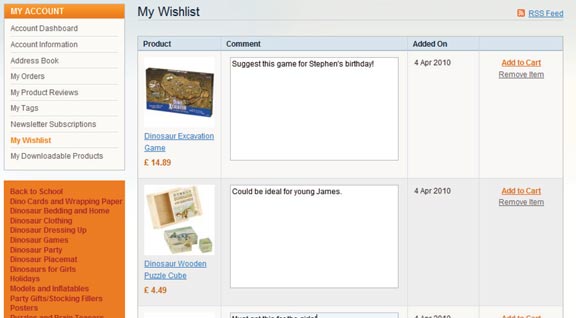
The wishlist page shows all the items that a customer has listed.  Next to a picture of each product listed, is a box for customers to make personal notes for each item on their list.  There is plenty of room to make notes and to type in comments (see example below).

The Everything Dinosaur Wishlist for Customers

Picture credit: Everything Dinosaur

The picture shows what a typical customer wishlist looks like.  In the example above, two products can be seen in this particular wishlist, the dinosaur excavation game and a dinosaur wooden puzzle cube.  The field for personal comments can clearly be seen, and adjacent to this is the date when these items were added (4th April).  Customers can transfer items directly to a shopping cart (add to cart), or simply remove an item (remove).  To save the comments and/or the changes made to a wishlist, simply scroll down the page and click the button marked “update wishlist”.  Once this has been done, any changes made are safely stored on the customer’s personal wishlist.

Sharing Wishlists

Wouldn’t it be a good idea if you could share your wishlist with other people?  Perhaps you are putting together some gift ideas for your child’s birthday and you want to be able to share this list with other relatives.  Well so long as those relatives have an email address – now you can.

The Everything Dinosaur technical team have set up an RSS feature for the wishlist.  RSS stands for “really simply syndication”, it allows customers to distribute information in a standardised format, sending a wishlist of dinosaur gift ideas to relatives and friends; for example.

Sharing the Everything Dinosaur Wishlist

Sharing product gifts is easy – use Wishlist.

Picture credit: Everything Dinosaur

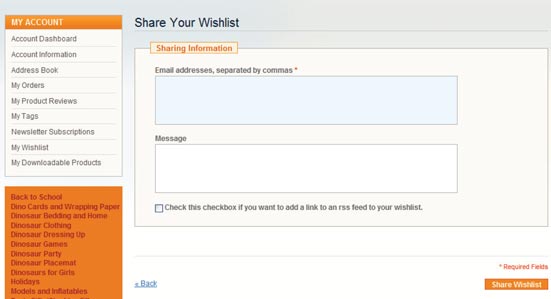
At any time the information in a wishlist can be shared with others, simply scroll to the bottom of the page and click the “share wishlist” icon.

Once the “share wishlist” icon has been clicked, customers are invited to list the email addresses that they want to send this information to.  Each email can be typed into the box (each address separated by a comma (,)) and there is an opportunity to include a message to the recipients of the information if required.  By pressing the “share wishlist” icon at the bottom this information will be sent to the designated email addresses.

On this page there is a checkbox marked “check this checkbox if you want to add a link to an RSS feed to your wishlist”.  If a customer ticks this box, the share wishlist email will include a link within it so that a customer’s friends and relatives can subscribe to feeds from that customer.  This will enable them to keep up to date with gift ideas and any changes.

This is yet another feature for the benefit of customers that has been added to the Everything Dinosaur website.  Shopping and sharing ideas and suggestions with friends and family could not be simpler.

4 04, 2010

From Full Stops to Commas – update on the Frog Blog 2010

By |2023-01-04T08:00:56+00:00April 4th, 2010|Categories: Animal News Stories, Everything Dinosaur News and Updates, Main Page|0 Comments

Tadpoles are Developing – Frog Blog 2010

Not exactly the most wonderful spring weather at the moment, at least we have been able to avoid the heavy snow falls that affected parts of Scotland earlier this week.  The patches of frogspawn in the pond are showing signs of development, well at least those clutches of eggs that are in the sunny shallows.  Although, these clumps of spawn (we are not sure what the collective noun for frogspawn is), were some of the last to be laid, several days after the first frogspawn, they are developing more quickly.

The spawn that was laid first was moved out of the shallow water into slightly deeper water, this was as a result of all the frantic activity of the frogs.  Two clumps of spawn have ended up in about 2 feet of water.  The frogspawn can still be seen and as far as we can tell it is not developing as quickly as the frogspawn produced later but laid in the warmer, sunlit shallows.

Frog Blog

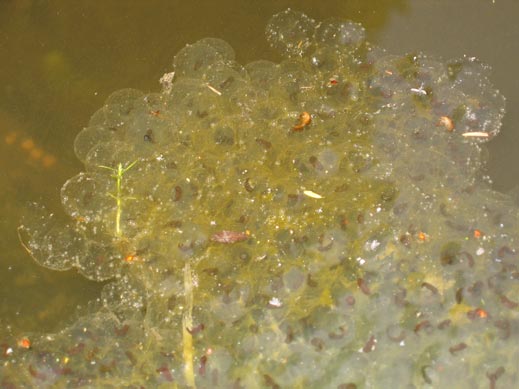
Tadpoles Developing in the Frogspawn

Picture credit: Everything Dinosaur

Tadpoles

The first frogspawn was laid around 20th March, this particular clump of spawn has been pushed into deeper water, whereas, the spawn laid towards the end of the mating period has remained in shallows and seems to be developing quicker.  The picture above shows a clump of frogspawn in the shallows.  Note that the black dots of the embryos are turning from a round “full stop” into a “comma” shape with a distinctive head and a tail.  Movement can be detected in the clump of spawn as the tadpoles move inside their eggs.  No signs of development can be seen in the spawn in the deeper part of the pond.  We have suspected for sometime that egg development was related to water temperature.  Those eggs exposed to direct sunlight in shallows will be warmed and therefore hatch quicker than their counterparts deeper in the pond.  It is really a question of balance, perhaps the clump of spawn in the deeper water is protected from drying out and is less likely to predated upon by terrestrial based predators.  The price paid for this is a slow start to the hatching process.

Go to Top