All about dinosaurs, fossils and prehistoric animals by Everything Dinosaur team members.

Articles, features and information which have slightly more scientific content with an emphasis on palaeontology, such as updates on academic papers, published papers etc.
12 03, 2026

Why Did Triceratops Have a Big Nose?

By |2026-03-15T10:34:41+00:00March 12th, 2026|Categories: Palaeontological articles|0 Comments

Recently published research reveals Triceratops possessed a surprisingly complex nose.  Famed for its huge size and impressive horns, “three horned face” had specialised structures that helped regulate heat and conserve moisture.  The Triceratops nasal cavity study has been published in the journal “The Anatomical Record.” Triceratops is one of the most recognisable dinosaurs ever discovered. It lived during the Late Cretaceous in North America, and two species have been named.  This ceratopsian regularly tops our dinosaur popularity polls.  Fossils of Triceratops are on display in museums all over the world.  However, this new research demonstrates that there is still much to learn about this dinosaur.

Triceratops information poster.

A Triceratops dinosaur poster. This Late Cretaceous dinosaur is one of the most easily recognisable of all the dinosaurs. Picture credit: Everything Dinosaur.

Picture credit: Everything Dinosaur

Investigating the Triceratops Nasal Cavity

The new study suggests the Triceratops nasal cavity was far more complex than previously thought. Scientists now think its enormous snout housed specialised tissues linked to breathing, moisture regulation and temperature control. Researchers examined several fossil skulls of Triceratops and other horned dinosaurs. First, they used CT scans to look inside the bones. Next, they created sophisticated 3D computer models of the nasal region. The team then compared these fossils with the noses of extant reptiles, birds and crocodilians. Extant phylogenetic bracketing was employed to model the probable soft tissues associated with the nasal region.

As a result, the researchers produced the first comprehensive hypothesis for the soft tissues inside the ceratopsid snout.

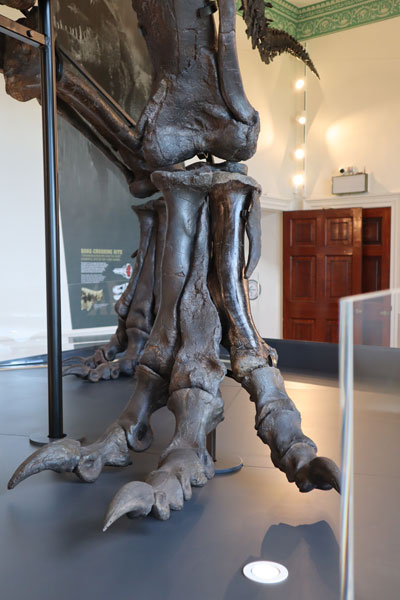
Triceratops Fossil on Display

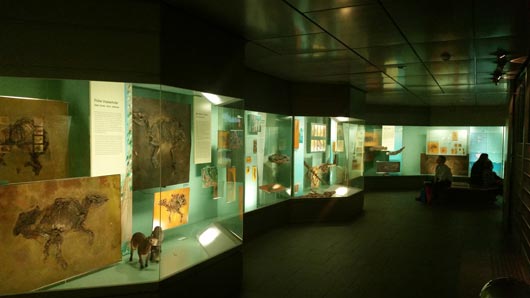
A cast of a Triceratops skeleton on display at the Naturmuseum Senckenberg (Natural History Museum – Frankfurt). On the left a wall mounted example of a Plateosaurus can be seen. Picture credit: Everything Dinosaur.

Picture credit: Everything Dinosaur

Nerves, Blood Vessels and Nasal Glands

The results suggest the Triceratops nasal cavity contained an intricate network of nerves and blood vessels. In addition, the scientists identified pathways for neurovascular structures within the narial region. They also inferred the locations of a nasal gland and a nasolacrimal duct. Interestingly, the pattern of nerve supply in ceratopsids appears unique among reptiles. Researchers suggest this unusual arrangement evolved as the nostril openings became larger during ceratopsian evolution. Therefore, the enlarged snout of Triceratops likely supported more than just breathing.

Acquisition of such a structure might have mitigated a thermal problem associated with the large size of the ceratopsid head. After all ceratopsians such as Pentaceratops, Torosaurus and Triceratops are famed for their super-sized skulls.

Haolonggood horned dinosaur models. The two Haolonggood Triceratops figures.

Two spectacular Haolonggood horned dinosaur models. The two Triceratops figures (Qin Ming and Hu Yan Zhuo). Triceratops is represented by dozens of dinosaur models. Picture credit: Everything Dinosaur.
Picture credit: Everything Dinosaur

The picture (above) shows two recent Triceratops figures produced by Haolonggood.  Collectors and dinosaur fans have dozens of Triceratops figures to choose from; this horned dinosaur is extremely popular.

To view the Haolonggood range of prehistoric animal figures: Haolonggood Dinosaur Models.

Evidence for Respiratory Turbinates

The study also suggests the presence of respiratory turbinates in ceratopsid dinosaurs. Respiratory turbinates are delicate, curled structures found inside the noses of birds and mammals today. They help warm and moisten incoming air. In addition, they reduce water loss when animals breathe out. The researchers identified an osteological correlate that suggests these structures may have existed in ceratopsids. If correct, this would represent the first evidence for respiratory turbinates in these dinosaurs.

Cooling a Horned Giant

Respiratory turbinates may have played another important role. In living animals, these structures can help regulate body temperature. This function may have been especially useful for Triceratops. The dinosaur possessed a very large skull, which could potentially trap heat in warm environments. Blood vessels within the nasal tissues may have helped cool the head as air passed through the nose. Consequently, the nasal cavity may have helped prevent overheating in such a large animal.

Triceratops Skull on Display

The magnificent Triceratops skull on display in the “Dinosaurs! Age of the Giant Lizards” gallery at the Berlin Naturkundemuseum. Picture credit: Lukasz Papierak.

Picture credit: Lukasz Papierak

The horns and frill of Triceratops often attract the most attention. Yet this new research highlights another remarkable feature. The Triceratops nasal cavity appears to have been a complex biological system. It likely supported breathing, moisture balance and temperature control. As a result, this famous dinosaur’s impressive snout was not just for show. Instead, it helped the animal maintain stable internal conditions in the Late Cretaceous world.

The scientific paper: “Nasal soft-tissue anatomy of Triceratops and other horned dinosaurs” by Seishiro Tada, Takanobu Tsuihiji, Hiroki Ishikawa, Noriyuki Wakimizu, Soichiro Kawabe and Kodai Sakane published in The Anatomical Record.

The award-winning Everything Dinosaur website: Triceratops Models.

11 03, 2026

Innovative Technology Demonstrates Famous Bromacker Site is Older than Previously Thought

By |2026-03-12T07:32:31+00:00March 11th, 2026|Categories: Palaeontological articles|0 Comments

Sophisticated dating of zircon crystals found in volcanic ash has demonstrated that the famous Bromacker fossil site is four million years older than previously thought. The Bromacker fossil site is located in the Thuringian Forest near the village of Tambach-Dietharz (Germany).  The study, published in the journal “Gondwana Research” indicates that the fossil-bearing rocks are 294 million years old.  These rocks record a terrestrial ecosystem from the Early Permian (Asselian faunal stage).

The volcanic ash tuff layer which contained the zircon crystals is only a few millimetres thick.  It was discovered during field work in 2024.

One of the co-authors of the paper, Sophie König (Friedenstein Foundation) commented:

“When we uncovered the dark, reddish-purple ash layer, the difference to the surrounding rock was immediately apparent, and we were very hopeful that we had finally found material that could be dated. The fact that the rock sample actually contained usable zircons still came as a surprise to me. We are delighted to have added an important scientific building block to the highly successful Bromacker project.”

Bromacker fossil site is dated accurately following zircon dating study.

A photograph of zircon crystals. Picture credit: Jakob Stubenrauch.

Picture credit: Jakob Stubenrauch

Dating the Bromacker Fossil Site

Zircon crystals are durable and inert. They naturally trap radioactive uranium in their crystal lattice but exclude lead. As uranium naturally decays into lead at a known constant rate, measuring the ratio of uranium to lead found in a crystal is an accurate method of calculating the absolute age of the crystal. This permits volcanic deposits that contain zircon crystals to be accurately dated. In turn, this provides geologists with a benchmark against which associated sediments can be dated.  The ratio of U to Pb acts as an internal clock.

In order to date the age of the ash layer zircon crystals were extracted from rock samples and analysed radiometrically at the TU Bergakademie Freiberg.  The scientists could then determine the age of the famous Bromacker fossil site with a high degree of precision.

The results of the dating study have significant implications for research. They will help to date ecosystems and fossils from other fossil deposits of similar age that, like Bromacker, formed on the supercontinent Pangaea. The age of these fossils can now be better determined thanks to the correlation with the precisely dated Bromacker fossils.

Providing Information About Permian Ecosystems

Lead author of the research, Dr Lorenzo Marchetti (Museum für Naturkunde Berlin) explained:

“This extraordinary fossil deposit, which provides so much information about Permian ecosystems, needed precise dating in order to become a global reference for biostratigraphic, palaeoclimatic and evolutionary biology studies. Careful exploration of the Bromacker site led to this unexpected but urgently needed discovery of a layer of ash containing well-preserved zircon crystals.”

The new age of 294 mya has implications for the scientific understanding of early ecosystems and terrestrial vertebrates.  For example, the food pyramid as we know it today developed earlier than previously thought. The time span between the first appearance of herbivores and the development of modern food webs was shorter, proving that the evolution of Bromacker organisms proceeded more rapidly than previously thought. Thanks to the new age dating, it is now clear that all these evolutionary innovations and the transition to a more seasonal climate occurred much earlier than the scientific community had previously assumed.

Remarkable fossil discoveries at the famous Bromacker fossil site: Spectacular Fossil Finds for the Bromacker Project Team.

Everything Dinosaur acknowledges the assistance of a media release from the Museum für Naturkunde Berlin in the compilation of this article.

The scientific paper: “First high-precision radioisotopic age from the Permian Bromacker lagerstätte (Tambach Formation, Germany) and implications for biochronology and biota evolution” by Lorenzo Marchetti, Jakob Stubenrauch, Alexandra Käßner, Marion Tichomirowa, Sophie König, Anna Pint and Thomas Voigt published in Gondwana Research.

The award-winning Everything Dinosaur website: Models of Prehistoric Animals.

5 03, 2026

A New Early Permian Tetrapod from Brazil is Described

By |2026-03-05T17:11:44+00:00March 5th, 2026|Categories: Palaeontological articles|0 Comments

An international team of palaeontologists has described a new species of early land vertebrate from Brazil. The species is named Tanyka amnicola. Researchers identified this unusual animal from fossils discovered in north-eastern Brazil. Their findings appear as an open access paper in the journal Proceedings of the Royal Society B. Importantly, the fossils reveal an amphibian with a very unusual jaw. The unique jaw morphology suggests adaptations to either specialised processing of small invertebrates or consumption of plants. This demonstrates that some stem tetrapods were exploring niches in ecosystems in the Southern Hemisphere during the Permian.

Fossils from the Pedra de Fogo Formation

The fossils come from the Pedra de Fogo Formation. This formation lies within the Parnaíba Basin of Brazil. Scientists recovered nine isolated lower jaws, each about fifteen centimetres long. Although researchers have not yet found other bones, these jaws reveal important clues. Professor Jörg Fröbisch from the Museum für Naturkunde Berlin played a key role in this study.

Professor Fröbisch commented that the discovery followed many years of work in the region. In fact, the first jaw was discovered during one of the earliest expeditions. For more than fifteen years, researchers have studied the fossils of the Parnaíba Basin. The project involves scientists from Brazil, Argentina, South Africa, the USA, the UK (London Natural History Museum) and Germany.

Life reconstruction of Tanyka amnicola.

Life reconstruction of Tanyka amnicola grazing on some plants. Picture credit: Vitor Silva.

Picture credit: Vitor Silva

Tanyka amnicola An Ancient “Living Fossil”

Interestingly, Tanyka amnicola belonged to a very old lineage. As a result, the animal could already be considered a “living fossil” in its own time.

Professor Fröbisch explained:

“What is particularly exciting is that even during its lifetime around 275 million years ago, it could have been described as a living fossil, as it belongs to an archaic group that actually lived 30-50 million years earlier.”

During this period in Earth’s history Brazil was part of a supercontinent called Gondwana. This enormous landmass included South America, Africa, Antarctica and Australia.

A Remarkably Twisted Jaw

The lower jaw of Tanyka amnicola shows a very unusual structure. Lead author Jason Pardo explained that the twisted jaw initially puzzled the researchers. However, every fossil jaw shows the same shape. Therefore, the feature represents normal anatomy rather than damage or taphonomy.

The teeth point sideways rather than straight upwards. Meanwhile, the inner surface of the jaw tilts towards the palate. Furthermore, the jaw surface carries many small teeth. These teeth may have formed a rough grinding surface. When the mouth closed, the teeth probably rubbed against each other. Consequently, the animal could crush or shred food. Hence, the theory that this tetrapod may have been herbivorous, or at least plants made up a proportion of its diet.

Professor Juan Cisneros from the Federal University of Piauí, a co-author of the study believes the animal ate plants at least part of the time.

He stated:

“Based on the structure of its teeth, we assume that Tanyka ate plants at least some of the time. This is surprising, as most of its relatives were carnivores.”

Therefore, Tanyka amnicola may represent an early experiment in herbivory among early tetrapods.

A Window into Early Permian Ecosystems

Fossils from the early Permian are relatively rare. Consequently, every discovery provides valuable information. The Pedra de Fogo Formation offers one of the few windows into Gondwana’s ecosystems at that time.

Co-author Dr Kenneth Angielczyk commented:

“The Pedra de Fogo Formation offers one of the few windows into the animal world of Gondwana during the early Permian period. Tanyka shows us which animals lived there and what ecological roles they played.”

Fossils from this Formation also help scientists understand how early tetrapods interacted.

Tanyka amnicola probably lived close to rivers and lakes. The species name reflects its habitat, the word “amnicola” translates as “river dweller”.  The genus name is derived from the local Guaraní language, it translates as “jaw”.

Researchers estimate that Tanyka amnicola may have reached around one metre in length.

More Discoveries May Follow

At present, scientists only know the animal from jawbones. However, future discoveries could change that. For example, researchers hope to find skulls or articulated skeletons. Such fossils would help reconstruct the entire animal.

Nevertheless, even these isolated jaws provide remarkable insight.

For now, Tanyka amnicola offers a fascinating glimpse into early tetrapod evolution. Moreover, it highlights the importance of the Pedra de Fogo Formation in revealing an ancient ecosystem from Gondwana.

Everything Dinosaur acknowledges the assistance of the Museum für Naturkunde Berlin in the compilation of this article.

The scientific paper: “An aberrant stem tetrapod from the early Permian of Brazil” by Jason D. Pardo, Claudia A. Marsicano, Roger Smith, Juan Carlos Cisneros, Kenneth D. Angielczyk, Jörg Fröbisch, Christian F. Kammerer and Martha Richter published in the Royal Society Proceedings B.

The award-winning Everything Dinosaur website: Prehistoric Animal Figures.

3 03, 2026

First Clear Evidence of Ceratopsians in Late Cretaceous Europe

By |2026-03-08T20:45:38+00:00March 3rd, 2026|Categories: Palaeontological articles|0 Comments

A groundbreaking scientific paper published in January (2026), has confirmed the presence of ceratopsian dinosaurs in Late Cretaceous Europe. The research focuses on the Hungarian dinosaur Ajkaceratops kozmai. The findings challenge long-standing ideas about Europe’s prehistoric ecosystems.

For decades, palaeontologists believed that horned dinosaurs were missing from Europe. Ceratopsians were widespread across Asia and North America during the Late Cretaceous. Famous species include Triceratops and Pachyrhinosaurus. Yet convincing fossils confirming their presence in Europe remained elusive.

The new research suggests these dinosaurs were hiding in plain sight.

The Enigmatic and Highly Significant Ajkaceratops kozmai

Ajkaceratops was first described from fragmentary fossils discovered in Hungary. These remains came from the Csehbánya Formation, rocks dating to approximately eighty-four million years ago (Santonian faunal stage of the Late Cretaceous). The fossils hinted at a small horned dinosaur, about the size of a labrador dog.

However, some researchers questioned this interpretation. The fossils were incomplete and difficult to interpret.

The new study, with corresponding author Professor Susannah Maidment (London Natural History Museum), provides crucial evidence. The research team described a new specimen, catalogue number MTM 2025.1.1. This fossil includes a much more complete skull. Detailed analysis of this fossil confirms that Ajkaceratops kozmai is indeed a true ceratopsian dinosaur.

Professor Maidment explained in a media release that the study indicates that far from being absent from Europe, ceratopsians may have been relatively common.

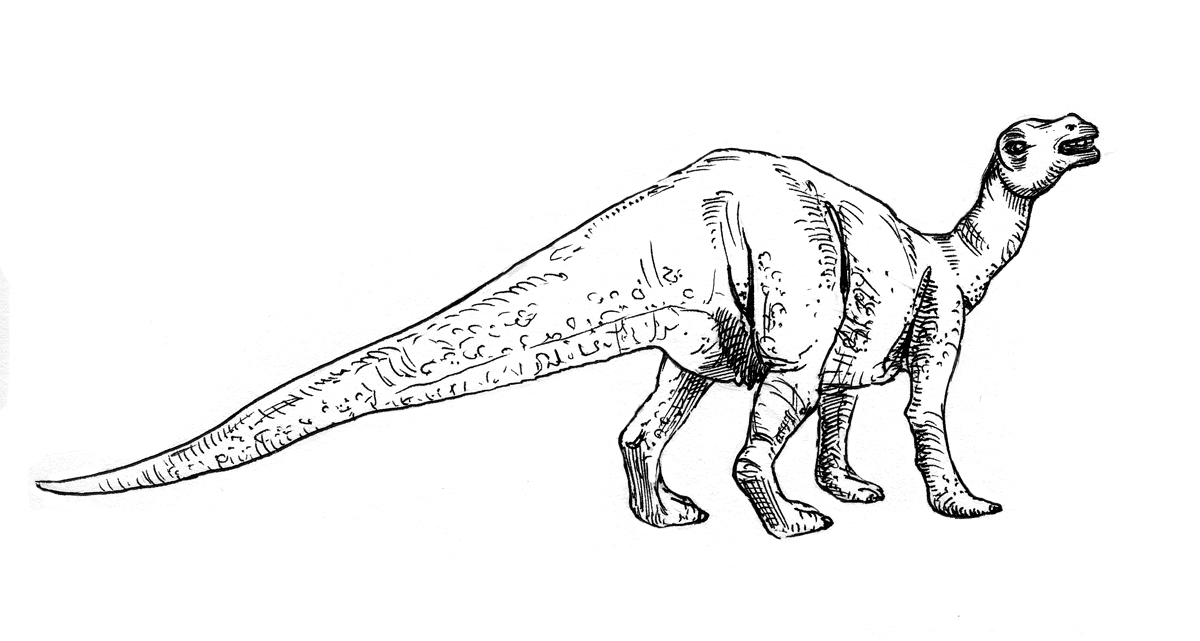
Ajkaceratops kozmai scale drawing.

A scale drawing of the Late Cretaceous European ceratopsian Ajkaceratops (A. kozmai). Picture credit: Generated using AI/Canva with additional annotation by Everything Dinosaur.

Picture credit: Generated using AI/Canva with additional annotation by Everything Dinosaur

Uncovering Another Surprising Discovery About Rhabdodontids

The research uncovered an even more surprising discovery. Several dinosaurs previously classified as rhabdodontids may actually be ceratopsians. Rhabdodontids were thought to be iguanodontians. In addition, these herbivorous dinosaurs were regarded as unique to Europe. However, the new analysis suggests that some fossils attributed to rhabdodontids belong to horned dinosaurs instead. For example, a dinosaur named as Mochlodon vorosi is now considered a junior synonym of Ajkaceratops.

Another dramatic revision involves the Romanian dinosaur Zalmoxes shqiperorum. This species has now been reassigned to a new ceratopsian genus named Ferenceratops (Maidment et al, 2026). The genus honours the pioneering Austro-Hungarian palaeontologist and polymath Baron Franz Nopcsa.

A Hidden Diversity of European Ceratopsians

These revisions suggest that horned dinosaurs may have been far more common in Europe than previously believed. Many fossils may have been misidentified because of incomplete material. The confusion stems partly from evolutionary history. Ceratopsians and iguanodontians share a common ancestor. They are both classified as ornithischian dinosaurs.  These two groups later evolved similar features. For instance, both developed complex chewing mechanisms and large body sizes. Some species also adopted quadrupedal locomotion. These similarities make fragmentary fossils difficult to identify.

Obelignathus septimanicus life reconstruction.

An example of a typical rhabdodontid dinosaur. Life restoration of newly described rhabdodontid dinosaur Obelignathus septimanicus in the Late Cretaceous environment recorded in the ‘Grès à Reptiles’ Formation in southern France. A pair of dromaeosaurid dinosaurs can be seen lurking in the background. Picture credit: Edyta Felcyn-Kowalska.

Picture credit: Edyta Felcyn-Kowalska

Reassessing the Biota of Late Cretaceous Europe

During the Late Cretaceous, Europe formed a chain of islands scattered across the Tethys Sea. Scientists believed this isolation produced unique dinosaur faunas. Such as the fauna associated with the Hateg Basin. However, the presence of ceratopsians suggests European ecosystems may have been more similar to the fauna found elsewhere in the Northern Hemisphere.

The discovery also fills an important gap in ceratopsian evolution. Early horned dinosaurs originated in Asia and later spread to North America. Europe may have served as an important stepping stone during these dispersals. Furthermore, the study highlights the importance of museum collections. Fossils stored for decades can reveal new secrets when re-examined with modern techniques.

As more discoveries emerge, palaeontologists may uncover an unexpected diversity of European horned dinosaurs. It seems that Europe’s “missing” ceratopsians were there all along hiding in plain sight.

The scientific paper: “A hidden diversity of ceratopsian dinosaurs in Late Cretaceous Europe” by Susannah C. R. Maidment, Richard J. Butler, Stephen L. Brusatte, Luke E. Meade, Felix J. Augustin, Zoltán Csiki-Sava and Attila Ősi published in Nature.

For ceratopsian figures and other dinosaur models: Dinosaur Figures.

2 03, 2026

The Remarkable Spinosaurus Artwork

By |2026-03-08T10:46:21+00:00March 2nd, 2026|Categories: Palaeontological articles|0 Comments

Following our post last month featuring news about the scimitar-crested spinosaurid Spinosaurus mirabilis, today, we publish some more images of this remarkable African theropod.  Our thanks to vertebrate palaeontologist and co-author of the study Daniel Vidal (University of Chicago) for helping team members to access these incredible illustrations.  In addition, we thank the media department at the University for providing these official images and the press release.

The beautiful artwork was created by talented palaeoartist Dani Navarro.

Spinosaurus mirabilis life reconstruction.

A life reconstruction of the recently named new Spinosaurus species Spinosaurus mirabilis. Picture credit: D. Navarro.

Picture credit: D. Navarro

To read Everything Dinosaur’s blog post about the discovery of S. mirabilisA New Spinosaurid Species is Described.

Dani Navarro’s artwork has featured numerous times on this blog.  For example, Dani has provided several illustrations including front cover art for the prestigious magazine “Prehistoric Times”. In addition, he works closely with the Paul Sereno Fossil Lab and the University of Chicago.

An Award-winning Artist Illustrates Spinosaurus mirabilis

This award-winning artist has worked on the study of the Concavenator’s hump and the complete reconstruction of Edmontosaurus from fossil mummies. Furthermore, he has provided stunning artwork reconstructions of Spinosaurus aegyptiacus. Therefore, it is not surprising to find him producing illustrations of the recently described Spinosaurus mirabilis.

Spinosaurus mirabilis head.

A close-up view of the head and neck of the recently described Spinosaurus (S. mirabilis). Picture credit: D. Navarro.

Picture credit: D. Navarro

Mike from Everything Dinosaur states:

“The work of scientific illustrators cannot be underestimated.  They skilfully reconstruct an animal from the fossil evidence.  Their artwork vividly brings to life a long extinct animal and helps to inform and inspire.”

Everything Dinosaur acknowledges the assistance of a media release from the University of Chicago in the compilation of this article.

The scientific paper: “Scimitar-crested Spinosaurus species from the Sahara caps stepwise spinosaurid radiation” by Paul C. Sereno, Daniel Vidal, Nathan P. Myhrvold, Evan Johnson-Ransom, María Ciudad Real, Stephanie L. Baumgart, Noelia Sánchez Fontela, Todd L. Green, Evan T. Saitta, Boubé Adamou, Lauren L. Bop, Tyler M. Keillor, Erin C. Fitzgerald, Didier B. Dutheil, Robert A. S. Laroche, Alexandre V. Demers-Potvin, Álvaro Simarro, Francesc Gascó-Lluna, Ana Lázaro, Arturo Gamonal, Charles V. Beightol, Vincent Reneleau, Rachel Vautrin, Filippo Bertozzo, Alejandro Granados, Grace Kinney-Broderick, Jordan C. Mallon, Rafael M. Lindoso and Jahandar Ramezani. Paper published in the journal Science.

Visit the Everything Dinosaur website: Prehistoric Animal and Dinosaur Toys.

1 03, 2026

Celebrating Dragons and the Dinosauria on St David’s Day

By |2026-03-01T09:35:07+00:00March 1st, 2026|Categories: Palaeontological articles|0 Comments

Today, we join friends and family in Wales to celebrate St David’s Day.  It is an annual Welsh celebration held on the first day of March. This day honours Saint David, the patron saint of Wales, whose life and legacy are remembered with pride and cultural festivities right across the nation. Across the country, people wear daffodils and leeks. They wave the striking Welsh flag, proudly displaying its iconic red dragon. This heraldic dragon symbol, known in Welsh as Y Ddraig Goch, has deep roots in legend, folklore, and national identity.  However, what is the connection between dragons and the Dinosauria? Quite a lot, in fact!

Dragons and the Dinosauria

To vertebrate palaeontologists, the word dragon often conjures images of legendary beasts. Yet, it also has a clear connection to prehistoric life. Many dinosaur names contain the suffix – saurus, a Greek word meaning “lizard”. In China, new dinosaur species often include “long” in their names — a word that translates to dragon. For example, we recently wrote a blog article highlighting the discovery of a remarkable iguanodontid dinosaur from China named Haolong dongi. The genus name translates as “spiny dragon”.

To read our post: “Spiny Dragon” Reveals Secrets of Dinosaur Skin.

Research team members studying the fossil material (H. dongi).

Researchers examining the Haolong dongi fossil material. Picture credit: Thierry Hubin (Institute of Natural Sciences).

Picture credit: Thierry Hubin (Institute of Natural Sciences)

Many dinosaur discoveries spark imaginations just like mythical dragons do. Their enormous sizes, sharp teeth and reptilian skins have fuelled human stories for centuries.  For instance, there are several Chinese dinosaurs represented by CollectA Delxue models. The beautiful CollectA Deluxe Beishanlong model is a favourite.   This theropod’s name translates as “Northern White Mountains Dragon”.

The CollectA Deluxe Beishanlong figure.

The CollectA 1:40 scale Beishanlong dinosaur model shown in lateral view. Picture credit: Everything Dinosaur.

Picture credit: Everything Dinosaur

To view the CollectA range of scale models in stock: CollectA Deluxe Dinosaur Models.

Dragons and Dinosaurs

Both dragons of myth and real prehistoric reptiles remind us how powerful ancient reptiles captured human imagination. They also help us celebrate cultural heritage alongside scientific discovery.

So, on this St David’s Day, let’s give a nod to Wales and its enduring dragon symbol. We acknowledge the cultural significance of this day and that dinosaurs and dragons are entwined.

Mike from Everything Dinosaur commented:

“Happy St David’s Day to all our Welsh readers and dinosaur fans everywhere!”

The Everything Dinosaur website: Dinosaur Toys.

27 02, 2026

New Research Reveals More Bird-Like Tyrannosaurus Foot Function

By |2026-02-27T15:43:19+00:00February 27th, 2026|Categories: Palaeontological articles|0 Comments

Tyrannosaurus rex remains one of the most iconic dinosaurs. People imagine this giant predator thundering across Late Cretaceous landscapes chasing prey. But new science suggests it didn’t stomp like a lumbering beast. Instead, it may have moved in a way more akin to extant flightless birds such as an ostrich. Researchers from the College of the Atlantic (Maine), Oklahoma State University, Colorado Northwestern Community College and the late Scott Swann examined how the feet of T. rex interacted with the ground as it walked. This new study into Tyrannosaurus rex foot function provides new information about theropod gait and speed.

They combined measurements of bones, predictive equations and comparisons with living animals like ostriches.  Their study has been published this week in Royal Society Open Science.

Tyrannosaurus rex Foot Function – Walking on Tiptoes

Traditional reconstructions assumed T. rex made contact with the ground using the heel first. This would give a broad, flat footfall and a slow, ponderous stride. But the new analysis turned this idea on its head. The deepest parts of known fossil footprints sit under the toes, not the heel. That suggests the dinosaur struck the ground mainly with the front of its foot, much like birds do today.

This “tiptoe” style of locomotion is very different from how we once thought giant theropods walked. Instead of low, heavy steps, T. rex likely took shorter, quicker strides, with its weight balanced over the toes. That’s remarkably similar to the way fast, bipedal birds like ostriches move.

The Everything Dinosaur Evolution Tyrannosaurus rex display base.

A new study provides new information about Tyrannosaurus rex locomotion and gait. The researchers postulate that T. rex struck the ground with its toes first.  The Everything Dinosaur Evolution Tyrannosaurus rex display base features three-toed theropod prints that have been modelled based on real tyrannosaur tracks. Picture credit: Everything Dinosaur.
Picture credit: Everything Dinosaur

Locomotion and Speed

As the researchers postulate that the toes struck the ground first and that the stride was rapid, the authors propose that T. rex may have moved quicker than previously estimated. Their calculations suggest speeds of roughly 5–11 metres per second. That translates to about 11–25 miles per hour (17.7 to 40.2 kph).  Still not quite fast enough to chase down a jeep as depicted in the 1993 film “Jurassic Park” but quicker than previous research has suggested.

So, T. rex could run faster than David Beckham: Locomotion and Velocity Study (Theropod Dinosaurs).

To put this in perspective, ostriches can sprint at over 40 km/h (25 mph). A dinosaur as massive as T. rex using a bird-like gait is a fascinating twist on our view of its locomotion. Of course, how fast any individual dinosaur really ran would depend on age, health and body size. But this paper gives us a new way to think about how it moved.  Indeed, the research team provides estimates of velocity for different T. rex specimens within their dataset.

Tyrannosaurus rex foot function study provides estimates of Tyrannosaurus velocity based on growth stage.

Estimated speeds of T. rex specimens within the dataset used in the Tyrannosaurus rex foot function study. Different dinosaur models including the Everything Dinosaur Evolution T. rex model are used to illustrate the estimated velocity. Picture credit: Everything Dinosaur based on the Boeye et al paper.

Picture credit: Everything Dinosaur based on the Boeye et al paper

Footprints and the Everything Dinosaur Evolution T. rex Model

Everything Dinosaur’s Evolution T. rex model beautifully captures one aspect of this research. The display base features replicated Tyrannosaurus footprints from the fossil record. These prints are not just decorative. They reflect real ichnological data, and they give us clues about gait and stance.  For example, the two tracks on the display base have been carefully modelled.  They have deeper toes than heels and this reflects the evidence presented in this scientific paper.

T. rex tracks on the Everything Dinosaur Evolution display base.

The tracks on the Everything Dinosaur Evolution display base are based on actual prints from the fossil record. The deeper toe area indicates that these tracks reflect the latest research. Picture credit: Everything Dinosaur.
Picture credit: Everything Dinosaur

To view the Everything Dinosaur Evolution model range: Everything Dinosaur Evolution Models.

The new study’s findings resonate with that real footprint evidence. If T. rex walked with a bird-like foot function, then those tracks on our model base become even more meaningful. They show where the animal shifted weight onto its toes, aligning with the idea of higher stride frequency and elevated speed potential.

The Movement of Extinct Animals

The movement of extinct animals has interested numerous researchers.  Tyrannosaurus rex locomotion has been extensively studied, in part, due to an iconic scene from “Jurassic Park”. The research team used complex statistical analysis to compare fossil specimens with extant animals including ostriches. Additionally, the models are consistent with recent studies suggesting slower to more intermediate top speeds for adult Tyrannosaurus that fall within the range of 5–11 metres per second. This study lays the groundwork for future studies to add comparisons with additional theropods and potentially identify ecological differences between species.

This research doesn’t just revise a number on a speed chart. It touches on how the largest land predator of its time interacted with its environment. A bird-like gait has implications for energy use, hunting strategy, balance and stability. It also reinforces the evolutionary link between theropod dinosaurs and modern birds.

In summary, T. rex may have been both terrifying and surprisingly agile. With Tyrannosaurus rex foot function studies like this, we continue to peel back layers of preconception about how dinosaurs lived and moved. And models like Everything Dinosaur’s Evolution T. rex help us share that story with collectors and enthusiasts around the world.

The scientific paper: “Evidence of bird-like foot function in Tyrannosaurus” by Adrian Tussel Boeye, Kyle Logan Atkins-Weltman, J. Logan King and Scott Swann published in the Royal Society Open Science.

The award-winning Everything Dinosaur website: Dinosaur and Prehistoric Animal Models.

22 02, 2026

New Scimitar-crested Spinosaurus Species Described

By |2026-02-25T22:13:51+00:00February 22nd, 2026|Categories: Palaeontological articles|0 Comments

Palaeontologists have revealed an extraordinary new species of dinosaur. This giant theropod, named Spinosaurus mirabilis, lived around ninety-five million years ago in what is now the central Sahara Desert. It is the first new species in the Spinosaurus genus described in more than a century.

The discovery challenges long-held ideas about how spinosaurids lived and hunted. The name mirabilis means “marvellous” in Latin, reflecting the unique and striking anatomy of this Cretaceous piscivore.

Spinosaurus mirabilis life reconstruction.

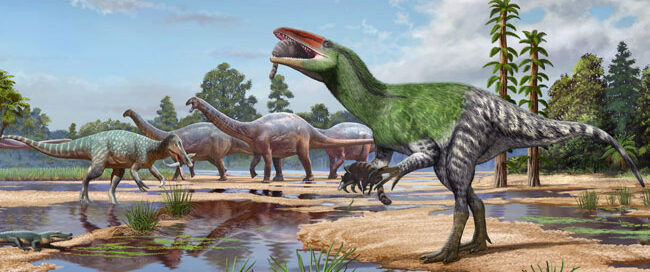
A Spinosaurus mirabilis has caught a coelacanth. Picture credit: D. Navarro.

Picture credit: D. Navarro

A Remarkable Discovery

The story began in 2019 when scientists pulled a massive, oddly shaped bone from Sahara sands. The scimitar-shaped crest of this dinosaur was so large and unexpected that the scientists initially did not recognise it for what it was. Only after a return expedition was despatched (2022) and the discovery of additional fossils did the truth emerge — a new dinosaur species had been found.

The research team, led by the University of Chicago’s Paul Sereno, published the findings in the academic journal “Science”.

Based on the crest’s surface texture and interior vascular canals, the study team concluded that this crest was sheathed in keratin.  It may have been brightly coloured and played a role in species identification and visual display.

The crest of the new species of Spinosaurus (S, mirabilis).

Ana Lázaro holding crest of Spinosaurus mirabilis in field. Picture credit: Alvaro Simarro.

Picture credit: Alvaro Simarro

Another striking feature of the skull is its interdigitating upper and lower tooth rows. These make a deadly trap for slippery fish. Interdigitating teeth, where those of the lower jaw protrude outward and between those of the uppers, is a time-honoured adaptation on among piscivores in the fossil record. For example, this type of dentition is found in ichthyosaurs, crocodilians and pterosaurs. Among dinosaurs, it sets Spinosaurus and closest kin apart.

Commenting on the significance of this discovery, lead author Paul Sereno, (PhD, Professor of Organismal Biology and Anatomy at the University of Chicago) stated:

“This find was so sudden and amazing, it was really emotional for our team. I’ll forever cherish the moment in camp when we crowded around a laptop to look at the new species for the first time, after one member of our team generated 3D digital models of the bones we found to assemble the skull — on solar power in the middle of the Sahara. That’s when the significance of the discovery really registered.”

Viewing the tall crested Spinosaurus skull.

Field team members getting their first look at the tall crested Spinosaurus skull. Picture credit: Jessica Schwartz.

Picture credit: Jessica Schwartz

What Made Spinosaurus mirabilis Special?

Previously, spinosaurid bones and teeth had only been found principally in coastal deposits. This led to some experts postulating that these fish-eating theropods may have been fully aquatic, pursuing prey underwater. However, the new fossil area in Niger documents animals that were living inland, some 500 to 1000 km from the nearest coastline. The proximity of the spinosaurid material to the fossilised remains of sauropods suggest that this was a forested, inland ecosystem crossed by many rivers.

Paul Sereno added:

“I envision this dinosaur as a kind of ‘hell heron’ that had no problem wading on its sturdy legs into two metres of water but probably spent most of its time stalking shallower traps for the many large fish of the day.”

Paul Sereno with a cast of the skull of S. mirabilis.

Paul Sereno with a cast of the skull of Spinosaurus mirabilis. Picture credit: K. Ladzinski.

Picture credit: K. Ladzinski

An Amazing Journey

The journey that culminated in this remarkable fossil discovery began with a single sentence in a monograph from the 1950s.  A French geologist mentioned finding a single fossil tooth resembling those of the giant carnivore Carcharodontosaurus found in Egypt’s Western Desert at the turn of the last century.

The field team ended up meeting a local Tuareg man who led them on his motorbike deep into centre of the Sahara, where he had seen huge fossil bones. After nearly a day of travel with no shortage of doubts regarding the success of this venture, the local man led them to the fossil site (Jenguebi).  There, with little time to spare before returning to camp, the team found teeth and jaw bones of what turned out to be a new Spinosaurus species.

A Spinosaurus premaxilla discovered at the dig site.

The snout end of Spinosaurus mirabilis weathering out of the substrate. Picture credit: Daniel Vidal.

Picture credit: Daniel Vidal

What Does this Mean for the Spinosauridae?

The discovery of Spinosaurus mirabilis expands our view of spinosaurid evolution. It shows that these theropods were not restricted to coastal habitats. Instead, they thrived inland inhabiting river systems.  This new Spinosaurus species suggests that the spinosaurids diversified in ways we are only beginning to understand.

This species helps fill a gap in the fossil record. It hints at a broader evolutionary story across Africa’s Cretaceous landscapes.

The locality, representing the Farak Formation may yield numerous vertebrate remains. The spinosaurid material is approximately ninety-five million old (Cenomanian faunal stage of the Late Cretaceous). At the end of the Cenomanian faunal stage, an abrupt rise in sea levels and climate change probably brought the spinosaurid radiation to an end.

The Phylogeny of Spinosaurus mirabilis

A time-calibrated phylogenetic analysis resolves three Spinosauridae evolutionary phases. Firstly, an initial Jurassic radiation when their distinctive elongate fish-snaring skull evolved and split into two distinctive designs, baryonychine and spinosaurine. Secondly, an Early Cretaceous circum-Tethyan diversification when both reigned as dominant predators. Finally, an early Late Cretaceous phase when spinosaurines attained maximum body size as shallow water ambush specialists limited geographically to northern Africa and South America.

The discovery of the tall-crested Spinosaurus mirabilis in a river system within an inland basin supports a lifestyle interpretation of a wading, shoreline predator with visual display an important aspect of its biology.

Everything Dinosaur acknowledges the assistance of a media release from the University of Chicago in the compilation of this article.

The scientific paper: “Scimitar-crested Spinosaurus species from the Sahara caps stepwise spinosaurid radiation” by Paul C. Sereno, Daniel Vidal, Nathan P. Myhrvold, Evan Johnson-Ransom, María Ciudad Real, Stephanie L. Baumgart, Noelia Sánchez Fontela, Todd L. Green, Evan T. Saitta, Boubé Adamou, Lauren L. Bop, Tyler M. Keillor, Erin C. Fitzgerald, Didier B. Dutheil, Robert A. S. Laroche, Alexandre V. Demers-Potvin, Álvaro Simarro, Francesc Gascó-Lluna, Ana Lázaro, Arturo Gamonal, Charles V. Beightol, Vincent Reneleau, Rachel Vautrin, Filippo Bertozzo, Alejandro Granados, Grace Kinney-Broderick, Jordan C. Mallon, Rafael M. Lindoso and Jahandar Ramezani. Paper published in the journal Science.

The award-winning Everything Dinosaur website: Museum Quality Dinosaur Models.

19 02, 2026

Remarkable Fossil Demonstrates Tyrannosaur/Prey Interaction

By |2026-02-20T10:10:08+00:00February 19th, 2026|Categories: Palaeontological articles|0 Comments

A remarkable Edmontosaurus skull fossil on display at the Montana State University’s Museum of the Rockies sheds new light on how members of the genus Tyrannosaurus tackled their prey. Moreover, this intriguing specimen forms the centrepiece of a new collaborative study involving scientists from Montana State University and the University of Alberta.  The research, published in the academic journal PeerJ, provides potential evidence of tyrannosaur hunting strategy as well as insights into feeding behaviour.

In 2005, a nearly complete Edmontosaurus skull (MOR 1627) was found in the Hell Creek Formation of eastern Montana on lands managed by the Bureau of Land Management. Importantly, the skull preserves a dramatic detail. A broken tyrannosaur tooth remains embedded in the dinosaur’s face. A partial tooth crown is embedded in the nasal bone. Consequently, it attracted the attention of doctoral researcher Taia Wyenberg-Henzler (University of Alberta) and Dr John Scannella, Curator of Palaeontology at the Museum of the Rockies.

The researchers wanted to identify the owner of the tooth.  Is this evidence of Tyrannosaurus rex hunting behaviour?

Rare Evidence of Ancient Behaviour

Although bite marks frequently appear on fossil bones, embedded teeth are extremely uncommon. Therefore, this specimen offers exceptional scientific value.

Co-author of the study, Wyenberg-Henzler explained:

“The great thing about an embedded tooth, particularly in a skull, is it gives you the identity of not only who was bitten but also who did the biting. This allowed us to paint a picture of what happened to this Edmontosaurus, kind of like Cretaceous crime scene investigators.”

Confirming the Culprit

Crocodilians or pterosaurs were quickly ruled out.  They compared the tooth crown with teeth from Hell Creek Formation theropods. The morphology most closely matched teeth from a large-bodied predator. Curvature and ovoid cross-sectional shape of the tooth further suggests that the tooth is a maxillary tooth from a middle or posterior tooth position. The researchers concluded that the embedded crown is most likely an adult Tyrannosaurus maxillary tooth rather than an immature Tyrannosaurus or Nanotyrannus tooth. Denticle shape also suggests that the embedded tooth is a tyrannosaurid tooth.

To read Everything Dinosaur’s recent blog post about evidence for Nanotyrannus being a valid taxon: Nanotyrannus Hyoid Bone Makes Crucial Breakthrough.

Furthermore, CT scans of the skull provided additional detail. These scans were carried out at Advanced Medical Imaging at Bozeman Health Deaconess Hospital. Dr Scannella (Museum of the Rockies) emphasised the importance of the find. The fossil captures a moment of behaviour, specifically a tyrannosaur biting into the face of a duck-billed dinosaur.

Edmontosaurus skull reveals embedded tyrannosaur tooth in nasal.

An artist’s reconstruction of the tyrannosaur attack on the unfortunate Edmontosaurus. Picture credit: Jenn Hall.

Picture credit: Jenn Hall

Predator or Scavenger?

Interestingly, the skull shows no signs of healing around the embedded tooth. The lack of reactive bone in the region surrounding the tooth suggests the animal died around the time the tooth became embedded in the nasal. Therefore, two possibilities remain. The Edmontosaurus may already have been dead when bitten. Alternatively, the attack itself may have been fatal.

Nevertheless, the position of the tooth offers further clues. The researchers noted that the impact angle suggests a face-to-face encounter. Typically, such injuries occur during active predation rather than casual scavenging. An examination of the hunting strategies of extant mammalian and reptilian carnivores confirmed that bites to the head are often employed to swiftly despatch prey.

The study authors conclude that the embedded tooth is most consistent with a bite inflicted during an attempt to control the struggling Edmontosaurus or deliver a killing blow followed by carcass consumption. In addition, the force required to snap a tyrannosaur tooth inside bone indicates a powerful, potentially lethal bite. Consequently, the evidence paints a vivid picture of the duck-billed dinosaur’s final moments.

Edmontosaurus Skull Provides New Insights into Tyrannosaurus Feeding Behaviour

The feeding ecology of Tyrannosaurus has long generated debate among palaeontologists. Some researchers have argued for active predation, while others have emphasised scavenging. However, this remarkable Hell Creek fossil adds an important data point. It provides rare, direct evidence of tyrannosaur feeding behaviour preserved in the fossil record.

For scientists and dinosaur enthusiasts alike, the specimen offers a compelling glimpse into the harsh realities of Late Cretaceous ecosystems.

Everything Dinosaur acknowledges the assistance of a media release from the Museum of the Rockies in the compilation of this article.

The scientific paper: “Behavioral implications of an embedded tyrannosaurid tooth and associated tooth marks on an articulated skull of Edmontosaurus from the Hell Creek Formation, Montana” by Taia C.A. Wyenberg-Henzler​ and John B. Scannella published in PeerJ.

The award-winning Everything Dinosaur website: Tyrannosaurus Models and Dinosaur Figures.

13 02, 2026

The Earliest Reptile Body Impressions with Scaly Skin are Described

By |2026-02-13T16:17:50+00:00February 13th, 2026|Categories: Palaeontological articles|0 Comments

Scientists have identified the oldest reptile skin impressions from a remarkable fossil discovered in Germany. The fossil also preserves possible evidence of a cloaca (vent).  The vent shape and structure are reminiscent of the vents found in extant turtles and living squamates. Dr Lorenzo Marchetti from the Museum für Naturkunde Berlin led the research. The study has been published in the academic journal “Current Biology”.

The oldest reptile skin impressions known to science.

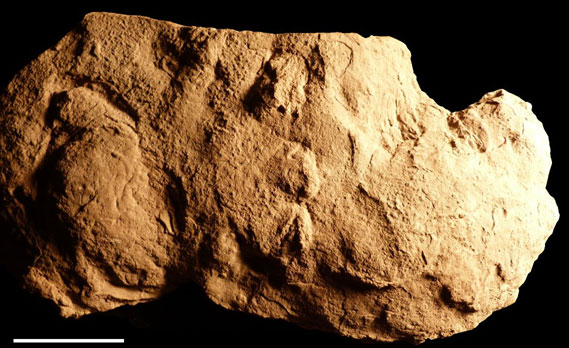
The earliest resting trace of a stem reptile and the fossil specimen preserves the earliest evidence of epidermal scales and a cloaca (vent). These scales are preserved on a newly described resting trace Cabarzichnus pulchrus representing the oldest and most complete body-impression occurrence of a Palaeozoic stem reptile. Picture credit: Lorenzo Marchetti

Picture credit: Lorenzo Marchetti

The Oldest Reptile Skin Impressions Known to Science

The stunning and beautifully  preserved skin impressions were found on a slab with associated footprints of an early reptile (Varanopus microdactylus). The material is from the Goldlauter Formation and dates from the Early Permian. Modern radiometric dating of volcanic ash layers allows the finds to be precisely dated. They are around 299-298 million years old. This makes them the oldest direct evidence of reptile skin found to date.

Skin structures such as scales, feathers or horned beak remnants are documented by a large number of fossils. For example, several examples of dinosaur integument are known. Recently, we wrote a blog post about a remarkable study of the skin of Diplodocus. However, the German skin impressions are around twice as old as the Diplodocus skin impression material.

To read about the study of diplodocid integument: The Amazing Skin of a Young Diplodocus.

Sauropod skin impression.

A sauropod skin impression (NHMUK R1868) on display as part of the London Natural History Museum Patagotitan exhibition. Picture credit: Everything Dinosaur.
Picture credit: Everything Dinosaur

Commenting on the significance of the research, Dr Lorenzo Marchetti stated:

“Such soft tissue structures are extremely rare in the fossil record – and the further back we go in geological history, the more extraordinary they become. The traces from the Thuringian Forest open up new perspectives on the early development of reptiles and their skin structures.”

Cabarzichnus pulchrus

The newly described resting traces have been named Cabarzichnus pulchrus.  It is a new genus and species of trace fossil. The associated footprints have proportions similar to those of bolosaurs – an early group of reptiles from the lineage of today’s lizards. The preserved scale shapes range from diamond-shaped to hexagonal to laterally pointed and show remarkable parallels to integuments of living reptiles.

We Have a Cloaca

The skin impression representing the base of the tail preserves possible evidence of a cloaca (vent). Most terrestrial vertebrates have a cloaca – a common opening for the excretion of faeces and urine, which is also the exit point for the reproductive organs. Only live-bearing mammals have separate openings. In the fossil record, the cloaca is almost never preserved and clearly recognisable as part of the soft tissue. However, the skin impression shows traces of a cloaca opening near the base of the tail. The impression of the narrow slit suggests that the cloaca of the Cabarzichnus track maker differs in shape and orientation from that of dinosaurs and crocodiles, resembling instead the cloaca of turtles, lizards and snakes.

Trace fossils which preserve the oldest reptile skin impressions can provide a more complete picture of the evolution of early land vertebrates.

Dr Marchetti added:

“Trace fossils are much more than mere footprints. They preserve details of anatomy that would otherwise be completely lost and contribute significantly to a better understanding of the evolution of early terrestrial vertebrates.”

This record of dermal and epidermal scales provides evidence for the co-existence of epidermal and dermal scales in Carboniferous stem amniotes and for epidermal scale differentiation in Asselian stage (Early Permian) stem reptiles. Therefore, this adaptation precedes the main phases of the global warming and aridification associated with the Early Permian and probably enabled the diversification of stem reptiles.

Everything Dinosaur acknowledges the assistance of a media release from the Museum für Naturkunde Berlin in the compilation of this article.

The scientific paper: “The earliest reptile body impressions with scaly skin” by Lorenzo Marchetti, Antoine Logghe, Michael Buchwitz, Mark J. MacDougall, Arnaud Rebillard, Thomas Martens and Jörg Fröbisch published in Current Biology.

For models and figures of Palaeozoic vertebrates: Models of Early Terrestrial Vertebrates.

Go to Top