

Researchers at the Museum für Naturkunde Berlin (Germany) made a spectacular discovery while cataloguing their collections. A fossilised plant specimen challenges long-held perceptions about the evolutionary origins of cannabis. The potential fossil cannabis plant discovered near Eisleben in Saxony-Anhalt, could be the oldest known example of the cannabis genus.
While reviewing historical collections, scientists uncovered a fossilised leaf impression originally described in 1883. At the time, researchers named it Cannabis oligocaenica. However, new dating evidence places this specimen much earlier than previously thought. The fossil does not date from the Oligocene Epoch. It is much older. Recent dating using sophisticated technology places the fossil in the Lower Eocene, approximately 56–48 million years ago.
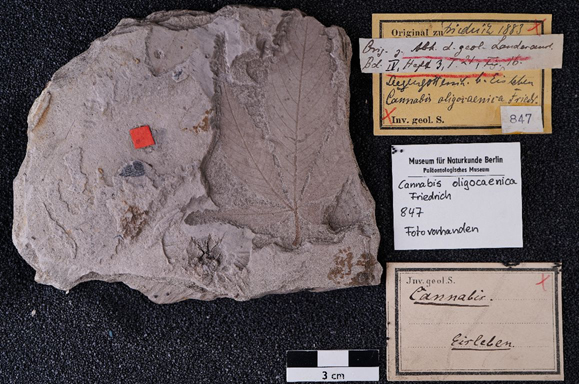
Potential fossil cannabis plant sheds doubt on the Asian origins of the Cannabaceae. Picture credit: Ludwig Luthardt.
Picture credit: Ludwig Luthardt
A Potential Fossil Cannabis Plant
The modern cannabis species (Cannabis sativa), probably originated in north-western China. This hypothesis is supported by the analysis of fossil pollen grains indicating the presence of these plants in China around twenty million years ago. Today, the plant is still endemic to China. However, molecular clock studies suggest an origin approximately twenty-eight million years ago.
The evolutionary origins of these plants, prized for their stimulant and hallucinogenic properties is challenged by this chance discovery. The fossil represents a leaf impression preserved in lithified mud, first described in 1883 and named Cannabis oligocaenica. Despite its name suggesting an Oligocene origin, the fossil is much older.
The fossil’s shape, with its serrated margins and narrow lance-shaped leaves, closely resembles modern cannabis plants. However, key diagnostic features are missing, such as the fine hairs found on living species. These hairs produce the psychoactive compound tetrahydrocannabinol (THC). It is thought plants evolved this compound to help counter the attention of grazing animals.
It remains uncertain whether this fossil specimen represents the earliest known cannabis plant.
One thing for sure, the specimen is a “high-light” of the Museum’s fossil plant collection.
Mike from Everything Dinosaur stated:
“This story demonstrates the importance of re-assessing specimens in museum collections. If confirmed, it could extend the evolutionary origins of cannabis by tens of millions of years. In addition, this fossil challenges the idea of an Asian origin for these plants.”
Visit the Everything Dinosaur website: Prehistoric Animal Models.


Leave A Comment