

A reassessment of horned dinosaur fossils discovered ninety years ago in the famous Dinosaur Provincial Park Formation of Alberta has led to the erection of a new chasmosaurine species. Previously assigned as the holotype for the species Chasmosaurus russelli, the fossil material (CMNFV 8800), has been re-described as Cryptarcus russelli. This revision of chasmosaurine fossil material demonstrates how modern research continues to refine dinosaur classification.
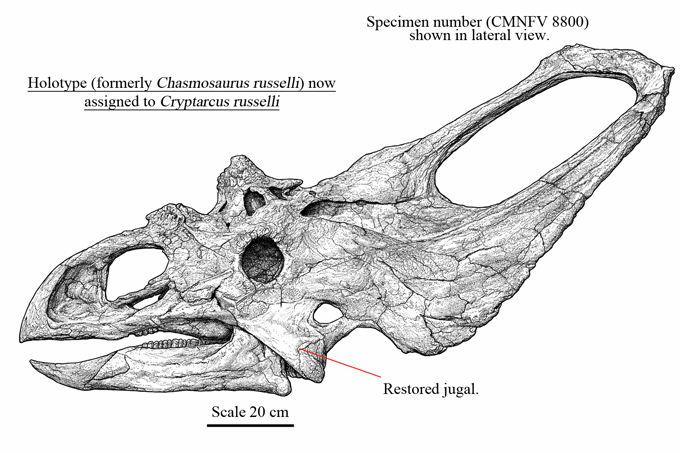
Holotype skull material (formerly Chasmosaurus russelli) now assigned to Cryptarcus russelli shown in left lateral view. The restored jugal is highlighted. Picture credit: Everything Dinosaur with line drawing based on Figure 3 (part A) from the scientific paper.
Picture credit: Everything Dinosaur with line drawing based on Figure 3 (part A) from the scientific paper.
Line drawing created from Figure 3 in [Holmes et al] (2026), New information on the holotype of “Chasmosaurus” russelli (Ornithischia: Ceratopsidae) necessitates the establishment of a new genus to receive the species”, licensed under CC BY 4.0.
An Iconic Fossil Specimen is Re-defined
Discovered in 1936 and named Chasmosaurus russelli in 1940 (Sternberg), the fossil material reviewed in a study published in the Canadian Journal of Earth Sciences changes views on the evolution and radiation of the Chasmosaurinae. For decades, Chasmosaurus russelli was considered one of two species within the genus Chasmosaurus. However, palaeontologists have long suspected that something was unusual about this specimen. While it shared traits with other Chasmosaurus fossil material, it also displayed features seen in more distantly related horned dinosaurs. This raised an important question. Did C. russelli truly belong in the Chasmosaurus genus?
To answer this question, researchers carefully re-examined the original skull. They removed old plaster reconstructions and re-prepared the fossil. This step was crucial because earlier restoration work had obscured important anatomical details. For example, old paint was removed and a fine preparation using a mounted needle was undertaken to remove artificial surface sculpturing and restoration plaster. The jugal was identified as having been restored during the original preparation work in the late 1930s. The holotype skull was carefully photographed and documented.
Next, the researchers conducted a detailed anatomical study. They focused on key skull features, especially the frill and facial bones. In addition, they carried out phylogenetic analyses. These tests compared the fossil’s characteristics with those of other members of the Chasmosaurinae subfamily.
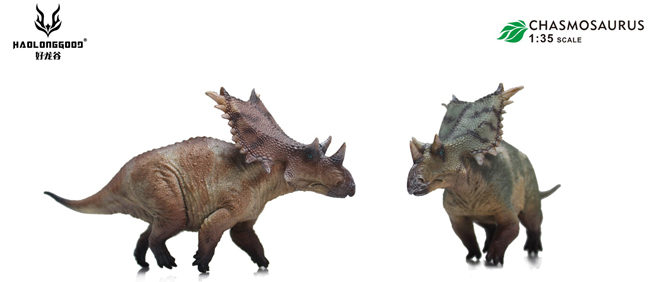
The Chasmosaurus genus has proved popular with dinosaur model collectors and several Chasmosaurus figures have been made. The image shows the two Haolonggood Chasmosaurus figures.
To view the range of Haolonggood ceratopsians and other dinosaurs available: Haolonggood Dinosaur Models.
Inconsistent Results
Interestingly, the results were inconsistent. Some analyses placed the specimen closer to Chasmosaurus. Others linked it more closely to taxa known from southern Laramidia such as Pentaceratops and Utahceratops. In some cases, its phylogenetic position could not be resolved at all.
To read our blog post from 2022 about the discovery of a new chasmosaurine dinosaur from New Mexico: New Chasmosaurine Described from Southern Laramidia.
The specimen CMNFV 8800 shows a mix of features seen in genera such as Agujaceratops, Utahceratops and Pentaceratops. However, these traits appear in a scattered and inconsistent way, making it difficult to link the specimen closely to any one of these dinosaurs. As a result, researchers found no strong evidence to place CMNFV 8800 within an existing genus, although future discoveries could refine its position.
Importantly, some features once thought diagnostic of Chasmosaurus were found to be unreliable. For instance, traits like horn size and frill shape can vary according to ontogeny or fossil taphonomy.
Crucially, the specimen is both distinctive and clearly identifiable when compared to other chasmosaurines. For this reason, the researchers established a new genus, Cryptarcus, to accommodate the holotype previously known as Chasmosaurus russelli. Other fossils from the lower Dinosaur Park Formation that have traditionally been assigned to this species will be reassessed in a future study.
Cryptarcus russelli
As the specimen could not be confidently assigned to Chasmosaurus or any other genus, the researchers made a decisive move. They erected a new genus, Cryptarcus, to accommodate these fossils. The name Cryptarcus means “hidden arch”. It reflects both the dinosaur’s concealed identity within the Chasmosaurus genus and the distinctive arch shape of its frill.
Furthermore, the study suggests this dinosaur may represent a separate evolutionary lineage. It could be related to southern chasmosaurines like Pentaceratops. Alternatively, its features may have evolved independently through convergent evolution. The erection of C. russelli highlights the complexity of ceratopsian evolution. Horned dinosaurs often display subtle differences in their skulls. These differences can be difficult to interpret, especially when fossils are incomplete or distorted.
As a result, taxonomic revisions to the Ceratopsidae are not uncommon. They show how new techniques and re-examining previously described material can reveal hidden diversity within well-known dinosaur groups. The naming of Cryptarcus russelli marks an important step in ceratopsian research. By revisiting an old fossil with new methods, scientists have uncovered a new genus hiding in plain sight.
This discovery reminds us that even familiar dinosaurs can still surprise us. Moreover, it shows that previous assumptions about the fauna associated with the Dinosaur Park Formation might be incorrect.
Research from 2020 linking chasmosaurines from southern Laramidia to chasmosaurines from Alberta: Two New Transitional Chasmosaurine Dinosaurs.
The scientific paper: “New information on the holotype of “Chasmosaurus” russelli (Ornithischia: Ceratopsidae) necessitates the establishment of a new genus to receive the species” by Robert B. Holmes, Jordan C. Mallon, Michael J. Ryan and David C. Evans published in the Canadian Journal of Earth Sciences.

Leave A Comment