

Researchers have described a single dinosaur caudal vertebra (tail bone) from Denman Island (British Columbia, Canada). It has been identified as an ornithomimosaur caudal vertebra. The fossil, thought to represent a bone from the middle part of the tail, is only the second dinosaur fossil identified from the Upper Cretaceous Nanaimo Group. In addition, it is the first definitive dinosaur fossil found in Canadian outcrops. Specifically, the caudal vertebra is from marine sediments of the Campanian-aged Cedar District Formation. The fossil discovery suggests that ostrich-like dinosaurs were present on the western margins of Laramidia.
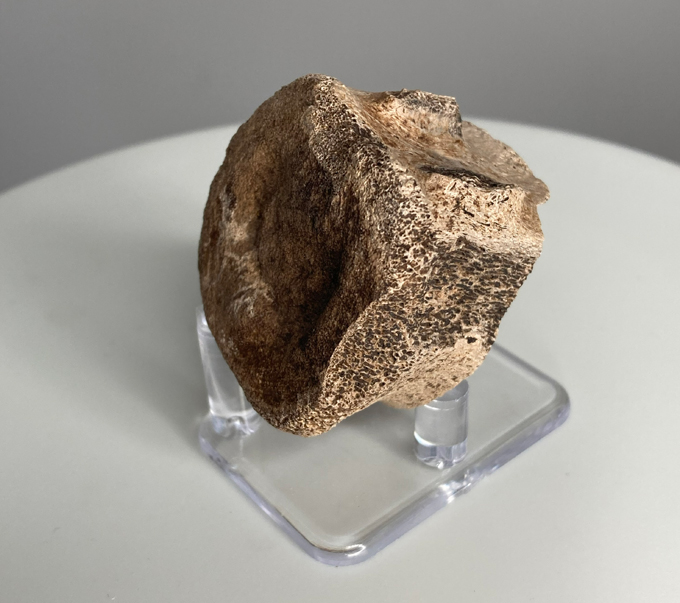
A single dinosaur caudal vertebra similar to the fossil discovery. A tail bone ascribed to the Ornithomimosauria clade has been found in Upper Cretaceous deposits on Denman Island (British Columbia). Picture credit: Everything Dinosaur.
Picture credit: Everything Dinosaur
A Dinosaur Caudal Vertebra
The discovery of the single caudal bone is only the second reported occurrence of dinosaur fossils from the Upper Cretaceous Nanaimo Group. In 2015, we reported a partial theropod femur from Sucia Island (Washington State, USA). Interestingly, this bone also derives from the Cedar District Formation, but it is geologically older than the ornithomimosaur tail bone.
- Partial theropod femur (Washington State, USA) – 83.6 to 79.8 mya
- Mid-caudal ornithomimosaur vertebra (Denman Island, British Columbia, Canada) – 79.8 to 75.5 mya
mya = millions of years ago.
To read our blog post from 2015 about the partial theropod femur fossil discovery: Washington State’s First Dinosaur.
The Upper Cretaceous Nanaimo Group
The deposits of the Upper Cretaceous Nanaimo Group of Vancouver Island have been studied for decades. Numerous vertebrate fossils have been collected representing a diverse marine biota. For example, fossils of fish including sharks, pterosaurs, elasmosaurids and birds have been found. However, despite intensive collecting no dinosaur fossils had been discovered.
Writing in the journal “FACETS” researchers, Victoria Arbour (Royal British Columbian Museum), Timon Bullard (École Secondaire Esquimalt High School) and David Evans (Royal Ontario Museum) describe an isolated theropod caudal vertebra. The fossil was found in marine sediments of the Campanian-aged Cedar District Formation of Denman Island. This small island is located off the eastern coast of the much larger Vancouver Island.
Contemporaneous with Judith River and Two Medicine Formation Biotas
The bone resembles the tail bones of ornithomimosaurs. However, the specimen cannot be identified at the family level. It was likely transported from the western margin of North America to the east. The Nanaimo Group was deposited at least 37o miles (600 km) south of its present position, and this ornithomimosaur likely lived at a similar palaeolatitude to contemporaneous dinosaur faunas in the Two Medicine and Judith River formations in the Western Interior.
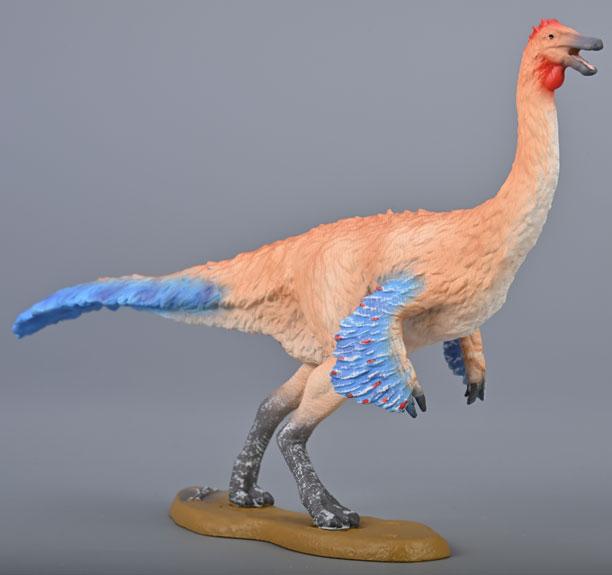
Ornithomimosaurs were probably feathered. In addition, they had long necks, small skulls and lengthy tails. Analysis of the long and graceful hindlimbs suggests that these dinosaurs were fast runners. The caudal vertebra found on Denman Island is likely to have come from the middle part of the animal’s tail.
The image (above) is that of the recently introduced CollectA Deluxe Gallimimus model. It is a popular figure with collectors and dinosaur fans. Furthermore, it is one of very few models representing ornithomimosaurs available.
To view the CollectA Deluxe range of prehistoric animal models: CollectA Deluxe Prehistoric Animals.
The scientific paper: “An ornithomimosaur from the Campanian Cedar District Formation (Nanaimo Group) of Denman Island, British Columbia, Canada” by Victoria M. Arbour, Timon S. Bullard and David C. Evans published in FACETS.
For models of ornithomimosaurs and other dinosaurs: Theropod Models and Dinosaur Toys.

Leave A Comment