

A groundbreaking scientific paper published in January (2026), has confirmed the presence of ceratopsian dinosaurs in Late Cretaceous Europe. The research focuses on the Hungarian dinosaur Ajkaceratops kozmai. The findings challenge long-standing ideas about Europe’s prehistoric ecosystems.
For decades, palaeontologists believed that horned dinosaurs were missing from Europe. Ceratopsians were widespread across Asia and North America during the Late Cretaceous. Famous species include Triceratops and Pachyrhinosaurus. Yet convincing fossils confirming their presence in Europe remained elusive.
The new research suggests these dinosaurs were hiding in plain sight.
The Enigmatic and Highly Significant Ajkaceratops kozmai
Ajkaceratops was first described from fragmentary fossils discovered in Hungary. These remains came from the Csehbánya Formation, rocks dating to approximately eighty-four million years ago (Santonian faunal stage of the Late Cretaceous). The fossils hinted at a small horned dinosaur, about the size of a labrador dog.
However, some researchers questioned this interpretation. The fossils were incomplete and difficult to interpret.
The new study, with corresponding author Professor Susannah Maidment (London Natural History Museum), provides crucial evidence. The research team described a new specimen, catalogue number MTM 2025.1.1. This fossil includes a much more complete skull. Detailed analysis of this fossil confirms that Ajkaceratops kozmai is indeed a true ceratopsian dinosaur.
Professor Maidment explained in a media release that the study indicates that far from being absent from Europe, ceratopsians may have been relatively common.
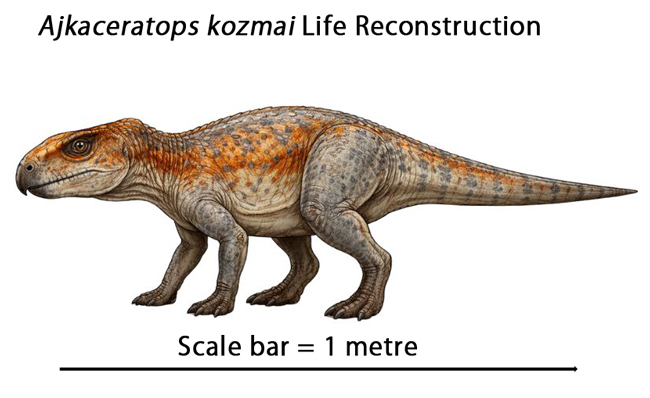
A scale drawing of the Late Cretaceous European ceratopsian Ajkaceratops (A. kozmai). Picture credit: Generated using AI/Canva with additional annotation by Everything Dinosaur.
Picture credit: Generated using AI/Canva with additional annotation by Everything Dinosaur
Uncovering Another Surprising Discovery About Rhabdodontids
The research uncovered an even more surprising discovery. Several dinosaurs previously classified as rhabdodontids may actually be ceratopsians. Rhabdodontids were thought to be iguanodontians. In addition, these herbivorous dinosaurs were regarded as unique to Europe. However, the new analysis suggests that some fossils attributed to rhabdodontids belong to horned dinosaurs instead. For example, a dinosaur named as Mochlodon vorosi is now considered a junior synonym of Ajkaceratops.
Another dramatic revision involves the Romanian dinosaur Zalmoxes shqiperorum. This species has now been reassigned to a new ceratopsian genus named Ferenceratops (Maidment et al, 2026). The genus honours the pioneering Austro-Hungarian palaeontologist and polymath Baron Franz Nopcsa.
A Hidden Diversity of European Ceratopsians
These revisions suggest that horned dinosaurs may have been far more common in Europe than previously believed. Many fossils may have been misidentified because of incomplete material. The confusion stems partly from evolutionary history. Ceratopsians and iguanodontians share a common ancestor. They are both classified as ornithischian dinosaurs. These two groups later evolved similar features. For instance, both developed complex chewing mechanisms and large body sizes. Some species also adopted quadrupedal locomotion. These similarities make fragmentary fossils difficult to identify.

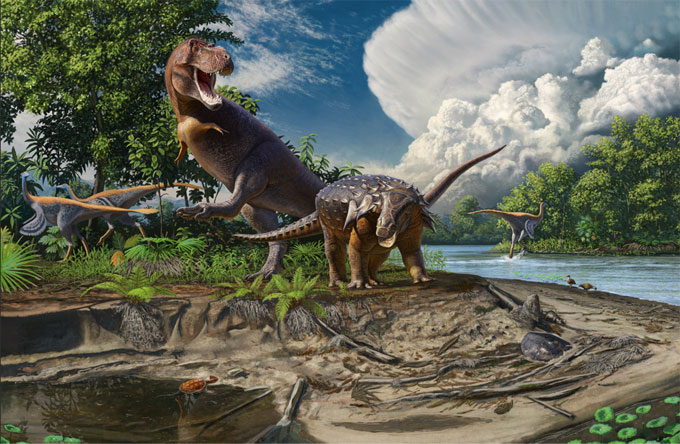
An example of a typical rhabdodontid dinosaur. Life restoration of newly described rhabdodontid dinosaur Obelignathus septimanicus in the Late Cretaceous environment recorded in the ‘Grès à Reptiles’ Formation in southern France. A pair of dromaeosaurid dinosaurs can be seen lurking in the background. Picture credit: Edyta Felcyn-Kowalska.
Picture credit: Edyta Felcyn-Kowalska
Reassessing the Biota of Late Cretaceous Europe
During the Late Cretaceous, Europe formed a chain of islands scattered across the Tethys Sea. Scientists believed this isolation produced unique dinosaur faunas. Such as the fauna associated with the Hateg Basin. However, the presence of ceratopsians suggests European ecosystems may have been more similar to the fauna found elsewhere in the Northern Hemisphere.
The discovery also fills an important gap in ceratopsian evolution. Early horned dinosaurs originated in Asia and later spread to North America. Europe may have served as an important stepping stone during these dispersals. Furthermore, the study highlights the importance of museum collections. Fossils stored for decades can reveal new secrets when re-examined with modern techniques.
As more discoveries emerge, palaeontologists may uncover an unexpected diversity of European horned dinosaurs. It seems that Europe’s “missing” ceratopsians were there all along hiding in plain sight.
The scientific paper: “A hidden diversity of ceratopsian dinosaurs in Late Cretaceous Europe” by Susannah C. R. Maidment, Richard J. Butler, Stephen L. Brusatte, Luke E. Meade, Felix J. Augustin, Zoltán Csiki-Sava and Attila Ősi published in Nature.
For ceratopsian figures and other dinosaur models: Dinosaur Figures.

Leave A Comment