Analysis of a beautifully preserved lower jawbone found in the southern Pyrenees of Spain has led to a new species of Late Cretaceous hadrosauroid dinosaur being erected. Named Fylax thyrakolasus (F. thyrakolasus), it is the youngest non-hadrosaurid hadrosauroid described to date. This dinosaur was one of the very last of all the non-avian dinosaurs to have existed and a phylogenetic assessment places Fylax as the sister taxon of Tethyshadros which is known from north-eastern Italy and was formally named and described in 2009.
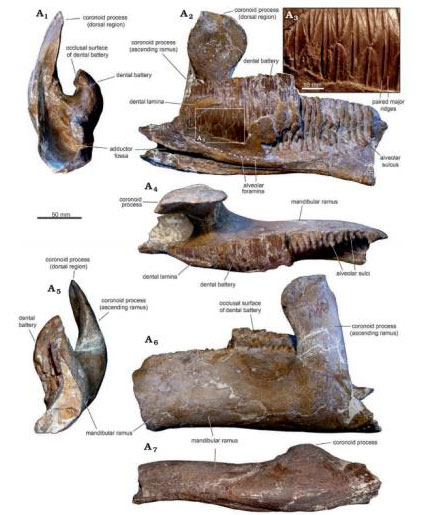
Dentary of the hadrosauroid dinosaur Fylax thyrakolasus gen. et sp. nov. (IPS-36338, holotype) from the uppermost Maastrichtian Figuerola Formation. Views of the specimen in posterior (A1), medial (A2), dorsal (A4), anterior (A5), lateral (A6), and ventral (A7) views. A detailed lingual view of the tooth crowns appears in A3. Picture credit: Prieto-Márquez and Carrera Farias.
Described from a Dentary
Described from a left dentary (lower jawbone), found in Lleida Province in Spain, the researchers from The Autonomous University of Barcelona (Universitat Autònoma de Barcelona), identified several unique characteristics that enabled them to erect a new taxon. The genus name is derived from the Greek thýra which means door or gate and kólasi which means hell. This translates as the “keeper of the gates of hell” a reference to the proximity of the fossil dentary to the layers of rock that mark the end Cretaceous mass extinction event that saw the demise of the non-avian dinosaurs.
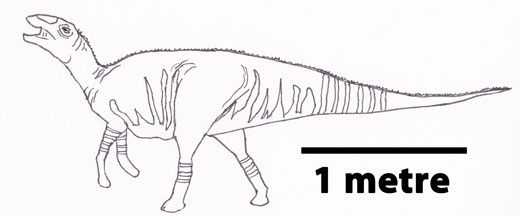
Based on analysis of more complete hadrosaurid fossil remains, Fylax is estimated to have been between 3.5 to 4 metres in length and it is the stratigraphically youngest non-hadrosaurid hadrosauroid known to date.
A life reconstruction of the recently described hadrosauroid from the uppermost Maastrichtian strata of the Figuerola Formation in the southern Pyrenees of Spain. The dinosaur, one of the very last to exist, has been named Fylax thyrakolasus. Note scale bar = 1 metre. Picture credit: Everything Dinosaur.
Picture credit: Everything Dinosaur
An Asian Origin for Hadrosauroids
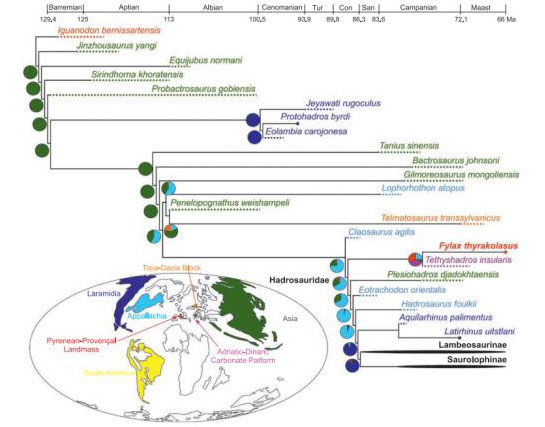
Although not the focus of their study, subsequent analysis and mapping of the geographical distribution of ornithopod fossil remains led the researchers to support the hypothesis of an Asian origin for hadrosauroids, which then subsequently dispersed to the eastern North American landmass of Appalachia. They suggest that the European archipelago that existed during the Late Cretaceous could have facilitated the westward dispersal of hadrosaurid outgroups from Asia to Appalachia.
A time calibrated cladogram showing global distribution of hadrosaurs and their close relatives. Pie charts indicate the likelihood of ancestral areas. This study suggests an Asian origin for hadrosauroids and subsequent dispersal to Appalachia, where Hadrosauridae probably evolved, from here once dispersed into Laramidia the Lambeosaurinae and Saurolophinae subfamilies evolved. The European archipelago probably provided a series of island stepping stones permitting the dispersal of hadrosaurids from Asia into North America. Picture credit: Prieto-Márquez and Carrera Farias.
The scientific paper: “A new late-surviving early diverging Ibero-Armorican duck-billed dinosaur and the role of the Late Cretaceous European Archipelago in hadrosauroid biogeography” by Prieto-Márquez, A. and Carrera Farias published in Acta Palaeontologica Polonica.
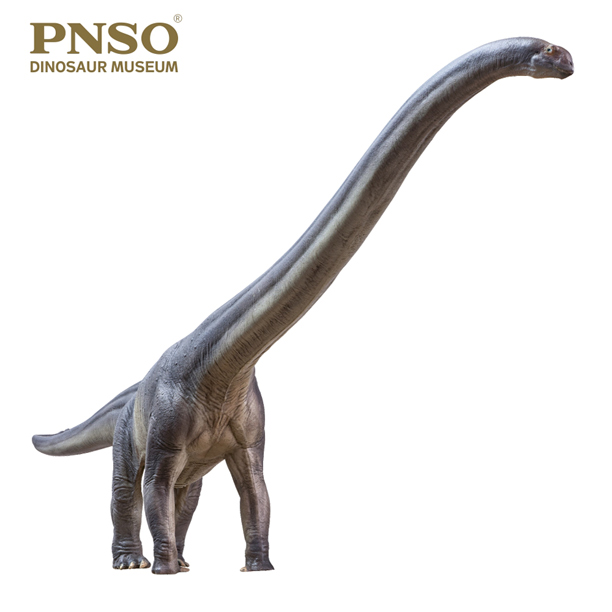
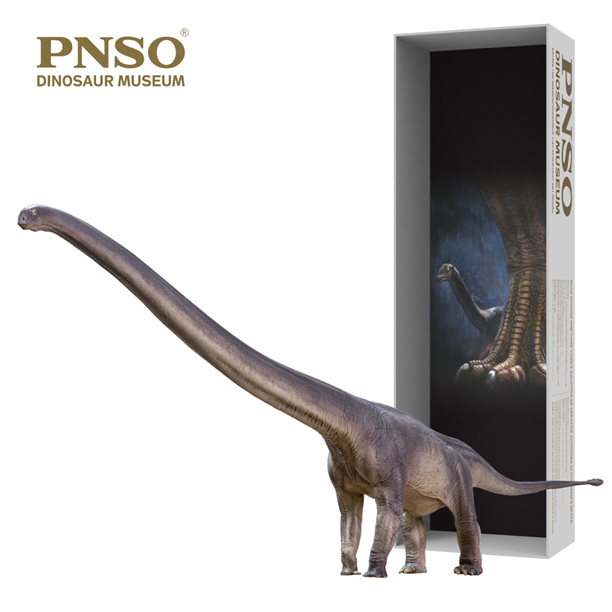
New PNSO prehistoric animal announcements continue to come thick and fast as the Chinese manufacturer announces the introduction of a new Mamenchisaurus dinosaur model in their Scientific Art range. This new version of Er-ma the Mamenchisaurus is in 1:45 scale, although it is roughly the same size as the existing PNSO Scientific Art Mamenchisaurus which has a stated scale of 1:35.
A view of the giant PNSO Er-ma the Mamenchisaurus dinosaur model.
A Sauropod with a Club Tail
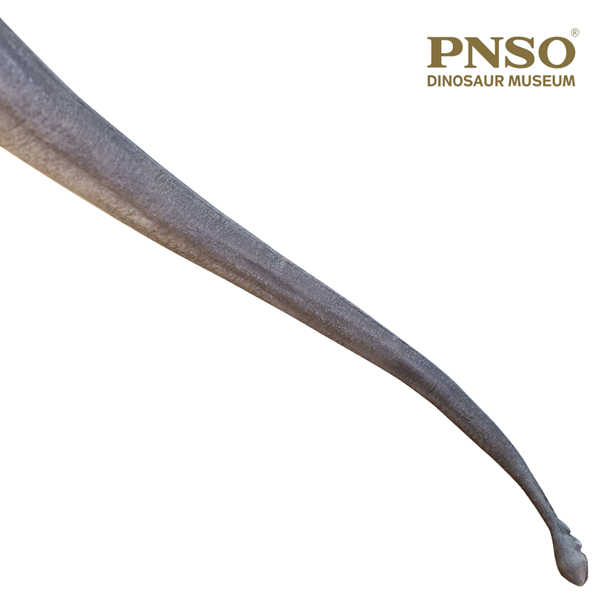
This new PNSO Mamenchisaurus figure has been given a small defensive club on the end of its tail, reminiscent of Shunosaurus. There may be some debate as to whether this dinosaur possessed such a club, fused caudal vertebrae in at least one specimen does suggest that a tail club was present.
The tail club as depicted on the new for 2021 PNSO Mamenchisaurus dinosaur model.
Several species of this Asian sauropod have been described, since the first taxon Mamenchisaurus constructus was named in 1954. In 2001, a well-preserved and nearly complete specimen assigned to the species M. hochuanensis was shown to have four fused vertebrae at the tip of its tail. These fused caudal vertebrae were not thought to have been caused by taphonomy and a pathological cause was discounted. It was proposed that these bones represented a defensive tail club or perhaps a tactile, sensory organ.
The new for 2021 PNSO Mamenchisaurus has been furnished with a tail club and in the release notes accompanying this figure’s announcement the model is described as representing M. hochuanensis.
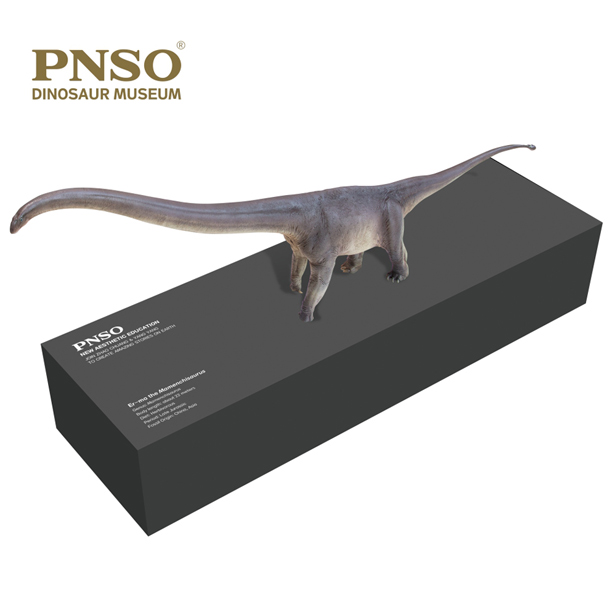
The PNSO Er-ma the Mamenchisaurus dinosaur model (2021) standing on a prototype of the product packaging.
Mamenchisaurus Model Measurements
This is the second, large Mamenchisaurus to be introduced by PNSO, after the original Er-ma figure in 1:35 scale that came into stock at Everything Dinosaur back in March 2019. Although, these two dinosaur models have different declared scales, they are approximately the same size. This can be explained by the fact that the figures have different postures and they represent different Mamenchisaurus species.
The 2019 Er-ma the Mamenchisaurus (1:35 scale) measures 47.5 cm in length and has a head height of 15 cm. Everything Dinosaur team members have suggested that this figure represents M. constructus.
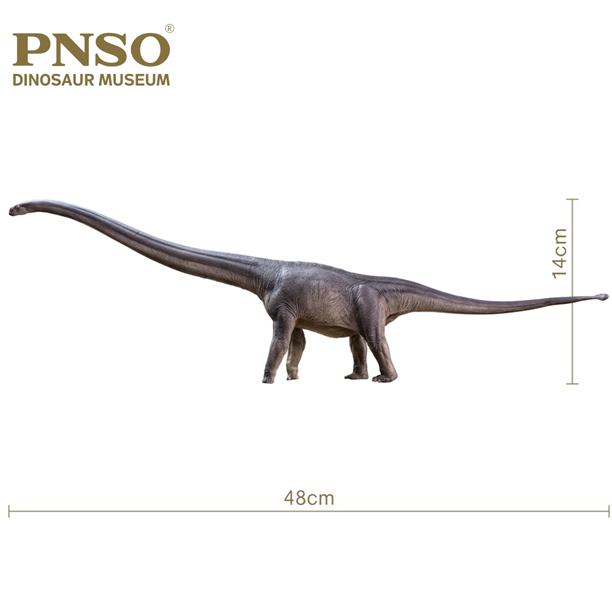
The new for 2021 Er-ma the Mamenchisaurus (1:45 scale) measures 48 cm long and is 14 cm tall, it represents the species M. hochuanensis.
The PNSO Er-ma the Mamenchisaurus measures 48 cm long and the head is around 14 cm off the ground. It is reported as a 1:45 scale model.
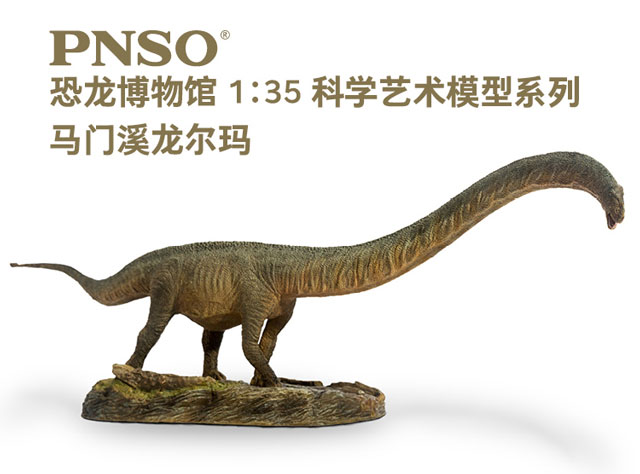
The original Er-ma the PNSO Mamenchisaurus dinosaur model. This is a 1:35 scale model, it is thought to represent a different species of Mamenchisaurus.
A spokesperson from Everything Dinosaur commented:
“We welcome the new for 2021 PNSO Mamenchisaurus figure. We cannot confirm or deny at this stage whether the original Er-ma Mamenchisaurus model that has proved to be so popular with collectors, will be retired and withdrawn from production. The new for 2021 figure has a different declared scale, but since the models represent different species and the actual fully-grown size for these sauropods is not known, the declared scale for a figure of this type of dinosaur is somewhat irrelevant in our view.”
The new for late 2021 PNSO Er-ma the Mamenchisaurus with prototype packaging shown behind the figure.
Due in Stock Later in the Year
The new PNSO Er-ma the Mamenchisaurus is due in stock at Everything Dinosaur later in the year (2021). Sending out such a huge model will prove challenging for the team. The box that this figure is supplied in measures 54 cm in length. This might require the UK-based company to commission a special cardboard box to permit these items to be sent out to customers safely.
Er-ma the Mamenchisaurus 1:45 scale dinosaur model. A view of the proposed product packaging.
To view the current range of PNSO prehistoric animal models available from Everything Dinosaur: PNSO Age of Dinosaurs.
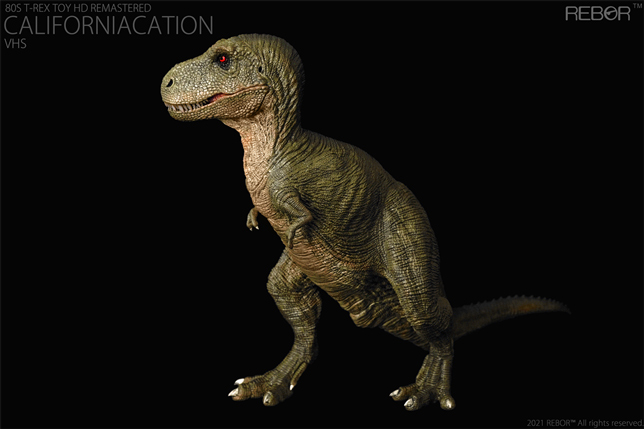
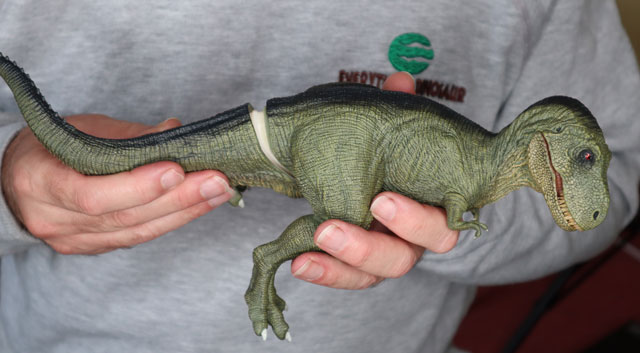
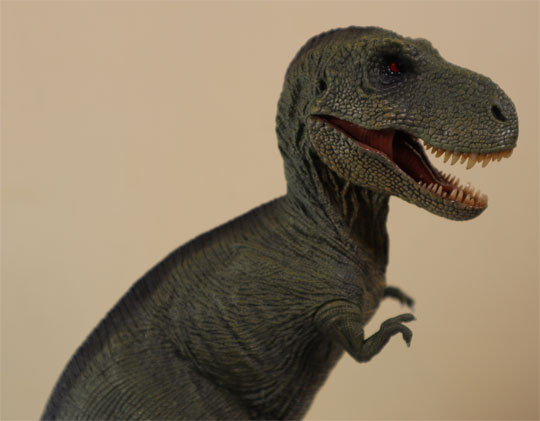
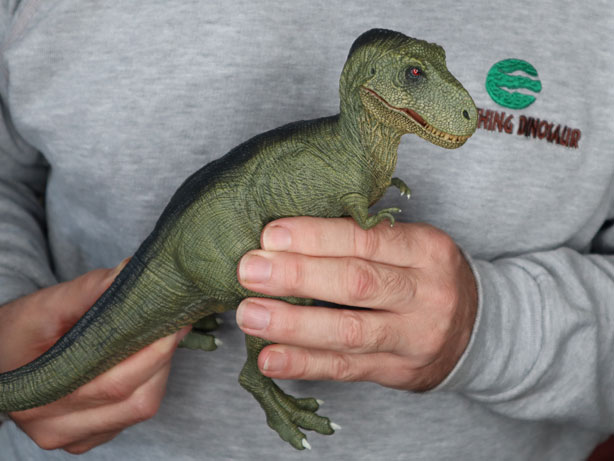
Rebor’s celebration of dinosaurs depicted in the popular media has kicked-off with the introduction of the T. rex figure entitled Rebor 1:35 80s T-REX Toy HD Remastered “Californiacation” VHS and what a splendid “old school” representation of Tyrannosaurus rex it is.
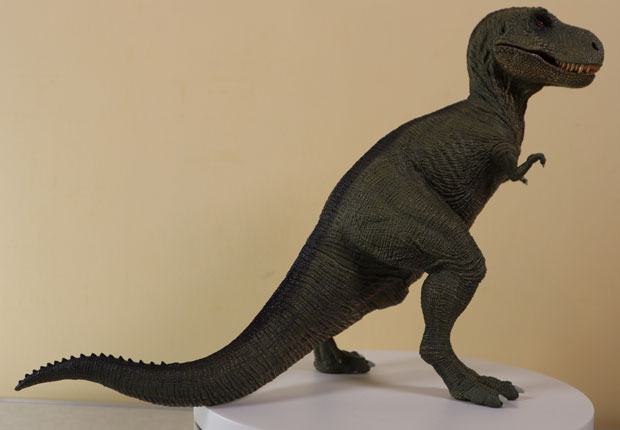
The Rebor “retrosaur” Californiacation T. rex figure in lateral view. Picture credit: Everything Dinosaur.
Picture credit: Everything Dinosaur
T. rex from the Movies
The Rebor range of “retrosaurs” pays homage to how dinosaurs such as Tyrannosaurus rex were depicted in films in the 20th Century. For example, the Californiacation figure resembles the meat-eating dinosaur that attacked Kong in the iconic 1933 movie “King Kong”. We think Willis O’Brien, the pioneering American stop motion animator who worked on the famous monster movie would be most impressed with this new Rebor replica.
The Rebor “retrosaur” a 1:35 scale T. rex dinosaur model.
The Rebor 1:35 80s T-REX Toy HD Remastered “Californiacation” VHS confronts the Rebor Mountain Gorilla model “Patriarch”. Everything Dinosaur team members attempt to recreate a famous scene from the 1933 film “King Kong” in which a dinosaur does battle with the eponymous gorilla. Picture credit: Everything Dinosaur.
Attaching the Tail on the Rebor “Retrosaur” T. rex
Just like many of the recent Rebor model introductions the T. rex known as “Californiacation” requires some assembly. The tail is supplied as a separate piece that has to be attached to the body. This is done to save on packaging and to insert the tail is a very simple job. Some considerable force needs to be applied to insert the tail piece, but if the tail proves difficult to insert, try dipping the connecting plug on the tail in a cup of boiling water for 2-3 seconds. This should make the plastic plug more malleable and aid assembly.
Attaching the tail piece on the Rebor 1:35 80s T. rex toy HD remastered “Californiacation” VHS dinosaur figure. Considerable force is required to insert the tail piece, but assembly can be made easier by dipping the tail plug into boiling water for a few seconds to help make the plastic more malleable. Picture credit: Everything Dinosaur.
Picture credit: Everything Dinosaur
T. rex Figure with an Articulated Jaw
In common with many other theropod models, the Rebor 1:35 80s T-REX Toy HD Remastered “Californiacation” VHS replica has an articulated lower jaw. The forelimbs are also poseable.
The Rebor “retrosaur” Californiacation T. rex figure has an articulated lower jaw.Picture credit: Everything Dinosaur.
Picture credit: Everything Dinosaur
Feeling very much at home at Everything Dinosaur the Rebor 1:35 80s T. rex toy HD remastered “Californiacation” VHS. Picture credit: Everything Dinosaur.
Picture credit: Everything Dinosaur
To view the range of Rebor prehistoric animal figures in stock at Everything Dinosaur: Rebor Models and Figures.
Researchers have described a new species of crocodilian from the Late Jurassic of Chile. Named Burkesuchus (B. mallingrandensis), it heralds from the Toqui Formation of southern Chile. As such, this 70-centimetre-long reptile shared its home with sauropods and the bizarre Chilesaurus (C. diegosuarezi). Analysis of the fragmentary fossil bones, including all important skull material suggests that Burkesuchus was a basal member of the Mesoeucrocodylia, the crocodilian lineage that led to modern crocodiles.
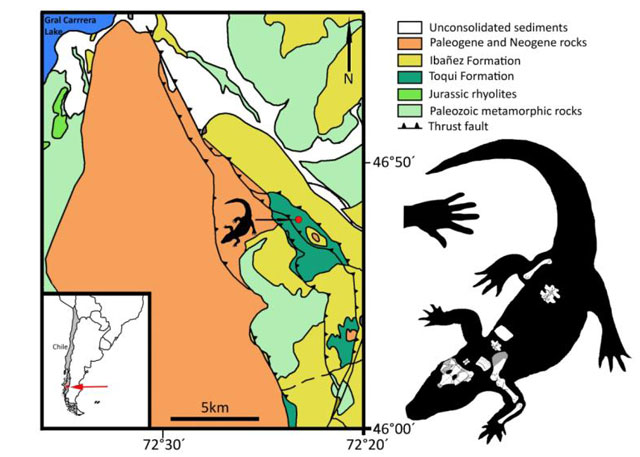
A map (insert) showing the location of the fossil finds, the geology of the region and a silhouette of Burkesuchus showing location of known bones within the skeleton with a human hand silhouette to show scale. The silhouette shows the skeletal location of the prehistoric crocodile remains. Picture credit: Novas et al.
Shedding Light on the Fauna Associated with the Toqui Formation
Fossils of Burkesuchus were collected from outcrops of the Toqui Formation (Tithonian stage of the Late Jurassic). Analysis of zircon samples subjected to radiometric dating suggest that this small crocodilian lived around 147 million years ago. The fossils found consist of skull material, dorsal vertebrae, elements from the limbs including a right scapula and coracoid (shoulder bones) a nearly complete right femur (thigh bone) and several osteoderms (body armour).
Photographs and line drawings of the cranium (SGO.PV 17700) of Burkesuchus mallingrandensis in (A, B) dorsal; (C, D) posterior; and (E, F) left lateral views. Note scale bar equals 1 cm. Picture credit: Novas et al.
A “Missing Link” in Crocodile Evolution
The genus name honours the American Coleman Burke for his financial support of the field work and “suchus” from Latin, meaning crocodile. The species name is a reference to Mallín Grande, the name given to this scenic, very beautiful but remote part of Chile, south of General Carrera Lake.
Semi-aquatic crocodilian fossils dating from the Jurassic of South America are rare. To date, the only other non-marine crocodilian known from this continent is Batrachomimus from the Upper Jurassic of Brazil, which is thought to be a paralligatorid. However, analysis of the limb bones associated with Burkesuchus reveals that it possibly represents an intermediate form between crocodilians with a more semi-erect gait and sprawling forms reflecting the gait and locomotion of modern crocodilians. Burkesuchus could represent a transitional form, helping palaeontologists to understand the evolutionary history of this important group of archosaurs.
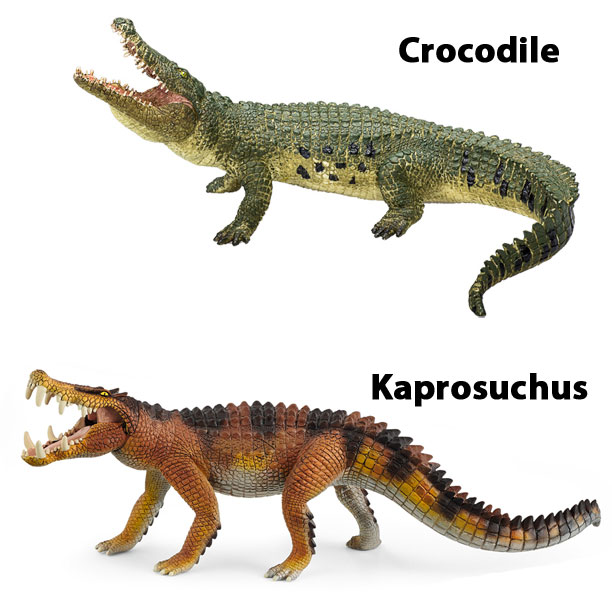
Comparing the gait of a modern crocodile (top) with that of Kaprosuchus from the Late Cretaceous of Niger. During the Mesozoic crocodyliforms occupied a wide variety of ecological niches and many different gaits were adopted. Today, modern extant crocodilians and their relatives all have a sprawling gait. Picture credit: Everything Dinosaur.
Picture credit: Everything Dinosaur
The Significance of a Prehistoric Crocodile
The discovery of Burkesuchus expands the meagre record of non-marine crocodile representatives from the Late Jurassic of South America and the researchers conclude that Batrachomimus and Burkesuchus indicate that the evolution of more derived crocodyliforms could have occurred in South America.
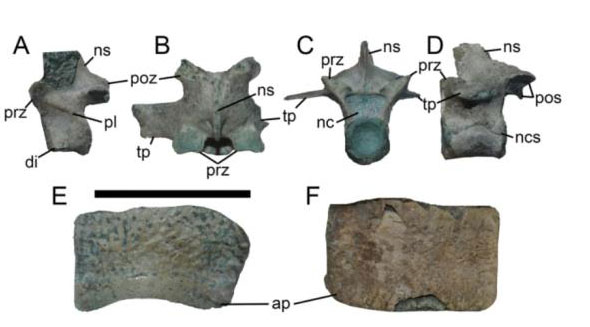
Photographs of vertebrae and osteoderm of Burkesuchus mallingrandensis (SGO.PV 17700). (A) cervical vertebra in left lateral view; (B–D) dorsal vertebra in (B) dorsal, (C) anterior, and (D) left lateral views; (E–F), dorsal osteoderm in (E), dorsal and (F), ventral views. Scale bar equals 1 cm. Picture credit: Novas et al.
The scientific paper: “New transitional fossil from late Jurassic of Chile sheds light on the origin of modern crocodiles” by Fernando E. Novas, Federico L. Agnolin, Gabriel L. Lio, Sebastián Rozadilla, Manuel Suárez, Rita de la Cruz, Ismar de Souza Carvalho, David Rubilar-Rogers and Marcelo P. Isasi published in Scientific Reports.
Those very kind and generous people at Eofauna shared their image which highlights all their beautiful prehistoric animal models in the company’s Eofauna Scientific Research range. Everything Dinosaur team members have been most impressed with this model series and we look forward to further additions to this exciting range in the near future.
The current range of Eofauna Scientific Research prehistoric animal models. We have titled this image “the magnificent seven”! All these stunning figures are in stock at Everything Dinosaur (July 2021).
Seven Stunning Eofauna Scientific Research Figures
The image (above) shows all seven of the current range of Eofauna Scientific Research figures in lateral view. Can you name them all?
The first of these amazing figures was introduced just four years ago (2017), since then the range has grown to include three dinosaur genera and three genera of prehistoric elephant. The team behind the Eofauna range have a particular expertise in prehistoric Proboscidea (elephants and their close relatives), hence all three of the prehistoric mammals in this series released to date are replicas of extinct members of the elephant family (Elephantiformes).
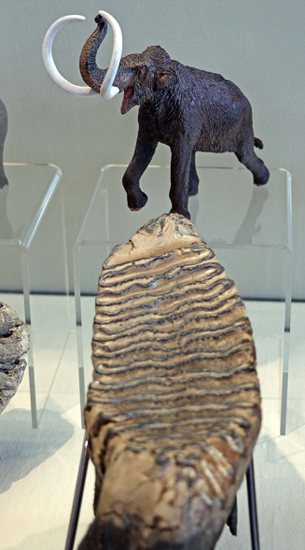
Some of these impressive figures have found themselves being used in museum displays to illustrate the variety of elephants that once roamed our planet.
An Eofauna prehistoric elephant model used in a museum display. Picture credit: Dr Jan Fischer/Urweltmuseum GEOSKOP
The Magnificent Seven
For the record, here is the list of the seven models currently in the Eofauna Scientific Research range. We have produced the list in the order in which the figures were released.
Eofauna Scientific Research Models (July 2021):
Steppe Mammoth (Mammuthus trogontherii) – introduced October 2017.
Straight-tusked Elephant (Palaeoloxodon antiquus) – introduced late spring 2018.
Giganotosaurus (Giganotosaurus carolinii) – introduced January 2019.
Deinotherium (Deinotherium giganteum) – introduced October 2019.
Atlasaurus (Atlasaurus imelakei) – introduced November 2019.
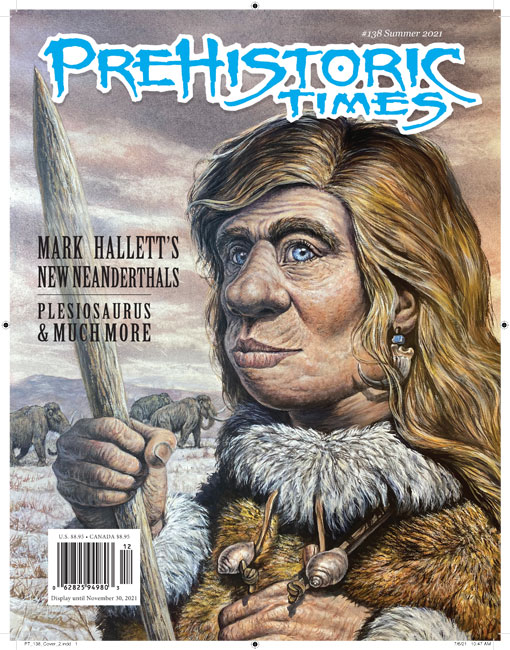
The latest edition of “Prehistoric Times” magazine has arrived and once again it is jam-packed with fascinating features, informative articles and lots of amazing reader submitted artwork. The highly respected palaeoartist Mark Hallett has provided the front cover, a piece entitled “Venus of the Steppes” as it features a female Neanderthal and inside the magazine Mark provides an update on Neanderthal research and examines how our perception of our “close cousins” has changed.
The front cover of “Prehistoric Times” magazine edition 138 (summer 2021). The artwork is entitled “Venus of the Steppes”.
The in-depth article looks at how Neanderthals hunted, examines evidence of a “Neanderthal culture” in the form of art, ornaments and a belief in an afterlife. Mark also considers the cause of their extinction and reviews their legacy in terms of the genes that parts of the modern human (H. sapiens) population have inherited.
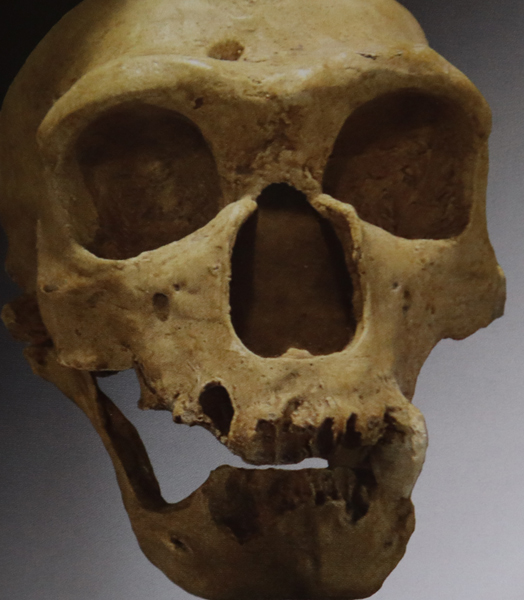
The famous Chapelle aux Saints Neanderthal skull.
Tenontosaurus and Plesiosaurus
The featured prehistoric animals in issue 132 are Tenontosaurus and Plesiosaurus. Phil Hore provides plenty of information and the articles include lots of reader submitted artwork. Stand outs for us when it comes to Tenontosaurus include Kurt Miller’s striking Tenontosaurus pair and Diane Ramic’s colourful geometric pastiche. When reading the Plesiosaurus feature, we admired the big-eyed plesiosaur illustration reminiscent of “Nessie” by Anders Bang and the silhouetted plesiosaurs and other Mesozoic marine life depicted by Jacob Micallef.
The talented Tracy Lee Ford focuses on Hypsilophodon (H. foxii) in his regular “How to Draw Dinosaurs” piece. As well as providing detailed views of skeletal anatomy including evidence of an “opposable toe”, he also demonstrates how Hypsilophodon has been depicted over the last 110 years or so, concluding his well-written article with a modern H. foxii life reconstruction.
Burian’s Ornithopods
John Lavas continues his long-running series on the remarkable career of the influential Czech artist Zdeněk Burian. The focus is on the Ornithopoda and some stunning images are reproduced including an illustration of Iguanodon (I. bernissartensis) that may have been the inspiration for how the movie monster “Godzilla” was depicted. In turn, Burian’s iguanodontid artwork may have been influenced by tales from African explorers of “elephant graveyards”.
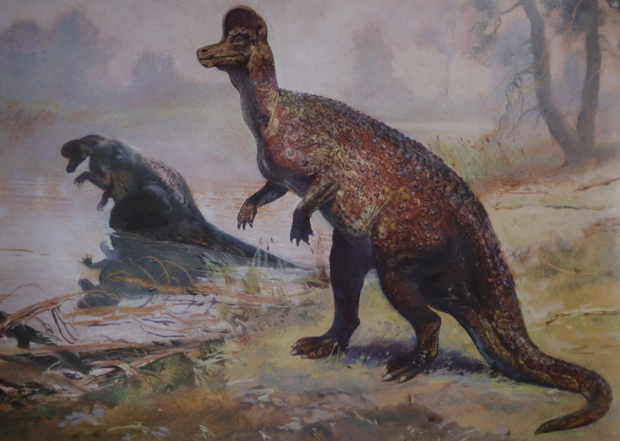
An illustration of Corythosaurus casuarius by Burian. This artwork is featured in the series showcasing the career of the illustrious Czech artist.
The book “Locked in Time: Animal Behavior Unearthed in 50 Extraordinary Fossils” by chums of Everything Dinosaur Dean Lomax and Bob Nicholls is reviewed by editor Mike Fredericks in the “Mesozoic Media” section and look out for Randy Knol’s update on new prehistoric animal figures. Our thanks to Dr Andreas Forrer for the article recreating the Pleistocene of Germany in his article discussing the remarkable fossil finds associated with the Wipper Valley of Thuringia. The summer edition of “Prehistoric Times” is crammed with lots of interesting articles, features and illustrations.
To subscribe to “Prehistoric Times” magazine: Subscribe!
With all the problems occurring in global logistics due to the COVID-19 pandemic, Everything Dinosaur team members were delighted to receive a large shipment of Papo prehistoric animal models. Dozens of different types of Papo prehistoric animal model including the Giganotosaurus, Pentaceratops and the Chilesaurus model were carefully unpacked and put into the various product bays at Everything Dinosaur’s warehouse.
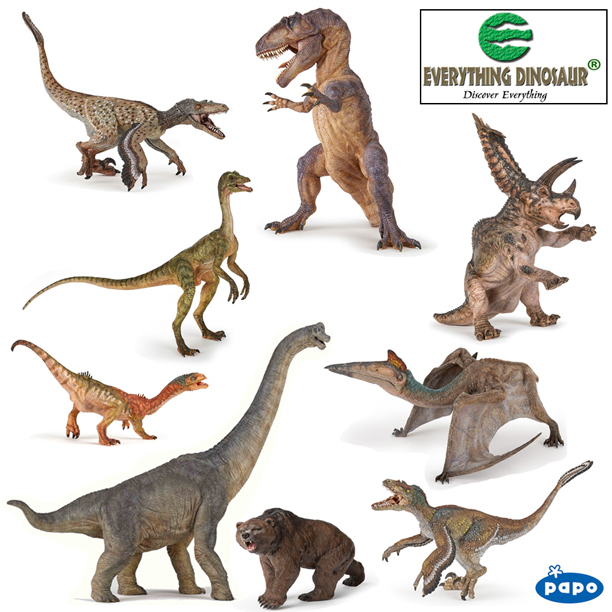
Everything Dinosaur received (mid July 2021) a large shipment of Papo prehistoric animal models. More than a dozen Papo figures are now back in stock at Everything Dinosaur. More Papo figures are in stock at Everything Dinosaur. Picture credit: Everything Dinosaur.
Picture credit: Everything Dinosaur
A Craving for Cryolophosaurus
Team members have been busy updating waitlists and emailing customer who had requested Papo models to be reserved for them. Dinosaur model collectors have been craving for the return of the Papo Cryolophosaurus, waiting patiently for Parasaurolophus and queuing for Quetzalcoatlus. Staff have spent much of the afternoon contacting customers to let them know about the stock updates.
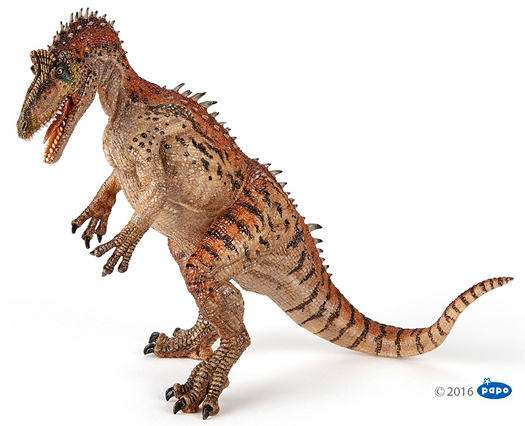
The Papo Cryolophosaurus dinosaur model. Introduced in 2016, this dinosaur model is quite hard to track down but Everything Dinosaur has brought in more stock for the summer (July 2021).
Papo Dinosaurs and Prehistoric Animal Models
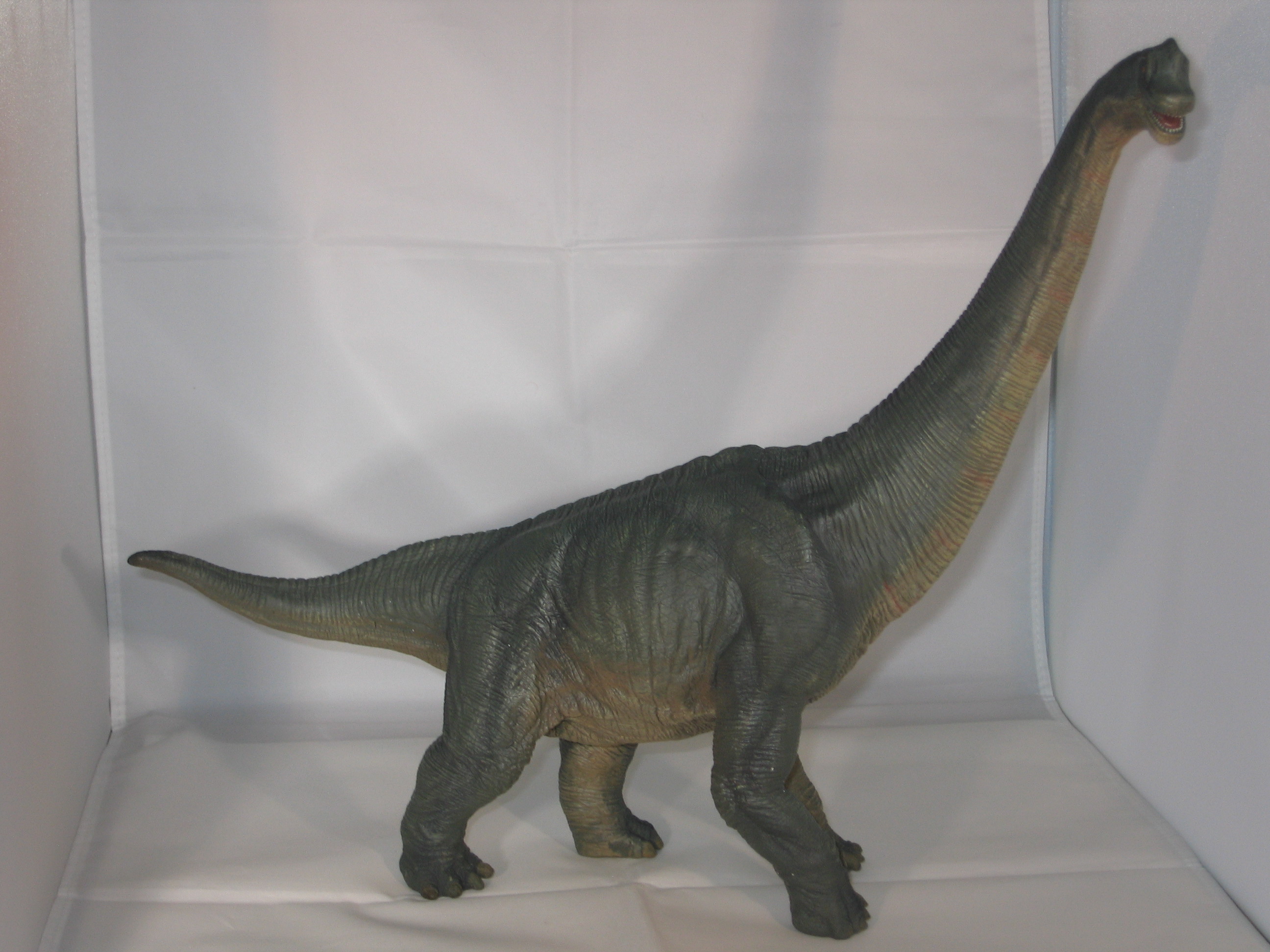
The Papo “Les Dinosaures” model range is very popular with collectors, but like many companies, Papo have encountered problems moving stock from the factory into markets. The Everything Dinosaur shipment contains all the 2019 and 2020 additions to this range plus some of the more difficult to obtain figures such as the Papo Cryolophosaurus and the popular Brachiosaurus figure.
In our studio – Papo Brachiosaurus. The popular Papo Brachiosaurus dinosaur model is in stock at Everything Dinosaur (July 2021). Picture credit: Everything Dinosaur.
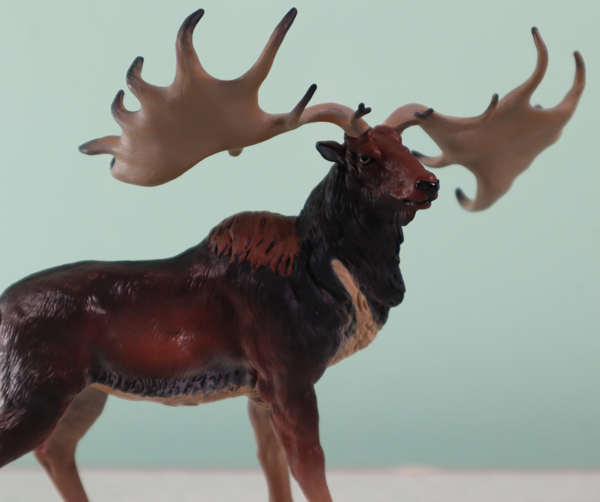
A spokesperson from Everything Dinosaur confirmed that this shipment contained prehistoric mammal models as well as dinosaur figures. They were able to reassure collectors that the magnificent Papo Megaloceros, an introduction to the Papo range in 2020, was back in stock.
The beautifully painted Papo Megaloceros model. The Papo Megaloceros model is back in stock at Everything Dinosaur. Picture credit: Everything Dinosaur.
Picture credit: Everything Dinosaur
To view the Papo Megaloceros, the Brachiosaurus and the Papo Cryolophosaurus along with the rest of the Papo model range available from Everything Dinosaur: Papo Dinosaur and Prehistoric Animal Models.
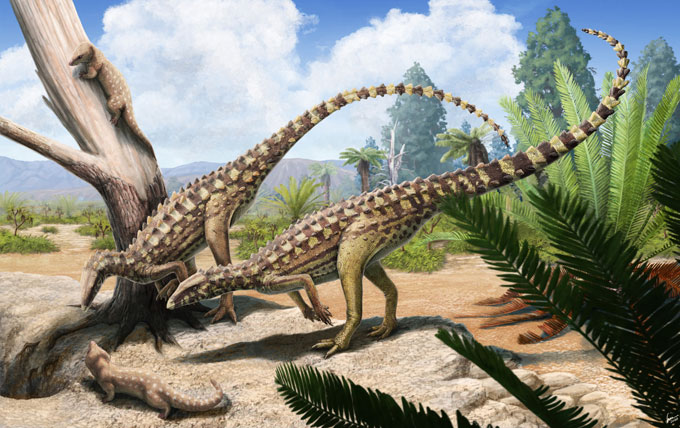
When asked to name an armoured dinosaur, we suspect that most readers would quickly reply with “Stegosaurus” or possibly “Ankylosaurus”. True, some armoured dinosaurs are very famous, having seeped into the public consciousness thanks to countless appearances in the media, dinosaur documentaries and films. However, very little is known about the origins of this diverse and highly successful ornithischian clade. Newly, published research on the labrador-sized early thyreophoran Scutellosaurus (S. lawleri) is helping scientists to better understand the evolutionary origin of these dinosaurs.
A life reconstruction of the Early Jurassic, primitive member of the Thyreophora Scutellosaurus (S. lawleri). This labrador-sized dinosaur is helping to shed light on the early evolution of the armoured dinosaurs and is the only definitive bipedal thyreophoran described to date. Picture credit: Gabriel Ugueto.
A Palaeontological Project Lasting Sixteen Years
The scientific paper, the first detailed anatomical assessment of Scutellosaurus covering its entire skeleton, has been published in the on-line, open access journal Royal Society Publishing. The dedicated research team consisted of PhD student Benjamin Breeden (University of Utah), Professor Richard Butler (University of Birmingham), Professor Timothy Rowe (University of Texas at Austin) along with PhD student Tom Raven and Dr Susannah Maidment (Natural History Museum, London).
This research project was first proposed back in 2005. Sixteen years after the project’s inception, the paper has been published providing a new perspective on the evolution of the armoured dinosaurs.
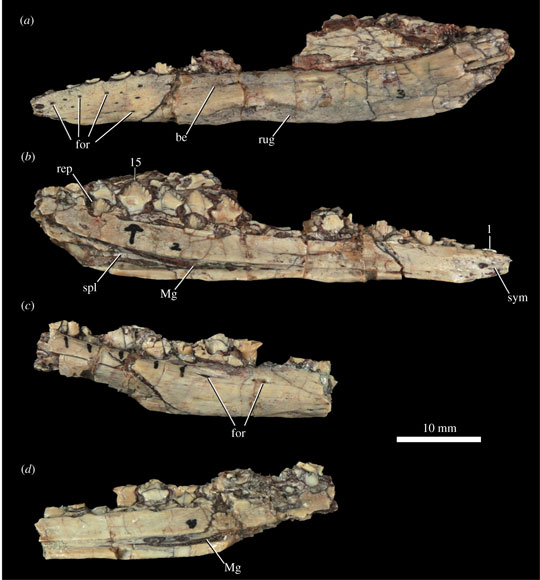
Scutellosaurus lawleri, holotype (MNA.V.175) dentaries. Left dentary in lateral (a) and medial (b) views. Right dentary in lateral (c) and medial (d) views. Picture credit: Breeden et al.
Scutellosaurus lawleri
Named and described in 1981, from material discovered ten years earlier. Scutellosaurus lawleri fossils come from the Kayenta Formation of Arizona, more specifically mudstones associated with the “middle third” of this Formation (Lower Jurassic). It has been estimated that the Scutellosaurus fossils are around 181 to 186 million years old (Pliensbachian and Toarcian stages).
More than seventy Scutellosaurus specimens are known, representing all parts of the skeleton. As such, Scutellosaurus fossil material is much more abundant than that of other early armoured dinosaurs such as Scelidosaurus (S. harrisoni), which was named and described by the famous Victorian anatomist Richard Owen. This relative abundance of fossil material in comparison with other early armoured dinosaurs makes Scutellosaurus an ideal candidate to help palaeontologists to better understand the evolution of this important group of plant-eating dinosaurs.
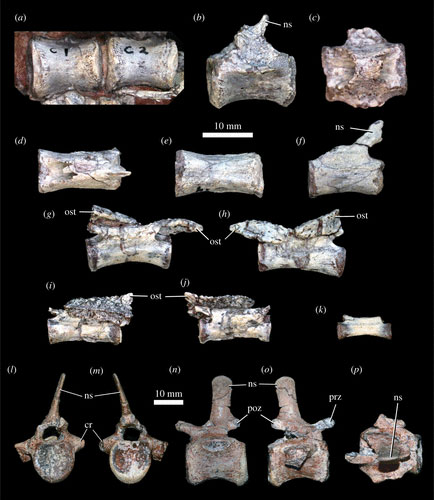
Views of selected tail bones (caudal vertebrae) of the ornithischian Scutellosaurus lawleri. Picture credit: Breeden et al
Scutellosaurus was a Biped
One of the key findings of this research is that based on limb proportions and postcranial skeletal assessments, Scutellosaurus was bipedal. As such, it is the only bipedal thyreophoran known to science. It had been suggested that as thyreophorans evolved into larger and more heavily armoured forms they lost this ability to adopt a bipedal posture.
Although the exact layout of the dermal armour of Scutellosaurus is not known, the researchers tested the hypothesis that heavier armour led these dinosaurs to adopt a quadrupedal stance.
The research team calculated the centre of mass of Scutellosaurus with its armour, without armour, with the armour of Stegosaurus and with the armour of the Late Cretaceous ankylosaurid Euoplocephalus. They found that the addition of armour did cause the centre of mass to move slightly further back in the body in all the tests. However, the team concluded that the evolution of armour probably was not the reason to cause early armoured dinosaurs to adopt quadrupedal locomotion.
More derived taxa of armoured dinosaurs required forelimb support for their body weight for other, as yet not understood reasons.
Armoured Dinosaurs Grew Slowly
Detailed analysis of Scutellosaurus bones indicate that this dinosaur grew very slowly throughout its life. This supports other studies that suggest that thyreophorans had lower metabolic rates when compared to other dinosaurs, even closely related ornithischians.
Lots of Variety in Early Jurassic Dinosaur Faunas
The supercontinent Pangaea did begin to break-up during the Jurassic, but at the time Scutellosaurus roamed what was to become the western United States, this landmass was largely intact, which in theory would have helped homologous populations of dinosaurs to evolve. That is to say, that given the absence of any geographical barriers preventing movement, similar dinosaur faunas would have existed across Pangaea. When this study of Scutellosaurus is looked at from the wider perspective of dinosaur evolution and radiation, a different picture emerges.
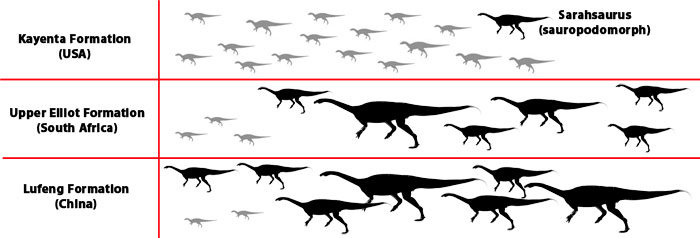
The ornithischian dinosaurs from the Kayenta Formation are represented by Scutellosaurus lawleri, a larger unnamed thyreophoran known from isolated bones and an undescribed hetrodontosaurid. Scutellosaurus fossils are the most abundant dinosaur fossils associated with the Kayenta Formation, they are much more common than theropod or sauropodomorph fossils. In contrast, the roughly contemporaneous upper Elliot Formation of South Africa has many more sauropodomorphs than ornithischians and the dinosaur biota of the Lufeng Formation of China is dominated by sauropodomorphs with ornithischian material exceptionally rare.
A comparison of plant-eating dinosaur faunas from three Lower Jurassic Formations. The grey silhouettes represent ornithischian dinosaurs which in the case of the Kayenta Formation is dominated by the thyreophoran Scutellosaurus. The black silhouettes represent members of the Sauropodomorpha, which in the Kayenta Formation is represented by Sarahsaurus.
This suggests that there was considerable variation in the composition of dinosaur biotas during the Early Jurassic.
The scientific paper: “The anatomy and palaeobiology of the early armoured dinosaur Scutellosaurus lawleri (Ornithischia: Thyreophora) from the Kayenta Formation (Lower Jurassic) of Arizona” by Benjamin T. Breeden, Thomas J. Raven, Richard J. Butler, Timothy B. Rowe and Susannah C. R. Maidment published by Royal Society Publishing.
Earlier this month (July 13th, 2021), Everything Dinosaur announced that PNSO were adding a replica of the controversial Late Cretaceous tyrannosaur Nanotyrannus to their product range. Logan the Nanotyrannus will join several other tyrannosauroid figures in the exciting and highly respected PNSO mid-size, prehistoric animal model range. A Tarbosaurus figure has been announced (Chaunzi the Tarbosaurus) and earlier this year, Everything Dinosaur announced that this range would also include a replica of Yutyrannus huali (Yinqi the Yutyrannus).
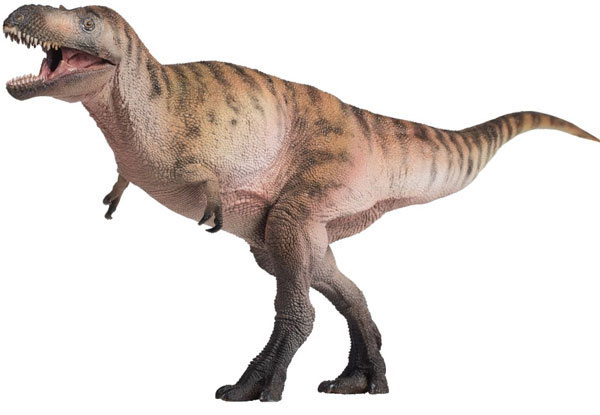
The new for 2021 PNSO Nanotyrannus dinosaur model (Logan the Nanotyrannus).
A Controversial Tyrannosaur Genus
Nanotyrannus (N. lancensis) was named and scientifically described in 1988 (Bakker et al), based on a slender skull (CMNH 7541) discovered by David Dunkle from the Cleveland Museum of Natural History (Ohio) in 1942. Bakker et al concluded that the skull represented an adult animal, but this has been refuted by a number of authors since publication. Other T. rex fossil finds, most notably the teenage specimen known as “Jane” excavated by palaeontologists from the Burpee Museum of Natural History (Illinois) and now part of a permanent tyrannosaur display, have demonstrated that the body shape of T. rex changed dramatically as it grew.
The narrow-skulled, long-limbed and more gracile tyrannosaur specimens probably do not represent a pygmy form of tyrannosaur that shared the Late Cretaceous habitat with the bruiser T. rex, these specimens are juveniles. However, as part of Everything Dinosaur’s commitment to education, we still have to prepare a fact sheet on Nanotyrannus to accompany sales of the PNSO Logan the Nanotyrannus dinosaur model.
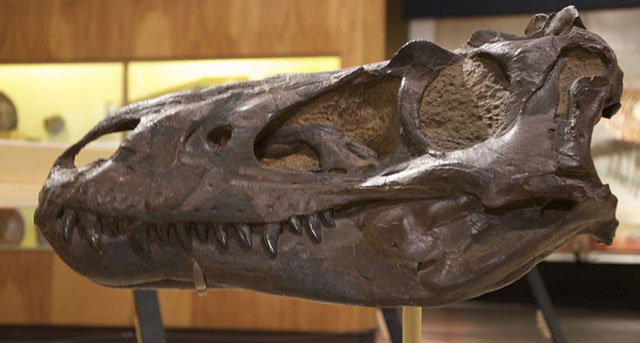
A cast of CMNH 7541 skull of Nanotyrannus lancensis (lateral view). Picture credit: S. Anselmo.The teeth of juvenile T. rexes are more slender compared to the very robust teeth of adult T. rexes which also tend to be “D-shaped” in cross section.
Nanotyrannus Scale Drawing
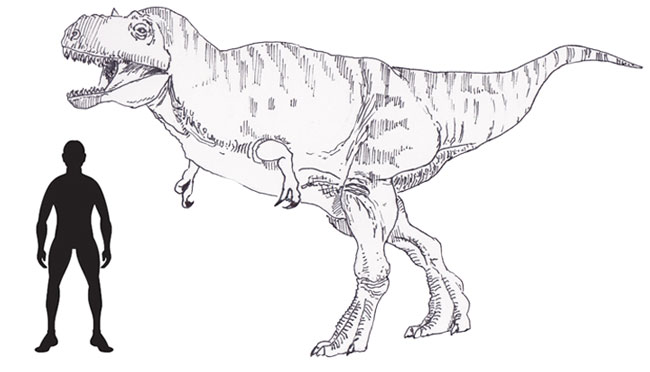
Logan the Nanotyrannus could represent N. lancensis or perhaps it could represent a teenage T. rex. That decision ultimately rests with the purchaser, team members at Everything Dinosaur will be supplying their customers with a fact sheet and this will contain a scale drawing based on the original estimated size for Nanotyrannus of a little over five metres in length.
A spokesperson from the UK-based mail order company confirmed that the illustration will be used in the Nanotyrannus fact sheet. In addition, the spokesperson explained how commissioning such drawings helped to support the wider community.
To view the PNSO prehistoric animal models currently in stock at Everything Dinosaur: PNSO Age of Dinosaurs.
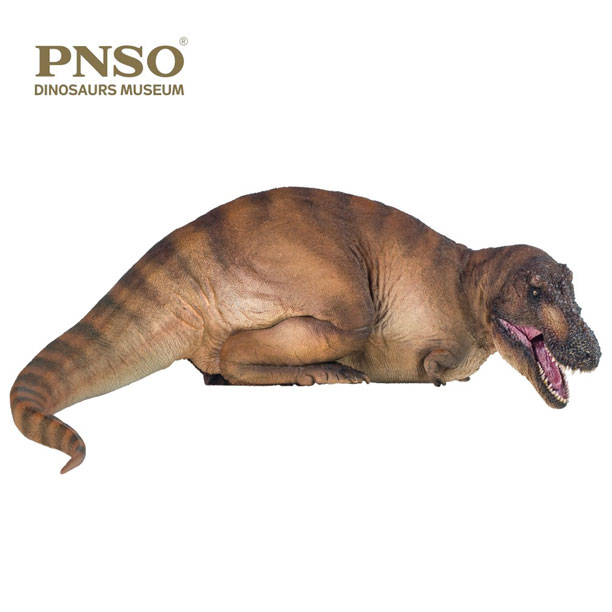
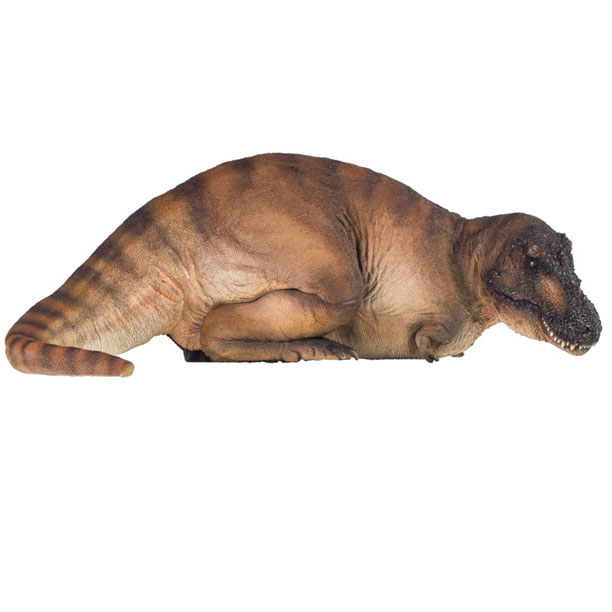
PNSO will be adding a 1:35 scale replica of a female Tyrannosaurus rex in a resting pose to their 1:35 Scientific Art model series. This exciting new for 2021 dinosaur model will be in stock at Everything Dinosaur later in summer.
Although the position of the hind legs in this resting pose is controversial it is great to see a manufacturer introduce a figure of a theropod dinosaur in a prone, resting position.
A Prone Tyrannosaur
PNSO has received praise for the number of tyrannosauroid models that they have introduced. In the last few weeks Everything Dinosaur has announced Tarbosaurus and Nanotyrannus replicas that are being added to the company’s mid-size model range. These figures will join a Yutyrannus replica and the Qianzhousaurus dinosaur model. The PNSO Andrea the female T. rex is the first to show a tyrannosaur in resting pose and the first, definitive indication of a female dinosaur being reflected in a PNSO model sculpt.
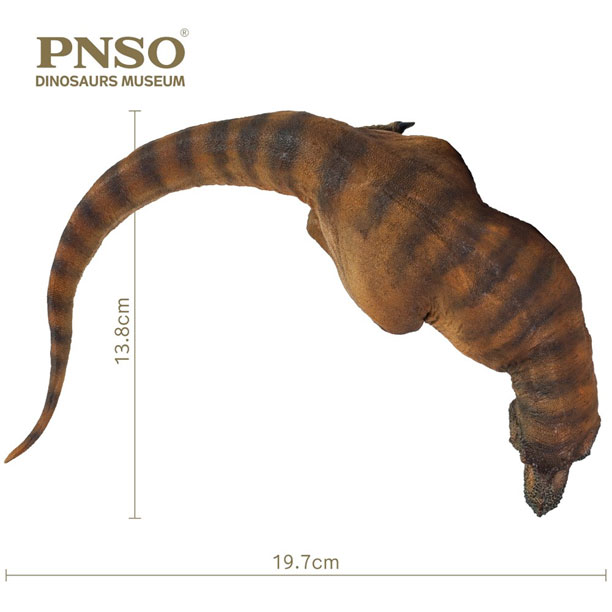
PNSO Andrea the T. rex measures 19.7 cm long, accounting for the curve of the tail. The model is 13.8 cm wide and it has a stated scale of 1:35.
A 1:35 Scale T. rex Replica
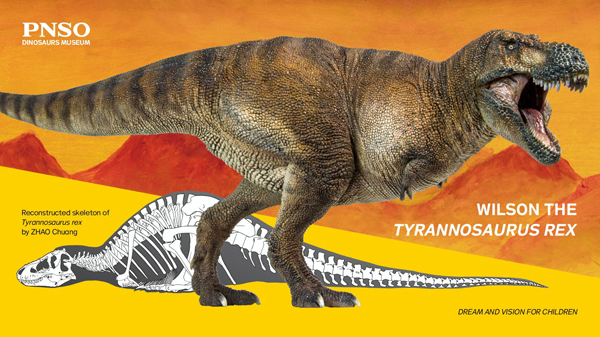
Andrea the female T. rex has been designed to accompany the recently introduced new version of Wilson the T. rex. This implies that the two 1:35 scale replica rexes represent a pair, the larger, more robust female resting whilst the male (Wilson) stands nearby. In one of the promotional shots to illustrate Wilson, an illustration of a skeletal reconstruction of a resting Tyrannosaurus rex was included, a hint from the manufacturer about a future model release (Andrea).
The new PNSO “Wilson” Tyrannosaurus rex dinosaur model. The skeletal reconstruction was a hint about the forthcoming addition of a T. rex figure in a resting pose.
The PNSO 1:35 scale T. rex dinosaur model in a resting pose.
Model Measurements
The resting Tyrannosaurus rex model measures 19.7 cm long, accounting for the curve of the tail. The model is 13.8 cm wide. Wilson the standing T. rex figure measures just over 34 cm in length and stands a fraction under 12 cm tall. Both figures have a declared scale of 1:35 and each model has an articulated lower jaw.
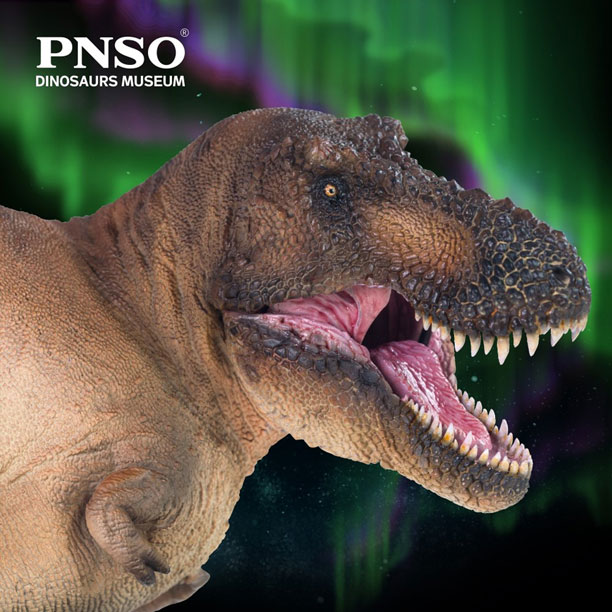
PNSO Andrea the female T. rex dinosaur model has an articulated lower jaw.
An Eagerly Awaited Dinosaur Model
A spokesperson from Everything Dinosaur commented that dinosaur model fans and collectors had been requesting a theropod dinosaur in a resting pose. The spokesperson also confirmed that they receive lots of emails asking questions about sexual dimorphism in the Dinosauria. Collectors have the chance to display a male and female T. rex together with the female representing a robust form.
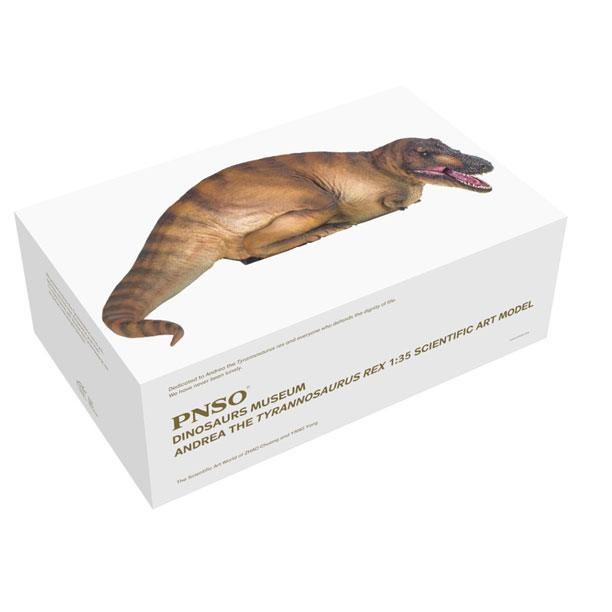
PNSO Andrea the female Tyrannosaurus rex (1:35 scale model in the scientific art series), product packaging.
Teasing Collectors
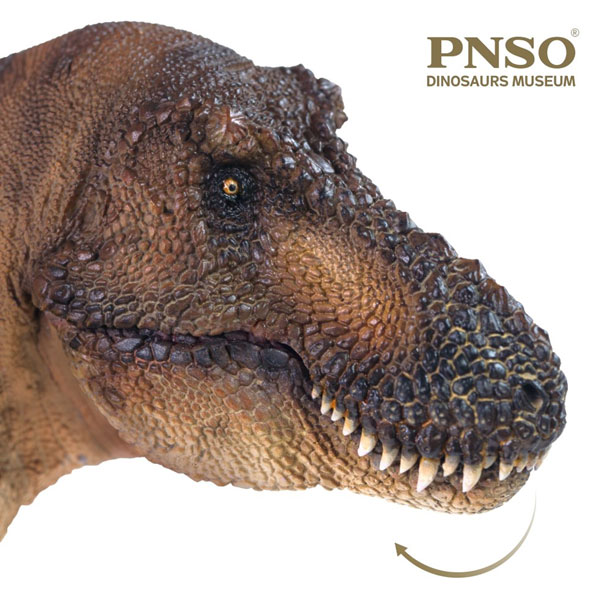
The first image of Andrea the female T. rex to be released by PNSO revealed just the head of the dinosaur model. Collectors remained unaware of the innovative pose that the design team had chosen for their female T. rex.
A close view of the head of the PNSO female T. rex. This image was the first one to be released, model collectors were unaware that the model showed T. rex in a resting position.
Whilst there has been some debate about the positioning of the rear legs of the figure, the introduction of a theropod dinosaur model in a recumbent position has attracted lots of positive comments from fans of dinosaur models who are looking forward to adding this attractive replica to their collections.
Andrea the resting T. rex will be in stock at Everything Dinosaur later in the summer.
To view the extensive range of PNSO dinosaur models available from Everything Dinosaur: PNSO Age of Dinosaur Models.