All about dinosaurs, fossils and prehistoric animals by Everything Dinosaur team members.

Everything Dinosaur team members working in schools, helping museums and other educational bodies. Our work with and in schools.

1 01, 2017

A Happy New Year

By |2023-05-13T14:21:46+01:00January 1st, 2017|Categories: General Teaching|Comments Off on A Happy New Year

Happy New Year to All Educationalists

Wishing all teachers, teaching assistants, higher learning assistants, school staff, home schoolers and educationalists a happy 2017.  Let’s get ready for the next term and make it a wonderful teaching term, engaging and enthusing children and helping to make them life-long learners.

Happy New Year!

Visit the amazing Everything Dinosaur website: Everything Dinosaur.

A Happy New Year from Every One at Everything Dinosaur

Everything Dinosaur celebrating the start of 2017.

Happy New Year 2017. Picture credit: Everything Dinosaur.

Picture credit: Everything Dinosaur

Can you spot the flying reptile?  Can you find the Everything Dinosaur logo?

After the holidays, it is time to get down to completing the planning for the next scheme of work, finishing off learning objectives and preparing to engage with young minds keen to absorb new ideas and to have new experiences.  Happy New Year!

For prehistoric animal models and figures of extinct animals: Prehistoric Animal Models and Figures.

9 12, 2016

Year 2/3 Children Design Dinosaurs

By |2023-05-12T17:19:36+01:00December 9th, 2016|Categories: Educational Activities, Main Page, Teaching|0 Comments

Dinosaur Designs

As 2016 draws to a close, team members at Everything Dinosaur can reflect on all the teaching work that they have carried out over the last twelve months.  Our work in schools may be just about finished for the year, but we are still responding to emails and phone calls from teachers advising them on next term’s dinosaur topic.

Schoolchildren Design Dinosaurs

The teaching itinerary may be completely full for the Spring Term, next week will see us sending out emails to schools to finalise the arrangements for January’s teaching dates, but we are still supporting those schools and classes that we visited in November, helping the teaching team to maximise the benefits from one of our dinosaur workshops in school.

Visit Everything Dinosaur: Everything Dinosaur.

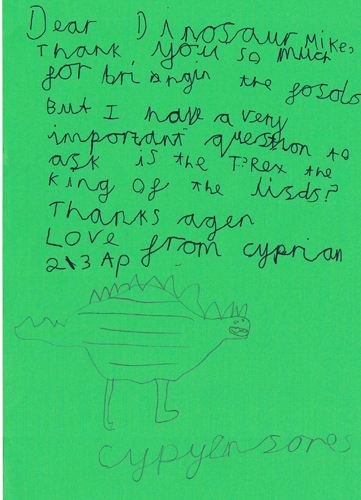
A Thank You Letter from Cyprian

Year 2/3 children design dinosaurs.

A “Cypyensores” created by Cyprian (Year 2/3).

Picture credit: Everything Dinosaur

Thank You Letters

Take for example, one of our recent visits to work with a mixed class of Year 2/3 children.  During our dinosaur and fossil themed workshop, we set the class a number of our “pinkie palaeontologist” challenges.  We asked the children to send us a thank you letter.  This provides the teacher with a great opportunity to introduce a dinosaur-themed writing exercise.

The picture above shows one such thank you letter, sent into Everything Dinosaur from Cyprian.  If the children had questions that we had not been able to answer during our morning of dinosaur and prehistoric animal themed teaching activities, we suggested that they might want to include the question within their letter.

This gives the teaching team the opportunity to check appropriate use of grammar and punctuation.  It also provides a wonderful opportunity for the children to practice their cursive hand-writing, a key requirement of the English element of the national curriculum for this age group.

A Dinosaur Design by Lois

Lois (Year 2/3) designs a plant-eating dinosaur.

Lois and her green, plant-eating dinosaur.

Picture credit: Everything Dinosaur

Designing Dinosaurs

During the workshop with this mixed class of Year 2/3 children, we asked the class to have a go at designing their very own dinosaur.  This permitted us to help reinforce the teacher’s scheme of work which included reference to simple food chains, habitats and the idea of extinction events.  Cyprian designed a “Cypyensores”, whilst Lois, one of his classmates, opted to produce a green, plant-eating dinosaur, with lots of lovely labels to help describe this dinosaur and to indicate what it might have needed to survive if this dinosaur had lived millions of years ago.

The class teacher commented:

“Thank you so much for coming to visit us on Friday, I really hope you enjoyed your time at our school.  All of the children really enjoyed meeting you and learning some amazing information about the dinosaurs.  It was a great discussion point for my class, which carried on until home time!”

To enquire about Everything Dinosaur’s outreach work: Email Everything Dinosaur.

2 12, 2016

Thank You Letters from Year 2/3 Children

By |2023-05-11T16:29:43+01:00December 2nd, 2016|Categories: Key Stage 1/2|Comments Off on Thank You Letters from Year 2/3 Children

Pebble Brook Primary Pupils Say Thank You to Everything Dinosaur

Pupils at Pebble Brook Primary in Year 2/3 have been learning all about dinosaurs and life in the past under the tutelage of their enthusiastic teaching team.  As part of a varied and challenging cross-curricular scheme of work, a dinosaur expert from Everything Dinosaur was invited into the school to deliver three dinosaur and fossil themed workshops, one for each class.

Over the course of the day, the visitor set the children a number of challenges aimed at supporting the teaching team’s lesson plans.  For example, after the fossil workshop with class 2/3AP, the pupils were challenged to write thank you letters and send them to Everything Dinosaur’s offices.

Children Send in Thank You Letters to Everything Dinosaur

Year 2/3 children design dinosaurs.

A “Cypyensores” created by Cyprian (Year 2/3).  Picture credit: Everything Dinosaur.

Picture credit: Year 2/3AP and Everything Dinosaur

Fossil Workshop

After our dinosaur and fossil workshops, thank you letters were sent into Everything Dinosaur by the Year 2 and Year 3 children.

The class teacher emailed Everything Dinosaur to say:

“Thank you so much for coming to visit us on Friday, I really hope you enjoyed your time at our school.   All of the children really enjoyed meeting you and learning some amazing information about the dinosaurs.  It was a great discussion point for my class, which carried on until home time!”

For dinosaur soft toys and prehistoric plush to help inspire your young palaeontologist: Prehistoric Plush/Dinosaur Soft Toys.

Everything Dinosaur

A spokesperson from Everything Dinosaur commented:

“We really enjoyed our time at the school.  It was wonderful to meet so many budding palaeontologists.  Our thanks for all the letters we received.  We wish the teaching team and the children every success with the rest of the term topic.”

Visit the Everything Dinosaur website: Everything Dinosaur.

1 12, 2016

Year 2/3 Send in Thank You Letters

By |2023-05-11T15:54:36+01:00December 1st, 2016|Categories: Educational Activities, Main Page, Teaching|0 Comments

Year 2/3AP Say Thank You

Back on the 18th November, one of our team members visited Pebble Brook Primary in Cheshire to undertake a series of dinosaur and fossil themed workshops with three classes.  We challenged Miss Pestell’s class to write to our offices and send us thank you letters.  Could the inspired pupils compose thank you letters after the dinosaur workshop?

We wanted to see lots of careful hand-writing with sentences starting with capital letters and proper use of punctuation.  Sure enough, yesterday afternoon the postman arrived and handed over a big red envelope which when opened, was found to contain lots of lovely letters from the children.

Thank You Letters after a Dinosaur Workshop

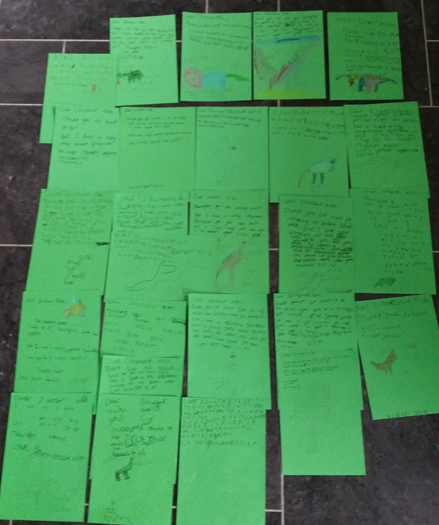
What a Lovely Set of Thank You Letters from 2/3AP

Thank you letters sent to Everything Dinosaur

Year 2/3AP sent in thank you letters to Everything Dinosaur after our fossil workshop.  Picture credit: Everything Dinosaur.

Picture credit: Everything Dinosaur

To contact Everything Dinosaur team members: Email Team Members at Everything Dinosaur.

Drawings of Dinosaurs

During our dinosaur workshop, we asked the eager, young palaeontologists to imagine designing their very own dinosaur.  The children chose to illustrate their letters to us with some of their dinosaur creations.  Our dinosaur expert wanted to see lots of labelling on the diagrams and the children certainly obliged, well done Year 2/3AP.  Young Alfie even put a drawing of “Dinosaur Mike” next to his dinosaur so that he could show the scale, that’s a really good idea.

Alfie’s Letter Included a Prehistoric Animal Drawing That Used “Dinosaur Mike” for Scale

Alfie says thank you after the dinosaur workshop.

Alfie’s thank you letter.  Picture credit: Everything Dinosaur.

Picture credit: Everything Dinosaur

A number of the children, including Ashlea, Luke and Adam wanted to know how we find all the fossils?  Well, it takes patience and you have to visit places such as beaches where fossils are being washed out of the cliffs, then you simply explore the beach area picking up and examining any strange shaped objects you might find amongst the stones and gravel.

Questions About Tyrannosaurus rex

Sometimes, we have to dig out dinosaur bones using excavators and shovels, but when we get close to the bone we take great care and use much smaller tools such as fine chisels and brushes to carefully free the fossil from the surrounding rock.   If the children of class 2/3AP found a complete fossil of a Tyrannosaurus rex buried in their playground and they all worked eight hours a day, seven days a week it could take more than three years to excavate the fossilised bones, clean them all and prepare them for display in a museum!

Mia asked how much does a T. rex weigh?  Another good question, we estimate that a fully-grown T. rex would weigh around seven tonnes, that’s heavier than more than 250 Year 2 pupils!  Some children asked how big was a T. rex skull?  Recently, palaeontologists discovered a Tyrannosaurus rex skull in America, when it has been dug out and put together it is likely to measure more than 1.2 metres long.

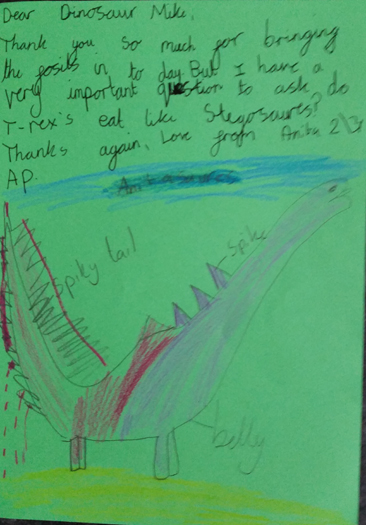
A Super Thank You Letter Sent in by Anita

Young dinosaur fan send in a letter.

A thank you letter to Everything Dinosaur from Anita.  Picture credit: Everything Dinosaur.

Picture credit: Everything Dinosaur

Several of the children impressed with their joined-up hand-writing and we really like the spiky dinosaur that Anita drew for us.  To answer your question Anita, T. rex was a meat-eater, whilst Stegosaurus was a plant-eater, can the children in Year 2/3AP remember the word used by scientists to describe a meat-eater C_R_IV_RE?  Can they remember the word used to describe plant-eaters H_RB_V__E?

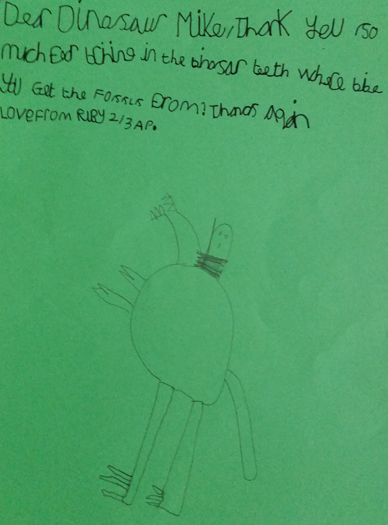
A Thank You Letter from Ruby

A thank you letter from Ruby.

Ruby’s thank you letter.  Picture credit: Everything Dinosaur.

Picture credit: Everything Dinosaur

Lots and Lots of Questions

Andrea asked what age our dinosaur expert was when he found his first fossils?  He was eight-years-old, when he found his first fossils on a trip to the seaside.  Lucie and Patricia asked how many fossils have we got?  To be honest Patricia and Lucie, we have never stopped to count them all, we must have a few thousand in total.

Our thanks to Andrei, Ryan, Cyprian and Lois and to the whole of class 2/3AP for their super dinosaur designs.  We enjoyed looking at all the prehistoric animal drawings and we loved reading all the wonderful letters.  A big T. rex roar with delight to all the children in Year 2/3AP and a special thank you from us to Miss Pestell for being such an inspiring teacher.

Visit Everything Dinosaur’s website: Everything Dinosaur.

29 11, 2016

Carrfield Primary Academy and Dinosaurs

By |2023-05-09T14:23:33+01:00November 29th, 2016|Categories: Educational Activities, Main Page, Teaching|0 Comments

Key Stage 1 Study Dinosaurs, Volcanoes and Fossils

Children in the three Key Stage 1 classes at Carrfield Primary Academy (south Yorkshire), have spent the second half of the autumn term learning all about dinosaurs, prehistoric animals, volcanoes and fossils.  Working with the Cornerstones curriculum, the dedicated teaching team have been exploring all things prehistoric under the “Dinosaur Planet” scheme of work.  The well-appointed and tidy classrooms have lots of amazing dinosaur themed examples of the children’s work on display.  In class 1HJ, the budding young palaeontologists have been learning about bones and parts of the body by creating their very own dinosaur skeletons.

Studying Prehistoric Animals

Dinosaur Skeletons on Display

Year 1 make dinosaur skeletons from drinking straws.

Carefully crafted dinosaur skeletons on display in a Year 1 classroom.

Picture credit: Carrfield Primary Academy/Everything Dinosaur

Dinosaur Fact Flaps

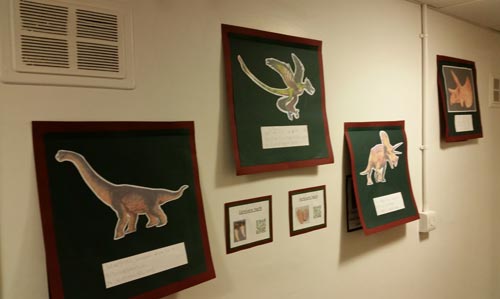
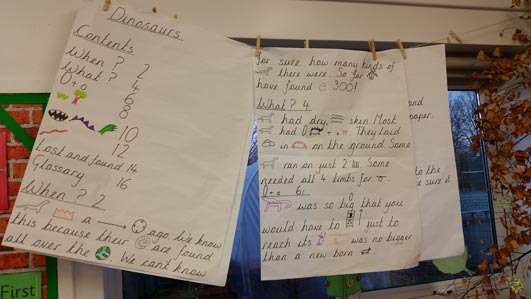
Outside of the Year 1 classroom, the teaching team have posted up “dinosaur fact flaps” featuring a massive Brachiosaurus, the plant-eating horned dinosaur Triceratops and the tiny, feathered meat-eater Microraptor.  Some excellent examples of non-fiction writing accompany the informative dinosaur posters.

Class 1HJ Posted Up Lots of Dinosaur Information

Class 1HJ and their dinosaur posters.

Dinosaur facts and figures posted up by the Year 1 class at Carrfield Primary Academy.

Picture credit: Carrfield Primary Academy/Everything Dinosaur

Dinosaur Explorers in Class 1/2LD

Under the inspiration tutelage of the teaching team, the children in the mixed Year 1/2 class have been creating dinosaur themed story maps all about their favourite prehistoric animals.  We hope the tongue-twister we provided on the famous fossil hunter Mary Anning inspires the children to write their own prehistoric animal themed poetry.

Lots of Schematic Story Maps on Display in the 1/2LD Classroom

Dinosaur themed schematic story maps on display.

Schematic story maps are a great way to check understanding and learning.

Picture credit: Carrfield Primary Academy/Everything Dinosaur

Demonstrating Evidence of Learning

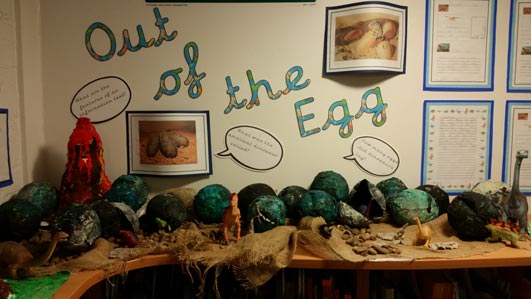
Being able to demonstrate evidence of learning as the children progress through a term topic is extremely important.   These schematic story maps are a great way to check understanding and to test the children’s ability to recall information.  Outside in the corridor, the pupils in 1/2LD have been looking at baby dinosaurs and studying dinosaur eggs.  Paper mâché models of the eggs of dinosaurs had been created and if you look inside, you can see the baby dinosaurs waiting to hatch.

Key Stage 1 Children Look at Dinosaur Eggs

Dinosaur egg arts and crafts by KS1.

“Out of the Egg” display by Year 1/2 children.

Picture credit: Carrfield Primary Academy/Everything Dinosaur

The paper mâché models certainly made an “egg-citing” display.  The children had also constructed volcanoes out of plastic bottles and paper mâché.  Mums, dads, grandparents and guardians had been invited into the school to help the volcanoes erupt!

For dinosaur and prehistoric animal themed gifts and toys: Dinosaur Gifts and Toys.

Year 2 Combine Learning About Three-Dimensional Shapes with Dinosaur Studies

The teacher in Year 2 with the help of the enthusiastic teaching assistants had been explaining about three-dimensional shapes.  The challenge set was could the class create a Tyrannosaurus rex out of cylinders, cubes and cones?

A 3-D Tyrannosaurus rex on Display Outside of 2CN Classroom

A 3-D model of a dinosaur in school.

A three-dimensional dinosaur helps children to learn about spheres, cylinders, cubes and cones.

Picture credit: Carrfield Primary Academy/Everything Dinosaur

The children made some three-dimensional dinosaur teeth out of clay, they could compare their clay teeth to the dinosaur teeth we showed the children in the workshop.  What sort of three-dimensional shapes are the teeth of dinosaurs?

We provided lots of extension ideas and suggestions plus some extra resources to help the teachers with their lesson plans as they bring this exciting dinosaur themed topic, a topic that has been thoroughly enjoyed by the teaching team as well as the children, to a conclusion.

Visit Everything Dinosaur’s website: Visit Everything Dinosaur.

19 11, 2016

Exploring Life in the Past with Year 2/3

By |2023-05-09T12:25:46+01:00November 19th, 2016|Categories: Educational Activities, Main Page, Teaching|0 Comments

Dinosaurs and Fossils with Year 2/3

For the children in the three classes of Year 2/3 at Pebble Brook Primary School, the autumn term has been dedicated to learning all about prehistoric life.  Over the last eight weeks or so, the dedicated teaching team have introduced a wide range of cross-curricular activities all linked to learning about dinosaurs, prehistoric animals and the Stone Age.

Prehistoric Life

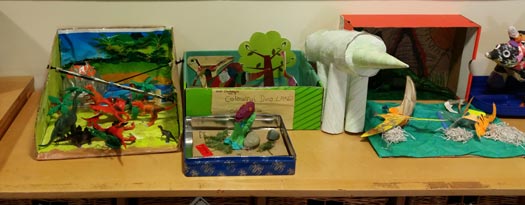
As part of the challenging scheme of work that had been devised, the children were asked to make a dinosaur themed model over the half-term break.  A member of the Everything Dinosaur team visiting the school had the opportunity to view some of the amazing dinosaurs and prehistoric scenes the children had created.

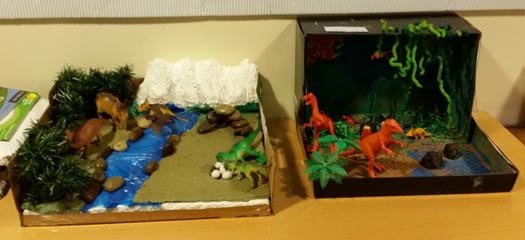
On Display Outside the Year 2/3 Classrooms – Prehistoric Scenes

Dinosaurs on display.

Dinosaur and prehistoric scenes outside the classrooms.

Picture credit: Pebble Brook Primary School/Everything Dinosaur

The collection of prehistoric landscapes and dinosaur dioramas made a very attractive exhibit and several of the children’s models were used in a special assembly following our dinosaur and fossil workshop.  The Year 2/3 children presented some of the fascinating facts that they had learned about dinosaurs to other classes as well as the mums and dads.

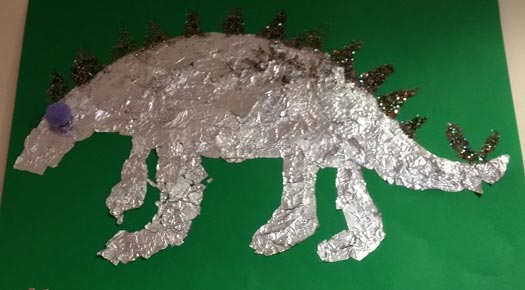
A Very Sparkly Dinosaur Created as a Half-term Project

A very sparkly armoured dinosaur.

A very sparkly armoured dinosaur spotted in Year 2/3 AP classroom.

Picture credit: Pebble Brook Primary School/Everything Dinosaur

Fiction and Non-fiction Writing Exercises

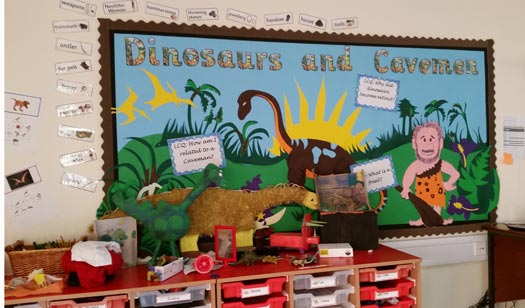
The well-appointed classrooms highlighted lots of fiction and non-fiction writing exercises and each of the three classrooms had a special “wow wall” with a wonderful dinosaur and Stone Age people illustration surrounded by lots of topic themed words to help the budding young palaeontologists expand their vocabularies.

Prehistoric theme for a special topic about life in the past.

A colourful dinosaur and cavemen display board.

Picture credit: Pebble Brook Primary School/Everything Dinosaur

For creative, dinosaur themed toys and gifts: Prehistoric Animal Themed Toys and Gifts.

Carnivores, Omnivores and Herbivores

The children were keen to demonstrate their knowledge and they enthusiastically explained the foods that carnivores, omnivores and herbivores ate, all linking nicely into that part of the Year 2 science programme in the English national curriculum that relates to living things and their habitats.  In addition, the Year 3 children enjoyed learning about the properties of fossils, which dove-tails into the lower Key Stage 2 science programme that covers soils, rocks and fossils.

Exploring Life in the Past

Dinosaurs and cavemen.

A dinosaur and cavemen themed display board.

Picture credit: Pebble Brook Primary School/Everything Dinosaur

Measuring Dinosaurs and Other Prehistoric Life

All three classes would be getting to grips with the use of rulers for measuring in the very near future, the extension activity we provided which involves measuring and comparing the footprints of different dinosaurs should work well with the teaching team’s lesson plans.  The dinosaur coprolite certainly proved to be very popular and it helped reinforce the children’s learning after they had examined some “dinosaur poo” in a previous classroom activity.

Mini “Jurassic Worlds” on Display

Colourful dinosaur scenes.

Several prehistoric scenes on display outside the classroom.

Picture credit: Pebble Brook Primary School/Everything Dinosaur

Everything Dinosaur and a Dinosaur Workshop

All too soon, it was time to leave the enthusiastic pupils and their dedicated teachers.  However, we did set the children a special challenge.  As they had lots of questions and since we were unable to address them all during the day, it was suggested that the children could write into our office or email us and we would do our best to provide them with answers.  This provided yet another non-fiction writing activity for the children to undertake, as well as giving the teachers the opportunity to explore the differences between writing a letter and sending an email with their pupils.

Take a tour of the Everything Dinosaur website: Tour Our Website (Everything Dinosaur).

16 11, 2016

How Do We Know Dinosaurs Roamed the Earth?

By |2023-05-09T11:56:35+01:00November 16th, 2016|Categories: Key Stage 1/2|Comments Off on How Do We Know Dinosaurs Roamed the Earth?

Brook Class Learn All About Brachiosaurus

Children in Brook Class (Year 2), at St Margaret’s C of E Primary have been getting to grips with the question how do we know dinosaurs roamed the Earth?  So far this term the eager young palaeontologists have been looking at different types of dinosaurs, when they lived and what they ate.

With the help of Mrs Turner (class teacher) and Miss McGinn (class teaching assistant), the pupils have been carrying out their own research into different dinosaurs and working out whether they were carnivores, herbivores or even omnivores.

Learning About Dinosaur Diets

There were lots of examples of the children’s work pinned up around the spacious classroom, there was even a poster all about the long-necked dinosaur Brachiosaurus (Brak-kee-oh-sore-us), on one of the walls.  The Year 2 class had been learning Brachiosaurus facts and during our visit to explore dinosaurs and fossils, our dinosaur expert explained that Brachiosaurus was so gigantic that a child could have had a bath in one of its massive footprints!

Brook Class Study Brachiosaurus

Papo dinosaur word mat - Brachiosaurus.

A Papo Brachiosaurus dinosaur word mat.  Children study Brachiosaurus.  Picture credit: Everything Dinosaur.

Picture credit: Everything Dinosaur

The picture (above) features a Papo Brachiosaurus.

To see the Papo range of prehistoric animal figures: Papo Dinosaur Figures and Models.

Brook Class and Brachiosaurus

Brachiosaurus was one of the largest dinosaurs of the Late Jurassic.  Its front legs were longer than its hind legs, this gave it a sloping back, but it probably would not have been a very good idea to try to slide down its back, as although this dinosaur was a herbivore, it was very tall, its head would have been as high as a four storey house.  Brachiosaurus was so tall that it could feed on the tops of trees and get food that other plant-eating dinosaurs could not reach.

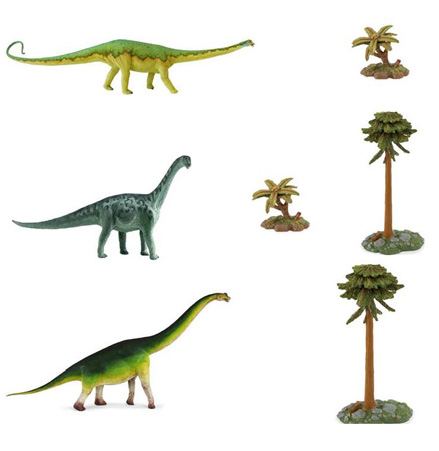
Brachiosaurus Compared to Diplodocus

Many different types of sauropod.

Long necks for different feeding envelopes.  Picture credit: Everything Dinosaur.

Picture credit: Everything Dinosaur

The long arms and long neck of Brachiosaurus allowed it to reach high up into trees to feed on the parts that other dinosaurs such as Diplodocus could not reach.

During our workshop, we challenged Brook class to have a go at designing their very own dinosaur, how many of the dinosaur designs will have long necks?

Visit Everything Dinosaur’s website: Everything Dinosaur.

14 11, 2016

Free Dinosaur Themed Anti-Bullying Posters

By |2023-05-09T09:24:13+01:00November 14th, 2016|Categories: General Teaching|Comments Off on Free Dinosaur Themed Anti-Bullying Posters

Dinosaurs “Power for Good” Anti-Bullying Week

This week sees the start of Anti-Bullying Week in the United Kingdom.  This annual event, aimed at raising awareness about bullying is organised by the Anti-Bullying Alliance and to coincide with the start of a week-long of activities.

Everything Dinosaur is making parents and teachers aware that the company has produced a series of free, dinosaur themed anti-bullying posters.  Bullying in schools is being tackled in proactive ways by many schools, but sadly incidents of bullying do still occur.  Cyber or on-line bullying is also becoming a serious problem, with a report from the NSPCC’s Childline service stating that it counselled more than 4,500 children in the last twelve months, an increase of 88% compared to 2011-2012.

Everything Dinosaur’s Free to Download Anti-Bullying Posters

Anti-bullying poster provided by Everything Dinosaur.

Stop the Bullies!  Make your school a bully free school.

Picture credit: Everything Dinosaur

Dinosaur Themed Anti-Bullying Posters

Aided by the Anti-Bullying Alliance, a number of country-wide events and activities are planned.   These will help to raise awareness over the issue of bullying and the consequences of having been bullied and Everything Dinosaur team members have been doing their bit to help primary school teachers and educationalists to get the anti-bullying message across.

Everything Dinosaur provides teachers, teaching assistants and other educationalists, such as those who home educate, with lots of free teaching resources.  Amongst this extensive set of resources, several anti-bullying posters have been prepared, we encourage all interested parties to download these resources.

To email Everything Dinosaur team members: Contact Everything Dinosaur Team Members.

Everything Dinosaur Supporting Teachers and Schools

A spokesperson from Everything Dinosaur commented:

“Bullying blights lives and we support the great work done by many organisations to raise awareness about the problem.  It is essential that we get the message across to school children that bullying is simply not going to be tolerated.  We have seen some tremendous initiatives launched by schools with regards to anti-bullying strategies and we hope our free dinosaur themed anti-bullying posters will help to get this important message across.”

Visit Everything Dinosaur’s child-friendly and award-winning website: Take a look at Everything Dinosaur.

3 11, 2016

Amazing Dinosaurs at Anfield Road Primary School

By |2024-05-06T15:33:07+01:00November 3rd, 2016|Categories: Main Page, Teaching|0 Comments

Year 2 Tackle Dinosaurs

It was a busy day for High Flyers, Bright Sparks and Whizz Kids, the three classes in Year 2 at Anfield Road Primary yesterday.  The children had just started their term topic “Can you Walk with Dinosaurs?” as well as having just moved into their brand-new classrooms.

Can You Walk with Dinosaurs?

The enthusiastic teaching team had prepared for the dinosaur and fossil themed workshop delivered by Everything Dinosaur, by helping the children to explore what they already knew about dinosaurs and other prehistoric animals, part of a teaching method, we refer to as KWL – what children know?  What they would like to know and what have they learned at the end of the topic?  This is a great way to start a term topic and the outcomes from this class exercise can provide an invaluable guide to planning the scheme of work.

For resources for a dinosaur themed teaching topic: Everything Dinosaur.

Studying Triceratops

The children in High Flyers class had used cut-outs of Triceratops (during our workshop we explored the chin of a Triceratops), to write down what they know about dinosaurs.  Lots of amazing pre-knowledge being demonstrated and plenty of room on the spacious display wall for lots of other dinosaur related facts.

What Do We Know About Dinosaurs? (High Flyers)

What do we know about dinosaurs?

Children explore what they know about dinosaurs.

Picture credit: Anfield Road Primary/Everything Dinosaur

A Dinosaur World Ready for Creative, Imaginative Play (Bright Sparks)

A dinosaur display in the classroom.

A prehistoric park ready for creative, imaginative play in the classroom.

Picture credit: Anfield Road Primary/Everything Dinosaur

For inexpensive dinosaur models and figures: Mojo Fun Dinosaur Models.

The teacher in the Bright Sparks classroom had helped the children create a miniature dinosaur world.   This is a great way of helping the children to work out what resources animals need to survive and no doubt this mini “Jurassic Park” will inspire the children when it comes to fiction and non-fiction writing.

Over the course of the day, our dinosaur expert met a number of children who had names quite similar to the names of some dinosaurs.  We challenged the children to design their own dinosaur, labelling the body parts (especially the skull).  Could they come up with a name for their new dinosaur?

Morgan and Morganucodon

During one of our dinosaur workshops we met a little boy called Morgan.  He explained that a big asteroid hit the Earth and that helped wipe out the dinosaurs.  Morgan and all his friends showed great listening skills and they joined in all the exercises with tremendous enthusiasm.  Coincidentally, the Everything Dinosaur team member who led the workshops at the school is currently proof reading a new book all about prehistoric mammals, some of which would have scurried around the feet of dinosaurs.

One of the earliest mammals was a little mouse-sized creature called Morganucodon (pronounced Mor-gan-yew-coe-don), so, especially for Morgan, we have included a picture of this Triassic mammal in our article.

A Picture of Morganucodon For Morgan and His Friends

The Triassic mammal Morganucodon.

An illustration of the Triassic mammal Morganucodon.

For its size, this little mammal had a big brain.  In the dinosaur themed workshop, we challenged the children to test their brains against the brain of the biggest, heaviest armoured dinosaur known to science, just one of the many activities and topic areas covered as we compared people to dinosaurs.

Ready to Display All the Dinosaur Themed Work (Whizz Kids)

Ready to explore a dinosaur themed term topic.

A wall in the classroom ready to display dinosaur themed work.

Picture credit: Anfield Road Primary/Everything Dinosaur

Dinosaurs in the New Classrooms

We had the opportunity to take a quick look around the new classrooms.  The children had just moved into them earlier in the week.  The light, airy and superbly appointed classrooms looked fantastic.  The teaching team and the rest of the dedicated staff at Anfield Road Primary are quite rightly very proud of these new teaching facilities, we look forward to seeing lots of lovely dinosaur themed numeracy and literacy displays posted on the walls of the spacious classrooms.

1 11, 2016

Exclusive Fossil Hunting at Biddulph Grange

By |2024-05-06T15:15:14+01:00November 1st, 2016|Categories: Dinosaur Fans, Educational Activities, Geology, Main Page, Teaching|0 Comments

Already for the Fossil Hunting at Biddulph Grange

Last Sunday, Everything Dinosaur team members visited Biddulph Grange Garden in Staffordshire as part of the dinosaur themed activities that had been organised at the National Trust property.  Our staff arrived nice and early and set up a fossil hunting activity for the budding young palaeontologists in the specially erected marquee that had been provided.

Fossil Hunting with Everything Dinosaur

All Ready for the Fossil Hunting Activity at Biddulph Grange Garden
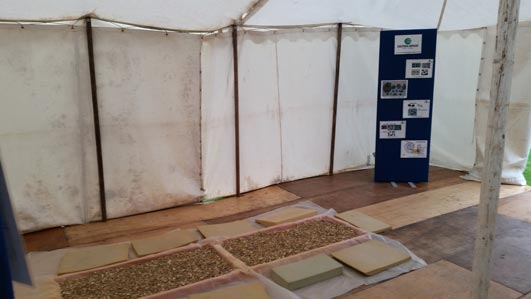
Everything Dinosaur fossil hunting activity.

Fossil trays laid out at Biddulph Grange Gardens.

Picture credit: Everything Dinosaur

The picture above shows the marquee starting to get prepared for all the visitors we were expecting that day.  The event, part of The National Trust’s promotional campaign to raise awareness about the restoration of the unique Geology Gallery at Biddulph Grange, had been sold out for some weeks.

However, on the day itself our dedicated team met up with a number of other visitors to the beautiful gardens and we even gave away some fossils to visitors who had been unaware of the event and “popped into the tent to have a look around”.

To take a look around Everything Dinosaur’s award-winning website: Everything Dinosaur.

Preparing the Tables to Help Identify the Fossils
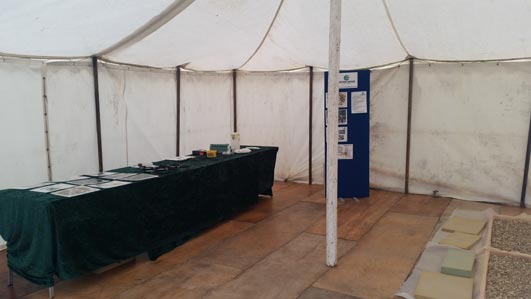
Everything Dinosaur at Biddulph Grange Gardens 2016.

Fossil trays laid out at Biddulph Grange Gardens.

Picture credit: Everything Dinosaur

Giving Away Fossils

We put lots of gravel into the trays on the floor and then carefully added a variety of fossils so that visitors could have a go at spotting fossils amongst the stones.  There were shark teeth, bivalves, brachiopods, fossilised wood, trilobites, ammonites, belemnite guards and even pieces of fossilised bone.

We certainly had a busy day, our early arrival allowed us to get organised and lay out all the helpful fossil identification charts that we had prepared.  We had to keep up topping up the fossil hunting trays, the visitors were finding so many specimens.

The Geology Gallery

The early arrival also allowed Everything Dinosaur team members to visit the partially restored Geology Gallery.  When completed (late spring 2017), the gallery will house many fossils and casts that help explain about prehistoric animals and life in the past.  Mr James Bateman, the former owner of Biddulph Grange and Gardens, built a wonderful gallery dedicated to uniting the ideas of a biblical creation with the newly emerging sciences of geology and palaeontology, scientific ideas that were beginning to take root in the 1860s.

Day V (Five) in the Geology Gallery
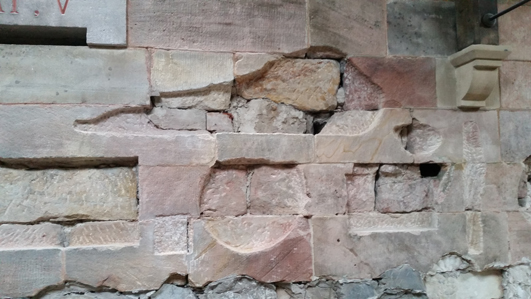
Biddulph Grange Geology Gallery.

Part of the Geology Gallery at Biddulph Grange Gardens, ready for restoration.

Picture credit: Everything Dinosaur

The picture above shows the spaces in the walls where the original fossils were housed.  The large, almost triangular space at the top of the photograph was the location of a partial ichthyosaur skull (Temnodonotosaurus platydon).  Sadly, very little documentation regarding the gallery and its contents have been preserved.  One of the fascinating problems associated with this particular restoration project is trying to work out what fossils went into the various spaces.

For replicas of iconic animals from the fossil record: Learning – Dinosaur Crafts and Replica Fossils.

Only one of the original fossils remains, a section of Lepidodendron bark with its characteristic diamond shaped leaf scars.

The Lepidodendron Bark Fossil in the Geology Gallery
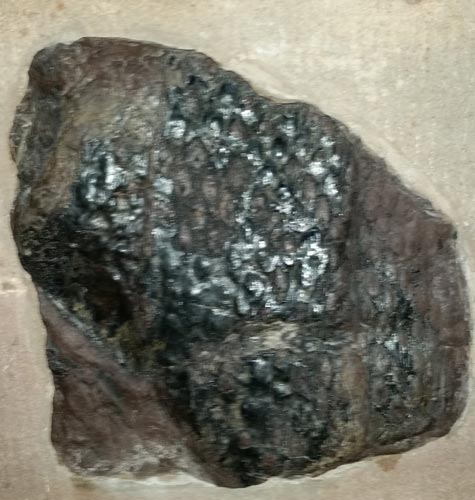
A piece of fossilised bark (Lepidodendron).

The Lepidodendron fossil (ancient bark).

Picture credit: Everything Dinosaur

Lepidodendron Fossil Hunting

Although the term Lepidodendron is used to refer to a genus of tree-sized lycopsid, strictly, only the scale bark on the uppermost part of the plant is named Lepidodendron.  Plants are rarely preserved as whole fossils but normally occur as isolated fragments, often representing different parts of the organism, the leaves, roots, trunk, stems, fruiting bodies, flowers and such like.  As these different parts are found separately, each plant tends to get a separate scientific name.  Hence, the roots of this lycophyte are referred to as Stigmaria and the base of the trunk is called Knorria.

Lepidodendron is derived from the Greek, it means “scale tree”, a very apt description for the diamond-shaped leaf scales which can be clearly seen in the Biddulph Grange fossil.


Go to Top