All about dinosaurs, fossils and prehistoric animals by Everything Dinosaur team members.

Everything Dinosaur team members working in schools, helping museums and other educational bodies. Our work with and in schools.

20 04, 2017

Year 4 Study the Stone Age

By |2023-06-17T10:30:58+01:00April 20th, 2017|Categories: General Teaching, Key Stage 1/2|Comments Off on Year 4 Study the Stone Age

Year 4 and Stone Age Art

Year 4 children at Great Wood Primary have been studying the topic “Stone Age to the Bronze Age”.  As part of a rich and varied scheme of work, the children have been looking at cave art and paintings such as those from the famous Lascaux caves situated in a hill overlooking the village of Montignac, in the Dordogne area of south-west France.  The children have produced some fabulous Stone Age art.

Cave Art Recreated by the Year 4 Classes

Stone Age art.

Stone Age art created by schoolchildren. Picture credit: Everything Dinosaur.

Picture credit: Everything Dinosaur

The picture above shows a prehistoric Woolly Rhino (Coelodonta antiquitatis) on the left of the photograph.  The children’s Woolly Rhinoceros drawing is reminiscent of the famous Coelodonta antiquitatis depiction to be found in the caves located at Chauvet-Pont-d’Arc in southern France.  Whilst the red coloured, horned animal is very similar to a drawing of a Steppe Bison (Bison priscus) from Altamira, Spain.

For models and replicas of prehistoric animals including a Woolly Rhino figure (whilst stocks last): Wild Safari Prehistoric World Models.

Year Two Handle Woolly Rhino Fossil Bones

Everything Dinosaur visited the school to conduct a dinosaur and fossil themed workshop with the children and ironically, in one of the many packing crates that they had brought with them, they had some Woolly Rhino fossil bones.  The children in Year 2 who had brothers and sisters in Year 4, were invited to handle the fossil bones of an animal that their siblings had so diligently drawn.

Stone Age Art

The teachers took plenty of photographs and these could then be shared with their colleagues teaching the lower Key Stage 2 classes.  In this way, Everything Dinosaur was able to help Year 2 learn about fossils as well as helping to reinforce learning for Year 4, adding another dimension to their project work.

Visit Everything Dinosaur’s award-winning website: Everything Dinosaur.

18 04, 2017

The Tactile Qualities of the Schleich Brachiosaurus

By |2023-06-16T07:36:48+01:00April 18th, 2017|Categories: Early Years Foundation Reception|Comments Off on The Tactile Qualities of the Schleich Brachiosaurus

In Praise of the Schleich Brachiosaurus Dinosaur Model

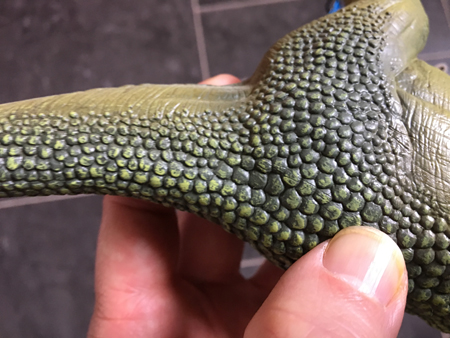
It’s big and chunky and great for creative, imaginative play.  Furthermore, the new for 2017 Schleich Brachiosaurus has some beautifully created, giant scales on its body, neck and limbs which make this dinosaur model ideal for exploring the texture of different materials with Foundation Stage children.

The Schleich Brachiosaurus Dinosaur Model

Schleich Brachiosaurus (2017).

The new for 2017 Schleich Brachiosaurus dinosaur model.  Picture credit: Everything Dinosaur.

Picture credit: Everything Dinosaur

Recognising the Differences and Similarities Between Materials

Dinosaur models and toys fascinate young boys and girls alike and team members at Everything Dinosaur use various dinosaur models and replicas in their outreach work with children, particularly those children in Foundation Stages one and two or lower Key Stage one.  The tactile quality of the Schleich Brachiosaurus is a particular favourite as the children feel the model’s rough scales and smooth skin.  We also use the model to help children learn and remember the names for different parts of the body.

Great to Touch – Exploring Properties of Materials

The Schleich Brachiosaurus dinosaur model.

The tactile quality of a Schleich Brachiosaurus dinosaur model. Picture credit: Everything Dinosaur.

Picture credit: Everything Dinosaur

The Schleich Brachiosaurus Dinosaur Model

The dinosaur model is accurate enough to keep budding palaeontologists happy in the classroom and some of the very youngest children who have participated in our dinosaur themed workshops, enjoy feeling the different textures on the dinosaur model.  The Schleich Brachiosaurus is very well crafted and the scales really stand out, this makes it a very effective item to use in sensory play.  The figure measures around thirty-five centimetres in length and it has a “chunky” feel to it but it can be handled easily by even young children with poor motor skills and hand to eye co-ordination.

A Close-Up View of the Finely Detailed Scales on the Schleich Brachiosaurus Dinosaur Model

The texture on the neck and shoulders of the Schleich Brachiosaurus dinosaur model.

The beautiful texture of the Schleich Brachiosaurus is ideal for creative play. Picture credit: Everything Dinosaur.

Picture credit: Everything Dinosaur

The contrasting surfaces of the hand-painted, plastic figure prove useful when exploring the properties of materials and the feel of different textures.  As it is a dinosaur, there is no problem maintaining focus and attention.

To view the Schleich Brachiosaurus and other Schleich prehistoric animal models available from Everything Dinosaur: Schleich Dinosaurs and Prehistoric Animal Figures.

The Classroom Dinosaur

As an extension exercise we encourage the teaching team to go on a food hunt for their plant-eating dinosaur.  Taking children out into the playground or into the school vegetable patch to pick daisies and grass so that the classroom dinosaur can have a good feed.  In addition, we have written simple lesson plan exercises, extensions of creative play in which the children think about which materials would make a good bed for a dinosaur to sleep on.  Once again, this is a great way to introduce basic adjectives such as “rough” or “smooth”, “hard” or “soft”.

At Home in the Classroom (Schleich Brachiosaurus)

Schleich Brachiosaurus model.

Schleich Brachiosaurus dinosaur model.

Picture credit: Everything Dinosaur

The Schleich Brachiosaurus dinosaur model with its superb textured skin makes it ideal for sensory play in the classroom or nursery.

Visit the Everything Dinosaur website: Everything Dinosaur.

10 04, 2017

Beautiful Stone Age Cave Paintings Created by Young Artists

By |2024-05-07T15:16:35+01:00April 10th, 2017|Categories: General Teaching, Key Stage 1/2|Comments Off on Beautiful Stone Age Cave Paintings Created by Young Artists

“Stone Age to Bronze Age”

Teaching about history to lower key stage two pupils can be quite a challenge for educationalists.  Sometimes it can be difficult to engage and enthuse children, especially with a fact heavy topic such as the “Stone Age to the Bronze Age” area of the national curriculum.  It can also be quite difficult to identify ways in which the subject can provide “touchstone” opportunities to interact with other aspects of the curriculum – to provide cross curricular extensions for the teaching team to implement.

Over the last few days we have seen some excellent examples of this subject area interacting with art and design elements.  Palaeolithic art, cave paintings (also known as parietal art), links in with this topic area providing a historical context for exploring ideas such as concept art, expressionism and how ancient tribes interacted with nature.  It can also give teachers the opportunity to introduce new painting techniques to the children.

Year 3 Children Create Parietal Art (Cave Paintings)

Cave art from schoolchildren.

A wonderful example of cave art from school children from Bowlee Community Primary. Picture credit: Everything Dinosaur.

Picture credit: Everything Dinosaur

Cave Art Teaching Resources

Here are some articles on parietal art, that can help teachers with this term topic.

Indonesian Cave Paintings Change Ideas About the Origin of Art – Exploring the origins of human culture.

Cave Women Played an Important Role in Cave Art – The role of women in early societies.

Famous Cave Paintings Threatened by Pollution – The effect of pollution on ancient cave paintings.

Visit Everything Dinosaur’s user-friendly website: Everything Dinosaur.

28 03, 2017

EYFS Become Palaeontologists for a Morning

By |2023-06-12T07:39:59+01:00March 28th, 2017|Categories: Educational Activities, Main Page, Teaching|0 Comments

Foundation Stage Children Study Dinosaurs

Another busy day for the team members at Everything Dinosaur.  Children in the Foundation Stage classes (Nursery and Reception), at Saint Thomas C of E Primary have been learning all about dinosaurs and fossils.  Everything Dinosaur was invited into the school to work with the two classes over the course of the morning.  This well-appointed school conducts lots of outreach activities with its pupils, the children certainly get the opportunity to experience a wide variety of curriculum related activities.  The hall had been set aside for our visit, after all, some fossils can be quite big, or even “massive” as pointed out by a child in Nursery when we looked at the best way to describe fossils.

Using a Big Space for all the Big Fossils we Brought

The hall is closed for dinosaurs and fossils.

Dinosaurs and fossils in the school hall. Picture credit: Everything Dinosaur.

Picture credit: Everything Dinosaur

Visit the user-friendly Everything Dinosaur website: Everything Dinosaur.

Dinosaurs and Fossils

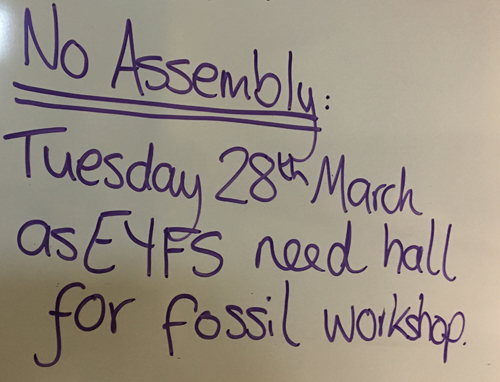
The morning assembly was cancelled, this allowed us to have more time working with the Foundation Stage children.  The Nursery class went first and they, very enthusiastically, mimicked the survival skills of armoured dinosaurs.  The children “froze like statues” when Tyrannosaurus rex came into their forest.  Prior to the workshop, we had checked with the teaching team so that we could deliver sessions that supported the scheme of work and learning objectives.  We were informed that one pupil loved looking at smooth objects, so we ensured that some polished fossils, including sectioned ammonites were incorporated into the tactile workshops.

The Reception Class has a Cave for a Fossil Display

We are palaeontologists! Dinosaurs and fossils on display.

We are palaeontologists (display area in school).  Picture credit: Everything Dinosaur.

Picture credit: Everything Dinosaur

The light, airy and tidy Reception classroom had lots of space for dinosaur themed displays.  We especially liked the “cave” in the corner that the dedicated teaching team had created for the budding palaeontologists to practice their phonics and to display their fossil finds.

Dinosaur Themed Extension Activities for Foundation Stage

Having been advised that the Reception class were going to be learning about the famous fossil hunter Mary Anning, we made sure to provide some suitable extension resources featuring this pioneering Georgian woman.  We also challenged the class to draw their very own dinosaur, could they label the body parts including the skull?  This simple exercise is a great way to reinforce learning when it comes to parts of the body and the differences between ourselves and other animals.  A “dinosaur hokey cokey” that we had prepared was also handed over, a chance to help the children with their motor skills and to tie in drama and music/movement activities into the dinosaurs and fossils term topic.

For dinosaur themed toys and games: Dinosaur Toys and Games.

After the conclusion of our morning’s work, the Foundation Stage Two teacher emailed to say:

“Thank you ever so much for the workshop with Reception and Nursery.  The children were highly engaged throughout the sessions and did not stop talking about all the things they learnt throughout the day.  The resources and delivery of the session were brilliant and enabled the children to stay focused and handle lots of interesting objects.  Also, the resources provided for the teachers will be a great way to supplement the topic after the workshop so the children can continue their learning.”

To request more information about Everything Dinosaur’s outreach work: Email Everything Dinosaur.

20 03, 2017

Sesame Street Introduces Muppet with Autism a Helpful Move Praised by Campaigners

By |2024-05-07T13:58:43+01:00March 20th, 2017|Categories: General Teaching|Comments Off on Sesame Street Introduces Muppet with Autism a Helpful Move Praised by Campaigners

Sesame Street Introduces Julia

The award-winning and much loved children’s television programme “Sesame Street” is introducing a muppet on the autism spectrum.  Julia, a little girl with bright orange hair, a toy rabbit and autism will make her television debut later this spring on US channels PBS and HBO.  The character has already featured in a number of spin-offs from the television series, which has been circulated world-wide since it first aired in 1969.  Everything Dinosaur team members work with many children on the autism spectrum.  Children on this spectrum can obsess about dinosaurs.

Explaining About the Autistic Spectrum

Helping people to understand autism and the autistic spectrum is hard enough when it comes to explaining to adults and explaining the condition to young viewers is going to be particularly challenging, but we at Everything Dinosaur praise the production company behind “Sesame Street” for introducing this new character.

In Julia’s debut episode, the colourful and cheerful muppet will demonstrate some common characteristics associated with children on the autistic spectrum.  For example, when Big Bird is introduced to her, she ignores him.

Confused, Big Bird thinks “that maybe she didn’t like me”.  The other muppets reassure him by explaining that “she does things just a little differently”.

It is about recognising and accepting differences.

The Autism Spectrum and Dinosaurs

Autism and Dinosaurs

dinosaurs and learning about prehistoric animals

Dinosaurs and autism.  Lots of evidence of vocabulary development and independent learning.

Picture credit: Everything Dinosaur

Sesame Street’s Connection with Diplodocus

A little-known fact is that the “Sesame Street” programme concept came about during discussions between producer Joan Ganz Cooney and the then Vice President of the Carnegie Foundation Lloyd Morrisett.  The Carnegie Foundation was created by Andrew Carnegie, the Scottish industrialist and philanthropist, after whom the Diplodocus species Diplodocus carnegii was named.

The Connection between Sesame Street and Diplodocus

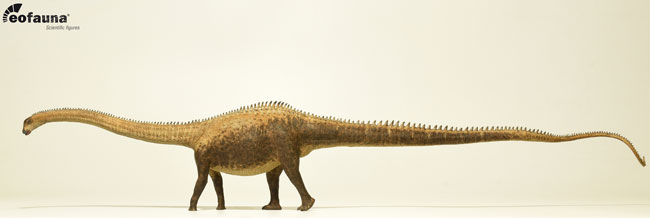
Eofauna Diplodocus scale model

The Eofauna Diplodocus carnegii model measures around 60 cm in length and stands 11 cm tall. It is a 1/40th scale model.

The picture (above) shows a Diplodocus from the Eofauna series of models and figures.

To view this range: Eofauna Scientific Research Models.

A spokesperson from Everything Dinosaur commented:

“We welcome this innovation and we hope that the producers will make resources to help teachers explain autism to children available as downloads on the Sesame Street website.”

Visit the award-winning and user friendly Everything Dinosaur website: Everything Dinosaur.

17 03, 2017

Beautiful Dinosaur Drawings from Clutton Primary School

By |2024-05-07T15:27:30+01:00March 17th, 2017|Categories: Early Years Foundation Reception, General Teaching, Key Stage 1/2|Comments Off on Beautiful Dinosaur Drawings from Clutton Primary School

Dinosaur Drawings from Clutton Primary School

Our thanks to the children in the mixed Foundation Stage and Key Stage 1 class at Clutton Church of England Primary (Cheshire), who, with the support of their enthusiastic teacher, sent in some dinosaur drawings.  During our dinosaur and fossil workshop with the children, we challenged the class to have a go at designing their very own prehistoric animal.  We set this up as an extension activity to support the teaching team’s scheme of work.  From the drawings we received, it looks like the children had a really good time designing their very own dinosaur.

Dinosaur Drawings

A Dinosaur Design from Libby Complete with Labels

A dinosaur drawing from Libby.

After a dinosaur workshop schoolchildren were invited to design their own dinosaur. Picture credit: Everything Dinosaur.

Picture credit: Clutton C of E Primary and Everything Dinosaur

Well done Libby!  We appreciate how hard you worked when it came to labelling your dinosaur.

For dinosaur and prehistoric animal themed gifts and toys: Dinosaur Themed Gifts and Toys.

A Design Your Own Dinosaur Teaching Extension Activity

A colourful dinosaur drawing,

A colourful dinosaur drawing. Picture credit: Everything Dinosaur.

Picture credit: Clutton C of E Primary and Everything Dinosaur

The picture above is of another dinosaur drawing sent in by the teacher on behalf of her class.  We think this drawing comes from Kyle.  It is a very interesting interpretation of the Dinosauria.  What a great name for a dinosaur “T. rex boon“.

Our thanks to all the children and to the teachers at Clutton C of E Primary who made us most welcome when we visited the school on the 10th of March to deliver a dinosaur themed workshop.  Hope the term topic goes well.

Visit the award-winning Everything Dinosaur website: Everything Dinosaur.

14 03, 2017

Gorseybrigg Year 1 and Dinosaurs

By |2023-06-08T13:46:36+01:00March 14th, 2017|Categories: General Teaching, Key Stage 1/2|Comments Off on Gorseybrigg Year 1 and Dinosaurs

Dinosaurs and Fossils at Gorseybrigg Primary School

Children in Year 1 at Gorseybrigg Primary School have spent the last two weeks studying dinosaurs and fossils.  Gorseybrigg Primary is a bright, modern school, with extensive playing fields and spacious, light, well-equipped and very tidy classrooms.  Displays all about life in the Arctic are still pinned to the walls of the Year 1 classroom, but slowly and surely these displays are being replaced by various scenes of prehistoric life as the children get to grips with all things dinosaur.  On the floor is a miniature dinosaur land created by schoolchildren.

Dinosaurs and a Dinosaur Land

Over the last fortnight, the children have learned about herbivores and carnivores, built their own “Jurassic Park” and explored such questions as whether or not dinosaurs had feathers.  The scheme of work that our dinosaur expert viewed prior to his fossil and dinosaur themed workshop was very comprehensive and carefully thought out.

Year 1 Children Make Their Own “Jurassic Park”

A wonderful dinosaur land created by schoolchildren.

A wonderful dinosaur land created by schoolchildren.

Picture credit: Gorseybrigg Primary School/Everything Dinosaur

The dinosaur land features prehistoric plants and a couple of volcanoes.  The prehistoric animal models seem to be very much at home.

To view the range of prehistoric animal models and figures supplied by Everything Dinosaur: Dinosaur and Prehistoric Animal Models.

A spokesperson from Everything Dinosaur commented:

“It was a delight working with the children.  They were such an enthusiastic cohort.  Many of the children stated that they wanted to become palaeontologists!”

A Footprint Measuring Exercise

The children showed a lot of confidence with the dinosaur footprint measuring exercise that we set them.  The children were comfortable using rulers and they enjoyed comparing the different types of dinosaur track.

Visit Everything Dinosaur’s award-winning website: Everything Dinosaur.

13 03, 2017

A Purple Woolly Mammoth Inspires Dexter and His Classmates

By |2023-07-21T21:10:11+01:00March 13th, 2017|Categories: Adobe CS5, Educational Activities, Main Page, Teaching|0 Comments

Whirley Primary School Reception Children Study Dinosaurs

Children in the Reception class at Whirley Primary School have been studying dinosaurs and learning about fossils this half term.  Under the expert guidance of their teachers, the children have been looking at different types of dinosaur and working out which ones ate meat and which ones ate plants.  In addition, the children have written stories about a Woolly Mammoth.

Tyrannosaurus rex is certainly a big favourite amongst the enthusiastic, young palaeontologists and the pupils enjoyed learning lots of new facts about T. rex during a dinosaur themed workshop.  For many schools, this week is “Science Week” and it was great to see the Foundation Stage children joining in and using their big brains (which are twenty times the size of an armoured dinosaur’s brain), to remember where they had been sitting.

Dinosaurs and a Woolly Mammoth

Working in the hall, our dinosaur expert was surrounded by wonderful art displays created by the schoolchildren, including some wonderful illustrations of erupting volcanoes by Mr Jackson’s Year 3 class.  Our dinosaur expert felt very much at home surrounded by such colourful drawings.

Year 3 Have Been Study Rocks Including How Igneous Rock is Formed

Volcano drawings by Year 3.

Drawings of volcanoes.

Picture credit: Whirley Primary School/Everything Dinosaur

A Purple Woolly Mammoth

Some of the Reception children found a purple Woolly Mammoth model in their classroom.  The teacher explained that dinosaurs lived a long time ago, millions of years before Woolly Mammoths and people.  Young Dexter was so intrigued to hear about Woolly Mammoths that he was inspired to draw a Woolly Mammoth for himself.

Foundation Stage Children Draw a Woolly Mammoth

A Foundation Stage pupil draws a Mammoth.

A child in Reception class draws a Woolly Mammoth.

Picture credit: Whirley Primary School/Dexter/Everything Dinosaur

That’s a great drawing, Dexter’s teacher was very proud as he had written the words “Woolly Mammoth” and “tusks” on his illustration.  Well done Dexter!

Reception Children Write on their Prehistoric Animal Drawings

Labelling a Woolly Mammoth.

Helping young children become more confident with their writing.

Picture credit: Whirley Primary School/Dexter/Everything Dinosaur

Providing an Extension Activity

We set the children an extension activity.  In return for some dinosaur stickers, could the children have a go at drawing their very own dinosaur?  Could they label its body parts including the skull?  We hope the picture of a purple coloured Woolly Mammoth helps to inspire the children with their prehistoric animal designs.

For models and replicas of Woolly Mammoths and other prehistoric creatures: CollectA Deluxe Age of Dinosaurs Figures.

A Purple Woolly Mammoth Drawing for the Reception Children at Whirley Primary School

A purple Woolly Mammoth.

A purple coloured Woolly Mammoth for Reception class.

Picture credit: Whirley Primary School/Dexter/Everything Dinosaur

Can the children label the purple Woolly Mammoth’s body parts?  Can they label the skull?

All to soon the morning had come to an end and it was time to pack up so that the lunchtime supervisors could set up the tables ready for the school dinners.  Not to worry, we provided an assortment of teaching materials and other resources to the enthusiastic teaching team to help them carry on with this stimulating and challenging Foundation Stage term topic.

Visit the Everything Dinosaur website: Everything Dinosaur.

12 03, 2017

What Do You Know About Dinosaurs?

By |2023-06-08T09:59:39+01:00March 12th, 2017|Categories: Educational Activities, Main Page, Teaching|0 Comments

What Do You Know About Dinosaurs?  K-W-L Technique

Children at Clutton Church of England Primary School in Cheshire have had a busy week.  The pupils in the Foundation Stage and Key Stage 1 have been learning all about dinosaurs and life in the past and on Friday, one of our dinosaur experts visited the school to work with the enthusiastic children for a morning.

Before our dinosaur workshop commenced, the Everything Dinosaur team member had the opportunity to examine some of the children’s work including mind maps created by the teacher to help the teaching team develop an appropriate scheme of work for the mixed age group class.

What Do You Know About Dinosaurs?

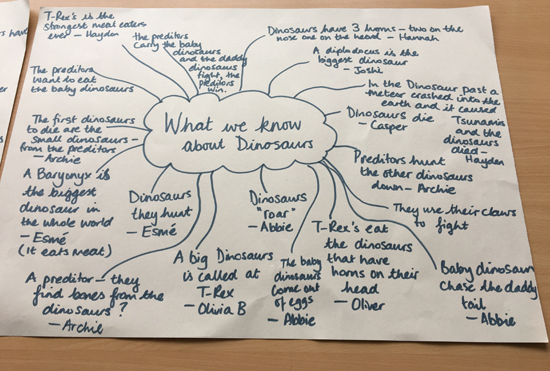
The KWL technique helps teachers understand subject pre-knowledge.

Using the KWL technique to start a term topic all about dinosaurs.

Picture credit: Clutton C of E Primary School/Everything Dinosaur

What is the K-W-L Technique?

The mind maps formed part of the teacher’s planning for the topic.  She was utilising a technique called the K-W-L.  The K-W-L concept aids teachers and helps them to plan a topic and to check understanding.  It consists of three phases, firstly, the children brainstorm and say what they think they know about dinosaurs and prehistoric animals.

During the brainstorming session, the children will make statements and assertions that provide the teacher with details as to what the children would like to find out about prehistoric animals.  The third phase, which is conducted at the end of the period of teaching, highlights what the children have learned at the end of their studies.  This third phase permits the teaching team to check understanding and gives them the opportunity to reinforce leaning if required.

The Three Phases of the K-W-L Technique

  • How much do you know about a subject area?
  • What would you like to learn about a subject?
  • What have we learned about a subject at the end of the topic?

The Second Phase – What Would We Like to Learn About Dinosaurs?

KWL - technique used in schools (dinosaur term topic).

What do you want to know about dinosaurs?

Picture credit: Clutton C of E Primary School/Everything Dinosaur

Helping to Guide Lesson Planning

When the children in Foundation Stage and Key Stage 1 were asked to consider what they already knew about dinosaurs they demonstrated considerable pre-knowledge.  For example, the children knew what the term predator meant and they could explain a little bit about the extinction of the dinosaurs at the end of the Cretaceous period.

The teaching team were able to gain valuable insights into gaps in the children’s understanding of the wider world when the second mind map was created.  For instance, Olivia wanted to know if dinosaurs killed people, whilst Josh asked how did the dinosaurs eat things?  These two questions could guide the teaching team and provide a stimulus for the scheme of work.

When Did the Dinosaurs Live?

Perhaps, a timeline could be created explaining just how long ago the dinosaurs lived.  The children could look at the teeth of dinosaurs in books and compare these teeth to the teeth of animals alive today and try and work out which dinosaurs were herbivores and which ones were carnivores.

The K-W-L technique provides a useful planning aid for teachers and teaching assistants.

 To see how schematic story maps can help children learn: Schematic Story Maps Help Children to Remember Facts.

For information on Everything Dinosaur’s outreach work: Email Everything Dinosaur.

Visit Everything Dinosaur’s website: Everything Dinosaur.

10 03, 2017

Amazing Dinosaurs Come to Clutton C of E Primary

By |2024-05-07T15:30:05+01:00March 10th, 2017|Categories: Early Years Foundation Reception, General Teaching, Key Stage 1/2|Comments Off on Amazing Dinosaurs Come to Clutton C of E Primary

Dinosaurs Come to Clutton C of E Primary

It was a Jurassic themed morning for the budding, young palaeontologists in Foundation Stage and Key Stage 1 at Clutton C of E Primary school.  The children had been learning all about dinosaurs and fossils under the guidance of the enthusiastic teaching team and to round off the week, a visit from an expert from Everything Dinosaur had duly been arranged.  Prior to the dinosaur and fossil themed workshop, the teaching team had time to show their visitor some of the excellent work that the children had been doing since they started the prehistoric animal themed topic two weeks ago.

What the Children Know About Dinosaurs

The KWL technique helps teachers understand subject pre-knowledge.

Using the KWL technique to start a term topic all about dinosaurs.

Picture credit: Clutton C of E Primary School/Everything Dinosaur

Lots of pre-knowledge was demonstrated by the children.  For example, Hayden commented that “a meteor crashed into the Earth and it caused tsunamis and the dinosaurs died”.  Well done Hayden, scientists think that a big rock from space did crash into the Earth some 66 million-years-ago and this may have been one of the key factors in the extinction of the dinosaurs.  Oliver stated that “T. rex ate the dinosaurs that had horns on their head”.  He is quite right, big meat-eaters like Tyrannosaurus rex did eat the plant-eating horned dinosaurs like Triceratops and Styracosaurus.

Tyrannosaurus rex An Extremely Dangerous Dinosaur

Rebor GrabNGo 02 T. rex Type A (Anterior View). T. rex named by Henry Fairfield Osborn.

The Rebor GrabNGo 02 T. rex Type A in anterior view.  Picture credit: Everything Dinosaur.

Picture credit: Everything Dinosaur

The picture (above) shows a Rebor GrabNGo T. rex dinosaur model.

To view the Rebor range: Rebor Prehistoric Animal Models and Figures.

Dinosaurs Roar

Abbie explained that dinosaurs could roar.  Some dinosaurs probably did make lots of noise, but other dinosaurs, especially some of the smaller ones, probably squeaked, squawked and may even have honked!  Esmé commented that dinosaurs hunt, the meat-eaters certainly did go hunting and in the workshop, the children learned how the colossal (good word Olivia), Ankylosaurus kept himself safe when a T. rex came into the forest.

During his visit, our dinosaur expert saw some amazing examples of the children’s work.  There was some super hand-writing on display and several beautiful dinosaur skeletons that had been made from tissue paper and glue.  The Foundation Stage and the Key Stage 1 pupils were certainly enjoying their dinosaur themed term topic.  We hope they enjoy the extension activities we provided and good luck with the dinosaur drawing exercise, remember to label those body parts including the skull!

Visit the Everything Dinosaur website: The Everything Dinosaur Website.

Go to Top