By Mike|2023-12-31T20:23:49+00:00November 13th, 2019|Categories: Early Years Foundation Reception|Comments Off on Foundation Stage 2 Have Fun Learning About Animals
Foundation Stage 2 – Animal Skeletons
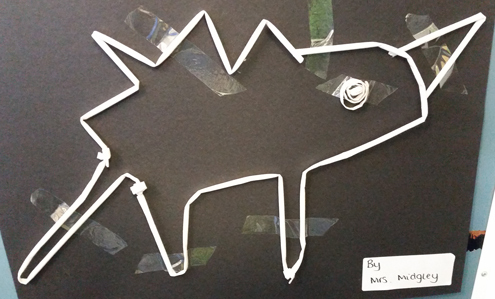
Whilst on a visit to a school to conduct a dinosaur themed workshop with some eager and excited Reception class children, our dinosaur expert spotted some super animal skeletons that the children had created. Using straws and cotton buds to represent bones, the Foundation Stage 2 children had made skeletons of various animals. The children had made skeletons of birds, people, dinosaur skeletons, cats, dogs and even a fish.
Dinosaur Skeletons
Anatomy Class – Reception Class Make Animal Skeletons
A dinosaur made from straws. Picture credit: Everything Dinosaur.
Picture credit: Everything Dinosaur
The skeletons that the children had created certainly made a colourful display outside in the corridor adjacent to the hall where we were conducting our dinosaur and fossil themed workshop.
The three classes of Reception-aged children at Broughton Primary in Flintshire have been busy learning all about dinosaurs and fossils this term. With the half-term break approaching, a team member from Everything Dinosaur was invited into the school to deliver three dinosaur workshops, one for each class, to help reinforce their learning as the topic came to a conclusion. During the visit, our dinosaur and fossil expert was given a tour of a couple of the spacious and tidy classrooms and shown the prehistoric landscapes that the children had created.
Class 1 (Dosbarth 1) – Prehistoric Landscape
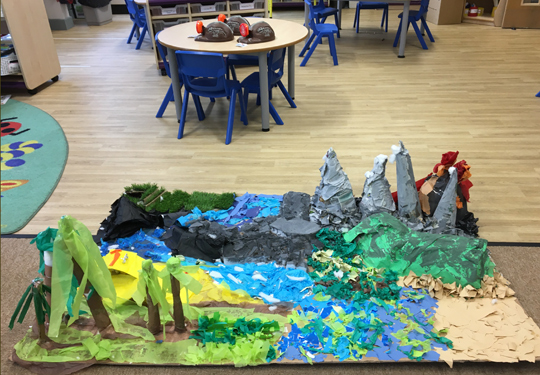
A very colourful prehistoric landscape created by a Reception class.Picture credit: Everything Dinosaur.
Picture credit: Everything Dinosaur
What do Dinosaurs Need to Keep them Healthy and Happy?
As part of an enriched and varied scheme of work, the Reception classes have been learning about animals and what they need to help keep them safe, healthy and happy. The children have incorporated some of this learning into their prehistoric landscapes that they have been building. For example, class 1 ensured that there were plenty of plants for the herbivores to graze upon and lots of rocks for the dinosaurs to hide amongst to keep them safe from Tyrannosaurus rex.
As part of the extension activities for the classes following our workshops, we supplied extra resources for the teaching team. Each class was given their very own hard hat to wear when they went out looking for fossils. Dinosaurs as a term topic certainly lends itself to lots of creative play and exploration.
A Prehistoric Landscape Created by a Reception Class – Can you See the Three Fossil Hunting Hard Hats?
The prehistoric scene created by a Reception class (Dosbarth 1). The three fossil hard hats donated by Everything Dinosaur can be seen in the background. These hard hats have a lamp on the front to help the children search for fossils.Picture credit: Everything Dinosaur.
The enterprising teaching team had used a variety of materials to help create the mini “Jurassic Parks”, these items will help the children to explore and learn about the properties of different materials. Class 3 had even included a large, cardboard and cloth cave for their dinosaur models to hide in.
The Prehistoric Landscape Created by Class 3 (Dosbarth 3)
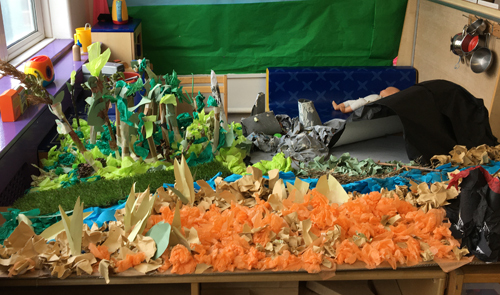
The prehistoric landscape created by class 3. A very colourful landscape for the dinosaur models to play in.Picture credit: Everything Dinosaur.
Picture credit: Everything Dinosaur
Cretaceous Conifers
The children in class 3 had created a large cardboard and crepe paper forest for the plant-eating dinosaurs to browse. The forest would provide lots of handy nesting places for the dinosaurs too.
Cretaceous Conifers – A Prehistoric Forest for Dinosaurs to Explore
Cardboard and crepe paper trees for the dinosaurs to hide amongst.Picture credit: Everything Dinosaur.
Picture credit: Everything Dinosaur
For further information about Everything Dinosaur’s teaching and science outreach work: Email Everything Dinosaur.
By Mike|2023-12-31T15:47:52+00:00October 24th, 2019|Categories: Early Years Foundation Reception|Comments Off on Reception Children Make Dinosaur Landscapes
Reception Children Make Dinosaur Landscapes
The children in the three Reception classes at Broughton Primary (Flintshire), have certainly enjoyed learning about dinosaurs this term. A team member from Everything Dinosaur visited the school this morning to deliver three dinosaur and fossil themed workshops to help round off the scheme of work for the first half of the autumn term.
During the visit, our team member was shown some amazing dinosaur landscapes that the children had built.
Children in Class 1 (Reception) have Created a Prehistoric Landscape
A very colourful prehistoric landscape created by a Reception class.Picture credit: Everything Dinosaur.
The Reception classes have been learning about animals and what they need to keep them safe and happy. The children created a river to allow the dinosaurs to catch fish to eat. The river would also provide water for the prehistoric animals to drink. The plant-eating dinosaurs have plenty of leaves to chew but all the dinosaurs have to be careful as the volcano has erupted and bright red lava is spilling out down its slopes.
Class 1 Children Constructed a Volcano as part of their Dinosaur Landscape Project
The prehistoric scene created by a Reception class (Dosbarth 1). The three fossil hard hats donated by Everything Dinosaur can be seen in the background. Picture credit: Everything Dinosaur.
Picture credit: Everything Dinosaur
Class 3 also constructed a home for their dinosaur models. Their very own version of “Jurassic Park” included a big forest for the dinosaurs to hide in so that they felt safe and a huge cave for them to explore. The hard hats we provided with the lamps on their front might come in handy when it comes to exploring the depths of the cavern.
The Prehistoric Scene Created by Class 3 (Dosbarth 3)
The prehistoric landscape created by class 3. Picture credit: Everything Dinosaur.
Picture credit: Everything Dinosaur
The Reception classes enjoyed their dinosaur workshops and demonstrated some amazing counting and recall of dinosaur facts during the morning. We hope they like the dinosaur hokey cokey activity we provided too.
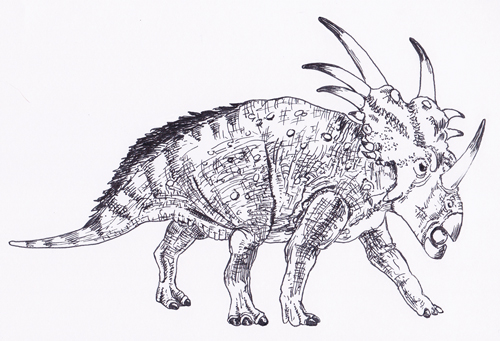
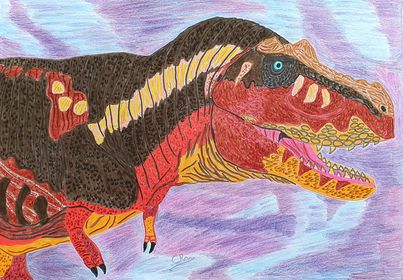
The artist has taken great care to illustrate this dinosaur. Lots of amazing detail such as different shaped scales on the skull and the bony ridges over the orbit (eye socket) can be seen in this line drawing. Our congratulations to Caldey for creating such a super dinosaur illustration.
Everything Dinosaur team members receive lots of dinosaur themed drawings. Our thanks to Caldey for sending in a rather splendid red-headed Tyrannosaurus rex illustration.
By Mike|2023-12-31T12:02:49+00:00October 14th, 2019|Categories: General Teaching, Key Stage 1/2|Comments Off on Stunning and Beautiful Autumn Dinosaurs
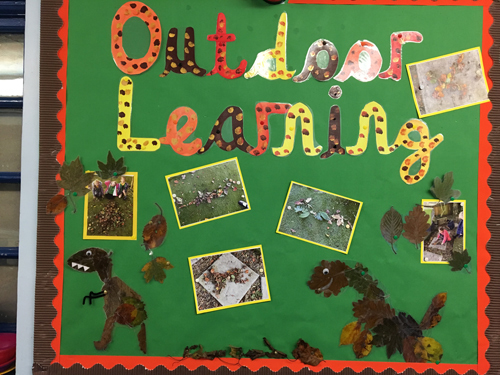
Dinosaur Display Made from Leaves
Lots of Key Stage 1 children and Reception classes have been learning about dinosaurs this term. On one of our many school visits a dinosaur expert at Everything Dinosaur spotted a colourful display of prehistoric animals that had been created using leaves. It seems that dinosaurs are even becoming involved in forest school activities, all part of creative, imaginative and thoroughly engaging teaching schemes of work.
A Dinosaur Created from Autumn Leaves
Dinosaur leaves and outdoor learning. Picture credit: Everything Dinosaur.
Picture credit: Everything Dinosaur
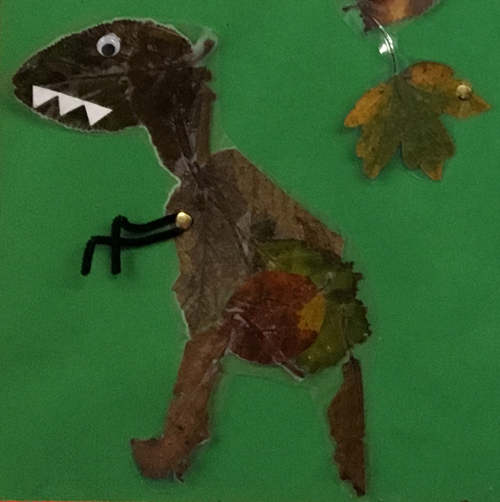
A Dinosaur Leaf Monster
A spokesperson from Everything Dinosaur commented:
“We come across lots of wonderful and creative curricular during our visits to schools. We congratulate the teaching team for combining the term topic all about dinosaurs and fossils to learning about the changing environment and seasons. This really is a great example of creative cross-curricular teaching.”
A Dinosaur Leaf Monster
A dinosaur leaf monster. Picture credit: Everything Dinosaur.
The autumn term is well underway and team members at Everything Dinosaur are busy conducting dinosaur themed and fossil workshops in schools, catering for a wide range of different age groups. This week, our team members will be dealing with the eager and very excitable Early Years Foundation Stage classes (Nursery and Reception), as well as working with slightly more mature (we hope), students in Key Stages 3 and 4.
Everything Dinosaur Team Members Preparing for a School Visit
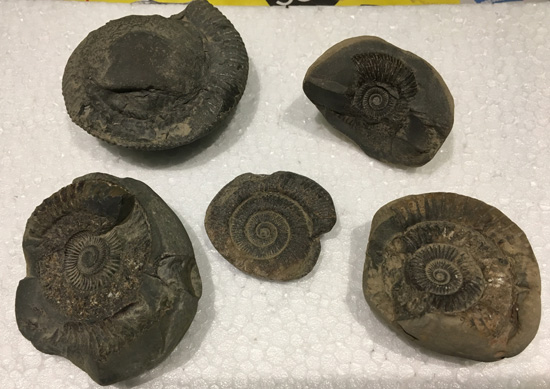
One of the things we have been asked to discuss with the students in year nine and ten that we will be working with this week, is potential career options in the Earth sciences. This is certainly a very broad subject and we hope to provide some pointers. We have been brushing up on our knowledge regarding career paths as well as brushing up some rather beautiful Dactylioceras ammonite fossils that we intend to use in a short exercise looking at taphonomy and the importance of index fossils.
Selecting Fossils to Use in Our Exercise with Key Stage 3 and Key Stage 4 Students
A selection of ammonite fossils to be used in an exercise exploring the role of index fossils with science students.Picture credit: Everything Dinosaur.
The children in Year 1 at St Joseph’s Primary (Lancashire), had a morning of pretending to be palaeontologists as their autumn term topic “Dinosaur Planet” was kicked-off in style. The friendly staff had prepared a scheme of work all about dinosaurs, an area of learning used elsewhere in the school, as the Nursery children (EYFS), would also be studying Tyrannosaurus rex, Triceratops, Stegosaurus et al over the course of the academic year.
“Dinosaur Planet”
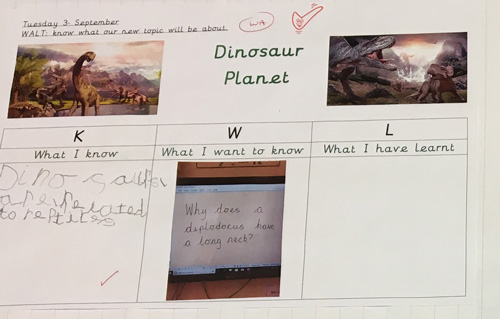
Prior to our visit to conduct a morning of dinosaur and fossil themed activities with the enthusiastic children, the teaching team had challenged the class to record in their topic books what they knew about these long extinct animals. Our dinosaur expert was impressed with the neatness of the handwriting, how well the letters had been formed and the appropriate finger spacing between words.
“Dinosaur Planet” – What I Know About Dinosaurs
At the start of the dinosaur topic the Year 1 children recorded what they know about dinosaurs. For example, one pupil wrote that dinosaurs are related to reptiles – that’s right, the Dinosauria are indeed a diverse group of reptiles.Picture credit: Everything Dinosaur.
Picture credit: Everything Dinosaur
Why Did Diplodocus Have a Long Neck?
As part of the writing exercise, referred to as KWL:
what I know?
secondly, what I want to know?
what have I learned? An opportunity to check understanding at the end of the topic.
The year 1 children wanted to know why did a Diplodocus have a long neck?
Why Did a Diplodocus Have a Long Neck?
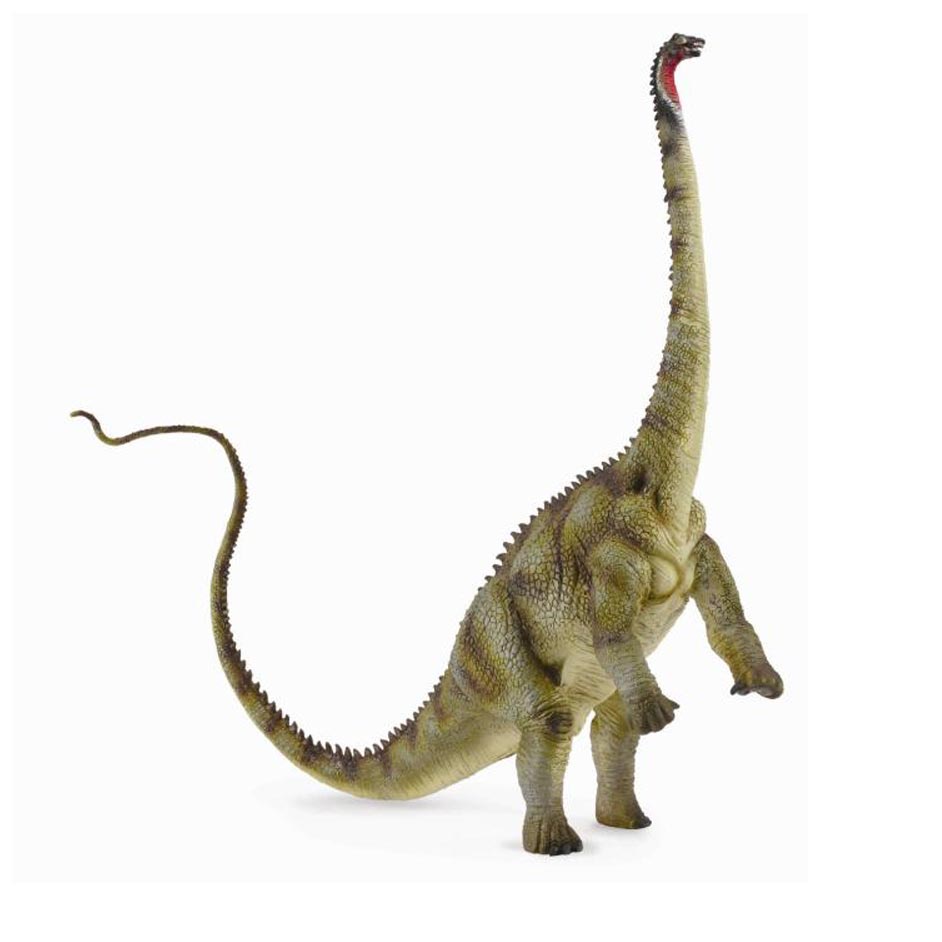
During the morning of dinosaur themed activities, the school visitor from Everything Dinosaur made sure to answer the question about the neck of Diplodocus.
The picture (above) shows a Diplodocus model from the CollectA Age of Dinosaurs model range.
The first part of the morning involved visual and kinaesthetic learning with lots of physical exercises to help reinforce learning. In the second part of the workshop, which was conducted in the classroom, the children were given the opportunity to find their own fossils. The eager young palaeontologists found lots of fossils in our special challenge, teeth from prehistoric sharks, pieces of fossilised turtle shell, lots of ammonites and even some armour from a Jurassic crocodile!
The Children Demonstrated Lots of Pre-knowledge
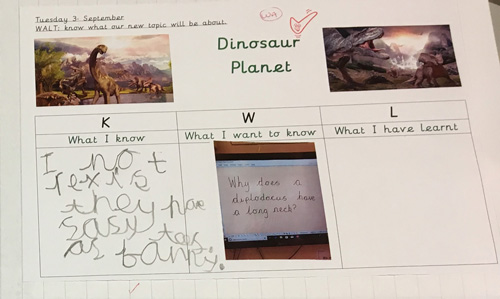
KWL exercise (Year 1 term topic). The Year 1 children were keen to demonstrate their knowledge about dinosaurs, even a Gallimimus was mentioned.Picture credit: Everything Dinosaur.
Picture credit: Everything Dinosaur
We are confident that the budding young palaeontologists at St Joseph’s Primary are going to really enjoy their autumn term topic.
If you are preparing for a “Dinosaur Planet” term topic, visit the Everything Dinosaur website: Everything Dinosaur.
Our thanks to young Nataliya (Year 2), who sent into Everything Dinosaur a beautiful illustration of a dinosaur that she had designed following a visit to her school by one of our team members. Nataliya and her classmates had taken up our challenge to design a dinosaur as part of an extension exercise that arose following one of our dinosaur and fossil workshops at the school. The dinosaur was named “spikeraptor” and despite its fearsome name, Nataliya explained that this dinosaur was a herbivore and even included a picture of some leaves that the dinosaur was grazing upon in her prehistoric portrait.
A Colourful Dinosaur Design – “Spikeraptor”
A colourful green dinosaur – Spikeraptor the product of the imagination of young Nataliya (Year 2).
Picture credit: Nataliya (Key Stage 1) and Everything Dinosaur
Lovely Labels on the Dinosaur Drawing
As part of a writing exercise we asked the children to label their prehistoric animal’s body parts. Nataliya was keen to emphasis the spikes and prickles on her dinosaur and our congratulations to Nataliya and the rest of the class for sending in some super drawings with fantastic examples of handwriting. These drawings have made our day and we shall post them up in our warehouse so that all the Everything Dinosaur team members can view them.
By Mike|2023-12-29T16:20:26+00:00September 2nd, 2019|Categories: Key Stage 3/4|Comments Off on Making Exciting Plans and Preparations for KS3
Making Preparations for Key Stage 3
It has been a busy end to August for our teaching team as they finalise plans for school and college visits over the autumn term (2019). All has been put in place and prepared as the schools start back. We have dealt with the last minute enquiries and provided what support and assistance that we can. Everything Dinosaur team members are involved in a variety of teaching projects including some work with Key Stage 3 and Key Stage 4 students. Our aim is to support the science element of the curriculum, especially those areas related to biology, chemistry and genetics.
In addition, we have been contacted with requests for careers advice.
The Practical Implications of Scientific Working
Pause for a pic next to a digs station The importance of working scientifically. Picture credit: Everything Dinosaur.
Preparing Lesson Plans with an Emphasis on Scientific Working
When preparing lesson plans for older students (KS3 and KS4), we keep a list on the desk which reminds of the purpose of science for these age groups. This helps us to focus on meeting the learning needs of the class.
For example, here is the list we use when considering a KS3 class (Year 7 to Year 9).
Use scientific ideas, theories and models to help explain current/past events (link to evolution and to climate change).
Build on existing scientific knowledge from Key Stage 2 and to make connections between the different scientific disciplines.
Understand a range of familiar, everyday applications of science.
Consider the advantages and disadvantages of scientific developments in the context of their impact on the environment, humanity and the planet
Explore different views on topic areas and consider the reasons for these differences.
Emphasis the role of building empirical and experimental evidence to support findings and scientific ideas.
Design and conduct investigations of different types, making use of available resources and reference sources.
To critique and evaluate the experiments undertaken and to consider how the research could be improved/developed.
To consider the role of scientific communication in disseminating research findings – how does science reach a wider audience?
These lists that we have developed act as an “aide mémoire” to ensure that we remain focused on the learning needs of each class.
By Mike|2023-12-26T16:31:25+00:00August 6th, 2019|Categories: General Teaching|Comments Off on Protecting the Dinosaurs of the Isle of Skye
Further Legal Protection for Isle of Skye Dinosaurs
The internationally-recognised fossil bearing strata that dates from the Middle Jurassic on the Isle of Skye has been granted greater legal protection. Earlier this month, the Scottish Minister for Rural Affairs and the Natural Environment, Mairi Gougeon signed a Nature Conservation Order (NCO), aimed at protecting globally significant vertebrate fossil sites on the Scottish Island.
Many Dinosaur Fossils Including Footprints have been Discovered on the Isle of Skye
A dinosaur footprint from the Isle of Skye.
Picture credit: Colin MacFadyen (Scottish National Heritage)
Protecting the Isle of Skye Fossil Sites
The principle aim of the Nature Conservation Order is to prevent rare vertebrate fossils such as dinosaur footprints and bones, along with marine reptiles and fossil evidence of early mammals, being collected and removed by non-authorised parties. The Nature Conservation Order also aims to encourage local people and the wider public, including the thousands of tourists that visit Skye each year, to take an interest in and report any potentially important fossil discoveries.