By Mike|2023-12-26T16:31:25+00:00August 6th, 2019|Categories: General Teaching|Comments Off on Protecting the Dinosaurs of the Isle of Skye
Further Legal Protection for Isle of Skye Dinosaurs
The internationally-recognised fossil bearing strata that dates from the Middle Jurassic on the Isle of Skye has been granted greater legal protection. Earlier this month, the Scottish Minister for Rural Affairs and the Natural Environment, Mairi Gougeon signed a Nature Conservation Order (NCO), aimed at protecting globally significant vertebrate fossil sites on the Scottish Island.
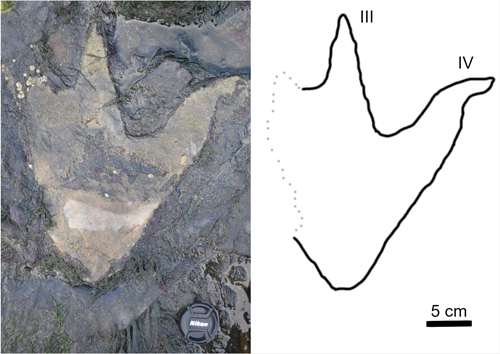
Many Dinosaur Fossils Including Footprints have been Discovered on the Isle of Skye
A dinosaur footprint from the Isle of Skye.
Picture credit: Colin MacFadyen (Scottish National Heritage)
Protecting the Isle of Skye Fossil Sites
The principle aim of the Nature Conservation Order is to prevent rare vertebrate fossils such as dinosaur footprints and bones, along with marine reptiles and fossil evidence of early mammals, being collected and removed by non-authorised parties. The Nature Conservation Order also aims to encourage local people and the wider public, including the thousands of tourists that visit Skye each year, to take an interest in and report any potentially important fossil discoveries.
By Mike|2023-12-26T14:58:03+00:00July 29th, 2019|Categories: General Teaching|Comments Off on A Fabulous Komodo Dragon Drawing
A Komodo Dragon Drawing
Our thanks to young Caldey for sending into us a superb illustration of a Komodo dragon, the largest living lizard in the world today, with some individuals attaining lengths of around 3 metres and weighing as much as 75 kilogrammes.
An Illustration of a Komodo Dragon (Varanus komodoensis)
A drawing of the Rebor Komodo dragon model.
Picture credit: Caldey
Komodo Dragon Described as a “Land Crocodile”
When first described by Europeans in the early years of the 20th century, this large lizard was thought to be a form of “land crocodile”. Scientist now know that the Komodo dragon is a member of the monitor lizard family, although how it evolved is a bit of a mystery.
As it is restricted to a handful of islands in the Indonesian archipelago, it had been thought that a lack of other large carnivores in its habitat enabled this lizard to reach such a large size. However, some scientists now think that the Komodo dragon is part of a long line of large, ground dwelling monitor lizards that inhabited south-eastern Asia and Australia for several million years. If this is the case the Komodo dragon represents the last of this evolutionary line, “a dead clade walking”.
Caldey’s drawing was probably inspired by the Rebor Komodo dragon model.
A dorsal view of the new Rebor GrabNGo Komodo dragon model. Picture credit: Everything Dinosaur.
Picture credit: Everything Dinosaur
To view the range of Rebor models and figures in stock at Everything Dinosaur: Rebor Figures and Models.
Listed as vulnerable by the IUCN, its range has contracted due to human activity, but it has protected status within Indonesia and there are controversial plans to reduce the human population on Komodo by forcing villagers to locate elsewhere in order to protect this species.
Our thanks to Caldey for providing us with such a super Komodo dragon drawing.
By Mike|2023-12-26T06:08:18+00:00July 5th, 2019|Categories: General Teaching|Comments Off on A Fantastic Term Topic “Footprints from the Past”
International Primary Curriculum “Footprints from the Past”
Plans are well advanced for dinosaur and fossil themed workshops to be delivered in the new academic year. Team members are busy with their lesson planning and preparations including writing schemes of work to support the International Primary Curriculum (IPC) and the topic area “Footprints from the Past”.
Everything Dinosaur staff have prepared workshops for Foundation Stage classes through to Upper Key Stage 2, helping to enthuse and motivate, working with classes when the children will be investigating dinosaurs and fossils.
Dinosaurs and Fossils Provides Lots of Cross-curricular Learning Opportunities
A collection of dinosaur footprints sent in to Everything Dinosaur by Reception children. Picture credit: Everything Dinosaur.
Picture credit: Everything Dinosaur
We do a lot of work with schools and our workshops are built around the International Primary Curriculum aims and objectives including developing writing skills, aiding literacy, exploring ideas, problem solving, building confidence and encouraging an understanding of materials and the wider world. There is certainly a big “wow factor” with a visit from ourselves but everything our teaching team does, attempts to reinforce learning and help achieve the teaching outcomes required.
The “Big Idea” behind this element of the IPC curriculum entitled Footprints from the Past, is that nobody has ever seen a living a dinosaur and therefore how do we know so much about them? This introduces the concept of “dinosaur detectives”, challenging the class to explore ideas and to work scientifically.
From a scientific perspective, dinosaurs are technically not extinct. So, when working with Lower Key Stage 2 for example, we like to challenge their understanding of dinosaurs and extinction, develop some themes through the tactile, visual and kinaesthetic elements of the class workshop and then set the class extension activities based around exploring some of the ideas that we have covered.
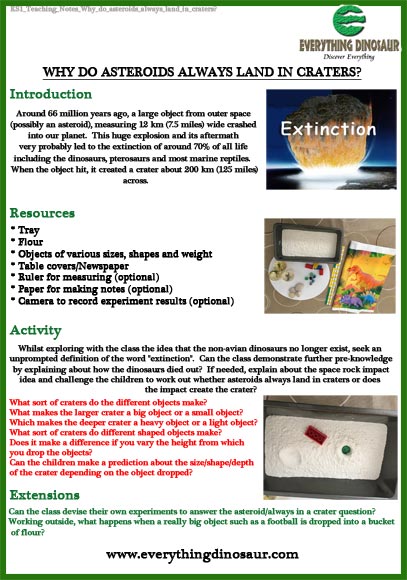
Did an Extra-terrestrial Impact Wipe Out All the Dinosaurs?
PDF download of teaching notes/lesson plan is available from Everything Dinosaur. Picture credit: Everything Dinosaur.
Picture credit: Everything Dinosaur
Everything Dinosaur
Everything Dinosaur is manned by teachers and real fossil experts and we visit schools to conduct dinosaur and fossil themed workshops whilst working with the learning objectives and intended outcomes as set by the teaching team. We undertake a lot of work in support of the pupil premium in England. We add into our workshops real aspects of palaeontology, enabling children to experience some of the science behind the study of dinosaurs, fossils and other extinct animals. Our costs are made up of a subsidised amount for the teacher/palaeontologist’s time, plus travelling expenses and a small charge to cover the packing of fossils and any materials used.
It looks like our team members are going to have very busy autumn and spring terms.
By Mike|2023-12-25T22:04:50+00:00June 30th, 2019|Categories: General Teaching|Comments Off on A Dazzling Diabloceratops Drawing from a Dinosaur Fan
A Dazzling Diabloceratops Drawing
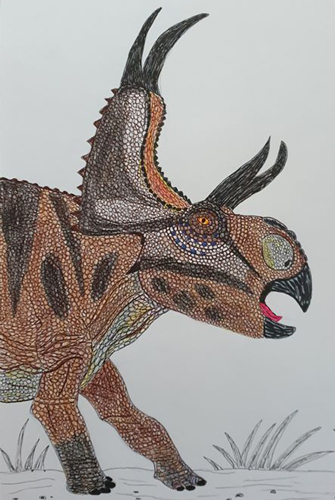
Our thanks to Caldey for sending into Everything Dinosaur a superb drawing of the horned dinosaur Diabloceratops. Knowledgeable dinosaur fans like Caldey, know that there were lots of horned dinosaurs (Ceratopsians), in fact, over seventy different species of horned dinosaur have been named to date, numerous new genera have been erected in the last twenty years or so.
Caldey’s Impressive Diabloceratops Drawing
The Schliech Diabloceratops inspired Caldey to illustrate this dinosaur back in 2019.
Picture credit: Caldey
Diablocertops eatoni
Diabloceratops is one of those genera of horned dinosaurs erected this century. It was described and named in 2010 from fossilised skull material found in Utah (Wahweap Formation), back in 2002. Although a member of the Ceratopsia, since it was classified as a member of the subfamily Centrosaurinae, Diabloceratops was only distantly related to the famous Triceratops.
We think the inspiration behind Caldey’s excellent drawing was the recently introduced Schleich Diabloceratops dinosaur model.
The Schleich Diabloceratops Dinosaur Model
The Schleich Diabloceratops dinosaur model. Picture credit: Everything Dinosaur.
Our thanks to Caldey for sending into us this fabulous dinosaur drawing.
A spokesperson from Everything Dinosaur commented:
“It is always a pleasure to receive artwork from fans of dinosaurs. Caldey’s attention to detail and careful illustration of the dinosaur is admirable. It is a dazzling Diabloceratops drawing.”
By Mike|2023-12-25T12:44:35+00:00June 27th, 2019|Categories: General Teaching|Comments Off on A Playful New Schleich Plesiosaurus
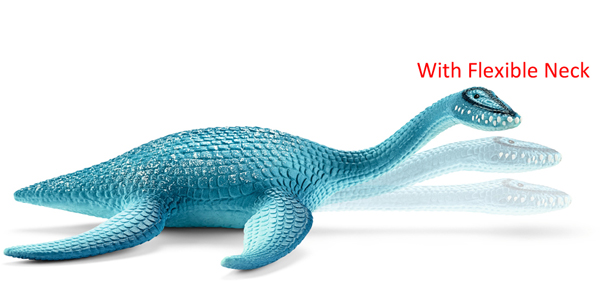
A Schleich Plesiosaurus – A Flexible Friend
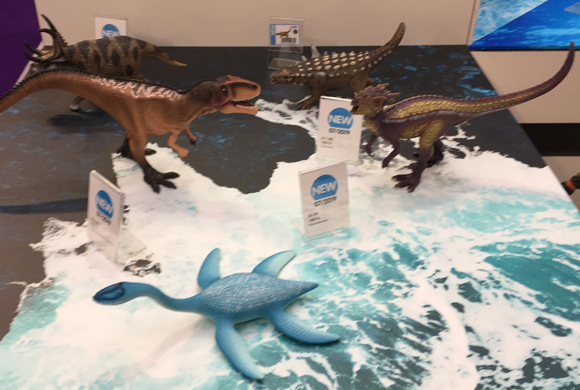
Schleich, the German-based model and figure manufacturer have added a Plesiosaurus to their range of prehistoric animals. This little replica of an animal reminiscent of the legendary “Loch Ness Monster” measures a little over sixteen centimetres in length and it is great for creative, imaginative play.
The New for 2019 Schleich Plesiosaurus Marine Reptile Model
The Plesiosaurus has a beautifully designed skin with very prominent scales, ideal for sensory play. The figure has been designed for children from three years and older and it has been very skilfully painted. Unlike most plastic prehistoric animal figures, this little plesiosaur has a flexible, bendy neck. The head can be manoeuvred into lots of positions, it has certainly proved to be very popular with the budding, young palaeontologists who have had the chance to view this model already.
The Schleich Plesiosaurus Figure Used in a Prehistoric Landscape Display
New models being introduced into the Schleich prehistoric animal model range in July 2019. Picture credit: Everything Dinosaur.
A spokesperson from Everything Dinosaur commented:
“Although Plesiosaurs are famous for their long necks and relatively small heads, the necks of these fish-eaters were not that flexible. The very largest of the Plesiosauria had more than seventy neck bones (cervical vertebrae), that is ten times what we have in our own necks. However, studies have shown that the necks of these Mesozoic marine reptiles were not bendy, they could not hold their head up in a “swan-neck” posture. This anatomical detail notwithstanding, the Schleich Plesiosaurus is great for imaginative play and it will make a lot of young learners very happy.”
Dinosaur Drawings and Letters from Year 2 (Great Wood Primary School)
Our thanks to the budding scientists at Great Wood Primary School in Morecambe (Lancashire), who sent into our offices some wonderful dinosaur illustrations and a set of beautifully written letters explaining how much they enjoyed their recent dinosaur workshop with one of our team members. As part of our extension activity suggestions with the Year 2 classes we challenged them to design their very own prehistoric animal. We received lots of amazing dinosaur designs.
Dinosaur Illustrations
A Selection of Letters from the Children – Some Featured Illustrations of Imaginary Prehistoric Animals
A selection of letters received from the eager young palaeontologists at Great Wood Primary School (Morecambe, Lancashire).Picture credit: Everything Dinosaur.
Picture credit: Everything Dinosaur
Writing Thank You Letters
The teachers very kindly sent in thank you letters that the children had written. Writing a thank you letter to Everything Dinosaur is a great way for the teaching team to check learning and understanding following a recounting activity. This letter writing exercise helps young learners practice sentence sequencing, planning their composition, as well as spelling and the layout and format of a letter. The children can also read their letters out aloud as part of a further teaching activity within the classroom.
A Very Colourful Dinosaur Design with Lots of Wonderful Labels
A very colourful prehistoric animal produced by a Year 2 child at Great Wood Primary School (Morecambe).Picture credit: Everything Dinosaur.
Picture credit: Everything Dinosaur
Children Produced Letters and Drawings
Jessica’s dinosaur drawing and letter (Year 2 at Great Wood Primary School).Picture credit: Everything Dinosaur.
Picture credit: Everything Dinosaur
A spokesperson from Everything Dinosaur commented:
“We try to provide additional teaching resources when we visit a school to deliver a dinosaur themed workshop. In addition, during our workshop with the class the opportunity often arises to challenge the children to produce a piece of work, such as their very own dinosaur design or to write a thank you letter. In this way, we are providing extension ideas to the teaching team and supporting the teacher’s scheme of work.”
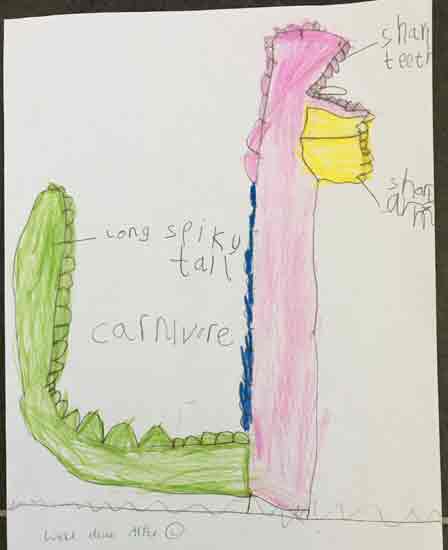
A Very Spiky Dinosaur Design
Stacy chose to draw a green, armoured dinosaur with a very spiky tail. One of the splendid dinosaur illustrations. Picture credit: Everything Dinosaur.
Picture credit: Everything Dinosaur
Our Thanks to the Schoolchildren
Our thanks once again to the teaching team and the children in Year 2 at Great Wood Primary School for taking the time and trouble to send into us examples of their work. Congratulations to you all!
Dinosaurs with Spiky Tails was a Common Characteristic Amongst the Children’s Dinosaur Designs
A colourful dinosaur drawing from Alice in Year 2 at Great Wood Primary School).Picture credit: Everything Dinosaur.
Another busy few days at Everything Dinosaur with a series of school visits to deliver dinosaur and fossil themed workshops. Our week concluded with a series of workshops with the Key Stage 1 and Reception classes at Newport Infant School (Shropshire). The whole school is studying dinosaurs over a two-week period and Everything Dinosaur was invited into the school to help kick-start the scheme of work.
As our visit came to an end, we were presented with a set of dinosaur and prehistoric animal drawings that had been produced by one of the classes that we had worked with.
Drawings of Dinosaurs and Prehistoric Animals Presented to Everything Dinosaur
Dinosaur drawings presented to Everything Dinosaur from schoolchildren. Picture credit: Everything Dinosaur.
Picture credit: Everything Dinosaur
Dinosaur Drawings
A spokesperson from Everything Dinosaur commented:
“We try to set lots of cross-curricular extension activities when working with children in Foundation Stage 2 and Key Stage 1. This helps to support the lesson plans that have been devised by the teaching team. We challenged the children to draw a dinosaur and to label body parts using some of the new terms that we had introduced to the class during our workshop. It is always a pleasure to receive such wonderful drawings and the writing element of this exercise helps the children to develop important motor skills.”
For further information on Everything Dinosaur’s outreach work and our contribution to the community: Contact Everything Dinosaur.
Visit the award-winning and easy to use Everything Dinosaur website: Everything Dinosaur.
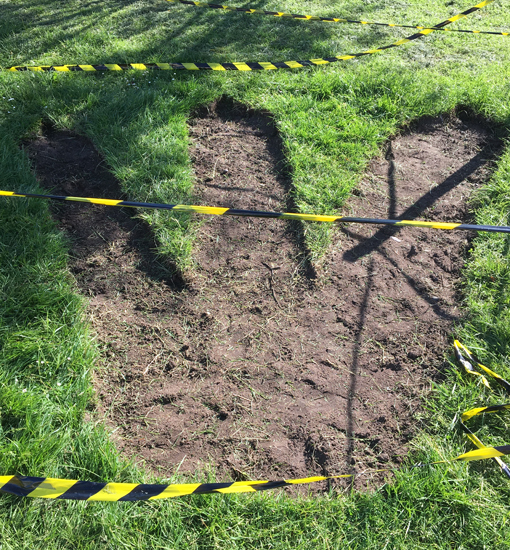
Pupils at Newport Infant School (Shropshire), are studying dinosaurs and prehistoric animals over the next two weeks. The schoolchildren discovered a huge three-toed dinosaur footprint in their well-kept and spacious playground at the start of the week. With the help of the dedicated and enthusiastic teaching team the pupils decided that the giant track must have been made by a dinosaur!
A Giant Dinosaur Footprint Discovered in the School Playground
A huge dinosaur footprint spotted at a school. Picture credit: Everything Dinosaur.
Picture credit: Everything Dinosaur
Dinosaur Footprint Spotted
Mr Remington, the school caretaker took the precaution of sealing off that part of the playground and the children became “dinosaur detectives” as they tried to work out what kind of dinosaur had paid them a visit. The footprint is just one of the many creative dinosaur and prehistoric animal themed activities that the staff have planned for the children. All the school is involved from Reception to the Year 2 classes and Everything Dinosaur had been invited into the school to deliver a series of workshops with the budding young palaeontologists.
During the workshops the children demonstrated some amazing knowledge and were happy to explain about dinosaurs and to discuss dinosaur facts. Some of the children in the Reception classes had even brought in numerous dinosaur books from home to show our dinosaur expert.
We hope the additional teaching resources and extension materials that we supplied helps to support the school’s creative and challenging scheme of work.
By Mike|2024-05-11T17:06:33+01:00June 1st, 2019|Categories: General Teaching|Comments Off on The Six Stages of Play Explained and Some Helpful Advice
Outlining the Six Stages of Play
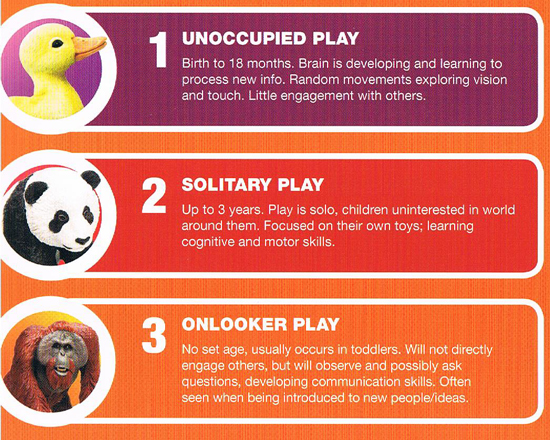
As teachers, we know that creative, imaginative play is very important to help young minds develop. Our congratulations to Safari Ltd for helping to promote the six stages of play as identified by the American sociologist Mildred Parten who defined six stages of play during her extensive research examining how children develop their social skills.
Helping to Educate and Inform about the Importance of Play
Outlining the stages of play.
Picture credit: Safari Ltd
Play is Very Important
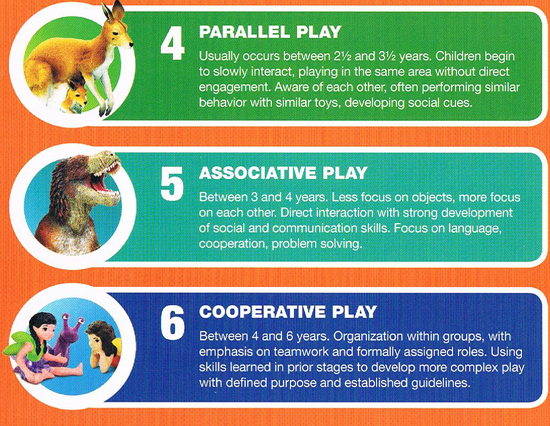
Researchers such as Dr Parten noted that as children develop, their style of play alters. She identified six, distinct stages of play, the first four or which are focused around individual play. As children grow-up the way that they play changes. The latter stages (Associative and Co-operative), involve more complex play with much more interaction with other children.
The Second Set of Play Stages (Stage 4 to Stage 6)
The stages of play (stage 4 to stage 6).
Picture credit: Safari Ltd
The Stages of Play and their Importance in the Classroom
Teaching teams working with Early Years (EYFS), know the importance of play. It is not just a way for children to have fun but it is extremely important to help them develop and practice personal and social skills. When we visit schools, we observe many examples of creative play having been devised by the teachers and their teaching assistants. Structured play helps young minds to mature and helps children to interact with others and the wider world.
Our congratulations to Safari Ltd for publishing helpful literature on this important subject.
By Mike|2023-12-22T13:16:54+00:00May 27th, 2019|Categories: General Teaching|Comments Off on New Book All About Theropod Dinosaurs
A New Book All About Theropod Dinosaurs
At Everything Dinosaur, we do all we can to encourage children with their reading. Books open doors and in our job we get the opportunity to read and review a huge range of science books all about dinosaurs and prehistoric animals. We occasionally get asked to review fictional tales about dinosaurs, especially ones aimed at young readers. Recently, the publishing team at the Natural History Museum asked us to provide a precis and review of a new book all about dinosaurs entitled “The Encyclopedia of Dinosaurs The Theropods”. This book was originally published in Spanish, but now it has been translated into a number of other languages.
The Front Cover of “The Encyclopedia of Dinosaurs – The Theropods”
The “Encyclopedia of Dinosaurs The Theropods” (front cover).
Teaching About Dinosaurs
When team members visit schools to deliver dinosaur and fossil themed workshops to classes, we discuss our work and the contribution we make to the publishing industry. The children are most excited about this, especially when we mention that we get lots of free books!