All about dinosaurs, fossils and prehistoric animals by Everything Dinosaur team members.

Everything Dinosaur team members working in schools, helping museums and other educational bodies. Our work with and in schools.

30 04, 2019

A Late Cretaceous Dinosaur and Prehistoric Animal Diorama

By |2023-12-05T10:38:16+00:00April 30th, 2019|Categories: General Teaching, Key Stage 3/4|Comments Off on A Late Cretaceous Dinosaur and Prehistoric Animal Diorama

Late Cretaceous Dinosaur and Prehistoric Animal Diorama

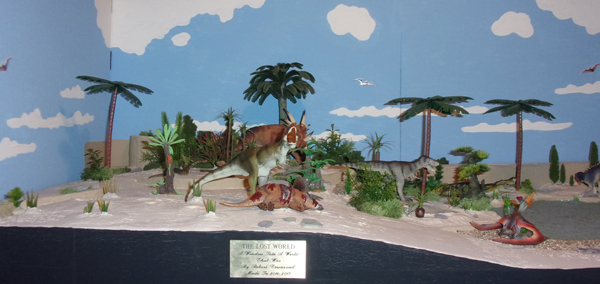
Our thanks to Robert who sent in to us a photograph of the dinosaur and prehistoric animal landscape that he had created.  He has built a huge prehistoric landscape, complete with authentic Mesozoic vegetation, dinosaur footprints, flying reptiles and a watering hole.  The talented model maker then created his very own Late Cretaceous prehistoric scene using his large collection of dinosaur and prehistoric animal models.

A Late Cretaceous Dinosaur and Prehistoric Animal Diorama

A Late Cretaceous diorama.
An ancient Late Cretaceous landscape. A Late Cretaceous diorama.

Picture credit: Robert

We think you will agree the results are very impressive.

A Creative and Imaginative Prehistoric Scene

A lot of care and thought has gone into making this creative and imaginative scene.  Robert has been careful to research the prehistoric animals that his model collection represents and he has only featured models of prehistoric animals that would have lived in North America during the Late Cretaceous.  The diorama features such famous dinosaurs as Tyrannosaurus rex, Triceratops, Styracosaurus and the armoured giant Ankylosaurus.

The prehistoric scene also features a large pterosaur replica.  The pterosaur (Pteranodon sternbergi), has swooped down to the watering hole to take a drink, but it had better watch out as a large predator (Albertosaurus), is stalking it.  On the ground, this flying reptile would have been vulnerable to attack from tyrannosaurids, let’s hope that it spots the danger in time and is able to take flight.

The Pteranodon is Being Stalked by an Albertosaurus

Pteranodon stalked by Albertosaurus.
A resting pterosaur is stalked by Albertosaurus.

Picture credit: Robert

A Late Cretaceous Diorama

Our congratulations once again to Robert, for creating such a wonderful prehistoric animal diorama and that is a wonderful collection of dinosaur and prehistoric animal figures that you have got there.

For dinosaur and prehistoric animal models: Prehistoric Animal Models and Figures.

Visit the Everything Dinosaur website: Everything Dinosaur.
25 04, 2019

Questions and Answers with Year 2

By |2023-12-05T09:29:24+00:00April 25th, 2019|Categories: Key Stage 1/2|Comments Off on Questions and Answers with Year 2

Dinosaur Themed Questions and Answers

Following a morning of delivering dinosaur and fossil themed workshops with two classes of Year 2 children at Great Wood Primary (Morecambe, Lancashire), the children had prepared some fantastic questions and after packing away his equipment our dinosaur expert was invited into the classroom for a question and answer session.

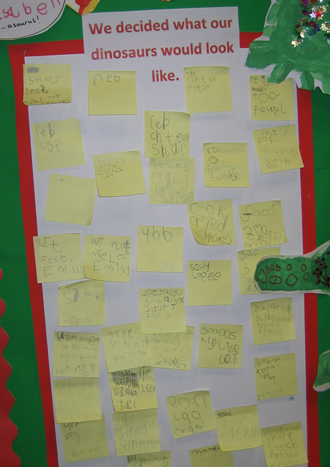
Prior to his visit, the children had been introduced to the term topic and the teaching team had used the K.W.L. technique to tease out from class what they thought they knew about dinosaurs and what they would like to learn about.  From this group brainstorming session, the children used post-it notes to jot down questions that they would like to put to the visitor from Everything Dinosaur.

An Amazing Collection of Questions Compiled for Everything Dinosaur

Questions all about dinosaurs.
All about dinosaurs. Compiling questions about dinosaurs. Picture credit: Everything Dinosaur.

Picture credit: Everything Dinosaur

Questions About Dinosaurs (K.W.L. Teaching Technique)

The K.W.L. acronym stands for what you KNOW, WHAT you would like to know and at the end of the teaching programme – what you have LEARNED.  This teaching method aids teachers and helps them to plan a topic area and to check understanding and learning.  It consists of three phases, firstly, the children brainstorm and say what they think they know about prehistoric animals.  During the brainstorming session, the children will make statements and assertions that provide the teaching team with details as to what the children would like to find out about dinosaurs.  The third part of the technique, which is conducted at the end of the term topic or period of learning, highlights what the children have learned.  This third phase permits the teaching team to check understanding and gives them the opportunity to reinforce leaning if required, for example, if any weak areas are identified.

Posted Up on the Classroom Wall – Lots of Questions About Dinosaurs

Children prepare questions about dinosaurs.
Dinosaur day inspires young, creative minds. Picture credit: Everything Dinosaur.

Picture credit: Everything Dinosaur

For further information about Everything Dinosaur’s work: Contact Everything Dinosaur.

Visit the Everything Dinosaur website: Everything Dinosaur.
22 04, 2019

Preparing and Extension Activity for Key Stage 1

By |2023-12-05T08:53:04+00:00April 22nd, 2019|Categories: General Teaching, Key Stage 1/2|Comments Off on Preparing and Extension Activity for Key Stage 1

Dinosaur Themed Extension Activity for Key Stage 1

Everything Dinosaur team members are getting ready for the start of the summer term (UK).  Staff have a lot of dinosaur and fossil themed workshops and other activities to prepare.  For example, in a few days, a team member is visiting a school to conduct some dinosaur workshops with Year 2 classes and once the workshops have been concluded they have been invited to a question and answer session with two classes of Year 2.

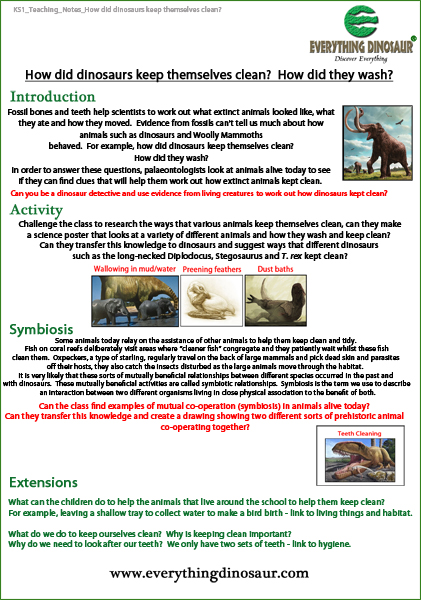
As part of our extension activities to help support the teaching team’s scheme of work, we have developed a lesson plan based around answering the question how did dinosaurs keep themselves clean?

Visit the award-winning Everything Dinosaur website: Everything Dinosaur.
A Helpful PDF – Dinosaur Extension Activity for Key Stage 1

To assist the teaching team, we have developed a lesson plan outlining the learning aims and objectives.  Fossil bones and teeth help scientists to work out what extinct animals looked like, what they ate and how they moved, but evidence from fossils can’t tell palaeontologists much about the way that prehistoric animals behaved.

Trace fossils such as trackways and burrows can provide some evidence, but in order to answer questions about Dinosauria hygiene, scientists have to study animals alive today in order to get some clues.  By studying living creatures palaeontologists can make educated assumptions about how extinct animals kept themselves clean.

Did Some Dinosaurs Roll Around in the Dust to Help Keep Themselves Clean?

Dinosaur extension activity for schools.
An extension activity for schools. How did dinosaurs keep clean? Picture credit: Everything Dinosaur.

Picture credit: Everything Dinosaur

A spokesperson from Everything Dinosaur commented:

“When we visit schools, we like to provide additional resources to help support the topic area.   We are happy to provide lots of free information including prepared lesson plans and lesson guides.  It is all part of our extensive programme of dinosaur and fossil themed workshops in schools.”

For further information about the range of science outreach offered by Everything Dinosaur: Email Everything Dinosaur.

19 04, 2019

The New Edition of the Encyclopedia of Dinosaurs

By |2023-12-05T08:24:53+00:00April 19th, 2019|Categories: General Teaching|Comments Off on The New Edition of the Encyclopedia of Dinosaurs

A New Book About Dinosaurs – “Encyclopedia of Dinosaurs”

Everything Dinosaur has been sent a new book about prehistoric animals for them to review.  The book is entitled “Encyclopedia of Dinosaurs – The Theropods”.  Written by Rubén Molina-Pérez and Asier Larramendi, the book focuses on the Theropoda, a suborder of the Dinosauria, perhaps the most diverse and speciose of all the dinosaur suborders.

The Front Cover of the “Encyclopedia of Dinosaurs – The Theropods”

Encyclopedia of Dinosaurs The Theropods"
The “Encyclopedia of Dinosaurs The Theropods” (front cover).

Picture credit: Natural History Museum (London)

The Theropoda (Beast Feet)

In this beautifully illustrated book, the focus is very much on the Theropoda (beast feet).  Theropod dinosaurs ruled the planet from millions of years, ranging from the some of the smallest dinosaurs known to science to the mighty carnivores such as Allosaurus, Carcharodontosaurus and Tyrannosaurus rex.  Crammed full of colour reconstructions and illustrations with vivid, user-friendly graphics and text, this book is a great addition to the book collection of dinosaur fans.  Published by the Natural History Museum, we have received an advance copy of this book so we can produce a review of this new publication.

Described as a stunningly illustrated guide packed with everything you could ever wish to know about the Theropoda, this new dinosaur book is aimed at academics as well as the general reader.

“The Encyclopedia of Dinosaurs – The Theropods”

Title: “Encyclopedia of Dinosaurs – The Theropods”
Price: £30 (hardback format)
Size: 288 pages with colour illustrations throughout
Publication date: May 2019
ISBN: 978 0 565 09497 3

Visit the Everything Dinosaur website: Everything Dinosaur.
19 04, 2019

Preparing for a Question and Answer Session with Year 2

By |2023-12-05T07:27:59+00:00April 19th, 2019|Categories: Adobe CS5, Educational Activities, Everything Dinosaur News and Updates, Main Page, Teaching|0 Comments

Preparing for a Question and Answer Session with Year 2

This week, sees the beginning of the summer term for schools in the UK.  Everything Dinosaur team members have a very congested programme of dinosaur and fossil workshops to look forward to over the next few weeks and in a few days a member of staff will be visiting a school in Lancashire to conduct a series of workshops with Year 2 classes.

As part of a busy morning of dinosaur and fossil themed activities, the teaching team have requested that we participate in a question and answer session with the budding, eager palaeontologists.  The children will, no doubt, pose some challenging and intriguing questions to our dinosaur expert, however, we have prepared a special question just for them as part of our programme of suggested extension activities.

Visit the Everything Dinosaur website: Everything Dinosaur.

Our question for the Key Stage 1 children (Year 2) – how did dinosaurs keep themselves clean?

Did Dinosaur Preen their Feathers just like Birds?

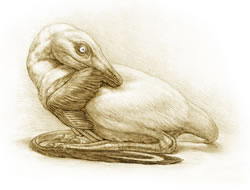
Mei long illustration.
Did dinosaurs preen their feathers like modern birds?  If many dinosaurs were feathered, how did they keep their feathers clean?

Everything Dinosaur Providing an Extension Activity

Fossil bones and teeth can provide palaeontologists with lots of information about extinct animals, but evidence from body fossils can’t tell us much about how animals that lived in the past behaved.  Trace fossils preserve evidence of the activity of animals, such as tracks, burrows, trails and borings.  From this data, scientists can infer behaviour such as dinosaurs moving in a herd, based on fossilised footprints indicating the same type of animals all moving at the same pace in the same direction.  However, there is very little evidence preserved in the fossil record about how extinct animals kept themselves clean.

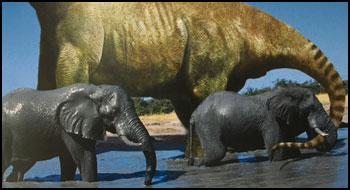
Did Sauropod Dinosaurs Wallow in Mud Like Some Large Mammals?

How did dinosaurs keep themselves clean?
If large mammals like extant elephants wallow in mud then perhaps large sauropod dinosaurs behaved in a similar way.

Our Challenge to the Year 2 Classes

In order to answer some of these questions about the behaviour of dinosaurs, palaeontologists examine the behaviours of animals alive today that are related to the Dinosauria.  By observing how birds and reptiles keep themselves clean, then perhaps the likely behaviours of dinosaurs can be deduced or inferred.

Can the Year 2 children conduct research into how living animals keep themselves clean?  Can they transfer this knowledge to the extinct members of the Dinosauria and suggest ways that different dinosaurs such as Apatosaurus and Tyrannosaurus rex kept clean?

Extensions

As with all our dinosaur and fossil workshops in school, we like to provide lots of extension ideas to the teaching team.

  • What can the children do to help the animals that live around the school to help them keep clean?  For example, providing a shallow tray filled with water to make a bird bath – linking to the English national curriculum science syllabus – living things and habitats.
  • Why do we need to keep clean?  Why is it important to brush our teeth?  A link to hygiene and personal development.

For further information about the outreach work conducted by Everything Dinosaur team members: Contact Everything Dinosaur.

17 04, 2019

Symbiosis in the Dinosauria

By |2023-12-05T08:22:54+00:00April 17th, 2019|Categories: General Teaching, Key Stage 1/2, Key Stage 3/4|Comments Off on Symbiosis in the Dinosauria

Symbiosis in the Dinosauria

Some animals alive today relay on the assistance of other animals to help them keep clean and tidy.  Tropical fish on coral reefs deliberately visit areas where “cleaner fish” congregate and they patiently wait whilst these fish clean them and remove dead skin and parasites.  In Africa, the Oxpecker (Buphagus spp.), a type of starling, regularly hitch a ride on the back of a large mammals, such as elephants and pick dead skin and parasites from their host’s hide.  These birds also catch insects disturbed as the large animals move through the scrub and bush.

Symbiosis in the Dinosauria

It is very likely that these sorts of mutually beneficial relationships between different species occurred in the past and with dinosaurs.

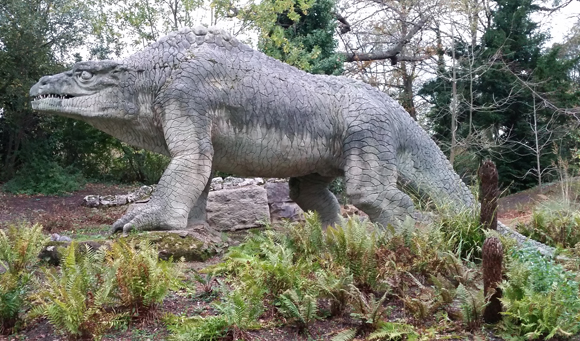
The Megalosaurus dinosaur at Crystal Palace Park.
The Megalosaurus statue at Crystal Palace a dinosaur from 1854. Since the nascent days of palaeontology, scientists have speculated about symbiosis within the Dinosauria. Picture credit: Everything Dinosaur.

Picture credit: Everything Dinosaur

Visit the Everything Dinosaur website: Everything Dinosaur.
Symbiosis – Classroom Extension Ideas

Mutually beneficial activities are termed symbiotic relationships by scientists.  In the picture (above), a statue of a large theropod dinosaur (Megalosaurus) is shown. Since the early days of studying dinosaur bones, symbiosis within the Dinosauria was suspected. Symbiosis is the term used to describe an interaction between two different organisms living in close physical association to the benefit of both.

  • Can your class find examples of mutual co-operation (symbiosis) in the natural world?
  • Can the class consider ways that pupils and staff at the school co-operate together?

For further information contact Everything Dinosaur: Email Everything Dinosaur.

9 04, 2019

A Colourful and Beautiful Dinosaur Themed Display

By |2024-05-11T16:53:44+01:00April 9th, 2019|Categories: Early Years Foundation Reception, General Teaching|Comments Off on A Colourful and Beautiful Dinosaur Themed Display

A Colourful Dinosaur Themed Display

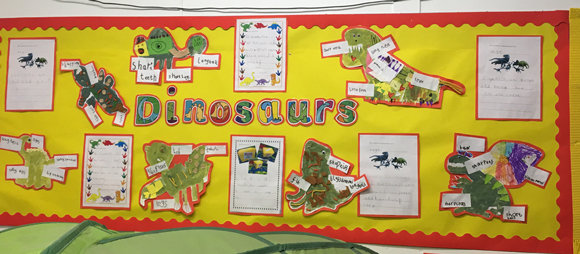
A very colourful and informative dinosaur and prehistoric animal display created by the Reception class at Micklehurst All Saints Primary school.  When visiting a school to conduct a series of dinosaur workshops with the Foundation Stage classes, our team member delivering the workshops, spotted a super, prehistoric animal themed display on the wall of a classroom “dinosaur den”.

A Colourful Dinosaur Themed Display Spotted in the Classroom

A dinosaur display in the children's dinosaur den.
A dinosaur display in the children’s dinosaur den. Picture credit: Everything Dinosaur.

Picture credit: Everything Dinosaur

A spokesperson for Everything Dinosaur commented:

“It was such a beautiful dinosaur display in the classroom, we asked permission of the teaching team so that we could take a photograph of the children’s work.”

Visit the award-winning Everything Dinosaur website: Everything Dinosaur.

2 04, 2019

Mei long – The Sleeping Dragon

By |2023-11-30T21:47:20+00:00April 2nd, 2019|Categories: General Teaching|Comments Off on Mei long – The Sleeping Dragon

Mei long – The Sleeping Chinese Dragon

The beautifully preserved fossils of a small, Chinese dinosaur have provided scientists with an insight into how some types of dinosaur might have slept.  Fossils of the little Chinese theropod dinosaur known as Mei long reveal that it coiled up in a sleeping posture with its head tucked under its arm and its tail wrapped around its body.  This sleeping posture preserved in a number of M. long specimens is very similar to the sleeping postures of many living birds.

A Life Reconstruction of the Little Chinese Feathered Dinosaur Mei long

Paleo-Creatures Mei long.
The Paleo-Creatures Mei long figure. Picture credit: Everything Dinosaur.

Picture credit: Everything Dinosaur

The Chinese company PNSO have a replica of this dinosaur in their range of figures.

To view the PNSO range of models: PNSO Age of Dinosaurs Models.

The fossils of Mei long come from north-eastern China.  These unfortunate dinosaurs were buried by hot volcanic ash as they slept.  Their fossils have been preserved in three-dimensions, helping palaeontologists to learn more about the resting and sleeping postures of theropod dinosaurs.

Visit the award-winning Everything Dinosaur website: Visit Everything Dinosaur.

21 03, 2019

Exploring the Properties of Materials – Exploring Dinosaurs

By |2023-11-30T09:43:50+00:00March 21st, 2019|Categories: Early Years Foundation Reception, General Teaching|Comments Off on Exploring the Properties of Materials – Exploring Dinosaurs

Dinosaurs Helping to Encourage Tactile, Creative Play

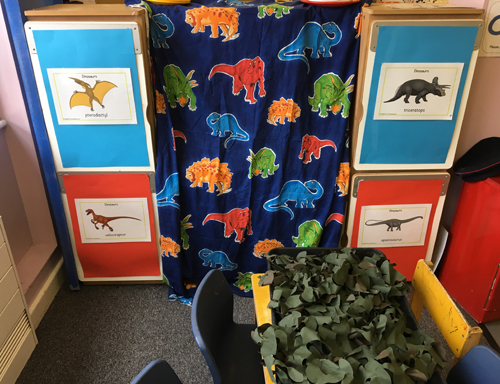
Team members praised the teaching team for having such a well-organised and spacious dinosaur den. We spotted this simple but very effective play area whilst on a visit to a school to conduct a series of dinosaur and fossil themed workshops with Reception classes.  The teaching team had laid out a number of play areas related to the term topic of dinosaurs.  One play area involved the children building their own “dinosaur world”. A second play area was dedicated to digging for dinosaur bones.

Tactile Exploration and Developing Creative Play

A tidy dinosaur den.
A spacious and tidy dinosaur den spotted in a Reception classroom. Picture credit; Everything Dinosaur.

Picture credit: Everything Dinosaur

A Tidy Dinosaur Den

Such a play area encourages creative play, the concept of sharing and working together. We spotted some simple guidelines and instructions stating how many children can play at a station at any one time.  The children have the opportunity to explore a range of materials and different types of dinosaur model.  This is a great resource for children to help them learn about the properties of materials and of great assistance to kinaesthetic orientated learners.

For dinosaur toys, models and games: Prehistoric Animal Models, Toys and Games.

A simple play area with dinosaur models and other tactile objects helps children to explore the properties of materials.  This is a wonderful resource to help encourage creative, independent, imaginative play.

It is an example of dinosaurs and prehistoric animals helping to encourage creative play amongst Foundation Stage children.

Visit the award-winning Everything Dinosaur website: Everything Dinosaur.
21 03, 2019

A Recipe for Dinosaur Shortbread Biscuits

By |2023-11-30T07:31:26+00:00March 21st, 2019|Categories: Adobe CS5, Dinosaur Fans, Educational Activities, Main Page, Press Releases, Teaching|0 Comments

Dinosaur Shortbread Biscuits Recipe

Here is a quick and simple recipe to make dinosaur shortbread biscuits.  Making biscuits such as these is a fun activity that young children can participate in.  These dinosaur shortbread biscuits make great treats or can be used to help with the catering for a dinosaur themed birthday party.

A Recipe for Dinosaur Shortbread Biscuits

Dinosaur shortbread biscuits recipe.
A recipe for dinosaur shortbread biscuits.  A simple biscuit recipe that is a great idea for a dinosaur themed birthday party – perfect for prehistoric party fun! Picture credit: Everything Dinosaur.

Picture credit: Everything Dinosaur

Ingredients (Makes About Twenty Biscuits)

  • Butter or margarine 110 grammes (4oz)
  • Caster sugar 50 grammes (2oz)
  • Plain flour, sifted 175 grammes (6oz)
  • Extra caster sugar for dusting

Method

  1. Preheat the oven to 150°C /300°F (Gas mark 2).  Lightly grease two baking sheets.
  2. Begin by first beating the butter (or margarine) with a wooden spoon to a soft consistency, and then beat in the sugar, followed by the sifted flour.
  3. Still using the wooden spoon, start to bring the mixture together, then finish off with your hands to form a paste.
  4. Transfer the mixture to a board lightly dusted with caster sugar, and then quickly and lightly roll it out to about 1/8 inch (3mm) thick (dusting the rolling pin with sugar if necessary).
  5. Cut the biscuits out using dinosaur biscuit cutters or, a dinosaur-shaped card that acts as a template and then arrange them on the baking sheet and bake on a highish shelf in the oven for 30 minutes.  Cool the biscuits on a wire rack, dust them with some caster sugar, and store in an airtight tin to keep them crisp.
  6. Once cooled, the biscuits can be iced and decorated to make a fun dinosaur themed snack or an ideal party food for a prehistoric animal themed party or other special occasion.

Dinosaur Biscuits – Just Out of the Oven

Dinosaur biscuits
Dinosaur biscuits cooling on a wire rack.  Once cooled, these biscuits can be decorated. Picture credit: Everything Dinosaur.

Picture credit: Everything Dinosaur

The Everything Dinosaur Weblog

The Everything Dinosaur weblog is crammed full of helpful articles aimed at the parents, grandparents and guardians of dinosaur enthusiasts and budding, young palaeontologists.  If you search our blog using terms such as “dinosaur party”, “cake” and “biscuit”, you will discover lots of helpful articles, ideas, recipes and suggestions to assist you with dinosaur themed party planning and other fun prehistoric animal orientated activities.  Have fun!

Everything Dinosaur is a UK-based supplier of dinosaur and prehistoric animal themed models, toys and merchandise, check-out our website: Visit Everything Dinosaur.

Go to Top