By Mike|2024-05-06T09:23:23+01:00March 10th, 2020|Categories: General Teaching|Comments Off on Supporting the Amazing “Dippy on Tour”
Everything Dinosaur Supporting “Dippy on Tour”
As part of the Natural History Museum of London’s nationwide tour of the Diplodocus dinosaur replica “Dippy on Tour”, Everything Dinosaur has been asked to provide a number of dinosaur and fossil themed outreach activities to help support the public’s perception of science. During March (2020), team members will be visiting several locations in the north-west of England providing dinosaur and fossil themed workshops aimed at families.
Everything Dinosaur’s Outreach Activities Supporting a Nationwide Dinosaur Tour
Everything Dinosaur’s dinosaur and fossil theme workshops planned for the “Dippy on Tour” exhibition. Picture credit: Everything Dinosaur.
Picture credit: Everything Dinosaur
These fun and lively events sold out a long time ago. Everything Dinosaur’s programme includes visiting numerous libraries and other public buildings and delivering educational and fun, family orientated dinosaur and fossil themed workshops.
A spokesperson for the company said:
“We are looking forward to the workshops and we are going to be very busy tackling all the questions about dinosaurs that we are going to be asked. Our plan is to give away a few fossils too.”
The picture (above) depicts a Natural History Museum Diplodocus replica. These figures are available through Everything Dinosaur and help support the “Dippy on Tour” programme.
By Mike|2024-01-17T14:12:07+00:00March 8th, 2020|Categories: General Teaching|Comments Off on Celebrating the Important Role of Women in Science on International Women’s Day 2020
Celebrating the Role of Women in Science on International Women’s Day
Today, (March 8th 2020), is International Women’s Day. International Women’s Day is an annual event, which has its origins in the early part of the 20th century. This day provides us with an opportunity to highlight the enormous contribution to science and scientific enquiry made by women.
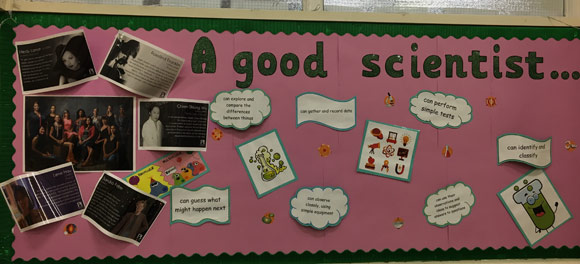
Everything Dinosaur took a photo of an appropriate poster on display at a school. The school was Ilderton Primary. Everything Dinosaur team members were visiting the school to conduct a fossil workshop. The poster highlighted the role of women in science.
Recognising and Celebrating the Contribution of Women in Science
Celebrating the role of women in science. A poster celebrating the role of women in science. The photograph was taken on a visit to Ilderton Primary. Picture credit: Everything Dinosaur.
Picture credit: Everything Dinosaur
On a visit to a school in London (Ilderton Primary), to deliver a series of dinosaur and fossil themed workshops, an Everything Dinosaur team member spotted a wonderful display highlighting the role of women in science.
It is great to see women in science celebrated in this way, we hope that the display helps to motivate and enthuse the next generation of women scientists.
The user-friendly and award-winning Everything Dinosaur website: Everything Dinosaur.
By Mike|2024-01-17T07:49:26+00:00February 14th, 2020|Categories: General Teaching|Comments Off on New Research Suggests Climate Change Could Adversely Affect Amphibians and Reptiles
New Research Suggests Climate Change Could Adversely Affect Amphibians and Reptiles
Researchers from Tel Aviv University (Israel) and Queen’s University Belfast have carried out one of the most comprehensive studies to date to better understand what affects life expectancy among all living vertebrates in the world. The study’s conclusions not only challenge a long-accepted theory about the lifespan of organisms, but also provide a new perspective on climate change – that global warming could have a huge impact on the life expectancy among cold-blooded animals such as reptiles and amphibians.
Studying Reptiles and Amphibians
With many schools having ponds in their grounds and wildlife areas, it is important to emphasise how crucial these habitats are for many animals, particularly frogs, toads and newts as the spawning season gets underway.
Forty-one Percent of All Amphibian Species Assessed to Date* Are Threatened with Extinction
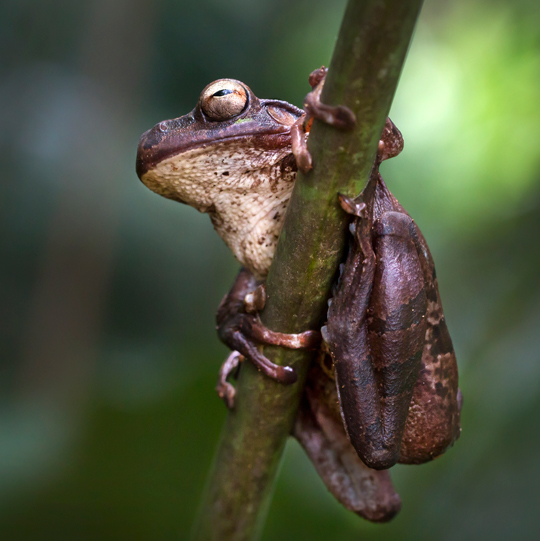
Cold-blooded animals such as frogs may be exceptionally vulnerable to climate change.
Picture credit: Queen’s University Belfast
* International Union for Conservation of Nature Red List Data.
The “Rate of Living” Theory
Some animals with backbones, such as some species of frog, can live for less than a year. Whilst other animals such as elephants and turtles can live for a very long time. The “rate of living” theory has long been accepted as an explanation as to why organisms age. According to this theory, the faster the metabolic rate the shorter the lifespan.
The scientists from Queen’s University Belfast and Tel Aviv University looked at data from over 4,100 land vertebrate species from across the planet to test the prevailing “rate of living” theory. They found that ‘rate of living’ does not affect aging rates, rejecting the previously accepted link between metabolism and lifespan.
Identifying Extinction Factors for Reptiles and Amphibians
The study, published today (Friday 14 February), in the journal Global Ecology and Biogeography, found that rates of aging in cold-blooded organisms including amphibians and reptiles are linked to high temperatures. These findings led the scientists to propose an alternative hypothesis: the hotter the environment is, the faster the rate of living that in turn leads to more accelerated aging and a shorter lifespan. Dr Daniel Pincheira-Donoso, co-author and Lecturer in Evolution & Macroecology at the School of Biological Sciences at Queen’s University Belfast, explained:
“Our findings can have critical implications for our understanding of factors that contribute to extinctions, especially in modern times when we are facing a worldwide decline of biodiversity, with cold-blooded animals being particularly endangered. Now we know that the life-expectancy of cold-blooded vertebrates is linked to environmental temperatures, we could expect to see their lifespans further reduced as temperatures continue to rise through global warming.”
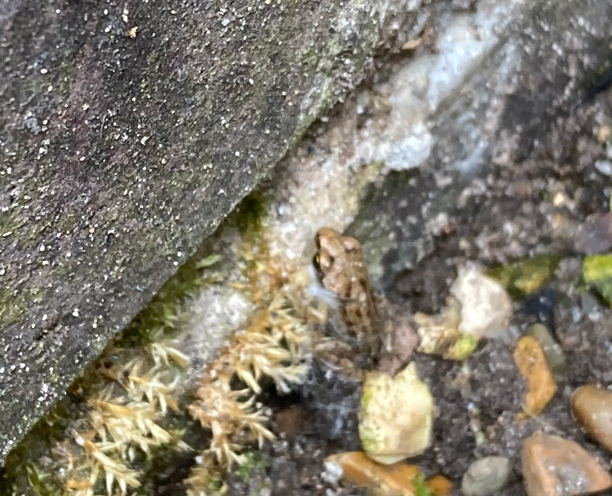
A Tiny Frog Emerging from a Pond
A close-up view of the tiny, baby frog spotted near to the office pond. Picture credit: Everything Dinosaur.
Providing suitable habitats for animals such as frogs, newts and toads is essential. School wildlife areas, especially those with a body of water can play a vital role in helping to sustain local populations, as well as providing schoolchildren with an opportunity to study wildlife at close quarters. Teaching teams can then use these resources to help link learning to key elements of the science curriculum.
By Mike|2024-01-17T07:37:34+00:00February 12th, 2020|Categories: General Teaching|Comments Off on New Dinosaur Model Wins Award
Wild Safari Prehistoric World Camarasaurus Model Wins Award
Readers of the magazine “Prehistoric Times” have voted the Wild Safari Prehistoric World Camarasaurus model the best dinosaur model of 2019. The discerning readers of the magazine selected this dinosaur figure based on its scientific accuracy and its suitability for permitting creative, imaginative play.
Camarasaurus Model
The Wild Safari Prehistoric World Camarasaurus Model Wins an Award
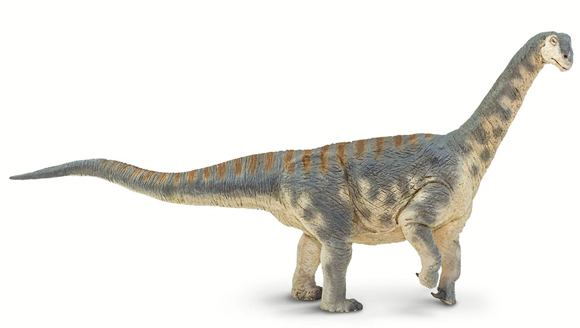
The award-winning Wild Safari Prehistoric World Camarasaurus dinosaur model.
An Extensive and Diverse Prehistoric Animal Model Range
The Wild Safari Prehistoric World model range from Safari Ltd features an extensive range of extinct animals and other prehistoric creatures. The Camarasaurus figure, the largest dinosaur introduced by this American company last year, has been voted the best dinosaur toy of 2019 by readers of “Prehistoric Times” magazine.
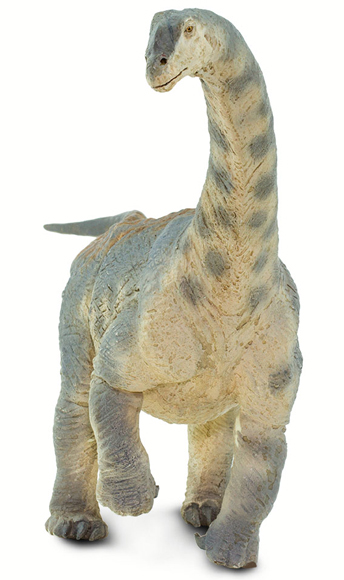
The Camarasaurus model (pronounced KAM-are-oh-sore-us ), measures around thirty-five centimetres long and that carefully sculpted head stands some sixteen centimetres high. The model is not too heavy and ideal for little hands and creative minds. The design team at Safari Ltd work hard to ensure that the dinosaur models that they create are scientifically accurate, utilising the latest research from palaeontologists to assist them in this process.
Voted the Best Dinosaur Toy of 2019 – The Wild Safari Prehistoric World Camarasaurus Dinosaur Model
The award-winning Wild Safari Prehistoric World Camarasaurus dinosaur model.
Picture credit: Everything Dinosaur
Wild Safari Prehistoric World Camarasaurus Model
“Prehistoric Times” readers praised the model for its intricate paint detail and the pose of the dinosaur with its foot raised as if the animal was in motion. Whether on the shelf or in the toy chest, the Wild Safari Prehistoric World Camarasaurus makes an excellent accessory helping to encourage children to have fun and play whilst learning about dinosaurs and life in the past.
Commenting on the award, a spokesperson for UK-based Everything Dinosaur stated:
“Our teaching team recognises the benefits of creative, imaginative play. It is wonderful to see that the great care and attention to detail that Safari Ltd put into their dinosaurs has been acknowledged by readers of the magazine. At the heart of everything that Safari Ltd do, is the desire to develop toys that teach, helping to educate young learners, fostering their curiosity and their respect for the environment and conservation. Learning about long extinct creatures such as the Camarasaurus can help children become enthusiastic environmental activists and provide a perspective on climate issues affecting our planet today.”
By Mike|2024-01-14T10:58:47+00:00January 31st, 2020|Categories: General Teaching|Comments Off on Pachycephalosaurus with a Bump on its Head
Pachycephalosaurus with a Cranial Lesion
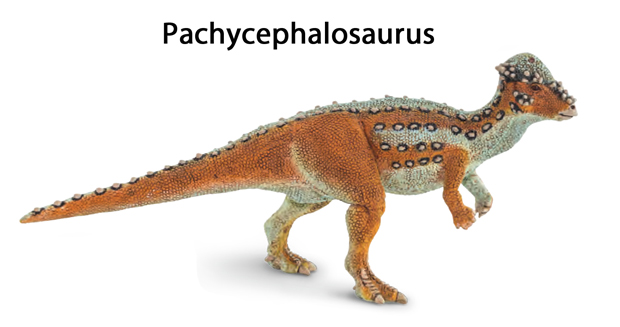
The recently introduced (2020), Wild Safari Prehistoric World Pachycephalosaurus dinosaur model is a highly detailed and scientifically accurate replica of a Late Cretaceous prehistoric animal. This dinosaur toy has been expertly sculpted to highlight distinctive traits and characteristics of a “bone-headed” dinosaur. The dome-headed skull with all its lumps and bumps has been skilfully recreated by the design team at Safari Ltd.
There’s even a scar on the skull showing the damage incurred as a result of a fight with another dinosaur.
Pachycephalosaurus Dinosaur Model
An Everything Dinosaur Team Member Points out the “Battle Damage” on the Skull of the Dinosaur Model
A close-up view of the top of the head of the Wild Safari Prehistoric World Pachycephalosaurus model with the “battle damage” highlighted. Picture credit: Everything Dinosaur.
The models and figures that make up the Wild Safari Prehistoric World range by Safari Ltd are great for creative, imaginative play. The prehistoric animal models are thoroughly researched so that they are as accurate as possible. The Pachycephalosaurus figure has been intricately painted in a striking orange colour with the skull area coloured grey. It is an excellent figure, one that will encourage children to have fun and play whilst learning more about the lives of long extinct animals.
The Wild Safari Prehistoric World Pachycephalosaurus Dinosaur Model (Safari Ltd)
The new for 2020 Wild Safari Prehistoric World Pachycephalosaurus model. Picture credit: Everything Dinosaur.
Picture credit: Everything Dinosaur
A spokesperson from Everything Dinosaur commented:
“Safari Ltd have a substantial range of dinosaurs and prehistoric animal models in their portfolio. The design team try their very best to provide scientifically accurate figures and this Pachycephalosaurus with its battle damage is typical of this model range. Providing a dinosaur with a realistic dent in its skull (battle damage), helps children to appreciate that these models represent animals that lived in the past, animals that were just as active and complex as many animals that the children are familiar with that are alive today.”
By Mike|2024-01-13T10:10:08+00:00January 14th, 2020|Categories: General Teaching, Key Stage 1/2|Comments Off on Ysgol Maes Owen – Deinosoriaid A Wonderful Workshop
Ysgol Maes Owen – Deinosoriaid
The children in Year 3 and Year 4 at Ysgol Maes Owen in North Wales have been studying dinosaurs and fossils this spring term. The eager young palaeontologists constructed a “dinosaur island” and are researching prehistoric animals so that they can populate their own “Jurassic World”. As part of the term topic, the enthusiastic teaching team have challenged the children to learn lots of dinosaur facts and to build a set of dinosaur “Top Trumps”. We hope our advice about which was the cleverest dinosaur helped.
Dinosaurs and Fossils
With four workshops to squeeze into the day, a classroom had to be allocated for the visitor from Everything Dinosaur. Not to worry, there was plenty of space in the classroom to put all the resources our dinosaur expert had brought and there was still room to have a go at creeping through a forest like a giant, armoured dinosaur.
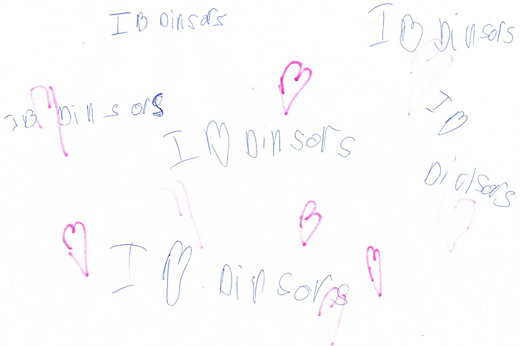
During wet play (thanks to storm Brendan), Lilly demonstrated her appreciation of dinosaurs (deinosoriaid), she certainly enjoys learning all about dinosaurs as her note (below) shows.
Lilly Shows Her Appreciation for Dinosaurs
Young girl writes about dinosaurs. Picture credit: Everything Dinosaur.
Picture credit: Everything Dinosaur
We are sure the footprint measuring resources along with the dinosaur timeline lesson plan we provided will help the teaching team with this exciting topic.
Whilst on a visit to a school to deliver a series of dinosaur and fossil themed workshops to lower Key Stage 2 classes, one of our team members at Everything Dinosaur was given the opportunity to view some of the work carried out by the Year six children as they studied Darwinism and natural selection as part of their curriculum.
Several of the children had collaborated on poster displays providing an outline of Darwin’s ground-breaking theory regarding how populations change due to the transfer of heritable traits from one generation to another. The posters included details of Darwin’s life such as his voyage on the Beagle, his work on the finches on the Galapagos Islands and of course, the publication of his book “The Origin of Species” and its consequences for academia and the wider world.
Gomphotherium
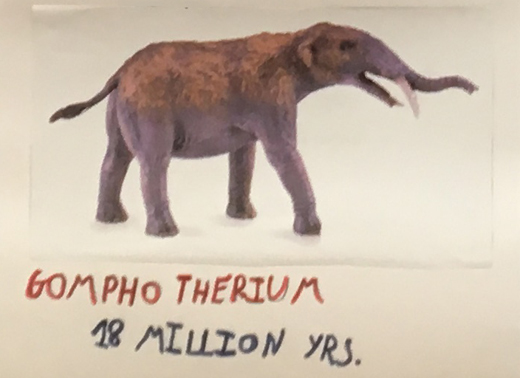
One part of the display focused on the evolution of the elephant family (Order Proboscidea) and our eagle-eyed team member spotted an image of the CollectA Deluxe 1:20 scale Gomphotherium model that had been used to help illustrate different genera of ancient elephants.
An Image of the CollectA Deluxe 1:20 Scale Gomphotherium Model Features in the Display
The CollectA Deluxe 1:20 scale Gomphotherium model features in a display on the evolution of elephants. Picture credit: Everything Dinosaur.
Many different types of prehistoric elephant were featured in the posters. For example, one of the earliest and most primitive members of the elephant family – Moeritherium was featured, along with Deinotheres and representatives of the Mammuthus genus.
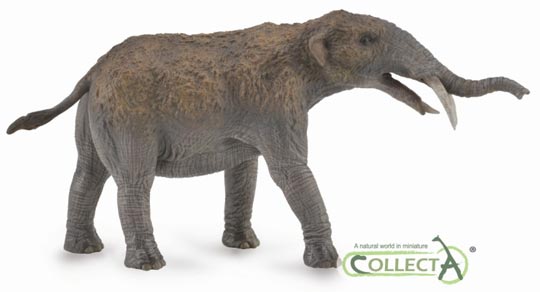
The CollectA Deluxe Gomphotherium Model
The CollectA 1:20 scale Gomphotherium model.
Our team member suggested that Everything Dinosaur would be happy to assist the children with their studies by providing scale drawings of a number of proboscideans.
By Mike|2024-05-06T09:25:24+01:00December 16th, 2019|Categories: General Teaching|Comments Off on A Fantastic and Colourful Cretaceous-themed Seasonal Gift
Colourful Cretaceous-themed Seasonal Gift
During our many visits to schools to deliver dinosaur and fossil themed workshops, we are constantly amazed at the creativity of the teaching teams and the schoolchildren. As the autumn term draws to a close we know that this time of year is exceptionally busy for schools. With Christmas just around the corner and many schools due to break up for the holidays in the next few days or so, there is so much still to do. Plus, of course there is all the planning for the scheme of work for the next term to complete.
A Sesonal Dinosaur Gift
We know from our bulging mail bag and congested email inbox that lesson plan preparation and topic area research are well underway in schools as dedicated teaching teams and their senior leadership finalise plans for spring.
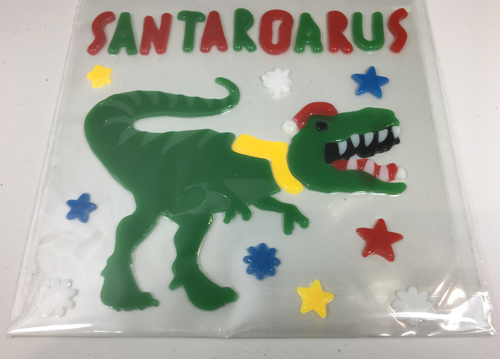
We were surprised therefore to receive this thoughtful seasonal gift in the post. A very creative idea, a set of window stickers for our office with a dinosaur theme.
A Creative and Seasonal Gift for our Dinosaur Experts
A seasonal decoration with a dinosaur theme. Picture credit: Everything Dinosaur.
Picture credit: Everything Dinosaur
There are so many inspirational and clever teachers in schools. We get to work with some extraordinary and very talented people. This certainly is a very colourful and creative gift, which our dinosaur experts greatly appreciate.
By Mike|2024-01-06T13:34:36+00:00December 10th, 2019|Categories: Key Stage 1/2|Comments Off on Dinosaurs Help with Sentence Construction
Dinosaurs Help with Sentence Construction
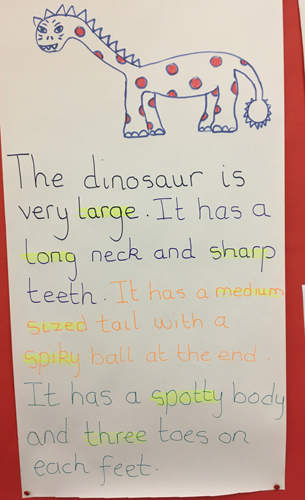
A team member from Everything Dinosaur spotted this innovative approach to teaching Key Stage 1 children the rudiments of sentence construction whilst on a visit to the school to conduct a dinosaur and fossil themed workshop. In order to help the Year 1 children to understand how sentences are formed, the teacher had drawn a dinosaur and asked the children to describe it. The adjectives the class came up with when they viewed the drawing were recorded and then these adjectives were used to construct a sentence.
Dinosaur Themed Teaching
Dinosaurs Help with Sentence Construction
A super example of a dinosaur themed activity helping to support Year 1 literacy. This example was spotted on a visit to Greenhill Primary in Bury. Picture credit: Everything Dinosaur.
Picture credit: Everything Dinosaur
We are not quite sure what the genus the dinosaur illustration represents, perhaps it is one that has yet to be formally scientifically described. That’s not the point, when it came to using adjectives the spotty dinosaur provided the class with plenty of opportunities to come with lots of “describing words”.
By Mike|2024-01-06T11:40:57+00:00December 6th, 2019|Categories: General Teaching, Key Stage 1/2|Comments Off on Greenhill Primary Children Enjoy Learning About Fossils and Dinosaurs
Greenhill Primary Palaeontologists
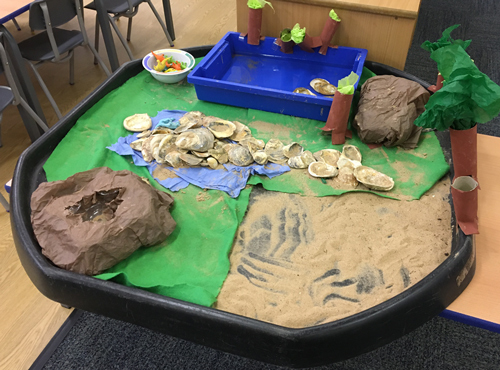
Children in Year 1 at Greenhill Primary (Bury, Greater Manchester), have been busy learning all about dinosaurs and other prehistoric animals this term. A team member was given the opportunity to visit the school to work with the eager, young palaeontologists over the course of the morning. The first part of the session was based in the spacious hall, the second part of the workshop, which involved dinosaur footprint measuring and finding fossils, took place in the well-appointed and very tidy classroom.
Pupils as Palaeontologists
Year 1 Children Had Created a Play Area for Their Dinosaurs
Children from Greenhill Primary have created a dinosaur play area. Picture credit: Everything Dinosaur.
Picture credit: Everything Dinosaur
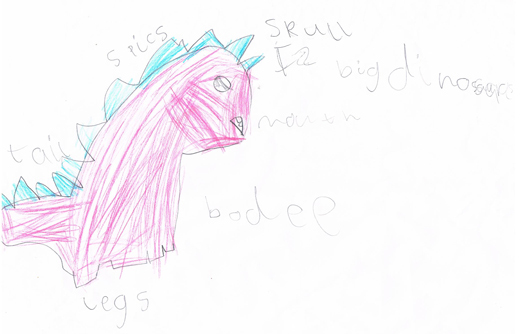
As an extension exercise, our dinosaur expert challenged the children to draw a dinosaur and to label its body parts including the skull. During the wet play, Nayaab drew and labelled a beautiful pink and blue dinosaur which was then presented to Everything Dinosaur at the conclusion of the morning’s activities.
Drawing and Labelling a Dinosaur
A beautiul pink dinosaur drawn by a young palaeontologist. Picture credit: Everything Dinosaur.