All about dinosaurs, fossils and prehistoric animals by Everything Dinosaur team members.

Pictures of fossils, fossil hunting trips, fossil sites and photographs relating to fossil hunting and fossil finds.

11 03, 2019

New Australian Ornithopod Described

By |2023-11-24T14:03:06+00:00March 11th, 2019|Categories: Dinosaur and Prehistoric Animal News Stories, Dinosaur Fans, Main Page, Palaeontological articles, Photos/Pictures of Fossils|0 Comments

Galleonosaurus dorisae – A New Aussie Dinosaur

A new type of Australian dinosaur has been described from the fossilised remains of five upper jaw bones (maxillae) found at the Flat Rocks locality in the Wonthaggi Formation in the famous Gippsland Basin of Victoria.  Five small-bodied ornithopods are now known from the state of Victoria.  The new plant-eating dinosaur has been named Galleonosaurus dorisae.  The jaw bones are of different sizes and this has permitted palaeontologists to plot growth changes in these little dinosaurs as they matured.

Writing in the Journal of Palaeontology, the researchers which include Matthew Herne (University of New England, New South Wales) and Alistair Evans (Monash University, Melbourne), used detailed CT-scans of the fossil material to gain fresh insights into the structure and morphology of the cranial anatomy and dentition of small Australian ornithopods.  The research leading to the establishment of this new genus has also helped to define more clearly other small ornithopods known from the Gippsland Basin and the Otway Basin located on the opposite side of Port Phillip Bay.

A Life Reconstruction of the Newly Described Ornithopod Galleonosaurus dorisae

Galleonosaurus dorisae illustrated.
A life reconstruction of the newly described Australian ornithopod Galleonosaurus dorisae.

Picture credit: James Kuether

Galleonosaurus dorisae – “Galleon Lizard”

When the scientists were examining the maxillae, their shape reminded them of the upturned hull of an old-fashioned sailing ship – a galleon.  It was the morphology of the jaw that inspired the genus name “Galleon Lizard”.  The species or trivial name honours Doris Seegets-Villiers for her geological, palynological, and taphonomic work on the Flat Rocks fossil vertebrate locality.

Jaw Fossils and a Tooth with a CT-scan of the Fossil Material
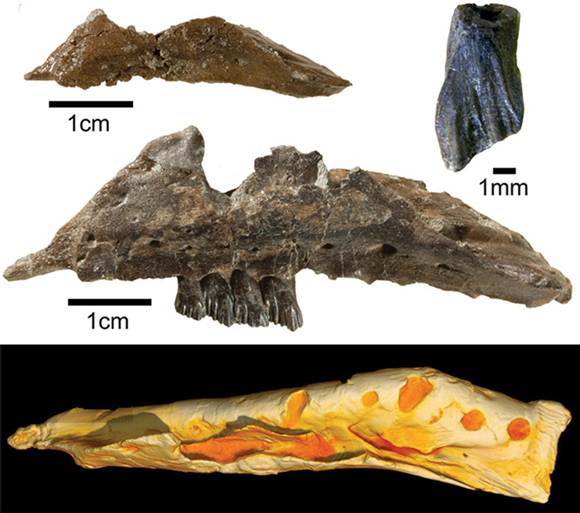
Galleonosaurus fossiils and a CT-scan of a jaw.
Fossil jaw bones, a single tooth and a CT-scan image of a jaw bone (Galleonosaurus dorisae).

Picture credit: Herne et al

Niche Partitioning in Ornithopods

The plethora of vertebrate fossils at the Flat Rocks site, suggests that several more dinosaurs await discovery.  However, for the moment, the researchers are confident that Galleonosaurus shared its habitat with at least one other small, light, fast-running ornithopod – Qantassaurus intrepidus.  The jaws of Qantassaurus are more robust and more powerful.  The researchers were able to confirm that Q. intrepidus is uniquely characterised by a deep, foreshortened dentary (lower jaw).  This suggests that the robust Q. intrepidus and the more gracile jawed G. dorisae fed on different vegetation, they did not compete directly for food, an example of niche partitioning.

Dr Herne described Galleonosaurus:

“We know it would have been a two-legged, quite agile plant-eating dinosaur.  It seems that Galleonosaurus was no doubt closely related to possibly as many as four or five other species that look a little bit similar and were similar sizes, but we can tell they’re different by the anatomy of the jaws and the teeth.”

A Lush Conifer Dominated Rift Valley with an Immense Volcanic Mountain Chain to the East

Extensive research on the Otway Formation material to the west of Port Phillip Bay in conjunction with research on the geology of the Gippsland Basin have permitted scientists to build up a picture of what life was like in this part of Australia during the Early Cretaceous.  The dinosaurs lived in an extensive rift valley that had formed as Australia began to separate from Antarctica.

Conifer forests dominated and at such high latitudes, the lush environment would have been subjected to long periods of extensive daylight in the summer, but conversely the winters would have been cold with little daylight each day.  Although the Earth’s climate was much warmer than today during the Early Cretaceous, it is quite possible that these little dinosaurs would have had to endure winter temperatures close to freezing.

Gondwana in the Early Cretaceous (Barremian Faunal Stage)
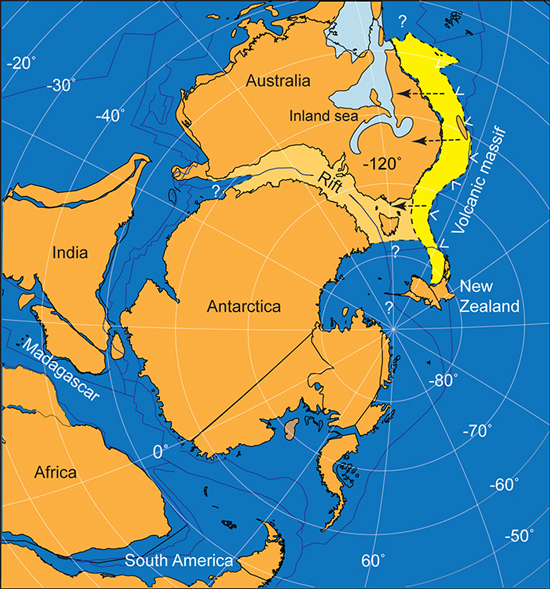
Gondwana in the Early Cretaceous.
Around 125 million years ago, although Gondwana was breaking up, Australia was still linked to Antarctica with a large volcanic mountain range to the east.

Picture credit: Herne et al

A Skeletal Reconstruction of the Skull of Galleonosaurus and the Anatomical Position of Jaw Material
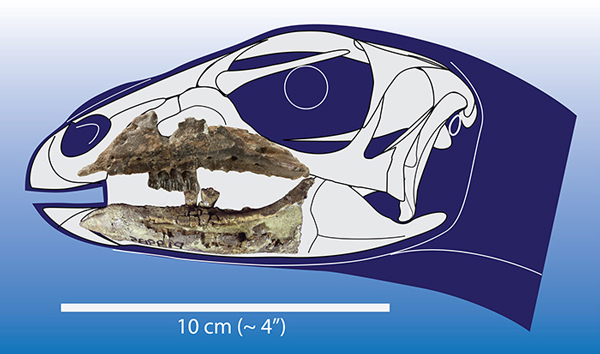
Jaw fossils of Galleonosaurus dorisae.
An illustration of the skull of Galleonosaurus dorisae with fossil elements placed in the correct anatomical position.  The lower jaw shown in the image might pertain to G. dorisae based on a reassessment of other known lower jaw elements associated with Q. intrepidus and Atlascopcosaurus loadsi.

Picture credit: Herne et al

A Phylogenetic Analysis of Galleonosaurus dorisae

The scientists conclude that a highly diverse, small-bodied ornithopod fauna flourished in the periodically disturbed, high-latitude, riverine floodplain environment of the Australian-Antarctic rift valley during the Early Cretaceous (Barremian to Early Albian faunal stage).  A phylogenetic analysis places Galleonosaurus as the earliest member of the Elasmaria, a clade of Gondwanan ornithopods distantly related to the Hypsilophodonts.

The Five Victorian Ornithopods – Spanning 12 million years

The Lower Cretaceous rocks either side of Port Phillip Bay were laid down at different times during the Cretaceous.  The Gippsland Basin deposits close to the town of Inverloch, were laid down around 125 million years ago, however, the Otway Basin deposits (Eumeralla Formation), represent younger material laid down in the Early Albian (113 million years ago).

  1. Leaellynasaura amicagraphica – named in 1989 (Early Albian faunal stage), from the Eumeralla Formation (Otway Basin).
  2. Atlascopcosaurus loadsi – also named in 1989 from the Eumeralla Formation.
  3. Diluvicursor pickeringi – named in 2018 (Eumeralla Formation).  To read an article about the discovery of this dinosaur: Fast-running Ornithopod from Victoria.
  4. Qantassaurus intrepidus named in 1999 from the Wonthaggi Formation (Gippsland Basin) – older strata associated with the Barremian faunal stage of the Early Cretaceous.
  5. The newly described Galleonosaurus dorisae (2019), also from the Wonthaggi Formation.

Dr Herne stated:

“The interesting thing about that whole coast line is it gives us a decent age range over quite a long period.”

A spokesperson from Everything Dinosaur commented:

“It is likely that many more small dinosaurs are going to be named and described in the future.  Fossil finds from Victoria will, most likely, lead to further revisions of Gondwanan ornithopod taxonomy.”

For models and replicas of ornithopods and other dinosaurs: Dinosaur and Prehistoric Animal Models.
3 03, 2019

New Research into Late Triassic Frogs of North America

By |2023-11-23T14:50:38+00:00March 3rd, 2019|Categories: Dinosaur and Prehistoric Animal News Stories, Main Page, Palaeontological articles, Photos/Pictures of Fossils|0 Comments

The Earliest Equatorial Record of Frogs

Researchers including palaeontologists from the Department of Geosciences at Virginia Tech, have identified tiny fossil fragments collected from Upper Triassic deposits in Arizona that provide evidence of the oldest known frogs from North America.  Although, no new genus has been erected, the scientists are confident that further study of the microfossils at the location may yield skull and jaw bones which will result in the naming of new species.

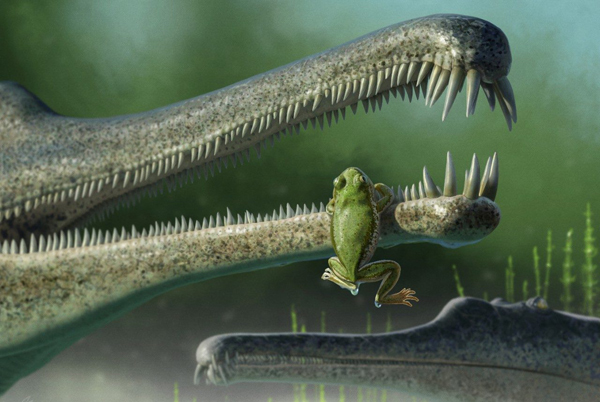
A Little Chinle Frog Has a Close Encounter with a Phytosaur

A suggested encounter between a frog and a phytosaur.
A Chinle frog encounters a phytosaur. It is likely that phytosaurs would have fed on amphibians.

Picture credit: Andrey Atuchin

The Oldest Known Frogs from North America

The fossils are composed of several tiny pieces of hip bone, (from the ilium), they were collected last May from three separate locations within the famous Chinle Formation and they have been dated to between 223 and 213 million years ago.  The bones represent the earliest equatorial record of the Salientia, the group that includes stem and crown-frogs.  These tiny amphibians, little more than two centimetres in length, are not direct ancestors of modern frogs (Anura).

One of the authors of the scientific paper, published in the journal Biology Letters, Assistant Professor Michelle Stocker, stated that these fossils underscore the importance of microfossil collection, analysis and study as it helps palaeontologists to build up a more comprehensive picture of an ancient ecosystem.

New Insights into a Triassic Ecosystem

Assistant Professor Stocker explained:

“This new find highlights just how much there is still to learn about the Late Triassic ecosystem and how much we can find when we just look a little closer.  We are familiar with the charismatic archosaurs from the Chinle Formation, but we know that based on other ecosystems, they should make up a small percentage of the animals that lived together.  With this new focus, we are able to fill in a lot of those missing smaller components with new discoveries.”

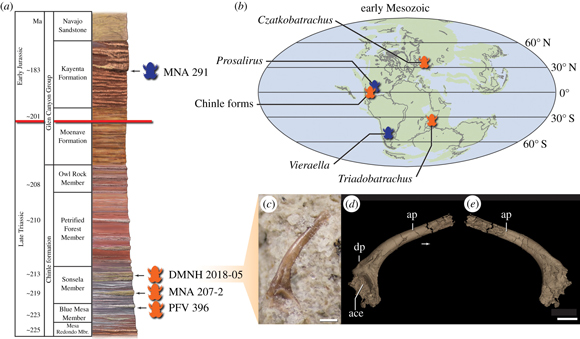
Time-calibrated Stratigraphic and the Geographical Distribution Across Pangaea of Triassic and Jurassic Anurans

The stratigraphic and biogeographic distribution of Triassic and Jurassic fossil frogs.
Time-calibrated stratigraphic and biogeographic distribution of Triassic and Jurassic Period anuran specimens.

Picture credit: Biology Letters

The image above shows (a) the stratigraphic sequence indicating the three fossil examples of Chinle frogs and their relationship to the Early Jurassic Prosalirus (MNA 291) from the Kayenta Formation (Arizona), whilst (b) shows the biogeographic distribution of fossil anurans from the Jurassic and Triassic.  Note, the proximity of the Late Triassic Chinle frogs to the equator.  Photograph (c) shows an eyelash sized fossil ilium whilst (d) and (e) are computerised scans of the same fossil material shown in lateral and medial views.  Scale bars equal 1 millimetre.

Chinle Formation Frogs – Long and Hollow Hip Bones

The fossil material gathered from extensive sieving  and screen washing of sediments in order to obtain microvertebrate fossils, consists of long, hollow hip bones with the hip socket offset rather than centred, anatomical traits that are characteristic of frogs and that help to support their hoping style of locomotion.  Stocker and her collaborators include fellow scientists from Virginia Tech, Arizona’s Petrified Forest National Park, and the University of Florida’s Museum of Natural History.

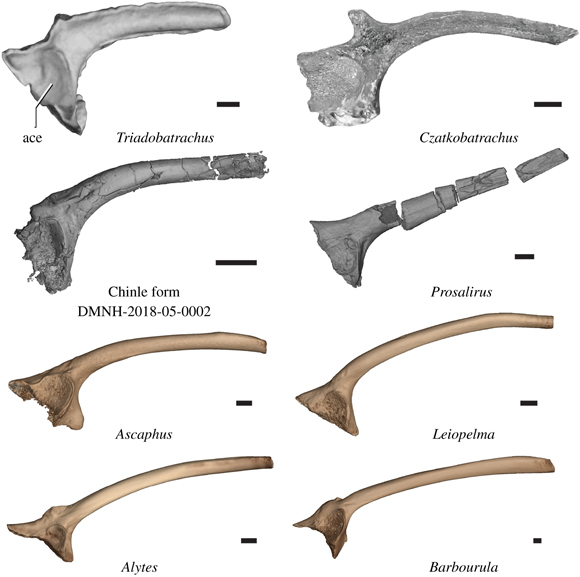
The Chinle frogs share more features with living frogs and Prosalirus, a genus of Early Jurassic frog found in sediments from the present-day Navajo Nation (Arizona), than to Triadobatrachus, an Early Triassic frog discovered in Madagascar.

Stocker added:

“These are the oldest frogs from near the equator.  The oldest frogs overall are roughly 250 million years old from Poland [Czatkobatrachus] and Madagascar, but those specimens are from higher latitudes and are not equatorial.”

Comparing the Ilia of Stem Anurans

Comparing fossilised hip bones from stem anurans (frogs).
Comparing the ilia of stem anurans and those of extant frogs (Ascaphus, Leiopelma, Alytes and Barbourula) scale bar = 1 mm.

Picture credit: Biology Letters

Frog Evolution

Co-author Sterling Nesbitt (Virginia Tech), commented:

“Now we know that tiny frogs were present approximately 215 million years ago from North America, we may be able to find other members of the modern vertebrate communities in the Triassic Period.”

This is the first time that frog fossils have been found in sediments associated with phytosaurs and early members of the Dinosauria.

The research team hope that further work screening and washing sediments from the Chinle Formation sites, will yield more information about the tiny animals that lived alongside some of the first dinosaurs in North America.

A spokesperson from Everything Dinosaur stated:

“The sieving and screen washing methodology employed to discover the tiny hip bones and fossil material associated with Late Triassic frogs could also be used to help identify other small animals that lived in this ecosystem, animals such as salamanders, early squamates and even small mammals.”

Everything Dinosaur acknowledges the assistance of a press release from the Virginia Tech College of Science in the compilation of this article.

The scientific paper: “The Earliest Equatorial Record of Frogs from the Late Triassic of Arizona” by Michelle R. Stocker, Sterling J. Nesbitt, Ben T. Kligman, Daniel J. Paluh, Adam D. Marsh, David C. Blackburn and William G. Parker published in Biology Letters.

Visit the Everything Dinosaur website: Everything Dinosaur.

28 02, 2019

Rare Fossils of a North Lincolnshire Pliosaur Go on Display

By |2023-11-23T10:05:25+00:00February 28th, 2019|Categories: Dinosaur and Prehistoric Animal News Stories, Geology, Main Page, Photos/Pictures of Fossils|0 Comments

The “Scunthorpe Pliosaur”

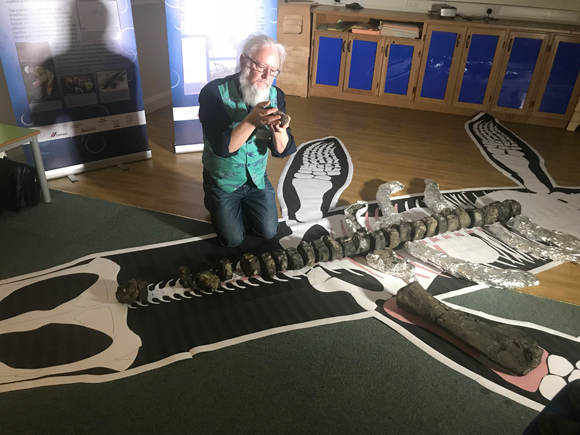
This week has seen the formal unveiling of the fossilised remains of a pliosaur at North Lincolnshire Museum in Scunthorpe.  The fossils, consisting of a single tooth, a series of vertebrae, elements from the ribs, the tip of the snout and a single humerus, suggest an animal of around eight metres in length.  It would have been one of the apex predators of the Late Jurassic marine environment.

The “Scunthorpe Pliosaur” on Display

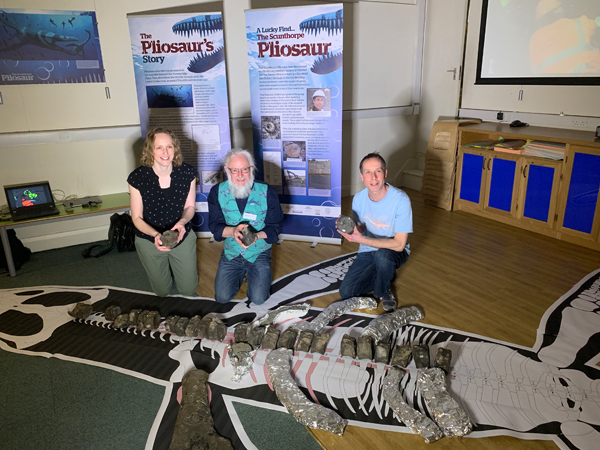
Rose Nicholson, Richard Forrest and Darren Withers with the Scunthorpe Pliosaur.
Rose Nicholson (North Lincolnshire Museum), palaeontologist Richard Forrest and Darren Withers (Stamford and District Geological Society), showing where the fossil bones are located on a pliosaur skeleton.

Picture credit: North Lincolnshire Museum

A Memorable Geology Field Trip

The first evidence of the remains of a marine reptile, were discovered by Darren Withers of the Stamford and District Geological Society during a field trip to a north Lincolnshire quarry in October 2017.  The Society had visited the quarry previously and were aware that the Kimmeridge Clay deposits (dating from 157 to 152 million years ago), contained numerous fossils, but marine reptile bones, especially several pieces from an individual skeleton are exceptionally rare.

After spending some time looking at the quarry floor, Darren decided to investigate some of the stepped banks in the quarry side.  He followed a trail of small Rasenia cymodoce ammonites until they petered out after about thirty metres, but he decided to explore further and then a surprising discovery was made:

Darren commented:

“I’m so glad I did [explore a little further] because the next thing I was looking down at was a large vertebra.”

CEMEX, the quarry owners, granted further access to the site and over the next twelve months or so more of the pliosaur remains were found.  In total, the haul consists of twenty-eight vertebrae, a single tooth, fourteen rib elements, a bone from the upper arm (humerus) and some fragments from the front portion of the upper jaw (premaxilla).  It has been estimated that the specimen is around 155 million-years-old.

Excavating the Pliosaur Specimen

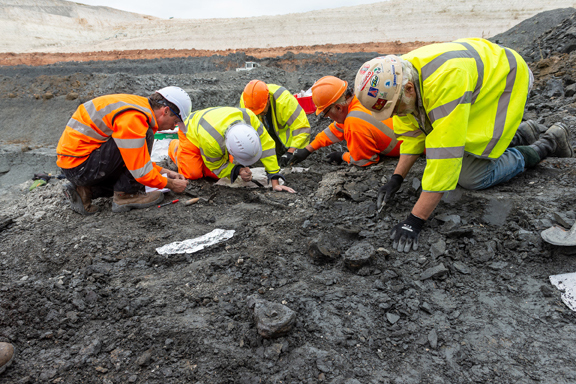
Extracting the fossilised remains of a pliosaur.
Extracting fossils at the north Lincolnshire quarry (CEMEX).

Picture credit: North Lincolnshire Museum

Pliosaurs were marine reptiles, part of the Plesiosauria Order, specifically, the short-necked plesiosaurs, the Suborder Pliosauroidea.  They were the apex predators in most Late Jurassic marine ecosystems.  Pliosaurs had an enormously powerful bite, perhaps the most powerful bite of any vertebrate, a complex system of sensory organs in their snouts, superb eyesight and the ability to taste water as they swam to help them locate prey.

A Model of a Typical Pliosaur

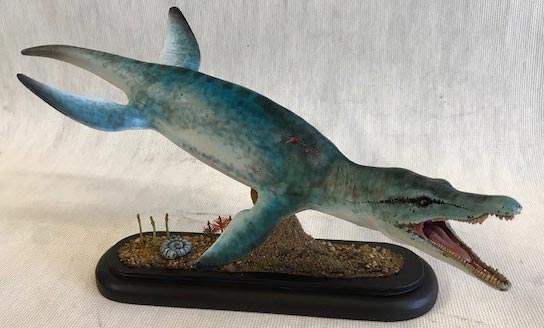
Martin Garratt's customised CollectA Deluxe Pliosaurus.
The customised CollectA Deluxe Pliosaurus model.  The model helps to portray what the “Scunthorpe Pliosaur” might have looked like.

Picture credit: Martin Garratt/Everything Dinosaur.

Explaining the significance of the “Scunthorpe Pliosaur”, Richard Forrest, a vertebrate palaeontologist with an extensive knowledge of the Plesiosauria stated:

“Although the specimen is not complete it tells a fascinating story of how the carcase was broken down by scavenging and decay in the ancient Kimmeridge Clay seas.  Because top predators are much less common than their prey, this is indeed a rare find.  We have hundreds of specimens of other marine reptiles, but only a handful of Pliosaurs.”

The “Scunthorpe Pliosaur” Goes on Display

The fossils will be on display at the North Lincolnshire Museum in a temporary exhibit, however, there are plans to give this exceptionally rare fossil find from eastern England a permanent home at the Museum.

Richard Forrest Examines the Pliosaur Vertebrae

Richard Forrest (vertebrate palaeontologist) examines a Pliosaur vertebra.
Richard Forrest laying out one of the vertebrae in the correct anatomical position.

Picture credit: North Lincolnshire Museum

Councillor Elaine Marper, responsible for the North Lincolnshire Museum added:

“We are over the moon to be able to have this prehistoric sea monster on display at North Lincolnshire Museum.  This is a rare find and to have the fossilised remains stay in North Lincolnshire and go on display for the public is a real feat.  Thank you to CEMEX for making this possible.”

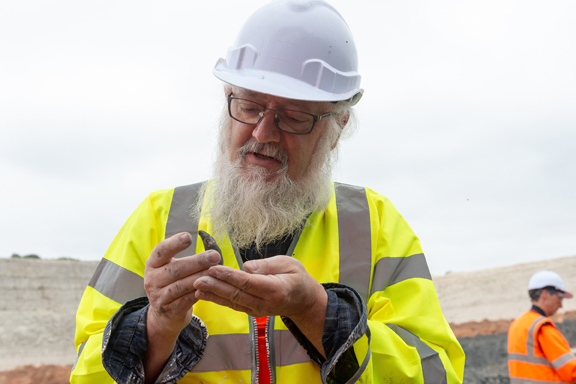
Richard Forrest at the Quarry Holding the Pliosaur Tooth Discovered at the Site

The pliosaur tooth examined by Richard Forrest.
Richard Forrest holding a pliosaur tooth.

Picture credit: North Lincolnshire Museum

Everything Dinosaur acknowledges the assistance of a press release from North Lincolnshire Council in the compilation of this article.

26 02, 2019

Middle Cambrian Worm – Amiskwia Finds a New Home

By |2023-11-23T09:30:46+00:00February 26th, 2019|Categories: Dinosaur and Prehistoric Animal News Stories, Main Page, Palaeontological articles, Photos/Pictures of Fossils|0 Comments

Weird Prehistoric Worm Finally Gets Classified

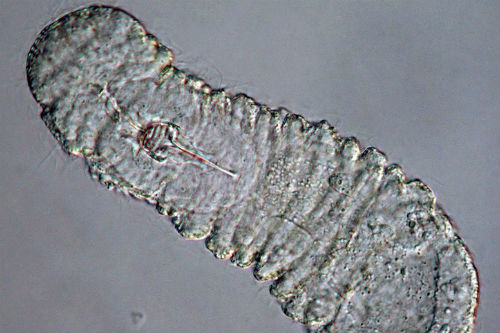
Ever since Charles Doolittle Walcott, discovered the now famous Burgess Shale deposits of Cambrian-aged fossils in British Columbia, palaeontologists have marvelled at the amazing snapshot of ancient marine life the fossils represent.  One of the enduring mysteries surrounding many of the preserved remains is how to classify the more than 500-million-year-old-fossil specimens.  One such Burgess Shale creature, a prehistoric worm with jaws – Amiskwia sagittiformis and its equally ancient cousin A. sinica from the roughly contemporaneous Maotianshan shales of Yunnan Province, China have finally found a home on the Tree of Life.

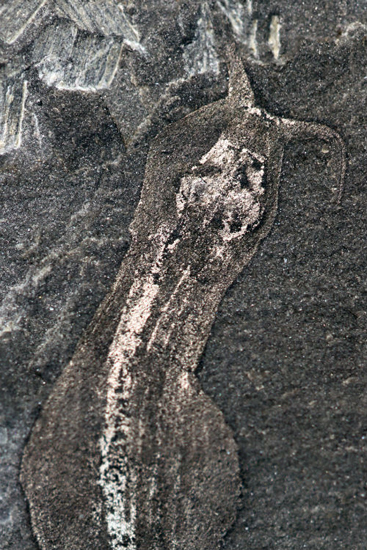
A Fossil of Amiskwia sagittiformis (Burgess Shale)

Amiskwia sagittiformis from the Burgess Shale.
The fossil, Amiskwia sagittiformis from the Burgess Shale (508 million years old), preserving bilateral jaw elements inside its head.

Picture credit: Luke Alexander Parry/University of Bristol – Yale University

Analysis of Fossils from the Smithsonian Institute

Researchers from Bristol University in collaboration with a former colleague now based at the University of Yale, have identified that this soft-bodied creature is a stem lineage to arrow worms that possesses the jaw apparatus seen in microscopic gnathiferan worms.  This new analysis of ancient fossils helps to link recent DNA studies on the bristle-jawed arrow worms (Chaetognatha), indicating that these worms are related to the Gnathifera, tiny, unsegmented worms with primitive jaws that like the chaetognaths, are found in marine environments.

The scientists conclude that the soft-bodied taxon Amiskwia possesses characters intermediate between chaetognaths and gnathiferans.

A Close View of the Head of an Extant Arrow Worm

A photograph of the head of an arrow worm.
The head of the arrow worm, Parasagitta elegans.  This group of animals (Chaetognatha), are the closest living relatives to the Amiskwia genus.

Picture credit: Rafael Martin Ledo/Consejería de Educación de Cantabría

Originally Described by Walcott

Like many of the Burgess Shale animals, an original description of Amiskwia was published by Walcott (1911).  Walcott made the connection with extant arrow worms (chaetognaths).  These unsegmented worms are predators and they use the spines on their head for catching prey.  Despite the remarkable degree of preservation of Burgess Shale specimens, fossils of Amiskwia are very rare when compared to other Burgess Shale Middle Cambrian biota.  Fossils of Amiskwia sinica are also very rare in the Chinese Maotianshan shales.  These types of creatures may have comprised a scarce component of the Middle Cambrian marine fauna, or perhaps, there is a fossil preservation bias.

With few fossils to study, there was widespread debate amongst scientists with regards to Walcott’s conclusions regarding the taxonomy of Amiskwia.  The renowned American palaeontologist, Stephen Jay Gould (1941-2002), re-ignited the controversy by speculating that these little, soft-bodied, squished fossils represented an organism that had no modern relatives.  Gould proposed that Amiskwia was an experiment in evolution that ultimately failed leaving an extinct lineage and no modern-day descendants.

Amiskwia Fossils

The problem with Walcott’s idea that Amiskwia was related to arrow worms was that scientists were unable to find evidence of any grasping spines at the anterior end of the animal in any of the fossils.  Instead, many researchers proposed that Amiskwia was a representative of another group of worms the ribbon worms (Nemertea).

When Dr Jakob Vinther from the University of Bristol’s Schools of Earth Sciences and Biological Sciences and Luke Parry (Yale University), studied specimens of Amiskwia, kept at the Smithsonian Institute, they found something that had been overlooked by the previous researchers.

Dr Vinther explained:

“I coated the specimen with ammonium chloride smoke to make the relief of the fossil stand out and then I could see that in the head was a pair of robust elements.”

Amiskwia and a Set of Fossil Jaws

Interpreting these structures as a set of jaws, their resemblance led the scientists to the conclusion that there was a link between these fossils and the Gnathifera.  In essence, the Amiskwia fossil material represents a sort of half-way stage between two important groups of invertebrates.  Amiskwia had the jaw apparatus of a gnathiferan, but the body plan of an arrow worm.

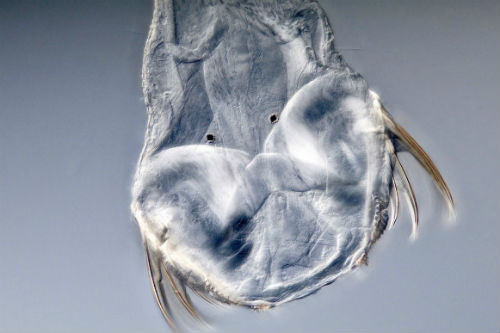
A Microscopic Member of the Gnathifera – the gnathostomulid Rastrognathia macrostoma

The gnathostomulid Rastrognathia macrostoma.
The gnathostomulid Rastrognathia macrostoma, these microscopic animals have a jaw apparatus similar to Amiskwia, which scientists now propose are amongst the closest living relatives of living arrow worms.

Picture credit: Martin Vinther Sørensen/SNM Denmark

A Fossil Link

This study in conjunction with the recent DNA analysis, confirms that Amiskwia is the fossil link between the Gnathifera and arrow worms, the Chaetognatha.  This research was originally conducted some years, ago but was not published as the paper’s conclusions lacked supporting evidence from other studies.

Dr Vinther added:

“The bizarre combination of anatomy seemed altogether alien back in 2012.  Some people have proposed that there could be a relationship between arrow worms and gnathiferans based on their shared possession of a jaw apparatus, both made of a substance called chitin.  However, there was little other evidence to suggest a relationship, such as evidence from phylogenetic analyses of DNA.”

Co-author of the scientific paper, Luke Parry stated:

“It altogether seemed like heresy to propose that gnathiferans and arrow worms may be related back then so we held off publishing our intriguing results out of fear of criticism from our peers.  However, new DNA studies have since emerged that found arrow worms to be more and more closely affiliated to the Gnathifera in the Tree of Life.  In particular, some researchers found that arrow worms share a duplication of the important Hox genes with a gnathiferan, the rotifers.  We suddenly felt no more in a deadlock situation.”

Scientific Findings Published

Now the authors have published their findings in the journal Current Biology. The study follows a new phylogenetic study, which finds robust support for arrow worms forming an evolutionary group with gnathiferans.

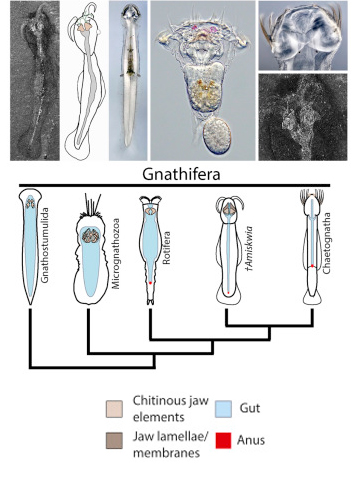
The Inferred Phylogeny of Amiskwia and its Position in Relation to the Gnathifera and the Chaetognatha

Amiskwia inferred phylogeny.
Inferred phylogeny. Thumbnails at the bottom of the figure show reconstructions of relevant extant and extinct gnathiferan and chaetognath taxa.

Picture credit: Current Biology

Scientists have pieced together a little bit of the enigmatic Burgess Shale and the Chinese Maotianshan biotas and linked them to modern organisms.  Amiskwia has been found a place on the Tree of Life.  It is a stem lineage to arrow worms that possess the jaw apparatus seen in gnathiferan worms.

This jaw evolved into the fearsome grasping spines in living arrow worms, which play an important role in  marine ecosystems.

The scientific paper: “Bilateral Jaw Elements in Amiskwia sagittiformis Bridge the Morphological Gap between Gnathiferans and Chaetognaths” by Jakob Vinther and Luke A. Parry published in Current Biology.

Everything Dinosaur acknowledges the help of a press release from the University of Bristol in the compilation of this article.

Visit the Everything Dinosaur website: Everything Dinosaur.

22 02, 2019

New Fleet-footed Tyrannosaur Leaps 70-million-year Gap

By |2023-11-23T09:59:23+00:00February 22nd, 2019|Categories: Dinosaur and Prehistoric Animal News Stories, Dinosaur Fans, Main Page, Palaeontological articles, Photos/Pictures of Fossils|0 Comments

The Diminutive Tyrannosaur Moros intrepidus

A small, but speedy dinosaur is the newest member of the Superfamily Tyrannosauroidea, a distant relative of the most famous dinosaur of all Tyrannosaurus rexT. rex et al might have a reputation for being giant, bone-crunching apex predators, but for much of their evolutionary history, the tyrannosaurs have been rather over-shadowed by other super-sized dinosaur carnivores.  Indeed, it was only in the last few million years of the Cretaceous that these types of theropod emerged as the apex predators of northern latitudes.  The new dinosaur, named Moros intrepidus, at approximately 78 kilograms (data range 53 to 85 kilograms), around the same bodyweight as a South American Jaguar (Panthera onca), is about ninety times lighter than its famous top-of-the-food-chain relative.

Moros intrepidus

Ironically, contrary to public opinion, M. intrepidus might just be more typical of the Tyrannosauroidea bauplan than its more famous relatives – Gorgosaurus, Albertosaurus and T. rex.

The Newly Described Moros intrepidus from the Late Cretaceous of Central Utah

Life reconstruction Moros intrepidus.
Moros intrepidus from the Late Cretaceous of central Utah.

Picture credit: Jorge Gonzalez

Teeth and a Hind Limb from a New Theropod Dinosaur

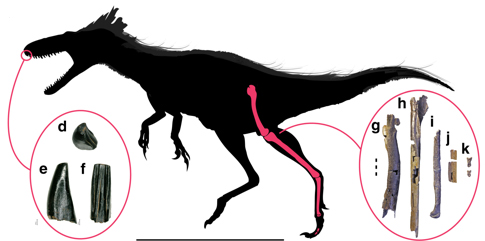
The fossilised remains of a partial right leg consisting of a femur, a tibia, metatarsal bones and some toe bones from the fourth toe were discovered in sediments representing the lower Mussentuchit Member of the Cedar Mountain Formation located in Emery County (Utah).  These fossils, in conjunction with isolated teeth from the front portion of the upper jaw (premaxilla) found nearby provide the basis for this new taxon.  The deposits represent a terrestrial environment, a large delta and they date from approximately 96 million years ago (Cenomanian faunal stage of the Late Cretaceous).

Moros intrepidus represents the oldest known Cretaceous-aged tyrannosauroid discovered to date in North America. It extends the definitive fossil record for these types of dinosaurs by around 15 million years.

The Temporal Relationships and Phylogeny of the Tyrannosauroidea

Moros intrepidus fills a 15-million-year evolutionary gap.
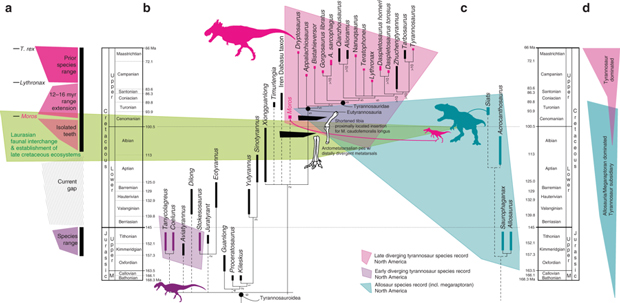
Phylogenetic and temporal relationships between tyrannosauroids and an examination of faunal turnover.  The allosaurs/Megaraptor apex predator niche was gradually taken over by tyrannosaurs.

Picture credit: Nature Communications Biology

In the diagram (above), the section on the left (a), shows the fossil record gap between Late Jurassic tyrannosauroids and much larger Late Cretaceous members of the Tyrannosauridae family such as Lythronax (L. argestes).  Section (b) demonstrates the temporal range of these theropods and the change in bauplan, whilst (c) demonstrates key evolutionary anatomical changes.  The blue and pink coloured shapes in (d) reflect the transition from allosaur/megaraptoran dominated ecosystems to tyrannosaur dominated palaeoenvironments.

A Changing of the Guard When it Comes to Apex Predators

Palaeontologists know that the tyrannosaur lineage dates back a long way.  For example, basal tyrannosaurids such as Stokesosaurus (S. clevelandi) are known from Upper Jurassic deposits of Utah.  By the Late Cretaceous (Campanian faunal stage), tyrannosaurs were large and had become the iconic apex predators beloved by dinosaur fans and film directors.  The fossil record for North American tyrannosaurs was essentially blank, giving palaeontologists a T. rex skull-sized headache when it came to piecing together how these theropods changed over time.

The discovery of Moros helps to narrow a 70-million-year-gap in the fossil record of tyrant lizards in North America.

Lead-author of the study, published in “Nature Communications” Lindsay Zanno of the North Carolina Museum of Natural Sciences explained:

“When and how quickly tyrannosaurs went from wallflower to prom king has been vexing palaeontologists for a long time.  The only way to attack this problem was to get out there and find more data on these rare animals.”

A Silhouette of M. intrepidus Showing the Anatomical Position of the Known Fossil Material

Moros intrepidus silhouette showing placement of known fossil elements.
Silhouette of M. intrepidus showing known fossil elements.  Key = (g) femur, (h) tibia, (i) fourth metatarsal, (j) second metatarsal, and (k) pedal phalanges of the fourth digit.   Scale bar (c) 1 m, (g–k) 5 mm.  Note the tooth (views d-f) are not to scale.

Picture credit: Nature Communications Biology

Living in the Shadow of Siats meekerorum

In 2013, two of the authors of the Moros intrepidus paper, Lindsay Zanno and Peter Makovicky (Field Museum, Chicago), published a study on a large allosauroid from similar-aged sediments.  The dinosaur, named Siats meekerorum is estimated to have measured around 12 metres in length, dwarfing the contemporary Moros, which had a hip height of around 1.2 metres.  The researchers conclude that within a palaeoenvironment dominated by giant, allosauroid theropods, tyrannosaurs such as M. intrepidus relied on their speed and small size and would have kept out of the way of the larger predators.

A spokesperson from Everything Dinosaur commented:

“During the Cenomanian, tyrannosauroids like Moros intrepidus were secondary predators within an ecosystem dominated by apex predators from a completely different part of the theropod family tree.  For the greater part of the tyrannosaur evolutionary history, these types of dinosaurs were marginal predators, living in the shadow of much bigger carnivorous dinosaurs.”

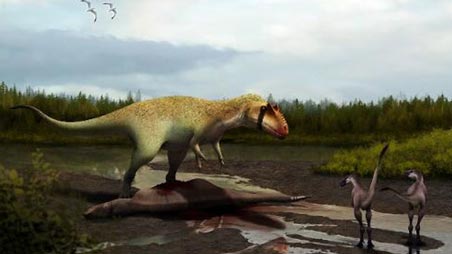
A Life Reconstruction of Siats meekerorum with two Tyrannosauroids shown in the Foreground

Siats meekerorum .
Siats meekerorum has nothing to fear from these two tyrannosaurs.  Moros intrepidus may have scavenged the kills of larger theropods but these types of tyrannosauroid were very much the secondary predators.

Picture credit: Julio Laceardo

To read Everything Dinosaur’s article on the discovery of Siats meekerorumUnravelling the Apex Predators of the Cretaceous Before Tyrannosaurs.

Phylogeny Points at Asian Ancestry

A study of the longer limb bones indicates that the individual was around six to seven years of age when it died.  It was likely to have reached its adult size.  A phylogenetic assessment indicates an affinity with Asian tyrannosaur taxa, in essence, the ancestors of famous North American dinosaurs such as Gorgosaurus and Tyrannosaurus rex migrated into North America from Asia.

Assistant Research Professor Zanno stated:

“T. rex and its famous contemporaries such as Triceratops may be among our most beloved cultural icons, but we owe their existence to their intrepid ancestors who migrated here from Asia at least 30 million years prior.  Moros signals the establishment of the iconic Late Cretaceous ecosystems of North America.”

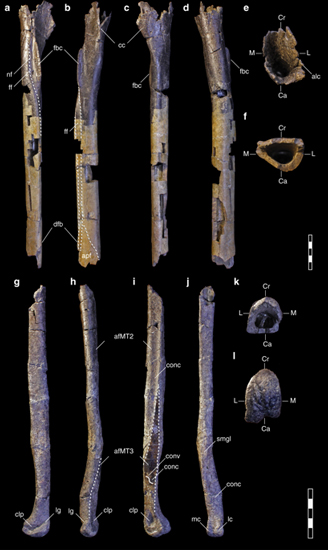
Views of the Lower Leg Bones from the Right Leg of M. intrepidus

Views of the lower leg bones of Moros intrepidus.
Right tibia (a–f) and right fourth metatarsal (g–l) of M. intrepidus (NCSM 33392).

Picture credit: Nature Communications Biology

What’s in a Name?

The etymology of this new tyrannosauroid reflects the later faunal turnover that led to the apex predator roles in North America being dominated by tyrannosaurs.  The genus name is from the Greek “Moros”, the embodiment of impending doom, for the descendants of this fast-running dinosaur were to evolve into some of the largest and most formidable terrestrial predators known to science.  The species name is from the Latin “intrepidus”, a reference to these intrepid dinosaurs making the migration from Asia into North America and their subsequent dispersal.

Size is Not Everything

Although around ninety times lighter than Tyrannosaurus rex, Lindsay warns against underestimating the predatory abilities of Moros.

She added:

“Moros was lightweight and exceptionally fast.  These adaptations, together with advanced sensory capabilities, are the mark of a formidable predator.  It could easily have run down prey, while avoiding confrontation with the top predators of the day.  Although the earliest Cretaceous tyrannosaurs were small, their predatory specialisations meant that they were primed to take advantage of new opportunities when warming temperatures, rising sea-level and shrinking ranges restructured ecosystems at the beginning of the Late Cretaceous.  We now know it took them less than 15 million years to rise to power.”

The scientific paper: “Diminutive fleet-footed tyrannosauroid narrows the 70-million-year gap in the North American fossil record” by Lindsay E. Zanno, Ryan T. Tucker, Aurore Canoville, Haviv M. Avrahami, Terry A. Gates and Peter J. Makovicky published in Nature Communications Biology.

Visit the Everything Dinosaur website: Everything Dinosaur.

20 02, 2019

Rare Dinosaur Trackways Saved from Floods

By |2024-04-11T10:20:32+01:00February 20th, 2019|Categories: Dinosaur and Prehistoric Animal News Stories, Dinosaur Fans, Main Page, Photos/Pictures of Fossils|0 Comments

A Unique Set of Australian Dinosaur Tracks on the Move

A series of dinosaur tracks located around ninety minutes’ drive away from the town of Winton in Queensland, representing three different types of Late Cretaceous dinosaur, are being moved in order to protect and preserve them.  The dinosaur footprints including a set of sauropod tracks, the hind prints of some which measure more than a metre across, represent the first substantial evidence of sauropod locomotion to be recorded from this part of Australia.  In addition, the track of a chicken-sized theropod is preserved at this location, along with the larger, tridactyl prints of an ornithopod.

These tracks are the first recorded evidence of substantial walking tracks for sauropods in Australia and the first Cretaceous-aged sequence of solitary ornithopod tracks to have been identified “down under”.

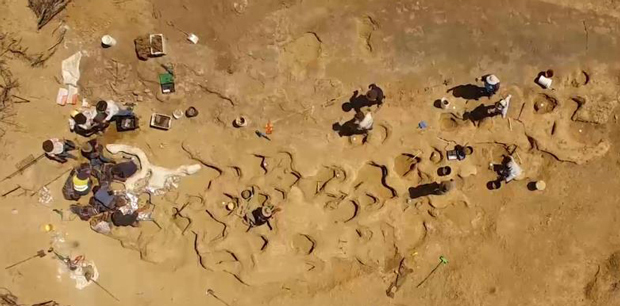
An Aerial View Showing the Exposed Dinosaur Tracksite

An aerial view of the trackway site.
An aerial view showing the extent of the sauropod trackway.

Picture credit: Australian Age of Dinosaurs Museum

First Dinosaur Tracks Exposed Nineteen Years Ago

The fossil trackways site was first exposed in the summer of 2000, when a small creek changed its course following substantial flooding across this part of central-west Queensland.   The footprints were not recognised at first and lay exposed to the elements, slowly being bleached by the extreme heat and subjected to infrequent but devastating water damage.  However, a major project to map and remove the tracks was begun in April 2018 by volunteers and staff from the Australian Age of Dinosaurs Museum.

It was soon realised that the dinosaur tracks, a series of depressions (hyporelief preservation), were extensive.  The sauropod tracks consist of at least twenty prints and run for approximately forty metres.  There is also evidence of the tracks having been made on the prints left by other sauropods including the tracks of a smaller long-necked dinosaur, tentatively described as a sub-adult.

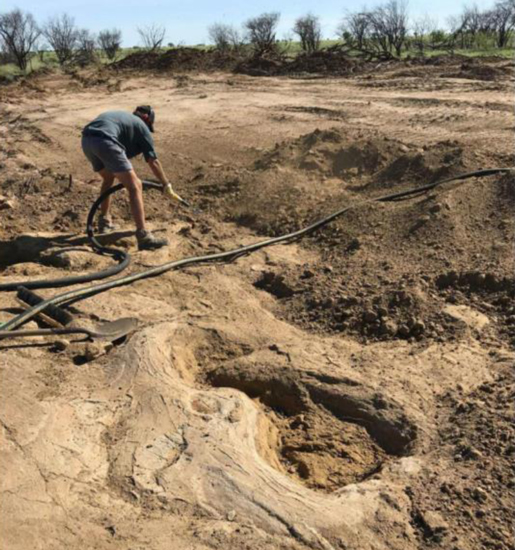
Exposing the Dinosaur Tracks Using an Air Blast Hose

Using an air blast hose to clean away the overburden.
Cleaning the overburden from around the sauropod tracks using an air blast hose.

Picture credit: Australian Age of Dinosaurs Museum

Restoration and excavation work has been undertaken to help protect the fragile sandstone prints, conserve them and to prepare them for transport to the Museum, where they will form part of a major new exhibit, safe from further erosion.

Incredibly Rare Dinosaur Trackway Assemblage

It is incredibly rare to have major Suborders of the Dinosauria (Theropoda, Ornithopoda and Sauropoda), represented at the same fossil trackway site, in the same bedding plane.

Dr Stephen Poropot of the Australian Age of Dinosaurs Museum and the lead researcher on the project stated:

“The small ornithopod and theropod footprints were clearly made by very similar [if not identical] trackmakers to those preserved at Dinosaur Stampede National Monument, which is located about 100 kilometres south of this site”.

To read about the Dinosaur Stampede National Monument tracks preserved at Lark Hill Quarry: Lark Quarry Dinosaur Footprints – Scientists Re-examine the Evidence.

Dr Stephen Poropot Carefully Measuring the Dinosaur Tracks

Mapping and measuring a dinosaur tracksite.
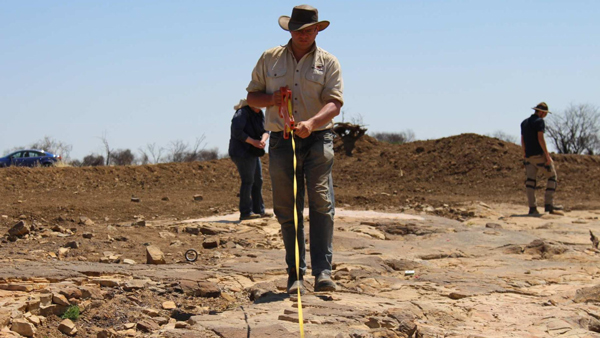
Dr Steve Poropot mapping and measuring the tracks.

Picture credit: ABC Science/Belinda Smith

Significant Sauropod Tracks

According to Dr Poropot, the longest sequence of sauropod tracks identified at the site can be followed continuously and the thumb claw impressions from the front feet can be clearly made out.  The sauropod prints are being heralded as the best of their kind found to date in Australia.  The tracks were created approximately 95 million years ago (Cenomanian faunal stage of the Late Cretaceous) and many of the sauropod tracks are surrounded by concentric mud cracks that were spread through the wet sands as these giant creatures moved across the landscape.

The Three Different Types of Dinosaur Track in Close Proximity

Highlighting different types of dinosaur track.
Sauropod tracks outlined in blue, Theropod tracks (red) and the ornithopod tracks outlined in green.  Dr Stephen Poropot’s boot in the top left corner provides scale.

Picture credit: Swinburne University of Technology

Made by Titanosauriform Sauropods

These trace fossils cannot be assigned to any particular species of dinosaur.  However, the deposit in which the fossils were found represents the Winton Formation and three genera of sauropods (all titanosaurs), have been described from these sandstone sediments to date:

  • Savannasaurus elliottorum named in 2016.
  • Diamantinasaurus matildae named in 2009 (it has been speculated that the sauropod tracks could have been made by Diamantinasaurus).
  •  Wintonotitan wattsi named in 2009.

Exposing the Titanosauriform Sauropod Tracks

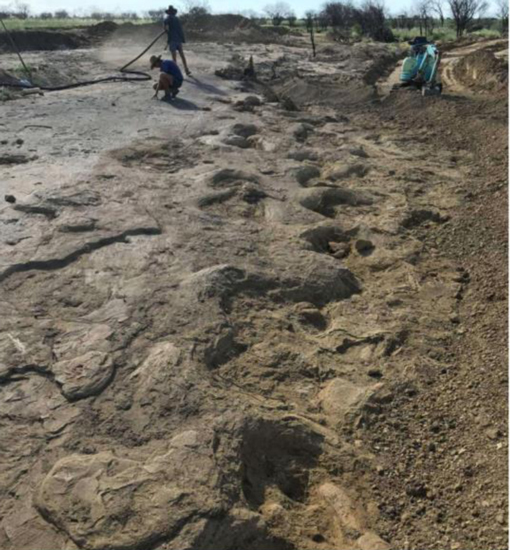
Titanosauriform tracks exposed at the site.
The edge of the titanosauriform sauropod trample zone revealed. The tracks were made by a dinosaur estimated at around 18 metres in length. These are the best preserved sauropod tracks at the site.

Picture credit: Australian Age of Dinosaurs Museum

David Elliott, Executive Chairman of the Australian Age of Dinosaurs Museum, who has been heavily involved with this sauropod-sized excavation and restoration project, explained that the relocation of the trackway began in September 2018 and twenty-five per cent of the total area, including all of the fragile footprints that were in danger of being destroyed, have now been removed.

He commented: “This is a very slow and painstaking process.  The total weight of the trackway is in the vicinity of 500 tonnes and we are transporting it back to the Museum, one two-tonne trailer load at a time.”

A scientific analysis of the trackways interpreting dinosaur body size, gaits and potential sauropod herd dynamics, has been submitted for peer review by Dr Poropot and his colleagues and Mr Elliott is hoping that the attraction, named “March of the Titanosaurs”, will be open to the public from May of next year.

A Major Boost For Queensland Tourism

David Elliott added:

“Very few museums in the world can boast a multi-sequence sauropod trackway as one of their in-house exhibitions, much less one fifty-five metres long with the footprints of all three major groups of Dinosauria represented.”

A Close-up View of the Sauropod Tracks

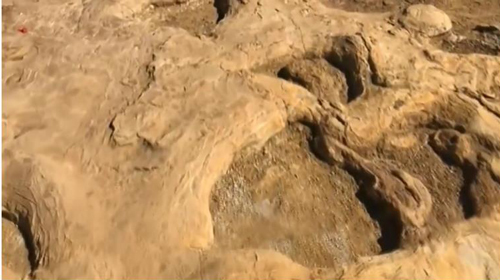
Sauropod tracks.
The exposed and cleaned sauropod tracks.

Picture credit: ABC Science/Belinda Smith

It is hoped that once opened in May 2020, “March of the Titanosaurs” will provide a major boost to tourism in this part of Queensland, especially after this area was hit by devastating floods recently.  Had the project to remove the dinosaur tracks been delayed, it is likely that many of the prints would have been destroyed in the flooding.

A spokesperson from Everything Dinosaur commented:

“This has been a tremendous conservation effort, we congratulate all those involved.  Thanks to this dedicated team, a hugely significant set of dinosaur trace fossils have been preserved.”

Visit the Everything Dinosaur website: Everything Dinosaur.

18 02, 2019

A New African Titanosaur is Announced

By |2023-11-22T11:55:19+00:00February 18th, 2019|Categories: Dinosaur and Prehistoric Animal News Stories, Dinosaur Fans, Main Page, Palaeontological articles, Photos/Pictures of Fossils|0 Comments

Mnyamawamtuka moyowamkia – Heart-shaped Tail Bones Help to Flesh Out Titanosaur Evolution

Scientists writing in the on-line, open access journal PLOS One, have published details of a new species of African titanosaur.  It took several years to carefully remove the fossil material from a high cliff wall overlooking the Mtuka riverbed in south-western Tanzania, but the fossils, representing a not fully mature dinosaur, are providing palaeontologists with important information about how African ecosystems changed over the course of the Cretaceous.  The new titanosaur has been named Mnyamawamtuka moyowamkia (pronounced Mm-nya-ma-wah-mm-too-ka mm-oh-yo-wa-mm-key-ah).  The name is derived from Kiswahili for “animal of the Mtuka river with a heart-shaped tail”.

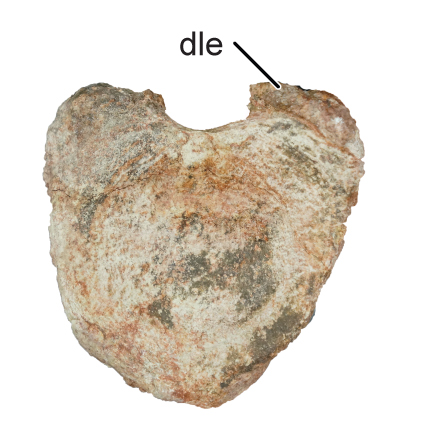
The heart-shaped tail element of the name refers to the strange shape of the most intact middle caudal vertebra described in the paper.  It bulges out at the sides (dorsolateral expansion of the posterior articular surface of the centrum), a unique tail bone morphology that resembles the shape of a romantic, love heart.

A Life Reconstruction of a Pair of  Mnyamawamtuka moyowamkia Titanosaurs

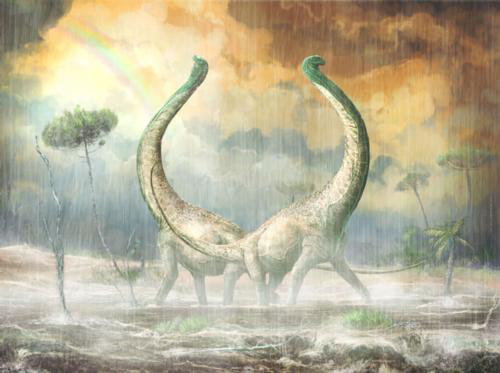
Mnyamawamtuka moyowamkia illustration
Mnyamawamtuka moyowamkia life reconstruction.

Picture credit: Mark Witton

Mnyamawamtuka moyowamkia

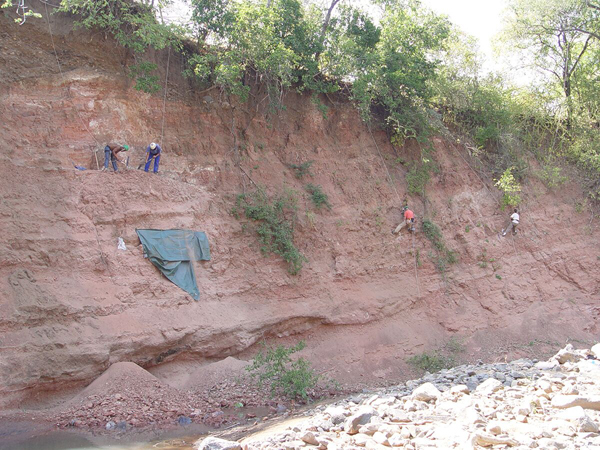
The first evidence of the dinosaur fossils was noted in 2004 and some fossils were excavated from the cliff face, in what were quite hazardous conditions, with field team members having to be lowered over the cliff on numerous occasions to work on the exposed bones.  Annual excavations took place until 2008, it was important to keep returning to the site as the fossils were in danger of being lost to the river in seasonal floods.

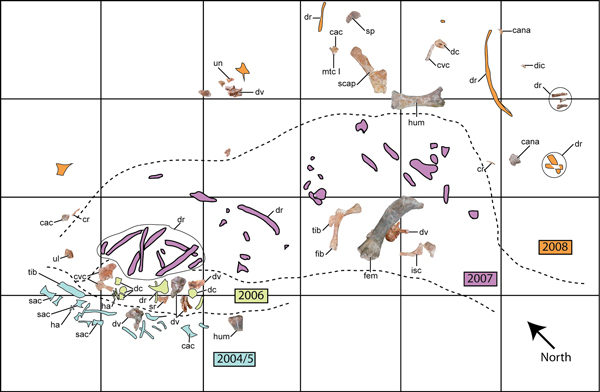
A Line Drawing of the Quarry Site Showing the Extent of the Annual Excavations

Quarry map of M. moyowamkia site.
Quarry map showing the layout and excavation timeline of the M. moyowamkia fossil material.

Picture credit: PLOS One

Around 110 -100 Million Years Old

The specimen was excavated from the Mtuka Member of the Cretaceous Galula Formation, which was deposited around 110 to 100 million years ago (Aptian to Cenomanian faunal stage of the Cretaceous).  A substantial portion of the postcranial skeleton has been recovered.

Dangerous Work!  The Excavation Site in 2007

The location of the Mnyamawamtuka moyowamkia fossils.
The quarry dig site above the Mtuka riverbed in south-western Tanzania.

Picture credit: Ohio University

Commenting on the importance of this discovery, in relation to the evolution of African titanosaurs, lead author of the paper, Dr Eric Gorscak, a recent PhD graduate of Ohio University and now an assistant professor at the Midwestern University (Illinois), stated:

“Although titanosaurs became one of the most successful dinosaur groups before the infamous mass extinction capping the Age of Dinosaurs, their early evolutionary history remains obscure, and Mnyamawamtuka helps tell those beginnings, especially for their African-side of the story.  The wealth of information from the skeleton indicates it was distantly related to other known African titanosaurs, except for some interesting similarities with another dinosaur, Malawisaurus, from just across the Tanzania–Malawi border.”

Adding to the Diversity of Titanosaurian Sauropods from Africa

The field team responsible for this discovery have also found the fossilised remains of two other titanosaurs in this part of Africa.  In 2017, Everything Dinosaur reported upon the discovery of Shingopana songwensis.

To read about S. songwensisA New Species of African Titanosaur is Named.

In addition, Rukwatitan bisepultus another Titanosaurian sauropod dinosaur, was named and described in 2014: A New Species of Titanosaurian Sauropod Rukwatitan bisepultus.

The researchers conclude that Mnyamawamtuka moyowamkia was distantly related to both Shingopana songwensis and Rukwatitan bisepultus, fossils of which come from younger Cretaceous sediments, although it did share some anatomical characteristics with Malawisaurus dixeyi from Malawi, that might have been contemporaneous.  This new fossil discovery is helping palaeontologists to better understand the distribution of titanosaurs between Africa and South America and their evolutionary relationships.

Heart-shaped Tail Bones

One of the middle caudal centra (tail bone from the middle portion of the tail), exhibits a unique dorsolateral expansion of the posterior articular surface of the centrum.  This unique characteristic was found to be present in the most intact middle caudal vertebra described.  This unique shape inspired the dinosaur’s name.

Heart-shaped Tail Bone Centrum (Rear View)

Heart-shaped tail bone.
A posterior view of a middle caudal vertebra showing the characteristic heart shape.  The term dle = dorsolateral expansion.

Picture credit: PLOS One

Tail Bones of Different Titanosaurs Compared

Titanosaur tail bne comparison.
A comparison of caudal vertebrae between three titanosaurs. Mnyamawamtuka moyowamkia (A), compared with Malawisaurus dixeyi (B) and Lohuecotitan pandafilandi of the Late Cretaceous of Spain (C). Posterior views and lateral views, scale bar = 10 cm.  The term dle = dorsolateral expansion.

Picture credit: PLOS One

The scientific paper: “A New African Titanosaurian Sauropod Dinosaur from the Middle Cretaceous Galula Formation (Mtuka Member), Rukwa Rift Basin, Southwestern Tanzania” by Eric Gorscak and Patrick M. O’Connor published in PLOS One.

Visit the Everything Dinosaur website: Everything Dinosaur.

12 02, 2019

Reflecting on the Eyes of Cretaceous Spiders

By |2023-11-22T11:01:41+00:00February 12th, 2019|Categories: Dinosaur and Prehistoric Animal News Stories, Geology, Main Page, Photos/Pictures of Fossils|0 Comments

Early Cretaceous Spiders Reveal Reflective Eyes

A team of scientists, including a researcher from the University of Kansas, writing in an academic journal (Journal of Systematic Palaeontology), have described spiders from the Early Cretaceous that had reflective eyes, an adaptation to permit these tiny predators to hunt at night.  The remarkable Early Cretaceous spider fossils were discovered in black shale beds from South Korea.  These beds form part of the Jinju Formation (Albian faunal stage) and the flattened fossils preserve the remains of spiders that lived between 113 and 110 million years ago.

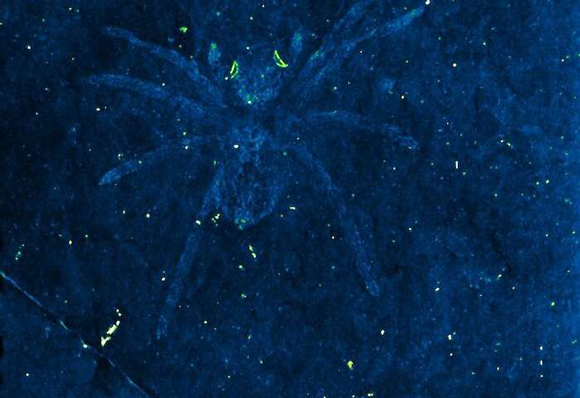
The Light Reflective Properties of the Crescent-shaped Tapetum

UV light reveals the ancient tapetum of spiders.
The two tapetum can be seen as crescent-shaped objects on the anterior portion of the head.

Picture credit: Paul Selden/University of Kansas

Early Cretaceous Spider Fossils

Two of the fossils from the extinct spider family Lagonomegopidae feature reflective eyes.  The fossils represent the first non-amber Lagonomegopidae to be described, with the first preservation of a spider eye tapetum recorded in the fossil record.

Co-author of the scientific paper, Paul Selden, Gulf-Hedberg Distinguished Professor of Geology and the Director of the Palaeontological Institute at Kansas University’s Biodiversity Institute and Natural History Museum, explained:

“Because these spiders were preserved in strange slivery flecks on dark rock, what was immediately obvious was their rather large eyes brightly marked with crescentic features.  I realised this must have been the tapetum — that’s a reflective structure in an inverted eye where light comes in and is reverted back into retina cells.  This is unlike a straightforward eye where light goes through and doesn’t have a reflective characteristic.”

Describing the Tapetum

Selden said that some contemporary spiders feature eyes with a tapetum, but the new paper is the first to describe the anatomical feature in a fossilised spider.  The research team said the discovery provides evidence for lagonomegopid enlarged eyes being posterior medians.

“In spiders, the ones you see with really big eyes are jumping spiders, but their eyes are regular eyes — whereas wolf spiders at night time, you see their eyes reflected in light like cats.  So, night-hunting predators tend to use this different kind of eye.  This was the first time a tapetum had been in found in fossil.  This tapetum was canoe-shaped — it looks a bit like a Canadian canoe.  That will help us place this group of spiders among other families.”

Selden’s collaborators were Tae-Yoon Park of the Korea Polar Research Institute and amateur fossil hunter Kye-Soo Nam of the Daejeon Science High School for the Gifted, who found the fossils preserved in the shale.

Early Cretaceous Spiders from the Jinju Formation

The description of the fossils increases the number of known spiders from the Jinju Formation from a single specimen to eleven.

Commenting on their remarkable state of preservation, Paul added:

“This is so rare because they’re very soft — they don’t have hard shells so they very easily decay.  It has to be a very special situation where they were washed into a body of water.  Normally, they’d float.  But here, they sank, and that kept them away from decaying bacteria, it may have been a low-oxygen condition.  These rocks also are covered in little crustaceans and fish, so there maybe was some catastrophic event like an algal bloom that trapped them in a mucus mat and sunk them, but that’s conjecture.  We don’t really know what caused this, but something killed off a lot of animals around the lake at one time or on an annual basis.”

According to Selden, the shale preserved the spider fossils in a manner that highlighted the reflectivity of the tapetum, a feature that may have been missed had the spiders been preserved in amber instead, as is more typical.

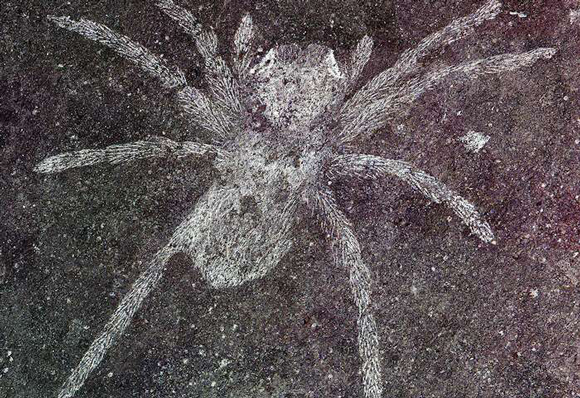
Preserved in the Black Shale an Almost Perfect Impression of an Early Cretaceous Spider

Fossilised remains of an Early Cretaceous spider with reflective eyes.
The black shale preserved perfect impressions of the ancient spiders.

Picture credit: Paul Selden/University of Kansas

The discovery of these spiders will help researchers to piece together a better understanding of the environment that existed in South Korea during the Early Cretaceous.

Everything Dinosaur acknowledges the assistance of a press release from the University of Kansas in the compilation of this article.

Visit the customer-friendly Everything Dinosaur website: Everything Dinosaur.

11 02, 2019

Two Ancient Seed-eating Birds Described from Amazing Fossils

By |2023-11-22T10:20:13+00:00February 11th, 2019|Categories: Dinosaur and Prehistoric Animal News Stories, Main Page, Photos/Pictures of Fossils|0 Comments

Eofringillirostrum boudreauxi  and Eofringillirostrum parvulum Passerines from the Early Eocene

A scientific paper has just been published in the journal “Current Biology”, that describes two Early Eocene, seed-eating, perching birds (passerines).  The birds are closely related, assigned to the same genus but one fossil was discovered in Wyoming, the other comes from the famous Messel shales of Germany and they are separated by around 5 million years.  These species are amongst the oldest fossil birds to exhibit a finch-like beak and provide the earliest evidence for a diet focused on small, hard seeds in crown birds.

The discovery of these two early granivores, will help scientists to better understand the evolution and radiation of this important group of birds, that make up 65% of all extant bird species.

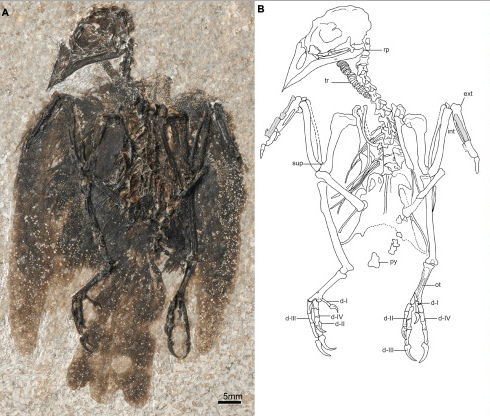
The Wyoming Specimen – Holotype of Eofringillirostrum boudreauxi

Eofringillirostrum boudreauxi holotype from the Green River Formation of Wyoming.
(A) Photograph and (B) line drawing of the holotype skeleton of Eofringillirostrum boudreauxi (FMNH PA 793).

Picture credit: Current Biology

The Ancestors of Sparrows, Finches, Crows, Robins etc.

Passerines might be ubiquitous these days, but once they were rare and only made up a small proportion of avian biotas.  We still have a lot to learn about their evolution.

Commenting on the significance of the fossil discoveries, one of the co-authors of the paper Lance Grande (Field Museum, Chicago), stated:

“This [Eofringillirostrum boudreauxi] is one of the earliest known perching birds.  It’s fascinating because passerines today make up most of all bird species, but they were extremely rare back then.  This particular piece is just exquisite.  It is a complete skeleton with the feathers still attached, which is extremely rare in the fossil record of birds.”

The Wyoming specimen, E. boudreauxi, is the earliest example of a bird with a finch-like beak, similar to many of the birds you see today inhabiting parks and gardens.  This legacy is reflected in its name; Eofringillirostrum means “dawn finch beak”, whilst the specific epithet honours Terry and Gail Boudreaux, who donated the holotype to the Field Museum.

The Green River Formation

The Wyoming specimen heralds from the famous Early Eocene Green River Formation, extensive fine-grained deposits formed in a lacustrine environment.  The area is famous for its beautifully preserved but compressed vertebrate fossil specimens.

Lead author of the research, Daniel Ksepka from the Bruce Museum (Connecticut), commented on the importance of finding fossil birds with finch-like beaks adapted to eating seeds:

“These bills are particularly well-suited for consuming small, hard seeds.  Anyone with a birdfeeder knows that lots of birds are nuts for seeds, but seed-eating is a fairly recent biological phenomenon.”

The earliest birds probably ate insects, plant material and even fish, although a recent theory has been proposed that the ability to consume seeds may have helped some kinds of birds survive the catastrophic end-Cretaceous mass extinction event.

To read an article about this: Seed-eating may have Helped Birds Survive Mass Extinction Event.

Comparing the Two Fossils

Both the Wyoming and the German specimens have similar shaped beaks, although the German fossil represents a slightly smaller type of bird.  Beak shape infers information about the bird’s diet and as such, beak shape plays a key role in avian radiations and is one of the most intensely studied aspects of avian evolution and ecology.

With two specimens that were both temporally and geographically dispersed the researchers were able to conclude that these types of birds were widespread during the Eocene.

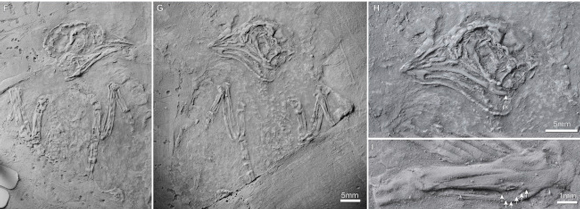
The Messel Shale Passerine Specimen – Eofringillirostrum parvulum

Eofringillirostrum parvulum from the Messel Shales.
Holotype slab (IRSNB Av 128a) and (G) counter slab (IRSNB Av 128b) of Eofringillirostrum parvulum with enlargements showing details of (H) skull and (I) carpometacarpus.

Picture credit: Current Biology

Found in Subtropical Habitats Not Open Plains

Whilst many Passeriformes (passerines or perching birds), are synonymous with open, grassland environments today, the researchers note that these fossil specimens occurred in subtropical palaeoenvironments.  Given that seed-eating (granivory), is a key adaptation that allows passerines to exploit open temperate environments, the seed-eating habit may have evolved prior to the movement of these types of birds into more open habitats.  The ability to consume and digest seeds may not have been a driver in allowing these types of birds to exploit new habitats, but this type of feeding behaviour would have proved to be extremely beneficial as the world became much cooler towards the end of Eocene and the once widespread rainforests gave way to more open landscapes.

Everything Dinosaur acknowledges the assistance of a press release from the Field Museum (Chicago), in the compilation of this article.

The scientific paper: “Oldest Finch-beaked Birds Reveal Parallel Ecological Radiations in the Earliest Evolution of Passerines” by Daniel T. Ksepka, Lance Grande and Gerald Mayr published in Current Biology.

Visit the customer-friendly Everything Dinosaur website: Everything Dinosaur.

8 02, 2019

New Species of Late Cretaceous Oviraptorid Named

By |2023-11-22T09:38:31+00:00February 8th, 2019|Categories: Dinosaur and Prehistoric Animal News Stories, Dinosaur Fans, Main Page, Palaeontological articles, Photos/Pictures of Fossils|0 Comments

Gobiraptor minutus – The Diversity of the Oviraptoridae in the Late Cretaceous

A new species of oviraptorid dinosaur (Oviraptoridae family), has been described by an international team of scientists.  The little dinosaur was probably feathered and it possessed thickened jaws, an adaptation to feeding on hard food items such as seeds, nuts or the shells of bivalves, molluscs and crabs.  Animals that have a diet of hard items are referred to as durophagous.   

The fossilised remains of a single, very young individual were found in the Altan Uul area of Ömnögovi Province, Mongolia, in strata from the famous Upper Cretaceous Nemegt Formation.  The new species has been named Gobiraptor minutus and it helps to demonstrate that this part of Asia in the Late Cretaceous was home to diverse variety of oviraptorids, many of which, probably occupied specialist niches within the ecosystem in a bid to minimise competition for resources.

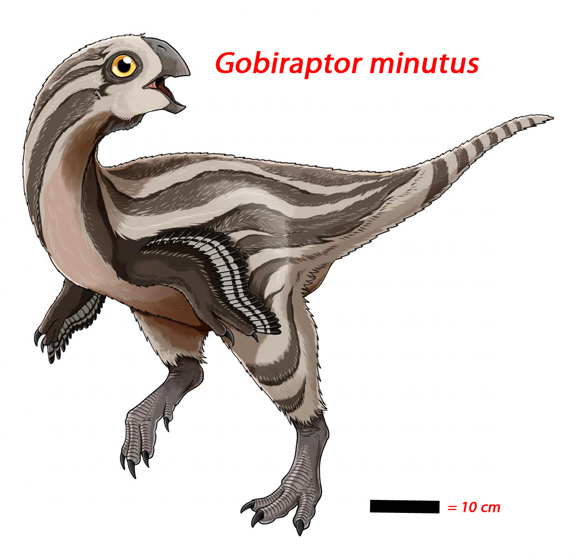
A Life Reconstruction of Gobiraptor minutus

Gobiraptor minutus life reconstruction.
A life reconstruction of Gobiraptor minutus.

Picture credit: Do Yoon Kim with additional annotation by Everything Dinosaur

Gobiraptor minutus – Rare for the Altan Uul Area of Southern Mongolia

Oviraptorid fossil specimens are relatively rare in the Altan Uul area of the Gobi Desert, however, within the Upper Cretaceous deposits exposed within the Gobi Desert, some ten oviraptorid taxa have so far been named and described.  Gobiraptor increases the diversity of oviraptorids known from the Nemegt Formation and demonstrates that these types of theropod dinosaurs were exceptionally abundant in the mesic environment* of that part of the world during the Late Cretaceous.

A mesic environment* – is a term used in ecology to describe an environment with a moderate amount of water.  Much of this part of Asia during the Late Cretaceous may be associated with a dry, arid environment, for example numerous types of other theropod fossils come from strata that represent almost desert-like conditions.  These fossils are found in the older Barun Goyot Formation which was laid down under more arid conditions.  The rocks in which the fossils of Gobiraptor were found consist mainly of river channel deposits, indicating that the palaeoenvironment changed and the environment became considerably wetter.

Thus, the finding of a new member of the Oviraptoridae family in the Nemegt Formation, which consists mostly of river and lake deposits, confirms that these dinosaurs were extremely well adapted to wet habitats.

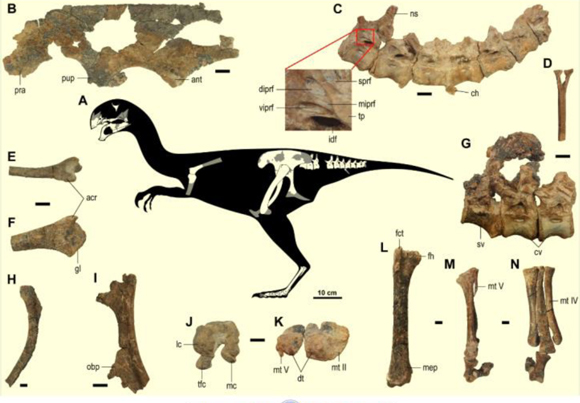
Fragmentary Fossils and Skeletal Reconstruction of Gobiraptor minutus

Gobiraptor minutus skeletal reconstruction.
Grey shaded bones indicate known fossil material.  Note scale bar on skeletal drawing – 10 cm.

Picture credit: PLOS One

Robust and Thickened Jaws Hint at a Dietary Specialism

Gobiraptor minutus, can be differentiated from other members of the Oviraptorosauria clade in having unusually robust and thickened jaws.  This unique mandibular morphology suggests that Gobiraptor was adapted to feeding on hard food items, it used its strong jaws to crush, indicating potential niche partitioning in the palaeoenvironment to reduce competition amongst small theropods and within the local population of oviraptorids.  Osteological analysis of the femur suggests that the fossil material represents a very young individual.

The phylogenetic analysis carried out by the researchers defines Gobiraptor as a derived oviraptorid closely related to three taxa from the Ganzhou region of southern China, but, ironically, the analysis suggests that it was rather distantly related to other Nemegt oviraptorids which, as the results of recent studies, are also not closely related to each other.

The authors propose that different dietary strategies may explain the wide taxonomic diversity and evolutionary success of this group of dinosaurs in this part of Asia.

Post-cranial Elements of G. minutus

Post-cranial elements of Gobiraptor.
Left femur in caudal view (A) and medial view (B).  Partial right humerous (C) and ilium (D).  (E) left metatarsal I and pedal digit I in medial view.  (F) left pedal digit IV in lateral view.  Scale bar = 5 cm.

Picture credit: PLOS One

The genus name honours the Gobi Desert, whilst the specific epithet is from the Latin for small, a reflection on the small size of the holotype.

The scientific paper: “A New Baby Oviraptorid Dinosaur (Dinosauria, Theropoda) from the Upper Cretaceous Nemegt Formation of Mongolia” by Sungjin Lee, Yuong-Nam Lee , Anusuya Chinsamy, Junchang Lü, Rinchen Barsbold and Khishigjav Tsogtbaatar published in PLOS One.

Visit the award-winning Everything Dinosaur website: Everything Dinosaur.

Go to Top