All about dinosaurs, fossils and prehistoric animals by Everything Dinosaur team members.

Pictures of fossils, fossil hunting trips, fossil sites and photographs relating to fossil hunting and fossil finds.

7 04, 2021

Sinomacrops – A New Anurognathid Pterosaur from China

By |2024-05-25T08:34:46+01:00April 7th, 2021|Categories: Dinosaur and Prehistoric Animal News Stories, Dinosaur Fans, Main Page, Photos/Pictures of Fossils|0 Comments

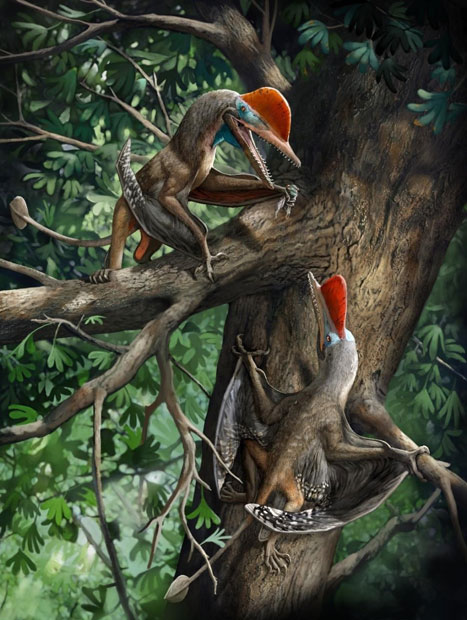
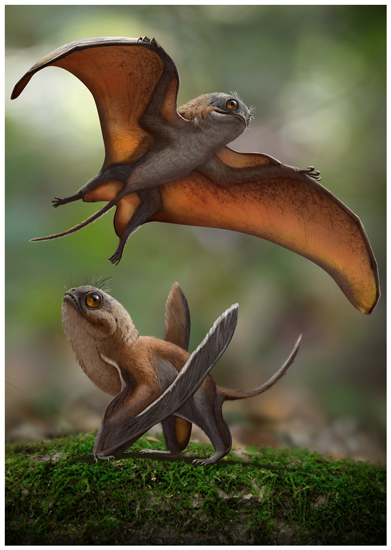
Researchers have published a description of a new species of anurognathid pterosaur from the Tiaojishan Formation in Hebei Province China. The diminutive flying reptile has been named Sinomacrops bondei and is the third anurognathid species to have been described from Jurassic-aged rocks found in China. Although the specimen is badly crushed, it represents the near complete skeleton of a single individual and as such it has helped palaeontologists to better understand the phylogeny of these enigmatic, but poorly known, wide-mouthed pterosaurs.

Sinomacrops bondei life reconstruction.
Sinomacrops bondei life reconstruction. Picture credit: Zhao Chuang.

The Amazing Anurognathidae

Palaeontologists that focus on the Pterosauria have long speculated as to where in the flying reptile family tree the Anurognathidae fit. Very few fossils are known and those that have been made available to study demonstrate a mix of basal as well as more derived traits. All the anurognathids described to date are estimated to have had wingspans less than 90 cm. Their fossils are associated with terrestrial environments and it has been suggested that these little flying reptiles lived in forests and ate insects, perhaps capturing them on the wing.

Sinomacrops bondei

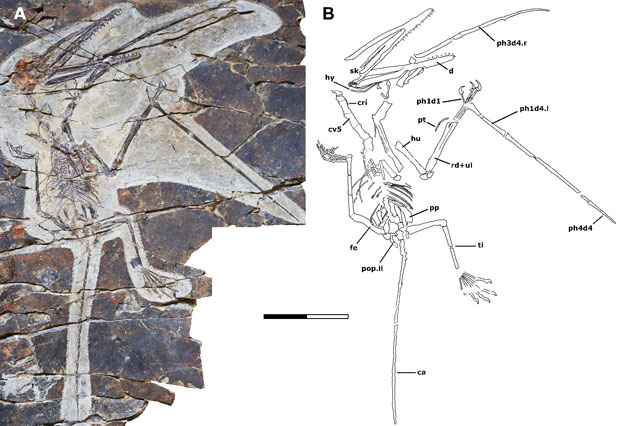
The genus name translates from the Greek for Chinese, large eyes/face. The specimen (number JZMP-2107500095) is the first record of an anurognathid pterosaur skull preserved in a mostly lateral view. The species epithet honours the Danish palaeontologist Niels Bonde in recognition of his many years contributing to vertebrate palaeontology.

Sinomacrops bondei fossil and line drawing
The fossilised remains of Sinomacrops bondei and an accompanying line drawing.

A Crushed Skeleton

Although the skeleton is badly crushed, the fossilised remains which herald from the Daohugou Beds of the Tiaojishan Formation and are therefore between 164 – 158 million years old (Callovian to the Oxfordian stage of the Middle to Late Jurassic), have provided a new insight into the variation of jaw shape in these wide-mouthed pterosaurs. In addition, the Sinomacrops discovery permitted the researchers to undertake a revision of anurognathid phylogeny and the researchers propose that these strange flying reptiles are a sister group of the Darwinoptera and basal members of the Monofenestrata.

The Monofenestrata

The Monofenestrata comprises a wide range of pterosaur families, broadly grouped together as they had long tails, a lengthy fifth toe and the possession of a single large opening on each side of the skull in front of the eyes. Hence the name Monofenestrata (Latin for “one window”), the merging of the nasal and antorbital openings into a single feature.

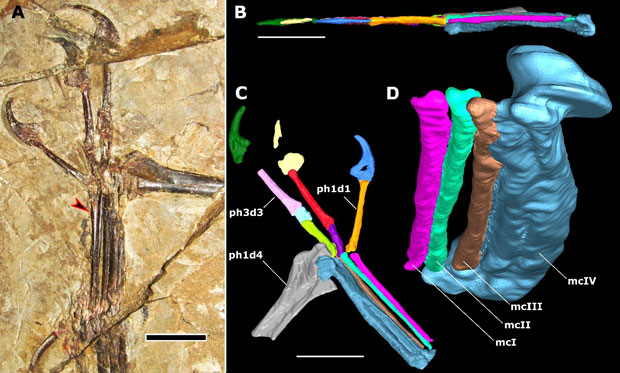
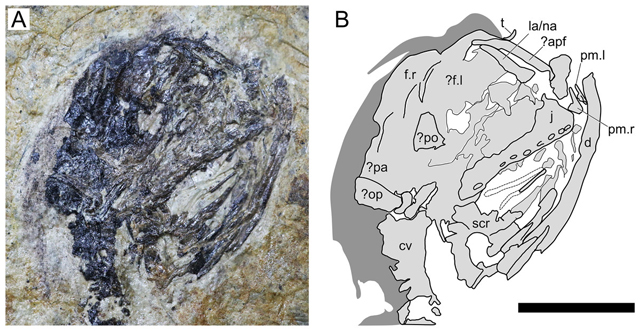
Sinomacrops skull and line drawing.
The crushed skull of Sinomacrops bondei and accompanying line drawing.

The scientific paper: “Sinomacrops bondei, a new anurognathid pterosaur from the Jurassic of China and comments on the group” by Xuefang Wei, Rodrigo Vargas Pêgas, Caizhi Shen, Yanfang Guo, Waisum Ma, Deyu Sun, Xuanyu Zhou​ published in PeerJ.

The Everything Dinosaur website: Pterosaur Models and Dinosaur Toys.

6 04, 2021

Trilobites had Gills on their Legs

By |2024-05-25T08:32:33+01:00April 6th, 2021|Categories: Dinosaur and Prehistoric Animal News Stories, Main Page, Palaeontological articles, Photos/Pictures of Fossils|0 Comments

Newly published research has provided palaeontologists with remarkable new evidence shedding light on the evolution of gill structures in the Arthropoda. Writing in the academic journal “Science Advances”, researchers from the University of California Riverside in conjunction with colleagues from the Indian Statistical Institute (Kolkata) and the American Museum of Natural History (New York), have demonstrated that some species of trilobite had gills on their upper limbs.

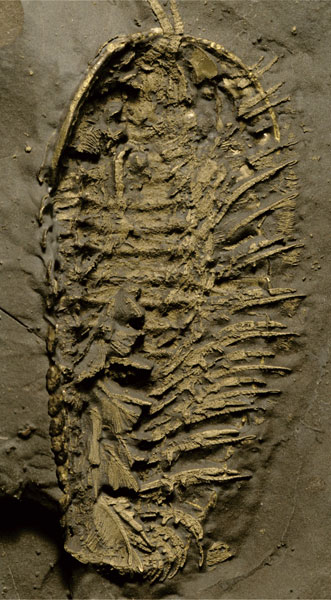
Trilobite Gill Fossil
One of the exceptionally rare trilobite specimens preserved in iron pyrite (fool’s gold) that led to the gill discovery. Picture Credit: Jin-bo Hou/University of California Riverside. The fossil is a specimen of Triarthrus eatoni from the famous Beecher’s trilobite bed from Oneida County, New York.

Exquisitely Preserved Fossils

Many thousands of species of trilobite have been named and described. However, very few fossils of these enigmatic, extinct members of the Arthropoda preserve soft parts of the animal’s bodies.

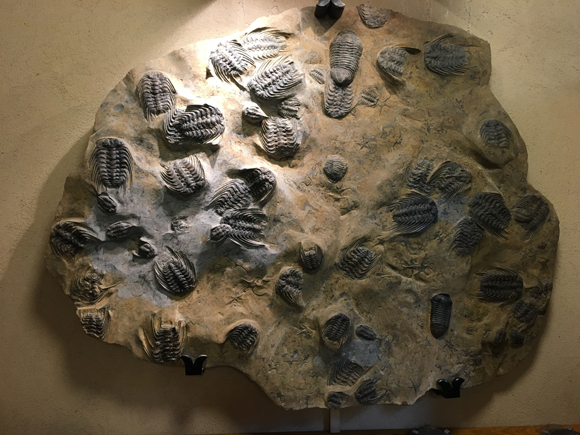
Trilobite fossils - the Selenopeltis slab.
Trilobites galore – the Selenopeltis slab from the Oxford University Museum of Natural History. The hard, exoskeletons of trilobites are extremely common fossils. Picture credit: Everything Dinosaur.

Picture credit: Everything Dinosaur

Fossils Preserved as Fool’s Gold Reveal New Information

The segmented limbs of trilobites were biramous, that is the limb was spilt into two branches. The function of the upper element of this limb has long been debated. It had been thought by some scientists that is served a respiratory function, but the evidence to support this hypothesis was lacking.

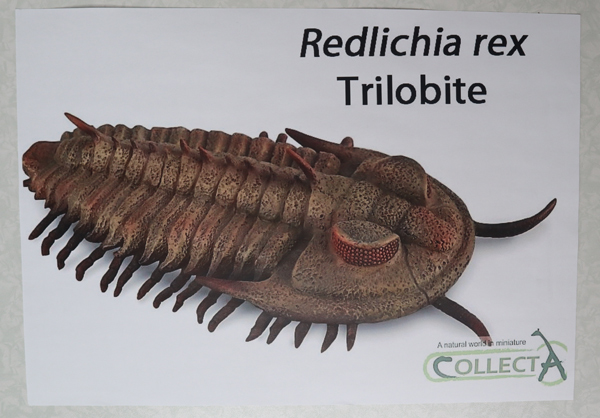
CollectA trilobite model.
Everything Dinosaur team members have prepared some images of CollectA invertebrate models including the CollectA Age of Dinosaurs Popular trilobite model (Redlichia rex). Picture credit: Everything Dinosaur.

Picture credit: Everything Dinosaur

The picture (above) shows a typical trilobite body plan. It is a model of a trilobite species from the CollectA model range.

To view this range: CollectA Age of Dinosaurs Prehistoric Life Models.

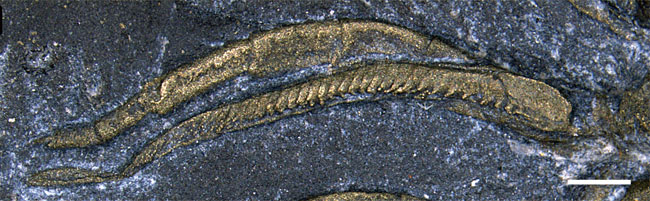
Remarkably detailed fossil specimens preserved in iron pyrite were subjected to scans using computerised tomography (CT scans). The computer generated images revealed dumbbell-shaped filaments in the upper limb branch that are morphologically comparable with gill structures in crustaceans.

A detailed view of a trilobite leg
A detailed view of a biramous (branched) trilobite leg showing the structures which have been interpreted as gill structures. Scale bar = 500 μm. Picture credit: Jin-bo Hou/University of California Riverside.

The Beecher’s Trilobite Bed

The beautifully preserved specimens with their soft parts replaced by pyrite come from the famous Beecher’s trilobite bed which is a Late Ordovician Lagerstätte with over 85% of the fossils found at the site representing the trilobite Triarthrus eatoni.

Lead author of the paper PhD student Jin-bo Hou (University of California Riverside) commented:

“Up until now, scientists have compared the upper branch of the trilobite leg to the non-respiratory upper branch in crustaceans, but our paper shows, for the first time, that the upper branch functioned as a gill”.

The research team mapped how blood would have filtered through chambers in these delicate structures, absorbing oxygen as it progressed through the tiny structures which measure around 30 microns across, that’s three times smaller than the diameter of a human hair.

Comparing Trilobites with Extant Arthropods

These structures appear much the same as gills in modern marine arthropods like lobsters and crabs, but crucial anatomical differences were identified, helping scientists to better understand the phylogeny of the Trilobita within the arthropod phylum. Comparing the specimens in pyrite to another trilobite species (Olenoides serratus), gave the team additional information about how the filaments were arranged relative to one another and to the legs.

The researchers concluded that the upper limb’s partial articulation to the body via an extended membrane is morphologically comparable to the junction of the respiratory book gills of extant horseshoe crabs (Limulus). Furthermore, this morphology differentiates it from the typically robust junctions associated with crustaceans and the extinct sea scorpions.

The scientific paper: “The trilobite upper limb branch is a well-developed gill” by Jin-bo Hou, Nigel C. Hughes and Melanie J. Hopkins published in Science Advances.

Visit Everything Dinosaur’s award-winning website: Everything Dinosaur.

5 04, 2021

Sorting Out Stygimoloch as New Model Arrives

By |2024-05-25T08:30:55+01:00April 5th, 2021|Categories: Dinosaur Fans, Everything Dinosaur News and Updates, Main Page, Photos/Pictures of Fossils|0 Comments

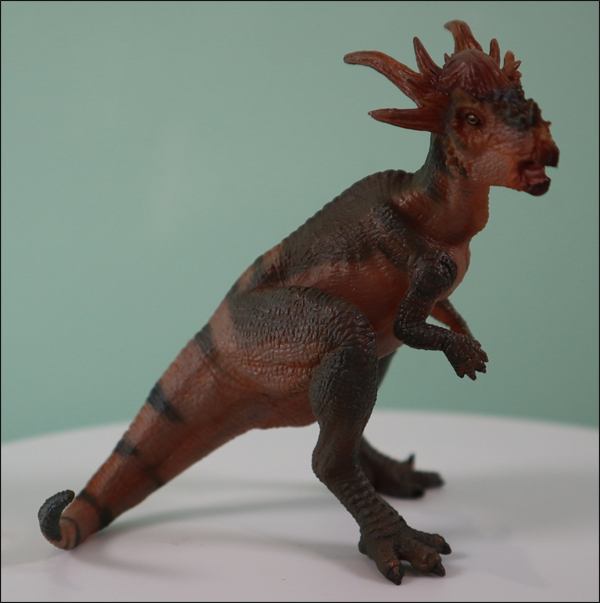
Everything Dinosaur team members have been asked to provide some scientific information on the “Styx Demon”, the pachycephalosaur known as Stygimoloch. The profile of this animal was raised recently due to its appearance in the last “Jurassic World – Fallen Kingdom” film to be released and with the introduction of a Stygimoloch model in the Papo “Les Dinosaures” range.

New for 2020 Papo Stygimoloch model.
The new for 2020 Papo Stygimoloch dinosaur model. A replica of a very spiky pachycephalosaur. Fossils used to erect this genus in 1983 are believed by many palaeontologists to represent juveniles of Pachycephalosaurus. Picture credit: Everything Dinosaur.

Picture credit: Everything Dinosaur

The picture (above) shows the Papo Stygimoloch model.

To view the range of Papo dinosaur figures: Papo Prehistoric Animal Models.

Preparing Stygimoloch Information for a Dinosaur Exhibit

A paper presented at the 2007 annual meeting of the Society of Vertebrate Paleontology suggested that the spiky Stygimoloch was not a valid species of dinosaur, but its fossils represented juveniles of the already described and much larger, bone-headed dinosaur Pachycephalosaurus. With the validity of this genus in question, this makes preparing scientific information for a dinosaur exhibit featuring Stygimoloch a bit of a challenge for our dedicated team members.

Reconstruction of a Juvenile Pachycephalosaurus skull.
A reconstruction of the fossil skull of the juvenile Pachycephalosaurus that has theropod-like teeth in the front of the jaws. The discovery of an almost complete skull and jaws of a juvenile Pachycephalosaurus in eastern Montana (2018), gave palaeontologists the opportunity to learn more about the potential diet of this dinosaur. Picture Credit Brian Boyle (Royal Ontario Museum).

Summarising the Story of Stygimoloch

In 1973, scientists from the Unive‎rsity of California Berkeley, whilst exploring Hell Creek Formation exposures in McCone County, Montana, found a single, robust skull fragment with the remains of three distinct, prominent horns projecting out of the back of it.

Although classified as a bone from a pachycephalosaur, no further work on the bone was carried out until palaeontologists Hans-Dieter Sues and Peter Galton published a comprehensive review of North American pachycephalosaur fossils in 1983. They named Stygimoloch (S. spinifer), based on this unusual skull bone and other fragmentary material that had once been thought to represent part of the neck frill from a Triceratops.

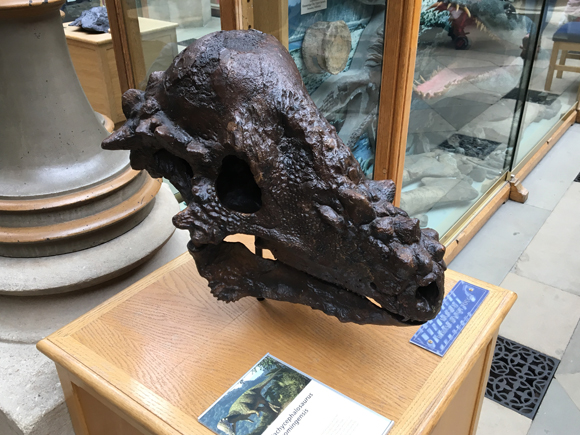
A replica skull of Pachycephalosaurus wyomingensis.
Pachycephalosaurus wyomingensis replica skull. Both Dracorex and Stygimoloch are believed by many scientists to represent juveniles of the already described genus Pachycephalosaurus. Picture credit: Everything Dinosaur.

Picture credit: Everyhting Dinosaur

Rising to the Challenge

Our team members are not ones to shy away from a challenge. As well as providing information on Stygimoloch for the exhibition, they also prepared some additional information featuring Pachycephalosaurus wyomingensis so that visitors could learn more about how perceptions regarding Hell Creek Formation pachycephalosaurs have changed.

Visit the Everything Dinosaur: Everything Dinosaur.

1 04, 2021

Llukalkan aliocranianus – New Abelisaurid from Argentina

By |2024-05-25T08:16:40+01:00April 1st, 2021|Categories: Adobe CS5, Dinosaur and Prehistoric Animal News Stories, Dinosaur Fans, Main Page, Palaeontological articles, Photos/Pictures of Fossils|0 Comments

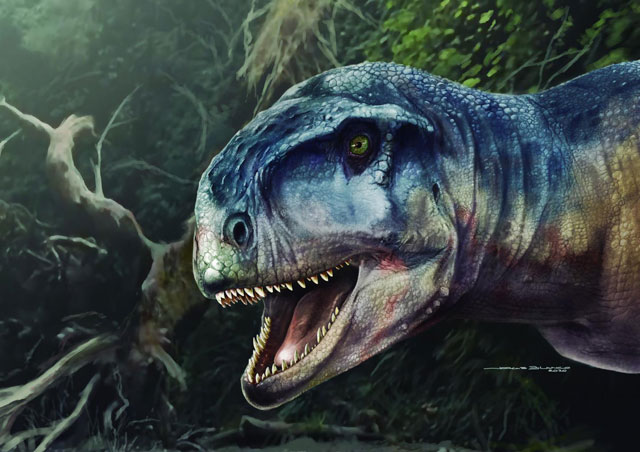
A team of international researchers have named and described a new species of fearsome, meat-eating dinosaur based on a partial skull found in 2015 in Neuquén Province (northern Patagonia). The dinosaur is a member of the Abelisauridae family and it has been named Llukalkan aliocranianus. The genus name is from the local Mapuche dialect and translates as “one who causes fear”. Not only was Llukalkan a likely apex predator, its discovery helps to confirm that the abelisaurs were one of the most important and significant predators in South America during the Late Cretaceous.

A Life Reconstruction of the Abelisaurid Dinosaur Llukalkan aliocranianus
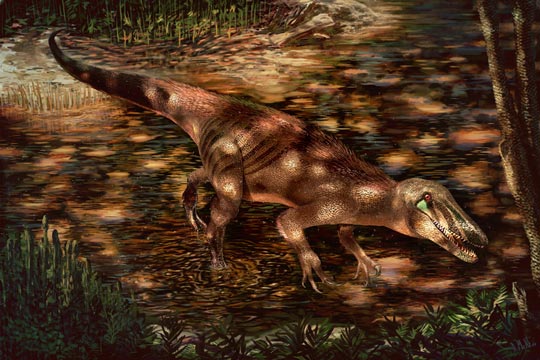
A life reconstruction of the newly described abelisaurid from Argentina Llukalkan aliocranianus. Picture credit: Jorge Blanco and the Journal of Vertebrate Paleontology.

Found in Close Proximity to Viavenator exxoni

The well-preserved skull was found in outcrops of the Bajo De La Carpa Formation at the La Invernada fossil site. The strata at this location were laid down approximately 85 million years ago (Santonian faunal stage of the Late Cretaceous) and the bones were found close to the location of an earlier abelisaurid discovery (Viavenator exxoni), which had been found by some of the scientists that also participated in the Llukalkan study.

Assessment of the lacrimal bone suggest that this skull material represents a sub-adult animal and comparison with other abelisaurids such as Carnotaurus indicates that Llukalkan may have been around five metres in length, making it slightly smaller than Viavenator which is estimated to have been around six metres long.

Skull Bones associated with Llukalkan aliocranius
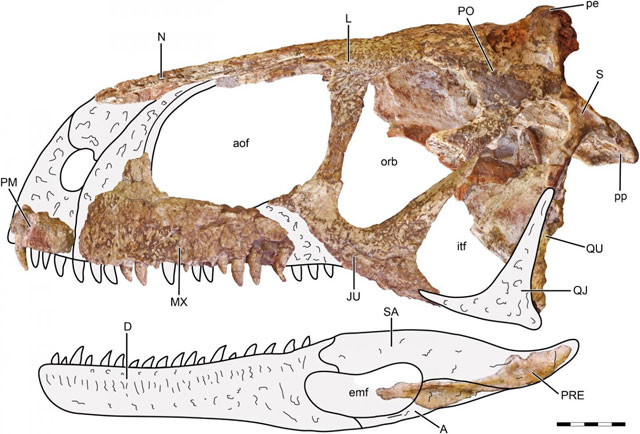
A view of the cranial material of the holotype (Llukalkan aliocranianus) – view in left lateral view with line drawing showing where the bones fit with the rest of the skull. Unique rugose and roughened patches on the skull bones confirmed that the scientists were dealing with a new species.

Writing in the peer reviewed academic publication the “Journal of Vertebrate Paleontology”, the researchers which included Federico A. Gianechini, Leonardo S. Filippi and Ariana Paulina-Carabajal identified a number of autapomorphies within the skull material that led them to confidently assign a new species. The trivial name is derived from the Latin for “different skull”.

Abelisaurids “Top Dogs”

Something like ten different genera of abelisaurid dinosaur have been discovered in Patagonia to date. The scientists state that Llukalkan and Viavenator were probably contemporaneous and they help to demonstrate the dominance of this type of theropod dinosaur in the Late Cretaceous of Argentina. Both Viavenator and the newly described Llukalkan were closely related, both have been assigned to the Abelisauridae clade – the Furileusauria which includes the geologically much younger and much larger Pycnonemosaurus (P. nevesi), fossils of which come from Brazil.

Megaraptors for Company

It is likely that these two furileusaurian abelisaurids probably shared their environment with another type of large theropod hypercarnivore. Fossils of the megaraptor Tratayenia rosalesi, which was described in 2018, are also associated with the Santonian-aged strata of the Bajo de la Carpa Formation, albeit the Tratayenia material was found at a different location.

Tratayenia stalking prey.
An illustration of the new Late Cretaceous megaraptoran dinosaur Tratayenia. Picture credit: Andrea McAfee (Carnegie Museum of Natural History).

At around eight metres in length (possibly even bigger), T. rosalesi was a formidable predator. Whether the abelisaurids were the “top dogs” when it came to the food chain remains uncertain. However, with the discovery of Llukalkan so close to the fossils of Viavenator, it does suggest that these types of theropods were extremely successful predators.

To read Everything Dinosaur’s earlier article on the discovery of Tratayenia rosalesi: A New Megaraptoran Theropod from Argentina.

The scientific paper: “A New Furileusaurian Abelisaurid from La Invernada (Upper Cretaceous, Santonian, Bajo De La Carpa Formation), Northern Patagonia, Argentina” by Federico A. Gianechini, Ariel H. Méndez, Leonardo S. Filippi, Ariana Paulina-Carabajal, Rubén D. Juárez-Valieri and Alberto C. Garrido published in the Journal of Vertebrate Paleontology.

The Everything Dinosaur website: Dinosaur Models and Toys.

31 03, 2021

Studying the Brains of Australia’s “Thunderbirds”

By |2024-05-22T21:27:32+01:00March 31st, 2021|Categories: Dinosaur and Prehistoric Animal News Stories, Dinosaur Fans, Main Page, Palaeontological articles, Photos/Pictures of Fossils|2 Comments

Australia boasts a weird and wonderful flora and fauna. Millions of years of isolation has led to the land “down under” evolving a very unique biota, perhaps most marked by the abundance of marsupial mammals. Today’s fauna, remarkable as it might be, is overshadowed somewhat by the incredible megafauna that once existed on the continent.

Australia’s Giant “Thunderbirds”

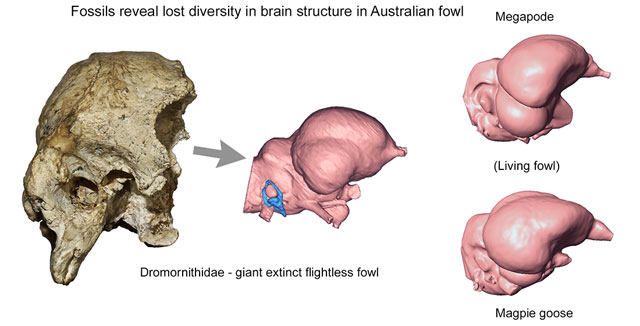
For example, giant, flightless birds thrived and evolved into a myriad of different sized forms as climates and habitats changed. Some of these birds, members of the extinct family the Dromornithidae, were giants and have been nicknamed Australia’s giant “Thunderbirds” or even “Devil Ducks”. A newly published study examines the evolutionary development of “bird brains” in a bid to settle the phylogeny of these giant birds.

Dromornis stirtoni life reconstruction.
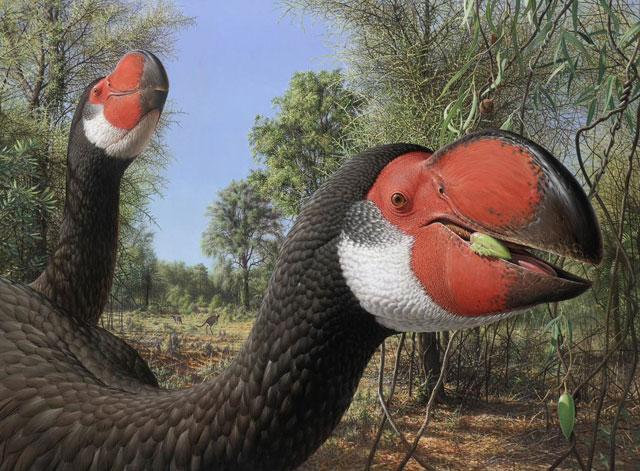
A life reconstruction of the giant Australian “Thunderbird” Dromornis stirtoni of the Late Miocene. At around 3 metres tall and weighing approximately 600 kilograms, D. stirtoni is one of the largest avian dinosaurs to have ever lived. Picture credit: Peter Trusler.

Mapping the Brains of “Mihirungs”

Scientists had puzzled over the phylogeny of these extinct birds for some time. Earlier studies suggested that they were related to waterfowl – hence one of their nicknames “Devil Ducks”. Researchers from Flinders University (Adelaide, South Australia), reconstructed the brains of a number of dromornithid genera in a bid to better understand the family’s origins and to learn more about their place in the Australian megafauna dominated prehistoric ecosystems.

One of the birds studied was the enormous Dromornis stirtoni, the largest of the “mihirungs” (the Aboriginal word for “giant bird”).

Dromornis "Thunderbird" fossils
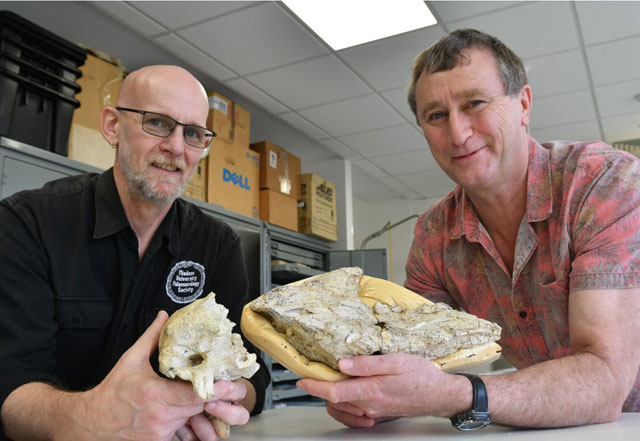
Dr Warren Handley and Associate Professor Trevor Worthy – the authors of the scientific paper, hold a skull (left) and partial upper bill (right) of the mihirung Dromornis planei. Picture credit: Flinders University.

Plant-eater or Meat-eater?

Heavier than a polar bear (Ursus maritimus) Dromornis stirtoni is known from Upper Miocene deposits from Australia’s Northern Territory. Dromornis had a huge skull, more than half a metre long, but its brain was squeezed for space.

It possessed a big, powerful beak, but its diet along with the diets of other dromornithids remains a mystery. It could have fed on leaves, nuts and fruit, or perhaps it was a predator. The lack of a “hook” and the absence of talons in this and other species suggests that these flightless birds were probably not hypercarnivores.

Examining Bird Brains (Australia’s Giant “Thunderbirds”)

Writing in the academic journal “Diversity”, the researchers examined the craniums of giant “Thunderbirds” looking at a variety of genera including the earliest Dromornis murrayi from the Late Oligocene to Dromornis planei and Ilbandornis woodburnei from the middle Miocene Epoch and Dromornis stirtoni, that roamed northern Australia around 7 million years ago (Messinian, the last stage of the Miocene).

Examining the brain structures of living and extinct Australian fowl
Fossil study reveals lost diversity in the brain structure of Australian fowl. Picture credit: Flinders University.

Related to Gamefowl (Galliformes)

The researchers conclude that these birds were probably more closely related to gamefowl (Galliformes) than they were to waterfowl (Anseriformes).

Commenting on the research, one of the authors Dr Warren Handley (Flinders University) stated:

“Together with their large, forward-facing eyes and very large bills, the shape of their brains and nerves suggested these birds likely had well-developed stereoscopic vision, or depth perception, and fed on a diet of soft leaves and fruit. The shape of their brains and nerves have told us a lot about their sensory capabilities, and something about their possible lifestyle which enabled these remarkable birds to live in the forests around river channels and lakes across Australia for an extremely long time.”

An Evolutionary Experiment

The researchers suggest that the Dromornithidae were the result of birds distantly related to chickens getting a free reign in evolutionary terms on the isolated continent. They took a very different evolutionary path when compared to their relatives the megapodes which still exist in Australasia.

The researchers postulate that the range in body sizes exhibited by dromornithids were due to climate change and the availability of food within the ecosystem. The Late Miocene was a period of dramatic climate change with the continent becoming more arid and cooler. Rainforests retreated and were replaced by more open woodlands, these changes may have played a role in the evolution of giant forms such as D. stirtoni.

Everything Dinosaur acknowledges the assistance of a media release from Flinders University in the compilation of this article.

The scientific paper: “Endocranial Anatomy of the Giant Extinct Australian Mihirung Birds (Aves, Dromornithidae)” by W. D. Handley and T. H. Worthy published in Diversity.

Visit the Everything Dinosaur website: Everything Dinosaur.

26 03, 2021

Study Shows Lots of Variation in Dinosaur Species

By |2024-05-22T21:12:29+01:00March 26th, 2021|Categories: Dinosaur and Prehistoric Animal News Stories, Main Page, Palaeontological articles, Photos/Pictures of Fossils|0 Comments

Researchers from the University of Bonn (Germany), in collaboration with colleagues from Liverpool John Moores University examined cranial material of the Plateosaurus species – P. trossingensis and discovered that the skulls of these dinosaurs demonstrated a high degree of variation. Just like people, this Plateosaurus species demonstrates a high degree of individual variation within a species.

Plateosaurus trossingensis fossil skeleton
Fossil of a Plateosaurus trossingensis, on loan from the Sauriermuseum Frick and on display at the Zoological Research Museum Alexander Koenig (ZFMK) in Bonn. Doctor Katja Waskow (left) from the Zoological Research Museum and on the right, Prof. Dr Martin Sander from the University of Bonn. Picture credit: Volker Lannert/University of Bonn.

Not All Dinosaurs of the Same Species Looked Alike

Plateosaurus from the Late Triassic of Europe is one of the most extensively studied of all the dinosaurs, thanks mainly to the huge bonebeds containing thousands of fossilised bones that have been found. It is by studying the fossilised remains that palaeontologists can put forward evidence to suggest the erection of a new species. However, this new study published in Acta Palaeontologica Polonica, suggests that the anatomy of Plateosaurus was significantly more variable than previously thought.

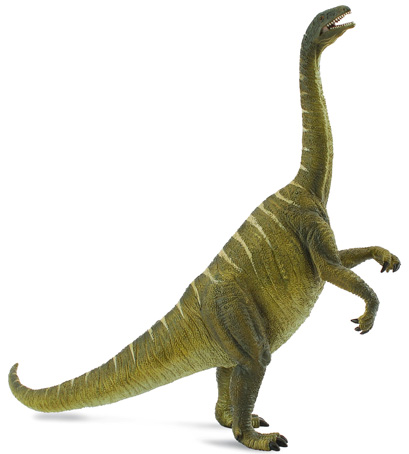
A Plateosaurus dinosaur model.
A rearing Plateosaurus. A model of a Plateosaurus (CollectA Plateosaurus), this Late Triassic member of the Prosauropoda is one of the most extensively studied of all the Dinosauria.

The picture (above) shows a CollectA Plateosaurus figure.

To view this range: CollectA Age of Dinosaurs Models and Figures.

Natural Variation

The researchers examined the complete skulls of fourteen individual Plateosaurus trossingensis specimens, eight of which had not been studied before, along with numerous other skull bones and discovered that there was considerable variation in the skulls. Such variation had been noted before and it had been suggested that the extensive bonebeds at Frick (northern Switzerland), Trossingen (south-western Germany) and Halberstadt (central Germany) might contain the fossilised remains of more than one species.

However, the researchers which included PhD student Jens Lallensack (University of Bonn), could not group these variations according to specific anatomical traits, locality or their stratigraphy. The team concluded that there was no evidence to indicate the presence of more than one species, but these types of dinosaurs showed considerable variation within their species (intraspecific variability).

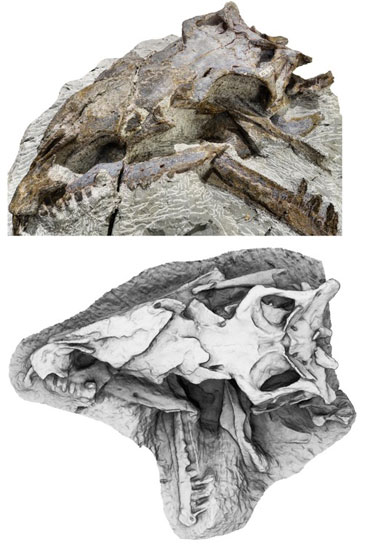
Plateosaurus trossingensis skull and drawing.
A Plateosaurus trossingensis skull in right lateral view with a colour coded diagram (below) showing individual fossil bones. Picture credit: Jens Lallensack (University of Bonn).

Taking into Account Bone Deformation

The careful documentation of the skull variation will assist other palaeontologists when it comes to understanding the distinct individuality of dinosaurs within a given population. The team were able to distinguish these differences from those characteristics of the bones that are deformed and altered as a result of their fossilisation. Being able to attribute bone deformation due to taphonomy (the fossilisation process), is extremely useful in helping to determine unique anatomical traits that could lead to the identification of a new species.

Photograph (top) and a model of a deformed skull resulting from the fossilisation process (below)
Photograph (top) and a model of a deformed skull resulting from the fossilisation process (below). Picture credit: Jens Lallensack (University of Bonn).

The scientific paper: “New skulls of the basal sauropodomorph Plateosaurus trossingensis from Frick, Switzerland: Is there more than one species?” by Jens N. Lallensack, Elżbieta M. Teschner, Ben Pabst and P. Martin Sander published in Acta Palaeontologica Polonica.

Visit the Everything Dinosaur website: Everything Dinosaur.

25 03, 2021

Cephalopods Evolved 30 Million Years Earlier Than Previously Thought

By |2024-05-22T21:11:24+01:00March 25th, 2021|Categories: Dinosaur and Prehistoric Animal News Stories, Main Page, Palaeontological articles, Photos/Pictures of Fossils|0 Comments

Cephalopods those advanced sophisticated molluscs such as octopi, squid and cuttlefish evolved some thirty million years earlier than previously thought according to some new research published this week.

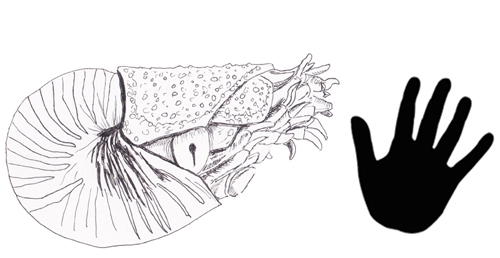
Nautilus scale drawing.
A scale drawing of an extant nautilus (Nautilus pompilius). Newly published research suggests the ancestors of the modern Nautilus were around at least 522 million years ago.  Picture credit: Everything Dinosaur.

Picture credit: Everything Dinosaur

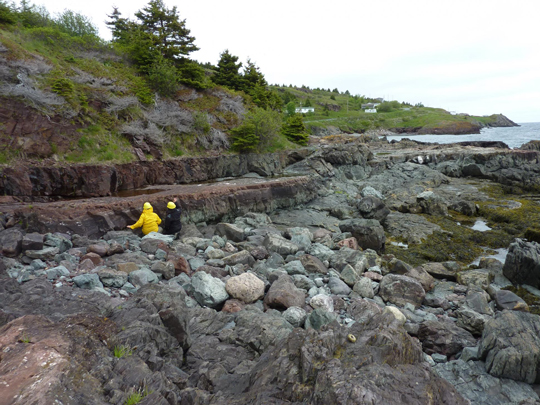
Cephalopods belong to the phylum Mollusca. Animals such as the octopus are regarded as highly intelligent, capable of complex behaviours and are regarded by many scientists as being as sophisticated, if not more so, than many vertebrates. The ancestors of the extant cephalopods around today originally possessed a chambered shell, indeed, the pearly nautilus still retains this feature (see above for a nautilus illustration). Researchers from Heidelberg University in collaboration with colleagues from the Bavarian Natural History Collections examined a 522 million-year-old outcrop from the Lower Cambrian Bonavista Formation exposed at Bacon Cove (south-eastern Newfoundland, Canada). Slices of the red sandstone which represent a shallow, marine depositional environment revealed tantalising glimpses of ancient Cambrian animals.

Looking for evidence of the oldest cephalopods known to science.
Scientists documenting the evidence at Bacon Cove (Newfoundland). Picture credit: Anne Hildenbrand (Heidelberg University).

The Oldest Known Cephalopods

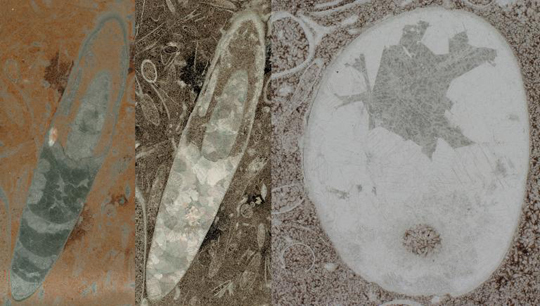
Tiny calcareous shells measuring no more than 14 mm high and around 3 mm wide discovered in cross-sections of the red sandstone rock are interpreted as representing phragmocones, part of the internal skeleton of a marine invertebrate. The researchers postulate that as similar structures are found in cephalopods, then these fossils represent the earliest evidence of the Cephalopoda.

Longitudinal and cross-sectional images of the fossils that could represent the oldest cephalopods known to science.
Longitudinal and cross-sectional images of the fossils that could represent the oldest cephalopods known to science. Picture credit: Gregor Austermann, Heidelberg University / Communications Biology.

An Extraordinary Find

Co-author of the research, Dr Gregor Austermann (Institute for Earth Sciences at Heidelberg University), commented:

“This find is extraordinary. In scientific circles it was long suspected that the evolution of these highly developed organisms had begun much earlier than hitherto assumed. But there was a lack of fossil evidence to back up this theory.”

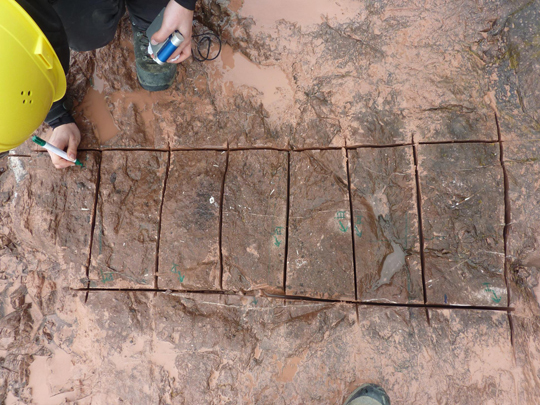
Documenting the fossil finds.
Carefully documenting the fossil finds at Bacon Cove. Picture credit: Anne Hildenbrand (Heidelberg University).

Plectronoceras cambria

Although molecular studies had suggested that cephalopods evolved earlier than indicated by the fossil record, there was very little physical evidence to back this up. Many palaeontologists regard Plectronoceras cambria, fossils of which come from Texas limestones and date from the Middle/Late Cambrian as the earliest cephalopod. These Canadian fossils, if proved to represent the body fossils of cephalopods, push back the evolutionary origins of this important group by at least 30 million years.

The specimens described here may represent the earliest cephalopods capable of regulating the buoyancy of their shell through a siphuncle. This view supports the molecular studies that suggest that cephalopods originated in the Early Cambrian. These animals may have been the first to actively control their buoyancy and therefore to be capable of moving up and down the water column. It could be speculated that these fossils which are around 522 million years old, represent the remains of some of the first animals living above the sea floor (pelagic animals) and able to swim (nektonic).

The scientific paper: “A potential cephalopod from the early Cambrian of eastern Newfoundland, Canada” by Anne Hildenbrand, Gregor Austermann, Dirk Fuchs, Peter Bengtson and Wolfgang Stinnesbeck published in Communications Biology.

Visit the award-winning Everything Dinosaur website: Prehistoric Animal Models and Toys.

24 03, 2021

Dig Those Remarkable Ankylosaurs

By |2024-05-22T21:07:36+01:00March 24th, 2021|Categories: Adobe CS5, Dinosaur and Prehistoric Animal News Stories, Dinosaur Fans, Main Page, Palaeontological articles, Photos/Pictures of Fossils|0 Comments

A study of the fossilised remains of an as yet unnamed species of ankylosaurid suggests that these dinosaurs were adapted for digging. Whilst it seems unlikely that these large herbivores could have lived in burrows, they may have been able to dig for roots and tubers, excavate wells in dried up rivers to reach subsurface water and dig into sediments to obtain supplementary minerals in a similar way that extant elephants do today.

The compact and low-slung Pinacosaurus could have been adapted for digging.
A compact and low-slung body shape with powerful limbs could be adaptations for digging. The low profile of the PNSO Pinacosaurus ankylosaurid model. A newly published scientific paper suggests that these types of dinosaurs may have dug shallow pits in which they could protect themselves from attack. Picture credit: Everything Dinosaur.

Picture credit: Everything Dinosaur

The model (above) is a Pinacosaurus armoured dinosaur from PNSO.

To view the range of PNSO dinosaur models: PNSO Prehistoric Animal Figures.

Digging Pits to Protect Their Undersides

Furthermore, many palaeontologists have postulated that these armoured herbivores might have been able to hunker down to defend their limbs and undersides from theropod predators. If these animals dug shallow pits they might have been able to protect themselves from attack and make it difficult for carnivorous dinosaurs to spot them when they were partially buried. Horned lizards (Phrynosoma) have a similar flat body and lateral fringe scales as seen in some types of ankylosaurid, these extant reptiles adopt these types of defensive strategies.

Discovered in the Early 1970s

Remains of an armoured dinosaur was first reported by a joint Soviet-Mongolian expedition to the southern Gobi Desert of Mongolia in the early 1970s. The skeleton consisting of dorsal vertebrae, elements from the limbs, ribs parts of the pelvis and the pectoral girdle along with several armoured scutes, was partially prepared for removal, but the excavation was not completed. The fossil specimen remained uncollected but crated up until 2008 when it was taken away for preparation by members of a Korean/Mongolian research team.

The crate containing (MPC-D 100/1359)
A close view of the crate containing the postcranial remains in a dorsal orientation. The fossil specimen was partially crated up but not removed from the site at Hermiin Tsav in the southern Gobi Desert (Mongolia). Abbreviations sc = scapula, dr = dorsal ribs, il = ilium.

Probably a New Species of Armoured Dinosaur

The sandstone sediments of the Upper Cretaceous (Middle to Late Campanian stage), Baruungoyot Formation have yielded the remains of three ankylosaurid taxa, namely Saichania chulsanensis, Tarchia kielanae and Zaraapelta nomadis. Writing in the journal “Scientific Reports” the researchers which include such luminaries as Phil Currie and Eva Koppelhus (University of Alberta), Michael Ryan (Canadian Museum of Nature) and corresponding author Yuong-Nam Lee (Seoul National University, South Korea), state the unnamed ankylosaurid has some similarities to S. chulsanensis, but there are anatomical differences. Unfortunately, very little postcranial fossils of Tarchia kielanae and Zaraapelta nomadis have been found making it impossible to undertake a direct comparison with this specimen (MPC-D 100/1359).

Photograph (a) and line drawing (b) of ankylosaurid fossil material.
The new ankylosaurid postcranial specimen (MPC-D 100/1359). Photograph (a) and line drawing (b) of the specimen in ventral view. Note scale bar equals 1 metre.

Adapted for Digging

The scientists speculate that several anatomical features identified in MPC-D 100/1359 could indicate that this ankylosaurid was adapted for digging. The bones in its front feet are arranged in a shallow arc, which could have enabled it to dig soft earth. The fused vertebrae and the reduced number of bones in its hind feet, compared to other dinosaurs, may have helped anchor the ankylosaurid when digging or moving its tail. The body shape of MPC-D 100/1359, which is wider in the middle and narrower at the front and rear, may have helped its body to remain straight when digging. These traits such as the narrow-wide-narrow body shape and the manus (hand) and pes (foot) bone configuration are also known in other ankylosaurids.

Dig Those Ankylosaurs

Digging for resources out of reach from other animals and excavating shallow pits as part of a defensive strategy might have been prevalent amongst these armoured dinosaurs.

Ankylosaurid skeletal drawing.
Line drawing of the ankylosaurid skeleton, known elements in white (c) dorsal view, (d) left lateral view with armour shown, (e) left lateral view with armour removed. Note scale bar = 1 metre.

To read Everything Dinosaur’s article from 2014 about the discovery of Zaraapelta nomadis: New Species of ankylosaurid in Praise of Victoria Arbour.

The scientific paper: “A new ankylosaurid skeleton from the Upper Cretaceous Baruungoyot Formation of Mongolia: its implications for ankylosaurid postcranial evolution” by Jin-Young Park, Yuong-Nam Lee, Philip J. Currie, Michael J. Ryan, Phil Bell, Robin Sissons, Eva B. Koppelhus, Rinchen Barsbold, Sungjin Lee and Su-Hwan Kim published in Scientific Reports.


21 03, 2021

Spring Clean for a Rare Allosaurus

By |2024-05-11T17:52:28+01:00March 21st, 2021|Categories: Dinosaur Fans, Everything Dinosaur News and Updates, Main Page, Photos of Everything Dinosaur Products, Photos/Pictures of Fossils, Press Releases|0 Comments

We have been asked to update an exhibit featuring the dinosaur Allosaurus. Our work will involve providing information for use on display boards next to a reconstruction of this Late Jurassic theropod.

A Spring Clean for Allosaurus

As part of our work to update the text associated with this dinosaur exhibit, we will be adding information about Allosaurus jimmadseni – a new species within this genus named and described in 2020.

An Allosaurus skeleton.
Note the narrow lower jaw, reflecting studies that show a relatively weak bite. Everything Dinosaur team members have been asked to provide an update on this iconic Late Jurassic dinosaur genus.

First Described in 1877

Allosaurus was named and described by the American palaeontologist Othniel Charles Marsh in 1877, on the basis of fragmentary remains including a single fossil tooth and a toe bone. The subsequent discovery of many thousands of fossils including nearly complete skeletons, most famously from the Cleveland-Lloyd Dinosaur Quarry in Emery County, Utah, has made Allosaurus one of the best-known of all the big meat-eating dinosaurs. Size estimates vary but it may have grown to more than 12 metres in length and weighed around 2.5 tonnes (depending on species).

CollectA "Roaring" Allosaurus model.
The CollectA “Roaring” Allosaurus dinosaur model. A 2020 model introduction by CollectA. This dinosaur model is regarded by many model collectors as an accurate depiction of Allosaurus.

The picture (above) shows an Allosaurus roaring figure from the CollectA Age of Dinosaurs Popular range.

To view this range: CollectA Age of Dinosaurs Models.

The State Fossil of Utah

In 1988, in recognition of the abundance of Allosaurus fossil material excavated from the Cleveland-Lloyd Dinosaur Quarry, Allosaurus was appointed the state fossil of Utah.

Several species of Allosaurus have been erected since it was first scientifically described, although most palaeontologists recognise just three species, the most recent of which to be named is Allosaurus jimmadseni (2020). This species was named in honour of James H. Madsen Jr. the first state palaeontologist of Utah.

To read Everything Dinosaur’s blog post from January 2020 about a third valid species of Allosaurus to be described: A New Species of Allosaurus is Announced.

Visit the Everything Dinosaur website: Everything Dinosaur.

20 03, 2021

New Utahraptor State Park Proposed

By |2024-05-11T17:52:56+01:00March 20th, 2021|Categories: Dinosaur and Prehistoric Animal News Stories, Dinosaur Fans, Geology, Main Page, Photos/Pictures of Fossils|0 Comments

Fossils of the large dromaeosaurid Utahraptor (U. ostrummaysorum) were put on display as legislators and campaigners lobbied for the creation of a state park named after the iconic theropod dinosaur.

Utahraptor dinosaur model
Legislators have proposed a new state park in Utah which would conserve and protect the famous Dalton Wells quarry (Yellow Cat Member of the Cedar Mountain Formation), which has yielded numerous important dinosaur fossils including the first fossils of the giant dromaeosaurid Utahraptor (U. ostrummaysorum).

The picture (above) shows a model replica of Utahraptor from the CollectA Age of Dinosaurs range.

To view this range: CollectA Prehistoric Life Popular Models.

A New State Park for Grand County, Utah

A bill has been proposed that would create the Utahraptor State Park, if passed this would be the 45th such park designated within the “Beehive State”. The park would cover an area of Grand County in eastern Utah, close to the town of Moab and it would include the Dalton Wells Quarry where the first fossils of the giant raptor Utahraptor were discovered.

As well as providing camp sites and trails the park would protect and preserve the Dalton Wells Quarry site. Although the park’s current plans do not include provision for a museum, it has been suggested that if funding could be found, then a small museum documenting the extensive Lower Cretaceous strata that are exposed in this area and their contribution to palaeontology could be constructed.

It has been speculated that a 1:1 scale replica of the skeleton of a Utahraptor could be erected within the park’s boundary.

The fossilised remains of a Utahraptor jaw (slab and counter slab)
Slab and counter slab of a Utahraptor jaw (dentary). This fossil was collected from the Arches National Park, the proposed Utahraptor State Park will border it. Picture credit: James Kirkland/St George News.

Utahraptor State Park Proposed

The proposals involve the conversion of approximately 6,500 acres (2,630 hectares), into a park. Responsibility for conservation would be undertaken by either Utah’s Division of Forestry, Fire and State Lands or the Utah School and Institutional Trust Lands Administration.

Rebor Wind Hunter (Utahraptor model).
A replica of the fearsome Early Cretaceous predator Utahraptor. The model is “Wind Hunter” the Rebor Utahraptor replica which has been out of production for some time.

The picture (above) shows a Utahraptor figure from the Rebor range of replicas.

To view this range: Rebor Prehistoric Animal Models and Figures.

A spokesperson from Everything Dinosaur commented:

“We do appreciate how tight budgets are right now, but if the funding could be found to establish this new park and to protect the famous Dalton Wells location, that would be fabulous. So much of the world’s open spaces and important scientific sites are under threat it would be wonderful to see this exceptionally important fossil site protected.”

Go to Top