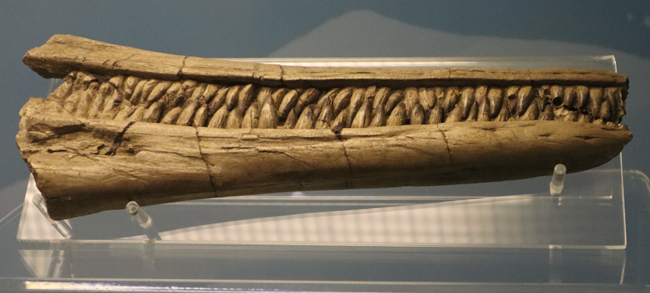
Whilst looking back at some pictures taken during a recent visit to Liverpool World Museum, team members came across a photograph of a museum exhibit that featured an ichthyosaur jaw.
A museum exhibit showing the jaw of a large ichthyosaur. Picture credit: Everything Dinosaur.
Picture credit: Everything Dinosaur
We expect amateur fossil hunters to return to the beaches at Lyme Regis and Charmouth after the recent storms and bad weather in a bid to find marine reptile fossils including ichthyosaur fossil remains. Isolated ichthyosaur bones such as those from the paddles, or vertebra (nicknamed “verts” by collectors), are relatively common but skull bones, particularly anything articulated and nearly complete are exceptionally rare.
We wish all those hardy fossil hunters planning their excursions happy hunting.
For models of ichthyosaurs and other marine reptiles such as plesiosaurs and pliosaurs take a look at this section of Everything Dinosaur’s award-winning website: Models of Sea Monsters and Marine Reptiles.
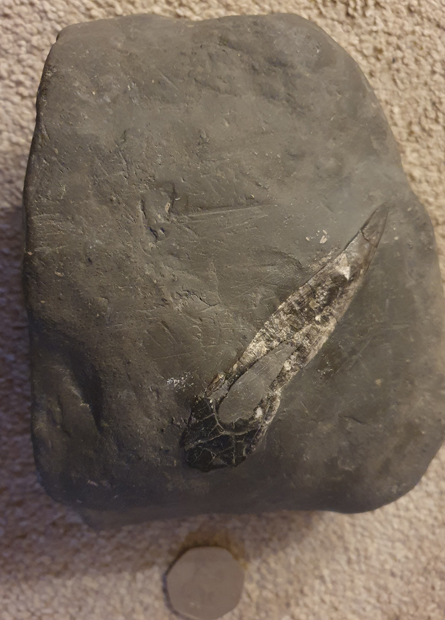
Recently, Everything Dinosaur was contacted by Lee who had collected a strange rock whilst visiting Yorkshire. Lee asked what the rock could be and sent in some photos. We contacted Lee and asked him to send in some more pictures, but this time including an object such as a coin that could provide a scale. In our email, we asked where this rock was found.
A fossil from Robin Hood’s Bay. Picture credit: Lee.
Robin Hood’s Bay Fossil
Lee commented that this rock was found at Robin Hood’s Bay on the north Yorkshire coast. This is a part of the world we know quite well and it is famous for its fossils. The Redcar Mudstone Formation dominates the geology of this part of the English coast and we suspect that the rock is mudstone and the unusual object is the remnants of a Jurassic shelly invertebrate.
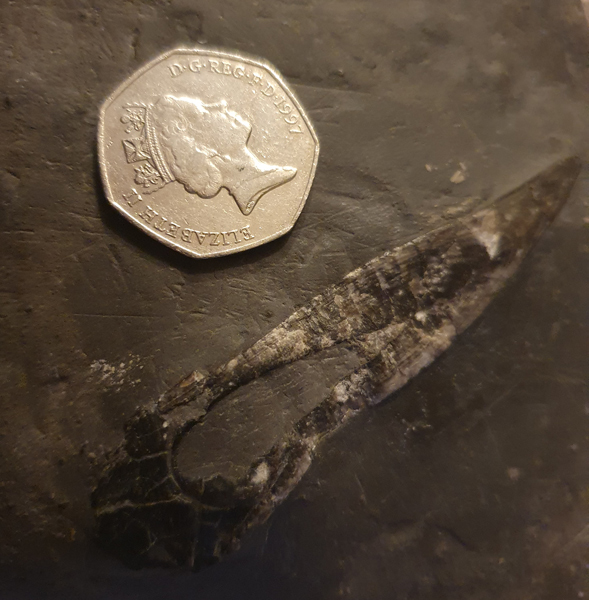
An unusual fossil from Robin Hood’s Bay on the North Yorkshire coast. We suspect that this a mudstone from the Redcar Mudstone Formation, with the remnants of a highly eroded shelly fossil dating from the Lower Jurassic. Picture credit: Lee
Lower Jurassic
The shales, mudstones and sandstones that outcrop at Robin Hood’s Bay date from the Lower Jurassic (Sinemurian to Pliensbachian fauna stages) and we suspect that this fossil is around 195 – 185 million years old.
The specimen is heavily eroded, and we think it is being viewed as a cross-section. Ammonites are relatively common on this stretch of coastline as are Gryphaea fossils (Devils toenails) and crinoids. It is very difficult to identify this item, just from the photographs, however, we think that as there seem to be striations (lines) visible in the fossil that this is a highly eroded bivalve.
A close-up view of the fossil from Robin Hood’s Bay. The coin provides a scale. Picture credit: Lee.
Any Suggestions
We know that many of our blog readers are enthusiastic fossil collectors. We would welcome any suggestions and help with the identification of this specimen.
For replicas of ammonites and belemnites take a look at this section of the Everything Dinosaur website: CollectA Prehistoric Life Models.
In today’s blog post we look at the dwarf nodosaurid Patagopelta (P. cristata), which was formally named and described earlier this month.
A new, very small, armoured dinosaur has been named and described from fossils found in Argentina. The dinosaur which measured around 2 to 2.3 metres in length (based on the dimensions of the femur), suggests that some members of the Nodosauridae in Gondwana became smaller in the Late Cretaceous, perhaps as armoured dinosaurs in South America were under evolutionary pressure from other ornithischians and titanosaurs.
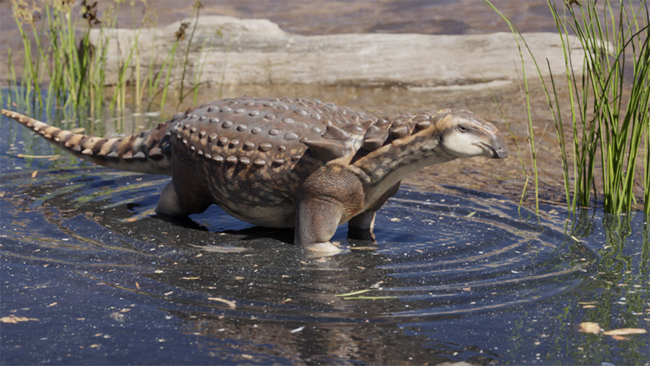
A life reconstruction of the newly described, dwarf nodosaurid from Argentina (Patagopelta cristata). Picture credit: Gabriel Diaz Yantén.
Dwarf Nodosaurid Patagopelta
Fragmentary remains of Late Cretaceous armoured dinosaurs are known from Chile and Argentina, but little work had been undertaken to assess these specimens and to review their phylogeny and taxonomic relationship with other members of the Ankylosauria clade from North America and elsewhere in the world.
Writing in the ” Journal of Systematic Palaeontology”, the researchers led by Facundo Riguetti, a CONICET doctoral fellow, reassessed the known ankylosaur material in conjunction with some other recently found fossils and, as a result, they were able to establish a new nodosaurid species from bones and a single tooth found in sediments of the Allen Formation (Campanian–Maastrichtian) in Salitral Moreno, Río Negro Province (northern Patagonia).
Patagopelta cristata
The dinosaur’s genus name translates as “Patagonian shield” whilst the trivial name derives from the Latin for crest – a reference to the diagnostic crests on both the anterior surface of the femur and the lateral osteoderms of the cervical rings.
Dr Riguetti commented:
“The importance of the study lies in the fact that Patagopelta is the first species of Ankylosauria described for the continental territory of Argentina, which fills the existing gap for this group and adds a new thyreophoran to the very few incomplete and indeterminate remains known for our country from this type of ornithischian dinosaur.”
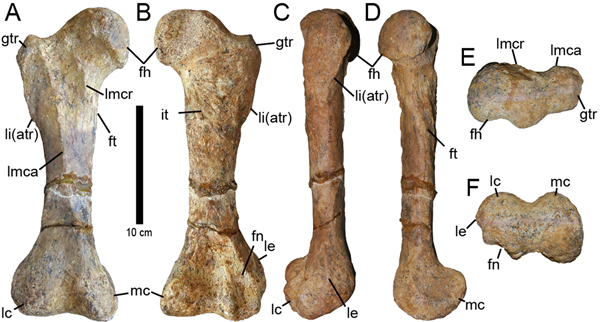
The right femur of Patagopelta (specimen number MPCA-SM-1), in A, anterior, B, posterior, C, lateral, D, medial, E, proximal and F, distal views. As the fragmentary left femur would have been the same size it is thought the femora came from a single animal. Other fossil remains represent several individuals. Abbreviations: fh, femoral head; fn, fibular notch; ft, fourth trochanter; gtr, greater trochanter; it, interwoven texture; lc, lateral condyle; le, lateral epicondyle; li (atr), linea intermuscular (associated to the anterior trochanter); lmca, linea muscularis caudalis; lmcr, linea muscularis cranialis; mc, medial condyle. Scale bar = 10 cm. Picture credit: Riguetti et al.
The Right Femur
The best-preserved fossil element is the right femur, which is complete and shows typical anatomical characteristics associated with the Nodosauridae. This bone along with the distinctive cervical osteoderms led to the erection of this new species. As the femur is only 25 cm in length and bone histology suggests an adult animal, the researchers conclude that Patagopelta was a dwarf form of armoured dinosaur.
Co-author Sebastián Apesteguía, a CONICET researcher, explained:
“For an armoured dinosaur, Patagopelta is extremely small. Due to the size of the femur, only 25 centimetres in length, we estimate that the animal must have been between two and three meters long, while, in general, ankylosaurs are medium-sized or large animals, with an average length of between four and five metres.”
A Faunal Exchange Across the Americas
Although it is thought that the Nodosauridae evolved in the Northern Hemisphere, towards the end of the Cretaceous (Campanian – Maastrichtian), a land bridge existed between North America and South America that permitted a faunal exchange. Titanosaurs migrated north, which explains why fossils of titanosaurs such as Alamosaurus occur in the USA. Ornithischian dinosaurs such as hadrosaurs and nodosaurids moved south.
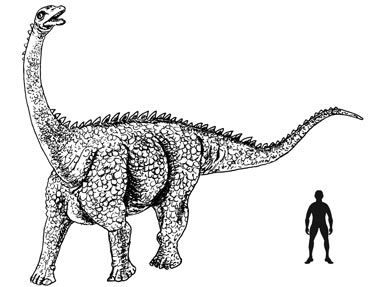
Scale drawing of Alamosaurus. A giant titanosaur known from North America that is probably descended from titanosaurs that roamed South America. Picture credit: Everything Dinosaur.
The image above shows a typical Late Cretaceous titanosaur, for models of Late Cretaceous dinosaurs including titanosaurs and armoured dinosaurs: CollectA Prehistoric Life Models.
Sebastián Apesteguía added:
“That is why in South America we only expect to find animals like Patagopelta in rocks from the Late Cretaceous, just before the global extinction of the dinosaurs took place.”
Dwarfism in Late Cretaceous South American Thyreophora
The size of Patagopelta along with the recently described Stegouros (Soto-Acuña et al, 2021)*, from southernmost Chile, suggests that armoured dinosaurs in South America may have gradually become smaller. This trait is not known in members of the Thyreophora described from other parts of the world. Palaeontologists have speculated that perhaps competition from titanosaurs and the migration of hadrosaurs into South America might have led to armoured dinosaurs adapting to different ecological niches to avoid competition. By being smaller these animals needed fewer resources than larger, contemporaneous herbivorous dinosaurs.
It has also been suggested that the geology of Patagonia where the fossils of Patagopelta were found might provide a clue to the dwarfism. Geologists are aware of several Late Cretaceous marine transgressions in the region. This might have led to the establishment of an island archipelago with dinosaurs living on these small islands gradually become smaller due to a scarcity of resources (the “island rule”).
Tracks of Dwarf Ankylosaurs
Members of the Patagopelta research team had previously described tracks of dwarf ankylosaurs, possibly affected by similar circumstances, preserved in Upper Cretaceous deposits in Bolivia.
Everything Dinosaur acknowledges the assistance of a media release from Consejo Nacional de Investigaciones Científicas y Técnicas (CONICET) in the compilation of this article.
The scientific paper: “A new small-bodied ankylosaurian dinosaur from the Upper Cretaceous of North Patagonia (Río Negro Province, Argentina)” by Facundo Riguetti, Xabier Pereda-Suberbiola, Denis Ponce, Leonardo Salgado, Sebastián Apesteguía, Sebastián Rozadilla and Victoria Arbour published in the Journal of Systematic Palaeontology.
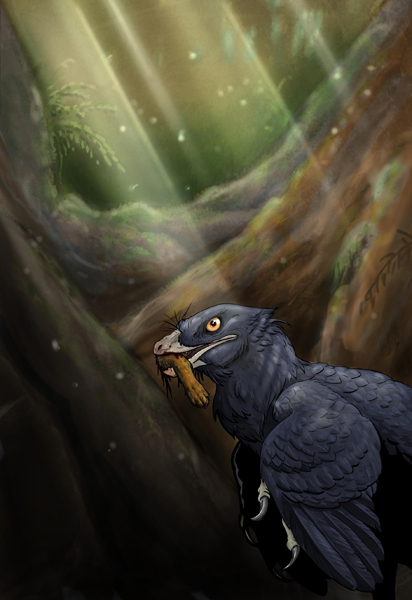
The first, definitive proof of a dinosaur eating a mammal has been found. A foot of a tiny, mouse-sized mammal has been discovered inside the body cavity of the feathered theropod Microraptor (M. zhaoianus). Previously, other Microraptor specimens from Lower Cretaceous rocks of northern China had revealed the fossilised remains of a fish, a primitive bird and a lizard associated with the body cavity. Palaeontologists now know that this crow-sized predator also ate mammals. This is the first record of a dinosaur consuming a mammal.
A life reconstruction showing the Microraptor with the mammal’s foot. Picture credit: Ralph Attanasia.
Mammal Foot Found Inside Ribcage
A new study led by Dr David Hone (Queen Mary University of London), published in the academic “Journal of Vertebrate Paleontology”, documents the first known incident of a dinosaur having eaten a mammal.
Microraptor is a genus of small, dromaeosaurid which lived in the forests of northern China around 120 million years ago (Early Cretaceous). The remarkable fossils found in Liaoning Province have enabled palaeontologists to build up a detailed picture of life in these ancient, dinosaur-dominated forests.
Researchers have also identified a wide variety of mammals and mammaliamorphs that co-existed with the dinosaurs and pterosaurs. Together these creatures make up a diverse ecosystem known as the Jehol biota
To read Everything Dinosaur’s blog post from 2021 describing the remarkable diversity of vertebrates associated with the Jehol biota: The Jehol Biota.
Microraptor had long feathers on its arms and legs and was, very probably arboreal, gliding from tree to tree, hunting out small animals to eat.
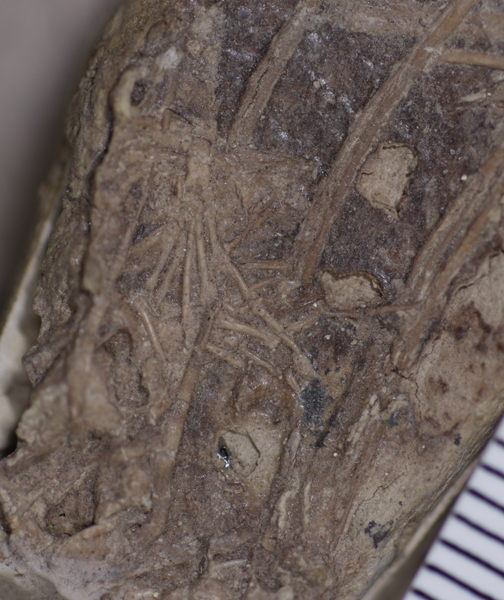
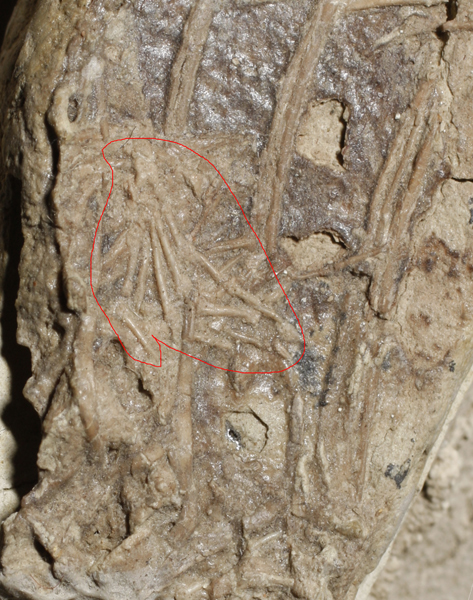
The mammal foot inside the Microraptor fossil. Picture credit: Alex Dececchi.
Spotting the Fossilised Foot
The Microraptor specimen was first described twenty-two years ago, but the preserved remains of the tiny foot had been overlooked. Professor Hans Larsson of McGill University in Montreal spotted what others had missed – the remains of another animal inside the Microraptor’s rib cage. In collaboration with Dr Hone, and colleagues from Canada, China and the USA, a paper describing this remarkable discovery has now been published.
A close-up view of the mammal’s foot inside the Microraptor skeleton. The foot bones have been outlined in red. Picture credit: Alex Dececchi with additional annotation by Everything Dinosaur.
Dinosaur Eating a Mammal
The mammal foot is almost complete and belonged to a very small animal, approximately the size of a modern house mouse. Examination of the bones suggest that it was one that predominantly lived on the ground and was not well adapted for climbing trees, making it an interesting prey choice for the mainly arboreal Microraptor.
Previous studies have revealed other Microraptor specimens containing the remains of a bird, a lizard and a fish. This specimen of the species Microraptor zhaoianus demonstrates that Microraptor also consumed small mammals. This little feathered dinosaur was a generalist, consuming a wide variety of prey.
It is not certain if the dromaeosaurids in question had directly preyed upon and eaten these animals or found them already dead and had scavenged them (or a mixture of both) but the mammal at least falls into the range of typical prey size predicated for a predator the size of Microraptor.
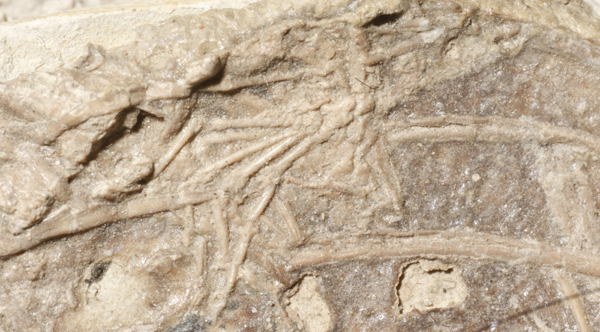
An extreme close-up view of the mammal pes (foot) inside the fossil of Microraptor. Picture credit: Alex Dececchi.
Dr Hone’s co-authors on the paper include Dr Alex Dececchi, Mount Marty College (USA), Dr Corwin Sullivan at the Department of Biological Sciences, University of Alberta, and Professor Xu Xing at the Institute of Vertebrate Palaeontology and Palaeoanthropology, Beijing.
A Significant Fossil Discovery
Commenting on the significance of this fossil discovery, Dr David Hone stated:
“It’s so rare to find examples of food inside dinosaurs so every example is really important as it gives direct evidence of what they were eating.“
Dr Hone from the University’s School of Biological and Behavioural Sciences added:
“While this mammal would absolutely not have been a human ancestor, we can look back at some of our ancient relatives being a meal for hungry dinosaurs. This study paints a picture of a fascinating moment in time – the first record of a dinosaur eating a mammal – even if it isn’t quite as frightening as anything in Jurassic Park.”
Co-author of the study, Dr Alex Dececchi, from Mount Marty College, commented:
“The great thing is that, like your housecat which was about the same size, Microraptor would have been an easy animal to live with but a terror if it got out as it would hunt everything from the birds at your feeder to the mice in your hedge or the fish in your pond.”
Everything Dinosaur acknowledges the assistance of a media release supplied by Dr David Hone in the compilation of this article.
The scientific paper: “Generalist diet of Microraptor zhaoianus included mammals” by Hone, D.W.E., Dececchi, T.A., Sullivan, C., Xu, X. and Larsson, H.C.E. published in the Journal of Vertebrate Paleontology.
Correction
This is not the first recorded incidence of a dinosaur consuming a mammal. The press release, although provided by the appropriate authorities, had failed to recognise evidence cited in an earlier scientific paper.
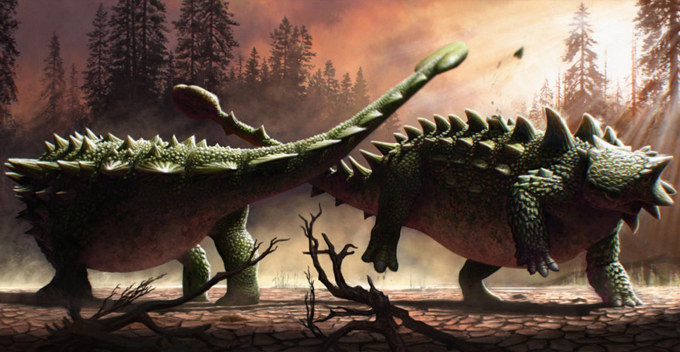
Ankylosaurs battled each other using their tail clubs for social dominance in intraspecific combat. A recently published scientific paper on the ankylosaur Zuul crurivastator suggests that these armoured dinosaurs used their tail clubs to bash each other as well as to fend off tyrannosaurs.
In the study, published in “Biology Letters” the research team, examined the osteoderms of the remarkably well preserved Zuul crurivastator, an armoured dinosaur described from fossils found in the Coal Ridge Member of the Judith River Formation (Montana). Several of osteoderms along the flanks show signs of damage and healing which led the scientists to postulate that these dinosaurs battled each other with their tail clubs. These fights would have been for social or territorial dominance, perhaps even a result of a “rutting” season fighting for mates – behaviour associated with many mammals today.
A pair of ankylosaurs (Zuul crurivastator) indulge in some intraspecific combat. Picture credit: Henry Sharpe
Zuul crurivastator
Named and formally described in 2017, Zuul crurivastator (pronounced Zoo-ul cruh-uh-vass-tate-or) roamed the northern part of Laramidia approximately 76 million years ago (Campanian faunal stage of the Late Cretaceous).
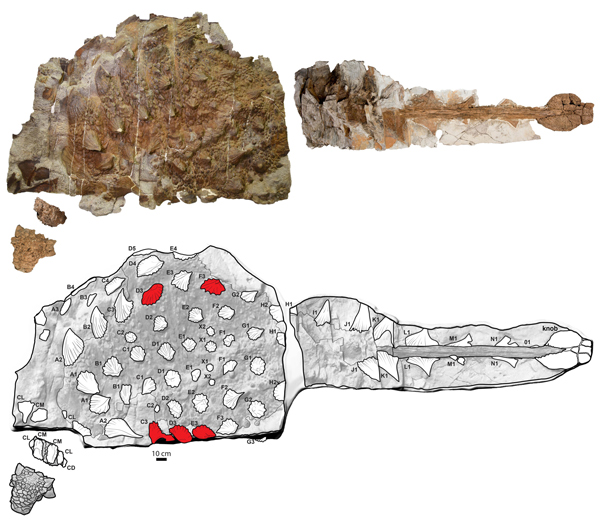
Zuul’s body was covered in bony plates (osteoderms) of different shapes and sizes and the ones along its flanks were particularly large and spiky. Interestingly, the scientists which included lead author and renowned ankylosaur expert Dr Victoria Arbour (Royal British Columbia Museum, Canada), noted that dermal armour near the hips on both sides of the body showed damage that had subsequently healed. This localised, bilaterally symmetrical pathology is speculated to have been caused by ritualised combat rather than wounds inflicted by an attacking theropod dinosaur.
Identifying damaged osteoderms in the holotype of Zuul crurivastator. A composite photograph of the skull, first cervical half ring, body block and tail block (top). Fossil material is brown and surrounding rock matrix is grey. Interpretive illustration showing non-pathological osteoderms in white and pathological osteoderms in red (bottom). Picture credit: Arbour, Zanno and Evans.
An Exciting Piece of the Ankylosaur Puzzle
Dr Arbour commented:
“I’ve been interested in how ankylosaurs used their tail clubs for years and this is a really exciting new piece of the puzzle. We know that ankylosaurs could use their tail clubs to deliver very strong blows to an opponent, but most people thought they were using their tail clubs to fight predators. Instead, ankylosaurs like Zuul may have been fighting each other.”
The genus name honours a fictional monster from the 1984 film “Ghostbusters”, whilst the trivial part of the binomial name translates as “the destroyer of shins”, a nod to the idea that tail clubs were used as defensive weapons to deter attacks from predatory theropod dinosaurs. The substantial club on the end of the three-metre-long tail being used to bash into the lower legs of tyrannosaurs. This new research does not refute the idea that these tail clubs had a role in defence, but based on the pathology seen in the Zuul holotype (specimen number ROM 75860) the scientists propose that sexual selection and intraspecific combat drove their evolution. Many mammals today such as deer, antelope, cattle and sheep have horns and antlers that have evolved for use in battles between members of the same species.
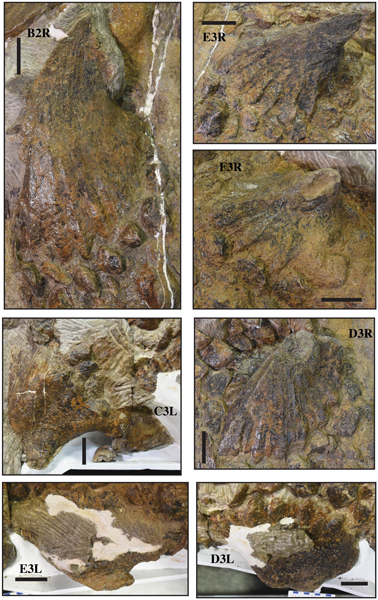
Details of pathological and non-pathological osteoderm morphology in ROM 75860 (Zuul crurivastator). B2R and E3R are non-pathological flank osteoderms. F3R and D3R are pathological flank osteoderms missing the tips of the apex, and the keratinous sheath has not grown over the tip. D3L is a pathological flank osteoderm missing a large portion of the apex, and the keratinous sheath has overgrown the damaged region. C3L and E3L are pathological flank osteoderms with highly modified morphologies, missing large portions of the trailing posterior edge and with the keratinous sheath covering the damaged region. Picture credit: Arbour, Zanno and Evans.
It had been suggested previously that ankylosaurs may have clubbed each other, and that broken and healed ribs could provide evidence to support this idea. Unfortunately, ankylosaurid skeletons are extremely rare in the fossil record, these animals were not common, even in the Late Cretaceous of North America, where the ecosystem was dominated by other ornithischian dinosaurs such as duck-billed dinosaurs and ceratopsians.
Implications for Ankylosaur Behaviour
The remarkable Zuul fossil skeleton provides palaeontologists with an opportunity to study pathology recorded on the bones and dermal armour.
Co-author Dr David Evans (Curator of Vertebrate Palaeontology at the Royal Ontario Museum) explained:
“The fact that the skin and armour are preserved in place is like a snapshot of how Zuul looked when it was alive. And the injuries Zuul sustained during its lifetime tell us about how it may have behaved and interacted with other animals in its ancient environment.”
Tail Clubs for Social Dominance
The researchers conclude that the imposing tail club of Zuul could have been used in defence when needed, but the analysis suggest that sexual selection drove the evolution of this weapon. This finding has consequences for how palaeontologists perceive ankylosaurs. It suggests that these dinosaurs were capable of complex behaviours and that they likely engaged in ritualised combat over mates or for social dominance as inferred in other types of dinosaurs and observed in living mammals and birds.
Everything Dinosaur acknowledges the assistance of a media release from the Royal Ontario Museum in the compilation of this article.
The scientific paper: “Palaeopathological evidence for intraspecific combat in ankylosaurid dinosaurs” by Victoria M. Arbour, Lindsay E. Zanno and David C. Evans published in Biology Letters.
A new species of North American, Late Cretaceous tyrannosaur has been announced. It is the third species in the Daspletosaurus genus. Daspletosaurus wilsoni is older than D. horneri, but geologically younger than D. torosus. The skull demonstrates a mix of traits found in primitive tyrannosaurs as well as several more derived characteristics associated with later members of the Tyrannosauridae such as Tyrannosaurus rex.
Writing in the on-line, open access journal PeerJ, the researchers from the Badlands Dinosaur Museum (North Dakota), suggest that the discovery of a tyrannosaur intermediate in age between the previously described species of this genus, supports earlier research identifying several species of Daspletosaurus as a single evolving lineage, and supports the descent of T. rex from this group.
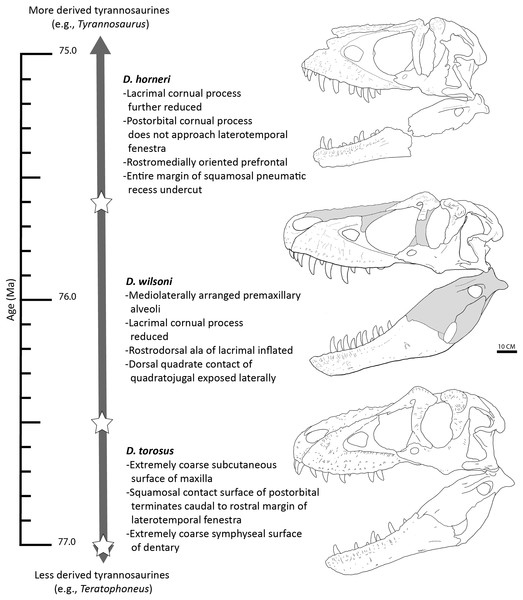
Changes in the Daspletosaurus genus over time with three distinct species now identified. Known skull bones of D. wilsoni shown in white. The evolutionary changes in these tyrannosaurs with key anatomical differences listed. Note scale bar = 10 cm. Picture credit: Warshaw and Fowler.
From the Judith River Formation (Campanian Faunal Stage)
The fossil specimen was discovered in 2017. It consists of a partial, disarticulated skull and jaw bones with an exceptional degree of preservation along with vertebrae, a rib and the first metatarsal. The material comes from Judith River Formation exposures in north-eastern Montana. The fossil was found by John Wilson and the species name has been erected in his honour.
The new species displays a mix of characteristics found in more primitive, geologically older tyrannosaurs. For example, D. wilsoni sports a prominent set of horns around the eye, as well as features otherwise known from later members of this group (including T. rex), like a tall eye socket and expanded air-pockets in the skull. In this way, this newly described species represents a transitional form between older and younger tyrannosaur species.
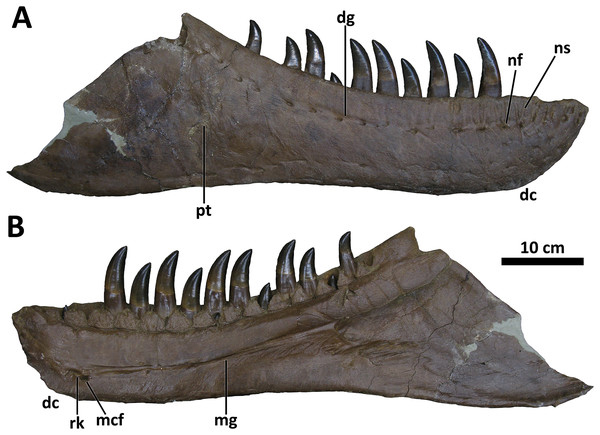
The right dentary of BDM 107 (the holotype). Picture credit: Warshaw and Fowler.
Daspletosaurus wilsoni
Several tyrannosaurs have now been named from the Upper Cretaceous of North America. The researchers note that many of the species are very closely related, forming consecutive sequences where one species evolves into another species over time. When one ancestral species evolves into a second descendant species, this is referred to as anagenesis, as opposed to cladogenesis when successive branching events produce many species that are closely related to each other but not direct descendants of a single species.
The authors of the scientific paper conclude that anagenesis might be the driver of evolutionary change within the Dinosauria at the end of the Cretaceous rather than cladogenetic evolutionary models.
Daspletosaurus Replicas
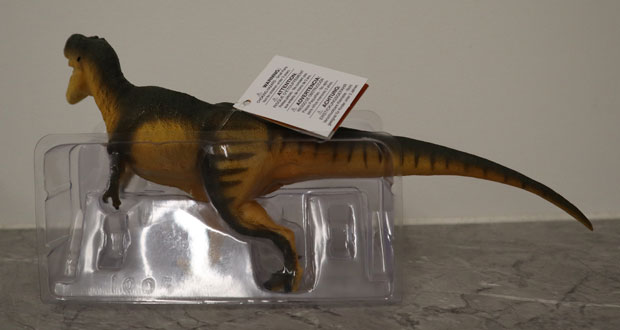
The first species of Daspletosaurus (D. torosus) was named and described in 1970, the second species, the geologically youngest species, D. horneri was named in 2017. Few models of this tyrannosaur existed but in 2013 CollectA added a Daspletosaurus model to their Prehistoric Life model range. More recently (2021), Safari Ltd introduced a Daspletosaurus figure into their Wild Safari Prehistoric World range.
The new for 2021 Wild Safari Prehistoric World Daspletosaurus dinosaur model. Picture credit: Everything Dinosaur.
The scientific paper: “A transitional species of Daspletosaurus Russell, 1970 from the Judith River Formation of eastern Montana” by Elias A. Warshaw and Denver W. Fowler published in PeerJ.
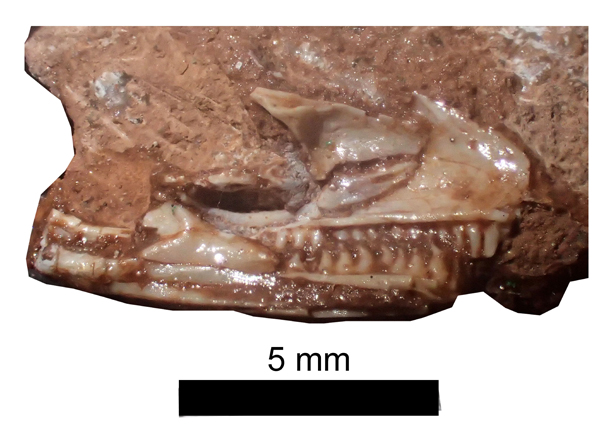
A fossil specimen found in a cupboard at the Natural History Museum (London) proves that there were modern lizards in the Triassic. The Squamata (lizards and snakes), were thought to have had their evolutionary origins in the Middle Jurassic, but analysis of this previously undescribed specimen pushes back the origins of this Order by tens of millions of years.
The partial skull of the stem lizard shown in lateral view. Picture credit: David Whiteside, Sophie Chambi-Trowell, Mike Benton and Natural History Museum UK.
A Gloucestershire Quarry
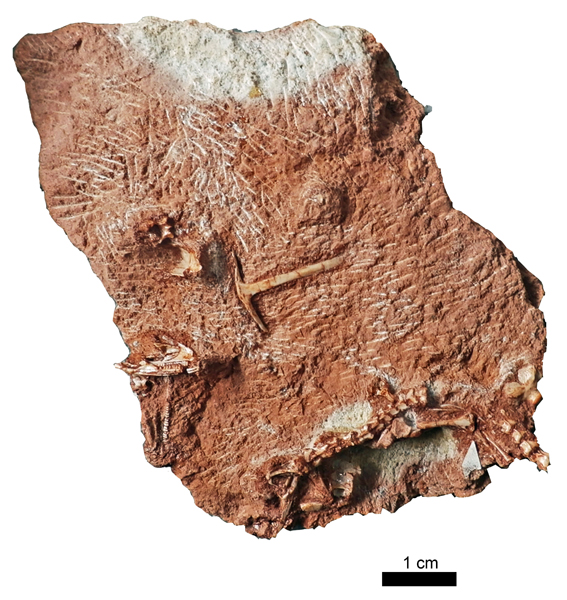
The fossil was collected along with other reptile specimens from a quarry near to Tortworth in Gloucestershire, it was labelled “Clevosaurus and one other reptile”. Clevosaurus material, whilst not common, is well-known from Triassic-aged rocks from the south-west of England, particularly in Avon and Gloucestershire. Clevosaurs are members of an ancient Order of reptiles called the Rhynchocephalia, of which there is only one extant genus today, the Tuatara. Although they may resemble lizards, they are distinct and not members of the Squamata.
The whole specimen showing the skull (left) and skeleton (base of specimen). Picture credit: David Whiteside, Sophie Chambi-Trowell, Mike Benton and Natural History Museum UK.
X-ray Scans and Computer Models
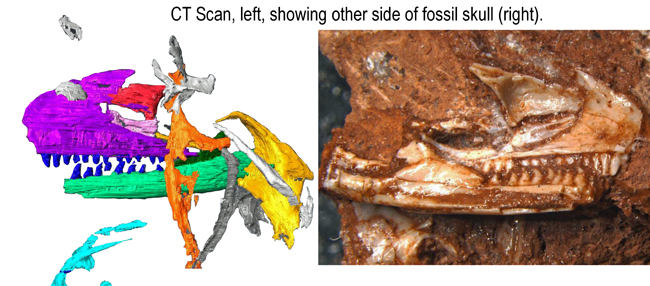
At the time the fossil was collected, the technology did not exist to permit scientists to investigate the specimen in detail. Writing in the academic journal “Science Advances” the researchers conclude that based on the detailed X-ray scans (computerised tomography) of the fossil and the computer-generated models that resulted, the fossil represents a basal member of the reptilian lineage that would lead to modern snakes and lizards.
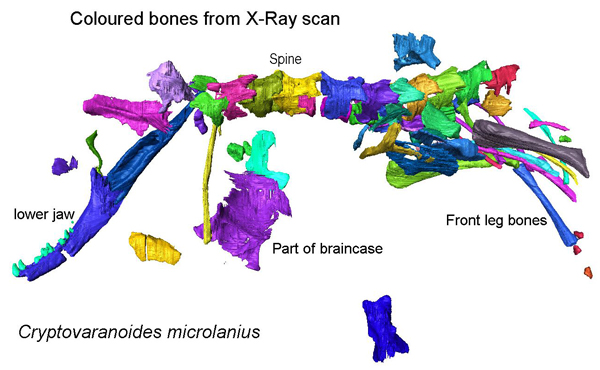
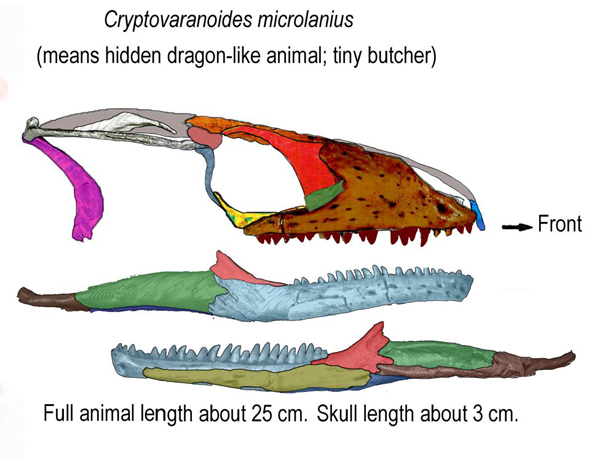
CT scan showing the left side of the stem lizard head with bones in different colours beside the fossil showing the right-hand side. Picture credit: David Whiteside, Sophie Chambi-Trowell, Mike Benton and Natural History Museum UK.
This fossil indicates that the origin of lizards and snakes (Squamata) was much further back in geological time than previously thought.
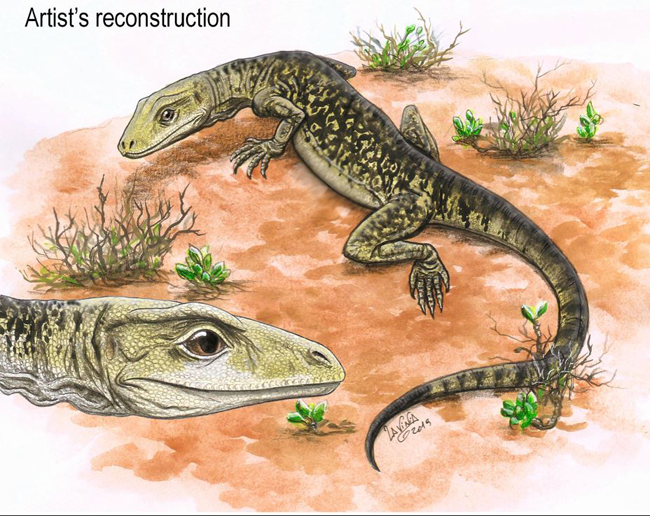
The research team, led by Dr David Whiteside of Bristol University’s School of Earth Sciences, have named their incredible discovery Cryptovaranoides microlanius which means “small butcher” in tribute to its jaws that were filled with sharp-edged slicing teeth.
Explaining the significance of this research Dr Whiteside stated:
“I first spotted the specimen in a cupboard full of Clevosaurus fossils in the storerooms of the Natural History Museum in London where I am a Scientific Associate. This was a common enough fossil reptile, a close relative of the New Zealand Tuatara that is the only survivor of the group, the Rhynchocephalia, that split from the squamates over 240 million years ago. As we continued to investigate the specimen, we became more and more convinced that it was actually more closely related to modern day lizards than the Tuatara group.”
Life reconstruction of Cryptovaranoides. Picture credit: Lavinia Gandolfi.
Modern Lizards
Cryptovaranoides is clearly a squamate as its anatomy differs from the Rhynchocephalia. The braincase is different, it had different neck vertebrae and the anatomy of the shoulder girdle is more reminiscent of a modern lizard than a Tuatara. The scientists identified only one major primitive feature not found in modern squamates, an opening on one side of the end of the upper arm bone, the humerus, where an artery and nerve pass through.
X-ray scan of the skeleton, showing the backbone, the lower jaw, and limbs with resulting computer-generated image. Picture credit: David Whiteside, Sophie Chambi-Trowell, Mike Benton and Natural History Museum UK.
Other Primitive Characteristics
Analysis of the Cryptovaranoides material revealed that this crown squamate does have some other, apparently primitive characters such as a few rows of teeth on the bones of the roof of the mouth, but experts have observed the same in the living European Glass lizard and many snakes such as Boas and Pythons have multiple rows of large teeth in the same area. Despite this, it is advanced like most living lizards in its braincase and the bone connections in the skull suggest that it was flexible.
Co-author of the paper Professor Mike Benton (University of Bristol) added:
“In terms of significance, our fossil shifts the origin and diversification of squamates back from the Middle Jurassic to the Late Triassic. This was a time of major restructuring of ecosystems on land, with origins of new plant groups, especially modern-type conifers, as well as new kinds of insects, and some of the first of modern groups such as turtles, crocodilians, dinosaurs, and mammals.”
Modelling of the lizard skull with jaws. Picture credit: David Whiteside, Sophie Chambi-Trowell, Mike Benton and Natural History Museum UK.
Dr Whiteside paid tribute to the late Pamela L. Robinson who recovered the fossil from the quarry and did a lot of preparation work on the specimen, however, with no access to CT scanning technology, she was not able to perceive the significance of her discovery.
Everything Dinosaur acknowledges the assistance of a media release from the University of Bristol in the compilation of this article.
The scientific paper: “A Triassic crown squamate” by Whiteside, D. I., Chambi-Trowell, S. A. V., and Benton, M J. published in Science Advances.
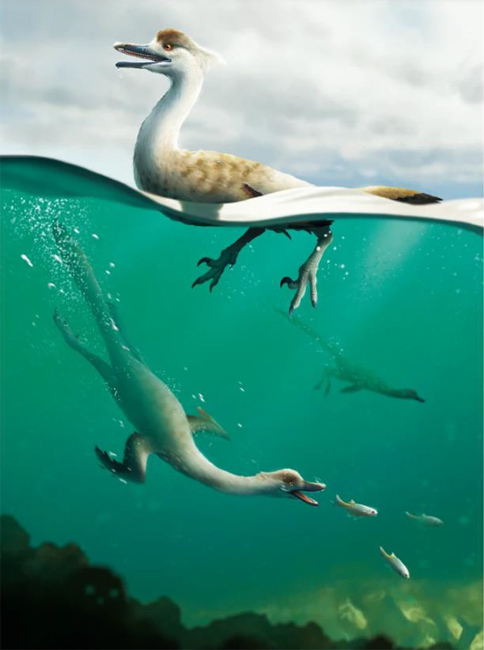
Scientists have concluded that a newly described dromaeosaurid from Mongolia with its streamlined body may have been semi-aquatic. The duck-sized theropod, named Natovenator polydontus had a ribcage that angled downwards towards the pelvis, an anatomical trait also found in extant diving birds. The researchers, writing in the journal “Communications Biology”, suggest that this dinosaur, a relative of Velociraptor, could potentially have been a swimming predator, hunting and catching fish.
Natovenator polydontus life reconstruction. This dromaeosaurid dinosaur may have filled an ecological niche similar to that of extant diving birds today. Picture credit: Yusik Choi.
Natovenator polydontus
The semi-articulated fossil specimen was discovered in 2008 by a joint Mongolian/Korean field team. The material consisting of substantial postcranial elements and a partial skull comes from the Barun Goyot Formation at Hermiin Tsav in the southern Mongolian Gobi Desert. Phylogenetic analysis suggests that Natovenator polydontus is closely related to Halszkaraptor (H. escuilliei) which heralds from southern Mongolia too, but from slightly older strata – the Djadochta Formation.
When Halszkaraptor was formally described in 2017, it was proposed that this dromaeosaurid was adapted to a life in water. The discovery of Natovenator adds weight to the theory that some dromaeosaurs were semi-aquatic. The two dinosaurs, which were most probably feathered have been placed in the same clade – the Halszkaraptorinae.
The dinosaur had a long, flexible neck and analysis of the jaws indicate that Natovenator had lots of small teeth, ideal for grabbing slippery fish.
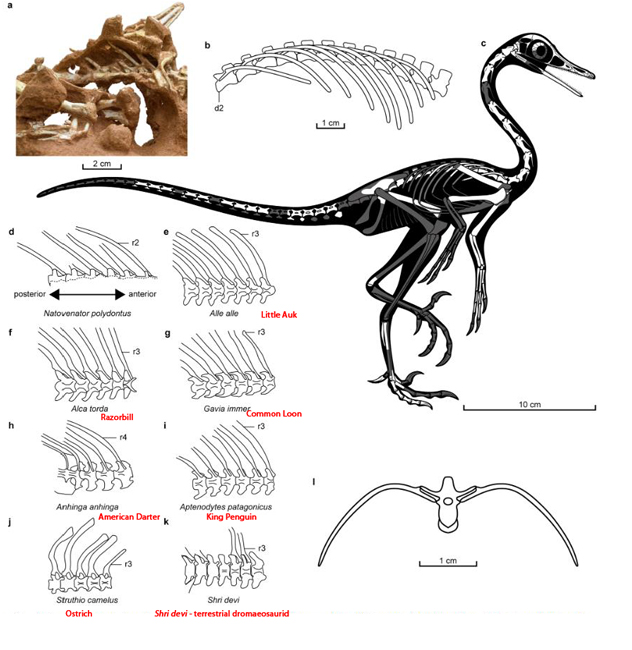
A skeletal reconstruction (known bones in white) and comparison of the sloping ribs in N. polydontus with extant diving birds. Natovenator lived approximately 68 million years ago (Maastrichtian faunal stage of the Cretaceous). Picture credit: Lee et al with additional annotation by Everything Dinosaur.
The picture above shows the dorsal vertebrae and ribs of Natovenator in ventral view (a), with (b) a line drawing in left lateral view showing how the ribs are angled downwards towards the rear of the animal. Diving birds and penguins share this anatomical trait (e-i), which is believed to help these animals to be more streamlined when they dive and swim. Line drawing (j) shows the ribs of the entirely terrestrial ostrich whilst (k) shows the dorsal vertebrae and known ribs of Shri devi, another dromaeosaurid from the Barun Goyot Formation which was probably entirely terrestrial too.
Could the shape, direction and orientation of the ribs be evidence to suggest that Natovenator was semi-aquatic?
Swimming Hunter with Many Teeth
The dinosaur’s genus name translates from the Latin and means “swimming hunter”, whilst the specific or trivial name refers to the unusually large number of teeth located in the jaw. The anatomical position and orientation of the ribs has not been recorded in a non-avian dinosaur before. If Natovenator and the closely related Halszkaraptor were semi-aquatic, then this demonstrates the great diversity within the Theropoda. Dinosaurs evolving to exploit specific niches in ancient ecosystems.
A spokesperson from Everything Dinosaur commented that this was a remarkable discovery that once again highlighted the range of body plans that dinosaurs evolved to exploit niches within ecosystems. As many semi-aquatic animals today have dense bones, perhaps a study of the bone density of Natovenator might help confirm that this dinosaur was indeed, at home on the water.
Dromaeosaur Diversity
The Dromaeosauridae were a very successful group of theropod dinosaurs. Numerous genera have been described. To gain an appreciation of different dromaeosaurs, take a look at the extensive Beasts of the Mesozoic range of articulated “raptor” figures: Beasts of the Mesozoic Articulated Dinosaur Models.
The scientific paper: “A non-avian dinosaur with a streamlined body exhibits potential adaptations for swimming” by Sungjin Lee, Yuong-Nam Lee, Philip J. Currie, Robin Sissons, Jin-Young Park, Su-Hwan Kim, Rinchen Barsbold and Khishigjav Tsogtbaatar published in Communications Biology.
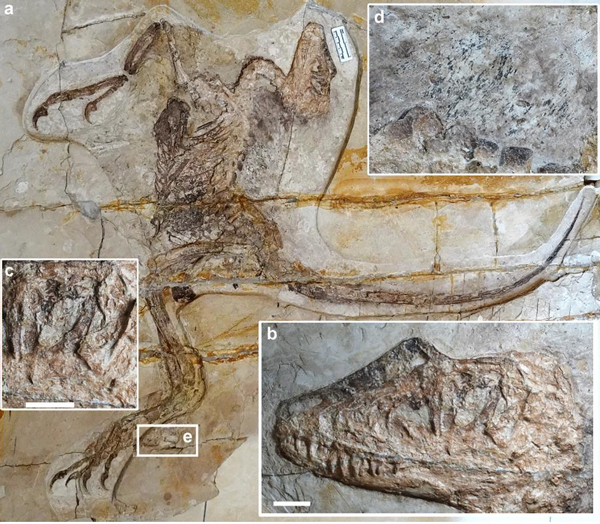
A new species of Chinese dromaeosaurid dinosaur has been described based on superbly preserved remains found in Inner Mongolia. The new dromaeosaurid species has been named Daurlong wangi and a phylogenetic assessment suggests that this dinosaur was closely related to Tianyuraptor and Zhenyuanlong.
Daurlong wangi holotype fossil material, a new dromaeosaurid from the Lower Cretaceous Jehol Biota of Inner Mongolia, China. The whole specimen (a), close-up view of the skull (b) scale bar = 2 cm, with (c) detail of the orbit scale bar = 1 cm. Traces of feathers associated with trunk (d) and (e) the preserved remains of a frog in association with the dromaeosaurid. Picture credit: Wang et al.
Daurlong wangi
Described by the scientists, which include researchers from Chinese Academy of Geological Sciences and the Inner Mongolia Museum of Natural History, as a mid-sized dromaeosaurid, Daurlong is estimated to have been around 1.5 metres long. The nearly complete specimen comes from Lower Cretaceous exposures of the Longjiang Formation in the Morin Dawa Daur Autonomous Banner (Inner Mongolia). The fossilised remains were excavated from Pigeon Hill, apt as this feathered dinosaur was related to modern birds (Aves). Both birds and the Dromaeosauridae are members of the Eumaniraptora clade.
New Dromaeosaurid Species
The binomial scientific name for this new dromaeosaurid is derived from the indigenous Daur Nation and from the Chinese word for dragon. The species name honours the director of the Inner Mongolia Museum of Natural History, Mr Wang Junyou.
The Daurlong wangi holotype – specimen number IMMNH-PV00731. Skull (a, b), left scapula (c), sternum and left hand (d, e), right forelimb (f). Reconstruction in (g) by M. Auditore (CC-BY 4.0). Note scale bar in skeletal reconstruction = 10 cm. Picture credit: Wang et al.
Finding a Frog
Some evidence of plumage is preserved along the top of the back of the skull, around the trunk and along the edges of the tail. The scientists writing in the academic journal “Scientific Reports” found no evidence of preserved melanosomes in association with the feather filaments.
A bluish layer located towards the back of the rib cage has been putatively described as remnants of the intestines. Such a soft tissue discovery would be exceptionally rare within the Dinosauria, and could help inform palaeontologists over the origins and evolution of the digestive tract of birds and other closely related genera.
The fossilised remains of a small frog were found in the same slab as the Daurlong specimen. Everything Dinosaur is not aware of any gut contents indicating that this small, meat-eater ate frogs, but it is very likely that Daurlong would have consumed amphibians such as frogs as well as lizards and small mammals.
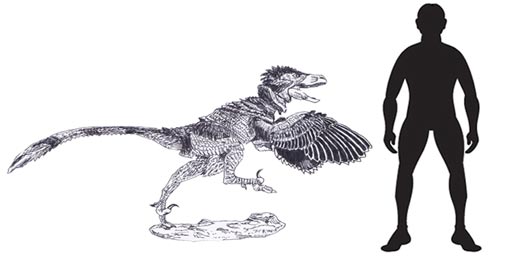
A scale drawing of Zhenyuanlong suni. The newly described dromaeosaurid Daurlong wangi is thought to have been closely related to Zhenyuanlong. Picture credit: Everything Dinosaur.
The Beasts of the Mesozoic range of articulated prehistoric animal figures contains several examples of Cretaceous dromaeosaurids.
The scientific paper: “Intestinal preservation in a birdlike dinosaur supports conservatism in digestive canal evolution among theropods” by Xuri Wang, Andrea Cau, Bin Guo, Feimin Ma, Gele Qing and Yichuan Liu published in Scientific Reports.
A world’s first complete fossil skeleton of a prehistoric reptile studied by scientists that was thought lost forever, has been re-discovered as researchers uncovered marine reptile casts. These casts, although replica copies of the actual fossils, can still provide palaeontologists with valuable information.
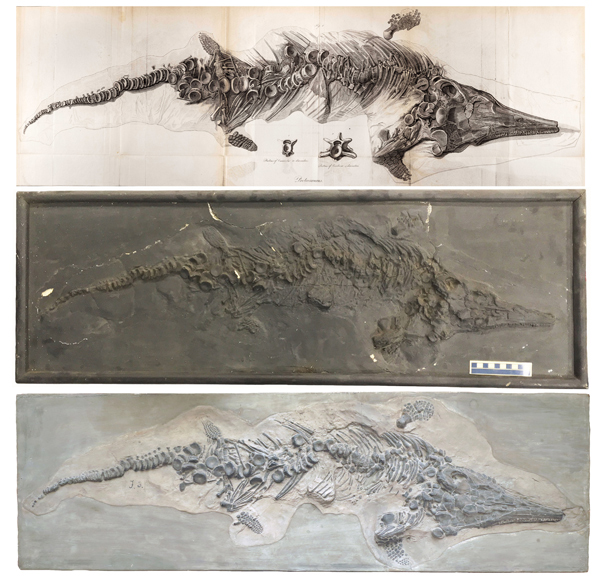
Original scientific illustration by William Clift (top) and the two newly discovered marine reptile casts. Picture credit: The Royal Society.
“Proteosaurus” Resurfaces
The fossilised remains of an ichthyosaur that was probably excavated by Mary Anning and named “Proteosaurus”, was destroyed in a German bombing raid in World War II. It had been assumed that this historically significant fossil had been lost to science, however, palaeontologists have identified two plaster casts held in collections outside of the UK, which reveal important new data. The casts were discovered by Dr Dean Lomax, a palaeontologist and Visiting Scientist at the University of Manchester, and Professor Judy Massare, from the State University of New York, Brockport, USA.
Dr Lomax in collaboration with renowned palaeoartist Bob Nicholls recently produced a book which looks at the astonishing direct evidence indicating the lives and behaviours of long-extinct animals that can be found in the fossil record. The book entitled “Locked in Time” can be found here (search on the website for author Dean Lomax): Columbia University Press.
Found in 1818
The ichthyosaur fossil was discovered in 1818 at Lyme Regis, Dorset, and almost certainly found by the famous pioneering palaeontologist Mary Anning. Named “Proteosaurus” the specimen was acquired by a prolific collector, Lt-Col. Thomas James Birch, who sold it to the Royal College of Surgeons, London in 1820, to raise funds for Mary Anning and her family who were struggling to pay their rent.
The fossil discovery came at a time when academics were beginning to scientifically study prehistoric animal remains, the sciences of geology and palaeontology were developing. Ichthyosaur fossils had been found earlier, but there was disagreement as to what the specimens represented. Each new fossil find was adding important information to the debate and the 1818 specimen was the most complete ichthyosaur skeleton found to date. It was examined by Sir Everard Home, a highly respected British surgeon, who published his findings in the journal of The Royal Society in 1819.
Unfortunately, the fossil was completely destroyed by a German air raid in May 1941, when the Royal College of Surgeons in London was bombed.
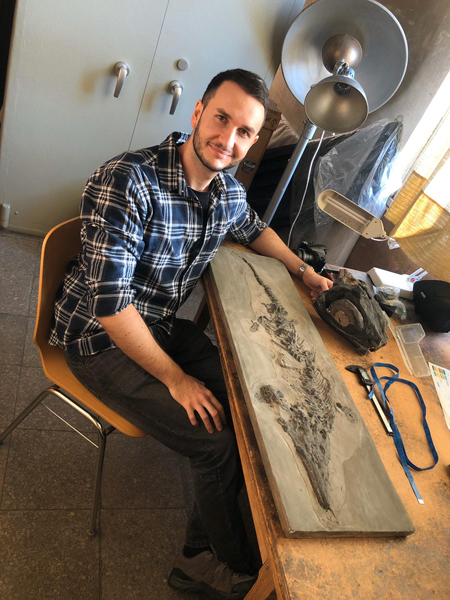
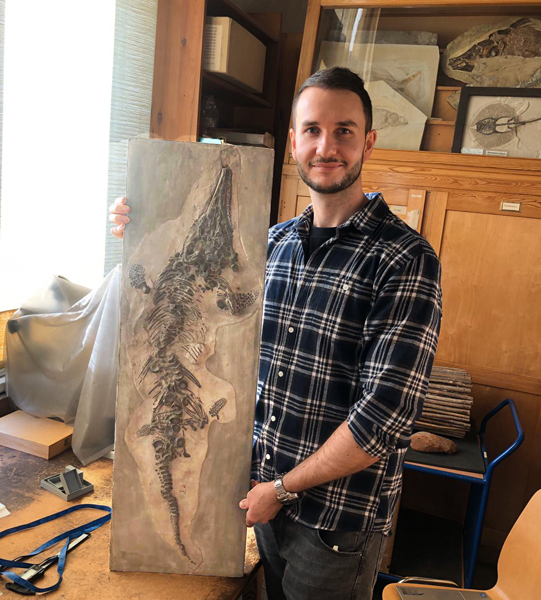
Dr Dean Lomax with the cast from the Natural History Museum (Berlin). Picture credit: Dean Lomax/University of Manchester.
An Important Role in Establishing Palaeontology as a Scientific Discipline
Dr Dean Lomax commented:
“When research on this fossil was published, it was still more than twenty years before the word “dinosaur” would be invented. This and other early ichthyosaur finds sparked a major interest in collecting more of these curious, enigmatic creatures. The discoveries and research on ichthyosaurs played an important role in establishing palaeontology as a scientific discipline.”
Dr Lomax and Professor Massare have collaborated on numerous projects and have made several important discoveries whilst studying historic fossil collections. For example, in 2015, their research led to the naming of Ichthyosaurus anningae, the first, new Ichthyosaurus species to be named in nearly 130 years.
In 2016, whilst examining the marine reptile collection housed at the Peabody Museum (Yale University), Massare and Lomax found an extremely old replica cast of an ichthyosaur, which was subsequently identified as the first-known cast of the fossil studied by Sir Everard Home. Up until this point, there was no record of any casts of this significant ichthyosaur fossil.
The Museum Assistant in vertebrate palaeontology at the Peabody Museum, Daniel Brinkman explained:
“Peabody curatorial staff assumed that the specimen was a real ichthyosaur fossil and not a plaster cast painted to look like the original fossil from which it was moulded.”
The Yale University cast was purchased by Yale Professor Charles Schuchert, as part of a substantial collection of fossils from the estate of Frederick A. Braun, a professional fossil dealer, however, very little else is known about the cast. It is not known when Braun acquired it, or who made the cast.
The Berlin Discovery
In 2019, Dean Lomax visited the Natural History Museum in Berlin (Germany) to study their fossil collection and was surprised to find a second cast of the 1818 ichthyosaur. This replica was in much better condition than the Yale cast.
The scientific head of collections at the Natural History Museum (Berlin), Dr Daniela Schwarz commented:
“When Dr Lomax visited our collections, he kept asking me for information about this cast and I couldn’t help him very much because of missing records and labelling of the specimen. So, when I learned about the outcome of his detective work and that this important specimen’s cast now rested in our collections for more than a century, I was really stunned! This discovery once more demonstrates the necessity to carefully preserve also undetermined and casted material in a natural history collection for centuries, because in the end, there will always be someone who discovers its scientific value!”
Dr Dean Lomax holds the precious Berlin fossil cast. Picture credit: Dean Lomax/University of Manchester.
Studying the Ichthyosaur Fossil Replicas
Studies of both casts have shown that they were made at two different times. The Yale cast might even be a very old cast made when the ichthyosaur was still in the possession of Lt-Col. Thomas James Birch.
Professor Massare said:
“In Home’s 1819 article, he illustrated the original skeleton. This drawing by William Clift was the only visual evidence we had of the ichthyosaur. Now, having two casts, we can verify the reliability of the original illustration by comparison with the casts. We have identified a couple of bones that Home missed, and found a few discrepancies between the drawing and the casts.”
This new study has been published today in the journal, Royal Society Open Science, one of the journals of The Royal Society, which ironically published the original paper on the discovery of the ichthyosaur fossil back in 1819.
Explaining the decision to publish in Royal Society Open Science, Dr Lomax stated:
“When we discovered the casts, we felt compelled to submit our research to The Royal Society, especially because they had played a major role in publishing the first accounts of ichthyosaurs in the scientific literature over two hundred years ago.”
Professor Massare added:
“We hope that our discovery of these two casts might encourage curators and researchers to take a closer look at old casts in museum collections.”
Everything Dinosaur acknowledges the assistance of a media release from the University of Manchester.
The scientific paper: “Rediscovery of two casts of the historically important ‘Proteo-saurus’, the first complete ichthyosaur skeleton” by D. R. Lomax and J. A. Massare published in Royal Society Open Science.