All about dinosaurs, fossils and prehistoric animals by Everything Dinosaur team members.

Pictures of fossils, fossil hunting trips, fossil sites and photographs relating to fossil hunting and fossil finds.

9 09, 2022

Unravelling the Plateosauridae – A New Species is Announced (T. maierfritzorum)

By |2023-08-30T20:21:35+01:00September 9th, 2022|Categories: Adobe CS5, Dinosaur and Prehistoric Animal News Stories, Dinosaur Fans, Main Page, Palaeontological articles, Photos/Pictures of Fossils|0 Comments

Researchers have re-examined the fossilised remains of a Late Triassic, herbivorous dinosaur that had been assigned to the Plateosaurus genus and determined that the fossils represent a new species. The new dinosaur has been named Tuebingosaurus maierfritzorum and unlike Plateosaurus it was an obligate quadruped.

Tuebingosaurus fossils and scale drawing.
Skeletal silhouette of Tuebingosaurus with ascribed fossil bones shown in white. Silhouette of person provides the scale. The attribution of the bone marked in grey (fibula) is uncertain. Picture credit: Omar Rafael Regalado Fernandez / Ingmar Werneburg.

The genus Plateosaurus was erected in 1837 (Hermann von Meyer), before the term Dinosauria was coined, it was one of the first dinosaurs to be scientifically described. It has earned a reputation as somewhat of a taxonomic waste basket with numerous species assigned to it, often based on poorly preserved or fragmentary fossil remains.

Researchers at the University of Tübingen’s Senckenberg Centre for Human Evolution and Palaeoenvironment in Germany reassessed fossil bones discovered in Trossingen in 1922 and identified several unique anatomical traits leading them to conclude that these remains did not represent Plateosaurus as had previously been thought. Indeed, the bones are so different that they do not belong to a member of the Plateosauridae family, but most likely represent a member of the related clade the Massopoda.

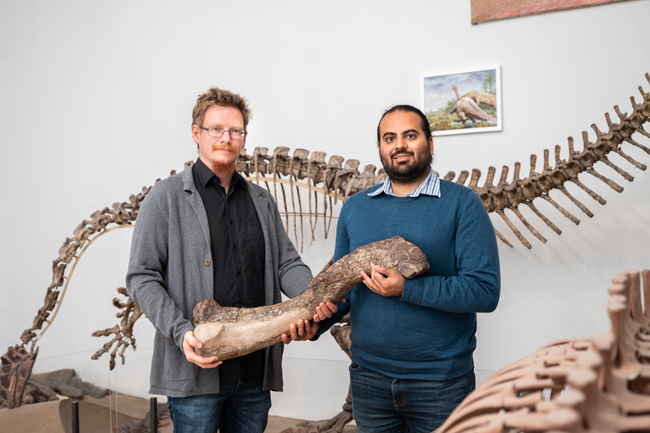
Tuebingosaurus hib bones viewed by the scientists.
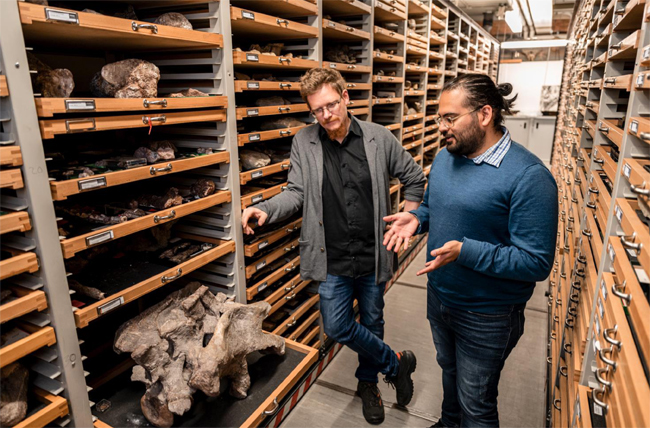
Ingmar Werneburg (left) and Omar Rafael Regalado Fernandez (right) in the archive of the paleontological collection at Tübingen. The hips of Tuebingosaurus maierfritzorum can be seen in the foreground. Picture credit: Valentin Marquardt/Universität Tübingen.

Broader and More Robust Hips

Writing in the journal “Vertebrate Zoology”, the researchers, Dr Omar Rafael Regalado Fernandez and Dr Ingmar Werneburg demonstrate that the hips are much broader and more robust when compared with plateosaurs. In addition, the limb bones such as the femur are unusually large and the fused sacral vertebrae are characteristic of an obligate quadruped and not Plateosaurus that are believed to have been facultative bipeds (quadrupeds, but capable of walking on their hind legs if the need arose).

Tuebingosaurus fossils in display cabinet.
Two phalanges (toe bones) (centre) of Tuebingosaurus maierfritzorum in a display cabinet at the Württemberg Hall. Picture credit: Valentin Marquardt/Universität Tübingen.

The Swabian Alb Mountains

The fossil bones of Tuebingosaurus maierfritzorum display characteristics of sauropods, the super-sized, long-necked dinosaurs such as Diplodocus, Brontosaurus and Brachiosaurus that dominated terrestrial faunas some fifty million years after Tuebingosaurus roamed. The fossil material is part of Tübingen’s paleontological collection. It originated from a quarry site near Trossingen at the edge of the Swabian Alb mountain range in Baden-Württemberg (Germany). The area is famous for its extensive plateosaur bonebeds and the huge amount of Plateosaurus fossils collected confirm that this lizard-hipped genus was extremely common in the Late Triassic and that Plateosaurus lived in large herds.

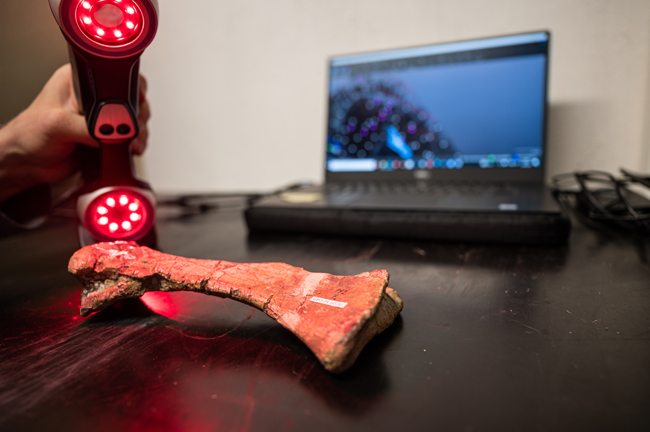
Scanning a Tuebingosaurus foot bone.
Three-dimensional image of a footbone from Tuebingosaurus being made with a handheld laser scanner. Picture credit: Valentin Marquardt/Universität Tübingen.

Following the in-depth analysis, which included scanning limb bones to provide a data source to compare to Plateosaurus fossils, the scientists concluded that these fossils represent a dinosaur more closely related to the Sauropoda than Plateosaurus.

The Trossingen Biota

Examination of the matrix material found in association with the Tuebingosaurus fossils, and the surface condition of the bones suggests that this dinosaur sunk into a swamp when it died. The bones on the left side of the body were exposed on the surface for several years and show signs of weathering.

Several different types of dinosaur are known from the Plateosaurus dominated Trossingen Formation, which dates to the Norian-Rhaetian faunal stages of the Late Triassic. Coelophysoids such as Liliensternus, which at around 5 metres long, could have predated upon Tuebingosaurus juveniles have been found. The Trossingen Formation has also yielded fragmentary fossils of other miscellaneous theropods plus evidence of different types of prosauropod.

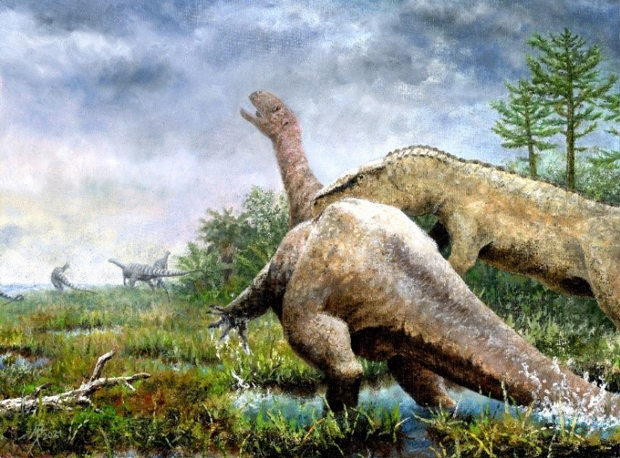
The large rauisuchian Teratosaurus (T. suevicus) is also known from the Trossingen Formation and in the image below an unfortunate Tuebingosaurus is being attacked by this six-metre-long, predator from the crocodilian lineage of the Archosauria.

Tuebingosaurus life reconstruction.
Reconstruction how the death of Tuebingosaurus maierfritzorum may have occurred. Bones of the predatory archosaur Teratosaurus were also found in Trossingen. However, it has only been proven that Tuebingosaurus fell on its right side. Weathering indicates that the bones on the left side of the body probably lay for several years on the surface. Picture credit: Marcus Burkhardt.
Tuebingosaurus maierfritzorum

The individual bones of Tuebingosaurus maierfritzorum (pronounced Too-bin-go-sore-us my-ah-frits-zor-um), had been stored separately but have now been united in their own permanent display case. The genus name honours the university city of Tübingen and its inhabitants, whilst the specific name pays tribute to two German zoologists, Professor Wolfgang Maier from Tübingen and Professor Uwe Fritz from Senckenberg Natural History Collections in Dresden.

This new dinosaur species has now been described in the latest edition of the Senckenberg Natural Science Society’s journal Vertebrate Zoology, which also pays tribute to Wolfgang Maier on his 80th birthday.

Ingmar Werneburg (left) and Omar Rafael Regalado Fernandez (right) hold a femur from Tuebingosaurus maierfritzorum
Researchers Ingmar Werneburg (left) and Omar Rafael Regalado Fernandez (right) hold a femur from Tuebingosaurus maierfritzorum. Picture credit: Valentin Marquardt/Universität Tübingen.

Everything Dinosaur acknowledges the assistance of a media release from the University of Tübingen in the compilation of this article.

The scientific paper: “A new massopodan sauropodomorph from Trossingen Formation (Germany) hidden as ‘Plateosaurus’ for 100 years in the historical Tübingen collection” by Omar Rafael Regalado Fernández, Ingmar Werneburg published in Vertebrate Zoology.

Visit the Everything Dinosaur website: Everything Dinosaur.

6 09, 2022

A New Abelisaurid from Argentina

By |2022-10-18T10:35:41+01:00September 6th, 2022|Categories: Adobe CS5, Dinosaur and Prehistoric Animal News Stories, Main Page, Palaeontological articles, Photos/Pictures of Fossils|0 Comments

A new species of dinosaur has been described from fossils found in Neuquén Province (Argentina). Named Elemgasem nubilus it is the first unambiguous abelisaurid known from the Coniacian faunal stage of the Late Cretaceous.

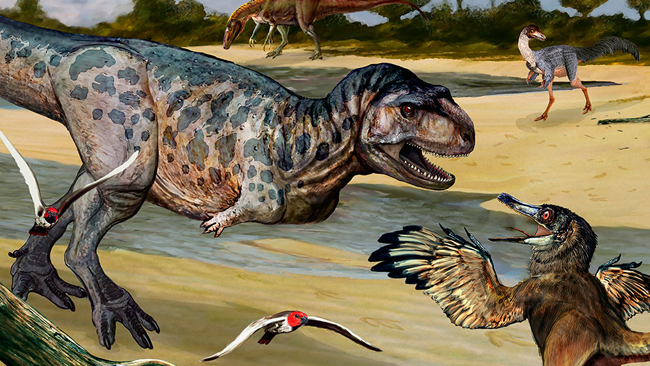
Elemgasem life reconstruction
A life reconstruction of the newly described abelisaurid Elemgasem nubilus depicted with other Late Cretaceous prehistoric fauna associated with the Portezuelo Formation of Patagonia. Picture credit: Abel Germán Montes.

A field team of CONICET researchers have excavated the fragmentary remains of a new species of carnivorous dinosaur from Upper Cretaceous exposures near to the city of Plaza Huincul, in the province of Neuquén in Patagonia (Argentina). The fossils come from the Portezuelo Formation and represent an individual animal around four metres in length and standing approximately two metres tall. Bone histology revealed that this abelisaurid was around eight years old when it died. The histological analysis suggests that Elemgasem probably would not have grown much bigger, making this predator much smaller than related abelisaurids such as Carnotaurus and Ekrixinatosaurus.

Regarded as a sub-adult, the scientists who include co-author Rodolfo Coria (Universidad Nacional de Río Negro, Argentina), writing in the journal of The Palaeontological Association conclude that this dinosaur had already reached sexual maturity.

Palaeontologist Rodolfo Coria excavates dinosaur fossils
Co-author of the scientific paper Rodolfo Coria (Universidad Nacional de Río Negro) excavating fossils in Neuquén Province. Picture credit: CONICET.

Documenting the Evolution of the Abelisauridae

The Abelisauridae are a diverse group of medium-to-large-sized predatory dinosaurs predominately associated with the landmass of Gondwana. Numerous genera have been described based on fossils found in the Southern Hemisphere and they are known from almost all parts of Gondwana in all the faunal stages associated with the Late Cretaceous, except for the Coniacian (90 to 86 mya approximately).

This period in Earth’s history is marked by a turnover in terrestrial and marine fauna due to global climate change leading to worldwide extinctions.

Explaining the significance of these fossils, co-author Rodolfo Coria stated:

“The identification of a new species is always a scientifically relevant event, especially if the species belongs to an emblematic family of carnivorous dinosaurs such as the abelisaurs. Elemgasem represents a key piece in the puzzle of the evolution of this group, which began to be put together with the first findings of José Bonaparte, the most important Argentinean vertebrate palaeontologist of the 20th century – in the 1980s”

Although the fossil material is fragmentary, a new genus has been erected based on several autapomorphies including notable rugosity on the lateral surface of the fibula and the shape of the tail bones which are different from any other abelisaurid described to date.

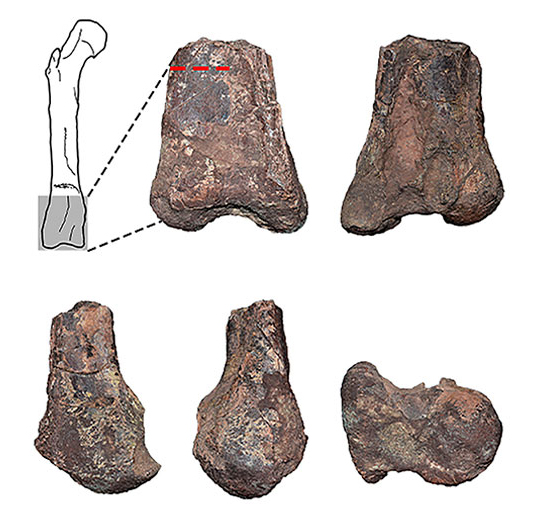
Views of the distal portion of the right femur of Elemgasem.
Views of the distal portion of the fossilised right femur of Elemgasem nubilus with an accompanying line drawing that shows the position of the bone. Picture credit: Mattia A. Baiano.

The First Abelisaurid from the Portezuelo Formation (New Abelisaurid)

Elemgasem is the first abelisaurid described from fossils from the Portezuelo Formation and it was part of a diverse dinosaur-dominated terrestrial fauna with several different types of theropod present including dromaeosaurids, alvarezsaurids and megaraptorids.

Phylogenetic analysis indicates the E. nubilus could be tentatively assigned to the Brachyrostra tribe within the Carnotaurinae subfamily, although the limited amount of fossilised material prevented the researchers from making a more positive taxonomic assessment.

The genus name is derived from the name of a god in the regional Tehuelche culture and the trivial name is from the Latin for “cloudy days”, a reference to the strange, foggy conditions that the dig team encountered whilst they worked in the field.

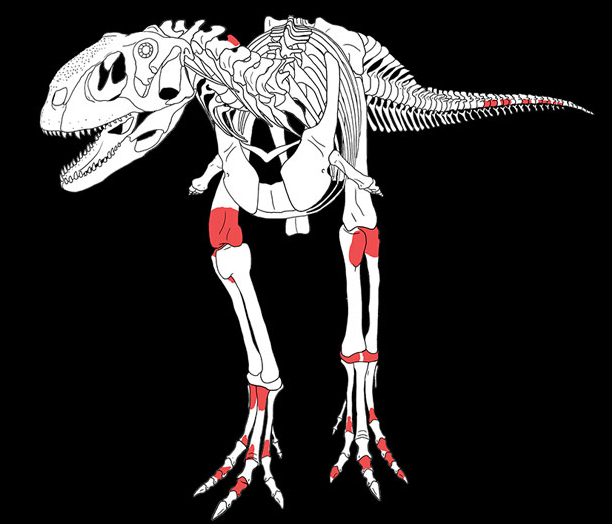
Elemgasem skeletal reconstruction.
Skeletal reconstruction of Elemgasem nubilus with known fossil elements shown in red. Picture credit: Abel Germán Montes.

Dr Coria added:

“We already knew of abelisaurian forms in older horizons [such as the Cenomanian] or more modern ones [such as the Campanian], so it was predictable that there would be some in intermediate times. What we did not expect was to find a comparatively small abelisaur like Elemgasem, whose size is clearly smaller than the rest of the species in the group, such as Carnotaurus, Aucasaurus or Skorpiovenator.”

It is the first abelisaurid from the Turonian–Coniacian interval and it increases the diversity of this theropod family at a time of marked turnover in the tetrapod fauna of South America.

Rebor has introduced several scale replicas of abelisaurid dinosaurs. To view the extensive range of Rebor models and figures available from Everything Dinosaur: Rebor Figures and Models.

Everything Dinosaur acknowledges the assistance of a media release from CONICET in the compilation of this article.

The scientific paper: “Elemgasem nubilus: a new brachyrostran abelisaurid (Theropoda, Ceratosauria) from the Portezuelo Formation (Upper Cretaceous) of Patagonia, Argentina” by Mattia A. Baiano, Diego Pol, Flavio Bellardini, Guillermo J. Windholz, Ignacio A. Cerda, Alberto C. Garrido and Rodolfo A. Coria published in Papers in Palaeontology.

1 09, 2022

New Research Identifies Africa’s Oldest Dinosaur

By |2024-04-13T09:00:52+01:00September 1st, 2022|Categories: Adobe CS5, Dinosaur and Prehistoric Animal News Stories, Dinosaur Fans, Main Page, Palaeontological articles, Photos/Pictures of Fossils|0 Comments

An international team of scientists have unearthed the remains of Africa’s oldest dinosaur skeleton. The fossils represent a sauropodomorph, which has been named Mbiresaurus raathi. The fossils were excavated from Pebbly Arkose Formation exposures in Mashonaland Central Province, Zimbabwe. This basal sauropodomorph and the associated vertebrate fauna discovered to date is helping scientists to better understand the dispersal and distribution of early dinosaurs and their contemporaries.

Mbiresaurus raathi life reconstruction
A life reconstruction of the sauropodomorph Mbiresaurus raathi (foreground) with examples of the Zimbabwean biota of the Upper Triassic Pebbly Arkose Formation. Two rhynchosaurs (front right) are not disturbed by the as yet, unnamed herrasaurid dinosaur pursuing a cynodont (back right). An aetosaur observes the goings on from the opposite bank (left). Picture credit: Andrey Atuchin.

Mbiresaurus raathi

The research team led by palaeontologists from Virginia Tech in collaboration with colleagues from the Natural History Museum of Zimbabwe, the Universidade de São Paulo, (São Paulo, Brazil) and the Chipembele Wildlife Education Centre, (Mfuwe, Zambia) have explored the extensive Upper Triassic sandstone exposures of the Pebbly Arkose Formation. As well as finding the nearly complete and articulated sauropodomorph specimen (M. raathi), the team have been documenting the vertebrate fauna associated with these 230-million-year-old deposits.

The first evidence of Africa’s oldest dinosaur known to science was found during fieldwork in 2017. Two years later, the team returned to excavate more of the specimen and to work on the fossilised remains of an as yet, unnamed theropod dinosaur discovered nearby.

Excavating the fossilised remains of Mbiresaurus raathi.
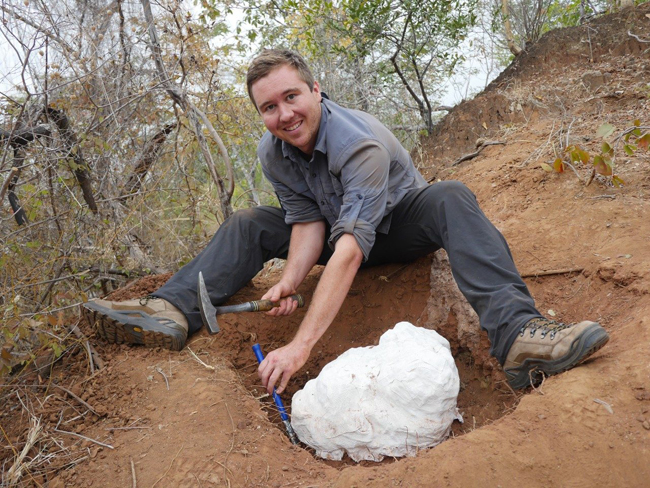
Christopher Griffin in 2017, carefully excavating part of the Mbiresaurus raathi skeleton, wrapped in a plaster field jacket. Picture credit: Stephen Tolan for the Paleobiology & Geobiology Research Group at Virginia Tech.

The holotype (NHMZ 2222) consists of a considerable portion of the entire skeleton including skull material. A second specimen (NHMZ 2547), representing a larger individual was discovered in close proximity to the holotype. The research team estimate that Mbiresaurus was around two metres in length and weighed approximately 25 kilograms.

Chris Griffin holds a jaw fragment.
Christopher Griffin holds in his hand portion of the lower jaw of Mbiresaurus in Virginia Tech’s Derring Hall. Picture credit: Zach Murphy for the Paleobiology & Geobiology Research Group at Virginia Tech.

Commenting on the significance of this dinosaur discovery, field team member Christopher Griffin, who graduated in 2020 with a PhD in geosciences from the Virginia Tech College of Science, stated:

“The discovery of Mbiresaurus raathi fills in a critical geographic gap in the fossil record of the oldest dinosaurs and shows the power of hypothesis-driven fieldwork for testing predictions about the ancient past.”

Documenting the Early Dinosauria

South America is regarded by many palaeontologists as the cradle of dinosaur evolution. As far as scientists are able to deduce; based on the fossil record, the dinosaur dynasty began with the evolution of small, agile meat-eaters in South America. However, as landmasses at the time mostly consisted of a single, super-sized continent (Pangaea), it is perfectly feasible to propose that the Dinosauria arose elsewhere and spread across Pangaea.

Herrerasaurus scale drawing.
Herrerasaurus – potentially an early, carnivorous dinosaur from the Upper Triassic Ischigualasto Formation of north-western Argentina. The evolutionary origins of the Dinosauria remain ambiguous, it is hoped that further exploration of the Upper Triassic (Carnian) deposits of the Pebbly Arkose Formation will help palaeontologists to better understand dinosaur evolution and dispersal. Picture credit: Everything Dinosaur.

Dr Griffin added:

“These are Africa’s oldest-known definitive dinosaurs, roughly equivalent in age to the oldest dinosaurs found anywhere in the world. The oldest known dinosaurs, from roughly 230 million years ago, the Carnian Stage of the Late Triassic, are extremely rare and have been recovered from only a few places worldwide, mainly northern Argentina, southern Brazil, and India.”

Sterling Nesbitt, an associate professor at the Department of Geosciences at Virginia Tech and co-author of the scientific paper published this week in the journal “Nature”, explained that basal sauropodomorphs such as Mbiresaurus demonstrate how the early evolutionary history of the Dinosauria is being rewritten with every new discovery.

2019 expedition team in Harare (Zimbabwe)
Some of the 2019 expedition team photographed in Harare (Zimbabwe), prior to the fieldwork. From left are Kudzie Madzana, Edward Mbambo, Sterling Nesbitt, George Malunga, Christopher Griffin, Darlington Munyikwa. Picture credit: by Zach Murphy for Virginia Tech.

An Ancient Triassic Biota

The Carnian-aged fossils are providing scientists with evidence of a diverse reptilian biota which co-existed with the earliest dinosaurs. The fieldwork has revealed evidence of cynodonts, aetosaurs (armoured archosaurs more closely related to crocodylians than to the archosaur lineage that led to the birds and the dinosaurs), and rhynchosaurs.

The team also unearthed fossilised remains of an as yet, unnamed theropod dinosaur (herrerasaurid). These archaic animals are similar to the biota associated with contemporaneous deposits found in South America and India.

Excavating the herrerasaurid dinosaur.
Sterling Nesbitt (left) and Christopher Griffin excavate the fossilised remains of an as yet, unnamed herrerasaurid dinosaur in 2019. Picture credit: Murphy Allen for Virginia Tech.

What’s in a Name?

The genus name Mbiresaurus is from the local Shona language for the name of the district “Mbire” where the fossils were found and from the Greek for lizard. The species name honours palaeontologist Michael Raath for his pioneering work studying vertebrate fossils found in Zimbabwe. The research team conclude that Mbiresaurus was probably bipedal and from an analysis of its small, serrated teeth, it was probably herbivorous although omnivory cannot be ruled out.

A New Theory on the Early Dispersal of the Dinosauria

The researchers have postulated a new theory on dinosaur dispersal. As Africa was once part of the colossal super-continent Pangaea, the distribution and dispersal of the Dinosauria was constrained by climatic conditions across the landmass.

The central portion of Pangaea was dominated by extremely arid environments. These deserts acted as a barrier, the earliest dinosaurs were restricted to southern Pangaea. Only later in their evolutionary history, during a period of climate change resulting in a much wetter climate (Carnian Pluvial Event) did the Dinosauria disperse worldwide.

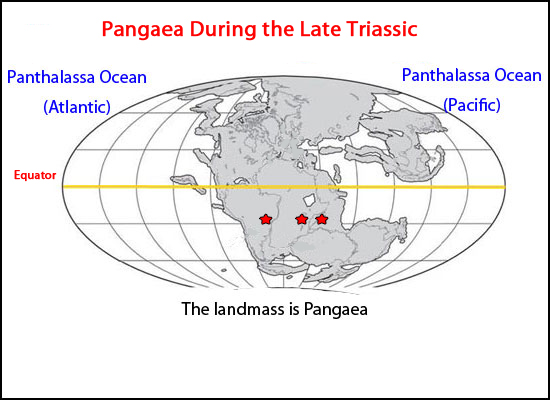
Pangaea dinosaur distribution (Carnian faunal stage).
The fossils from the Upper Triassic deposits of northern Zimbabwe from a geographical bridge between contemporaneous fossil bearing deposits in India and southern Brazil. The red stars demonstrate the link between the three locations with Zimbabwe in the centre. Picture credit: Everything Dinosaur.

The research team deliberately targeted Zimbabwe for fieldwork as the northern part of the country would have been located at roughly the same latitude as southern Brazil and India during the Late Triassic.

They conclude that the distribution of the first dinosaurs is correlated with palaeolatitude-linked climatic barriers, and dinosaurian dispersal to the rest of the super-continent was delayed until these barriers were removed. The distribution of the earliest members of the Dinosauria remained restricted by the climatic conditions that prevailed in southern Pangaea.

An Exciting Development for Palaeontology in Zimbabwe

The discovery of a nearly complete specimen of one of the earliest dinosaurs known to science provides a major boost to the Natural History Museum of Zimbabwe and demonstrates that palaeontologists from southern Africa have a major role to play in obtaining evidence about early dinosaur evolution.

Michel Zondo, a curator and fossil preparator at the Natural History Museum of Zimbabwe commented:

“The discovery of the Mbiresaurus is an exciting and special find for Zimbabwe and the entire palaeontological field. The fact that the Mbiresaurus skeleton is almost complete, makes it a perfect reference material for further finds. It is the first sauropodomorph find of its size from Zimbabwe, otherwise most of our sauropodomorph finds from here are usually of medium- to large-sized animals.”

Everything Dinosaur acknowledges the assistance of a media release from Virginia Tech in the compilation of this article.

The scientific paper: “Africa’s oldest dinosaurs reveal early suppression of dinosaur distribution” by Christopher T. Griffin, Brenen M. Wynd, Darlington Munyikwa, Tim J. Broderick, Michel Zondo, Stephen Tolan, Max C. Langer, Sterling J. Nesbitt and Hazel R. Taruvinga published in Nature.

29 08, 2022

Giant Sauropod in the Garden

By |2023-02-07T09:34:23+00:00August 29th, 2022|Categories: Adobe CS5, Dinosaur and Prehistoric Animal News Stories, Main Page, Palaeontological articles, Photos/Pictures of Fossils|0 Comments

Back in June (2022), Everything Dinosaur team members wrote about the “White Rock spinosaurid” *, what could turn out to be the biggest predatory dinosaur found to date in Europe. At the time, many media outlets mistakenly reported that these fossils, found on the Isle of Wight, represented “Europe’s biggest dinosaur”. Not true, the remains of what could be the largest dinosaur ever discovered in Europe are being excavated in a Portuguese back garden.

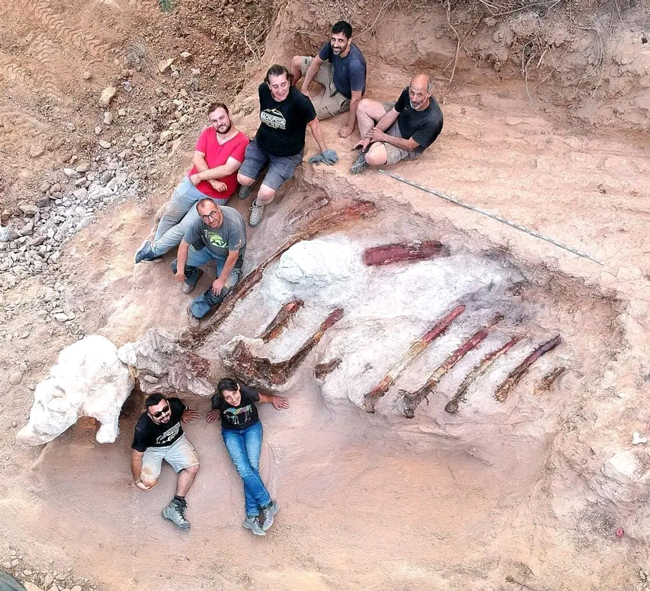
Field team members at the dig site.
Field team members pose next to the exposed ribs of the sauropod. Picture credit: Instituto Dom Luiz (Faculty of Sciences of the University of Lisbon, Portugal).

Giant Sauropod

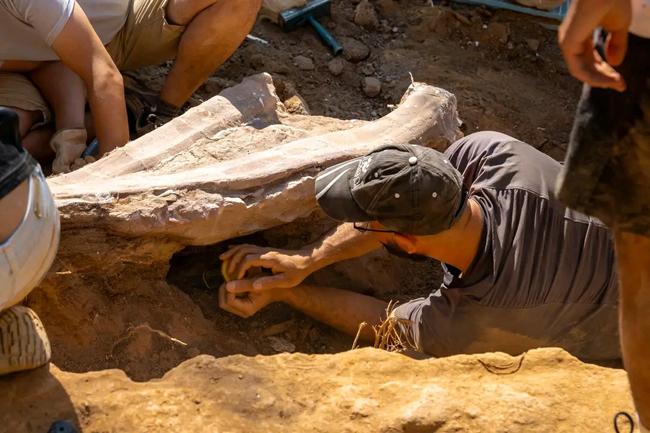
The first fossils were uncovered in 2017 when the property owner in the city of Pombal, in the Leiria District, central Portugal, began construction work in the garden. The strata in this area of Portugal were laid down approximately 150 million years ago (Upper Jurassic) and the fossils are from a sauropod, a long-necked, long-tailed herbivore that could have measured more than 25 metres long.

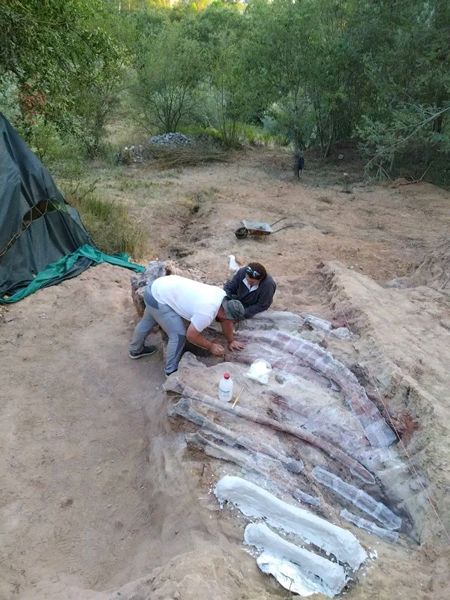
Field team members working to expose the ribs.
Working to expose the sauropod ribs. Picture credit: Instituto Dom Luiz (Faculty of Sciences of the University of Lisbon, Portugal).

A joint Spanish/Portuguese field team have been working to expose, stabilise and remove the fossilised bones. In the picture above, two ribs have been coated in plaster and burlap in preparation for their removal from the site.

A European Brachiosaurid

Tentatively described as a member of the Brachiosauridae family, parts of the backbone and ribs have been excavated so far. The bones were found in virtually their original articulated and anatomical position.

Elisabete Malafaia, post-doctoral researcher at the Faculty of Sciences of the University of Lisbon and member of the field team excavating the giant bones stated that it was extremely unusual to find all the ribs of a sauropod, almost entirely intact. The skeleton was found in the position that the dinosaur probably died in, no post-mortem transport of the corpse took place.

Removing sediment around the ribs.
Removing sediment around the ribs. Picture credit: Instituto Dom Luiz (Faculty of Sciences of the University of Lisbon, Portugal).

The field team are optimistic that more bones remain buried, including the skull. To find an almost complete skeleton of this type of dinosaur would be a truly remarkable discovery with the potential to provide scientists with an enormous amount of data on Late Jurassic sauropods.

A Member of the Macronaria

The Neosauropoda clade, a sub-group within the Sauropoda is divided into two sub-clades. The Diplodocoidea and the Macronaria. The Macronaria are distinguished by having a large nasal (external naris), the diameter of the nasal opening exceeding the diameter of the eye socket (orbit). Brachiosaurids and the titanosaurs, which thrived during the Cretaceous, represent some of the biggest land animals to have ever existed.

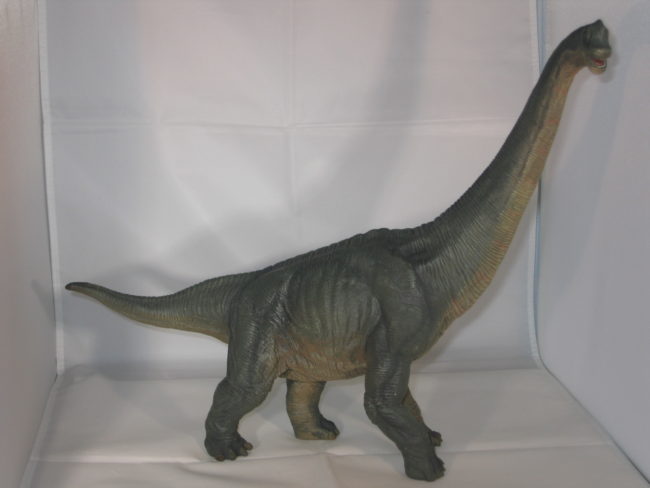
Papo Brachiosaurus Model
A replica of a typical brachiosaurid (Brachiosaurus altithorax). Picture credit: Everything Dinosaur.

It has been speculated that the head height of the Portuguese sauropod could be as much as 12 metres, that would make this dinosaur tall enough to look over a three-storey house!

The giant ribs of the sauropod
The giant ribs of the sauropod. Picture credit: Instituto Dom Luiz (Faculty of Sciences of the University of Lisbon, Portugal).

Years of Laboratory Work Ahead

Dinosaur fans will have to be patient and wait for a formal scientific description. It is likely to take several years to fully prepare and study the huge, fossilised bones, of what is probably a new dinosaur species. A spokesperson from Everything Dinosaur commented that this was an amazing fossil find and that this Portuguese discovery could rival some of the sauropod fossils found in the roughly contemporaneous Morrison Formation of the western United States.

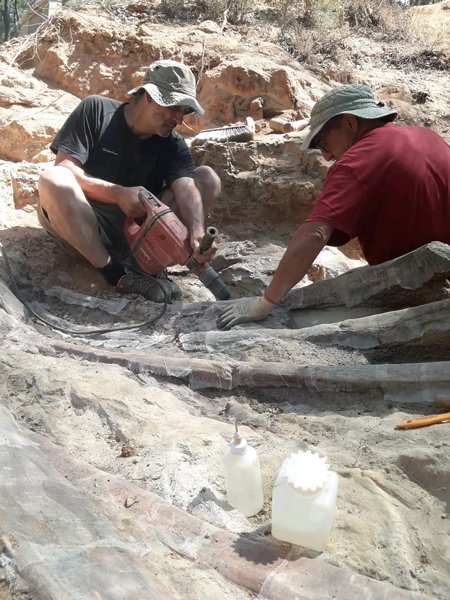
Carefully removing matrix surrounding the sauropod bones.
Carefully removing matrix surrounding the sauropod bones. Picture credit: Instituto Dom Luiz (Faculty of Sciences of the University of Lisbon, Portugal).

Everything Dinosaur contacted the Faculty of Sciences of the University of Lisbon media team to request images for this blog post, we acknowledge their assistance in the compilation of this article. The University’s press team kindly responded, supplied images and wrote:

“Obrigada pelo interesse neste trabalho. Partilho aqui algumas imagens com boa resolução.”

This translates as “thank you for your interest in this work, here are some high-resolution images for you.”

We look forward to hearing more about this remarkable discovery and the eventual naming and scientific description of a huge sauropod from a Portuguese garden.

“White Rock spinosaurid” * – to read Everything Dinosaur’s article from June, 2022 on the discovery of potentially Europe’s largest carnivorous dinosaur known to date: Super-sized Carnivorous Dinosaur from the Isle of Wight.

27 08, 2022

Thalassotitan – Terror of the Seas

By |2023-03-26T12:29:19+01:00August 27th, 2022|Categories: Adobe CS5, Dinosaur and Prehistoric Animal News Stories, Dinosaur Fans, Main Page, Palaeontological articles, Photos/Pictures of Fossils|0 Comments

An international team of researchers have uncovered the remains of a huge mosasaur, one that was adapted to hypercarnivory and was an apex predator in the shallow seas of North Africa around 66 million years ago. In addition, the scientists have unearthed remains of other marine vertebrates that shared this giant’s habitat. Acid damage on the bones suggest that these animals were prey and ingested by mosasaurids potentially this new leviathan named Thalassotitan atrox.

Thalassotitan atrox

Thalassotitan life reconstruction
Thalassotitan life reconstruction. Picture credit: Andrey Atuchin.

Late Cretaceous Marine Giant

The remains of this Late Cretaceous marine giant, including a 1.4-metre-long-skull were excavated from the Upper Cretaceous, phosphatic beds of the Ouled Abdoun Basin (northern Morocco). High sea levels created a shallow, tropical sea that teemed with life in North Africa and at the very end of the Cretaceous, approximately 66 million years ago (Maastrichtian faunal stage of the Cretaceous), the 9-metre-long Thalassotitan was the apex marine predator.

Dr Nick Longrich poses next to the skull of Thalassotitan
Dr Nick Longrich poses next to the skull of Thalassotitan which is in its protective field jacket. Picture credit: University of Bath.

A Contemporary of Tyrannosaurus rex

Thalassotitan atrox was a mosasaur, which are extinct members of the largest order of reptiles the Squamata. As such, Thalassotitan was more closely related to snakes and lizards than it was to archosaurs such as crocodilians and the Dinosauria. However, it was a contemporary of Tyrannosaurus rex and like T. rex it was a hypercarnivore, attacking and feeding upon other large vertebrates.

An Apex Predator

The massive jaws and robust, conical teeth suggest that Thalassotitan was an apex predator, filling a similar environmental nice as Orcas (Orcinus orca) and the Great White shark (Carcharodon carcharias) in extant marine ecosystems. The research team, who included Dr Nick Longrich, Senior Lecturer from the Milner Centre for Evolution at the University of Bath and lead author on the study, published in the journal Cretaceous Research, postulate that the acid-etched fossilised bones of other vertebrates found in the same deposit might represent prey ingested by mosasaurids, likely Thalassotitan.

Thalassotitan size comparison
Thalassotitan compared in size to an Orca and a diver. Picture credit: University of Bath.

Thalassotitan’s large teeth are often broken and show extensive signs of wear, with some teeth in the jaws worn down to the root. Piscivory (fish-eating) would not have caused this damage, the scientists conclude that this is evidence to support the theory that Thalassotitan was an apex predator.

Dr Longrich commented:

“Thalassotitan was an amazing, terrifying animal. Imagine a Komodo Dragon crossed with a great white shark crossed with a T. rex crossed with a killer whale.”

Thalassotitan’s Potential Victims

The scientists comment that possible remains of Thalassotitan’s victims may have been found. Fossils from the same beds show damage from acid, perhaps evidence of their partial digestion in the stomach of Thalassotitan before the bones and teeth were regurgitated. Fossils with this particular damage include large predatory fish, a sea turtle, a half-metre-long elasmosaurid (plesiosaur) skull, and jaws and skulls of at least three different mosasaur species.

Dr Longrich explained the significance of the acid etched fossil bones and teeth stating:

“It’s circumstantial evidence. We can’t say for certain which species of animal ate all these other mosasaurs. But we have the bones of marine reptiles killed and eaten by a large predator and in the same location, we find Thalassotitan, a species that fits the profile of the killer – it’s a mosasaur specialised to prey on other marine reptiles. That’s probably not a coincidence.”

Thalassotitan fossil material.
Thalassotitan fossil material. The skull is shown in right lateral view. Picture credit: University of Bath.

Mosasaurids Not in Decline Immediately Prior to their Extinction

The discovery of T. atrox along with the other dozen or so mosasaurid genera identified from fossils found in the Ouled Abdoun Basin suggests that mosasaurs continued to diversify and fill new niches until their extinction at the end of the Cretaceous. These marine lizards probably filled ecological niches vacated by the recently extinct ichthyosaurs and they may have out-competed plesiosaurs. The mosasaurs were probably not in decline prior to the end-Cretaceous extinction event.

Co-author of the scientific paper, Professor Nour-Eddine Jalil (Muséum National D’Histoire Naturelle, Paris), added:

“The phosphate fossils of Morocco offer an unparalleled window on the paleobiodiversity at the end of Cretaceous. They tell us how life was rich and diversified just before the end of the ‘dinosaur era’, where animals had to specialise to have a place in their ecosystems. Thalassotitan completes the picture by taking on the role of the megapredator at the top of the food chain.”

A Threat to Other Marine Animals and to Other Thalassotitans

Extensive pathology associated with the fossilised remains of Thalassotitan indicate that these large mosasaurs sustained injuries as a result of combat. Injuries not only sustained through predation but also during intra-specific combat – fights with members of their own species. The skull and jaws show signs of injury. Other mosasaur fossils have similar pathology, but in Thalassotitan these wounds were exceptionally common, suggesting frequent, intense fights over feeding grounds or mates.

Merciless Sea Monster

Although not the largest mosasaurid described to date, specimens from the Tylosaurus and Hainosaurus genera indicate body lengths in excess of twelve metres, Thalassotitan was a formidable predator, and this is emphasised by the binomial scientific name chosen by the research team. The genus name is from the Greek for “sea monster” or “sea titan” and the species name means “cruel or merciless”

Phylogenetic analysis recovers Thalassotitan as a close relative of Prognathodon currii and P. saturator within the Mosasauridae tribe the Prognathodontini. Prognathodon is represented by numerous species all known from the end of the Cretaceous (Campanian to Maastrichtian faunal stages). Prognathodon species are characterised by very robust skulls, with powerful jaws.

More Discoveries Waiting to be Made

Dr Longrich and his colleagues stressed the importance of the prehistoric animal fossils from the Upper Cretaceous of Morocco and hinted that further exciting discoveries are likely to be made.

Thalassotitan caudal vertebrae.
Thalassotitan caudal vertebrae prepared for transport. Picture credit: University of Bath.

He stated:

“There’s so much more to be done. Morocco has one of the richest and most diverse marine faunas known from the Cretaceous. We’re just getting started understanding the diversity and the biology of the mosasaurs.”

The extensive, Upper Cretaceous phosphate beds of the Ouled Abdoun Basin have proved palaeontologists with more than a dozen species of mosasaurid to study. Many of these mosasaurs show anatomical adaptations that permitted them to exploit different niches in the ecosystem (niche partitioning). For example, Gavialimimus (G. almaghribensis) had a long, narrow jaw lined with interlocking teeth suggesting that this mosasaur specialised in hunting small fish. In contrast the recently described Pluridens serpentis had disproportionately small eyes, suggesting that this mosasaurid either hunted at depth or within murky water.

To read Everything Dinosaur’s article about P. serpentis: Giant Moroccan Mosasaurid Pluridens serpentis.

Everything Dinosaur acknowledges the assistance of a media release from the University of Bath in the compilation of this article.

The scientific paper: “Thalassotitan atrox, a giant predatory mosasaurid (Squamata) from the Upper Maastrichtian Phosphates of Morocco” by Nicholas R. Longrich, Nour-Eddine Jalil, Fatima Khaldoune, Oussama Khadiri Yazami, Xabier Pereda-Suberbiola, and Nathalie Bardet published in Cretaceous Research.

For models and replicas of mosasaurs and other marine reptiles: CollectA Scale Prehistoric Animal Models.

20 08, 2022

New Ceratopsian from New Mexico

By |2023-04-05T08:13:14+01:00August 20th, 2022|Categories: Adobe CS5, Dinosaur and Prehistoric Animal News Stories, Dinosaur Fans, Main Page, Palaeontological articles, Photos/Pictures of Fossils|0 Comments

A new species of chasmosaurine horned dinosaur has been described based on a nearly complete skull found in the vicinity of Alamo Mesa in the Bisti/De-na-zin Federal Wilderness Area (New Mexico). The dinosaur has been named Bisticeratops froeseorum and its discovery lends weight to the hypothesis that there was a thriving dinosaur and vertebrate fauna in north-western New Mexico towards the end of the Cretaceous (Campanian stage).

A New Ceratopsian Dinosaur

Bisticeratops life reconstruction.
Bisticeratops life reconstruction. North-western New Mexico during the Campanian, note the tyrannosaur attacking a Bisticeratops in the background. Picture credit: Sergey Krasovskiy.

Furthermore, the formal scientific description of Bisticeratops froeseorum adds to the growing record of chasmosaurine ceratopsids in the south-western USA and provides new information about the taxonomic diversity of ceratopsids.

Farmington Member (Kirtland Formation)

A nearly complete fossilised skull was discovered in 1975 by a field party from the University of Arizona.

The skull (specimen number NMMNH P-50000) and the holotype for Bisticeratops froeseorum exhibits a combination of character states that clearly differentiate it from the closely related Pentaceratops sternbergi and other chasmosaurines.

The fossil material was recovered from strata associated with the Farmington Member of the upper Kirtland Formation. Dinosaur fossils from the Farmington Member are rare and the biota poorly known. However, the discovery of Bisticeratops results in a substantial increase in the stratigraphic and paleogeographic range of the Chasmosaurinae in the Western Interior Basin of North America.

Holotype skull of Bisticeratops froeseorum
Holotype skull of Bisticeratops froeseorum (NMMNH P-50000) shown in right lateral view. Picture credit: Dalman et al.

Bisticeratops froeseorum A New Ceratopsian Species

Based on the skull material and a comparative analysis using more complete fossils from related members of the Chasmosaurinae, the latest member of the diverse ceratopsid biota associated with Laramidia is estimated to have measured around seven metres in length, with brow horns over a metre long.

Bisticeratops skeletal drawing
Bisticeratops skeletal drawing. The area shaded blue represents the known fossil material. Note scale bar = 1 metre. Picture credit: Dalman et al.

The Evolutionary Development of the Chasmosaurinae in Southern Laramidia

Writing in the “New Mexico Museum of Natural History and Science Bulletin”, the researchers conclude that in southern Laramidia during the Late Campanian, the Dinosauria were thriving and the biota was experiencing a high faunal turnover with lots of new species evolving.

The formal scientific description of Bisticeratops froeseorum adds to the growing record of chasmosaurine ceratopsids known from the south-western United States and provides new information about the diversity of these horned dinosaurs during the Late Cretaceous.

Two years ago, Everything Dinosaur wrote a blog post about two newly described chasmosaurines from New Mexico (Fowler and Freeman Fowler, 2020). The two newly named horned dinosaurs Terminocavus sealeyi and Navajoceratops sullivani along with other chasmosaurine specimens from the Farmington and De-na-zin Members of the Kirtland Formation (Taxon C), form a sequence of horned dinosaur evolution, stretching over five million years from Utahceratops to Pentaceratops and on to Anchiceratops.

To read Everything Dinosaur’s earlier blog post about T. sealeyi and N. sullivani: Transitional Ceratopsids Knitting Together Horned Dinosaurs.

Roaming Laramidia

Bisticeratops roamed the southern region of the North American landmass known as Laramidia approximately 74 million years ago. If the sandstones and siltstones of the Farmington Member were deposited around 74 million years ago, this suggests that Bisticeratops is approximately 2 million years younger than Pentaceratops sternbergi and Titanoceratops ouranos

Furthermore, Bisticeratops is younger by 1 million years than the recently named Navajoceratops sullivani and 750,000 years younger than Terminocavus sealeyi. Additionally, Bisticeratops is nearly 500,000 years older than the De-na-zin Member (uppermost Kirtland Formation) unnamed chasmosaurines NMMNH P-21100 and NMMNH P-41228. It is also noted that Bisticeratops occurs approximately 1 million years before Sierraceratops turneri.

Bisticeratops Geographic and Stratigraphic Position
Geographic and stratigraphic position of the type locality of B. froeseorum. Paleobiographic reconstruction by Ron Blakely. Image credit: Dalman et al.

Bisticeratops froeseorum – What’s in a Name

The genus name references the Bisti/De-na-zin Wilderness Area, the area from which the specimen came; whilst “ceratops” is from the Greek for “horned face”.

The species name “froeseorum” honours the late Edgar Froese the founder and leader of the instrumental music band Tangerine Dream and his son Jerome Froese the former member of Tangerine Dream.
Tangerine Dream is a German instrumental/electronic music band founded in 1967 by Edgar Froese. The group has seen many personnel changes over the years, with Edgar Froese having been the only constant member until his death in 2015. The best-known line-up of the group was in mid 1970s consisting of Edgar Froese, Christopher Franke, and Peter Baumann, then in 1979, Johannes Schmoelling replaced Baumann, and after 5 years Paul Haslinger replaced Schmoelling.

In 1986 the Tangerine Dream trio consisting of Edgar Froese, Christopher Franke, and Paul Haslinger performed in Albuquerque, New Mexico. The concert took place at Kiva Auditorium in downtown Albuquerque.

Senior author of the scientific paper Sebastian Dalman (New Mexico Museum of Natural History) wrote in an email to Everything Dinosaur:

“According to various reports, New Mexico was a favourite place of Tangerine Dream members and every time they toured U.S. they liked to stop by in New Mexico. Today, Tangerine Dream after the passing of Edgar Froese, continues with new members including Thorsten Quaeschning, Hoshiko Yamane, and Paul Frick. I always wanted to honour the band with my scientific work, which their music inspired over the years.”

Bisticeratops skull with illustrative line drawing.
Holotype skull of B. froeseorum (NMMNH P-50000) shown in right lateral view with accompanying line drawing. Image credit: Dalman et al.

Our thanks to Tangerine Dream fan Sebastian for his assistance in the compilation of this article.

The scientific paper: “A new chasmosaurine ceratopsid from the Upper Cretaceous (Campanian) Farmington Member of the Kirtland Formation, New Mexico” by Sebastian G. Dalman, Steven E. Jasinski and Spencer G. Lucas published in the New Mexico Museum of Natural History and Science Bulletin.

19 08, 2022

“April” the Tenontosaurus Reveals Her Secrets

By |2022-10-18T11:00:34+01:00August 19th, 2022|Categories: Adobe CS5, Dinosaur and Prehistoric Animal News Stories, Dinosaur Fans, Main Page, Palaeontological articles, Photos/Pictures of Fossils|0 Comments

Researchers from the University of Manchester examining the fossilised remains of a Tenontosaurus have revealed new information about this ornithopod as well as evidence to support a trophic relationship (predator/prey or scavenging) with Deinonychus (D. antirrhopus).

Tenontosaurus Life Reconstruction
A life reconstruction of the iguanodontian Tenontosaurus. A pair of predatory theropods (Deinonychus) are seen in the background and a Deinonychus approaches from the left of the picture (note the raised second toe on the foot). Newly published research lends weight to the argument for a trophic relationship between these two Early Cretaceous dinosaurs. Picture credit: James McKay.

Found in an “Ash Layer” – Cloverly Formation

The fossils of a Tenontosaurus tilletti were discovered on private land in Wheatland County (Montana) in 1994 and acquired by the University of Manchester five years later. The fossils (specimen number MANCH LL.12275) represent one of the most complete and best-preserved T. tilletti known from the fossil record. It was originally described as a mounted, articulated skeleton found with gastroliths and cycad seeds in the stomach region that had been excavated from an ash layer (Cloverly Formation, upper Aptian-lower Albian, upper Lower Cretaceous). In addition, it was stated that two broken Deinonychus teeth had been discovered in association with the cervical vertebrae (neck bones).

The original description of the dinosaur nicknamed “April” was not challenged and the specimen was displayed in the Fossil Gallery of the Manchester Museum, until 2004, when it was replaced with a replica of a Tyrannosaurus rex (“Stan” – BHI 3033).

April the Tenontosaurus Mounted Exhibit
The mounted skeleton of the Tenontosaurus specimen known as “April”. Picture credit: University of Manchester.

Not an Ash Layer and No Cycad Seeds

The research team used X-ray CT scanning and X-ray fluorescence (XRF) to assess so-called “seeds” and “ash” found with the specimen and revealed that they were not seeds after all and that the dinosaur did not die in a layer of ash, as had previously been suggested when it was found. The sediment, originally described when the specimen was collected as volcanic ash is actually lime mud. The team concluded that whilst the deposit might consist of a small proportion of volcanic ash, this dinosaur was not buried in a layer of ash as a consequence of a volcanic eruption.

The cycad “seeds” found with the fossilised bones, measure 25 mm and 35 mm in diameter. When analysed, these spherical structures were identified as inorganic mineral concretions and not evidence of the last meal of this plant-eating dinosaur.

CT scan proves that "seeds" are inorganic mineral concretions.
One of the alleged cycad seeds, that when examined proved to be a non-organic mineral concretion. Picture credit: University of Manchester.

Evidence of Gastroliths

When first described for sale, it was stated that twelve gastroliths had been found in the body cavity. Gastroliths are stones found in the digestive tract, they help to grind up plant-material, providing mechanical assistance and aiding the extraction of nutrients from the vegetation consumed. Only a handful of examples of gastroliths being associated with ornithopods have been reported. The research team were able to confirm that the small, smooth pebbles found were most probably gastroliths. These small stones could have been washed into the body cavity of the dead dinosaur, but this idea is not compatible with the muddy sediment (representing a low energy depositional environment), in which the skeleton was entombed.

“April’s” stomach stones are the second oldest occurrence of gastroliths in an ornithopod known to science and the first gastroliths to be identified in a more derived member of the Ornithopoda.

April the Tenontosaurus with associated fossil material
The skeleton of “April” the Tenontosaurus with views of gastroliths, a CT scan of an alleged seed that when examined has been found to be a non-organic mineral concretion and a partial Deinonychus tooth found in association with the Tenontosaurus fossil material. Picture credit: University of Manchester.

The Diet of Tenontosaurus

Whilst gastroliths have been recorded in a wide variety of extinct vertebrates, only three unambiguous records of gastroliths in ornithopods had been reported previously. The earliest known evidence of stomach stones in a member of the Ornithopoda comes from Changmiania (C. liaoningensis) from the Lower Cretaceous Yixian Formation of Liaoning Province (China), that was formally named and described in 2020 (Yang et al).

To view Everything Dinosaur’s blog post from 2020 about the discovery of Changmiania: The Eternal Sleeping Dinosaur.

The Manchester Tenontosaurus is the largest ornithopod dinosaur known with gastroliths. The confirmation of stomach stones lends weight to the assertion that the teeth and jaws of Tenontosaurus were not as effective at processing vegetation as later, more derived ornithopods such as the Hadrosauroidea. However, the flora and therefore the diet of these herbivores changed dramatically during the Cretaceous as gymnosperms (conifers, cycads and such like) were gradually replaced by angiosperms (flowering plants).

Dr John Nudds examines the Tenontosaurus skeleton
Dr John Nudds, one of the authors of the scientific paper, examining the Tenontosaurus fossil material. Picture credit: University of Manchester.

The Deinonychus Teeth

Writing in the academic journal “Cretaceous Research”, the researchers report that one of the broken teeth was now missing but the other tooth most probably comes from a Deinonychus, providing further evidence to support the long-standing assertion, originally made by John Ostrom in 1970, that Tenontosaurus was a common food item for Deinonychus.

Tenontosaurus Foot (Dr Dean Lomax)
The right foot of “April” the Tenontosaurus. Picture credit: Dr Dean Lomax/University of Manchester.

Dedicated to Dr Jon Tennant

Doctors Dean Lomax and John Nudds from The University of Manchester dedicated this study to their friend, colleague and co-author, Dr Jon Tennant, who sadly died on 9 April 2020, before this study could be published.

Dr Dean Lomax commented:

“Jon completed his Masters at Manchester on this very specimen, in 2010. It was his idea for the three of us to come together and write this paper, which we officially began in 2018. Jon contributed significantly to palaeontology and was a massive advocate for open access. At every opportunity Jon encouraged others and was immensely passionate about palaeontology. This project would not have been possible if it was not for his research on the specimen described herein. Jon leaves a remarkable legacy behind.”

Co-author of the scientific paper Dr Jon Tennant who sadly passed away before the research could be published.
Co-author of the scientific paper Dr Jon Tennant who sadly passed away before the research could be published. Picture credit: University of Manchester.

Whilst predator/prey relationships are often inferred, this specimen provides further evidence to support the hypothesis that Deinonychus fed on Tenontosaurus. The completeness and exceptional state of preservation suggests that further study of “April” may yield yet more information about the life and behaviour of this Early Cretaceous dinosaur.

Everything Dinosaur acknowledges the assistance of a press release from the University of Manchester in the compilation of this article.

The scientific paper: “Gastroliths and Deinonychus teeth associated with a skeleton of Tenontosaurus from the Cloverly Formation (Lower Cretaceous), Montana, USA” by John R. Nudds, Dean R. Lomax and Jonathan P. Tennant published in Cretaceous Research.

13 08, 2022

A Very Strange Armoured Dinosaur from South America

By |2022-10-18T14:18:34+01:00August 13th, 2022|Categories: Adobe CS5, Dinosaur and Prehistoric Animal News Stories, Dinosaur Fans, Main Page, Palaeontological articles, Photos/Pictures of Fossils|0 Comments

Researchers have announced the discovery of a new species of Late Cretaceous armoured dinosaur from fragmentary fossils found in North Patagonia, (Río Negro Province, Argentina). It may represent an entirely new and previously unknown branch of the armoured dinosaur family tree from South America (Gondwana). Named Jakapil kaniukura (pronounced Jack-a-pil can-nee-ook-your-rah), it is the first definitive thyreophoran species from the Patagonia of Argentina and it might have been a biped with short, stumpy arms reminiscent of the abelisaurid theropod dinosaurs.

Jakapil kaniukura life reconstruction (thyreophoran).
Life reconstruction of Jakapil kaniukura, the first thyreophoran dinosaur of its kind from Argentina and South America. Picture credit: Mauricio Álvarez and Gabriel Díaz Yanten (paleogdy).

Fossils from the “La Buitrera Paleontological Area” (LBPA)

Writing in the academic journal “Scientific Reports”, researchers from the Universidad Maimónides (Buenos Aires, Argentina) in collaboration with a colleague from the Universidad del País Vasco/Euskal Herriko Unibertsitatea (Bilbao, Spain), report the discovery of a fragmentary, disarticulated skeleton representing a sub-adult animal, from the upper beds of the Candeleros Formation (early Late Cretaceous 94-97 million years ago). The sandstone exposures represent aeolian (wind borne) sand dunes indicating an arid to semi-arid palaeoenvironment in what is now termed the “La Buitrera Paleontological Area” (LBPA). The holotype (MPCA-PV-371), consists of skull elements including bones from the jaw, rib fragments, bones from the shoulders, two partial upper arm bones (humeri), a possible partial right ulna and other assorted fragmentary limb bones. Fifteen partial teeth were also recovered along with numerous osteoderms (dermal armour).

Jakapil kaniukura skeletal reconstruction.
Skeletal reconstruction of Jakapil kaniukura with known fossil material in white. Fragmentary fossil material pictured, note scale bar = 40 cm. Picture credit: Riguetti et al.

The sub-adult animal is estimated to have had a body length of less than 1.5 metres, perhaps weighing around 4.5 to 7 kilograms.

Commenting on the significance of this fossil discovery, lead author of the paper Facundo Riguetti (Universidad Maimónides), stated:

“Our finding is important for several reasons. On the one hand, Jakapil expands the fossil record known in the region and allows us to know a little better the prehistoric ecosystem of our land, and specifically of the ancient Kokorkom desert, today northern Patagonia.”

Jakapil kaniukura excavation site.
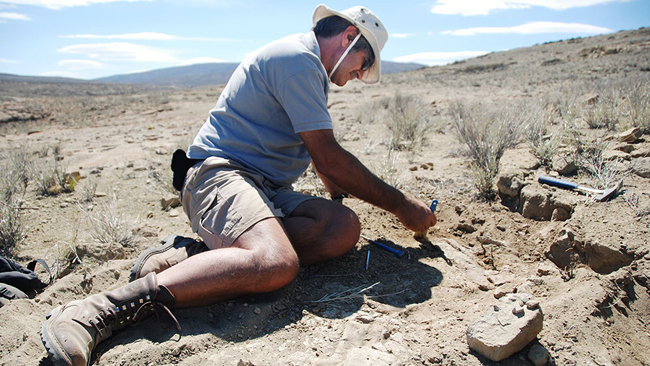
First author of the scientific paper, Facundo Riguetti at the dig site. Picture credit: Sebastián Apesteguía.

The PhD student went onto add:

“Moreover, this new species represents a lineage of thyreophoran dinosaurs previously unknown in South America. The Thyreophora originated about two hundred million years ago and evolved rapidly into several species distributed throughout the world. However, of these early thyreophorans, the lineage represented by Jakapil was the only one that persisted until at least a hundred million years ago.”

A Survivor from an Ancient Armoured Dinosaur Line

Phylogenetic analysis recovers Jakapil kaniukura either as a basal member of the Thyreophora or a stem ankylosaur, closely related to Scelidosaurus, fossils of which are associated with the Lower Jurassic Charmouth Mudstone Formation of Dorset, England. Its discovery suggests that early thyreophorans had a much broader geographic distribution than previously thought and that an ancient lineage persisted into the early Late Cretaceous.

One of the dermal scutes associated with the Jakapil kaniukura fossil specimen.
Fossilised fragment of dermal bones that act as armour for the plant-eating dinosaur. Picture credit: Facundo Riguetti.

A Bipedal Armoured Dinosaur

Evolutionary trends observed in armoured dinosaurs suggest a transition between small, cursorial, light-weight species to much larger, heavily armoured quadrupedal forms epitomised by the likes of Stegosaurus in the Late Jurassic and Ankylosaurus and Edmontonia in the Late Cretaceous. The relative dimensions of the forelimb and hind limb bear a greater resemblance to those of bipedal theropods and basal ornithischian dinosaurs than they do to members of the Thyreophora.

The reduced nature of the upper arm, indicated by the fragmentary humeri resembles the arm bones of abelisaurids – famous for their tiny, almost vestigial front limbs.

Life reconstruction Jakapil kaniukura.
A life reconstruction of the newly described Cretaceous thyreophoran Jakapil kaniukura. Picture credit: Daniel Boh with additional annotation by Everything Dinosaur.

Etymology

The genus name is from the northern Tehuelchean language meaning “shield bearer”, whilst the species name is derived from the Mapudungun language for “crest” (kaniu) and “stone” (kura) which references the diagnostic bony crest on the lower jaw.

Co-author of the scientific paper Sebastián Apesteguía at the Jakapil dig site.
Co-author of the scientific paper Sebastián Apesteguía at the Jakapil dig site. Picture credit: Pablo Destito.

The researchers, including co-author Sebastián Apesteguía (Universidad Maimónides) speculate that Jakapil, if it was a biped, resembled Scutellosaurus, which is known from the Early Jurassic of Arizona. However, they caution against defining this little armoured dinosaur as bipedal. They observe that it still retains some anatomical characteristics associated with a quadrupedal stance and they comment that more complete limb bones are required to make a more accurate assessment of its locomotion.

Everything Dinosaur acknowledges the assistance of a media release from the Consejo Nacional de Investigaciones Científicas y Técnicas (CONICET) in the compilation of this article.

The scientific paper: “A new Cretaceous thyreophoran from Patagonia supports a South American lineage of armoured dinosaurs” by Facundo J. Riguetti, Sebastián Apesteguía and Xabier Pereda-Suberbiola published in Scientific Reports.

29 07, 2022

Finding Fossil Fish Down on the Farm

By |2023-04-17T14:16:50+01:00July 29th, 2022|Categories: Adobe CS5, Dinosaur and Prehistoric Animal News Stories, Dinosaur Fans, Geology, Main Page, Palaeontological articles, Photos/Pictures of Fossils|0 Comments

A farmer’s field in rural Gloucestershire (England), has provided palaeontologists with a remarkable glimpse into an Early Jurassic marine ecosystem.

Underneath a grassy bank, normally grazed by cattle at Court Farm, Kings Stanley near Stroud, lies an exceptional fossil site that contains the remains of fish, ammonites, squid, marine reptiles and other creatures, with many of the specimens preserved in three dimensions.

Fossil fish skull
A three-dimensional fish skull (Pachycormus spp.) from a limestone concretion found at Court Farm. Note the small ammonite located in association with the skull. Picture credit: Dean Lomax.

A Toarcian Ecosystem

The clays and hard limestone nodules, many of which contain fossils, were deposited around 183 million years ago (Toarcian stage of the Early Jurassic).

The site was discovered by Sally and Neville Hollingworth, avid fossil collectors who recently uncovered the remains of mammoths in the nearby Cotswold Water Park which was featured in the BBC One documentary “Attenborough and the Mammoth Graveyard” in 2021.

Fossil Hunters Neville and Sally Hollingworth
Neville and Sally Hollingworth at the dig site. Picture credit: Nigel Larkin.

Commenting on the significance of this location, enthusiastic fossil hunters Neville and Sally stated:

“These fossils come from the Early Jurassic, specifically a time called the Toarcian. The clay layers exposed at this site near Stroud have yielded a significant number of well-preserved marine vertebrate fossils that are comparable to the famous and exquisitely preserved similar fauna of the Strawberry Bank Lagerstätte from Ilminster, Somerset – a prehistoric site of exceptional fossil preservation. Excavations at Kings Stanley over the last week have revealed a rich source of fossil material, particularly from a rare layer of rock that has not been exposed since the late 19th century.”

Early Jurassic Fossil Fish
A stunning Early Jurassic Fossil fish from the dig site. Picture credit: Dean Lomax.

Limestone Concretions

A team of eight scientists spent a total of four days working to clear an area of the bank approximately eighty metres in length. An excavator proved invaluable, but the field team still had to endure record breaking temperatures as they laboured to find and crack open three-dimensionally preserved limestone concretions, many of which contained fossils.

Team members working at the Court Farm dig site.
Field team members busy examining and splitting limestone concretions checking for fossils. Picture credit: Nigel Larkin.

Each specimen was carefully logged onto a database and approximately 200 kilograms of clay from around the concretions was also collected and carefully sieved using a state-of-the-art sediment processing machine to help locate microvertebrate fossils such as fish teeth and small bones.

Sediment processing machine
The sediment processing machine used to help retrieve small fossils from the Lower Jurassic strata exposed at Court Farm (Gloucestershire). Note the novel use of two water troughs. Picture credit: Dr David Ward.

Fossils Donated to Local Museum

Many of the fossils found at the site will be donated to the palaeontology collection of a local museum (The Museum in the Park, Stratford Park, Stroud).

Team member and world-renowned, palaeontological conservator Nigel Larkin (Visiting Research Fellow at Reading University) commented:

“Give a person a fish and you feed them for a day. Give a palaeontologist a fossil fish and they will tell you the species, the age of the rock, the climate of the time when the fish was alive plus the water depth and salinity and plenty of other information. This site – already an interesting farm in a beautiful setting – is one big outdoor classroom and the lessons now include geology, palaeontology, evolution and climate change. They tell farmers to diversify but this goes one step beyond!”

Exceptional Fossil Fish Finds

Some of the best finds include fossil fish, so well-preserved that details of the scales, fins and even their eyeballs can be made out. One of the most impressive discoveries was a three-dimensionally preserved fish skull, a Pachycormus, (see first image), a genus of ray-finned fish known from the Toarcian of Europe.

The lack of any signs of scavenging of the corpses and the absence of encrusting animals or burrows in the sediment suggest that the fauna which was frozen in time under a farmer’s field was rapidly buried.

A fossil fish (slab and counter slab)
A limestone nodule spilt open reveals the fossilised remains of an Early Jurassic fish (slab and counter slab). Picture credit: Dean Lomax.

Splitting Concretions to Find Fossil Fish and Other Remains

The layered concretions around the organisms formed relatively early before the sediments were compacted, as the original sediment layering is preserved. These concretions prevented further compaction, compression and distortion from the overlying sediments during burial and thus preserved the fossils as three-dimensional time capsules.

Dr Dean Lomax, a palaeontologist and a Visiting Scientist at the University of Manchester, who recently led the excavation of the Rutland ichthyosaur that also dates to the Toarcian geological age, was part of the team he explained:

“The site is quite remarkable, with numerous beautifully preserved fossils of ancient animals that once lived in a Jurassic sea that covered this part of the UK during the Jurassic. Inland locations with fossils like this are rare in the UK. The fossils we have collected will surely form the basis of research projects for years to come.”

Court Farm dig team.
The dig team take a well-earned break, time for a group photograph. Picture credit: Nigel Larkin.

To visit the website of Dr Dean Lomax: British Palaeontologist Dr Dean Lomax.

Landowner, Adam Knight, who has seen part of his farm temporarily converted into a real life “Jurassic Park” added:

“I’m delighted that after the initial work that Sally and Nev did over three years ago we now have a full-scale dig on the farm involving a range of fossil experts from The Natural History Museum, University of Manchester, University of Reading and The Open University. On Friday we were also joined by Emily Baldry on a day’s work experience before she goes to university to study palaeontology – it’s wonderful to see her enthusiasm for her chosen profession. It has been a real pleasure to host the dig and I’m excited to see the results of what has been found.”

Important Microvertebrates and Fossil Insects

Dr David Ward (research scientist at the Natural History Museum, London), outlined his contribution to the fieldwork explaining that his role was to collect evidence of all the small creatures that lived alongside the larger vertebrates and invertebrates in the ancient marine ecosystem.

The silty clay found in association with the limestone concretions was carefully washed and pushed through a fine sieve. Dr Ward’s wife Alison played a vital role in the collection process, and she added:

“My specialism is surface picking. This involves finding areas where fossils, particularly small bones and teeth, are naturally concentrated on the surface. Here, once I had collected them, I dug up the surrounding clay and fed it into David’s clay washing machine. The result is a fine concentrate of tiny fish bones and shells which we sort under a microscope.”

The Basis for a PhD

For Open University PhD student Emily Swaby, this fossil site has very special significance. Her PhD research is focused on how insects were affected by dramatic environmental changes that took place during the Toarcian. Fossil insects are extremely rare and although the Court Farm site represents marine deposition, insect fossils are known from such locations.

Emily commented:

“Further research at this site and surrounding Gloucestershire localities might help us to work out the abundance and diversity of insects during this time and help us to understand how this environmental change influenced insects.”

A view of the Court Farm dig site
A view of the exposed strata at the Court Farm dig site. Picture credit: Steve Dey.

Everything Dinosaur acknowledges the assistance of a media release from the University of Manchester and additional information supplied by Dr Dean Lomax in the compilation of this article.

27 07, 2022

Plesiosaurs Swam Alongside Spinosaurus According to New Research

By |2024-02-25T07:55:31+00:00July 27th, 2022|Categories: Adobe CS5, Dinosaur and Prehistoric Animal News Stories, Dinosaur Fans, Main Page, Palaeontological articles, Photos/Pictures of Fossils|0 Comments

Plesiosaur fossils found in strata associated with a 100-million-year-old river system prove that some plesiosaurs, traditionally thought to be marine animals, may have lived in freshwater. These long-necked, piscivores co-existed with the giant dinosaur Spinosaurus (S. aegyptiacus).

Spinosaurus and Plesiosaurus encounter.
A plesiosaur in freshwater encounters a Spinosaurus. Artwork by Andrey Atuchin. Picture credit: University of Bath.

Freshwater Plesiosaurs

Scientists from the University of Bath and University of Portsmouth in the UK, and Université Hassan II (Morocco), have reported evidence small plesiosaurs from Kem Kem Group deposits in Morocco.

The fossils include bones and teeth from three-metre-long adults and an arm bone (humerus) from a 1.5- metre-long juvenile. They hint that these creatures routinely lived and fed in freshwater, alongside frogs, crocodiles, turtles, fish, and the huge aquatic dinosaur Spinosaurus.

Plesiosaur humerus
The humerus (upper arm bone) from a juvenile plesiosaur. Picture credit: University of Bath.

When is a “Marine Reptile” a Marine Reptile?

The Plesiosauria clade was a long-lived and widely distributed group of marine reptiles. Most fossils, which date from the Upper Triassic to the end of the Cretaceous (Maastrichtian faunal stage), are associated with marine deposits, but a few specimens have been found in strata associated with brackish and freshwater environments. The researchers report plesiosaurs from river deposits of the Kem Kem Group. The numerous shed teeth show heavy wear similar to that observed in in the teeth of coeval spinosaurids. Contemporary plesiosaur fossils from the Bahariya Formation of Egypt have been identified as examples of the Polycotylidae plesiosaur family.

Kem Kem Fossils

The Kem Kem fossils probably represent leptocleidid plesiosaurs. Most Leptocleididae fossils come from shallow nearshore, brackish or freshwater palaeoenvironments suggesting that these small-bodied plesiosaurs were adapted to shallow, low-salinity environments.

A plesiosaur tooth
A single plesiosaur tooth from the Kem Kem Group. Numerous teeth have been found indicating that these plesiosaurs were frequent visitors to freshwater habitats and perhaps were permanent residents. Picture credit: University of Bath.

As the fossil plesiosaur teeth show the same signs of wear as the teeth of Spinosaurus, the researchers imply that the plesiosaurs were eating the same food – chipping their teeth on the armoured fish that lived in the river. This indicates that they spent a lot of time in the river, rather than being occasional visitors.

As other types of Mesozoic marine reptile (mosasaurids and the crocodile-like teleosaurids), are thought to have inhabited (at least some of the time), freshwater environments, this suggests that so-called “marine reptiles” may have thrived in non-marine habitats.

Co-author of the scientific paper, Dr Nick Longrich (University of Bath Milner Centre for Evolution), commented:

“It’s scrappy stuff, but isolated bones actually tell us a lot about ancient ecosystems and animals in them. They’re so much more common than skeletons, they give you more information to work with. The bones and teeth were found scattered and in different localities, not as a skeleton. So, each bone and each tooth is a different animal. We have over a dozen animals in this collection.”

Diverse and Varied Kem Kem Group Freshwater Fauna

While extant marine mammals like whales and dolphins wander up rivers, either to feed or because they are lost, the number of plesiosaur fossils in the river deposits suggest that is unlikely. The team identified cervical, dorsal and caudal vertebrae, lots of teeth and the humerus from a juvenile. The researchers postulate that the plesiosaurs were able to tolerate fresh and salt water, like some whales, such as the beluga whale (Delphinapterus leucas).

Co-author Dr Samir Zouhri said:

“This is another sensational discovery that adds to the many discoveries we have made in the Kem Kem over the past fifteen years of work in this region of Morocco. Kem Kem was truly an incredible biodiversity hotspot in the Cretaceous.”

Kem Kem Group fauna.
Silhouettes showing examples of Kem Kem Group freshwater fauna. Silhouettes show approximate size, the size and the diversity of predators suggests a rich ecosystem. Picture credit: University of Bath.

Plesiosaurs – Freshwater Incursions

The researchers compiled a list of all the geological formations that have shown evidence for the presence of members of the Plesiosauria clade in brackish or freshwater. Having collated this information, they re-examined the data identifying the different types of plesiosaur associated with the deposit.

As a result, a map documenting the incidences of freshwater incursions by different plesiosaur types was produced.

Plesiosaur distribution map
Plesiosaur distribution map. Evidence for freshwater/estuarine incursion by different types of plesiosaur. Picture credit: University of Bath.

For the key to the geological formations see the end of this article.

Co-author David Martill (University of Portsmouth) exclaimed:

“What amazes me is that the ancient Moroccan river contained so many carnivores all living alongside each other. This was no place to go for a swim.”

Plesiosaurus Swam Alongside Spinosaurus

Key to the Geological Formations Featured in the Plesiosaur Map

Geographic distribution of non-marine Plesiosauria Formations: 1, Dinosaur Park Formation (Campanian); (2), Horseshoe Canyon Formation (Campanian – Maastrichtian); 3, Isachsen Fm. (Late Aptian); 4, Strand Fiord Formation (Turonian – Coniacian); 5, Great Estuarine Group (Bathonian); 6, La Colonia Formation (Upper Campanian – Lower Maastrichtian); 7, Wadhurst Clay Formation (Valanginian); 8, Tunbridge Wells Sands Formation (Upper Valanginian); 9, Wessex Formation (Barremian); 10, Upper Weald Clay Formation (Barremian); 11, Vectis Formation (Barremian – Aptian); 12, Obernkirchen Sandstone (Late Berriasian);
13, Bükerberg Formation (Berriasian); 14, Kem Kem beds (Cenomanian – Albian?); 15, Chenini Formation (Albian); 16, Bahariya Formation (Cenomanian), 17, Sunday River Formation (Valanginian); 18, Lianmugin Formation (Upper Aptian); 19, Xinhe Formation (Middle Jurassic); 20, Ziliujing Formation (Toarcian); 21, Xintiangou Formation (Middle Jurassic), 22, Xiashaximiao Formation (Middle Jurassic); 23, Shezi Formation (Upper Triassic); 24, Razorback Beds (Sinemurian); 25, Evergreen Formation (Pliensbachian – Toarcian); 26, Griman Creek Formation (Albian); 27, Eumeralla Formation (Aptian) 28; Wonthaggi Formation (Valanginian – Aptian), 29 Eumeralla Formation (Upper Aptian – Lower Albian). Note that some formations contain more than one occurrence.

Everything Dinosaur acknowledges the assistance of a media release from the University of Bath in the compilation of this article.

The scientific paper: “Plesiosaurs from the fluvial Kem Kem Group (mid-Cretaceous) of eastern Morocco and a review of non-marine plesiosaurs” by Georgina Bunker, David M. Martill, Roy Smith, Samir Zouhri and Nick Longrich.

For models and replicas of plesiosaurs and Spinosaurus figures: CollectA Deluxe Prehistoric Life Scale Replicas.

Go to Top