All about dinosaurs, fossils and prehistoric animals by Everything Dinosaur team members.

Articles, features and information which have slightly more scientific content with an emphasis on palaeontology, such as updates on academic papers, published papers etc.

5 09, 2014

A Little Detail on a Great Big Dinosaur – Dreadnoughtus

By |2023-11-13T21:35:10+00:00September 5th, 2014|Categories: Dinosaur and Prehistoric Animal News Stories, Dinosaur Fans, Palaeontological articles|2 Comments

Dreadnoughtus schrani – A Dinosaur on a Massive Scale

And so the announcement came this week about the discovery of a super-sized, South American dinosaur that weighed as much as thirteen, bull African elephants.  Dreadnoughtus was so named as the huge bones (and for a change when it comes to the Titanosauria, there are quite a lot of them), reminded the scientists of the impervious super-structure of turn-of-the-century battleships.  This was a plant-eating dinosaur that was simply too big to be vulnerable to attack from predators.  Invulnerability would have been very handy for this immense creature as this dinosaur would have been preoccupied with eating, trying to cram enough calories into its enormous digestive system to keep its house-sized body functioning.

A Dinosaur on a Massive Scale – Dreadnoughtus schrani
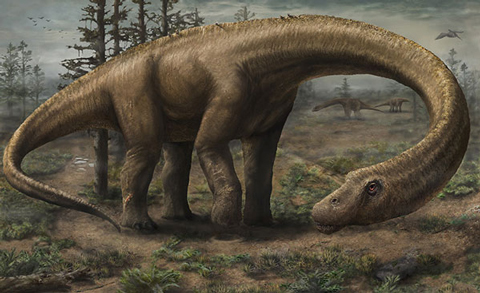
Huge dinosaur from southern Patagonia.

Picture credit: Jennifer Hall

Dreadnoughtus schrani

Many articles have already been written about this new titanosaur, the scientific paper was published by the Nature Publishing Group on the 4th September, this paper has already received more than 20,000 page views and the story has been picked up by dozens of news outlets.  We at Everything Dinosaur, had known about this research for some time, there are more exciting titanosaurid discoveries from South America still to be announced, so this blog article hopes to recap the main points about the significance of this study and to focus on a couple of areas that may not have been covered by other media outlets.

The “Elephant in the Room”

Firstly let’s deal with the size – this is a real “elephant in the room” moment, as with all large dinosaur fossils, this seems to be the most prominent and frequently asked question – just how big was this dinosaur?

The Size and Scale of the Dinosaur Discovery
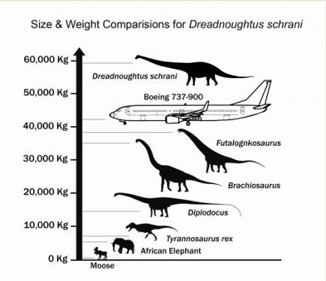
Heavier than a 737 Jet.

Picture credit: Dr Ken Lacovara

Although D. schrani may not be the very biggest of all the dinosaurs that ever existed.  It is certainly right up there, with an estimated body mass of 59,300 kilogrammes (the actual measurement was 59,291 kilogrammes but some rounding has taken place in the media).

How Do Scientists Estimate the Body Mass?

This leads us to one the most important points to note about this discovery.  The international research team led by Drexel University’s Dr Kenneth Lacovara was able to recover around 45% of the total skeleton of a single individual specimen, including cranial material (skull bones).  Most of the rear portion of the animal was excavated including a left humerus (upper arm bone) and femur (thigh bone).  These limb bones hold the key to estimating body size.  Earlier studies have shown that an analysis of the these limb bones and measurements of their circumference, corresponds to relative body mass in terrestrial quadrupeds.

Put simply, imagine weighing several different herds of cows before they are slaughtered for meat.  The cows would be of different sizes and therefore there would be some variance in total body weights.  Once the cows had met their demise, the upper arm bones and thigh bones could be collected for each animal.  The mid shaft circumference for these bones would then be measured and recorded.  A correlation would most likely be found between the mid shaft circumference measurements and the body weight recorded earlier.  For instance, bigger circumference equals a heavier animal.

This correlation provides accurate data on the body mass estimates of four-limbed, terrestrial animals that are alive today.  So the theory goes, that if it works for animals that are extant (living today), then it should also work for extinct animals such as the Dinosauria.  This correlation is extremely useful as the sauropods and the later titanosaurs are so different from living creatures that anatomical comparisons are just not relevant.

The preservation of these limb bones which have been found to scale with body mass, permits the scientists to make an estimate of the body mass of Dreadnoughtus schrani.  The same equation has been used to estimate the body masses of a number of other substantial dinosaurs, but none of them quite match the bulk of Dreadnoughtus.  It therefore suggests that the Dreadnoughtus schrani holotype material represents an individual titanosaurid that was much heavier than other titanosaurs and indeed much more massive than most other sauropods.

Dreadnoughtus Compared to Other Sauropoda (Limb Circumference Analysis)
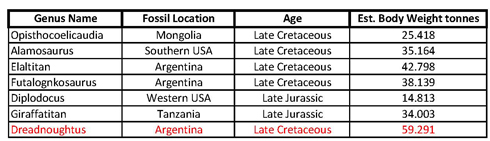
Dreadnoughtus - the most complete skeleton of a giant titanosaurid dinosaur discovered to date.
Dreadnoughtus – the most complete skeleton of a giant titanosaurid dinosaur discovered to date.

Table credit: Everything Dinosaur, data compiled from Nature Publishing Group and Benson et al.

Still Growing?

Astonishingly, of the two specimens found together, the largest one, the Dreadnoughtus that was estimated to be heavier than a Boeing 737 aircraft was probably not yet fully grown.  Identifying when a dinosaur reached its maximum size is a complicated business (related to indeterminate growth), however, the research team found that it was likely that this super-sized dinosaur was still growing at the time of its death.  The scapula (shoulder blade) had not fused completely to the coracoid bone.

The posteromedial margin of the coracoid foramen (small opening, located in the middle of the coracoid), was butted up against the distal portion of the shoulder blade.  Palaeontologists have cited these conditions as indicating that the individual was still growing.  A study of the humerus supports this hypothesis, the lack of lines of arrested growth indicate that this dinosaur was immature at the time of death.  Although some scientists have questioned the validity of these indicators, whatever the outcome, the larger individual of the two Dreadnoughtus specimens found to date, represents the biggest dinosaur known to science for which a robust body mass has been calculated.

Not reported by many media sources but for the record the femur length is in excess of 1.9 metres and the humerus is 1.6 metres long.

Dinosaur Fossils Found in Southern Patagonia

Another, significant point we wanted to make concerns the location of the dinosaur fossils.  Whilst Patagonia may now be synonymous with dinosaur discoveries, Argentinosaurus, Giganotosaurus et al, many of these fossils come form the northern and central parts of this vast region.  These fossils come from a relatively unexplored part of south-western Patagonia.  The fossil material was excavated from the Cerro Fortaleza Formation, an exposure on the eastern bank of the Río La Leona, (Santa Cruz Province), this is more than 750 miles (1,200 kilometres) away from the location of other major Cretaceous-aged dinosaur fossil finds.

We at Everything Dinosaur are unaware of any radiometric dating and although Campanian-aged biostratigraphical material is associated with some horizons of the Cerro Fortaleza Formation, the precise age of these fossils remains unclear.  They are between 83 million and 66 million years old, with some sources stating 77 million years of age (Campanian to Maastrichtian faunal stages).

Location of the Dreadnoughtus Quarry

The site of the fossil discovery.

Picture credit: Map de la provincia de Santa Cruz

A Team Effort

Last but not least, the 116 fossils, some of which do show potential evidence of scavenging by theropod dinosaurs, have been excavated, prepared and digitally mapped by a dedicated team of researchers.  This has certainly been a colossal undertaking, yes, we know the tail itself measures some thirty feet in length, (the total length of Dreadnoughtus schrani has been estimated at 26 metres) and the skull (only one fragment of which has been found) was around eighty-eight centimetres in length.  It is quite right to focus on the huge size of this member of the titanosaur family, but we at Everything Dinosaur would like to take this opportunity to thank all the researchers for their hard work.

The first fossil was spotted during a expedition back in 2005, the femur we think. From 2005 to 2009 a series of field trips took place to excavate the two individual specimens, since then a great deal of preparatory work and fossil prep has been carried out by scientists from Drexel University, a number of graduates from this institution but also with the aid and support of the likes of the Carnegie Museum of Natural History,  the Museo Argentino de Ciencias Naturales, Argentina and Laboratorio de Paleovertebrados, Universidad Nacional de la Patagonia (also Argentina).

Even a scientist from the University of Manchester (Dr Victoria Egerton), a lecturer in Applied Palaeontology, was involved.   Our congratulations to everyone who has participated in this amazing study, an exceedingly rare opportunity to learn about one of the largest terrestrial vertebrates that is known to science.

For models and replicas of titanosaurs and other prehistoric animals: CollectA Deluxe Prehistoric Animal Models and Figures.
28 08, 2014

Walking Fish Provides Clues to the First Tetrapods

By |2023-03-16T10:17:17+00:00August 28th, 2014|Categories: Animal News Stories, Dinosaur and Prehistoric Animal News Stories, Palaeontological articles|0 Comments

Researchers Study Living Fish to Gain Insight Into Fossil Record

Arguably one of the most significant events in the history of life on Earth occurred when the first vertebrates walked on land.  The date when types of prehistoric fish made the move to land and began the evolutionary journey that would lead to the tetrapods keeps changing in the light of new fossil discoveries.

Tetrapods

Tetrapods are vertebrates, this group includes the amphibians, reptiles, birds and mammals and that means, we are tetrapods too.  One of the most important fossil discoveries in recent years, was made in a limestone quarry in Poland.  On one stone slab scientists discovered strange track-like marks about fifteen centimetres wide.  These were controversially interpreted as having been made by the limbs of an animal capable of moving around on land.  It was envisaged that whatever strange creature made these marks, it must have been more than two metres long.  This trace fossil suggests that the first animals walked on land around 400-395 million years ago, some thirty-five million years earlier than previously thought.

To read more about this Polish discovery: Clues to the First Land Animals?

Walking Fish

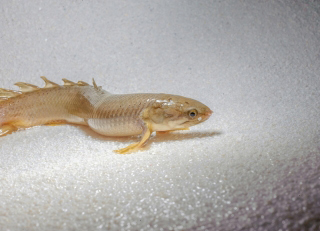
A team of researchers from McGill University (Montreal, Canada), have turned to a living fish in order to gain a better understanding of the evolutionary changes that must have taken place to allow certain types of fish such as the sarcopterygians to adapt to a more terrestrial lifestyle.  If, sometime around 400 million years ago (Lower Devonian Epoch), a group of fish began exploring terrestrial environments, the first stage on the long evolutionary journey to the tetrapods, how did these fish do it?  What changes to their bodies and fins took place to allow them to adapt to this new habitat?

Helping to answer these questions was the aim of the research team at McGill University and to do this they turned to a living (extant) fish called Polypterus.

Little Fish Takes Part in “Ground Breaking” Experiments

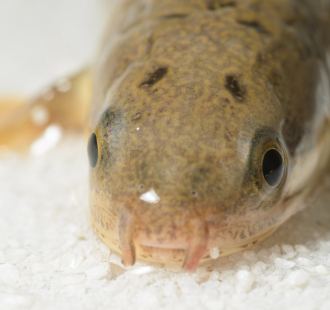
A giant leap for fish-kind!

A giant leap for fish-kind!

Picture credit: McGill University

The Polypterus Genus

There are ten or so species in the Polypterus genus, as far as we at Everything Dinosaur know, they are all African and freshwater fish.  Polypterus is the only vertebrate known to science that possesses lungs and is capable of breathing air but has no trachea.

These little fish have been studied for more than one hundred and fifty years, Thomas Huxley no less was involved in some of the earliest research.  He placed them in the Order Crossopterygii, now regarded as a synonym of the Sarcopterygii – although this classification has now been largely disproved.  The first successful domestic breeding programme commenced in 2005, this paved the way for laboratory studies.

“Walking” on Land

The McGill team in collaboration with the University of Ottawa, studied Polypterus fish to show what might have happened when fish first attempted to walk out of the water.  These air breathing fish can “walk” on land, (really it is a bit of shuffle), but they do superficially resemble Devonian sarcopterygians, (hence Huxley’s classification).  The scientists raised juvenile Polypterus on land for nearly a year, with an aim of revealing how these “terrestrialised” fish looked and moved when compared to Polypterus specimens raised in a more normal environment.

Project leader, Emily Standen, a former McGill University post-doctoral student stated:

“Stressful environmental conditions can often reveal otherwise cryptic anatomical and behavioural variation, a form of developmental plasticity.  We wanted to use this mechanism to see what new anatomies and behaviours we could trigger in these fish and see if they match what we know from the fossil record.”

The team discovered that these fish underwent remarkable anatomical and behavioural changes in response to their stressful environment.  These fish walked more effectively by placing their fins closer to their bodies, lifted their heads higher and kept their fins from slipping as much as fish that were raised in water.

Polypterus Showed Anatomical and Behavioural Changes

Helping to explain the evolution of Tetrapods.

Helping to explain the evolution of tetrapods.

Picture credit: McGill University

Fellow researcher, Trina Du (McGill University PhD student) explained:

“Anatomically, their pectoral skeleton changed to become more elongate with stronger attachments across their chest, possibly to increase support during walking and a reduced contact with the skull to potentially allow greater head or potential neck motion.”

Hans Larsson, Canada Research Chair in Macroevolution at McGill and an Associate Professor at the Redpath Museum added:

“Because many of the anatomical changes mirror the fossil record, we can hypothesise that the behavioural changes we see also reflect what may have occurred when fossil fish first walked with their fins on land.”

“Terrestrialised” Polypterus

The “terrestrialised” Polypterus is unique and provides fresh ideas on how fossil fishes may have used their fins in a terrestrial environment and what evolutionary processes may have been involved.  Hans Larsson went onto to say that this experiment was the first example that they were aware of, that demonstrated developmental plasticity may have facilitated a large-scale evolutionary transition, by first accessing new anatomies and behaviours that could later be genetically fixed in the population by natural selection.

The study was conducted by Emily Standen, University of Ottawa, and Hans Larsson, Trina Du at McGill University and supported by the Canada Research Chairs Program, Natural Sciences and Engineering Research Council of Canada (NSERC) and Tomlinson Post-doctoral fellowship.  It has been published in the journal “Nature”.  Everything Dinosaur acknowledges the help of McGill University in the compilation of this article.

13 08, 2014

Unique Dinosaur Footprints Damaged

By |2024-05-02T12:00:43+01:00August 13th, 2014|Categories: Dinosaur and Prehistoric Animal News Stories, Dinosaur Fans, Main Page, Palaeontological articles|0 Comments

Welsh Dinosaur Footprints Vandalised

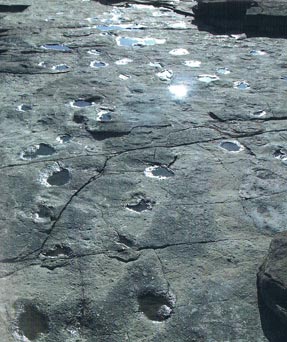
They might be as much as 200 million years old but the thoughtless actions of fossil hunters have damaged a number of dinosaur footprints preserved at a site of special scientific interest (SSSI) in Wales.  A number of prints have been damaged including one that was filled with plaster of paris in a bid to make a cast and then an attempt was made to hammer the cast out of the rock.  The fossilised footprints form part of an important palaeontological site in the Vale of Glamorgan.  The prints can be found on a stretch of exposed coastline between the towns of Barry and Sully on the northern coast of the Bristol Channel, the trace fossils are the oldest known dinosaur tracks to found anywhere in the British Isles.

Welsh Dinosaur Footprints

The picture above shows one of the three-toed (tridactyl) prints with marks around it where an attempt was made to cut out the fossil from the surrounding rock.

The fossils, which are located in strata that form the Mercia Mudstone Group have been subjected to vandalism before.  Sadly, authorities and conservation bodies face a dilemma, do they permit free access to the site so that walkers can view the fossilised footprints and tracks in situ or should the trace fossils be removed and stored in a secure facility to prevent vandalism and fossil thefts?

Back in August 2012, Everything Dinosaur team members reported on the theft of footprint fossils from the same area, fortunately the fossils were recovered a few weeks later.

To read about the earlier fossil theft: Dinosaur Footprints Stolen from the Vale of Glamorgan.

This new damage was discovered by South Wales archaeologist Karl-James Langford whilst he was conducting students around the SSSI.

Mr Langford, the founder of Archaeology Cymru (Archaeology Wales) stated:

“I took a group of ten students to give them the tour of the dinosaur footprints.  I could not hide my horror at the damage which had been deliberately caused.   We examined one print that had been filled with plaster of paris.  On a visit to inspect the damage with another group later that same day, somebody had deliberately tried to smash it out with a breeze block, damaging the 200 million year old print in the process.”

It has also been reported that fires had been lit around the site and rubbish left, calls were made last night to provide this extremely important fossil site with greater protection.

What’s so Special About this Location?

The mudstones exposed on this stretch of the coast running along the northern edge of the Bristol Channel were laid down towards the end of the Triassic Period (Upper Triassic – Norian to Rhaetian faunal stage), dinosaur footprint fossils from this time in Earth’s history are extremely rare and the site is one of the world’s most important in terms of recording the activities of Late Triassic dinosaurs.  This was an area of mud flats and silts leading towards the edge of a shallow tropical sea to the south-west.  Many different types of ancient reptile crossed these mud flats and their footprints and tracks were preserved.

Hundreds of individual prints have been recorded and something like sixty trackways have been mapped.  Most of the dinosaur tracks represent a small, three-toed, theropod which has been given the ichnogenus Grallator.  An ichnogenus is a name given to an organism that has left trace fossils, usually tracks, prints or burrows.  Other types of dinosaur footprints have been recorded, including tracks representing a large meat-eater (theropod) and a series of trails left by plant-eating prosauropods.

Field Photograph Showing Preserved Trace Fossils at Barry (Vale of Glamorgan)

Dinosaur Tracks from the Late Triassic.

Dinosaur tracks from the Late Triassic.

Picture credit: Tom Sharpe (Dinosaurs of the British Isles)

Dinosaur Tracks

The photograph above shows a number of rounded footprints and tracks.  The rounded prints are believed to have been made by a prosauropod dinosaur.  Many of the tracks are quite difficult to spot, the best time to see them is in the evening when the low sun casts shadows on those tracks which represent natural casts.  In addition, if there has been recent rain, or a high tide many of the trackway depressions will be filled with water and this makes observing the prints much easier.

Team members at Everything Dinosaur would like to echo the comments made by a number of other organisations with regards to this damage.  It is essential that sites such as this are protected and safeguarded and we urge all readers to remember that this is a SSSI and as such it is an offence for any person or persons to intentionally or recklessly damage or destroy any of the features of special interest of an SSSI!

If any visitor to this location sees suspicious activity, such as damage to footprints, attempts to make casts or actions that could lead to the theft of a print, please alert the Countryside Council for Wales, the Geology Department of the National Museum of Wales or the Geologists’ Association South Wales Group.

Useful Contacts

For the Geology Department of the National Museum of Wales telephone +44 (0)29 2057 3213

Email: the Geologists’ Association of South Wales Group: [email protected]

For the Countryside Council for Wales, try Natural Resources Wales (Mon-Fri) on 0300 065 3000

7 08, 2014

Laquintasaura – What Does it all Mean? That’s a Great Question!

By |2024-05-02T12:09:00+01:00August 7th, 2014|Categories: Dinosaur and Prehistoric Animal News Stories, Dinosaur Fans, Main Page, Palaeontological articles|0 Comments

Notes on the Newly Described Dinosaur – Laquintasaura

Over the last day or so, the popular science media has carried a vast array of articles detailing the discovery of a new type of dinosaur from the continent of South America.  There have been radio interviews with some of the scientists behind the academic paper, news reports and of course, a number of video news stories too.   The great majority of the press outpourings have been excellent.  The naming of a new dinosaur is a big story, the general public seems to have an ever-lasting fascination with these ancient animals.

Palaeontologists and science editors far cleverer than ourselves have provided a comprehensive overview of Laquintasaura venezuelae, so rather than dwell on describing this animal, we at Everything Dinosaur will try to place this dinosaur discovery in context and cover some of the issues raised in the scientific paper that were not necessarily picked up by the general media.

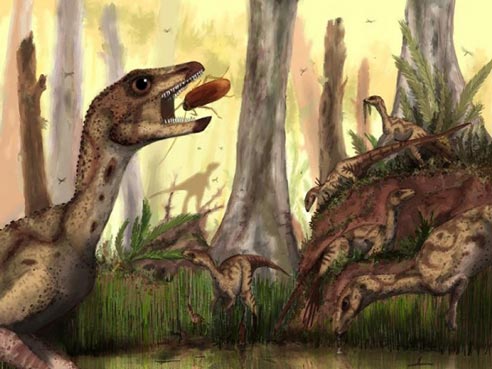
The Illustration of the Newly Named Dinosaur L. venezuelae

Small, Early Jurassic, bird-hipped dinosaur

Small, Early Jurassic, bird-hipped dinosaur.

Picture credit: Mark Witton/Natural History Museum

Why Saura and Not Saurus?

First of all, let’s deal with the name Laquintasaura venezuelae.  The fossil material (and there is lots of it), comes from a single bone bed located at a dig site which is effectively a road cutting between the two small towns of Seboruco and La Grita in  Táchira State, western Venezuela, just a few miles from the border with Columbia.

The horizon from which the fossils were excavated form part of the La Quinta Formation, which outcrops in western Venezuela and eastern Columbia.  So the  name is pronounced La-quin-tah-sore-rah  ven-ee-zway-lay and it translates as “Venezuela’s lizard from the La Quinta”, but note the ending of the genus, it is “saura” and not the much more common “saurus”, what’s going on here?

Saura is the female form of the Greek word saurus, it still means lizard and a number of dinosaurs have been given genus names which take the female form of saurus, examples are the likes of Maiasaura (means “good mother lizard”), or the small Cretaceous ornithopod Leallynasaura which was named after the daughter of the discoverer.  There is nothing particularly feminine about Laquintasaura, it is very likely that the bone bed represents the remains of both males and females, in this case, we think the name has come about as the rock formation “La Quinta” has a female root.

Early Jurassic – So What?

The majority of the rocks that make up the La Quinta Formation are sandstones, accurately dating these rocks is made all the more difficult due to the lack of marine deposits and the more abundant zonal fossils that help to date them.  However, the scientists involved in this study have been able to date the age of the fossils with a very high degree of confidence.  Zircon crystals found very close to the fossilised bones permitted highly accurate radiometric dating techniques to be applied.  Essentially, these crystals are abraded by acids, cooked at very high temperatures and then the proportion of uranium isotopes is measured.

Radioactive elements such as uranium begin to decay from the moment they are formed.  They decay and form “daughter” isotopes by shedding electrons at a consistent, regular rate.  By measuring the proportion of isotopes in these minute zircon crystals the rock formation can be accurately dated.  The fossils of Laquintasaura are 200.91 million years old, plus or minus half a million years or so.

Very few dinosaur fossils have been found that can be dated so accurately to this period in Earth’s history.  The vast majority of the dinosaur fossils that have been dated to around 200 million years or so, are lizard-hipped dinosaurs (saurischians), Laquintasaura is a member of that other group of dinosaurs, the bird-hipped dinosaurs (Ornithischia).

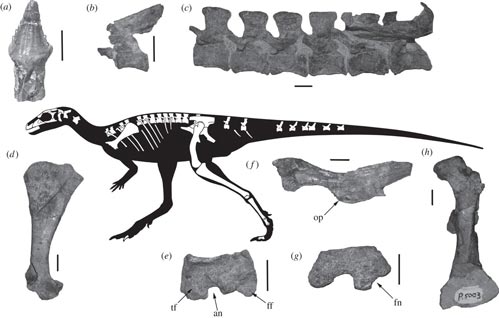
Photographs of Some of the Fossil Material and Outline Body Shape

Abundant fossil finds.

Abundant fossil finds.

Picture credit: Proceedings of the Royal Society B.

What’s so Special about Laquintasaura?

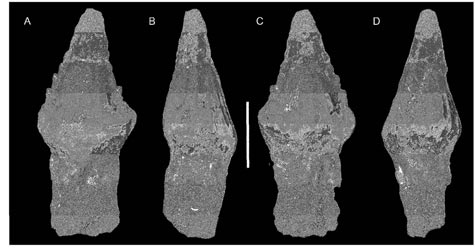
The picture above shows an outline of the body shape of Laquintasaura.  It was estimated to be about a metre long, but half of its body length was made up of the tail.  It was lightly built and probably a fast runner, roughly the size of a common Red Fox (Vulpes vulpes).  The drawing also indicates the sort of fossil material that has been found.  Most of the fossils are isolated teeth, or represent bones from the hip area or fragments of rib.  However, other fossils representing parts of the skull, the limb bones and vertebrae have also been found but these elements are much rarer.  The fossils represent the remains of at least four individuals, but probably many more.

Key to the Picture

  • (a) Triangular cheek tooth
  • (b) Neck bones
  • (c) Dorsal vertebrae
  • (d) Left shoulder blade
  • (e) Part of the ankle bone
  • (f) Left ischium (bone from the hip)
  • (g and h) Views of the femur

This is the first early ornithischian bone bed containing the bones of a number of individual dinosaurs found anywhere in the world.  Studies of the bones suggest that the fossils represent a group of animals that ranged from about three years to twelve years of age.

Although the bones are jumbled up, they do not show any obvious signs of having been transported a long distance perhaps by a river in spate.  Palaeontologists interpreting this fossil deposit have suggested that this bone bed was not formed over a long period, where single dinosaur carcases were deposited in the same location as a result of seasonal, violent floods.

The fossils seem to have been transported and deposited in a low-energy water environment, perhaps a slow moving river and it has been suggested that this group of dinosaurs died in a single catastrophe.  It is unclear whether they all died as a result of becoming stuck in the water, or whether the water transport occurred after death.   This suggests that this was a social group, a small herd or a flock if you prefer.

Most palaeontologists are confident that later ornithischians, the likes of the iguanodonts, duck-billed dinosaurs and the horned dinosaurs lived in herds.  If Laquintasaura is a social, bird-hipped dinosaur, then these fossils have provided the earliest known evidence for the evolution of complex social groups in the Ornithischia.  This social behaviour in ornithischian dinosaurs is being seen around fifty million years earlier than previously thought.

Weird Teeth

The teeth are unlike any other teeth associated with ornithischian dinosaurs.  They are quite prominent, and although triangular in shape, the edges are curved and slightly concave in appearance.  The edges of the crown (the tooth that sticks out of the gum) are coarsely serrated.  This suggests that this little dinosaur was most probably a herbivore eating tough ferns and horsetails.  It probably also grabbed at passing insects or small reptiles from time to time, hence the bug eating Laquintasaura depicted in Mark Witton’s excellent illustration (see above).

A Close up of One of the Teeth of Laquintasaura (various views)

Strange teeth indicate herbivorous habit.

Strange teeth indicate herbivorous habit.

Picture credit: Barrett et al, Proceedings of the Royal Society B.

Venezuela’s First Dinosaur – Dinosaurs Thrived Around the Equator

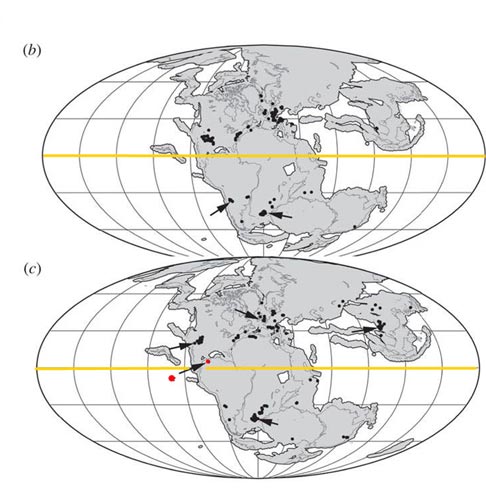
Much has been made of the fact that this is the first dinosaur ever to be discovered in Venezuela.  Indeed, this is the first dinosaur to be named and described from the northern portion of South America.  Two hundred million years ago, Venezuela formed part of the central portion of the giant super-continent Pangaea.  Laquintasaura seems to have thrived in a habitat close to the equator in the centre of this huge land mass.  Very few dinosaur fossils have been found in what is termed the palaeoequatorial region.

It had been thought that much of this part of the world in the Late Triassic/Early Jurassic was too hot and dry to support extensive, complex ecosystems.  Much of this area was thought to have been covered by vast, inhospitable deserts.  However, the finding of the fossils of Laquintasaura suggests that dinosaurs and most likely other types of vertebrate did live in these regions.

The Location of the Laquintasaura Fossils (Palaeoequatorial Environment)

Spatial distribution of early bird-hipped dinosaurs.

Spatial distribution of early bird-hipped dinosaurs.

Picture credit: Proceedings of the Royal Society B.

The diagram (b) shows the location of dinosaur fossil finds mapped onto a picture of the world from the Late Triassic.  The yellow line indicates the position of the equator.  Diagram (c) shows the position of dinosaur fossil finds known from the very Early Jurassic.  Arrows indicate ornithischian dinosaur finds.  Note the scarcity of palaeoequatorial dinosaur finds and the very limited palaeobiogeographical distribution of ornithischians in the Late Triassic and their subsequent spread in the Early Jurassic.  The red dot in diagram (c) indicates the site of the Laquintasaura fossils.  As these dinosaurs were small, around one metre in length, it is highly unlikely that these dinosaurs could have migrated long distances, this and the fact that the fossil bones show little sign of long distance transport indicates that Laquintasaura lived close to the equator.

The discovery of Laquintasaura suggests that there were ornithischian dinosaurs living close to the equator around 200 million years ago.  Their presence (and the discovery of two theropod teeth at the same site), indicates that western Venezuela supported a diverse and flourishing ecosystem.

What Does it Mean for Dinosaur Evolution?

The fossils of Laquintasaura come from just a few hundred thousand years after the end Triassic extinction event.  The period of deep time marked by the end of the Triassic experienced a mass extinction event.  The type and diversity of terrestrial vertebrates altered dramatically with many kinds of reptile and amphibian becoming extinct.

Palaeontologist Dr Paul Barrett of the Natural History Museum (London) and one of the lead authors of the scientific paper commented:

“Laquintasaura lived very soon after the major extinction at the end of the Triassic Period, 201 million years ago, showing dinosaurs bounced back quickly after this event.  It is fascinating and unexpected to see they lived in herds, something we have little evidence of so far in dinosaurs from this time.”

Either the dinosaurs did recover quickly after this extinction event or they were not too badly affected when compared to other vertebrates.

Laquintasaura

In addition, scientists are aware that by the Middle Jurassic, the bird-hipped dinosaurs had begun to diversify into a range of body types.  There were the likes of the ancestors of the camptosaurs, heterodontids and the first of the armoured dinosaurs.

This research carried out by the University of Zurich and the Natural History Museum is helping to piece together the origins and the subsequent diversification of this group of the Dinosauria that led them to become the dominant terrestrial herbivores of the Mesozoic.

4 08, 2014

Unravelling a Remarkable Ammonite Mystery

By |2024-05-02T12:11:17+01:00August 4th, 2014|Categories: Dinosaur and Prehistoric Animal News Stories, Main Page, Palaeontological articles|3 Comments

Why did the Ammonites go Extinct but the Nautilus Survive?

A team of international researchers led by scientists from the American Museum of Natural History (New York), have been trying to unravel one of the great mysteries of invertebrate palaeontology.  Why did the ammonites go extinct but their relative the Nautilus survive the Cretaceous extinction event?  Building on previous research, lead author of the scientific paper, published this week in the journal “Geology”, Dr Neil Landman believes that over specialisation and limited geographic distribution led to the downfall of this particular group of chambered shelled molluscs.

 A Nautilus Compared to an Extinct Ammonite

Similar creatures but only the Nautilus is around today.

Similar creatures but only the Nautilus is around today.

Picture credit: Everything Dinosaur/Safari Ltd

Ammonites

Ammonites belong to the Class Cephalopoda and they seem to have been entirely marine, pelagic animals (living above the sea floor).  Although more closely related to today’s cuttlefish, ammonites and their living relative the Nautilus both had coiled, chambered shells.  The first nautiloids can be traced back to the Late Cambrian, whilst the ammonites are believed to have originated in the Devonian geological period.

There are two extant genera of Nautilus alive today.  These animals tend to be found in deep water (up to seven hundred metres, although more usually around three to four hundred metres) and they inhabit the deeper slopes of coral reefs in the Indo-Pacific.  They are believed to be scavengers feeding on a variety of dead animal matter.

In this new study, the researchers including scientists from the Royal Belgian Institute of Natural Sciences, Saint Petersburg State University, Polska Akademia Nauk (Warsaw), Bowling Green State University (Ohio) and the Natural History Museum of Maastricht (Holland) as well as Dr Landman, mapped all the locations of ammonite fossil finds in the last half a million years or so of the Cretaceous (Maastrichtian faunal stage).  They then compared this data with the occurrences of the nautiloid genus Eutrephoceras over the same period.

Surviving into the Palaeogene

The scientists also included information from a recently published study that looked at ammonite genera that appear to have briefly survived beyond the Cretaceous into the Palaeogene.

What? Evidence of ammonites surviving beyond the Cretaceous extinction event we hear you ask!  There is some evidence to suggest that a few types of ammonite did indeed survive into the Age of Mammals.  Perhaps the very last of this great group of marine invertebrates lived for a hundred thousand years or so before they too finally became extinct.

In a few, very special locations the sequence of strata that was led down at the end of the Cretaceous (Maastrichtian faunal stage) and the first deposits of the Palaeogene (Palaeocene epoch, Danian faunal stage) can be identified.  One such location is the cliffs at Stevns Klint on the Danish island of Sjaelland.  Fragmentary fossils representing two different genera of ammonite have been identified from the strata immediately above the thin, dark line that marks the end of the Cretaceous.

Dr Landman has been at the forefront of these studies and he believes as many as six species may have lingered, sort of “dead clades swimming”.

Fragmentary Fossils of Ammonites from Stevns Klint

Fragmentary fossils indicate survival of some species into the Palaeocene Epoch.

Fragmentary fossils indicate survival of some species into the Palaeocene Epoch.

Picture credit: PLOS One

 The picture above shows ammonite fossilised remains found in the Palaeocene aged strata at Stevns Klint and surrounding area.  Pictures A, B and D-H are fossils of the ammonite Baculites vertebralis whereas picture C represents the species Hoploscaphites constrictus.  The white arrows in pictures A and C indicate voids left after the dissolution of the original aragonite shell.

To read more about Stevns Klint being granted UNESCO World Heritage status: Famous KT Boundary Gets UNESCO World Heritage Status.

Studying Geographical Distribution

The research team plotted the fossil data against two criteria, firstly they looked at all the occurrences of each genus and secondly they looked at the maximum distance between occurrences for each genus, an examination of geographical distribution based on an assessment of world geography at the end of the Mesozoic.  The scientists discovered that most of the ammonite genera at the very end of the Maastrichtian were restricted in their geographic distribution.  This may have made the ammonites more susceptible to an extinction event.  This idea is reinforced when the geographical spread of those genera that may have briefly survived into the Palaeocene is examined.

These genera have a significantly greater geographical spread when compared to non-surviving ammonite genera.  The research team suggest that those types of ammonite that were more broadly distributed had a greater chance of survival, at least for a little while longer.  This pattern is further emphasised when the distribution of the nautiloid  Eutrephoceras is considered.  The scientists found that the distribution of Eutrephoceras was as broad as that of the most widely distributed ammonites at the end of the Cretaceous.

However, even the most geographically dispersed ammonites became extinct in the Palaeocene, whereas Eutrephoceras survived.  This new paper proposes that a broad geographical distribution may have initially protected some ammonites against dying out, but it was no guarantee of their ultimate survival.

Ammonite Fossils are Popular with Fossil Collectors

Examples of fossil Ammonites.

Examples of fossil ammonites.

Picture credit: Everything Dinosaur

Restricted Distribution

The restricted distribution of ammonites may have contributed to their extinction.  Other studies have also helped shed light on the reasons for the demise of the Ammonoidea, Dr Landman and his colleagues at the American Museum of Natural History have been at the forefront of many of these research projects.  Many scientists now agree that ammonite numbers and the range of species was in decline before the end of the Cretaceous and this Subclass of cephalopods would have been devastated by the aftermath of the extraterrestrial impact event.  Large amounts of acid rain falling into the sea would have significantly altered the pH balance of marine environments, this would have had a major impact on ammonite numbers.

Dr Landman stated:

“The ammonites petered out due to more than one disastrous change caused by the impact.  Ocean acidification likely dissolved the shells of their microscopic young, which floated on the ocean’s surface early in their life-cycle.  Fossil records also show the impact event devastated plankton species, the primary food source for adult ammonites.  These effects may have only lasted a hundred years or so, but that would have effectively starved some of the ammonites.”

To read a related report by Everything Dinosaur into studies of the prey of Ammonites: The Last Supper of an Ammonite.

In contrast, the deeper living nautiloids may have been less affected by changes at the ocean’s surface and as they are less reliant on plankton as a staple source of food they could have ridden out the cataclysmic events.  This may explain why there are two genera of nautiloids around today but as far as anyone knows, not one species of ammonite remains.

Everything Dinosaur’s Review of the Recently Introduced Wild Safari Ammonite Model

Video credit: Everything Dinosaur

To view Everything Dinosaur’s range of Safari Ltd prehistoric animal models including ammonite models: Safari Ltd. Wild Safari Prehistoric World.

CollectA have also introduced ammonite and nautiloid replicas: CollectA Prehistoric Life Replicas.

1 08, 2014

Downsizing Dinosaurs – The Key to Survival

By |2023-03-14T15:13:53+00:00August 1st, 2014|Categories: Dinosaur Fans, Main Page, Palaeontological articles|0 Comments

Sustained Miniaturisation in the Dinosauria the Key to their Survival as Birds

A new study led by the University of Adelaide but involving scientists from a number of universities including Bristol University and the University of Southampton has mapped the evolution of meat-eating dinosaurs and identified how these large creatures gave rise to the birds (Aves).  The Theropoda, or at least parts of this meat-eating dinosaur group kept shrinking in size for at least fifty million years before the evolution of Archaeopteryx.  It’s a question of downsizing the dinosaurs according to a new study.

Archaeopteryx – A Transitional Form

Archaeopteryx may not have been the first bird, but the dozen or so fossils of this enigmatic dino-bird, all of which come from Germany, provide evidence of a transitional creature that shows anatomical features of both dinosaurs and birds.  Most scientists now accept that birds are descended from the dinosaurs, one particular group of meat-eating dinosaurs called the Maniraptora.  Dinosaurs in the family Dromaeosauridae, fearsome, aggressive predators such as Velociraptor (V. mongoliensis) are members of the Maniraptora clade, but over what time period did the evolutionary changes take place to result in a small bird from larger Dinosaurian ancestors?

 Shrinking Dinosaurs over Fifty Million Years Gave Rise to the Birds

Sustained miniaturisation gave rise to the birds.

Sustained miniaturisation gave rise to the birds.

Picture credit: Davide Bonadonna

The international research team, led by Associate Professor Michael Lee (School of Earth and Environmental Sciences, Adelaide University), including Gareth Dyke and Darren Naish (both from the University of Southampton) and Andrea Cau (from the University of Bologna and Museo Geologico Giovanni Capellini), have published their work in the latest edition of the academic journal “Science”.  Professor Michael Benton (Bristol University) provides an adjunct to this research “How Birds Became Birds”.

Theropoda Evolution

In professor Benton’s perspective he explains the importance of this new study by placing it into the context of existing research into Theropoda evolution.  Professor Benton states that although it is now widely accepted that the birds evolved from a particular branch of the dinosaur family tree, it is not certain how quickly this evolutionary transition took place.  One of the first birds known from the fossil record (A. lithographica) from the Upper Jurassic of Germany, was thought to have evolved its wings, feathers and the ability to fly within just ten million years or so.

However, over the last two decades, scientists have been able to trace the thirty or so characteristics that distinguished the small, Archaeopteryx with its aerial abilities from its larger, ground-dwelling dinosaur ancestors back through the Theropoda.  This new study reinforces the thinking that the anatomical changes needed to convert a terrestrial predator into an agile, creature capable of powered flight began to emerge much earlier in this group of meat-eating dinosaurs.

Mathematical Models to Trace the Evolution of Archaeopteryx

New from Papo for 2014 a model of Archaeopteryx.

New from Papo for 2014 a model of Archaeopteryx.

Picture credit: Everything Dinosaur

How Much Earlier?

How much earlier?  This new work suggests that changes began to take place in the Theropoda at least fifty million years before Archaeopteryx.  This means that as far back as 200 million years ago, at the beginning of the Jurassic, evolutionary changes in meat-eating dinosaurs were beginning to occur that would eventually lead to today’s birds.

The team used a complex mathematical modelling technique more associated with the study of the geographical spread and evolution of viruses to assess the changes in the skeletons of theropod dinosaurs.  In total 1549 skeletal, anatomical characteristics were mapped from over 120 specimens of theropod dinosaurs and birds.  Two main drivers leading to the transition of dinosaurs into birds were identified.

The group of theropod dinosaurs directly related to the birds undergoes sustained miniaturisation across fifty million years.  Average body weights are gradually reduced from around 160 kilogrammes in Early Jurassic direct theropod ancestors to the very light Archaeopteryx, estimated to have weighed less than one kilogramme.  Secondly, this particular group of dinosaurs seems to have been evolving skeletal adaptations such as feathers and wishbones up to four times faster than other types of dinosaur.

A spokes person from Everything Dinosaur stated:

“This highly informative new research, has applied a sophisticated mathematical model to help unravel the evolutionary relationship between the birds and their dinosaur ancestors.  Instead of thinking about dinosaur/bird evolution as a quick leap into the air derived from a relatively small component of the Dinosauria, it seems like dinosaur/bird evolution is more akin to a long runway leading to an eventual take off”.

Downsizing the Dinosaurs

The distinct and prolonged miniaturisation of the theropod/bird stem across tens of millions of years would have facilitated the evolution of many unique characteristics associated with smaller body size.  This would have permitted these dinosaurs to exploit a variety of different ecological niches which their larger cousins could not.  Small size also infers a more agile lifestyle, faster reactions, sharper senses – steps towards the evolution of enhanced balance, large eyes and more sophisticated brains that could eventually manage the complex body movements required to coordinate powered flight.

New Study Examines the Dinosaur to Bird Evolutionary Pathway

Adasaurus mongoliensis illustrated.

An illustration of the dromaeosaurid Adasaurus. Picture credit: Everything Dinosaur.

Picture credit: Everything Dinosaur

Associate Professor Michael Lee, the lead author on the mapping of this part of the Dinosauria family tree commented that the branch of the Theropoda that gave rise to the Aves was the only group of dinosaurs that kept getting smaller.

He explained:

“Birds evolved through a unique phase of sustained miniaturisation in dinosaurs.  Being smaller and lighter in a land of giants, with rapidly evolving anatomical adaptations, provided these bird ancestors with new ecological opportunities, such as the ability to climb trees, glide and to fly.”

It can be argued that these evolutionary characteristics, miniaturisation and more rapid anatomical adaptations were the reasons for the survival of the birds at the end of the Cretaceous.

The University of Adelaide staff member added:

“Ultimately, this evolutionary flexibility helped birds survive the deadly meteorite impact that killed off all their Dinosaurian cousins.”

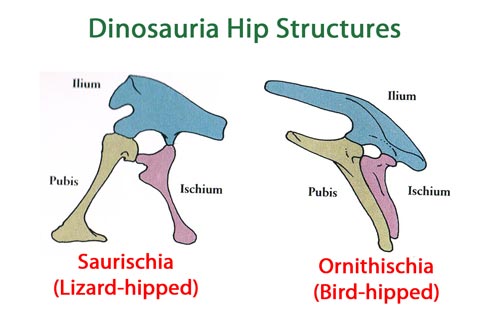
So why were a group of theropod dinosaurs able to evolve quicker than other types of dinosaurs.  We may have to look at bird-hipped dinosaurs for an answer.  As far as we know, the lizard-hipped theropod dinosaurs were the only meat-eating dinosaur group.  The bird-hipped members of the Dinosauria (ornithischians) were all plant-eaters.  Their hips evolved in a different direction (literally) to the saurischians (lizard-hipped forms).

The pubis bone got pushed backwards, purportedly to accommodate a larger gut to help digest all that tough plant material.  A big gut meant a bigger body, so part of the Theropoda, the allosaurids for example, evolved bigger and bigger forms so that they could hunt and kill the herbivores which themselves were getting bigger and bigger.

The Dinosauria Classified as Two Distinct Sub-Groups

Classifying dinosaurs by the shape of their hip bones.

Classifying dinosaurs by the shape of their hip bones.

Picture credit: Everything Dinosaur

As Associate Professor Lee points out, the theropod dinosaurs were the only group to continually push the envelope when it came to size of their skeletons.  It is possible that the herbivorous dinosaurs simply could not shrink, since a plant-based diet requires a larger gut for digestion.  In the meantime, the Theropoda could explore alternate resources, habitats and even prey.  All of these new activities, such as chasing insects, climbing trees and gliding would in turn, have led to other novel anatomical adaptations.

“So as the dinosaurs shrank, their other features evolved more quickly, which led to faster shrinking to take advantage of these new abilities and so on.”

There is one further, rather intriguing point to be made when the consequences of this research are considered.  If miniaturisation in a branch of the theropod dinosaurs began as far back as the Early Jurassic around 200 million years ago, could the ultimate driver for these changes have been the Triassic/Jurassic extinction event that marked the demise of a very large number of terrestrial archosaur groups?

To view articulated models and replicas of dromaeosaurid dinosaurs and other prehistoric animals: Beasts of the Mesozoic Articulated Figures.

25 07, 2014

Did All Dinosaurs Have Feathers? That is an Excellent Question!

By |2024-05-02T12:19:05+01:00July 25th, 2014|Categories: Dinosaur and Prehistoric Animal News Stories, Dinosaur Fans, Educational Activities, Palaeontological articles|0 Comments

Kulindadromeus Discovery Gets Palaeontologists into a Flap

The embargo has been lifted and we can now talk about the amazing new fossil discovery from Siberia, details of which has just been published in the academic journal “Science”.  News of the discovery of the first ever plant-eating dinosaur with feathers as well as scales has been announced.  So what does this mean?  Feathered dinosaurs have been discovered before right?  True, but and it is a big “but“, feathers have only been associated with one group of dinosaurs up until now, the theropods, the group of dinosaurs most closely related to birds.

Kulindadromeus

The dinosaur has been named Kulindadromeus zabaikalicus and at just over a metre in length, it is not going to be breaking any size records when it comes to extinct prehistoric animals.  Indeed, if we had the technology to travel back 175 million years or so, to the area surrounding what was to become the Siberian city of Chita, this little dinosaur would have probably gone almost unnoticed.  However, the publication of this long-awaited scientific paper is very important and over the next few paragraphs we will try to put this fossil discovery into perspective.

The Order Dinosauria (the dinosaurs) can be split into two distinct groups based on the structure and position of their hip bones.  These two sub-divisions are the Ornithischia (bird-hipped dinosaurs) and the Saurischia (lizard-hipped dinosaurs).  Those theropods many of whom were feathered, belong to the saurischians.   The Siberian fossils show that a member of the ornithischian group also had feathers.

Feathers Amongst the Dinosauria

Ornithischians had feathers too.

Ornithischians had feathers too.

Picture credit: Everything Dinosaur

The Dinosaur Family Tree

The picture above shows the dinosaurs split into two groups, on one side of the dinosaur family tree are the lizard-hipped dinosaurs, the long-necked sauropods and the theropods, those mainly meat-eating dinosaurs who are the closest related to birds (Aves).  The other part of the Dinosauria consists of the bird-hipped ornithischians, an almost entirely vegetarian group consisting of the horned dinosaurs, duck-bills, armoured dinosaurs and such like.  Kulindadromeus, described as a neoornithischian dinosaur and definitely amongst the bird-hipped dinosaurs, shows that other types of dinosaurs, not just the theropods had feathers too.

Kulindadromeus zabaikalicus

The terms “bird-hipped” and “lizard-hipped” can be a little confusing, especially when we are trying to identify the ancestors of birds.  These terms were first coined by Henry Govier Seeley in 1887.  He divided the dinosaurs into two groups, based on the fact that all the dinosaurs known at the time (and the majority of dinosaurs discovered to date for that matter), had a pelvis that followed one of two distinctive shapes.

There was a bird-like pelvis, where the pubis bone points backwards and the lizard-hipped configuration where the pubis bone points forward.  It is the lizard-hipped dinosaurs,the theropoda, that are most closely related to the Aves and indeed one group of theropods, the maniraptorans that are the direct ancestors of today’s birds.

Classifying the Dinosauria

Classifying dinosaurs by the shape of their hip bones.

Classifying dinosaurs by the shape of their hip bones.

Picture credit: Everything Dinosaur

Back in 2010, a scientific team led by Sofia Sinitsa, a geologist at the Institute of Natural Resources, Ecology and Cryology from the Siberian city of Chita, explored some highly fossiliferous strata located in the nearby Kulinda valley.  The site represented a low energy depositional environment with freshwater crustaceans, insect larvae and plant fossils.  The strata was laid down by the edge of a large lake, evidence of ash in the layers of rock indicated that there were volcanoes in the neighbourhood too.

Fragmentary fossils indicating the presence of small dinosaurs were also discovered but their poor state of preservation led the scientists to focus on other fossil material.  Expeditions to the same locality found more fossils of dinosaurs over the next two summers and as a result, Pascal Godefroit, a palaeontologist at the Royal Belgian Institute of Natural Sciences (Brussels) was contacted along with other scientists as the implications of the discovery began to dawn on the Russian team.

Dr Godefroit commented:

“We were completely shocked by the discoveries.”

Pictures from the Dig Site and Some of the Fossil Material Collected

A vast amount of fossil material was collected.

A vast amount of fossil material was collected.

Picture credit: Royal Belgian Institute of Natural Sciences

Bristle-like and brush-like structures had been identified in a number of Cretaceous species of ornithischian dinosaur, most notably in dinosaurs such as Psittacosaurus and Tianyulong, but these quills, brushes and bristles have been described by researchers as representing the very earliest development stage of feathers, what scientists call proto-feathers.

To read an article by Everything Dinosaur on the evidence of quills and bristles in later ornithischian dinosaurs:

Evidence of feathers in psittacosaurids: Upsetting the Apple Cart.

The scientists claim that these new fossils differ from the the bristle-like structures found in much later ornithischian dinosaurs as they have complex, multi-filamented structures typical of the feathers associated with the Theropoda.

Kulindadromeus zabaikalicus (pronounced Cul-lin-dah-dro-me-us zah-bay-cal-lik-us) had been named after the Kulinda valley locality and from the Greek “dromeus”, which means runner.  The trivial name honours the Zabaikal krai region of Siberia in which the Kulinda valley can be found.

An Illustration of Kulindadromeus zabaikalicus

Feathered dinosaur down amongst the horsetails.

Feathered dinosaur down amongst the horsetails.

Picture credit: Andrey Atuchin

Dated to around 175 to 160 million years ago (Aalenian to Early Callovian of the Mid Jurassic), this one- metre-long plant-eater had filamentous structures covering most of its body, including its head, neck and chest.  The more complex feather-like structures are confined to the upper arms and upper legs, an arrangement found in a number of fossils of small theropod dinosaurs excavated from Cretaceous strata in the famous Lioaning Province of north-eastern China.

Explaining the significance of this discovery, Dr Godefroit stated:

“For the first time we found more complex, compound structures together with simpler hair-like structures in a plant-eating dinosaur that really resemble the proto-feathers in advanced meat-eaters”.

Multiple Filamentous Structures Associated with the Femur (Thigh Bone)

Complex feather-like structures on the thigh

Complex feather-like structures on the thigh.

Picture credit: Royal Belgian Institute of Natural Sciences/ Dr. Pascal Godefroit

Fossil Feathers

The scientists are confident that these little, fast-running creatures could not fly, so why evolve feathers then?  The answer is quite simple, feathers first evolved for other purposes and they only became adapted for flight much later.  These feathers probably helped to keep these small animals insulated and warm.  This suggests that contrary to popular opinion, most dinosaurs were endothermic (warm-blooded  like mammals and birds) and not cold-blooded like today’s reptiles.

The longer, more complex feather structures may have had some role in display and visual communication.  In total, at least six fossil skulls have been found along with a large number of fossilised bones from many individuals and lots of different growth stages have been recognised.  The abundance of fossil material will give the palaeontologists the chance to study how feathers changed as animals grew and matured.

If this neoornithischian had complex feathers then this also throws up an intriguing set of possibilities.  The common ancestor of both the ornithischian and saurischian dinosaurs could have been feathered, or perhaps, feathers evolved in different types of dinosaur, an example of convergent evolution.

Chinese palaeontologist Xing Xu of the Institute of Vertebrate Palaeontology and Palaeoanthropology (Beijing), someone who has intensively studied the Lioaning feathered dinosaurs commented:

“The finds are a fantastic discovery”.

However, he warns against getting too carried away, stating that the fossils are too fragmentary to be certain that the more complex feathery structures actually correspond to those found later in birds.  We suspect that further research is going to be carried out into the nature of these branched integumentary structures, before palaeontologists will agree that feather-like structures were widespread amongst the Dinosauria.

One of the co-authors of the scientific paper, Professor Danielle Dhouailly from the Université Joseph Fourier in La Tronche (France ), has been examining these ancient structures and comparing them to the down and feathers found in modern birds.  The lake sediments also preserved scales, so scientists now have evidence that both scales and feathers could be found on individual dinosaurs.  In addition, scientists now know that the leg scales found in modern birds are essentially aborted feathers.

The Ancient Lake Sediments Preserved Evidence of Scales

Fossilised bone (sandy colour) surrounded by evidence of small scales on the foot.

Fossilised bone (sandy colour) surrounded by evidence of small scales on the foot.

Picture credit: Royal Belgian Institute of Natural Sciences/ Dr. Pascal Godefroit

Professor Dhouailly added:

“Developmental experiments in modern chickens suggest that  avian  scales are aborted feathers, an idea that explains why birds have scaly legs.  The astonishing discovery is that the molecular mechanisms needed for this switch might have been so clearly related to the appearance of the first feathers in the earliest dinosaurs”.

There is more research to be done, but this discovery has potentially huge implications for our view of the Dinosauria.  Ironically, back in the beginning of 2014, Everything Dinosaur team members were asked to predict what news stories might occur over the year and they did predict that a discovery regarding feathered ornithischian dinosaurs would be announced.

To read Everything Dinosaur’s full list of 2014 predictions: 2014 Palaeontology Predictions.

Team members congratulate all those involved in this exciting fossil discovery and the subsequent research.

To view models and replicas of feathered dinosaurs and other prehistoric creatures: Safari Ltd Prehistoric World Figures.

22 07, 2014

Evolution and Extinction of the African Carcharodontosauridae

By |2023-03-14T10:05:14+00:00July 22nd, 2014|Categories: Dinosaur Fans, Everything Dinosaur videos, Geology, Main Page, Palaeontological articles|0 Comments

“Shark Toothed Lizard” – The Rise and Fall of Carcharodontosaurus

The Carcharodontosaurus genus currently consists of two species, the first of which Carcharodontosaurus saharicus  (originally called Megalosaurus saharicus), is known from fossil material found in North Africa.  The second species, named and described in 2007, was erected following fossil finds, including skull material from the Echkar Formation of Niger, this species is known as C. iguidensis.  Although both species are known from fragmentary material and a few isolated teeth, differences in the shape of the upper jaw and the structure of the brain case enabled scientists to confidently establish Carcharodontosaurus iguidensis as a second, distinct species.

An Illustration of a Typical Carcharodontosaurid Dinosaur

Fearsome "Shark Lizard"

Fearsome “Shark Lizard”. Picture credit: Everything Dinosaur.

Picture credit: Everything Dinosaur

Carcharodontosaurus

Carcharodontosaurus means “shark-toothed lizard”,  a reference to the fact that the teeth of this huge carnivore, reminded scientists of the teeth of sharks belonging to the Carcharodon genus of sharks, such as the teeth of the Great White Shark (C. carcharias).  It is ironic that this terrestrial predator should be named after a marine carnivore, as changing sea levels very probably influenced the evolution of these dinosaurs and may have ultimately led to their extinction, at least from Africa.

To view Everything Dinosaur’s range of CollectA dinosaur models including a 1:40 scale Deluxe Carcharodontosaurus: CollectA Deluxe Prehistoric Life Replicas.

Pronounced – Car-car-oh-dont-toe-sore-us, the oldest dinosaur currently assigned to the Carcharodontosauridae family is Veterupristisaurus (Vet-ter-roo-pris-tee-sore-us).  This dinosaur was named and described in 2011, although the fossil material was discovered over seventy-five years ago.   The fossils come from the famous Tendaguru Formation of Tanzania, it lived during the Late Jurassic and the trivial name V. milneri honours the now retired Angela Milner who worked at the Natural History Museum (London).

A Cretaceous Predator

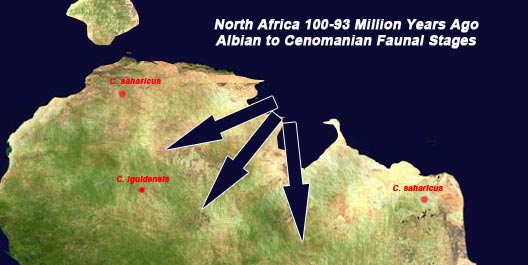
Carcharodontosaurus lived during the Cretaceous (Late Albian to mid Cenomanian faunal stages).  During this time, the great, southern super-continent called Gondwanaland continued to break up and as sea levels rose, so populations of dinosaurs became separated by the inflow of sea water.

Rising Sea Levels Influence Dinosaur Evolution

Rising sea levels but off dinosaur populations.

Rising sea levels isolated dinosaur populations. Picture credit: Everything Dinosaur.

Picture credit: Everything Dinosaur

Communities became isolated and this may have provided a boost to the evolution of new species.  The map shows the approximate location of fossil material associated with C. saharicus and C. iguidensis.  Populations of carcharodontosaurids may have become cut-off from each other and this gave rise to new species of Carcharodontosaurus.  This may help to explain the abundance of super-sized predators that lived in this part of the world during the Cretaceous.

Both species of Carcharodontosaurus shared a common ancestor, but their separation led to the evolution of two, distinct species.  This natural process is called allopatric speciation.

Sadly for the mega fauna that inhabited the coastal swamps and verdant flood plains of North Africa, rising sea levels in the later stages of the Cenomanian led to the destruction of much of this habitat.  The loss of habitat probably led to the demise of the ecosystem and the vulnerable apex predators such as the carcharodontosaurids and the spinosaurids became extinct.

To read an article on the discovery of C. iguidensis: New Giant Meat-Eating Dinosaur from Africa.

21 07, 2014

Brain of World’s First Super Predator Studied

By |2023-03-14T10:02:23+00:00July 21st, 2014|Categories: Dinosaur and Prehistoric Animal News Stories, Main Page, Palaeontological articles|0 Comments

Brain Provides Clue to the Descendants of the Cambrian Anomalocaridid Lyrarapax unguispinus

An international team of scientists, including researchers from the University of Arizona have identified and mapped the brain in an anomalocaridid that swam in the ancient seas that existed in the Cambrian geological period.  Their study of the brain of this twelve centimetre long predator provides clues as to the taxonomic relationship that this extinct group has to extant members of the Animalia Kingdom.

The Brain of an Anomalocaridid

In addition, the remarkably well preserved fossil that is around 520 million years old, suggests that the brains of the anomalocaridids were relatively simple, the brains of their prey were, in many cases more complex.  This leads to the intriguing thought that the evolution of apex predators could have given a boost to the evolution of better senses and ultimately bigger and more sophisticated brains.

The scientific paper, published in the journal “Nature” describes for the first time, the brain of an anomalocaridid, a group of extinct, early members of the Arthropoda that evolved into the first group of animal super-predators known in the fossil record.  The largest specimens of Anomalocaris measure around a metre in length and it is now known that this group of nektonic predators survived into the Ordovician.

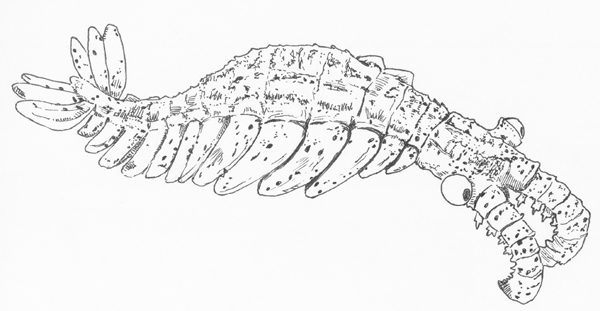
Anomalocaris

An Illustration of a Typical Anomalocaridid

Anomalocaris

Anomalocaris drawing. Picture credit: Everything Dinosaur.

Picture credit:  Everything Dinosaur

To view models and replicas of prehistoric invertebrates including Anomalocaris (whilst stocks last): CollectA Prehistoric Life Models.

Super Predator

An extensive analysis of the beautifully preserved fossils of a new to science, species of anomalocaridid predator discovered in Yunnan Province (China), suggests that these creatures have an affinity with the bizarre velvet worms (Onychophorans).  These strange little creatures are found in the southern hemisphere and they are classed in the taxon Panarthropoda.  Unlike true arthropods these creatures do not have an exoskeleton and they live in the undergrowth and leaf litter feeding on smaller animals such as insects and mites.

An Illustration of a Velvet Worm (Peripatus)

Peripatus - creatures like this may have been the first to walk on land.

Peripatus – creatures like this may have been the first to walk on land.

Picture credit: BBC

The fossil material comes from the famous Chengjiang Formation (Yunnan Province), which rivals the Burgess Shale of British Columbia in terms of the variety of Cambrian fauna that is preserved.  First explored by Chinese palaeontologists in 1984, the members that make up this part of the Chengjiang Formation have preserved in exquisite detail ancient marine creatures.  The degree of fossil preservation is so good that even internal structures such as nervous systems can be studied.

One of the Fossils of the Newly Described L. unguispinus Showing Brain Morphology

This photograph and corresponding drawing show the flattened, fossilized trace of the brain of the world's earliest known predator; the X-like structure in the head denotes the fossilised brain.

This photograph and corresponding drawing show the flattened, fossilised trace of the brain of the world’s earliest known predator; the X-like structure in the head denotes the fossilised brain.

Picture credit: University of Arizona

The Fossilised Brain

The “X-shaped” structure seen clearly in the line drawing interpretation of the fossil denotes the fossilised brain.  Two dark round spots represent the optic ganglia with nerves that lead from the eye-stalks into the head.  The smaller, almond-shaped areas just in front would have supported the creature’s grasping appendage.  The main brain region is in front of the mouth, giving rise to two nerve cords leading down along the animal.

Commenting on the research, lead author of the scientific paper, Professor Nicholas Strausfeld (Director of Arizona University’s Centre for Insect Research) stated:

“It turns out the top predator of the Cambrian had a brain that was much less complex than that of some of its possible prey and that it looked surprisingly similar to a modern group of rather modest worm-like animals.”

Lyrarapax unguispinus

The new species has been named Lyrarapax unguispinus, this translates from the Latin to mean “spiny clawed lyre shaped predator”.  It is likely that this creature was an active predator hunting other invertebrates and perhaps preying on the recently evolved primitive, jawless vertebrates, the fore-runners of the first fish.

Lyrarapax Attacks a Shoal of Primitive Fish

Artist's impression of Lyararapax, one of the species of the world's first predators, the anomalocaridids, chasing its possible prey, primitive fishes that also existed in the Lower Cambrian

Artist’s impression of Lyrarapax, one of the species of the world’s first predators, the anomalocaridids, chasing its possible prey, primitive fishes that also existed in the Cambrian.

Picture credit: Professor Nicholas Strausfeld/University of Arizona

Professor Strausfeld and his colleagues have made some remarkable discoveries amongst the Chengjiang biota, back in the autumn of 2013, Everything Dinosaur reported on the mapping of the brain and nervous system of a Cambrian arthropod, fossils of which had been recovered from the same location as the Lyrarapax fossil material.

To read more about this remarkable discovery: Mapping the Ancient Brains and Nervous Systems of Cambrian Arthropods.

By examining in minute detail the brain morphology of this long extinct species, the scientists were able to compare the neuroanatomy with extant velvet worms (Onychophorans).  The terrestrial velvet worm, such as Peripatus, has a simple brain located at the front of the mouth and a pair of ganglia, a group of nerve cells, located in the front part of the optic nerve and at the base of long, sensory feelers.

Similar Neuroanatomy to Extant Velvet Worms

The anomalocaridid fossil resembles the neuroanatomy of today’s Onychophorans (velvet worms) in several ways, according to Strausfeld and his collaborators. Onychophorans have a simple brain located in front of the mouth and a pair of ganglia – a collection of nerve cells – located in the front of the optic nerve and at the base of their long feelers.  Anomalocaridids do not have these feelers, but they do have a pair of grasping claws extending out from the front of their heads.

Professor Strausfeld explained:

“Surprise, surprise, that is what we also found in our fossil.  These top predators in the Cambrian are defined by just their single pair of appendages, these wicked-looking graspers, extending out from the front of their head.  These are totally different from the antennae of insects and crustaceans.  Such frontally disposed appendages are not found in any other living animals with the exception of the velvet worms.”

Study Suggests Velvet Worms are Descended from Anomalocaridids

A side-by-side comparison reveals the similarity between the brain of a living Onychophoran (green) and that of the anomalocaridid fossil Lyrarapax unguispinus (grey)

A side-by-side comparison reveals the similarity between the brain of a living Onychophoran (green) and that of the anomalocaridid fossil Lyrarapax unguispinus (grey).

Picture credit: Professor Nicholas Strausfeld

The relatively simple brain structure of these large, apex predators may have driven the evolution of more sophisticated senses and brains in their intended prey.

Professor Strausfeld concluded:

“With the evolution of dedicated and highly efficient predators, the pressure was on other animals to be able to detect and recognize potential danger and rapidly coordinate escape movements.  These requirements may have driven the evolution of more complex brain circuitry.”

A Close up of the Head of Lyrarapax Showing a Powerful Grasping Claw

The grasping claw on this specimen can clearly be seen.

The grasping claw on this specimen can clearly be seen.

Picture credit: Peiyun Cong

Everything Dinosaur acknowledges the help of a University of Arizona press release in the compilation of this article.

17 07, 2014

New Type of “Four Winged” Flying Dinosaur – A Liaoning Surprise?

By |2023-03-14T09:39:54+00:00July 17th, 2014|Categories: Dinosaur and Prehistoric Animal News Stories, Main Page, Palaeontological articles|1 Comment

Changyuraptor yangi – Let’s Not Get into Too Much of a Flap

And so on the 15th July, the paper on a new type of airborne dinosaur was published in the journal “Nature Communications”.  The world was officially introduced to Changyuraptor yangi or to interpret the genus name, “long feathered raptor”.  At about the size of a European Herring Gull (Larus argentatus), this newest member of the microraptorines, is the largest theropod dinosaur discovered to date with long pennaceous feathers attached to the hind limbs.  At an estimated weight of around three to four kilogrammes, it is three times heavier than the largest species of Microraptor – M. zhaoianus (if indeed the fossils discovered to date do indeed represent three different species and not a single species but with extensive intra-specific variation), and four times heavier than that extant gull we mentioned earlier.

Changyuraptor yangi

Changyuraptor has other claims to fame.  For example, its tail feathers are extremely long, measuring nearly thirty centimetres in length.  The longest tail feather is around 30% the length of the entire skeleton.

However, for us at Everything Dinosaur, the announcement of this fossil find comes as no real surprise.  The fossil material is from north-eastern China and it forms part of the amazing Jehol Biota which represents an Early Cretaceous ecosystem which has been preserved in strata that date from around 133 million years ago to 121 million years ago or thereabouts.  All the microraptorine fossil material comes from this part of the world and the fossilised fauna and flora portray a habitat that had distinct seasons with a temperate forest habitat interspersed with large bodies of freshwater and swamps.

The Jehol Biota

The area teemed with life and with the finding of one predatory dromaeosaurid dinosaur with aerodynamic abilities (Microraptor), finding other examples of dinosaurs filling this ecological niche was always likely.

These hunters may not have caught their prey on the wing, but they probably spent a great deal of their lives high up in the tree canopy living an arboreal existence and stomach content analysis from Microraptor specimens indicate that these dinosaurs, closely related to the likes of Velociraptor, ate small mammals, lizards and even primitive birds.  One poor unfortunate perching bird seems to have been swallowed whole.

An Illustration of Changyuraptor yangi (Silhouette of Person shows Scale)

“Four winged” terror.

Picture credit: S. Abramowicz

The international team of scientists behind the scientific paper, such as Luis M. Chiappe (Natural History Museum of Los Angeles County), Michael Habib (University of Southern California), Gang Han, Shu-An Ji, Xueling Liu and Lizhuo Han (Bohai University, Liaoning Province), in collaboration with colleagues based in New York and South Africa have described the beautifully preserved fossil material and then analysed this animal’s flight characteristics. Why, for example, did this “four-winged terror” have such long feathers on its tail?

The Holotype Fossil Material (C. yangi)

The slab (a) and the counter slab (b) of the holotype.

Picture credit: Nature Communications

Weighing Four Kilogrammes

At 1.32 metres in length and weighing close to four kilogrammes, taking to the air may not have been too much of a problem for our feathered friend here.  Especially if this dinosaur launched itself from the branches of trees and glided around.  However, controlling itself in flight and coming into land may have been somewhat more difficult for such a heavy, large-bodied animal.

The international research team examined the aerial competency of Changyuraptor and concluded that the tail may have acted as a pitch control structure, reducing air speed and helping to ensure a safe landing.  Those hind limbs with their feathers too, would have assisted with gliding and with the legs rotated down and underneath the body as it descended, then the feathers could have made effective air brakes, in a similar way to the “trousers” on Archaeopteryx.

To read an article on the feathered legs of Archaeopteryx: Feathers Evolved Before Flight – Archaeopteryx Had Feathered Trousers.

Dr Michael Habib (University of Southern California) stated:

“It makes sense that the largest microraptorines had especially large tail feathers, they would have needed the additional control.”

Dr Alan Turner of Stony Brook University (New York), a co-author of the paper added:

“Numerous features that we have long associated with birds in fact evolved in dinosaurs long before the first birds arrived on the scene.  This includes things such as hollow bones, nesting behaviour, feathers…and possibly flight.” 

Liaoning Province Fossils

Bone structure analysis undertaken concluded that this was a fully grown, mature animal that rivalled the largest pterosaurs known from Liaoning Province in size as it glided in the sky above this ancient Chinese landscape.  The holotype material was found back in 2012 and since its discovery the notion that flight preceded the origin of Aves has been consolidated.  Birds inherited flight characteristics from their near relatives the Dinosauria.  For the time being we shall give the last word to Luis Chiappe:

“This new fossil documents that dinosaur flight was not limited to very small animals but to dinosaurs of a more substantial size.  Clearly far more evidence is needed to understand the nuances of dinosaur flight but Changyuraptor is a major leap in the right direction.”

Go to Top