All about dinosaurs, fossils and prehistoric animals by Everything Dinosaur team members.

Articles, features and information which have slightly more scientific content with an emphasis on palaeontology, such as updates on academic papers, published papers etc.

11 01, 2008

New Insights into Thecodontosaurus – Bristol’s very own Dinosaur

By |2022-11-07T10:57:35+00:00January 11th, 2008|Categories: Dinosaur and Prehistoric Animal News Stories, Geology, Main Page, Palaeontological articles|0 Comments

Study of Microfossils shows Thecodontosaurus to be an Inhabitant of Island Paradise

Research into the microscopic fossils from sediments similar to those where fossils of the early Jurassic prosauropod Thecodontosaurus have been found reveal that scientists may have got it wrong when it comes to considering this dinosaurs habitat.

Thecodontosaurus

Previously, palaeontologists had thought that this small dinosaur had inhabited a dry, desert upland area but a study of palynomorphs (organic-walled microfossils such as plant spores and marine algae), show that lush, tropical islands were its home.

It had been thought the dinosaur lived in the arid uplands of the Late Triassic.   However, a joint paper published by Dr David Whiteside (University of Bristol) and Professor John Marshall (University of Southampton), provides more information on the palaeoenvironment and shows that small islands were this little dinosaurs home.

Thecodontosaurus was approximately 2-3 metres long, although most its length was made up by its tail and neck.  Its fossils have been found in the Bristol area of south-west England and also in Germany.  It resembled Plateosaurus but was much smaller, perhaps as a result of living on islands.  Dwarfism is a common feature of island animals as there are fewer resources for animals to exploit in the limited land area.

 A Plateosaurus
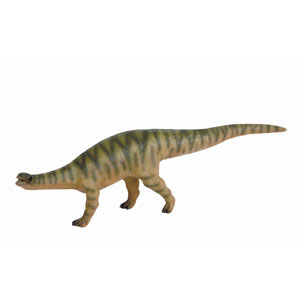
“Flat Lizard” replica.  A model of a Plateosaurus.

Picture credit: Everything Dinosaur

The Plateosaurus pictured above shows the basic body plan of a Thecodontosaurus, but Plateosaurus was much larger, perhaps exceeding 8 metres in length.

There used to be a scale model of Plateosaurus available, designed by a German team (Bullyland museum line), however this model has now been retired.

To view the existing Museum Line range and other models: Dinosaur and Prehistoric Animal Models.

The first fossils of this dinosaur were discovered in 1834, this was actually before Sir Richard Owen had coined the word “Dinosauria” so for a few years scientists were unsure how to actually classify this animal.  The debate as to its classification continues today, as some scientists argue that the very primitive features exhibited by Thecodontosaurus may indicate that it may actually be a representative of the sauropodomorph dinosaurs and not a prosauropod.

Numerous Specimens are Known

A number of specimens of this dinosaur are known, all are important as the global fossil record for vertebrates at the Triassic/Jurassic geological boundary is quite poor.  Unfortunately, the holotype (the specimen upon which the original description of Thecodontosaurus is based), was destroyed in a German bombing raid over England in World War II.

Dr Whiteside and Professor Marshall combined their expertise in Late Triassic reptiles and microfossils to provide a much more detailed picture of the habitat of Thecodontosaurus.  Their work is supported by geological studies of the Bristol area which indicates that during this dinosaurs time the area consisted of a shallow, tropical sea with small islands dotted around it.

The remains of what were once prominent limestone plateaux can be identified by geologists, tracing the rock strata around the Vale of Glamorgan.  These higher areas would have been above sea level and form islands.  This collaborative work between the two universities has helped produce a much more complete understanding of the ecosystem that Thecodontosaurus lived in.

Perhaps Thecodontosaurus could have swam between islands in search of food.  Its long tail could act as a rudder and provide propulsion whilst its strong limbs would have made it quite a powerful swimmer.  The neck, although not as long as with other prosauropod type dinosaurs such as Anchisaurus, could easily have been held out of the water as this animal paddled along.

“Socket-toothed Lizard”

Thecodontosaurus means “socket-toothed lizard” .  The teeth are unusual for a dinosaur of this type, they were shaped a bit like a modern monitor lizards.  Each tooth was embedded in a separate tooth socket and they were small, serrated and blade-like.  Thecodontosaurus could represent an important evolutionary shift for the dinosaur clade, moving away from a carnivorous life-style and taking to a diet of plants.  Could animals like Thecodontosaurus have heralded a change in dinosaur diets?  Certainly, living on small islands with a limited food supply would have predisposed these animals towards a more varied diet, perhaps adapting to plants as these would have proved to be a more reliable food source.

Whatever the actual relationship between Thecodontosaurus and the other long-necked dinosaurs, their evolutionary journey seems to have been a pretty successful one.  Sauropods survived to the very end of the Mesozoic and along the way they evolved into animals like Brachiosaurus, Diplodocus and Argentinosaurus – the largest land animals ever known.

9 01, 2008

Looking inside a Dinosaur – Rare Chinese Fossil provides Insight into Insides

By |2024-04-03T07:27:50+01:00January 9th, 2008|Categories: Dinosaur and Prehistoric Animal News Stories, Main Page, Palaeontological articles|0 Comments

Fossil permits peek inside a Dinosaur

A fossil of a primitive ceratopsian called Psittacosaurus has provided scientists with a glimpse of what these dinosaurs were like in the flesh.  Research published in the scientific journal of the Royal Society outlines the work carried out to study the fossilised skin of this small Cretaceous dinosaur.

It is rare for soft tissue such as skin to be fossilised but recently the discovery of a mummified hadrosaur in America has provided scientists with an opportunity to examine the hide of a dinosaur in detail.

To read the article on the dinosaur “mummy”: Mummified Dinosaur unlocks Duck-Billed Dinosaur Secrets.

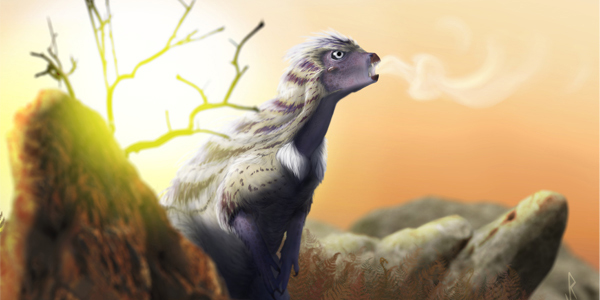
Psittacosaurus

It is not clear whether Psittacosaurus was covered in primitive feathers called proto-feathers, this has yet to be determined and more finds will be required but this latest discovery reveals that this little dinosaur was a “tough cookie” with a thick, scaly skin composed of 25 layers of collagen similar to modern sharks and dolphins.  Palaeontologists believe this tough, outer coating supported the dinosaur’s organs and protected it from predators, although it could also have helped insulate this relatively small dinosaur and keep it warm.

Puncture marks on the fossil, identified as teeth marks indicate that the dinosaur’s carcase was torn open by another dinosaur, the carcase was soon buried by fine sediments and the folded skin was preserved.

Psittacosaurus was a small dinosaur, an early ancestor of the horned dinosaurs such as Triceratops.  The name means “parrot lizard” in deference to the parrot like beak this animal possessed.  This beak, was supported by a single median bone called the rostral bone – it is the one feature that distinguishes ceratopsians from all other dinosaur families.  The hind-limbs were slightly longer than the forelimbs.  This suggests that Psittacosaurus probably adopted a four-footed stance but could if required, such as when attempting to escape from predators, run on its hind legs.

Many Psittacosaurus Fossils are Known

Something in excess of over 400 specimens of Psittacosaurus are known from the fossil record, representing at least ten species.  Fossils have been found in Mongolia, Russia and China with further reported finds in Thailand.  Although not as well known as other ceratopsians such as Protoceratops and Triceratops, Psittacosaurus fossils are extremely important to palaeontologists as individuals of varying ages have been found.  This has helped scientists piece together how these animals changed and grew from hatchlings to fully grown adults.  The study of how a creature grows and changes over its lifetime is called ontogeny.

Psittacosaurus (right) and Protoceratops (left)

Picture credit: Everything Dinosaur

The models in the picture have been taken from the Feathered Dinosaur Models, available from Everything Dinosaur.  These models were originally designed by scientists from the American museum of Natural History.

To view the Feathered Dinosaurs and other prehistoric animal models: Dinosaur and Prehistoric Animal Models.

Commenting on this exciting discovery, Professor Theagarten Lingham-Soliar of the University of KwaZulu-Natal stated: “as noted from the studies on modern-day animals, this fibre structure plays a critical part in the stresses and strains the skin may be subjected to and is ideally suited to providing support and protection”.

Psittacosaurus, may not be the biggest dinosaur, it may not be the most popular amongst young dinosaur fans but it has provided some of the most exceptional fossils from the Mesozoic.  This new research provides further insight into the anatomy of dinosaurs, once again it is the little psittacosaur, that has got palaeontological circles buzzing.

The discovery last year of a “dinosaur den” containing the fossils of a group of juvenile psittacosaurs provided palaeontologists with a tantalising glimpse of the social life and behaviour of these little dinosaurs.

Psittacosaur nursery article: Dinosaur Nursery Unearthed in China.

4 01, 2008

Biting Bugs and Insects a cause of the Dinosaur Decline?

By |2022-11-07T10:35:01+00:00January 4th, 2008|Categories: Dinosaur and Prehistoric Animal News Stories, Main Page, Palaeontological articles|0 Comments

New Book claims Biting Insects and Bugs helped in Dinosaur Demise

The trend for putting forward a new spin on the mass extinction theories continues unabated with the publication of a new book entitled “What Bugged the Dinosaurs? Insects, Disease and Death in the Cretaceous”  published by Princeton University Press.

When it comes to mass extinctions the events that took place 66 million years ago leading to the eradication of the dinosaurs, pterosaurs, marine reptiles and about 65% of all life on Earth, certainly attracts the most attention.

Recently, the Chicxulub impact theory first put forward in 1980 by the father and son team of Luis and Walter Alvarez was challenged by new evidence of volcanic activity in India – The Deccan Traps effect.

To read article on Deccan Traps: Blame the Deccan Traps.

Now this book postulates that changing ecosystems and the rise of biting disease carrying insects could have played a significant role in bringing down the dinosaurs.

An important contributor to the extinction of the dinosaurs, could have been the rise and evolution of insects, especially the slow-but-overwhelming threat posed by new disease carriers. And the evidence for this emerging threat and the diversification of insects and arthropods has been captured in fossilised tree sap – amber.

Co-author of this new book George Poiner Jr. (courtesy professor of zoology at Oregon State University), stated:

“There are serious problems with the sudden impact theories of dinosaur extinction, not the least of which is that dinosaurs declined and disappeared over a period of hundreds of thousands, or even millions of years.  That time frame is just not consistent with the effects of an asteroid impact. But competition with insects, emerging new diseases and the spread of flowering plants over very long periods of time is perfectly compatible with everything we know about dinosaur extinction.”

George and his co-author, his wife, Roberta have spent many years studying the micro-fossils and preserved insect and arthropod remains from the Late Cretaceous.  They theorise that although there were dramatic geological and climatic changes at the famous “K-T Boundary”, these events on their own do not explain what may have been a slow and gradual demise of the Dinosauria.

However, perhaps with animal populations under severe stress from such events, they may have been weakened to such an extent that diseases and parasites spread by biting/ sucking insects and arthropods could have finally seen them off.

“We don’t suggest that the appearance of biting insects and the spread of disease are the only things that relate to dinosaur extinction,” George Poinar said. “Other geologic and catastrophic events certainly played a role. But by themselves, such events do not explain a process that in reality took a very, very long time, perhaps millions of years. Insects and diseases do provide that explanation.”

George and his wife, Roberta have published previous works detailing their studies into the ecosystems and fauna revealed by fossil amber.

“During the Late Cretaceous Period, the associations between insects, microbes and disease transmission were just emerging,” he commented. “We found in the gut of one biting insect, preserved in amber from that era, the pathogen that causes leishmania — a serious disease still today, one that can infect both reptiles and humans. In another biting insect, we discovered organisms that cause malaria, a type that infects birds and lizards today.”

“In dinosaur feces, we found nematodes, trematodes and even protozoa that could have caused dysentery and other abdominal disturbances. The infective stages of these intestinal parasites are carried by filth-visiting insects.”

In the lush, tropical Late Cretaceous insects, lice and other parasites would have thrived and perhaps these animals caused disease epidemics that helped weaken the populations of mega fauna.

The Poinars cite the case of bird malaria which when introduced into Hawaii killed off many of the native honey creepers on the islands.  Although from our perspective this is a case of isolated animal communities being exposed to new pathogens, new diseases that they had not been exposed to before, with the consequence of them not being able to build up any immunity within the species.  Dinosaurs co-existed for millions of years with parasites and biting insects – the fossil record of Mesozoic animals bares testament to this.

The authors suggest that in addition to the parasitic effects on the dinosaurs, the ecosystem was being radically altered due to the rapid expansion of the angiosperms (flowering plants); in part due to the pollination activities of insects.  The flowering plants do seem to have been an evolutionary success story by the end of the Mesozoic with cycads, gingkoes and other gymnosperms being upstaged by their more colourful plant competitors.  But again this process would have been quite gradual, giving herbivores the opportunity to adapt to and exploit these new food sources.  For example, some scientists have speculated that the Pachycephalosaurs may even have specialised as nibblers and browsers of flowering plants and bushes just like many African gazelles do today.

“Insects have exerted a tremendous impact on the entire ecology of the Earth, certainly shaping the evolution and causing the extinction of terrestrial organisms,” the Poinars wrote in their book. “The largest of the land animals, the dinosaurs, would have been locked in a life-or-death struggle with them for survival.”  Although a rather dramatic statement, perhaps more akin to helping to sell their book, a weakened population could have further declined due to the activities of parasites and other pathogens brought on by the increase in insects and arthropods.  But again, all organisms compete with each other and it is hard to believe that all the large terrestrial fauna, including the pterosaurs could have succumbed to pests and diseases.

“We can’t say for certain that insects are the smoking gun, but we believe they were an extremely significant force in the decline of the dinosaurs,” Poinar said. “Our research with amber shows that there were evolving, disease-carrying vectors in the Cretaceous, and that at least some of the pathogens they carried infected reptiles. This clearly fills in some gaps regarding dinosaur extinctions.”

Insects have been connected to the demise of the dinosaurs on numerous occasions.  In our extensive library we have book entitled “Before the Ark” published by the British Broadcasting Corporation (BBC) in 1975.  The authors were Dr Alan Charig, curator of Fossil Amphibians, Reptiles and Birds at the London Natural History museum and Brenda Horsfield – a television producer.  The book accompanied a television documentary series on palaeontology.  In Chapter 13, entitled “Fall of the Dinosaurs” the then, current theories about dinosaur extinction were discussed.

One idea put forward was that the emergence and rapid expansion of the order Lepidoptera (moths and butterflies), put paid to the dinosaurs.  The larval stages, the caterpillars with their voracious appetites consumed a lot of the vegetation leading to the sudden collapse of food webs and the extinction of the mega fauna at the top of these food webs.  A caterpillar caused defoliated eco-system is a bit hard to digest, (no pun intended), after all why did the marine reptiles and ammonites also disappear.  The birds would certainly have spotted a new food source and helped reduce caterpillar numbers, unless of course the larvae had already developed complicated bird scaring defences like the modern hawk moths or become unpalatable such as the Cinnabar moths of the UK and Europe.

Birds had diversified and filled many ecological niches, surely they would have been quick to exploit this new food source and anyway the Dr Charig and Ms Horsfield go on to cast considerable doubt as to the validity of this theory, for example mass defoliation on such a scale would have left some sort of evidence within the fossil record.  Palynomorphs – organic walled micro fossils such as plant spores and pollen do indicate a dramatic change in vegetation at the K-T Boundary, the “fern spike”, but this adds credence to the impact of a huge environmental disaster such as asteroid impact or massive volcanic activity.  The ferns are often the first plant group to recover, hence the large increase in fern spores making up the micro fossil record from around 66 million years ago.

To read more about the fern spike: Humble Ferns – Evidence to Support the Impact Theory.

Certainly, this new book will interest many, the theories put forward will fuel further debate and provide much food for thought.  Indeed, as the human race experiences its own climate change and environmental problems, perhaps the rising seas, flooding low-lying land will give rise to new epidemics of diseases such as malaria as mosquitoes swarm and thrive in the newly created marshlands.

It might not just be dinosaurs that end up being “bugged” out of existence.

The team at Everything Dinosaur are grateful for the information supplied by Oregon State University (Jan 4 2008) in the writing of this article.

To visit Everything Dinosaur website: Everything Dinosaur Homepage.

10 12, 2007

New Study Examines Lack of Vitamin D and Possible Tuberculosis Link

By |2024-04-03T07:10:42+01:00December 10th, 2007|Categories: Dinosaur and Prehistoric Animal News Stories, Main Page, Palaeontological articles|0 Comments

Early Hominid Skull shows signs of Tuberculosis

In science, a breakthrough in one field leads to a better understanding in a whole host of other scientific studies, often ones that on first inspection would have Little to do with the field of science where the break through occurred.

Take our understanding of tuberculosis for example.  Tuberculosis is an infectious disease of the lungs, it is caused by the bacillus Mycobacterium tuberculosis and unless effective treatment is available, this disease can be fatal.  In 2007, a series of papers were published in various scientific and medical journals detailing the outcome of an extensive research project that proved a link between humans ability to produce vitamin D and their ability to fight off tuberculosis.  It seems that vitamin D produced in the skin as it reacts with sunlight can strengthen our immune system and trigger a chain of events that help people fight and kill the infectious bacillus within their bodies.

Now palaeontologists have applied this modern theory to help them examine the skull of an ancient human found recently in western Turkey, a skull which is estimated to be 500,000 years old.  The fossil remains have been identified as belonging to Homo erectus an early hominid that was extremely successful migrating out of Africa establishing humans in parts of the world for the first time.  H. erectus moved north up the Nile valley, through Sinai and onto the region of the Black Sea.  For this poor individual, a male aged between 15 to perhaps 40 years of age, whose skull was found in a block of rock, this was as far as he got.  However, H. erectus continued to spread and colonise new areas of the world including the Himalayas, the jungles of south-east Asia and eventually China.  Hence the alternative name for this particular species of human “Peking Man”.  Indeed, it could be claimed that Homo erectus was one of the most successful species of hominid ever.  They were around for over 1 million years and they spread to virtually every known part of the Old World.

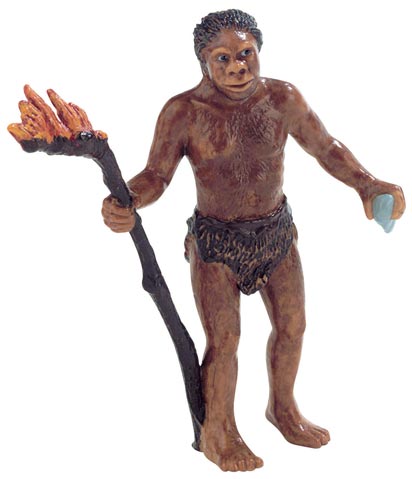
A Model of Homo erectus

H. erectus illustration. A model of an early hominid.

Early hominid model – Homo erectus.

To view models of early hominids as well as prehistoric mammals: Safari Ltd. Prehistoric Animal Figures.

The skull will help scientists understand more about the migration of H. erectus but intriguingly anthropologists from the university of Texas have identified strange pits and lesions on the inside of the cranial material which may indicate that this poor fellow suffered from and probably died from tuberculosis.

The blue arrow indicates the lesions identified on this piece of skull material.  The lesions are caused by a specific kind of tuberculosis bacillus that infects the membrane surrounding the brain.  Inflamed nodules within the membranes create pressure on the bone surface leaving marks and lesions.

If tuberculosis lesions are present in the skull then it may reinforce the theory regarding the association between vitamin D and the ability to fight off tuberculosis infection.

Vitamin D is synthesised in the skin by exposure to sunlight. Since ultraviolet radiation penetrates only the top layers of skin, people with darker complexions produce less of the vitamin, as the pigment in their skin filters out the sunlight.

Earlier studies have suggested that humans migrating north developed a lighter skin complexion as an adaptive response to maintain their vitamin D levels when exposed to less sunlight.  So it may have been an inability to synthesis vitamin D due to having a dark skin colour that caused the demise of many early hominids as they journeyed north.

Published medical literature about modern people (H. sapiens) who have migrated from southern latitudes—and are more likely to have a darker skin colour—to more northern latitudes show a higher incidence of tuberculosis, and this appears to be linked to an inability to synthesis enough vitamin D.

After a presumably dark-skinned population of Homo erectus had migrated north, this individual male in western Turkey was unable to generate enough vitamin D from the reduced sunlight, and a tuberculosis infection proved fatal.   If more skulls are studied then perhaps more lesions will be found and this could give scientists an insight into the speed of the H. erectus migration.

The paper on this unusual discovery has been published today in the American Journal of Physical Anthropology.

24 11, 2007

Claws! Giant Sea Scorpion of the Devonian

By |2023-02-18T13:15:15+00:00November 24th, 2007|Categories: Dinosaur and Prehistoric Animal News Stories, Main Page, Palaeontological articles|1 Comment

Fossil Claw Indicates Giant Arthropods of the Devonian

Spiders can be quite frightening, especially at this time of year when some particular types of spider, such as the Wolf Spider take up residence in your house to avoid the wintry weather.  Suddenly, seeing one of these animals scuttling along the living room floor can be enough to make anyone jump, but scientists in Germany have come across a fossil to really put the wind up anyone with a slight fear of arthropods.

Giant Sea Scorpion

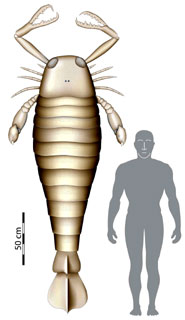
Markus Poschmann of the Mainz museum, in Germany has found a 390-million-year-old fossil claw from what could be the biggest arthropod known to date.  The fossil was found in a quarry near the town of Prum in western Germany.  The fossil is part of a claw of a sea scorpion species named Jaekelopterus rhenaniae, this species had been described and named from other German finds last century but this new find reveals that this particular sea scorpion was a giant of the Devonian seas, reaching lengths in excess of 2.5 metres,

Based on the size of the claw, which is 46 cm long scientists have calculated that this animal would have grown to at least 2.5 metres in length, making it a contender for the largest ever arthropod.  Certainly, based on these measurements this new find puts J. rhenaniae up alongside the likes of Pterygotus, another huge sea scorpion (known as Eurypterids).

Jaekelopterus rhenaniae

Jaekelopterus rhenaniae was probably a top predator during this part of the Devonian period, feeding on other arthropods, including smaller sea scorpions and fish.  Markus and co-author Simon Braddy, a palaeobiologist from Bristol University have just had their work published in Biology Letters, a scientific journal.

A Scale Drawing of Jaekelopterus (J. rhenaniae)

Jaekelopterus scale drawing

Jaekelopterus scale drawing. Life reconstruction of Jaekelopterus. Picture credit: Markus Poschmann.

Picture credit: Markus Poschmann

Lived in a Marine Environment

Based on other fossils of J. rhenaniae it can be seen that the limbs were relatively weak and would not have supported the weight of this huge animal without the assistance of water, so the scientists have speculated that this animal spent the vast majority of its life in a marine environment.  It would have been a ferocious ambush predator, tackling any animal smaller than itself that ventured within reach.  Once captured the powerful claws would have simply torn the victim to pieces, which could then have been passed up to the animal’s mouth on the underside of its heavily armoured head.

Despite this animal’s terrible appearance, it was no terror of the deep.  Instead it would have patrolled the shallow coastal areas, where there would have been a greater congregation of potential prey.  This theory is borne out by evidence from the matrix from which the fossil was taken.  The rocks reveal that the claw was buried by sediments laid down in a coastal swamp or probably a river delta.

With arthropods this size swimming around its no wonder that the vertebrates decided to give living on land a go.

To view models and replicas of Palaeozoic invertebrates: CollectA Prehistoric Life Models.

19 11, 2007

Dating the Mesozoic Cow New Study Suggests it was the Fish and Ostracods that did it!

By |2024-04-02T21:24:26+01:00November 19th, 2007|Categories: Dinosaur and Prehistoric Animal News Stories, Main Page, Palaeontological articles|1 Comment

Dating an early Mammal Tooth to the very end of the Cretaceous

On Friday 9th November we published an article about the discovery of an ancient tooth, believed to come from an early ancestor of ungulates (hoofed mammals) from 65 million years ago.  The discovery had been made in India, and this find was important as very little is known about Late Cretaceous mammals.

To read article: Very ancient udders! Mesozoic cow discovered in India.

Mammal Tooth

At first we queried whether the tooth had indeed been recovered from late Maastrichtian strata, thus placing this tooth at the very end of the age of Dinosaurs 65 million years ago.  The diversification and geographical distribution of mammals is still very poorly understood at this particular time in Earth’s history.  Material from the southern continents (Gondwanaland) is particularly rare, with most mammal fossils from this particular faunal stage having been recovered from the Northern Hemisphere – Laurasia.

However, one of the research scholars who worked on this particular discovery, Omkar Verma of the department of Geology (University of Jammu), was able to furnish us with a little more information.  From the articles and research papers that we were sent, it seems that the tooth was dated using other micro-fossil remains that had been recovered from the same matrix and the same site.  In particular remains of an ancient fish (a ray) Igdabatis indicus; and evidence from the many types of ostracod (crustaceans) and their carapaces indicates that the tooth came from the Maastrichtian faunal stage, placing this ancient mammal at the time of the last of the dinosaurs.

Dating the Fossils

Dating of fossils using “key” or “indicator” species which have a more precise date assigned to them in the palaeontological record is called biostratigraphy.  The remains of I. indicus are associated with the very late Cretaceous and so it seems that the mammalian tooth can be dated to that time period as well.

Ostracods, are still abundant today (the date back to the Cambrian period) and live in both marine and freshwater environments, there are thousands of different genera.  As the carapace or shell can enclose the entire body including the legs they are often referred to as “seed shrimps”, but their importance to micro-palaeontologists cannot be underestimated.  The huge numbers of micro-fossil remains and their prevalence all over the world enables scientists to accurately date geological deposits and thus assist in the dating of rarer finds such as in this case, the ancient mammalian molar from an ancestor of cows.

To view replicas of prehistoric mammals and other extinct creatures: Papo Dinosaur and Prehistoric Animal Models.

17 11, 2007

Where is the best place to find a new Dinosaur – in a museum collection?

By |2023-02-24T16:05:14+00:00November 17th, 2007|Categories: Dinosaur and Prehistoric Animal News Stories, Main Page, Palaeontological articles|0 Comments

If you want to find a new Dinosaur Species- try looking in a Museum’s Vaults

The romantic notion of an earnest young palaeontologist exploring the base of a cliff away from the rest of the dig team and uncovering their very own brand new genus of dinosaur is a bit fanciful, but these occasions do occur.  However, sometimes amazing discoveries can be made by simply re-examining earlier finds in museum collections.

This is precisely what happened to Mike Taylor, a PhD student from the University of Portsmouth who has discovered a brand new type of sauropod (long-necked dinosaur) whilst studying at the Natural History museum – London.

New Dinosaur Species

For Mike, who has been studying the vertebrae of sauropods for 5 years as soon as he saw the strange partially complete fossil bone, he knew it was very different from fossil vertebrae he had seen before.  The isolated bone represents a posterior part of the dorsal vertebrae section of an elephant-sized sauropod.  The fossil was unearthed in the early 1890s in Ecclesbourne Glen, near Hastings in the county of Kent.  Unfortunately since palaeontology was very much in its infancy and the importance of accurate mapping of find locations was not well understood, no detailed records were kept of the actual site.

Acquired by the London Natural History Museum

The fossil was acquired by the Natural History museum and briefly reviewed by the English palaeontologist Richard Lydekker in 1893, but after this it was simply stored in the vaults – that is until a very observant PhD student came along and noted its significance.

Xenoposeidon proneneukus

This new dinosaur has been named Xenoposeidon proneneukus, which means “alien sauropod – forward sloping” in homage to another sauropod called Sauroposeidon discovered in Western North America and because the upper portion of this single bone slopes forward.  It has been estimated that this animal lived during the early Cretaceous approximately 130 million years ago and from the shape and structure of this single dorsal vertebra it appears to represent a totally new family of Sauropoda.

Mike’s work is to published in the academic journal “Palaeontology” and here’s hoping that his diligence and hard work leads to more exciting discoveries in the museum’s collection.

More Dinosaurs Awaiting Discovery

Having been privileged to visit behind the scenes at a number of museums, the fact that new species of dinosaur (and even new families) can be found does not really surprise us.  For example, the Natural History museum has over 70 million specimens in its collection, the vast majority in storage.  Many of the fossils unearthed in the past have been misidentified and mis-labelled so there may be other fascinating finds awaiting discovery.

Once whilst at the Royal Tyrrell museum in Alberta, Canada we calculated that in their fossil depository, the tonnes and tonnes of burlap covered fossil bearing rock would take over 100 years to prepare and describe properly.  One hundred years, if every single palaeontologist and team worker stopped what they were doing and then spent 8 hours a day working on the museum’s back catalogue.

For dinosaur and prehistoric models and figures including sauropods: CollectA Deluxe Prehistoric Animal Figures.

8 11, 2007

Ideas on Dinosaurs Breathing – A Breath of Fresh Air

By |2023-02-19T10:39:59+00:00November 8th, 2007|Categories: Dinosaur and Prehistoric Animal News Stories, Main Page, Palaeontological articles|2 Comments

Study shows Dinosaurs were Super Efficient Breathers

A recent study carried out by a team of scientists from the Faculty of Life Sciences at the University of Manchester (England) has added further evidence to the theory that dinosaurs and birds are closely related.

One view of dinosaurs is that many of them were active, highly mobile and busy animals rather than the very slow, cumbersome leviathans depicted by earlier scientists and illustrators.  To be able to move quickly animals need efficient lungs to provide enough oxygen to muscles in their bodies.  For the real heavyweights of the dinosaur world – the sauropods, their sheer size led to their own set of anatomical problems.

Heterodontosaurus breathing study.

A life reconstruction of the early ornithischian Heterodontosaurus.  Research suggests that dinosaurs were super efficient breathers.

Picture credit: University of Witswatersrand.

The long necks on the likes of Diplodocus, and Brachiosaurus were too long for air to reach their lungs on the first breath, without super efficient lungs to process air and a large and powerful heart to pump blood round their enormous bodies, they would not have been able to function properly.  In the case of a brachiosaurid, having to pump oxygen rich air from the centre of the body 40 feet up into the air to reach its head (and the tiny brain that perched on top of a fifty tonne body), would have been a momentous task without some sort of super efficient breathing system.  If a sauropod did not have a very efficient heart and lungs then its blood pressure would have been very difficult to manage.  If it dropped its head suddenly, the dramatic change in blood pressure could have caused the animal to lose consciousness; had they been burdened by a mammalian type set of lungs.

The good news for dinosaurs, revealed in this new study from the Manchester team, is that it looks like many of them had super efficient breathing systems, much superior to our own lungs and hearts.

Mammalian Breathing – the Downside

I am not one to put a downer onto our own mammalian anatomy, after all, if my lungs and heart did not work I certainly would not be able to finish this article.  However, our breathing processes although perfectly adequate for our needs are not very efficient.  In order for us to be active our blood needs to supply oxygen to our organs and muscles, and then take the waste products away.  When we breathe in, air enters the two sack like objects in our chest (the lungs), through capillaries and other tiny vessels the oxygen seeps through into the blood stream and is carried away to all parts of the body by the blood cells.  Waste products such as carbon dioxide is dumped back into the lungs by the blood stream and this is exhaled.  A strong heart enables more oxygen to be pushed through our bodies.  Although this is something of a very simplified explanation, I am sure you get the idea.

The mammalian system does have a major drawback, the lungs have only one entrance/exit point for the air.  We mix up the exhaled air with new air being breathed in.  We never get rid of all the used air inside us, every time we inhale we just mix fresh air with oxygen extracted air we are going to breathe out.  This is not a very efficient process and as a result this contributes to the physical limitations of our bodies.

Birds, in contrast, are much more efficient breathers.  Instead of just one entrance/exit point in the lungs they have openings at both ends, plus a series of air sacs in front and behind the lungs.  It is these air sacs, not the lungs that inflate and deflate with each breathe.  Acting like bellows they pump the air through the lungs and out a different tube than it went in.  This is a one-way system with old, stale air never mixing with fresh oxygen rich air and as a result, it is a very effective system.  For their size, birds have disproportionately large hearts, these provide the pumps to enable the whole system to function.

The trouble with air sacs is that you have to make room for them inside your body.  Birds allow for the air sacs by having hollow bones which can accommodate these specialised features.  Hollow bones are found in the fossil record in pterosaurs, sauropods and the theropods – as well as certain other groups such as sphenodonts.

Taking the pterosaurs first, although they are not closely related to birds, they may have evolved a similar solution for the need to get lots of oxygen into their bodies as they too were fliers.  You need a super efficient oxygen transport system if you are going to do something as aerobically challenging as fly.

Dinosaurs Breathing

The sauropods and theropods (lizard-hipped dinosaurs – saurischian dinosaurs) show honeycomb like structures linked by tiny passageways in their fossilised bones.  These structures would have helped these animals by keeping their skeletons light to aid mobility and to assist with balance but could they also be indicators of a super efficient air-sac breathing system?

The Manchester University Team, led by Dr Jonathan Codd studied the breathing processes of modern birds and crocodiles (the closest living relatives to dinosaurs).  They then compared these specimens to the fossils of small, bipedal Coelurosauria which are known to have hollow bones and the honey comb arrangement of structures.  A specific group of Coelurosauria was studied – the maniraptorans, animals such as Oviraptor, Velociraptor and Microraptor, believed by many palaeontologists to be the group of dinosaurs that actually gave rise to birds.

Looking Closely at the Ribs

Dr Codd and his colleagues (including palaeontologist Dr Phil Manning), focused on tiny bones associated with ribs called uncinate processes.  These tiny bones stretch between the ribs and are found in modern birds.  Initially it was thought that these bones helped to strengthen the rib cage and enable birds to cope better with the physical stresses of flying.  Now it is thought that they also act as levers helping to inflate the air sacs by pushing the rib cage outwards.  Birds breathe with their beaks closed, air travels along the nasal cavity before filling the lungs and multiple air sacs.  Air can flow in and out efficiently, thanks in part to the squeezing and pumping action of bones such as the uncinate processes.

The dinosaur species studied were found to have tiny L-shaped uncinate processes, could these bones have helped these animals expand their rib cages and sternums to enable the air sacs within their bodies to have been filled?  In proportion to the birds; the dinosaurs have relatively larger uncinate processes, comparable to the scale seen on super efficient bird breathers such as penguins.  As penguins dive for food they need to be able to keep a great deal of oxygenated blood inside their bodies.  This new work, due to be published in the Proceedings of the Royal Society B: Biological Sciences, presents an explanation as to how groups of dinosaurs such as the theropods and sauropods were able cope with the problem of getting a lot of oxygen to their muscles.

So certain types of dinosaurs breathed like birds.  How the ornithischians such as the hadrosaurids and the Thyreophora managed is still open to debate, perhaps their extensive and highly complicated nasal passages seen in the skulls of certain genera may provide a clue.

Everything Dinosaur stocks a huge range of dinosaur and prehistoric animal models including saurischian and ornithischian dinosaurs.  To view this range: Dinosaur and Prehistoric Animal Models.

4 11, 2007

Humble Ferns – Evidence to support the Impact Theory?

By |2023-02-19T10:46:39+00:00November 4th, 2007|Categories: Dinosaur and Prehistoric Animal News Stories, Main Page, Palaeontological articles|0 Comments

Fossil Fern Pollen – Evidence to support the Asteroid/Meteorite Theory?

With the recently published paper citing the volcanic activity that caused the Deccan Traps as the main driving force behind the mass extinction that occurred 65 million years ago, it might be time to review some of the other evidence gathered by scientists to help explain what exactly went on.

In Denmark, about 40 kilometres south of the capital city, Copenhagen there is an area of exposed Cretaceous/Tertiary chalky cliffs that over look the Baltic sea.  The cliffs are white like the famous cliffs on the coast of southern England but closer examination reveals a strange looking grey band of clay about 8 cm wide running across them.  The locals call this fisk ler, translated this means fish-clay, due to the large number of fish bones found within it.  This clay band has been dated to 66 million years and is one of the few sites around the world where the K-T boundary layer is exposed.

Analysis of Impact Layer

Analysis of this clay layer has revealed evidence that supports the impact theory as the cause of the mass extinction.  Firstly the clay layer contains soot.  An asteroid impact would have thrown molten rocks up into the air and these would have caused forest fires when they landed.  An impact of the magnitude  of the Chicxulub event, would have thrown red-hot rocks all over the planet.  Any material ejected into the upper atmosphere would have become hot due to friction as it plunged back down to Earth, adding to the rain of incendiaries.  Some scientists claim that the soot layer is so dense in the deposits studied on the Baltic that if they had been laid down in just 1 or 2 years they could have produced by half the world’s vegetation burning.

Mass Extinction Event

Whatever the reason for the event, life on Earth was devastated, not only did the dinosaurs, marine reptiles and pterosaurs perish but also about 90% of all protozoan genera and algae went extinct too.  Marine plankton disappears from the micro-fossil record so abruptly that it forms a distinct boundary.   Deposits which show this distinct phase have been nicknamed the plankton line by geologists.

Humble Ferns

However, it is the humble fern that provides the strongest evidence of a sudden and dramatic single event devastating life on Earth. Studies of fossil spores and pollen (important elements making up micro-fossil sites), show that prior to the end of the Cretaceous fern spores make up about 25% of the percentage of total spore and pollen micro-fossils.  Flowering plants were dominant by the end of the Cretaceous period and it is the angiosperms that make the major part of fossil plant elements at micro-fossil level.

At the K-T boundary few spores and pollen fossils are found.   In the first part of the Palaeocene epoch (lower Danian faunal stage deposits), there is a sudden and dramatic rise in the fern spore component of the micro-fossil fauna and flora.  Indeed, in some sediments, fern spores make up 99% of micro-fossils recorded immediately post the end of the Cretaceous.

As the Palaeocene progressed the percentage of fern spores in the fossil record falls, eventually reaching levels seen prior to the mass extinction event.  This surge in fern spores is called the Fern Spike.

A Diagram showing Dramatic Fern Spike after the Cretaceous

Chart source: Everything Dinosaur (ref: R. C. Moran)

The Fern Spike

Many Palynologists (scientists who study pollen and spores), claim that the fern spike indicates a sudden and dramatic climatic catastrophe such as an impact event and not the thousands of years of volcanic eruptions as indicated by supporters of the Deccan Traps hypothesis.  Ferns are often the first plants to recover after forest fires and other natural disasters.  They are often at the vanguard of re-populating areas that have been severely polluted.  Could they provide evidence to support a collision with a body from outer space?

The fern spike seems to be a phenomenon that passes quite quickly in geological time.  It is certainly true that ferns are some of the first plant species to re-colonise ground that has suffered from a forest fire, but equally ferns are some of the first plant species to establish themselves on volcanic slopes and lava flows.  So perhaps the fern spike was caused by the dramatic and immense volcanic eruption phase 65 million years ago in India that led to the deposition of the thickest layers of basalt that now make up the Deccan Traps?

For models and replicas of prehistoric plants and prehistoric creatures: CollectA Prehistoric Life Models.

3 11, 2007

Dinosaur Asteroid Impact Extinction Theory Challenged – Blame the Deccan Traps

By |2023-02-24T16:32:50+00:00November 3rd, 2007|Categories: Main Page, Palaeontological articles|0 Comments

New Studies Point Finger at Deccan  Traps for Demise of the Dinosaurs

In 1980, American scientists Luis and Walter Alvarez published their theory regarding an extra-terrestrial body impacting with the Earth, causing the mass extinction event that marked the end of the Age of Reptiles.  The discovery of the Chicxulub crater in the Gulf of Mexico, the “smoking gun” evidence in the 1990s added credence to this theory put forward by the father and son team.

Extinction of the Dinosaurs

Recent studies of the asteroid belt that lies between Mars and the outer planets had led one group of scientists to deduce the fate of the dinosaurs was sealed back in the Jurassic when an impact between huge asteroids sent one immense lump of space rock on a collision course with Earth:

Article here: Dinosaur extinction set in motion by asteroid collision in the Jurassic.

Now a second team of American scientists have challenged the asteroid/meteorite theory and proposed that massive volcanic eruptions in India led to the demise of the Dinosaurs and about 65% of all life on Earth.  New studies of the enormous basaltic lava flows of western and central India – known as the Deccan Traps, indicate that the most violent and devastating eruptions are dated very closely to the mass extinction event.

The Deccan Traps

Volcanic activity on this scale would have thrown out into the atmosphere huge volumes of carbon dioxide and sulphur dioxide, dramatically changing the world’s climate and leading to the collapse of entire ecosystems.

The Deccan Traps is one of the largest volcanic provinces on the planet.  The basaltic lava flows that occurred around 70-65 million years ago, cover an area of over 500,000 square kilometres, this is twice the size of the whole of the United Kingdom.  In parts, the basalt is over 2 kilometres deep.  Plate movements and other tectonic factors have broken up the lava deposits, some scientist estimate that the volcanic activity at the end of the Cretaceous deposited enough lava to cover 1,500,000 square kilometres – this would have covered half of India.

Enormous Eruptions

It has been accepted for some time that these enormous eruptions would have had a devastating effect on the Earth’s climate.  Apart from the damage caused by the eruptions themselves, the smoke and the ash clouds would have been vast and disrupted the climate.  The sulphur dioxide pumped into the air would have led to acid rain and the carbon dioxide and other gases, as well as being toxic to life would have led to global warming.

This new study by the American team dates the most massive volcanic activity right up against the K-T boundary and as a result the research team has published a paper claiming that it was these eruptions and not the asteroid impact that led to the wipe-out.

Eruptions at Beginning of the Extinction Phase

The main period of eruptions has been linked chronologically to the estimated date for the beginning of the extinction phase, during this period geologists estimate that ten times more climate changing gases would have been released compared to the Chicxulub impact event.  So it was probably the volcanic activity that did for the Earth’s climate, although the huge extra-terrestrial impact could not have come at a worse time and would have added to the environmental chaos.  As indeed with other impacts (some scientists believe there were two such impacts, only 300,000 years apart, in geological time very close to each other – a real double whammy.

Use of Dating Techniques

Previous dating techniques involved paleomagnetic signatures of crystals formed in the lava as it cooled.  These indicated that the main eruptions occurred around 800,000 years before the geological boundary between the Mesozoic ending and the Cenozoic beginning.  More recent studies measuring the radioactive decay of argon and potassium isotopes in the lava deposits placed the biggest period of volcanic activity within 300,000 years of the K-T boundary.  However, it is evidence from tiny marine micro-fossils that the American researchers believe prove the volcanic activity to be a direct cause of the mass extinction.

Mass Extinction Event

Scientists are confident that shortly after the mass extinction event, one of the first signs of ecosystems beginning to recover was the establishment of new types of planktonic foraminifera (similar to the animals that helped form the white cliffs of Dover).  Analysis of deposits in Bay of Bengal region of the Deccan traps has shown that marine sediments were deposited on top of the basaltic lava from the most active phase of the Trap’s formation.

In these marine deposits, evidence of the foraminifera micro-fossils have been found, indicating that these marine deposits were laid down almost immediately after the extinction event.  It is therefore logical to deduce that the lava deposits immediately preceding the marine sediments must have been laid down about the time of the death of the dinosaurs and the wiping out of much of life.

Presented at an Annual Meeting

The American team’s paper has already received support from a number of notable academics from Europe.  It was formerly presented at the annual meeting of the Geological Society of Denver has received widespread comments and reviews.  The sheer magnitude of the volcanic activity certainly played a role in climate change but this study of the micro-fossils puts the worst of the eruptions immediately prior to the mass extinction, as if these eruptions triggered the extinction event.

The American team has cited a number of other studies which support their conclusions and state that their work sheds light on an anomaly that the Chicxulub impact theory supporters have not been able to resolve.  Analysis of other sites around the world along the K-T boundary and from sediments laid down thousands of years after the extra-terrestrial impact show that life on Earth was very slow to recover.

Life Slow to Recover

The micro-fossils do not enter the fossil record for another 300,000 years post the asteroid/meteorite collision.  The fact that the marine environment does not show any signs of recovery for about 300,000 years after the impact, can be explained by looking at the lava deposits above the tell-tale marine deposits in the Bay of Bengal.  These younger deposits of lava were laid down after the mass extinction event, but still caused enough disruption to delay the recovery of life on Earth.

According to the American researchers the last period of Deccan Trap eruptions occurred in the early Palaeocene (Danian faunal stage) about 280,000 years after the end of the Mesozoic.  It was these eruptions that caused the delay in the recovery of life forms and the building up of ecosystems.

Several Mass Extinctions

The fossil record indicates that there have been a number of mass extinction events in the history of life on Earth.  It is certain that the K-T boundary represents a period of dramatic environmental change.  The dual effect of the formation of the Deccan Traps coupled with asteroid impacts would explain the mass extinction, the dying out of the non-avian dinosaurs, marine reptiles, pterosaurs, certain birds, ancient crocodiles, and many kinds of invertebrates could be due to a number of factors.  This is not doubted, what remains in dispute is the contribution to the mass extinction each of these factors played.

Visit Everything Dinosaur’s customer-friendly website: Dinosaur Themed Gifts, Models and Toys.

Go to Top