All about dinosaurs, fossils and prehistoric animals by Everything Dinosaur team members.

Articles, features and information which have slightly more scientific content with an emphasis on palaeontology, such as updates on academic papers, published papers etc.

1 11, 2007

Fossil Jellyfish dated from the Cambrian Period

By |2023-02-24T17:45:44+00:00November 1st, 2007|Categories: Dinosaur and Prehistoric Animal News Stories, Main Page, Palaeontological articles|2 Comments

Exceptionally well preserved Ancient Jellyfish

Anyone who has ever found a jellyfish washed up on the beach, knows how peculiar looking these creatures are with their soft body parts and long delicate tentacles.  Scientists know that soft-bodied jellyfish have existed for hundreds of millions of years and represent examples of the first complex multi-cellular organisms to evolve on Earth, now some amazing fossils discovered in the western USA shed more light on their evolution.

Fossil Jellyfish

A team of American researchers from the University of Kansas have uncovered the remains of ten jellyfish in Utah, from strata dating back to the very end of the Cambrian period, making these particular animals 500 million years old.

As jellyfish have no bones, shells, beaks or other hard calcified body parts they rarely fossilise and very little is known about their origin or evolution.  Several indistinct “blobs” which may represent the remains of jellyfish and their ancestors have been found from ancient marine deposits such as the Burgess shales in Canada, but these new discoveries show the jellyfish in fantastic detail.

The Cambrian Explosion

The specimens remarkable state of preservation allows scientists to compare the fossils with species of jellyfish alive today.  These finds are the best preserved specimens from the Cambrian period found to date and mark a period in the evolution of life when many new body forms and types of creature appeared.  This period has been named “the Cambrian explosion”.  Scientists are still not sure why at this time in the Earth’s history that evolution began to accelerate.  Perhaps increasing levels of oxygen in the atmosphere stimulated the emergence of new life forms, or maybe the abundance of warm, shallow seas encouraged life.

There may not have been a huge increase in marine animals at all, simply that with more hard-bodied animals evolving such as trilobites the fossil record is richer.

Trilobite Fossils
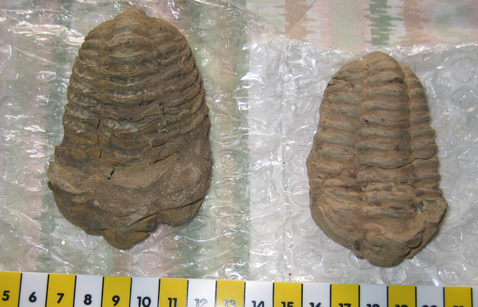
The definition of benthic. A pair of trilobite fossils. Trilobites feature in the televison programme "First Life".

Trilobites and other “hard-shelled” creatures have a greater fossilisation potential than jellyfish.

Picture credit: Everything Dinosaur

Superb Preservation

Such is the quality of the preserved remains that researchers from the University of Kansas were able to liken the fossils to living specimens of jellyfish alive today.  The researchers have suggested that these animals may represent early ancestors of three modern families of living jellyfish.  The picture above shows a comparison between two of the fossils and pictures of modern jellyfish genera.  If these relationships are proved, two contrasting theories as to the evolution of these animals can be put forward.

Did jellyfish evolve slowly and by the end of the Cambrian they were already complex organisms like their modern descendants?  If this is the case, then the origin of jellyfish and other soft bodied creatures would have to be pushed back into the Proterozoic era.

Alternatively, did jellyfish evolve into their current complex forms very quickly around 500 million years ago, perhaps as a reaction to the Cambrian explosion?

For replicas and figures of ancient invertebrates and other prehistoric creatures: CollectA Prehistoric Life Models.

As with many fossils, new finds ask as many questions as they provide answers.  So very little is known about the Cambrian and Pre-Cambrian periods.  Scientists cannot even agree how best to divide up and classify these ancient times, but it was during this time that all the main animal groups alive on Earth today, including the chordates, our ancestors evolved.
31 10, 2007

Rare Sauropod Femur Discovered In Japan

By |2024-04-01T10:21:25+01:00October 31st, 2007|Categories: Dinosaur and Prehistoric Animal News Stories, Main Page, Palaeontological articles|0 Comments

Huge Sauropod Thighbone Unearthed in Japan

A partial sauropod femur (thigh bone) of a long-necked dinosaur has been discovered by a team of Japanese palaeontologists in Katsuyama, Fukui Prefecture on Honshu island.  This is only the second time a sauropod  femur has been discovered in Japan.  The first thigh bone was unearthed in 1996 in the Kinki region of Japan, on Honshu island but on the Pacific ocean side of the island, whereas as this new find in Fukui Prefecture is from the side of the island that faces the Sea of Japan.   The sediments from which this second fossil femur has been extracted have been dated to the Early Cretaceous period about 120 million years ago (Aptian faunal stage).

Sauropod Femur

The bone measures 85 cm long and is believed to have been part of the dinosaur’s right hind leg.  The part of the bone that connects to the knee joint is intact (distal end) but the the part attaching this bone to the hips has been corroded away.  This fossil site has also provided other fossil material including three typical sauropod-like teeth, a partial rib bone and elements of a sauropod foreleg.  As these fossils have been recovered from the same strata as the femur and are in association with the thigh bone, scientists have speculated that all these bones belonged to the same animal.

Sauropod Fossil Bones

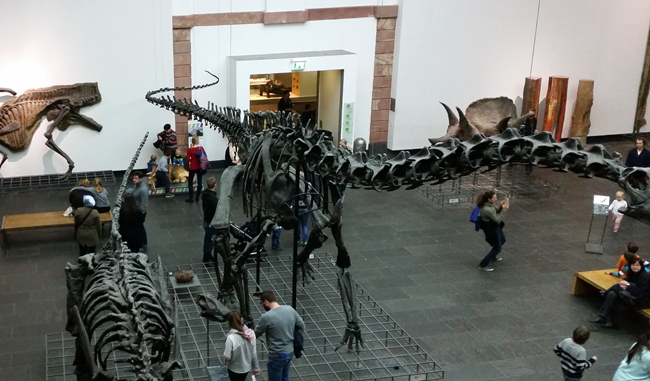
Despite the robust nature and huge size of sauropod bones, complete articulated specimens are extremely rare.  Even very well known dinosaurs such as Diplodocus are known from only incomplete and partial remains.  Lots of the reconstructed specimens and fossil replicas dominating museum entrance halls and exhibitions are actually composites.  They have been made up from the remains of several animals.  Indeed, when it comes to fitting skulls to these huge exhibits, skulls from completely different genera have been added to complete the look of the specimen.

Sauropod skulls are notoriously rare, this is because they are on the end of a long, articulated neck and during decomposition the head often falls off and is lost in the fossilisation process.

This is why, even large museums have often resorted to putting the head of a different species onto the body of another dinosaur to complete their reconstruction.  This has been done partly through mistakes made when it comes to sorting out which skull belonged to which animal and partly through necessity due to the paucity of the sauropod skull record.

A Sauropod Fossil Skeleton on Display at a Museum

Sauropod skeleton (cast) on display.

A sauropod (diplodocid) skeleton exhibit on display at the Frankfurt Natural History Museum (Naturmuseum Senckenberg). Picture credit: Everything Dinosaur.

Picture credit: Everything Dinosaur

For models and replicas of sauropods and figures of some Japanese dinosaurs: CollectA Age of Dinosaurs Models and Figures.

Although the genus to which this particular Japanese dinosaur belonged cannot be identified from the material found so far, scientist may be able to estimate the size of this animal by studying the proportions of the limb bones of other sauropods.

To read an article on other recent dinosaur discoveries in Japan: Duck Billed Dinosaur Skull found in Japan.

30 10, 2007

Evidence of Pack behaviour in “Raptors” unveiled in China

By |2023-02-13T08:19:52+00:00October 30th, 2007|Categories: Dinosaur and Prehistoric Animal News Stories, Main Page, Palaeontological articles|0 Comments

Is a Fossil Trackway Proof of Pack Hunting in “Raptors”?

For many years scientists have speculated that the speedy, carnivorous raptors (more appropriately termed dromaeosaurs), such as Velociraptor and Deinonychus were pack hunters.  Movies such as “Jurassic Park” popularised theories about these animals, making them out to be vicious, ruthless, yet intelligent killers.

Hollywood’s depiction of these swift hunters stretched the truth to say the least, the likes of Velociraptor became a man-sized predator when in truth it stood about 1 metre tall.  Even the sickle shaped foot claw on the second toe was blown out of proportion to some extent.

“Raptors” in the Movies

Movie directors wanted to show this claw as a razor sharp scythe capable of tearing victims to pieces, recent studies indicate that in Velociraptor’s case the claw (which barely exceeded 9 cm in length was not a terrible slashing weapon.  It may have had a sharp point and been an effective “grappling hook” to help the animal jump onto and stay on its larger victims.

However, the dromaeosaurs did come in different sizes, although the basic body plan – swift biped with a stiffened tail to assist with balance and sharp turns, remains the same of the genera associated with this family.  Dinosaurs such as Utahraptor represent very large and formidable beasts.

Now evidence to back up how raptors have been depicted in the movies has emerged from China.  A recently excavated fossil trackway shows six dromaeosaurs tracks, all moving in the same direction.  If the tracks were made at the same time (and there is some palaeontological data to suggest this), then could this be a pack of raptors out on patrol?

A joint international team drawn from the University of Chicago and the Qingdao Institute of Marine Geology have uncovered a series of footprints that capture the moment when six equally sized dromaeosaurs walked side by side next to some flowing water, possibly a stream or small river.

Shandong Province

The fossil site is in the Shandong Province of eastern China and the sediments have been dated to between 120 -100 million years ago, placing the footprints in the Cretaceous period.  This is the first fossil evidence palaeontologists have of possible pack behaviour in these animals.  Ripple marks also preserved in the rock strata indicate that the trackways were covered shortly after they were made, thus strengthening the hypothesis that this evidence represents a group moving together.

This site has already provided a number of sets of dinosaur prints, providing a great deal of material for ichnologists (the term used to describe scientists who specialise in studying trackways).   The report on the evidence for dromaeosaur pack hunting plus some additional information on the trackways of a smaller dromaeosaur found nearby have been published in the European scientific journal “Naturwissenschaften”.

Evidence of Pack Behaviour

Pictures show one of the trackways left by the larger dromaeosaur.  The line drawing on the top right depicts a single footprint (made by the left foot).  The picture on the bottom right with the 5cm scale bar is a picture of a footprint made by a smaller dromaeosaur at the same site (left foot).

In the trackways, two clear toe prints can be seen.  The third toe print (actually representing the second digit on the foot) is only partial, indicating that this toe, the one with the sickle claw was held off the ground.  Scientists had suspected that the sickle claw was raised off the ground, examination of the joints in the second toe bones indicated that this was probably the case.  These beautifully preserved tracks confirm the theories, that indeed the sickle toe was carried off the ground.

The larger tracks contain foot prints about 28 cm long and 12 cm wide, these indicate the presence of larger dromaeosaurs in this area, possibly about the size of Deinonychus from North America.  Ironically, these tracks may represent an animal about as big as the over-sized Velociraptors as seen in the movie “Jurassic Park”.  The second set of tracks  represent a much smaller raptor, possibly the same size of a Velociraptor (1 metre tall at the hips).

Not Possible to Identify the Species

Although it is not possible to identify the species that made these tracks, the larger trackway provides the first evidence of the presence of big dromaeosaurs in China.  Ichnologists have named the bigger dromaeosaur Dromaeopodus shandongensis.  The name means “swift footed from Shandong Province”.  The smaller tracks have been ascribed to a new genus of raptor called Velociraptorichnus.

The parallel trackways do not demonstrate pack behaviour, nor can we assume that these animals adopted any sophisticated group hunting strategies like packs of mammals, such as wolves or lions.  However, this is the first evidence of potential social groups in dromaeosaurs, plus proof that the second toe was held off the ground – just like in the movies.

Films depict the raptors as deadly, pack predators using cunning to outwit their victims.  Is this too the stuff of fiction or will we find evidence to support this theory as well?

Young dinosaur fans can excavate their own Velociraptors and other prehistoric animals using these fossil kits available from Everything Dinosaur: Dinosaur Toys and Gifts.

28 10, 2007

“Oh we Do Like to be Beside the Seaside” – Early Man a Beach-comber According to New Study

By |2024-04-01T10:20:58+01:00October 28th, 2007|Categories: Dinosaur and Prehistoric Animal News Stories, Main Page, Palaeontological articles|1 Comment

Learning to Beach comb – an Essential Survival Technique for Early Man

A study by American palaeoanthropologists published in the journal “Nature” provides evidence of early man (Homo sapiens) turning to a beach-combing existence to survive global climate change.

Early Man

A South African cave located at Pinnacle Point on the Indian Ocean shows evidence of periodic habitation by humans, with the first evidence of people living in the cave dating back to around 164,000 years ago, a time when much of the world’s freshwater was locked up in ice sheets.  The lack of free water in the environment led much of Africa to suffer drought and put the population of modern humans under extreme pressure.

A Harsh Environment

The harsh environment drove many tribes to extinction, but it seems our beach-combing ancestors were able to survive by living off the bounty brought in by the tides twice a day.  The scientists from Arizona State University excavated the cave and discovered shellfish remains, small stone tools called bladelets and evidence of the use of ochre from deposits dated to more than 160,000 years ago.  The Pinnacle Point cave is extremely important and has yielded much information on the ascent of man as modern humans are believed to have evolved around 180,000 to 200,000 years ago in southern Africa.

The oldest finds in the cave trace the early origins of our own species and link modern people to a coastal environment much earlier in our evolution than previously thought.  Until the discoveries at Pinnacle Point, the earliest evidence for humans living beside the sea was from strata 125,000 years old.  These remains pushes back our association with a beach-combing lifestyle by 40,000 years.

Beach-combing Existence

It seems that these people plucked shellfish from the rock pools and perhaps used the small bladelets as barbs on wooden harpoons to catch fish.  It seems that shelled animals were consumed in large numbers, the scientists have unearthed the remains of whelks, limpets and molluscs.  A fragment of a whale barnacle found in the cave may also indicate that our early ancestors scoured the beach for whale and seal carcases.  The meat and blubber would have been a rich source of protein and carbohydrate.

The evidence of ochre has important implications for our social development.  Ochre is formed from hematite rocks.  These can be ground up to produce a red pigment that could have been used as  a body paint or red dye.  This may indicate that these early humans were already practising symbolic behaviours, using ochre in this way is a trait that would not look out of place in a site dating from the New Stone Age.

The stone tools found in the cave also indicate that these people were using technologically advanced tools, that were to remain unchanged for 150,000 years.

Stone Tools

These stone tools bare the scratch marks from use by their owners and the stone at the bottom of the picture shows evidence of ochre.

The Pinnacle Point cave, located at Mossel Bay, half-way between Cape Town and Port Elizabeth would have been an ideal home for early humans.  At the time it was first settled, the cave would have been 3 miles inland, but high up overlooking the bay.  This would have made the cave safe from any flooding or extreme high tides as well as providing an excellent vantage point to spot potential food on the beach below.

Evidence of human habitation can be found in various strata in the cave, with the first settlers living around 164,000 years ago, marking the start of perhaps several hundred years of use.  The site seems to have been settled again around 140,000 years ago and then there is evidence of permanent settlement between 120,000 and 90,000 BC.

A Survival Strategy

Scientists have long speculated about how early humans coped with the extreme droughts caused by the Ice Ages.  Many believe that H. sapiens nearly went extinct during this period, when the extremely dry climate wiped out a large number of mammal species and led ourselves to the brink of extinction.  It seems it was coastal sites like Pinnacle Point that enabled our ancestors to hold on and eek out an existence.  The environment improved when the ice sheets retreated, enabling seasonal rains to return and to become more certain.

In these conditions, early mankind was able to flourish and migrate out of Africa (often via maritime and coastal routes).  Around 120,000 years ago man began to settle areas beyond their homeland of southern Africa, into the Middle East and eventually Europe via ocean coastal routes and routes along the Red Sea.

Our species came so very close to extinction due to the harsh environmental conditions that some scientists have estimated that there were just a few thousand people left living in isolated pockets of Africa.  It is from these people that all 7 billion of us are descended.  Although we are now extremely diverse with Chinese, Indians, Europeans and Americans, our genetic make-up reveals how closely related we all our to each other.

In fact subscribers to the “Daughters of Eve Hypothesis”  believe that there are just seven original human bloodlines, each one linked to a group of early humans and their migration route from Africa.  Our genome is so constrained as a result of this early extinction leaving few ancestors from which the rest of us are related; that viruses such as bird flu, although originating in the Far East can be lethal to Westerners too.

It is worth thinking about… a person reading this web log living in Basingstoke, England is more closely related genetically to a Chinese farmer in a remote part of Mongolia than one mountain gorilla is to another mountain gorilla in the next valley.  With this week’s United Nations report on the problems caused by human population growth, the lack of resources and the impact of the human race on the environment, some comfort may be taken from the fact that our species has survived dramatic climatic change before.

They adapted to a beach-combing lifestyle to cope with the lack of other food resources, but despite man’s ingenuity, our species came so close to the brink of extinction, and besides, it is unlikely that there will be enough sites such as Pinnacle Point to go round next time.

Visit Everything Dinosaur’s award-winning website: Everything Dinosaur.

27 10, 2007

Dig a Dinosaur – Evidence that Dinosaurs Lived in Burrows

By |2023-02-13T08:15:04+00:00October 27th, 2007|Categories: Dinosaur and Prehistoric Animal News Stories, Main Page, Palaeontological articles|0 Comments

Fossils of Burrowing Dinosaur Found in Montana

Scientists have speculated that with dinosaurs dominating life on Earth during the Mesozoic they will have filled a lot of environmental niches, specialising in types of food and different ways of living.  Now a team of palaeontologists from Montana State University have found evidence that some dinosaurs spent at least part of their lives in burrows.

Unusual Sandstone Deposit

Working in an area of south-western Montana, the leader of the university team, David Varricchio discovered an unusual deposit of sandstone protruding from the surrounding sediments.  Choosing to excavate this peculiar feature, the team dug through the sandstone and discovered a mass of small dinosaur bones tangled up in a single layer.  The remains represent a new species of Ornithopod, perhaps closely related to Hypsilophodontia.

Three individual skeletons were located, each one virtually complete, there was two smaller animals and a larger one.  Could this be an underground den where an adult looked after the young?

Further excavation of the 95-million-year-old sediment (dated to the middle Cretaceous – Cenomanian faunal stage), revealed that the sandstone mass was S-shaped and about 2.1 metres in length. For most of its length, the sinuous feature had an oval cross section about 30 centimetres in diameter and about 40 cm high.  However, at its lower end—where the dinosaur bones were found—it broadened to a width of 45 cm, could this be a nursery chamber?  The elongated sandstone mass intersected with three distinct layers of rock derived from mud and clay, perhaps a sign that those strata were in place before the material that formed the sandstone was deposited.

Burrowing Dinosaur

Close study of the fossil remains showed that they were unbroken and showed no signs of having been weathered before they were buried. The bones show no signs of predation either, so it is unlikely a meat-eater dragged the bodies into the burrow.  David Varricchio and his university team have proposed that the mass of sandstone represents a sudden influx of material that filled in a burrow, such as that from a sandstorm trapping its occupants and suffocating them.

These findings have been reported at the scientific symposium and meeting of the Society of Vertebrate Palaeontology in Texas.  This unique discovery adds weight to the theory that some dinosaurs cared for their young and showed a strong maternal or paternal nature.

Oryctodromeus cubicularis

The dinosaur has been named Oryctodromeus cubicularis (means digging runner of the lair).  The size of the juveniles and the complexity of the burrow indicates that this particular species may have spent a long time looking after young.  The adult was approximately 2.1 metres in length with an estimated weight of 25 kilogrammes.  The juveniles were approximately 1.3 metres long.

Reviewing the papers produced by the Montana team, Dr Paul Sereno commented “all the pieces are there to support the burrowing interpretation”.  Dr Sereno has specialised in Ornithischian cladograms so was able to add credence to the hypothesis that this small biped was a Hypsilophodont.

Being bipedal enabled this little animal to evolve modified forelimbs that could have helped with the digging of dens and burrows.  Although study of the adult arm bone (humerus, ulna and radius) may indicate large muscle attachments to assist with digging, the absence of a manus (hand) prevents scientists from speculating on further anatomical modifications to assist with excavation.  Similar forelimb modifications are seen in modern animals such as rabbits that also have a running and burrowing existence.

Adapted for Digging

The dinosaur’s wide, broad hips as well as being a trait of herbivores may also have assisted with burrow digging.  Oryctodromeus could have braced itself in a wide stance while burrowing.  Modifications to the skull and jaw bones may also have helped this little animal manipulate soil.

The large orbit in the skull may indicate that this animal had big eyes and this may indicate that Oryctodromeus was nocturnal.  The presence of a burrow provides evidence of social behaviour, with a prolonged period of parental care coupled with aspects of territory management and possibly social interactions if rival pairs of these animals wandered into another Oryctodromeus’s domain.  Some scientists have speculated that some other small Ornithopods may also have lived part of their lives in burrows.  Their forelimbs may also show modifications for digging.

The technical scientific term for burrowing animals is fossorial, this word and the term fossil are derived from the same Latin source – fossillis; which is related to digging.

Certainly, a little pack of Oryctodromeus working alongside palaeontologists would have been very useful when it came to excavating fossils.

Digging for fossils is certainly very hard work, especially when the matrix is unforgiving and hard such as compacted sandstone.  Machinery cannot be used close to any fossil bearing sediment in case of damage so much of the close excavation is down to elbow grease.  However, when it comes to removing the matrix around fossil bone a steady hand and a lot of patience is required.

Young dinosaur fans can experience this for themselves with Everything Dinosaur’s Dig-a-Dino Series which features excavation kits of prehistoric animals such as Triceratops, Velociraptor, Stegosaurus, Tyrannosaurus rex and the Pterosaur Pteranodon:

As an alternative, the smaller Dinosaur Fossil Finds provide a similar experience but inside the gypsum based block there is a mini dinosaur fossil.  There are six models in this series including Pachycephalosaurus and Diplodocus.

Dinosaur crafts and other gift ideas: Dinosaur Toys and Gifts.

18 10, 2007

Giant Dinosaur Discovered in a Cretaceous “Lost World”

By |2022-11-04T12:52:35+00:00October 18th, 2007|Categories: Dinosaur and Prehistoric Animal News Stories, Dinosaur Fans, Main Page, Palaeontological articles|0 Comments

Palaeontologists Reveal new Contender for the “Biggest Dinosaur of All Time”

A new species of huge dinosaur believed to have measured over 105 ft (32 metres) long has been revealed to the world this week.  This enormous animal, a long-necked titanosaur was discovered in 2000 by a team of palaeontologists excavating an area rich in Cretaceous fossils on the banks of Lake Barreales in the Argentine province of Neuquén in the badlands of Patagonia.

Huge Dinosaur

The immediate area is rich in plant and animal remains providing scientists with a unique insight into the ecosystem at the time.  In the seven years of study, 240 fossil plants have been found, dozens of fish, at least two species of crocodile, hundreds of teeth, a pterosaur and the remains of a predatory megaraptor.  The diversity of finds has provided the South American team with a glimpse of their very own “Lost World”.  An ecosystem with giant plant-eating titanosaurs, perhaps the largest land animals of all time, wandering the landscape.

This new dinosaur has been named Futalognkosaurus dukei.  The genus name has been created from the local Indian dialect Mapuche and means “giant chief of the lizards”.  The species name was selected in recognition of the expedition’s sponsors the Duke Energy company of Argentina.

Futalognkosaurus dukei

The very size of this animal’s carcase may have created the conditions needed to trap so much fossil material in one place.  Scientists believe that the dead animal’s body blocked a waterway, in effect acting like a giant dam.  A logjam of other dead animals and plant materials was then trapped behind it and slowly buried.  Marks on the huge fossilised bones show that scavengers fed on the carcase before it was completely submerged.  Such a large animal would have attracted a whole host of predators to feed upon it.

The picture shows the size of this animal’s huge bones with a what appears to be a left humerus and vertebrae.  The spinal vertebrae weighed 8 tonnes and many of the neck vertebrae were over 1 metre tall.  An estimated 70 per cent of the skeleton has been found. It is more usual for only 10 per cent of mega-herbivores to be recovered.  This makes it one of the most complete sauropod/titanosaurs ever discovered.

Futalognkosaurus has been estimated at being 32-34 metres long  (105-112ft) with the neck alone stretching to over 17 metres.  The tail was estimated at 15 metres.   These measurements put Futalognkosaurus in the top 5 of big dinosaurs (all of them titanosaurs), with Argentinosaurus (estimated to have been 35 metres long), just keeping the title of the biggest yet described.

The titanosaurids seem to have been particularly successful in South America and remained dominant herbivores in this part of the world right up to the end of the Cretaceous, whilst elsewhere sauropods became less common and were replaced by the ornithopods.

A number of large titanosaurs are known from South America, many of the excavated from this part of Patagonia, Neuquensaurus, Puertasaurus, Antarctosaurus and Titanosaurus.

Some of these titanosaurs developed body armour, perhaps as some protection against the giant megaraptor packs and the huge allosaurs that roamed the plains.

A typical example is Saltasaurus, a small-sized titanosaur tipping the scales at around 8 Tonnes.  Several fossilised skeletons have been excavated from Argentina and Uruguay, with thousands of bony plates (scutes) lying around them, these plates, some no bigger than peas provided protection against the giant predators.

Saltasaurus dinosaur model

“Reptile from Salta Province”.  A replica of Saltasaurus.

A model of a typical titanosaur: Dinosaur and Prehistoric Animal Models.

16 10, 2007

The Puzzling Therizinosaurs – are they the Strangest of all Dinosaurs?

By |2022-11-04T10:34:07+00:00October 16th, 2007|Categories: Dinosaur Fans, Main Page, Palaeontological articles|0 Comments

Therizinosaurs – A Dinosaur Designed by a Committee!

Looking back over various text books, journals and papers from the 1960s, 70s and 80s you can get an impression of how our knowledge of dinosaurs has changed over time.  New fossils and new techniques used to study existing specimens have yielded much more data, which when interpreted has provided palaeontologists with a great deal of information about these prehistoric animals.  However, the Mesozoic fossil record is still full of surprises and the emergence of the therizinosaurs, this bizarre group of meat-eaters turned plant-eaters illustrates this point nicely.  Puzzling therizinosaurs are they a dinosaur designed by a committee?

Puzzling Therizinosaurs

Very large fossilised claws were found by a Russian expedition to Mongolia in 1948, at first these claws, which measured up to 1 metre in length, were thought to belong to a huge tortoise, and these fossils remained a mystery with little further evidence found to help describe the creature to which these huge claws belonged to.  In 1954, papers published by the expedition leader, the eminent Russian palaeontologist Evgeny Aleksandrovich Maleev (who was also responsible for naming Tarbosaurus bataar); described the genus Therizinosaurus and the species T. cheloniformis – the first “scythe reptile” had been described, but what this animal actually looked like was very much down to speculation.

Several years later fossil finds from China (hind limb bones indicating a four-toed foot, a tooth, part of the pelvic girdle) were discovered and a more complete picture of this strange dinosaur group began to emerge.

Therizinosaurs seem to be comprised of various elements of other dinosaur clades.  Parts of the very wide hip area resemble prosauropods, the pelvic bones with the swept back pubis bone, pushed up against the ischium is more typical of an ornithischian dinosaur than a saurischian.  This arrangement is known in other saurischian dinosaurs, maniraptorans such as Deinonychus and Velociraptor have this arrangement, as do their close relatives the birds (Aves).  The wide hips and the placing of these pelvic bones may have evolved to accommodate an enlarged gut as the therizinosaurs switched to eating plants.

The huge claws would have been helpful in pulling down branches and it is thought that these animals fed rather like giant sloths.  About 12 different genera are known, all but one located in Asia, but the fossil record of these creatures is very sparse.

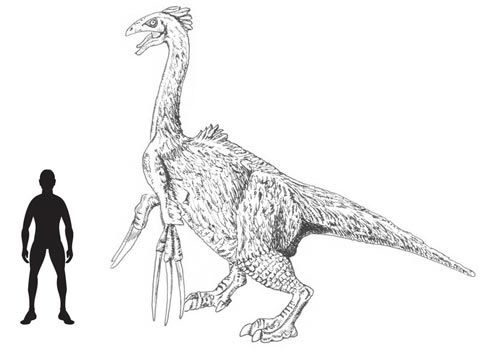
A Drawing of Therizinosaurus

Source: Young Palaeontologist Ewan

Our thanks to Ewan for his excellent drawing.

How effective the huge claws may have been at deterring the large tyrannosaurs around at the time is the subject of much speculation.  These large creatures were not capable of moving very fast to escape predators, perhaps they flapped their arms in a threat display to put off would-be attackers.  The claws were very heavy and scientists have carried out preliminary studies to try to understand whether the muscles in the forelimbs permitted these animals to swing the claws with much force.  If they had been able to put some “umph” into it then the claws would have been very formidable weapons indeed.  The lack of fossils has prevented scientists from carrying out more detailed studies, this area of research is on-going.

Huge Forelimbs

The discovery of huge forelimbs (ascribed to Deinocheirus), further confused and compounded scientists.  The forelimbs of Deinocheirus were enormous – 2 metres long, these are the only remains found so far and they are in the same area and same geological deposits of therizinosaurs.  Each finger on the three-fingered hand had a huge claw, but this time the claw was very different from the long blade-like claws of a Therizinosaurus.  These claws were thicker and much more curved.   Palaeontologists have speculated that Deinocheirus was a giant ant-eater.

A Scale Drawing of the Giant Therizinosaurus (T. cheloniformis)

Puzzling therizinosaurs - a scale drawing of Therizinosaurus.

Huge “scythe lizard”  An illustration of a puzzling therizinosaur.

Picture credit: Everything Dinosaur

PNSO have introduced a range of theropod dinosaur models including therizinosaurs and Deinocheirus.  To view the range of PNSO Age of Dinosaurs figures in stock at Everything Dinosaur: PNSO Age of Dinosaurs Figures.

If Deinocheirus turns out to be a close relative of the therizinosaurs then this could be an example of parallel evolution.  In mammals, the order Xenarthra (means strange-jointed mammals; as the vertebrae have extra joints between them), consists of bizarre looking animals such as sloths, armadillos and ant-eaters.  These are all closely related mammals that have evolved to fill specialist niches in the food chain, in perhaps just the same way that these bizarre therizinosaurs did so 100 million years earlier.

15 09, 2007

Palaeocommunities in upper Campanian stratigraphy of Alberta

By |2022-10-31T09:22:20+00:00September 15th, 2007|Categories: Main Page, Palaeontological articles|0 Comments

Abundant Ornithischian Fossils shed light on Late Cretaceous mega-fauna

With the re-examination of many of the lost quarries within the Dinosaur Provincial Park of Alberta more data on the palaeocommunities from this region has been collected.  This has provided some intriguing information that may indicate a succession line of ornithischian genera (both ceratopsia and hadrosauridae) and lead to a greater understanding of the type of habitats preferred by many types of dinosaur.

Lots of Field Work in Southern Alberta

Between 1898 and 1954 nearly 40 large palaeontological expeditions were sent out into the Dinosaur Provincial Park many led by the famous Charles Sternberg and his sons, collecting museum quality specimens for institutions such as the Royal Ontario museum, the American museum of Natural History and the then British museum (London Natural History museum).  However, poor and incomplete field documentation as well as incorrectly catalogued field photographs has led to a number of these sites being “lost”.  The rapid erosion of the messas and buttes within the local landscape has further complicated the finding of these fossil sites from just the photographic evidence alone.

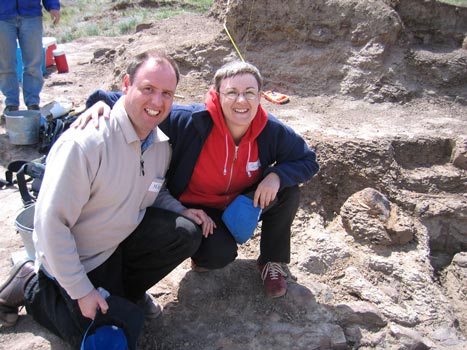
Team Members Undertaking Field Work in Alberta

Rocks, fossils and dinosaurs

Pause for a pic next to a digs station.  Everything Dinosaur team members at the Dinosaur Provincial Park (Southern, Alberta).

Picture credit: Everything Dinosaur

Royal Tyrrell Museum

Researchers from the Royal Tyrrell museum have been playing detective and gathering evidence so that these old quarries can be located and mapped using modern global positioning technology.  Re-visiting these sites once they had been found again has yielded more specimens and important micro-fossils, overlooked by the scientists during the first excavations.  It is a good job some palaeontologists are untidy, many of the sites have been found again as site rubbish dumps have been located.  Dates when expeditions first visited a site have been calculated by studying old newspapers left behind by the original scientists.  During the early to mid part of the 20th century, expeditions would carry bundles of old newspapers with them to wrap fossils.  Fragments of newspaper recovered from the dumps and from around old quarries has helped the Royal Tyrrell team to accurately date when these quarries were first explored.

Modern palaeontological techniques have helped produce more finds and the sites have been properly numbered and accurately recorded.  This helped provide a clearer picture of the changes in environment and the resulting fauna over the 2 million years or so that the Dinosaur Park Formation represents (believed to cover 76 million – 74 million years ago).

Using this new information and the stratigraphic distribution of ornithischian dinosaurs, a time frame for major genera can be plotted.  For example, no chasmosaurines have been found in the Oldman Formation, but chasmosaurs have been found in upper Campanian sediments dating from 76 million years ago, with Chasmosaurus russelli being found in the earliest strata with Chasmosaurus belli being found in later strata, indicating a succession.  Another ceratopsian group, the centrosaurines are confined to a zone of sediments about 40 metres deep dating from 76.5 mya to about 75 mya, after this their place in the fossil record seems to be taken by styracosaurs.

A similar pattern of succession can be seen in the main hadrosaur types around at the time when these sediments were laid down.  In earlier sediments, roughly equating to the time of centrosaurine dominance in the ceratopsia fauna, Corythosaurus genera dominate.  These give way to increasing numbers of lambeosaurs such as Lambeosaurus magnicristatus.

Everything Dinosaur stocks a wide range of ornithischian dinosaurs that roamed southern Alberta at the end of the Cretaceous. To view part of our range: PNSO Age of Dinosaurs Figures and Models.

The Biota of the Upper Campanian

This does not mean that the animals that preceded the later ones are directly ancestral to them, but it might indicate that certain genera were better able to adapt to the changing environment in this part of western North America during the latter stages of the Cretaceous.  The Dinosaur Park Formation was deposited in the last stages of the transgressive phase of the Bearpaw cycle.  Rising sea-levels would have made the area much more coastal and the climate would have been greatly affected by the encroachment of the sea.   Perhaps the centrosaurs and corythosaurs were less able to adapt to the changing environment and preferred more inland habitats.  This allowed the styracosaurs and the lambeosaurs to move in and out compete these other dinosaurs.

Ornithischian Faunal Zones within upper Campanian Stratigraphy of Alberta

74 mya – “Pachyrhinosaurid” – L. magnicristatus – C. irvinensis faunal zone?

Styracosaurus – Lambeosaurus faunal zone      C. belli

76 mya –  Centrosaurus – Corythosaurus faunal zone      C. russelli                   

78 mya –  New Centrosaurus Species         No Chasmosaurines found

Ref: Dinosaur Provincial Park (Ecosystem Revealed) – P. J. Currie and E. B Koppelhus

13 09, 2007

New Study Suggests Tendons connecting the heel to the calf muscles – Not our Achilles heel?

By |2024-04-01T10:03:48+01:00September 13th, 2007|Categories: Dinosaur and Prehistoric Animal News Stories, Main Page, Palaeontological articles|0 Comments

Could the Development of an Achilles Tendon give Hominids an Edge?

Recently, a team of scientists from the University of Manchester led by Dr Bill Sellers presented new evidence on the locomotion of bipedal theropod dinosaurs.  Their study involved the use of a powerful computer programme that analysed extant and extinct animal data and then calculated the top running speed of each animal tested.  The results did not reveal too many surprises.  The larger the theropod the slower it could run.

Running Speeds

The fastest dinosaur in this study proved to be the chicken-sized Compsognathus.  Measurements from the fossilised skeleton led the Manchester university computer to calculate that this tiny dinosaur could run at an impressive 40 mph.  A six tonne T. rex on the other hand could run at just 18mph (still fairly striking considering the size of the animal).

You can read the full article here:

Tyrannosaurus rex could run down David Beckham.

Early Hominids

The Manchester team went on to present a second study, this time with the focus on human evolution, their work suggests that if early hominids lacked an Achilles tendon, then they would have managed little more than an amble.

However, if the likes of Homo ergaster had evolved an Achilles then their ability to run would have been greatly enhanced.  Being able to run away from potential predators is an effective survival strategy, particularly in the dry Savannah environments where early hominids, such as H. ergaster lived.  But if they could run, could our direct ancestors have hunted?  Fossil remains of Homo ergaster have revealed teeth worn away in a pattern that indicates a diet of chewing at flesh.  Does this indicate that evolutionary advantages such as Achilles tendons allowed them to hunt?  If the likes of Homo ergaster were able to hunt or indeed to roam around their habitat efficiently so they could locate carcases and scavenge them, this would have permitted them to obtain a lot of protein from the meat they ate.

Our Achilles Heel?

Lots of protein is essential if you are going to develop a big brain, is the reason for our eventual success to be found in the tendon that links our heel to our calf muscles?

The Achilles tendon acts as a spring whilst running.  It stores and releases energy and greatly improves the running action.  Strong tendons can make a huge difference to how fast an animal is capable of moving, they are after all what gives the kangaroo its bounce.

The study by Dr Sellars involved inputting the anatomical details of an early human ancestor Australopithecus afarensis, postulated from the limited fossil evidence we have (the well-known “Lucy” fossil) plus additional evidence from footprints, preserved in volcanic ash at Laetoli (Tanzania).  The powerful bio-mechanical computer then analysed the evidence and came up with an efficient form of bipedal locomotion for our 3.5 million year old ancestor.  The research indicates that Lucy and her kind were already efficient walkers but their gait, limb bone measurements and the lack of an Achilles tendon would have severely hampered their ability to run.

Challenges Previous Studies

This study contradicts in part, the work done by Patricia Kramer of Washington University.  Her work focused on the relationship between the wide pelvis and shorter legs of A. afarensis.  According to this research, A. afarensis was actually a more efficient walker than modern humans.  Patricia and her team calculated that these early hominids “wiggled” rather than “waddled” when they walked and concluded that just because H. sapiens is the only surviving species of bipedal hominid; this did not mean that our way of walking was the best.

This Manchester team’s work, presented to the British Association for the Advancement of Science sheds new light on the cursory abilities of the earliest ape-men.  The problem is, the evolution of hominids is still poorly know, the lack of fossils is a real drawback.  Virtually all the material on the origins of mankind going back 6 million years could be easily fitted inside a single transit van, the fossil record of our own evolution is so poor.

Hominid Taxonomy

Scientists still debate how the various hominid species are inter-related, this new work which shows the importance of the Achilles tendon in terms of effective running speed does little to shed further light on how the hominid family tree shapes up.  Indeed, in apes the origins of the Achilles tendon is a very confusing issue.  Our closest living relatives chimps and gorillas lack an Achilles tendon, whereas gibbons the least closely related great ape to Homo sapiens has one.

It may be misleading to use the extant apes to review the evolutionary importance of running.  Chimpanzees and gorillas adopt a quadruped stance and spend a lot of their time on the ground.  Gibbons are largely arboreal and it may be this difference that is the real reason for the absence/or presence of the Achilles tendon in these genera.

Efficient Walkers

The Manchester University model shows that early hominids were quite efficient walkers, but were poor runners.  Effective running followed much later on our evolutionary path, once we could walk upright we had an advantage but the development of an Achilles tendon permitted our ancestors to run and perhaps hunt more effectively.

It seems that the old adage is true – “you must walk before you can run”.

Visit Everything Dinosaur’s award-winning website: Everything Dinosaur

11 09, 2007

Miniaturisation in Dinosaurs – a clue to the Origin of Flight

By |2023-02-14T21:07:41+00:00September 11th, 2007|Categories: Dinosaur and Prehistoric Animal News Stories, Main Page, Palaeontological articles|0 Comments

Tiny Mongolian Dinosaur may shed “Light on the Origin of Flight”

A combined team of palaeontologists and researchers from the North Carolina State University and the North Carolina Museum of Natural Sciences have published evidence that contradicts many scientists views on how dinosaurs may have evolved into birds.

A widely accepted doctrine had been that miniaturisation was one of the last stages in the long series of changes required in order for dinosaurs to evolve into flying animals, the first avians – birds.  However, the US team’s analysis of a small Mongolian dinosaur, recovered from Cretaceous deposits, throws an evolutionary spanner into the works.

Small Theropod Dinosaur

Dr Julia Clarke, assistant professor of palaeontology at the university, led the analysis of the new dinosaur species called Mahakala omnogovae (derived from the words for Lord Shiva), which had been discovered in the Gobi desert.  This small, basal Dromaeosaur was only 70 cms long and weighed little more than 2-3 kgs.  Although, the fossil is far from complete, the researchers are confident that this specimen represents an adult of the species and not a still growing juvenile, so Mahakala is one of the smallest dinosaurs known.

A Typical Small Theropod Dinosaur (Dromaeosauridae Family)

Atrociraptor marshalli scale drawing. A small theropod dinosaur.

A scale drawing of the dromaeosaurid Atrociraptor marshalli.  An illustration of a typical small theropod dinosaur.

Picture credit: Everything Dinosaur

How to Fly

In order to achieve powered flight, animals have to become lighter so that they are able to take off under their own muscle power.  Modern birds (Neornithes) have a number of anatomical adaptations to help them fly, for example no teeth, a reduction in the number of digits, the development of a pygostyle and so on; all helpful in making their skeletons lighter and thus assisting in powered flight.  It had been thought that miniaturisation would have assisted the evolution of birds, with smaller and smaller dinosaurs able to run faster and leap higher into the air; and over many generations; slowly powered flight evolved from this.

However, with dromaeosaurs small size was relatively common well before the ability to fly evolved.  There are a number of small light-weight dinosaurs known from the Late Cretaceous, dinosaurs such as the 1 metre tall Bambiraptor from the Western United States and Byronosaurus.  These swift and agile hunters show many bird-like adaptations in their skeletons.  Perhaps there was a biological advantage in being small and fast running.  Clearly, such small fleet-footed animals would have not been on the menu of the large tyrannosaurs, even young Tyrannosauridae would have had little chance of catching them.  There would have been plenty of food around for such animals, many small mammals, lizards, snakes, insects, even larger dinosaur’s eggs.  The feathers on these small dinosaurs would have been essential for insulation, helping these animals to retain body heat.

The Evolution of Flight

The evolution of flight and the eventual rise of the birds may have been an “evolutionary side-shoot”, an indirect consequence of being small, feathered and nimble.  Many dinosaur families seem to have small members within them whose descendants got bigger not smaller as previously thought.  Small size in members of the dromaeosaur group occurs well before many other innovations in locomotion and growth strategy that would have helped these animals eventually evolve into true birds.

Dr Julia’s work has been published in this month’s edition of the journal “Science”.

The trouble with small, light weight animals whether they are true birds or the dinosaur ancestors of birds, is that they tend not to be found as fossils.  Their skeletons are light and delicate and not able to withstand the rigours of fossilisation.  Many animals are scavenged and their remains scattered, so there is little chance for scientists to recover an articulated specimen.    Chances are there were probably many thousands of different types of small theropod around in the latter stages of the Mesozoic.  The bipedal theropod body plan is a very successful design, after all it had been around for most of the age of reptiles with very few modifications.  These animals would have inhabited areas with plenty of cover such as forests and scrub-land.  Forest environments do not lend themselves to the prevailing conditions that allow rapid burial and fossilisation to occur.  Only in rare circumstances can such animals be preserved; such as the sediments that went on to form the lithographic limestone of Solnhofen that permitted remains of Archaeopteryx to be fossilised or the amazing fossils found in the Sihetun region of the Liaoning Province, China.

At best, we still have a very patchy fossil record of the evolution of birds and it may be many more years before scientists are able to piece together the relationship between true birds and non-avian dinosaurs.

The evolution of birds and the roles that certain groups of dinosaurs had to play in this is likely to remain contentious for sometime to come.  One puzzle is that an animal such as Archaeopteryx can be found in Late Jurassic sediments and yet more primitive avian features are found in specimens from the Liaoning deposits which are approximately 30 million years younger.

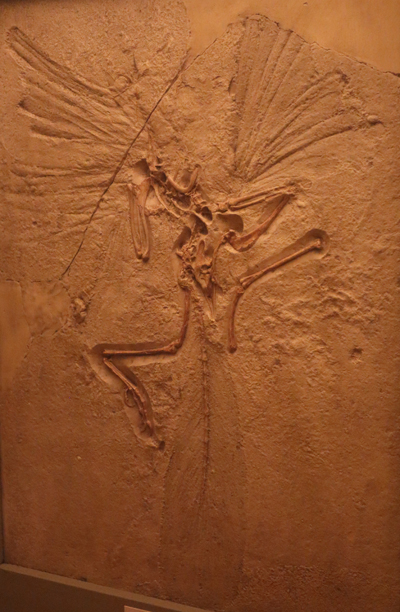
A Cast of an Archaeopteryx Fossil on Display at Liverpool Museum

Archaeopteryx fossil cast

Archaeopteryx fossil cast. Picture credit: Everything Dinosaur.

Picture credit: Everything Dinosaur

A number of manufacturers have introduced feathered dinosaur models.  The American Museum of Natural History have approved a “tube of feathered dinos”, which includes animals such as a feathered Velociraptor, Dilong and Microraptor.

Our favourite feathered friend remains Archaeopteryx, a truly amazing and enigmatic animal with only 7 fossils known to date (one of them consists of a single feather)!

To see a collectible dinosaurs including feathered dinosaurs: Dinosaur and Prehistoric Animal Models.

Go to Top