All about dinosaurs, fossils and prehistoric animals by Everything Dinosaur team members.

Articles, features and information which have slightly more scientific content with an emphasis on palaeontology, such as updates on academic papers, published papers etc.

10 09, 2007

Remembering the Unique Talent of Stephen Jay Gould

By |2024-04-01T10:01:41+01:00September 10th, 2007|Categories: Famous Figures, Main Page, Palaeontological articles|0 Comments

Today, September 10th, would have been the sixty-sixth birthday of the American palaeontologist Stephen Jay Gould.  Stephen; died of lung cancer on May 20th, 2002 but in his life he did as much as anyone to popularise palaeontology and evolutionary biology.

Remembering the Palaeontologist Stephen Jay Gould

A prolific writer and gifted teacher, Stephen inspired many students to further develop their careers in science.  He taught at Harvard University and was a key member of the American Museum of Natural History, producing numerous research papers and putting forward some far-reaching theories.  He became widely known from his science articles written for the American Natural History journal.

Such was his popularity and statue that he was called “America’s unofficial evolutionist laureate” and he certainly captured the public’s imagination with books such as “Bully for Brontosaurus”, published in 1991, a wonderful title for a book that explored the reasons for the extinction of the dinosaurs.  He also studied the diversification of the fossil record in the Burgess Shale deposits and wrote many papers on the explosion of life forms that occurred at this time.

Along with fellow scientist, Niles Eldredge, Gould put theory the idea of “Punctuated Equilibria”, building on the theory of Darwinism to propose that evolution did not happen in a smooth process but occurred in rapid bursts followed by periods where organisms changed little.  He was a strong opponent of Creationism and Intelligent Design and argued vociferously against these concepts.  His engaging writing style and sense of fun made him a firm favourite amongst readers of popular science.

He Made Palaeontology Popular

He appeared in a number of science documentaries and related programmes.  He even appeared in an episode of the Simpsons, providing the voice for his own caricature.  The makers of this television cartoon series were big fans and after his death a tribute was paid to him by dedicating an episode to his memory.

8 09, 2007

Amazing Fossil Fish found in Canadian Oil Drill Core

By |2023-02-13T06:53:16+00:00September 8th, 2007|Categories: Dinosaur and Prehistoric Animal News Stories, Main Page, Palaeontological articles|0 Comments

Incredible Fish Fossil found in Oil Drill Core

Sometimes a scientific discovery can be down to pure chance.  Despite huge advances in the technology available to palaeontologists, the finding of a brand new species can have more to do with serendipity than with appropriate planning and correct scientific practice.

The discovery of a new species of Late Cretaceous fish is a typical example of how “lady luck” can intervene and help scientists shed more light on life in the Mesozoic.  In 1988, a Canadian oil company called Cequel Energy Inc. was sinking drill cores into a region of west-central Alberta, prospecting for fossil fuels.

A 75 mm wide drill was thrust more than 1,300 metres deep into the Albertan sediments.  When the drill core was pulled up and examined it revealed a beautifully preserved 96 million-year old fossil fish, neatly encircled by the cylindrical drill core.  Only the tip of the snout and the last part of the tail had been lost, the rest of the fish fossil neatly fitted into the diameter of core sample.

One very lucky fossil find – a Cretaceous Teleost

Picture courtesy of University of Alberta

Occasionally core samples do reveal fossils, such as the Plateosaur fossil fragments extracted by an oil company offshore Norway in May 2006, but to find a delicate fish fossil such as this is a particularly rare event.

To read about the Plateosaur remains found in the Nowegian drill core:

Norway’s First Dinosaur – Say Hello to Plateosaurus.

Fish skeletons are light and fragile, even if they avoid being scavenged and are rapidly buried, wave action and currents can quickly disperse the bones as the flesh rots away.  However, in this instance the skeleton is virtually complete and perfectly preserved providing further evidence on the evolution of teleosts.

The core was taken from an area of Alberta just south of Grande Prairie, the fossil was found in core material from the Dunvegan Formation and as a result of this the fish has been named Tycheroichthys dunveganensis (means lucky fish from the Dunvegan Formation).  This deep-bodied fish belonged to a now extinct group called the Paraclupeidae, which are related to modern herrings.  Fish fossils from this group have been found in Lebanon and Brazil but this is the first time that this family have been reported from North America.

This fish has been referred to as a holotype (a specimen on which the original description of the species will be based).  During the latter part of the Cretaceous, North America was effectively split in two by the shallow Western Interior Seaway.  This sea stretched from the Gulf of Mexico to the Arctic Ocean covering the majority of Alberta during the late Cretaceous (with a few notable exceptions such as the Dinosaur Provincial Park Formation and the Oldman Formation).

The fish fossil lay amongst the other core samples for many years, under the supervision of the Canadian museum of Nature.  Palaeontologists from the University of Alberta reviewed the core samples and realised the significance of the fish fossil.  Their work on this amazingly lucky find has just been published in the Canadian Journal of Earth Sciences.

Articulated specimens such as this are extremely rare and given the circumstances of its discovery, it really is remarkable how this little fish fossil has survived.  The fossil has now been treated to help its preservation and stored in the secure vaults in the Canadian museum.

For models and replicas of prehistoric sharks and other ancient fish: PNSO Age of Dinosaurs Figures.

7 09, 2007

New Study Suggests End of the Dinosaurs set in Motion by Asteroid Collision in Mid Jurassic

By |2024-04-01T10:00:27+01:00September 7th, 2007|Categories: Dinosaur and Prehistoric Animal News Stories, Main Page, Palaeontological articles|0 Comments

Did Two Asteroids colliding in Outer Space seal the Fate of the Dinosaurs?

In 1980 the physicist Luis Alvarez and his son, geologist Walter Alvarez proposed a theory that an asteroid hitting the Earth might have caused the mass extinction that led to the demise of the dinosaurs.  High levels of the rare Earth element iridium had been found in sediments dating from the Late Cretaceous and this led the father and son team to postulate that an asteroid impact could have wiped out much of life on Earth 66 million years ago.

Impact from Space

Their theory was given further credence with the discovery, in 1990, of a huge impact crater found off the coast of Mexico.  Could this be the “smoking gun” evidence of an asteroid impact that led to the extinction of the dinosaurs?

The impact crater, now known as the Chicxulub crater (a Mayan word that translates to “tail of the devil”) is estimated to have been 112 miles (180 kilometres) across and was made by an object of around 6 miles in diameter (10 kilometres).  Evidence now suggests that there may have been a series of impacts around 65 million years ago.  Such a catastrophic bombardment would have resulted in global environmental damage, huge fires, acid rain and mega tsunamis.  Not surprisingly then that approximately 70% of life was wiped out.

This theory has been largely accepted by the scientific community, but debate has arisen as to where this asteroid object came from.  Now new research by a joint US and Czech team, published in the journal Nature points to an event between 140 mya (million years ago), and 180 mya that set in motion the asteroid collision that would spell doom for the non-avian dinosaurs.

Asteroid Collision

A collision between two large asteroids in an orbit between Mars and the outer planets may have sent huge splinters of rock hurtling towards Earth, including the one that hit 65 mya claims the team from the South-west Research Institute of Colorado.

The three researchers, William Bottke, David Vokrouhlicky and David Nesvorny created a computer simulation that plotted the paths and direction of many large objects in what is known as the “Asteroid Belt” between Mars and Jupiter.  The orbit of one large terrestrial object known as (298) Baptistina intrigued them, as it shared the same orbital path with a lot of smaller asteroids.

Using the computer model to study the trajectories of these objects in the past, the team noted that the Baptistina asteroid and these other rocks were once joined together as a giant asteroid over 100 miles across, cruising the innermost region of the asteroid belt.  Their studies showed that between 140 mya and 180 mya (160 mya is the time period stated with most confidence by the researchers), a time when dinosaurs were dominating the Jurassic period – this huge asteroid was “bumped” into by another monster rock some 37 miles across (60 kilometres).

For a lesson plan relating to asteroids and extinction events designed for Key Stage 1 and Key Stage 2 students: Why Do Asteroids Always Land in Craters?

From this soundless collision was born a huge cluster of rocks, including 300 bodies larger than 6 miles in diameter (10km) and 140,000 bodies larger than 1/2 mile in size.  Over the remainder of the Mesozoic these rock pieces found new orbits under the influence of the Yarkovsky effect (named after the Russian engineer who identified this phenomenon), thermal particles from the Sun give objects momentum.  As the group of rocks spread out, at least some of them were captured by the gravitational pull of the inner planets and they began their journey with many impacting on Mars, Earth and Venus.

One such lump ended up colliding with Earth and causing the Cretaceous/Tertiary mass extinction.  The joint US and Czech team identify other celestial craters that may have been caused by debris from the Baptistina collision, a number of craters on Venus may have been as a result of this event and the huge moon crater Tycho estimated to be 108 million years old may also have been caused by an asteroid sent on its course by the initial impact 250 million miles away and approximately 60 million years earlier.

For dinosaur themed toys, clothing and gifts: Visit Everything Dinosaur’s On-line Shop.

5 09, 2007

Evidence of Chemical Warfare from the Mesozoic

By |2023-02-23T07:56:11+00:00September 5th, 2007|Categories: Dinosaur and Prehistoric Animal News Stories, Main Page, Palaeontological articles|0 Comments

Beetles with Chemical Weapons from the Age of Dinosaurs

Palaeontologists at Oregon State University have discovered a Cretaceous soldier beetle trapped in amber at the very moment it was operating its chemical defences to ward off an attacker.  This is the earliest known fossil of this type of beetle and the first time that this sort of defensive behaviour has been captured in the fossil record.

Cretaceous Soldier Beetle

The soldier beetle, a relatively small insect by modern soldier beetle standards at just over 6mm long was apparently on a tree when it was threatened by a much larger insect, perhaps some sort of cockroach (judging by the long antenna also preserved in the fossil tree resin).

The preserved antenna indicate the attacker’s length at being between 50-75mm but that did not deter the soldier beetle as it operated its chemical defences, oozing a sticky, irritating substance from its abdomen in a bid to protect itself from becoming a meal.  At the very moment the attack was launched, the soldier beetle was encased in tree sap which over millions of years formed amber, thus preserving this moment in time, allowing scientists to study it.

It is not known whether the attacking insect got away from the gooey sap as it crept down the tree trunk, only the antenna were trapped with the soldier beetle.

The Remains of the Attacker

Perhaps the remains of the attacker have also been preserved in another, now detached piece of amber, or more likely the larger insect was able to pull itself clear before becoming totally immersed in the adhesive sap, loosing its large antenna in the process.

The amber fossils date from approximately 100 million years ago (Cretaceous period) and have been sourced from Hukawng valley in Myanmar (formerly Burma).  Professor George Poinar Junior, a visiting professor of zoology at Oregon State University and an expert in interpreting insect remains preserved in amber, led the research.  His team’s findings have just been published in the Journal of Chemical Ecology.

A book review by Everything Dinosaur (fossil insects): Fossil Insects Book Review.

The scientists state that this discovery is the earliest fossil record of a chemical defence mechanism, indicating that this type of protective response, now common in insect taxa and amongst other animal species has been around for more than 100 million years.

Chemical Defences

Not only was this soldier beetle able to produce a chemical defence but close, microscopic study of the specimen indicates that the substance was only being released from the left rear of the insect.  This may indicate that soldier beetles during the Cretaceous had already developed the ability to control the direction of release, making this an already highly evolved and sophisticated defensive mechanism.

Professor Poinar commented that the chances of this type of behaviour being caught in tree sap and then having appropriate environmental conditions to permit preservation of this event as amber, plus the chances of the amber being found and brought to the attention of scientists to study – were extremely remote.  However, remarkable finds such as this one do turn up and give palaeontologists the opportunity to look through a window and observe events from the age of reptiles.

Studying Fossil Beetles

This fossil has pushed back the known existence of this type of beetle by about 60 million years.  Although this genus of soldier beetle is now extinct, the soldier beetle family is widespread with many thousands of species located in Europe, Asia, Africa and the Americas.

Soldier beetles can be found in many gardens, in the UK the best time to see them is July and August.  It is believed soldier beetles got their name as their bright shiny carapaces or elytra (wing cases) reminded early naturalists of the brightly coloured soldier’s uniforms that were worn at the time when the science of biology was beginning to develop in the western world.

Soldier Beetles in the UK

The common soldier beetle (Rhagonycha fulva), is ubiquitous within the United Kingdom.  It is easily identified thanks to its bright red colouring and the black tips to its rear.  This beetle, like many soldier beetles is an omnivore.  It can be found sitting on top of large flowers such as cow parsley and hogweed preying on small flying insects that visit the flowers and it also feeds on nectar.  They are rarely seen on their own but are often found with mates – hence their nickname “bonking beetles”.

The Same Chemical Defences

Many soldier beetles use chemical defences to protect themselves just like their Mesozoic ancestor.  Their wing cases are quite soft and offer little protection and if you are going to sit out on a big flower head all day in a brightly coloured uniform you are going to need some form of protection to stop you ending up as someone else’s lunch.

It seems this form of sophisticated defence mechanism has been around for a lot longer than scientists thought.  Not surprising really when you consider how long insects have been around, but it is interesting to speculate that this type of beetle with a predilection for sitting on flowers was around at the time when the first flowering plants were becoming established.  Did this family of beetles take advantage of the new angiosperms and as a result were able to thrive and diversify themselves?

Visit Everything Dinosaur’s award-winning website: Everything Dinosaur.

3 09, 2007

The Missing Monoclonius – A Favourite Dinosaur

By |2024-04-01T09:48:44+01:00September 3rd, 2007|Categories: Main Page, Palaeontological articles|0 Comments

What ever happened to Monoclonius?

In the offices at Everything Dinosaur, we have a large collection of prehistoric animal and dinosaur books, many of them quite rare and out of print.  These have been collected over the years and in our quieter moments it is great to be able to thumb through them and look at the way our knowledge and the way in which dinosaurs are depicted has changed.

One of our favourites is “Dinosaurs and other Prehistoric Reptiles” written by Jane Werner Watson and featuring the wonderful illustrations of Rudolph Zallinger.  Mr Zallinger was commissioned to produce a mural showing the evolution of dinosaurs by the Yale Peabody museum.  His work went on display in 1947 and although our view of these animals has changed dramatically over the last 70 years; his artwork remains stunning.  His highly detailed vistas of the Mesozoic landscape have inspired many to enter this field of science.  They really are quite beautiful.

An Endearing Ceratopsian Image

One endearing image is a ceratopsian called Monoclonius (single horn). It is depicted in the (typical for the time), bent leg posture facing an approaching Gorgosaurus.  However, scientists debate whether or not the name Monoclonius is valid, perhaps remains ascribed to Monoclonius should be re-classified to Centrosaurus.

A Juvenile Centrosaurus – Is the Monoclonius Genus Valid?

The missing Monoclonius. A replica of a juvenile Centrosaurus

A replica of a juvenile Centrosaurus. The validity of the Monoclonius genus continues, the ontogeny of horned dinosaurs complicates the issue.

Complicated Taxonomic History

The taxonomic history of these two genera have been mingled together for nearly 100 years.  In many situations, it is the lack of fossil evidence that cause problems for palaeontologists, however, with this particular group of Ceratopsidae the opposite is true.  There is so much material to study that the case for acknowledging Monoclonius as a separate genus becomes blurred.  Extensive Centrosaurinae bonebeds are known from the Dinosaur Park Formation (and other geological formations) of Alberta, Canada.

These sites have provided vast amounts of material, including complete specimens, as well as articulated remains and many skulls.  Dodson provided the first review of the status of these two taxons in 1990 Dodson, P. “On the status of the ceratopsids Monoclonius and Centrosaurus”.  He concluded that Centrosaurus and Monoclonius were sufficiently different from each other to be classified as separate genera.  However, in 1997 Sampson and Tanke assisted by Michael Ryan reviewed this material, focusing their studies on the ontogenetic evidence from the Alberta bonebeds.

The bonebeds provide fossils of Centrosaurines of different ages, from young individuals to mature adults.  This study built on the earlier work of Charles Sternberg and his report on the horned dinosaurs of Alberta that had been published in 1940.  Sampson et al concluded that fossils that had previously been described as Monoclonius (M. crassus); showed evidence of belonging to immature individuals lacking adult characteristics.  Based on this evidence the 1997 team declared Monoclonius a “nomen dubium”.  Nomen dubium is a term used to describe an animal or plant whose validity is in doubt.  Effectively, the fossils of Monoclonius were classified as belonging to young, sub-adult Centrosaurus.

Missing Monoclonius

The term Monoclonius continues to be used by dinosaur enthusiasts and some professional palaeontologists.  The name was first used by Sir Edward Drinker Cope, the eminent American palaeontologist who named and described the first Monoclonius (M. crassus) in 1876.  Thanks to the inclusion of the Monoclonius illustration by the likes of Rudolph Zallinger in many books, the name has seeped into popular culture and is perhaps better known than Centrosaurus.

The story of Monoclonius is far from over, a lot of indeterminate cceratopsian material from Canada and the USA is still referred to as belonging to Monoclonius.  The largest skull of any centrosaurine yet found (CMN 8790), part of the Canadian Museum of Nature collection has been classified as Monoclonius lowei and as such might represent a valid specimen of Monoclonius.

As centrosaurines matured so their cranial ornamentation changed.  Mature centrosaurs such as Centrosaurus apertus saw changes in the shape and size of their frill epoccipitals (the lumps and bumps of bone that were found on the edges of their neck frills).  The first pair of epoccipitals became enlarged as the animal aged and formed hooks that curved over the opening in the skull (parietal fenestra).  They resembled small bent horns, a feature picked up by Zallinger and included in his 1947 illustration of Monoclonius.

Beasts of the Mesozoic Models and Figures

The popular Beasts of the Mesozoic model series features several replicas of horned dinosaurs including centrosaurines.  To view this range: Beasts of the Mesozoic Models and Figures.

2 09, 2007

Why does Neovenator have a muzzle shaped face?

By |2023-02-12T08:51:25+00:00September 2nd, 2007|Categories: Main Page, Palaeontological articles|0 Comments

Raised crests on the Nasals make Neovenator a very peculiar looking Theropod

Sunday and we are back in the office working on some new fact sheets in preparation for the launch of the new Procon/Collecta range of dinosaur models.  We first saw the prototypes of this new set of six prehistoric animals about 12 months ago.  The team at Everything Dinosaur had been asked to examine them and make suggestions regarding anatomical accuracy, also to comment on the choice of dinosaurs that were going to make up the series.  The six dinosaurs featured are Spinosaurus (seems every manufacturer wants to come up with one of these), Eustreptospondylus, Augustinia, Baryonyx, Allosaurus and Neovenator.  As a British based company, it is very rewarding to see UK dinosaurs featured in the new collection, especially ones such as Eustreptospondylus and Neovenator which are known from only one major fossil find, plus a few scattered bones.

Neovenator Illustration

We have been working with an accomplished and very well respected American illustrator called Mike Fredericks.  He has been providing us with sketches of the new models that we can use to produce scale drawings in our fact sheets.  We find it is all very well saying that Neovenator could be up to 7 metres long and 2 metres tall, this does not mean much to some of our younger dinosaur fans but if you put a scale model of their dad in the drawing then the impressive size of some of these animals is made much clearer.

Interesting to note that the actual size of Neovenator salerii is still debated, despite it being 30 years since the only relatively complete skeleton of this animal was discovered.  The 50% complete specimen (MIWG.6348), which began to be excavated in 1980, two years after its discovery on the Isle of Wight, indicates an animal about 7 metres long.  However, an isolated pedal phalanx (toe bone), also from the Isle of Wight (MIWG.4199) and attributed to Neovenator may indicate that this allosaur reached lengths in excess of 10 metres.

A Sketch of Neovenator – With the Muzzle like Face

Picture courtesy of Mike Fredericks

Neovenator has been classified as an allosaurid and is the largest allosaur discovered so far in Europe.  The end of Neovenator’s ischium has an “expanded boot”, this feature is seen in a particular group of allosaurs called the carcharodontosaurids, although other features of the fossil remains enable Neovenator to be classified into its own genus.  If Neovenator is classified as a close relative of carcharodontosaurids it implies that this particular group of meat-eating dinosaurs originated in Europe before spreading into Africa (Carcharodontosaurus), South America (Giganotosaurus) and North America (Acrocanthosaurus).  The carcharodontosaurids may turn out to comprise the largest meat-eaters the world has ever known (not withstanding the latest information on the huge tyrannosaur skull unearthed in the US by Kevin Rigby).  So Europe might be the birthplace of the really big theropods and not Asia or the Americas as previously thought.

Neovenator

Neovenator was a bizarre looking carnivore.  The main elements of the skull and jaws recovered from the Isle of Wight consist of the left premaxilla and left maxilla.  These bones made up what was the snout of the animal and they indicate that it had a broad muzzle with raised nasal crests.  In life these features would have given the impression that Neovenator had a broad beak.  Why did Neovenator have these unusual features?

A number of suggestions have been put forward, this large hunter may have used its beak to knock down prey that it was pursuing.  It could have butted them with its head and knocked them off balance, this may have been a successful hunting strategy of young Iguanodontids as they ran away on their hind legs.

The muzzle could also have been used for display purposes.  Scientists have speculated whether these large Theropods lived in packs and the nasal crests could have been an ontogenetic feature (changes with age), with only one specimen found so far this is a difficult theory to prove. The muzzle shape in combination with any colour changes that occurred as the animal reached maturity could indicate social standing in the pack.

From the size of the naris (which is very large), it seems that sense of smell was very important to Neovenator, perhaps the muzzle shaped evolved to permit extended nasal passages giving this animal an improved sense of smell.  If more material is discovered then palaeontologists may be able to shed more light onto this mystery.

Ironically, there may be fossils of Neovenator already in museums, especially the Natural History museum – London.  For many years isolated fragments and individual theropod bones had been ascribed to the Megalosauridae group.  Indeed, some palaeontologists claim that this taxon has become a “dumping ground” for any miscellaneous meat-eating dinosaur fossils.  So there may be more Neovenator remains already in museum draws, these may provide more information on the size of the animal plus shed more light on the structure of the skull.

Neovenator Models and Figures

Everything Dinosaur stocks a variety of theropod models and figures including replicas of Neovenator.

View the CollectA Prehistoric Life model range: CollectA Prehistoric Life Model Range.

CollectA Deluxe: CollectA Deluxe Prehistoric World Models.

24 08, 2007

How did the Silurian Period get its Name?

By |2023-02-12T10:43:35+00:00August 24th, 2007|Categories: Geology, Main Page, Palaeontological articles|0 Comments

Why is the Silurian called the Silurian?

Recently we took a small party to some locations we know in the county of Shropshire where you can find fossils of brachipods, bivalves, coral and such like. Shropshire’s geology is strongly associated with the Silurian period (it lasted from approximately 435mya to 410 mya), indeed two of the epochs within the Silurian are named from places in the county – the Ludlow and Wenlockian epochs.  However, geologists in North America have different terms for rocks of this age from the Silurian (the Lockportian and the Tonawandan).

Silurian

The Silurian marks a period of sea level rises (called marine transgressions), much of the county was covered in warm, shallow seas, during this time and marine life flourished.  The beginning of the Silurian (Silurian/Ordovician boundary) is marked by a major extinction event but by the time the rocks that form Wenlock Edge were laid down life was once again flourishing with jawed fish such as the placoderms and acanthodians beginning to diversify.  The arthropods continued to dominate and were the top predators  during this period.   The first corals were forming in these shallow seas, made by the now extinct rugose and tabulate corals.

Fossil Hunting Trip

Whilst on our fossil hunting trip we were asked how the Silurian got its name.  The Silurian was named by Sir Roderick Murchison, the wealthy Scottish aristocrat.  Sir Roderick had thought in the wars against Napoleon but when these ended he turned his attention to the embryonic science of geology.  Encouraged by friends such as the Reverend William Buckland (the very same William Buckland who named and described the very first dinosaur – Megalosaurus); he explored the fossil-bearing strata of south Wales and Shropshire.  Being independently wealthy Sir Roderick was able to mount expeditions to explore the geology of Europe and his connections soon saw him elected to the London Geological Society.

Sir Roderick named the rock strata that made up the chronological succession of fossils the Silurian after an ancient Welsh Celtic tribe called the Silures.  At the time, his friend and colleague Adam Sedgwick (Professor of Geology at Cambridge University) had just named the much earlier rock strata where the first great abundance of fossils had been found – the Cambrian, after another ancient Welsh tribe.

Silurian strata shows the first signs of the colonisation of the land with the establishment of primitive vascular plants such as Cooksonia. During this time the first arthropods ventured onto land.

For replicas and models of Silurian invertebrates and other prehistoric creatures: CollectA Prehistoric Life Replicas and Models.

23 08, 2007

What’s in a Name – The Classification of Dinosauria

By |2023-02-15T21:24:28+00:00August 23rd, 2007|Categories: Dinosaur and Prehistoric Animal News Stories, Main Page, Palaeontological articles|0 Comments

How the Dinosauria came to be Named

The classification of Dinosauria into a separate and distinct order is shrouded with controversy.  It may be widely known that the term “Dinosauria” was first used by Sir Richard Owen, how the term came into being and accepted by the scientific community is quite contentious.

Linking the Fossil Evidence

A number of attempts had been made link the three known ancient land dwelling reptiles – Iguanodon, Megalosaurus and Hylaesaurus in the early 1830s.  The distinguished German naturalist Hermann von Meyer (who was later to name and describe Plateosaurus in 1837), had used the phrase “Saurians” when describing these animals and their mammalian characteristics in a paper published in 1832.

However, it was a fossil unearthed in 1841 that finally provided the evidence to unite all these huge land reptiles into a separate taxon.  A new bone of an Iguanodon had been discovered on the Isle of  Wight.  This new discovery was brought to the attention of Richard Owen and he duly went off to the island to examine it.  The fossil was an Iguanodon’s sacrum (the lower part of the spine).  As Owen studied this new find it dawned on him that the Iguanodon sacrum had an identical characteristic to the sacrum of the Megalosaurus that had been on display at the Ashmolean museum, Oxford for the past twenty years or so.

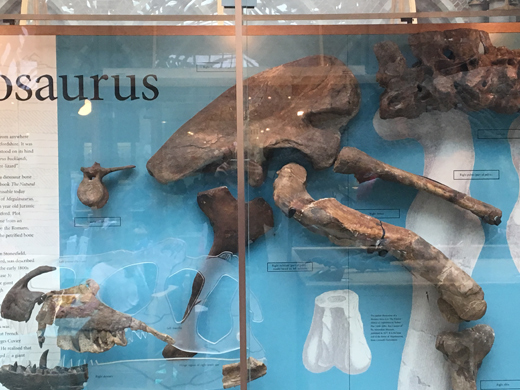
Megalosaurus Fossil Material on Display

Megalosaurus fossil material on display.

The Megalosaurus display case (Oxford Museum of Natural History). Picture credit: Everything Dinosaur.

Picture credit: Everything Dinosaur

Five Sacral Vertebrae

The five sacral vertebrae forming the lower part of the spine of both the Iguanodon and Megalosaurus were fused in exactly the same way.  Having a fused sacrum strengthens the backbone and is an adaptation for living on land, dinosaurs have it as do mammals and humans (although our lower spines are fused in a different way to dinosaurs).  This fossil vertebrae provided the vital evidence of an anatomical link between the meat-eating Megalosaurus and the plant-eater Iguanodon.  They belonged to the same order.

Prior to this, these reptiles had been loosely grouped together under the term “Lacertians” but now these land animals were seen as a very distinct group from crocodiles, marine reptiles and pterosaurs.  They had characteristics very similar to mammals, with an upright gait, pillar like legs that were held directly underneath the body.

Richard Owen

Richard Owen had been engaged by the British Association for the Advancement of Science (BAAS) to produce a comprehensive paper on these ancient creatures – his “Report on British Fossil Reptiles”.  He delivered his paper in a presentation made at the annual meeting of the BAAS in August 1941, but extensively re-wrote it before its final publication in April 1842.  Working from his study at the Royal College of Surgeons in London, Richard added the following note to his paper:

“The combination of such characters, some as the sacral ones, altogether peculiar among Reptiles, others borrowed, as it were, from groups now distinct from each other, and all manifested by creatures far surpassing in size the largest of existing reptiles, will, it is presumed, be deemed sufficient ground for establishing a distinct tribe or sub-order of Saurian Reptiles for which I propose the name of Dinosauria”.

Richard Owen had toyed with a number of names for this new classification over the winter of 1841 but after discussing the matter with friends he hit upon the idea of using the Greek words “deinos” meaning terrible or fearfully great and “sauros”  meaning lizard.

The Classification of Dinosauria

Hence the term dinosaurs or terrible lizards came into being.

Perhaps Owen had been pointed in the direction of the Greek poetic style of Homer as the word “Deinos” is found in the work accredited to the ancient Greek poet.   In the prose, the word Deinos is used to mean inconceivable and unknowable, a very apt description; as few scientists could fail to recognise the impact of the establishment of a extinct sub-order of reptiles on the prevailing view about the Creation.

Mystery Surrounds the Naming of the Order

Mystery surrounds the naming of this order, much of the earlier work of Mantell is discredited in Owen’s paper.  Indeed he takes credit for many of the insights made by Mantell and others.  Poor Mantell is ridiculed for his inaccurate estimates of the size of Iguanodon.  Owen takes great delight in belittling Mantell’s comparisons of the fossils of Iguanodon with a modern Iguana.  He almost gleefully, mocks Mantell for naming Iguanodon from the fossil teeth resembling that of an Iguana lizard.

Owen states that the teeth when studied in cross-section under a microscope bare little similarity.  This is a little unfair, as at the time Mantell made his conclusions fewer Iguanodon fossils were known and he did not have access to a microscope.

Mantell and the Classification of Dinosauria

Ironically, it was Gideon Mantell who first pointed out the bipedal stance of Iguanodon.  He had noted a number of characteristics regarding the limb bones of Iguanodon that led him to conclude that this animal was capable of standing on its hind feet using its forelimbs for grasping vegetation.  Owen completely failed to notice this despite having better access to fossil specimens of Iguanodon than Mantell.  Owen envisaged Iguanodon as an elephantine type quadruped whereas it was Mantell who had given us the first insight into the true nature of anatomy of dinosaurs.

Dinosaur Models: Dinosaur and Prehistoric Animal Models.

19 08, 2007

Where on a Diplodocus was its Nose?

By |2023-02-16T08:09:46+00:00August 19th, 2007|Categories: Main Page, Palaeontological articles|3 Comments

Sauropod Nostrils – Where do they belong?

Dinosaurs are so ubiquitous these days sometimes it is worthwhile reminding ourselves just how little we actually know about them.  Certainly, our knowledge is improving all the time and many commentators have claimed that we are presently in another “golden age of dinosaur discoveries”.  With all the new techniques available, more work can be done on the existing fossil record and with more parts of the world being opened up to exploration the number of dinosaur fossils is increasing rapidly.

However, despite huge advances we still know relatively little about many of these creatures.  As the Walking with Dinosaurs – Live experience tours Canada we could all be mistaken for thinking that there is no more to learn, but this is far from the reality.

For example, where on a long-necked dinosaur was its nose?

Long-necked Dinosaurs

The long-necked dinosaurs (Sauropoda) have been known for a very long time, Apatosaurus (formerly known as Brontosaurus) was named and described by Othniel Charles Marsh 130 years ago, Brachiosaurus was named and described by Riggs in 1903 and thanks to the philanthropist Andrew Carnegie fully mounted skeletons of Diplodocus (albeit in the wrong posture) have adorned the main halls of many Natural History museums all over the world for nearly a century.

A Model of a Diplodocid Dinosaur – Diplodocus
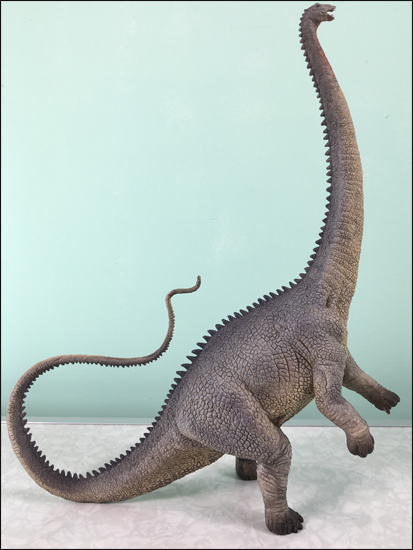
CollectA rearing Diplodocus (grey). Research into Diplodocus feeding habits.

The new CollectA rearing Diplodocus dinosaur model in the elephantine colour scheme. Picture credit: Everything Dinosaur.

Picture credit: Everything Dinosaur

When fossils of these huge animals first came to light, scientists could not imagine them as purely terrestrial creatures, surely such huge reptiles, many estimated to have weighed 50 Tonnes or more would be much more comfortable living in water, where their huge bulk could have been supported by the water.  Certain skeletal features supported this view, such as the arrangements of claws on the feet, supposedly to stop these sauropods slipping on the muddy lake floors, the arrangement of the their weak peg like teeth – surely only suited to cropping soft vegetation found in lakes and on their margins.

Diplodocus

Scientists assumptions about these dinosaurs and their aquatic lifestyles were reinforced in 1884 with the discovery of an almost intact skull of a Diplodocus.  This showed a large hole at the top of the head, which scientists interpreted as the entire nasal cavity.  After all, if  you spent all  your time under water, a blow-hole type structure at the top of the head would make a lot of sense.   It was argued that these animals were as big as whales and whales lived in water with a nostril arrangement at the top of their heads so the dinosaurs had evolved a similar structure to assist them with their underwater lifestyle.

Aquatic Sauropods

The idea of aquatic sauropods was first postulated in the late 19th century, most famously by the American palaeontologist Edward Drinker Cope.  This type of illustration featured in numerous books, magazines and publications right up to the 1980s.  However, the modern interpretation of sauropod fossils depict them as largely terrestrial creatures, but despite this seismic shift in our perception, the nostrils of these animals are still placed at the top of head.  This can be clearly seen in many drawings and artistic impressions as well as in many scale models.

The Nostrils of Diplodocus

Lawrence M. Witmer famously challenged this view and placed the nostrils of Diplodocus in a much more anterior position on the skull.  Working as an associate professor of biomedical sciences at the University of Ohio, Witmer had access to a number of late Jurassic sauropod specimens and conducted an analysis of sauropod skulls with an emphasis on the Duplicates.  Soft tissue scars found on skull bones were studied, along with 62 animals from 45 species of crocodile, birds and schemata, which were x-rayed and dissected, the soft tissue making up the nasal cavities and naris were mapped and the extant species were compared to the fossil evidence.

From this work, Witmer re-modelled the skull of Diplodocus putting the nose much closer to the mouth at the front of the beast.  What’s more the conclusions from this work led palaeontologists to acknowledge the existence of quite sophisticated and highly vascular, taking up to 50% of the space available in an Diplodocus skull.

The pink skull at the top of the diagram clearly shows the large naris opening at the top of the head (now believed to only part of this animal’s complicated nasal system), using Witmer’s work as a guide the nostrils have no been placed at the front of the skull.

The position of the nostrils has considerable implications for a number of biological and physical processes in diplodocoid physiology.  If the nostrils were placed at the front then they alter our perceptions of the role of sense of smell for this animal.  Did sense of smell help these huge animals find a mate, avoid danger or to find food?  The close proximity of these sensory organs (mouth and nose) in Witmer’s model does make sense from a morphology and physiological standpoint.  With a better understanding of the structure of the nasal passages palaeontologists can speculate on how these passages may have helped humidify and filter air on the way to and from the lungs.

With a head exposed to the sun could these nasal passages play an important role in cooling the brain and regulating body temperature.  Losing heat for an animal of such volume would not necessarily have been an issue but thermal regulation of the brain could have been a problem as these beasts wandered the hot Jurassic landscape.

Witmer and his team have more work to do, especially on the role of these complicated nasal airwaves on body and brain temperature regulation.  Although the naris at the top of the skull in sauropods is seen as part of the nasal system it seems that the passages were much more complicated than first thought.  However, the scientific community remains divided on some of the more controversial findings from Witmer’s work.

Some scientists still place a greater emphasis on the naris at the top of the skull and if the work of Witmer is to be accepted it has implications for other types of dinosaurs, the Ornithischia, for example.  If these concepts are developed this could lead to a whole new interpretation of the crests on hadrosaurs.

Modellers still depict sauropods with nostrils in a more posterior position.  Although more modern interpretations are coming to the fore.  We recently worked on the Brachiosaurus for the dinosaur collection preferring to opt for a more posterior position for placement of the nostrils.  As a member of the “macronarians”, the big nostril sauropods we thought this was appropriate.

Dinosaur Collection Brachiosaurus (the Collecta Brachiosaurus and the Collecta rearing Diplodocus model): Dinosaur and Prehistoric Animal Models.

The lack of sauropod skull material still continues to frustrate palaeontologists, perhaps the recent discoveries of new well preserved diplodocoid skulls in Western North America well shed further light on this anatomical puzzle.


29 07, 2007

The link between T. rex Bacterial Bite and Sense of Smell

By |2023-02-13T20:54:32+00:00July 29th, 2007|Categories: Dinosaur and Prehistoric Animal News Stories, Dinosaur Fans, Main Page, Palaeontological articles|0 Comments

Is T. rex sense of Smell proof of a Bacterial Bite?

By measuring the volume of the brain case of dinosaurs we can estimate the size of their brains.  A Tyrannosaurus rex specimen such as BHI3033, “Stan” the nearly complete gracile Tyrannosaurus rex discovered by Stan Sacrison in 1992, had a brain case with a volume of approximately 1,000 cubic centimetres.  In contrast, human being’s brains take up a volume of up to 1,800 cubic centimetres.  But brain size is not the be all and end all. 

Tyrannosaurus rex

Firstly, not all of the brain case volume was made up of brain, there are variations in the percentage of the brain case volume that the actual brain filled.  Also, different parts of the brain are responsible for different functions. With T. rex the cerebrum area (the part of the brain dedicated to thinking and problem solving) was very small.  In us, this part of the brain makes up by far the largest proportion of brain volume.  By looking at the brain case and studying the holes in the skull that carried nerves back and forth we can assess how intelligent a dinosaur was and how much of the brain was dedicated to functions such as sight, thinking, smell, balance and so on.

Powerful Sense of Smell

Scientists have estimated that about 50% of T. rex’s brain was dedicated to sense of smell (olfactory bulb), so it is fair to assume that the sense of smell was very important to Tyrannosaurus rex.  Perhaps this helps reinforce the “bacterial bite” theory.

T. rex could ambush an unsuspecting hadrosaur, inflict a wound with its massive jaws and then use its sense of smell to track down its victim.  The T. rex could follow the duck-billed dinosaur for several days, slowly but surely loss of blood and the inflected wound would weaken the animal and then T. rex could step in to finish it off.

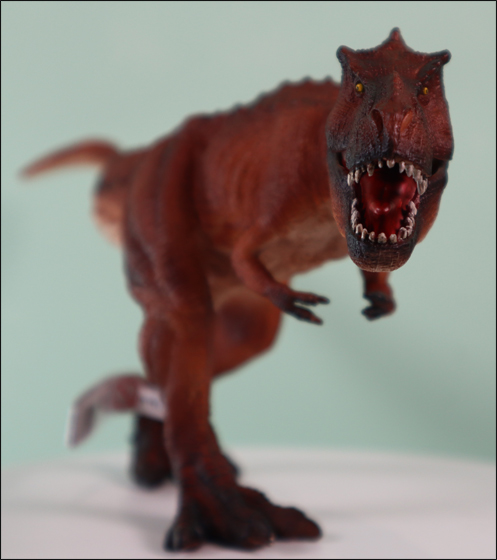
A Tyrannosaurus rex Replica

The Mojo Fun T. rex Deluxe dinosaur model approaches.

The Mojo Tyrannosaurus rex deluxe figure demonstrates stereoscopic vision and it is known that this dinosaur had a powerful sense of smell.  Picture credit: Everything Dinosaur.

Picture credit: Everything Dinosaur

Perhaps the large part of the brain dedicated to sense of smell is evidence of a bacterial bite in tyrannosaurs.

Everything Dinosaur supplies a T. rex skull kit that permits you to assemble your very own life-like tyrannosaur skull.

Dinosaur Crafts for Kids: Visit Everything Dinosaur.

Go to Top