In January, Everything Dinosaur received an order for two PNSO Sinosauropteryx models. These are popular prehistoric animal figures but we did contact Claire, the customer, just to check that they had not purchased an additional figure in error. Claire replied to our email and reassured us stating:
“Thank you for emailing! No, the purchase of a second PNSO Sinosauropteryx figure was not a mistake. My fiancé and I are planning to use them as cake toppers for our wedding.”
Intrigued, we asked Claire would it be possible for her to send us a picture of her dinosaur themed wedding cake.
Sure, enough over the weekend we were sent a photograph of the fabulous cake.
PNSO Sinosauropteryx models used as cake toppers for a spectacular dinosaur themed wedding cake. Picture credit: Claire.
Picture credit: Claire
PNSO Sinosauropteryx Wedding Guests
What a spectacular wedding cake. Even the two PNSO Sinosauropteryx models have been dressed up for the occasion. The cake looks beautiful, and we love the little flourishes such as the ammonite fossils on the side and the cascading waterfall made from blue icing.
Claire and her husband Bradley cutting the dinosaur themed wedding cake. Picture credit Claire.
Picture credit: Claire
We at Everything Dinosaur would like congratulate the happy couple. We wish Claire and Bradley every success and happiness as they build their new lives together.
To view the Sinosauropteryx figures that featured on the wedding cake and the rest of the PNSO prehistoric animal replicas: PNSO Age of Dinosaurs.
Our thanks to model collector William who sent into Everything Dinosaur a review of the recently introduced PNSO Therizinosaurus dinosaur model.
William begins his review by commenting on the model’s head. He praises its shape, the placement of the nostrils and the details shown around the eyes. The articulated lower jaw is also commented upon.
The new PNSO Therizinosaurus model has a beautifully detailed head with lots of evidence of a shaggy coat of feathers on the neck. The model also has an articulated lower jaw.
PNSO Therizinosaurus Dinosaur Model
Turning to the main body sculpt, the superb integumentary coat of feathers is praised with the reviewer awarding “100 points for this feature”. The wide pelvis is present, and the model has been given robust and powerful thighs combined with four-toed, plantigrade feet. The huge gut is highlighted and the reviewer confirms that the PNSO figure has a cloaca.
The scythe-like claws, for which this dinosaur is famous are described as “just perfection”. William comments that his figure stands unaided, but he does recommend the use of the clear, plastic display stand provided with the model for long term display.
Qingge the Therizinosaurus
PNSO selected a sloth-like colouration for their figure. There are no bright, clashing colours. The colour scheme chosen suits “Qingge”.
His eyes are a strong orange with a determined look set in them as if he means business, with a ring of green feathers around each orbit. The upper beak is pink with grey wash at the tip, with a dark wash on the mouth interior. From the back of the head down to the wrist the figure is a dark, charcoal grey which then transitions into a russet brown over the main upper body. The massive claws have a very naturalistic look.
A PNSO feathered theropod dinosaur. This is the new PNSO Qingge the Therizinosaurus dinosaur model.
Model Measurements
William provides details of the accessories supplied with the figure, the art poster and the clear, plastic support stand.
Scale: 1:35 Length: 7.8 inches Height: 6 inches
He confirms that the dinosaur fossil material comes from Upper Cretaceous deposits of the Nemegt Formation (Mongolia).
Providing Information About Therizinosaurus
As with previous reviews, William provided some information about the fossil discoveries.
Three years after the end of World War II, palaeontologists and field teams were out back in the field looking for fossil bones. A joint Mongolian/USSR Academy of Sciences expedition was despatched to the Nemegt Formation exposed in the Gobi Desert. Strange, fragmented fossils were uncovered.
Renowned palaeontologist Evgeny Maleev (who also described the tyrannosaur Tarbosaurus), thought the bones represented a turtle-like animal. He erected the family Therizinosauridae. After years of research and the discovery of more complete fossil specimens, Therizinosaurus was revealed to be bizarre, herbivorous member of the Maniraptora clade of dinosaurs.
The PNSO model has been photographed against a green, stylised background and a more detailed prehistoric scene has not been used in the background – such was the company’s eagerness to get this model announced.
The PNSO Therizinosaurus Dinosaur Model
William described Therizinosaurus cheloniformis and provided details on taxonomy.
Classification: Theropoda Superfamily: Therizinosauroidea Family: Therizinosauridae Type species: Therizinosaurus
William also described the Late Cretaceous environment as represented by the Nemegt Formation and mentioned the presence of large tyrannosaurs, the apex predators in the ecosystem.
He explained:
“Therizinosaurus would have been no easy meal for either Tarbosaurus bataar and the fleet-footed Alioramus remotus.”
“Qingge is an example of how to execute accuracy within a scale figure. PNSO’s Therizinosaurus cheloniformis is the only version I’ll ever need to own.”
Our thanks to William for sending into Everything Dinosaur his comprehensive model review.
The Silurian is a relatively short geological time period when compared to the other periods outlined in the geological time scale. The Silurian lasted around twenty-five million years (444 million years ago to approximately 419 million years ago). Although it was brief, in relative terms, during the Silurian the first land plants evolved and many invertebrate forms began to make the transition to a terrestrial habit. Life in the seas still dominated the Earth’s biota. One of the apex, marine predators was the straight-shelled nautiloid. Some of these orthocones evolved into giants.
Everything Dinosaur and the straight-shelled nautiloid Orthoceras which was introduced into the CollectA range in 2020. Picture credit: Everything Dinosaur.
Picture credit: Everything Dinosaur
Straight-shelled Nautiloid
During the Silurian most of the nautiloid cephalopods had straight or slightly curved shells. The planispiral forms had yet to become common. The last straight-shelled forms (Orthocerida), probably died out during the Mesozoic. Most straight-shelled nautiloids became extinct at the end of the Triassic, but one fossil specimen collected in the Caucasus (Zhuravlevia insperata), indicates that one species persisted into the Early Cretaceous.
An early scale drawing design for the Orthoceras/Orthocone fact sheet. Picture credit: Everything Dinosaur.
Picture credit: Everything Dinosaur
Zhuravlevia insperata
Described in 1994 by Larisa Doguzhaeva of the Swedish Museum of Natural History, based on a fragmentary orthocerid fossil, Zhuravlevia insperata is the geologically youngest straight-shelled orthocone known to science. The tiny fossil, just 1.3 cm long, with four chambers preserved, was found when Aptian-aged concretions from the Hokodz River Basin in the north-western Caucasus (Russia), were being split.
The orthocone fragment would be around 120 million years old.
CollectA introduced an Orthocone replica in 2020. The figure was added to the Age of Dinosaurs Popular range.
The macronarian clade of sauropods includes some of the largest dinosaurs to be scientifically described. However, many of these super-sized sauropods are known from scrappy and fragmentary remains. Dinosaurs with a high profile with the public are often very poorly understood by palaeontologists. Team members at Everything Dinosaur, take a look at one such example concerning the Macronaria. Time to outline the differences between Brachiosaurus and the Giraffatitan genus. Giraffatitan vs Brachiosaurus – a tale of the tape.
Giraffatitan vs Brachiosaurus
The Brachiosaurus genus was erected by Elmer Riggs (1903) following a study of two partial sauropod skeletons found in the Grand River Valley of Colorado. Riggs named this newly discovered dinosaur Brachiosaurus altithorax, it remains the type species.
The Wild Safari Brachiosaurus dinosaur model (lateral view). The official model image from 2013.
In the early 20th century, extensive excavations in German East Africa (Tanzania), resulted in the collection of a large amount of brachiosaurid and other dinosaur fossil material. The German palaeontologist Werner Janensch, in 1914, compared the African fossils with Brachiosaurus fossil remains from North America and concluded that the African material represented the same genus. Janensch named two further species of Brachiosaurus – Brachiosaurus brancai and Brachiosaurus fraasi.
A Dinosaur Subgenus
The American palaeontologist Gregory S. Paul reconstructed the skeleton of Brachiosaurus brancai and highlighted several autapomorphies between these African fossils and B. altithorax. He still considered the Tanzanian material to represent Brachiosaurus but concluded that these fossils should be placed in a subgenus and proposed Brachiosaurus (Giraffatitan) brancai whilst designating the U. S. fossil material as Brachiosaurus (Brachiosaurus) altithorax.
Further revisions and studies from other scientists led to the realisation that the African brachiosaurid was generally more gracile with a different body shape when compared to Brachiosaurus altithorax. The tail of the African dinosaur was shorter and not as tall. In addition, Brachiosaurus altithorax had a dorsal vertebrae series that was 23% bigger than that associated with the Tanzanian material.
Over the last fifteen years or so, the genus Giraffatitan and the species G. brancai became more accepted by academics with most palaeontologists regarding the African fossils as distinct but representing a dinosaur that was closely related to the sauropod represented by the American material.
W-Dragon Giraffatitan Compared to a Papo standing T. rex dinosaur model. Picture credit: Everything Dinosaur.
Everything Dinosaur team members received a request from a prehistoric animal model collector for more information about the invertebrate replicas included within the CollectA Age of Dinosaurs Popular model range. As always we were happy to oblige and emailed over further information, including some pictures of the CollectA trilobite model.
CollectA Redlichia rex trilobite model.
CollectA Age of Dinosaurs Popular Models
Over recent years, the design team at CollectA have added several replicas of extinct, iconic prehistoric invertebrates to their Age of Dinosaurs Popular range. For example, in 2020 CollectA added a trilobite replica to their product portfolio, a replica of the large, predatory trilobite called Redlichia rex.
Everything Dinosaur team members have prepared some images of CollectA invertebrate models including the CollectA Age of Dinosaurs Popular trilobite model (Redlichia rex). Picture credit: Everything Dinosaur.
Picture credit: Everything Dinosaur
CollectA Trilobite Model
Team members were happy to send over the additional information as requested. We are always pleased to hear from fellow model and figure collectors.
There are just a few, limited-edition Rebor Meta the hatchling Deinosuchus figures in the estuary colour scheme left in stock at Everything Dinosaur. With stocks dwindling Rebor fans and model collectors have a last chance to purchase this increasingly rare figure.
Just two Rebor Meta Hatchling Deinosuchus limited-edition figures left in stock at Everything Dinosaur. Picture credit: Everything Dinosaur.
Limited-edition Collectable Figures
Team members could only find two Meta the hatchling Deinosuchus models in the estuary colour scheme in the warehouse this morning. Only five hundred figures in total were made. The Deinosuchus replicas have proved very popular and just two figures are left. Each figure has its own unique number from one to five hundred. Everything Dinosaur has number thirteen and number forty available.
One of just a very few Rebor Meta the Hatchling Deinosuchus figures in the estuary colour scheme left in stock at Everything Dinosaur. Picture credit: Everything Dinosaur.
Hatchling Deinosuchus
With only five hundred of these figures being made, the Rebor Club Selection: Meta the Hatchling Deinosuchus estuary variant has proved to be a popular purchase for collectors and fans of Cretaceous prehistoric animals. The hatchling Deinosuchus stands on a plinth with the limited edition number stated on the underside. There is a small piece of eggshell provided within the box so that the plinth and the figure can be united in a seamless display.
Team members at Everything Dinosaur recommend gluing the Deinosuchus egg in place just in case the replica is knocked and the egg falls. We would not want to have any broken crocodilian eggs as these figures are a limited-edition collectable.
The Rebor Meta the hatchling Deinosuchus in the Estuary colour variant. This is one of the few figures in stock (number 13). Picture credit: Everything Dinosaur.
A spokesperson from Everything Dinosaur stated:
“We could only find two of these figures in our warehouse. We are close to selling out of the estuary colour variant. When these are sold, we will not be able to get anymore. Only five hundred of these figures were made in total.”
To view the range of prehistoric animal model replicas in stock at Everything Dinosaur, including Deinosuchus figures (whilst stocks last): Rebor Replicas and Prehistoric Animal Models.
The spokesperson added, that both boxes were a little crumpled but the models inside were in pristine condition.
Our thanks to prehistoric animal model collector and dinosaur fan William who sent in his review of the PNSO Suchomimus dinosaur model. William has stated that from the first images he viewed, he has found “Thabo” very pleasing. He describes the PNSO figure as one of the finest and most accurate Baryonychinae figures available.
The new for 2023 PNSO Thabo the Suchomimus dinosaur model. A replica of a baryonychine from PNSO.
A Customer Reviews Suchomimus
The reviewer begins by commenting on the head sculpt. He explains that the nostrils are lower on Suchomimus compared to the Spinosaurini suggesting that Suchomimus and other members of the Baryonychinae subfamily were less aquatic, perhaps preferring to hunt in the shallows.
The colours chosen by PNSO are highlighted and the articulated jaw blends in well. The anterior of the jaws has the classical terminal rosette typical of the Spinosauridae.
The new for 2023 PNSO Suchomimus replica has an articulated lower jaw.
The Body and the Limbs
The reviewer states that the flesh that was prominent along the spine has been recreated and any “shrink wrapping” of the figure avoided by the design team. The model has also been provided with a cloaca.
William exclaims:
“Thabo is a model that is fantastic from any angle, and it will make a great diorama figure.”
The musculature of the shoulder area is praised and the texture on the forelimbs highlighted. The size and proportions of the digits and their associated claws are commented upon and the hind limbs are also praised.
The reviewer explains that the blunt toe claws are realistic, the living animal having blunt toe claws as a result of its locomotion.
The PNSO Thabo the Suchomimus dinosaur model.
PNSO Suchomimus Dinosaur Model
William highlights the bright, orange eyes which work well with the rainbow-coloured nasal crest. The body is described as being a deep, rich matt grey with a paler band running along the back and with stripes covering the tail. The skin texture of the figure is complimented and the numerous skin folds and wrinkles praised.
As with earlier reviews, William provides model measurements and information on the accessories supplied with the PNSO figure:
Standard white PNSO box with clear, plastic trays to protect the model, art poster and transparent support stand.
The Suchomimus figure is supplied with an A3-sized poster, a full-colour, 64-page booklet and a QR code on the product packaging links to a video which demonstrates how the model was created.
Information About Suchomimus
William also submitted some information about the dinosaur and its fossils.
Time Period: Early Cretaceous – 112 million years ago, fossils from the Elrhaz Formation.
William explained that Suchomimus shared an extensive floodplain environment with other large theropods such as the early carcharodontosaurid Eocarcharia dinops and the abelisaurid Kryptops palaios. He also outlines some of the latest research that suggests that members of the Baryonychinae were not as well adapted to an aquatic life as later spinosaurids, whose nostrils were positioned higher up the snout.
Our thanks to William for providing Everything Dinosaur with such a comprehensive review.
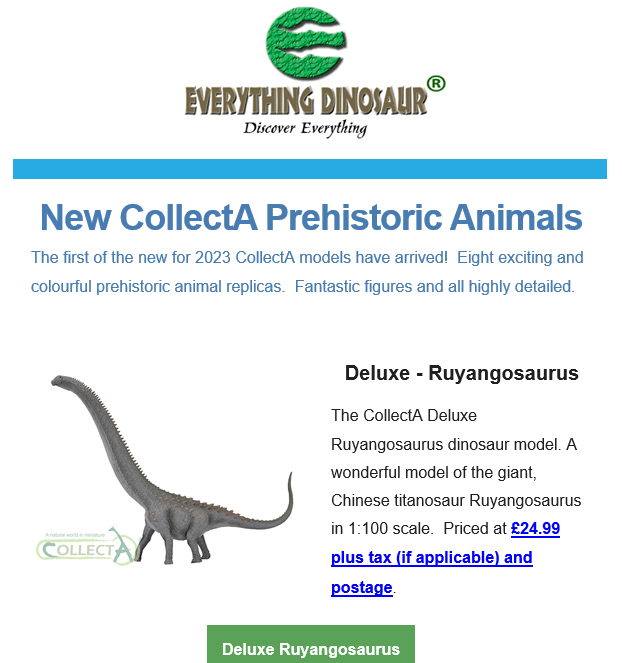
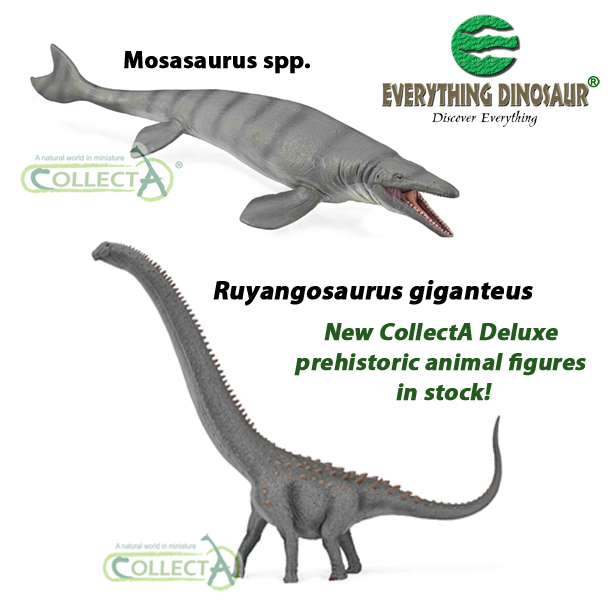
Team members at Everything Dinosaur have prepared a Ruyangosaurus scale drawing for use in the company’s free Ruyangosaurus dinosaur model fact sheet. The new for 2023 CollectA Deluxe Ruyangosaurus figure is due into stock shortly and the fact sheet will be sent out with model purchases.
Ruyangosaurus was formally named and scientifically described in 2009 (Lü et al) in the Geological Bulletin of China. It is regarded as one of the largest Asian dinosaurs known to science. One species has been assigned to the genus (R. giganteus). Size estimates for this Early Cretaceous titanosaur vary, but it has been speculated that Ruyangosaurus was around thirty to thirty-five metres in length.
The new for early 2023 CollectA Deluxe Ruyangosaurus dinosaur model.
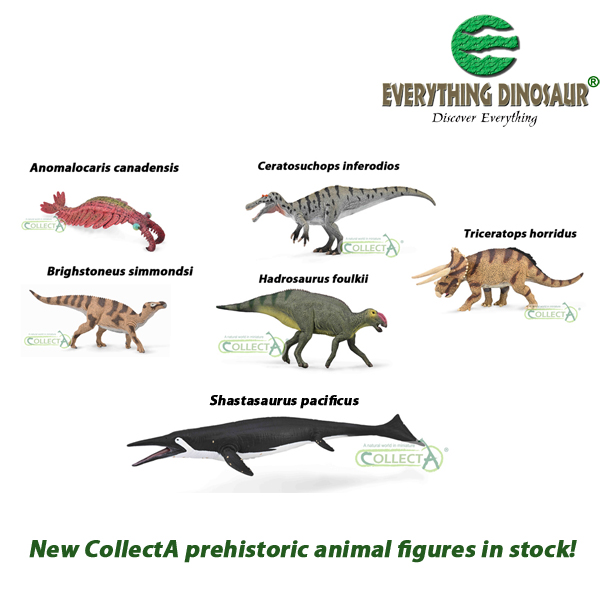
A spokesperson from Everything Dinosaur explained that for virtually every named prehistoric animal that the company sells, a fact sheet is prepared. As new for 2023 CollectA models arrive, so fact sheets for Ruyangosaurus, Ceratosuchops, Brighstoneus, Anomalocaris and the marine reptile Shastasaurus have been prepared.
Everything Dinosaur can confirm that it will be stocking the PNSO Mungo the Meraxes dinosaur model. This figure is due in stock later this spring (2023). Mungo the Meraxes was announced earlier this week and whilst we expect the output from PNSO to slow down a little this year, the number of new figures the company has produced recently has been remarkable.
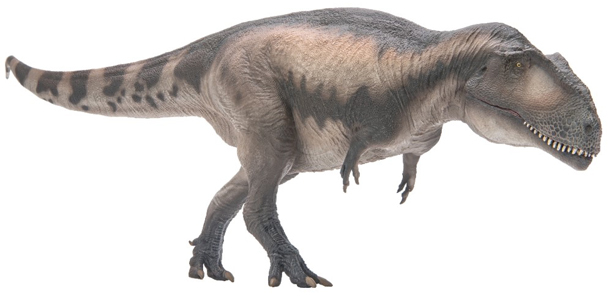
The carcharodontosaurid from the Late Cretaceous of Argentina Meraxes gigas. The PNSO model will be in stock at Everything Dinosaur in the spring (2023).
Meraxes gigas
Meraxes (M. gigas) was formally named and scientifically described in 2012 (Canale et al). It is a member of the Carcharodontosauridae family of theropods and at approximately 11 metres long and weighing 4 Tonnes (estimated 4.26 Tonnes), it was probably the apex predator in its Late Cretaceous environment. Another giant carcharodontosaurid Mapusaurus (M. roseae), is also known from the Huincul Formation of Argentina, but Meraxes fossil material is associated with geologically older strata.
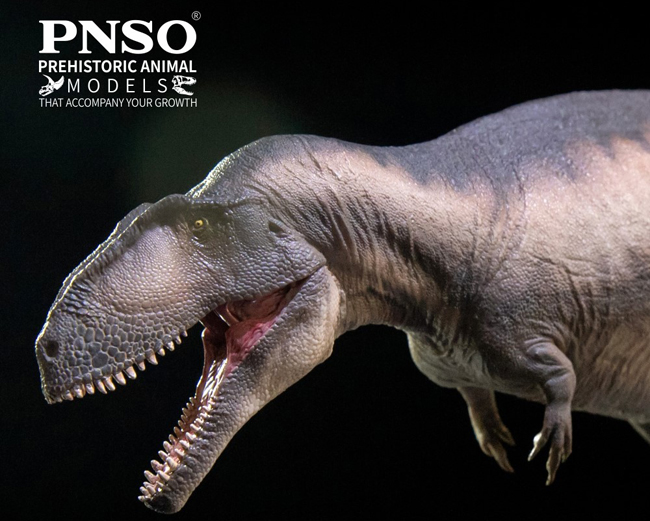
The PNSO Mungo the Meraxes has an articulated lower jaw, and it will be supplied with a clear plastic support stand, a poster and a 64-page, illustrated colour booklet.
The Meraxes model will have an articulated lower jaw.
A Carcharodontosaurid Dinosaur Model
An almost complete right arm is known. The arm is proportionately quite small and suggests that as with the abelisaurids and the later tyrannosaurids reduced forelimb size is an evolutionary trait of the Carcharodontosaurinae.
The PNSO model shows the reduced forelimbs and the striking colouration chosen for the figure is reminiscent of the Wild Safari Prehistoric World Giganotosaurus model that was introduced some years previously.
Wild Safari Prehistoric World Giganotosaurus dinosaur model.
Skull material, (Meraxes gigas has one of the best-known craniums of all the Carcharodontosauridae), enabled palaeontologists to estimate the size of other Cretaceous theropods such as Acrocanthosaurus (A. atokensis) and Giganotosaurus carolinii.
The model is supplied with a transparent support base, a poster, a full-colour, 64-page booklet and a QR code on the box provides access to a video showing how the model was made.
Model Measurements
The PNSO Meraxes measures 30.2 cm in length with a head height of 10.4 cm. Although PNSO do not declare a scale for this figure, team members estimate that based on an 11-metre-long animal, the figure is in approximately 1:36 scale.
The Meraxes model measures 30.2 cm long and has a head height of 10.4 cm.
A spokesperson from Everything Dinosaur confirmed that this figure along with the recently announced new version of the PNSO Lucas the Giganotosaurus model would be in stock in the late spring.
The spokesperson added:
“It is great to see PNSO expanding their theropod dinosaur model range.”
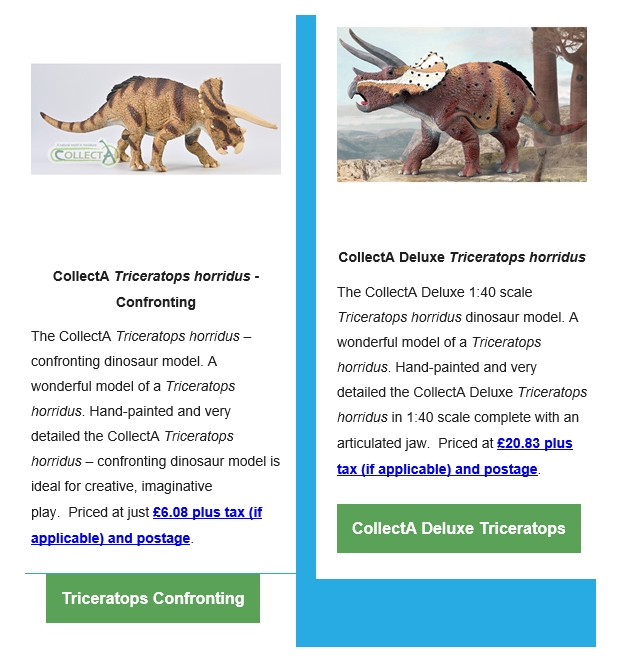
New Beasts of the Mesozoic models (2023) feature in the latest Everything Dinosaur customer newsletter. New ceratopsians and tyrannosauroid replicas to collect. The headline item in the newsletter is the feathered tyrannosauroid Yutyrannus huali in 1:18 scale.
The new for 2023 Beasts of the Mesozoic Yutyrannus huali tyrannosauroid dinosaur model is highlighted in Everything Dinosaur’s latest customer newsletter. Picture credit: Everything Dinosaur.
Beasts of the Mesozoic Models
There are seven additions to the popular Beasts of the Mesozoic models range. Four carnivorous dinosaurs and three ceratopsian figures. Part of the new “tyrannosaur” series, a replica of a juvenile T. rex and a 1:6 scale Dilong paradoxus have arrived at Everything Dinosaur’s warehouse.
The juvenile T. rex figure (left) and the 1/6th scale Dilong replica. Picture credit: Everything Dinosaur.
Jurassic and Cretaceous Dinosaur Models
Whilst six of the seven new figures represent Cretaceous dinosaurs, the Guanlong (G. wucaii) is an articulated model of an early tyrannosauroid (proceratosaurid tyrannosauroid) known from the Late Jurassic of China.
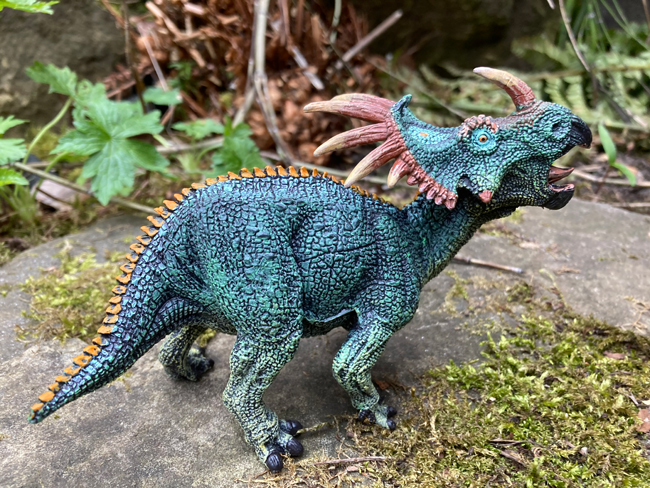
There are two new replicas of Styracosaurus for fans of horned dinosaurs to collect. Both Styracosaurus models are in 1:18 scale and called “Old Buck” as they represent a mature male.
The Late Jurassic tyrannosauroid Guanlong (left) and the Late Cretaceous ceratopsian Styracosaurus (right). Picture credit: Everything Dinosaur.
Old Buck Styracosaurus
One of the “Old Buck” Styracosaurus figures has been painted to reflect injuries it may have sustained in a fight with a tyrannosaur. None of the tyrannosauroids that have just been added to the Beasts of the Mesozoic range were coeval with Styracosaurus. Collectors will have to wait for the tyrannosaurs associated with the Campanian faunal stage such as Albertosaurus and Gorgosaurus to be introduced.
The Beasts of the Mesozoic Styracosaurus dinosaur model. Picture credit: Everything Dinosaur.
Old Buck (Bloody)
The articulated Styracosaurus with the battle damage is known as “Old Buck Bloody”.
A spokesperson from Everything Dinosaur commented that:
“Along with the two new Styracosaurus models, a trio of articulated baby Diabloceratops models have been added to the Beasts of the Mesozoic range.”
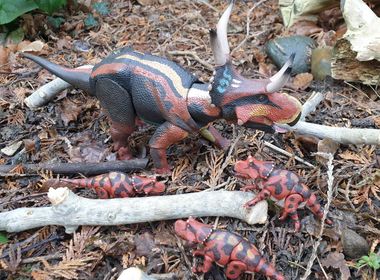
The Old Buck – Bloody (left) and the trio of baby Diabloceratops figures (right). Picture credit: Everything Dinosaur.